Treasures of London – Freud’s collection of antiquities…

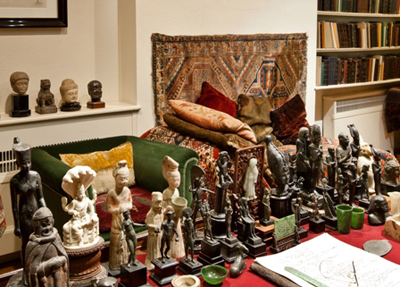
Freud's-DeskThis group of antiquities sits upon the desk of Sigmund Freud – the “founding father” of psychoanalysis –  at what was his home in Hampstead.

It’s part of an extensive collection of around 2,000 items which is on display at house – now the Freud Museum – located at 20 Maresfield Gardens.

The antiquities – which include Egyptian, Greek, Roman, and Oriental artefacts fill a series of cabinets and sit on almost every available surface in Freud’s study including the desk upon which Freud typically wrote until the early hours of the morning.

Collected by Freud from the 1890s onward, they include everything from a bronze statuette of the Greek goddess Athena (dating from the 1st or 2nd century AD – it’s mentioned in one of his manuscripts and, one of Freud’s favorite objects, was one of only three items he chose to have smuggled out of Vienna when his entire collection was threatened in 1938), a small bronze head of the Egyptian God Osiris believed to date from between 1075-716 BC, and a silver Roman ring featuring a blue glass intaglio depicting a pastoral scene which dates from between the 1st century BC and the 1st century AD (it was given as a gift from Freud to German psychoanalyst Ernst Simmel in 1928).

The museum has launched a conservation fund to repair and conserve the most fragile of the items and is aiming to raise £40,000 for the work. It follows a successful campaign earlier this year to raise funds for the conservation of Freud’s famous couch, brought from his former home in Vienna (seen in the background of this image).

Freud and his family lived at the home after escaping from Austria following the country’s annexation by Nazi Germany in 1938. It remained the family home until the death of Freud’s daughter, Anna, in 1982. The museum opened to the public in 1986.

PICTURE: Courtesy of the Freud Museum.

WHERE: Freud Museum, 20 Maresfield Gardens, Hampstead (nearest Tube stations are Finchley Road and Swiss Cottage);  WHEN: Noon to 5pm, Wednesday to Sunday; COST: £6 adults; £4.50 seniors; £3 concessions (including children 12-16); children under 12 free; WEBSITE: www.freud.org.uk.

Around London – 1863 FA Minute Book at BL; marking International Slave Remembrance Day at the NMM; Kenwood House concerts; and Dylan at the NPG…

FA-Cup-Minute-BookThe 1863 FA Minute Book forms the centrepiece of a new display at the British Library marking the 150th anniversary of The Football Association. Handwritten by Ebenezer Cobb Morley, the minute book contained the 13 original rules of football and is valued at £2.5 million. It is being displayed along with other football related artefacts – such as a Guide for Referees from the 1930s – in the Sir John Ritblat Treasures Gallery alongside the Magna Carta, Shakespeare’s First Folio and Captain Scott’s diary and is the first time the library has had a football-themed display. The Football Association was formed on 26th October, 1863, at the Freemason’s Tavern in London with the meeting documented in the minute book which also records the establishment of The FA Cup and the first international football match. Football Rules, entry to which is free, runs at the British Library in King’s Cross until 17th December. For more, see www.bl.uk. For more on the FA’s 150th anniversary, check out www.thefa.com.

As mentioned last week, Hidden London kicks off today and runs over this August bank holiday weekend. The second year it’s been held, the initiative is your chance to see some of the country’s finest museum collections and archives.  To see what’s on, head to www.hiddentreasures.org.uk/?page_id=118.

The National Maritime Museum tomorrow marks International Slavery Remembrance Day tomorrow with a series of free family-oriented events. The programme, which takes place at the museum and around Greenwich, involves music, workshops, talks and walking tours and will culminate in a commemorative ceremony by the River Thames. The day falls on the date of the first successful slave uprising in the western hemisphere which took place in Haiti on 23rd August, 1791, and led to the island’s independence. For more, see www.rmg.co.uk/national-maritime-museum/.

English Heritage’s season of concerts at Kenwood House beside Hampstead Heath kicks off this weekend. Live by the Lake features artists including Suede and Keane, an outdoor live screening of Singin’ in the Rain featuring the Royal Philharmonic Concert Orchestra, Opera Alfresco and An Evening of Gershwin. Events run until 1st September. For more, see www.english-heritage.org.uk/daysout/properties/kenwood-house/.

Pastel portraits by Bob Dylan go on show at the National Portrait Gallery in the West End from Saturday. Bob Dylan: Face Value features 12 new works by singer/songwriter and the portraits represent characters, some of which are real and some fictitious. Dylan, who has 110 million record sales to his name, has been sketching and drawing since childhood but only starting exhibiting his portraits six years ago. The exhibition, in Room 40, is free and runs until 5th January. For more, check www.npg.org.uk.

10 (more) curious London memorials…6. 7 July Memorial…

77-Memorial

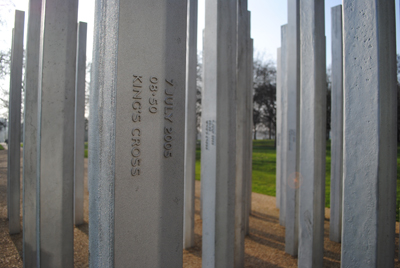
It’s not immediately obvious what this series of upright stainless steel pillars standing on the eastern edge of Hyde Park has been placed there for.

But look a little closer and you’ll see inscribed upon a date which any long-term Londoner immediately recognises – 7th July, 2005: the day when a series of bombs claimed 52 lives on three trains and a bus at various locations around central London.

The memorial, designed by architects Carmody Groarke and engineering team Arup working in consultation with victims’ representatives, Royal Parks and the Department for Culture, Media & Sport, consists of 52 pillars – one for each victim of the bombings.

The 3.5 metre high, 850 kilogram pillars are clustered together in four groups representing the four locations of the bomb attacks – Tavistock Square, Edgware Road, King’s Cross and Aldgate. They are marked with the times, dates and locations of the bombings and there’s also a 1.4 tonne stainless steel plaque upon which are written the names of the victims located nearby.

The RIBA award-winning memorial, which is located just to the north of the colossal statue Achilles and Hyde Park Corner, was unveiled by Prince Charles and Lady Camilla on the fourth anniversary of the attack in 2009.

For more, see the Royal Parks website www.royalparks.org.uk/parks/hyde-park/hyde-park-attractions/7-july-memorial.

LondonLife – Pre-Raphaelite wall painting discovered at Red House…

Red-House-Wallpainting,-l-to-r---Adam-Eve-Noah-Rachel-Jacob

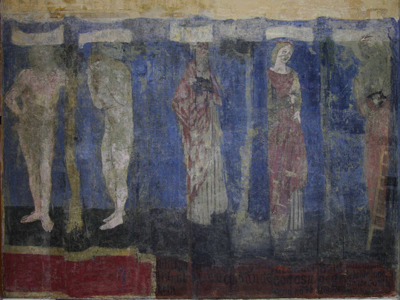
A remarkable Pre-Raphaelite painting has been found painted on the wall of a Bexleyheath house lived in by artist William Morris. The bedroom wall painting at Red House, which is believed to have been painted by Morris and other Pre-Raphaelites, was hidden behind a wardrobe and covered by wallpaper for years with only two figures from the painting visible. But following two months of conservation work by the National Trust – which acquired the property in south-east London in 2003 – a six by eight foot image has been discovered depicting Biblical characters such as Adam and Eve, Noah, and Rachel and Jacob. Designed to resemble a hanging tapestry, the image also contained faded and incomplete lines of text which have been identified as being from the Biblical book of Genesis (chapter 30, verse six). Morris lived at the house between 1860 and 1865, during which time Pre-Raphaelite artists such as Dante Gabriel Rossetti and his wife Elizabeth Siddal, Edward Burne-Jones and Ford Madox Brown were regular visitors. It is understood his friends helped decorate the property’s walls, ceilings and items of furniture with wall paintings and patterns. While it is thought Jacob was painted by Morris, Rachel possibly by Elizabeth Siddal and Noah by Madox Brown, further research is being undertaken to help identify who painted which image. For details on visiting times and how to get to the property, check out www.nationaltrust.org.uk/red-house/. PICTURES:  © National Trust / James Breslin and, © National Trust.

Red-House

Around London – ‘Hidden Treasures’; Open House programme; and the Isabella Plantation celebrates 60 years…

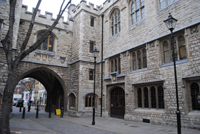
St-John's-GateHidden Treasures – the national initiative to celebrate the UK’s museum and archive collections – kicks off for its second year next Thursday, 22nd August, and runs over the bank holiday weekend until 27th August. Among the London institutions taking part this year are the British Library, the British Postal Museum and Archive in Houghton, the Museum of the Order of St John in Clerkenwell (pictured) and Orleans House Gallery in Twickenham. Hidden Treasures is an initiative of the Collections Trust and the Independent newspaper. All events are free but some have to be pre-booked and have limited spaces so make sure you check out the details at www.hiddentreasures.org.uk/?page_id=118.

The programme for Open House London – held over the weekend of 21st and 22nd September – will be made available online from today (or alternatively you can order a hard copy via the Open House London website). It’s important to note that a few of the buildings involved can only be entered by those successful in a ballot – they include 10 Downing Street, The View from The Shard, EDF Energy London Eye and Gray’s Inn. Head to the website – www.londonopenhouse.org – to enter the ballots which close on 13th September.

The Isabella Plantation – a 40 acre ornamental woodland garden located in the south west area of Richmond Park – is celebrating 60 years since its creation and they’ve kicked off a fortnight’s programme of free events community to mark the occasion. The events, which will be focused around the yurt by Peg’s Pond in the plantation,  include guided walks, a showcase of art for young people and a Teddy Bears picnic on the bank holiday weekend. One of the most visited parts of Richmond Park, the plantation is home to the Wilson 50 National Collection of Evergreen Azaleas, more than 150 hardy hybrid Rhododendrons, 50 species of Rhododendron and a large collection of camellias and magnolia as well as many rare and unusual trees and shrubs. While the plantation can be dated as far back as 1771 (then named Isabella Slade), it was planted for timber in 1831, and in 1953 the present garden was established and the old name Isabella adopted for it. For more on the events, see www.royalparks.org.uk.

As Muslims mark the end of Ramadan this weekend, the festival of Eid-ul-Fitr will be celebrated in Trafalgar Square on Saturday. As well as the chance to sample foods from across the Islamic world, there will also be entertainment on stage, exhibitions and children’s activities. The festival, put on by the Mayor of London Boris Johnson, runs between 1.30pm and 6pm. For more, see www.london.gov.uk/eid.

On Now: Take One Picture – Discover, Imagine, Explore: Children Inspired by Willem Kalf. This display at the National Gallery focuses on Willem Kalf’s Still Life with Drinking-Horn (about 1653) and features alongside it responsive works created by children from 25 schools across the UK and as far afield as Turkey with works from other schools captured in a slide-show. Located at the Annenberg Court (Getty Entrance), admission is free. Runs until 12th September. For more, see www.nationalgallery.org.uk.

10 (more) curious London memorials…5. National Police Memorial…

National-Police-Memorial

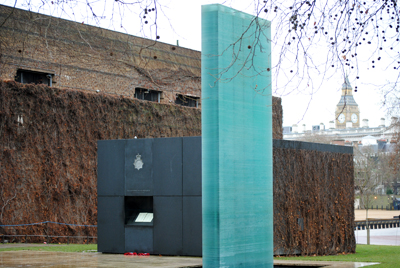
The unobtrusive box-like structure and adjacent glass pillar located on the corner of The Mall and Horse Guards Road in Whitehall is another memorial that is easy to overlook.

Unveiled by Queen Elizabeth II in 2005, it commemorates the 4,000 police officers who have been killed in the course of their duty in the UK and was commissioned by the Police Memorial Trust.

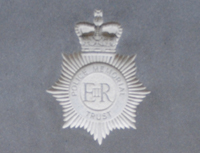
Police-Memorial-TrustThe trust was formed in the mid-1980s by the late film director Michael Winner following the shooting death of WPC Yvonne Fletcher, who was killed while policing a protest outside the Libyan Embassy in St James’s Square on 17th April, 1984.

The Trust ensured an individual memorial to WPC Fletcher now marked the spot of her death and was followed by further memorials to individual police officers before the trust began a campaign for a larger, national memorial in the mid-1990s.

As much as £2.3 million was raised from the public for the memorial which was designed by architectural firm Foster + Partners.

The memorial, which won a RIBA award, consists of a black granite clad wall with a glass chamber set into its face, inside which is a Book of Remembrance listing the names of all UK police officers killed in the course of duty (the pages of the book are apparently turned every two weeks). Above the chamber is carved the Metropolitan Police Crest.

The tall glass pillar which stands nearby in a reflecting pool was designed to pay homage to the blue lamps that once burned outside police stations.

For more on other police memorials in the UK, see www.policememorial.org.uk.

Famous Londoners – The Tower Ravens…

Ravens

OK, so they’re not people as such, but the ravens at the Tower of London are renowned the world over.

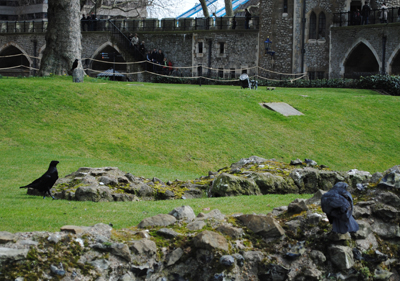
Known as the “Guardians of the Tower”, there are currently as many as eight ravens living at the tower, lodged in a space on the grass next to the Wakefield Tower.

Raven-pensLegend has it that there must be at least six ravens living at the Tower – should they leave, not only will the Tower fall but the kingdom as well (although we hasten to add that it’s been argued this tradition only started in the Victorian age and that there have been times when the numbers of ravens dropped below the required six, such as at the end of World War II when only one raven remained).

It was King Charles II who first ordered the ravens be protected – an order which must have upset Astronomer Royal John Flamsteed who complained after he found that the birds were interfering with the observation work he was carrying out from the Tower’s north-east turret. He later moved out to Greenwich.

The eight ravens who now live at the tower include Rocky, Merlin, Hugine and the latest additions Jubilee – given to the Tower last year to celebrate the Queen’s Diamond Jubilee – and Grip, named after Charles Dickens’ pet raven.

The birds are looked after by a team of four headed by the raven master, Chris Skaife, who each day feed them 170 grams (six ounces) of raw meat and special biscuits soaked in animal blood.

Not all ravens can cut the mustard to work at the Tower – one recent addition Pearl was apparently bullied by other ravens and had to be withdrawn. And while the birds have the feathers on one wing trimmed to stop them escaping to a new life on the wing, that hasn’t stopped some from doing so including Grog who took off in 1981 and was last seen outside an East End pub.

The oldest raven to ever live at the Tower was Jim Crow, who died at age of 44 in 1928.

WHERE: Tower of London (nearest Tube station Tower Hill); WHEN: 9am to 5.30pm, Tuesday to Saturday, 10am to 5.30pm Sunday to Monday; COST: £21.45 adults; £10.75 children under 15; £18.15 concessions; £57.20 for a family; WEBSITE: www.hrp.org.uk/toweroflondon/.  

Treasures of London – The Pearl Sword…

Pearl-Sword1

One of five City of London swords, tradition holds that the sword was given to the City Corporation by Queen Elizabeth I when the Royal Exchange opened in 1571.

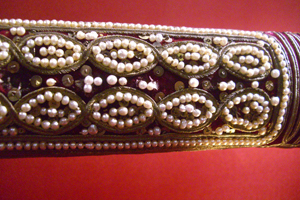
It takes its name from its pearl-encrusted scabbard – there’s said to be 2,500 of them sewn onto it – and was traditionally used in celebrations. These include a ceremony which takes place when the reigning monarch comes in State to the City.

Pearl-Sword2Seen during last year’s Diamond Jubilee celebrations, the ceremony involves the Lord Mayor taking the sword from the Sword-Bearer and offering it hilt-first to the monarch to touch – a symbol of the monarch’s authority over the city. It is then borne aloft in front of the monarch by the Lord Mayor.

Interestingly, the tradition of the monarch touching the sword hilt is said to date from the reign of King Charles I when the king entered the City in 1641 and just touched the sword given to him and handed it back to the Lord Mayor. Prior to that, the sword was handed over to the sovereign for the during the visit.

The City’s other four swords include the State Sword, the Mourning Sword, the Old Bailey Sword and Mansion House Justice Room Sword.

Guided tours of Mansion House – official residence of the Lord Mayor of London and where the Pearl Sword can be seen – are conducted on Tuesdays at 2pm (although it’s closed for August for refurbishments and on selected dates after that). Head here www.cityoflondon.gov.uk/mansionhousetours details. PICTURES Courtesy City of London.

Around London – The ‘Line of Kings’ has a makeover; London captured from St Paul’s; and, cycles at the Museum of London…

Line-of-Kings

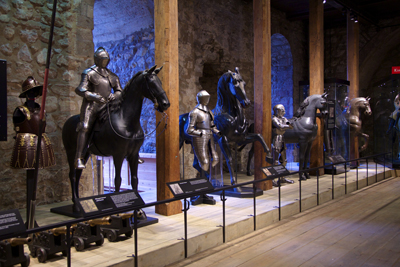
The Tower of London’s iconic exhibition, the Line of Kings, has had a makeover. Described as the “world’s longest running visitor attraction”, the Line of Kings features more than 500 objects including historic suits of armour – such as those worn by King Henry VIII, King Charles I and King James II – as well as life-sized wooden horses and individually carved king’s heads, many of which were made between 1685 and 1690. The exhibition was originally created following the Restoration in 1660 and was used as propaganda to promote the king’s rule (interestingly omitting queens and featuring only those deemed “good kings”). Rearranged and dispersed over the centuries, it’s been brought back together in the White Tower and reopened last month. Entry to the exhibition – a collaboration between Historic Royal Palaces and the Royal Armouries – is free as part of general admission to the Tower. For more, check out www.royalarmouries.org/line-of-kings. PICTURE: HRP/Newsteam

Four cameras mounted on top of St Paul’s Cathedral’s Golden Gallery have captured a 360 degree time lapse video of the capital. The video, which was shot in early July, captured 36 hours in the life of London and is the work of specialist photographer Henry Stuart who previously completed two projects from the Golden Gallery – a GigaPixel image of London and a Day Meets Night image. The latest project captured some 8,000 panoramic images. The time lapse video, which is set to Kyrie from Wolfgang Amadeus Mozart’s Missa in C major ‘Missa solemnis’ K337 being sung by the St Paul’s Cathedral Choir, can be found at http://visualise.com/videos/london-360-time-lapse-from-st-pauls-cathedral.

• On Now: London Cycles. This free exhibition at the Museum of London looks at cycling in the capital with highlights including 10 large scale portraits by Ugo Gattoni, bikes including an 1880s “boneshaker”, a penny farthing, an 1930s Enfield cycle and a ‘Boris’ bike as well as head cam footage from riders including from the annual Tweed Run bike. The free display runs until 22nd September. For more, see www.museumoflondon.org.uk.

10 (more) curious London memorials…4. ‘People of London’ Memorial…

People-of-London

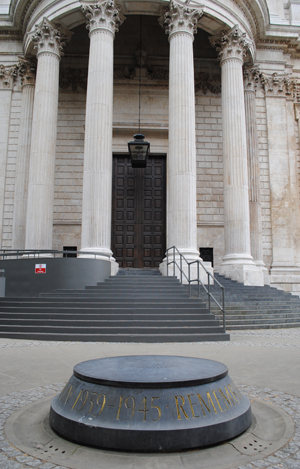
Amid all the grand war-related memorials of London, this rather humble memorial sitting outside the north transept of St Paul’s Cathedral in St Paul’s Churchyard can easily be overlooked. 

Known as the Memorial to the Londoners killed in World War II Bombardments or simply as the ‘People of London’ memorial as it’s called on the sculptor’s website, it commemorates the 30,000 Londoners who were killed during the Blitz  (not to be confused with the National Firefighters’ Memorial, known informally to many as the Blitz Memorial, which sits opposite the cathedral’s south transept and commemorates firefighters who died during the Blitz).

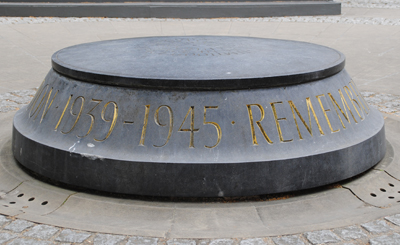
People-of-London---smallThe round memorial was carved from a three tonne block of Irish limestone and is set into paving (it was initially very shiny).

The gilded inscription which runs around the outside reads “Remember before God the people of London 1939-1945” while on top, written in a spiral, is an inscription written by Sir Edward Marsh – “In war resolution, in defeat defiance, in victory magnanimity, in peace goodwill”, the text of which was used by Sir Winston Churchill in the frontispiece to his history, The Second World War.

Unveiled by the Queen Mother on 11th May, 1999, the memorial is the work of Richard Kindersley, whose other memorials include the Commonwealth Memorial on Constitution Hill.

Kindersley writes on his website, that the “position of the memorial adjacent to St Paul’s is most appropriate, as most people will remember the dramatic photograph of the Cathedral dome of the taken during a devastating attack in 1941.”

It was paid for by public funds raised following an appeal in the Evening Standard newspaper, launched in connection with the 50th anniversary of VE Day.

LondonLife – New life for the Blue Plaques scheme…

Alexander-Pope

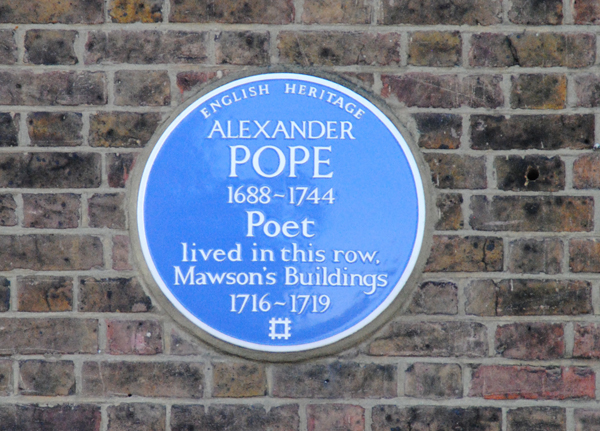
The humble Blue Plaque is set for a new lease on life following an announcement this week. The London Evening Standard has announced it will help breathe new life into English Heritage’s Blue Plaque’s scheme this week with the scheme – which was suspended in January due to funding cuts – set to relaunch next year in association with the newspaper. As many as 20 new plaques have already been funded through a £80,000 donation from property developer David Pearl, says the paper, and the public are being urged to help financially support the programme at www.english-heritage.org.uk/donate. The Standard also noted that from next year its readers will be able to vote for candidates for future plaques. Each Blue Plaque costs about £4,000 to create and install. Pictured is a Blue Plaque commemorating poet Alexander Pope’s residence in a Chiswick property between 1716-1719.  The property is now the Mawson Arms public house.

Around London – Radio Times celebrated at MoL; IWM reopens; and Lowry at the Tate…

A new exhibition marking the 90th anniversary of the iconic publication, Radio Times, opens at the Museum of London tomorrow (Friday). Cover Story: Radio Times at 90 features some of the magazines most famous covers depicting the likes of Tony Hancock, The Goon Show, Only Fools and Horses and Coronation Street, and charts the history of radio from the BBC’s first transmission to today’s multiple channels. As well as original artwork and photographs used in Radio Times, the display includes a special focus on Doctor Who with the chance for visitors to create their own Radio Times cover as they stand alongside a life-size Dalek. Other highlights include an original 1941 illuminated map used by the Luftwaffe which shows Radio Times‘ Waterlows printing plant in Park Royal alongside other targets. Radio Times was first published by the BBC in London on 29th September, 1923, and since 2011 has been owned by Immediate Media Co. The free exhibition runs until 3rd November. For more, check out www.museumoflondon.org.uk.

The Imperial War Museum has partially reopened this week. As well as the re-opening of its permanent galleries and exhibitions, the museum has launched a major new family-oriented exhibition Horrible Histories: Spies, a new art exhibition entitled Architecture of War and ‘IWM Contemporary’, a new programme showcasing significant works by leading artists in response to war and conflict. The museum will fully reopen in summer next year with the opening of new First World War Galleries. Horrible Histories: Spies, which runs until 4th January (admission charge applies), immerses visitors in the world of World War II spycraft with families able to uncover the techniques used by the most cunning spies. More on Architecture of War and IWM contemporary in upcoming posts. For more, see www.iwm.org.uk.

On Now: Lowry and the Painting of Modern Life. This exhibition at the Tate Britain represents the first to be held by a public London institution featuring  the works of LS Lowry since his death in 1976 and is the first to explore his connections with French art. Among works on display is a little known, untitled painting depicting a busy town square set against the backdrop of industrial Salford which was found on the back of the wooden panel on which Lowry painted his 1937 work The Mission Room. Others among the 90 works on display include Coming Out Of School (1927), The Pond (1950), Industrial Landscape (1955) and Hillside in Wales (1962) as well as Ancoats Hospital Outpatients Hall (1952), The Cripples (1949), Piccadilly Circus, London (1960) and Excavating Manchester (1932). Runs until 20th October. For more, see www.tate.org.uk.

10 (more) curious London memorials…3. William Wallace Memorial…

William-Wallace-memorialHe was captured in Scotland but it was actually at Smithfield in London that the Scottish leader, Sir William Wallace, was put to death on 23rd August, 1305.

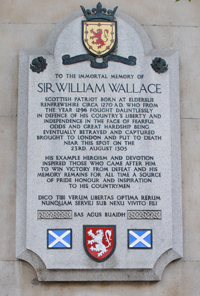
Erected in 1956 by “Scots and friends at home and abroad”, a plaque located on the wall of St Bartholomew’s Hospital overlooking the former execution ground commemorates the “Scottish patriot” Wallace, saying that from the year 1296 “fought dauntlessly in defence of his country’s liberty and independence in the face of fearful odds and great hardship”. It goes on to note that he was “eventually betrayed”, captured and executed “near this spot”.

Elsewhere the memorial reads: “His example, heroism and devotion inspired those who came after him to win victory from defeat and his memory remains for all time a source of pride, honour and inspiration to his countrymen”.

Having co-led the Scottish to victory against the army of King Edward I at the Battle of Stirling Bridge in 1297, Wallace was later knighted for his efforts and subsequently served as a Guardian of the Kingdom of Scotland.

Following his defeat at English hands in the Battle of Falkirk in 1298, he escaped and continued to evade capture until he was apprehended near Glasgow in August 1305. Brought to London where he was put on trial in Westminster Hall. Summarily found guilty of treason, he was stripped naked and dragged to Smithfield and it was there that he suffered the horrible death of being hung, drawn and quartered.

And while the 1995 movie, Braveheart, had Wallace crying out “Freedom” as he died, his last words are actually not recorded. His tarred head was subsequently displayed on a pike atop London Bridge while his limbs were sent to towns including Stirling in Scotland.

LondonLife – A new season for the Fourth Plinth…

Hahn_Gautier1

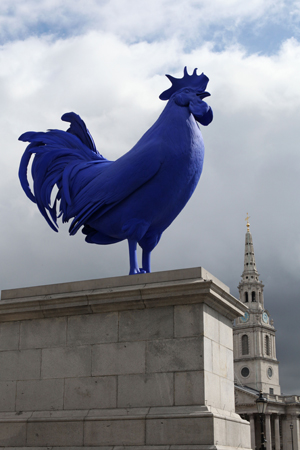
The latest commission for Fourth Plinth was unveiled in Trafalgar Square last Thursday. Katharina Fritsch’s Hahn / Cock, 2013, depicts a 4.72 metre high sculpture of a domestic farmyard cockerel completely coloured in vivid ultramarine blue. Fritsch, one of Germany’s leading contemporary artists, has works featured in the permanent collections of prominent galleries around the world including New York’s Museum of Modern Art. Originally designed by Sir Charles Barry to hold an equestrian statue (which was never completed), the fourth plinth has been most recently occupied by a series of works specially commissioned for the spot under the Mayor of London’s Fourth Plinth Programme. Recent commissions include Yinka Shonibare’s Nelson’s Ship in a Bottle and Antony Gormley’s One and Other. For more details, check out www.london.gov.uk/priorities/arts-culture/fourth-plinthPICTURE: Gautier Deblonde.

What’s in a name?…Old Bailey…

Running from Ludgate Hill to Newgate Street in the western part of the City, there are a couple of explanations behind the thoroughfare known as the Old Bailey.

Old-BaileyOne suggests that the name is derived from Latin word ballium which referred to a wall built for defence and which, in this instance, referred to the old Roman wall which surrounded the City.

Another, according to Antony Badsey-Ellis’ book What’s in a Street Name?, is that the name could be a corrupt form of ‘Bail Hill’ – a place where a bailiff held court.

For centuries the street’s name has also been used for that of a court based there. Now formally known as the Central Criminal Court, the first court – or sessions house – was built here in 1539 on part of the site now occupied by the court.

Built next to the Old Bailey court house – and pre-dating it was Newgate Prison – but when this was demolished in 1902, the Old Bailey (which itself had been rebuilt in the 1670s having been destroyed in the Great Fire of London and then subsequently remodelled) was again rebuilt and, opening in 1907, now covers the site.

For an archive of the court’s proceedings, check out www.oldbaileyonline.orgFor more on the history of The Old Bailey, check out Theresa Murphy’s The Old Bailey: Eight Hundred Years of Crime, Cruelty and Corruption.

Treasures of London – Shakespeare’s Blackfriars deed…

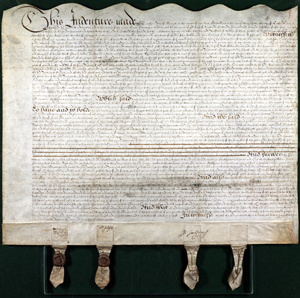
Shakespeare's-DeedIn 1613, the playwright William Shakespeare – now widely regarded as the greatest writer of the English language – purchased a property in Blackfriars.

The only real estate he was to buy in London, the purchase of the gatehouse – which may have stood on the junction of St Andrew’s Hill and Ireland Yard – was apparently made as an investment (Shakespeare never lived there).

The deed which recorded the sale (dated 10th March, 1613) – only one of six documents in the entire world which bears Shakespeare’s authenticated signature – is in the care of the London Metropolitan Archives.

According to the deed, he bought the property from Henry Walker, a minstrel, paying £140 for the property (he mortgaged £60 of it the next day – the document for this is located in the British Library).

Other parties mentioned on the document are William Johnson, a London-based vintner and possibly landlord of the Mermaid tavern in Cheapside, and two ‘gentlemen’ John Jackson and John Heminges, an actor, manager and editor of Shakespeare’s first folio.

They were appointed as trustees in Shakespeare’s interest and handled the sale of the property after Shakespeare’s death in 1616. The copy of the deed held by the LMA was that of Henry Walker (Shakespeare’s copy is in the Folger Shakespeare Library in Washington).

The deed is currently on display as part of an exhibition surrounding the 400th anniversary of its signing. ‘Shakespeare and London’, a free exhibition, also features other documents from the period as well as maps, prints and models and runs at the LMA (40 Northampton Road) until 26th September. Due to the age and importance of the deed, the deed itself will only be displayed at specific times – check the LMA website for details.

Around London – Celebrating the coronation at Buckingham Palace; Royal births at the MoL; the Fourth Plinth unveiled; Menon remembered; and, manufacturing at the Design Museum…

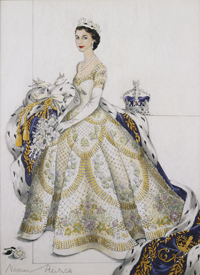
Norman-Hartnell-sketchThe Queen’s Coronation in 1953 is the subject of a special exhibition opening at Buckingham Palace as part of the palace’s summer opening. Celebrating the 60th anniversary of the coronation, the display features an array of outfits including uniforms and robes worn on the historic event on 2nd June, 1953, as well as a series of paintings recording the event, works of art and objects used on the day and film footage and sound recordings. Among the highlights of the exhibition will be sketches made by Norman Hartnell, the principal designer of the outfits worn at the coronation by the Queen, principal ladies of the immediate Royal Family and the Maids of Honour. The State Rooms of Buckingham Palace open on Saturday and remain open until 29th September. An admission charge applies. For more, see www.royalcollection.org.uk. PICTURE: Her Majesty The Queen in her Coronation Dress, 1953, Norman Hartnell. Royal Collection Trust/All Rights Reserved.

Meanwhile in this, the week of the birth of Prince George, it’s only fitting that we mention a small display at the Museum of London showcasing memorabilia relating to royal babies of years past. A Royal Arrival features baby clothes and other items worn by future monarchs. They include a embroidered skullcap worn by the future King Charles I, a tiny linen vest and mitten which once was worn by the future King George III and a dress emblazoned with the three feather insignia which belonged to the future King Edward VII, eldest son of Queen Victoria. The free display will be on show until October. For more, see www.museumoflondon.org.uk.

The new commission for Trafalgar Square’s Fourth Plinth will be unveiled today. The 4.7 metre high sculpture, Hahn/Cock, is the work of contemporary artist Katharina Fritsch. It will sit on the plinth for the next 18 months.  For more details, see www.fourthplinth.co.uk.

Indian statesman VK Krishna Menon has been commemorated by English Heritage with a blue plaque on his former residence in Highgate. A key campaigner for Indian independence, Menon lived at 30 Langdon Road from 1929 to 1931, having moved to England from Madras in 1924. In 1947, Menon was appointed India’s First High Commissioner in London and among his greatest achievements was his work in keeping the country in the British Commonwealth after independence. Having been a local councillor in St Pancras, he later returned to India and embarked upon a political career there. For more, see www.english-heritage.org.uk/discover/blueplaques/.

The-Future-Was-HereOn Now: The Future is Here. A major new exhibition examining the changes taking place in manufacturing around the world, opened this week at the Design Museum. The Future is Here looks at how everything from “cars to shoes” is manufactured, funded, distributed and bought. Among highlights is a ‘Factory’ where visitors can discover how 3D printing works and see production in process. There will also be the chance to make your own ‘action doll’ and see a sofa designed through a crowd-sourcing process which involved members of the public. Runs until 3rd November. Admission charge applies. For more, see www.designmuseum.org.

10 (more) curious London memorials…2. Animals in War Memorial…

Animals-in-War

This week we take a look at another of London’s war-related memorials but unlike the vast majority, this one, as its name says, commemorates animals, not humans.

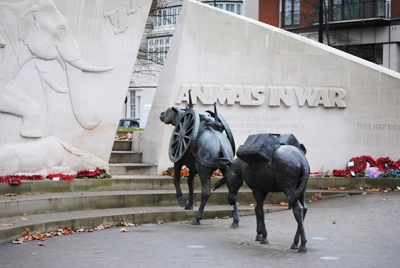
Located in the middle of Park Lane near the intersection with Upper Brook Street on the eastern side of Hyde Park, the memorial is dedicated “to all the animals that served and died alongside British and Allied Forces in wars and campaigns throughout time”. Another inscription on the memorial reads “They had no choice”.

A further dedication at the memorial pays tribute to the “millions” of animals who have died in wars. “From the pigeon to the elephant, they all played a vital role in every region of the world in the cause of human freedom,” it says. “Their contribution must never be forgotten.” It’s been said that as many as eight million horses were killed in World War I alone.

It features a couple of bronze pack mules making their way through a gap in a curved, 58 foot wide Portland stone wall – themselves carrying reliefs of various animals including an elephant, horses, camels and pigeons – while on the other side is a bronze horse and a dog, looking ahead.

The memorial is the work of Somerset-based sculptor David Backhouse and was unveiled by Princess Anne in November 2004, the 90th anniversary of the outbreak of World War I. It was apparently inspired by Jilly Cooper’s book, Animals in War, and commissioned by the Imperial War Museum. It was paid for by £2 million in public donations.

For more, check out www.animalsinwar.org.uk.

London Pub Signs – The Tipperary…

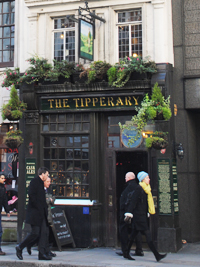
Built on land which once formed part of ‘White Friars’ (Carmelite) monastery, this Fleet Street institution is the latest incarnation in a string of pubs which have occupied the site since at least the early 17th century.

The-TipperaryA pub was built on the site in about 1605. Made of stone rather than wood (the stones apparently plundered from the monastery), the property – which stands over the top of what’s left of the River Fleet – survived the Great Fire of London in 1666.

While there seem to be a few competing versions of the pub’s history, it was apparently first named the Bolt-in-Tun (the sign of which showed a barrel pierced by a crossbow quarrel or bolt) and became a popular coaching inn (an alley opposite still bears the name Bolt Court). It was apparently later renamed The Boar’s Head.

The pub – located at 66 Fleet Street – was at some stage – the sign outside says in 1700, others suggest it was in the late 1800s – it was bought by Dublin-based brewery SG Mooney & Son (the Mooney name is still on the doorstep). It was after this purchase that it was transformed into what is claims was the first Irish pub outside of Ireland and, perhaps more importantly, the first pub outside Ireland to serve Guinness (first bottled and later draught).

The pub’s name was changed to the Tipperary after World War I when, as one story goes, returning Irish soldiers made it a favourite of theirs and christened it in honour of the song It’s A Long Way To Tipperary.

Bought by Greene King in the 1960s, the pub underwent a restoration which took it back to the style it would have been during Mooney’s days.

The pub apparently once featured a clock by renowned Fleet Street clockmaker Thomas Tompion, known as the “father of English clockmaking”. A replica now sits in the pub thanks to the original being stolen.

Special – London unearthed…

ForeshoreThis month the Festival of Archaeology is being celebrated all across the UK, including in London where about 30 different events are being held. This year they include the chance to visit the remains of the Elizabethan Rose Theatre in Bankside and see for yourself preparations for an excavation to start next year, the opportunity to walk through the London offices of the Egypt Exploration Society, a series of hands-on archaeology-related activities at Eltham Palace in south London, behind the scenes tours of the Museum of London, and the chance (next weekend – 27th/28th July) to go mud-larking along the foreshore of the River Thames outside the Tower of London and then present your findings to archaeologists for identification (pictured above from a previous year). Get in there and have some fun! For more details of events, check out www.archaeologyfestival.org.uk.