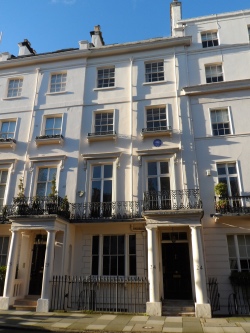
10 sites from Mary Shelley’s London…8. Chester Square…

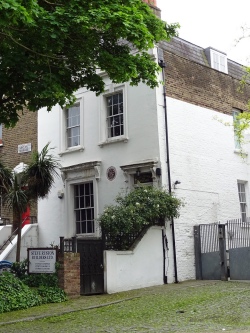
One of the still standing properties most associated with Mary Shelley in London (hence the English Heritage Blue Plaque), Shelley lived in this home at 24 Chester Square, on the square’s north-west side, from 1846 until her death in 1851.

Mary moved here for the last few years of her life after her son Percy (a child she had with now deceased husband Percy Bysshe Shelley) had come into a substantial inheritance following the death of his grandfather in 1844.

During this period, she spent her time between this house which had been relatively recently built by Thomas Cubitt, and the Shelley’s ancestral home at Field Place, Sussex, where her son Percy Florence and his wife Jane lived.

Shelley was 53 when she died here on 1st February, 1851, of a suspected brain tumour. She had apparently asked to be buried with her parents in the graveyard of St Pancras Old Church but instead was buried at St Peter’s Church in Bournemouth close to her son’s new home in Boscombe. Her son had her parents exhumed and buried with her there.

The Blue Plaque was installed on this property in 2003 and unveiled by her biographer Miranda Seymour.

PICTURE: Spudgun67 (licensed under CC BY-SA 4.0).


LondonLife – River bend…

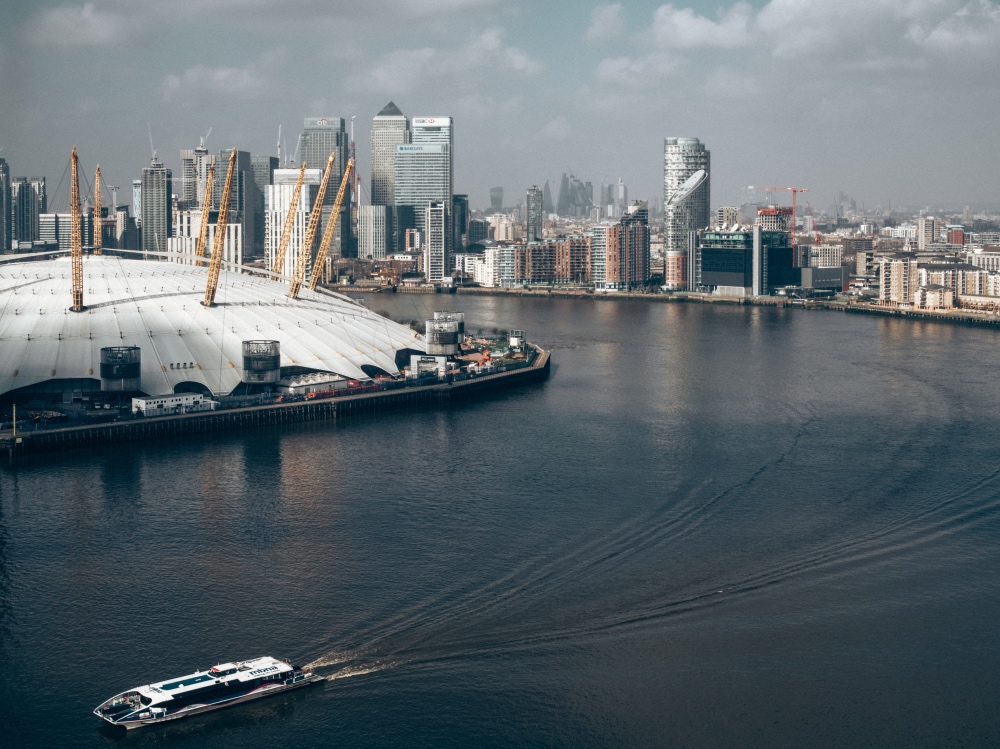
Looking across the O2 Arena towards the Docklands. PICTURE: Claus Grünstäudl/Unsplash

Famous Londoners – Sir John Lawrence, Lord Mayor of London…

The Lord’s Mayor’s Show is coming up soon (10th November) so we thought it a good time to take a quick look at the life of one of the city’s most memorable Lord Mayors – Sir John Lawrence, who served in the office in 1664-65.

Sir John, a merchant and member of the Worshipful Company of Haberdashers (and Master of the company in 1677), is remembered for the role he played during the Great Plague of 1665 which preceded the Great Fire of London the following year.

Following the arrival of the plaque in London, those with the means took to their heels and left the city for safer climes. But Sir John assured the public that he and the City officers would remain at their posts to keep law and order among the frightened populace.

He oversaw the issuing of a series of plague-related orders designed to stem the spread of disease and appointed people to oversee and attend to the needs of households affected by the disease and search out the bodies to be taken away as well as doctors to tend to the sick and help prevent infection.

His efforts in ensuring the food supply remained steady have been particularly praised as has his opening of his own home in St Helen’s Bishopsgate to those servants who were discharged when the households in which they worked fled the city.

His tenure as mayor is often favourably contrasted with that of his successor, Sir Thomas Bludworth but Sir John also had numerous other positions during his lifetime, including as president of St Thomas’ Hospital, a committee member of the East India Company and a Fellow of the Royal Society.

Sir John was married and had two children. He died on 26th January, 1692, and was buried at the Church of St Helen’s Bishopsgate.

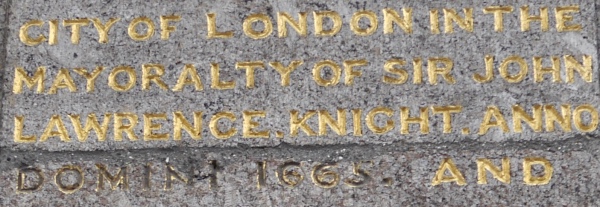
He is remembered on a plaque at Bunhill Fields for being mayor when, at the City’s expense, the burial ground was enclosed with a wall.

PICTURE: Part of the inscription at the gates of Bunhill Fields commemorating Sir John’s role in enclosing the burial ground. (Edwardx; licensed under CC BY-SA 3.0).


This Week in London – Edward Burne-Jones at Tate Britain; Fictional pirates at V&A Museum of Childhood; and, British Museum’s new Islamic gallery…

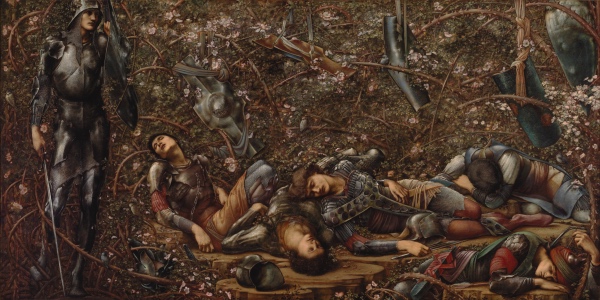
Two celebrated series of paintings by Pre-Raphaelite artist Edward Burne-Jones have been brought together for the first time in their entirety in a new exhibition at Tate Britain. The large scale works known as The Briar Rose (c1890) and the unfinished Perseus series (started in 1875) – the artist’s most famous narrative cycles – are at the centre of a new exhibition, Edward Burne-Jones: Pre-Raphaelite Visionary, which opened at the gallery yesterday. The Briar Rose features four canvasses – shown in a museum setting together for the first time – which illustrate the fairy tale of Sleeping Beauty while the Perseus cycle, commissioned by then-MP and future PM Arthur Balfour, was intended to be 10 large scale oil paintings retelling the ancient myth of Perseus but was only partly realised (the display includes four finished paintings and six full scale preparatory drawings). The other 150 works on show in this display – the first major Burne-Jones retrospective to be held in London in more than 40 years – include paintings, tapestries and stained glass panels. Among other highlights are the large scale paintings Love among the Ruins (1870-73) and The Wheel of Fortune (1883), the stained glass work, The Good Shepherd (1857-61), and altar piece The Adoration of the Magi (1861), drawings including Desiderium (1873), portraits such as those of Amy Gaskell (1893) and Lady Windsor (1893-95) and embroideries, illustrated books and large scale tapestries including The Arming and Departure of the Knights of the Round Table on the Quest for the Holy Grail (1890-1894) and the Adoration of the Magi (1894). Runs until 24th February. Admission charge applies. The exhibition is accompanied by a programme of talks and events. For more, see www.tate.org.uk. PICTURE: The Briar Wood 1874-84, oil paint on canvas, The Faringdon Collection Trust.

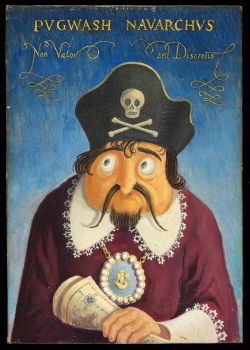
Fictional pirates in popular culture are the subject of a new exhibition at the V&A Museum of Childhood in Bethnal Green. A Pirate’s Life For Me explores the origins and characters of fictional pirates through more than 80 objects including David Munrow’s unpublished play Barnacle Bill, toys designed by Playmobil (exhibition sponsor) and Lego, the first ever painting of Captain Pugwash (pictured), six 18th century Spanish doubloons and the original illustration of the costume design for Captain Hook for the first ever theatrical production of Peter Pan in 1904. Young visitors to the exhibition are invited to take a journey starting at a seaside tavern where they will find a mysterious map which leads on to a pirate boutique, large scale pirate ship and tropical “treasure island”. The exhibition runs until 22nd April. Admission is free. For more, see www.vam.ac.uk/moc/whats-on. PICTURE: Framed painting of Captain Pugwash, painted by John Ryan, 1950, oil on board, © John Ryan Estate.

The British Museum’s new Albukhary Foundation Gallery of the Islamic World opened to the public last week with a display featuring a “comprehensive presentation of the Islamic world through art and material culture” including everything from architectural fragments of a Persian port city and courtly treasures of intricate craftsmanship to rich textiles from the Ottoman Empire and contemporary art. Among the objects on show, which cover the period from the 7th century to the present day, are the 14th century illustrated Persian epic, Shahnama (Book of Kings), and the 16th-century Indian Mughal emperor Akbar’s Hamzanama (Adventures of Hamza), elaborate 19th-century mother-of-pearl inlaid wooden Turkish bath clogs, a brightly decorated Uzbek woman’s robe with Russian lining and 21 stones, an installation of 21 paintings by Idris Khan created in response to the new gallery. A series of free public events is being held to mark the opening. Located in Rooms 42-43. The opening follows the reopening late last month of the Mitsubishi Corporation Japanese Galleries showing off some 430 artworks and artefacts from the museum’s Japanese collection. They included several newly acquired objects, such as a Edo period complete set of Samurai armour bearing the crest of the More clan and Time Waterfall – panel #8 (Blue), a contemporary digital artwork by Miyajima Tatsuo which will greet people as they enter. Found in Rooms 92-94. Admission is free. For more, see www.britishmuseum.org.
Send all items for inclusion to exploringlondon@gmail.com.

10 sites from Mary Shelley’s London…7. Charles and Mary Lamb’s house…

Renowned sibling writers Charles and Mary Lamb lived in a property at 64 Duncan Terrace in Islington from 1823-27 and, their visitors there apparently included Mary Shelley.

Shelley had returned to London in 1823 after the death of her husband Percy Bysshe Shelley who had drowned along with two other men off the coast of Italy in July the previous year.

Back in London, Shelley lived in various properties as far afield as Kentish Town – many of which are no longer extant. But one home she was known to have visited after her return (which is still standing) was that of the Lambs.

Charles, part of the literary circle which included Samuel Taylor Coleridge and William Wordsworth, described the property – Colebrook Cottage – as a “white house with six good rooms”. Now Grade II-listed, it dates from the 18th century.

The New River once ran close by  – so close, in fact, that one guest, believed to be the blind poet George Dyer, walked into the river after leaving the house and had to be rescued by Lamb. The river is now covered.

The property features an English Heritage Blue Plaque (although in this case, it’s actually brown), commemorating Lamb’s stay here.

PICTURE: Spudgun67 (licensed under CC BY 2.0).


LondonLife – Scientific achievement celebrated in new Quentin Blake wall at the Science Museum

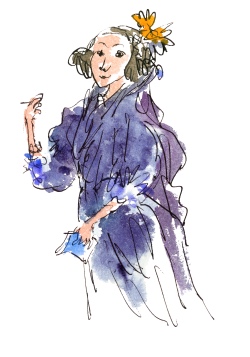
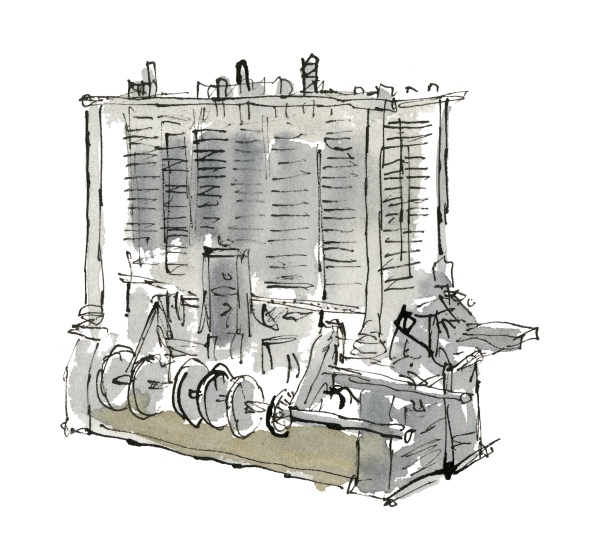
A new work by acclaimed illustrator Sir Quentin Blake has gone on show in the Science Museum in South Kensington. The work, which hangs on the external walls of Wonderlab: The Equinor Gallery, features five panels featuring some 20 women and men from the world of science of technology including the “enchantress of numbers”, mathematician Ada Lovelace (1815-1852 – pictured right; her ‘analytical machine’ is below), polymath Jagadis Chandra Bose (1858-1937) – the first scientist to use a semiconductor to detect radio waves, Sir Richard Arkwright (1732-1792) – pictured with his ground-breaking spinning machine, and pilot Amy Johnson (1903-1942) – pictured alongside the De Havilland Gipsy Moth in which she made the first solo flight from Britain to Australia. London-born Blake, who had his first cartoons published in Punch when just 16-years-old, is most famous for his illustrations in children’s books including in works by Roald Dahl and David Walliams. For more on the Science Museum, head to www.sciencemuseum.org.uk.

Where’s London’s oldest…(unchanged) bus route?

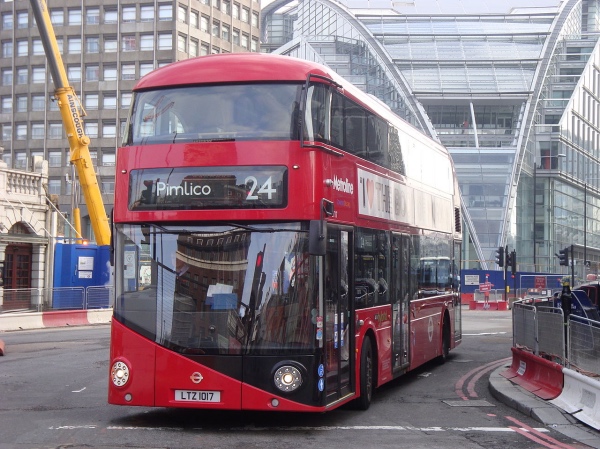
London’s oldest unchanged bus route in London is commonly cited as Route 24 which runs over seven miles from Hampstead to Pimlico.

The route was first launched in 1910 but initially stopped at Victoria Station. It was extended to Pimlico just two years later in 1912 and has largely unchanged ever since (apparently with the exception of some minor adjustments due to one-way traffic schemes).

The route, which operates 24 hours a day, does take in some key landmarks of London – among them Trafalgar Square, Horse Guards Parade and Parliament Square. In 2013, Transport for London, said some 28,000 people used the route each day.

In 1965, the double-decker buses on the route – which have always been powered by motors rather than horses – became the first to have front entry. In 1988, it became the first route through central London to be privatised when purchased by Grey-Green (the line is now operated by Metroline).

Mostly recently, in 2013, it became the first route to fully implement the curvaceous new ‘Routemasters’ (while they’ve commonly been called that, the new buses are actually just called the ‘new bus for London’).

PICTURE: One of the new buses on the route in 2014 (Aubrey Morandarte (licensed under CC BY-SA 2.0))

This Week in London – Sir Walter Raleigh’s “lost garden”; Anglo-Saxon Kingdoms; artworks celebrate women’s stories; and, Beast Quest at Hampton Court…

The “lost garden” of Sir Walter Raleigh opens at the Tower of London on Saturday, marking the 400th anniversary of the famous explorer’s death. Sir Walter, an adventurer who was a court favourite in the time of Queen Elizabeth I and enemy of King James I, was imprisoned in the tower on three occasions, at times living there with his wife and family, before he was eventually executed  on 29th October, 1618. Held in the Bloody Tower, he used the courtyard outside to grow plants from the New World and experiment with ingredients from an “elixir of life”. The gardens, which occupy the spot where the original apothecary garden once stood and are now a new permanent display at the tower, features a range of fragrant herbs, fruit and flowers. There’s also information on how they were used by Raleigh and his wife, Bess Throckmorton, to create herbal remedies and the chance for green-fingered families to concoct their own elixir. Meanwhile, the Bloody Tower has been revamped with a combination of film, sound, graphics and tactile objects to provide an insight into Raleigh’s times of imprisonment at the tower. Sir Walter and his wife Bess will also be present, entertaining crowds on Tower Green with stories of his adventures. Included in the usual admission price. For more, see www.hrp.org.uk/toweroflondon.

The Domesday book, the earliest surviving public record in the UK, forms the centrepiece of a new exhibition looking at the history, art, literature and culture of Anglo-Saxon England which opens at the British Library tomorrow. Anglo-Saxon Kingdoms: Art, Word, War spans the six centuries from the end of Roman Britain to the Norman Conquest. As well as the Domesday documents – last displayed in London seven years ago and on loan from The National Archives, among the 180 treasures are the Lindisfarne Gospels, Beowulf and Bede’s Ecclesiastical History as well as finds from Sutton Hoo and the Staffordshire Hoard. The Codex Amiatinus, a giant Northumbrian Bible taken to Italy in 716, returns to England for the first time in 1,300 years. The exhibition, which runs until 19th February, is being accompanied by a series of talks and events. Admission charge applies. For more, see http://www.bl.uk. PICTURE: © The National Archives.

A series of 20 new works by London women artists go on display in public spaces across the city from today. The free exhibition, LDN WMN, is being curated by the Tate Collective as part of the Mayor of London’s #BehindEveryGreatCity campaign marking the centenary of women’s suffrage in the UK. It features large installations, paintings and digital graphics in bringing the hidden stories of some of London’s pioneering and campaigning women to life. They include that of reporter and activist Jackie Foster, suffragist Lolita Roy, SOE operative Noor Inayat Khan and the women who built Waterloo Bridge. The artworks, by artists including Soofiya, Manjit That and Joey Yu, will be displayed in locations from Canning Town to Alexandra Palace, Brick Lane to Kings Cross. For locations, head to www.london.gov.uk/about-us/mayor-london/behindeverygreatcity/visit-ldn-wmn-series-free-public-artworks.

Phoenixes, dragons, griffins and other fantastic beasts take over Hampton Court Palace this half-term, bringing the fantasy children’s book series and gaming brand Beast Quest to life. The interactive experience will see families pitted against strange and magical beasts in a quest which will require bravery, quick-thinking and new found skills. The Beast Quest experience is suitable for all the family and takes about one hour, 15 minutes to complete. Runs from Saturday to 28th October and is included in the usual palace admission price. For more, see www.hrp.org.uk/hampton-court-palace/.

Send all items for inclusion to exploringlondon@gmail.com.
10 sites from Mary Shelley’s London…6. St Giles-in-the-Fields…

It was in this church in St Giles High Street in the West End that another significant event took place for Mary Shelley – her son William and daughter Clara Everina were baptised here on 9th March, 1818, just a couple of months after Frankenstein was first anonymously published.

The baptism took place just before Mary and her now husband, the poet Percy Bysshe Shelley, departed once again for the continent, apparently this time with no intention of returning.

In fact, the Shelleys attended three baptisms at the church that day – along with William (nicknamed “Willmouse”) and Clara, those undergoing baptism also included Allegra (at first called Alba), the daughter of Mary’s step-sister Claire Clairmont and the poet Lord Byron.

In fact, part of the group’s reason for going to Europe, along with Percy’s debts, ill-health and fears over the custody of their children, was to take Allegra to her father, Lord Byron.

The officiating churchman was said to be one Charles McCarthy.

The current font, which dates from 1810, in the church is presumably that in which they were baptised. It was installed well after the now Grade I-listed Palladian church, which is sometimes known as the “Poet’s Church”, was consecrated in 1733 (it is the third said to have been built on the site since the start of the 12th century).

PICTURE: Prioryman (licensed under CC BY-SA 4.0)

LondonLife – World War I remembered in St James’s Park…


The last in a series of major exhibitions on World War I by celebrated photographer Mike St Maur Sheil, Fields of Battle, Lands of Peace and Reconciliation – 2018 is a free outdoor exhibition in St James’s Park reflecting on the final year of the war. The exhibition, like the others before it, features photographs of the battlefields of World War I as they appear today along with archival pictures and maps. Mike St Maur Sheil says the theme of his displays – which have reached an audience of more than 10 million and been exhibited at locations including Paris’ Jardin du Luxembourg, Dublin’s St Stephen’s Green and at the junction of Broadway and 5th Avenue in New York – “has always been that time and nature have healed the wounds of war and reveal that what were once places of horror and killing have now become landscapes of beauty and tranquillity.” The free exhibition can be seen until 19th November. For more on St James’s Park, see www.royalparks.org.uk/parks/st-jamess-parkPICTURES – Two of the images on show: Top, showing the effect of artillery bombardment upon the landscape at Verdun; Below, the landscape today at Beaumont Hamel on the Somme with the shell holes and trenches still clearly visible. (Mike St Maur Sheil / Mary Evans Picture Library).

What’s in a name?…Bishopsgate…

This major London thoroughfare (and ward of the City of London) owes its name to one of the eight former gates of the City of London – that’s right, Bishopsgate.

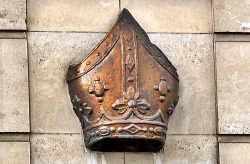
Located at what’s now the junction with Wormwood Street (and marked by a mitre which appears on a building there), the gate was the departure point for Ermine Street which ran from London to Lincoln and York.

The gate and hence the road – which runs northward from the intersection of Gracechurch Street and Cornhill to where it becomes Norton Folgate Street (which links into Shoreditch High Street) – is believed to have been named for the 7th century Bishop Erkenwald (Earconwald). It was he who apparently first ordered its reconstruction on the site of a former Roman gate.

By Tudor times, the street had become known for the mansions of rich merchants – among those who had their homes here were Sir Thomas Gresham, Sir John Crosby and Sir Paul Pindar (Crosby Hall was later re-erected in Chelsea and the facade of Sir Paul Pindar’s house, is in the V&A). The street also become known for its many great coaching inns, all of which were eventually demolished.

Bishopsgate was the first street in London to have gas lighting when it was introduced about 1810 and, about 1932, became the first in Europe to have automated traffic lights (at the junction with Cornhill).

The City of London ward straddles the site of the old London wall and gate and is accordingly divided into “within” and “without” sections.

While there are a number of churches associated with the street – St Ethelburga Bishopsgate, St Helen’s Bishopsgate and St Botolph-without-Bishopsgate, these days it is largely lined by office buildings including the former NatWest Tower. Other notable buildings include that of the Bishopsgate Institute and the busy Liverpool Street Station is also accessible from Bishopsgate.

The name Bishopsgate is also synonymous with an IRA truck bombing which took place in the street on 24th April, 1993, in which one man was killed and 44 injured.

PICTURE: Top – Looking southward along Bishopsgate in 2014. (stevekeiretsu; licensed under CC BY-NC 2.0); Right – The Bishop’s mitre marking the location of the former gate (Eluveitie/ licensed under CC BY-SA 3.0).

Treasures of London – The Readymoney Drinking Fountain…

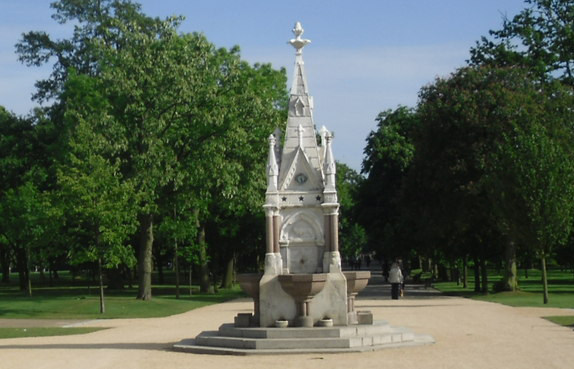
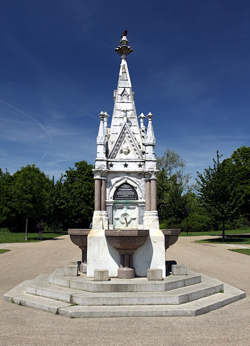
This gothic drinking fountain located in the centre of the Broad Walk in The Regent’s Park takes its name from Sir Cowasjee Jehangir, whose nickname, thanks to his business success, was ‘Readymoney’.

A wealthy industrialist from Bombay, Sir Cowasjee donated the four-sided fountain to the park in 1869 as a thank-you for the protection he and fellow Parsees received from British rule in India (hence why the fountain is also sometimes called the Parsee Fountain).

Made from 10 tonnes of Sicilian marble and four tonnes of red Aberdeen granite, it was designed by Robert Keirle – architect to The Metropolitan Free Drinking Fountain and Cattle Trough Association – and made by sculptor Henry Ross (at a cost of £1,400).

Set on an octagonal stepped base, it features a basin on each of the four sides. Decorative elements above the basins include carved marble panels featuring a lion and a Brahmin bull.

Three of the gables feature a small bust – one of Queen Victoria, another of Prince Albert and another of Readymoney himself. The fourth has a clock instead.

The now Grade II-listed fountain was erected by the Metropolitan Drinking Fountain and Cattle Trough Association and unveiled by Princess Mary of Teck (later Queen Mary, wife of King Edward VII) on 1st August, 1869 (she also has some gardens in the park named after her).

The fountain was restored in 1999-2000 and again in 2016-17. The water no longer flows but it remains as a memorial to Sir Cowasjee’s story.

PICTURES: Top – Peter Smyly (licensed under CC BY-SA 2.0); Right – Chmee2 (licensed under CC BY-SA 3.0) Images cropped.

This Week in London – V&A’s new Photography Centre; ‘Women in Jazz’; and, Anna Albers retrospective…


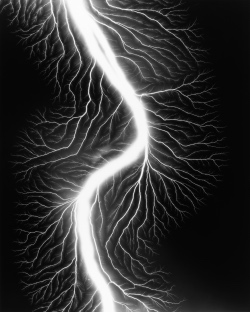
The world’s first photographic experiments and earliest cameras, pictures by everyone from pioneer Julia Margaret Cameron to 20th century great Cecil Beaton, and a series of newly commissioned works by German photographer Thomas Ruff and American artist Penelope Umbrico are among attractions at the V&A’s new Photography Centre, the first phase of which opens tomorrow. Designed by David Kohn Architects, the new centre spans four galleries and more than doubles the space dedicated at photography at the South Kensington institution. The initial display, Collecting Photography: From Daguerreotype to Digital, includes more than 600 objects from across the world including seminal prints and negatives by pioneers like William Henry Fox Talbot and Cindy Sherman, 20th century greats like Alfred Stieglitz, Walker Evans and Irving Penn, and contemporary photographers like Hiroshi Sugimoto, Mary McCartney and Martin Parr. There’s a pioneering botanical cyanotype by Anna Atkins, images by the world’s first female museum photographer – Isabel Agnes Cowper, and motion studies by Eadweard Muybridge as well as camera equipment, photographic publications, original documents and a “digital wall” to showcase cutting-edge photo imagery. The opening is being accompanied by a three week ‘spotlight’ on photography across the V&A including talks, screenings, courses, workshops and other events. Entry to the new centre in the V&A’s North East Quarter is free. A second phase, including a teaching and research space, browsing library and studio and darkroom for photographer residencies, will open in 2022. For more, see www.vam.ac.uk. PICTURES: Top – Rendering of Gallery 99 in the new Photography Centre (© David Kohn Architects); Right – Hiroshi Sugimoto, Lightbody Fields 225, 2009, Gelaton silver print form a photogram (© Hiroshi Sugimoto, Victoria and Albert Museum).

The role women have played in the development of jazz music is the subject of a new exhibition at the Barbican Music Library in the City of London. Women in Jazz explores how social and political changes in the 20th century played a significant role in encouraging more female involvement in jazz and highlights the new generation of performers. The display includes photographs, journals, video and memorabilia from the National Jazz Archive. Opens on Tuesday and runs until 31st December. For more, follow this link.

The first major retrospective of textile artist Anna Albers (1899-1994) opens at the Tate Modern today. Anna Albers features her most important works – many shown in the UK for the first time – in a display including more than 350 objects including small-scale studies, large wall-hangings, jewellery made from everyday items, and textiles designed for mass production. It explores the many aspects of Albers’ practice including the intersections between art and craft hand-weaving and machine production as well as the artist’s writings, including The Pliable Plane: Textiles in Architecture (1957), On Designing (1959) and On Weaving (1965). Berlin-born Albers was a student at the Bauhaus in the 1920s and there began working with textiles – later taking her talent to the US and making many visits to Central and South America. The exhibition in the The Eyal Ofer Galleries runs until 27th January. Admission charge applies. For more, see www.tate.org.uk.

Send all items for inclusion to exploringlondon@gmail.com.

10 sites from Mary Shelley’s London…5. The Temple of the Muses, Finsbury Square…

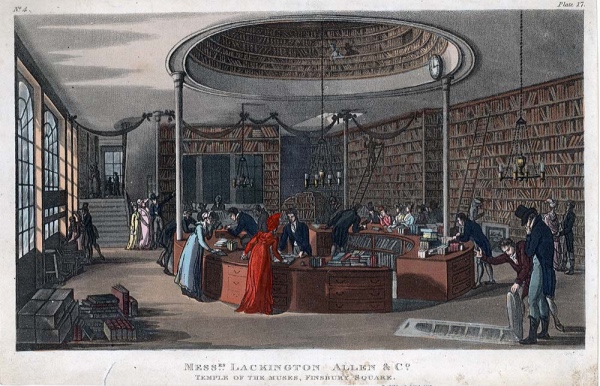
The publishers of the first edition of Frankenstein – a company known as Lackington, Hughes, Harding, Mavor and Jones – were based in Finsbury Square in Islington within a building known as The Temple of the Muses.

Designed as a ‘temple to reading’ (it is attributed by some to George Dance the Younger), the rather grand building in the south-east corner of the square was built by the aforementioned James Lackington in 1791 to sell books (his stocks grew to include tens of thousands of items), some of which the company would publish themselves.

The massive building was crowned a central dome topped with a flagpole (from which a flag fluttered when Lackington was in residence) under which was a circular counter around which it was apparently said a coach and horses could be driven see image).

The original Lackington had long since retired from the business when Mary Shelley came along. His relative George Lackingham then ran the business with many partners – Richard Hughes, Joseph Harding, William Mavor and a Jones. Known consequently as Lackington, Hughes, Harding, Mavor and Jones, the company had apparently previously had a couple of different names including Lackington, Allen & Co.

Frankenstein; or, The Modern Prometheus was first offered as a three volume book – without Shelley’s name attached – to the public on New Year’s Day, 1818 (slightly behind schedule due to printing delays). Thanks to the initial print run being late and an advertising mix-up, it was subsequently republished on 11th March the same year (this is now considered by many the original publication date).

The Temple, meanwhile, survived until 1841 when it burned down. The business, now known as Harding and Lepard, then moved to Pall Mall East.

PICTURE: Interior view of the Temple of the Muses (engraving/etching by William Wallis, probably in Jones’ University edition of British Classic Authors, 1828/Via Wikipedia)

LondonLife – Sunset on Millennium Bridge…

PICTURE: Chelsea London Phillips


London Pub Signs – The Walrus and The Carpenter…

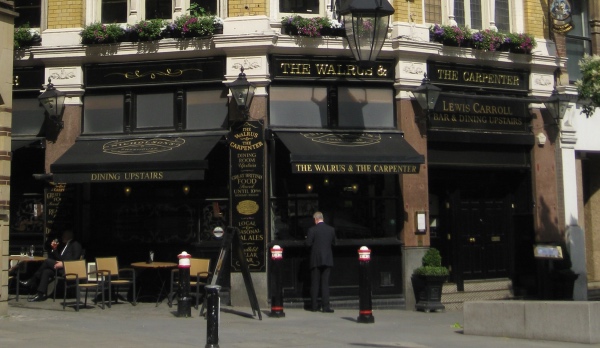
This rather oddly named pub can be found at 45 Monument Street in the City of London, just a short walk (you may have guessed) from The Monument itself.

There actually nothing terribly mysterious about the name – it comes from a nonsensical narrative poem by Lewis Carroll which he puts in the mouths of those rambunctious twins Tweedledum and Tweedledee in the book, Through The Looking Glass, and What Alice Found There, published in 1871.

No, the real mystery here is why this particular pub, which sits on the corner with Lovat Lane (renamed from Love Lane in the early 20th century; no prizes for guessing what went on there previously), was given this name.

The pub – and there’s been one on the site since at least the early 19th century – was apparently previously known as The Cock and once served the porters from the nearby Billingsgate Market on Lower Thames Street (just across the road). But after Billingsgate moved out to Docklands in 1982, the pub changed its name.

Why remains a matter of conjecture – although in the poem the two main characters encounter a bed of oysters which they eventually eat (perhaps there’s a link here to the fact Billingsgate was formerly located nearby?).

The rooms inside include the, given the pub’s moniker, appropriately named Lewis Carroll Bar and Dining Room.

The pub is now part of the Nicholson chain, previously having been under the Charrington and Fuller’s umbrellas. For more, see www.nicholsonspubs.co.uk/restaurants/london/thewalrusandthecarpentermonumentlondon.

PICTURE: Chemical Engineer (licensed under CC BY-SA 4.0).


This Week in London – The Sun explored; Darwin’s story on stage; Freud meets Dali; and, medallic art in Britain…

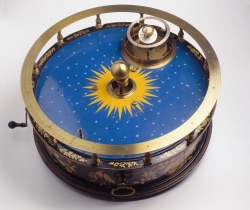
• The biggest ever exhibition exploring the Sun opens at the Science Museum in South Kensington this Saturday. The Sun: Living With Our Star features everything from Nordic Bronze Age artefacts revealing ancient beliefs about how the Sun was transported across the sky to details of upcoming NASA and European Space Agency solar missions. Highlights include the original ‘orrery’ (pictured), an instrument made for the Earl of Orrery in 1712 to demonstrate the motions of the Earth and Moon around the Sun, a rare concave mirror known as a yang-sui which was used for lighting fires in China and dates to between 202 BCE and 9 CE, and a Tokomak ST25-HTS, a prototype nuclear fusion reactor which successfully created and sustained plasma for a record-breaking 29 hours in 2015. There’s also an astronomical spectroscope made for Norman Lockyer, founder of the Science Museum, who used it to identify the element helium in 1868 – the exhibition actually coincides with the 150th anniversary of Lockyer’s discovery, the first of an “extra-terrestrial” element. The exhibition also includes interactive experiences including a huge illuminated wall display allowing visitors to see the Sun rise in different seasons and locations and another in which visitors are able to bask in the sun while sitting in deck chairs under palm trees with sand at their feet. Runs until 6th May next year. Admission charge applies. The exhibition is being accompanied by a programme of events including “family festivals” in early November and early March. For more, see www.sciencemuseum.org.uk/see-and-do/the-sun-living-with-our-star. PICTURE: Science Museum Group Collection/© © The Board of Trustees of the Science Museum.

The story of Charles Darwin is told in a new two hour stage play featuring a cast of seven people and 30 hand-made puppets which opened at The Natural History Museum this week. The Wider Earth, which follows Darwin as he sets out on a daring five year journey aboard the HMS Beagle through uncharted landscapes, is being staged in the museum’s Jerwood Gallery following sold-out seasons in Australia and represents the first time a performance-based theatre has been constructed in the museum. Presented by Trish Wadley Productions and Dead Puppet Society in association with Glass Half Full Productions, the show runs until 30th December. To book tickets, head to www.thewiderearth.com.

This year marks 80 years since Sigmund Freud and Salvador Dalí famously met in London on 19th July, 1938 – a meeting at which Dalí revealed to Freud his recently completed painting The Metamorphosis of NarcissusThe Freud Museum has launched a new exhibition – Freud, Dalí and the Metamorphosis of Narcissus – which explores the extensive influence of Freud on Dalí and on Surrealism as well as Freud’s own reaction to the painting. The painting forms the centrepiece of the exhibition which also includes drawings, photographs and prints as well as documents including letters, manuscripts, books and Freud’s appointment diary. The display is accompanied by a programme of events. Runs until 24th February. Admission charge applies. For more, see www.freud.org.uk.

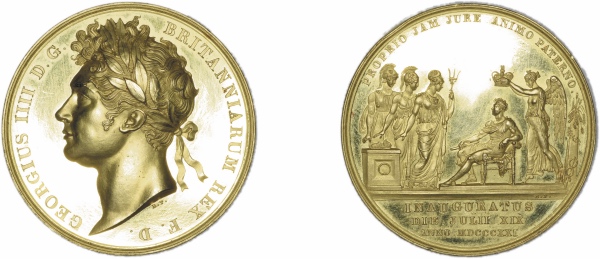
The “invaluable” role artists from abroad played in the development of British medallic art is the focus of a new display at the British Museum. Witnesses: émigré medallists in Britain features medals from six centuries documenting significant historical moments and commemorating famous British figures. The earliest objects date from Elizabethan England when Dutch artist Steven van Herwijck introduced the art of the medal to Britain’s cultural elite while ‘stars’ in the display include a spectacular Waterloo medal conceived by 19th century Italian gem engraver Benedetto Pistrucci which took 30 years to complete and bears the image of the four allied sovereigns – George, Prince Regent, Francis II of Austria, Alexander I of Russia and King Frederick William III of Prussia. The free display can be seen in Room 69a until 7th April next year. For more, see www.britishmuseum.org. PICTURE: Benedetto Pistrucci: Coronation of George IV, 1821, gold, 35mm. © the Trustees of the British Museum M5716. B, 1070. CME6436.

Send all items for inclusion to exploringlondon@gmail.com.

10 sites from Mary Shelley’s London…4. Church of St Mildred, Bread Street

Following their sojourn at Lake Geneva where, in September, 1816, Mary Shelley (then Godwin) first started writing Frankenstein, Shelley and her lover – the poet Percy Bysshe Shelley – returned to England and then to London where on 30th December, 1816, they were married at St Mildred’s Church, Bread Street.

The marriage followed the suicide of Percy Shelley’s wife, Harriet, who was found drowned in the Serpentine in Hyde Park on 10th December that year. Harriet’s family had apparently resisted the poet taking custody of the couple’s two children and it has been reported that Percy was advised by lawyers that marrying Mary, pregnant to him again at this stage, would improve his chances of his winning custody of them.

Mary’s father William Godwin and step-mother Mary Jane Claremont Godwin attended the wedding and the rift which had divided the family due to the couple’s earlier elopement was apparently at least partly mended as a result. Others in attendance were the publisher and poet Leigh Hunt.

The church in which they were married once stood on the east side of the south end of Bread Street in the City of London (and is not to be confused with the Church of St Mildred, Poultry, which once stood near Mansion House).

Originally dating at least as far back as the early 13th century, it had been destroyed in the Great Fire of London in 1666 and then rebuilt to the designs of Sir Christopher Wren in the years following.

In good condition and retaining many of Wren’s original fittings into the 20th century, the building was sadly destroyed by bombing in 1941 (and the parish subsequently united with that of St Mary le Bow). The site is now covered by the Grade II-listed Seventies office building, 30 Cannon Street.

A memorial to Admiral Arthur Philip, which now stands just off New Change, was once located in this church.

PICTURE: Interior of St Mildred, Bread Street from The Churches of London by George Godwin (1839). (Via Wikipedia)

LondonLife – A new window for the Queen…


A new stained glass window depicting bright country scenes was unveiled in Westminster Abbey last week in honour of Queen Elizabeth II.
The Queen’s Window, located in the south transept overlooking Poet’s Corner, is the work of world-renowned artist David Hockney and was commissioned by the Dean and Chapter of Westminster to celebrate her reign. The work is Hockney’s first in stained glass and features a Yorkshire scene with hawthorn blossom which uses his distinct colour palette of yellow, red, blue, pink, orange and greens. “The subject reflects The Queen as a countrywoman and her widespread delight in, and yearning for, the countryside,” the abbey said in a statement. The window was created by York-based stained glass artists Barley Studio to Hockney’s designs. Other artists who have completed stained glass works in the abbey include Sir Ninian Comper, Hugh Easton and John Piper with the last stained glass windows, by Hughie O’Donoghue, installed in the Lady Chapel in 2013. PICTURE: Alan Williams/Westminster Abbey

Lost London – St George’s Circus Clocktower…

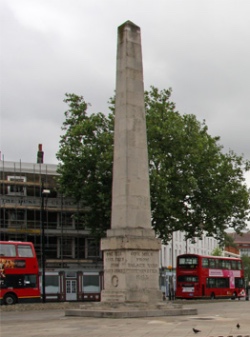
Erected around the turn of the 19th century to celebrate Queen Victoria’s Diamond Jubilee in 1897 (some put the date  of its erection at about 1897; others in about 1905), the clocktower replaced an obelisk that had previously stood in the centre of St George’s Circus in  Southwark.

The rather ornate tower was designed by architect and engineer Jan F Groll and featured four oil lamps to help light the intersection, described as the first purpose-built traffic junction in England.

It survived until the late 1930s when it was demolished after being described as a nuisance to traffic.

Meanwhile, the Robert Mylne-designed obelisk had been first erected in 1771 and marked one mile from Palace Yard, one mile 40 feet from London Bridge and one mile, 350 feet from Fleet Street (Mylne, incidentally, was the architect of the original Blackfriars Bridge).

Following its removal, it was taken to Geraldine Mary Harmsworth Park where it stood until 1998 when it was moved back to its position in St George’s Circus where it now stands. It was Grade II*-listed in 1950.

There’s a replica of the obelisk in Brookwood Cemetery – it marks the spot where bodies taken from the crypt of the Church of St George the Martyr, located in Borough High Street, in 1899 were reinterred to ease crowding.

PICTURE: Once the site of a clocktower, the obelisk has since been returned to St George’s Circus (Martin Addison/licensed under CC BY-SA 2.0/image cropped)