Treasures of London – The (new) Design Museum…

design-museum1

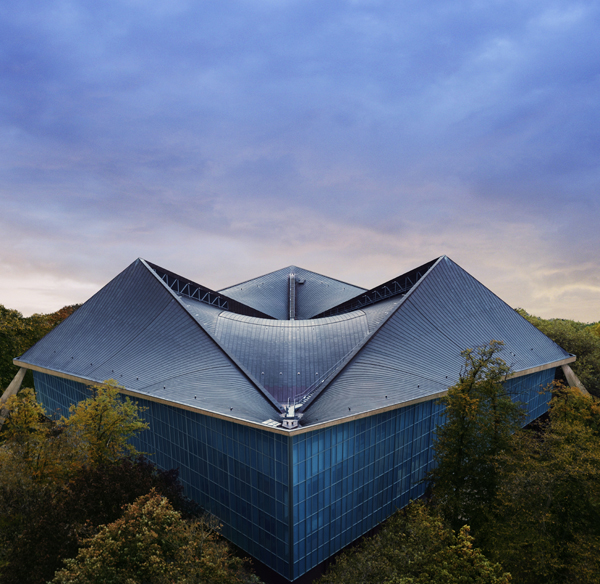
The Design Museum’s new home in Kensington finally opened this week and it’s already been getting some rave reviews, hence why, despite its freshness, we thought we’d mention it in our Treasures of London feature.

The museum, which moved to its new premises after 25 years in Shad Thames, now occupies the former Commonwealth Institute building, which dates from 1962 and was designed by Robert Matthew. The building has recently undergone a £83 million makeover with the interiors designed by architect John Pawson.

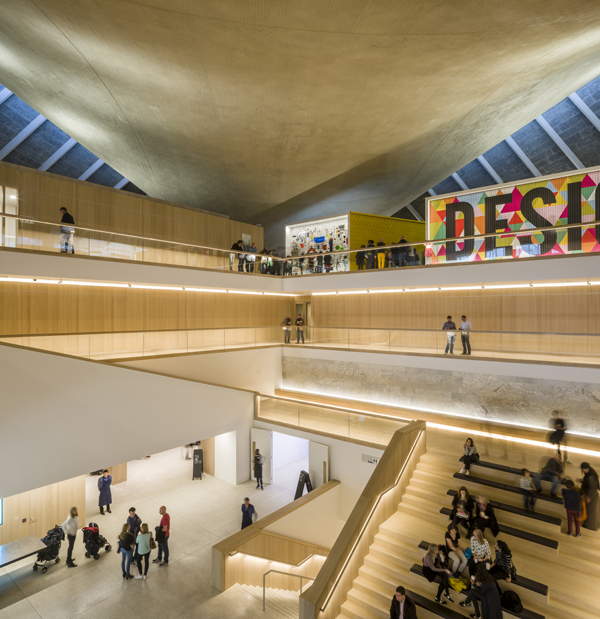
The new museum has three times the space of the previous premises and features the only collection in the UK devoted exclusively to contemporary design and architecture. At the heart of the building is the Designer Maker User exhibition which, as the museum’s first free permanent display, occupies the top floor of the museum, and includes more than 1,000 items of 20th and 21st century design. At its entrance can be found a wall featuring more than 200 items from 25 countries nominated by the general public including a Bible, Coca-Cola can and a £5 banknote.
design-museum2

Inside, the Designer section focuses on the thought-processes of designers and features a full-sized production of a gerberette used in the Richard Rogers-designed Centre Pompidou in Paris as well as models and images of the works of the late architect Zaha Hadid, David Mellor’s traffic lights, Kinneir and Calvert’s British road signage system and a full scale prototype for a new London Tube train designed by PriestmanGoode as well as Moulton bicycles and London Underground maps.

The Maker section, meanwhile, traces the evolution of manufacturing from Thonet bentwood cafe chairs and Model T Ford cars to robotic arms and 3D printing and includes objects at different stages of production – from tennis balls to the London 2012 Olympic Torch.

And in the User section, visitors will be led to explore the interaction between the consumer and brands that have become household names – Braun, Sony, Apple and Olivetti – as well as the impact of design on politics, fashion and music. Displays in the latter part include Gucci tennis shoes, the fashions of Vivienne Westwood and Christian Louboutin and the pioneering magazine The Face.

design-museum3

As many as 500,000 people are expected to visit the museum in its first year. Along with permanent displays, also unveiled this week was the new exhibition, Fear and Love, featuring 11 new installations by world leading designers. They include The Pan-European Living Room by architecture practice OMA, Room Tone by fashion designer Hussein Chalayan, Pittsburgh-based designer Madeline Gannon’s “mechanical creature” Mimus, and a series of death masks called Vespers created using 3D printing technology Neri Oxman.

And running until 19th February is the Beazley Designs of the Year, a celebration of design that promotes or delivers change, enables access, extends design practice or captures the spirit of the year past. Categories include architecture, digital, fashion, graphics, product and transport.

WHERE: The Design Museum, 224-238 Kensington High Street, Kensington (nearest Tube stations are Kensington High Street. Earl’s Court and Holland Park); WHEN: 10am to 6pm daily; COST: free (admission charges to special exhibitions); WEBSITE: http://designmuseum.org

PICTURES: Top – Gravity; Middle – Gareth Gardner; Bottom – Helene Binet. Courtesy The Design Museum.
This Week in London – London and the slave trade; a rare VC; and, Sir Elton John’s photo collection…

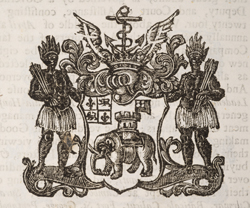
royal-african-company• London’s role in the slave trade during the 17th and 18th centuries is the subject of a new display opening at the Museum of London Docklands tomorrow. Called The Royal African, it tells the story of the Royal African Company, founded as a joint venture between the Duke of York (the future King James II) and leading London merchants in 1672 (the coat-of-arms of which is pictured), through looking in-depth at the life of William Sessarakoo. An African prince, Sessarakoo grew up in a Royal African Company fort at Annamaboe in modern Ghana but when his father sent him to London to be educated, he was tricked and instead sold into slavery in Barbados. He spent four years as a slave until he was freed by members of the Royal African Company who wanted to retain good relations with his father and subsequently brought him to London. The display is being housed in the museum’s London, Sugar & Slavery Gallery and can be seen until 4th June next year. Entry is free. For more, see www.museumoflondon.org.uk/museum-london-docklands. PICTURE: © Museum of London.

• A rare Victoria Cross found on the foreshore of the River Thames has gone on show at the Museum of London in the City. Mystery surrounds the medal which was given for actions at the Battle of Inkerman during the Crimean War. While a number of medals were awarded for actions in the battle, only two have a location recorded as unknown. The first is that awarded to Scottish Private John McDermond from the 47th (the Lancashire) Regiment for saving the life of Lt Col O’Grady Hall who had been injured and surrounded by the enemy which leading a charge against a Russian column while the second is that awarded to Irish Private John Byrne of the 68th (Durham) Light Infantry who rescued a wounded comrade under fire. On show alongside the medal is a record book which details the engraving on each VC issued between 18554 and 1927, the original medal design from the jewellers Hancocks and a modern copy of a VC. The medal, which was found and then reported by Tobias Neto, is on show until 15th December. For more, see http://www.museumoflondon.org.uk/museum-london.

Sir Elton John’s collection of modernist photography is the subject of an exhibition which opened at the Tate Modern in South Bank earlier this month. The Radical Eye: Modernist Photography from the Sir Elton John Collection features more than 150 works from more than 60 artists including Man Ray, André Kertész, Berenice Abbot, Alexandr Rodchenko and Edward Steichen. Among the subjects show in the images are Henri Matisse, Pablo Picasso and Jean Cocteau. The exhibition runs until 7th May. For more, see www.tate.org.uk/visit/tate-modern.

Send all items for inclusion to exploringlondon@gmail.com.

Eight historic department stores in London…3. Fortnum & Mason…

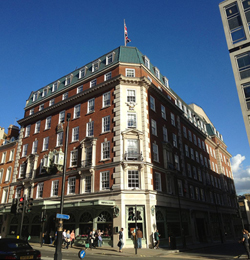
Now a Piccadilly institution, Fortnum and Mason’s origins (which we dealt with in 2011 in a London’s oldest post but couldn’t resist looking at again) famously go back the early 17th century when Hugh Mason rented out a spare room to William Fortnum, a Footman in the household of Queen Anne.

fortnum-masonThe entrepreneurial Fortnum decided to supplement his income by selling Queen Anne’s half-used candle wax (new candles were required every night) for a small profit. It was he who convinced his landlord, who also had a small shop in St James’s Market, to join with him in a joint venture – the first Fortnum & Mason – in Duke Street in 1707.

Initially founded as a grocery store, Fortnum & Mason, which moved to its current site at 181 Piccadilly in 1756, become known for its high quality and rare goods – in particular tea – and during the 18th and 19th centuries supplied the gentry who were in London for the ‘season’. Departments inside the store have included a rather bizarre ‘Expeditions Department’ which apparently supplied King Tut’s finder Howard Carter and a 1922 expedition to Mount Everest.

It has held numerous Royal Warrants since the mid 1800s with the first granted in 1863 when the firm was appointed as grocers to the then Prince of Wales.

A supplier of British officers during the Napoleonic Wars, Fortnums was also active during the Crimean War when Queen Victoria had shipments of “concentrated beef tea” sent to Florence Nightingale for use in her hospitals there.

Other claims to fame include the creation of the first Scotch egg in 1738 as a food for travellers and that in 1886, it became the first store in Britain to stock tins of Heinz baked beans. It also operated a post office between 1794 and 1839 when the General Post Office was founded.

The iconic clock which hangs on the facade of the building was commissioned in 1964 by Canadian businessman Garfield Weston who bought the business in 1951. Every hour models of Mr Fortnum and Mr Mason come forth and bow to each other. Other features on the building itself include four colonies of bees which have lived on the roof since 2008 in uniquely-designed hives.

The store, now famous for its luxury food hampers, underwent a £24 million restoration in the lead-up to its 300th anniversary in 2007. As well as the flagship store, it also now operates stores in St Pancras (2013) and Heathrow Airport (2015) as well as, since last year, in Dubai (it did open a store on Madison Avenue in New York in the 1930s but the business was short-lived thanks to the Depression). Fortnum & Mason products can also be found in a growing number of department stores around the world.

The Piccadilly store houses a number of eateries including The Parlour, The Gallery and The Wine Bar as well as, since it was opened by Queen Elizabeth II herself in 2012, the Diamond Jubilee Tea Salon – already famous for its afternoon teas.

See www.fortnumandmason.com.

PICTURE: Gryffindor/Wikimedia/CC BY-SA 4.0

LondonLife – Autumn colour in Bushy Park…

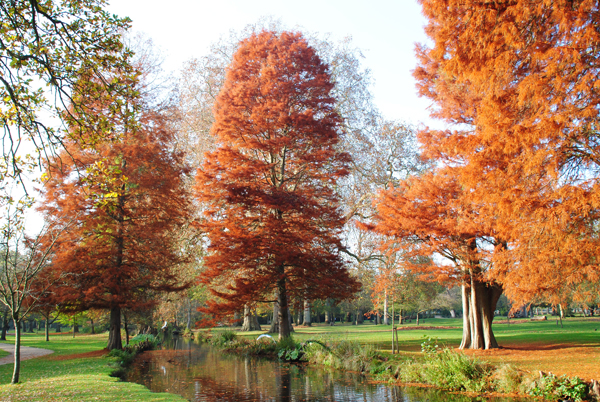
autumn-colours

Autumnal colour on display in Bushy Park, south-west London. For more on the history of the park, see our earlier post here.

PICTURE: David Adams

What’s in a name?…Euston…

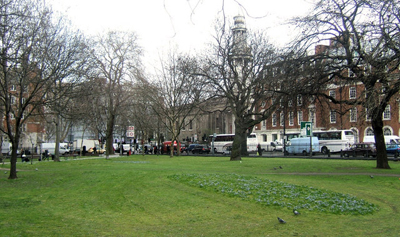
euston-gardensThe name Euston first makes an appearance in London in the Georgian era when Euston Square was laid out north of the City.

The moniker came from the square’s landlord, the Duke of Grafton, who owned a country seat called Euston Hall near Thetford in Suffolk, and apparently derives from the Anglo-Saxon ‘Efe’s Tun’ meaning the ‘farmstead of a man called Efe’.

The now much altered square (the gardens of which are pictured) was originally developed in the 1820s; in the 1850s the New Road – which had been developed by the second Duke of Grafton, Charles Fitzroy, in the 1730s to take farm traffic off Oxford Street and Holborn – was renamed Euston Road.

It only makes sense then that when the mainline station on that road was developed in the 1830s (it opened in 1837, exactly a month after Queen Victoria became the monarch), it too was named Euston (as was the now long-gone Euston Arch – see our earlier post here).

Euston Underground Station opened in 1907 while Euston Square Underground station, which originally opened as Gower Street in 1863, was renamed Euston Square in 1909.

Interestingly the area around Euston Road also features numerous references to Grafton in honour of the duke – Grafton Street, Grafton Place and Grafton Way among them – while other streets also have links to the names of the dukes’ family – Warren Street (which also lends its name to a Tube station), for example, is named for Anne Warren, the wife of the second duke’s grandson.

PICTURE:  Kevin Gordon/CC BY-SA 2.0

A Moment in London’s History – Queen Elizabeth II opens the National Theatre…

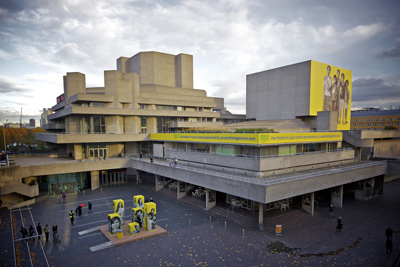
royal-national-theatreIt was 40 years ago this year that South Bank landmark, The National Theatre, was officially opened by Queen Elizabeth II.

The National Theatre company had been founded 13 years before (although the concept was first proposed more than 100 years before) and was, until 1976, based at the Old Vic close to Waterloo Station.

The new (now Grade II*-listed) premises (which was originally also to house an opera house, although this plan was later dropped) was designed by architects Sir Denys Lasdun and Peter Softly and the structural engineers Flint & Neill. To this day the brutalist design provokes some strong opinions (Prince Charles once described it as “a way of building a nuclear power station in the middle of London without anyone objecting”).

It contains three auditoriums: the Olivier (named for acting great Sir Laurence Olivier), the Lyttelton (named for Oliver Lyttelton, Lord Chandos, first chairman of the National Theatre) and the Dorfman (known as the Cottesloe until 2014, it was originally named for Lord Cottesloe, chairman of the South Bank board which oversaw the building of the theatre, before being renamed after businessman and philanthropist Lloyd Dorfman) and were opened progressively between 1976 and 1977.

While the first performances began to be held in the Lyttelton theatre from March, the complex was only officially opened by the Queen on 25th October with parts of the building still unfinished. Sir Laurence Olivier gives a speech of welcome in the auditorium which bears his name – it is his only appearance on the complex’s stages.

In 1988, the complex was granted the title Royal by the Queen – hence it’s officially the Royal National Theatre – in honour of the company’s 25th birthday.

More than 1,000 people now work on the five acre site which as well as the theatres, features rehearsal rooms, workshops where sets and scenes are created and painted and costumes and props are made.

Since it was founded, the National Theatre has presented more than 800 productions to an audience numbering well into the millions.

For more, see www.nationaltheatre.org.uk.

PICTURE: Aurelien Guichard/CC BY-SA 2.0)

This Week in London – New museum on policing in the Square Mile; the 801st Lord Mayor’s Show; and maps on show at the BL…

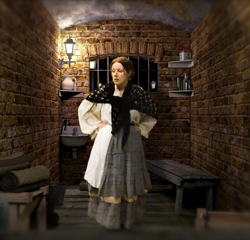
catherineeddowes2Stories including that of Catherine Eddowes, one of the victims of the notorious Jack the Ripper whose tale is brought to life through a virtual hologram (pictured), that of the Houndsditch Murders which claimed the lives of three police officers, and those of the more than 70 horses which have served in the City of London Police are among those told in the new purpose-built City of London Police Museum. A collaboration between the City of London Police and the City of London Corporation’s Guildhall Library, the new facility covers the 177 year history of the men and women charged with policing the Square Mile. Other stories highlighted in the museum include that of the recruitment of women into the force, the impact of the two World Wars on policing in the capital (featuring photographs taken by City of London police officers Arthur Cross and Fred Tibbs), the force’s tackling of terrorism and the progress of its communications, uniforms and kit and the victory of the City of London Police as the winner of the Olympic gold medal for the tug of war in 1920 (which, given the event was dropped, leaves them as the current champions). Entry to the museum, which opened this week at Guildhall, is free. For more, see www.cityoflondon.police.uk/about-us/history/museum/Pages/default.aspx. PICTURE: Courtesy City of London Police Museum.

The Lord Mayor’s Show takes place this Saturday, kicking off with a river pageant followed by the grand procession through City streets and fireworks over the Thames. The 801st Lord Mayor’s Show celebrates the election of Andrew Parmley as the 689th Lord Mayor of the City of London. This year’s procession, which kicks off at 11am and runs from Mansion House down Cheapside to the Royal Courts of Justice – where the Lord Mayor swears allegiance to the Crown – and back again at 1pm via Victoria Embankment, features 6,500 participants, 180 horses and 164 vehicles including steam engines, fire engines and a tank. The Show’s Pageantmaster, Dominic Reid, is celebrating his 25th consecutive show this year (his father organised 20 shows before him). The river pageant, featuring the QRB Gloriana, sets off from Westminster at 8.30am with Tower Bridge opening in salute at 9.25am. The fireworks display, which takes place over the Thames between Blackfriars and Waterloo, starts at 5.15pm. The tradition dates back to 1215. For more, see https://lordmayorsshow.london.

A major new exhibition looking at the history of the 20th century through maps has opened at the British Library in King’s Cross. Maps and the 20th Century: Drawing the Line features maps ranging from the first sketch of the London Underground dating from 1931, to declassified Ministry of Defence maps from the Cold War era, John Betjeman’s personal set of Ordinance Survey maps from the 1920s, a Russian moon globe from 1961 and EH Shepard’s first map of the Hundred Acre Wood (home of Winnie the Pooh). Other highlights include 3D relief models of the Western Front from 1917, a dress made of World War II escape maps printed on silk, an aerial photograph of Liverpool with targets marked used by the Luftwaffe, a map of the Atlantic Ocean floor from 1968. The exhibition, which runs to 1st March, is running in conjunction with a series of events exploring how maps continue to shape and influence our world. Admission charge applies. For more, follow this link.

Send all items for inclusion to exploringlondon@gmail.com

Eight historic department stores in London…2. Liberty & Co…

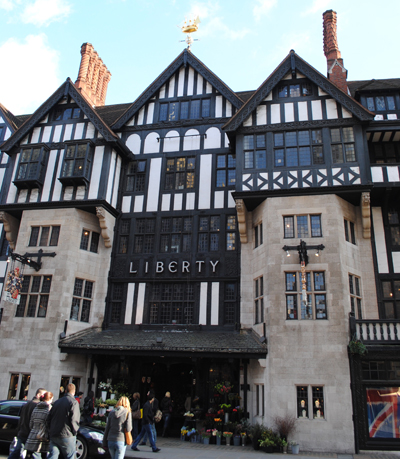
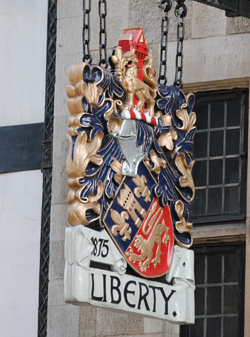
liberty1Liberty, now a West End institution, was founded by Arthur Lasenby Liberty in 1875 with a vision to transform the way people thought of fashion and homewares.

Born the son of a Buckinghamshire draper, Liberty worked with relatives from a young age before he eventually started work with a women’s fashion house, Farmer and Rogers. Rising to management, when they refused to make him a partner in the business, he decided to strike out on his own and established Liberty & Co at 218a Regent Street, an ‘oriental warehouse’ selling ornaments, fabric and objets d’art. He named the property East India House.

libertyOnly 18 months after he first set up shop – financed with a £2,000 loan from his future father-in-law and employed three staff – he was already expanding his premises into properties to the south in Regent Street to house furnishings and carpets. He eventually took over all the buildings between 140 to 150 and named the extended building Chesham House.

The costume department was introduced in 1884 and together with its director EW Godwin, Liberty created in-house fashions to challenge those of Paris. He is also noted for having encouraged and collaborated with designers like Archibald Knox and William Morris.

Liberty, who took the company public in 1894, was knighted in 1913. He died in 1917, seven years before the current Liberty store – the mock-Tudor building on the corner of Regent Street and Great Marlborough Street – was built.

Designed by Edwin T Hall and son, the shop was built from the timbers of two ships, the HMS Impregnable and the HMS Hindustan (and the shop frontage measures the same length as the latter). It was built around three light wells, each of which was surrounded by smaller rooms – many of which have fireplaces and were designed to give the feel of rooms in a house.

Features on the Grade II*- listed building include its weathervane – an exact replica of the Mayflower, which took pilgrims to the US in 1620, decorative shields including the arms of Shakespeare and those of the wives of King Henry VIII, and the clock above the Kingly Street entrance.

Liberty, which is generally acknowledged to have been a powerful influence on 19th and 20th century fashions and tastes, was bought by its current owners, BlueGem in 2010.

~ www.libertylondon.com

LondonLife – Gasometer, East Greenwich…

gasometer

A gasometer built in 1886 as part of the South Metropolitan Gas Company’s East Greenwich works.

PICTURE: Sérgio Rola/Unsplash

London Pub Signs – The Seven Stars, Holborn…

seven-starsLocated at 53 Carey Street in Holborn, this rather plain looking pub boasts a heritage apparently dating back to before the Great Fire of London.

Said to date from 1602, the Grade II-listed pub was apparently built as an alehouse, though the facade is 19th century as is much of the interior. Its location, just to the west of Temple Bar, meant it survived the Great Fire of London – though only just.

The name apparently relates to an appeal to Dutch sailors – it is said to have been so named in reference to the Seven United Provinces of The Netherlands (it’s also been said that the pub’s location is in the midst of an area of London in which Dutch settlers lived during the period).

It was apparently formerly known as The Log and Seven Stars or The Leg and Seven Stars, although it’s been speculated these are simply a corruption of The League and Seven Stars – a story which might make sense given the origins of the pub’s name (‘league’ referring to the union of the seven provinces).

The pub these days lies in the heart of the city’s legal community – the Royal Courts of Justice lies just to the south and Lincoln’s Inn, one of the four inns of court, to the north.

For more, see www.thesevenstars1602.co.uk.

PICTURE: Mike Quinn/CC BY-SA 2.0

This Week in London – Emma Hamilton’s life explored; artist self-portraits; and, National Trust garnitures…

Emma Hamilton, the mistress of Horatio Nelson – hero of the Battle of Trafalgar, is the subject of a new exhibition at the National Maritime Museum in Greenwich. One of the most famous figures of her time, Hamilton rose from obscure beginnings to the heights of celebrity and is best remembered for the scandalous affair she had with Lord Nelson for the six years prior to his death in 1805. Emma Hamilton: Seduction and Celebrity brings together more than 200 objects, many of which have never been displayed before, including paintings, letters, costumes and jewellery. Highlights include works by artists George Romney, Sir Joshua Reynolds and Sir Thomas Lawrence, letters from Hamilton and her lovers, betrothal rings exchanged between Hamilton and Nelson, her songbooks and decorative objects. The exhibition, which runs until 17th April, is accompanied by a series of events including walking tours and late openings. Admission charges apply. For more, see www.rmg.co.uk/national-maritime-museum.

The first-ever exhibition of portraits of artists in the Royal Collection opens at The Queen’s Gallery, Buckingham Palace, tomorrow. Portrait of the Artist features more than 150 paintings, drawings, prints, photographs and decorative arts including a self-portrait by Sir Peter Paul Rubens (1623) which was hung in Whitehall Palace, a portrait of his former assistant Anthony van Dyck (c1627-28), and Cristofano Allori’s work Head of Holofernes (1613) in which the artist appears as the decapitated Holofernes as well as self-portraits by everyone from Rembrandt to Lucien Freud and David Hockney. The exhibition runs until 17th April. Admission charges apply. For more, see www.royalcollection.org.uk/visit/the-queens-gallery-buckingham-palace.

Sir Joseph Lyons, founder of Lyons tea shops and the ‘Corner Houses’ of London – among the first chain restaurants in England, has been honoured with an English Heritage Blue Plaque at his former home in Hammersmith. Sir Joseph, who lived at the property in the 1890s close to the now-demolished headquarters of his catering empire at Cadby Hall, opened the doors to his first teashop at 213 Piccadilly in 1894. He was knighted by King George V in 1911. For more, see www.english-heritage.org.uk/visit/blue-plaques/.

On Now: Garnitures: Vase sets from National Trust Houses. Being run in conjunction with the National Trust, the display at the Victoria & Albert Museum in South Kensington explores the history of ‘garniture’ – sets of ornamental vases unified by their design and a specific context. A status symbol for a period between the 17th and 19th century, garnitures fell out of fashion and complete sets are now extremely rare. The display features garnitures loaned from 13 different National Trust houses as well as objects from the V&A’s collection. Highlights include a garniture made in miniature for a doll’s house, an extremely rate 17th century silver set of jars, a Rococo set and Wedgwood ceramics. The free exhibition runs until 30th April. For more, see www.vam.ac.uk/exhibitions/garnitures.

Send all items for inclusion to exploringlondon@gmail.com.

Eight historic department stores in London…1. Selfridges…

selfridges
Christmas lights are appearing already and shop windows are being unveiled. So in the lead-up to the yuletide celebrations this year, we’re taking a look at eight of London’s most historic department stores.

To kick it off, we’re looking at how it all started for Selfridges, the department store started by American Harry Gordon Selfridge and made famous, in recent times, as the setting for the TV series, Mr Selfridge.

Selfridge, who had been born in Wisconsin in the US, formed the company Selfridges & Co in 1906, having made his way to London from Chicago where he had been extensively involved in the department store Field & Leiter (later Marshall Fields) rising to become a junior partner in the business (he had, after leaving Marshall Fields, apparently subsequently opened his own store in Chicago but not wanting to compete with his former employees, decided to head for London).

As well as drawing on his own resources, he was backed by Samuel Waring of furniture makers Waring & Gillow, who did so on condition that he not sell furniture in his store, a condition respected long after W&G had ceased trading.

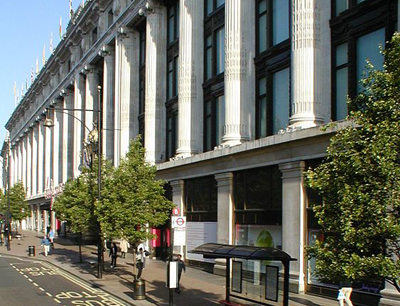
Work began on his new purpose-built neo-classical department store at 400 Oxford Street soon after. Featuring rows of columns and taking up a whole block, it was designed by American architect Daniel Burnham whom Selfridge knew from Chicago and wasn’t fully completed until 1928. As mentioned in a previous post, an idea for a colossal tower on the building was never realised.

The grand opening was held on 15th March, 1909, and, a master of the theatrical, Selfridge’s publicity campaigns had ensured a crowd and as many as 30 police officers were apparently required to help hold back the crowds.

Known to his staff as The Chief, Selfridge – who now preferred the name Gordon to Harry, kept the masses talking about his store when in July that same year he put on display the plane French aviator Louis Bleriot had used when making the first flight over water. More than 150,000 people came to see it.

Selfridge, driven by his credo that “the customer is always right”, revolutionised the way the British shopped – particularly women – with his stylish display of goods in-store and in the windows, not to mention store features like the women’s toilets (a novelty for the age), Art Deco lifts, rooftop gardens and the Palm Court Restaurant (destroyed by fire caused by bombing in the 1940s). Other facilities included a post office, theatre booking office, library and an information bureau.

And the innovations kept coming: in 1910, he opened a beauty department inside the ground-floor entrance and in 1911, the Bargain Basement was born. The world’s biggest bookshop became part of the store in 1911 as well as a pet department. He also launched a delivery system using a fleet of horse-drawn vans and then petrol and electric powered vans.

And Selfridge continued to draw crowds with events ranging from a gala charity ball on the rooftop in 1913 to a showing of John Logie Baird’s televisor in 1925. In 1931, the famous clock, The Queen of Time was installed over the flagship store’s entrance.

Selfridge, who was forced to retire in 1939 after losing much of his personal fortune – thanks at least in part to his free-spending lifestyle, died in 1947.

Aside from the flagship store in London, Selfridges stores can now be found in Birmingham and Manchester (two).

PICTURE: Russ London/Wikimedia/CC BY-SA 2.5/Image cropped

For more on the history of Selfridges, see Lindy Woodhead’s Shopping, Seduction & Mr Selfridge.

LondonLife – HMS Belfast marks 45 years on the Thames…

hms-belfast

The HMS Belfast has marked 45 years since it sailed up the River Thames to its current mooring site off The Queen’s Walk, just to the west of Tower Bridge. The ship, which is Europe’s only surviving World War II cruiser and which, as well as taking part in that conflict, also saw action in the Korean War, opened to the public in 1971. More than nine million people have since visited the ship which features nine decks, all of which are open to sightseers. For more on the ship, see www.iwm.org.uk/visits/hms-belfast.

Famous Londoners – Five notable Lord Mayors of London…

The Lord Mayor’s Show will be held on 12th November so we thought in the lead-up to it, we’d look briefly at the lives of five of the notable Lord Mayors of London during the 801 years of the institution…

William Hardel: Mayor of London (the title Lord didn’t come until a century later) in 1215, Hardel was the only commoner on the committee – known as the enforcers – appointed to see that the provisions of the Magna Carta were carried out.

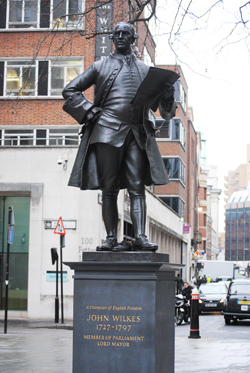
john-wilkesJohn Wilkes: A radical, politician, journalist and notorious womaniser, he was Lord Mayor of Lord in 1774. He is noted for being the subject of what is reputedly the only cross-eyed statue in London (pictured), found at the intersection of Fetter Lane and New Fetter Lane in the City of London. It is said to be a true-to-life depiction.

David Salomans: The first Jewish Lord Mayor of London, the banker and MP was elected in 1855. One of his tasks during his time as Lord Mayor was the removal of the inscription on The Monument which had blamed Roman Catholic conspirators for the Great Fire of London.

Robert Fowler: The last Lord Mayor of London to have served in the office more than once, Fowler held the office in 1883 and 1885. Many others had done so previously – including the famous Richard ‘Dick’ Whittington – but none since.

Dame Mary Donaldson: The first female Lord Mayor of London, she was elected in 1983, having previously held the honours of being first female alderman (1975) and first female sheriff (1981). Dame Fiona Woolf became the second female Lord Mayor in 2013.

For more on the Lord Mayors, see our earlier entries on Henry Fitz-Ailwyn, Richard ‘Dick’ Whittington, William Walworth and Thomas Bludworth.

This Week in London – Museums at Night; Roman London rediscovered; and, Pablo Picasso on show…

museums-at-night From tonight (and across this weekend), museums all over Greater London will be opening their doors after usual closing time as part of the annual Museums at Night event. Among those institutions taking part in the event, produced by Culture24, are such well-known icons as the British Museum, Tower Bridge and The National Gallery as well as lesser known establishments like Queen Elizabeth’s Hunting Lodge in Chingford, Southside House on Wimbledon Common and the Grant Museum of Zoology in central London. The October event follows an earlier Museums at Night in May. For the full programme of events, see www.museumsatnight.org.uk.

Roman London is the subject of a new exhibition at the City of London Corporation’s Guildhall Library. Londinium AD43 features the work of photographer Eugenio Grosso who takes the visitors on a photographic journey through time from London’s foundations to its present. The display shows how much of London’s Roman settlement has been preserved and features photographs of locations once home to significant London sites. Runs until 31st March. For more, see www.cityoflondon.gov.uk/things-to-do/guildhall-library/Pages/default.aspx

More than 75 portraits in all media by Spanish artist Pablo Picasso can be seen at the recently opened Picasso Portraits exhibition at the National Portrait Gallery. Including well-known masterpieces and some works never seen in Britain before, the works include a group of self-portraits as well as caricatures of Picasso’s friends, lovers, wives and children and images he created inspired by artists of the past. Runs until 5th February. Admission charge applies. For more, see www.npg.org.uk.

Send all items for inclusion to exploringlondon@gmail.com.

What’s in a name?…Mansion House

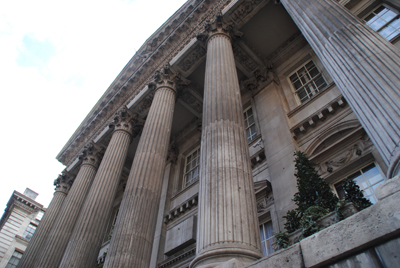
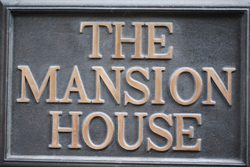
the-mansion-houseMansion House, perhaps best known as a tautological-sounding Tube station, is actually the name of the official residence of the Lord Mayor of London (a suitable subject, we felt, given the upcoming Lord Mayor’s Show in November).

mh2Designed by George Dance the Elder and built between 1739 to 1753 (many years after the idea of an official residence for the Lord Mayor was proposed in the aftermath of the Great Fire of London), the Palladian-style property – located a stone’s throw from the Royal Exchange and the Bank of England on a short stretch of street named after the property – has been the home of the Lord Mayor since the latter date.

It was built on the site of what was known as the Stocks Market (it had previously been the location of some stocks – used to punish people for various misdemeanours), the name isn’t actually as repetitive as it looks but actually means “official residence” and was previously used to designate homes which went with particular ecclesiastical jobs.

As well as accommodation for the Lord Mayor, the interior of the Grade I-listed property features two halls known as the Egyptian Hall and what was initially known as the Dancing Gallery but is now the Ballroom (we’ll be taking a more in-depth look at the property at a later date).

The Tube station opened in 1871 as the eastern terminus of the Metropolitan District Railway. Interestingly, Bank station is actually closer to the property with Mansion House station located to the south-west down Queen Victoria Street.

This Week in London – A Dutch master rediscovered; Science Museum’s new gallery; and, Rome defaced…

The first exhibition dedicated to the works of 17th century Dutch master Adriaen van de Velde has opened at the Dulwich Picture Gallery in south London. Adriaen can de Velde: Dutch Master of Landscape features more than 60 of his most accomplished works including landscapes and beachscapes as well as red chalk preparatory studies, pen and ink drawings and watercolours. There’s also a selection of his larger works including Portrait of a Family in a Landscape and Landscape with cattle and figures. Part of the Rediscovering Old Masters: The Melosi Series being shown at the Dulwich Picture Gallery, the exhibition is being held in partnership with the Rijksmuseum in Amsterdam. Runs until 15th January. For more, see www.dulwichpicturegallery.org.uk.

• The Science Museum in South Kensington has opened its “most ambitious” interactive science gallery featuring interactive exhibits, artworks, live demonstrations and immersive experiences. Wonderlab: The Statoil Gallery, which cost £6 million to create, features more than 50 exhibits in seven zones and spans topics as diverse as sound, forces, light and mathematics. Highlights include a giant interactive orrery (mechanical model of the solar system), the chance to explore the effects of different materials on a friction slide and live science shows featuring explosions, rockets, and space. Admission charges apply. For more, see www.sciencemuseum.org.uk/wonderlab.

 A free exhibition focusing on defaced coins and other objects has opened at the British Museum. Defacing the past: damnation and desecration in imperial Rome takes on Roman history from the view of the defacer and features coins of Caligula and Nero – the first emperors to suffer ‘damnation’ after their deaths, as well as defaced images of Domitian and Commodus, both of whom were killed by conspirators as a result of their extravagant and autocratic behaviour. Runs in Room 69a until 7th May. For more, see www.britishmuseum.org.

Send all items for inclusion too exploringlondon@gmail.com.

LondonLife – Heathrow gets greener…

heathrow-garden-gateThe UK’s first airport “garden gate” – featuring some 1,680 plants – has been planted at Heathrow’s Terminal 3 in a six month trial of the concept which could see the garden gates being implemented across the airport. Designed by urban greening specialists Biotecture, the installation at Gate 25 covers seven different sites in the gate room and features plants such as English native ivy and the Peace Lily and provides an “eco-sanctuary”, conveying a sense of calm to passengers as they embark on their journey.

A Moment in London’s History – The (other) Great Fire of London…

fireOf course, the Great Fire of London in 1666 is only one of numerous fires which have occurred in London (although it was no doubt the greatest in terms of destruction). But among others was a fire in 1212 which has been described as London’s worst in terms of the death toll which some have put as high as 3,000 (although it’s generally believed it’s unlikely to have been that high).

The fire, which only came some 77 years after another great conflagration destroyed a stretch of the city reaching from Westminster to St Paul’s Cathedral in 1135, began in Southwark on 10th July (hence it’s also known as the Great Fire of Southwark). Crossing London Bridge, it went on to destroy a large part of the City itself.

As well as destroying buildings on London Bridge including houses and the chapel (the structure itself, having recently been rebuilt in stone, survived somewhat intact although it only remained in partial use for some time afterward), also destroyed the Southwark church known as St Mary Overie (precursor to today’s Southwark Cathedral) as well as many buildings around Borough High Street.

There were apparently numerous deaths – the story goes that many of them occurred when a mass of people poured onto London Bridge from the City as they attempted to cross to Southwark to help put out the fire (or perhaps just gawk at it).

They were trapped in the middle of the bridge when, with the south end was already ablaze, the north end caught fire from sparks. As well as suffering fatally from the effects of flames and smoke, people were apparently crushed in panic and others were pushed off the bridge to drown in the River Thames (along with some of the boat crews who tried to rescue them).

And, just as the Great Fire of 1666, the fire of 1212 did result in some building reforms including the placement of a ban on the use of thatch for rooves.

This Week in London – The Queen’s House reopens; Caravaggio at The National Gallery; and, Victorian entertainments at the British Library…

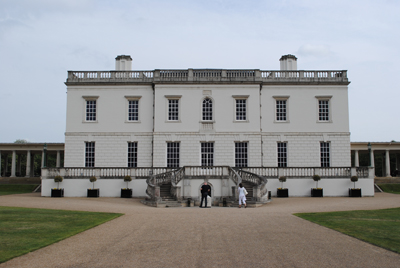
the-queens-houseThe Queen’s House in Greenwich has reopened this week following more than a year long restoration to mark its 400th anniversary. The property was designed by Inigo Jones for King James I’s wife, Queen Anne of Denmark (supposedly it was a gift from the king, given as an apology for swearing in front of her after she accidentally killed one of his dogs while hunting), and, commissioned in 1616 (but not finished until 1636, well after Queen Anne’s death), is regarded as Britain’s first fully classical building. The newly reopened premises houses more than 450 works of art from the National Maritime Museum’s collection and a new gold leaf artwork – inspired by the newly restored Tulip Stairs – on the ceiling of the Great Hall created by Turner Prize-winning artist Richard Wright. Other attractions include Gentileschi’s painting Joseph and Potiphar’s Wife, which has returned to the house, where it is on display in the King’s Presence Chamber, for the first time since 1650, and the iconic Armada Portrait of Queen Elizabeth I, which is now on permanent display. Entry to the property is free. The property’s reopening is being accompanied by a series of talks. For more, see  www.rmg.co.uk/queens-house.

The first major exhibition to explore the work Italian artist Caravaggio has opened at The National Gallery on Trafalgar Square this week. Beyond Caravaggio features 49 paintings traces the life of Michelangelo Merisi da Caravaggio (1571-1610), from his early years in Rome producing highly original works depicting youths, musicians, cardsharps and fortune-tellers through to his sensational first public commission in 1600 and the many commissioned works which followed, his two trips to the Kingdom of Naples (both times while fleeing the law, the first after committing murder), and how his works inspired – and were reflected in the works of – other painters. Works on show include Caravaggio’s Boy Bitten by a Lizard (1594-95) and The Supper at Emmaus (1601), as well as the recently discovered The Taking of Christ (1602) and Saint John the Baptist in the Wilderness (1603-04) along with a host of works from other painters. The exhibition is a collaboration with the National Gallery of Ireland and the Royal Scottish Academy and will head to these institutions after it finishes its run at The National Gallery on 15th January. Admission charge applies. For more, see www.nationalgallery.org.

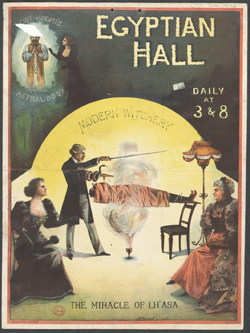
egyptian-hallA free exhibition exploring the popular Victorian entertainments which have shaped today’s theatrical traditions opens at the British Library in King’s Cross tomorrow. Victorian Entertainments: There Will Be Fun focuses on five performers who were instrumental entertainers during the 19th century – from mesmerist Annie De Montfort and ‘Royal Conjurer’ Evasion to Dan Leno – the “funniest man on earth”, circus owner ‘Lord’ George Sanger and magician John Nevil Maskelyne of the Egyptian Hall. The display features decorative posters, handbills, musical scores, advertisements and tickets and  includes items drawn from the 6,000 pieces of printed ephemera contained in the library’s Evasion collection as well as original sound recordings, artefacts on loan from The Magic Circle Museum and memorabilia from the Egyptian Hall in London. Five original performance pieces have been commissioned for the exhibition and every Saturday until 17th December, a company of actors and performers will present archive material from the exhibition in a contemporary performance. There’s also an extensive events programme accompanying the exhibition. Runs until 12th March. For more, see www.bl.uk/events/victorian-entertainments-there-will-be-fun. PICTURE: Modern Witchery Maskelyne at the Egyptian Hall; © British Library Board

Send all items for inclusion to exploringlondon@gmail.com.