This Week in London – Wellington Arch marks the Battle of Waterloo; Shakespeare’s Globe celebrates the Bard’s birth; and the ‘cathedral on the marsh’ open day…

The Battle of Waterloo comes under the microscope in a new exhibition opening at Wellington Arch on Hyde Park Corner tomorrow. Wellington Arch: Waterloo 1815 – The Battle for Peace provides an overview of the battle and the reasons which led to it, the people involved and the battle’s legacy. Displayed items include the sword the Duke of Wellington carried at the battle, his handwritten battle orders and an original pair of ‘Wellington boots’ as well as, of course, the arch itself, which was built in 1825-27 as a monument to Wellington’s victories over Napoleon. Admission charge applies. For more, see www.english-heritage.org.uk/visit/places/wellington-arch/.

Shakespeare’s Globe in Southwark celebrates the Bard’s birthday with a Hamlet-themed day of free family events this Sunday. Along with an Elsinore bouncy castle, there will be sword-fighting demonstrations, ‘skull’ coconut shies and a grave-digging ball pool while actors who have taken on the role of Hamlet over the years while appear on stage attempting to deliver the quickest ever reading of the play and famous film adaptions of Hamlet will be playing on screen around the site. The day will also mark almost a year since Shakespeare’s Globe embarked on an unprecedented two year global tour of Hamlet taking in every country in the world in honour of last year’s 450th anniversary of Shakespeare’s birth. The birthday event at the Globe runs between 11am and 4.30pm. For more, see www.shakespearesglobe.com.

The famous “cathedral on the marsh” – the Crossness Pumping Station –  is open to the public this Sunday, the first of five days it will be open this year. The pumping station at Abbey Wood in south-east London was built by Sir Joseph Bazalgette as part of a general sewerage system upgrade and was opened by the Prince of Wales in 1865. The Grade I-listed Beam Engine House was constructed in the Romanesque-style and features some of the “most spectacular ornamental Victorian cast ironwork” to be found today. The day runs from 10.30am to 4pm. Admission charges apply but no booking is required. For more, see www.crossness.org.uk.

Send all items for inclusion to exploringlondon@gmail.com. 

LondonLife – New galleries link Museum of London with current events…

Looking-for-Londoners-6The Museum of London has opened two new display spaces which feature new archaeological discoveries, reveal the relevance of the museum’s collection to current events in London and showcase objects not usually on display. Opened last week, Looking for Londoners currently features objects uncovered during recent excavations to improve the Baitul Aziz Mosque at Dickens Square in Southwark, including the skull of an 18th century longhorn cow, pots used in burying Roman remains, and as child’s cup dating from the mid-19th century believed to have belonged to Richard Greenfield, born in 1847 as the fourth child of grocer Samuel Greenfield and his wife Mary Ann (pictured). Show Space’s current display, meanwhile, is themed on the idea of ‘spring’ and Londoners attempts to bring nature into the capital with objects including a ‘spring’ fancy dress outfit worn in the late 1890s to a ball in the Portsmans Rooms in Baker Street, cupcake coloured porcelain figurines featuring various embodiments of spring and a ‘mystery gnome’. Access to the new permanent galleries is free. For more, see www.museumoflondon.org.uk. PICTURE: © Museum of London

This Week in London – 70 years of British history in the spotlight at the Hayward; Napoleonic propaganda at the British Museum; pick the copy at the Dulwich Picture Gallery; and, Fulham Palace during World War I…

The last 70 years of British history is under the spotlight at the Hayward Gallery, South Bank, in a new exhibition, History is Now:7 Artists Take on Britain. As the title suggests, seven UK-based artists – John Akomfrah, Simon Fujiwara, Roger Horns, Hannah Starkey, Richard Wentworth and Jane and Louise Wilson – are each looking at a particular period of cultural history spanning the years from 1945 to today. The artists have selected more than 250 objects from public and private collections and have displayed these along with photographs, newspapers, films, domestic items and artefacts. The exhibition, which runs until 26th April, is part of the Southbank Centre’s Changing Britain 1945-2015 Festival which runs until 9th May. For more, see www.southbankcentre.co.uk.

The use of Napoleon’s image in propaganda during the Napoleonic Wars is the subject of an exhibition which opened last week at the British Museum in Bloomsbury. Bonaparte and the British: prints and propaganda in the age of Napoleon looks at how propaganda was used on both sides of the channel and includes works by both British and French satirists. Among British artists whose work is featured is that of James Gillray, Thomas Rowlandson, Richard Newton and George Cruikshank and the exhibition also features a range of objects – mugs, banners and even Napoleon’s death mask – drawn from the museum’s collection. The exhibition, which runs until 16th August, is free and can be found in Room 91. For more, see www.britishmuseum.org.

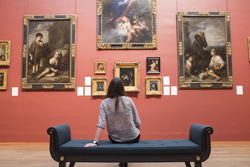
DulwichCan you pick a copy? Visitors to the Dulwich Picture Gallery in the city’s south have the opportunity to test their skills with a new initiative which has seen a Chinese replica placed somewhere among the 270 Old Master paintings on display. Made in China: A Doug Fishbone Project explores the nature and importance of the concept of the original versus that of the copy and the role of art as commodity. People have three months – until 26th April – to visit the gallery and find the replica painting before submitting their answers via an iPad in the gallery (those who correctly identify it will be entered into a competition to win a custom print from the gallery’s collection signed by the American artist Doug Fishbone). The replica will be revealed on 28th April when it will hang side-by-side with the original. Admission charge applies. For more, see www.dulwichpicturegallery.org.uk. PICTURE: © Stuart Leech/Dulwich Picture Gallery.

• The Talk: Isambard Kingdom Brunel – The man who built the world. Robert Pulse, director of The Brunel Museum, will give a free talk about the life and achievements of the great Victorian engineer Brunel at the John Harvard Library 211 Borough High Street on 17th February at 6.30pm. For more information, follow this link.

On Now: Fulham Palace through the Great War. This exhibition at the former home of the Bishop of London on the Thames River in west London tells the story of the palace during World War I and examines the lives of those connected with the palace who died in the conflict, such as William Burley, son of Bishop Winnington-Ingram’s chauffeur. It tells how the bishop – described as an “enthusiastic” recruiter – visited the frontline in 1915 and how, in 1918, the palace was occupied by a Red Cross hospital. Runs until 16th April. Entry is free. For more, see www.fulhampalace.org/visiting-whats-on/exhibitions/.

Send all items for inclusion to exploringlondon@gmail.com.
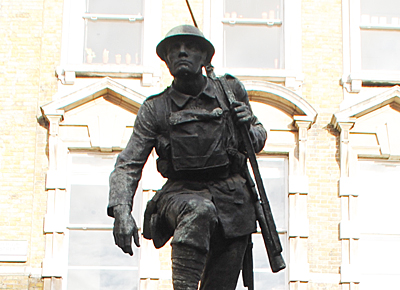
10 of London’s World War I memorials – 2. Borough High Street War Memorial…

Southwark

Recently restored ahead of the World War I centenary, the St Saviour’s parish war memorial in Southwark was  designed by Captain Philip Lindsey Clark, awarded the Distinguished Service Order for his service during the war.

Unveiled in November, 1922, it features a bronze figure depicting an advancing infantryman atop a plinth and has bronze panels on either side of the plinth featuring scenes of battleships and of bi-planes. The figure of St George and the dragon can be found on the front of the plinth and a mourning woman, depicting Grief, with a baby and a dove on the rear.

The Grade II-listed memorial, which is located on a traffic island, is dedicated to “the men of St Saviour’s Southwark who gave their lives for the Empire 1914-1918”.

The recent restoration project, which came after one of the relief panels fell off in 2011, was funded by Borough, Bankside & Walworth Community Council’s Cleaner Greener Safer programme. The picture (above) was taken before the restoration.

This Week in London – Breaker’s Yard opens at Sutton House; WWI remembered; and, preparing for an Open House…

A former car breaker’s yard in Hackney has reopened as a “pocket park” of “installations and hidden spaces” following an extensive transformation project. Located next to the National Trust’s Tudor manor house, Sutton House, Breaker’s Yard incorporates elements from the site’s history including car tyres, a bus greenhouse, bespoke metal gates made out of more than 1,000 toy cars donated by celebrities, locals and artists, and a multi-storey caravan sculpture, The Grange, created by landscape designer Daniel Lobb who also designed the park in collaboration with arts-based educational charity, The House of Fairy Tales. The flower-filled park also features an ice-cream van, decorated by Rose Blake – daughter of Sir Peter Blake, which will act as a “playful shop”. The park is one of a 100 ‘pocket parks’ created under a $2 programme by the Mayor of London, Boris Johnson, in this case in collaboration with the National Trust and a host of volunteers. Entry to the park is free but admission charge applies to the house. For more on the park and Sutton House, see www.nationaltrust.org.uk/sutton-house/.

A photographic exhibition, Exploring London’s First World War Memorials, is running at City Hall near Tower Bridge in Southwark. Organised by the Mayor of London with aid from the War Memorials Trust, English Heritage and others, the exhibition is centred on new images of war memorials by London-based photographer James O Jenkins. As well as more traditional monuments, the memorials take the form of everything from fountains to paintings, buildings and landscape features. Entry is free. Runs until 12th September. For more, see www.london.gov.uk/events. Meanwhile, the Guildhall Library is showcasing images taken by photographer Simon Gregor for the Remembrance Image Project. Runs until 12th November and is part of a series of World War I commemorative events the library is running. Others include an installation by artist Rebecca Louise Law called Poppy made up of 8,000 paper poppies from the Royal British Legion. For more on World War I commemorative events at the Guildhall LIbrary follow this link.

Open House London’s programme is available for download from tomorrow (Friday, 15th August). The event, which will be held over the weekend of 20th and 21st September, will this year be conducted under the theme of ‘revealing’ and will feature more than 800 buildings, from Open House “favourites” like The Gherkin (aka 30 St Mary Axe) and the Foreign and India Office through to lesser known properties like Wandsworth’s Quaker Meeting House or the Butcher’s Hall in the City (some of which have to be booked before the weekend). There will also be a free programme of neighbourhood walks, engineering and landscape tours, cycle rides and talks by experts. To see the programme, head to www.openhouselondon.org.uk.

Send all items for inclusion to exploringlondon@gmail.com.
Books – ‘The Devil in the Marshalsea’…

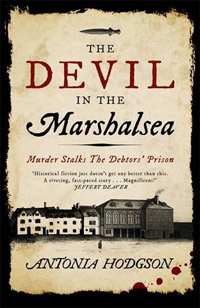
The Devil in the MarshalseaAntonia Hodgson, Hodder & Staughton, 2014

The-Devil-in-the-MarshalseaA murder-mystery set among the desperate and dangerous denizens of London’s Marshalsea Prison in 1727, The Devil in Marshalsea tells the story of lad-about-town Tom Hawkins who is tossed into the notorious prison for debt.

Hawkins’ only chance of escape is to find the killer of one Captain Roberts, who died in the jail before his arrival, and it’s a task that brings him into conflict with, and under the suspicion of, many within the prison walls.

There’s plenty of historical detail and the book delivers an insightful look into what life in Marshalsea would have been like – although as Hodgson points out in an historical note at the start, this is not the Marshalsea of Charles Dickens’ Little Dorrit – that wasn’t opened until 1800 on a different site while this one was located between Mermaid Court and what is now Newcomen Street in Southwark.

The characters are largely based on actual people – Hodgson goes to the trouble to describe the background to each in some explanatory endnotes – and their stories criss-cross the main narrative.

There’s plenty of twists along the way and the story plunges on at a cracking pace as Hawkins has to confront his worst fears and struggles to discern who is friend and who is foe in a world where everyone appears to be driven by their most base desires.

An enlightening read and, as is the case with a good murder-mystery, hard to put down. A terrific debut.

To buy this book, follow this link The Devil in the Marshalsea.

10 sites from Shakespearean London – 6. Shakespearean connections in the Elizabethan world: The George Inn and Middle Temple Hall…

Today we’re taking a look at a couple of still extant London buildings which have strong associations with playwright William Shakespeare…

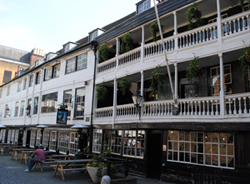
George-InnThe George Inn, Southwark. Located at 75-77 Borough High Street, the George Inn is London’s last remaining galleried inn. The current building has its origins in the late 17th century after the original inn, which can be traced back to at least the mid-1500s – was destroyed in a fire in 1676. Now owned by the National Trust, it is leased out and remains open as a public house – part of the Greene King chain. While its known for its connections with 19th century writer Charles Dickens – he was a patron of this establishment and mentions it in Little Dorrit (a fact we mentioned in our series on Dickens back in 2012), the inn (or at least the previous version of it) also has Shakespearean connections with its prime Southwark location meaning it’s quite possible Shakespeare himself may have visited. Whether that’s the case or not, it is known that the premises served at time as a theatre of sorts in his day with acting troops performing in the courtyard while audience members could stand in the courtyard and watch or pay extra for a seat in the gallery. For more on the inn, see www.gkpubs.co.uk/pubs-in-london/the-george-inn-pub/.

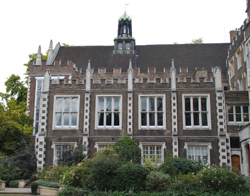
Middle-Temple-HallMiddle Temple Hall. Built between 1562 and 1573 by Edmund Plowden (memorialised with monuments in both the hall and nearby Temple Church), this magnificent Tudor hall has survived both the Great Fire of London and the Blitz and continues to serve the legal profession today. It too was used as a theatre/concert hall in Elizabethan times and later as a site for Inigo Jones’ masques but in terms of the Shakespearean connection, it is known for being where the first recorded performance of Twelfth Night took place – on the night of Candlemas (2nd February) 1602. The Lord Chamberlain’s Men performed the play and it is thought that Shakespeare himself was among the players. For more on the hall, which is only rarely opened to the public, you can visit our earlier posts here and (on ‘Drake’s Cupboard) here or the official website at www.middletemple.org.uk/home/.

For more on the George Inn, check out Pete Brown’s social history Shakespeare’s Local: Six Centuries of History Seen Through One Extraordinary Pub.


Famous Londoners – Philip Henslowe…

A contemporary of William Shakespeare (and hence, given our current focus on Shakespeare, the reason why we’re featuring him), Philip Henslowe was a theatre owner and impresario who, along with John Chomley, built the Rose Theatre in Bankside.

Henslowe is believed to have been born in about 1550 and was the son of Edmund Henslowe, master of the game at Ashdown Forest in Sussex. He is known to have moved to London in the 1570s and there became an apprentice to dyer Henry Woodward. Marrying Woodward’s widow Agnes, from 1577 Henslowe lived in Southwark – in the Liberty of the Clink – where, along with other business interests including bringing in timber from Sussex, he is known to have been a prominent landlord.

He and Chomley built The Rose Theatre – the first theatre in Bankside – in 1587 on land Henslowe had purchased several years earlier and from 1591 onwards, he partnered with the acting company known as the Admiral’s Men (they had parted ways with theatre owner James Burbage after a dispute about money). In fact it was the company’s leading actor, the renowned Edward Alleyn, who married Henslowe’s step-daughter Joan.

Following the arrival of the rival Globe Theatre in Bankside in the late 1590s, Henslowe decided to make a move and built the Fortune Theatre in the north-west corner of the City which subsequently became home to the Admiral’s Men. He is also believed to have had interests in several other theatres – Newington Butts, the Swan and more latterly, the Hope in Paris Garden, a versatile facility which could be used as both animal-baiting ring and theatre.

His prominence in business matters led to many rewards including serving as a Groom of the Chamber during the reign of Queen Elizabeth I and the delightfully named Gentleman Sewer of the Chamber during the reign of King James I.

He died in 1616, leaving behind a diary which spans the period 1592 to 1609 – it includes mention of performances of many of Shakespeare’s plays and although the Bard himself doesn’t get a mention, many of his contemporaries – Christopher Marlowe and Ben Jonson included – do. The diary – which had been written in an old account book and provides great detail of Henslowe’s theatre-related business – passed into the care of Dulwich College which his son-in-law had founded.

Click here to buy Henslowe’s Diary.

10 sites from Shakespearean London – 5. Other Elizabethan theatres…

Last week we had a look at two former theatres in Shoreditch which had strong associations to William Shakespeare and in previous weeks we’ve talked about both The Globe and Blackfriars Playhouse. So this week we thought we’d wrap up our look at Elizabethan theatres with a brief glance at a couple of other theatrical establishments which may have had some association with The Bard…

The Rose. Built by Philip Henslowe in 1587, the theatre is located close to where The Globe later stood in Bankside. Many companies performed here – including Lord Strange’s Men in 1592 when, according to some, Shakespeare may have been the actors in the company. The theatre’s remains are open to the public. For more on The Rose, you can see our earlier Lost London entry.

The Swan. Built by Francis Langley in the mid 1590s in the Paris Gardens area in the west of Bankside, The Swan was the most impressive of London’s theatres when first constructed due to both its size – it’s believed to have held an audience as big as 3,000 people – and the manner of its construction. It’s a matter of debate whether the Lord Chamberlain’s Men – the acting troupe Shakespeare was a part of – ever performed here while waiting for the Globe to be built. By the early 1630s, the theatre had apparently fallen into disrepair.

Newington Butts. In use from 1580, this theatre was located in Surrey (the name is now preserved in that of the street still known as Newington Butts just to the south of the Elephant & Castle roundabout). Little is known about the theatre but it’s believed the Lord Chamberlain’s Men played here in the mid 1590s and apparently gave their earliest known performances of a number of Shakespeare’s plays including Titus Andronicus and The Taming of the Shrew took place. Butts were typically used in the national sport of archery but that may not apparently be the explanation behind the name here which may instead refer to an odd-shaped area of land.

For more on Elizabethan theatre, check out Elizabethan-Jacobean Drama: The Theatre in its Time.

10 sites from Shakespearean London – 4. Shakespeare’s Shoreditch theatres…

While the association between the Bard and Bankside’s Globe Theatre is well known (see our earlier post here for more), the Bard and his plays were also performed in various other theatres around London. Here we take a quick look at a couple in Shoreditch, then a more rural suburb of London known for its associations with the (somewhat seedy) entertainment industry…

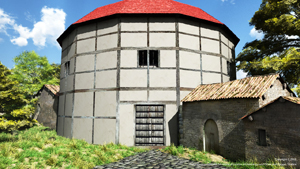
The-Theatre The Theatre, Shoreditch. Built in 1576 by James Burbage on property that had once been part of Holywell Priory, the Theatre was the home of a number of acting companies including The Lord Chamberlain’s Men of which Shakespeare was a member. The polygon-shaped theatre served as the home of the company between 1594 and 1598 when a dispute with a landlord over the lease led them to leave, temporarily settling at The Curtain Theatre, before rebuilding their theatre, now renamed The Globe, in Southwark. Between 2008 and 2010, archaeologists from Museum of London Archaeology (MOLA) carried out an investigation beneath a disused warehouse in New Inn Broadway, near the intersection of Curtain Road and Great Eastern Street, and found the remains of a 14 sided theatre about 22 metres across. Plans have been mooted to build a new theatre on the site. To find out more about The Theatre and see a terrific animated recreation by Cloak & Dagger Studios and MOLA (pictured), head to www.explorethetheatre.co.uk. PICTURE: Courtesy of MOLA (Museum of London Archaeology) and Cloak and Dagger Studios.

The Curtain Theatre, Shoreditch. The Lord Chamberlain’s Men only performed here temporarily, between 1598-1599, before relocating to Southwark. Henry V (the reference to “this wooden O” in the prologue of the play is taken to refer to this theatre) and Romeo and Juliet are believed to be among Shakespeare’s plays which premiered here. Located just a couple of hundred yards south of The Theatre and built the year after it, it also hosted Ben Jonson’s Every Man in his Humour, a play in which Shakespeare is known to have performed. The polygonal theatre’s name comes from the road on which it stood – Curtain Road, which, it has been suggested, was named after the Holywell Priory’s ‘curtain wall’. It continued as a theatre until the 1620s and was later converted into tenements. The remains of what is believed to have been the Curtain Theatre were found by MOLA archaeologists in 2012 and further excavations are expected with the hope that one day the site will be open to the public with plays performed here. There is a plaque commemorating the site at 18 Hewett Street which is only a short distance from where the excavations were carried out. For more on the Curtain Theatre, check out www.shakespearesshoreditch.com.

For more on Elizabethan theatres, see Julian Bowsher’s Shakespeare’s London Theatreland: Archaeology, History and Drama.

10 sites from Shakespearean London – 3. Shakespeare’s houses…

The playwright is believed to have lived in several different locations in London and is also known to have invested in a property. Here we take a look at a couple of different locations associated with him…

St-Helen'sBishopsgate: Shakespeare is believed to have lived here in the 1590s – in 1596 tax records show he was living in the parish of St Helen’s. The twin-nave church of St Helen’s Bishopsgate (pictured), which would have been his parish church, still stands. In fact, there is a window to Shakespeare’s memory dating from the late 19th century.

•  Bankside: In the late 1590s, Shakespeare apparently moved across the Thames to Bankside where he lived at a property on lands in the Liberty of the Clink which belonged to the Bishop of Winchester. The exact address remains unknown.

Silver Street, Cripplegate: It’s known that in 1604, Shakespeare moved from Bankside back to the City – it’s been speculated outbreaks of plaque may have led him to do so. Back in the City, he rented lodgings at the house of Christopher and Mary Mountjoy in on the corner of Monkwell and Silver Streets in Cripplegate, not far from St Paul’s Cathedral. Mountjoy was a refugee, a French Huguenot, and a tire-maker (manufacturer of ladies’ ornamental headresses). The house, which apparently stood opposite the churchyard of the now removed St Olave Silver Street, was consumed in the Great Fire of London in 1666 (the church was also lost in the Great Fire). The former church site is now located on the south side of London Wall. Silver Street itself was wiped out in the Blitz and is now lost under the Barbican redevelopment but the house lives on in a representation found on a late 16th century map created by Ralph Agas.

Ireland Yard, Blackfriars: In 1613, Shakespeare purchased the former gatehouse of the Blackfriars Priory located here, close to the where the Blackfriars Theatre was located. It is believed the property was purchased as an investment – there’s no evidence he ever lived there but it was passed to his daughter Susanna after his death. Incidentally, there is some speculation that Shakespeare may have lived in Blackfriars when he first came to London – a man believed to have been a boyhood friend from Stratford, Richard Field, who was known to have lived there.

For a more in-depth look at Shakespeare’s time in Silver Street, see Charles Nicholl’s The Lodger: Shakespeare on Silver Street.

Famous Londoners – Christopher Marlowe…

Born the same year as Shakespeare, Christopher Marlowe was, like him, one of the foremost dramatists of the Elizabethan era.

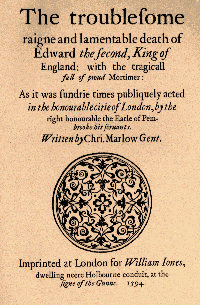
EdwardiiquartoBorn in Canterbury the son of shoemaker John Marlowe and his wife Catherine in 1564 (he was baptised on 26th February and likely to have been born a few days before), Marlowe attended the King’s School in the city and went on to study at Corpus College in Cambridge, receiving a Bachelor of Arts in 1584 and a Master of Arts in 1587. It is believed that at around this time, he was also working secretly for the government of Queen Elizabeth I, although what the nature of that work was remains unknown.

While Marlowe’s first play was Dido, Queen of Carthage, he first found theatrical success in 1587 with Tamburlaine the Great, later followed with a second part. His other four plays included The Jew of Malta, Edward the Second, The Massacre at Paris about the St Bartholomew’s Day Massacre in 1572, and Doctor Faustus.

The plays served as key works for the Admiral’s Men, the company of Edward Alleyn who performed many of the key roles in the plays, and who is strongly associated with the Rose Theatre  – indeed it was here that Tamburlaine the Great, The Jew of Malta, and Doctor Faustus premiered (you can see our earlier post on the theatre here).

Marlowe, who is known to have lived in Shoreditch, also completed other works included poetry and translations and while there is little evidence about his personal life, there is much speculation including that he was, as aforementioned, a spy as well as a carouser (he is known to have frequented taverns in London including Ye Olde Cock in Fleet Street), a homosexual and/or a heretic. It has also been suggested he was a tutor to noblewoman Arabella Stuart.

It is known that he was arrested in 1592 in Flushing in The Netherlands for counterfeiting coins and was sent back to England but no further action was taken.

His death is one of the big mysteries of his life. A warrant was issued for Marlowe’s arrest over some heretical tracts which were found in the lodgings of his colleague Thomas Kyd (who when questioned apparently implicated him) and he appeared to answer to the Privy Council on 20th May, 1593. They weren’t sitting and he was apparently instructed to appear daily until further notice. He was dead 10 days later.

The exact circumstances of his death remain a matter of speculation. It is often said he died in a drunken brawl with one early source suggesting this was over a homosexual love affair and another, more recent, theory suggesting he even faked his own death to avoid being executed for heresy (an extrapolation of this theory goes that after his fake death he continued writing plays under the name of William Shakespeare but this is generally deemed fairly far-fetched). The official account recorded at the time was that he was stabbed to death in a brawl over payment of a bill with men at a house in Deptford.

He was buried in an unmarked grave at St Nicholas’ Church in Deptford. There is a memorial window to him in Poet’s Corner in Westminster Abbey. A gift of the Marlowe Society, it was unveiled in 2002 and controversially included a question mark after the generally accepted date of his death. There is a portrait, dated 1585,  generally believed to be of Marlowe at Cambridge.

PICTURE: Title page of the earliest known edition of Edward II (1594)/Wikipedia

10 sites from Shakespearean London – 2. Southwark Cathedral…

Southwark-Cathedral1

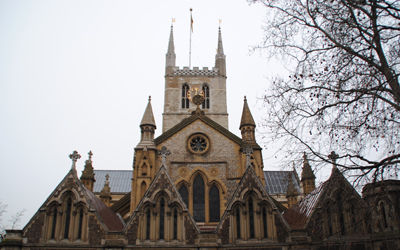
Located close to the Bankside theatres where William Shakespeare’s plays would have been performed, Southwark Cathedral – known then as St Saviour’s Church – has plenty of connections to the Elizabethan theatre world.

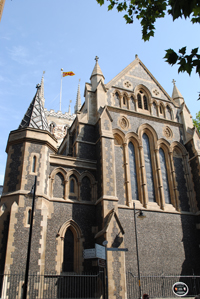
Southwark-Cathedral2Not only was the Bard’s youngest brother, the actor Edmund, buried here in 1607 (the grave is unmarked but there’s a commemorative stone in the floor of the choir), the playwrights John Fletcher and Philip Massinger and theatre owner Phillip Henslowe were also buried here. And like them, another theatre owner (and Henslowe’s son-in-law), Edward Alleyne, also held positions at the church.

The cathedral has several memorials to Shakespeare. These include a memorial window in the south aisle – unveiled in April 1954 on the anniversary of Shakespeare’s death, it depicts characters from some of his works and was designed by Christopher Webb to replace an earlier window which had been destroyed during World War II. Below it is an alabaster reclining figure of the playwright set against a relief of Southwark as it appeared during the 17th century. Carved by Henry McCarthy, it was unveiled in 1912.

The history of the church is believed to go back to at least Saxon times. Between 1106 and 1538, it served as the church of the Augustinian Southwark Priory and was dedicated to St Mary Overie. Following the Dissolution in the mid 16th century was re-dedicated as the parish church of St Saviour’s. It only became a cathedral in 1905 with the creation of the Diocese of Southwark. While some scant parts of the building date back to the 12th century  (the church was rebuilt after a fire in the 13th century), much of it has been altered.

 For more on Elizabethan England, check out Ian Mortimer’s recent book The Time Traveller’s Guide to Elizabethan England.

10 sites from Shakespearean London – 1. The Globe…

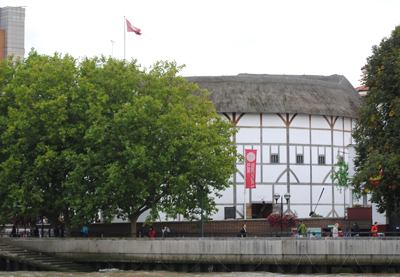
The-GlobeMention William Shakespeare and London in the same breath and everyone immediately thinks of one building – the reconstructed Globe on Bankside. So we thought that to kick off our new series – being run in honour of the 450th anniversary of the playwright’s birth – we’d take a look at history of the iconic structure.

The-Globe2The original Globe Theatre, located a few hundred metres to the south, opened in 1599 as a home for the actors’ company known as the Lord Chamberlain’s Men (later renamed the King’s Men on the accession of King James I in 1603), of which Shakespeare was a member. Founded by James Burbage, this merry band was originally was housed at London’s first purpose-built playhouse Shoreditch before lease disputes led them to establish a new theatre in Southwark, close to the then existing theatre, The Rose.

Up and running by 1599 (Shakespeare was among four actors who bought a share in the property to help fund the new building which used timbers from the former Shoreditch theatre), the new theatre was used for 14 years until, during a performance of Henry VIII in 1613, wadding from a stage cannon ignited and the theatre burned to the ground. Rebuilt with a tiled roof, it remained the home of the company until it was closed down by the Puritan government in 1642 and demolished two years later.

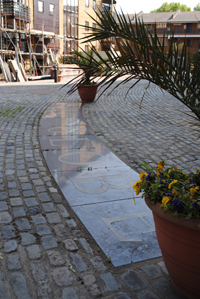
You can see the original site of The Globe just in nearby Park Street. The shape of the structure is marked by a dark line embedded in the pavement (pictured).

The reconstructed building which stands proudly by the water today was the vision of the late American actor, director and producer, Sam Wanamaker. He founded the Shakespeare Globe Trust which, with the on-site assistance of Queen Elizabeth II, opened the theatre at its current site in 1997 (sadly, Wanamaker had died three-and-a-half-years previously).

The building’s design was drawn from sifting through what little historical evidence could be found including the findings of an archaeological dig at the original site, descriptions contained in Shakespeare’s plays (including the line from Henry V – “Or may we cram within this wooden ‘O’), and printed panoramas from the time, although it should be noted that much – particularly the design of the stage – is speculative.

Meanwhile the techniques used in the construction of the theatre were the subject of years of research and were in accord with those of the early 17th century  and included using oak laths and staves to support lime plaster and then covering the walls in white lime wash while the roof was made of water reed thatch.

One of the best ways to see the theatre and make the most of the atmosphere is to see a play from a standing position in the pit!

WHERE: Globe Theatre Exhibition & Tour, Shakespeare’s Globe, 21 New Globe Walk (nearest Tube stations are Southwark and London Bridge); WHEN: Exhibition is open 9am to 5.30pm daily – tours run at various times, see website for details; COST: Exhibition and tour cost is £13.50 adults/£12 seniors/£11 students/£8 children (5-15 with children under five free)/£36 family of four; WEBSITE: www.shakespearesglobe.com.

A Moment in London’s History – When London Bridge was pulled down…

This year we’re launching a new regular edition to Exploring London in which we take a brief look at a moment in the city’s long and colourful history.

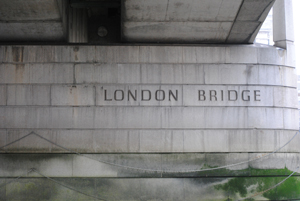
London-BridgeFirst up, we travel back exactly 1,000 years to 1014. The story – recorded in Viking Skaldic poetry but apparently not in Anglo-Saxon sources – goes that during the ongoing conflict between the Danes and Anglo-Saxons, the Danish had taken the city, occupying both the city proper and Southwark. At that stage, there was a timber bridge crossing the Thames.

Desperate to regain the city (the Viking ruler Sweyn died on 3rd February that year – this may have been why the attack was launched), the Anglo-Saxon King Æthelred (known to history as ‘the Unready’) and his Norwegian Viking allies apparently under King Olaf II sailed up the Thames in a large flotilla.

Despite meeting fierce resistance from the Danish occupiers – they lined the bridge and attacked the invasion force with spears – the attackers, apparently using thatching stripped from the rooves of nearby houses to shield themselves, managed to get close enough to attach cables to the bridge’s piers and then pull the bridge down.

There’s much speculation that the song London Bridge is falling down was inspired by the incident but it, like much of this story itself, remains just that – conjecture (but it’s still a nice story!)

The bridge was subsequently rebuilt and King Æthelred died only two years later, on 23rd April, 2016. The crown passed to his son Edmund Ironside but he too died after ruling for less than a year before the Viking Canute was crowned king.

For more on the history of London Bridge, see our earlier posts Lost London – London Bridge and Lost London: Gates Special – The Stone Gate, London Bridge.

PICTURE: Not the original London Bridge

London Pub Signs – The Barrowboy and Banker…

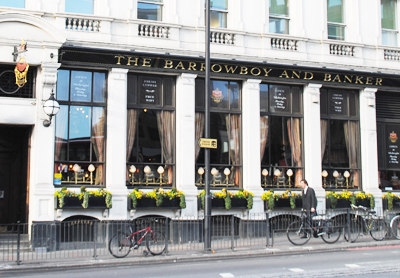
The-Barrowboy-&-Banker

Located just a hop, skip and a jump from the ever-popular Borough Market in Southwark, this oddly monikered pub’s name comes from two separate parts of its history.

The ‘barrowboy’ part refers to the barrow boys or costermongers who used to ply their trade at the nearby market, carting their produce in barrows.

The ‘banker’ part refers to the origins of the building in which the Grade II-listed premises at 6-8 Borough High Street is located. Like one of our previous posts (see The Counting House), it was formerly a bank – in fact, it claims to have been the first ever branch of the National Westminster Bank, which opened in 1970 after the National Provincial Bank and Westminster Bank merged to create what is now known as NatWest.

Some of the 19th century building’s original features – such as the high ceilings and large windows looking out onto the street – are still evident inside but one of the more interesting features – former bank vaults – aren’t open to the public. They lie beneath the bar and are now used for storage.

The pub, now known as an ale and pie house, is part of the Fuller’s chain. For more on the pub, check out http://barrowboy-and-banker.co.uk.

Treasures of London – ‘Drake’s Cupboard’…

One of the foremost seafarers of the Elizabethan age, Sir Francis Drake became the second sea captain to circumnavigate the globe when he did so in his renamed vessel, The Golden Hind, between 1577 and 1580.

Drake's-CupboardWhile it is not believed he was a member of the Middle Temple – one of the Inns of Court, he certainly had some connections and a visit to Middle Temple Hall is recorded in August, 1586, when he was congratulated having just returned from a voyage to the Spanish Indies.

His ongoing connection to the inn can be found in two objects which remain at the hall today.

The first is a ‘cupboard’, known as Drake’s Cupboard (cup board being an alternative for table), it is reputedly to have been made from a hatch cover off the Golden Hind (there’s a replica of this ship in Southwark). Replacing an earlier table, the cupboard is used in various ceremonial aspects of life at the Inn such as, for example, being the table on which members sign a book when they are called to the Bar.

The second, meanwhile, is a lantern which hangs over the entrance to the hall and was reputedly taken from the poop deck of the ship (this was destroyed during the bombings of World War II and a replica now hangs in its place).

Both items can only be viewed when the hall is opened to the public on rare occasions like the annual Open House London event. For more on Middle Temple Hall, see our earlier entry here and www.middletemple.org.uk.

Around London – Borough Market’s new map app; Richard Dimbleby blue plaqued; Manet at the RA; and, Light Show at the Hayward…

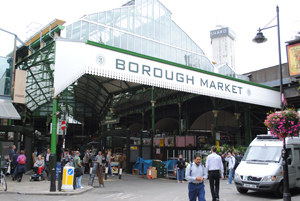
Borough Market, which claims to be London’s oldest food and drink market (see our earlier entry on the market here), has introduced a new app which provides smartphone users with an interactive map of the market so they can get information on the go. The app loads automatically when people enter the market website on their phones. Further features of the mobile site are yet to be unveiled. For more information, see www.boroughmarket.org.uk.

Broadcaster Richard Dimbleby (1913-65) has been honored with an English Heritage blue plaque at his former home in Cedar Court, Sheen Lane, East Sheen in London’s south west. Once the nation’s most famous broadcaster, Dimbleby, father of David Dimbleby, lived at the flat between 1937-39 – a time when he delivered some of his earliest radio reports including one on Prime Minister Neville Chamberlain’s return from Munich. Dimbleby’s career on radio and television spanned some 30 years and saw him reporting on some of the great events of his time. He was the BBC’s first war correspondent and was the first reporter to describe the horrors of Belsen concentration camp as well as being among the first reporters to enter Berlin where he reported from the ruins of Hitler’s bunker. Dimbleby was also commentator on television specials such as the Coronation of Queen Elizabeth II in 1953 and Winston Churchill’s funeral in 1965. For more, see www.english-heritage.org.uk/about/news/?topic=Blue%20Plaques.

On Now: Manet – Portraying Life. This display at the Royal Academy of Arts in Piccadilly’s Burlington House is the first major exhibition to showcase Edouard Manet’s portraiture in the UK. It examines the relationship between his portraits and his scenes of modern life and includes more than 50 paintings, gathered from public and private collections in Europe, Asia and the US, spanning his career from the mid 1800s to his death in 1883. The exhibition is arranged thematically with different sections looking at Manet’s family, his artist, literary and theatrical friends as well as his models. Highlights include The Luncheon (1868), Mme Manet in the Conservatory (1879), Berthe Morisot with a Bouquet of Violets (1872), Street Singer (1862), The Railway (1873) and Music in the Tuileries Gardens (1862). Admission charge applies. Runs until 14th April. For more, see www.royalacademy.org.uk.

On Now: Light Show. This installation at the Hayward Gallery in South Bank “explores the experiential and phenomenal aspects of light” and brings together sculptures and installations that use light to sculpt and shape space in different ways. The artworks date from the 1960s to the present day and are the work of 22 different artists. Admission charge applies. Runs until 28th April. For more, see www.haywardlightshow.co.uk.

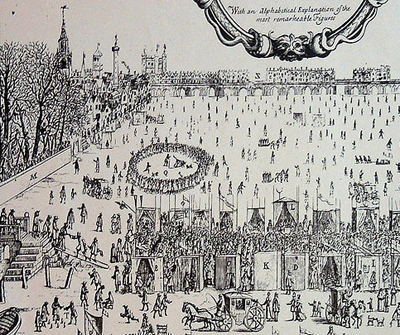
Lost London – Frost fairs…

 As London undergoes the big chill with much of the rest of the country, we thought we’d take a quick look at the frost fairs which were once held on top of the frozen River Thames.

While records reveal the Thames froze over as far back as the city’s Roman era, the first recorded ‘frost fair’ dates from the mid-16th century (Queen Elizabeth I is said to have attended one in 1564) while the last was held in 1814.

Frost_Fair_of_1683While the lower temperatures played a role in allowing the ice to get thick enough to hold frost fairs on top (the period between the 14th and 19th centuries is known as the ‘Little Ice Age’ in northern Europe), so too did the fact that the Thames was broader and shallower than it is now, not to mention the narrow arches of Old London Bridge (it was demolished in 1831 – for more on this, see our earlier entry) which slowed the waters of the Thames.

The fairs were set up in a range of locations along the river. Descriptions of them talk of a range of activities being carried out on the river’s frozen surface – yes, the use of sleds and skates but also things like bear-baiting, coach, horse racing, dancing and puppet plays as well as the setting up of booths or stalls from which traders sold food, souvenirs, and, importantly, drink.

One of the longest of the fairs – recorded by diarist John Evelyn – was held over the winter of 1683-84 and located between Temple and Southwark. It featured streets of stalls with different traders grouped in different areas. King Charles II himself was a visitor.

During the last and biggest frost fair, held on the river near Blackfriars Bridge, a street known as ‘City Road’ ran down the middle of the Thames and donkeys gave people rides.

There is a frieze depicting a ‘frost fair’ underneath the southern end of Southwark Bridge.

PICTURE: Detail of an image of the Frost Fair of 1684 with London Bridge in the background. Source: Wikipedia.

10 Historic London Markets – 1. Borough Market…

In the first of a new series looking at some of London’s most historic markets, we take a look at the history of Borough Market in Southwark, now the city’s most famous food market.

The origins of a food market in the area go back to at least to the reign of the Anglo-Saxon King Ethelred the Unready in early 11th century (some have suggested as far back as Roman times) with food vendors clustering around the southern end of London Bridge. The market was relocated to Borough High Street in the 1200s.

In 1755, traffic congestion saw Parliament close the market but Southwark residents raised £6,000 and bought a small area of land known as The Triangle – once part of the churchyard of the now long gone church of St Margaret’s – and reopened the market there.

The Triangle still remains at the heart of the market which sits partly under railway arches just to the south of the Southwark Cathedral churchyard. New market buildings were constructed in the mid 1800s but deemed “impractical”, they were replaced by new buildings in the late 1800s and 1930s (the latter was when the art deco entrance on Borough High Street was erected).

The market was refurbished in 2001 and the ornate Grade II-listed Floral Hall, which was originally the south portico on the Floral Hall at Covent Garden (taken down to make way for the Royal Opera House), was installed in 2003.

There are now more than 100 stalls in the wholesale and retail food market, making it one of the largest in London. It is owned by a charitable trust, The Borough Market (Southwark), with the volunteer trustees all local residents. Sections in the market include the Jubilee Market and the Green Market and a blue plaque, declaring the market London’s “oldest fruit and veg market”, was installed by Southwark Council earlier this year.

The amazing variety fine food on offer will tempt even the most jaded of palates but be warned that you have to queue as it can get a little packed with tourists at lunchtimes!

WHERE: 8 Southwark Street (nearest Tube Stations are London Bridge or Borough); WHEN: 10am to 3pm Monday to Wednesday, 11am to 5pm Thursday, 12pm to 6pm Friday, and, 8am to 5pm Saturday; COST: Free entry; WEBSITE: www.boroughmarket.org.uk