Olympics Special – The Olympic Torch Relay, part II…

We take a break from our regular series this week to bring you some images from the second half of the Olympic Torch Relay as it made it’s way around London toward tonight’s Opening Ceremony…


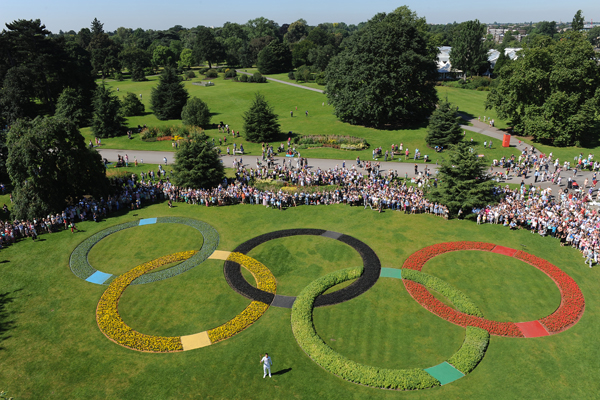
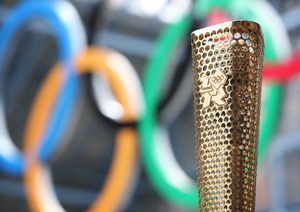
Day 67 (24th July): Tennis player Oliver Golding holds the Olympic Flame in between the Olympic Rings at Kew Gardens, London.

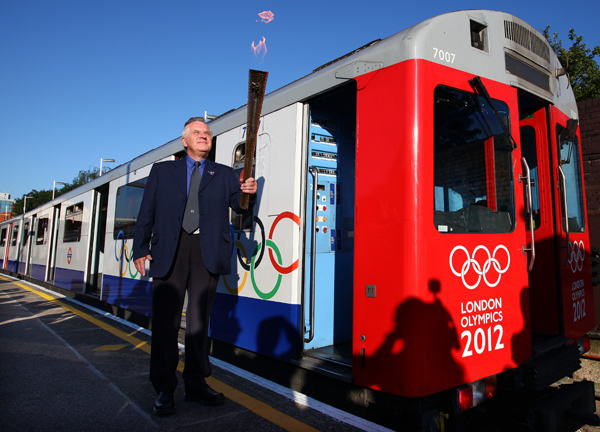
London Underground employee John Light carries the Olympic Flame onto an underground train at Wimbledon Station.

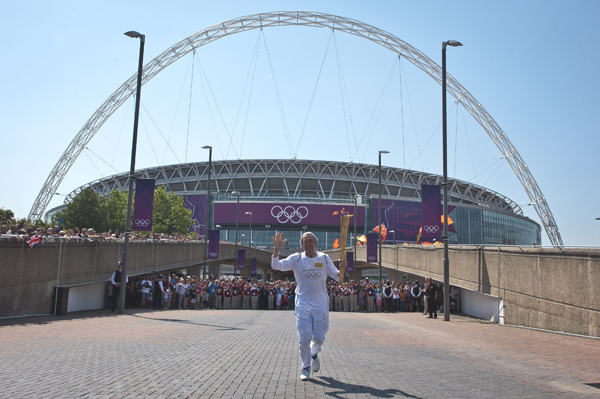
Day 68 (25th July): Former World Cup winning footballer Gordon Banks carries the Olympic Flame down Wembley Way, at Wembley Stadium.


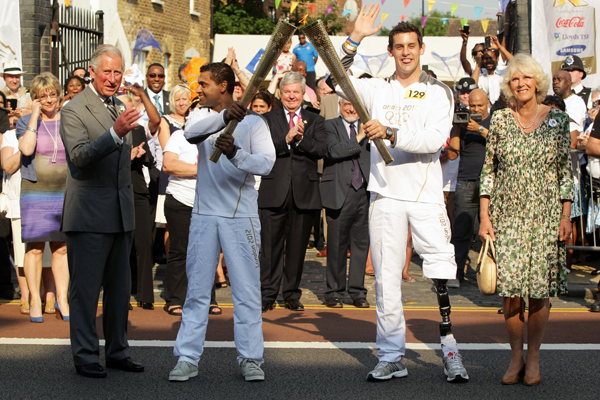
Prince Charles, Duke of Cornwall, and Camilla, Duchess of Cornwall, pose with  young entrepreneur Jay Kamiraz and Paralympian Scott Moorhouse as they kiss together Olympic torches in Tottenham.

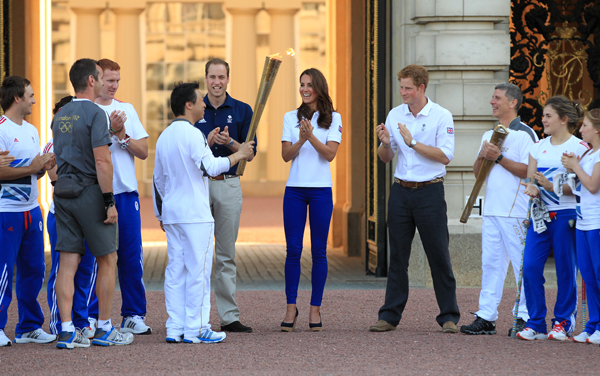
Day 69 (26th July): Disaster mapping charity volunteer Wai-Ming Lee passes the Olympic Flame to mountain rescue team leader John Hulse in front of Buckingham Palace in the presence of Prince William, Kate, Duchess of Cambridge and Prince Harry.

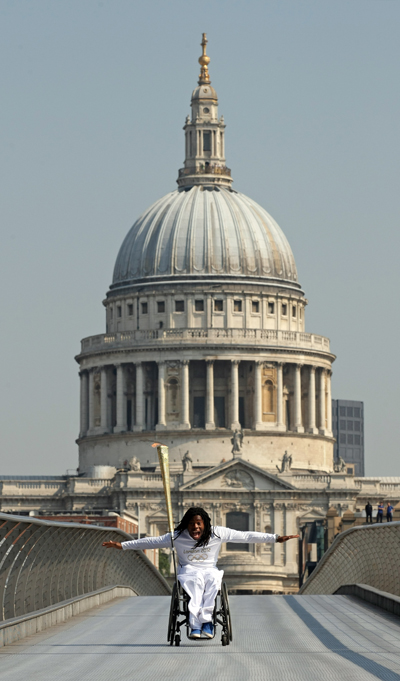
Wheelchair basketballer Ade Adepitan carries the Olympic Flame on Millennium Bridge.

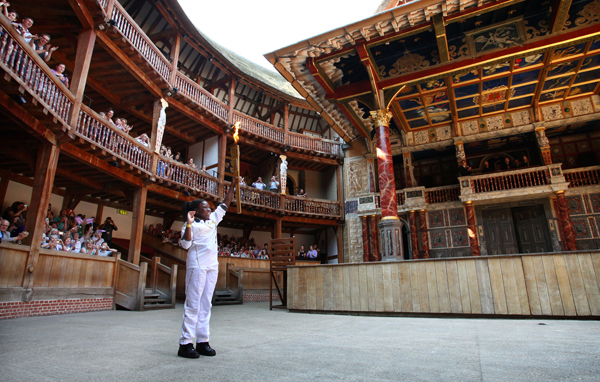
Student Ifeyinwa Egesi holds the Olympic Flame inside the Globe Theatre.

For more on the Torch Relay, see www.london2012.com/torch-relay/

ALL PICTURES: LOCOG.

Around London – Bells…and more bells; Olympic memorabilia; free wifi in the West End; The Arch returns to Kensington Gardens; and, Impressionists at the RA…

• It’s all about the Olympics in London this week and many of the events – like the Opening Ceremony and Torch Relay (see last week’s post) – are well covered elsewhere, but we thought we’d mention a couple of things in relation to the Games: 

The first is the ‘All the Bells’ project which will see bells across London being rung at 8:12am on Friday to “ring in” the first day of the Olympic and Paralympic Games. Work No. 1197: All the bells in a country rung as quickly and as loudly as possible for three minutes, commissioned as part of the London 2012 Festival, is the brainchild of Turner Prize-winning artist and musician Martin Creed and will involve thousands of bells across the nation. Speaking of bells, the City of London has announced that some of the City’s churches will be ringing continuously during the three Olympic marathon events – the men’s, women’s, and Paralympic events. As many as 57 of the country’s most experienced bell ringers, co-ordinated by the Ancient Society of College Youths (a ringing society created in London in 1637) will be working for three to four hours continuously at churches including St Paul’s Cathedral, St Mary le Bow, St Lawrence Jewry, St Magnus the Martyr, St Vedast and St Katharine Cree. During the women’s marathon, an all-female band will be attempting a peal at St Paul’s, the first all-woman attempt on the bells. (Apologies, this article had originally had the time for the bell ringing at 8.12pm – it is in the morning, not the evening!)

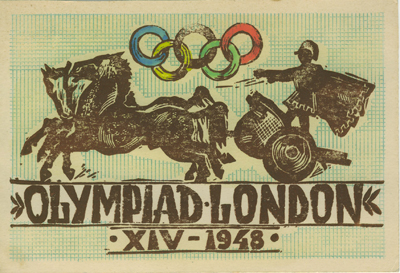
A new exhibition exploring London’s Olympic history has opened at the British Library. Olympex 2012: Collecting the Olympic Games features a range of memorabilia including a swimming costume and the finishing tape broken by – later disqualified – marathon runner Dorando Pietri  from the 1908 London Games (see our earlier post for more on him) as well as posters and artworks, stamps, letters and postcards. The exhibition also features audio interviews with Olympians including William (Bill) Roberts, a relay runner in the 1936 Berlin Olympics, and Dorothy Tyler, a medal-winning high jumper who competed in the 1936 and 1948 Olympics. Presented by the British Library and International Olympic Committee, the exhibition runs until 9th September at the library in St Pancras. Entry is free. For more, see www.bl.uk. PICTURE: Rare 1948 postcard by an unknown artist (c) Private collection/IOC

• A new free wifi network has been launched in London’s West End. Westminster City Council and telco O2 launched the network this week. It will initially cover Oxford and Regent Streets, Trafalgar Square, Leicester Square, Piccadilly Circus and Parliament Square with further areas in Westminster and Covent Garden the next to be included in the network. A once-only registration process is required to join.

• Henry Moore’s famous sculpture, The Arch, has been returned to its original home in Kensington Gardens. The six metre high work was presented to the nation by Moore in 1980 and was positioned on the north bank of the Long Water until 1996 when the structure became unstable and was placed in storage. In late 2010, the Royal Parks began a project with The Henry Moore Foundation to see if the work could be returned to the gardens. Work began to restore the piece – which consists of seven stones weighing 37 tonnes – to its original location earlier this year. For more on Kensington Gardens, see www.royalparks.org.uk/parks/kensington-gardens.

• On Now: From Paris: A Taste for Impressionism. This Royal Academy of Arts exhibition at Burlington House features 70 works from the Sterling and Francine Clark Art Institute in Williamstown, Massachusetts, and includes works by Manet, Monet, Pissarro, Degas, Sisley, Morisot and Renoir as well as those of post-Impressionist artists Corot, Théodore Rousseau and J-F. Millet, and ‘academic’ paintings by Gérôme, Alma-Tadema and Bouguereau. Runs until 23rd September. Admission charge applies. See www.royalacademy.org.uk for more.

Famous Londoners – Mr Punch…

Infamous, perhaps, rather than famous, Mr Punch (one half of Punch & Judy) this year celebrated the 350th anniversary of his first public appearance in London (which, in our view, makes him an honorary Londoner!).

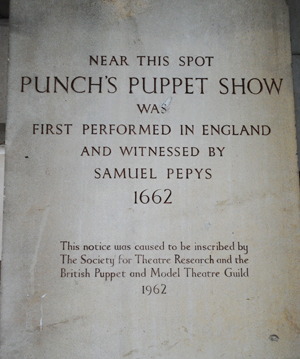
The first documented appearance of the hook-nosed Mr Punch – known for his acrimonious relationship with his wife Judy –  dates back to 9th May, 1662, when diarist Samuel Pepys recorded seeing a Mr Punch puppet performing as part of an Italian marionette show at Covent Garden (officially awarded a Guinness World Record title earlier this year for being the first recorded Mr Punch puppet show).

Mr Punch’s origins go back to Italy (Punchinello is thought to be an anglicised version of the character name of Pulcinella), typically wears a jester’s motley and tall, ‘sugarloaf’, hat with a tassel. Now generally a hand-puppet rather than a marionette, these days he usually performs in a mobile puppet booth with a cast of characters who as well as Judy can include a baby, a police constable and a crocodile.

Storylines – which were initially aimed at adults but are now generally aimed at children – vary but usually include references to current events (and perhaps also some mocking of public figures) and inevitably involve the unruly and often bawdy trickster, Mr Punch, doing away with his foes before uttering the line: “That’s the way to do it!”

Interestingly, Punch & Judy performers refer to themselves as “professors”  – there’s a story, apparently apocryphal, that this title was granted to the performers by King Charles II thanks to his enjoyment of the show. Collecting money from an audience watching the show is known as ‘bottling’ and those who assist the professor by doing so as ‘bottlers’, thanks to the tradition of using a bottle for the task.

Mr Punch reached the height of his popularity in the Victorian and Edwardian ages and could typically be seen carrying on in seaside resorts across the country. The dramatic decline in his popularity since means it can be harder to find a Punch & Judy show today (and even when you do, much of his more brutal antics have been excised from plays so as not to offend modern sensibilities), but it’s still possible to see Punch and Judy performances in many places across the UK including, on occasion, at Covent Garden where there is a plaque (shown above) commemorating the performance seen by Mr Pepys.

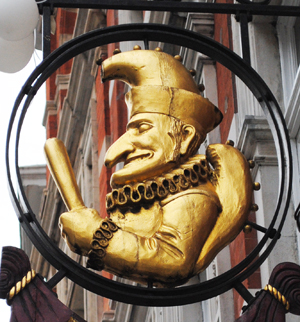
Mr Punch is still celebrated every year at Covent Garden’s May Fayre and Puppet Festival (held close to 9th May – not only the day Mr Pepys saw the puppet but now regarded as Mr Punch’s ‘birthday’) and there is a fellowship of Punch and Judy performers – The Punch & Judy Fellowship – who aim to “preserve, promote and protect” the traditions of the puppet show. Punch can also be seen on the facade of the Punch Tavern in Fleet Street – the sign is pictured above (keep on eye out for our upcoming Pub Signs look at the pub’s history).

Around London: Olympic Torch Relay hits London; mascots pop-up all over the city; and Shakespeare at the British Museum…

• The Olympic Torch Relay arrives in London tomorrow night before working its way around all of the city’s 33 boroughs and reaching the Olympic Stadium for the Opening Ceremony next Friday.  The torch will arrive in the city by helicopter from Guildford tomorrow night and then be abseiled into the Tower of London where it will spend the night ensconced with the Olympic medals. The relay will travel 200 miles over the next week, carried by more than 980 torchbearers. The route is as follows:

  • Saturday, 21st July – Greenwich via Newham, Tower Hamlets and Hackney to Waltham Forest (highlights include a visit to the Cutty Sark);
  • Sunday, 22nd July – Redbridge via Barking & Dagenham and Havering to Bexley (highlights include a ride on the London Eye and a crossing of the Thames);
  • Monday, 23rd July – Lewisham via Bromley, Croydon, Sutton and Merton to Wandsworth (highlights include a visit to a live filming of Eastenders);
  • Tuesday, 24th July – Kingston via Richmond, Hounslow, Hillingdon and Denham to Ealing (highlights include a visit to Kew Gardens);
  • Wednesday, 25th July – Harrow via Brent, Barnet and Enfield to Haringey (highlights include a visit to Wembley Arena);
  • Thursday, 26th July – Camden via Islington, the City of London, Southwark, Lambeth, Wandsworth, Kensington & Chelsea and Hammersmith & Fulham  to Westminster (the many landmarks to be visited include St Paul’s Cathedral, Shakespeare’s Globe, Trafalgar Square, Buckingham Palace and Hyde Park);
  • Friday, 27th July – From Hampton Court Palace (where it will be taken into the maze) on board Gloriana via the Thames to Olympic Park for the Opening Ceremony.

The 70 day torch relay, which kicked off on 19th May, will have travelled a total distance of about 8,000 miles and have involved 8,000 torchbearers by the time it reaches its end. LOCOG and Transport for London have advised people to see the relay at a location closest to their home given the expected crowds. For more detailed route information, see www.london2012.com/torch-relay/route/. PICTURE: LOCOG

Still talking all things Olympics and London’s largest ever ‘pop up’ shop – where you can buy Olympic merchandise – was officially opened by multiple gold medalist Sir Steve Redgrave in Hyde Park last week. The shop, located on Rotten Row, will be the site of special athlete visits during the Games and visitors can have their photo taken with the Olympic Torch.

• Meanwhile, life-sized versions of the Olympic mascot Wenlock and Paralympic mascot Mandeville are popping up at some of London’s key tourist locations. The 83 two metre tall sculptures capture various elements of life in London with incarnations including a Beefeater, a giant red phone box and a replica of Big Ben. The figures can be found on the routes of Stroll, six new discovery trails designed to help both tourists and Londoners get more out of the city. A QR code on the bottom of each of the sculptures directs smartphone users to further information about the discovery trails. The discovery trails are part of the Mayor of London Presents, a city-wide programme featuring free events, shows and activities. For more on what’s happening in your area, see www.molpresents.com. Some of these events are also being run as part of the Festival of London 2012. For more on this, see http://festival.london2012.com.

• On Now: Shakespeare: staging the world. Part of the World Shakespeare Festival taking place in London, this exhibition at the British Museum looks at the then emerging role of London as a “world city” as interpreted through Shakespeare’s plays and examines the role the playhouse performed in this. The museum has collaborated with the Royal Shakespeare Company to produce the exhibition which features more than 190 objects including paintings, jewels and rare manuscripts. These include the Ides of March coin, a Roman gold aureus commemorating the assassination of Julius Caesar (Julius Caesar), the Lyte Jewel, presented to Thomas Lyte in 1610 in thanks for his work in tracing King James I’s lineage back through Banquo (Macbeth), and a 1610 bird’s-eye view of Venice (Othello and The Merchant of Venice). Runs until 25th November. Admission charge applies. For more, see www.britishmuseum.org.

LondonLife – BBC World Service bids adieu to Bush House…

Seventy-one years of broadcasting from Bush House in Aldwych came to an end last week when the BBC World Service formally left the building. The building has been used by the BBC for foreign language broadcasting since 1941 (the service’s previous home, Broadcasting House in Portland Place having been bombed out), initially for the European Service and, since 1958, for the rest of what was then called the Overseas Service. Designed by American architect Harvey Corbett, the building at the end of Kingsway in west London was constructed in 1923 and opened in 1925 (additions were made in 1928 and 1935). Built for an Anglo-American trading company at the enormous cost of around £2 million (a price tag which led to it being declared the most expensive building in the world), it was named for American businessman, Irving T. Bush. Noted for its distinctive portico featuring two male statues depicting Anglo-American friendship, the premises has been the site of important events including General Charles De Gaulle’s wartime broadcasts to the Free French while among those who worked in the building were George Orwell, who worked for the Eastern Service during World War II. The BBC, who have returned the World Service to Broadcasting House following a major extension, have never actually owned the building – owners during its residency there have included the Church of Wales and its current Japanese owners. For more on Bush House and its BBC connections, see www.bbc.co.uk/historyofthebbc/collections/buildings/bush_house.shtml. For the final broadcast, see www.bbc.co.uk/news/entertainment-arts-18805063. PICTURE: Bush House, 1951 – Courtesy BBC.

Lost London – The Savoy Palace…

At one time the grandest of medieval townhouses in London, the history of the Savoy Palace, also known as the Palace of the Savoy, goes back to at least the 13th century.

A mansion was built here by Simon de Montfort, the ill-fated Earl of Leicester, in 1245. Following his death, it and the land between the Strand and the Thames were gifted by King Henry III to Peter, Count of Savoy, and it was renamed the Savoy Palace (apparently originally spelt Savoie).

The uncle of the king’s young wife Eleanor of Provence, Peter had accompanied his niece to London for her wedding to the king at Canterbury Cathedral on 14th January, 1236, and decided to stay. In 1241, the king named him the Earl of Richmond and in 1246 granted him the land upon which the property was built.

After being briefly given to a religious order, Queen Eleanor gifted the property to Prince Edmund (“Edmund Crouchback” – a term referring to his entitlement to wear a crusader’s cross, not a hunchback), the 1st Earl of Lancaster and younger brother to King Edward I.

It was subsequently occupied by Edmund’s successor earls and, later, dukes. Among the ‘guests’ to visit the palace during the 14th century were the French King Jean (John) II, held there for three years following his capture by the Black Prince at the Battle of Poitiers during the Hundred Years War in 1356.

Interestingly, as the property of the Dukes of Lancaster, the precinct around the palace was considered part of County Palatine of Lancaster (created in 1351), meaning that the rule of the dukes was applied here instead of that of the king – a situation which remained in place until the 1800s.

The palace eventually became the property of John of Gaunt, the 2nd Duke of Lancaster and third son of King Edward III. The richest and most powerful man in the kingdom (he was all but king in name during the younger years of King Richard II in whose name he ruled), Gaunt’s home was said to be sumptuous.

It’s perhaps not surprising then that it become a focus of the rebels during the Peasant’s Revolt in 1381 (it had been attacked unsuccessfully a few years earlier). They attacked and destroyed the property, razing it to the ground. (The story includes the tale that 32 men drank themselves to death after becoming trapped in the cellar while the palace burned).

The site, however, continued to be referred to as that of the Savoy and in the early sixteenth century King Henry VII, by order of his will, financed the founding of the Savoy Hospital on the site for the poor people (the Queen’s Chapel of the Savoy is a relic of this building – see our earlier post here). The hospital closed in 1702 and was later demolished (we’ll deal with this in more detail in a later Lost London post).

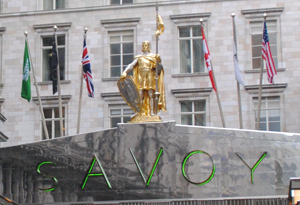
The site, which stands on the north side of the Thames just west of Waterloo Bridge,  is now occupied by the salubrious Savoy Hotel (the entrance of which is pictured above) and the Savoy Theatre, which, like the hotel, was founded by impressario Richard d’Oyly in the 1880s (the theatre was the first building in the country to be entirely lit by electric lighting).

The name of the Savoy Palace is also remembered in street names around the site including Savoy Street, Savoy Hill, Savoy Steps, Savoy Way and Savoy Place.

Celebrating the Diamond Jubilee with 10 royal London locations – 10. Royal relatives…

In this, the final in our series looking at the Queen’s relationship to London we take a look at some of the key monuments to her family in the city.

King George V (1865-1936). Queen Elizabeth II’s paternal grandfather, King George V, can be seen in a statue in Old Palace Yard, overlooked by Westminster Abbey (pictured here complete with pigeon). The work of Sir William Reid Dick, it was erected in 1947 and depicts the king wearing the robes of the Order of the Garter.

• Queen Mary (1867-1953). Paternal grandmother to the current Queen, Queen Mary the consort of King George V is commemorated with a small profile relief in The Mall, close to the corner of Marlborough Road. Also the work of Sir William Reid Dick, it was unveiled in 1967.

• King Edward VIII (1894-1972). The older brother of King George VI who infamously abdicated his crown thanks to his love for American divorcee Wallis Simpson, it’s perhaps not surprising that there are no public statues to King Edward VIII in London (at least, none we’re aware of – if you know differently, please let us know).

• King George VI (1895-1952). The father of Queen Elizabeth II is commemorated in a statue in Carlton Gardens, just off The Mall. Erected in 1956, it was the work of William McMillan and as with that of King George V, depicts the king wearing Garter robes. It was moved in 2008 from nearby to its current site to form part of the joint memorial to the Queen’s  parents.

• Elizabeth, The Queen Mother (1900-2002). The long-lived Elizabeth Bowes-Lyon, who died in 2002 at the age of 101, is commemorated in the other half of the joint monument which stands just off The Mall. Unveiled in 2009, the statue of the Queen is the work of sculptor Philip Jackson and shows the Queen in her younger days wearing the robes of the Order of the Garter.

Next week we start a new Wednesday series looking at the history of some of London’s Olympic sites…

Treasures of London – Duke of York’s Column…

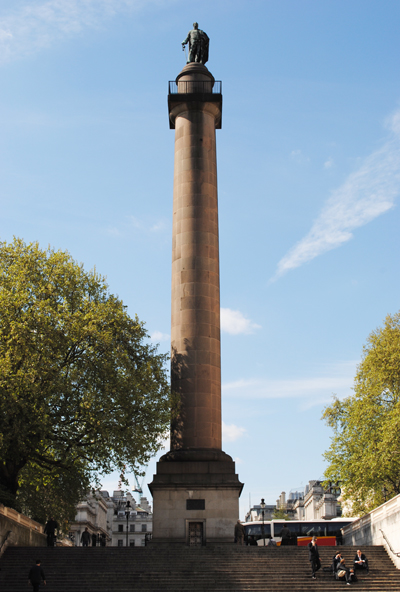
With Nelson’s Column in Trafalgar Square stealing much of the limelight, the Duke of York’s Column in Waterloo Place tends to get overlooked. So we thought it was time we took a more in-depth look at its history.

The monument is dedicated to Prince Frederick (1763-1827), the second son of King George III and commander-in-chief of the British Army during wars which were fought between France and European powers including Britain between 1792 and 1802.

The Duke was not a successful military commander on the field – his one outing in Flanders was a disaster and is said to have resulted in him being immortalised in the song, The Grand Old Duke of York – but he is celebrated for reforming the army after his return to England.

The almost 42-metre high monument  features a larger-than-life bronze statue of the Duke dressed in the robes of the Knights of the Garter – the work of Sir Richard Westmacott – standing on the top of a granite column and gazing down a series of steps and over The Mall towards St James’s Park.

The overall monument was designed by Benjamin Dean Wyatt. His design was selected by a committee from among other submissions and erected between 1830-33. While the Duke was an inveterate gambler and died deeply in debt, the British Army is said to have voted to forgo a day’s pay to fork out the £25,000 required to build the commemorative monument. It was said in jest that the height of the monument allowed the Duke to escape his creditors.

Interestingly, the hollow column contains a spiral staircase which originally gave access to a viewing platform at the top. Access was apparently prohibited after a spate of suicides.

Looking for more on statues and monuments around London – why not check out Peter Matthews’ London’s Statues and Monuments?

Celebrating the Diamond Jubilee with 10 royal London locations – 9. Royal chapels…

Palaces aside, the Queen also owns a series of chapels – the Chapels Royal – in London which, although not as grand as Westminster Abbey, have each played an important role in the history of the monarchy. 

The term Chapel Royal originally referred to a group of priests and singers dedicated to serving the Sovereign’s personal spiritual needs and as such would follow the monarch around the country. It was in Stuart times that they became more settled establishments with the two main Chapels Royal – the Chapel Royal and the Queen’s Chapel – located in St James’s Palace.

• The Chapel Royal, St James’s Palace. Constructed by King Henry VIII, the chapel was decorated by Hans Holbein the Younger in honor of the king’s (short) marriage to Anne of Cleves. Queen Mary I’s heart is said to be buried beneath the choir stalls and it was here that Queen Elizabeth I apparently prayed waiting for news of the progress of the Spanish Armada. King Charles I took the Sacrament of Holy Communion here before his execution in 1649 and the chapel was where Queen Victoria married Prince Albert (her marriage certificate still hangs on the wall). In more recent times, the coffin of Diana, Princess of Wales, was placed before the altar so family and friends could pay their respects before her 1997 funeral. Among the composers and organists associated with the chapel are Thomas Tallis, William Byrd, Henry Purcell and George Frideric Handel. The chapel is not open to the public except for services.

• The Queen’s Chapel, St James’ Palace (pictured right). Now located outside the palace walls, this chapel was built by King James I for the Catholic Henrietta Maria, the bride of his son, then Prince Charles (later King Charles I). Designed by Inigo Jones, Grinling Gibbons and Sir Christopher Wren were also involved in its creation. The chapel was used by Henrietta Maria until the Civil War and later became the home of the Danish Church in London. The chapel is not open to the public except for services.For more on this chapel or the Chapel Royal at St James’s Palace, follow this link.

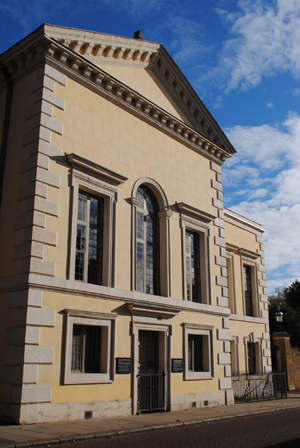
• The Queen’s Chapel of the Savoy. Built in the Middle Ages to serve the now long gone Savoy Palace, London home of Count Peter of Savoy (uncle to King Henry III’s wife, Eleanor of Provence, the original building was destroyed in the Peasant’s Revolt of 1381. The current building, located in Savoy Hill, off the Strand, was built on the orders of King Henry VII in the late 15th and early 16th century to serve the hospital he founded on the site of the palace. The chapel since served many other congregations – including a German Lutheran congregation – but remains royal property via the Duchy of Lancaster, which is held in trust for the Sovereign and used to provide an income for the British monarch. It is officially the Chapel of the Royal Victorian Order. For more, see www.duchyoflancaster.co.uk/duties-of-the-duchy/the-queens-chapel-of-the-savoy/.

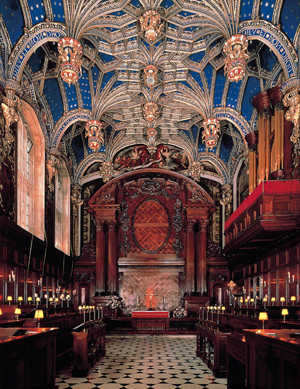
• Chapel Royal, Hampton Court Palace (pictured right). There has been a chapel here since the Knights Hospitallers occupied the site in the 13th century but it was Cardinal Wolsey who built the chapel to its present dimensions after acquiring the property in 1518. The current building, however, dates from the later ownership of King Henry VIII – Wolsey surrendered the property to him when he fell from favour – and further works in the eighteenth and nineteenth centuries. Many subsequent monarchs have worshipped here. The chapel, with its stunning ceiling, is open to the public when visiting Hampton Court Palace. For more, see www.chapelroyal.org. PICTURE: Historic Royal Palaces/newsteam.co.uk

• The Chapel Royal of St Peter ad Vincula, Tower of London. Originally a parish church, this was incorporated into the walls of the Tower in the reign of King Henry III. It was subsequently rebuilt at least twice – in the reign of King Edward I and King Henry VIII – and is home to the graves of important personages executed at the Tower including Henry VIII’s one-time wives, Anne Boleyn and Catherine Howard as well as Jane Grey, the nine day queen, and Sir Thomas More and Bishop John Fisher. The chapel can be accessed during a Yeoman Warder’s tour of the Tower of London. For more, including details of an appeal for its restoration, see www.hrp.org.uk/TowerOfLondon/stories/thechapelproject.

• Chapel Royal of St John the Evangelist, Tower of London. Located within the White Tower, this beautiful chapel – arguably the oldest church in London – dates back to the construction of the tower by King William the Conqueror the late 11th century and remains one of the best preserved examples of Anglo-Norman architecture in England. King Henry III added stained glass windows but for much of its later history the chapel was used for records storage. Tradition records that King Henry VII’s wife, Elizabeth of York, was laid in state here following her death in childbirth and that it was here Queen Mary was betrothed by proxy to Philip of Spain. This can be visited as part of a visit to the Tower of London. For more, see www.hrp.org.uk/TowerOfLondon/Sightsandstories/Prisoners/Towers/ChapelofStJohns

For more on churches in London, check out Stephen Millar’s London’s City Churches
and Stephen Humphrey’s London’s Churches and Cathedrals: A Guide to London’s Most Historic Churches and Cathedrals, Leigh Hatt’s London’s 100 Best Churches: An Illustrated Guide or the Pevsner Architectural Guide London: City Churches.

Where’s London’s oldest…bank?

While it may not be the oldest (that remains a matter of some dispute), we can say that one of London’s oldest banks stands at 1 Fleet Street.

Child & Co’s origins go back to the mid-1600s when Francis Child entered into a partnership with Robert Blanchard to run a goldsmith’s business. In 1673, the business, now known as Blanchard & Child moved to the premises it now occupies.

Child later married Blanchard’s step-daughter and on Blanchard’s death in 1681, he inherited the entire company, renaming it Child & Co (knighted in 1689, Child later served as a Lord Mayor of London and as an MP) and in 1698 was appointed “jeweller in ordinary” to King William III.

Following Child’s death in 1713, his sons continued the business, transforming it into a bank. It’s first banknote was issued in 1729.

The bank passed into the ownership of the Earls of Jersey in the mid-1800s and in 1880, following the removal of the Temple Bar gate, rebuilt its premises.

The bank, which at one stage had a branch in Oxford, was later sold to London-based commercial bank Glyn, Mills, Currie, Holt & Co and this in turn was acquired by the Royal Bank of Scotland. They remain the current owners.

Interestingly, the bank is said to be the model for Tellson’s Bank in Charles Dickens’ novel, A Tale of Two Cities.

For a book on the financial history of the City of London, check out David Kynaston’s City of London: The History: 1815-2000.

Where is it? #30…

The latest in the series in which we ask you to identify where in London this picture was taken and, importantly in this case, what it’s of. If you think you can identify this picture, leave a comment below. We’ll reveal the answer early next week. Good luck!

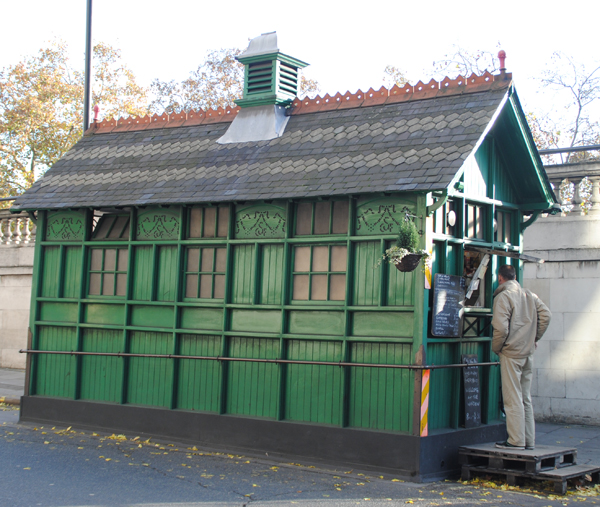
Well done to Parktown and Carol who both correctly named this as a cabman’s shelter at Temple Place near Temple Tube station. This shed is one of only 13 now left out of what were 61 shelters built by the Cabmen’s Shelter Fund between 1875 and 1914 (others, painted in the same distinctive green colour, can be in places like Russell Square, on Chelsea Embankment and on Kensington Road). The fund was established by the Earl of Shaftesbury and other well-meaning philanthropists to provide cabbies, who were prohibited from leaving their cabs unattended at a stand, with refreshments at affordable prices so they could have a hot meal while at work. The shelters, which were built on public highways, were, thanks to Metropolitan Police rules, allowed to be no bigger than a horse and cart, hence the rather small size (although they can seat up to 13 men as well as providing a kitchen). Only cabbies are allowed inside the shelters but anyone can order takeaway!

Around London – Leicester Square reopens; RA and MOL exhibitions mark Diamond Jubilee; ‘Jed’ retires; and, the history of horses at the British Museums…

• Leicester Square officially reopened last night following a £15.3 million transformation which has seen every paving stone replaced, new plants, and 40 new water jets placed around the Grade II listed fountain and statue of William Shakespeare. The 17 month makeover also included new lighting, new seating and a refurb of the underground toilets. The square – which owes its name to Robert Sidney, the 2nd Earl of Leicester, who purchased this land in 1630 and, after building himself a mansion, kept aside part of the land for public use – now welcomes as many as 250,000 tourists a day and is known as one of the world’s premiere sites for the release of new films.

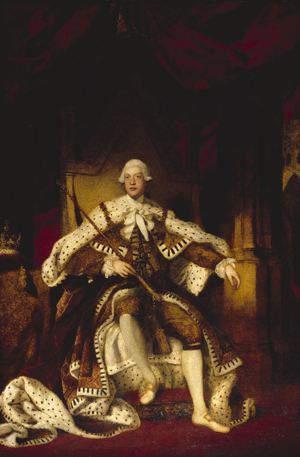
• The Royal Academy of Arts is marking the Queen’s Diamond Jubilee with a new exhibition opening tomorrow which features a selection of paintings by Royal Academicians elected during the early part of the Queen’s reign. The Queen’s Artists will include works by Jean Cooke, Frederick Gore and Ruskin Spear and will be displayed in the Reynolds and Council Rooms. Meanwhile The Saloon will house a collection of sculptures, paintings and drawings prepared by Royal Academicians for British coins and royal seals on loan from the Royal Mint Museum. The collection includes portraits of the Queen by Edward Bawden and Sir Charles Wheeler which have never before been shown in public, and Sir Anthony Caro’s new coin design of the London 2012 Olympic Games. Over in the Tennant Gallery, The King’s Artist’s George III’s Academy, will look at the king’s role in the foundation of the academy in 1768 and his influence in selecting the first artists. Highlights include portraits of King George III (pictured) and Queen Charlotte painted by the academy’s first president, Sir Joshua Reynolds. Admission charge applies. For more, see www.royalacademy.org.uk. PICTURE: Copyright Royal Academy of Arts, London/John Hammond.

• A new exhibition focusing on Londoners and their treasured souvenirs commemorating Queen Elizabeth II opens tomorrow at the Museum of London. At Home with the Queen features 12 photographic portraits of Londoners at home with their mementos as well as a selection of royal commemorative objects from the museum’s collection. The latter include trinkets produced for Queen Victoria’s Diamond Jubilee in 1897, official Coronation Day street decorations, Silver Jubilee paper tableware and souvenirs relating to the current Diamond Jubilee. Runs until 28th October. Admission is free. For more (including a series of events running on conjunction with the exhibition), see www.museumoflondon.org.uk.

The Royal Parks’ Shire horse, Jed, retired last week after a decade of service working in Richmond Park. The Queen presented a commemorative retirement rosette to Jed who was born in 1993 and joined the Royal Parks from Bass Brewery in Burton upon Trent almost 10 years ago. Horses have been used in Richmond Park since it was enclosed by King Charles I in 1637. The horses took a break in 1954 but the Shires were reintroduced in 1993 as a way to sustainably manage the parkland. For more on Richmond Park, see www.royalparks.org.uk/parks/richmond-park.

On Now: The horse: from Arabia to Royal Ascot. This major free exhibition at the British Museum is part of the august institution’s Diamond Jubilee celebrations and traces the history of the horse from domestication around 3,500 BC through to present day, with a particular focus on Britain’s equestrian tradition, from the introduction of the Arabian breed in the 18th century to events like Royal Ascot. Highlights include one of the earliest known depictions of horse and rider – a terracotta mould found in Mesopotamia dating from around 2000 to 1800 BC, a cylinder seal of Darius dating from 522 to 486 BC depicting the king hunting lions in a chariot, a 14th century Furusiyya manuscript, an Arabian manual of horsemanship, and the 19th century Abbas Pasha manuscript, the primary source of information about the lineage of purebred Arabian horses acquired by Abbas Pasha (mid-nineteenth century viceroy of Egypt). The exhibition is being held in Room 35. Runs until 30th September. For more, see www.britishmuseum.org.

London Pub Signs – The Marquess of Anglesey

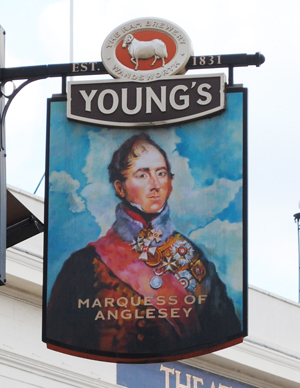
While it’s said there’s been a public house on this site since 1682, the name of the current premises on the corner of Bow and Russell Streets in Covent Garden came much later.

Originally two premises which have now merged together, the pub takes its name from Henry Paget, an 18th and 19th military man who was most famous for his role as cavalry commander at the Battle of Waterloo.

Paget, whose leg had to be amputated after the battle after he was struck by a cannon ball in the closing stages, was created Marquess of Anglesey just two weeks later in thanks for his service. He subsequently served in government roles after the battle, including as Lord High Steward of England and, (for the second time) as Lord Lieutenant of Ireland.

His private life was as colourful as his career – he had eight children by his first wife, Lady Caroline Villiers, before eloping with the Duke of Wellington’s sister in law, Lady Charlotte Cadogan, with whom he had a further 10 children.

For more on the pub, take a look at its website at www.themarquess.co.uk.

For a great book on London’s pubs, take a look at London’s Best Pubs: A Guide to London’s Most Interesting & Unusual Pubs.

LondonLife – Florence Nightingale remembered…

The life of Florence Nightingale, ‘The Lady with the Lamp’, depicted here on the Crimean War Memorial at Waterloo Place, is to be commemorated at the annual service in Westminster Abbey tomorrow. The Florence Nightingale commemoration service is held “to celebrate nursing and midwifery and all staff, both qualified and unqualified working in these services”. During the service a lamp, carried this year by Claire Gibbs, will be taken from the Abbey’s Florence Nightingale Chapel (formerly known as the Nurses’ chapel but rededicated in May 2010 – the centenary of Nightingale’s death) and escorted by a procession of nurses – this year it’s students from Liverpool John Moores University – to Reverend Professor Vernon White who will place it upon the High Altar. The address will be given by the former Archbishop of Canterbury, Lord Carey. Nightingale (1820-1910) rose to fame for her pioneering nursing work during the Crimean War and established the first secular nursing school in the world at St Thomas’ Hospital in London. The upcoming International Nurses Day is celebrated each year on her birthday – 12th May. Tickets for this year’s commemoration service are already allocated – to apply for tickets to next year’s, keep an eye on www.florence-nightingale-foundation.org.uk for details.

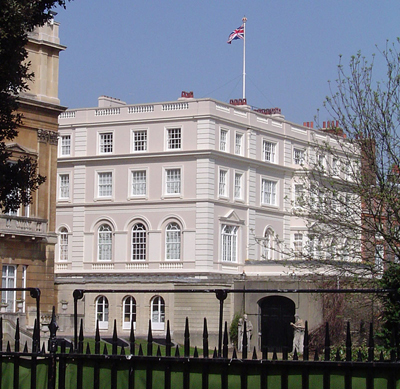
Celebrating the Diamond Jubilee with 10 royal London locations – 3. Married life at Clarence House…

Princess Elizabeth and Prince Philip were married at Westminster Abbey, a highly significant property in the Queen’s story which we’ll be looking at in more depth shortly, on 20th November, 1947 (and, as did other brides in post-war Britain, the princess had to collect coupons for her wedding dress).

Following their honeymoon at Broadland – the home of Lord Mountbatten in Hampshire and at Birkhall, Balmoral, in Scotland, in 1949, they and their baby son, Charles, moved into Clarence House, their home for the next three years.

The house, which still featured Victorian decor, was refurbished although post-war austerity ensured the decor and furnishings – many of which were wedding presents – remained simple. The house still contains a Georgian dining table and 20 ladder-back chairs which were the gift of the Royal Warrant Holders Association and a mahogany sideboard and four side tables which were a present from Queen Mary, the Queen’s grandmother.

Princess Anne, second child of the Queen and Prince Philip, was born in the house in 1950.

Clarence House was originally built between 1825 and 1827 to the designs of John Nash (he also designed Buckingham Palace) and was designed as the home of George III’s third son, Prince William Henry, Duke of Clarence and his wife Adelaide, and incorporated some of the Tudor buildings of St James’ Palace.

Indeed, Prince William Henry liked the house so much that on succeeding to the throne as King William IV in 1830, he decided not to move to Buckingham Palace and instead remained at Clarence House.

Later occupants have included Queen Victoria’s mother, the Duchess of Kent, and two of her sons, Prince Alfred, Duke of Edinburgh, and Prince Arthur, Duke of Connaught as well as Queen Elizabeth, the Queen Mother, who moved in after the property was vacated by Queen Elizabeth II and remained living at the house until her death in 2002.

Today Clarence House is the official London residence of Prince Charles, Prince of Wales, and his wife Camilla, the Duchess of Cornwall, as well as Prince Harry.

Clarence House is usually open for tours during summer but will not be opening this summer due to the Paralympic and Olympic Games blocking the entrance from The Mall. For details on the 2013 opening, see www.royalcollection.org.uk/visit/clarencehouse.

PICTURE: ChrisO, Wikipedia

Around London – Cutty Sark reopens; Genghis Khan at Marble Arch; New theatre for the West End; and, Shakespeare’s cash…

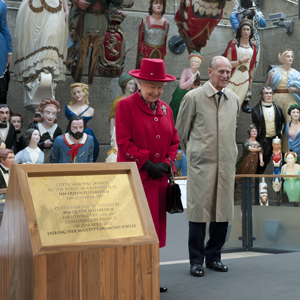
• The Cutty Sark, the world’s last surviving 19th century tea clipper, reopens to the public today following a £50 million, six year conservation project. The project to restore the Greenwich-docked ship has involved raising it more than three metres so visitors can walk underneath and see for themselves the sleek lines which helped the vessel set a then record-breaking speed of 17.5 knots or 20mph in sailing from Sydney to London. As well as raising the ship three metres, the project has involved encasing the ship’s hull in a glass casing to protect it from the weather – this area also contains the museum’s extensive collection of more than 80 ships’ figureheads, never been seen in its entirety on the site. The ship’s weather deck and rigging, meanwhile, have been restored to their original specification and new, interactive exhibitions on the vessel’s history have been installed below deck. Originally launched in 1869 in Dumbarton, Scotland, Cutty Sark visited most major ports around the world, carrying cargoes including tea, gunpowder, whiskey and buffalo horns and made its name as the fastest ship of the era when carrying wool between Australia and England. The ship became a training vessel in the 1920s and in 1954 took up her current position in the dry dock at Greenwich before opening to the public. In November 2006, the ship’s rig was dismantled in preparation for a restoration project – this received a setback on 21st May, 2007, when a fire broke out aboard the ship and almost destroyed it. The ship – which was officially reopened by Queen Elizabeth II and the Duke of Edinburgh (pictured) yesterday – is now under the operational management of the umbrella body, Royal Museums Greenwich. For more (including the online purchasing of tickets), see www.rmg.co.uk/cuttysark or www.cuttysark.org.uk. PICTURE: National Maritime Museum, London.

• A large statue of Genghis Khan has invaded Marble Arch. The 16 foot (five metre) tall sculpture of the Mongolian warlord, created by artist Dashi Namdakov, was erected by Westminster City Council as part of its ongoing City of Sculpture festival which is running in the lead-up to the Olympics. The statue has sparked some controversy – Labour councillors at Westminster have reportedly suggested Dambusters hero Guy Gibson would be a more suitable subject for a statue than the warlord Khan. The Russian artist, who has an exhibition opening at the Halcyon Gallery in Mayfair next month, told the Evening Standard he simply wanted to honor Khan on the 850th anniversary of his birth.

• Development of a new West End theatre, the first to be built in the area in 30 years, has been given the green light. The new 350 seat theatre will be part of a development project located between Charing Cross Road and Oxford Street which will also feature office and retail spaces. The site was occupied by a pickle factory in the 19th and 20th centuries and from 1927 was the home of the Astoria cinema, remodelled as a live venue in the 1980s. Live music was last presented there in 2009 when the site was compulsorily acquired for the Crossrail project.

• On Now: Crowns and Ducats: Shakespeare’s money and medals. This exhibition at the British Museum explores the role of money in Shakespeare’s world and looks at how coins – a frequently recurring motif in Shakespeare’s work – and medals were issued to mark major events. Objects in the display include Nich0las Hilliard’s ‘Dangers Averted’ medal of Elizabeth I and William Roper’s print of the Queen, the first to be signed and dated by a British artist, as well as a money box such as might have been used at the Globe and a hoard of coins, including a Venetian ducat, deposited in Essex around the time of Shakespeare’s birth. Almost every coin mentioned in Shakespeare’s plays will be on show – from ‘crack’d drachmas’ to ‘gilt twopences’. Runs until 28th October in room 69a. Entry is free. For more, see www.britishmuseum.org.

LondonLife – Flight

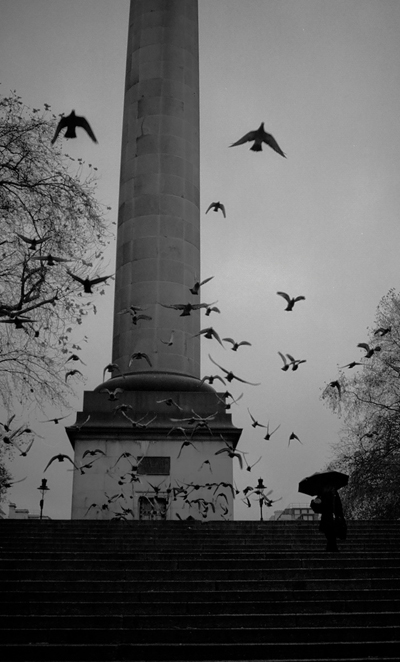
Says the photographer, Aaron Reiff-Zall: “It’s the Duke of York column, there are some steps down from Waterloo Place to The Mall. I live in London, so have done a lot of street photography here. As well as being very interested in its history and culture much like yourselves. I stood out in the rain for maybe an hour-and-a-half to craft that shot, I thought the column would make a nice back-drop, and there are always lots of birds milling about at the top. So I knew if I waited, the right person will come along and disturb them to produce the shot I wanted. After a few false alarms, and times when the birds didn’t go the way I wanted, I saw this lady with the umbrella happen by, framed the shot, hoping it would be right, and at the right moment when the birds took to flight, they luckily flew towards me as I wanted, I captured a burst of maybe five frames of film. Developed that and voila!” For more of Aaron Reiff-Zall’s work, see www.flickr.com/photos/aaronrz/.

Taken an interesting photograph of somewhere in London? We’re always looking for interesting images of the city so if you’ve got one you reckon captures a snippet of life in London, please contact us at exploringlondon@gmail.com or via our new Flickr group at www.flickr.com/groups/exploringlondon/

Around London – Crown Jewels polished for Diamond Jubilee; Diana’s dresses at Kensington Palace; a plaque for Ziggy Stardust; and At Home with the World…

• A revamped Crown Jewels display opens today at the Tower of London to mark the Diamond Jubilee of Queen Elizabeth II. The new display features graphics, music and newly restored film footage and will focus on the coronation ceremony as its central theme, exploring how the regalia are used in the ceremony. The regalia – which includes some of the most extraordinary diamonds in the world such as the Star of Africa and Koh-i-Nur – is being displayed in the order in which it is used at the coronation ceremony. The Crown Jewels have been on show to the public at the Tower of London since at least 1661 after they were remade for King Charles II’s coronation. The previous collection had been largely destroyed in the Civil War although some pieces survived including a gilt silver spoon probably made for King Henry II or King Richard I (the “Lionheart”). For more information, see www.hrp.org.uk/TowerOfLondon/.

Five dresses worn by Diana, Princess of Wales, have gone on display at Kensington Palace  which re-opened to the public this week following a £12 million overhaul. The five dresses include a black silk taffeta gown (designed by Emanuel) which Diana wore to a fundraising event at the Goldsmith’s Hall in 1981 – her first official engagement with Prince Charles as well as a formal dinner dress of ivory silk (Catherine Walker) created for a State Banquet for the King and Queen of Malaysia in 1993 and a black ribbed silk shift evening dress (Gianni Versace) worn to the London premiere of Apollo 13 in Hammersmith in 1995. For more on the revamp of the palace see our earlier post. Or visit www.hrp.org.uk/KensingtonPalace/.

• A plaque commemorating the site where the iconic image for the cover of David Bowie’s 1972 album The Rise and Fall of Ziggy Stardust and the Spiders of Mars was photographed has been unveiled in the West End. The plaque at the somewhat innocuous site at 23 Heddon Street, just off Regent Street, was installed by the Crown Estate and unveiled this week by Gary Kemp of Spandau Ballet. The image for the album cover was shot by the late photographer Brian Ward who managed to persuade Bowie to step outside the ‘studio’ space he had rented upstairs despite the fact it was a cold, wet January night.

• On Now: At Home with the World. This exhibition at the Geoffrye Museum explores the cosmopolitan nature of London’s homes over the past 400 years and looks at how diverse cultures have helped shaped the homes – covering everything from Chinese porcelain and the tea craze of the 1700s to the use of Islamic and Indian patterns in the 1800s, the popularity of Scandinavian and American design in the 1900s and the globalism of today. The period rooms on show at the museum have been reinterpreted to highlight the international influences. This is one of a series of Stories of the World: London exhibitions taking place across the city which are exploring four aspects of life – home, identity, journeys and place – as part of the London 2012 Cultural Olympiad program. Runs until 9th September. Entry is free. For more, see www.geffrye-museum.org.uk.

Celebrating Charles Dickens – 8. Dickens’ literary connections, part 1…

London is redolent with sites which appeared in the books of Charles Dickens and, having had a look at his life, it’s time we turn our attention to some of the sites relevant to his writing. For the next two weeks, we’re looking at just a few of the many, many sites which feature in his novels. So, here’s seven places to get us going…

• Saffron Hill, Clerkenwell. Once a notorious slum akin to St Giles (see last week’s entry) and the city’s Italian Quarter, Saffron Hill is where Fagin and his gang of thieves operate in Oliver Twist and have their den.

• Chancery Lane, Holborn. Much of the novel Bleak House is set around this narrow street between High Holborn and Fleet Street – Tom Jarndyce kills himself in a coffee shop here in the novel and Lincoln’s Inn Hall – formerly home of the High Court of Chancery – also features.

• The Old Bailey. Some have suggested Dickens worked here as a court reporter although there is no compelling evidence he did so. But the the Old Bailey (the current building dates from the early 20th century, well after Dickens’ death) and Newgate Prison certainly featured in his books – it is here that Fagin is eventually hung in Oliver Twist.

• Child & Co’s Bank, Fleet Street. While the present building dates from 1878, Dickens is believed to have used the bank as the model for Tellson’s Bank in A Tale of Two Cities.

• St Dunstan-in-the-West, Fleet Street. In David Copperfield, David and his aunt, Betsy Trotwood, make a special trip to see the giants Gog and Magog strike the church bells. It also features in Barnaby Rudge and Dickens dedicated his Christmas story, The Chimes, to the church.

• Garden Court and Fountain Court (pictured), Middle Temple. Garden Court is where Pip lived in Great Expectations and where Abel Magwitch turned up to reveal himself as Pip’s benefactor. Fountain Court features in Martin Chuzzlewit as the site for the romance of Ruth Pinch and John Westlock.

• Golden Square, Soho. Mentioned in Nicholas Nickleby – Nicholas’ uncle, Ralph Nickleby, was thought to live in a previous building at number seven.

There’s some great books about London sites which appear in Dickens’ books – among them are Ed Glinert’s Literary London: A Street by Street Exploration of the Capital’s Literary Heritage and Michael Paterson’s Inside Dickens’ London as well as Paul Kenneth Garner’s 
A Walk Through Charles Dickens’ London.

Celebrating Charles Dickens – 7. Five other London sites of significance…

We’ve looked at Charles’ Dickens childhood in London and some of his residences, workplaces and the pubs he attended. Before we take a look at some of the sites relevant to his writings, Exploring London takes a look at just a handful of the many other London sites associated with the famous Victorian author…

• Seven Dials and the former St Giles slum, Soho. An notorious slum of the 19th century, this area was among a number of “rookeries” or slums toured by Dickens in 1850 in the company of Inspector Field and police from Scotland Yard, and later helped to inform much of his writing. Seven Dials itself – located at the junction of Mercer and Earlham Streets and Upper St Martin’s Lane (pictured right is the monument at the junction’s centre) – has just undergone a renovation but much of the St Giles area is now irrevocably modernised. We’ll be mentioning another notorious slum located in Saffron Hill, Clerkenwell, in an upcoming week.

• Holland House, Kensington. Dickens became a friend of Lady Holland’s after attending one of her exclusive soirees at the age of 26. He was a guest at the house, now a youth hostel, in Holland Park on numerous occasions.

• Royalty House, Dean Street, Soho. The former site of the Royalty Theatre, known in Dickens’ day as Miss Kelly’s Theatre, it was here on 21st September, 1845, that Dickens and a group of friends performed Ben Jonson’s play, Every Man in his Humour (1598). Dickens acted as stage manager and director as well as playing the part of Captain Bobadil.

• Buckingham Palace. It was here in March 1870 – not long before his death – that Dickens had his only face-to-face meeting with Queen Victoria. She apparently found him to have a  “large, loving mind and the strongest sympathy with the poorer classes”.

• Westminster Abbey. Our final stop for it was here that Dickens was buried on 14th June, 1870, following his death at his home near Rochester in Kent. Dickens had apparently wanted to be buried in Rochester but given his public profile, Westminster Abbey was seen as the only fitting place of rest for him (his wishes for a small, private funeral were, however, respected but thousands did visit the site in the days following). His grave sits in Poet’s Corner.