Where’s London’s oldest…music hall?

Wilton’s Music Hall  seems to be regularly making news these days so the revelation that it’s London’s oldest (in fact, according to the venue’s website, it’s the oldest surviving grand music hall in the world) probably comes as no surprise.

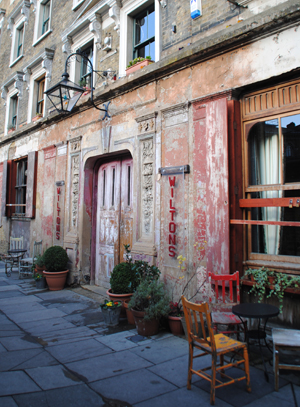
The hall, located in Graces Alley, Whitechapel, started out life as a pub which stood in the middle of a row of terrace houses. Named the Prince of Denmark, it is said to have had the first mahogany counters in London (hence the ‘Mahogany Bar’ at the front of the music hall today) and incorporated a concert room built at the rear of the ground floor.

The building was taken over by John Wilton in the 1850s. He also bought up the neighbouring terrace homes and subsequently built the grand music hall which still stands today – one of what were then a new generation of large music halls which appeared in London in the mid to latter part of the 19th century but had all but disappeared by 1900.

Wilton’s Music Hall opened on 27th March, 1859, and continued to operate under Wilton’s management for the next couple of decades. In 1877 it was badly damaged in a fire an rebuilt the following year.

Ten years later, however, the Wesleyan Mission took over the building and used it as a hall – dockers were served meals here during their first ever strike in 1889, it was used as a safe house during the so-called Battle of Cable Street of 1936 in which police clashed with protestors opposing a march by the British Union of Facists, and during World War II it was used as shelter for people bombed out of their homes.

The Methodists left in the 1950s and in 1964, the building was scheduled for demolition. Thanks to the intervention of poet John Betjeman, however (he led a campaign to prevent its destruction), the hall was saved. While it’s been undergoing restoration work ever since, more work is still required and the hall is still looking for donations to help fund it.

As well as operating once again as a music venue, it has since appeared in numerous films including Chaplin, The Krays, and the latest Sherlock Holmes film – Sherlock Holmes: A Game of Shadows.

There is a more detailed history of Wilton’s Music Hall at www.arthurlloyd.co.uk/Wiltons.htm, a music hall and theatre site. Wilton’s website can be found here.

10 curiously named churches of London – 7. St Margaret Pattens

It’s not often you’d come across a church named after a type of shoe, but that’s the case with the church of St Margaret Pattens.
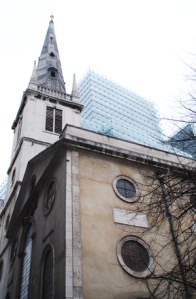
Located in Eastcheap, a church dedicated to St Margaret – a saint who was martyred in Antioch in the Middle East – has stood on the current site for at least 900 years. The earliest reference dates from 1067 and the church was rebuilt at least once in the medieval period, with the costs of construction apparently partly funded out of gifts presented to a crucifix or rood which stood in Rood Lane close to the church.

It’s only since the 17th century, however, when the church was rebuilt to the design of Sir Christopher Wren after the Great Fire of London, that it took on the name ‘Pattens’ to distinguish itself from other churches dedicated to St Margaret.

Pattens were wooden undershoes which were trapped beneath normal footwear and raised the wearer above the street, allowing them to walk across muddy roads and still arrive at their destination cleanshod. This footwear was apparently made and sold near which the church was located.

The trade of pattenmaking, incidentially, died out as streets became paved – according to the church’s website, the last pattenmaker died in the 19th century. There’s still a sign in the church asking women to remove their pattens before entering.

It’s worth noting before we move on that there is an alternative theory as to the origins of the name – this is that it commemorates a benefactor, possibly a canon at St Paul’s named Ranulf Patin – but it’s the former interpretation which is more widely accepted.

St Margaret Pattens, which was united with that of St Gabriel Fen after the latter was destroyed in the Great Fire, was damaged by bombing in World War II but was restored in the mid 1950s.

While the church lost many of its valuables during the Reformation (with the exception of a silver gilt communion cup dating from 1545 – on loan to the Victoria & Albert Museum), notable features inside include a memorial to King Charles I (since 1890, the king has been remembered in a special service each year held on the nearest Thursday to the date of his execution – 30th January) and a Royal Stuart Coat-of-Arms believed to be those of King James II.

There’s also a reredos containing a painting by Italian Carlo Maratta (1625-1713), two unusual canopied pews reserved for churchwardens, an hourglass dating from 1750 used to time the sermons, and a bell which dates from before the Great Fire. It’s also possible to view a set of pattens.

Among those who have been associated with the church is famed medieval Lord Mayor of London, Dick Whittington, apparently at one time the church’s patron (you can see our earlier post on him here), as well as livery companies including, as one would expect, the Worshipful Company of Pattenmakers, and the Worshipful Company of Basketmakers.

WHERE: Corner of Eastcheap and Rood Lane (nearest Tube stations are Monument, Bank and Tower Hill). WHEN: Weekdays from 10.30am (check website for services)COST: Free; WEBSITE: www.stmargaretpattens.org.
10 curiously named churches of London – 6. St Katharine Cree

Contrary to what some may, St Katharine Cree is not named after a person of that name (or at least not entirely). St Katherine, certainly, but the addition of ‘Cree’ is simply a medieval corruption of ‘Christ Church’.

The name Christ Church, abbreviated to Cree, was applied to this church because it was the prior of the Augustinian Priory of the Holy Trinity in Aldgate, also known as Christ Church, who founded St Katharine Cree in 1280 for the use of the area’s parishioners (apparently their use of the priory church was causing problems).

The current building dates from 1630 (although the tower dates from 1504), making it the only surviving Jacobean church in London.

It  was consecrated by William Laud, then Bishop of London (and later beheaded for, among other things, his support of King Charles I). He is commemorated in one of the church’s chapels.

Unlike so many other of London’s churches, St Katharine Cree was not destroyed in the Great Fire of London and only suffered minor damage in the Blitz. But structural problems meant it did need substantial restoration in the 1960s.

Inside, is a mid 17th century font and stained glass dating from the same era which depicts a Catherine wheel (St Katherine/Catherine is said to have died strapped to a spiked wheel when martyred during the time of the Roman Empire.).

There is also a rose window which was modelled on that of old St Paul’s Cathedral (before it was destroyed by the Great Fire). Parts of the organ, which was restored in the early Noughties, date from the 17th century and the original was played by none other than George Frideric Handel and Henry Purcell. The six bells were restored in 2009 following an appeal.

Among those buried at St Katharine Cree are Sir Nicholas Throckmorton, a 16th century diplomat (his monument is inside), and the artist Hans Holbein the Younger (his grave is also claimed by St Andrew Undershaft).

The church today has no parish but is the Guild Church to Finance, Commerce and Industry (its rector is that of St Olave Hart Street). Among its annual events is the Lion Sermon given in October, a tradition that dates back to 1643 and owes its origins to the former Lord Mayor of London, Sir John Gayer, who decided to finance the sermon after he survived an encounter with a lion in Syria.

WHERE: Leadenhall Street, London (nearest Tube stations are Aldgate and Tower Hill); WHEN: See website for service timesCOST: Free; WEBSITE: www.sanctuaryinthecity.net/St-Katharine-Cree.html.

LondonLife – New Year’s Day Parade 2012

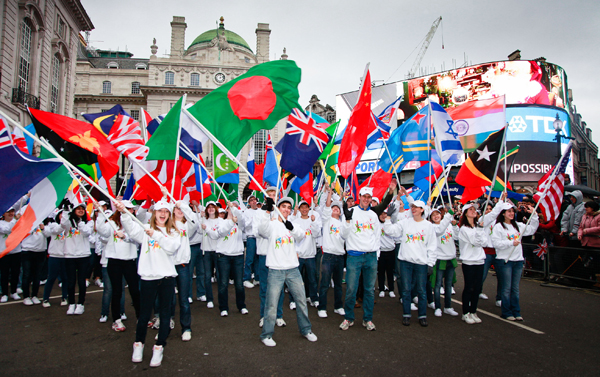
More than 8,500 performers – including those pictured celebrating the launch of London’s Olympic year – took part in this year’s New Year’s Day Parade in London, the wettest in the event’s 26 year history. But the wild weather didn’t put off the more than 500,000 people who turned out to watch the parade as it made its way from the starting point outside the Ritz Hotel in Piccadilly via Trafalgar Square to Parliament Square. As many as 19 London boroughs submitted entries in a competition based on the themes of the Olympics and the Queen’s Diamond Jubilee with Merton (its entry ‘From Horsepower To High Speed Rail’ featured animatronics) and the City of Westminster (its entry ‘Peter Pan’ involved a giant galleon and the The Sylvia Young Theatre School) announced as joint winners. For more on the parade, see www.londonparade.co.uk.

IMAGE: Courtesy of www.londonparade.co.uk

Happy New Year!


Wishing all Exploring London’s readers a very happy start to 2012!

PICTURE: London fireworks, 2011 © Sung Kik Kim (www.istockphoto.com)

Exploring London’s 10 most popular posts for 2011 – Numbers 2 and 1…

And so we come to it – the most popular posts on Exploring London this year – one of which is perhaps surprising, the other of which not!

2. Treasures of London – The Cheapside Hoard: A look at the “greatest find of Jacobean and Elizabethan jewellery ever made”, much of which is now held at the Museum of London;

1. The Royal Wedding – Eight curious facts about Royal Weddings past and present: Perhaps not a surprising winner, given the worldwide interest in 2011’s Royal Wedding, this post looked at some of the stranger facts surrounding royal weddings in Britain in the relatively recent past.

And that brings our countdown to an end. Our usual coverage resumes next week…

Exploring London’s 10 most popular posts for 2011 – Numbers 4 and 3…

We’re getting down to the pointy end of the countdown now. Here’s numbers four and three in Exploring London’s list of our most popular posts for 2011…

4. Curious London Memorials – 4. The Suffragette MemorialOne of our series on curious London memorials, this looked at a memorial in St James, erected in the 1970s to mark the contribution of those who fought for women’s right to vote;

3. The Royal Wedding – London’s royal reception venue: Another of our Royal Wedding themed posts, this looked at the history of Buckingham Palace, location of the reception which took place after the wedding of Prince William and Kate Middleton, now the Duchess of Cambridge.

Exploring London’s 10 most popular posts for 2011 – Numbers 6 and 5…

The countdown of our 10 most popular posts for 2011 continues with numbers six and five…

6. The Royal Wedding – A view from The Mall: Another Royal Wedding entry, this post from April was all about the glamour and excitement of the day itself as we joined the crowds lining The Mall;

5. Treasures of London – The Whispering Gallery, St Paul’s Cathedral: One of London’s star sights, the Whispering Gallery at St Paul’s has long held a fascination for visitors and Londoners alike.

Exploring London’s 10 most popular posts for 2011 – Numbers 8 and 7…

Our countdown continues with numbers 8 and 7…

8. Where’s London’s oldest…outdoor statue? – A somewhat controversial post for some, this talks about London’s oldest full-length statue – that of King Alfred the Great in Trinity Square as well as referencing some of the other oldest statues in the city;

7. The Royal Wedding – London’s Royal Wedding Venues – Part of our coverage of the marriage of Prince William and Kate Middleton (now the Duchess of Cambridge) in April, this looks at where royal weddings have taken place in the past, including Westminster Abbey.

Merry Christmas!

Wishing all Exploring London’s readers a Merry Christmas and Happy New Year!

Keep an eye out next week for our retrospective countdown looking at our 10 most popular posts of 2011!

PICTURE: Detail of Christmas decorations in Regent Street.

Around London – Lloyd’s gets Grade I; 700,000 historic items online in NT database; and, introducing the Silverdale Hoard…

London’s iconic Lloyd’s Building (also known as the ‘inside out’ building thanks to a design in which utility pipes, lifts and stairways are exposed on the outside) has been listed as a Grade I building, becoming the youngest building to be granted such status. John Penrose, Minister for Tourism and Heritage, made the decision following advice from English Heritage. Roger Bowdler, English Heritage’s designation director, said he was “delighted” at the decision. “Its listing at the highest grade is fitting recognition of the sheer splendour of Richard Rogers’s heroic design. Its dramatic scale and visual dazzle, housing a hyper-efficient commercial complex, is universally recognised as one of the key buildings of the modern epoch.” The futuristic-looking building is one of very few post war buildings to be protected with a Grade I listing. Construction of the tower started in 1981 and was largely completed by May 1984. It was occupied two years later. As well as its futuristic exterior, the building also features a nod to the past with the Adam Room, which dates from the 1760s and was moved here intact from which was moved from Bowood House in Wiltshire. The building is also home to the Lutine Bell, which comes from a French frigate captured by the British in 1793, and was rung to herald important announcements (today these are generally only ceremonial). The history of Lloyd’s goes back to 1688 when it’s believed the first Lloyd’s Coffee House opened in Tower Street.

• More than 700,000 objects in the care of the National Trust can be accessed virtually via a new online database. The database, accessed via www.nationaltrustcollections.org.uk contains details of more than 700,000 objects – everything from artworks by Gainsborough to a laudanum bottle containing remnants of poison and the cotton underwear of a grocer – currently housed at more than 200 properties as well as in storage or on loan to other organisations. Highlights include a costume made from beetle wings for the actress Ellen Terry, an early anti-aging ‘machine’, a furnished Victorian dolls house from Uppark House in West Sussex, and a Bible reputed to have been used at the execution of King Charles I from Chastleton House in Gloucestershire. The database has been in development for 15 years and the work to develop it will continue.

A 1,100-year-old collection of Viking Age objects including silver arm-rings and brooch fragments and coins from the Silverdale Hoard – found in Silverdale, Lancashire, in September – has gone on display in room 2 of the British Museum until early in the New Year. Among the 200 objects in the hoard is a type of coin not seen before and bears the inscription Airdeconut which appears to be an early attempt to represent the name Harthacnut. Lancaster City Museum has reportedly expressed an interest in acquiring the hoard. For more, see www.britishmuseum.org.

10 curiously named churches of London – 5. St Magnus the Martyr

St Magnus the Martyr has to be one of the most oddly dedicated churches in London. Indeed, for many years there was confusion over which St Magnus it was dedicated to – candidates including  a second and a third century martyr and a Viking who was slain in the Orkney Isles around 900 years ago.

Revived interest in the latter St Magnus in the early 20th century thanks to the discovery of his remains hidden in a pillar in the Orkney ‘capital’ of Kirkwall , however, led to a confirmation of the church’s dedication in 1924.

There is believed to have been a church on the site since Roman times (a fact which has contributed to the confusion over it’s more recent dedication) but its first known mention as that of St Magnus is shortly after the Norman Conquest.

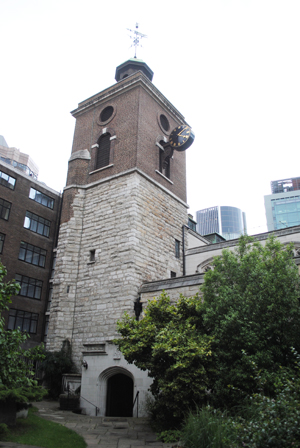
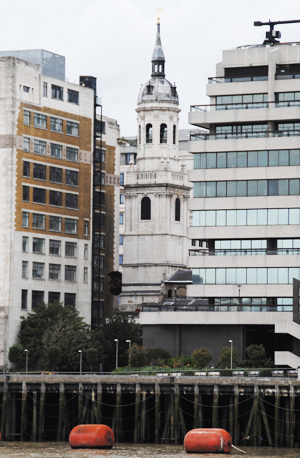
The church’s location, on the approach to London Bridge (see the picture, right, of the church tower overlooking the Thames), meant it occupied an important place in the life of medieval London. Following the Reformation, the patronage of the church was held alternately by the Abbey of Bermondsey and the Abbot and Convent of Westminster – this later passed into the hands of the Bishop of London, Edmund Grindall, and it was he who appointed the church’s most famous rector, Miles Coverdale, best remembered today as a Bible translator (there is a large monument to him in the church).

The church had been repaired in the early 17th century but was destroyed completely in the Great Fire of 1666. It was subsequently rebuilt to the designs of the ubiquitous Sir Christopher Wren.

A fire in 1760 did considerable damage to Wren’s building but it was restored and improvements continued to be made on a sporadic basis until 1831 when Sir John Rennie’s new London Bridge was opened and the old bridge demolished, meaning St Magnus no longer occupied the ‘gateway’ position it had for centuries prior.

The church only received relatively minor damage during World War II when a bomb struck London Bridge but was later restored. Features of the church now include the exterior clock, which dates from 1700, and a piece of wood believed to have one formed part of the Roman wharf which has been placed under the porch.

Among those buried at St Magnus’ during medieval times were Henry Yevele, master mason to King Edward III and King Richard II (his monument was destroyed in 1666). The church still has connections to the Fishmonger’s Company and the Plumber’s Company.

WHERE: Lower Thames Street, London (nearest Tube stations are Monument and London Bridge); WHEN: 10am to 4pm Tuesday to FridayCOST: Free; WEBSITE: www.stmagnusmartyr.org.uk.

LondonLife: Those Christmas Lights (part two)…

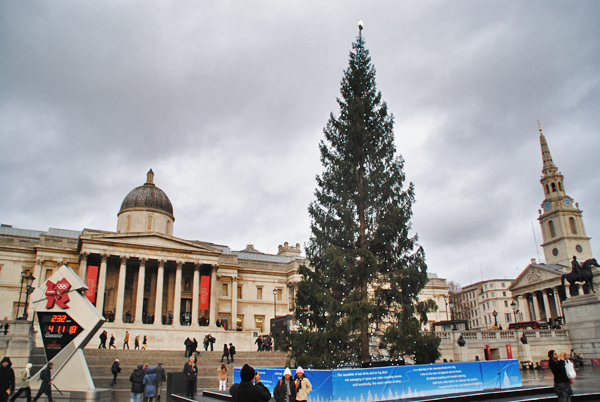
The Trafalgar Square Christmas Tree – donated  by the people of Oslo each year since 1947 as a thanks for the support Britain gave to Norway during World War II. On the left is the Olympic countdown clock.

A giant hedge-like reindeer outside Covent Garden, a market since at least the 1600s but once the site of a large kitchen garden for the monks of the Convent of St Peter, Westminster (see our earlier post for more).

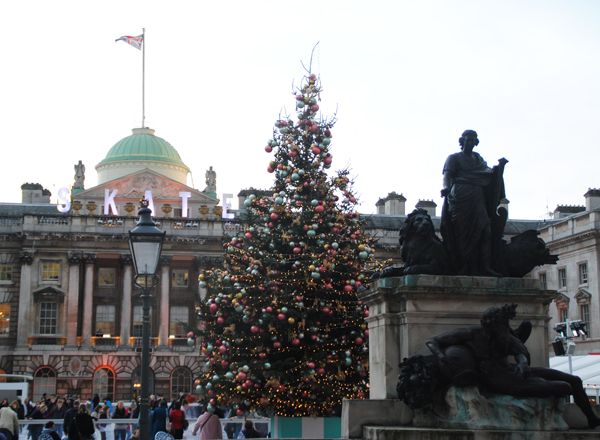
Christmas tree near the ice-skating rink at Somerset House, now an arts and cultural centre but originally built on the site of a Tudor palace in the late 1770s as a home for three “learned societies” – the Royal Academy of Arts, the Royal Society, and the Society of Antiquaries – as well as government offices (including the Navy Board).

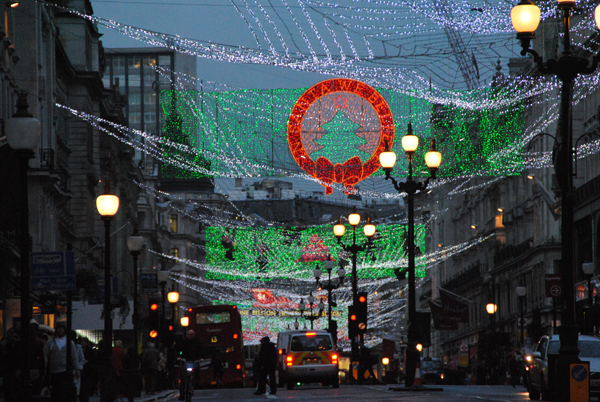
Christmas lights in Regent Street, one of the city’s premier shopping streets, in the West End. It’s current shape was designed by architect John Nash in the early 19th century.

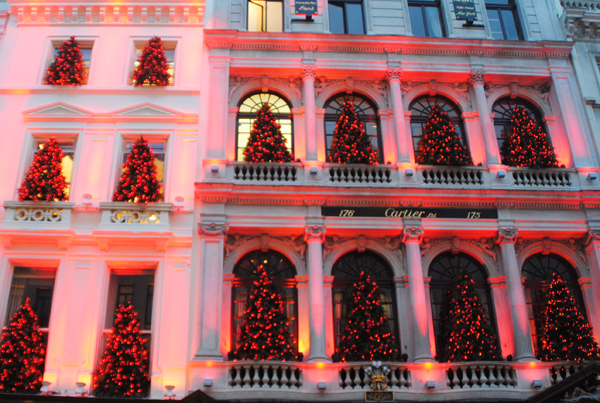
Christmas decorations on the exterior of Cartier in Old Bond Street, Mayfair. The area takes its name from the May Fair once held there and is now one of the most expensive areas within London (see our earlier post for more).

Looking for a book about London? See The Exploring London Little List of Books for Christmas…

Lost London: Gates Special – Aldersgate

Its name now more well known as one of the City of London’s 25 wards, Aldersgate was a gate opening to the city’s north, located close to where the Museum of London now stands, and was one of the city’s four original gates.

A plaque in Aldersgate Street marks where the gate once stood (there’s also an explanatory ‘London Wall’ plaque nearby) – it was finally knocked down in 1761.

The gate’s origins go back to late Roman times – it was apparently created to strengthen the city’s northern defences against Saxon incursions – and was built with two roadways passing through the wall protected by semi-circular towers. (The name apparently has nothing to do with the age of the gate as many believe but may be a corruption of a Saxon name Ealdred or come from a type of tree which grew nearby.)

An important link to places like the fair at Smithfield, St Bartholomew’s Priory and the Charterhouse in the Middle Ages, it was used as a prison and even as late as 1660, diarist Samuel Pepys writes of seeing the limbs of executed traitors displayed upon it. It was also had residential quarters above it – these were said to have been occupied at times by the City Crier and in the mid-1500s were used by printer and stationer John Day (he is said to have printed an early copy of the Bible, dedicated to King Edward VI, there in 1549).

In 1603, it was through Aldersgate that King James I entered London (his arms were later placed over the gate), and just 14 years later, in 1617, the entire gate was rebuilt. Repaired in the aftermath of the Great Fire of London in 1666 (it’s final form was said to feature, as well as the arms of King James I, statues of the Biblical figures Jeremiah and Samuel), it was finally demolished in 1761 to improve the flow of traffic.

PICTURE: Site of where Aldersgate once stood. To the right of the picture is the Church of St Botolph-without-Aldersgate.

Around London: A new pleasure garden for London; music hall star Dame Gracie Fields honored; mystery portraits at the NPG; and, celebrating the Olympics (from a Peruvian perspective)…

A new pleasure garden will be built in the city’s east as part of celebrations for next year’s Diamond Jubilee. London Pleasure Gardens, announced back in March, will be built upon a 60,000 square metre site at Pontoon Dock, opposite the ExCeL Exhibition Centre, and consist of an “ever-evolving creative playground for both resident Londoners and tourists alike”. The gardens, which will feature landscaped walkways, a floating cinema, an ‘adult’s playground’ and a range of facilities such as a ‘glass cafe’ – are expected to be open for the Queen’s Jubilee Weekend on 1st June. It’s expected that more than 40,000 people a day will pass through the site during the Olympics. London has had a long association with the concept of pleasure gardens – places where people gathered to listen to music, see art, eat and drink and talk, the most famous of which was the Vauxhall Pleasure Gardens. But the Royal Docks also had its own pleasure gardens in the past – these existed between 1851 and 1884 and were named the Royal Victoria Gardens.  For more, see www.londonpleasuregardens.com.

• Music hall star Dame Gracie Fields has been honored by English Heritage with a blue plaque on the Islington house where she lived for three years in the 1920s. It was while living at 72a Upper Street with her parents and first husband Archie Pitt, that she consolidated her reputation as one of Britain’s most popular performers and it was also during this time that she recorded for the first time (she was to become a regular on the BBC and by 1933 had cut a massive four million discs) and appeared before King George V and Queen Mary at a Royal Variety Performance. Following her success, Fields and Pitt built a mansion in The Bishop’s Avenue, Hampstead, called ‘The Tower’ in honor of the show which had made her a star – Mr Tower of London. She later separated from Pitt and married an Italian born director Monty Banks. They moved to the US in 1940 amid fears her husband would be interned and, after the war, she settled on the Italian island of Capri where, following Banks’ death in 1950, she married again. She made her final appearance on the London stage in 1978 – closing a Royal Variety Performance – and died back in Capri the following year.

• And, briefly…..A new species of dinosaur – Spinops sternbergorum – has reportedly been discovered at the Natural History Museum, identified from bones previously gathering dust on a shelf at the museum.

On Now: Imagined Lives: Portraits of Unknown People. This exhibition at the National Portrait Gallery centres on a group of 14 portraits from the 16th and 17th centuries which depict unknown people. Originally thought to represent famous figures like Queen Elizabeth I, the identity of the sitters is now considered unknown. In response to the pictures, eight internationally renowned authors – from Alexander McCall Smith and Joanna Trollope to Julian Fellowes and Terry Pratchett – have written imaginative short stories about the portraits, bringing them to life. The exhibition was originally shown in Somerset but is now running at the NPG until 22nd July. Admission is free. For more information, see www.npg.org.uk.

On Now: London and the Olympics. The Museum of London is hosting a new display which looks at the 1908 and 1948 Olympic Games held in London but, in twist, looks at not only the experiences of Londoners but those of the 41 man team Peru sent to the 1948 games. Pictures included in the display come from an album made by one of the athletes, Enrique Mendizabal Raig, recording the team’s visit (you can find the images on Flickr here). Entry is free. Runs until September. For more, see www.museumoflondon.org.uk.

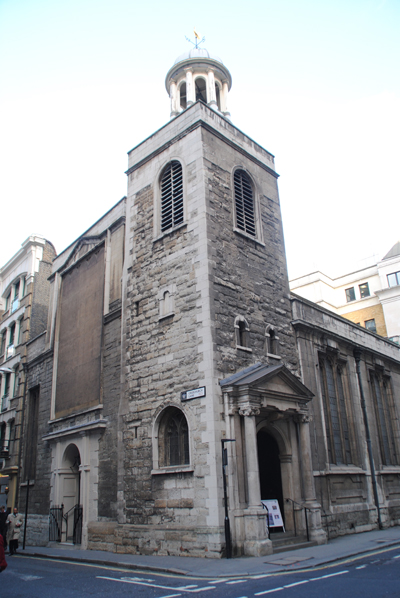
10 curiously named churches of London – 4. St James Garlickhythe

Situated close to London’s riverfront, there is believed to have been a church on this site since at least 1100, although it is believed to have been previously dedicated jointly to the apostles St James and St John.

The name of Garlickhythe can be explained by its location – the word ‘hythe’ is a Saxon word for a landing place or jetty and it is believed garlic, used as a preservative and medication, was unloaded nearby and even possibly traded on Garlick Hill where the church stands.

The church was rebuilt in the 1300s and again after the Great Fire (it was another of Sir Christopher Wren’s designs and thanks to the abundance of natural light inside was known as ‘Wren’s Lantern’) but it largely escaped damaged in World War II (the projecting tower clock was among the casualities but while a 500 lb bomb buried itself in the south-east corner of the church, it failed to explode).

What bombs failed to do, however, a death watch beetle did and when one was discovered in the roof timbers in the 1950s, the church was closed until 1963 while it was restored. The exterior clock was restored in 1988 and repairs to the south transept were required after a crane counterweight smashed into the church in 1991.

Inside, the church boasts the second highest ceiling  – 40 foot – of any churches in London (St Paul’s being the highest) and much of the carved woodwork inside, including the font cover, altar table and churchwardens pews, is still original.

There is also original ironwork including a mayoral swordrest as well as a Stuart and Georgian coat-of-arms (the Stuart arms are among a number of features which come from St Michael Queenhithe – it was combined with this parish in the late 1800s; St Michael’s was pulled down in 1894 ).

The magnificent Bernhard Schmidt organ was installed in 1718. The church also houses two rare chalices dating from the time of Edward VI in the mid-16th century and some other rare plate as well as the oldest parish registers in England (these date from the 16th century with the first entry being that of the baptism of Edward Butler on 18th November, 1535).

St James Garlickhythe, which sits in the parish of St James Garlickhythe with St Michael Queenhithe and Holy Trinity-the-Less (the latter being another now demolished church), boasts connections to 12 livery companies including the Vintners (the church is located in Vintry Ward) and the Joiners. Among those buried there are six former mayors.

The church is currently appealing for funds for a new ring of eight bells to mark the Diamond Jubilee of Queen Elizabeth II next year.

And we couldn’t mention the church without referring to Jimmy Garlick, the church’s mummy. An embalmed body of an older man, this was discovered in the church vaults in 1855 and, identity unknown, was subsequently put on display so that curious onlookers could, for a small fee, look upon him or apparently even touch him. Jimmy, whose identity remains unknown, is no longer on public view.

WHERE: Garlick Hill (just off Upper Thames Street) (nearest Tube station is Mansion House). WHEN: See website for service timesCOST: Free; WEBSITE: www.stjamesgarlickhythe.org.

Around London – Dickens at the Museum of London; looking at Leicester Square’s past; Mr Chinnery’s art; and, Wellcome’s Miracles & Charms…

• Dickens fever is well and truly upon us in the lead-up to the bicentenary of his birth in February and tomorrow the Museum of London opens its own unmissable exhibition, Dickens and London. Displays centre on the relationship between Dickens and the city and visitors will be able to follow in the great novelist’s footsteps as they visit some of the places which sparked his imagination as well as confront some of the great social issues of the 19th century – including childhood mortality, prostitution and poverty – and be taking on a tour of some of the age’s greatest innovations – everything from railways and steamboats to the Penny Post. Among the objects on display will be Dickens’ writing desk and chair, his bank ledger, excavated items from Jacob’s Island, a notorious slum which was located near Bermondsey, and manuscript pages describing an East End opium den which was featured in Dicken’s unfinished novel, The Mystery of Edwin Drood (this, along with William Powell Frith’s celebrated portrait of the author, are being lent by the Victoria and Albert Museum). The exhibition also features a specially commissioned film looking at London after dark in Dickens’ time and today. Costumes from the upcoming BBC One drama series, Great Expectations, will also be on display and there is also a specially commissioned window display by acclaimed creative director and set designer Simon Costin showing a wintery London in the mid-19th century. The museum is also offering a new iPhone and iPad graphic novel app, Dickens: Dark London, which will take users on a “journey through the darker side” of Dickens’ London. Opens on 9th December (tomorrow) and runs until 10th June, 2012. Admission charges apply. For more, see www.museumoflondon.org.uk. For more on Dickens, see www.dickens2012.org. PICTURE: Dickens Dream by Robert William Buss (Courtesy Museum of London).

New hoardings have gone up at Leicester Square celebrating the area’s history as work continues on an £18 million plan by Westminster City Council to revitalise the Leicester Square streetscape. The more than 160 square metres of hoardings feature 11 images spanning a period of 250 years (and selected from thousands of archive images of the square). Meanwhile in Trafalgar Square, the famous Norwegian Christmas Tree was lit in a ceremony last Thursday. The tree is an annual gift from the people of Oslo as thanks for British support during Norway’s years of occupation in World War II. It will be lit from noon until midnight every day until 6th January.

And, briefly…..London’s Kew Gardens has been voted the top visitor attraction in Britain at the British Airways magazine travel award while the London Eye and Tate Modern came runner’s up…..Figures released to mark the 10th anniversary of free admission to England’s national museums show that visitor numbers to the museums have more than doubled over the past decade…..and, the first woman Tube driver, Hannah Dadds, reportedly died at the age of 70.

On Now: The Flamboyant Mr. Chinnery: An English artist in India and China. This exhibition at Asia House in New Cavendish Street in the West End, focuses on the work of 19th century artist George Chinnery and features landscapes and portraits he painted while in China and India. Runs until 21st January. Admission is free. For more, see www.asiahouse.org.

• On Now: Miracles & Charms. The Wellcome Collection is hosting this exhibition which features two shows – Infinitas Gracias: Mexican miracle paintings, the first major exhibition of Mexican votive paintings outside of Mexico, and Charmed life: The solace of objects, an exhibition of unseen London amulets from Henry Wellcome’s collection. Runs until 26th February, 2012. For more, see www.wellcomecollection.org.

10 curiously named churches of London – 3. St Mary-le-Bow

We’ve already touched on the history of St Mary-le-Bow in our earlier series on Sir Christopher Wren but thought it was worth revisiting in a bit more detail. 

Another of Wren’s churches (after all, remember he designed more than 50 in the city), St Mary-le-Bow, on the corner of Cheapside and Bow Lane, has a history dating back at least to the Norman Conquest (although it is thought it may stand on the site of an earlier Saxon church) when it was constructed of Caen stone on the orders of Lanfranc, the new Archbishop of Canterbury, and was perhaps seen as a symbol of Norman oppression.

The name ‘le Bow’ is said to come from the Norman arches (it was apparently initially known as St Mary de Arcubus) which stand in what is now the crypt – this would have only been partially underground when built. From 1251, it hosted one of the church’s most important courts, which, thanks to its location, was known as the Court of the Arches. There is now a cafe in the crypt.

Like many other churches in the City, St Mary-le-Bow has been repeatedly repaired and rebuilt – following damage in a tornado in the late 11th century, the collapse of its tower in 1271, and, of course, the Great Fire of London in 1666 – Wren’s subsequent rebuilding included the construction of the fine great tower (pictured here against the backdrop of more modern City buildings, it was his second tallest structure after St Paul’s and was built to accommodate the Bow bells ). The church’s most recent remodelling was in 1964 after it was almost completely destroyed during bombing in May, 1941.

One of the church’s most important claims to fame is its bells. These included the city’s principal curfew bell, rung at 9pm each day since at least as far back as 1363. It is said that ‘true Londoners’ or ‘Cockneys’ must be born within hearing of the Bow bells and it was the pealing of the Bow bells (or what may have only been one bell at the time) which, of course, caused thrice-mayor Dick Whittington to turn back when leaving London. The church (in particular, its curfew bell) is also among a number of City churches mentioned in various versions of the rhyming song, Oranges and Lemons.

Features inside include a memorial to the first British Governor of New South Wales in Australia, Admiral Arthur Phillip, who was born nearby, and a bronze relief of St George and the Dragon given by Norway in commemoration of the work of the Norwegian Resistance during World War II. The churchyard outside contains a statue of Captain John Smith, founder of Virginia, and former parishioner.

For an indepth history of the church, you can’t go past the rather comprehensive St Mary-le-Bow: A History.

WHERE: Cheapside (nearest Tube station is St Paul’s). WHEN: 7.30am to 6pm Monday to Wednesday (closes 6.30pm Thursday and 4pm Friday and not usually open on weekends or bank holidays)COST: Free; WEBSITE: www.stmarylebow.co.uk.

LondonLife – Giant baubles at Covent Garden…

Covent Garden is all decked out for Christmas, including the hanging of giant baubles above each of its two halls and a giant green hedge-like reindeer at the market’s eastern end. For more on Covent Garden, see our earlier ‘What’s in a name?’ entry

What’s In a Name?…Elephant and Castle

A somewhat neglected area located in the Borough of Southwark, just south-east of Borough, Elephant and Castle takes its rather odd name from a coaching inn which once stood on the site – the Elephant and Castle.

The area is more correctly known as Newington but the name Elephant and Castle was apparently adopted informally in the mid 18th century as the area rose in prominence thanks in part to the opening of Westminster Bridge.

The inn, which stood on the site of a former playhouse, was apparently rebuilt several times but there is now no sign of it – the current, rather ugly, Elephant and Castle pub which is said to stand a short distance from where the tavern once stood, was built in the 1960s.

The origins of the sign of the Elephant and Castle, meanwhile, apparently comes from the mid-15th century when members of the Cutler’s Company adopted the sign of the elephant as their symbol (perhaps representing the ivory they used in their trade). The Worshipful Company of Cutlers still has an elephant carrying a castle on its back in its coat-of-arms.

The area of Elephant and Castle, meanwhile, was known for its shopping and theatres before it was heavily bombed in the Blitz. It still features a rather grim shopping mall (pictured is the sign of the elephant and castle out front) which was said to have been the first covered shopping mall in Europe when it opened in the mid-1960s – it is apparently due for demolition as part of a larger regeneration project. The area has already seen some major new developments like the the residential tower known as Strata.

Other prominent buildings include the Metropolitan Tabernacle – standing opposite the shopping centre, this was founded by preacher Charles Hadden Spurgeon in the 19th century and rebuilt after World War II (interestingly, the site of the tabernacle is where three men, known as the Southwark Martyrs, were burnt at the stake for heresy in 1557 during a period of religious persecution in the reign of Queen Mary I).

Famous residents have included Charlie Chaplin – who lived in a workhouse in the area as a child – while other notable features include a large stainless box which stands at the centre of the area’s major road intersection, linking what is now New Kent Road and Kennington Park Road (via Newington Butts) with roads leading to Lambeth, Westminster, Waterloo and London Bridges among others (this is actually a memorial to scientist Michael Faraday, who was born in nearby Newington Butts). The area also boasts its own Tube station, Elephant & Castle.