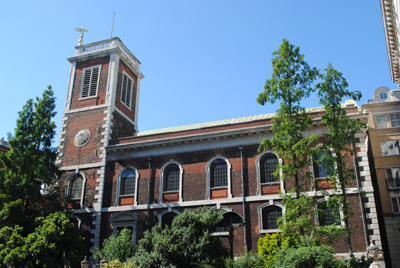
10 curiously named churches of London – 2. St Vedast-alias-Foster

This strangely named church has its origins at least as far back as the 12th century when it was under the jurisdiction of the Prior and Convent of Canterbury. 
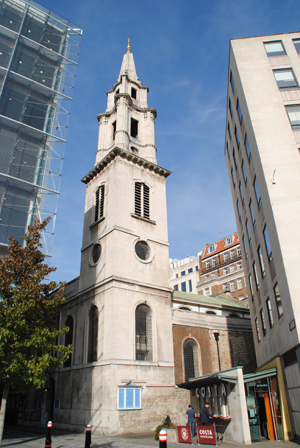
The name St Vedast is in itself unusual – St Vedast (known as St Vaast elsewhere) is said to have been the Bishop of Arras in northern France during the late fifth and early sixth centuries. How his name came to be associated with a church in London remains a matter of speculation but one plausible explanation is that the church was founded in the twelfth century by a small group of French merchants who had emigrated from Arras.

The ‘alias Foster’ part of the name is perhaps easier to explain although it has led to considerable confusion over the years. While some have in the past suggested the name refers to a different obscure saint – that is, the church is dedicated to St Vedast and St Foster – Foster is actually just an corrupted Anglicised version of Vedast.

But back to the church’s history. The medieval building was apparently replaced at the beginning of the sixteenth century and in the early 1600s this was enlarged and “beautified”. It escaped total destruction during the Great Fire of London but was badly enough damaged to require restoration and this was carried out, albeit not very well, so that in the late 1600s, Sir Christopher Wren was asked to rebuild it.

Given the demands of Wren’s time elsewhere, it’s not known if he personally designed the resulting church (the spire is possibly the work of Nicholas Hawksmoor), but the church was rebuilt and stood until 194o when the body of the building was ruined in the Blitz. The spire, however, survived and the restoration of the remainder of the church was completed in 1962.

It was also after World War II that the city parishes were reorganised and St Vedast-alias-Foster was united with three other former parishes – St Alban Wood Street, St Anne & St Agnes, St Lawrence Jewry, St Mary Aldermanbury, St Michael-le-Querne, St Matthew Friday Street, St Peter Chepe, St Olave Silver Street, St Michael Wood Street, St Mary Staining, St Mary Magdalene Milk Street, St John Zachary, and St Michael Bassishaw, of which only the buildings of St Lawrence Jewry and St Anne and St Agnes remain along with the tower of St Alban Wood Street).

Although the bulk of the building of St Vedast-alias-Foster is modern, the church does retain its seventeenth century Great West Doors and the font also comes from that century, having been designed by Wren and carved by Grinling Gibbons for the church of St Anne and St Agnes. The reredos which stands behind the altar, meanwhile, is inscribed with the Ten Commandments, the Lord’s Prayer and The Creed, and originally stood in St Christopher-le-Stock Parish Church in Threadneedle Street. Other features to come from other churches include the seventeenth century pulpit (All Hallows, Bread Street) and swordrest (St Anne and St Agnes).

The church’s Fountain Courtyard features part of a Roman floor found under St Matthew Friday Street and a stone (actually baked brick) upon which is inscribed cuneiform writing. The latter, which comes from a Zigurrat in modern Iraq built in the 9th century BC, was presented to Canon Mortlock, rector of the church, marking his work with novelist Agatha Christie and her husband, archaeologist Sir Max Mallowan and was found during his 1950-65 dig on the site. The lump of stone bears the name of Shalmaneser who reigned from 858 to 834 BC.

Famous figures associated with the church include John Browne, sergeant painter to King Henry VIII, Sir Thomas More, Lord Chancellor of King Henry VIII who was born in nearby Milk Street, and Thomas Rotherham, rector of the church from from 1463-48 and later Archbishop of York and Lord Chancellor of King Edward IV.

WHERE: 4 Foster Lane (nearest Tube station is St Paul’s). WHEN: 8am to 5.30pm weekdays/11am to 4pm Saturday (Mass is held between 12.15 and 12.45 weekdays and a sung Eucharist at 11am on Sundays) COST: Free but a donation of at least £1 per head is asked; WEBSITE: www.vedast.org.uk.
10 curiously named churches of London – 1. St Andrew-by-the-Wardrobe

Look a little deeper and you’ll find there’s often a fascinating story behind many of London’s seemingly odd place names. Churches are no exception and in this new series we’re looking at some of the stories behind the name. First up, it’s the church of St Andrew-by-the-Wardrobe, a rather austere-looking church which looms up over Queen Victoria Street.

While the present church largely dates from after World War II – it was bombed during the Blitz and only the outer walls remain of what was there before (the previous church was itself a rebuild to the designs of Sir Christopher Wren after an earlier version was burnt down in the Great Fire of 1666) – there has apparently been a church on the site since at least the 12th century. Indeed, in the 13th century it was associated with the then royal residence known as Baynard’s Castle.

The church’s rather unusual name owes its origins to King Edward III’s decision in 1361 to move the Royal Wardrobe – which included his state robes and other valuables – from the Tower of London to a new building which lay near to the church (there’s a plaque in nearby Wardrobe Place marking the former location of the King’s Wardrobe which also burnt down in the Great Fire and was subsequently relocated). Hence St Andrew-by-the Wardrobe.

While the interior of the church is a complete reconstruction of Wren’s original, it does still boast some early treasures including  an original pulpit as well as a font and cover of Wren’s period (these come from the now long gone church of St Matthew Friday Street), a figure of St Andrew dating from about 1600 and another of St Ann (mother of Mary), who is holding her daughter who is in turn holding Jesus, dating from about a century earlier. There’s also a royal coat of arms – dating from the Stuart period – which originally came from St Olave’s Old Jewry.

Among the most prominent residents in the church’s parish was the playwright William Shakespeare (there’s a rather odd oak and limewood memorial to him and a contemporary composer, singer and musician, John Dowland – who was  buried in the churchyard, inside). Another Shakespearian contemporary, Ben Jonson, also apparently lived in the parish. The church also has links with with the Mercers, Apothecaries and Blacksmiths livery companies.

Earlier this year St Andrew-by-the-Wardrobe, which is a sister church to St James Garlickhythe (another unusually named church), celebrated 50 years since its post war reopening in 1961.

WHERE: Access is via St Andrew’s Hill or Queen Victoria Street (nearest Tube stations are St Paul’s and Mansion House). WHEN: The church building and the Chapel of St Ann are normally open for visitors between 10am and 4pm weekdays while the nave is open on Fridays from 11am to 3pm (check with the church before going); COST: Free; WEBSITE: www.standrewbythewardrobe.net.

The Royal Parks – 8. Bushy Park

And so we come to the final entry in our special series on Royal Parks – Bushy Park (Royal Parks also look after Brompton Cemetery, but given it’s not strictly a park, we’ll deal with that in an upcoming post).

Lying off the beaten track near Hampton Court in south-west London, Bushy Park’s location means it’s perhaps the least glamourous of the Royal Parks we have looked at. Yet, like the other parks, its connection with royalty goes back a long way – in this case to the time of King Henry VIII.

The park was included as part of the Hampton Court estate given to the king by Cardinal Wolsey. Henry immediately transformed what had been farmland (complete with artifical medieval rabbit warrens, the remains of which can still be seen) into a deer chase and enclosed the park with a brick wall (a section of the original wall lies on the north side of Hampton Court Road).

The character of the park was altered again in 1610 when King Charles I ordered the creation of the Longford River, a 12 mile ornamental canal designed to bring water from the River Colne in Hertfordshire to the park’s water features.

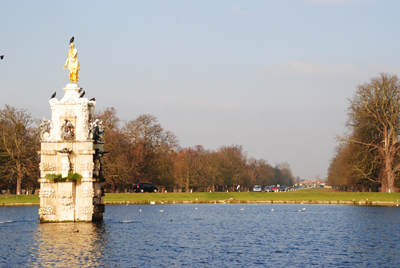
Christopher Wren had a hand in the park’s design in 1699 when he designed Chestnut Avenue – a mile long formal roadway which runs through the centre of the park. He also added the round pond at its end and placed a fountain topped with a statue in its midst.

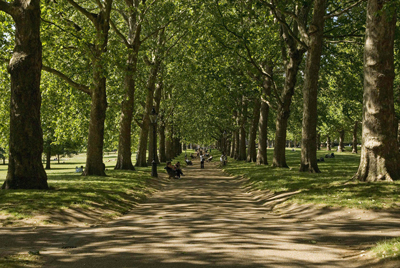
Known as the Diana Fountain after the Roman goddess of hunting, the statue (pictured above with Chestnut Avenue behind) actually represents one of Diana’s nymphs Arethusa. It was commissioned by King Charles I for his wife, Queen Henrietta Maria, and originally stood at Somerset House before Oliver Cromwell moved it to the Privy Garden at Hampton Court and Wren then moved it to its current location.

The 17th and 18th century also saw the appearance of houses at the park to be used as hunting lodges (and the ranger’s home), and gardens were added.

Worth noting here is the story of shoemaker Timothy Bennet. A resident of nearby Hampton Wick, in 1752, when an old man, he successfully fought to ensure a public right-of-way through the park after the then ranger, Lord Halifax, ordered it closed to the public. There’s a monument to him outside Hampton Wick Gate and a walking path which runs across the park at perpendicular to Chestnut Avenue is still known as Cobbler’s Walk.

More gardens were added in the 20th century including the Waterhouse and Pheasantry Plantations. Other areas include the tranquil Woodland Gardens and the Water Gardens which are comprised of a Baroque-style collection of pools, cascades, basins and the canal. There are also a series of ponds – including a pond for model boats – to the east of Chestnut Avenue.

The park saw service in both World Wars. During the first, Canadian troops were stationed there (there’s a totem pole in the Woodland Garden marking this) and other areas within the park were used for growing produce as part of the “Dig for Victory” campaign.

During the second, it was used again for food production and in 1942 became a US base and later Supreme Headquarters Allied Expeditionary Forces – the location where General Dwight Eisenhower planned Operation Overland, the reinvasion of Europe which kicked off with the D-Day landings. There are memorials concerning this connection in the park’s north-east corner.

Facilities today include the Pheasantry Welcome Centre, which opened in 2009, and includes a cafe, toilets and information. There are also sporting facilities, a small cafe near the carpark and a children’s playground.

WHERE: The park lies north of Hampton Court Palace, just west of Kingston and Hampton Wick and south of Teddington (nearest train station is Hampton Wick or Hampton Court). WHEN: 24 hours except in September and November when it’s open between 8am and 10.30pm; COST: Free; WEBSITE: www.royalparks.gov.uk/Bushy-Park.aspx

Favourite Places – London Historians’ Mike Paterson on war memorials in London…

In a special Favorite Places to mark Remembrance Day, Mike Paterson, director of London Historians, talks about his favorite war memorials…

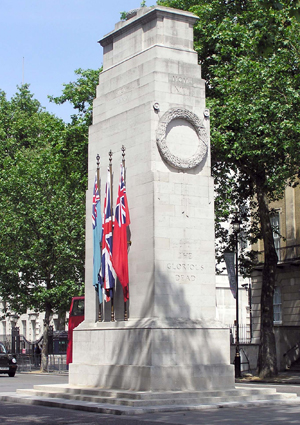
At this time of year, the focus is inevitably on Lutyens’ Cenotaph in Whitehall. Version 1, in wood and plaster,  was hurredly constructed in just two weeks in time for the 1919 victory parade. The version we know today was unveiled on 11th November the following year and is a plain, austere and fitting tribute to all our lost service personnel, the centre of the nation’s attention every Remembrance Sunday.

It is estimated there are over 70,000 war memorials in Britain. As a nation we have, let’s face it, a bellicose history, and London in particular has been intimately involved in both World Wars. No surprise then, that as you walk the streets, you happen upon something referencing conflict around every corner. In addition to memorials themselves, we have dozens of now largely forgotten field marshals, generals and other martial leaders.

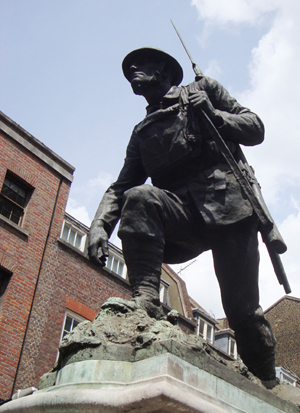
But the best, I believe, are the ones celebrating the common soldier. I have some favourites. The City of London Regiment infantryman atop a tall plinth in Holborn by Albert Toft (1922), dramatically standing tall, his rifle by his side, bayonet fixed. In Borough High Street there is a fine statue by P Lindsay Clark (1922), remembering the men from St Saviour’s (pictured, right). It is of a soldier, rifle slung, purposefully leaning forward as he trudges through the mud. A very recent statue unveiled by the Queen in 2000 is of a five-man tank crew, in Whitehall Place very near Embankment Station. By Vivien Mallock, it gives a very strong feeling of cameraderie and I always find it uplifting when walking by.

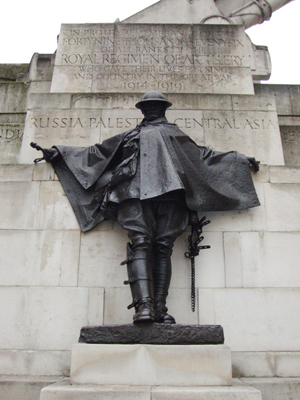
But of all the memorials to the rank and file soldier, by far the most outstanding is, for me, the Royal Artillery monument on Hyde Park Corner, unveiled in 1925. It commemorates the 49,000 artillerymen who lost their lives in the Great War.

The piece comprises a massive Portland stone plinth mounted by a 9.2 inch howitzer gun, augmented on all sizes by statues in bronze of gunners in various poses. One of these men – controversial at the time – is dead, covered by his great coat; you can see his hand and part of the side of his face.

The memorial (pictured, right) was designed by Charles Sargeant Jagger (1885 – 1934). Lionel Pearson constructed the stone parts while Jagger himself sculpted the soldiers.  Informally posed, they are all exquisite examples of the sculpor’s art.

The most striking is that of the artillery driver, leaning back onto the plinth and resting his outstretched arms on it. His cape – stretched from wrist to wrist – hangs down limply. In fact, the man rather resembles a crucified figure without the cross. I was delighted some months ago to discover a maquette (small working model) of this figure at the Honourable Artillery Company HQ in the City.

Jagger – a First World War veteran himself – was an outstanding memorial sculptor. If you’re waiting for a train at Paddington and have a little time on your hands, do check out his memorial to the fallen soldiers of the Great Western Railway. It’s a deeply poignant depiction of a squaddie – his coat draped over his shoulders and wearing a long, home-made scarf – reading a letter from home. You can find it on Platform 1, and I defy you not to be deeply moved.

PICTURES: Mike Paterson

Treasures of London – The London Stone

The London Stone was once considered to be one of the City’s most important relics with the very existence of the city depending on its survival. Yet, hidden away behind an iron grille set into the front of a building at 111 Cannon Street, the block of Clipsham limestone is these days all but forgotten, occupying an ignominious position opposite the gleaming new Cannon Street Station.

The stone’s origins lie shrouded in mystery but the legend, propagated in the 19th century, goes that it once formed part of an altar built by Trojan wanderer and founder of London, Brutus. Yet, according to the Museum of London, the saying often associated with the legend  – “So long as the Stone of Brutus is safe, so long will London flourish” – was apparently invented in 1862.

It has been suggested the stone, which is a Grade II* listed structure, may be a relic of the city of the Roman city of Londinium, although no-one seems to know for sure. The earliest mention of it was apparently around 1100 AD and it was subsequently associated with some of London’s most famous characters.

It is said that Jack Cade, leader of the 15th century Kentish rebellion, struck it with his sword after entering London in a symbolic gesture designed to reflect his taking control of the city and naming himself ‘Lord of London’. The poet William Blake is said to have believed it to be associated with druidism – perhaps it was part of an altar? – and even the great 17th century architect Christopher Wren had a view on it – he thought it was part of a Roman ruin after seeing its foundations.

One widely believed and circulated theory was that it was the stone from which all distances from London were measured during Roman times. Its heritage listing says it may have been a Roman milestone. It has also been suggested it is the base of an Anglo-Saxon waymarker or cross.

The stone was located in its current position after World War II. Since the 18th century it had been set into the wall of a Wren-designed church, St Swithin London Stone, which had stood on the site where the stone now sits but which was demolished in 1962 after being bombed in the Blitz. Prior to being moved to the church, the stone stood upright on the south side of Cannon Street. It was moved to the church after becoming a traffic hazard.

There has been talk in recent years of moving the stone to a better home but for the moment it remains behind the grill by the footpath.

The Royal Parks – 3. Green Park

Perhaps the most overlooked and least celebrated of central London’s Royal Parks, Green Park (officially The Green Park) is a peaceful oasis of leafy trees between the bustle of Piccadilly and traffic of Constitution Hill and part of an unending swathe of green which connects Kensington Gardens with, eventually, St James’ Park.

Originally meadowland used for hunting, the earliest known mention of the area where the park now stands was apparently in 1554 when it was believed to be a staging point for Thomas Wyatt (the younger) who led a group of rebels protesting against the marriage of Queen Mary I to King Philip II of Spain. The unfortunate – and unsuccessful (in terms of his rebellion at least) – Wyatt was later beheaded for treason.

In 1668, King Charles II had the park enclosed with a brick wall and stocked with deer, as well as having a ranger’s lodge and icehouse built (to keep his drinks cool when entertaining in summer). While it was initially known as Upper St James’s Park, by 1746 Green Park had its own name. It’s not really known what prompted the name change but the unofficial story is that Queen Catherine of Braganza, wife of King Charles II, found out that her philandering husband had picked some flowers there for another woman – a milkmaid. In revenge, she had every flower in the park pulled up with orders they were not to be replanted. To this day, while some 250,000 daffodils bloom here in spring, there remain no formal flowerbeds in the park.

The 47 acre (19 hectare) park, which was also used on occasion as a duelling ground, underwent further development at the beginning of the following century with the creation of the ornamental Tyburn Pool near the centre of the park.

Queen Caroline, the wife of King George II, meanwhile, had a reservoir built to supply water to St James’s Palace and Buckingham Palace (it was known as the Queen’s Basin) as well as a library and the Queen’s Walk. Planted in 1730, this runs along the eastern side of the park and helped to turn it into a fashionable place in which to be seen (and led to the building of many a mansion in nearby Piccadilly).

Other buildings in the park have included two temporary ‘temples’ – the Temple of Peace (erected in 1749 to mark the end of the War of Austrian Succession) and the Temple of Concord (erected in 1814 to mark 100 years of the rule of the Hanoverian dynasty). Both of these, believe it or not, burnt down during the celebrations they were built for.

The park, which underwent a redesign in which the first trees were planted in the 1820s as part of architect John Nash’s grand plans for St James’s Park, was opened to the general public in 1826 but by then many of its earlier features – including the ranger’s house, Tyburn Pool and the Queen’s Basin – were already gone.

In more recent times, war memorials have been added to the park – the maple-leaf daubed, Pierre Granche-designed memorial to Canadian soldiers in 1994 (Canada is also remembered in Canada Gate on the park’s south side, installed in 1908 to mark the nation’s contribution to the Empire), and a set of memorial gates on Constitutional Hill at the park’s western end which is dedicated to the five million people from the Indian Sub-Continent, Africa and the Caribbean who served in World War II in 2004. The park also features the ‘Diana fountain’, installed in 1952 by the Constance Fund (and currently undergoing restoration).

On 14th June, a 41 royal gun salute is fired here to mark the Queen’s birthday. Salutes are also fired here for the State Opening of Parliament in November or December, Remembrance Sunday, and for State Visits.

WHERE: Green Park (nearest tube station is Green Park and Hyde Park Corner); WHEN: daily; COST: free; WEBSITE: http://www.royalparks.gov.uk/Green-Park.aspx

PICTURE: Courtesy of Royal Parks. © Anne Marie Briscombe 

LondonLife – Open House London, The Middle Temple Hall

Last weekend saw thousands of people make their way to rarely opened properties across London as part of Open House London. Among the properties we visited was the Middle Temple Hall, one the finest example of a 15th century hall in London (if not the UK). The hall was built in the 1560s and early 1570s – by which time the Middle Temple, one of the medieval Inns of Court (more of which we’ll be talking about in an upcoming series), had already existed for about 200 years – and the hall which the Temple currently used, that of the former Templar Knights, was starting to fall apart. The new hall was constructed under the direction of law reporter Edmund Plowden, then Treasurer of the Inn, and funded by members of the Middle Temple. In use by about 1570, Queen Elizabeth I is, according to some stories, said to have dined there many times and it was in the hall that the first performance of Shakespeare’s Twelfth Night took place. While it suffered some damage in World War II bombings, the hall still looks much as it did in the late 1500s. It remains at the centre of the Middle Temple’s collegiate and social life and it is here that members are called to the Bar. Among the notable objects inside are numerous paintings and stained glass memorials of people associated with the Inn (including Sir Walter Raleigh and numerous monarchs – from King Charles I to King Edward VII) as well as the High Table – a table made of three 29 foot long planks from a single oak, it is said to be a gift from Queen Elizabeth I – and the ‘cupboard’, a smaller table which was apparently made from the hatch cover of Sir Francis Drake’s ship, the Golden Hind. Late note: I should add that the Middle Temple Hall is not normally open to the public.

LondonLife – The BBC Proms

Last weekend the Last Night of the Proms was held at Royal Albert Hall, the culmination of the summer music season’s 117th year.

The origins of the Proms go back to 10th August, 1895, when Robert Newman, manager of the concert venue Queen’s Hall in Langham Place, London, decided to offer a popular program of music in a less formal “promenade arrangement” which would be accessible to the masses and would ultimately lead them to a greater appreciation of classical music.

He offered conductor Henry Wood the opportunity to conduct the first Proms season, known as ‘Mr Robert Newman’s Promenade Concerts’. Early on, Wood and Newman established the tradition of having a Wagner Night on Mondays and a Beethoven Night on Fridays and Wood used the platform of the Proms to promote up-and-coming performers.

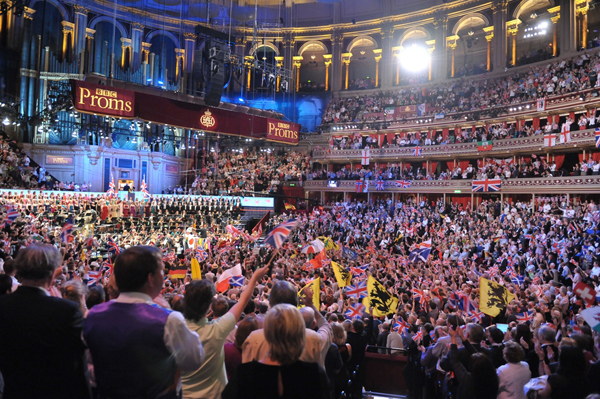
In 1927 the BBC took over the management of the Proms, now formally known as the BBC Proms, and has continued in that role ever since bar an interruption during World War II. It was during World War II, incidentally, that the event moved to the magnificent Royal Albert Hall in South Kensington (the magnificent interior of which can be seen above), after Queen’s Hall was gutted following a bombing raid on 10th May, 1941.

The eight-week Proms program has since continued to widen with the introduction of complete opera performances in the 1960s, concerts by foreign ensembles and other music styles including jazz, Gospel and that specifically targeted at children.

Now including more than 70 main concerts, the music festival – for which standing tickets can still be bought continuing the tradition of ‘promenading’ – also continues to also be a showcase for new works. For more on the Proms, see www.bbc.co.uk/proms, and for more on the venue, see www.royalalberthall.com.

PICTURE: Courtesy of BBC, Chris Christodoulou

10 small (and fascinating) museums in London…9. HMS Belfast

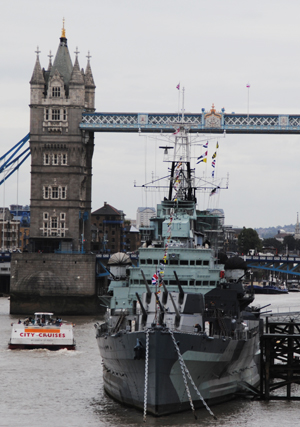
OK, so it’s not exactly small but HMS Belfast – an offshoot of the Imperial War Museum moored permanently on the Thames near Tower Bridge – does make a fascinating museum in which to spend a few hours.

Commissioned into the Royal Navy on 5th August, 1939 (just in time for the start of World War II), the HMS Belfast is a large light cruiser built, along with the HMS Edinburgh, as an improvement on the then existing ‘Southampton’ class vessels. It is now the only surviving example of the many big gun armoured warships which were built for the Royal Navy in first half of the twentieth century.

Assigned to the Home Fleet on the outbreak of war, the ship operated out of Scapa Flow in the Orkney Isles in far north Scotland and was charged with patrolling the northern waters as part of efforts to impose a maritime blockade on Germany. Striking a mine in November of that year, however, it was put of out action until two years later when it rejoined the Home Fleet and then began escorting Arctic convoys to the Soviet Union – a mission which saw it take part in the Battle of North Cape off the Norwegian coast in late 1943 (this battle saw the sinking of the German battle cruiser Scharnhorst).

The HMS Belfast later saw action on D-Day, the Allied invasion of Normandy in 6th June, 1944, when it was employed to bombard German positions onshore before, heading to Japan where, after the end of the war, it was used to evacuate survivors of prisoners-of-war and internment camps in China.

The HMS Belfast saw action in the Korean War and then spent further time in the Far East before – under threat of being disposed of and broken up – it was acquired as a museum and moored in London. The first visitors were admitted on Trafalgar Day, 1971, and, as of last year, nearly 10 million people have taken up the chance to look at the ship.

These days there’s a well-defined route through the vessel, complete with audio guide (it’s included in the admission price), which takes visitors on an informative journey describing what life was like for those who served onboard the Belfast – including everything from the Arctic messdecks where ratings slept in hammocks to the NAAFI store where they could buy supplies, sick bay, the ‘modern’ laundry room, and chapel as well as the engine room, shell rooms and magazines, and , of course, the bridge.

Many of the rooms have been set up – some using life-sized manniquins – to show how they would have looked during a typical day. Particularly worth a look is the new Gun Turret Experience: A Sailor’s Story 1943, an immersive film, light and sound show which gives a glimpse into what life was like working inside one of the six inch gun turrets.

It can take a while to get around the whole ship (and parents are asked not to take small children into the boiler room) but it’s well worth taking the time to explore properly. In addition to the features of the ship itself, there are two exhibitions – one looking at the role of the ship in peace and war, and the other, an interactive experience in what life was like on board.

WHERE: HMS Belfast is moored on the Thames between London Bridge and Tower Bridge. Entry is from the south bank of the Thames near Morgans Lane (nearest Tube stations are London Bridge, Tower Hill or Monument); WHEN: 10am-6pm (last admission 5pm) daily until 31st October, then 10am to 5pm (last admission 4pm); COST: £13.50 adults/£10.80 seniors and students/children under 16 free (price includes a voluntary donation); WEBSITE: http://hmsbelfast.iwm.org.uk.

What’s in a name?…Whitechapel

An area of the East End of London which has become synonymous with the Jack the Ripper murders of the late 1880s, the origins of the name Whitechapel actually lie much further back in history.

The name dates back to the 14th century when the church of St Mary Matfelon (or Matfelun) was built on what is now the corner of Whitechapel High Street and Adler Street. The church, which was known as the “white chapel” apparently thanks to the white stone used in the walls, was apparently first constructed the mid 13th century and is said to have been named after a prominent local family. It became the parish church of Whitechapel in the 14th century.

Rebuilt and extended several times over the ensuing centuries – including in 1673 and the 1870s, it was bombed during the Blitz in 1940 and ultimately finally removed in 1952. The site where it once stood is now the Altab Ali Park, named after a young Bangladeshi man who was murdered in a racially motivated attack in Adler Street in 1978.

Whitechapel originally stood along the road, which from Roman times ran from London to Colchester. The fact it stood outside the city walls meant it to became home to some of the city’s more undesirable businesses including slaughterhouses, tanneries and breweries.

Greater numbers of poor came into the area from Middle Ages onwards and by the mid-1800s it was one of London’s most crowded, poorest and disease ridden areas, known for its immigrant population and for its rising levels of crime.

This reputation was only solidified in 1888 when the killings of the so-called murderer Jack the Ripper garnered worldwide attention for the brutal slayings of at least five women (some believe the figure should be much higher). Speculation still surrounds the Ripper’s identity.

These days, Whitechapel – along with many inner city areas – is undergoing a gentrification process and is now known as something of a hub for art and music as well as home to a street market in Brick Lane.

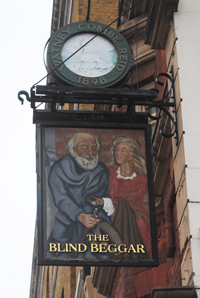
Ripperology aside, other notable landmarks include The Blind Beggar pub in Whitechapel Road (it was here gangster Ronnie Kray shot George Cornell in 1966; its sign is pictured above) and the Whitechapel Bell Foundry (described in the Guinness Book of Records as Britain’s oldest manufacturing company, it was founded in 1570 and among the most famous bells cast there are the US Liberty Bell (1752) Big Ben (1858) – stay tuned for our upcoming ‘London’s Oldest’ entry).

The area is also home to the internationally renowned Whitechapel Gallery on the corner of Brick Lane and Whitechapel High Street and the East London Mosque, one of the largest in the UK.

Where’s London’s oldest…public park?

Dating from the early 1600s, London’s oldest public park is Finsbury Circus Gardens, located just to the north of London Wall and east of Moorgate.

The now heritage-listed gardens were open as a public park from 1606 (and was originally known as Moor Fields – the moors were drained and gravel walks laid out in 1527 but it wasn’t until 1606 that the area was laid out with elm trees and benches).

The park wasn’t enclosed until 1815-17 when City of London surveyor William Montague laid the area out according to the designs of prominent London architect George Dance the Younger.

The gardens were acquired by the City of London Corporation in 1900 and in 1909 were replanned. The oval-shaped park, the largest of the City’s gardens, is these days home to the City of London Bowling Club, the only bowling club in the City (founded in 1924; the bowling green dates from the following year and the current pavilion from 1968).

During World War II a barrage balloon was anchored here to deter low level air raids. Among it’s other claims to fame is the Tudor era bat (apparently a forerunner of the modern cricket bat) found on the site in the 1980s and skulls which have also been found dating from the Roman period.

The gardens are currently partly closed due to the Crossrail development.

PICTURE: Wikipedia

Around London – South Bank marks 60 years since the Festival of Britain; Royal wedding cakes; and, a new cable car for London…

• South Bank is celebrating the 60th anniversary of the 1951 Festival of Britain with a four month series of events. The official celebrations kicked off yesterday and will run until early September. Highlights of the celebrations include the Museum of 1951 – a temporary museum located in Royal Festival Hall featuring exhibits relating to the 1951 festival, themed weekends including next weekend’s ‘London in Love’, featuring performances by Billy Bragg, and a Festival of Britain-inspired ‘Meltdown’ curated by Ray Davies of The Kinks (runs from 10th to 19th June). The original Festival of Britain was opened on 3rd May, 1951, with the intention of developing a sense of “recovery and progress” among the British in the aftermath of World War II and marked the centenary of the 1851 Great Exhibition. The South Bank Exhibition was at the heart of what were national celebrations and was attended by more than eight million people. For more information on what’s happening, see www.southbankcentre.co.uk.

• Historic royal wedding cakes have been recreated this Easter weekend  in an exhibition celebrating the lead-up to this Friday’s Royal Wedding. The English Heritage-event Let Them Eat Cake, which is being held at Wellington Arch near Hyde Park Corner, features a “four-and-20 blackbirds pie” of the sort King Henry VIII gave to his new wife Anne Boleyn as well as recreations of Prince Charles and Lady Diana’s wedding cake and that of Queen Elizabeth II. The event, which is sponsored by Tate & Lyle Sugars, involves some of Britain’s leading bakers. For more, see www.english-heritage.org.uk/daysout/events/765107/. See Exploring London this week for more on the upcoming Royal Wedding.

• The Mayor of London, Boris Johnson, confirmed this week that work will begin on a new cable car to cross the Thames River in East London this summer. The 34 gondola cable car will stretch for 1.1 kilometres, connecting Greenwich Peninsula and the O2 on the river’s south bank with Royal Victoria Docks and the ExCel centre on the north and carrying up to 2,500 people every hour. Construction will be carried out by a consortium of firms led by Mace – the company currently building the Shard Tower – and it is hoped it will be completed before next year’s Olympics.

Keats’ love letter to be returned home; a royal wedding Oyster; youngest Spitfire pilot honored; and, The Cult of Beauty at the V&A

A love letter Romantic poet John Keats wrote to his beloved Fanny Brown will be returned to the house in which it was written. Keats wrote the letter in 1820 while living next door to her at Wentworth House in Hampstead, north London – his home from 1818 to 1820 and the setting that inspired some of his most memorable poetry including Ode to a Nightingale. The City of London Corporation, who manage the house – now a museum known as Keats House, recently purchased the letter with the support of the Heritage Lottery Fund for £80,000. They say it will now be returned to the house and displayed there. In the letter Keats wrote: “I shall Kiss your name and mine where your Lips have been – Lips! why should a poor prisoner as I am talk about such things.” He said his consolation was “in the certainty of your affection”. See www.keatshouse.cityoflondon.gov.uk.

Amid the host of souvenirs and trinkets up for sale in the lead-up to the wedding of Prince William and Catherine Middleton comes news of a unusual offering from Transport for London – a limited edition royal wedding Oyster card. The card, which will go on sale in the week leading up to the ceremony, features a portrait of the couple and their wedding date – 29th April, 2011. More than 750,000 of the cards will be offered for sale. The move is not without precedent – in 1981, a unique ticket was produced for the marriage of Prince Charles and Lady Diana.

• Squadron Leader Geoffrey Wellum, the youngest Spitfire pilot to take part in the Battle of Britain, was granted the Freedom of the City of London at a ceremony at Guildhall last week. Wellum was just 18-years-old when he joined the RAF in August 1939. Serving in a frontline squadron, he flew many combat missions including dogfights during the Battle of Britain and was subsequently awarded the Distinguished Flying Cross.

• On Now: The Cult of Beauty: The Aesthetic Movement 1860-1900 at the Victoria & Albert Museum in . Said to be the “most comprehensive” exhibition ever staged on the Aesthetic Movement in Britain, it brings together masterpieces in painting as well as sculpture, design, furniture, architecture, fashion and literature of the era and explores some of the key personalities  involved in the movement – from William Morris and Frederic Leighton through to James McNeil Whistler, Dante Gabriel Rossetti, Edward Burne-Jones and Oscar Wilde. Organised in collaboration with the Fine Arts Museums of San Francisco, the exhibition runs until 17th July. Tickets are £12 (concessions available). See www.vam.ac.uk.

Curious London Memorials – 10. The Bard or not The Bard?

For the last in our series of curious London memorials, we’re looking at one which isn’t quite what it seems.

At first glance, the granite plinth topped by a bronze bust of William Shakespeare which stands in gardens at the junction of Love Lane and Aldermanbury in the City, looks like yet another tribute to the Bard.

But take a closer look and you’ll read that the inscriptions in fact refer to John Heminge and Henry Condell, two actors and friends of the Bard, who were responsible for collecting his works and giving them “to the world”.

The two men were partners with Shakespeare at the Globe and it was they who were behind the publication of his First Folio in 1623. They were both buried here in what was formerly the churchyard of St Mary Aldermanbury (first destroyed in the Great Fire of 1666 and then again in the Blitz although the surviving walls were later rebuilt in the US – more on that another time), Heminge on 12th October, 1630, and Condell on 29th December, 1627.

It’s worth quoting the inscription on the memorial – and there is a lot of it – at greater length. “The fame of Shakespeare,” it reads, “rests on his incomparable dramas. There is no evidence that he ever intended to publish them and his premature death in 1616 made this the interest of no-one else. Heminge and Condell had been co-partners with him in the Globe Theatre Southwark and from the accumulated plays there of thirty-five years with great labour selected them. No men living were so competent having acted with him in them for many years and well knowing his manuscripts. They were published in 1623 in folio, thus giving away their private rights therein. What they did was priceless, for the whole of his manuscripts with almost all those of the dramas of the period have perished.”

The memorial was erected by Charles Clement Walker, of Shropshire, in 1896. Walker, who has his own memorial in Northampton Square in Clerkenwell, was a Justice of the Peace for the counties of Salop and Stafford and a native of the parish of Clerkenwell.

The bronze bust of Shakespeare was by Charles Allen.

Around London – Year of the Rabbit celebrations; virtual art galleries; and, to the moon and back on ‘Boris bikes’

London will celebrate Chinese New Year this Sunday as it once again hosts the largest celebrations outside of Asia attracting some 250,000 people from around the globe. The event programme, which celebrates 2011 as the Year of the Rabbit, kicks off at 11am on the main stage in Trafalgar Square with firecrackers at noon, a Lion and Dragon performance at 1.10pm and dance and song during the afternoon culminating in a finale just before 6pm. There will also be a stage in Shaftesbury Avenue with performances throughout the day. Roads in the area will be closed for the event.

You no longer have to be in London to walk through the galleries of the Tate Britain or the National Gallery. Both institutions are among 17 around the world taking part in the Google Art Project which allows web surfers to virtually “walk” around the museum using the organisation’s Street View technology and turn 360 degrees to view the artworks in situ on the walls. The project also allows viewers to look through images of more than 1,000 artworks and, in addition, each institution has selected one artwork which then captured in “super high resolution” and then placed on line (Hans Holbein’s The Ambassadors‘ for the National Gallery, Chris Ofili’s No Woman, No Cry for the Tate). See www.googleartproject.com for more.

Cyclists have ridden the distance to the moon and back 13 times – 10 million kilometres – since the launch of Mayor Boris Johnson’s cycle scheme. Transport for London released figures this week showing riders have made more than 2.5 million journeys on the “Boris bikes” since the scheme was launched six months ago. The TfL has announced plans to expand the Barclays Cycle Hire scheme to new areas of east London including all of the Borough of Tower Hamlets, North Shoreditch, Bethnal Green, Bow, Canary Wharf, Mile End and Poplar by spring 2012. Almost 110,000 people are now signed up to the scheme. www.tfl.gov.uk.

The youngest Spitfire pilot in the Battle of Britain is to be granted the Freedom of the City of London in a special ceremony next month. Squadron Leader Geoffrey Wellum was awarded the Distinguished Flying Cross for his service in a front line squadron during the battle.

Around London – New Year’s Eve fireworks; New Year’s Day Parade; and remembering the Blitz…

A British pyrotechnic company, Kimbolton Fireworks, will be used for the first time in the creation of the Mayor of London’s fireworks display at the London Eye on New Year’s Eve. And in another first, the firework display will be accompanied by music. The mayor’s office have warned that viewing areas for the fireworks fill up early (and will be closed when full) and have suggested that families with young children may consider attending a fireworks display closer to home. For more information, including a detailed viewing area plan, see www.london.gov.uk/get-involved/festivals/newyearseve/at-fireworks.

London’s New Year’s Day parade celebrates it’s 25th anniversary when it kicks off at 11.45am on New Year’s Day. The parade route starts outside the Ritz Hotel in Piccadilly and runs down Lower Regent Street and along Pall Mall and Cockspur Street into Trafalgar Square before heading down Whitehall and into Parliament Square where it concludes at 3pm. The parade will involve some 10,000 people representing 20 different countries. More than half a million people are expected to line the route. For more information, see www.londonparade.co.uk.

Firefighters have laid wreaths at the Firefighters’ Memorial outside St Paul’s Cathedral in commemoration of the 70th anniversary of one of the worst nights of the Blitz. More than 160 people were killed on the night of 29th December, 1940, in what became known as the ‘Second Great Fire of London’. While large parts of the city were destroyed in the German attack, St Paul’s was spared a similar fate thanks to the actions of specialist firefighters assigned to the building. The night was immortalised by Daily Mail photographer Herbert Mason in what is now an iconic photograph of the Blitz showing the great dome of St Paul’s wreathed in smoke.

Roman London – 5. Remains under St Bride’s

Our final entry in our short series on Roman London concerns the Roman remains found under St Bride’s Church in Fleet Street.

Following heavy bombing during World War II, much of the church was destroyed. But the bombing did reveal hitherto unknown secrets below the church.

As well as the remains of what were thought to be numerous plague and cholera victims (dating from 1665 and 1854 respectively), these included remains dating back to the 2nd century AD which featured the foundations of a somewhat mysterious Roman building and pavement, both of which were built outside the later Roman wall. There are also the remains of a ditch which is believed by some to be part of what was a quarry.

The remains can now be viewed in the church’s crypt along with those of the earlier churches. For more on St Brides, see our previous entry here.

WHERE: Fleet Street (nearest tube St Paul’s); WHEN: 8am to 6pm Monday to Friday, 11am to 3pm Saturday, 10am to 1pm and 5pm to 7.30pm Sunday; COST: Entry is free but guided tours are available on Tuesday afternoons at 3pm for £5 a person; WEBSITE: www.stbrides.com.

Treasures of London – Cleopatra’s Needle

Sited relatively unobtrusively on the north bank of the Thames at Victoria Embankment, it’s easy to overlook this ancient Egyptian obelisk which was erected on its current site in 1878.

Although it’s commonly known as “Cleopatra’s Needle”, the red granite obelisk is in fact one of a pair originally constructed in the 15th century BC and placed in the Egyptian city of Heliopolis at the behest of Pharoah Thutmose III (the second one is now in New York’s Central Park and is also known by the name, Cleopatra’s Needle). The inscriptions were added later by Ramsses II. Both obelisks were subsequently moved to Alexandria and placed in a temple honoring Mark Antony. They later toppled over (and were covered in sand, which apparently helped with preservation).

The obelisk was given to the United Kingdom in 1819 by the grateful ruler of Egypt and Sudan, Mehemet Ali, in commemoration of British victories over the French at the Battle of the Nile and the Battle of Alexandria in 1801.

After the British government decided not to transport the obelisk to London due to the high expense, it remained in Alexandria until 1877 when Sir William James Erasmus Wilson contributed £10,000 toward the cost in an act of publicly-minded benevolence. After an eventful journey it which at one point it and the iron cylinder it was encased in – dubbed the Cleopatra – were declared sunk before being found again (tragically six crew drowned in the incident), it was finally erected in October 1878.

A time capsule is buried at the base of the obelisk which contains, among other things, a portrait of Queen Victoria, hairpins, copies of the Bible in several languages and a map of London. One of the two bronze sphinxes which these days guard the obelisk, meanwhile, still bears the scars of damage which took place in World War II when a bomb landed nearby.

Around London – New VC gallery at Imperial War Museum; Roman remains unearthed at Syon Park; and, High Society at the Wellcome Collection…

An exhibition containing the world’s largest collection of Victoria Crosses has opened at the Imperial War Museum, housed in what is the museum’s first new major permanent gallery for 10 years. The Extraordinary Heroes exhibition – housed in the Lord Ashcroft Gallery – contains his Lordship’s collection of 162 Victoria Crosses, awarded for parts played in wars stretching from the Crimean to the Falklands, displayed alongside the 48 Victoria Crosses and 31 George Crosses already held by the museum. As well as the awards, the new gallery will display many objects for the first time, including a badly damaged backpack worn by Lance Corporal Matt Croucher when he leapt on a grenade during action in Afghanistan in 2008 to save the lives of his fellow soldiers (he survived as well), and the diving suit worn by Acting Leading Seaman James Magennis who won a VC for his role in placing limpet mines in the Johore Straits in World War II. The gallery was paid for with a £5 million donation from Lord Ashcroft. Admission is free. For more information, see www.iwm.org.uk.

The remains of a Roman settlement have been unearthed at historic home, Syon Park, in London’s west. Archaeological experts from the Museum of London have already removed around 11,500 pieces of pottery, jewellery and about 100 coins from the site on the Syon Park estate. Syon Park, the home of the Duke of Northumberland, sits on the northern bank of the Thames, opposite Kew Gardens. The site was excavated in 2008 in preparing for the construction of a new luxury hotel there. Some of the artefacts will go on display at the new hotel, the London Syon Park, A Waldorf Astoria Hotel, which will open early next year. The settlement, which includes a Roman road and burials, was discovered only half a metre below ground level. For more information on the property, see www.syonpark.co.uk.

Now on: From an early morning coffee in European cities to chewing betel nut in Asia, the Wellcome Collection’s major winter exhibition, High Society, traces the role mind-altering drugs have played in history and culture. The display includes more than 200 exhibits, from an 11th century manuscript written by monks in Suffolk detailing poppy remedies, to a 17th century account by Captain Thomas Bowrey describing his crew’s experiments with the cannabis drink bhang, and an account of NASA’s experiments with intoxicated spiders. Admission is free. The exhibition runs until 27th February. For more information, see www.wellcomecollection.org.

Remembrance Day

It’s Remembrance Day and all across the UK – and around the world – people are pausing to reflect on those who gave their lives fighting for their country. While the main events related to the day – the laying of wreaths at the Cenotaph and a parade – takes place on Remembrance Sunday, we’re marking the day today with a list of 10 of London’s World War I and II-related war memorials.

This list is by no means comprehensive – there are scores of other memorials in London which relate to the two world wars – but we’d welcome your comments of any others you think we should mention. Lest We Forget…

1. The Cenotaph – The most famous of London’s war memorials (pictured right), this simply designed – almost plain – monument stands in the middle of Whitehall and was designed by Sir Edwin Lutyens to commemorate the dead of World War I. It is here that the Queen and other dignitaries lay wreaths on Remembrance Sunday in remembrance of the war dead of both world wars.

2. The Monument to the Women of World War II – Located just along from the Cenotaph, this much criticised memorial marks the role more than seven million women played during World War II. Unveiled in 2005, the memorial was designed by John W. Mills and depicts a series of coats worn by women during the war hanging as though on pegs.

3. The Tower Hill Memorial – This memorial, which was originally unveiled in 1928 and then added to after World War II, commemorates the men and women of the merchant navy and fishing fleets who were killed in either world war and have no known grave. It lists more than 36,000 names. For more information, see www.cwgc.org/search/cemetery_details.aspx?cemetery=90002&mode=1.

4. The Battle of Britain Monument – Located on the north bank of the Thames at Victoria Embankment, this monument pays tribute to those who took part in the Battle of Britain during World War II. Sculpted by Paul Day, it features scenes from the battle in high relief bronze with virtually life-sized statues of airmen scrambling to their aircraft at its centre. Unveiled on 18th September, 2005, the 65th anniversary of the battle. For more information, see www.bbm.org.uk

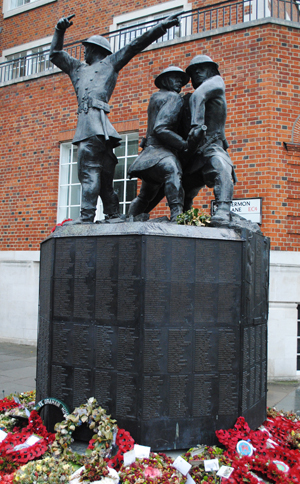
5. The National Firefighters Memorial – Marking the role played by firefighters during the Blitz of London in World War II (as well as the role of firefighters generally), the memorial (pictured right) was designed by John Mills and features the “Blitz” statue – two life-sized firefighters and an officer cast in bronze – standing atop a plinth. First unveiled in by Queen Elizabeth II in 1991, it originally featured the names of 997 men and women who died during the Blitz inscribed upon it but this was extended to include firefighters who have died in peacetime and an additional 1192 names were added prior to a rededication in 2003. Located just south of St Paul’s on the main route to the Millennium Bridge, it is the focus of the annual Firefighters Day of Remembrance held each September. For more information, see www.firefightersmemorial.co.uk.

6. The Animals in War Memorial – Commemorating all the animals that died alongside British, Commonwealth and Allied forces during the wars and conflicts of the 20th century, this unusual monument at Brook Gate in Park Lane was unveiled in 2004. The sculptures include two mules, a horse and a dog all cast in bronze while other animals are depicted in bas-relief on a wall of Portland stone. For more information, see www.animalsinwar.org.uk

7. Canada Memorial – Located in Green Park (just inside Canada Gate), the memorial, designed by Quebec artist Pierre Granche, honors the more than 100,000 Canadians who died in the world wars as well as the more than one million who served. Made of red granite inset with bronze maple leaves, it was designed to create the impression of maple leaves floating down a stream. Unveiled by Queen Elizabeth II in 1994.  www.vac-acc.gc.ca/remembers/sub.cfm?source=memorials/ww2mem/green-park-memorial

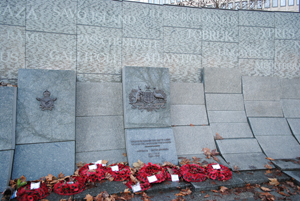
8. Australian War Memorial – Located close to Wellington Arch at Hyde Park Corner, this monumental wall (pictured right) marks the role Australians played in both World Wars. More than 100,000 Australians died during the conflicts and the names of the 23,844 towns in which they were born are inscribed on the wall over which is superimposed the names of 47 battles in which Australians fought in. Unveiled on the 85th anniversary of Armistice Day, 2003. For more information, see www.awmlondon.gov.au.

9. New Zealand War Memorial – Located at Hyde Park Corner diagonally opposite the Australian War Memorial, this monument was designed by architect John Hardwick-Smith and sculptor Paul Dibble and features 16 bronze cross-shaped ‘standards’ of varying heights set in formation and inscribed with text, patterns and some small sculptures. Dedicated on Armistice Day, 2006, by Queen Elizabeth II.

10. Soviet War Memorial – Found in the Geraldine Mary Harmsworth Park – adjacent to the Imperial War Museum in Southwark, the Soviet War Memorial was unveiled in 1999. Designed by sculptor Sergei Shcherbakov, it commemorates the 27 million people who died in the Soviet Union during World War II. For more information, see www.scrss.org.uk/sovietmemorial.htm.