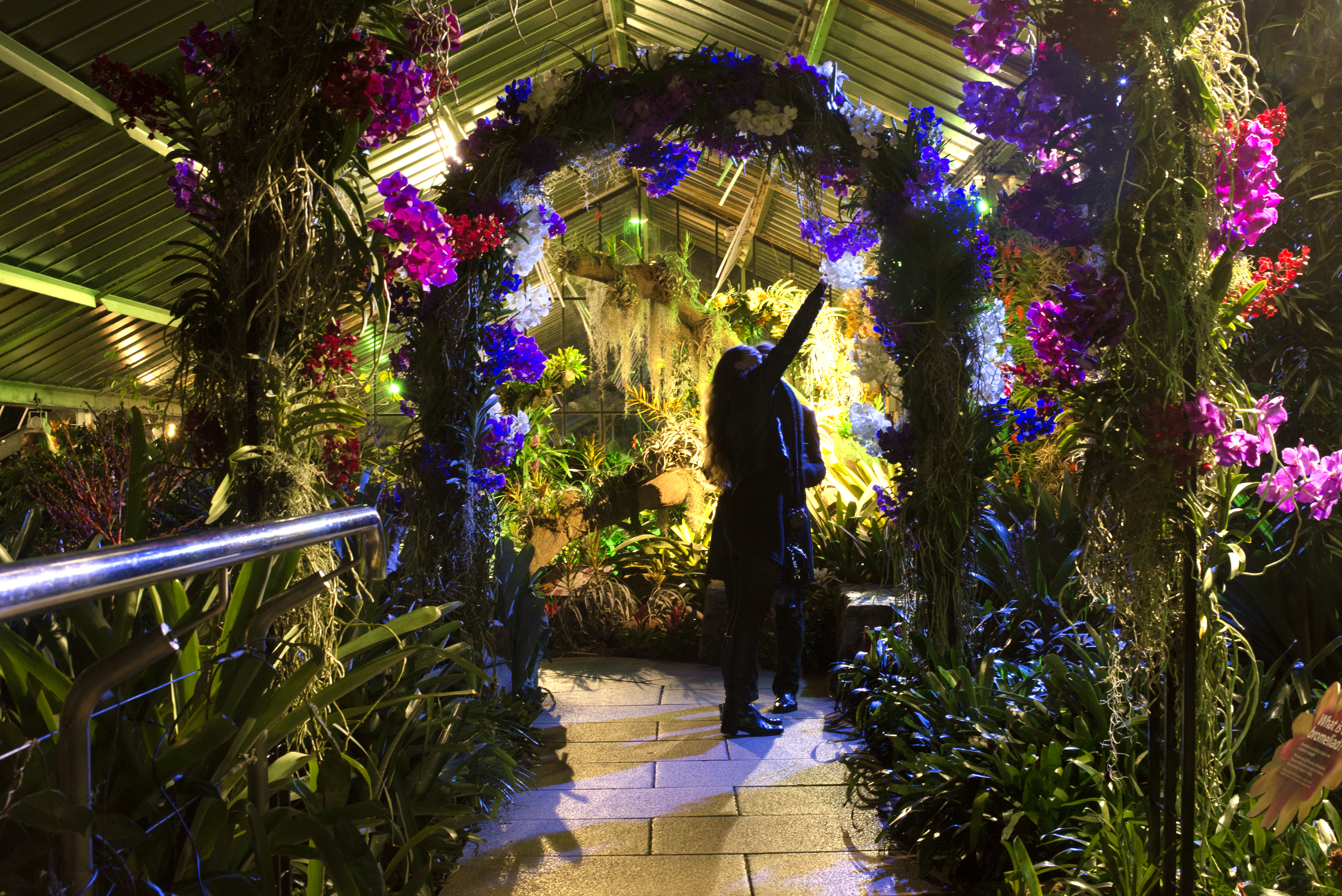
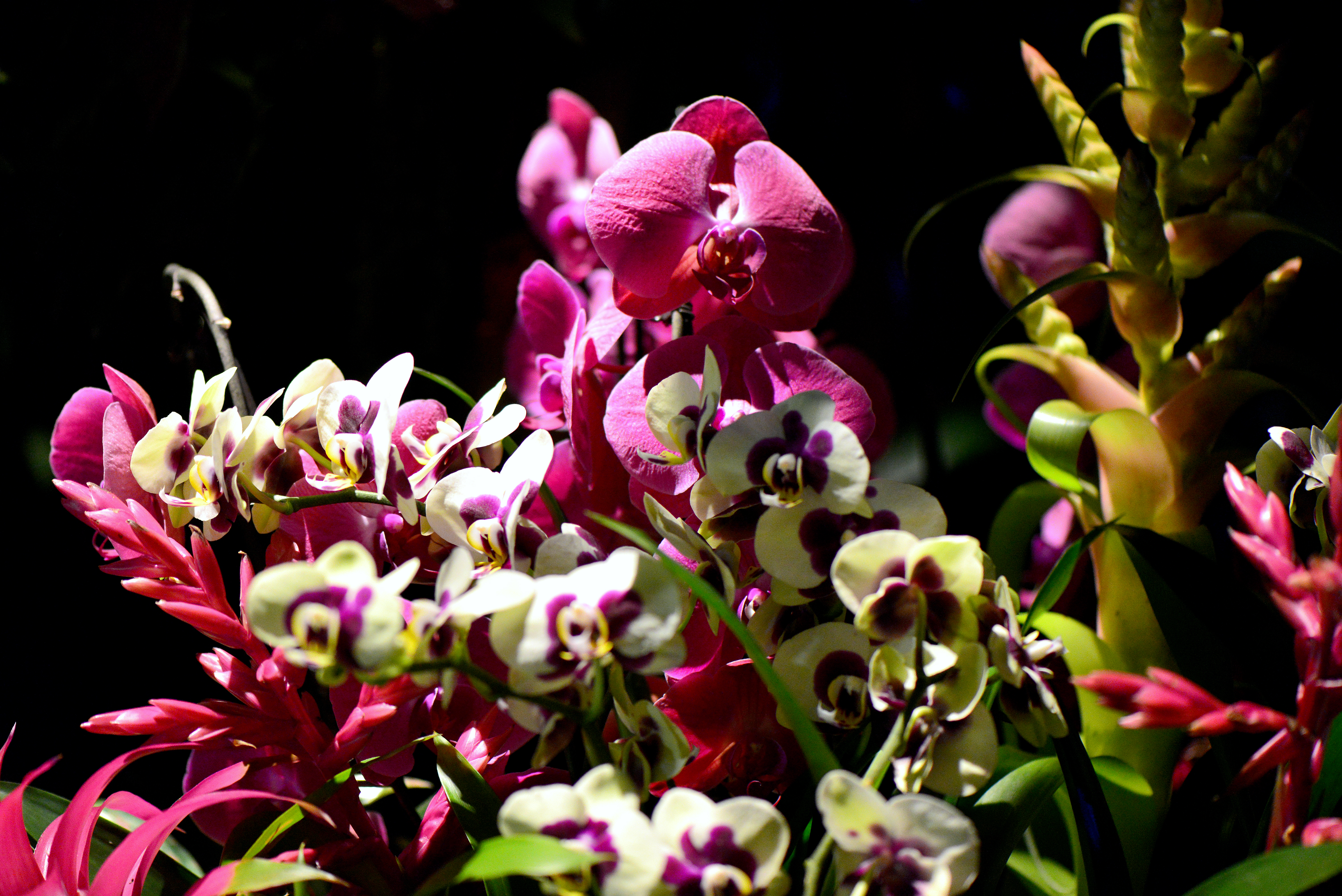
Get a taste of the tropics at Kew Gardens. The rare beauty of orchids is on show in the Princess of Wales Conservatory as part of the annual Orchid Festival which runs until 6th March. And as was the case last year, the festival once again features a series of late openings giving visitors the chance to experience the colourful display after dark. Admission charge applies – for more information on dates and times, see www.kew.org. PICTURES: Jeff Eden/RBG Kew.
Gardens
This Week in London – Norway on show at Dulwich; Bruegel the Elder at the Courtauld; and, Kew Gardens celebrates the orchid…
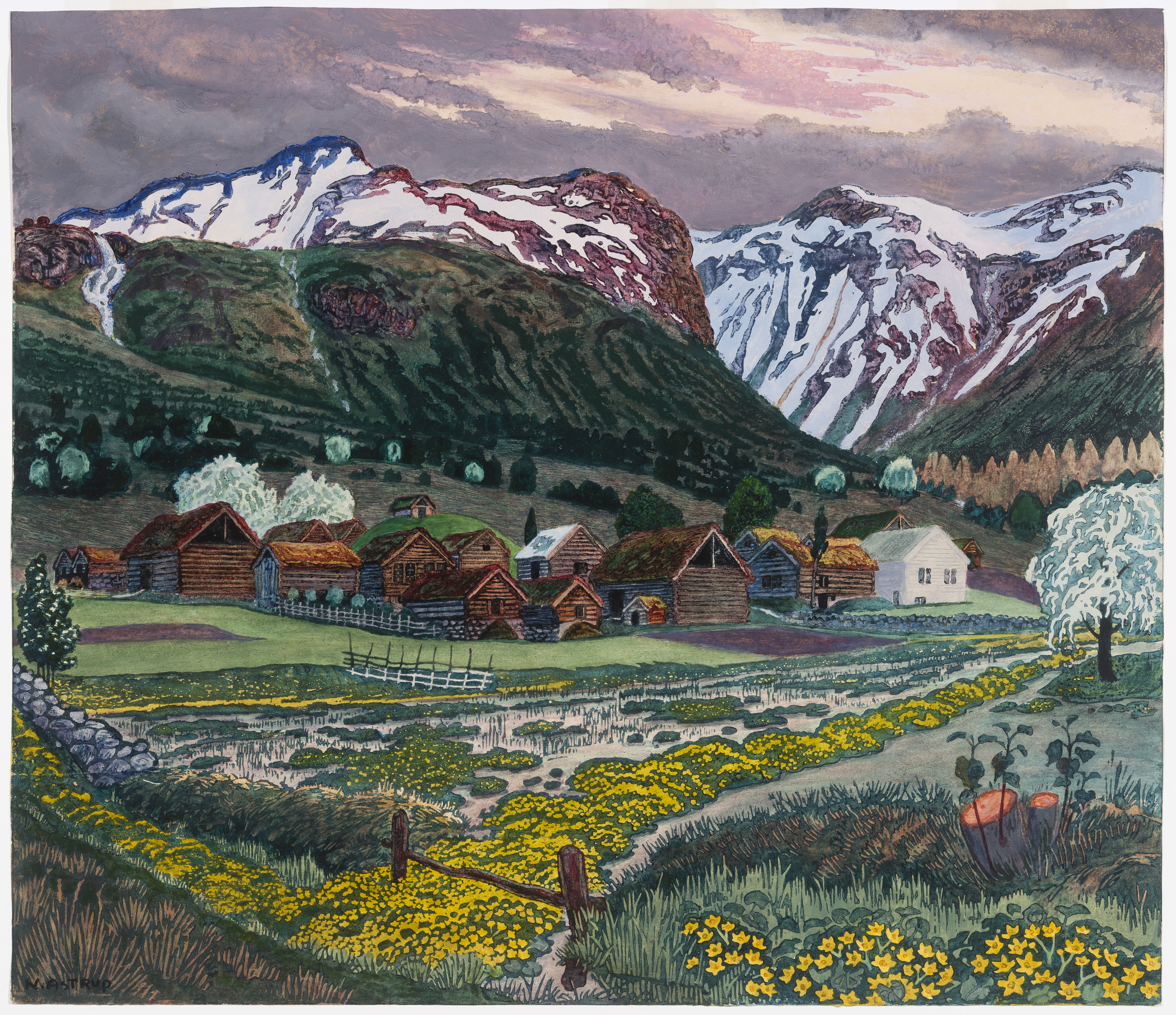
• The first UK show dedicated to the works of Norwegian landscape painter and printmaker, Nikolai Astrup, opens at the Dulwich Picture Gallery tomorrow. Painting Norway: Nikolai Astrup (1880-1928) features more than 120 paintings, woodcuts and archive material – many of public display for the first time. Astrup is described as one of Norway’s finest 20th century artists and long with Munch, expanded the possibilities of woodcuts to capture the wild landscapes and traditional way of life in his western Norway home. Works on show include everything from the woodcut A Clear Night in June (1905-07), the many coloured masterpiece A Night in June in the Garden (1909), and the celebratory Midsummer Eve Bonfire (1915). Runs until 15th May. Admission charges apply. The gallery is also hosting a series of related events. For more, head to www.dulwichpicturegallery.org.uk. PICTURE: Marsh Marigold Night, c.1915 – The Savings Bank Foundation DNB/The Astrup Collection/KODE Art Museums of Bergen. Photo © Dag Fosse/KODE.
• Bruegel the Elder’s only three surviving grisaille paintings have been brought together in a new exhibition opening at the Courtauld Gallery at Somerset House today. The works, painted in shades of grey, include the Courtauld’s Christ and the Woman Taken in Adultery as well as The Death of the Virgin (brought from the National Trust-managed Upton House) and Three Soldiers (borrowed from the Frick Collection in New York. They’re among the less than 40 works attributed to the artist (c1525-1569) and while The Death of the Virgin was owned by his friend, map-maker Abraham Ortelius, Christ and the Woman Taken in Adultery was one of few paintings kept by the artist himself. The exhibition Bruegel in Black and White: Three Grisailles Reunited also includes replicas made by Bruegel’s sons as well as other grisailles while other works by Bruegel from the Courtauld’s collection will be displayed in the Butler Drawings Gallery. Runs until 8th May. Admission charges apply. For more, see www.courtauld.ac.uk.
• Head to Kew Gardens for a splash of colour as the annual Orchid Festival kicks off in the Princess of Wales Conservatory on Saturday. And, following the success of last year’s events, the conservatory will once again throw its doors open after dark on the 11th, 18th and 25th February and 3rd March for Orchid Lates at Kew Gardens (there’s also a special Valentine’s Late at Kew Gardens on 13th February). Admission charges apply. For more, head to www.kew.org.
Send all items for inclusion to exploringlondon@gmail.com.
This Week In London – Artists and gardens at the RA; London tattoos; and, out of this world photos at the Natural History Museum…
• A major exhibition looking at the role of gardens in the paintings of Claude Monet and his contemporaries opens at the Royal Academy of Arts in Piccadilly on Saturday. Painting the Modern Garden: Monet to Matisse spans the period from the 1860s to the 1920s and includes more than 120 Impressionist, Post-Impressionist and Avant-Garde works including 35 by Monet as well as “rarely seen” masterpieces by Paul Klee, Emil Nolde, Gustav Klimt and Wassily Kandinsky. Highlights include Monet’s Agapanthus Triptych (1916-1919) as well as his Water Lilies (1904) and Lady in the Garden (1867), Auguste Renoir’s Monet Painting in His Garden at Argenteuil (1873) , Kandinsky’s Murnau The Garden II (1910) and Pierre Bonnard’s Resting in the Garden (1914). The exhibition, which has previously been at The Cleveland Museum of Art in Ohio, runs until 20th April. Admission charge applies. For more, see www.royalacademy.org.uk. PICTURE: Claude Monet, Lady in the Garden, 1867; © The State Hermitage Museum/Vladimir Terebenin.
• The world of professional tattooing is the subject of a new display at the Museum of London. Tattoo London, which opens at the City-based museum tomorrow, looks at the history of tattooing in the capital – which dates back to a time before Captain Cook – as well as life inside four contemporary tattoo studios. Also on display will be newly commissioned artworks by tattooists from the studios – Lal Hardy at New Wave, Alex Binnie at Into You, Claudia de Sabe at Seven Doors, and Mo Coppoletta at The Family Business. A series of events are being held in conjunction with the display which runs until 8th May. Entry is free. For more, see www.museumoflondon.org.uk.
• A new photographic exhibition exploring the solar system has opened at the Natural History Museum. Otherworlds: Visions of our Solar System features 77 composite images pieced together from date collected on NASA and ESA missions by artist, curator and writer Michael Benson. Highlights include A Plutonian haze – a colourised image of Pluto created from data captured during New Horizon’s flyby of the dwarf planet in July last year, Enceladus vents waters into space – captured in 2009 by NASA’s Cassini mission it shows Saturn’s sixth largest moon Enceladus spraying water into space, and, A Warming Comet – a picture of the twin-lobed comet 67P/Churyumov-Gerasimenko venting gas and dust captured by ESA’s Rosetta probe in July last year. The exhibition can be seen until 15th May at the South Kensington museum. Admission charge applies. For more, see www.nhm.ac.uk/otherworlds.
Send all items for inclusion to exploringlondon@gmail.com.
LondonLife – Facelift for one of the UK’s “most unique” cemeteries…
Brompton Cemetery in London’s west is to undergo a major renovation thanks to a £6.2 million project. Designed by Benjamin Baud and consecrated by the Bishop of London in 1840, the 39 acre cemetery – one of the oldest Grade I listed cemeteries in the country and known as one of London’s “magnificent seven” cemeteries – was strongly influenced by landscapes around St Peter’s in Rome. Among the 205,000 people buried there are suffragette Emmeline Pankhurst, Sir Thomas Spencer Wells – Queen Victoria’s surgeon, and thousands of former Chelsea pensioners. The project will see the chapel, central colonnades and catacombs restored and the transformation of North Lodge into a visitor’s centre with shop and cafe as well as other conservation and improvement works. It is funded by an almost £4.5 million grant from the BIG Lottery Fund and the Heritage Lottery Fund as well as a £1.2 million investment from The Royal Parks, managers of the site, and £500,000 from The Royal Parks Foundation, only half of which has been raised. Those looking to donate to the foundation’s appeal, can visit www.SupportTheRoyalParks.com. PICTURE: © The Royal Parks
Top posts of 2015 – A lost ‘castle’; Jack Cade and London; and, a garden in Seething Lane…
2016 is fast approaching and to celebrate, we’re looking back at the 10 most popular posts we published in 2015. Today, we look at numbers seven, six and five…
7. At number seven is a post we published in February as part of our ongoing Lost London series. In it we looked at the later history of the fortification known as Baynard’s Castle – Lost London – Baynard’s Castle (part 2)…
6. Another in our series on London’s ‘battlefields’ – this one, published in November looks at the role the city played in Jack Cade’s rebellion during King Henry VI’s reign – 10 London ‘battlefields’ – 4. Jack Cade’s rebellion…
5. Our fifth most popular post of 2015 was another in our series on gardens – 10 small, ‘secret’ and historic gardens in central London…5. Seething Lane Garden…
We’ll look at numbers four and three tomorrow…
Top posts of 2015 – A garden gem; London and the Peasant’s Revolt; and, the Duke of Wellington’s cloak…
2016 is fast approaching and to celebrate, we’re looking back at the 10 most popular posts we published in 2015.
10. Our 10th most popular post was published in July came from our special series on “10 small, ‘secret’ and historic gardens in central London” and looks at the origins of The Goldsmith’s Garden – 10 small, ‘secret’ and historic gardens in central London…1. Goldsmiths’ Garden…
9. Published in November, our ninth most popular post was from our current special series on London ‘battlefields’ and looks at the role the city played in the 14th century Peasant’s Revolt – 10 London ‘battlefields’ – 3. London sacked in the Peasant’s Revolt…
8. At number eight is a post from our long-running Treasures of London series, which, in the year of the 200th anniversary of the Battle of Waterloo, looks at a recent acquisition by the National Army Museum – Wellington’s cloak – Treasures of London – Duke of Wellington’s cloak…
We’ll look at numbers seven through five tomorrow…
LondonLife – An illuminated Christmas at Kew…
It was Queen Charlotte who first dressed the branches of a Christmas tree in Kew Palace in the 1790s and, drawing on that tradition, Kew Gardens is once again hosting a mile long winter light experience. Visitors can walk through ribbons of light, count the festooned Christmas trees and listen to a holly bush choir as well as see larger than life winter flora such as snowdrops and Christmas roses and pause at the scented Fire Garden for a moment of reflection. Santa and his elves are appearing on stage at the Princess of Wales Conservatory and a Victorian carousel and other rides are located at the White Peaks Cafe where visitors can sample goodies like mulled wine, spiced cider and roasted chestnuts. The after-dark event runs from 5pm to 10pm on select dates until 2nd January. Admission charge applies. For more, see www.kew.org. PICTURE: The Palm House at Kew Gardens lit up for Christmas. Courtesy Kew Gardens.
Wrapping up 10 small, ‘secret’ and historic gardens in central London…
Over the past couple of months our special Wednesday series has looked at “10 small, ‘secret’ and historic gardens in central London”. So we’re finishing the series by taking a quick look back at the 10 gardens we featured (and providing a single point where you can find any you may have missed)…
10 small, ‘secret’ and historic gardens in central London…1. Goldsmiths’ Garden…
10 small, ‘secret’ and historic gardens in central London…2. Whittington Garden…
10 small, ‘secret’ and historic gardens in central London…3. St Dunstan in the East Garden…
10 small, ‘secret’ and historic gardens in central London…4. St Mary Aldermanbury Gardens…
10 small, ‘secret’ and historic gardens in central London…5. Seething Lane Garden…
10 small, ‘secret’ and historic gardens in central London…6. Red Cross Garden, Southwark…
10 small, ‘secret’ and historic gardens in central London…7. St Swithin’s Church Garden…
10 small, ‘secret’ and historic gardens in central London…8. Postman’s Park…
10 small, ‘secret’ and historic gardens in central London…9. Garden of Rest, Marylebone…
10 small, ‘secret’ and historic gardens in central London…10. Geffrye Museum Gardens…
Do you have a favourite? Or maybe there’s a ‘small, secret and historic’ garden we didn’t mention that you love (and we may mention in a future special)?
10 small, ‘secret’ and historic gardens in central London…10. Geffrye Museum Gardens…
We’ve mentioned the Geffrye Museum gardens before but they’re well worth a more detailed mention.
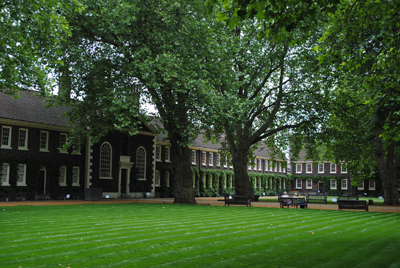
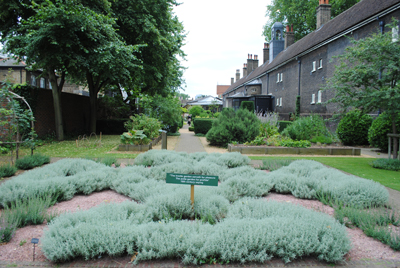
There are two distinct gardens at the Geffrye – the first are the public gardens located just off Kingsland Road which were originally laid out when the almshouses in which the museum is now based were constructed while the second is the walled herb garden and series of period garden ‘rooms’ which are much more recent additions.
While origins of the former date back to when the almshouses – 14 homes of four rooms each with a central chapel – were built in 1712-14 by the Ironmonger’s Company under instructions in the will of Sir Robert Geffrye (for more on him, see our earlier Famous Londoners entry here), they weren’t opened to the public until 1912 when the London County Council took over the site (for more on the history of the almshouses, see our earlier entries here and here).
These gardens originally featured a series of lime trees and by the early 19th century, an image shows lawns surrounded by railings with some flower beds and trees. The front lawns were apparently grazed by sheep or employed for growing crops of potatoes.
By the mid-1800s, the lime trees had been replaced by London plane trees, most of which are still standing. The gardens were again laid out in 1900-01 and again after the LCC took over in 1910 when a small pool was added in front of the chapel and a bandstand and playground elsewhere in the gardens.
The grounds also include a small graveyard – that of the Ironmongers’ – and among those buried here are Geffrye and his wife, their remains brought here from the chapel of St Dionis Backchurch in Lime Street when it was demolished in 1878.
The walled herb garden and period garden ‘rooms’, meanwhile, were added in the 1990s. The herb garden opened in 1992 on a what had been a derelict site to the north of the building – it features four square beds containing more than 170 different herbs and plants.
The period garden ‘rooms’, meanwhile, were laid out in 1998 to showcase middle class town gardens from different eras. They currently include a Tudor “knot garden”, a Georgian garden, a Victorian garden and an Edwardian garden.
Each of these gardens has been carefully constructed using evidence gathered from drawings and prints, maps and garden plans along with plant lists, diaries and literature.
WHERE: Geffrye Museum, 136 Kingsland Road, Shoreditch (nearest tube station is Old Street; nearest Overground station is Hoxton); WHEN: 10am to 5pm, Tuesday to Sunday (front gardens are open all year round by period and herb gardens are only open until 1st November and reopen on 28th March; COST: Entry is free; WEBSITE: www.geffrye-museum.org.uk/explore-the-geffrye/explore-gardens/.
10 small, ‘secret’ and historic gardens in central London…9. Garden of Rest, Marylebone…
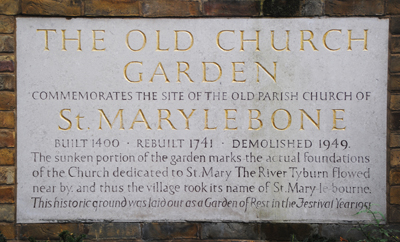
This pocket park is another of those located on the site of a former church – in this case the Marylebone Parish Church which now stands to the north.
The church – the third to serve the parish – was built here in 1740 but was replaced when the current parish church was built between 1813 and 1817.
The former church didn’t close until 1926, however, continuing use as a parish chapel, and even then wasn’t demolished until 1949 after it was damaged by bombing during World War II.
In 1951, the St Marylebone Society created a Memorial Garden of Rest on the site (also known as the Old Church Garden). It was opened in March, 1952, by Viscount Portman.
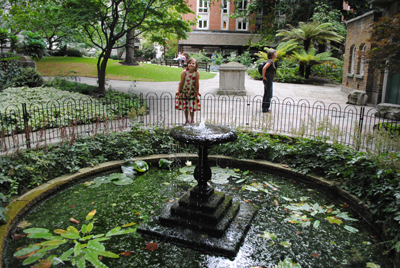
The foundations of the former church were marked out in the sunken portion of the garden. The predominantly paved garden also contains numerous gravestones and memorials.
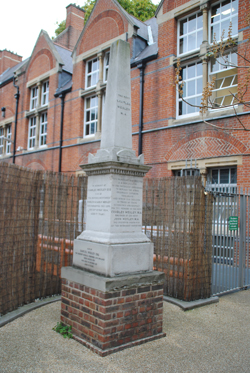
These include that of Methodist movement leader Charles Wesley, erected in 1858 to commemorate his burial in 1788 (pictured right). There’s also a plaque recording notable burials at the church, including the painter George Stubbs (1806), royal apothecary John Allen (1774), architect James Gibbs and bare knuckle boxer James Figg (1734). Other plaques detail some of the church’s history.
Also of note in the garden is a Judas tree (Cercis siliquastrum), named for being the variety upon which Judas hung himself or, alternately, because its fruit pods resemble bags of silver. The current tree replaces an earlier one.
WHERE: Garden of Rest Marylebone, Marylebone High Street (nearest tube stations are St Paul’s and Barbican); WHEN: 7am to dusk; COST: Entry is free; WEBSITE: www.myparks.westminster.gov.uk/parks/garden-of-rest-marylebone/.
What’s in a name?…Kew…
Famed as the location of the Royal Botanic Gardens, Kew is a Thames-side suburb in London’s west.
It’s the riverside location which gives the area its name – Kew is apparently a corrupted form of Cayho, a word first recorded in the early 14th century which is itself made of two words referring to a landing place (the ‘Cay’ part) and a spur of land (the ‘ho’ part). The latter may refer in this case to the large “spur” of land upon which Kew is located, created by a dramatic bend in the Thames. The former may refer to a ford which crossed the river here (explaining the name of Brentford on the other side).
While the area had long been the home of a small hamlet for the local farming and fishing community, more substantial houses began to be developed in Kew in the late 15th and early 16th centuries thanks to the demand for homes for courtiers attending the King Henry VII and his successors at nearby Richmond Palace (the royal connections of the area in fact go back much further to the early Middle Ages).
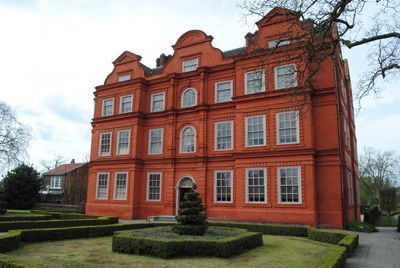
But it was during the Georgian era, when the Royal Botanic Gardens were founded and Kew Palace, formerly known as the Dutch House, became a royal residence (it is pictured above), that Kew really kicked off (and by the way, Kew Palace is not the only surviving 17th century building in the area – West Hall, once home of painter William Harriot, is also still here).
While King George II and his wife Queen Caroline used Richmond Lodge, now demolished but then located at the south end of what is now the gardens, as their summer residence, they thought Kew Palace would make a good home for their three daughters (their heir, Frederick, Prince of Wales, lived opposite his sisters at the now long-gone White House). Kew Palace, meanwhile, would later be a residence of other members of the Royal Family as well, including King George III during his bouts of madness.
Other buildings of note from the Georgian era in Kew include Queen Charlotte’s Cottage, a thatched property built between 1754 and 1771 and granted to Queen Charlotte by her husband, King George III (like the palace, it now lies within the grounds of Kew Gardens). St Anne’s Church, located on Kew Green, dates from 1714 and hosts the tombs of artists Johann Zoffany and Thomas Gainsborough.
In 1840, the gardens which surrounded the palace were opened to the public as a national botanic garden and the area further developed with the opening of the railway station in 1869, transforming what was formerly a small village into the leafy largely residential suburb which we find there today (although you can still find the village at its heart).
As well as Kew Gardens (and Kew Palace), Kew is today also the home of the National Archives, featuring government records dating back as far as 1086.
10 small, ‘secret’ and historic gardens in central London…8. Postman’s Park…
Housing one of London more unique memorials, Postman’s Park in the City’s north is located on what were once the churchyards and burial grounds of three different churches.
The park – which took its name from its popularity with postal workers who came here to escape their job at the nearby former General Post Office (read a Lost London article on the GPO here) – opened in 1880.
It was originally located on the site of the former churchyard of St Botolph’s-without-Aldersgate and was subsequently expanded to incorporate the adjacent churchyard of St Leonard, Foster Lane, and the burial ground of Christ Church, Greyfriars (also known as Christ Church, Newgate Street). Some of the headstones still stand along the park’s boundaries.
Its key feature is the G.F. Watts Memorial To Heroic Self Sacrifice (pictured, right). Victorian artist and philanthropist George Frederic Watts proposed the memorial commemorating “heroic men and women” who had given their lives to save others to mark Queen Victoria’s Jubilee in 1887 but the memorial which now stands there wasn’t built until 1900.
The memorial consists of a loggia, the inside of which is lined with glazed tablets. Each of these commemorates acts of bravery by “everyday heroes” as they attempted to rescue people from fires, runaway trains, sinking ships and drowning. There were 13 plaques at the time of his death in 1904 and his wife Mary added a further 34.
The latest of the memorials commemorating 62 individuals was added in 2009 (for more details, head to our earlier post here, part of our Curious London Memorials series; you can also find more about the memorial, including a free app, here).
The park also features a sundial and fountain amid bright flower beds and various species of trees including a large banana tree, a dove tree and Tasmanian tree ferns.
Claims to fame include its role in the 2004 film Closer, which starred Natalie Portman, Julia Roberts, Jude Law and Clive Owen (we won’t go into details, just in case you haven’t seen it!).
WHERE: Postman’s Park, between King Edward Street and St Martin’s le Grand (nearest tube stations are St Paul’s and Barbican); WHEN: The park, managed by the Corporation of London, is open 7am to 8pm or dusk (whichever is earlier); COST: Entry is free; WEBSITE: www.cityoflondon.gov.uk/things-to-do/green-spaces/city-gardens/visitor-information/Pages/Postman’s-Park.aspx.
This Week in London – Palaces mark Queen Elizabeth II’s long reign; Richmond Park’s open day; celebrating a famous London redhead; and, London shops features in new work…
• A special photographic display has opened at Buckingham Palace this week to commemorate the fact that Queen Elizabeth II has this week become Britain’s longest-reigning monarch. The outdoor photographic display Long To Reign Over Us features a selection of photographs spanning the period from 1952 to today including informal family moments, official portraits and visits of the Queen to places across the UK and Commonwealth. Highlights include a black and white portrait by Dorothy Wilding from the start of the Queen’s reign in 1952, Cecil Beaton’s official Coronation Day portrait from 1953 and a 2006 image of the Queen with her Highland Ponies. The displays, which are also being shown as Windsor Castle and the Palace of Holyroodhouse in Edinburgh, can be seen by visitors to Buckingham Palace’s summer opening until 27th September. Admission charge applies. For more, see www.royalcollection.org.uk. PICTURE: Dorothy Wilding. Royal Collection Trust/© William Hustler and Georgina Hustler/National Portrait Gallery, London
• Still celebrating the Queen becoming Britain’s longest reigning monarch, and a new film installation celebrating the reigns of Queen Elizabeth II and Queen Victoria – whose reign she has now surpassed – has opened at Kensington Palace. The film installation explores key moments in the reigns of both – coronations, weddings, births as well as other key moments in their public lives – and also examines the impact of new technologies in the reigns of both queens. For more, see www.hrp.org.uk/kensingtonpalace.
• Richmond Park in London’s south-west is holding its annual open day this Sunday with a range of activities for kids including pony rides, the opportunity to see inside a bug hotel with a fibro-optic camera and the chance make pills in a restored Victorian pharmacy. The Holly Lodge Centre, normally reserved for schools and learning groups, will open its doors to the general public will be at the centre of the day, offering a range of activities for children while there will also be a guided walk led by the Friends of Richmond Park, vintage car displays, and a World War I re-enactment. The day runs from 11am to 4pm. Entrance to the Royal Park is free but parking is £5. For more, see www.royalparks.org.uk.
• This Saturday is Redhead Day UK 2015 and to mark the occasion, the Guildhall Art Gallery in the City of London is inviting visitors to celebrate by taking a selfie with Dante Gabriel Rossetti’s iconic redhead La Ghirlandata. Painted by Rossetti in 1873, the artwork, said to be one of the finest pre-Raphaelite works in the world, is on permanent display at the gallery. The painting features on the cover of Jacky Colliss Harvey’s new book Red: A Natural History of the Redhead, three copies of which will be given away in a special draw at the gallery. Entry is free. For more, see www.cityoflondon.gov.uk/things-to-do/visit-the-city/attractions/guildhall-galleries/Pages/guildhall-art-gallery.aspx.
• A six metre high ceramic installation created for the V&A by artist Barnaby Barford has gone on display in the museum’s Medieval & Renaissance Galleries in South Kensington. The Tower of Babel is composed of 3,000 small bone china buildings, each of which depicts a real London shop. Bamford photographed more than 6,000 shopfronts in the process of making the work, cycling more than 1,000 miles as he visited every postcode in London. The work can be seen until 1st November. Admission is free. See www.vam.ac.uk.
Send all items for inclusion to exploringlondon@gmail.com.
This Week in London – The Waterloo Cartoon on show; see inside a former Huguenot’s home; and, Royal Parks’ harvest festivals…
• A monumental Victorian-era drawing of the Battle of Waterloo has gone on display in London for the first time since 1972. The Waterloo Cartoon, more formally known as The Meeting of Wellington and Blucher after the Battle of Waterloo, measures more than 13 metres long and three metres high. A preparatory drawing for a wall painting which still exists in the House of Lords’ Royal Gallery, it took artist Daniel Maclise more than a year to complete in 1858-59 and was based on eye-witness accounts (the artist even recruited Queen Victoria and Prince Albert to use their German contacts to gather information from Prussian officers present on the day). Long considered a masterpiece, it was bought by the Royal Academy in 1870 – the year of Maclise’s death – and was on show at Burlington House until the 1920s. It has been in storage for much of last century and, newly restored following a grant from Arts Council England, has now gone on display to mark the 200th anniversary of the Battle of Waterloo. The newly conserved drawing is the focus of a new exhibition – Daniel Maclise: The Waterloo Cartoon, which opened at the Royal Academy in Piccadilly yesterday (between May and August, it was on show as part of a Waterloo exhibition at the Royal Armouries in Leeds). Runs until 3rd January. Admission charge applies. For more, see www.royalacademy.org.uk.
• There’s a rare chance to see inside a former Huguenot merchant’s house dating from 1719 in Spitalfields this weekend. The property at 19 Princelet Street was the home of the Ogier family, who had come to London escaping persecution in France and worked in the silk weaving trade. It was later subdivided into lodgings and workshops with later occupants following a range of trades and professionals while a synagogue was opened in the garden in 1869. The site – which the Spitalfields Centre charity hopes to establish as a museum of immigration – is not generally open to the public but will be open this Saturday and Sunday – from 2pm to 6pm. Entry is free (but donations would be welcome) and there may be queues so its suggested you arrive early. For more, see www.19princeletstreet.org.uk.
• Watch a bee keeping demonstrations, help dig up some potatoes and introduce the children to some farm animals. The Kensington Gardens’ Harvest Festival will be held this Sunday, between 11am and 4pm, and will also include a range of children’ activities, experts from the Royal Parks Guild on hand to answer your questions about food growing and complimentary hot and cold drinks available throughout the day while stocks last. It’s the first of three harvest festivals to be held in Royal Parks this month with Greenwich Park set to host its inaugural harvest festival on 13th September (11am to 4pm) and The Regent’s Park Allotment Garden to host one on 19th September (11am to 5pm). For more, see www.royalparks.org.uk.
Send all items for inclusion to exploringlondon@gmail.com.
10 small, ‘secret’ and historic gardens in central London…7. St Swithin’s Church Garden…
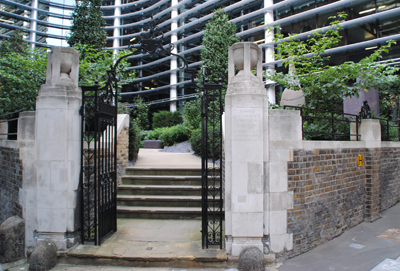
Back into the City of London this week and it’s another garden located on the site of a former church.
Situated just off Cannon Street, this much overlooked tiny raised garden was created on the site of the former Church of St Swithin. The church is believed to have existed here as early as the 11th century and was replaced, thanks largely to the generosity of Lord Mayor Sir John Hind, with a larger building in the early part of the 15th century – it featured one of the first towers built specifically for the task of hanging bells inside.
The church was among those destroyed in the Great Fire of London in 1666 but, now united with the parish of St Mary Bothaw, was rebuilt to the designs of Sir Christopher Wren shortly after in 1677-88.
Later known as St Swithin, London Stone thanks to the mysterious London Stone being built into the south wall of the church in the late 18th century (for more on the stone and its current location, see our earlier post here), the church survived until World War II when it was damaged beyond repair during bombing and was later destroyed.
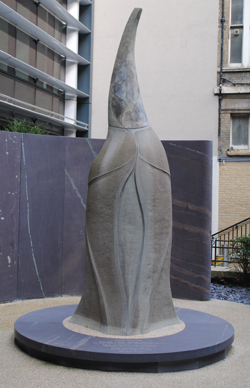
Relandscaped in 2010, the garden features a rather dramatic memorial (pictured) to the suffering of women and children in war in general and medieval figure, Catrin Glyndwr in particular. Unveiled in 2001, it was designed by Nic Stradlyn-John and sculpted by Richard Renshaw.
The daughter of the Welsh Prince Owain Glyndwr, she was captured in 1409 and brought with her children and mother to the Tower of London. Catrin and two of her children died in late 1413 and were buried in the former church.
WHERE: St Swithin’s Church Garden, Salters Hall Court off Cannon Street (nearest Tube station is Cannon Street); WHEN: daily; COST: Free; WEBSITE: www.bost.org.uk/open-places/red-cross-garden/.
10 small, ‘secret’ and historic gardens in central London…6. Red Cross Garden, Southwark…
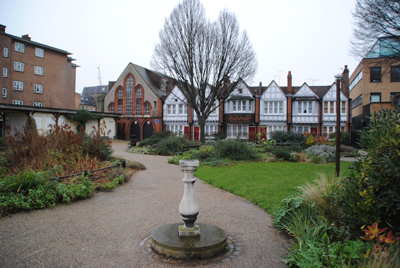
We travel south of the Thames this week to Red Cross Garden in Southwark. Located not far from Borough Market, the garden has a rich history, having first been laid out in 1887 by the social reformer, philanthropist and National Trust co-founder Octavia Hill.
Described as Hill’s “flagship project”, it was here, after being granted use of the land by the Ecclesiastical Commission, that she demonstrated the role gardens and open spaces play in improving the lives of the poor living in 19th century Southwark (in the picture you can see in the background the hall and cottages which were also part of the project – Hill had these constructed between 1888-89, the hall being for community activities and the cottages homes for the “working poor”. Both were designed by Elijah Hoole).
The garden in Redcross Way was created on the site of a derelict paper factory and a hop warehouse and originally contained meandering paths, an ornamental pond with fountain, a bandstand and a covered play area for children as well as an elevated walkway for viewing the garden – described by Hill as an “open air sitting room for the tired inhabitants of Southwark”. There were a number of colourful mosaics – one called The Sower is still in situ but another known as The Good Shepherd was apparently lost.
The original layout of garden, which were used as the venue for the annual Southwark Flower Show as well as other events, had been lost by the late 1940s and it was only in much more recent years that it was restored by the Bankside Open Spaces Trust (with funding from the Heritage Lottery Fund and Southwark Council). They were officially reopened in 2006 by Princess Anne.
The award-winning garden is now managed by BOST which leases the space from Southwark Council and relies on the work of volunteers (any donations are always welcome!). The latest addition has been the Victorian bandstand which, constructed in a style true to the original, was unveiled late last year.
WHERE: Red Cross Garden, Redcross Way, Southwark (nearest Tube stations are Borough and London Bridge); WHEN: 9am to dusk, daily; COST: Free; WEBSITE: www.bost.org.uk/open-places/red-cross-garden/.
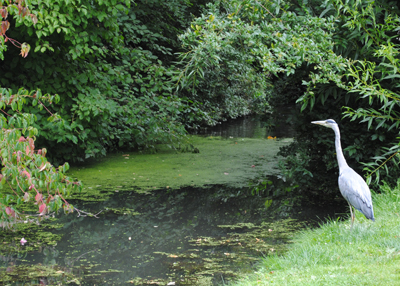
LondonLife – New River Wildlife…
10 small, ‘secret’ and historic gardens in central London…5. Seething Lane Garden…
This small, simply laid out garden in the City of London is redolent with history.
It was once the site of the Navy Office, the workplace of diarist Samuel Pepys, and it was in the garden of this building that he and Sir William Penn buried their wine and parmesan cheese for safety during the Great Fire of London in 1666.
The office survived the Great Fire but was, oddly enough, destroyed by fire only a few years later in 1673 (there is a blue plaque commemorating it in the garden) and a new office, designed by Sir Christopher Wren, was built here in the early 1680s before it was demolished in 1788.
It’s due to its association with Pepys (who also lived in the street and was buried in the nearby church of St Olave Hart Street) that it boasts a bronze bust of him which was erected by the Samuel Pepys Club in 1983, designed by Karin Jonzen and funded by public subscription. It was presented to the garden by Fred Cleary who played an instrumental role in encouraging green spaces in the Square Mile in the 1970s.
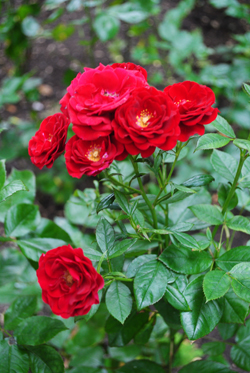
The garden, which was laid out in about 1950, is also notable for its beds of red roses, planted to commemorate the deal struck in 1381 in which the Sir Robert Knollys was belatedly granted permission for a footbridge his wife had built over Seething Lane. She had done so contrary to planning rules while he was away fighting with John of Gaunt (ostensibly so she could avoid the dust of the street when crossing from her house to her rose garden), and so when he returned, the City of London Corporation allowed the bridge (now long gone) to remain, but only in exchange for the symbolic “penalty” of one red rose a year.
The occasion is still marked each June in a ceremony overseen by the Company of Watermen and Lightermen of the River Thames in which a red rose is plucked from the garden and delivered to the Lord Mayor of London at Mansion House.
WHERE: Seething Lane Garden, Seething Lane, City of London (nearest Tube stations is Tower Hill); WHEN: Daily; COST: Free; WEBSITE: www.cityoflondon.gov.uk/things-to-do/green-spaces/city-gardens/Pages/default.aspx.
This garden reopened in 2018 after being redeveloped as part of the Trinity Square redevelopment.
10 small, ‘secret’ and historic gardens in central London…4. St Mary Aldermanbury Gardens…
Like St Dunstan in the East, these gardens at the corner of Love Lane and Aldermanbury are also based inside the remains of a medieval church.
The church of St Mary Aldermanbury (the name may relate to its proximity close to Guildhall, or the ‘Alderman’s Bury’ or ‘Alderman’s Hall’), mentioned as far back as the late 12th century, was destroyed in the Great Fire of London but was among those rebuilt to the designs of Sir Christopher Wren only to be destroyed again during the Blitz in 1940.
This time there was to be no rebuilding and instead, in 1966 the walls – all that remained – were moved more than 4,000 miles away to the town of Fulton, Missouri, in the US.
There they were reconstructed in the grounds of Westminster College – site of Winston Churchill’s famous “Iron Curtain” speech in 1946 – and the church restored as a memorial to the former British PM. The National Churchill Museum is located beneath.
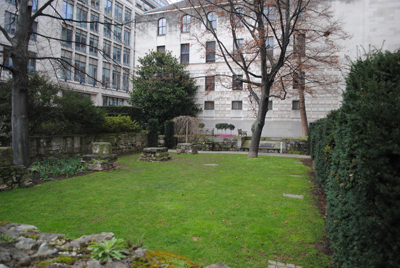
There’s plaque mentioning this in the gardens (and featuring an image of what the church looked like after its reconstruction in Fulton) which still contains the church’s footings (these date from the 15th century when the church was apparently partially rebuilt) and give an indication of what the church’s footprint would have been along with headstones (among those whose remains were buried here was the notorious Judge Jeffreys).
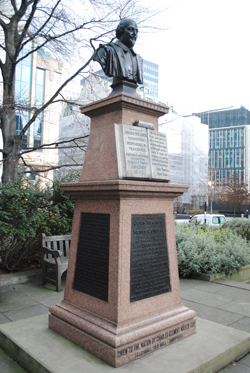
Other features include a memorial to Henry Condell and John Heminge, both involved in the publication of William Shakespeare’s first folio (you can read more about it in our earlier post here).
The garden was laid out after the church was removed. It is a designated Site of Local Importance for Nature Conservation and attracts wildlife including birds such as blackbirds, woodpigeons, house sparrows and blue tits. Plantings were added in 2011 to maximise the attraction to bird as well as bees and butterflies. On the corner outside the garden is a fountain.
WHERE: St Mary Aldermanbury Garden, Aldermanbury, City of London (nearest Tube stations are St Pauls and Monument); WHEN: 8am to 7pm daily; COST: Free; WEBSITE: www.cityoflondon.gov.uk/things-to-do/green-spaces/city-gardens/visitor-information/Pages/St-Mary-Aldermanbury.aspx.
LondonLife – Enjoying the greenery…
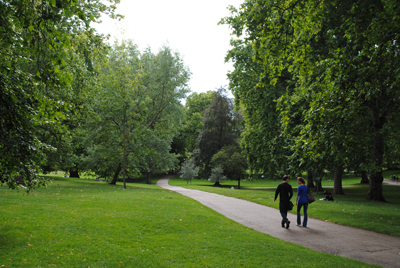
A stroll through the green oasis of the aptly named Green Park in central London. For a look at the history of Green Park, see our earlier post here.