What’s in a name?…Waterloo…

Waterloo-Bridge

Given the recent commemorations surrounding the bicentenary of the Battle of Waterloo (including a re-enactment of the arrival of news of Wellington’s victory in London where it was delivered to the Prince Regent), we thought it only fitting to take a look at the use of the name in London.

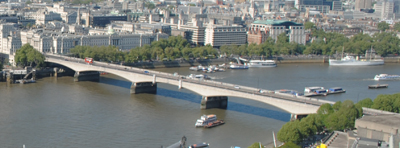
The name Waterloo, which now refers to a district in Lambeth centred on Waterloo Station, was first used to designate the bridge which crosses the Thames here.

Opened in 1817 as a toll bridge, the John Rennie-designed structure was known as Strand Bridge during its construction but renamed Waterloo at its opening two years after the battle. (Rennie’s bridge was later demolished and rebuilt in the 20th century – the current bridge is pictured above).

The name was also used to designate Waterloo Road and in the early 1820s was given to the church St John’s Waterloo (now St John’s and St Andrew’s at Waterloo) located on the road.

In 1848, Waterloo Station opened and it was after this that the surrounding district, known in past ages for its swampiness (hence streets like Lower Marsh), generally became known as Waterloo.

Landmarks in the Waterloo district include the historic Old Vic Theatre, which opened in 1818, and the Young Vic Theatre as well as the Lower Marsh Market.

On 3rd July, Waterloo will host the Waterloo Carnival with a picnic on Waterloo Millennium Green and a procession (for more on that, see www.waterlooquarter.org/news/come-and-support-this-years-waterloo-carnival) while the month-long Waterloo Food Festival kicks on on 1st July. For more on events in Waterloo commemorating bicentenary, see www.wearewaterloo.co.uk/waterloo200/.

Treasures of London – Waterloo Memorial…

Waterloo-MemorialUnveiled earlier this month at Waterloo Station to mark the bicentenary of the Battle of Waterloo, the memorial features a supersized solid bronze replica of the obverse side of the Waterloo Campaign medal depicting Nike, the Greek goddess of victory.

The memorial, which was installed on a balcony above the main concourse by The London Mint Office on behalf of Waterloo200 – the organisation overseeing bicentenary commemorations, is dedicated to the 4,700 members of the allied armies who were killed in the battle on 18th June, 1815 (which also left 14,600 wounded and 4,700 missing).

The upsized medal, which has a diameter of 65 centimetres, is a replica of one which was the first to be commissioned for every soldier who fought in the battle, regardless of their rank.

Designed by London-based artist Jason Brooks, the memorial also features a famous quote from the Duke of Wellington on granite: “My heart is broken by the terrible loss I have sustained in my old friends and companions and my poor soldiers. Believe me, nothing except a battle lost can be half so melancholy as a battle won.”

It was unveiled on 10th June by the 9th Duke of Wellington (pictured with the memorial) in a ceremony attended by some of the descendants of those who fought and died in the battle.

Waterloo Station was itself, of course, named in commemoration of the battle (well, indirectly – it, like the surrounding district itself, took its name from nearby Waterloo Bridge which was in fact named after the battle).

Treasures of London – The Great Pagoda, Kew Gardens…

pagoda

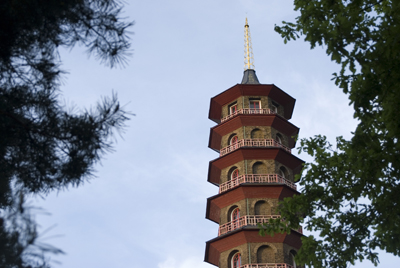
News this week that Historic Royal Palaces and the Royal Botanic Gardens are embarking on a two year project to restore eighty decorative dragons to the Kew Pagoda has led us to take a look at the history of the exotic tower set amid the trees.

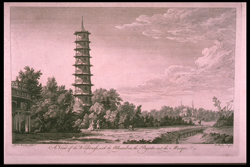
pagoda15Designed by architect Sir William Chambers (one of his drawings is depicted here), the pagoda was built in 1762 during the eighteenth century craze for Chinoiserie and was probably commissioned by Princess Augusta as part of the ongoing works she undertook in the gardens after the death of her husband Prince Frederick, eldest son of King George II and Queen Caroline.

Standing 163 feet (or almost 50 metres) high, the 10 storey pagoda was originally decorated with eighty golden dragons. It was designed to be the high point of a world tour through the gardens which also took in Roman ruins and Arabic mosques.

While the pagoda remains, the dragons were only on the structure for some 22 years before being removed in 1784 during roof repairs. Thanks to rumours they were made of solid gold, it was suggested they were sold off to pay the debts of the Prince Regent (the future King George IV), but experts say the wooden figures had simply rotted and so had to be removed.

Following their removal, the dragons subsequently disappeared and despite several attempts to find them – including one by Decimus Burton, architect of the famous Palm House (for more on that, see our earlier post), in 1843 – they have never been found.

Historic Royal Palaces and the Royal Botanic Gardens have now decided to replace them with new ones, drawing on contemporary accounts and drawings and using a team of specialist craftsmen to create them.

The restored pagoda – complete with new dragons – will be open to the public in 2017.

It is one of several ornamental buildings still located in the gardens. Others include a Japanese gateway and a Japanese wooden house called a minka.

WHERE: The Great Pagoda, Kew Gardens (nearest Tube station is Kew Gardens); WHEN: 10am daily (closing times vary – see websites for details); COST: £16.50 adults/£13 concessions/children £3.50 (discounts apply for online bookings); WEBSITE: www.kew.org.

PICTURES: RBG Kew

This Week in London – Marking VE Day’s 70th; Rut Blees Luxemburg at the Museum of London; and India’s Sidi community on show at the NPG…

Three days of events kick off in London tomorrow to mark the 70th anniversary of Victory in Europe (VE) Day. Events will include a Service of Remembrance at the Cenotaph in Whitehall at 3pm tomorrow (Friday) coinciding with two minutes national silence while Trafalgar Square – scene of VE Day celebrations in 1945 – will host a photographic exhibition of images taken on the day 70 years ago (the same images will be on show at City Hall from tomorrow until 5th June) and, at 9.32pm, a beacon will be lit at the Tower of London as part of a nation wide beacon-lighting event. On Saturday at 11am, bells will ring out across the city to mark the celebration and at night, a star-studded 1940s-themed concert will be held on Horse Guards Parade (broadcast on BBC One). Meanwhile, on Sunday, following a service in Westminster Abbey, a parade of current and veteran military personnel will head around Parliament Square and down Whitehall, past the balcony of HM Treasury where former PM Sir Winston Churchill made his historic appearance before crowds on the day, to Horse Guards. A flypast of current and historic RAF aircraft will coincide with the parade and from 1pm the Band of the Grenadier Guards will be playing music from the 1940s in Trafalgar Square. Meanwhile, starting tomorrow, special V-shaped lights will be used to illuminate Trafalgar Square, St Paul’s Cathedral and the Houses of Parliament as a tribute. For more information, see www.gov.uk/government/topical-events/ve-day-70th-anniversary.

The works of leading London-based photographer Rut Blees Luxemburg are on show in at new exhibition at the Museum of London in the City. London Dust will feature three major newly acquired works by Luxemburg including Aplomb – St Paul’s, 2013, Walkie-Talkie Melted My Golden Calf, 2013, and the film London/Winterreise, 2013. Blees Luxemburg’s images – others of which are also featured in the exhibition – contrast idealised architectural computer-generated visions of London that clad hoardings at City-building sites with the gritty, unpolished reality surrounding these. In particular they focus on a proposed 64 floor skyscraper, The Pinnacle, which rose only seven stories before lack of funding brought the work to a halt. The free exhibition runs until 10th January next year. For more, see www.museumoflondon.org.uk.

The Talk: The Cutting Edge – Weapons at the Battle of Waterloo. Paul Wilcox, director of the Arms and Armour Research Institute at the University of Huddersfield, will talk about about the weapons used at Waterloo with a chance to get ‘hands-on’ with some period weapons as part of a series of events at Aspley House, the former home of the Iron Duke at Hyde Park Corner, to mark the bicentenary of the Battle of Waterloo. To be held on Monday, 11th May, from 2.30pm to 4pm. Admission charge applies and booking is essential – see www.english-heritage.org.uk/apsley for more.

On Now: On Belonging: Photographs of Indians of African Descent. A selection of ground-breaking photographs depicting the Sidi community – an African minority living in India – is on show at the National Portrait Gallery off Trafalgar Square. The works, taken between 2005 and 2011, are those of acclaimed contemporary Indian photographer Ketaki Sheth and the exhibition is his first solo display in the UK. They provide an insight into the lives of the Sidi, and include images of a young woman named Munira awaiting her arranged wedding, young boys playing street games, and the exorcism of spirits from a woman as a young girl watches. Admission is free. Runs in Room 33 until 31st August. For more, see www.npg.org.uk.

Send all items for inclusion to exploringlondon@gmail.com.

This Week in London – Duke of Wellington on show; wartime City bank recreated in Warwickshire; and early photographs at the Tate…

ArthurWellesleyThe Duke of Wellington’s political and military career as well as his personal life is being explored in an exhibition running at the National Portrait Gallery off Trafalgar Square until August. Wellington: Triumphs, Politics and Passions features 59 portraits and other works including a rarely seen portrait of the Iron Duke painted by Sir Thomas Lawrence and commissioned by Sarah, Countess of Jersey, a year after Wellington had become Prime Minister. The portrait (pictured) remains unfinished – the state it was in when Lawrence died in 1830 – and, held in a private collection, hasn’t been shown in public for any significant period until now. The exhibition also includes a John Hoppner portrait of the duke as a young soldier, a daguerreotype taken by Antoine Claudet on Wellington’s 75th birthday in 1844 and drawings by Lawrence of Wellington’s wife, Kitty. The exhibition – which is part of the commemorations marking 200 years since the Battle of Waterloo, runs until 7th June. Admission is free. For more see www.npg.org.uk. PICTURE: Arthur Wellesley, 1st Duke of Wellington by Sir Thomas Lawrence (1829), © On loan to National Portrait Gallery by kind permission of Mr. & Mrs. Timothy Clode.

Upton House is Warwickshire has turned the clock back to 1939 with a display dedicated to the time when the Bearstead family moved their City-based bank, M Samuel & Co, to their historic family mansion to escape the Blitz in London. Twenty-two bank staff took over the house, sleeping in shared dormitories and taking meals of rook pie in the home’s Long Gallery while secretaries typed surrounded by works of art. The National Trust has returned 12 rooms to their wartime look based on research conducted by 80 of the volunteers at the house. They’re filled with thousands of objects, from ration-book toothpaste to wartime toilet rolls, to recreate a wartime experience at the home. Outside an Anderson Shelter stands in the garden where heritage vegetables are being grown in an allotment. Visitors will also find out how 40 of the most precious works in the home were sent to a special storage facility in a Welsh slate mine to protect them. Admission charge applies. For more, see www.nationaltrust.org.uk/upton-house/

On Now – Salt and Silver: Early Photography 1840-1860. This exhibition at Tate Britain in Millbank is the first major exhibition in Britain dedicated to salt prints, the earliest form of paper photography, and features 90 images including some of the best and rarest early photographs. The salt print technique was invented in Britain in the 1840s and 1850s and spread across the world, hence as well as portraits, still lifes and scenes from ‘modern life’, the images on show include from William Fox Talbot’s images of a Paris street to Nelson’s Column under construction, Linnaeus Tripe’s views of Puthu Mundapam in India and Auguste Salzmann’s studies of statues in Greece. Runs in the Linbury Galleries until 7th June. Admission charge applies. For more, see www.tate.org.uk.

Send all items for inclusion to exploringlondon@gmail.com.

This Week in London – Wellington Arch marks the Battle of Waterloo; Shakespeare’s Globe celebrates the Bard’s birth; and the ‘cathedral on the marsh’ open day…

The Battle of Waterloo comes under the microscope in a new exhibition opening at Wellington Arch on Hyde Park Corner tomorrow. Wellington Arch: Waterloo 1815 – The Battle for Peace provides an overview of the battle and the reasons which led to it, the people involved and the battle’s legacy. Displayed items include the sword the Duke of Wellington carried at the battle, his handwritten battle orders and an original pair of ‘Wellington boots’ as well as, of course, the arch itself, which was built in 1825-27 as a monument to Wellington’s victories over Napoleon. Admission charge applies. For more, see www.english-heritage.org.uk/visit/places/wellington-arch/.

Shakespeare’s Globe in Southwark celebrates the Bard’s birthday with a Hamlet-themed day of free family events this Sunday. Along with an Elsinore bouncy castle, there will be sword-fighting demonstrations, ‘skull’ coconut shies and a grave-digging ball pool while actors who have taken on the role of Hamlet over the years while appear on stage attempting to deliver the quickest ever reading of the play and famous film adaptions of Hamlet will be playing on screen around the site. The day will also mark almost a year since Shakespeare’s Globe embarked on an unprecedented two year global tour of Hamlet taking in every country in the world in honour of last year’s 450th anniversary of Shakespeare’s birth. The birthday event at the Globe runs between 11am and 4.30pm. For more, see www.shakespearesglobe.com.

The famous “cathedral on the marsh” – the Crossness Pumping Station –  is open to the public this Sunday, the first of five days it will be open this year. The pumping station at Abbey Wood in south-east London was built by Sir Joseph Bazalgette as part of a general sewerage system upgrade and was opened by the Prince of Wales in 1865. The Grade I-listed Beam Engine House was constructed in the Romanesque-style and features some of the “most spectacular ornamental Victorian cast ironwork” to be found today. The day runs from 10.30am to 4pm. Admission charges apply but no booking is required. For more, see www.crossness.org.uk.

Send all items for inclusion to exploringlondon@gmail.com. 

This Week in London – Biggest ever Magna Carta exhibition; 200 years since Waterloo at the NPG; and, Alexander McQueen at the V&A…

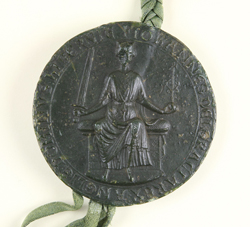
great-seal-king-john-eton-college-british-library-magna-carta-law-liberty-legacyThe largest ever exhibition related to the Magna Carta opens at the British Library in King’s Cross tomorrow to mark the 800th anniversary of the document’s sealing. Magna Carta: Law, Liberty, Legacy features two original Magna Carta manuscripts from 1215 as well as 1215 document, the Articles of the Barons (known as ‘draft’ of the Magna Carta), the Petition of Right (1628), the English Bill of Rights (1689), and the Universal Declaration of Human Rights (1948). It will also display two of the most celebrated documents in American history – the Delaware copy of the Bill of Rights and Thomas Jefferson’s handwritten copy of the Declaration of Independence (both on loan from the US National Archives) –  along with UK cabinet papers from 1941 in which it was proposed an original Magna Carta manuscript from 1215 be given to the US in return for their support in World War II and artefacts including King John’s teeth, thumb bone and fragments of clothing taken from his tomb in 1797 as well as his will. The exhibition tells the story of the Magna Carta from its creation in 1215 through to its later use by people fighting for various rights and freedoms and its continuing impact on the world today. There’s also a series of interviews with politicians, historians and public figures including Burmese activist Aung San Suu Kyi, former US President Bill Clinton and William Hague. Runs until 1st September. Admission charge applies. For more – and a digitised gallery of artifacts – visit www.bl.uk/magna-carta-exhibition. PICTURE: Great Seal of King John, 1203 © Eton College Archives on display in Magna Carta: Law, Liberty, Legacy.

The first gallery exhibition devoted to the Duke of Wellington opens at the National Portrait Gallery off Trafalgar Square today. Marking the 200th anniversary year of the Battle of Waterloo, Wellington: Triumphs, Politics, and Passions explores Wellington’s political and military career as well as his personal life. Highlights include Goya’s 1812 portrait of Wellington following his entry into Madrid (later modified to recognise further battle honours and awards), and Thomas Lawrence’s famous portrait painted in 1815, the same year as the Battle of Waterloo (the painting, which normally hangs in Apsley House, was used as the basis of the design of the £5 British note from 1971 to 1991). The exhibition of 59 portraits and other works also includes rarely seen works loaned by Wellington’s family include a John Hoppner portrait of the duke as a young soldier and a daguerreotype portrait taken by Antoine Claudet for Wellington’s 75th birthday in 1844. Runs until 7th June. Admission is free. For more, see www.npg.org.uk or for more on the 200th anniversary of the Battle of Waterloo, see www.waterloo200.org.

An exhibition celebrating the works of the late fashion designer Alexander McQueen opens at the V&A in South Kensington on Saturday. Alexander McQueen: Savage Beauty presents his works in 10 sections which focus on everything from McQueen’s roots in London, his “skilful subversion of traditional tailoring practices”, his fascination with the animal world and his longstanding interest in Eastern cultures. At the centre of the exhibition is The Cabinet of Curiosities, a display showcasing more than 100 garments and accessories and shown with film footage from his many catwalk presentations. The exhibition runs until 2nd August. Admission charge applies but you’ll have to be quick – the exhibition has already set the record for the most ever advance sales for an exhibition at the museum. For more, see www.vam.ac.uk/savagebeauty.

Send all items for inclusion to exploringlondon@gmail.com.


London Pub Signs – The George and Devonshire…

The-George-and-Devonshire

The last remaining pub in old Chiswick village in west London, The George and Devonshire has a history dating back to the 1650s.

The-George-and-Devonshire2Initially known simply as The George (like so many taverns and pubs, apparently after England’s patron saint), by the 1820s the name had changed to The George and Devonshire – the Duke of Devonshire’s former showpiece property, Chiswick House, can still be found nearby (for more on Chiswick House, see our earlier post here). The coat of arms of the Dukes of Devonshire now hang over the door.

The Grade II-listed building at 8 Burlington Lane, which is conveniently located just metres from a Fullers brewery, dates from the 18th century.

There was apparently once a secret passageway which led from the pub under the nearby St Nicholas’ Church (burial place of artist William Hogarth) to an opening located among a group of small cottages near the Thames – it is said to have been used by rum and spirits smugglers in the 1700s. The remains of the entrance can still apparently be seen in the pub’s cellar.

For more, see www.georgeanddevonshire.co.uk.

This Week in London – Churchill’s Scientists; Waterloo online; a Chelsea murder case reopened; exploring Crossrail; and, astronomical photography…

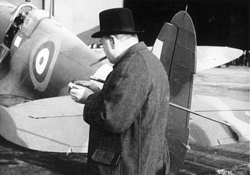
Churchill-with-a-Spitfire-from-Castle-Bromwich,-credit-Philip-Insley,-CBAF-Archive-Vickers-ArchiveSyndics Marking the 50th anniversary of the death of Winston Churchill, a new exhibition at the Science Museum in South Kensington looks at his passion for science and the influence that had on bringing World War II to an end. Churchill’s Scientists celebrates the individuals who flourished under Churchill’s patronage (and , as well as helping to bring about the end of World War II, also launched a post-war “science renaissance”) – from Robert Watson-Watt (inventor of radar) through to Bernard Lovell (creator of the world’s largest telescope) – and also delves into more personal stories of Churchill’s own fascination with science and tech. The display include objects from the museum’s collection as well as original archive film footage, letters and photographs. Highlights include the high speed camera built at Aldermaston to film the first microseconds of the detonation of the UK’s first home grown atomic bomb, the cigar Churchill was smoking when he heard news of his re-election as PM in 1951, and a one-piece green velvet “siren suit” designed by Churchill to wear during air raids (only one of three originals known to exist, it’s never been on public display outside of the tailors who created it). The free exhibition runs until 1st March and is part of the Churchill 2015 programme of events. Visit www.sciencemuseum.org.uk/churchill for more. PICTURE: Churchill with a Spitfire from Castle Bromwich (Philip Insley, CBAF Archive Vickers ArchiveSyndics).

The National Army Museum and Waterloo2oo have launched an online gallery which will eventually comprise images and information on more than 200 artefacts associated with the Battle of Waterloo ahead of the 200th anniversary in June. Among the objects featured on Waterloo200.org are the Duke of Wellington’s boots, a French eagle standard captured in battle and the saw used to amputate the Earl of Uxbridge’s leg. One hundred items – drawn from the Army Museum’s collection as well as from European museums and private collections – can already be seen on the site with a further 100 to be added before the bicentenary on 18th June.

The Talk: Death in Disguise: The Amazing True Story of the Chelsea Murders. On 12th February, the Guildhall Library in the City of London will host Gary Powell as he examines the facts of this double murder which took place in Chelsea in May, 1870, and left Victorian society reeling. For more events at the library, follow this link.

On Now: Breakthrough: Crossrail’s tunnelling story. This exhibition at the London Transport Museum in Covent Garden brings a new perspective on the massive Crossrail project currently underway in the city. Visitors will experience the tunnel environment through a five metre high walk-through installation featuring a computer simulation of a giant boring machine as well as learn about how the project is shaping up, play interactive tunnelling games and hear firsthand from those who work underground. Admission charge for adults applies. Runs until August. For more, see www.ltmuseum.co.uk.

Extended: Astronomy Photographer of the Year Exhibition. This exhibition at the Royal Observatory Greenwich features the winning images from last year’s competition. They include the Briton James Woodend’s image of a vivid green aurora in the Icelandic night sky; American Patrick Cullis’ view of earth taken from 87,000 feet above ground; and, New Zealander Chris Murphy’s image of dusty clouds dancing across the Milky Way. The exhibition can be seen for free in the Observatory’s Astronomy Centre until 19th July. For more, see www.rmg.co.uk/astrophoto.

• Send all items for inclusion to exploringlondon@gmail.com. 

This Week in London – Celebrating the Year of the Bus; the British Library looks at WWI; medieval jousting and The Duke of Wellington; and, Blue Plaque nominations resumed…

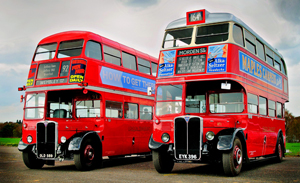
BusesAlmost 50 buses, from a horse-drawn model of the 1820s to the New Routemasters of today, will come to Regent Street on Sunday in celebration of the Year of the Bus. The ‘Regent Street Bus Cavalcade’ – which will stretch from Piccadilly Circus to Oxford Circus and will see the iconic West End street closed to traffic – will also feature a variety of free family events including Lego workshops (there will be a bus shelter and bus stop made entirely out of Lego outside Hamley’s toy shop), children’s theatre performances, a pop-up London Transport canteen and the chance to have a personal message recorded by the voice of London’s buses, Emma Hignett. There will also be an exhibition – Battle Bus – which provides information about the B-type bus (a newly restored version of which will be on display) which was used during World War I to carry soldiers to the frontline as well as ambulances and mobile pigeon lofts while jewellery company Tatty Devine will feature a special range of bus-inspired jewellery and hold jewellery-making workshops on board a London bus. The cavalcade, supported by the Regent Street Association and The Crown Estate, is part of Transport for London’s celebrations marking the Year of the Bus, organised in partnership with the London Transport Museum and the capital’s bus operators. The free event runs from 11.30am to 6pm. For more information, see www.tfl.gov.uk/yearofthebus and www.ltmuseum.co.uk.

A new exhibition of materials showing how people coped at home and on the front during World War I opens at the British Library in King’s Cross today as part of efforts to mark the war’s centenary. Enduring War: Grief, Grit and Humour features personal objects such as letters, a handkerchief bearing the lyrics of It’s A Long, Long Way to Tipperary, Christmas cards, school essays about airship raids over London sit and recruitment posters, humorous magazines and even a knitting pattern for balaclavas. Highlights include a letter in which Sir Arthur Conan Doyle expresses his concern over his son serving at the front, manuscripts by war poets such as Rupert Brooke as well as Wilfred Owen’s manuscript for Anthem for Doomed Youth, Vaughan Williams’ A Pastoral Symphony and Laurence Binyon’s For the Fallen. A specially commissioned video and ‘soundscape’, Writing Home, features personal messages contained on postcards written to and from the front. A range of events accompanies the free exhibition. Runs until 12th October. For more on the exhibition, see www.bl.uk.

Armoured knights on horseback can be seen jousting at Eltham Palace in south London this weekend. The former childhood home of King Henry VIII will host a Grand Medieval Joust which will also include displays of foot combat, the antics of a court jester, medieval music performances and a series of children’s events including a knight’s school. Runs from 10am to 5pm on both Saturday and Sunday. Admission charge applies. For more, see www.english-heritage.org.uk/events. Meanwhile, the Battle of Waterloo is being remembered at the Duke of Wellington’s home of Apsley House near Hyde Park Corner. Visitors will come face-to-face with Wellington’s troops and their wives, having the chance to take a look inside a soldier’s knapsack, see the equipment he used and the drills he performed as well as see the Battle of Waterloo recreated in vegetables. The Waterloo Festival – this year marks 200 years since Napoleon’s abdication and exile to Elba – runs from 11am to 5pm on Saturday and Sunday. Admission charge applies. For more, see www.english-heritage.org.uk/apsley/.

Nominations have reopened for English Heritage’s Blue Plaques scheme in London. In 2012 nominations were temporarily suspended while new funding for the scheme was found and thanks to one individual’s donation and the creation of a new Blue Plaques Club to support the scheme on an ongoing basis, they have now reopened. There are 880 official Blue Plaques on London’s streets – remembering everyone from Florence Nightingale to Fred Perry and Charles Darwin. For more and details on nominations, see www.english-heritage.org.uk/discover/blue-plaques/.

Send all items of interest for inclusion to exploringlondon@gmail.com.

Daytripper – Walmer Castle…

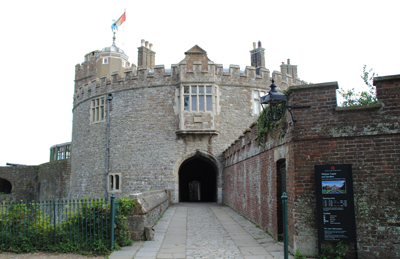
Walmer-CastleA coastal artillery fort built on the orders of King Henry VIII in light of a threatened Catholic invasion, Walmer Castle on the Kentish coast is officially the residence of the Lord Warden of the Cinque Ports.

What was a rather functional artillery platform has been embellished significantly in the years since it became the official residence of the Lord Warden in 1708, creating a comfortable home for holders of the title who have included Queen Elizabeth, the Queen Mother, the Duke of Wellington and bookseller WH Smith.

The ‘castle’, located about a two hour, 10 minute train journey from London (and then a mile walk from Walmer Station), was constructed in 1539 as one of a string of forts – others include nearby Deal Castle and the long gone Sandown Castle – designed to protect the watery stretch between Goodwin Sands and the coast known as the Downs.

Its low circular design, featuring a central ‘keep’ reached by a drawbridge and surrounded by a curtain wall with four projecting, semi-circular bastions, was influenced by the need to defend against heavy artillery and provide a platform for guns.

Initially garrisoned with ten gunners, four soldiers and two porters under the command of a captain and a lieutenant, Walmer saw little action during Tudor times but was the site of a siege during the Civil War.

Obsolete by the end of the 17th century, it was the Duke of Dorset who was the first Lord Warden (an office created in the thirteenth century to oversee the affairs of the Cinque Ports Confederation, a grouping of five ports including Hastings, Romney, Hythe, Dover and Sandwich) to use Walmer Castle as a residence, embarking on a renovation and extension of the existing structure.

Further alterations was carried out by successive Lords Warden, the most extensive being those made by  the 2nd Earl Granville, Lord Warden between 1865 and 1891, who commissioned architect George Devey to oversee the additions.

The gardens, meanwhile, which are well worth visiting in their own right, were also Granville’s work as well as that of an earlier Lord Warden, Prime Minister William Pitt the Younger, who was Lord Warden between 1792 and 1806.

The Duke of Wellington (Lord Warden between 1829 and 1852) reputedly enjoyed his time staying at the castle – he was even visited by the young Princess Victoria here in 1835 (she later stayed for a month with her family when Queen) and died here on 14th September 1852. His room can still be seen inside – the contents include the armchair he was sitting in when he died (the rooms also include a small museum dedicated to Wellington and another dedicated to William Pitt).

Not all Lords Warden enjoyed the property. Sir Winston Churchill, Lord Warden  between 1941 and 1965, never stayed here but Sir Robert Menzies, Prime Minister of Australia and Lord Warden between 1966 and 1978, did and the Queen Mother, Lord Warden between 1978 and 2002, was a regular visitor.

The castle was opened to the public soon after responsibility for it was transferred from the War Office to the Ministry of Works in 1905. It is now under the care of English Heritage and the rooms inside are decorated as they were in the 1930s (it was WH Smith who ensured historic furnishings at Walmer could not be removed). There are even a couple of holiday cottages on site which can now be rented.

WHERE: Walmer Castle, Kingsdown Road, Deal, Kent; WHEN: 10am to 6pm daily (until 6th July); COST: Adults £7.90/Children (5-15 years) £4.70/Concession £7.10; WEBSITE: www.english-heritage.org.uk/daysout/properties/walmer-castle-and-gardens/.

Around London – Celebrating London’s architecture; space at the NMM; Tate Britain redux; remembering Waterloo at Apsley House; and, ‘Coins and the Bible’ at the British Museum…

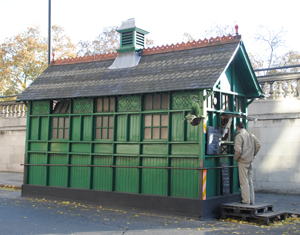
Cabmen's-ShelterThe London Festival of Architecture has returned with a month long celebration of the city’s built form in a program of events including talks, tours and exhibitions. Among the latter is Lesser Known Architecture – A Celebration of Underappreciated London Buildings – a free exhibition at the Design Museum which runs until 22nd July and looks at 10 structures ranging from London Underground Arcades and Cabmen’s Shelters (one of which is pictured) to Nunhead Cemetery. Other events include an exhibition at Somerset House – Nicholas Hawksmoor: Methodical Imaginings – looking at churches designed by Hawksmoor in the late 17th and early 18th centuries (this runs until 1st September), and The Secret Society – A Sculptural Banquet, a large scale installation by artist and designer Kathy Dalwood at Pitzhanger Manor in Ealing, west London (ends this Sunday). For more on the festival, check out www.londonfestivalofarchitecture.org or for fringe events, http://londonarchitecturediary.com.

A new exhibition featuring more than 100 images from space – including images of the colourful dust clouds in which new stars are formed, the aurora on the surface of Saturn and the sight of Earth from the International Space Station – opens at the National Maritime Museum in Greenwich tomorrow. Visions of the Universe takes visitors on a “visual trip through our solar system” with images of the moon, sun, plants and distant galaxies. It looks at the development of telescopy and photography and examines our understanding of our place in the cosmos. Space scientists including Astronomer Royal Sir Martin Rees and The Sky at Night‘s Chris Lintott introduce each section of the exhibition which has at its centre a 13×4 metre curved wall known as the ‘Mars Window’. It has the latest images from NASA’s Mars Curiosity Rover projected onto it. There is a programme of events accompanying the exhibition which runs until 15th September. For more, see www.rmg.co.uk.

Tate Britain is undergoing an overhaul this year with the opening of new galleries and a rearrangement of the institution’s collection. Last month, a new chronological presentation of the institution’s British art opened across more than 2o of the institution’s galleries. BP Walk through British Art features around 500 artworks, dating from the 1500s to present day, by artists ranging from Sir Joshua Reynolds and William Hogarth to JMW Turner, John Constable, Lucien Freud and David Hockney. Meanwhile new galleries have opened dedicated to the works of sculptor Henry Moore and artist William Blake. Around 30 of Moore’s works are featured in the rooms as well as more than 40 of Blake’s works. For more see www.tate.org.uk.

Apsley House, regency home of the Duke of Wellington, is hosting a series of events every weekend in June in the lead-up to the anniversary of the Battle of Waterloo. Interpreters will be at the house, known as Number 1 London, this weekend to discuss the dress and manners of the era while next weekend (15th and 16th June) visitors have the chance to meet some of Wellington’s soldiers and their wives. Gentry from the Napoleonic era will be celebrating the victory at Waterloo on 22nd and 23rd June while on the final weekend of the month, the focus will be on the 200th anniversary of the Battle of Vitoria in 1813, which led to eventual victory in the Peninsular War. For more, see www.english-heritage.org.uk/daysout/properties/apsley-house/.

On Now: Coins and the Bible. This free exhibition at the British Museum looks at how money was referred to in the Old and New Testament, and the use of Christian symbols such as crosses or monograms derived from Greek letters on later coins. These include the first coin, dating from about 450 AD, to depict an image of Jesus (the coin, on loan from the Hunterian Museum in Glasgow, is included in the exhibition). There are also early Biblical fragments on papyrus and vellum lent by the British Library and an ivory panel dating from the early 400s AD which includes an image of the purse of 30 pieces of silver Judas received after his betrayal of Jesus. Held in Room 69a, the exhibition runs until 20th October. For more, see www.britishmuseum.org.

Lost London – Mrs Salmon’s Waxworks…

Before Madame Tussaud arrived in London, there was Mrs Salmon and her famous waxworks, one of several such establishments in London.

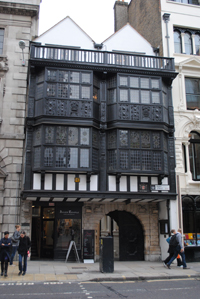
Prince-Henry's-RoomsFirst sited at the Sign of the Golden Ball in St Martin’s Le Grand – where it filled six rooms – in 1711, the display was relocated to the north side of Fleet Street where it remained until 1795 when it moved across the road to number 17 Fleet Street, now housing Prince Henry’s Room (pictured, room takes its name from Prince Henry, eldest son of the king, who died at the age of 18 and was apparently the inspiration for an inn which previously occupied the building called The Prince’s Arms).

The waxworks were apparently originally run by Mr Salmon – there are references to him being a “famous waxwork man” – but his wife, Mrs Salmon, continued it alone after his death in 1718 until her own death, variously said to have been in 1760 or as late as 1812. At some point after his death, Mrs Salmon is said to have remarried, to a Mr Steers.

Described in a handbill published soon after its initial move to Fleet Street, the exhibitions were said to include a scene of King Charles I upon the scaffold, another of the ill-fated Queen Boudicea, and more exotic tableaux including one showing Canaannite ladies offering their children in sacrifice to the god Moloch, another of a Turkish seraglio, and another of Margaret, Countess of Heningbergh with the 365 children she is said to have given birth to (all at once!). There was also a mechanised figure of the “famous English prophetess” Old Mother Shipton, who is said to have given a boot to visitors as they left.

While some accounts say the waxworks – which, according to the City of London website remained at the site until 1816 – were taken over by a Chancery Lane surgeon named Clarke after Mrs Salmon’s death (and by his wife after his death), it is also suggested that at some point they moved to Water Lane in east London where they were ruined by thieves.

Whatever its fate, it’s generally accepted that the famous waxworks were visited by the likes of James Boswell and artist William Hogarth. They were also mentioned by author Charles Dickens in David Copperfield. 

For more of London’s past, see Philip Davies’ Lost London 1870-1945.

Famous Londoners – John Nash…

Arguably the greatest architect of Regency London, John Nash’s imprint can still be seen in numerous sites around the city, from the master-planning of Regent’s Park and Regent Street to the beautiful buildings of All Soul’s Church in Langham Place and Marble Arch on the edge of Hyde Park.

Born the son of a Welsh millwright in Lambeth, London, on 18th January, 1752, Nash – who went on to work in a range of different architectural styles – trained as a draughtsman under the tutelage of architect Sir Robert Taylor and in 1777 established his own business as a builder and surveyor.
John-NashBut he certainly didn’t meet with immediate success and, following failure as a building speculator (he built properties in Bloomsbury Square and Great Russell Street but failed to make enough money from the venture – there’s a blue plaque on one of the houses, which he lived in, at 66 Great Russell Street), was declared bankrupt in 1783.

Meanwhile, his personal life was also in turmoil during these years – in 1775 he had married, Jane Kerr, the daughter of a Surrey surgeon, but separated from her in the early 1780s after various troubles including her eventually apparently having a child with a Welshman named Charles Charles, who is said to have died in prison after he was jailed for adultery.

Brought down by his misfortune, in the mid 1780s Nash moved to Carmarthen in Wales where he had family. Taking up work here, by the late 1780s he was designing prisons – the first was at Carmarthen – and worked on a number of other prominent buildings including St David’s Cathedral and various country houses.

Rising to prominence in Carmarthen society, by 1797, however, Nash was again working in London, initially in partnership with the renowned landscape architect Humphrey Repton with whom he had formed a business relationship some years earlier (although the partnership had soured over finances by 1800).

He built a substantial home at 29 Dover Street in Mayfair and in 1798, his first wife presumably dead, he married his second wife, Mary Anne Bradley, and soon started work on building a Gothic-inspired residence for them, known as East Cowes Castle, on the Isle of Wight. It was completed in 1802 but enlarged some years later.

Nash designed numerous country properties in the early 19th century, inspired by everything from castles to Italianate architecture, both in England and Ireland and soon came to the attention of the Prince Regent, the future King George IV (there was a rumour his wife was one of the prince’s discarded mistresses).

In 1806 he was officially made Deputy Surveyor General in the Office of Woods and Forests – the office which managed the Crown estate, and from 1815 on, he largely worked for the prince alone. Among the major London commissions from his royal patron were the design of Regent Street (he and his wife moved into number 14 in 1823) and the development of Regent’s Park on land formerly known as Marylebone Park and surrounding housing estates (for more on The Regent’s Park, see our earlier entry here). He also redeveloped St James’s Park.

In 1815, he was commissioned to develop the Prince Regent’s Marine Pavilion in Brighton and by 1822 had transformed the building into the spectacular Royal Pavilion which can be visited there today.

Nash was also involved in the development of The Regent’s Canal – which linked the Grand Union Canal in London’s west to the River Thames in London’s east and was completed in 1820 – and built many of the grand villas which still line it (for more on Regent’s Canal, see our earlier entry here).

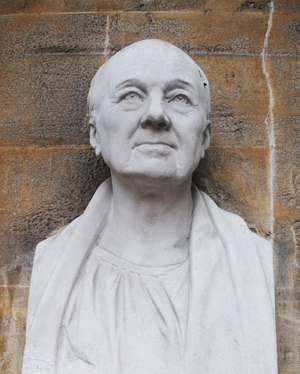
Becoming an official architect to the Office of Works in 1813 (an appointment which only ended in 1832, three years before his death), Nash went on to design churches – including All Soul’s in Langham Place (he’s depicted above in a bust at the church) – as well as West End theatres including the Haymarket Theatre and the Royal Opera House (which burnt down in 1867) as well as the adjacent Royal Opera Arcade and residences including Carlton House Terrace and Clarence House (for more on this, see our earlier entry here).

Other major commissions included the redevelopment of Buckingham Palace (parts of the current building are his work but the main facade isn’t – for more on the palace history, see our earlier entry here) and the Royal Mews, and the creation of Marble Arch, originally envisaged as the main gateway to the palace (see our earlier entry here). Nash also designed a conservatory for Kew Gardens.

Nash’s close relationship with the Prince Regent (who become King George IV on 29th January, 1820), meant that when the king died in 1830, he found himself on the outer (and his reputation took many years to recover thanks to his association with the unpopular king). With no knighthood forthcoming for his efforts (unlike many of his contemporaries) and the chance of further work unlikely (his work on Buckingham Palace had been left unfinished due to concerns over rising costs), Nash retired to his house on the Isle of Wight.

He died there on 13th May, 1835, and was buried in the churchyard at St James’s Church in East Cowes. He was survived by his wife who, having settled his debts, retired to Hampstead.

For an in-depth study of Nash, try Geoffrey Tyack’s book, John Nash: Architect of the Picturesque.