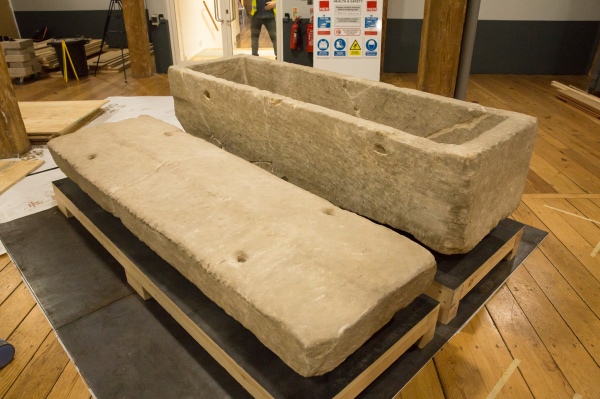
Excavated in a dig in Southwark during the summer of 2017, this Roman sarcophagus is now at the centre of a new exhibition, Roman Dead, at the Museum of London Docklands.
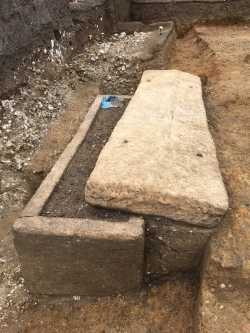 The site of the find, on the corner of Harper Road and Swan Street in Borough, is located in what is known as the ‘Southern Cemetery’, one of a number of distinct burial grounds located on the outskirts of the Roman city of Londinium. Some 500 Roman burials have been found in the southern site but the stone sarcophagus was the first discovery of its kind there.
The 1,600-year-old sarcophagus measures approximately 2.4 metres long, 75cm wide and 65 centimetres high. The lid of the coffin had been partly pushed to one side, indicating that it may have been disturbed by grave robbers during the 18th century. The interior was left partly filled with soil and small bones and a damaged Roman bracelet were found nearby – a possible indication that it was a child buried there.
Gillian King, senior planner for archaeology at Southwark Council, told the BBC at the time of the find that the grave owner must have been “very wealthy and have had a lot of social status to be honoured with not just a sarcophagus, but one that was built into the walls of a mausoleum”.
The sarcophagus is only the third to be discovered in London – one was discovered at St Martin-in-the-Fields near Trafalgar Square in 2006 and another in Spitalfields in 1999.
Roman Dead is running at the Museum of London Docklands until 28th October. Admission is free. For more, see www.museumoflondon.org.uk/museum-london-docklands.
PICTURE: Top – The sarcophagus being prepared for display; Side – The sarcophagus as it was found (© Southwark Council).




 4. Number four is another in our current series on London battlefields – this time looking at the site where Queen Boudicca is believed to have been defeated by the Romans –
  A detailed picture of the inhabitants of Roman London, known as Londinium, has been created for the first time, the Museum of London announced this week. Detailed analysis of the DNA of four skeletons has revealed a culturally diverse population. The examined skeletons include that of a Roman woman (pictured left), likely to have been born in Britain with northern European ancestry, found buried with high status grave goods at Harper Road, Southwark, in 1979, and another of a man, whose DNA revealed connections to Eastern Europe and the Near East, who was found at London Wall in 1989 with injuries to his skull which suggest he may have been killed in the nearby amphitheatre before his head was dumped in a pit. The other two skeletons examined were found to be that of a blue-eyed teenaged girl found at Lant Street, Southwark, in 2003, believed to have been born in north Africa, whose ancestors lived in south-eastern Europe and west Eurasia, and that of an older man found at Mansell Street who was born in London and whose ancestry had links to Europe and north Africa. The examination – the first multi-disciplinary study of the inhabitants of a Roman city anywhere in the empire – also revealed that all four suffered from gum disease. Caroline McDonald, senior curator at the museum, said that while it has always been understood Roman London was a culturally diverse place, science was now “giving us certainty”. “People born in Londinium lived alongside people from across the Roman Empire exchanging ideas and cultures, much like the London we know today.” The four skeletons will form the basis of a new free display, Written in Bone, opening at the Museum of London on Friday. PICTURE: © Museum of London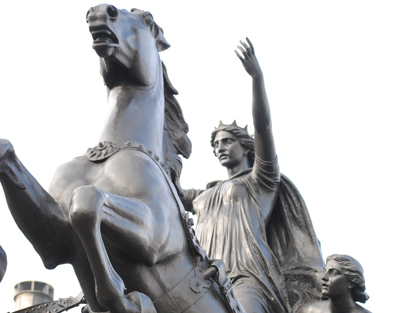
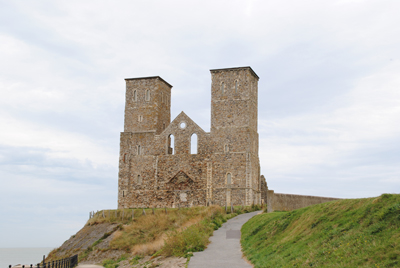
 The fort ceased to be garrisoned by regular troops by the end of the 4th century and archaeologists have found little sign of any activity there at the start of the next century.

 .
.
 Exploring London