10 small, ‘secret’ and historic gardens in central London…9. Garden of Rest, Marylebone…

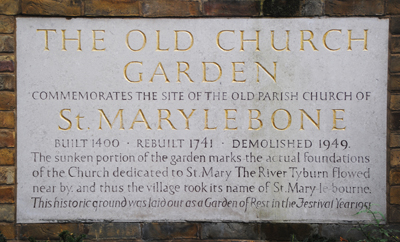
Marylebone2This pocket park is another of those located on the site of a former church – in this case the Marylebone Parish Church which now stands to the north.

The church – the third to serve the parish – was built here in 1740 but was replaced when the current parish church was built between 1813 and 1817.

Wesley-MonumentThe former church didn’t close until 1926, however, continuing use as a parish chapel, and even then wasn’t demolished until 1949  after it was damaged by bombing during World War II.

In 1951, the St Marylebone Society created a Memorial Garden of Rest on the site (also known as the Old Church Garden). It was opened in March, 1952, by Viscount Portman.

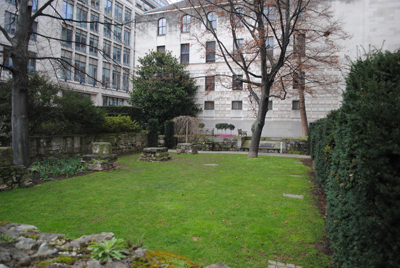
The foundations of the former church were marked out in the sunken portion of the garden. The predominantly paved garden also contains numerous gravestones and memorials.

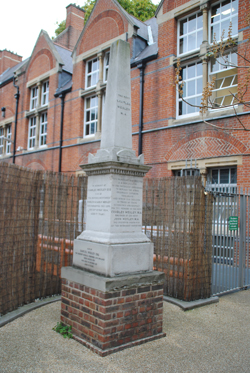
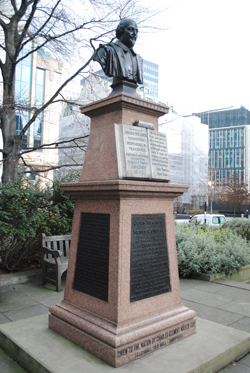
These include that of Methodist movement leader Charles Wesley, erected in 1858 to commemorate his burial in 1788 (pictured right). There’s also a plaque recording notable burials at the church, including the painter George Stubbs (1806), royal apothecary John Allen (1774), architect James Gibbs and bare knuckle boxer James Figg (1734). Other plaques detail some of the church’s history.

Also of note in the garden is a Judas tree (Cercis siliquastrum), named for being the variety upon which Judas hung himself or, alternately, because its fruit pods resemble bags of silver. The current tree replaces an earlier one.

WHERE: Garden of Rest Marylebone, Marylebone High Street (nearest tube stations are St Paul’s and Barbican); WHEN: 7am to dusk; COST: Entry is free; WEBSITE: www.myparks.westminster.gov.uk/parks/garden-of-rest-marylebone/.

LondonLife – Supermoon over Docklands…

Supermoon

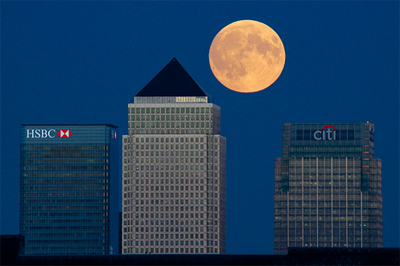
London photographer Ian Wylie captures the “supermoon” rising over Canary Wharf in London’s east on Sunday, ahead of the lunar eclipse in the early hours of Monday. As seen from London Bridge at 6:54pm – 20 minutes after moonrise and six minutes after sunset. A supermoon occurs when the moon reaches the closest part of its orbit to Earth and hence appears larger than normal. This week’s supermoon coincided with a lunar eclipse – in which the moon passes behind the Earth through its shadow (also known as an umbra) – which later made the moon appear red (a lunar eclipse is also known as a “blood moon”). Last seen in 1982, the phenomena will apparently not be visible again until 2033. PICTURE: © Ian Wylie/Flickr

This Week in London – Celts at the British Museum; the Fallen Woman at the Foundling; and Ai Weiwei…

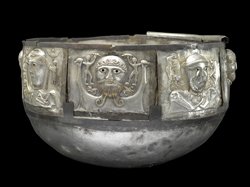
Gundestrup_Whole-ImageThe story of the Celts and their culture is being explored in a new exhibition which opens at the British Museum in Bloomsbury today. Celts: Art and Identity, being run in partnership with National Museums Scotland, is the first British exhibition on the Celts in 40 years. Highlights of the display include a hoard of four gold torcs found at Blair Drummond in Stirling in 2009, Christian artefacts including iron handbells used to call people to prayer, elaborately illustrated Gospels, carved stone crosses and, a gilded bronze processional cross which, dating from 700-800 AD and coming from Tully Lough in Ireland, will be on show for the first time in Britain. Also present will be the Gundestrup cauldron, which dates from 100 BC-1 AD and comes from Denmark (pictured), London artefacts such as the Waterloo helmet and Battersea shield, and works created more recently which reflect on an often mythical Celtic past such as George Henry and Edward Atkinson Homel’s 1890 painting The Druids: Bringing in the Mistletoe. Runs until 31st January in the Sainsbury Exhibition Gallery (Room 30). Admission charge applies. For more, see www.britishmuseum.org. PICTURE: © The National Museum of Denmark.

A new exhibition exploring the myth and reality of the ‘fallen woman’ in Victorian Britain opens at the Foundling Museum in Bloomsbury tomorrow. The Fallen Woman features works by artists including Dante Gabriel Rossetti, Richard Redgrave, George Frederic Watts and George Cruikshank, displayed alongside stereoscopes and depictions of the fallen woman in the era’s popular media. It also looks at the petitions of women applying to the Foundling Hospital, bringing to life the real ‘fallen women’ of the period through a specially-commissioned sound installation by artist and musician Steve Lewinson. The exhibition runs until 3rd January. Admission charge applies. For more, see www.foundlingmuseum.org.uk.

The London Transport Museum’s Depot in Acton hosts its autumn open days this weekend. The day includes the chance to see the original printing blocks used for the Johnston font – London Transport’s iconic typeface, expert talks on transport vehicles, a chance to see how the moquette – the seat covering on the tube – is made and film screenings from the LTM archive. From 11am to 5pm Saturday and Sunday. Admission charge applies. For more, see www.ltmuseum.co.uk.

The Worshipful Company of Woolmen will be holding their annual  sheep drive across London bridge this Sunday. The event, free to watch, kicks off at 10am and runs until 5pm. For more, see www.woolmen.com.

• On Now: Ai Weiwei. This landmark exhibition at the Royal Academy of Arts in Piccadilly celebrates the work of Honorary Royal Academician and leading Chinese artist Ai Weiwei with significant works from 1993 onwards and new, site specific installations. Among the key exhibits is Straight (2008-12), a body of work related to the Sichuan earthquake of 2008, fabricated from 90 tonnes of bent and twisted rebar which was collected by the artist and straightened by hand. Runs until 13th December.  Admission charge applies. For more, see www.royalacademy.org.uk.

Send all items for inclusion to exploringlondon@gmail.com.

LondonLife – The Quadriga at Hyde Park Corner…

The-QuadrigaKnown as ‘The Quadriga’, this bronze monument atop Wellington Arch at Hyde Park Corner depicts Nike, goddess of victory, in a four horse chariot. The work of English sculptor Adrian Jones, the quadriga was part of Decimus Burton’s original early 19th century design but it wasn’t until 1911-1912 that this colossal piece – once the largest bronze monument in Europe – was installed, replacing an equestrian statue of the Duke of Wellington which was moved to Aldershot (a smaller equestrian statue of the Duke now stands nearby). For more on the arch, see www.english-heritage.org.uk/visit/places/wellington-arch/.

This Week in London – Cosmonauts at the Science Museum; space on show at the Royal Observatory; Simon Schama’s portrait picks; and, celebrating iconic road signs…

Vostock- The greatest collection of Soviet spacecraft and artefacts ever exhibited outside of Russia can be seen at the Science Museum from tomorrow. Cosmonauts: Birth of the Space Age tells the story of Russia’s involvement in the ‘space age’ from the late 19th century through to life onboard Mir and the International Space Station. Exhibits cover the 1957 launch of Sputnik – the world’s first artificial satellite, the sending of the first human into space – Yuri Gagarin, in 1961, as well as the first women – Valentina Tereshkova – in 1963. Star objects include rocket pioneer Konstantin Tsiolkovsky’s 1933 drawings depicting spaceflight, an original model of Sputnik from 1957, and Vostok-6, the capsule that carried Tereshkova, as well as some of the many technologies developed for use on board the Salyut and Mir space stations and the ISS. The exhibition, a collaboration between the Science Museum, the State Museum Exhibition Centre ROSIZO and the Federal Space Agency Roscosmos, runs at the South Kensington museum until 13th March. Admission charge applies. For more, see www.sciencemuseum.ac.uk. PICTURE: Visitors study the Vostok 6 descent module, which safely returned Valentina Tereshkova from space. © Science Museum

Still talking of space and an exhibition of images of space goes on show at the Royal Observatory Greenwich from tomorrow. The Insight Astronomy Photographer of the Year 2015 awards, now in its seventh year, received more than 2,700 entries from amateurs and professionals who live in more than 60 countries across the globe. The winners, which will be announced today at a special ceremony at the Royal Observatory, were selected from short-listed pictures which include a meteor flying through space above Mt Ranier in the US, the night sky mirrored on the world’s largest salt flat of Salar de Uyuni in Bolivia, and images capturing a range of phenomena from across the universe – from the hyper giant star, Eta Carinae, to the supernova remnant known as the Jellyfish Nebula. The exhibition is free. For more, see www.rmg.co.uk.

Historian Simon Schama has joined with the National Portrait Gallery in creating five new temporary displays featuring portraits arranged by theme rather than year. Simon Schama’s The Face of Britain, which coincides with the launch of a five part TV series and book, will feature a range of portraits taken from the gallery’s collection around the themes of power, love, fame, people and self-portraits. It juxtaposes portraits of the likes of former PM Sir Winston Churchill and Margaret Thatcher with Queen Elizabeth I; and those of explorer Francis Drake and Thomas Carlyle alongside Amy Winehouse. The displays are integrated into a free trail with eight to 12 works in each of the five rooms. A full programme of events accompanies the displays which will be in the gallery, just off Trafalgar Square, until 4th January. Admission is free. For more, see www.npg.org.uk.

The London Design Festival kicks off on Saturday and as part of the event, the Design Museum is marking the 50th anniversary of Calvert and Kinneir British road signage with a free exhibition. MADE NORTH has commissioned a number of leading designers and artists to create their own interpretations of Margaret Calvert and Jock Kinneir’s circle, triangle and square signs including Sir Peter Blake, Sir Terence Conran, Sir Keith Grange, Betty Jackson, Julian Opie and Richard Rogers. A display of more than 40 of the new signs – along with a number of Calvert and Kinneir originals and a one-off version of the Road Works sign specially created by Calvert – are on show at a free installation in the Design Museum’s Tank and Riverside Hall until 25th October. More of the newly designed anniversary signs can be seen at locations across the city and at www.britishdesignproject.co.uk. For more on the London Design Museum, see www.designmuseum.org, and for the full programme of the London Design Festival, which runs until 27th September, check out www.londondesignfestival.com.

Send all items for inclusion to exploringlondon@gmail.com.
10 small, ‘secret’ and historic gardens in central London…8. Postman’s Park…

Postman's-ParkHousing one of London more unique memorials, Postman’s Park in the City’s north is located on what were once the churchyards and burial grounds of three different churches.

The park – which took its name from its popularity with postal workers who came here to escape their job at the nearby former General Post Office (read a Lost London article on the GPO here) – opened in 1880.

It was originally located on the site of the former churchyard of St Botolph’s-without-Aldersgate and was subsequently expanded to incorporate the adjacent churchyard of St Leonard, Foster Lane, and the burial ground of Christ Church, Greyfriars (also known as Christ Church, Newgate Street). Some of the headstones still stand along the park’s boundaries.

Postman's-Park3Its key feature is the G.F. Watts Memorial To Heroic Self Sacrifice (pictured, right). Victorian artist and philanthropist George Frederic Watts proposed the memorial commemorating “heroic men and women” who had given their lives to save others to mark Queen Victoria’s Jubilee in 1887 but the memorial which now stands there wasn’t built until 1900.

The memorial consists of a loggia, the inside of which is lined with glazed tablets. Each of these commemorates acts of bravery by “everyday heroes” as they attempted to rescue people from fires, runaway trains, sinking ships and drowning. There were 13 plaques at the time of his death in 1904 and his wife Mary added a further 34.

The latest of the memorials commemorating 62 individuals was added in 2009 (for more details, head to our earlier post here, part of our Curious London Memorials series; you can also find more about the memorial, including a free app, here).

The park also features a sundial and fountain amid bright flower beds and various species of trees including a large banana tree, a dove tree and Tasmanian tree ferns.

Claims to fame include its role in the 2004 film Closer, which starred Natalie Portman, Julia Roberts, Jude Law and Clive Owen (we won’t go into details, just in case you haven’t seen it!).

WHERE: Postman’s Park, between King Edward Street and St Martin’s le Grand (nearest tube stations are St Paul’s and Barbican); WHEN: The park, managed by the Corporation of London, is open 7am to 8pm or dusk (whichever is earlier); COST: Entry is free; WEBSITE: www.cityoflondon.gov.uk/things-to-do/green-spaces/city-gardens/visitor-information/Pages/Postman’s-Park.aspx.

Postman's-Park2

LondonLife – Remembering Agatha Christie…

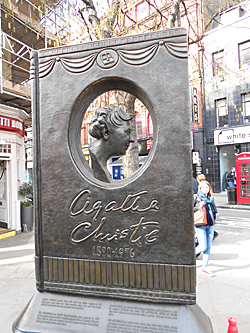
Agatha_ChristieToday marks 125 years since the birth of the world’s best-selling novelist, Agatha Christie, subject of this memorial which was unveiled in Covent Garden in 2012.

Standing at St Martin’s Cross – the intersection of Cranbourn and Great Newport Streets, the memorial – which also marks 60 years and 25,000 performances of her record breaking long-running London play The Mousetrap – is the work of sculptor Ben Twiston-Davies.

It takes the form of a 2.4 metre high book with a bust of Christie in profile and features a series of motifs from Christie’s works as well as a ‘bookshelf’ of her best sellers in English and other languages, the titles of which were selected in a competition involving fans.

Christie, who was born on 15th September, 1890, in Torquay, Devon, and died on 12th January, 1976, is famous for the scores of detective novels she wrote – featuring the likes of detectives Miss Marple and London’s own Hercule Poirot – which have gone on to sell more than two billion copies around the world.

The memorial was unveiled on 18th November, 2012, by Christie’s grandson, Matthew Pritchard, along with Sir Stephen Waley-Cohen, chairman of Mousetrap Productions, and the Lord Mayor of Westminster, Cr Angela Harvey.

For more on the memorial, see www.agathachristiememorial.co.uk. For more on events surrounding the anniversary, see www.agathachristie.com.

PICTURE: Diagram Lajard

This Week in London – Palaces mark Queen Elizabeth II’s long reign; Richmond Park’s open day; celebrating a famous London redhead; and, London shops features in new work…

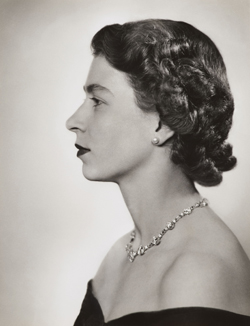
Dorothy-Wilding-1952A special photographic display has opened at Buckingham Palace this week to commemorate the fact that Queen Elizabeth II has this week become Britain’s longest-reigning monarch. The outdoor photographic display Long To Reign Over Us features a selection of photographs spanning the period from 1952 to today including informal family moments, official portraits and visits of the Queen to places across the UK and Commonwealth. Highlights include a black and white portrait by Dorothy Wilding from the start of the Queen’s reign in 1952, Cecil Beaton’s official Coronation Day portrait from 1953 and a 2006 image of the Queen with her Highland Ponies. The displays, which are also being shown as Windsor Castle and the Palace of Holyroodhouse in Edinburgh, can be seen by visitors to Buckingham Palace’s summer opening until 27th September. Admission charge applies. For more, see www.royalcollection.org.uk. PICTURE: Dorothy Wilding. Royal Collection Trust/© William Hustler and Georgina Hustler/National Portrait Gallery, London 

Still celebrating the Queen becoming Britain’s longest reigning monarch, and a new film installation celebrating the reigns of Queen Elizabeth II and Queen Victoria – whose reign she has now surpassed – has opened at Kensington Palace. The film installation explores key moments in the reigns of both – coronations, weddings, births as well as other key moments in their public lives –  and also examines the impact of new technologies in the reigns of both queens. For more, see www.hrp.org.uk/kensingtonpalace.

Richmond Park in London’s south-west is holding its annual open day this Sunday with a range of activities for kids including pony rides, the opportunity to see inside a bug hotel with a fibro-optic camera and the chance make pills in a restored Victorian pharmacy. The Holly Lodge Centre, normally reserved for schools and learning groups, will open its doors to the general public will be at the centre of the day, offering a range of activities for children while there will also be a guided walk led by the Friends of Richmond Park, vintage car displays, and a World War I re-enactment. The day runs from 11am to 4pm. Entrance to the Royal Park is free but parking is £5. For more, see www.royalparks.org.uk.

This Saturday is Redhead Day UK 2015 and to mark the occasion, the Guildhall Art Gallery in the City of London is inviting visitors to celebrate by taking a selfie with Dante Gabriel Rossetti’s iconic redhead La Ghirlandata. Painted by Rossetti in 1873, the artwork, said to be one of the finest pre-Raphaelite works in the world, is on permanent display at the gallery. The painting features on the cover of Jacky Colliss Harvey’s new book Red: A Natural History of the Redhead, three copies of which will be given away in a special draw at the gallery. Entry is free. For more, see www.cityoflondon.gov.uk/things-to-do/visit-the-city/attractions/guildhall-galleries/Pages/guildhall-art-gallery.aspx.

A six metre high ceramic installation created for the V&A by artist Barnaby Barford has gone on display in the museum’s Medieval & Renaissance Galleries in South Kensington. The Tower of Babel is composed of 3,000 small bone china buildings, each of which depicts a real London shop. Bamford photographed more than 6,000 shopfronts in the process of making the work, cycling more than 1,000 miles as he visited every postcode in London. The work can be seen until 1st November. Admission is free. See www.vam.ac.uk.

Send all items for inclusion to exploringlondon@gmail.com.

Special – Queen Elizabeth II becomes longest reigning monarch…

Queen-Elizabeth-II
We interrupt our regular programming this week to mark the day in which Queen Elizabeth II becomes the UK’s longest reigning monarch, passing the record reign of her great-great-grandmother, Queen Victoria.

The milestone of 63 years, seven months and two days (the length of Queen Victoria’s reign) will reportedly be passed at about 5.30pm today (the exact time is unknown as the Queen’s father, King George VI, passed away in his sleep).

While the Queen, now 89 (pictured here in 2010), will pass the day in Scotland attending official duties, in London Prime Minister David Cameron will lead tributes in the House of Commons.

As we go to press a flotilla of vessels – including Havengore and Gloriana – will process along the River Thames between Tower Bridge, open as a sign of respect, and the Houses of Parliament. As they passed HMS Belfast, the ship will fire a four gun salute.

Today is the 23,226th day of the Queen’s reign during which she has met numerous major historical figures – from Charles de Gaulle to Nelson Mandela – and seen 12 British Prime Ministers come and go.

London Pub Signs – The Mawson Arms/The Fox and Hounds…

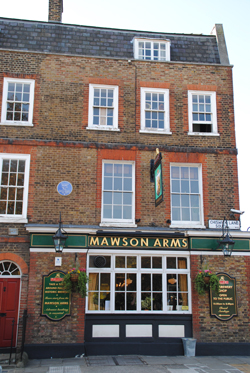
This curiously named Chiswick institution, one of few pubs in England with two names, owes its existence to the brewery located next to the terraces in Mawson Row.

Mawson-ArmsThomas Mawson founded the brewery on the site in the late 1600s/early 1700s and it eventually became what is now known as Fuller’s Griffin Brewery located a few doors down from the pub.

The Grade II*-listed building in which the pub is located dates from about 1715 when the terrace of five houses was constructed for Mawson.

The 18th century poet Alexander Pope was among residents at number 110 (between 1716-1719, when he published his translation of The Iliad and his first collected works). A function room in the pub now bears his name and there’s a blue plaque mentioning his stay on the outside.

While there had long been a pub here called the Fox and Hounds, in the late 19th century, the old pub was extended into the corner building and gained its second name, The Mawson Arms.

The pub, only a short walk away from the Thames, now serves as the starting point for a tour of the brewery. It’s traditionally been a favoured watering hole of brewery workers.

For more, see www.mawsonarmschiswick.co.uk.

This Week in London – The Waterloo Cartoon on show; see inside a former Huguenot’s home; and, Royal Parks’ harvest festivals…

A monumental Victorian-era drawing of the Battle of Waterloo has gone on display in London for the first time since 1972. The Waterloo Cartoon, more formally known as The Meeting of Wellington and Blucher after the Battle of Waterloo, measures more than 13 metres long and three metres high. A preparatory drawing for a wall painting which still exists in the House of Lords’ Royal Gallery, it took artist Daniel Maclise more than a year to complete in 1858-59 and was based on eye-witness accounts (the artist even recruited Queen Victoria and Prince Albert to use their German contacts to gather information from Prussian officers present on the day). Long considered a masterpiece, it was bought by the Royal Academy in 1870 – the year of Maclise’s death – and was on show at Burlington House until the 1920s. It has been in storage for much of last century and, newly restored following a grant from Arts Council England, has now gone on display to mark the 200th anniversary of the Battle of Waterloo. The newly conserved drawing is the focus of a new exhibition – Daniel Maclise: The Waterloo Cartoon, which opened at the Royal Academy in Piccadilly yesterday (between May and August, it was on show as part of a Waterloo exhibition at the Royal Armouries in Leeds). Runs until 3rd January. Admission charge applies. For more, see www.royalacademy.org.uk.

There’s a rare chance to see inside a former Huguenot merchant’s house dating from 1719 in Spitalfields this weekend. The property at 19 Princelet Street was the home of the Ogier family, who had come to London escaping persecution in France and worked in the silk weaving trade. It was later subdivided into lodgings and workshops with later occupants following a range of trades and professionals while a synagogue was opened in the garden in 1869. The site – which the Spitalfields Centre charity hopes to establish as a museum of immigration – is not generally open to the public but will be open this Saturday and Sunday – from 2pm to 6pm. Entry is free (but donations would be welcome) and there may be queues so its suggested you arrive early. For more, see www.19princeletstreet.org.uk.

Watch a bee keeping demonstrations, help dig up some potatoes and introduce the children to some farm animals. The Kensington Gardens’ Harvest Festival will be held this Sunday, between 11am and 4pm, and will also include a range of children’ activities, experts from the Royal Parks Guild on hand to answer your questions about food growing and complimentary hot and cold drinks available throughout the day while stocks last. It’s the first of three harvest festivals to be held in Royal Parks this month with Greenwich Park set to host its inaugural harvest festival on 13th September (11am to 4pm) and The Regent’s Park Allotment Garden to host one on 19th September (11am to 5pm). For more, see www.royalparks.org.uk.

Send all items for inclusion to exploringlondon@gmail.com.

10 small, ‘secret’ and historic gardens in central London…7. St Swithin’s Church Garden…

St-Swithins2Back into the City of London this week and it’s another garden located on the site of a former church.

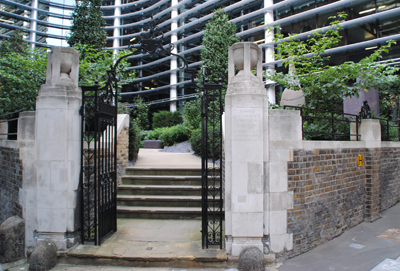
Situated just off Cannon Street, this much overlooked tiny raised garden was created on the site of the former Church of St Swithin. The church is believed to have existed here as early as the 11th century and was replaced, thanks largely to the generosity of Lord Mayor Sir John Hind, with a larger building in the early part of the 15th century – it featured one of the first towers built specifically for the task of hanging bells inside.

St-SwithinsThe church was among those destroyed in the Great Fire of London in 1666 but, now united with the parish of St Mary Bothaw, was rebuilt to the designs of Sir Christopher Wren shortly after in 1677-88.

Later known as St Swithin, London Stone thanks to the mysterious London Stone being built into the south wall of the church in the late 18th century (for more on the stone and its current location, see our earlier post here), the church survived until World War II when it was damaged beyond repair during bombing and was later destroyed.

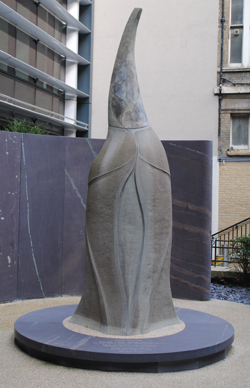
Relandscaped in 2010, the garden features a rather dramatic memorial (pictured) to the suffering of women and children in war in general and medieval figure, Catrin Glyndwr in particular. Unveiled in 2001, it was designed by Nic Stradlyn-John and sculpted by Richard Renshaw.

The daughter of the Welsh Prince Owain Glyndwr, she was captured in 1409 and brought with her children and mother to the Tower of London. Catrin and two of her children died in late 1413 and were buried in the former church.

WHERE: St Swithin’s Church Garden, Salters Hall Court off Cannon Street (nearest Tube station is Cannon Street); WHEN: daily; COST: Free; WEBSITE: www.bost.org.uk/open-places/red-cross-garden/.

LondonLife – See the Thames…in Blackfriars station…

Photo-exhibition-at-Blackfriars-station

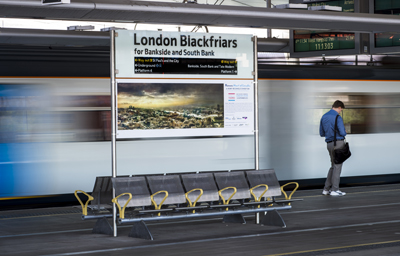
This is one of a series of works by renowned photographer Henry Reichhold which features in the exhibition Thames – Heart of London, currently on show at Blackfriars Thameslink railway station. Thameslink and JCDecaux have provided 49 platform advertising sites for the display, part of the Totally Thames celebrations taking place throughout September. The photographs, which measure 2.5 metres long, are an attempt to capture the character of the Thames as it winds its way through the city and were taken from a series of notable vantage points including the Shard, City Hall, OXO Tower, One Canada Square, Southbank Tower and the Houses of Parliament. As well as the river itself, they also capture some of the many events which have taken place upon it – from the Diamond Jubilee Pageant to New Year’s Day celebrations. Each image has taken between one and three weeks to create from up to 100 separate photographs – selected out of more than 800 taken on a single day – which have then been put together in a stunning panorama. New York-born Reichhold says the process of “extracting” the final image is “never the same”. “The camera is very stubborn about creating a ‘mechanical’ view and it is the reinterpretation of these files to in some way reflect what the human eye sees that I find so troublesome and fascinating.” The exhibition is at Blackfriars Station, 179 Queen Victoria Street, London, and runs until 30th September.  Entry is free to passengers with a valid GTR train ticket and to holders of a 10p platform ticket.

This Week in London – Tall ships at Greenwich; immersive art at Tate Britain; and, ‘Nature’s Bounty’ at Kew…

It’s all about big masted ships at Greenwich this Bank Holiday weekend as up to 15 ships drop anchor at the Royal Greenwich Tall Ships Festival. Two tall ships, the Dar Mlodziezy and Santa Maria Manuela, will be moored on Tall Ships Island in the river at Maritime Greenwich (accessed via MBNA Thames Clippers) while an additional 13 ships will be taking people on cruises from their base at Royal Arsenal Woolwich (tickets can be booked via Sail Royal Greenwich). On Saturday, a free family festival will be held in Woolwich Town Centre and at Royal Arsenal Riverside with music, roving entertainers, food and other activities including a fireworks display on the river at 10pm (fireworks can also be seen on Thursday, Friday and Sunday nights on the river at Maritime Greenwich at around 9.15pm). For more information – including how and where to book tickets, see www.royalgreenwich.gov.uk/tallships2015.

An immersive art project allowing visitors to engage with paintings in a multi sensory experience opened at Tate Britain on Milbank yesterday. Tate Sensorium has won this year’s annual IK Prize, presented by the Tate and supported by the Porter Foundation, awarded for a project which uses innovative technology to enable the public to explore the gallery’s collection in new ways. The display features four works by celebrated figures in 20th century painting: Francis Bacon’s Figure in a Landscape (1945), David Bomberg’s In the Hold (c 1913-1914), Richard Hamilton’s Interior II (1964) and John Latham’s Full Stop (1961). As part of the experience, which has been produced by creative studio Flying Object in conjunction with a cross-disciplinary team, visitors are offered the chance to wear biometric measurement wristbands to record the emotional impact of the experience. Admission to exhibition in gallery 34 is free but tickets are limited. Runs until 20th September. For more, see www.tate.org.uk/sensorium.

A series of detailed paintings of fruit, vegetables and edible plants from all over the world goes on show at the Shirley Sherwood Gallery of Botanical Art at Kew Gardens on Saturday. Nature’s Bounty features works from the Shirley Sherwood and Kew collections including works from the 19th century text, Fleurs, Fruits et Feuillages Chosis de la Flore et de la Pomona de L’ile de Java drawn by botanical artist Berthe Hoola Van Nooten as well as works from the Shirley Sherwood and Kew collections. The exhibition runs until 31st January. Admission charge applies. For more, see www.kew.org.

Send all items for inclusion to exploringlondon@gmail.com.

10 small, ‘secret’ and historic gardens in central London…6. Red Cross Garden, Southwark…

Red-Cross-Garden

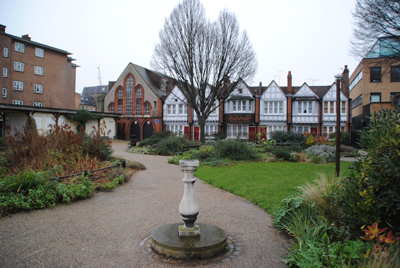
We travel south of the Thames this week to Red Cross Garden in Southwark. Located not far from Borough Market, the garden has a rich history, having first been laid out in 1887 by the social reformer, philanthropist and National Trust co-founder Octavia Hill.

Described as Hill’s “flagship project”, it was here, after being granted use of the land by the Ecclesiastical Commission, that she demonstrated the role gardens and open spaces play in improving the lives of the poor living in 19th century Southwark (in the picture you can see in the background the hall and cottages which were also part of the project – Hill had these constructed between 1888-89, the hall being for community activities and the cottages homes for the “working poor”. Both were designed by Elijah Hoole).

The garden in Redcross Way was created on the site of a derelict paper factory and a hop warehouse and originally contained meandering paths, an ornamental pond with fountain, a bandstand and a covered play area for children as well as an elevated walkway for viewing the garden – described by Hill as an “open air sitting room for the tired inhabitants of Southwark”. There were a number of colourful mosaics – one called The Sower is still in situ but another known as The Good Shepherd was apparently lost.

The original layout of garden, which were used as the venue for the annual Southwark Flower Show as well as other events, had been lost by the late 1940s and it was only in much more recent years that it was restored by the Bankside Open Spaces Trust (with funding from the Heritage Lottery Fund and Southwark Council). They were officially reopened in 2006 by Princess Anne.

The award-winning garden is now managed by BOST which leases the space from Southwark Council and relies on the work of volunteers (any donations are always welcome!). The latest addition has been the Victorian bandstand which, constructed in a style true to the original, was unveiled late last year.

WHERE: Red Cross Garden, Redcross Way, Southwark (nearest Tube stations are Borough and London Bridge); WHEN: 9am to dusk, daily; COST: Free; WEBSITE: www.bost.org.uk/open-places/red-cross-garden/.

This Week in London – Party like a Georgian; a playground with a history; and, a Dickens whodunnit…

Kensington-Palace• Join the Georgian Queen Caroline for a garden party in the grounds of Kensington Palace this weekend. The Georgian Court will be taking to the palace gardens for a summer celebration featuring music, military drills and theatre as they bring the era to life. Visitors are encouraged to immerse themselves in the experience as a courtier with the gardens decked out in a range of tents where they can try out costumes and powdered wigs as well as learn court etiquette, swordplay and dancing while the ice-house will feature Georgian ice-cream (and it’s rather odd flavours such as parmesan). Runs from tomorrow until Sunday. Admission charges apply (under 16s go free with a maximum of six children per paying adult). For more, see www.hrp.org.uk/KensingtonPalace/. PICTURE: ©Historic Royal Palaces

First created in 1923, a playground in Victoria Tower Gardens – newly named the Horseferry Playground – has been reopened after improvement works. The works, carried out under the management of Royal Parks, have seen the reintroduction of a sandpit as well as the installation of new swings and slide, dance chimes and a stare play installation to represent the River Thames. The playground, located close to the Houses of Parliament in Westminster, also features a series of timber horse sculptures, new seating and a refreshment kiosk with metal railings designed by artist Chris Campbell depicting events such as the Great Fire of London and Lord Nelson’s funeral barge and views of the River Thames. The project has also seen the Spicer Memorial, commemorating role of paper merchant and philanthropist Henry Spicer in the establishment of the playground – then just a large sandpit, restored. For more, see www.royalparks.org.uk/parks/victoria-tower-gardens.

Now On – A Dickens Whodunnit: Solving the Mystery of Edwin Drood. This temporary exhibition at the Charles Dickens Museum in Bloomsbury explores the legacy of Dickens’ final novel The Mystery of Edwin Drood, left unfinished after his death in 1870. Visitors are able to investigate crime scenes, search for murder clues and see the table on which the novel was penned as well as clips from theatrical adaptations, and a wealth of theories on ‘whodunit’. The exhibition runs until 11th November. Admission charge applies. For more, see www.dickensmuseum.com.

Send all items for inclusion to exploringlondon@gmail.com.

10 small, ‘secret’ and historic gardens in central London…5. Seething Lane Garden…

Seething-Lane-Garden

This small, simply laid out garden in the City of London is redolent with history.

It was once the site of the Navy Office, the workplace of diarist Samuel Pepys, and it was in the garden of this building that he and Sir William Penn buried their wine and parmesan cheese for safety during the Great Fire of London in 1666.

The office survived the Great Fire but was, oddly enough, destroyed by fire only a few years later in 1673 (there is a blue plaque commemorating it in the garden) and a new office, designed by Sir Christopher Wren, was built here in the early 1680s before it was demolished in 1788.

Seething-Lane-Garden2It’s due to its association with Pepys (who also lived in the street and was buried in the nearby church of St Olave Hart Street) that it boasts a bronze bust of him which was erected by the Samuel Pepys Club in 1983, designed by Karin Jonzen and funded by public subscription. It was presented to the garden by Fred Cleary who played an instrumental role in encouraging green spaces in the Square Mile in the 1970s.

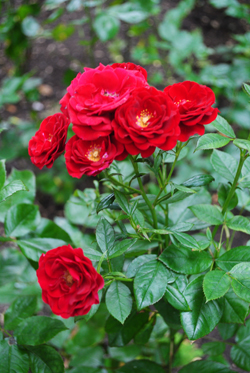
The garden, which was laid out in about 1950, is also notable for its beds of red roses, planted to commemorate the deal struck in 1381 in which the Sir Robert Knollys was belatedly granted permission for a footbridge his wife had built over Seething Lane. She had done so contrary to planning rules while he was away fighting with John of Gaunt (ostensibly so she could avoid the dust of the street when crossing from her house to her rose garden), and so when he returned, the City of London Corporation allowed the bridge (now long gone) to remain, but only in exchange for the symbolic “penalty” of one red rose a year.

The occasion is still marked each June in a ceremony overseen by the Company of Watermen and Lightermen of the River Thames in which a red rose is plucked from the garden and delivered to the Lord Mayor of London at Mansion House.

WHERE: Seething Lane Garden, Seething Lane, City of London (nearest Tube stations is Tower Hill); WHEN: Daily; COST: Free; WEBSITE: www.cityoflondon.gov.uk/things-to-do/green-spaces/city-gardens/Pages/default.aspx.

This garden reopened in 2018 after being redeveloped as part of the Trinity Square redevelopment.


What’s in a name?…Carnaby Street…

Renowned as the heart of the UK’s fashion industry in the 1960s, Carnaby Street’s origins go back to a mansion built here known as Karnaby House (with a ‘k’, although the street always apparently started with a ‘c’).

Carnaby-Street2The house was built in 1683 although who it was built for remains something of a mystery. It was apparently was demolished within 50 years or so when the east side of the street, which had been laid out in the late 1600s, was recorded as the site of a series of “pest” (plague) houses.

The street was later home an abbatoir and while tailors had moved in during the late 19th century, it wasn’t until the middle of the 20th century that it began to attract a reputation for fashion, becoming the epicentre of Swinging London during the 1960s.

Boutiques included John Stephen’s pioneering men’s boutique His Clothes – which attracted high profile customers including members of The Small Faces, The Rolling Stones and The Who – as well as Lady Jane, Lord John, and the wonderfully named I was Lord Kitchener’s Valet.

The street – which was pedestrianised in 1973 – is still home to a large number of fashion boutiques. It’s numerous pop-culture references include its appearance in U2’s video for the 1992 song Even Better Than The Real Thing and it being named as the location of the flat of ‘spy’ Austin Powers. In recent years it’s also has its own stage show: Carnaby Street: The Musical.

For more on Carnaby Street today, check out www.carnaby.co.uk.

This Week in London – Animals in the British Library; Gladiators at Guildhall; and celebrating “pocket parks”…

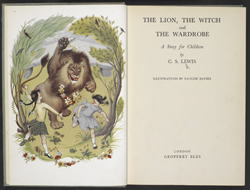
title-page-1950-cs-lewis-the-lion-the-witch-and-the-wardrobe-copyright-cs-lewis-pteFrom Peter Rabbit to Aesop’s Fables, animals and their appearance in some of the classics of literature are the subject of a new exhibition which opened at the British Library in St Pancras yesterday. Animal Tales explores the role animals have played in traditional tales around the world along with their importance in the development of children’s literature, and their use in allegorical stories such as CS Lewis’ The Lion, the Witch and the Wardrobe as well as literary transformations between man and beast (this last in a nod to the fact it’s the centenary of Franz Kafka’s The Metamorphosis). Highlights in the exhibition include one of the first children’s picture books – the 1659 edition of Comenius’ Orbis sensualism pictus, an 18th century woodblock edition of Wu Cheng’en’s Journey to the West, and a soundscape installation drawn from the library’s world leading collection of natural history recordings along with other animal tales from the sound archive. The exhibition, which runs until 1st November, will be accompanied by a series of events. Entry is free (and the display includes a children’s reading area and a family trail brochure). For more, see www.bl.uk. PICTURE: The title page from the 1950 London edition of CS Lewis’ The Lion, the witch and the wardrobe. © CS Lewis Pte Ltd.

Gladiators will battle it out on the former site of London’s open air Roman amphitheatre in Guildhall Yard this weekend. The shows – which will recreate what gladiatorial games were like in Roman Londinium – will be presided over by an emperor with the crowd asked to pick its side. The ticketed event, being put on by the Museum of London, takes place Friday night from 7pm to 8pm and on Saturday and Sunday, from noon to 1pm and between 3pm and 4pm. Admission charges apply. To book, see www.museumoflondon.org.uk.

A new International Visitors Victim Service has been launched in London to specifically help foreign nationals affected by crime in the city. The first of its kind in the UK, the service, which has been established by the Metropolitan Police working with independent charity Victim Support and embassies, already operates across the five central London boroughs and is now available through a mobile police kiosk located in the West End’s “impact zone”, an area which spans Leicester Square and Piccadilly Circus (alternatively they can contact the International Visitor Advocates by calling 0207 259 2424 or visit the West End Central Police Station at 27 Savile Row.

The Mayor of London, Boris Johnson, has celebrated the creation of 100 new pocket parks across London’s 26 boroughs in a scheme which is now being adopted by other locations across the country. The parks range from a rain garden in Vauxhall to a dinosaur playground in Hornsey and have seen more than 25 hectares of community land converted into enhanced green areas. A free exhibition is running at City Hall until 28th August which focuses on the stories of 11 people involved in the creation of the parks. For more on London’s “great outdoors”, you can see an interactive map at www.london.gov.uk/outdoors.

Send all items for inclusion to exploringlondon@gmail.com.

10 small, ‘secret’ and historic gardens in central London…4. St Mary Aldermanbury Gardens…

St-Mary-Aldermanbury2Like St Dunstan in the East, these gardens at the corner of Love Lane and Aldermanbury are also based inside the remains of a medieval church.

The church of St Mary Aldermanbury (the name may relate to its proximity close to Guildhall, or the ‘Alderman’s Bury’ or ‘Alderman’s Hall’), mentioned as far back as the late 12th century, was destroyed in the Great Fire of London but was among those rebuilt to the designs of Sir Christopher Wren only to be destroyed again during the Blitz in 1940.

Shakespeare-MonumentThis time there was to be no rebuilding and instead, in 1966 the walls – all that remained – were moved more than 4,000 miles away to the town of Fulton, Missouri, in the US.

There they were reconstructed in the grounds of Westminster College – site of Winston Churchill’s famous “Iron Curtain” speech in 1946 – and the church restored as a memorial to the former British PM. The National Churchill Museum is located beneath.

There’s plaque mentioning this in the gardens (and featuring an image of what the church looked like after its reconstruction in Fulton) which still contains the church’s footings (these date from the 15th century when the church was apparently partially rebuilt) and give an indication of what the church’s footprint would have been along with headstones (among those whose remains were buried here was the notorious Judge Jeffreys).

Other features include a memorial to Henry Condell and John Heminge, both involved in the publication of William Shakespeare’s first folio (you can read more about it in our earlier post here).

The garden was laid out after the church was removed. It is a designated Site of Local Importance for Nature Conservation and attracts wildlife including birds such as blackbirds, woodpigeons, house sparrows and blue tits. Plantings were added in 2011 to maximise the attraction to bird as well as bees and butterflies. On the corner outside the garden is a fountain.

WHERE: St Mary Aldermanbury Garden, Aldermanbury, City of London (nearest Tube stations are St Pauls and Monument); WHEN: 8am to 7pm daily; COST: Free; WEBSITE: www.cityoflondon.gov.uk/things-to-do/green-spaces/city-gardens/visitor-information/Pages/St-Mary-Aldermanbury.aspx.