Lost London – The ‘Tyburn Tree’

For six centuries, the gallows at Tyburn, in the city’s west, was one of London’s sites of public execution. Today, little remains to remind visitors of the infamous past of the area, which lies close to Marble Arch, but for a plaque set in the middle of a road.

From 1196 to 1783, it’s suggested that thousands of people (some have estimated as many as 60,000) were hanged at various gallows erected at Tyburn, known by numerous names over the centuries including ‘The Elms’, the ‘The Deadly Never Green Tree’, and most infamously the ‘Tyburn Tree’.

Hangings were apparently initially carried out using the branches of a tree on the bank of the Tyburn River but the first gallows date from 1220. In Elizabeth times these were upgraded to a larger gallows known as the ‘Triple Tree’ which enabled many more people to be hanged simulteously – as many as 24 at once in 1649.

The gallows was removed in 1759 because it was blocking the road and a mobile gallows used until hangings were moved into Newgate Prison (see our earlier entry on Newgate).

Executions were a public spectacle and it’s estimated that at times the crowds at Tyburn swelled to more than 50,000 people, all eager to witness someone “dancing the Tyburn jig”.

Among those to be hanged at Tyburn were William Fitz Osbern (a champion of London’s poor who was hanged in 1196), Roger Mortimer, 1st Earl of March (hanged in 1330 after being accused of assuming royal power), Perkin Warbeck (pretender to the throne of King Henry VII who was hanged in 1499), and Elizabeth Barton, the ‘Holy Maid of Kent’ (hanged for treason after prophesying King Henry VIII would die within six months of marrying Anne Boleyn).

Others included key figures in the so-called Pilgrimage of Grace (an uprising in England’s north in 1536 which followed King Henry VIII’s break with Rome) and many other Catholics including Oliver Plunkett, the Archbishop of Armagh and Primate of all Ireland (1681).

In an unusual move, the body of already deceased Oliver Cromwell, along with that of John Bradshaw and Henry Ireton, was exumed from his grave and and hanged there to mark the first anniversary of the Restoration.

What is believed to have been the site of the Tyburn Tree is today marked by a plaque set in a traffic island at the corner of Edgware Road and Bayswater Road (nearest tube station is Marble Arch).

There is a Shrine of the Martyrs dedicated to the more than 105 Roman Catholics who were hung at Tyburn for their faith at the Tyburn Convent in Hyde Park Place (for visiting details, see www.tyburnconvent.org.uk).

Note: This article originally referred to the Shrine of the Martyrs commemorating more than 350 Catholic martyrs who died during the Reformation as all being executed at Tyburn but it is believed some 105 were – the greater figure refers to those martyred across England and Wales during the Reformation.

Around London – Captain Kidd at Docklands; London’s Olympic Torch Relay path; St Giles’ seedy past; speech therapist Lionel Logue honored; and, The Seven Seas at Selfridges…

The true story of Captain Kidd and an exploration of London’s links with piracy is the focus of a new major exhibition at the Museum of London Docklands. Pirates: The Captain Kidd Story features original artefacts dating from 300 years ago when London was a site of pirate executions and tells the story of the infamous Captain Kidd’s life until his execution at Wapping’s Execution Dock. Among the artefacts is the original costume worn by actor Johnny Depp as he played Captain Jack Sparrow in the film Pirates of the Caribbean. The exhibition, which opens tomorrow and runs until 30th October, is being held in conjunction with a series of pirate related events including an adults-only pirate night on 27th May where you have the chance to sample some genuine “pirate drink” and take part in pirate speech lessons. Admission charges apply. For more information, visit the Museum of London Docklands website www.museumoflondon.org.uk/Docklands/Whats-on/Exhibitions-Displays/Pirates.htm.

The path of London’s Olympic Torch Relay has been announced and will finish with a week long jaunt through London. The torch will arrive in Waltham Forest on 21st July next year and then pass through Bexley, Wandsworth, Ealing, Haringey and Westminster before its arrival at the Olympic Stadium on 27th July. To find out how to nominate someone to carry the torch or for more information on the relay, visit www.london2012.com/olympic-torch-relay.

• On Now: London’s Underworld Unearthed: the Secret Life of the Rookery. The seedy side of the St Giles Rookery, a once infamous quarter of the capital, is laid bare in this new exhibition at the Coningsby Gallery. Back in 1751, the area was known as “a pit of degradation, poverty and crime” known for its free-flowing gin. Artist Jane Palm-Gold has displayed 18th and 19th century artifacts found during the Museum of London Archaeology’s recent excavation of old St Giles (conducted prior to the construction of the recent Central St Giles development which now covers the site) alongside her paintings, building what has been described as a “multi-layered psycho-geography that both mesmerises and disturbs”. Runs until 3rd June at the Coninsby Gallery at 30 Tottenham Street (nearest tube station is Goodge Street). Admission is free. For more information, see www.coningsbygallery.com

Australian speech therapist Lionel Logue – known for having helped cure King George VI of his stammer, the story of which is told in the recent Oscar-winning film, The King’s Speech – has been honored with a green plaque by Westminster Council. The plaque was expected to be unveiled today at 146 Harley Street, where Logue, who is known to have used fees from wealthier client to subsidise free treatments for those who could not afford them, lived from 1926 until 1952. The plaque is one of 94 which Westminster Council has placed to mark buildings of particular significance for their association with people who have made lasting contributions to society.

• On Now: The Seven Seas at Selfridges in Oxford Street. Conceptual artist Beth Derbyshire’s seven minute video installation features seven films of seven different seas around the globe. On show as part of Project Ocean – an initiative by Selfridges and 20 environmental and conservation groups aimed at celebrating the ocean’s beauty and highlighting the issue of overfishing. Runs until 8th June. For more information, see www.selfridges.com.

King James I’s London – 6. The Queen’s House, Greenwich

Long an admired landmark of Greenwich, the origins of the Queen’s House go back to the reign of King James I.

It was the Queen, Anne of Denmark, who commissioned the building of The Queen’s House in 1616 and gave it the name by which it is still known. Sadly, however, she died before it was completed.

King James I was said to have been a frequent visitor to the Tudor Palace of Greenwich (the building had earlier been known as the Palace of Placentia and was the birthplace of King Henry VIII in 1491).

King James  is traditionally said to have awarded the Manor of Greenwich to Queen Anne as an apology after he had publicly sworn at her when she had accidentally shot one of his favorite hunting dogs.

In 1616, Queen Anne decided to build a new property on the site as both a private retreat and a place where she could entertain and it was to the rising star Inigo Jones that she turned to for the design (in recognition of his growing status, he was appointed Surveyor of the King’s Works the following year).

The house was Jones’ most important job to date and the design he came up – based on a H with the two sides joined by a bridge over the Greenwich to Woolwich road – with is said to be the first Classical building in England.

Among the original features which survive to this day are the striking black and white geometrically patterned marble floor of the Great Hall (the room having been designed as a perfect cube), the painted ceiling of the Queen’s Presence Chamber and the iron balustrade the Tulip Stairs – said to be the first “geometric self-supporting spiral stair in Britain”.

Queen Anne became ill in 1618 and died the following year without seeing the end result of her commission. The work subsequently was shelved and only restarted (and completed in 1638) after King Charles I gave it to his wife, Queen Henrietta Maria.

She only had possession for a short time before Parliamentary forces seized it during the Civil War. After the Restoration, the Queen’s House was returned briefly to her by her son King Charles II (it was at this time that the original H-shape of the house was altered to a square) before part of it as later used as studio for painters and then as grace and favor apartments.

With the Old Royal Naval College now occupying the surrounding site, in 1805, King George III gave the property to the Royal Naval Asylum – a charity caring for the orphan children of seamen – and it later became part of the Royal Hospital School.

The National Maritime Museum took possession in 1934 and the building now houses the National Martime Museum’s collection of fine art. As an interesting aside, there have been several reported sightings of ghosts in the house, the latest as recently as 2002.

WHERE: The Queen’s House, National Maritime Museum, Greenwich (nearest DLR station is Cutty Sark); WHEN: 10am to 5pm daily (check website for closures); COST: Free; WEBSITE: www.nmm.ac.uk/places/queens-house

What’s in a name?…Charing Cross

The West End location of Charing Cross is named after the large stone cross that once stood at the top of Whitehall on what is now the southern side of Trafalgar Square – a site currently occupied by a statue of King Charles I.

The cross – an embellished Victorian-era replica of which can be found standing outside Charing Cross Station in the Strand – was one of a series of 12 erected by King Edward I in 1291-94 to commemorate his wife Eleanor of Castile.

They marked the sites where her funeral cortege rested overnight as it made its way from near Lincoln where she died south to Westminster Abbey where she was to be buried (for more on the cross and the Victorian replica, see our previous post here).

The final of these ‘Eleanor Crosses’ – which were originally made from wood before being replaced with stone ones –  was erected on a site which stood in the medieval village of Charing, located between the City of London and Westminster. The cross was pulled down in the 1640s by order of Parliament. Since 1675, the statue of King Charles I (pictured, with Trafalgar Square, once the site of the royal mews, in the background) has occupied the site.

The word Charing is an Anglo-Saxon or “Old English” term and is believed to relate to the nearby bend in the River Thames.

Between the mid-1700s until the mid-20th century, the former site of the Charing Cross was the point from which all distances from London were measured. There was also a famous pillory located here.

Around London – See museums after hours; the White Tower is white again; and, foundation stone for Bomber Command is laid…

• The annual Museums at Night event returns to London (and Britain) this weekend with hundreds of museums and galleries across the country opening their doors for special after hours events. Among those places in London taking part is the Churchill War Rooms, which is hosting a 1940s evening on Friday night, the London Canal Museum which is hosting”candle-lit tours, atmospheric lighting, and exhibits of art and film in dark places”, and the Petrie Museum of Egyptian Archaeology which is hosting a double hill of Hammer films and a “Gothic Egypt” trail. Other institutions taking part include the Sir John Soane Museum, the National Gallery, the Bank of England Museum, and Orleans House Gallery in Twickenham.  For more information about what’s on see www.museumsatnight.org.uk

King William the Conqueror celebrated at the Tower of London this week following the completion of a £2 million, three year project to clean the White Tower. First built shortly after the Norman Conquest of 1066, the tower had become blackened by pollution but has now been restored to its original color. For more information on visiting the Tower, see www.hrp.org.uk/toweroflondon/.

A foundation stone has reportedly been laid for a Bomber Command Memorial in Green Park. The memorial, which is due to be completed for the Queen’s Jubilee celebrations in 2012, will be constructed of Portland stone and will feature a nine foot tall statue of a bomber command aircrew. Bomber Command lost more than 55,000 airmen during World War II. The foundation stone was laid by the Duke of Gloucester. Supporters of the monument’s construction have included former Bee Gee Robin Gibb, Sir Michael Beetham, Marshal of the RAF, and  The Daily Telegraph newspaper which is running an appeal to help raise funds for the memorial.

King James I’s London – 5. Holland House

A Jacobean mansion located in Kensington’s Holland Park, Holland House was first built in 1605 for Sir Walter Cope, Chancellor of the Exchequer for King James I. 

Sir Walter apparently entertained the king and his wife, Queen Anne of Denmark, at the property – then named Cope Castle – on numerous occasions at the property and reportedly hosted the king the night after his son, Henry Frederick, the Prince of Wales, died in 1612.

Its name came with a later owner – the ill-fated Henry Rich, Cope’s son-in-law, who was made the 1st Earl of Holland in 1624 and was later executed for his role in supporting the Royalist cause during the Civil War during which the house was occupied by parliamentary troops.

The home was later used by various family members – among luminaries associated with the property are the essayist Joseph Addison who died there in 1719 as well as, in later years, the likes of Lord Byron, Benjamin Disraeli, Charles Dickens and Sir Walter Scott, all of whom visited the property during the property’s golden age in the 19th century when it was an important social gathering place.

The house was largely destroyed in a bombing raid in September 1940 and passed into ownership of the local authority. A youth hostel is now housed inside the restored east wing of the building while other buildings are used for a restaurant and function centre – all set within the 22 hectare (55 acre) Holland Park. Some of the ruins provide a backdrop for open-air theatre performances and concerts in summer.

WHERE: Holland Park (nearest tube stations are Holland Park, Kensington High Street and Notting Hill); WHEN: 7.30am to 30 minutes before dusk (check signs by entrance); COST: Park entrance is free (house is not open to the public); WEBSITE: www.rbkc.gov.uk/leisureandlibraries/parksandgardens/yourlocalpark/hollandpark.aspx

Where’s London’s oldest…bookshop?

Hatchards on Piccadilly (right next to Fortnum & Mason) is generally accepted as being London’s oldest surviving bookshop.

It was founded in 1797 by John Hatchard in Piccadilly (there seems some dispute over whether it still stands on exactly the same site).

The shop currently holds three royal warrants for the supply of books to the Royal Household.

Among high profile past customers have been Queen Charlotte (wife of King George III), former PMs Benjamin Disraeli and  Arthur Wellesley, the Duke of Wellington, and literary figures such as Rudyard Kipling, Oscar Wilde and Lord Byron.

It remains popular with lovers of literature and is noted for hosting book-signings by prominent authors with many signed book on the shelves.

For more, see www.hatchards.co.uk.

King James I’s London – 4. Charterhouse

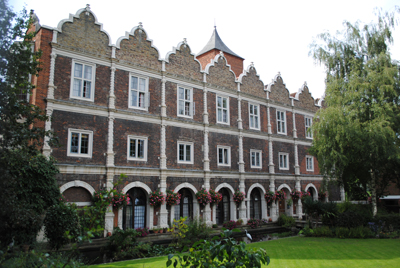
The Charterhouse School was founded in 1611 – the seventh year of King James I’s reign – on the site of a former Carthusian monastery in Smithfield.

It owes its creation to Thomas Sutton (1532-1611) who bought the site – which then contained a Tudor mansion – from Thomas Howard, Earl of Suffolk, in 1611, the year of Sutton’s death.

A Yorkshireman, Sutton (who is buried in the chapel in Charterhouse) is said to have been the “wealthiest commoner in England” at the time, having made a fortune after discovering coal. He used his resources to endow a school and an almshouse on the site.

Among the school’s alumni were John Wesley, founder of the Methodist Church, and novelist William Makepeace Thackeray.

The school – which is this year celebrating its 400th anniversary – moved to Godalming in Surrey in 1872 and the site was subequently occupied by the Merchant Taylor’s School while the almhouse continued to operate on the western part of the land (it still does today under the name Sutton’s Hospital in Charterhouse).

The school later became the medical college of the nearby St Bartholomew’s Hospital and is now occupied by Barts and The London School of Medicine and Dentistry.

For more on the Charterhouse, see www.thecharterhouse.org (tours run on Wednesday afternoons at 2.15pm from April until August and cost £10 per person). For more on the Charterhouse School, see www.charterhouse.org.uk.

Famous Londoners – Henry Fitz-Ailwyn

In the first of a series in Famous Londoners looking at past mayors of London, we profile the first person recorded as having that title, Henry Fitz-Ailwyn (also known as Henry Fitz-Ailwin). While his name might not be familiar to us today, it’s clear than in the 12th century, he was a personage to be reckoned with.

Believed to have been born in the 1130s or 40s, Fitz-Ailwyn is said to have been the son of a wealthy Londoner. Apparently involved in the cloth trade, possibly as a draper, he owned property in several counties and in what was Candlewick Street in London (now named Cannon Street).

Records show he was a London alderman in 1168 and later served as mayor, thanks apparently to the support of King Richard I (the dates are uncertain – some claim he took up the post in 1194 but the City of London Corporation records his tenure as 1189 to 1211).

Among his claims to fame are that he issued London’s first building regulations (concerning the need to build in stone) after a fire in 1212 destroyed parts of the city (although he apparently had no powers to enforce them).

Fitz-Ailwyn died the same year and is noted by the Museum of London as “the only mayor ever to serve in office for a full life term”.

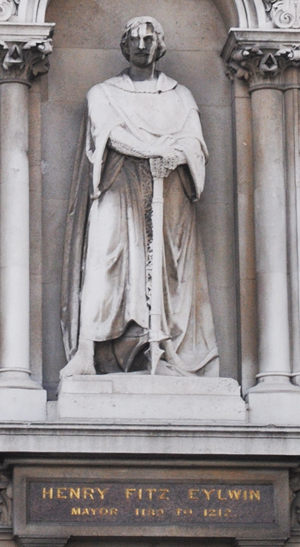
His name is commemorated in a window at the Guildhall and by a statue which stands on the exterior of one of the step buildings at Holborn Viaduct (pictured).

The Royal Wedding – Eight curious facts about Royal Weddings past and present…

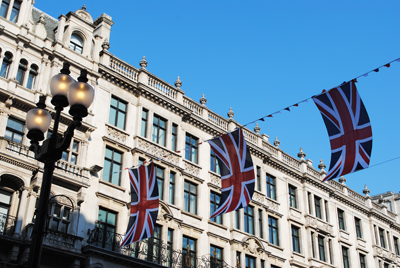
PICTURE: Bunting in Regent Street ahead of the Royal Wedding tomorrow.

Ahead of the wedding of Prince William and Kate Middleton tomorrow, here’s a look at some of the more curious and interesting facts related to London’s Royal Wedding past…

The first public Royal Wedding in modern times was that of Prince Albert, Duke of York (later King George VI), and Lady Elizabeth Bowes-Lyon (later Queen Elizabeth, the Queen Mother) which took place on 26th April, 1923. Instead of being held at a royal chapel as was more usual, they were married at Westminster Abbey in a public display which was apparently staged to lift the national spirit in the aftermath of World War I.

Lady Diana Spencer (later Diana, Princess of Wales) memorably said Prince Charles’ name in the wrong order during their wedding ceremony at St Paul’s Cathedral on 29th July, 1981. Lady Diana accidentally called him Philip Charles Arthur George instead of the correct Charles Philip Arthur George.

• Queen Victoria’s extravagant wedding cake was the first to feature a model of the bride and groom on its summit (with a figure of Britannia looming over them). The two tier cake measured nine foot across and weighed 300 lbs.

While white wedding dresses had been worn for some time, it was apparently after Queen Victoria wore a white dress at her 1840 wedding that the idea spread to the masses. (Interestingly, the first documented princess to wear a white wedding dress is said to have been Philippa of England, the daughter of King Henry IV, in 1406).

The first televised Royal Wedding was that of Princess Margaret, younger sister of Queen Elizabeth II, to Antony Armstrong-Jones (Lord Snowdon) on 6th May, 1960. It attracted some 300 million viewers worldwide.

The tradition of a royal bride leaving her bouquet on the Tomb of the Unknown Warrior in Westminster Abbey was started by Queen Elizabeth, the Queen Mother. She apparently did so in tribute to her brother Fergus who had died during World War I. Princess Mary, daughter of King George V, made a similar gesture at her wedding in 1922 – she left her bouquet at the Cenotaph in Whitehall after her wedding.

One of the most scandalous Royal Weddings was that of George, Prince of Wales (later King George IV) to Princess Caroline of Brunswick on 8th April, 1795 at the Chapel Royal in St James’s Palace. Described as being “far from a love match” on the Historic Royal Palaces’ website, Prince George was said to have been drunk during the wedding and at one stage apparently even attempted to escape from the ceremony.

If the rain stays away, the newly married prince and his bride will be returning to Buckingham Palace in the 1902 State Landau. The open-topped carriage was constructed for King Edward VII’s coronation and apparently made roomy to accommodation him. The carriage was used by Prince Charles and Lady Diana when they left St Paul’s Cathedral after their 1981 wedding. If the weather it poor, it’s expected that the 1881 Glass Coach, bought for the coronation of King George V in 1911, will be used instead.

For more fascinating facts on Royal Weddings, see the BBC website (www.bbc.co.uk/history/royal_weddings), or Historic Royal Palaces’ blog, The ‘other’ royal weddings (http://blog.hrp.org.uk). For more on the current Royal Wedding, see the official website (www.officialroyalwedding2011.org).

The Royal Wedding – Royal residences…

Word is that Prince William and his soon-to-be wife, Catherine Middleton, have yet to formally decide where they will live when in London (they are expected to spend much of their first two-and-a-half years of marriage in North Wales). 

Their initial London base, however, will reportedly be Clarence House. Located in The Mall, just down the road from Buckingham Palace and beside St James’s Palace, the grand building is currently the home of William’s father Charles, the Prince of Wales, his wife Camilla, Duchess of Cornwall, and, William’s brother, Prince Harry (it is also the home of William himself).

In years gone past, Clarence House served as the home of the newly married Queen Elizabeth II (then Princess Elizabeth) and her husband, Prince Philip, the Duke of Edinburgh. Prince Charles, who lived there with his parents until the age of three, returned to the property in August 2003 after the death of his grandmother Queen Elizabeth, the Queen Mother, who had lived in the building from 1953.

Clarence House was built between 1825 and 1827 to the designs of architect John Nash on the orders of Prince William Henry, the Duke of Clarence and later King William IV.

Choices for a permanent home in London for the soon-to-be married couple reportedly include Buckingham Palace (see yesterday’s entry), as well as Kensington Palace.

It was converted from a Jacobean mansion for King William III and Queen Mary II and has since been the home of many royals including, most famously, Diana, Princess of Wales. She and her then husband, Prince Charles, moved in following their wedding in 1981, and Princess Diana continued to live there after her divorce in 1996.

Other notable royal residents have included Queen Anne and Princess Margaret, sister of Queen Elizabeth II.

Another option – St James’s Palace – was built in 1531 on the site of a medieval leper hospital by King Henry VIII. Used initially for state occasions and to house royal relatives (Tudor monarchs actually lived at Whitehall Palace), it became the official royal residence in 1702, when Whitehall Palace burnt down, and remained so until the 1830s when King George III moved to Buckingham Palace.

The Royal Wedding – London’s royal reception venue

Following the wedding ceremony at Westminster Abbey on Friday, the now married happy couple will head in a carriage via a processional route down The Mall to Buckingham Palace.

There, they will enjoy a champagne reception with 600 guests hosted by the Queen before, at 1.30pm, appearing on the balcony of the palace to wave to the crowds and watch an aircraft flypast expected to include a Lancaster, Spitfire, Hurricane, two Typhoons and two Tornados.

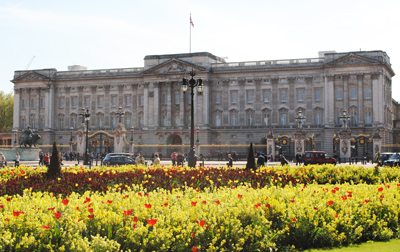
Buckingham Palace, which has served as the official London residence of the reigning monarch since 1837, has a long tradition of hosting royal events. Then much smaller and known as Buckingham House, the property was built for the Duke of Buckingham in 1705.

It passed into royal hands when it was bought by King George III in 1761 for his wife, Queen Charlotte, to use as a family home located conveniently close to St James’s Palace where many court functions were held.

The house was extensively remodelled in 1762 and again, this time on the orders of King George IV, in the 1820s (after initially wanting to use it, like his father, as a family home, the king decided after the works had started to instead transform it into a palace, created to the designs of architect John Nash).

When King George IV died in 1830, his brother King William IV ordered the works to be continued albeit with a new architect, Edward Blore (the spiralling costs of Nash’s work are said to have cost him the contract). The king himself never lived in the house – even offering at at one stage as a seat for Parliament after the Houses of Parliament were destroyed by fire in 1834 – and it wasn’t until the accession of Queen Victoria in 1837 that the palace became the sovereign’s official residence.

Further works were subsequently needed to ensure there was adequate accommodations for the Queen’s family and it was during these works that the monumental Marble Arch – designed as the centrepiece of the palace’s courtyard – was moved away to its present location on the north-eastern corner of Hyde Park.

The palace, which now boasts 775 rooms including 19 staterooms, has since been the site of numerous royal wedding receptions – it was on the balcony  where Queen Elizabeth II and Philip, the Duke of Edinburgh, greeted crowds on 20th November, 1947, after their wedding in Westminster Abbey and, similarly, where Prince William’s parents, Prince Charles and Princess Diana, held a reception before greeting crowds on 29th July, 1981, after their ceremony at St Paul’s Cathedral.

Buckingham Palace was also the location for Queen Victoria’s wedding breakfast following the ceremony in the Chapel Royal at St James’s Palace on 10th February, 1840.

The Royal Wedding – London’s Royal Wedding venues

In the first of a series this week looking at aspects of royal weddings in London in days past, we canvas some of the venues which have hosted the sometimes glittering occasions.

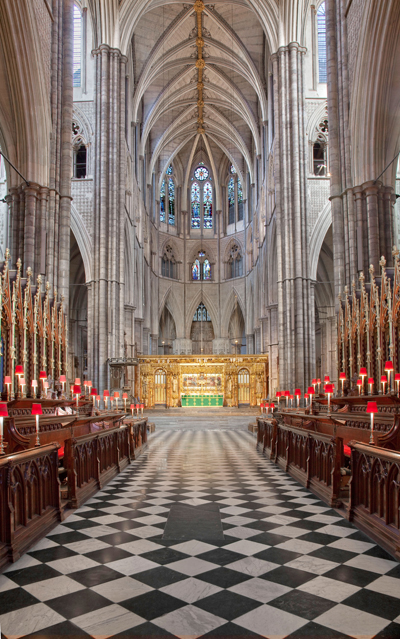
First up is Westminster Abbey (pictured), the location of Prince William and Kate Middleton’s wedding this Friday, which, despite its thousand year history, is only believed to have hosted 15 royal weddings.

Among them is said to have been the wedding of King Henry I to Matilda of Scotland on 11th November, 1100, as well as that of Richard, Earl of Cornwall and brother of King Henry III, who married his second wife, Sanchia of Provence, there on 4th January, 1243, and Joan of Acre, daughter of King Edward I, who married Gilbert, Earl of Gloucester, on 30th April, 1290 (her sister Margaret married John, Duke of Brabant, at the same venue less than three months later). The abbey also hosted the wedding of King Richard II to Anne, daughter of Emperor Charles IV of Bohemia, on 20th January, 1382.

The abbey church has become increasingly favored as a venue for royal weddings in more recent times. Among the most prominent hosted there last century were that of Prince Albert, Duke of York (later King George VI), who married Lady Elizabeth Bowes-Lyon on 26th April, 1923 and that of their daughter Princess Elizabeth (later Queen Elizabeth II) who married Prince Philip of Greece (later the Duke of Edinburgh) there on 20th November, 1947.

Two of the current Queen’s children were also married there – Princess Anne, who married Captain Mark Phillips on 14th November, 1973, and Prince Andrew, who married Sarah Ferguson on 23rd July 1986. (For more on Royal Weddings at the Abbey, see www.westminster-abbey.org/our-history/royals/weddings)

A notable break with the trend in recent times was the marriage of Prince Charles and Lady Diana Spencer – they were married in a fairytale ceremony at St Paul’s Cathedral on 29th July, 1981.

Other London locations for royal weddings have included the now non-existent Greenwich Palace (King Henry VIII married Katherine of Aragon on 11th June, 1509) and Hampton Court Palace (another of King Henry VIII’s marriages – that in which he was wed to Catherine Parr – was held here in a private chapel on 12th July, 1543).

Along with St George’s Chapel at Windsor, the Chapel Royal at St James’s Palace  in London was particularly popular in Victorian times – Queen Victoria married Prince Albert there on 10th February, 1840, and their eldest daughter, Princess Victoria, married Prince Frederick (the future German Emperor Frederick III) there on 25th January, 1858. On 6th July, 1893, the chapel also hosted the wedding of the future King George V and Princess Mary of Teck.

PICTURE: Copyright Dean and Chapter of Westminster

Happy St George’s Day!

Amid the celebration of Easter and the flurry of preparations for the upcoming Royal Wedding, you could be forgiven for overlooking the fact that today was St George’s Day.

Hard to do in central London, however, where Trafalgar Square was the centrepoint for celebrations of a musical kind.

Held on the 23rd April each year, St George’s Day – a national day of celebration in England although not yet a national holiday – commemorates the death of St George in 303 AD.

Tradition says St George was a Roman soldier who served the Emperor Diocletian before he was executed for refusing the adjure his Christian faith.

His story – which gradually morphed into a tale in which he defeats a dragon in a symbolic triumph of good over evil – came to England with returning crusaders during the Middle Ages.

He was later adopted as the country’s patron saint (it has been suggested this took place after King Henry V’s victory at the Battle of Agincourt in 1415 but while his feast day was made a national holiday in 1222, it remains a matter of conjecture as to when he become the country’s patron saint).

As one would expect of a national saint, there are numerous depictions of St George around London – the image above is of a massive bronze sculpture by Michael Sandle (1988) which sits in Salisbury Court in the City of London.

Around London – South Bank marks 60 years since the Festival of Britain; Royal wedding cakes; and, a new cable car for London…

• South Bank is celebrating the 60th anniversary of the 1951 Festival of Britain with a four month series of events. The official celebrations kicked off yesterday and will run until early September. Highlights of the celebrations include the Museum of 1951 – a temporary museum located in Royal Festival Hall featuring exhibits relating to the 1951 festival, themed weekends including next weekend’s ‘London in Love’, featuring performances by Billy Bragg, and a Festival of Britain-inspired ‘Meltdown’ curated by Ray Davies of The Kinks (runs from 10th to 19th June). The original Festival of Britain was opened on 3rd May, 1951, with the intention of developing a sense of “recovery and progress” among the British in the aftermath of World War II and marked the centenary of the 1851 Great Exhibition. The South Bank Exhibition was at the heart of what were national celebrations and was attended by more than eight million people. For more information on what’s happening, see www.southbankcentre.co.uk.

• Historic royal wedding cakes have been recreated this Easter weekend  in an exhibition celebrating the lead-up to this Friday’s Royal Wedding. The English Heritage-event Let Them Eat Cake, which is being held at Wellington Arch near Hyde Park Corner, features a “four-and-20 blackbirds pie” of the sort King Henry VIII gave to his new wife Anne Boleyn as well as recreations of Prince Charles and Lady Diana’s wedding cake and that of Queen Elizabeth II. The event, which is sponsored by Tate & Lyle Sugars, involves some of Britain’s leading bakers. For more, see www.english-heritage.org.uk/daysout/events/765107/. See Exploring London this week for more on the upcoming Royal Wedding.

• The Mayor of London, Boris Johnson, confirmed this week that work will begin on a new cable car to cross the Thames River in East London this summer. The 34 gondola cable car will stretch for 1.1 kilometres, connecting Greenwich Peninsula and the O2 on the river’s south bank with Royal Victoria Docks and the ExCel centre on the north and carrying up to 2,500 people every hour. Construction will be carried out by a consortium of firms led by Mace – the company currently building the Shard Tower – and it is hoped it will be completed before next year’s Olympics.

King James I’s London – 3. Golf on Blackheath

When King James I came south to take up the throne England, he is known to have brought that peculiarly Scottish game of golf with him and it is believed that it was at Blackheath, above the then Royal Palace of Placentia in Greenwich, that his courtiers first played the game.

According to the Royal Blackheath Golf Club, now located some way to the south of Blackheath in Eltham (the club moved there is 1923), documentary evidence shows the earliest players included James I’s son Henry Frederick, Prince of Wales, who is known to have gone golfing in 1606. The club itself notes that while it is generally accepted it was established in 1608, no documentary evidence to support this has yet been unearthed (records prior to 1787 are missing).

The first course at Blackheath – which has played a significant role in several events including as a rallying point during the Peasant’s Revolt of 1381 –  apparently consisted of five holes, each of which was played three times.

Famous Londoners – Peter, the Wild Boy

Found living ‘wild’ in the woods near Hamelin in northern Germany, in 1725, Peter was brought to London at the behest of King George I the following year (the king had heard of his plight while visiting his Hanoverian homeland and had initially had him taken to his summer palace at Herrenhausen). Peter subsequently spent time at the court of the king as well as those of the Prince of Wales, the future King George II, and his wife, Caroline of Ansbach.

On his arrival in London, Peter, believed to be about 15 or 16 years old when he was found, quickly acquired celebrity status – Daniel Defoe wrote a pamphlet, Mere Nature Delineated, in which he mused about his nature and Jonathan Swift wrote a satire on the excitement surrounding his arrival in London while a wax figure of him was exhibited in the Strand and along with other palace courtiers, he appears in a now famous painting by William Kent which still hangs on the king’s grand staircase in Kensington Palace.

Treated by the royals as something of a ‘pet’, efforts were made to educate Peter but later abandoned due to his apparent lack of progress. Many were also said to have been shocked at his lack of manners – something that may have helped contribute to his eventual departure from court.

When the king died in 1727, his daughter-in-law, now Queen Caroline, granted a yeoman farmer in Hertfordshire, James Fenn, a pension in return for looking after Peter.  He is recorded as having wandered off on a couple of occasions and, after one incident involving a fire in 1751, was fitted with a collar to prevent further escapes (the collar is still in the keeping of the Berkhamsted School in Hertfordshire).

Peter subsequently spent the remainder of his life in rural England (where he was known to have developed a love for gin but was generally remarked upon as being timid). Meeting him a few years before his death, Scottish philosopher and judge James Burnett, Lord Monboddo, recorded that while Peter could understand what was said to him, he could only say the words ‘Peter’ and ‘King George’.

Peter died in 1785, when he was at least 70-years-old. He was buried in the churchyard of St Mary’s Church in Northchurch, Hertfordshire.

It is now believed that Peter may have been affected by the chromosomal disorder Pitt-Hopkins Syndrome, thanks to the work of Historic Royal Palaces historian Lucy Worsley who, while researching the lives of courtiers at Kensington Palace for her book Courtiers, noted features such as Peter’s “cupid bow lips”, coarse hair and drooping eyelids in Kent’s portrait and passed on a description to a professor of genetics.

It is thought such a diagnosis may help explain why Peter ended up living alone in the German forest where he was found.

Where’s London’s oldest…hospital?

London’s oldest hospital – St Bartholomew’s Hospital in what is known now as Smithfield – was founded in the 12th century.

The hospital owes its foundations – like the neighbouring Priory of St Bartholomew (London’s oldest church – see our previous story on this here) – to Rahere, a courtier (possibly a minstrel or jester) at the court of King Henry I who, tired with triviality, may have become a priest.

In any event, after the death of Henry’s son William – he is believed to have drowned when the White Ship foundered in November 1120 – and that of his wife Queen Matilda, Rahere went on pilgrimage to Rome. He did so but contracted malaria while there and, while under the care of  monks, he vowed to found a hospital for poor men if he recovered.

He did recover and on his return journey had a vision of St Bartholomew who informed him that it was he who had helped him to recover and now desired him to found a church in Smithfield (then known as Smedfield).

Back in London, Rahere as he’d promised and, after petitioning the king, was granted a royal charter in 1122 to found the priory of Augustinian canons and the hospital.Work began in March 1123 and it was completed by 1145 when Rahere died (his tomb can still be seen in the church).

The hospital – one of a number in London at the time – was probably little more than a single hall with a chapel at one end. Other buildings and some cloisters were added later as was the Church of St Bartholomew the Less.

Under a charter of 1147, it was open to the needy, orphans, outcasts and the poor as well as sick people and homeless wanderers. In the 14th century, the definition was honed to include the sick until they recovered, pregnant women (until delivery) and for the maintenance of children born there until they were seven-years-old.

As well as the master (Rahere was the first), other ‘staff’ at the hospital initially included eight Augustinian brothers and four sisters but the hospital gradually became independent of the priory and by 1300, the hospital has its own dedicated master. By 1420, the two institutions had apparently become completely separate.

Following the Dissolution in 1539, the hospital was refounded in the 1540s thanks to a deal brokered between King Henry VIII and the Corporation of the City of London. Along with Bethlem, Bridewell and St Thomas’, St Bartholomews was one of four Royal Hospitals administered by the City.

The first regular physician – a Portuguese man by the name of Roderigo Lopez – was appointed around 1567 (he was later hung, drawn and quartered for an allegedly plotting against Queen Elizabeth I). Among the most famous physicians to serve at St Barts in later years was William Harvey, renowned for having ‘discovered’ the circulatory system.

The hospital survived the Great Fire in 1666 but in the 1700s most of the medieval buildings, with the exception of the tower in the Church of St Bartholomew the Less, were demolished as the hospital was rebuilt to the design of James Gibbs. The new design featured a central courtyard with a Great Hall contained in the north wing, reached by a ‘Grand Staircase’ decorated with images of the Good Samaritan and Christ at the Pool of Bethesda by celebrated artist William Hogarth.

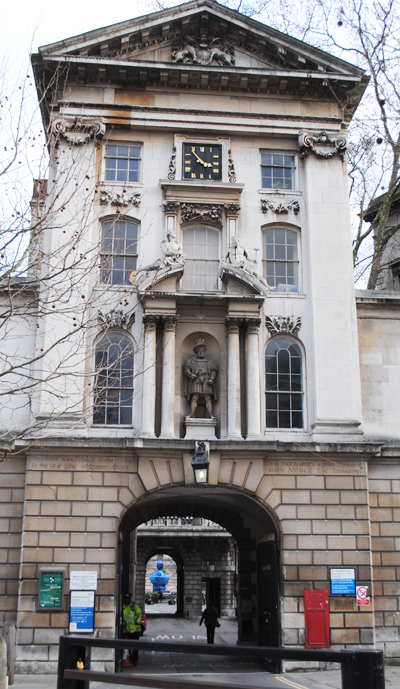
The famous Henry VIII gate (pictured above) dates from 1702, slightly before Gibb’s rebuilding project. Other buildings have been added in more recent times.

In more recent times, the hospital was amalgamated with The Royal London and the London Chest Hospitals in 1994 with the establishment of The Royal Hospitals NHS Trust (now known as the Barts and The London NHS Trust). St Barts is now a specialist cancer and cardiac hospital.

There is a museum at the hospital which houses exhibits including a facsimile of Rahere’s grant of 1137 (now in the hospital’s archives), amputation instruments dating from the early 1800s once used by surgeon John Abernathy and a display on William Harvey. Hogarth’s paintings are visible from the museum.  There are also guided tours of the hospital.

WHERE: Museum at St Barts Hospital (nearest tube station is Barbican); WHEN: 10am to 4pm Tuesday to Friday ; COST: Free (donations welcomed); WEBSITE:  www.bartsandthelondon.nhs.uk/about-us/museums-and-archives/st-bartholomew-s-museum/

Treasures of London – ‘The Ambassadors’

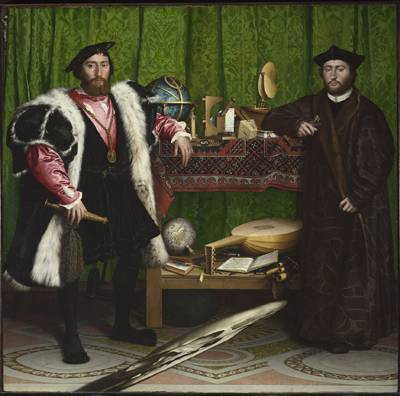
A stunning portrait on a grand scale, The Ambassadors depicts two influential figures from the 16th century – Jean de Dinteville, the then 29-year-old French ambassador to England and Georges de Selve, the then 25-year-old bishop of Lavaur and sometime French ambassador to the Emperor, the Venetian Republic and the Holy See.

The oil on oak work, which is housed in room four of the National Gallery and is also one of the images featured online as part of the Google Art Project, was painted by Hans Holbein the Younger in 1533 and is meant as a portrait to show the men’s power, learning and wealth – they are surrounded by objects which include celestial and terrestrial globes, a portable sundial, a lute (and its case), and books including one of hymns and another of arithmetic as well as richly decorated furnishings.

Yet there’s more to this painting than initially meets the eye – a closer look reveals a distorted skull in the foreground which, when viewed from the painting’s right-hand side comes into its proper perspective. A reflection on mortality perhaps?

And though no typically viewed as a religious work, there are also some striking religious overtones to this image including a broken string on the lyre – often seen as a Christian symbol of disharmony – and, partly hidden behind the curtain on the far left of the painting as you look at it, a crucifix hanging on the wall.

Holbein painted the work during his second stint in England while depicting life at the Tudor court. Among his most famous other images are one of King Henry VIII (held in the National Portrait Gallery) and another of Christina of Denmark (also in the National Gallery – painted to show Henry VIII the image of a potential future wife although the relationship never went any further than that).

PICTURE: Ng1314, Hans Holbein the Younger, Detail of Jean de Dinteville and George de Selve (‘The Ambassadors’), 1533 © The National Gallery, London.

WHERE: Room 4, National Gallery, Trafalgar Square (nearest tube stations Leicester Square and Charing Cross); WHEN: 10am to 6pm (Fridays 10am to 9pm); COST: Free; WEBSITE: www.nationalgallery.org.uk. The image is also available online as part of the Google Art Project here:www.googleartproject.com/museums/nationalgallery/the-ambassadors.

King James I’s London – 2. St James’s Park

Although royal connections with St James’s Park, the oldest royal park in London, go back to the time of King Henry VIII – it was he who first purchased the marshy watermeadow in 1532 with the idea of creating another of his many deer parks, it was on the accession of King James I that orders were given for the swamp to be drained and landscaped.

The landscape features included a large pool known as Rosamond’s Pond at the west end and, at the east end, a collection of waterways and islands used to attract birds that could then stock the royal larder. There was also a flower garden next to St James’s Palace (this had been built by King Henry VIII).

Among the other uses King James I had for the park were as a site to keep the royal menagerie which included exotic animals like crocodiles and camels. There were also bird aviaries placed along what is now appropriately named Birdcage Walk.

The layout of the park became more formal during the later reign of King Charles II who had been inspired by what he’d seen while in exile in France.

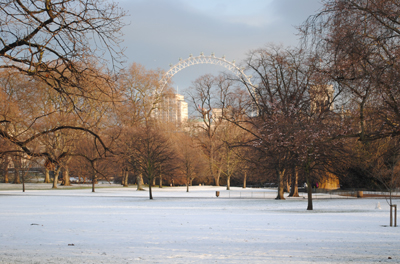
PICTURE: Looking across St James’s Park toward Whitehall in the snow.

WHERE: St James’s Park (nearest tube station is St James’s Park); WHEN: 5am to midnight daily; COST: Free entry; WEBSITE: www.royalparks.gov.uk/St-Jamess-Park.aspx