10 sites commemorating the Great Fire of London – 10. Two mysterious mice…

To end our series on memorials in London commemorating the Great Fire of 1666 – marking the event’s 350th anniversary – we’re taking a look at what is one of the smallest monuments in the City (and, despite all rumour, possibly not a memorial to the Great Fire at all).

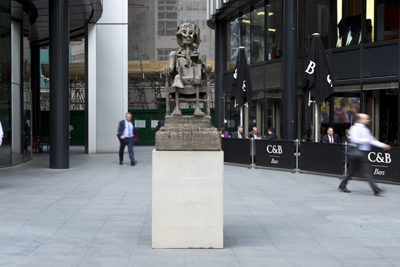
philpot-lane-miceMidway up the wall of a building at the corner of Eastcheap and Philpot Lane, not far from The Monument (for more on its history, see our earlier post here), can be seen two brown mice fighting over a piece of cheese.

The mice are commonly said to be a memorial, not to anyone who died during the fire, but to two men who died while building The Monument itself.

The cheese apparently relates to the story in that the two men fell to the deaths while fighting after one accused the other of eating his cheese sandwich. The two mice, one for each of the men, relate to the fact that it was apparently mice who were later found to be the culprits.

But we need to point out that not all agree on the memorial aspect of the mice, which have apparently been decorating the building’s cornice since the mid-1800s – and there are legitimate questions: why, for example, would the Victorians when constructing the property commemorate two long dead workers and how had the story even reached them of their deaths?

One theory is that the mice do commemorate two men who died in the circumstances described, but while building the property they are located upon and not The Monument at all.

The building, meanwhile, is said to have been constructed as offices and warehouses for spice merchants Hunt & Crombie – it’s been suggested the mice were merely part of the decorations made for the building and not a memorial at all.

Whatever the origins of the mice – and whether they represent a memorial or not – we thought they were a nice way to close out the special series on Great Fire of London commemorative sites. We’ll kick off a new Wednesday series shortly.
PICTURE: Spudgun67/Flickr/CC BY 2.0

LondonLife – ‘Really Good’…

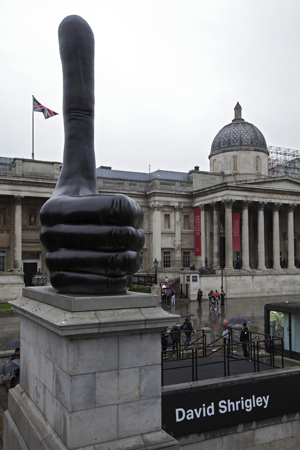
really-good-by-david-shrigley-c-gautier-deblondeA giant hand giving a thumbs-up, the latest commission to grace Trafalgar Square’s famous Fourth Plinth, was unveiled late last month. Really Good, by UK artist David Shrigley stands seven metres high and features a disproportionately long thumb arising from a closed fist. The sculpture is the latest in a string of artworks to have graced the plinth which was built in 1841 and originally designed to hold a statue of King William IV but, thanks to a lack of money, remained empty until recent times. Speaking at the launch of the new work last month, the artist said the work was about “making the world a better place or it purports to actually make the world a better place”. “Obviously, this is a ridiculous proposition, but I think it’s a good proposition,” The Independent reports him saying. “Artworks on their own are inanimate objects so they can’t make the world a better place. It is us, so I guess we have to ask ourselves how we can do this.” For more on the Fourth Plinth program, see www.london.gov.uk/what-we-do/arts-and-culture/art-and-design/fourth-plinth-2016

PICTURE: © Gautier Deblonde

10 sites commemorating the Great Fire of London – 7. The ancient plaque commemorating St Olave Silver Street…

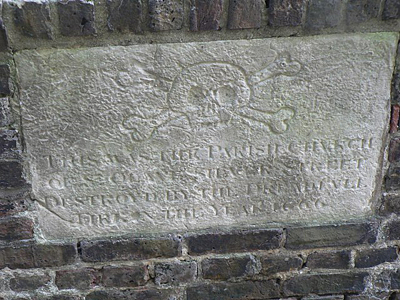
st-olave-silver-streetMany of the monuments commemorating the Great Fire of London, date from succeeding centuries (the Monument being a notable exception), one of the earliest can apparently commemorating the site of the Church of St Olave Silver Street.

The church dated from at least the 12th century and is one of a number in London which were apparently named after King Olaf, the first Christian King of Norway who fought alongside the Anglo-Saxon King Ethelred II against the Danes in England in the 11th century.

The church served as the parish church of the silversmiths and apparently in recognition of that boasted a figure of Christ on the cross which had silver shoes.

The church had been rebuilt in the early 1600s but was completely destroyed in the Great Fire of London and never rebuilt, the parish united with that of St Alban Wood Street.

The site of the church, now on the corner of London Wall and Noble Street, is now a garden and boasts an almost illegible plaque featuring a skull and crossbones, which is believed to date from the late 17th century, and which commemorates the destruction of the church in the Great Fire.

PICTURE: © Chris Downer/CC BY-SA 2.0

10 sites commemorating the Great Fire of London – 6. A rare survivor…

Walk around the streets of the City of London and it’s hard to miss the myriad of plaques commemorating many buildings lost in the Great Fire of London. On the Strand, however, can be found a plaque which commemorates a building that survived the fire.

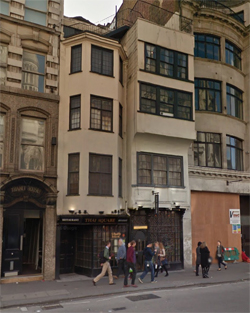
strand-buildingLocated at 230 Strand (opposite the Royal Courts of Justice), the narrow four storey building, complete with projecting second floor, dates from 1625 and was apparently originally built as the home of the gatekeeper of Temple Bar.

According to the sign upon it, the now Grade II* building was the only structure on the Strand to survive the fire of 1666.

Now a rather plain-looking building, it has been much altered over the years and for much of the 20th century housed the Wig and Pen Club for journalists and lawyers – running from at least 1908, it closed in 2003.

Along with the late 17th century building next door (the two are pictured above with number 230 on the right), it’s now part of a Thai restaurant.

PICTURE: Google Street View

10 sites commemorating the Great Fire of London – 5. Paternoster Square Column…

paternoster-square-column2
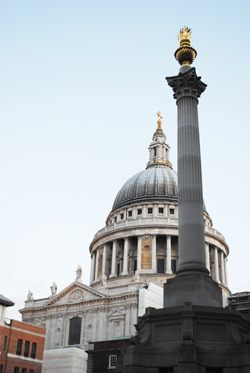
Located just to the north of St Paul’s Cathedral can be found Paternoster Square in the centre of which stands a column.

paternoster-square-columnThe 75 foot (23.3 metre) tall Corinthian column of Portland stone, which was designed by Whitfield Architects and erected in 2003, is topped by a gold leaf covered flaming copper urn which is lit up at night.

While it has been said that the column is “purely decorative”, the developers of Paternoster Square claim on their website that it actually serves several purposes in this case including both commemorative and practical.

Not only is it part of the ventilation system for the carpark underneath, they say its design is apparently a recreation of columns designed by Inigo Jones for the west portico of Old St Paul’s Cathedral.

And then there’s the three metre high urn on top which, not unlike that found on The Monument, they say commemorates the fact the site of the square has twice been destroyed by fire – the first time in the Great Fire of 1666 and the second in the Blitz during World War II.

The area around Paternoster Square was once home to booksellers and publishers’ warehouses.

This Week in London – The Great Fire of London’s 350th anniversary…

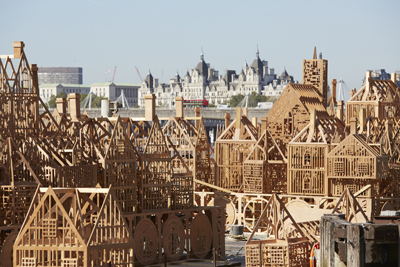
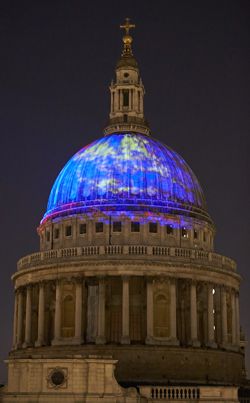
London-1666-by-David-Best-in-collaboration-with-Artichoke-©-Matthew-Andrews-(3)• The 350th anniversary of the Great Fire of London is upon us and to mark the event, the City of London is playing host to London’s Burning, a “festival of arts Fires-of-London--Fires-Ancient-and-Moden-by-Martin-Firrell-©-C.-Totman-(1)and ideas”, over the coming weekend. Produced by Artichoke, the festival includes everything from Fire Garden – an installation by French street art group Compagnie Carabosse at the Tate Modern, and Holoscenes – a six hour underwater performance installation by Los Angeles-based company, Early Morning Opera, in Exchange Square, Broadgate, to Fires of London: Fires Ancient and Fires Modern – two large scale projections by artist Martin Firrell onto St Paul’s Cathedral (pictured right) and The National Theatre, Station House Opera’s Dominoes – a kinetic sculpture of breeze block dominoes which retraces the path of the fire through the streets, and London 1666 – a 120 metre long wooden sculpture of Restoration London by American artist David Best working in collaboration with Artichoke which will be set alight on Sunday at a site on the river between Blackfriars Bridge and Waterloo Bridge (the sculpture is pictured above – you can also watch it live online here). Events run until 4th September. Head here to see the list of events in London’s Burning and to download a copy of the programme complete with map. PICTURES: © Matthew Andrews and C Totman.

Entry to The Monument – built as a permanent reminder of the great conflagration of 1666 – will be free from 2nd to 4th September in celebration of the Great Fire anniversary. Opening hours at the iconic 202 foot tall column have also been extended for the weekend but be warned that due to limited capacity, tickets mist be booked in advance with allotted time slots for entry. To book, head here.

A free exhibition telling the story of London’s bakers and their cakes, bread and puddings over the 350 years since 1666 has opened at the London Metropolitan Archives this week. London’s Baking! Bakers, Cakes, Bread and Puddings from 1666 takes its inspiration from Thomas Farriner and his Pudding Lane bakery, ground zero for the fire. And along with the displays, it features recipes for you to take away and bake including almond cakes from 1700, suet puddings from 1850 and “questionable” school dinner chocolate sponge traybake from the 1970s. Runs at the Clerkenwell-based organisation until 1st February. For more, see www.cityoflondon.gov.uk/events/Pages/event-detail.aspx?eventid=2749.

• Of course, these are just some of the events taking place as part of Great Fire 350. Others include the Fire Food Market in Guildhall Yard, running from 6.30pm to 10pm Saturday night and from 5pm to 10pm Sunday night, as well as events we’ve previously mentioned including the programme of events running at St Paul’s Cathedral and the Fire! Fire! exhibition at the Museum of London. For more of the walks, talks, performances, installations and other events taking place, head to www.visitlondon.com/greatfire350.

Send all items for inclusion to exploringlondon@gmail.com.

10 sites commemorating the Great Fire of London – 4. St Paul’s ‘Resurgam’…

Resurgam3
Old St Paul’s Cathedral was certainly the largest and most famous casualty of the Great Fire of London of 1666. And its passing – and rebirth – is recorded on several memorials, one of which can be found on the building itself.

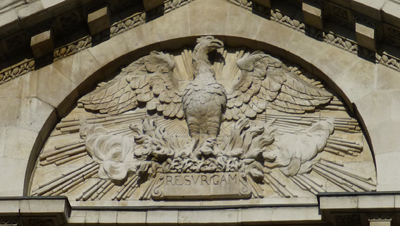
Set on the pediment which, carved by Caius Gabriel Cibber, sits above south portico off Cannon Street, the memorial depicts a phoenix rising from clouds of smoke (ashes), a symbol of Sir Christopher Wren’s new cathedral which rose on the site of the old Cathedral in the wake of the fire. Below the phoenix is the Latin word, ‘Resurgam’, meaning “I Shall Rise Again”.

The story goes that Wren had this carved after, having called for a stone to mark the exact position over which St Paul’s mighty dome would rise, the architect was shown a fragment of one of the church’s tombstones which had been inscribed with the word.

The foundation stone for the new cathedral, largely built of Portland stone, was laid without any fanfare on 21st June, 1675, and it only took some 35 years before it was largely completed. Some of the stonework from the old cathedral was used in the construction of the new.

We should note that the old cathedral was in a state of some disrepair when the fire swept through it – the spire had collapsed in 1561 and despite the addition of a new portico by Inigo Jones, it was generally in poor condition.

Stonework from the Old St Paul’s – everything from a Viking grave marker to 16th century effigies – are now stored in the Triforium, rarely open to the public (tours of the Triforium are being run as part of the programme of events being held at the cathedral to mark the 350th anniversary of the Great Fire – see www.stpauls.co.uk/fire for more).

PICTURE: givingnot@rocketmail.com/CC BY-NC 2.0 (image cropped)

10 sites commemorating the Great Fire of London – 3. The Templar’s column…

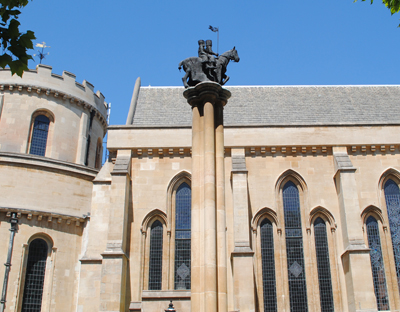
Knights-atop-the-columnStanding outside the Temple Church, in the west of the City of London (between Fleet Street and the River Thames), stands a pillar topped with a pair of Templar knights riding a horse in an obvious commemoration of the military order that once had its preceptory here.

But what many people don’t realise is that the column was also erected, apparently like the Golden Boy of Pye Corner, to commemorate another point where the all-consuming Great Fire of London was finally stopped.

The 10 metre high column was erected in 2000 (another of its purposes was to mark the millennium) in what was once the cloister courtyard of the headquarters of the Templars, which had originally founded to protect pilgrims to the Holy Land in 1119.

The bronze figures of the two men atop a single horse which caps the column was a representation of the image found on the order’s official. It represents the poverty of those who initially joined it – so poor they could only afford one horse for every two men, a situation which was to change dramatically in coming centuries as the order accumulated wealth, a situation which, eventually, in France, led to its downfall.

London Remembers reports that the column was designed in the gothic style, similar to the Purbeck marble columns in the church (which, incidentally, are said to be the oldest surviving free-standing examples of their kind) and deliberately made to contrast with the more florid column of Sir Christopher Wren’s Monument, which marks where the fire started and, also, according to a signboard, “the arrival of the new classical order”.

The column, designed by Ptolemy Dean, and the sculpture, designed by Nicola Hicks, were the gift of Lord Lloyd of Berwick, Treasurer of the Inner Temple in 1999. A Latin inscription around the base of the column reads: “Lest the Temple should be without a memorial of the start of the third millennium the Inner Temple caused this monument to be erected for the greater glory of God.”

For more on Temple and the Temple Church, see our earlier posts here and here and here.

10 sites commemorating the Great Fire of London – 2. The Golden Boy of Pye Corner…

Golden-Boy-of-Pye-CornerWe’ve mentioned this memorial before but it’s worth a revisit. While last week’s entry looked at a plaque marking the site of the start of the Great Fire of London in September, 1666, this week we’re taking a (second) look at one of the sites where it was stopped.

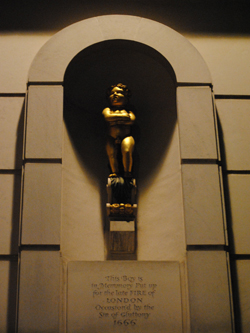
Positioned high on a building on the corner of Giltspur Street and Cock Lane in Smithfield, this small wooden gilt 17th century statue, by an unknown maker, was once located on front of the pub, The Fortune of War, which stood on the site until it was demolished in 1910 (it was apparently used by body-snatchers as a place to display stolen corpses for surgeons from the nearby St Bartholomew’s Hospital to take their pick from).

The statue marks one of the locations on the city fringes where the fire was ‘stayed’ through the demolition of buildings. It bears an inscription which reads “This Boy is in Memmory put up for the late Fire of London Occasion’d by the Sin of Gluttony 1666”.

Well below it is an explanatory note below explains that the boy was made deliberately fat (the statue was apparently originally known as ‘The Fat Boy’ although to the modern eye it doesn’t look particularly so) in reference to the rather odd claim the fire was started in Pudding Lane as a result of the sin of gluttony and not by Papists as had been originally claimed on The Monument.

It has been said that the statue – which is believed to have once had wings and which is the reason why the building it is upon carries a Grade II heritage listing – was merely a shop sign and originally had nothing to do with the Great Fire, which may well be the case, but that said it is known that the fire stopped here (sparing St Bart’s further up Giltspur Street).

PICTURE: David Adams

LondonLife – Sculpture returns to the City…

Sculpture1
Sculpture in the City has returned to the Square Mile for summer with 17 contemporary artworks by internationally renowned artists located in public spaces across the City of London.
 With the event now in its sixth year, this year’s sculptures include Jaume Plensa’s seven metre high cast iron work Laura (located at 30 St Mary Axe (aka The Gherkin), it’s pictured above), Matt Collishaw’s work, Magic Lantern Small – a grand scale “zoetrope”, one of the earliest moving image machines (located in Bury Court, it’s pictured below), and Huma Bhabha’s work, The Orientalist (located in Fenchurch Avenue, it’s pictured far below). Other works can be found in locations including St Botolph-without-Bishopsgate Gardens, The Leadenhall Building and St Helen’s Bishopsgate Churchyard. A map of the SITC trail and extra commentary on the individual artworks can be accessed by downloading the SMARTIFY app for Apple and Android devices and then scanning any of the sculptures. There’s also a map and information available at www.cityoflondon.gov.uk/sculptureinthecity. PICTURES: Nick Turpin

Sculpture2

Sculpture3

LondonLife – Childhood dreams captured in a jar for all to see…

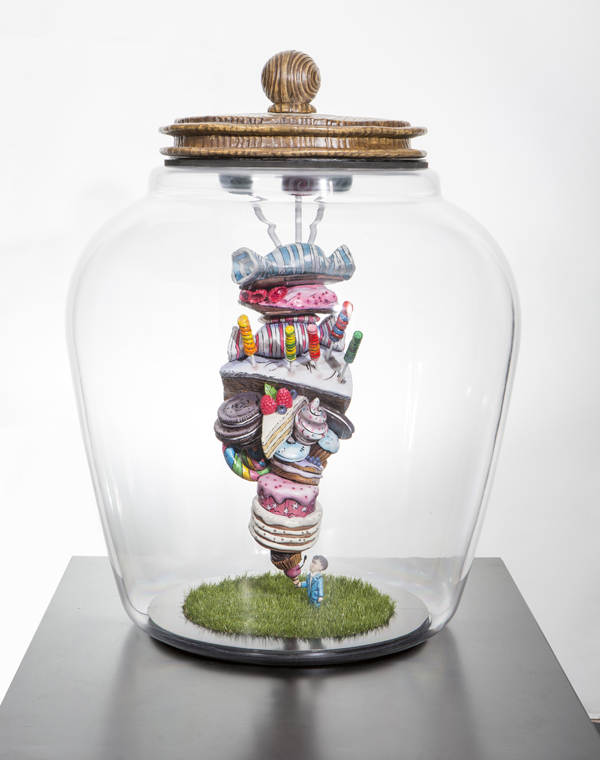
Steven-SpielbergDirector Steven Spielberg, actor and playwright Mark Rylance, physicist Professor Stephen Hawking, TV personality Simon Cowell, and The Duchess of Cornwall are among 50 high profile personalities who have put their childhood dreams and aspirations on show around the country – including in London – to mark not only the release of the film The BFG but also the 100th anniversary of Roald Dahl’s birth. Launched last weekend, the ‘BFG Dream Jar Trail’ features a series of up-to-six-foot-tall ‘Dream Jars’, each of which contains a sculpture representing the childhood dreams of a different personality. The free trail – which takes in London sites such as Trafalgar Square, the Tower of London, Leicester Square, Harrods, Emirates Stadium and The Shard – has been created in support of the work of Save the Children and a specialist nursing programme supported by Roald Dahl’s Marvellous Children’s Charity with the jars to be auctioned in collaboration with Paddle8 later this year to raise money for both causes (the auction will be launched on the film’s premiere on 17th July). At least 34 jars have already gone on display with more to be unveiled in coming days. The joint creation of  Save the Children, the Roald Dahl Literary Estate, Entertainment One and VisitLondon.com with support from Unilever, the trail can be seen until 31st August. To see the art trail map and discover the stories behind each jar and its location, head to www.visitlondon.com/bfg. For more on the 100th anniversary of Roald Dahl’s birth, head to www.roalddahl.com/roalddahl100. PICTURED: Above – director Steven Spielberg’s self-designed jar, on display in Leicester Square, illustrating his childhood fantasy of having all the sweets in the world but none of the ill effects from overindulgence.

10 notable blue plaques of London – 8. A notorious ‘tree’ recalled…

To look at it, you wouldn’t necessarily imagine the memorial marking the former site of the ‘Tyburn Tree’ near Marble Arch was part of the English Heritage Blue Plaques scheme. 

Tyburn-Tree2But, located on the ground on a traffic island at the junction of Edgware and Bayswater Roads, this memorial commemorating the site of the former gallows at what was once London’s execution grounds (and those who died upon it) is just that.

It’s estimated by some that as many as 60,000 people may have been executed here over the 600 years until the late 1700s

While the plaque only mentions one of the names by which the various gallows erected here were known – Tyburn being the name of the village originally here, others included ‘The Elms’, the ‘The Deadly Never Green Tree’ and the ‘Triple Tree’, the latter presumably a reference to the famous three-sided gallows set up here during the reign of Queen Elizabeth I.

The last gallows was removed in 1759 when executions were moved into Newgate Prison (for more on the Tyburn Tree, see our earlier post here).

The plaque was erected on the site in 1964 by the London County Council; it replaced an earlier triangular plaque the council had erected here in 1909.

The memorial was restored and rededicated in a ceremony in 2014 with the placement of three oak trees around it (this picture was taken before the restoration).

There is a green City of Westminster plaque nearby which commemorates 105 Roman Catholic martyrs who lost their lives on the gallows between 1535 and 1681 while the deaths of the more than 350 Roman Catholics who died across England and Wales during the Reformation, including those on the Tyburn Tree, are also recalled in a shrine at the nearby Tyburn Convent.

LondonLife – Spying a new view of London in a 40 second rush…

TOP-OF-SLIDE-MOCK-UP
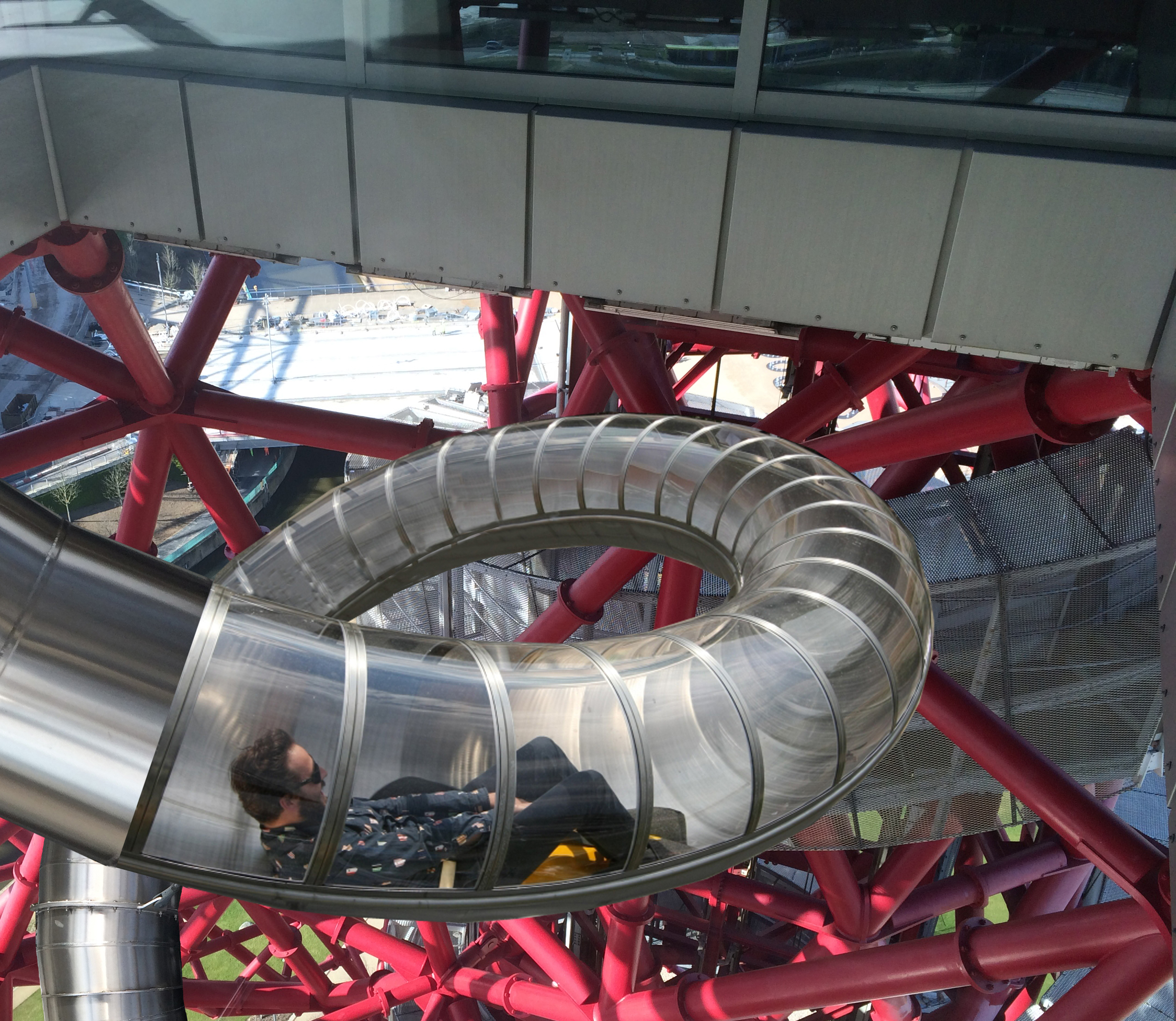
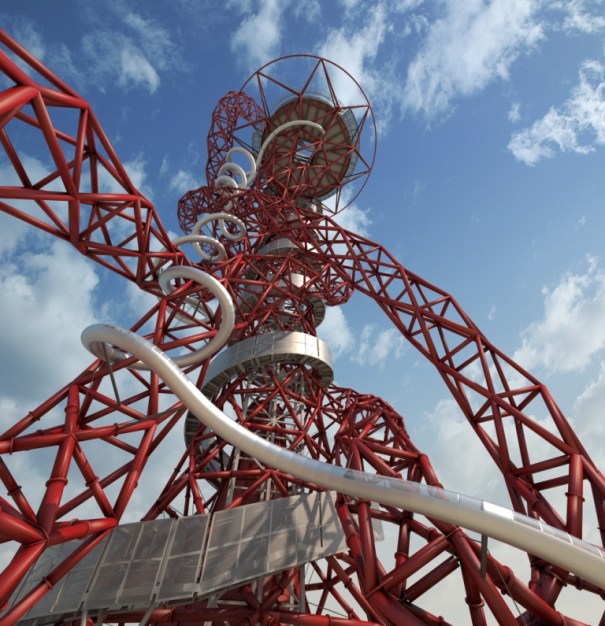
The world’s longest and tallest tunnel slide opened at the ArcelorMittal Orbit sculpture in Queen Elizabeth Olympic Park – the UK’s tallest public artwork – in London’s east last week.
Standing 178 metres high, the slide wraps around the sculpture 12 times as it descends toward earth, providing a 40 second ride of speeds up to 15 kph through a series of twists and turns including a tight corkscrew section known as the ‘bettfeder’ (named after the German word for ‘bedspring’). The slide, which was designed by Belgian artist Carsten Höller at the invitation of Sir Anish Kapoor, designer of the ArcelorMittal Orbit (constructed for the 2012 Olympic Games), is open until 30th December. For more on the Slide and to book, see http://arcelormittalorbit.com/whats-on/the-slide/. PICTURES: Supplied.

Copy-of-Slide-CGI-3

10 notable blue plaques of London – 6. A blue plaque for a deadly bomb…

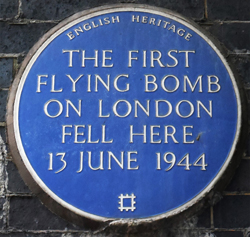
V1-flying-bombNot all of the plaques in the English Heritage blue plaques scheme commemorate people, some also commemorate places and events – the saddest of which is no doubt the landing of the first deadly V1 flying bomb on London during World War II.

Located in Bow in the East End is a plaque commemorating the site where the first flying bomb fell on London on 13th June, 1944, a week after D-Day and several months since the last bombs had fallen on London in what was known as the “mini-blitz”.

Carrying some 850 kilograms of high explosive, the unmanned, fast-moving bomb dived to the ground at about 4.25am on the morning of the 13th, badly damaging the railway bridge and track, destroying houses and, sadly, killing six people.

It was to be the start of a new bombing offensive which would eventually see around 2,500 of the V1 flying bombs reach London between June, 1944, and March, 1945.

They were responsible for killing more than 6,000 people and injuring almost 18,000 and were followed by the even more advanced V2 long range rockets – the world’s first ballistic missiles – in September, 1944. These were responsible for another 2,754 deaths in London before the war’s end.

The current plaque on the railway bridge in Grove Road was erected in 1998 by English Heritage and replaced one which was erected by the Greater London Council in 1985 and subsequently stolen.

PICTURE: Spudgun67/CC BY-SA 4.0

What’s in a name?…St Mary Overie…

The-Legend-of-St-Mary-Overie

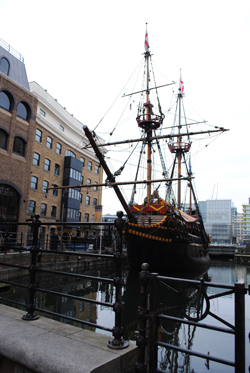
Now the name of a dock on Bankside (pictured below), St Mary Overie (also spelt as Overy) also forms part of the formal name of Southwark Cathedral, more properly known as The Cathedral and Collegiate Church of St Saviour and St Mary Overie.

St-Mary-OverieThe simple version of the name’s origins is that it simply means St Mary “over the river” (that is, St Mary on the south side of the Thames) which was used in relation to a priory founded there in the Norman era by two knights (it’s to this foundation that what is now Southwark Cathedral owes its origins, something we’ll take a more detailed look at the nunnery in an upcoming Lost London post).

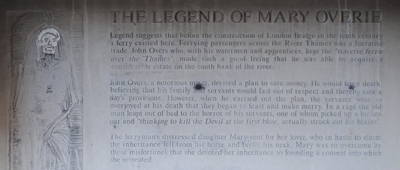
But there’s also another, more romantic version, of the name’s origins. That story, as it’s told on a plaque located at the dock (pictured above), goes back to before the Norman founding of priory, back to the days when, before the building of London Bridge, a ferry ran between the two banks of the River Thames.

The man responsible for the ferry was John Overs, a “notorious miser”, who decided to save money by feigning his death and thus plunging his household into mourning, saving that day’s provisions. As one may imagine, however, Overs was not a popular man and his servants, instead of fasting in their mourning, held a feast in celebration of his death.

In rage, the old master leapt out of his bed and a servant, terrified and imaging some sort of demonic manifestation, struck him fatally with an oar on the head.

Overs’ daughter, Mary, sent for her lover so that he may come and together with her claim her father’s inheritance but such was his haste, he fell from his horse and broke his neck. So overcome was Mary by her misfortunes that she founded a convent into which she subsequently retired (this was subsequently ‘refounded’ by the two Norman knights).

The dock, meanwhile, is today the berthing place of the Golden Hinde II, a sea-worthy replica of the flagship in which Elizabethan explorer Sir Francis Drake circumnavigated the globe (for more on the ship, see our earlier post here).

10 notable blue plaques of London – 5. Five Londoners with more than one blue plaque…

There’s quite a few whose London residence (or otherwise) is commemorated by more than one blue plaque. So, breaking away from our usual ‘one plaque’ format, here were listing five of those who have made the grade…

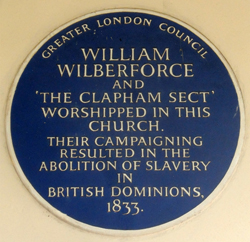
William-Wilberforce-blue-plaque1. William Wilberforce (1759-1833). The late 18th century and early 19th century politician and anti-slavery campaigner tops our list with three English Heritage blue plaques. The first is at 111 Brookwood Road in Battersea – the site of Brookwood House where Wilberforce resided during his anti-slavery campaign. The second is on Holy Trinity Church on Clapham Common, the church where Wilberforce and the Clapham Sect with whom he is associated worshipped. And the third is on a property at 44 Cadogan Place in Chelsea where Wilberforce died.

2. Dr Samuel Johnson (1709-1784). Like Wilberforce, the 18th century lexicographer Dr Johnson has three English Heritage blue plaques to his name. The first, on his famous Gough Square property in the City of London we’ve already mentioned (see our earlier post here), while the second is on a property at 8 Russell Street, Covent Garden, then occupied by bookseller Thomas Davies, which was where Dr Johnson famously first met James Boswell in 1763. The third time Dr Johnson’s name appears, more unusually, is on a plaque commemorating Essex Street – Dr Johnson is among a number of names listed on it for his role in establishing an “evening club” at the pub, the Essex Head, in the street in 1783.

3. Samuel Pepys (1633-1703): The 17th century diarist seems to pop-up everywhere in central London so it’s not surprising there are two plaques in the English Heritage blue plaques scheme dedicated to him (although both are located in the same street – one he apparently liked very much). The plaques are located at number 12 and number 14 Buckingham Street in Covent Garden and both mark the site of a Pepys residence.

4. Virginia Woolf (1882-1941): The writer, publisher and literary critic’s name appears on two properties – at 29 Fitzroy Square in Fitzrovia where Woolf lived between 1907-1911 and on Hogarth House at 34 Paradise Road in Richmond where she and Leonard Woolf lived between 1915-1924 (and also where they founded the Hogarth Press in 1917).

5. William Morris (1834-1896): The poet and artist has two English Heritage blue plaques to his credit – the first on 17 Red Lion Square in Holborn where Morris lived in a flat from 1856-1859 with Sir Edward C Burne-Jones, and the second on Red House in Bexleyheath where he and his wife Jane Burden lived from 1860-1865.

PICTURE: Spudgun67/Wikimedia/CC BY-SA 4.0 (image cropped)

10 notable blue plaques of London – 4. Oldest surviving blue plaque commemorating a woman…

Much has been made about the dearth of women featured on blue plaques in this 150th year of the scheme – according to English Heritage, only 13 per cent of the 900 odd blue plaques in London commemorate a woman.

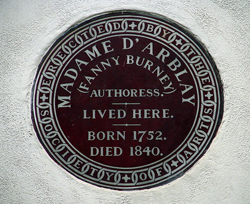
Fanny-Burney-plaqueAmong them are ballet dancer Margot Fonteyn, suffragette Sylvia Pankhurst, socialite Nancy Astor, and, in recent times, cookery writer Elizabeth David.

The oldest surviving blue plaque commemorating a woman, however, is that commemorating what is today a less well-known name, that of Fanny Burney.

Burney (1752-1840), who was known as Madame D’Arblay after she married, was a widely applauded novelist who was also noted for her diaries which record her involvement in the literary circles around Samuel Johnson and the Bluestocking Group.

The blue plaque commemorating her residence at 11 Bolton Street in Mayfair was erected in 1885 by the Society of Arts (which means that like others erected by the society, later the Royal Society of Arts, it’s brown not blue).

Burney, whose most profitable work, Camilla, was published in 1796 after she had spent five years as Second Keeper of the Robs to Queen Charlotte, lived in the house following the death of her husband, the Frenchman Alexandre D’Arblay.

She spent 10 years here – from 1818 until 1828 – and had apparently thought it would be her last residence but she went on to move into three further properties after this one.

PICTURE: Simon Harriyott/CC BY 2.0

LondonLife – Beetle-inspired moving installation at the V&A…

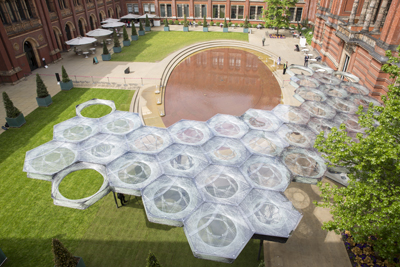
Elytra_Filament_Pavilion_at_the_VA_c_Victoria_and_Albert_Museum_London_5The result of four years of research, the Elytra Filament Pavilion is inspired by the fibrous forewing shells of flying beetles known as elytra. Featuring components which have been fabricated by a robot at the University of Stuttgart and then assembled on site in the V&A’s John Madejski Garden, the installation will grow and move in response to how visitors use the canopy thanks to anonymous data collected from sensors installed in the canopy fibres. On select dates – 17th and 18th June and 22nd September – visitors will be able to see new cells – each of which weighs about 45 kilograms and take an average of three hours to create – manufactured live by a Kuka robot. The installation is the work of experimental architect Achim Menges with Moritz Dorstelmann, structural engineer Jan Knippers and climate engineer Thomas Auer. The pavilion is one of the highlights of the V&A’s first ever ‘engineering season’ with the landmark exhibition – Engineering the World: Ove Arup and the Philosophy of Total Design opening on 18th June. Admission to see the installation, which can be seen at the South Kensington location until 6th November, is free. For more, see www.vam.ac.uk/EngineeringSeasonPICTURES: © Victoria and Albert Museum, London.Elytra_Filament_Pavilion_at_the_VA_c_Victoria_and_Albert_Museum_London_8

Treasures of London – Elfin Oak, Kensington Gardens…

Elfin-OakDelightfully carved out of a hollow oak tree, the Elfin Oak takes its name from the many colourful figures that adorn it.

The sculpture, which sits beside the Diana Princess of Wales Memorial Playground is the work of children’s book illustrator Ivor Innes.

He spent two years – 1928 to 1930 – carving “Little People” upon an ancient oak tree trunk that had been found in Richmond Park and relocated to Kensington Gardens (and in 1930, with his wife Elsie, published the children’s book, The Elfin Oak of Kensington Gardens).

The characters depicted include animals and fanciful creatures such as a gnome called Huckleberry, a series of elves including Grumples and Groodles and a witch named Wookey.

The hollow, incidentally, had been presented to The Royal Parks by Lady Fortescue in response to an appeal run to improve facilities in line with a scheme by George Lansbury (among other things, he also founded the Serpentine Lido).

Now a Grade II listed structure (and well protected by wire mesh), it has a few pop culture associations – among them, the fact that it appeared on the cover of Pink Floyd’s 1969 album, Ummagumma (the head of the band’s lead singer and guitarist David Gilmour can be seen projecting from the trunk).

Meanwhile, in 1996, Spike Milligan – long a fan of the oak – was the face of a successful campaign to raise funds for its restoration.

Announcing the Grade II listing in 1997, then Heritage Minister Tony Banks noted that the oak sat alongside the late Victorian fascination with Little People and complemented Sir George Frampton’s statue of Peter Pan (also located within the gardens).

“Together the two sculptures make Kensington Gardens very much the world capital of fairies, gnomes and elves,” he reportedly said.

PICTURE: Lonpicman/Wikimedia/CC BY-SA 3.0/

10 notable blue plaques of London – 3. The City of London’s only ‘blue plaque’ (and it’s not even blue)…

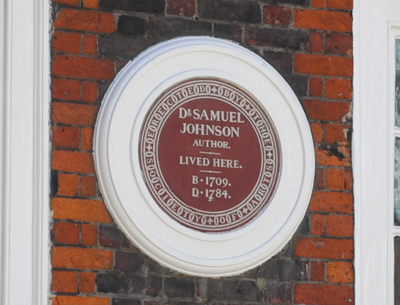
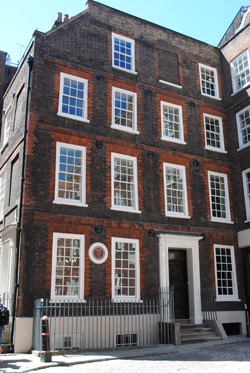
Samuel-Johnson-plaqueThere is only one official blue plaque in the square miles of the City of London – that which marks the property of lexicographer Dr Samuel Johnson in Gough Square (he always did like to stand out from the crowd) – and, like many of the plaques in the scheme, it’s not even blue.

Samuel-Johnson-plaque2The plaque was among the 35 erected in the first 35 years of the scheme – this one in 1876 – and was done so by the Society of Arts which then ran the scheme (later the Royal Society of Arts). In common with most of the first 35 plaques, it is brown in colour.

In 1879, just three years after this plaque was erected, the Society of Arts came to an agreement with the Corporation of the City of London that the corporation – the governing body of the square mile – would commemorate sites of historic significance within its boundaries and the agreement has stood ever since.

The hundreds of “blue plaques” since erected by the City of London Corporation are rectangular in nature and commemorate everything from structures like the long-gone historic gate of Aldgate (88 Aldgate High Street) to homes of the notable such as martyred Archbishop of Canterbury Thomas á Becket (86 Cheapside).

There’s a searchable database of all the City of London plaques which can be found here.

And, of course, Dr Johnson’s house, which he lived in from 1748-59 which compiling his famous A Dictionary of the English Language (the first comprehensive English language dictionary), is now a museum – for details of that, see our earlier post here.