10 notable blue plaques of London – 2. The (now long gone) first Blue Plaque…

The concept of a scheme involving placing commemorative plaques on what was once the homes of notable people was first raised by MP William Ewart in 1863 in Parliament.

Byron-plaqueThree years later, in 1866, the idea was adopted by the then Society of Arts (later the Royal Society of Arts) and in 1867 it erected two blue plaques, the first being one commemorating the birthplace of Lord Byron at 24 Holles Street just south of Cavendish Square in Marylebone and the second being that erected to Emperor Napoleon III in King Street (see last week’s post).

But the Byron plaque had the honour of being the first and it remained on the property until it was demolished in 1889 and the plaque, presumably, lost.

It has, however, been replaced several times on subsequent buildings on the site – the latest incarnation, is a “green plaque” erected by Westminster City Council on what is now a John Lewis store and was unveiled on National Poetry Day in 2012 (it replaced a non-standard, rectangular-shaped plaque – pictured above – which was installed after the building was bombed during World War II).

The current plaque describes Lord Byron as “one of the greatest British poets” and quotes him: “Always laugh when you can. It is a cheap medicine.”

Byron is said to have been born at the property on 22nd January, 1788 and was baptised George Gordon Byron at the nearby St Marylebone Parish Church. Interestingly, English Heritage says that recent research has shown there is no clear evidence for which house in Holles Street Lord Byron actually lived in meaning none of the plaques may have actually marked the correct site.

During the first 35 years of the scheme’s existence it erected on some 35 plaques (there are now some 900 in existence, so the pace has quickened since).

Less than half of them now survive but among those that do are plaques to poet John Keats (erected in 1896 on Keats’ House in Hampstead), novelist William Makepeace Thackeray (erected in 1887 on 2 Palace Green in Kensington) and politician and author Edmund Burke (erected in 1876 on 37 Gerrard Street in Soho.

PICTURE:  Wikimedia

10 notable blue plaques of London – 1. The oldest surviving blue plaque…

English Heritage are celebrating 150 years of the blue plaque scheme this year – the oldest of its kind in the world – and so to celebrate we’re looking at 10 of the most notable among them.

Napoleon-III-blue-plaqueFirst up, it’s the oldest surviving blue plaque. Located in King Street in Mayfair, just off St James’s Square, it commemorates the last French Emperor, Napoleon III, who lived at the property while a prince in 1848.

It was only a brief stay for the then soon-to-be emperor. The nephew and heir of Emperor Napoleon I, he , like other members of his family was exiled from France after the Battle of Waterloo in 1815 and spent the following years in various other countries in Europe as well as, finally, London where he lived firstly at Carlton Gardens and then at the King Street property.

He took the lease on this newly built house in February, 1847, and created what English Heritage has called a “shrine to the Bonapartes” inside, displaying such relics as Napoleon I’s uniforms and a portrait of his famous uncle by the celebrated French artist Paul Delaroche.

The prince was something of a society favourite during his time in London and was invited to join various of St James’s clubs and apparently even enrolled as a special constable during the Chartist riots of 1848.

When the Bourbon monarchy – in the person of King Louis Philippe – was overthrown in France in September that year, the prince abandoned the house to rush back to France (apparently in such a hurry that the story goes that he left his bed unmade and his bath still full of water).

The prince was elected first President of the Second Republic on his return to Paris and in 1852 took his place as Emperor Napoleon III on the restoration of the empire (incidentally, he ended up returning to England in exile following his defeat in the Franco-Prussian War and died in Kent in 1873).

The plaque, installed in 1867, also has the distinction of being the only one installed while the person it commemorates was still alive. The rule now is that those commemorated by a blue plaque need to have been dead for at least 20 years before the honour can be bestowed.

The plaque, which is rather more elaborate than modern versions, was put up by the Society of Arts (they’re mentioned on it) and the design features a French imperial eagle. It was manufactured by Minton Hollins & Co.

For more on Blue Plaques, see www.english-heritage.org.uk/visit/blue-plaques/.

Treasures of London – A lodge (or two) to commemorate a French friendship…

Lodge

This gardener’s lodge, featuring embedded sea-shells, is located in Lower Grosvenor Garden in Victoria. It’s one of a pair given by the French Government and, like its twin, was placed in the gardens in 1952 when they were remodelled in formal French style – including paths laid out in the design of a fleur-de-lis – in honour of Anglo-French cooperation in both world wars. The gardens were designed by French architect Jean-Charles Moreux and some of the shells were apparently brought over from France. In keeping with the French theme, the gardens also feature an equestrian statue of World War I figure, Marshal Ferdinand Foch, placed there in 1930.

LondonLife – An odd couple take a breather…

Cabot-Square

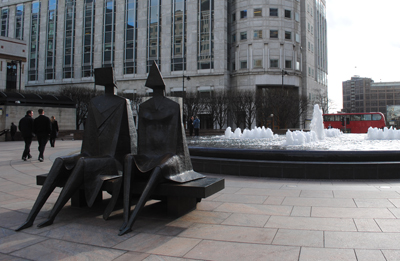
Couple on seat, Cabot Square, Canary Wharf. The much wondered at (who are the couple?; why do their heads have such odd shapes?) bronze sculpture is by Lynn Chadwick (2000).

LondonLife – Celebrating International Women’s Day…

Cavell

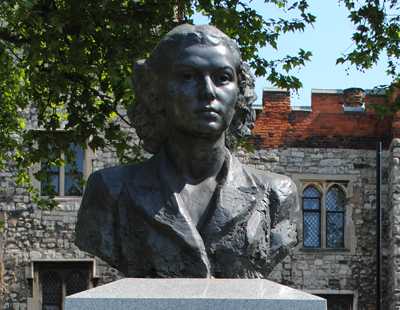
It’s International Women’s Day, so we’re celebrating by remembering two heroic women immortalised in statues in central London. Above is Edith Cavell, a British nurse who was trapped in Brussels by advancing German armies in 1914 and then subsequently arrested for aiding French and British soldiers to escape before being executed by firing squad on 12th October, 1915 – an event widely condemned around the world. The marble statue, located in St Martin’s Place at the intersection of Charing Cross Road and St Martin’s Lane, is by George Frampton and was erected in 1920. Below, meanwhile, is a bust of Violette Szabo which tops a memorial to the Special Operations Executive (SOE). Szabo, who was posthumously awarded the George Cross and the Croix de Guerre after she was captured and eventually executed by the German Army in early 1945, was among 117 SOE agents who did not return from their missions to France. Located on Albert Embankment, the statue – which is the work of Karen Newman – was unveiled in 2009.
Szabo

Treasures of London – Queen Alexandra Memorial…

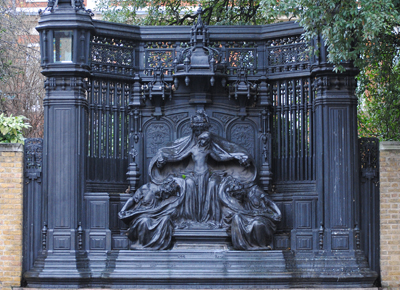
Queen-Alexandra-MemorialErected to the memory of Queen Alexandra, the consort of King Edward VII, the memorial – an ornate bronze screen – is located on the exterior of the garden wall of Marlborough House – the Queen’s former home – in Marlborough Road, opposite St James’ Palace.

Queen-Alexandra-Memorial-smallThe now Grade I-listed bronze memorial, which is the work of Alfred Gilbert and was erected in 1932, is sometimes described as London’s only Art Nouveau statue.

It depicts a central figure, described as “Love Enthroned”, supporting a young girl (perhaps a symbol of the Queen’s support for the next generation), and attended by two crowned bowing figures which it’s believed represent faith and hope. An inscription – “Faith, hope, love – The guiding virtues of Queen Alexandra” – sits below.

The memorial was unveiled on 8th June, 1932, with the Archbishop of Canterbury, Cosmo Gordon Lang, in attendance. Queen Alexandra’s Memorial Ode, composed by Sir Edward Elgar, was first performed at the ceremony.

The memorial was the last public artwork to be completed by Gilbert, noted for having also created what is arguably London’s most famous statue – that of Eros in Piccadilly (see our earlier post here), who was knighted by King George V after the unveiling.

The Queen lived at the property during her widowhood until her death in 1925.

Apologies – we neglected to put in the link! Now corrected.

10 London ‘battlefields’ – 10. The Battle of London…

The final in our series looking at London ‘battlefields’, this week we take a look at the so-called Battle of London, the air war fought over London during World War II which, along with the bombing of other British cities, is best known by the phrase The Blitz (it forms part of the greater Battle of Britain).

Blitz-memorialTaking place from the afternoon of 7th September, 1940, until May, 1941, the Blitz saw London sustain repeated attacks from the German Luftwaffe, most notably between 7th September and mid November when the city was bombed on every night bar one.

The night of 7th September, the first night of the Blitz (a short form of ‘Blitzkrieg’ – German for ‘lightning war’), was among the worst – with more than 450 killed and 1,300 injured as wave after wave of bombers attacked the city. Another 412 were killed the following night.

One of the most notorious raids took place on 29th December when  incendiary bombs dropped on the City of London starting what has been called the Second Great Fire of London. Around a third of the city was destroyed, including more than 30 guild halls and 19 churches, 16 which had been rebuilt by Sir Christopher Wren in the aftermath of the Great Fire of London in 1666.

The city was only attacked sporadically in the early months of 1941 but the night of the last major raid of the Blitz – that of 10th May, a night subsequently known as The Longest Night – saw the highest casualties of any night with almost 1,500 people reportedly killed.

The Blitz killed almost 30,000 civilian in London, and destroyed more than a million homes with the worst hit districts poorer areas like the East End.

The battle wasn’t one-sided – the RAF fought the Luftwaffe in the skies and did have some wins – on 15th September (a day known as Battle of Britain Day), for example, they shot down some 60 aircraft attacking London for the loss of less than 30 British fighters.

It was this victory which led the Germans to reduce the number of daylight attacks in favour of night-time raids which, until the launch of the RAF’s night-time fighters in 1941, meant they met little effective resistance. This included that of ground defences – throughout December, 1940, it’s said that anti-aircraft fire only brought down 10 enemy planes.

Yet, the Blitz did not lead to a German victory. For the Nazi regime, the purpose of the constant bombing of London (and other cities) was aimed at sapping the morale of its residents to the extent that they would eventually be forced to beg for peace. But the plan failed and Londoners, digging deep, proved their mettle in the face of fear.

Hundreds of thousands of people were involved in  Civil Defence working in a range of jobs – everything from air raid shelter wardens to rescue and demolition teams – and worked alongside firefighters whose numbers were supplemented by an auxiliary service. Naturally all suffered a high level of casualties.

As the weeks passed, the carnage mounted in terms of the loss of and damage to life, destruction of property and psychological toll. And yet the Londoners – sheltering Underground, most famously in the tunnels of the Tube – survived and, as had been the case after the first Great Fire of London, the ruined city was eventually rebuilt.

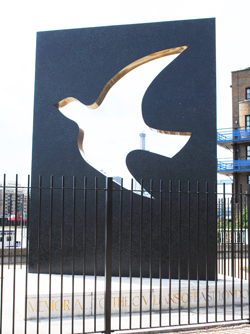
There are numerous Blitz-related memorials in London, many related to specific bombings. But among the most prominent are the National Firefighters Memorial, located opposite St Paul’s Cathedral, which pays tribute to the firefighters who lost their lives in the war (as well as in peacetime), and a riverside memorial in Wapping honouring civilians of East London killed in the Blitz.

Treasures of London – The Lampedusa Cross…

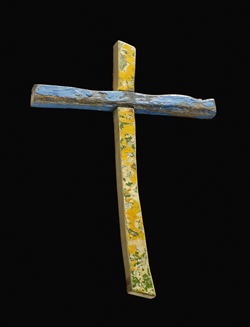
The-Lampedusa-CrossDonated to the British Museum in October (the last acquisition made under former director Neil MacGregor), the Lampedusa Cross was constructed by carpenter Francesco Tuccio out of wreckage from a refugee boat which sank off the Italian island of Lampedusa on 3rd October, 2013. At least 349 of the 500 refugees on board were drowned, some of whom were Eritrean Christians fleeing persecution, while 151 survived. Mr Tuccio, a resident of Lampedusa, decided to make a series of small crosses from the wreckage after meeting some of the refugees in the church of San Gerlando as a gift for them to both reflect their salvation and as a symbol of hope for the future. He was subsequently also asked to make a further cross which was carried by Pope Francis at the memorial service for the survivors. Asked by the British Museum if it could acquire a cross for its collection, Mr Tuccio made a cross specifically for the museum which he then donated to the institution, saying after he received a letter of thanks that “it is I who should thank you for drawing attention to the burden symbolised by this small piece of wood.” The cross went on display in Room 2 of the museum on 18th December (the last day of Mr MacGregor’s directorship). Entry is free. For more on the British Museum, see www.britishmuseum.org. PICTURE: © Trustees of the British Museum.

10 London ‘battlefields’ – 9. The Battle of Cable Street…

We hit the 20th century with this London ‘battle’, a confrontation in Stepney between police and a range of anti-fascist and fascist forces in the lead-up to World War II.

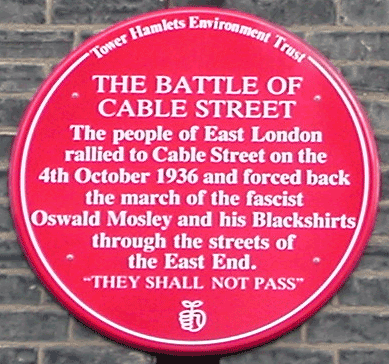
Battle-of-Cable-Street-red-plaqueThe ‘battle’ took place on a Sunday – 4th October, 1936 – following a summer of anti-Semitic violence and was sparked by a decision by the British Union of Fascists, led by Sir Oswald Mosley , to march through the East End, then the heartland of London’s Jewish community.

Incensed at the plans (and faced with government inaction despite calls for the march to be called off), anti-fascist protestors – which included large numbers of Jewish and Irish people as well as trade unionists, communists, socialists, anarchists and local residents – gathered initially at Gardiner’s Corner (named for a department store which once on the site at the junction of Whitechapel High Street and Commercial Road) to prevent the march.

The protestors were chanting and carrying banners which read “No Parasan” (“They shall not pass”, a slogan taken from anti-fascist forces who used it during the Spanish Civil War).

Estimates as to how many people turned out in protest vary widely – from 100,000 people up to as many as 250,000 or even 500,000 – but it’s clear that whatever the actual number, the crowd was huge and vastly outnumbered the up to 3,000 fascists – known as Blackshirts – who turned up to march and the 10,000 Metropolitan Police officers, some of whom were on horseback, sent to prevent the march from being disrupted.

With the path blocked despite police charges into the crowd, Mosley and his Blackshirts were advised by authorities to head south to Cable Street but there they encountered road-blocks made from furniture, paving stones and even apparently overturned lorries which appeared at the street’s west end, around the junction with Christian Street.

Police again attempted to clear the road but were blocked by the makeshift barricades and a wall of protestors while residents in houses lining the streets threw rubbish and even the contents of chamber pots at them. Police responded by sending in squads of men to snatch the ringleaders of the protests; protestors responded by ‘kidnapping’ some police officers.

Faced with continuing violence, Mosley was forced to abandon the march and the BUF were dispersed back through the City of London. The protestors meanwhile were said to have turned the event into a giant street party in celebration of their victory.

More than 100 people were said to have been injured in the violence and some 150 of the demonstrators were arrested. Most of the charges were of a minor nature but some of the ringleaders were given up to three year terms of imprisonment.

A large mural depicting the battle was painted on the side of St George’s Town Hall in Cable Street in the 1980s and there’s also a red plaque in nearby Dock Street (pictured) commemorating the incident.

Aside from a victory in itself, the battle was the catalyst for the passing of the Public Order Act of 1936 which meant the organisers of marches would henceforth have to seek permission of the police before holding them. It also banned demonstrators from marching in uniform.

PICTURED: A plaque commemorating the ‘battle’ in Dock Street which runs off the west end of Cable Street. Via Richard Allen/Wikipedia

Treasures of London – ‘Locking Piece’…

Locking-Piece

A Henry Moore original, Locking Piece was created in 1963-64 and first located on its current site on Riverwalk Gardens at Millbank, site of the former Millbank Penitentiary, four years later. The bronze sculpture consists of, as the name suggests, two interlocking pieces. There’s a couple of conflicting stories about where the idea for the work came from – in one, Moore said he was visiting a gravel pit near his home at Perry Green in Hertfordshire where he was playing with two pebbles which suddenly locked together (and hence came the idea of a sculpture of two interlocking pieces); and in another, Moore said the idea came from a bone fragment featuring a socket and joint found in his garden. Originally loaned to Westminster City Council, in 1978 the sculpture was given to the Tate Gallery which subsequently decided to leave the piece in situ. It’s one of numerous Moore works in London. For more on Henry Moore’s London works, see www.henry-moore.org/works-in-public/world/uk/london.

LondonLife – A rare glimpse inside King Henry V’s chantry chapel…

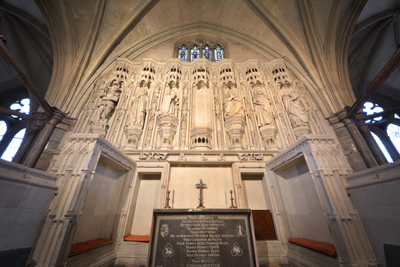
Henry-V-chantry-chapelA fortunate few last weekend had the chance to have a look inside King Henry V’s elaborately carved chantry chapel in Westminster Abbey as part of commemorations marking the 600th anniversary of the Battle of Agincourt. 

The chapel, which is located on a sort of mezzanine level above the king’s tomb at the east end of the Shrine of Edward the Confessor, is one of the smallest of the abbey’s chapels. It was constructed on the orders of the king – who died Vincennes in August, 1422, and was buried in the abbey on 7th November that year – so prayers could be said in perpetuity for his soul.

The tomb was completed in 1431 and the chantry chapel was built above between 1437 and 1450. The latter is entered via narrow stairways of worn steps hidden inside a pair of stone turrets which flank the tomb.

For centuries the Henry V’s funeral ‘achievements’ – the king’s saddle, helm and shield – were displayed on a wooden beam above the chantry chapel but these were restored and moved to the abbey museum in 1972.

Henry V’s wife, Catherine de Valois, who survived her husband by 15 years was eventually – in the Victorian age – buried under the chantry chapel altar (originally buried in the old Lady Chapel, King Henry VII had her removed and placed in an open coffin in the open air next to the tomb of King Henry V, when building his new chapel – among visitors to her mummified body was diarist Samuel Pepys who even kissed her. In 1778 she was buried in a vault before being relocated to her current position in 1878).

An inscription on the altar in the chantry chapel reads: “Under this slab (once the altar of this chapel) for long cast down and broken up by fire, rest at last, after various vicissitudes, finally deposited here by command of Queen Victoria, the bones of Catherine de Valois, daughter of Charles VI, King of France, wife of Henry V, mother of Henry VI, grandmother of Henry VII, born 1400, crowned 1421, died 1438”.

The chantry chapel is still occasionally used for services but, measuring just seven by three metres, is not usually open to the public because of size and access issues.

Westminster Abbey will hold a special service of commemoration on 29th October in partnership with charity Agincourt600. The day before, 28th October, it will host a one day conference for Henry V enthusiasts entitled ‘Beyond Agincourt: The Funerary Achievements of Henry V’. For more, see www.westminster-abbey.org/events/agincourt.

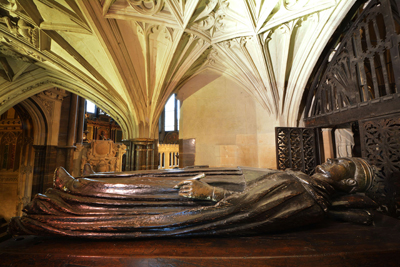
Above – King Henry V’s chantry chapel; Below – King Henry V’s tomb which sits below the chantry chapel. PICTURE: Jim Dyson/Dean & Chapter of Westminster

Henry-V-tomb

10 London ‘battlefields’ – 1. Queen Boudicca takes on the Romans…

boudicca

This month marks the 600th anniversary of the Battle of Agincourt and to mark the occasion, we’re looking at 10 of London’s “battlefields” (well, maybe not officially recognised battlefield sites but 10 places where fighting took place – or, as in this instance, legend says took place – at various times throughout London’s history).

First up it’s to King’s Cross, once said to have been site of a village known as ‘Battle Bridge’, so named because, according to tradition, it here in about 60AD that the rebellious hoards of Queen Boudicca (also known as Boadicea or Boudica) ran into the well-disciplined army of the Roman Governor of Britain, Gaius Suetonius Paulinus.

Paulinus had been campaigning in northern Wales when the Iceni rebellion broke out in East Anglia, apparently sparked by the Romans’ refusal to honour the will of the deceased King Prasutagus. He had left his land to the Emperor Nero and his two daughters but instead, the story goes that the Romans seized the land, flogged his wife Boudicca and raped his two daughters.

Understandably incensed at this treatment, the Iceni and members of other tribes rose in rebellion under Boudicca and laid waste to the Roman city of Camulodunum (what is now Colchester in Essex).

Boudicca then turned toward Roman Londinium, the provincial capital, and while Paulinus beat her there with a small number of troops, he quickly concluded he couldn’t defend it and ordered it evacuated. Boudicca, who is claimed to have fought from a chariot, and her army of tribesman apparently spared no-one when they arrived and burnt it to the ground. They then moved on to attack another Roman city – Verulamium (St Albans).

Paulinus, meanwhile, marshalled his forces – still apparently vastly outnumbered – and chose his battleground carefully. One legend suggests King’s Cross – then site of an ancient bridge across the River Fleet – as the battle’s location (although we should mention there are also numerous other sites which have been suggested as the location for the battle including locations in the Midlands along the Roman road of Watling Street, now the A5).

Where-ever it was, Paulinus had apparently chosen his position so that Boudicca couldn’t bring her greater numbers to bear on his flanks. Her army collapsed and, according to the Roman historian Tacitus, there was a rumour that 80,000 Britons were killed and just 400 Romans in the ensuing battle (although fair to say such numbers may be a stretch!).

The outcome was obviously devastating for Boudicca – there’s various accounts of what happened to her next with one being that she fell during the battle and another that, having survived, she committed suicide by poisoning herself. There is a legend that Boudicca was subsequently buried at a site now covered by platform nine or 10 at King’s Cross railway station. It’s also been suggested she was buried at Parliament Hill.

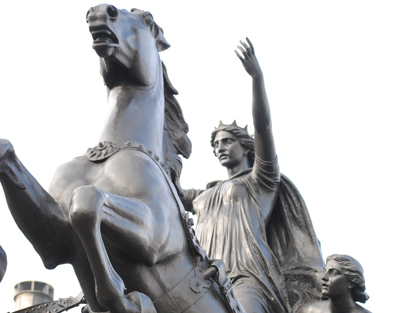
There’s a statue commemorating Boudicca and her daughters (pictured above) at the western end of Westminster Bridge. Designed by Thomas Thornycroft, it was made in 1850 but not erected on the site until 1902.

A Moment in London’s History – The execution of William Wallace…

William-Wallace-big

This year marks the 710th anniversary of the execution of Scottish rebel William Wallace in Smithfield so we thought we’d take a quick look at the circumstances of that event – made famous in recent times through the movie Braveheart.

William-WallaceFor some eight years, Wallace had been a thorn in the side of the King Edward I, promoting active resistance to his rule in Scotland after Edward forced the abdication and usurption of the crown of John Balliol.

Following a crushing defeat at the Battle of Falkirk on 22nd July, 1298, however, Wallace went to France where he attempted to gain French support for rebellion in Scotland but the effort proved ultimately futile and Wallace, back in Britain but refusing to submit to English rule, remained on the run.

At least until he was captured on 5th August, 1305, by Sir John Monteith, who had been made Sheriff of Dumbarton by King Edward I, at Robroyston near Glasgow.

Taken to Carlisle, he was bound hand and foot before being taken south to London in chains.

Wallace’s trial took place on 23rd August that year at Westminster Hall and, despite his protestations that he couldn’t be guilty of treason having never sworn loyalty to the English Crown, a guilty verdict was handed down along with the sentence of a traitor’s death – being hung, drawn and quartered.

Taken to the Tower of London, Wallace was stripped naked and then strapped to a wooden hurdle which was dragged by two horses through the streets via Aldgate to The Elms at Smithfield where he was hanged on a gallows.

Cut down while yet living, he was disembowelled and castrated and his entrails burnt. Wallace was then decapitated and his body cut into quarters which were sent to Berwick, Newcastle, Stirling and Perth as a warning against treason. His tarred head, meanwhile, was put on a pike and set above London Bridge.

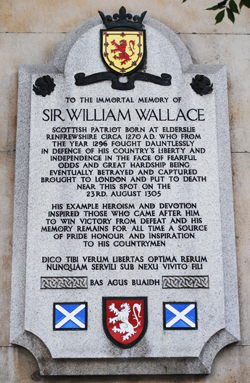
A memorial to Wallace can now be found on the wall of St Bartholomew’s Hospital at West Smithfield (pictured – for more on that, see our earlier post here).

10 small, ‘secret’ and historic gardens in central London…9. Garden of Rest, Marylebone…

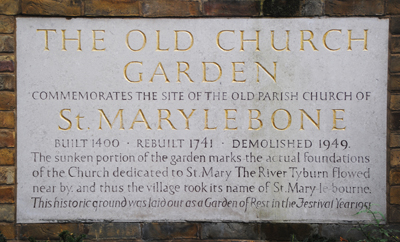
Marylebone2This pocket park is another of those located on the site of a former church – in this case the Marylebone Parish Church which now stands to the north.

The church – the third to serve the parish – was built here in 1740 but was replaced when the current parish church was built between 1813 and 1817.

Wesley-MonumentThe former church didn’t close until 1926, however, continuing use as a parish chapel, and even then wasn’t demolished until 1949  after it was damaged by bombing during World War II.

In 1951, the St Marylebone Society created a Memorial Garden of Rest on the site (also known as the Old Church Garden). It was opened in March, 1952, by Viscount Portman.

The foundations of the former church were marked out in the sunken portion of the garden. The predominantly paved garden also contains numerous gravestones and memorials.

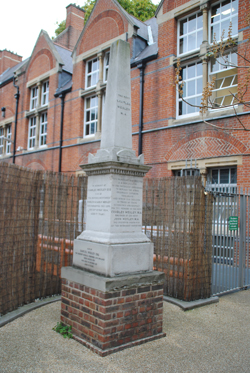
These include that of Methodist movement leader Charles Wesley, erected in 1858 to commemorate his burial in 1788 (pictured right). There’s also a plaque recording notable burials at the church, including the painter George Stubbs (1806), royal apothecary John Allen (1774), architect James Gibbs and bare knuckle boxer James Figg (1734). Other plaques detail some of the church’s history.

Also of note in the garden is a Judas tree (Cercis siliquastrum), named for being the variety upon which Judas hung himself or, alternately, because its fruit pods resemble bags of silver. The current tree replaces an earlier one.

WHERE: Garden of Rest Marylebone, Marylebone High Street (nearest tube stations are St Paul’s and Barbican); WHEN: 7am to dusk; COST: Entry is free; WEBSITE: www.myparks.westminster.gov.uk/parks/garden-of-rest-marylebone/.

LondonLife – The Quadriga at Hyde Park Corner…

The-QuadrigaKnown as ‘The Quadriga’, this bronze monument atop Wellington Arch at Hyde Park Corner depicts Nike, goddess of victory, in a four horse chariot. The work of English sculptor Adrian Jones, the quadriga was part of Decimus Burton’s original early 19th century design but it wasn’t until 1911-1912 that this colossal piece – once the largest bronze monument in Europe – was installed, replacing an equestrian statue of the Duke of Wellington which was moved to Aldershot (a smaller equestrian statue of the Duke now stands nearby). For more on the arch, see www.english-heritage.org.uk/visit/places/wellington-arch/.

10 small, ‘secret’ and historic gardens in central London…8. Postman’s Park…

Postman's-ParkHousing one of London more unique memorials, Postman’s Park in the City’s north is located on what were once the churchyards and burial grounds of three different churches.

The park – which took its name from its popularity with postal workers who came here to escape their job at the nearby former General Post Office (read a Lost London article on the GPO here) – opened in 1880.

It was originally located on the site of the former churchyard of St Botolph’s-without-Aldersgate and was subsequently expanded to incorporate the adjacent churchyard of St Leonard, Foster Lane, and the burial ground of Christ Church, Greyfriars (also known as Christ Church, Newgate Street). Some of the headstones still stand along the park’s boundaries.

Postman's-Park3Its key feature is the G.F. Watts Memorial To Heroic Self Sacrifice (pictured, right). Victorian artist and philanthropist George Frederic Watts proposed the memorial commemorating “heroic men and women” who had given their lives to save others to mark Queen Victoria’s Jubilee in 1887 but the memorial which now stands there wasn’t built until 1900.

The memorial consists of a loggia, the inside of which is lined with glazed tablets. Each of these commemorates acts of bravery by “everyday heroes” as they attempted to rescue people from fires, runaway trains, sinking ships and drowning. There were 13 plaques at the time of his death in 1904 and his wife Mary added a further 34.

The latest of the memorials commemorating 62 individuals was added in 2009 (for more details, head to our earlier post here, part of our Curious London Memorials series; you can also find more about the memorial, including a free app, here).

The park also features a sundial and fountain amid bright flower beds and various species of trees including a large banana tree, a dove tree and Tasmanian tree ferns.

Claims to fame include its role in the 2004 film Closer, which starred Natalie Portman, Julia Roberts, Jude Law and Clive Owen (we won’t go into details, just in case you haven’t seen it!).

WHERE: Postman’s Park, between King Edward Street and St Martin’s le Grand (nearest tube stations are St Paul’s and Barbican); WHEN: The park, managed by the Corporation of London, is open 7am to 8pm or dusk (whichever is earlier); COST: Entry is free; WEBSITE: www.cityoflondon.gov.uk/things-to-do/green-spaces/city-gardens/visitor-information/Pages/Postman’s-Park.aspx.

Postman's-Park2

LondonLife – Remembering Agatha Christie…

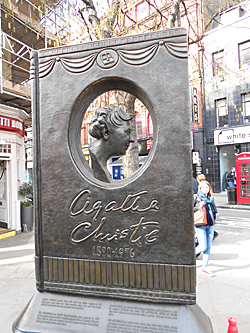
Agatha_ChristieToday marks 125 years since the birth of the world’s best-selling novelist, Agatha Christie, subject of this memorial which was unveiled in Covent Garden in 2012.

Standing at St Martin’s Cross – the intersection of Cranbourn and Great Newport Streets, the memorial – which also marks 60 years and 25,000 performances of her record breaking long-running London play The Mousetrap – is the work of sculptor Ben Twiston-Davies.

It takes the form of a 2.4 metre high book with a bust of Christie in profile and features a series of motifs from Christie’s works as well as a ‘bookshelf’ of her best sellers in English and other languages, the titles of which were selected in a competition involving fans.

Christie, who was born on 15th September, 1890, in Torquay, Devon, and died on 12th January, 1976, is famous for the scores of detective novels she wrote – featuring the likes of detectives Miss Marple and London’s own Hercule Poirot – which have gone on to sell more than two billion copies around the world.

The memorial was unveiled on 18th November, 2012, by Christie’s grandson, Matthew Pritchard, along with Sir Stephen Waley-Cohen, chairman of Mousetrap Productions, and the Lord Mayor of Westminster, Cr Angela Harvey.

For more on the memorial, see www.agathachristiememorial.co.uk. For more on events surrounding the anniversary, see www.agathachristie.com.

PICTURE: Diagram Lajard

Treasures of London – The Cordwainer…

The-CordwainerThis bronze sculpture, located in Watling Street in the City of London, commemorates Ward of Cordwainer which in medieval times was home to London’s shoe-making industry.

The term ‘cordwainer’ relates to a shoemaker who makes shoes from new leather and is derived from the fact that shoe-makers used leather – “cordovan” – from the then Moorish town of Cordoba in Spain (in London this trade was controlled by the Worshipful Company of Cordwainers).

The statue, the work of Alma Boyes, was erected in 2002 in celebration of the centenary of the Ward of Cordwainer Club and was a joint initiative of the club and the City Corporation. Initially erected in Bow Churchyard, it was relocated to its present location alongside St Mary Aldermary Church, close to the Queen Victoria Street end of Watling Street, a couple of years later.

10 small, ‘secret’ and historic gardens in central London…7. St Swithin’s Church Garden…

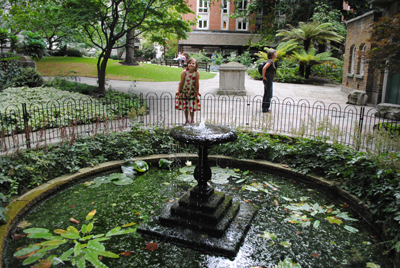
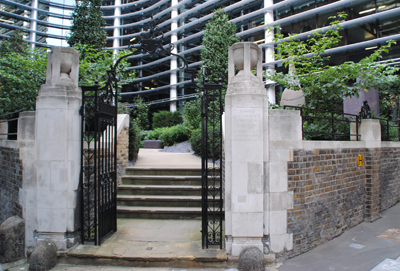
St-Swithins2Back into the City of London this week and it’s another garden located on the site of a former church.

Situated just off Cannon Street, this much overlooked tiny raised garden was created on the site of the former Church of St Swithin. The church is believed to have existed here as early as the 11th century and was replaced, thanks largely to the generosity of Lord Mayor Sir John Hind, with a larger building in the early part of the 15th century – it featured one of the first towers built specifically for the task of hanging bells inside.

St-SwithinsThe church was among those destroyed in the Great Fire of London in 1666 but, now united with the parish of St Mary Bothaw, was rebuilt to the designs of Sir Christopher Wren shortly after in 1677-88.

Later known as St Swithin, London Stone thanks to the mysterious London Stone being built into the south wall of the church in the late 18th century (for more on the stone and its current location, see our earlier post here), the church survived until World War II when it was damaged beyond repair during bombing and was later destroyed.

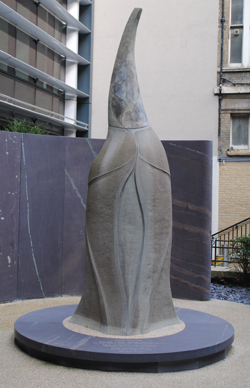
Relandscaped in 2010, the garden features a rather dramatic memorial (pictured) to the suffering of women and children in war in general and medieval figure, Catrin Glyndwr in particular. Unveiled in 2001, it was designed by Nic Stradlyn-John and sculpted by Richard Renshaw.

The daughter of the Welsh Prince Owain Glyndwr, she was captured in 1409 and brought with her children and mother to the Tower of London. Catrin and two of her children died in late 1413 and were buried in the former church.

WHERE: St Swithin’s Church Garden, Salters Hall Court off Cannon Street (nearest Tube station is Cannon Street); WHEN: daily; COST: Free; WEBSITE: www.bost.org.uk/open-places/red-cross-garden/.

This Week in London – Party like a Georgian; a playground with a history; and, a Dickens whodunnit…

Kensington-Palace• Join the Georgian Queen Caroline for a garden party in the grounds of Kensington Palace this weekend. The Georgian Court will be taking to the palace gardens for a summer celebration featuring music, military drills and theatre as they bring the era to life. Visitors are encouraged to immerse themselves in the experience as a courtier with the gardens decked out in a range of tents where they can try out costumes and powdered wigs as well as learn court etiquette, swordplay and dancing while the ice-house will feature Georgian ice-cream (and it’s rather odd flavours such as parmesan). Runs from tomorrow until Sunday. Admission charges apply (under 16s go free with a maximum of six children per paying adult). For more, see www.hrp.org.uk/KensingtonPalace/. PICTURE: ©Historic Royal Palaces

First created in 1923, a playground in Victoria Tower Gardens – newly named the Horseferry Playground – has been reopened after improvement works. The works, carried out under the management of Royal Parks, have seen the reintroduction of a sandpit as well as the installation of new swings and slide, dance chimes and a stare play installation to represent the River Thames. The playground, located close to the Houses of Parliament in Westminster, also features a series of timber horse sculptures, new seating and a refreshment kiosk with metal railings designed by artist Chris Campbell depicting events such as the Great Fire of London and Lord Nelson’s funeral barge and views of the River Thames. The project has also seen the Spicer Memorial, commemorating role of paper merchant and philanthropist Henry Spicer in the establishment of the playground – then just a large sandpit, restored. For more, see www.royalparks.org.uk/parks/victoria-tower-gardens.

Now On – A Dickens Whodunnit: Solving the Mystery of Edwin Drood. This temporary exhibition at the Charles Dickens Museum in Bloomsbury explores the legacy of Dickens’ final novel The Mystery of Edwin Drood, left unfinished after his death in 1870. Visitors are able to investigate crime scenes, search for murder clues and see the table on which the novel was penned as well as clips from theatrical adaptations, and a wealth of theories on ‘whodunit’. The exhibition runs until 11th November. Admission charge applies. For more, see www.dickensmuseum.com.

Send all items for inclusion to exploringlondon@gmail.com.