Where’s London’s oldest…Tube station?

In this, the year of the 150th anniversary of the creation of what we now know as the London Underground, it’s only fitting that we take a look at the city’s oldest Tube station – Baker Street.

Opened on 10th January, 1863, by the Metropolitan Railway, the Grade II* listed property was designed by John Fowler, the company’s engineer in chief. While some stations on the initial railway – which stretched from Paddington to Farringdon – had platforms located in open cuttings, Baker Street was one of only three initial stations (the other two were at what was then named Gower Street (now Euston Square) and Great Portland Street) which was genuinely located underground, with subterranean platforms covered by brick barrel-vaults and lit by gaslights as well as natural light brought from the surface by “lunettes”.

The station was subsequently extended and further developed and, thanks to the company’s desire to make Baker Street its headquarters and “flagship” station, it underwent a major overhaul in 1911-13 with Charles Walter Clark, another Metropolitan Railway employee, designing a new grand booking hall and concourse featuring a lost property office, “ladies’ room” and a WH Smith bookstall.

Features inside include a cast-iron screen – complete with clock –  installed at the entrance to the lower concourse in 1925 to help control passenger flow during the British Empire Exhibition at Wembley, a marble memorial to Metropolitan Railway employees who died in World War I, and, in a nod to the proximity of his fictitious Baker Street residence, large and small Sherlock Holmes silhouettes on tiles located at various places inside (there’s a statue of him outside the station).

For more on the 150th anniversary, see www.tfl.gov.uk/tube150.

Famous Londoners – William Blake…

Poet. Painter. Visionary? William Blake failed to find great success in his lifetime and died in relative obscurity but is now known internationally for his controversial and innovative works in the written word and visual arts.

Blake was born on 28th November, 1757, at 28 Broad Street in Soho, the third son of hosier James Blake and his wife Catherine (he was christened at St James’s Piccadilly). Little is known of his early life although accounts suggest he had some spiritual experiences – including a vision of a tree full of angels – as a young boy and also showed an interest in the visual arts at an early age.
William-BlakeAbout the age of 10, he started attending Henry Par’s drawing school before, at the age of 14, becoming an apprentice to James Basire, engraver to the Royal Society and Society of Antiquaries. Among his early assignments was to make drawings of the monuments and paintings at Westminster Abbey – interestingly, Blake’s earliest extant drawings are of the opening of King Edward I’s coffin on 2nd May, 1774.

In 1779, his apprenticeship completed, Blake enrolled as a student at the Royal Academy of Arts and at the same time, made his living as a copy engraver. His clients included the radical bookseller Joseph Johnson through whom he became introduced to people like Joseph Priestley. He also began producing original works on historical themes apparently with the aim of forging a career in the painting of history.

In 1782, Blake married Catherine Sophia Boucher and they took up life together at a property near Leicester Square, later moving to Lambeth. They were to have no children.

Experimenting with new methods of engraving, in 1788, he published the first of what he was to call his “illuminated books” – All Religions are One, and There is no Natural Religion – with his first illuminated book of poetry, Songs of Innocence, coming a year later (its sequel Songs of Experience was published in 1794). In 1789, he published The Book of Thel, combining his new method of engraving with “prophetic” verse.

Later works in prose and poetry – created while Blake was still working as an engraver – continued to explore his increasingly radical views on religion and politics. They included The Marriage of Heaven and Hell published in 1790, The French Revolution in 1791, America: A Prophecy in 1793 and Visions of the Daughters of Albion the same year.

In 1800, Blake moved to Felpham, West Sussex, thanks to his friendship with one William Hayley who engaged his skills on several projects. It was while living here that Blake began work on his epic poems Milton (printed in 1810-11) and Jerusalem (completed in 1820).

Following an incident in 1803 in which Blake removed a drunk soldier from his garden, Blake was charged with high treason but acquitted after a trial at Chichester.

Having meanwhile moved back to London, in 1809 Blake made a last effort to gain the public’s attention with his work and held an exhibition of his paintings and watercolours at his family home in Broad Street (now home of his eldest brother James). But the exhibition did not elevate his profile as he may have hoped and during his last years, Blake increasingly sank into obscurity amid tightening finances and, although he continued to produce poetry, paintings and engravings, he found it hard to find work.

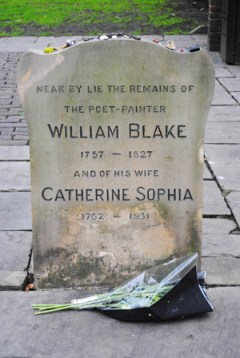
Blake died on 12th August, 1827, at his home at 3 Fountain Court on the Strand and was buried in an unmarked grave at Bunhill Fields. The stone which now stands there (pictured above) was added later.

It was during the Victorian-era that Blake’s work made its way into the hands of a larger audience than it ever had while he was alive, thanks to Blake enthusiasts like his first biographer Alexander Gilchrist and people associated with the Romantic movement.

His work continued to gain attention into the 20th century (in particular around the centenary of his death in 1927) and by mid-century had become what Robert N Essick says in Blake’s entry in the Oxford Dictionary of National Biography, “one of the cultural icons of the English-speaking world”. Interest in Blake and his works has continued both in the UK and around the world.

A new room dedicated to showing Blake’s works opened at Tate Britain in May.
10 Historic London Garden Squares…9. Queen Square…

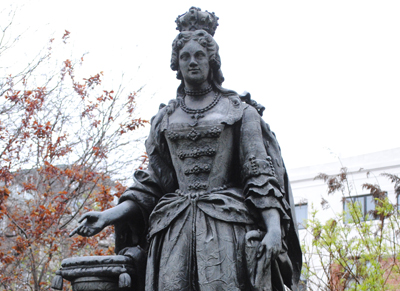
Queen-Charlotte

This rectangular-shaped square in Bloomsbury, known for its association with the medical profession, was first laid out in the early 1700s and was named for Queen Anne.

Originally known as Devonshire Square, the space was largely laid out between 1716 and 1725 on land owned by Sir Nathaniel Curzon of Kedlestone and, as with so many of London’s squares, attracted it’s fair share of the well-to-do. Among early residents were several bishops and members of the aristocracy.

Queen-SquareOne of the most interesting early associations with Queen Square is that of King George III and his consort Queen Charlotte. The king – better known to many as ‘Mad King George’ – was treated for mental illness in a house on the square and there’s a tradition that Queen Charlotte, stored some of the food to be consumed by the king during his treatment in the base of what is now the pub known as the Queen’s Larder (see our previous entry on the pub here).

There’s a statue of a queen in the central gardens which was thought to be of Queen Charlotte. Since it was erected in 1775, there has been some confusion over the statue’s identity – it has been thought at different stages to be of Queen Anne, Queen Mary (co-ruler with King William III), and Queen Caroline (consort of King George II) – a fact which has led to some confusion as to which queen the square was named after (although general consensus now seems to be that it was indeed Queen Anne whom the square was named after).

The houses in Queen Square – which was later associated with artists and literary types – were gradually replaced by institutional buildings relating to, among other things, education and the practice of medicine and today it remains a hub for the medical establishment – the National Hospital for Neurology and Neurosurgery and the Royal London Hospital for Integrated Medicine (formerly known as the Royal London Homoeopathic Hospital) are both located on the east side of the square and there are several other medical-related buildings located around it including the former Italian Hospital (Ospedale Italiano) which was founded by Italian businessman Giovanni Battista Ortelli in 1884 for poor Italian immigrants and since about 1990 has been part of the Great Ormond Street Hospital.

SamOther prominent buildings located on the square include the Church of St George the Martyr Holborn (number 44) which, built in 1706, predates the square’s formation. The church is known as the ‘sweep’s church’ due to the practice of a parishioner who provided Christmas dinners for 100 chimney sweep apprentices each year.

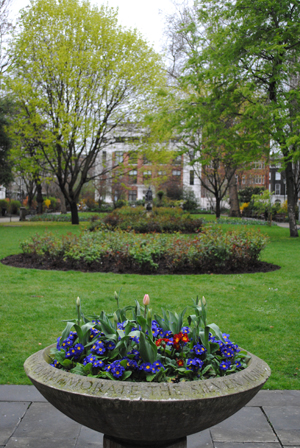
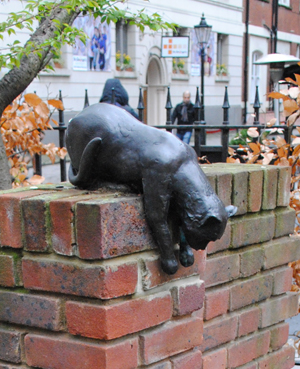
The gardens themselves are protected by an Act of Parliament passed in the 1830s and the gardens are to this day maintained by trustees appointed under that act. Aside from the statue of the queen, monuments in the gardens include a small plaque commemorating the bomb which landed in the square during a Zeppelin raid in World War I (no one was killed), benches commemorating 16 doctors from the homeopathic hospital who died in the Trident air disaster of 1972, and some lines of poetry on a flower bowl and surrounds by Philip Larkin and Ted Hughes in honor of the Queen’s Silver Jubilee of 1977. Statues include a 2001 bronze of Mother and Child and, (this one we love), a sculpture of Sam the cat, apparently a local resident (pictured)!

Treasures of London – Henry Moore altar at St Stephen Walbrook…

Henry-Moore-altar

A beautiful church in the round, St Stephen Walbrook has a rich history with one of its stand-out features is an altar designed by world renowned sculptor Henry Moore. 

The centrally located circular altar, carved between 1972 and 1983 of polished travertine marble (the marble was taken from the same quarry as that used in Michelangelo’s work), is eight foot across and weighs several tons.

It was commissioned  by property developer and churchwarden, Lord Palumbo, as part of a £1.3 million restoration of the church – built under the supervision of Sir Christopher Wren in the 1670s, replacing an earlier church which burnt down in the Great Fire – which took place between 1978 and 1987.

It was deliberately designed to be placed at the centre of the church and didn’t take up its new position without controversy with objectors to it taking the matter to the Court of Ecclesiastical Cases Reserved (they ruled the altar was acceptable for use in a Church of England church).

WHERE: St Stephen Walbrook, 39 Walbrook (nearest tube stations are Bank and Cannon Street); WHEN: 10am to 4pm weekdays (check website for changes); COST: Free; WEBSITE: www.ststephenwalbrook.net.  

Around London – Sculpture in the City; Taste of London; Paddington’s 1st Festival; and, Gauguin at the Courtauld…

LoveA free outdoor exhibition of nine artworks by world famous artists can be seen in the City of London from today. Works featured in this year’s Sculpture in the City exhibition – the third year the event has run – include Robert Indiana’s iconic LOVE sculpture (found at 99 Bishopsgate), Shirazeh Houshiary’s five spiralling stainless steel ribbons String Quintet (St Helen’s Square), and three giant steel dinosaurs, The Good, The Bad and The Ugly, made by the Jake & Dinos Chapman (30 St Mary Axe). Other artists whose work is featured include Antony Gormley, Keith Coventry, Richard Wentworth, Jim Lambie and Ryan Gander. The works will be on display in the Square Mile for the next 12 months. For more – including the locations of all nine installations – see www.cityoflondon.gov.uk/sculptureinthecity. PICTURE: Robert Indiana ‘LOVE’ (1966)  ∏ Morgan Art Foundation, Artists Right Socienty (ARS), New York – DACS, London. Photograph – A et cetera

The 10th Taste of London festival – London’s biggest outdoor food festival – kicks off in Regent’s Park today and runs over the weekend. This year sees amateur BBQ enthusiasts going head-to-head in a “battle of the BBQs” on Saturday while professionals will hit the grills on Sunday with the winners crowned champions of the Weber BBQ Challenge. Meantime, visitors can experience the food of 40 of the city’s top restaurants, shop at 200 food and drink stalls, enjoy fine wine tasting and watch demonstrations by some of the world’s top chefs including three generations of the Roux dynasty – Albert Roux, Michel Roux Jr and Emily Roux – as well as Rene Redzepi, Raymond Blanc, Ben Tish, Pascal Aussignac and Bruno Loubet. For more, see www.tastefestivals.com/london.

The first ever Paddington Festival – an 11 week showcase of art and culture supported by the City of Westminster – kicks off this weekend. Events include a “puppet theatre barge” at Little Venice and a launch event featuring an appearance by Chucky Venn (Eastenders) and steelpan and performances from local dance group, The Phoenix Dancers, at the Maida Hill Market. For more on the festival and for the full programme, see www.paddingtonfestival.co.uk. Other festivals kicking off this weekend include Shubbak 2013 – an international festival of Arab culture (www.shubbak.co.uk).

On Now: Collecting Gauguin: Samuel Courtauld in the 20s. Opening today, this exhibition at the Courtauld Gallery at Somerset House features the gallery’s collection of works by the Post-Impressionist master Paul Gauguin. The most important collection of Gauguin’s works in the UK, it was assembled by Samuel Courtauld between 1923 and 1929 and includes major paintings and works on paper by  along with one of only two marble sculptures the artist ever created. The exhibition, the gallery’s “summer showcase”, also features two important works formerly in the Courtauld’s collection and now on loan – Martinique Landscape and Bathers at Tahiti. Runs until 8th September. Admission charges apply. Meanwhile, The Courtauld Institute of Art’s MA Curating the Art Museum programme is also launching its annual exhibition, Imagining Islands: Artists and Escape, in response to the gallery’s summer showcase. A “trans-historical” exhibition displayed in two rooms, it explores artists’ fascination with other worlds and the search for utopia. Works include a 1799 engraving of Jan Brueghel the Elder’s Adam and Eve in Paradise, Barbara Hepworth’s 1957 work Icon and John Everett Millais’ 1862 painting, The Parting of Ulysses. For more, see www.courtauld.ac.uk.

10 Historic London Garden Squares…8. Russell Square

The largest garden square in Bloomsbury (and one of the largest in London), Russell Square was first laid out by Humphry Repton in 1806 and was located on what were the gardens of the home of the Dukes of Bedford, Bedford House.

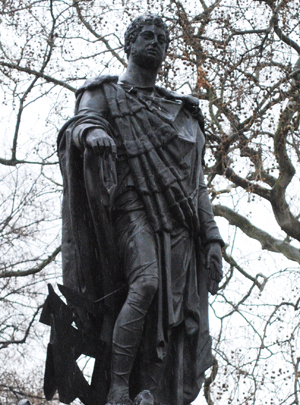
Duke-of-BedfordIts name is that family name of the 5th Duke of Bedford, Francis Russell, who initially ordered the creation of the square and owned the land upon which it stands. The Russell family still hold the title today – the current duke, the 15th, is Andrew Russell – and still run the Bedford Estates upon which the square still stands.

The square was originally lined with grand terraced homes aimed at the upper middle class – the survivors, which can be found largely on the southern and western side of the square, are these days occupied by offices and the University of London. The eastern side of the square is these days dominated by the French Gothic Hotel Russell – designed by Charles Fitzroy Doll, it was built in 1898.

Famous residents and inhabitants have included TS Eliot, who worked at a building in the square’s north-west corner when he was poetry editor at Faber & Faber, 19th century painter Sir Thomas Lawrence who had a studio at number 67, poet William Cowper, who lived at number 62 in the 1830s as a schoolboy, and George Williams, founder of the YMCA, who lived at number 13 in the late 19th and early 20th centuries. It also appears in William Thackeray’s novel, Vanity Fair, and Virginia Woolf’s Night and Day.

The gardens were overhauled in 2002 in view of Repton’s original design and a new ornamental fountain installed in the middle. A cafe was also added.

Russell Square still houses one of London’s 13 extant Cabmen’s Shelters while monuments within the gardens include a small memorial to the 7th July, 2005, bombings – two of which occurred nearby – and a statue of the 5th Duke of Bedford, another which is the work of Sir Richard Westmacott and which was erected in 1807-08 (pictured).

Where is it?…#65…And the answer is…

Where-is-it--#65

Can you identify where in London this picture was taken? If you think you can, leave a comment below. We’ll reveal the answer early next week. Good luck!

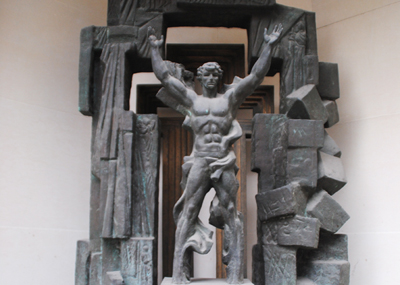
Apologies for the delay in revealing the answer to this. The picture shows a bronze sculpture entitled ‘Break the Wall of Distrust’, located in a niche at the corner of Cannon Street and Laurence Poutney Lane (number 108 Cannon Street). Designed by Soviet artist Zurab Tsereteli, it dates from 1990.

Hampton Court Palace Festival; good deeds at the Foundling Museum; Harold Wilson’s memorial; and, the RA’s summer exhibition…

The 2013 Hampton Court Palace Festival kicks off tonight. Highlights include a performance by the Royal Philharmonic Concert Orchestra and fireworks on Saturday night while other artists featured include Jools Holland, Lisa Stansfield, Frank Valli and the Four Seasons, Imeda May, Bjorn Again, Russell Watson, Cliff Richard and Joe Bonamassa and Beth Hart. For the full programme of events over the next couple of weeks, check out www.hamptoncourtpalacefestival.com.

It’s all about good deeds at the Foundling Museum. Opening at the museum in Bloomsbury tomorrow, a ceramic artist Clare Twomey’s exhibition – Exchange: 1,000 Good Deeds at the Foundling Museum – features more than 1,000 cups and saucers with each cup hiding instructions for a good deed underneath. The instructions are only revealed when a visitor selects a cup – they either agree to do the good deed, leaving it exposed and taking home the cup, or, if they’re not able to, can return the cup to its saucer. There is a limit of 10 cups available for exchange each day – ring or check the website for times when the exchanges may take place. Entry is free with museum admission. Runs until 15th September. For more, see www.foundlingmuseum.org.uk.

A memorial ledger stone to former Labour PM, Harold Wilson (later Lord Wilson of Rievaulx), was dedicated in Westminster Abbey this week. Lord Wilson (1916-1995) was PM from 1964 to 1970 and 1974 to 1976. The stone is placed near where Earl Attlee’s ashes were interred at a memorial service attended by Lord Wilson when Prime Minister in 1967. For more, see www.westminster-abbey.org.

On Now: Royal Academy of Arts Summer Exhibition 2013. Coordinated by Royal Academicians printmaker Norman Ackroyd and Eva Jiricna, this year’s exhibition at the Royal Academy in Piccadilly features more than 1,000 artworks with many going on display for the first time. Among the works on display will be Grayson Perry’s series of six tapestries entitled The Vanity of Small Differences – inspired by Hogarth’s A Rake’s Progress, it tells the story of Tom Rakewell. Other highlights include a room dedicated to portraiture – including photographs and works on paper – and a new large scale sculpture by Anthony Caro. Runs until 18th August. Admission charge applies. For more, see www.royalacademy.org.uk.

10 Historic London Garden Squares…7. Bloomsbury Square

Initially known as Southampton Square, Bloomsbury Square – located just to the east of the British Museum – was first developed in the mid-1660s, making it London’s oldest formal square.

Bloomsbury-SquareIt was the fourth Earl of Southampton, Thomas Wriothesley, who developed the square – his rather grand house, Southampton House, was located on the northern side of the square which initially featured gardens at the centre laid out in a cruciform pattern.

In 1723 – via the marriage of Southampton’s daughter, Lady Rachel Vaughan, to the ill-fated William, son of the 5th Earl of Bedford (he was implicated in the Rye House Plot and beheaded) – it passed to the Dukes of Bedford, becoming part of the Bedford Estates (and with it the earl’s house, later renamed Bedford House). The square took on its new name of Bloomsbury Square around this time.

Initially popular among the well-to-do, it had fallen somewhat from favour by the 19th century and with the 5th Duke preferring to live in the West End, in 1800 Bedford House was auctioned off and demolished. Terraced houses were later built along the now vacant north side of the square.

About 1806, the 5th Duke commissioned Humphry Repton to redesign the square and by the 1820s a garden including trees in the centre and a perimeter shrubbery. The gardens have gone through several makeovers since, including in the 1960s when an underground carpark was built underneath.

Most recently refurbished in 2006-2007 so they once again reflect Repton’s design, the gardens – which have been open to the public since 1950 – also contain a bronze statue of Whig politician (and friend of the Dukes of Bedford) Charles James Fox, which was designed by Sir Richard Westmacott and erected in 1816 (pictured, it was restored in 2006 to mark the bicentenary of Fox’s death).

It remained popular among middle class professionals, however, and among its most notable residents were the writer Isaac D’Israeli, father of the future Prime Minister Benjamin Disraeli, who lived at number six in the early 19th century (his son with him) while architect Sir Edwin Lutyens lived and worked at number 29 for more than 15 years after his marriage in 1897. Literary and artistic figures like Leonard and Virginia Woolf and Lytton Strachey, who became part of what was known as the ‘Bloomsbury Group’, were also famously known to have lived in the area around the square.

Most of the houses in the square are now used as offices but among the notable buildings there are the former home of the Royal Pharmaceutical Society of Great Britain (based in a building partly credited to architect John Nash) and, dating from 1930, Victoria House.

One of the more famous events to have taken place in the square occurred in 1780 during the anti-Catholic Gordon Riots when rioters burned down the house of the Lord Chief Justice. Almost 100 years earlier, in 1694, the square was site of a deadly fencing duel between Scottish financier John Law and Edward Wilson. Law killed Wilson, was subsequently convicted of his murder and sentenced to death but escaped by fleeing to the continent. He later become the founder of the Mississippi Company.

10 Historic London Garden Squares…6. Grosvenor Square

Grosvenor-Square-1

The largest square in Mayfair, Grosvenor Square was laid out in the 1720s on the orders of  Sir Richard Grosvenor of Cheshire.

Sir Richard owned the Grosvenor Estate, a considerable tract of land in London’s west which includes in its northern part the land upon which the square was created (the estate is now owned by Gerald Cavendish Grosvenor, the 6th Duke of Westminster).

It’s proximity to Hyde Park and Whitehall quickly made it, like many other historic squares, a fashionable place for politicians to live – among those who lived here in the late 18th century were three prime ministers.

The oval-shaped gardens in the middle of the square – which was only opened to the public in 1948 – were once home to a statue of King George I but this was removed at some point. Originally thought to have been laid out by gardener John Alston, they took on their current form in 1948 when they were redesigned by architect BWL Gallannaugh (interestingly, Grosvenor Square is also said to have been the last part of London to exchange gas lighting for electric lighting).

There’s almost no residential buildings on the square these days but among the most prominent buildings (in fact it dominates the west end of the square) is the US Embassy. Designed by Eero Saarinen, the building was completed in 1960 with US President John F Kennedy one of the first visitors.

Grosvenor-Square-2The hulking embassy is only one of the many American connections to the square, connections which at one point led to it being known as “Little America”. Dwight Eisenhower, commander of the US armed forces in World War II, based his headquarters at number 20 in 1944, while number nine – one of the few residences to survive – was home to John Adams, first American ambassador to the Court of St James and later the country’s second president.

The American theme, which has meant the square has been the focus of demonstrations such as those protesting the Vietnam War as well as outpourings of support such as in the wake of the September 11 attacks, is also evident in the statutory in the square’s gardens with grand, full size statues of  President Franklin D. Roosevelt (a bronze by William Reid Dick unveiled by Eleanor Roosevelt on the third anniversary of the president’s death – 12th April, 1948 – it is pictured above), President Eisenhower (a bronze by Robert Dean dating from 1989), and President Ronald Reagan (unveiled on 4th July, 2011, pictured right).

On the eastern side of the garden square is the September 11 Memorial Garden opened in 2003 while on the south side is the Monument to the Eagle Squadrons, the three RAF squadrons in World War II mostly composed of American volunteers before the US entered the war. There’s also a set of memorial “Diplomatic Gates”, installed in 1984 to commemorate the bicentennial of the Treaty of Paris and honour US and UK politician who have worked in the service of peace.

Other notable buildings include number one, the Canadian High Commission (previously the US embassy); and number four, one of  square’s oldest houses. Now demolished, number 44 was the home of the Earl of Harrowby and where the British Cabinet were dining when word arrived of Wellington’s victory at Waterloo.

10 Historic London Garden Squares…5. Berkeley Square…

Berkeley-Square

Located in the south-west of Mayfair in London’s West End, Berkeley Square was originally laid out by architect William Kent in the mid 1700s.

It takes its name from the Berkeley family of Gloucestershire (the first Lord Berkeley of Stratton was a Royalist commander in the Civil War) whose London residence, Berkeley House, stood on what is now the south side of the square until it was destroyed in a fire in 1733 (Devonshire House, whose residents included the 5th Earl of Devonshire and his somewhat notorious wife Georgiana, was subsequently built on the site and remained there until it was demolished in the 1920s).

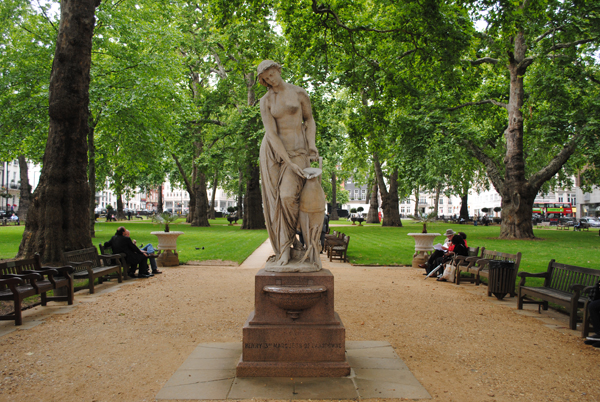
The gardens, which feature some of the city’s oldest London Plane trees (dating from 1789), have a pump house at the centre which was built in 1800 and is now Grade II listed (it stands on the site of an earlier equestrian statue of King George III). Other features including the statue Lady of Sumaria (Water Carrier) – pictured above – which was made by Pre-Raphaelite sculptor Alexander Munro in 1858 and stands at the garden’s southern end.

Among notable buildings which face onto the square are Lansdowne House – located on the south-west corner of the square, it was designed by Robert Adam and now home of the Lansdowne Club – and number 50 Berkeley Square, home of short-lived early 19th century PM George Canning (and said to be the most haunted house in London). The square was also the home of society favorite, Gunter’s Tea Shop, which dated from the mid-1700s.

Famous residents have included wartime PM Sir Winston Church (he lived at number 48 as a child); Horace Walpole, some of the first Prime Minister Robert Walpole (he lived at number 11 during the 1700s), Robert Clive (more famously known as Clive of India, he committed suicide in number 45 in 1774), and the fictional Bertie Wooster and his valet Jeeves (creations of author PG Wodehouse). The square also featured in the famous wartime song, A Nightingale Sang in Berkeley Square.

The square is open from 8am daily with closing times varying based on the season.

10 Historic London Garden Squares…4. St James’s Square…

A quiet square at the heart of the area known as St James, the square’s origins go back to the 1660s when King Charles II granted what was initially a lease (and later the freehold) over a section of St James’s Field to Henry Jermyn, a favourite of King Charles I’s queen Henrietta Maria who was created the 1st Earl of St Alban.

William-IIIThe earl began developing the residential square (the original design had houses on the south-side fronting onto Pall Mall) and, thanks to its proximity to Whitehall and St James’s Palace, quickly attracted some of the who’s who of London to live there.

Indeed it’s said that by the 1720s, seven dukes and seven earls were in residence in the square – other residents included PMs William Pitt the Elder and William Gladstone (both lived in Chatham House, at numbers 9 and 10, albeit at different times) as well as two of James II’s mistresses, Arabella Churchill and Catherine Sedley, who apparently lived at number 21 in the late 1600s.

Among the architects who designed houses around the square were Robert Adam, Sir John Soane, and, in more recent times, Edwin Lutyens.

The square – which reached its final layout, designed by John Nash, around 1854 – remained a desirable place to live even as in the 19th century, some of the houses gave way to financial institutions, private clubs, offices and even lodging houses. These days it’s dominated by business and other institutional organisations.

Organisations located in the square today include the Naval and Military Club (number four – former home of Nancy Astor), the East India Club (number 16) and the London Library (located at number 14, it was founded by Thomas Carlyle in 1841) as well as the international headquarters of BP.

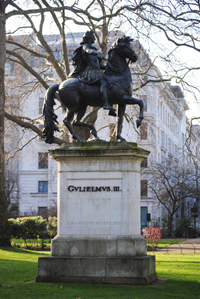
The gardens feature an equestrian statue of King William III at their centre (the work of John Bacon Sr and Jr, it was installed in 1808 and is pictured above). Other monuments include The Stag (located in the south-west corner, it is the work of Marcus Cornish and was installed in 2001) and, just outside the garden railings in the north-east corner, a memorial to WPC Yvonne Fletcher who was killed when a gun was fired from the Libyan Embassy (known as the Libyan People’s Bureau, it was located at number 5) during a demonstration on 17th April, 1984. The pavilion on the south side was designed by John Nash.

The gardens are private – managed by the St James’s Square Trust – but open to the public on weekdays from 10am to 4.30pm.

LondonLife – Paternoster Square from St Paul’s…

Paternoster-Square

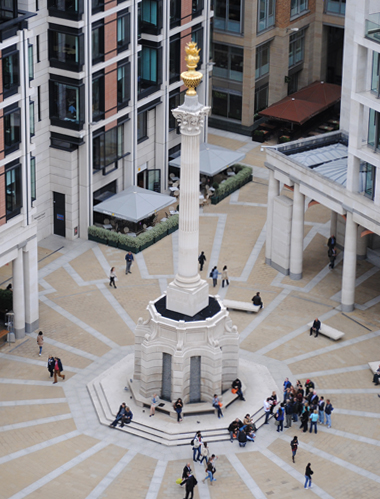
Looking down on Paternoster Square from St Paul’s Cathedral. The 23.3 metre tall pillar at the centre of the square is the  Paternoster Square Column. Designed by architects Whitfield Partners (responsible for the square’s redevelopment in the early 2000s) and topped by a gilded copper urn with flames coming out of the top, it serves as a ventilation shaft for a carpark underneath. The redevelopment of the square – home to the London Stock Exchange since 2004 – followed an earlier redevelopment in the 1960s (needed after aerial bombing destroyed the area in World War II, the second time the area had been destroyed – the first was when the Great Fire of London swept through in 1666). The square takes it name from Paternoster Row which once ran through it. For more, see www.paternostersquare.info.

PICTURE: David Adams

LondonLife: Clouds at St Pancras…

TerraceWires

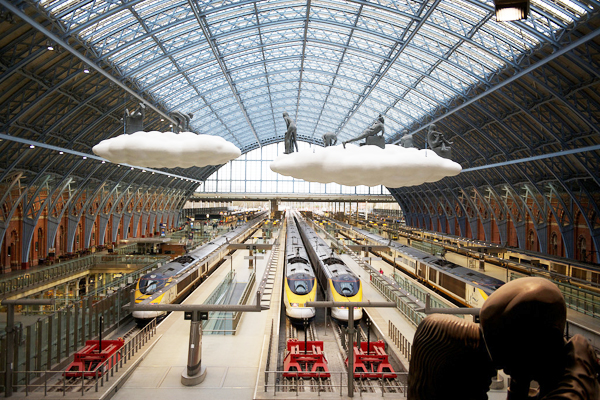
Lucy and Jorge Orta’s sculpture Cloud: Meteoros is the first sculpture to be unveiled for the ‘Terrace Wires’ project at St Pancras International. The sculpture, which hangs on wires from the station’s roof, features two clouds hovering over the station floor on which figures can be seen looking down. Says artist Lucy Orta: “Our sculpture is symbol the space in between: that of the daily routines of the millions of passengers and visitors to the station and the freedom of our imagination, daydreams – looking up to the sky.” The sculpture will remain in place for the rest of the year. For more on art at St Pancras, see http://stpancras.com/art/ and www.terracewires.comPICTURE: Sam Lane/HS1 Ltd.


10 Historic London Garden Squares…2. Parliament Square

Located in one of the most prominent sites in London, Parliament Square is these days perhaps best known as a protest site for those wanting to attract Parliament’s eye. And while, unlike say, Trafalgar Square, many visitors to London may not know its name, its proximity to the Houses of Parliament, Whitehall, Westminster Bridge and Westminster Abbey means it’s rarely off anyone’s tourist agenda.

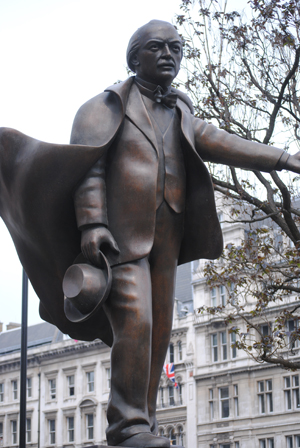
David-Lloyd-GeorgeThe history of the square goes back to 1868 when architect Sir Charles Barry (responsible for the design of the Houses of Parliament) designed a square to improve traffic flow in the area (and demolished many buildings – apparently the area was a slum – in the process).

The roads around the square featured London’s first traffic signals (it used semaphore arms rather than lights and was installed at the meeting of Great George and Bridge Streets) and in addition the square was originally the location for the Buxton Memorial Fountain which moved to its present position in Victoria Tower Gardens in 1940 (see our earlier post on the fountain here). In 1950, the entire square was redesigned by architect George Grey Wornum.

The square is home to a plethora of statues including former PMs Sir Winston Churchill, a relatively recent statue of David Lloyd George (pictured), Sir Robert Peel (also the founder of the Metropolitan Police Force – see our earlier post here), Benjamin Disraeli, the Earl of Derby and Lord Palmerston as well as South African PM Jan Christian Smuts and, (if you count the space in front of Middlesex Guildhall), US President Abraham Lincoln (a replica of a statue in Lincoln Park, Chicago) and former Foreign Secretary and PM George Canning. Among the last statues added was a nine foot high bronze figure of Nelson Mandela which was placed in the square in 2007 after an unsuccessful push to have it located in Trafalgar Square.

Among the most high profile of protests to have been held there is that of the late peace campaigner Brian Haw who camped on the square for 10 years until 2010. Among the most recent protests this year has been a colourful demonstration by beekeepers, calling for a ban on pesticides.

For more on London’s statues, see Peter Matthews’ London’s Statues and Monuments.

Around London – Workhouse life; funds needed for Salter statues; and Saloua Raouda Choucair at the Tate…

Life as an inmate inside a Victorian workhouse is explored in an exhibition at the Florence Nightingale Museum in Lambeth Palace Road. The exhibition, Workhouse – Segregated Lives, examines the design of the workhouses as well as the inmate’s diet, work and health while living there. Rare artefacts, firsthand accounts, pictorial representations and publications will all help to bring to life the “world of the workhouse” in this display which opened in February and runs until 5th July. There’s a program of events accompanying the exhibition including lectures by historians looking at subjects like the food served in the workhouse and how to find your workhouse ancestors. Admission charges apply. For more, see www.florence-nightingale.co.uk.

The Salter Statues campaign is appealing for funds for a new statue of former Bermondsey resident Dr Albert Salter after a famous statue of the doctor, known for his work with the area’s poor in the early part of the 20th century, was stolen from its location on Bermondsey Wall in 2011. A fundraising campaign has so far raised more than £16,000 with Southwark Council matching all donations made but £100,000 is needed. As well as a replacement statue of Dr Salter, the funds will also be used to buy a new statue of his wife, Ada, who was the first female Labour councillor in London. The new statues have been designed by artist Diane Gorvin, sculptor of the original group of statues which were erected in 1991 and, as well as the seated statue of Dr Salter, also included the couple’s daughter Joyce – who died aged eight of scarlet fever – and her cat (the statues of Joyce and her cat were removed after the theft and are being held in safekeeping). Donations can be made via www.salterstatues.co.uk.

The community of a residential complex at the former Arsenal football stadium in North London – Highbury Stadium Square – comes under examination in a new exhibition running at the Geffrye Museum in Hoxton. Photographer Simone Novotny, who is a resident of the complex herself, looks at the lives and stories of residents in 30 of the 700 new homes in a series of intimate portraits. Runs until 26th August. Admission charge applies. See www.geffrye-museum.org.uk for more.

On Now: Saloua Raouda Choucair. This exhibition at the Tate Modern on South Bank is the first major museum exhibition of the works of Lebanese artist Saloua Raouda Choucair and consists of more than 120 works – many of which have never been seen before – including paintings, sculptures and other objects. The Beirut-born artist, now aged 97-years-old, is credited as being a pioneer of abstract art in the Middle East and her works reflect her diverse interests in science, maths, Islamic art and poetry. Works in display include sculptures in wood, metal, stone and fibreglass (1950s-1980s) as well as early paintings including Self-Portrait (1943) and Paris-Beirut (1948). Runs until 20th October. Admission charge applies. For more, see www.tate.org.uk.

10 Historic London Garden Squares…1. Leicester Square…

In the first of a new Wednesday series looking at historic London garden squares, we take a look at what next to Trafalgar Square, is the most famous square in the entire city – Leicester Square.

Located in the heart of the West End, Leicester Square’s history finds its origins back in the 17th history when Robert Sidney, the 2nd Earl of Leicester acquired property on the site where the square now stands. Then known as St Martin’s Field and located within the parish of St Martin’s, Sidney purchased four acres in 1630 and constructed Leicester House on land now located at the square’s northern end.

Leicester-SquareThe earl raised the ire of locals, however, when – having subsequently fenced off the land to prevent people from wandering on to his property – he enclosed what had previously been common land.

The people appealed to King Charles I who appointed three members of the Privy Council to look at the issue. Their decision? That the earl keep a section of his land open for the use of the parishioners of St Martin’s.

First known as Leicester Field, it was this land which later became known as Leicester Square. Fine homes were built around the square (its proximity to the Royal Court and centre of government made it a desirable place to live for the well-to-do and those seeking influence) with the centre enclosed with rails (it’s pictured here in 1750).

The square’s reputation also had a royal boost when, in 1717/1718, Leicester House became home to Prince George (later King George II) and his wife Princess Caroline along with their court after the prince fell out with his father King George I and was banished from St James’ Palace (this story is recounted in marvellous detail in Lucy Worsley’s terrific book, Courtiers: The Secret History of the Georgian Court).

The prince remained at the house for 10 years and was proclaimed King George II after his father’s death at its gate. Interestingly, King George II’s eldest son, Prince Frederick, also lived here for a time after he too fell out with his father (King George II). Apparently their relationship was even worse than the previous generation’s had been.

Despite its royal attractions, even at this stage the square apparently had it’s darker side with some less than savoury characters attending the hotels and livery stables that were built there. But things were to get worse as the wealthy moved out – a situation not helped when Leicester House was demolished in the 1790s.

Leicester Square became known as an entertainment venue in the 19th century (among attractions was the short-lived Royal Panopticon of Science and Art which showcased the best in science and art and Wyld’s Great Globe which contained a gigantic model of the earth) and received a new injection of life when theatres and music halls moved in, bringing the crowds back with them.

Shakespeare-StatueMeanwhile, the status of the square – and whether it could be built upon – remained a matter of debate well into the 19th century. That ended in 1874 when businessman Albert Grant bought the freehold of the land, had the garden created upon it and then donated it to the Metropolitan Board of Works as a gift to the city.

Responsibility for the management of the square now rests with the City of Westminster. The square area – which is now known for hosting film premieres as well as the tourists who inevitably gather there – was pedestrianised in the 1980s and has just undergone a redevelopment and modernisation which was unveiled last year.

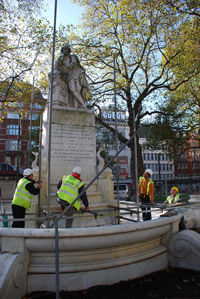
Meanwhile, work to restore the 19th century Shakespeare statue and fountain in the square’s centre is about to be completed (pictured). The square also contains a statue of actor Charlie Chaplin in the square as well as busts of scientist Sir Isaac Newton, painter and first president of the royal Academy Sir Joshua Reynolds, 18th century pioneer surgeon John Hunter, and painter William Hogarth.

The tradition of the entertainment continues in the modern era through the cinemas which now stand in the square and regularly host film premieres (an interesting, if oft-repeated, film-related anecdote connected to the square is that it was in a phone booth located at the square that during the 1960s a young actor Maurice Micklewhite saw a poster for The Caine Mutiny and decided to change his name to Michael Caine).

PICTURES (top) Wikipedia and (below) City of Westminster.

10 of London’s greatest Victorian projects – 10. The final wrap-up…

For the final in our series on 10 of London’s greatest Victorian projects, we’re taking a quick look at some of the great Victorian projects that we’ve previously examined on Exploring London…

Tower Bridge – An eight year project which opened in 1894. For more, see our earlier post, Treasures of London – Tower Bridge.

Albert Memorial – Completed in 1876, the memorial to the Prince Consort is a masterpiece of the Gothic Revival style. For more, see Curious London memorials – 2. The Albert Memorial.

Trafalgar Square – While plans were drawn up by John Nash, it was Sir Charles Barry who designed the basic layout we see today. See our earlier post – What’s in a Name?…Trafalgar Square for more.

You can see all the previous entries in this series here.

What do you think is the most iconic Victorian building in London?

Lost London – Euston Arch…

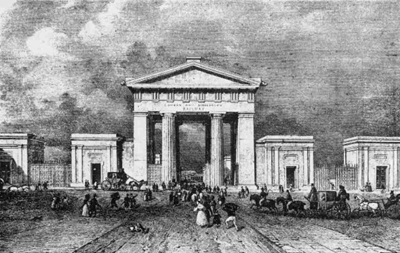
The original entrance to Euston Station, Euston Arch was not so much an arch as a colonnaded monumental gateway, formally known as a propylaeum, which resembled the entrance to a Greek temple.

Euston-ArchBuilt in 1837 (pictured here in 1851), it was designed by architect Philip Hardwick and inspired by the ancient architecture he had encountered on a trip to Europe – in particular the grand entrance to the Acropolis in Athens.

Commissioned by the London and Birmingham Railway as the grand entrance to the company’s new station then facing on to Euston Square (the site is now covered by the station structure), it was designed to complement the existing structure which had been built at the other end of the line in Curzon Street Station in Birmingham.

The building, which rose to a height of 21.5 metres and was built from Yorkshire-sourced sandstone, featured four columns behind which stood large iron gates. Rather controversial even when built, it led to an apparently unexciting courtyard lined with offices. There were lodges to either side.

While there had been a couple of proposals to relocate the arch – particularly after notice was given in 1960 that it would be demolished so the station could be rebuilt – none of the proposals came to fruition, and despite some intense last minute lobbying to preserve the arch by conservationists (among those lobbying were poet Sir John Betjeman and architectural scholar Sir Nikolaus Pevsner), demolition – viewed by some as an “architectural crime” – started in December 1961.

While sections of the arch was subsequently used as fill in the Prescott Channel in East London (numerous sections have since been recovered from the water), the main gates were saved and given to the National Railway Museum in York.

There has been talk of rebuilding the arch particularly since the formation of the Euston Arch Trust in 1994 (the patron of which is Michael Palin) with the aim of reusing some of the lost stonework. While rebuilding hasn’t yet eventuated, the proposed redevelopment of Euston Station in more recent years has given the project new impetus.

PICTURE: Wikipedia.

Dr Livingstone honoured; David Bowie at the V&A; Damian Lewis receives Freedom; pocket parks; and, try a new sport…

The President of Malawi, Joyce Banda, attending a wreath-laying ceremony at Westminster Abbey on Tuesday night to mark the bicentenary of the birth of Scottish missionary and explorer Dr David Livingstone. The ceremony took place at the grave of Dr Livingstone – his body was repatriated to London following his death in Zambia in 1873 from malaria and dysentery. The Very Reverand Dr John Hall, the Dean of Westminster, said the ceremony honored a “Scot of humble origins, but clear determination and courage”. “140 years after his death, he remains respected throughout these islands, and especially in Africa, where, for 30 years, he laboured to spread the Gospel, to explore the land’s secrets, and to map what he discovered,” he said. “Treating all people as his equals, he worked to abolish the slave trade in Africa.” Livingstone conducted several expeditions into the interior of Africa – while they included a failed attempt to find the source of the Nile, he is credited with documenting numerous geographical features including Victoria Falls (he named it after Queen Victoria) and Lake Malawi. Celebrated as a hero of the Victorian age, his meeting with Henry Stanley in October 1871 – Stanley had been sent to find him after he had lost contact with the outside world – gave rise to the expression “Dr Livingstone, I presume?” (though whether he actually said the phrase remains a matter of debate).

A landmark exhibition on the career of David Bowie opens at the V&A on Saturday. David Bowie is features more than 300 objects including handwritten lyrics, costumes, photographs, films, Bowie’s instruments and album artwork selected by the V&A’s theatre and performance curators, Victoria Broackes and Geoffrey Marsh. The exhibition takes an in-depth look at Bowie’s music and how it and his “radical individualism” has influenced and been influenced by wider movements in art, design and contemporary culture. Among the more than 60 costumes on display will be a Ziggy Stardust bodysuit (1972) and costumes made for the 1973 Aladdin Sane tour as well as some of Bowie’s own sketches, musical scores and diary entries. This exhibition, which is sponsored by Gucci and Sennheiser,  runs until 11th August. Admission charge applies. For more, see www.vam.ac.uk/davidbowieis.

Homeland star Damian Lewis has received the Freedom of the City of London in a ceremony at Guildhall on Tuesday in recognition of his “outstanding achievements in acting”. Lewis, who graduated from the City of London’s Guildhall School of Music & Drama in 1993, has appeared in The Forsyte Saga, US mini-series Band of Brothers and, of course, in Homeland. Interestingly, his maternal grandfather, Sir Ian Bowater, was Lord Mayor of the City of London from 1938 to 1939. For more, see www.cityoflondon.gov.au.

Work is underway on the first of the Mayor of London, Boris Johnson’s, “pocket parks”. The size of a tennis court, the pocket parks are set to “reinvent some of London’s forgotten nooks and crannies”. Among the first will be an edible park featuring vegetable, herbs, fruit trees and hops located on ‘dead space’ behind a Stockwell bus stop (the hops will be sold to the Brixton Beer Cooperative). All 100 of the pocket parks will be finished by March 2015 at a cost of £2 million. For more, see www.london.gov.uk/priorities/environment/greening-london/parks-green-spaces/pocket-parks.

It’s the chance to try a new sport for the first time in a day of free games and activities which will be held at the Queen Mother Sports Centre in Vauxhall Bridge Road on Saturday. From 10am to 3pm, visitors will be able to try a range of different sporting activities including football, basketball and swimming with athletes and coaches on hand to offer advice. For more, see www.westminster.gov.uk.