10 Historic London Garden Squares…1. Leicester Square…

In the first of a new Wednesday series looking at historic London garden squares, we take a look at what next to Trafalgar Square, is the most famous square in the entire city – Leicester Square.

Located in the heart of the West End, Leicester Square’s history finds its origins back in the 17th history when Robert Sidney, the 2nd Earl of Leicester acquired property on the site where the square now stands. Then known as St Martin’s Field and located within the parish of St Martin’s, Sidney purchased four acres in 1630 and constructed Leicester House on land now located at the square’s northern end.

Leicester-SquareThe earl raised the ire of locals, however, when – having subsequently fenced off the land to prevent people from wandering on to his property – he enclosed what had previously been common land.

The people appealed to King Charles I who appointed three members of the Privy Council to look at the issue. Their decision? That the earl keep a section of his land open for the use of the parishioners of St Martin’s.

First known as Leicester Field, it was this land which later became known as Leicester Square. Fine homes were built around the square (its proximity to the Royal Court and centre of government made it a desirable place to live for the well-to-do and those seeking influence) with the centre enclosed with rails (it’s pictured here in 1750).

The square’s reputation also had a royal boost when, in 1717/1718, Leicester House became home to Prince George (later King George II) and his wife Princess Caroline along with their court after the prince fell out with his father King George I and was banished from St James’ Palace (this story is recounted in marvellous detail in Lucy Worsley’s terrific book, Courtiers: The Secret History of the Georgian Court).

The prince remained at the house for 10 years and was proclaimed King George II after his father’s death at its gate. Interestingly, King George II’s eldest son, Prince Frederick, also lived here for a time after he too fell out with his father (King George II). Apparently their relationship was even worse than the previous generation’s had been.

Despite its royal attractions, even at this stage the square apparently had it’s darker side with some less than savoury characters attending the hotels and livery stables that were built there. But things were to get worse as the wealthy moved out – a situation not helped when Leicester House was demolished in the 1790s.

Leicester Square became known as an entertainment venue in the 19th century (among attractions was the short-lived Royal Panopticon of Science and Art which showcased the best in science and art and Wyld’s Great Globe which contained a gigantic model of the earth) and received a new injection of life when theatres and music halls moved in, bringing the crowds back with them.

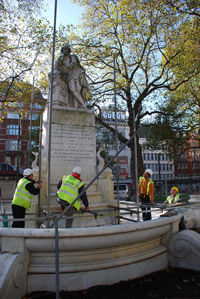
Shakespeare-StatueMeanwhile, the status of the square – and whether it could be built upon – remained a matter of debate well into the 19th century. That ended in 1874 when businessman Albert Grant bought the freehold of the land, had the garden created upon it and then donated it to the Metropolitan Board of Works as a gift to the city.

Responsibility for the management of the square now rests with the City of Westminster. The square area – which is now known for hosting film premieres as well as the tourists who inevitably gather there – was pedestrianised in the 1980s and has just undergone a redevelopment and modernisation which was unveiled last year.

Meanwhile, work to restore the 19th century Shakespeare statue and fountain in the square’s centre is about to be completed (pictured). The square also contains a statue of actor Charlie Chaplin in the square as well as busts of scientist Sir Isaac Newton, painter and first president of the royal Academy Sir Joshua Reynolds, 18th century pioneer surgeon John Hunter, and painter William Hogarth.

The tradition of the entertainment continues in the modern era through the cinemas which now stand in the square and regularly host film premieres (an interesting, if oft-repeated, film-related anecdote connected to the square is that it was in a phone booth located at the square that during the 1960s a young actor Maurice Micklewhite saw a poster for The Caine Mutiny and decided to change his name to Michael Caine).

PICTURES (top) Wikipedia and (below) City of Westminster.

10 of London’s greatest Victorian projects – 10. The final wrap-up…

For the final in our series on 10 of London’s greatest Victorian projects, we’re taking a quick look at some of the great Victorian projects that we’ve previously examined on Exploring London…

Tower Bridge – An eight year project which opened in 1894. For more, see our earlier post, Treasures of London – Tower Bridge.

Albert Memorial – Completed in 1876, the memorial to the Prince Consort is a masterpiece of the Gothic Revival style. For more, see Curious London memorials – 2. The Albert Memorial.

Trafalgar Square – While plans were drawn up by John Nash, it was Sir Charles Barry who designed the basic layout we see today. See our earlier post – What’s in a Name?…Trafalgar Square for more.

You can see all the previous entries in this series here.

What do you think is the most iconic Victorian building in London?

Lost London – Euston Arch…

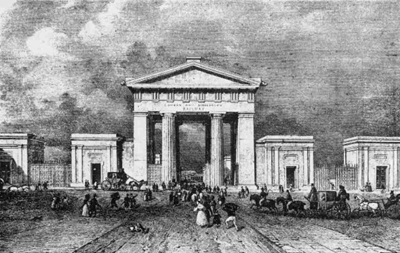
The original entrance to Euston Station, Euston Arch was not so much an arch as a colonnaded monumental gateway, formally known as a propylaeum, which resembled the entrance to a Greek temple.

Euston-ArchBuilt in 1837 (pictured here in 1851), it was designed by architect Philip Hardwick and inspired by the ancient architecture he had encountered on a trip to Europe – in particular the grand entrance to the Acropolis in Athens.

Commissioned by the London and Birmingham Railway as the grand entrance to the company’s new station then facing on to Euston Square (the site is now covered by the station structure), it was designed to complement the existing structure which had been built at the other end of the line in Curzon Street Station in Birmingham.

The building, which rose to a height of 21.5 metres and was built from Yorkshire-sourced sandstone, featured four columns behind which stood large iron gates. Rather controversial even when built, it led to an apparently unexciting courtyard lined with offices. There were lodges to either side.

While there had been a couple of proposals to relocate the arch – particularly after notice was given in 1960 that it would be demolished so the station could be rebuilt – none of the proposals came to fruition, and despite some intense last minute lobbying to preserve the arch by conservationists (among those lobbying were poet Sir John Betjeman and architectural scholar Sir Nikolaus Pevsner), demolition – viewed by some as an “architectural crime” – started in December 1961.

While sections of the arch was subsequently used as fill in the Prescott Channel in East London (numerous sections have since been recovered from the water), the main gates were saved and given to the National Railway Museum in York.

There has been talk of rebuilding the arch particularly since the formation of the Euston Arch Trust in 1994 (the patron of which is Michael Palin) with the aim of reusing some of the lost stonework. While rebuilding hasn’t yet eventuated, the proposed redevelopment of Euston Station in more recent years has given the project new impetus.

PICTURE: Wikipedia.

Dr Livingstone honoured; David Bowie at the V&A; Damian Lewis receives Freedom; pocket parks; and, try a new sport…

The President of Malawi, Joyce Banda, attending a wreath-laying ceremony at Westminster Abbey on Tuesday night to mark the bicentenary of the birth of Scottish missionary and explorer Dr David Livingstone. The ceremony took place at the grave of Dr Livingstone – his body was repatriated to London following his death in Zambia in 1873 from malaria and dysentery. The Very Reverand Dr John Hall, the Dean of Westminster, said the ceremony honored a “Scot of humble origins, but clear determination and courage”. “140 years after his death, he remains respected throughout these islands, and especially in Africa, where, for 30 years, he laboured to spread the Gospel, to explore the land’s secrets, and to map what he discovered,” he said. “Treating all people as his equals, he worked to abolish the slave trade in Africa.” Livingstone conducted several expeditions into the interior of Africa – while they included a failed attempt to find the source of the Nile, he is credited with documenting numerous geographical features including Victoria Falls (he named it after Queen Victoria) and Lake Malawi. Celebrated as a hero of the Victorian age, his meeting with Henry Stanley in October 1871 – Stanley had been sent to find him after he had lost contact with the outside world – gave rise to the expression “Dr Livingstone, I presume?” (though whether he actually said the phrase remains a matter of debate).

A landmark exhibition on the career of David Bowie opens at the V&A on Saturday. David Bowie is features more than 300 objects including handwritten lyrics, costumes, photographs, films, Bowie’s instruments and album artwork selected by the V&A’s theatre and performance curators, Victoria Broackes and Geoffrey Marsh. The exhibition takes an in-depth look at Bowie’s music and how it and his “radical individualism” has influenced and been influenced by wider movements in art, design and contemporary culture. Among the more than 60 costumes on display will be a Ziggy Stardust bodysuit (1972) and costumes made for the 1973 Aladdin Sane tour as well as some of Bowie’s own sketches, musical scores and diary entries. This exhibition, which is sponsored by Gucci and Sennheiser,  runs until 11th August. Admission charge applies. For more, see www.vam.ac.uk/davidbowieis.

Homeland star Damian Lewis has received the Freedom of the City of London in a ceremony at Guildhall on Tuesday in recognition of his “outstanding achievements in acting”. Lewis, who graduated from the City of London’s Guildhall School of Music & Drama in 1993, has appeared in The Forsyte Saga, US mini-series Band of Brothers and, of course, in Homeland. Interestingly, his maternal grandfather, Sir Ian Bowater, was Lord Mayor of the City of London from 1938 to 1939. For more, see www.cityoflondon.gov.au.

Work is underway on the first of the Mayor of London, Boris Johnson’s, “pocket parks”. The size of a tennis court, the pocket parks are set to “reinvent some of London’s forgotten nooks and crannies”. Among the first will be an edible park featuring vegetable, herbs, fruit trees and hops located on ‘dead space’ behind a Stockwell bus stop (the hops will be sold to the Brixton Beer Cooperative). All 100 of the pocket parks will be finished by March 2015 at a cost of £2 million. For more, see www.london.gov.uk/priorities/environment/greening-london/parks-green-spaces/pocket-parks.

It’s the chance to try a new sport for the first time in a day of free games and activities which will be held at the Queen Mother Sports Centre in Vauxhall Bridge Road on Saturday. From 10am to 3pm, visitors will be able to try a range of different sporting activities including football, basketball and swimming with athletes and coaches on hand to offer advice. For more, see www.westminster.gov.uk.

Where is it?…#60…

Where-is-it--#60
Can you identify where in London this picture was taken and what it’s of? If you think you can, leave a comment below. We’ll reveal the answer early next week. Good luck!

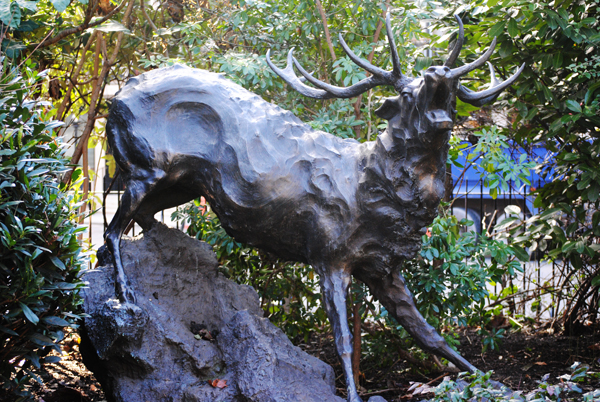
Well done to Jameson, this is indeed located in St James’s Square. Called – rather aptly – Stag, the sculpture dates from 2001 and is the work of Marcus Cornish. The larger-than-life bronze sculpture is located in the south-west corner of the West End square. For more on the work of Mr Cornish, see www.marcuscornish.com. Other statues in the square include an equestrian statue of King William III, the work of John Bacon Senior and Junior, which was installed in 1808.

LondonLife – Yuri Gagarin relocates to Greenwich…

Elena-Gagarina-and-Dr-Kevin-Fewster

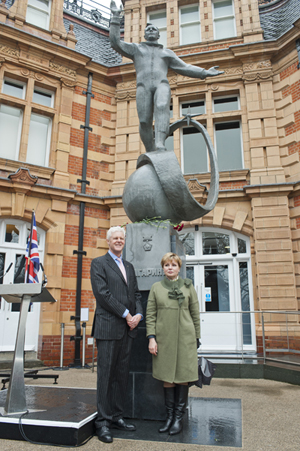
A statue of Russian cosmonaut and first man in space Yuri Gagarin has been relocated to the newly named Yuri Gagarin Terrace outside the Royal Observatory in Greenwich. First unveiled in The Mall, not far from Admiralty Arch, on 14th July 2011, the statue was a gift from the Russian federal space agency, Roscosmos, to mark the 50th anniversary of manned space flight (you can read more at our earlier post here). But it was only granted permission to remain on the site for 15 months and so has now been relocated to Greenwich where it as officially unveiled last Thursday in the week of Gagarin’s birthday by his daughter Elena Gagarina (pictured here with Royal Museums Greenwich director Dr Kevin Fewster). The statue – a 3.5 metre high zinc alloy figure – shows Gagarin dressed in a spacesuit and standing on a globe. It stands just outside the observatory’s Astronomy Centre. For more on the Royal Observatory Greenwich – the “home” of Greenwich Mean Time, see www.rmg.co.uk.

Famous Londoners – Jane Austen…

It’s probably a bit of a stretch to call Jane Austen a ‘famous Londoner’ (although the city does make a fairly regular appearance in her books) but she did have some strong associations. Given the 200th anniversary of Pride and Prejudice earlier this year, we thought it was only fitting to take a quick look at a five places associated with the author in London…

10 Henrietta Street, Covent Garden: Austen stayed in a flat here during the summer of 1813 and during March 1814. The premises was the home of her older brother Henry, then a banker, who moved here after the death of his wife Eliza. While here, Austen visited theatres including The Lyceum and The Theatre Royal, Drury Lane. The building is now occupied by offices.

23 Hans Place, Belgravia: The home of her brother Henry (after he moved from Covent Garden), Austen lived for two years in a house here in 1814-15 and is said to have particularly enjoyed the garden. The current building on the site apparently dates from later in the 19th century. There’s a blue plaque located on the house.

50 Albemarle Street, Mayfair: The former office of publishers John Murray who counted Austen among their first clients were located here.

Westminster Abbey: Austen is not buried here but in Winchester Cathedral. However, you will find a small memorial to her in Poet’s Corner, put here in 1967. It simply reads ‘Jane Austen 1775-1817’.

The British Library, St PancrasAusten’s rather tiny writing desk can be found here, usually on display in the Sir John Ritblat Gallery. It was donated to the library in 1999 by her Canadian descendents.

10 of London’s greatest Victorian projects – 6. Victoria and Albert Embankments…

We’ve already mentioned these two riverside embankments as part of our previous piece on Sir Joseph Bazalgette’s revolutionary sewer system. But so important are they to the shape of central London today – not to mention a great place to take a stroll – that we thought they’re also worth a mention in their own right.

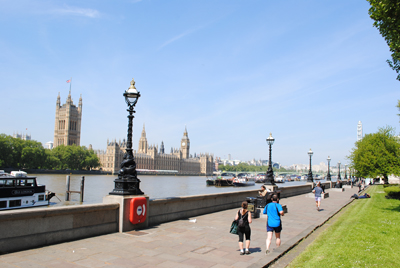
Albert-EmbankmentAs mentioned, the Victoria and Albert Embankments (the latter is pictured right) – named, of course, for Queen Victoria and her by then late consort, Prince Albert, who had died in 1861 (see our previous post What’s in a name?…Victoria Embankment) – were located on opposite sides of the River Thames and involved reclaiming a considerable amount of the river so new sewers could be laid.

Construction of Victoria Embankment – which was also seen as a way to relieve traffic congestion in the central London area – started in the mid 1860s and was complete by 1870. Running along the north and western banks of the Thames between Westminster and Blackfriars bridges, its creation involved the demolition of many riverside buildings as a new walk and roadway were constructed behind a wall.

Numerous monuments have since been located along this promenade – they include the Battle of Britain Monument, RAF Memorial and the mis-named Cleopatra’s Needle (see our earlier post to find out why) – as well as a number of permanently berthed ships including the HQS Wellington – the base of the Honorable Company of Master Mariners – and the HMS President.

The walkway also features original decorative lamps – interestingly, Victoria Embankment was the first roadway in London to be permanently lit  by electric-powered lighting (from 1878).

The parks, collectively known as Victoria Embankment Gardens, contain numerous statues and monuments (including one to Bazalgette himself – it’s located close to the intersection with Northumberland Avenue) as well as a bandstand. They also contain the remains of York Watergate – once fronting on to the river, it shows how much land was reclaimed for the project (you can also visit the riverside entrance to Somerset House to gain a feel for where the river once was – look through the glass floor and you’ll see the old riverbank below).

Albert Embankment, meanwhile, runs between Vauxhall and Westminster Bridges on the eastern side of the river. Constructed around the same time as Victoria Embankment, it was designed to prevent flooding of the low-lying areas of Vauxhall and Kennington and to help in Bazalgette’s sewage system plan (although it apparently doesn’t have the same large sewers as can be found on the other side of the river).

Sadly, the demolition did see the centre of what was once the village of Lambeth removed to make way for the new promenade and roadway. But like Victoria Embankment, Albert Embankment features delightfully decorative lamps along the riverfront promenade and is a great place for a walk in any weather.

Where is it?…#58

Where-is-it--#58

Can you identify where in London this picture was taken? If you think you can, leave a comment below. We’ll reveal the answer early next week. Good luck!

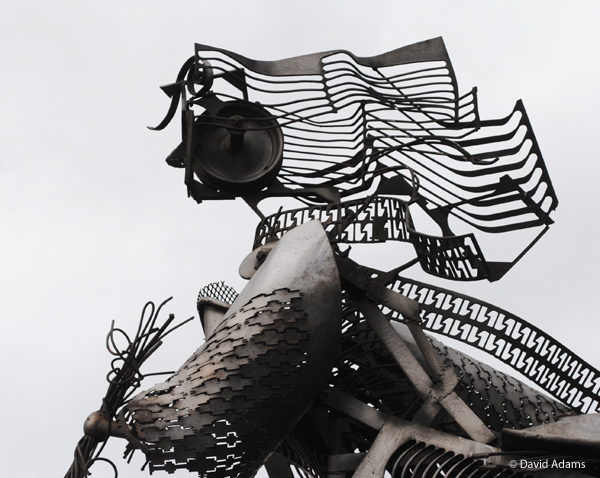
A bit of a harder one this week (so we thought we’d leave a bit longer before giving you the answer!). This is a sculptural figure – aptly named Figurehead for Docklands – which stands at the north-east corner of Poplar Dock in East London. Designed in 1997 by Anna Bisset, it’s made of cast iron and welded steel and was inspired by the idea of ship’s figureheads. Initially put on show at Tidal Basin, Royal Victoria Dock, over the summer of 1995 as part of an outdoor exhibition organised by the University of East London and the London Docklands Development Corporation, it was subsequently purchased by the LLDC and put on permanent display in its current location. For more of Anna Bisset’s work, visit www.annabisset.co.uk.

We’ll post our next Where is it? over the weekend…

Where is it?…#55

Where-is-it--#55

Can you identify where in London this picture was taken? If you think you can, leave a comment below. We’ll reveal the answer early next week. Good luck!

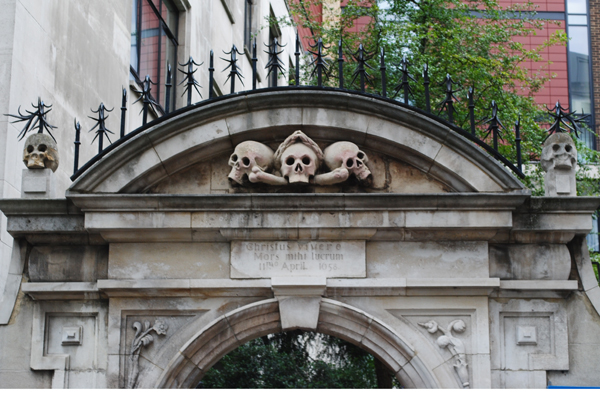
Well done to Jennifer and Parktown, this is indeed the gateway to the church of St Olave Hart Street, located on the corner of Hart Street and Seething Lane in the City of London. The church – which has a history going back to at least the 13th century – is named after St Olaf of Norway and, as mentioned, is indeed, burial place of the diarist Samuel Pepys. Charles Dickens referred to the church as “St Ghastly Grim” thanks to this rather macabre gateway. For more on the history of the church, see our earlier post here.

Where’s London’s oldest…Thames tunnel?

While the Greenwich foot tunnel may these days be more well-known due to the fact it is still open to pedestrians, London’s oldest under-Thames tunnel (also credited as the oldest underwater tunnel in the world) actually runs between Rotherhithe on the river’s southern bank and Wapping on the northern.
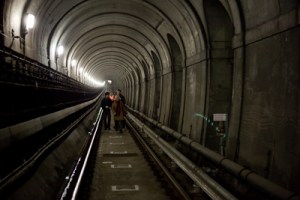
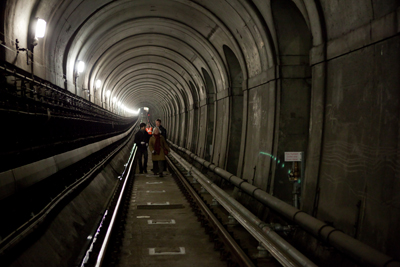
Thames_Tunnel-in-2010First opened in 1843, the Thames Tunnel (pictured left during a brief reopening to pedestrians in 2010) was the first major project of star Victorian engineer (and delightfully named) Isambard Kingdom Brunel (who, at the age of just 19 started work on the job with his father, a French engineer named Marc Isambard Brunel) and was known for a time as the eighth Wonder of the World.

It was constructed after demand grew for a way to transport goods across the crowded Port of London to the east of London Bridge. Given the height of the masts of larger ships, a bridge was deemed impracticable with the ramps required to take wheeled transport to the necessary height far too long (although this problem was overcome at the end of the 1800s by the use of new bascule technology in the construction of Tower Bridge).

Following several failed attempts to dig a tunnel under the Thames, Marc Brunel was given permission to build the new tunnel in the mid 1820s. The project relied on the use of a ‘tunnelling shield’, a then state-of-the-art technological solution to under river tunnelling which had only a few years earlier been patented by Marc Brunel and Thomas Cochrane, and Brunel initially thought the project would only take three years (it ended up taking as many as 18).

Construction by the newly formed Thames Tunnel Company, which had the support of none other than the Duke of Wellington, commenced in early 1825 at the Rotherhithe end. The shield enabled miners to dig out the tunnel while bricklayers came along behind them. While it significantly reduced the risk of a collapse (although several floods still did occur, taking the lives of six men – a fact which didn’t apparently much deter the sightseers who paid for the privilege of seeing the shield in operation), working conditions remained terrible with the men constantly showered with water from the river which was at that time the city’s main sewer. How many died indirectly as a result of working on the project is unknown.
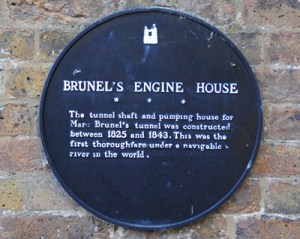
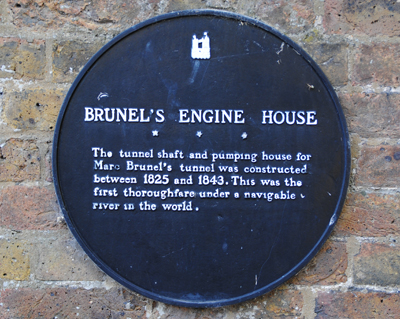
Brunel-plaqueIndeed, such was the stress of the project that Marc Brunel, later knighted for his efforts in building the tunnel, himself suffered a stroke during its construction. Isambard Brunel, who took over as the project’s engineer when the resident engineer fell ill in 1826, himself came close to being killed when he had to flee the flooding tunnel.

After much delay (including seven years in which the unfinished tunnel was left untouched) and several more disasters, the tunnel was finally completed in November, 1841.

After being fitted out with lighting, spiral staircases and roads in the following years, it was finally opened to pedestrians only on 25th March, 1843. While it was originally envisaged that the primary purpose of the tunnel would be to transport goods under the river, this never occurred.

Still, it did capture the public’s attention and as many as 50,000 people walked through the tunnel on the opening day (among the initial visitors to the tunnel was Queen Victoria herself). Within 10 weeks of its opening, a million people (a figure equal to what was then half the population of London) had reportedly passed through it.

Despite the number of people initially using it, however, the tunnel was still not a financial success and over the ensuing years became noted as a gathering place for unsavoury types. In 1865 it was purchased by the East London Railway Company which subsequently incorporated the tunnel into its railway network with both the Wapping and Rotherhithe entrance shafts converted into stations. It later become part of the London Underground network – the  – and since 2010 has been part of the London Overground.

Both stations are still in use and you can get a good sense of what the tunnel was like by riding the overground between Rotherhithe and Wapping. The Brunel Museum in Rotherhithe – actually housed within a building originally used to house machinery for draining the tunnel – see plaque above – is also a great place to find out more about the project and Brunel. Visit www.brunel-museum.org.uk for details.

PICTURES: Top – Lars Plougmann (Wikipedia)/Other – David Adams

For more on the life of Brunel, see Steven Brindle’s Brunel: The Man Who Built the World.
Exploring London’s 10 most popular posts for 2012 – 10 and 9…

And so the countdown begins…

10. LondonLife – Unveiling the Bomber Command Memorial. Marking the unveiled of the much anticipated Bomber Command Memorial in Green Park in late June.

9. Where’s London’s oldest…shop? Part of our series looking at London’s oldest buildings and features, this looked at The Old Curiosity Shop in Portsmouth Street, commonly credited with being London’s oldest shop. The fact that it tied in with the bicentenary of the birth of author Charles Dickens, who wrote a book of the same name, no doubt helped it into our list.

Treasures of London – The Burghers of Calais…

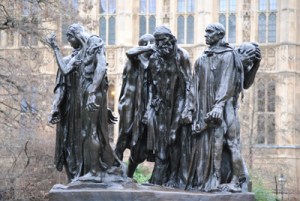
One of 12 casts made of an original which stands in Calais, France, this sculptural group commemorates one of the most poignant moments of the bloody Hundred Years War.

Burghers-of-CalaisThe original work, by the renowned Auguste Rodin who beat five others with his design, was completed in 1889 and stands outside Calais’ town hall. This cast was produced in 1908 and presented to the nation in 1914 by the National Art Collections Fund. It stands in Victoria Tower Gardens, just to the south of the Houses of Parliament in Westminster.

The sculpture commemorates an event which took place in 1347. Calais, then, as now, an important French port, had been besieged by the English for more than a year and, in a desperate situation as the townspeople starved (and despite orders from the French King Philip IV to hold out), the city authorities were seek terms from the English king, Edward III, still flushed with the success of the Battle of Crecy the year before.

Edward’s conditions for their surrender were harsh – six of the city’s leaders had to be handed over and the rest of the city would be spared. But more than that, the six had to leave the city stripped of almost all their clothes, wearing nooses around their necks and carrying the keys to the city and castle.

Six burghers, led by Eustache de Saint Pierre and also including John Daire and brothers James and Peter Wisant, did so and it is the scene of them making their way to King Edward that Rodin has captured. Their bravery was rewarded – while King Edward apparently order them to be beheaded, his pregnant English Queen, Philippa of Hainault, intervened on their behalf and they were spared execution, dressed and fed before they were safely escorted away.

Only 12 casts of the group were ever permitted under French law – the London cast was the third to be made.

Famous Londoners – Gog and Magog…

Regular watchers of London’s Lord Mayor’s Show parade will be familiar with the two giants Gog and Magog who for centuries have been an integral part of the procession. But just who are the two stern figures who strike fear into the hearts of all they pass (well, perhaps not so much the fear)?

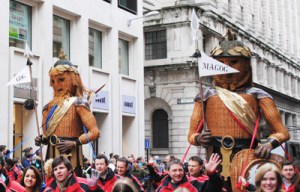
Gog-and-MagogWhile the names Gog and Magog appear several times in different contexts in the Bible came t0 epitomise the enemies of God, legend has it that the Gog and Magog seen in this context were leaders of a race of giants who inhabited Britain in times of prehistory.

Defeated by Brutus, a descendent of the Trojan Aeneas and the founder of London and first king of Britain, they were then chained to the gate of his palace which stood on the site of where Guildhall – home of the City of London Corporation – now stands.

Seen as guardians of the City of London, figures of the giants have been carried in the Lord Mayor’s Show – the annual procession surrounding the election of the new Lord Mayor – since as far back as the reign of King Henry V (originally made of ‘wickerwork and pasteboard’, they were later replaced with wooden ones).

The seven foot high wicker versions of the giants which are now carried in the parade were donated by the Worshipful Company of Basketweavers in 2006 (pictured here in the 2010 parade) and are the just latest in a series of effigies and statues of the two giants which have been associated with Guildhall.

These include pair of nine foot high limewood statues of the giants which currently stand in Guildhall – carved in 1953 by David Evans, they replaced two earlier, 14 foot high oak versions made by Richard Saunders in the early 1700s which were destroyed in the Blitz during World War II. They, in turn, were created to replace earlier papier mache versions.

As well as being found in numerous cities around the world, figures of the two giants also famously feature as the clock’s bell ringers on the facade of the Church of St Dunstan-in-the-West in Fleet Street. The clock, incidentally, was the first public clock in London to have a minute hand.

Where is it?…#51…

The latest in the series in which we ask you to identify where in London this picture was taken and, although this is a little odd this week, what it’s of. If you think you can identify this picture, leave a comment below. We’ll reveal the answer early next week. Good luck!

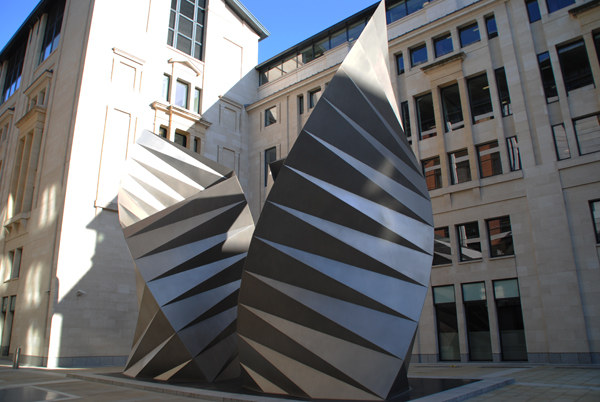
Well done to all those who correctly said this sculpture, Paternoster Vents (although many refer to it as Angel’s Wings), is located in Bishop’s Court, just to the west of Paternoster Square near St Paul’s Cathedral. The work of Thomas Heatherwick (yes, the same man who designed the stunning Olympic cauldron used in this year’s Games), it is actually some beautifully designed cooling vents for an electrical substation underneath. The 11 metre high sculpture takes its design from folded paper and is made from stainless steel.

Where’s London’s oldest…public bust?

You don’t have to go far in London to find a bust of a famous figure from English history but the oldest public bust (that is, located outdoors where passersby can see it) is in fact from Egypt.

Sitting above the entrance to Sotherby’s auction house in New Bond Street, Mayfair, is a bust of Sekhmet, a lion-headed Egyptian goddess of war and healing. The half-statue, made from black basalt, was made around 1,320 BC during the 18th dynasty.

It has been sitting above Sotherby’s entrance since the 1880s when it was sold at auction for £40, but never collected.

Sotherby’s, founded by Samuel Baker in 1744, has operated on the site at 34-35 New Bond Street since 1917 when it moved from its previous home at The Strand.

You might be interested in seeing our earlier entry for London’s oldest full length outdoor statue here

Where is it?…#49

The latest in the series in which we ask you to identify where in London this picture was taken and what it’s of. If you think you can identify this picture, leave a comment below. We’ll reveal the answer early next week. Good luck!

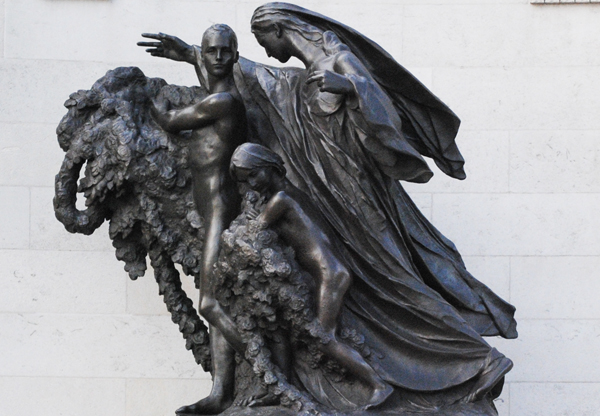
Sunday was Remembrance Day, so we thought it appropriate to have a war memorial as last week’s Where is it? This memorial, located at Victoria Embankment on the north bank of the Thames, is the Anglo-Belgian War Memorial, given in 1920 as a gift to Britain by the people of Belgium as a thank you for their help in providing a refuge in England during World War I. The work of celebrated Belgian sculptor Victor Rosseau, it features three bronze figures – a Belgian mother, a boy and a girl, the latter two carrying garlands – and although you can’t see it in this picture, there’s two figures behind them on the Portland stone surround representing ‘honour’ and ‘liberty’.

Where is it?…#48

The latest in the series in which we ask you to identify where in London this picture was taken and who it’s of. If you think you can identify this picture, leave a comment below. We’ll reveal the answer early next week. Good luck!

Well done to Angelo (and, I suspect the correct location for Mike), this is indeed a bust of Sir Christopher Wren and is located in a loggia outside the Guildhall Art Gallery facing into Guildhall Yard. It and three other larger than life busts of notable Londoners – playwright William Shakespeare, statesman Oliver Cromwell and diarist Samuel Pepys – are all the work of Tim Crawley and were installed when the gallery was completed in 1999. Along with them is a full length statue of Dick Whittington and his famous cat – these are the work of Laurence Tindall.

LondonLife – National Trust founder Octavia Hill honoured at Westminster Abbey…

Social reformer and co-founder of the National Trust Octavia Hill (1838-1912) was honoured at a service at Westminster Abbey earlier this month when a new memorial stone to her was dedicated. Concerned about the impact of development and industrialisation, Hill, who died 100 years ago this year, founded the National Trust with Sir Robert Hunter and Canon Hardwicke Rawnsley in 1895. A Londoner, Hill was also an important figure in the housing reform movement. Among those who attended the service were Simon Jenkins, the chairman of the Trust, and the organisation’s director-general, Dame Fiona Reynolds (pictured). The memorial stone, unveiled by Jenkins in the floor of the nave of the abbey, is made of Purbeck marble and was designed and made by Rory Young. For more on the National Trust, see www.nationaltrust.org.uk. For more on Westminster Abbey, see www.westminster-abbey.org. PICTURE: National Trust Images.

Where’s London’s oldest…bridge over the Thames?

While there’s been a bridge over the River Thames near where London Bridge now stands since Roman times, the bridge which is currently there was built in the early 1970s. To find Greater London’s oldest surviving bridge across the Thames we have to head to Richmond in the city’s west.

The 300 foot long stone arch bridge, made from Portland stone, was built between 1774-77 and replaced a ferry crossing between Richmond to the east and East Twickenham to the west (this had apparently been in operation since shortly after the Norman Conquest and at the time it was discontinued consisted of two vessels – a passenger craft and a ‘horse boat’).

Designed by James Paine and Kenton Couse and built by Thomas Kerr, the bridge features five arches including a 60 foot wide central span which was big enough for larger watercraft and gave the bridge its rather humpbacked appearance. Its construction was privately funded with the £26,000 required to build the bridge partly raised via tontine schemes under which subscribers paid an agreed sum into a fund after which they each receive an annuity, the value of which increases as members of the fund die off.

Initially a toll bridge (the tolls – which were 1/2d for passengers and up to 2s 6d for coaches drawn by six horses – were ended in 1859 when the last tontine shareholder died), the bridge was widened in the late 1930s but – now a Grade I listed structure – remains essentially true to its original design.

It was the eighth bridge to be built across the the Thames in Greater London but is now the oldest still standing (among those which predated it but have been demolished are London Bridge, Westminster Bridge and Blackfriars Bridge) and has been featured in paintings by the likes of  Thomas Rowlandson, John Constable and JMW Turner.