This Week in London – William Shakespeare’s influence; new Fourth Plinth commissions; the car and landscape; and London Stories…

First up, apologies that we were unable to launch our new Wednesday series yesterday due to some technical difficulties (stayed tuned for next week). And now, on with the news…

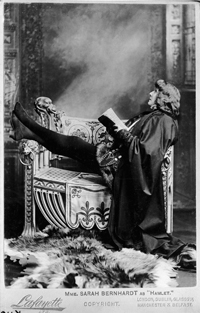
Sarah_Bernhardt_by_Lafayette_Ltd_1899_c__Victoria_and_Albert_Museum_London__William Shakespeare’s influence on successive generations of theatrical performance is the subject of a new exhibition at the V&A to mark the 450th anniversary of his birth on 23rd April. Shakespeare: Greatest Living Playwright centres on the Bard’s First Folio which, published in 1623, contains 36 plays including 18 works – Macbeth, The Tempest and Twelfth Night among them – which would be unknown without it. The display includes interviews, archive footage and photography and objects from the V&A collections as well as an audio-visual presentation by Fifty Nine Productions featuring interviews with contemporary theatre practitioners such as actors, directors and designers. Objects on display include a skull used by Sarah Bernhardt when playing Hamlet in 1899, an embroidered handkerchief used by Ellen Terry when playing Desdemona in 1881 at the Lyceum Theatre, and a pair of red boots worn by actor-manager Henry Irving in an 1887 production of Richard III. Runs in the V&A’s Theatre and Performance Galleries until 21st September. Admission is free. For more, see www.vam.ac.uk. PICTURE: Sarah Bernhardt as Hamlet, 1899, © Victoria and Albert Museum, London.

A skeletal horse and a giant hand giving a thumbs up will adorn the Fourth Plinth in Trafalgar Square during 2015-16. Hans Haacke’s Gift Horse is derived from an etching by painter George Stubbs and, while being a comment on the equestrian statue of King William IV which was intended for the plinth, also features an electronic ribbon displaying a live ticker of the London Stock Exchange on its front leg. Meanwhile David Shrigley’s Really Good is a 10 metre high hand giving a thumbs up – sending a positive message to those who see it. For more, see www.london.gov.uk/priorities/arts-culture/fourth-plinth.

The impact of the car on England’s landscape and the listed buildings of motoring history are the focus of a new exhibition in Wellington Arch. Carscapes: How the Motor Car Reshaped England features archive photographs, historic advertising, cartoons and motoring magazines as well as a 1930s traffic light, a petrol pump and other accessories and memorabilia. Wellington Arch, which is managed by English Heritage, is a fitting location for the exhibition – it was moved to its current position due to increasing traffic back in 1883. Admission charge apply. For more, see www.english-heritage.co.uk.

A new exhibition exploring some of the true and not-so-true stories inspired by and produced in London opens at the London Transport Museum in Covent Garden tomorrow. London Stories features the best entries from The Serco Prize for Illustration 2014 with more than 50 works of art on display depicting a well-known or obscure London narrative. The short-listed illustrations tackle everything from ghost buses to Buffalo Bill’s Wild West Show of 1887, a Pearly King and Queen, Lenin’s ‘Love letter to London’ and an escaped monkey jazz band. There’s also a host of musical and literary references – everything from Mary Poppins to Sweeney Todd and Oranges and Lemons. Tomorrow there will be a late opening of the exhibition complete with cash bar, DJ and story-telling for adults as well as the chance to create your own London story with illustration workshops and a photo-booth. Organised by London Transport Museum in partnership with the Association of Illustrators, it runs until 6th April. Admission charge applies. For more, see www.ltmuseum.co.uk.

Send all items of interest for inclusion to exploringlondon@gmail.com.

This Week in London – Handel and the royals; David Bailey; and, redefining German art…

• A new exhibition exploring German-born George Frideric Handel and his association with the royal family opens at the Foundling Museum in Bloomsbury tomorrow to mark the 300th anniversary of the coronation of King George I. The museum says no composer has been more closely associated with the British monarchy than Handel, whose anthem Zadok the Priest has been performed at every coronation since King George II in 1727 and whose Water Music was performed on the River Thames during the Diamond Jubilee for Queen Elizabeth II in 2012. By George! Handel’s Music for Royal Occasions features treasures from the Gerald Coke Handel Collection and loans from the British Library, the National Portrait Gallery, the British Museum and Westminster Abbey. Runs until 18th May. For more, see www.foundlingmuseum.org.uk.

A landmark exhibition of David Bailey photographs opens at the National Portrait Gallery today. Bailey’s Stardust – one of the gallery’s largest scale photographic exhibitions, it occupies most of the gallery’s ground floor – features more than 250 portraits including a new portrait of Kate Moss and previously unseen images from Bailey’s travels to the Naga Hills in India in 2012. There’s also rooms devoted to portraits of the Rolling Stones and Catherine Bailey, images from Bailey’s trip to Papua New Guinea in 1974 and from east Africa which Bailey visited in 1985 in support of Band Aid. Admission charge applies. Runs until 1st June. For more, see www.npg.org.uk.

A new exhibition at the British Museum explores how six key artists redefined the notion of art in Germany in the Sixties and Seventies. Germany divided: Baselitz and his generation features some 90 works including some 45 by George Baselitz as well as works by Markus Lupertz, Blinky Palermo, AR Penck, Sigmar Polke and Gerhard Richter. Thirty-four of the works, including 17 by Baselitz, have been donated by Count Christian Duerckheim while a loan of some 60 additional works from the Duerckheim Collection makes up the rest of the exhibition. Runs in Room 90 until 31st August. For more, see www.britishmuseum.org.

Send all items of interest for inclusion to exploringlondon@gmail.com.

Famous Londoners – Jonathan Wild…

The self-styled “Thief-Taker General”, Jonathan Wild was one of the most famous figures of London’s underworld in the early 18th century, credited by some as being the city’s first organised crime boss.

Jonathan-WildBorn to a family in Wolverhampton, Wild – who had at some point undertaken an apprenticeship as a buckle-maker – was married and had a son when he first came to London as a servant in 1704 and although he returned to the city of his birth after being dismissed, he apparently abandoned his family and returned to the capital in 1708.

Little is known of the first couple of years he spent in London but records show he was arrested for debt in March 1710 and sent to Wood Street Compter where he quickly ensconced himself and was even awarded the “liberty of the gate” – meaning he could leave the prison at night to aid in the apprehension of thieves.

It was also during this period that he came under the influence of a prostitute Mary Milliner. Upon his release in 1712 – thanks to an Act of Parliament passed to help debtors – he lived with her as her husband (despite his earlier marriage – and hers) in Covent Garden.

Acting as her protector when she was on the street, Wild also branched into the business of being a fence or receiver of stolen goods and racketeering offences like extortion. In 1713, he joined Charles Hitchen to be his assistant. Hitchen, who had been suspended from his position as the City’s Under Marshal thanks to his practice of extorting thieves and their victims (it’s thought he may have taught Wild the craft), was then working as a thief-taker.

Wild apparently took to the new role with fervour for when Hitchen was reappointed to his post as Under Marshal, Wild parted from his company and continued his work as a thief-taker, opening his own office in the Blue Boar Tavern in Little Old Bailey.

Wild’s method of operation was simple enough – he would organise thieves to steal items and then, when it was announced that said items were stolen, claimed to have found them and would return them to the rightful owners for a “reward”. At the same time, he’d often also aid the police by bringing to justice thieves from rival gangs (including Hitchen’s, for they were now rivals) or those of his own gang who had crossed him – and in all his dealings manage to keep at arm’s length from the actual business of stealing and receiving.

By 1718, Wild – who wore a sword as a sign of his authority and had pretensions of being a “squire” – was calling himself the “Thief-Taker General of Great Britain and Ireland”. It’s said that more than 60 thieves were sent to the gallows on the back of his testimony including the prolific housebreaker (and jail escapee) Jack Sheppard and his associate Joseph “Blueskin” Blake (who almost succeeded in killing Wild while he was awaiting trial).

Wild’s pursuit of Sheppard was the beginning of his own downfall (although authorities had as early as 1717 passed an Act of Parliament aimed squarely at ending his criminal enterprise, it seemed to have had little effect, at least initially). Sheppard’s demise had been unpopular with the masses and the press of the day – and in February 1725, Wild himself was arrested for assisting in the jailbreak of one of his gang members. Other members of the gang turned against him and eventually, in May that same year, he was sentenced to death for the theft of lace.

Having unsuccessfully attempted to kill himself by drinking laudanum before his execution, Wild was hanged at Tyburn on 24th May before a large and raucous crowd which apparently included an 18-year-old Henry Fielding.

Wild was buried in secret in the churchyard of St Pancras Old Church next to his third wife (and one of his many lovers), Elizabeth Mann (she had died in 1718 and he apparently married another woman shortly after). His body was later reported to have been dug up and eventually, following the recovery of a body with a hairy chest from the Thames which was identified as being Wild’s, a skeleton said to have been his was donated to the Royal College of Surgeons (it’s now on display in the Hunterian Museum).

The subject of numerous articles, books and ballads, Wild’s story has been since told numerous times and for varying purposes. Among them are Daniel Defoe’s True and Genuine Account of the Life and Actions of the Late Jonathan Wild, published in 1725, Henry’s Fielding’s ironic The History of the Life of the Late Mr Jonathan Wild the Great (1743), and John Gay and John Rich’s The Beggar’s Opera (1728) which features the character Peachum, said to have been based on Wild.

PICTURE: From “Ticket to the Hanging of Jonathan Wild”/Wikimedia Commons

To read more about Jonathan Wild, see Gerald Howson’s Thief-taker General: The Rise and Fall of Jonathan Wild.

What’s in a name?…Limehouse

Limehouse

This part of East London is believed to take its name not from lime trees nor from a house bearing that name. Rather it owes its origins to the process by which chalk shipped from Kent was converted into lime.

The process of ‘lime burning’ – which took place in these parts on the northern bank of the River Thames – involves heating the chalk in a bottle-shaped kiln, also known as an oast. Hence ‘lime oast’ became corrupted into Limehouse.

St-Anne's-LimehouseThe earliest reference to the name comes from the early medieval era but in later centuries the area was noted not so much for its lime-burning but its links with shipping – particularly following the opening on the Limehouse Cut in 1770 which linked the Thames with the River Lea and allowed goods to taken from the north of London directly to ships on the Thames without the need to navigate around the Isle of Dogs (see our earlier post on the Limehouse Cut). Limehouse Basin (pictured above, from the Limehouse Cut) opened in the early 19th century.

The area, which became increasingly industrialised as a result, is also known for its links to the Chinese community – and this included, in the Victorian era, opium dens, but the association ended around the 1950s by which time the Chinese community had largely moved to Soho (where Chinatown still stands today).

Among the area’s most prominent buildings are the Nicholas Hawksmoor-designed church, St Anne’s Limehouse (pictured), and the historic pub, The Grapes.

10 fictional character addresses in London – 7. Saffron Hill…

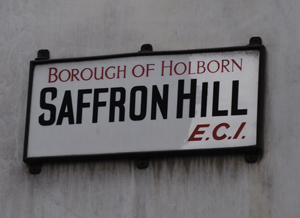
Saffron-Hill2Once at the heart of one of London’s most infamous rookeries or slums, Saffron Hill – located between Holborn and Clerkenwell – is forever associated with Charles Dickens’ 1838 novel, Oliver Twist, and in particular with the arch criminal Fagin.

In the text, Fagin’s den is located “near Field Lane” (the southern extension of Saffron Hill beyond Greville Street) and it is here that Fagin’s young associate, Jack Dawkins (better known as the Artful Dodger), takes Oliver after first encountering him.

As Oliver is led down Saffron Hill, Dickens records his thoughts and it’s worth quoting to get a flavour of the place as he saw it: “A dirtier of more wretched place he had never seen. The street was very narrow and muddy, and the air was impregnated with filthy odours. There were a good many small shops; but the only stock in trade appeared to be heaps of children, who, even at that time of night, were crawling in and out at the doors, or screaming from the inside. The sole places that seemed to prosper amid the general blight of the place, were the public-houses; and in them, the lowest orders of Irish were wrangling with might and main. Covered ways and yards, which here and there diverged from the main street, disclosed little knots of houses, where drunken men and women were positively wallowing in filth; and from several of the door-ways, great ill-looking fellows were cautiously emerging, bound, to all appearance, on no very well-disposed or harmless errands.” (Oliver Twist, p. 55, Vintage, 2007)

Saffron-Hill3Saffron Hill, known as London’s Italian quarter in the 19th century, takes its name from the saffron which was once grown here but which was not to be seen by the time Dickens’ wrote his book. As well as Fagin’s lair, the street is also home to salubrious pub The Three Cripples, Bill Sikes’ favoured watering-hole (The Three Cripples was apparently the name of a lodging house in Saffron Hill during Dickens’ time – it was located next to a pub called The One Tun) .

It’s worth noting that this is only one of many addresses in London associated with Dickens’ characters but the ill-fated Fagin does stand out as one of his most memorable.

PICTURE: Saffron Hill as it is now.

For more on Dickens’ London, check out Alex Werner’s  Dickens’s Victorian London: The Museum of London.

Where’s London’s oldest…public library?

While the designation of London’s oldest public library depends on your definition, for the purposes of this article we’re awarding the title to the Guildhall Library.

Its origins go back to about 1425 when town clerk John Carpenter and John Coventry founded a library – believed to initially consist of theological books for students, according to the terms of the will of former Lord Mayor, Richard (Dick) Whittington (for more on him, see our previous post here).

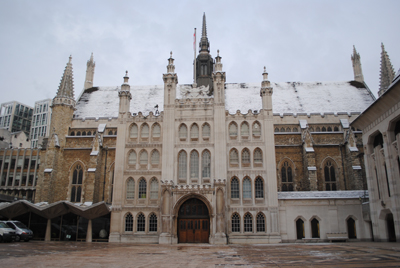
Guildhall2Housed in Guildhall (pictured above), this library apparently came to an end in the mid-1500s when Edward Seymour, the Duke of Somerset and Lord Protector for the young King Edward VI, apparently had the entire collection loaded onto carts and taken to Somerset House. They were not returned and only one of the library’s original texts, a 13th century metrical Latin version of the Bible, is in the library today.

Some 300 years passed until the library was re-established by the City of London Corporation. Reopened in  1828, it was initially reserved for members of the Corporation but the membership was soon expanded to include”literary men”.

By the 1870s, when the collection included some 60,000 books related to London, the library moved into a new purpose-built building, located to the east of Guildhall. Designed by City architect Horace Jones, it opened to the public in 1873.

The library lost some 25,000 books during World War II when some of the library’s storerooms were destroyed and after the war, it was decided to build a new library. It opened in 1974 in the west wing of the Guildhall where it remains (entered via Aldermanbury).

Today, the 200,000 item collection includes books, pamphlets, periodicals including the complete London Gazette from 1665 to the present, trade directories and poll books as well as the archive collections such as those of the livery companies, the Stock Exchange and St Paul’s Cathedral and special collections related to the likes of Samuel Pepys, Sir Thomas More, and the Charles Lamb Society.

The library also holds an ongoing series of exhibitions.

Where: Guildhall Library, Aldermanbury; WHEN: 9.30am to 5pm, Monday to Saturday; COST: Entry is free and no membership of registration is required but ID may be required to access rarer books; WEBSITE: www.cityoflondon.gov.uk/things-to-do/visiting-the-city/archives-and-city-history/guildhall-library/Pages/default.aspx.

Famous Londoners – Ben Jonson…

Often noted as the second greatest English dramatist of his generation (after that Shakespeare guy), the playwright Ben Jonson stands tall in his own right as one of the leading literary figures of the late 16th and early 17th century.

Born in 1572, Jonson was educated at Westminster School in London and possibly went on to Cambridge before he started work as a bricklayer with his stepfather and later served as a soldier, fighting with English troops in The Netherlands.

It was on his return to London that he ventured into acting – among his early roles was Hieronimo in Thomas Kyd’s The Spanish Tragedie – and by 1597 he was employed as a playwright.

While one of his early play-writing efforts (The Isle of Dogs, co-written with Thomas Nashe) led to a term of imprisonment in Marshalsea Prison in 1597 (he was also briefly imprison about this time for killing another actor in a duel, escaping a death sentence by pleading “benefit of the clergy”), the following year – 1598 – the production of his play Every Man In His Humour  established his reputation as a dramatist. Shakespeare, whom some suggest was a key rival of Jonson’s during his career – is said to have been among the actors who performed in it.

Further plays followed including Every Man Out Of His Humour (1599), his only tragedy Sejanus (1603), the popular Volpone (1606) and The Alchemist (1610), and Bartholomew Fair (1614) and it was during these years, particularly following the accession of King James I in 1603, that he became an important figure at the royal court).

His political views continued to cause trouble at times – he was again imprisoned in the early 1600s for his writings and was questioned over the Gunpowder Plot after apparently attending an event attended by most of those later found to be co-conspirators – but his move into writing masques for the royal court – saw his star continue to rise.

All up he wrote more than 20 masques for King James and Queen Anne of Denmark including Oberon, The Faery Prince which featured the young Prince Henry, eldest son of King James, in the title role. Many of these masques saw him working with architect Inigo Jones, who designed extravagant sets for the masques,  but their relationship was tense at times.

In 1616 – his reputation well established – Jonson was given a sizeable yearly pension  (some have concluded that as a result he was informally the country’s first Poet Laureate) and published his first collection of works the following year. Noted for his wit, he was also known to have presided over a gathering of his friends and admirers at The Mermaid Tavern and later at the Devil’s Tavern at 2 Fleet Street (Shakespeare was among those he verbally jousted with).

Jonson spent more than a year in his ancestral home of Scotland around 1618 but on his return to London, while still famous, he no longer saw the same level of success as he had earlier – particularly following the death of King James and accession of his son, King Charles I, in 1625.

Jonson married Anne Lewis – there is a record of such a couple marrying at St Magnus-the-Martyr church near London Bridge in 1594 – but their relationship certainly wasn’t always smooth sailing for they spent at least five years of their marriage living separately. It’s believed he had several children, two of whom died while yet young.

Jonson, meanwhile, continued to write up until his death on 6th August, 1637, and is buried in Westminster Abbey (he’s the only person buried upright in the abbey – apparently due to his poverty at the time of his death).

For an indepth look at the life of Ben Jonson, check out Ian Donaldson’s Ben Jonson: A Life.

Famous Londoners – Sir Arthur Conan Doyle…

Given our current Wednesday series, we thought it only fitting that we take a quick look at the life of Scottish-born Sir Arthur Conan Doyle, a physician and author most famous for his creation of fictional detective Sherlock Holmes.

Born in Edinburgh on 12 May, 1859, to a wealthy Irish-Catholic family, Doyle was educated at a Jesuit preparatory school in England before  undertaking a medical degree at the University of Edinburgh. It was there where he met his mentor, Dr Joseph Bell, a figure who at least partly inspired the creation of Holmes, and it was also during his time here that he first began writing – his first short story was The Mystery of Sasassa Valley. Having taken a voyage to the Arctic Circle in the post of ship’s surgeon and worked in Birmingham as a doctor’s assistant, he was awarded a medical degree in 1881 (he became MD in 1885).

His first job after graduation was aboard another ship – this time sailing to Africa – and after the voyage he settled back in England, briefly in Plymouth and then in Portsmouth where he opened his first medical practice. For the next few years, he continued  practising as a doctor while writing and in 1885 married his first wife Louisa Hawkins.

In 1886, he started writing A Study in Scarlet. Introducing Sherlock Holmes and Dr John Watson to the world,  it was eventually published in Beeton’s Christmas Annual in 1888. Doyle went on to write some 60 stories about Holmes over the ensuing years but also wrote other books including historical novels, fantasy and science-fiction stories (The Lost World), romances (The White Company), plays (including one about Sherlock Holmes), poetry and written works which reflected his interest in Spiritualism – an interest which had started while he was at university.

In 1890, having studied opthalmology in Vienna, he established a practice at 2 Upper Wimpole Street, Marylebone, London (the location lies only a short distance from his creation’s famous address at 221b Baker Street) and, with his family, took up residence in Montague Place and later at 12 Tennison Road in South Norwood (marked by a Blue Plaque). But with no patients, he spent his time writing, deciding to kill Holmes off in 1893 but subsequently bringing him back to life after a public outcry. He toured the US in 1894 (other countries he visited during his life included Australia) and later served as a surgeon in the Boer War (1899-1902), for which he was knighted in 1902.

Following the death of his first wife form tuberculosis in 1906 (with whom he had two children), Doyle married Jean Elizabeth Leckie in 1907. Moving to Windlesham in Sussex (it was here Doyle would live for the rest of his life while keeping a flat in London), they had three further children. Meanwhile his interest in Spiritualism continued to grow, particularly following the death of his son, Kingsley, in World War I.

His final 12 stories about Sherlock Holmes were published in 1928 in a compilation called The Casebook of Sherlock Holmes. The following year, despite poor health, he embarked on a Spirtualism tour on the continent but had to break it off and return home to Crowborough, East Sussex, in England. There he died on 7th July, 1930, leaving behind a literary legacy which has continued on unchecked. His grave can be found in Minstead Churchyard in New Forest.

For more on Sherlock Holmes, see our earlier posts Famous Londoners – Sherlock Holmes and 10 fictional character addresses in London – 1. 221b Baker Street….

10 fictional character addresses in London – 1. 221b Baker Street…

221b-Baker-Street

Today we kick off our new Wednesday series with a look at some of the most famous addresses in London where fictional characters once lived. Most, if not all, of the addresses we’ll look at are not fictional in themselves – they do actually exist – but the characters said to have lived there owe their lives solely to the imaginations of their creators and the readers and audiences who have loved and admired them.

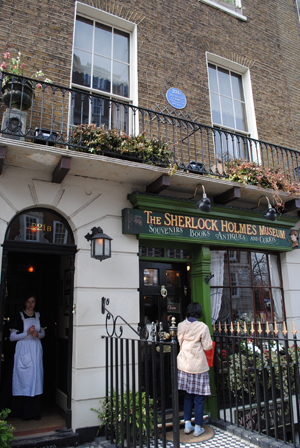
To kick it off, we take a quick look at what is certainly the most visited address of a fictional character in London – 221b Baker Street, the home of Sherlock Holmes and his associate Dr John Watson.

The-Sherlock-Holmes-MuseumWe’ve looked mentioned this Baker Street address in a couple of earlier posts – including a look at the origins of the naming of Baker Street and a piece on Sherlock Holmes himself.

So, to somewhat recap, the writer Sir Arthur Conan Doyle has Holmes and Watson living at this address from 1881 (it becomes their address in the first book featuring them – A Study in Scarlet, published in 1887) to 1904 when Holmes retired (Watson was not a continual presence here, moving in and out a couple of times).

What’s interesting is that the address now belongs to the Sherlock Holmes Museum, although in terms of the other numbers in the street, this is actually located between numbers 237 and 241 (in a street which was, prior to the 1930s, known as Upper Baker Street).

What is now number 221 is a 1930s art deco building formerly known as Abbey House (but this would have been 41 Upper Baker Street in 1887). It was the headquarters of Abbey National which had a long-running dispute with the museum over the right receive mail at the address 221b (since the closure of Abbey House in the early Noughties, the museum has received the mail).

It should be noted that there are also numerous other theories over the ‘real’ location of 221b Baker Street – in particular one which suggests the real address is opposite the former location of Camden House in Baker Street, thanks to a reference in The Empty House.

The museum, which is located in a house built in 1815, is set up as it was in Holmes’ day and contains his first floor study, filled with artefacts relating to the many cases he solved – including his famous pipe as well as his deerstalker hat, magnifying glass, violin, and the wicker chair which was used in Sidney Paget’s famous illustrations.

Other rooms include Dr Watson’s small second floor bedroom and the housekeeper Mrs Hudson’s room.

Worth noting is that there is also reconstruction of Holmes’ study at The Sherlock Holmes pub, located at 10-11 Northumberland Street in Westminster. This had been created for the Festival of Britain in 1951 by the Marylebone Borough Library and Abbey National and was located at Abbey House. For on this, check out the Westminister Libraries & Archives site.

WHERE: The Sherlock Holmes Museum, 221b Baker Street (nearest Tube station is Baker Street);  WHEN: 9.30am to 6pm daily; COST: £8 adults; £5 children (under 16); WEBSITE: www.sherlock-holmes.co.uk.

What’s in a name?…Gracechurch Street…

This central London thoroughfare runs through the heart of the City of London and has been a main thoroughfare since Roman times.

Gracechurch-StreetStretching from Eastcheap (near the Monument) to Leadenhall Street, the street runs over the site of what was Roman London’s forum and basilica (see our earlier post on the Roman buildings here).

The name, meanwhile, comes from the former medieval church of St Benet Gracechurch which was once located on the corner of Gracechurch and Fenchurch Streets.

The church, which was destroyed in the Great Fire of 1666 but rebuilt by Sir Christopher Wren before finally being demolished in 1876, was named for St Benedict (St Benet is a short form) while Gracechurch – which was used after the Great Fire – was a corruption of Grasschurch, a reference to it being located near a hay market (in fact, the church was also known as St Benet Grass). The street was also known as Gracious Street.

Landmarks along Gracechurch Street including the Leadenhall Market (see our earlier post here) and a 30s-inspired modern building of note which stands at number 20.

PICTURE: Looking down Gracechurch Street toward the Monument.

For more on London’s Wren churches, see John Christopher’s Wren’s City of London Churches.

Around London: Nelson and the Navy; Whistler at Dulwich; Eric Coates’ Blue Plaque; childrens’ books at BL…

A new permanent gallery looking at how the Royal Navy shaped individual lives and the course of British history over the 18th century opens at the National Maritime Museum in Greenwich on Monday 21st October, Trafalgar Day. Nelson, Navy, Nation charts a course from the Glorious Revolution of 1688 through to the defeat of Napoleon in 1815 and provides a setting for the museum’s many artefacts related to Vice-Admiral Lord Nelson. Among the 250 objects on display in the gallery are the uniform (with bullet hole) Nelson wore at the Battle of Trafalgar, artworks likes William Hogarth’s Captain Lord George Graham in his Cabin, a seven barreled volley gun and grim items like a surgeon’s tools including an amputation knife, bone saw and bullet forceps. There is also the last letter Nelson wrote to his daughter Horatia and mourning rings worn by close friends and family at his funeral. Entry to the new gallery is free. For more, see www.rmg.co.uk.

The first major exhibition dedicated to the American-born artist James Abbott McNeill Whistler’s time in London between 1859 and his death in 1903 opened at the Dulwich Picture Gallery this week. An American in London: Whistler and the Thames features paintings, etchings and drawings produced by the artist and more than 70 objects related to Whistler’s depiction of the Thames and Victorian London. Highlights include Nocturne: Blue and Gold – Old Battersea Bridge (1872/1873) and Brown and Silver: Old Battersea Bridge (1859-1863), the oil painting Wapping (1860-64) and the etching Rotherhithe (1860). There are also a series of portraits of Whistler and his patrons. Runs until 12th January. Admission charge applies. For more, see www.dulwichpicturegallery.org.uk.

Composer Eric Coates has been honoured with the unveiling of an English Heritage blue plaque outside his former home at Chiltern Court in Baker Street. Coates, who created “some of the best known and loved pieces of English light orchestral music”, lived in a flat at the property between 1930-39. For more, see www.english-heritage.org.uk/discover/blue-plaques/.

On Now: Picture This: Children’s Illustrated Classics. This exhibition in the Folio Society Gallery at the British Library takes a look at 10 of the most iconic children’s books of the 20th century – from Charlie and the Chocolate Factory to The Wind in the Willows, Paddington Bear, Peter Pan and Wendy, and The Iron Man as well as Just So Stories, The Hobbit, The Borrowers, The Secret Garden and The Railway Children. On display is at least four illustrated editions or artworks of each title with Quentin Blake, Michael Foreman, Peggy Fortnum and Lauren Child among the artists whose works are being shown. The exhibition also features five specially filmed interviews with four illustrators and Paddington Bear author Michael Bond. Runs until 26th January. Entry is free. For more, see www.bl.uk.

Around London – The Bard is back; Foundling Museum displays; and, exhibitions on iconoclasm and explicit Japanese art…

The Bard is back in Leicester Square with the announcement last week that restoration work on the square’s 19th century Grade II listed statue of William Shakespeare – the only full-length statue the playwright in central London – has been completed. The 11 month restoration was carried out as part of £17 million revamp of the square which has seen the installation of a new fountain. The statue, which was the work of James Knowles, has been in the square since it was completed in its current configuration in 1874. Meanwhile, in other sculpture-related news, Sorry, Sorry Sarajevo – a life-size statue of a man holding  a dead or badly injured man in his arms has been placed in St Paul’s Cathedral where it will remain for the rest of the year. The work by Nicola Hicks dates from 1993 – when the Bosnian war was at its height – and has been placed opposite Henry Moore’s 1983 sculpture, Mother and Child: Hood as part of the cathedral’s approach to next year’s World War I centenary.

Two new displays opened at the Foundling Museum in Bloomsbury last month. Hogarth and Copyright, which runs until 5th January, looks at the role the artist William Hogarth played in the passing of the 1735 Engravers’ Copyright Act (also known as Hogarth’s Act – it was the first law to protect artist’s rights over their work) while Handel and Lucretia, presented in conjunction with The Sir Denis Mahon Charitable Trust and running until 26th January, shows Guercino’s painting Lucretia alongside two early manuscripts of Handel’s cantata La Lucretia. Entry is part of admission price. For more, see www.foundlingmuseum.org.uk.

A new exhibition tracing the history of attacks on artworks in Britain from the 16th century to today opened at Tate Britain in Millbank this week. Art under Attack: Histories of British Iconoclasm looks at why and how monuments have been damaged over the past 500 years. The display includes the remarkable pre-Reformation sculpture, the Statue of the Dead Christ (about 1500-1520), which was discovered in 1954 beneath the chapel floor at the Mercer’s Hall. Already damaged – most likely at the hands of Protestant iconoclasts – it may have been buried there to protect it. Also displayed are fragments of monuments destroyed in Ireland last century, paintings including Edward Burne-Jones’ 1898 painting Sibylla Delphica which was attacked by suffragettes in 1913-14, and Allen Jones’ 1969 work Chair – damaged in a feminist attack in 1986. Runs until 5th January. Admission charge applies. For more, see www.tate.org.uk.

A controversial exhibition of sexually explicit Japanese works of art created between 1600-1900 opened at the British Museum this week. Shunga: sex and pleasure in Japanese Art – which carries a warning of “parental guidance for visitors under 16 years – features 170 works including paintings, prints and illustrated books. Drawn from collections in the UK, Japan, Europe and the US, the exhibition of explores the phenomena of what are known as shunga (‘spring pictures’), looking at why it was produced and to whom it was circulated. Admission charge applies. Runs until 5th January. For more, see www.britishmuseum.org.

Famous Londoners – David Garrick…

Playwright. Actor. Theatre manager. David Garrick stands out as a towering figure of the theatrical world in the 18th century and is remembered, at least in part, for his friendship with the irrepressible lexicographer Samuel Johnson.

Born on 19th February, 1717, in Hereford to an army officer (with French Huguenot roots) as the third of five children, Garrick attended school in Lichfield, north of Birmingham, including, at the short-lived Edial Hall School where Dr Johnson himself taught Latin and Greek. It was during his youth that he first took an interest in the stage, appearing in George Farquhar’s The Recruiting Officer.

When the school closed due to lack of funds, Garrick accompanied Dr Johnson to London (they had become friends) and there he and his younger brother Peter established a wine business (Peter eventually went back to Lichfield to run part of the business from there). While the business wasn’t a great success, Garrick took to acting in amateur theatricals and eventually – according to Peter Thomson, writing in the Oxford Dictionary of National Biography – made his professional debut acting incognito in a pantomime in London in March, 1741, although Garrick apparently said placed his debut in Ipswich that summer when he was acting in Thomas Southerne’s Oroonoko, or the Royal Slave (meanwhile the first performance of one of his dramatic works – Lethe, or Aesop in the Shades – had taken place at Drury Lane the previous year).

His breakthrough role came later that year – in October – when he appeared in London on the stage of the unlicensed Goodman’s Fields Theatre in the title role of Richard III. Soon acclaimed by the likes of Alexander Pope and William Pitt as the greatest actor of his time, further roles followed at Goodman’s Fields and at the famous Drury Lane Theatre as well as in Dublin (where he started an ultimately ill-fated love affair with Irish actress Peg Woffington who returned with him to London where he continued acting at Drury Lane).

Having also performed for a season, at the rival Covent Garden Theatre, in April 1747, Garrick entered into a partnership with James Lacy for the ownership of the Drury Lane Theatre. The first performance was apparently by Garrick himself, reading Ode to Drury Lane Theatre, on dedicating a Building and erecting a Statue, to Shakespeare – a piece written by Dr Johnson.

It was two years later – on 22nd June, 1749 – that he married a German dancer Eva Marie Veigel. They lived at a house at 27 Southampton Street and Garrick’s increasing wealth led him to buy a country property in Hampton, today in south west London, in 1754 which became known as “Garrick’s Villa”. Considerably altered, the Grade I-listed property still stands there today (albeit having suffered extensive damage in a 2008 fire) along with the summerhouse he built to house his collection of Shakespearian memorabilia – known as Garrick’s Temple to Shakespeare, it’s open to the public over from April to October.

Meanwhile, as well as managing the theatre, Garrick continued acting and writing plays. In September, 1769, he staged the Shakespeare Jubilee in Stratford-upon-Avon, celebrating 200 years since the playwright’s birth – even though it was five years too late and was ultimately a bit of a disaster, he took his celebration of Shakespeare back to Drury Lane and there it was a huge success.

Garrick, who moved from Southampton Street into the newly built Adelphi Terrace in 1772, remained manager of Drury Lane until his retirement in 1776 during which time it became widely acknowledged as the country’s leading theatre. He died at home on 20th January, 1779. His wife outlived him by 43 years. The couple had no children. Garrick was subsequently interred in Poet’s Corner, Westminster Abbey – the first actor to receive the honour.

Garrick’s legacy was enormous – not only is he famed for bringing a new ‘realistic’ style to the profession he so loved, he set new standards in the arts of public relations and was also an instrumental figure in having Shakespeare recognised as England’s national icon. Legend goes that he was also the actor responsible for the phrase “Break a leg!” – apparently so engrossed in a performance of Richard III that he overlooked the fact he’d fractured his bone.

Garrick’s name lives on in the Garrick Theatre (still operating in Charing Cross Road) and the Garrick Club, and there’s memorial to him on his former home in Adelphi Terrace.

Lost London – St Dunstan in the East…

St-Dunstan-in-the-East

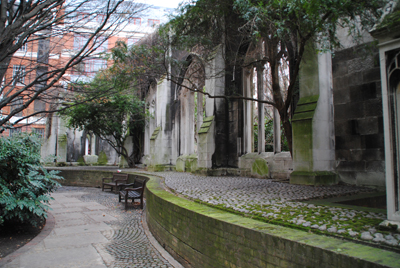
The ruins of this medieval church can still be found in the eastern end of the City of London and now play host to a rather delightful little park.

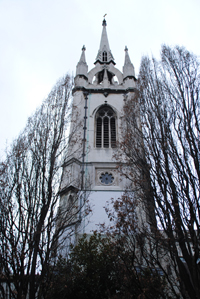
Originally built around 1,100 in the Gothic style, the church – which stands between St Dunstan’s Hill and Idol Lane (off Great Tower Street) was enlarged and repaired in ensuing centuries before suffering severe damage in the Great Fire of London in 1666. Not enough to destroy the church, however, and it was repaired in the late 1660s with a new steeple and tower designed by Sir Christopher Wren to fit with the existing structure, was added in the late 1690s. Inside were carvings by Grinling Gibbons.

St-Dunstan-in-the-East-smallBut by the early 19th century, however, the weight of the roof had pushed the walls dramatically out of line and, after an unsuccessful attempt to repair the church, it was decided to demolish it (with the exception of Wren’s tower) and rebuild.

Built in the Perpendicular style to the designs of David Laing, the new church reopened in 1821.

The church lasted for more than 100 years before it was again severely damaged, this time during the Blitz of 1941. Wren’s spire and tower thankfully remained but other than that it was a shell with only the north and south walls remaining.

The Anglican Church decided not to rebuild – the parish was incorporated into that of All Hallows by the Tower – and the City of London Corporation opted to turn the (now) Grade I-Iisted remains into a public park. It was opened in 1971 by the then Lord Mayor of London, Sir Peter Studd.

It remains there today, with beautiful climbing foliage – including many exotic plants – and a fountain in the nave. The tower, meanwhile, is used by a complementary medical centre.

A great place to pass a lunch hour!

Around London – Open House London; Yinka Shonibare at Greenwich; Bankside transformed; and Michael Peto at the NPG…

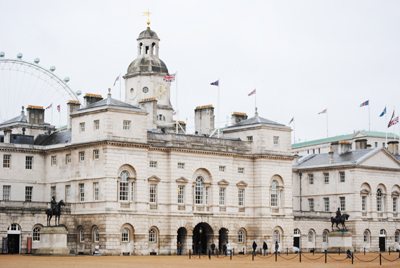
Tower 42_external It’s finally here. Open House London kicks off on Friday and with more than 800 buildings opening their doors, the only difficulty you’ll have this weekend will be choosing what you end up doing! This year’s theme is ‘celebrating architecture, people and place’ and among the highlights will be the opening of landmark structures like Battersea Power Station, Tower 42 (pictured), and the Gherkin (30 St Mary Axe) as well as 100 private homes, architects’ homes and “ground-breaking” housing developments and everything from the Shri Swaminarayan Temple in Brent to Horse Guards in Whitehall (certain buildings, like 10 Downing Street and The View from the Shard, are only open to people who won tickets in an earlier ballot). This year’s festivities also include a moonlit “culture crawl” through London on Friday night. If you haven’t ordered a hardcopy programme, you can check the listings online at www.openhouselondon.org. There’s also an Open House iPhone app available from the appstore.

A series of works by Yinka Shonibare – including some never before seen in the UK – went on display at Greenwich yesterday, thanks to Royal Museums Greenwich. The works, which explore notions of “Britishness, trade and empire, commemoration and national identity”, can be found inside and around buildings including the Queen’s House, National Maritime Museum and Royal Observatory and include Fake Death Pictures – a series of five vision of the death of naval hero Vice-Admiral Lord Nelson, Wind Sculpture – a gravity-defying object located on the Queen’s House lawn, Cheeky Little Astronomer – a specially commissioned sculpture located in the Flamsteed House at the Royal Observatory, and Nelson’s Ship in a Bottle – last seen on Trafalgar Square’s Fourth Plinth. Yinka Shonibare MBE at Greenwich, which is supported by a range of talks, debates and tours, runs until 23rd February. For more, see www.rmg.co.uk.

Bankside will be transformed this weekend as artists will be transforming disused hoardings and derelict buildings with original artworks as part of the Merge Festival. The work’s include Candy Chang’s Before I Die, Alex Chinnick’s Miner on the Moon, and Marcus Lyall and Mark Logue’s House of Pain. Until 20th October. For more on the festival celebrating Bankside, see www.mergefestival.co.uk.

On Now: Michael Peto Photographs: Mandela to McCartney. This new exhibition at the National Portrait Gallery just off Trafalgar Square features a previously unexhibited photo of Elizabeth Taylor and Richard Burton, taken at the beginning of their love affair. It’s one of 10 portraits taken by the late Hungarian-born photographer Michael Peto in London during the 1950s and 1960s – others feature Samuel Beckett, Jennie Lee, Paul McCartney and Ian McKellen. Admission is free. For more, see www.npg.org.uk.

10 (more) curious London memorials…8. The SOE Memorial…

SOE-bigTucked away on Albert Embankment just to the north of Lambeth Bridge, this moving memorial was only unveiled in 2009 and formally honours the under-cover agents who worked for the Allies behind enemy lines during World War II.

The plinth is topped with a larger-than-life bust of Londoner Violette Szabo, sculpted by London artist Karen Newman. Szabo, who here gazes out across the Thames, was tortured and executed after being captured by the Germans while on a mission behind enemy lines following the D-Day landings.

SOEThe daughter of a French mother and English father, Szabo grew up in South London and, when World War II broke out in 1939, volunteered to work as an undercover operative in France as member of the British Special Operations Executive (SOE).

She had successfully completed one mission and had returned to France for a second when she was discovered and sent to a prison camp where she was unsuccessfully tortured for information.

Posthumously awarded the George Cross and the Croix de Guerre, a plaque on the memorial says she was among the 117 SOE agents who did not survive their missions to France. As many as 407 SOE agents were sent on “sabotage missions” to occupied France to fight with the French resistance.

Surprisingly, this SOE Memorial was apparently the first public memorial to honour the work of the unit. Formed on the orders of PM Sir Winston Churchill, it consisted of agents from various countries who were devoted to the Allied cause. Its feats included a raid which destroyed a factory in the Telemark region of Norway where the Germans were trying to produce heavy water which is used in the creation of atomic bombs – an operation which receives a special mention on the memorial.

The memorial was officially unveiled by the Duke of Wellington on 4th October, 2009. One of the plaques on it states that the monument “is in honour of all the courageous S.O.E. Agents: those who did survive and those who did not survive their perilous missions”. “Their services were beyond the call of duty. In the pages of history their names are carved with pride.” Enough said.

For more on the history of women serving in the SOE, see Squadron Leader Beryl E Escott’s book The Heroines of SOE: F Section: Britain’s Secret Women in France.

London Pub Signs – Ye Olde Watling…

Ye-Olde-WatlingThis pub, located in the City, takes its name from the street upon which it stands – Watling Street.

The street, which is just 180 metres long, bears the same name as a great Roman road which ran all the way from Dover through London to the long gone Roman town of Viroconium (now known as Wroxeter in Shropshire).

The Roman road followed, to some extent, the route of an ancient Celtic pathway. But while the Celtic pathway crossed the Thames at Westminster, the Roman road, once the bridge was constructed, crossed at London Bridge and headed through London, apparently taking in this surviving piece.

The building itself – located on the intersection with Bow Lane – is said to have been constructed from old ship’s timbers by none other than Sir Christopher Wren in 1668. The upstairs rooms were said to have been used as a drawing office during the construction of Wren’s masterpiece, St Paul’s Cathedral. It may have also been used as  pub by the workmen building the cathedral – in fact it’s said to have been the first pub built after the Great Fire of 1666.

The pub is part of the Nicholson group. For more on it, check out www.nicholsonspubs.co.uk/yeoldewatlingwatlingstreetlondon.

PICTURE: Duncan Harris/Wikipedia

Famous Londoners – The Tower Ravens…

Ravens

OK, so they’re not people as such, but the ravens at the Tower of London are renowned the world over.

Known as the “Guardians of the Tower”, there are currently as many as eight ravens living at the tower, lodged in a space on the grass next to the Wakefield Tower.

Raven-pensLegend has it that there must be at least six ravens living at the Tower – should they leave, not only will the Tower fall but the kingdom as well (although we hasten to add that it’s been argued this tradition only started in the Victorian age and that there have been times when the numbers of ravens dropped below the required six, such as at the end of World War II when only one raven remained).

It was King Charles II who first ordered the ravens be protected – an order which must have upset Astronomer Royal John Flamsteed who complained after he found that the birds were interfering with the observation work he was carrying out from the Tower’s north-east turret. He later moved out to Greenwich.

The eight ravens who now live at the tower include Rocky, Merlin, Hugine and the latest additions Jubilee – given to the Tower last year to celebrate the Queen’s Diamond Jubilee – and Grip, named after Charles Dickens’ pet raven.

The birds are looked after by a team of four headed by the raven master, Chris Skaife, who each day feed them 170 grams (six ounces) of raw meat and special biscuits soaked in animal blood.

Not all ravens can cut the mustard to work at the Tower – one recent addition Pearl was apparently bullied by other ravens and had to be withdrawn. And while the birds have the feathers on one wing trimmed to stop them escaping to a new life on the wing, that hasn’t stopped some from doing so including Grog who took off in 1981 and was last seen outside an East End pub.

The oldest raven to ever live at the Tower was Jim Crow, who died at age of 44 in 1928.

WHERE: Tower of London (nearest Tube station Tower Hill); WHEN: 9am to 5.30pm, Tuesday to Saturday, 10am to 5.30pm Sunday to Monday; COST: £21.45 adults; £10.75 children under 15; £18.15 concessions; £57.20 for a family; WEBSITE: www.hrp.org.uk/toweroflondon/.  

10 (more) curious London memorials…4. ‘People of London’ Memorial…

People-of-London

Amid all the grand war-related memorials of London, this rather humble memorial sitting outside the north transept of St Paul’s Cathedral in St Paul’s Churchyard can easily be overlooked. 

Known as the Memorial to the Londoners killed in World War II Bombardments or simply as the ‘People of London’ memorial as it’s called on the sculptor’s website, it commemorates the 30,000 Londoners who were killed during the Blitz  (not to be confused with the National Firefighters’ Memorial, known informally to many as the Blitz Memorial, which sits opposite the cathedral’s south transept and commemorates firefighters who died during the Blitz).

People-of-London---smallThe round memorial was carved from a three tonne block of Irish limestone and is set into paving (it was initially very shiny).

The gilded inscription which runs around the outside reads “Remember before God the people of London 1939-1945” while on top, written in a spiral, is an inscription written by Sir Edward Marsh – “In war resolution, in defeat defiance, in victory magnanimity, in peace goodwill”, the text of which was used by Sir Winston Churchill in the frontispiece to his history, The Second World War.

Unveiled by the Queen Mother on 11th May, 1999, the memorial is the work of Richard Kindersley, whose other memorials include the Commonwealth Memorial on Constitution Hill.

Kindersley writes on his website, that the “position of the memorial adjacent to St Paul’s is most appropriate, as most people will remember the dramatic photograph of the Cathedral dome of the taken during a devastating attack in 1941.”

It was paid for by public funds raised following an appeal in the Evening Standard newspaper, launched in connection with the 50th anniversary of VE Day.

Treasures of London – Shakespeare’s Blackfriars deed…

Shakespeare's-DeedIn 1613, the playwright William Shakespeare – now widely regarded as the greatest writer of the English language – purchased a property in Blackfriars.

The only real estate he was to buy in London, the purchase of the gatehouse – which may have stood on the junction of St Andrew’s Hill and Ireland Yard – was apparently made as an investment (Shakespeare never lived there).

The deed which recorded the sale (dated 10th March, 1613) – only one of six documents in the entire world which bears Shakespeare’s authenticated signature – is in the care of the London Metropolitan Archives.

According to the deed, he bought the property from Henry Walker, a minstrel, paying £140 for the property (he mortgaged £60 of it the next day – the document for this is located in the British Library).

Other parties mentioned on the document are William Johnson, a London-based vintner and possibly landlord of the Mermaid tavern in Cheapside, and two ‘gentlemen’ John Jackson and John Heminges, an actor, manager and editor of Shakespeare’s first folio.

They were appointed as trustees in Shakespeare’s interest and handled the sale of the property after Shakespeare’s death in 1616. The copy of the deed held by the LMA was that of Henry Walker (Shakespeare’s copy is in the Folger Shakespeare Library in Washington).

The deed is currently on display as part of an exhibition surrounding the 400th anniversary of its signing. ‘Shakespeare and London’, a free exhibition, also features other documents from the period as well as maps, prints and models and runs at the LMA (40 Northampton Road) until 26th September. Due to the age and importance of the deed, the deed itself will only be displayed at specific times – check the LMA website for details.