Famous Londoners – Simon of Sudbury

Recently making news headlines thanks to the work of Adrienne Barker of the University of Dundee in reconstructing his face, Simon of Sudbury wasn’t born in London and, in fact, spent much of his early life elsewhere. But, as Bishop of London and Archbishop of Canterbury, he was a key figure in the 14th century city and it was in London that he eventually met his grisly death during the Peasant’s Revolt.

Simon Theobold was born around 1316 – the son of a wealthy Norfolk merchant – and, while details of his early life are scant, it has been suggested he studied at Cambridge before eventually entering the service of William Bateman, the Bishop of Norwich. He apparently became caught in the middle of a dispute between the bishop and the Abbot of Bury St Edmunds (the details of which we don’t have time to get into here) and it was this which is said to have led to the issuing of a royal order for his arrest, a move which forced him to flee England for the papal court at Avignon.

He quickly came to the attention of the popes and took on an official role, the reward for which was the income from various positions in the English church including Chancellor of Salisbury. In 1356, Pope Innocent VI sent him on a peace mission to King Edward III and it was during this mission that he came to the attention of the king. Having never been formally outlawed, he was apparently forgiven his earlier crimes and was soon acting on behalf of the king including at the Papal court.

In 1361, Simon was made Bishop of London and spent the next 10 years in the role, as well as continuing to act for the king, notably as a diplomat.

In 1375 following the death of incumbent William Whittelsey, he was elevated to the position of Archbishop of Canterbury. His time as archbishop was somewhat troubled – as well as facing accusations of being too close to the king, he also faced criticism over his treatment of Bible translator John Wycliffe – but it was his role in secular politics which led to his demise.

Following the accession of King Richard II in 1377, in 1380 Simon was appointed chancellor, a position which meant he bore the ultimate responsibility for the imposition of an extremely unpopular new poll tax. In 1381, there were calls for his death at the outbreak of rebellion in Kent, notably when the rebels entered Canterbury Cathedral. But as the crisis now known as the Peasant’s Revolt gained momentum, Sudbury remained with the king in the Tower of London where he apparently counselled a hard line.

King Richard II when to parley with the traitors at Mile End on 14th June and there apparently indicated that action would be taken against traitors around him (Wat Tyler was killed when the king again met the rebels, this time at Smithfield, the following day). A group of rebels subsequently stormed the tower and dragged out Sudbury and the treasurer, Sir Robert Hales. Taken to Tower Hill, they were there beheaded. Sudbury’s head, which apparently had a skullcap nailed to his skull, was impaled on a lance and put on display over London Bridge. His body was buried in Canterbury Cathedral.

The skull, meanwhile, was apparently taken down by a Sudbury man and taken back to his home town where it was kept at St Gregory’s Church. Some 630 years later, following an approach by Sudbury locals, forensic artist Adrienne Barker from the University of Dundee was asked to recontruct Simon’s head.

Following some CT scans of the skull, Barker – who carried out the work as part of her MSc Forensic Art studies under the tutelage of renowned facial reconstruction expert Professor Caroline Wilkinson – used state-of-the-art reconstruction techniques to recreate Sudbury’s facial features and complete a series of 3-D bronze-resin casts of his head. The models, one of which will be on permanent display at St Gregory’s Church in Sudbury alongside Simon’s skull, were unveiled in September.

PICTURE: University of Dundee

Treasures of London – The London Stone

The London Stone was once considered to be one of the City’s most important relics with the very existence of the city depending on its survival. Yet, hidden away behind an iron grille set into the front of a building at 111 Cannon Street, the block of Clipsham limestone is these days all but forgotten, occupying an ignominious position opposite the gleaming new Cannon Street Station.

The stone’s origins lie shrouded in mystery but the legend, propagated in the 19th century, goes that it once formed part of an altar built by Trojan wanderer and founder of London, Brutus. Yet, according to the Museum of London, the saying often associated with the legend  – “So long as the Stone of Brutus is safe, so long will London flourish” – was apparently invented in 1862.

It has been suggested the stone, which is a Grade II* listed structure, may be a relic of the city of the Roman city of Londinium, although no-one seems to know for sure. The earliest mention of it was apparently around 1100 AD and it was subsequently associated with some of London’s most famous characters.

It is said that Jack Cade, leader of the 15th century Kentish rebellion, struck it with his sword after entering London in a symbolic gesture designed to reflect his taking control of the city and naming himself ‘Lord of London’. The poet William Blake is said to have believed it to be associated with druidism – perhaps it was part of an altar? – and even the great 17th century architect Christopher Wren had a view on it – he thought it was part of a Roman ruin after seeing its foundations.

One widely believed and circulated theory was that it was the stone from which all distances from London were measured during Roman times. Its heritage listing says it may have been a Roman milestone. It has also been suggested it is the base of an Anglo-Saxon waymarker or cross.

The stone was located in its current position after World War II. Since the 18th century it had been set into the wall of a Wren-designed church, St Swithin London Stone, which had stood on the site where the stone now sits but which was demolished in 1962 after being bombed in the Blitz. Prior to being moved to the church, the stone stood upright on the south side of Cannon Street. It was moved to the church after becoming a traffic hazard.

There has been talk in recent years of moving the stone to a better home but for the moment it remains behind the grill by the footpath.

The Royal Parks – 4. St James’s Park

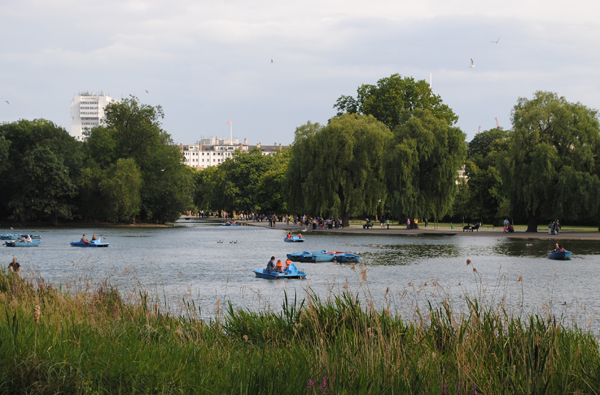
The fourth in a line of parks stretching from Kensington Palace to Westminster, St James’s Park largely owes its foundation to King James I. 

Given its early history is covered in our earlier post, we’ll skip forward to the time of King Charles II when, under to instruction of Frenchman Andre Mollet, the park was redesigned with new landscaping including wide lawns, avenues of trees and a wide, centrally positioned canal. It was King Charles II who also opened the park up to the public (he even mingled with them there along with his mistress Nell Gwynn). Interestingly the first pelicans were also introduced to the park around this time when the Russian ambassador presented a pair of pelicans to the king.

In the 18th century, Horse Guards Parade was added to the park by filling in one end of the park’s canal and was later used for parades. The ceremonies of Beating Retreat and Trooping the Colour are still held there today.

The next major changes came in the 19th century when in 1827-28, architect John Nash oversaw a more romantically inspired renovation, including the transformation of the canal into a natural looking lake and the addition of winding paths, as part of his grand scheme which still shapes much of London today.

It was also at this time that The Mall (which like Pall Mall takes it name from the game of Pelle Melle – see our earlier post) was transformed into a grand processional route (it was opened to traffic later, in 1887). The park, bounded to the west by Buckingham Palace, also takes in the Queen Victoria Memorial – completed in 1914 to replace the Marble Arch which was moved to its current location at the corner of Oxford Street and Park Lane in 1851 – and flower beds which are planted annually with 12,000 geraniums, the color of which is chosen to match the guardsmen’s tunics.

Meanwhile, in 1837, the Ornothological Society of London erected a cottage for the birdkeeper (the thatched cottage can still be seen there today and the post of birdkeeper still exists). The first bridge was placed across the lake in 1851 (and replaced in 1951 with the one that now stands there).

Little has changed in the 23 hectare (58 acre) park since Nash’s day. Newer facilities include a restaurant and a playground at the western end.

WHERE: St James’s Park (nearest tube station is St James’s Park); WHEN: 5am to midnight daily; COST: Free entry; WEBSITE: www.royalparks.gov.uk/St-Jamess-Park.aspx 

PICTURE: © Anne Marie Briscombe  (courtesy Royal Parks)

What’s in a name?…Strand

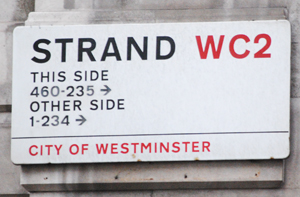
Now one of the major thoroughfares of the West End, the origins of the roadway known as the Strand go back to the Roman times leading west out of the city.

Later part of Saxon Lundenwic which occupied what is now the West End, it ran right along the northern shore of the Thames and so became known as the Strand (the word comes from the Saxon word for the foreshore of a river). During the following centuries the river was pushed back as buildings were constructed between the road and the river, leaving it now, excuse the pun, ‘stranded’ some distance from where the Thames flows.

Sitting on the route between the City of London and Westminster, seat of the government, the street proved a popular with the wealthy and influential and during the Middle Ages, a succession of grand homes or palaces was built along its length, in particular along the southern side.

All are now gone but for Somerset House – originally the home of the Dukes of Somerset, it was built in the 16th century but rebuilt in the 18th century after which it served a variety of roles including housing the Navy Office, before taking on its current role as an arts centre. Others now recalled in the names of streets coming off the Strand include the Savoy Palace, former residence of John of Gaunt which was destroyed in the Peasant’s Revolt, and York House, once home of the Bishops of Norwich and later that of George Villiers, favorite of King James I (see our earlier Lost London entry on York Watergate for more).

After the aristocracy decamped further west during the 17th and 18th centuries, the road and surrounding area fell into decline but was resurrected with a concerted building effort in the early 19th century (this included the creation of the Victoria Embankment which pushed the Thames even further away) which saw it become a favorite of the those who patronised the arts, including the opening of numerous theatres. Among those which still stand on the Strand today are the Adelphi and Savoy Theatres (this was apparently the first in London to be fitted with electric lights and sits on a site once occupied by the Savoy Palace).

Among the other landmarks along the Strand are the churches of St Mary-le-Strand (the present building which sits on what amounts to a traffic island) dates from 1717 and was designed by James Gibbs, and St Clement Danes, designed by Sir Christopher Wren and completed in 1682 (it is now the Central Church of the Royal Air Force). The Strand is also home to the Victorian-era Royal Courts of Justice (it boasts more than 1,000 rooms), Australia House (home of the oldest Australian diplomatic mission), the Strand Palace Hotel (opened in 1907) and Charing Cross Railway Station.

The Royal Parks – 3. Green Park

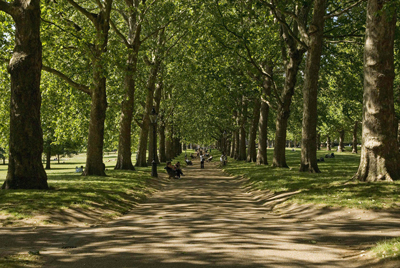
Perhaps the most overlooked and least celebrated of central London’s Royal Parks, Green Park (officially The Green Park) is a peaceful oasis of leafy trees between the bustle of Piccadilly and traffic of Constitution Hill and part of an unending swathe of green which connects Kensington Gardens with, eventually, St James’ Park.

Originally meadowland used for hunting, the earliest known mention of the area where the park now stands was apparently in 1554 when it was believed to be a staging point for Thomas Wyatt (the younger) who led a group of rebels protesting against the marriage of Queen Mary I to King Philip II of Spain. The unfortunate – and unsuccessful (in terms of his rebellion at least) – Wyatt was later beheaded for treason.

In 1668, King Charles II had the park enclosed with a brick wall and stocked with deer, as well as having a ranger’s lodge and icehouse built (to keep his drinks cool when entertaining in summer). While it was initially known as Upper St James’s Park, by 1746 Green Park had its own name. It’s not really known what prompted the name change but the unofficial story is that Queen Catherine of Braganza, wife of King Charles II, found out that her philandering husband had picked some flowers there for another woman – a milkmaid. In revenge, she had every flower in the park pulled up with orders they were not to be replanted. To this day, while some 250,000 daffodils bloom here in spring, there remain no formal flowerbeds in the park.

The 47 acre (19 hectare) park, which was also used on occasion as a duelling ground, underwent further development at the beginning of the following century with the creation of the ornamental Tyburn Pool near the centre of the park.

Queen Caroline, the wife of King George II, meanwhile, had a reservoir built to supply water to St James’s Palace and Buckingham Palace (it was known as the Queen’s Basin) as well as a library and the Queen’s Walk. Planted in 1730, this runs along the eastern side of the park and helped to turn it into a fashionable place in which to be seen (and led to the building of many a mansion in nearby Piccadilly).

Other buildings in the park have included two temporary ‘temples’ – the Temple of Peace (erected in 1749 to mark the end of the War of Austrian Succession) and the Temple of Concord (erected in 1814 to mark 100 years of the rule of the Hanoverian dynasty). Both of these, believe it or not, burnt down during the celebrations they were built for.

The park, which underwent a redesign in which the first trees were planted in the 1820s as part of architect John Nash’s grand plans for St James’s Park, was opened to the general public in 1826 but by then many of its earlier features – including the ranger’s house, Tyburn Pool and the Queen’s Basin – were already gone.

In more recent times, war memorials have been added to the park – the maple-leaf daubed, Pierre Granche-designed memorial to Canadian soldiers in 1994 (Canada is also remembered in Canada Gate on the park’s south side, installed in 1908 to mark the nation’s contribution to the Empire), and a set of memorial gates on Constitutional Hill at the park’s western end which is dedicated to the five million people from the Indian Sub-Continent, Africa and the Caribbean who served in World War II in 2004. The park also features the ‘Diana fountain’, installed in 1952 by the Constance Fund (and currently undergoing restoration).

On 14th June, a 41 royal gun salute is fired here to mark the Queen’s birthday. Salutes are also fired here for the State Opening of Parliament in November or December, Remembrance Sunday, and for State Visits.

WHERE: Green Park (nearest tube station is Green Park and Hyde Park Corner); WHEN: daily; COST: free; WEBSITE: http://www.royalparks.gov.uk/Green-Park.aspx

PICTURE: Courtesy of Royal Parks. © Anne Marie Briscombe 

Around London: Talking rubbish; Conan Doyle’s lost manuscript; John Martin’s apocalypse; and, Postmodernism at the V&A…

Twenty-five talking rubbish bins will be installed in Westminster City Council area as part of a campaign to encourage people to use them more. The rubbish bins, which will look no different from normal bins, will start chatting from 13th October and will be in London for two months before embarking on a UK tour after which they may become permanent fixtures. Each bin will have a unique respond when used – from singing a part of the Hallelujah Chorus to a blast of the trombone and will be tailored to suit their location (Covent Garden’s, for example, will be operatic in nature). The talking bins, which are also being trialled in Liverpool, are being put on the streets as part of Keep Britain Tidy’s Love Where You Live initiative.

A hitherto unpublished novel by Arthur Conan Doyle – creator of Sherlock Holmes – was published by the British Library this week. The Narrative of John Smith was Conan Doyle’s first novel and was written between 1883 and 1884 but the manuscript was lost on the way to the publishers. Conan Doyle rewrote it from memory but never resubmitted the work for publication. It serves as a rare insight into his creative development prior to his writing of more famous works like those featuring Holmes (the new book and an audio CD featuring Robert Lindsay, are available from the library shop). The library is also hosting an exhibition of related items in the Treasures Gallery, including one of the four notebooks that comprise the manuscript of The Narrative of John Smith, letters Conan Doyle wrote to his mother, and a “scientific and monthly magazine” he created when he was just 16. The exhibition is open until 5th January. The library is also hosting an event in which author Anthony Horowitz – commissioned by the Conan Doyle Estate to write a new Sherlock Holmes novel, The House of Silk, which will be published in November – will talk about his work and the new novel. To be held on 27th November from 2.30pm to 4pm (admission charge applies). For more, see www.bl.uk.

On Now: John Martin: Apocalypse. The Tate Britain is hosting an exhibition featuring the works of nineteenth century British artist John Martin, in the first show dedicated to his works in more than 30 years. While something of an outsider, Martin was a key figure in the art world of his day, known for his “dramatic scenes of apocalyptic destruction and biblical disaster”. The exhibition brings together some of his most famous paintings as well as previously unseen and newly restored works. Admission charge applies. Runs until 15th January. For more, see www.tate.org.uk/britain/.

• On Now: Postmodernism: Style and Subversion 1970-1990. An “in-depth survey of art, design and architecture of the 1970s and 1980s”, this exhibition at the Victoria & Albert Museum shows how postmodernism evolved from being merely a provocative architectural movement in the 1970s through to ideas that went on to broadly influence popular culture – everything from art and film to music and fashion. The exhibition is divided into three broad chronological sections – the first focuses on architecture, the second on the “proliferation of postmodernism through design, art, music, fashion, performance, and club culture during the 1980s” and the third on the “hyper-inflated commodity culture of the 1980s”. Admission charge applies. Runs until 15th January, 2012. For more, see www.vam.ac.uk.

LondonLife – Open House London, The Middle Temple Hall

Last weekend saw thousands of people make their way to rarely opened properties across London as part of Open House London. Among the properties we visited was the Middle Temple Hall, one the finest example of a 15th century hall in London (if not the UK). The hall was built in the 1560s and early 1570s – by which time the Middle Temple, one of the medieval Inns of Court (more of which we’ll be talking about in an upcoming series), had already existed for about 200 years – and the hall which the Temple currently used, that of the former Templar Knights, was starting to fall apart. The new hall was constructed under the direction of law reporter Edmund Plowden, then Treasurer of the Inn, and funded by members of the Middle Temple. In use by about 1570, Queen Elizabeth I is, according to some stories, said to have dined there many times and it was in the hall that the first performance of Shakespeare’s Twelfth Night took place. While it suffered some damage in World War II bombings, the hall still looks much as it did in the late 1500s. It remains at the centre of the Middle Temple’s collegiate and social life and it is here that members are called to the Bar. Among the notable objects inside are numerous paintings and stained glass memorials of people associated with the Inn (including Sir Walter Raleigh and numerous monarchs – from King Charles I to King Edward VII) as well as the High Table – a table made of three 29 foot long planks from a single oak, it is said to be a gift from Queen Elizabeth I – and the ‘cupboard’, a smaller table which was apparently made from the hatch cover of Sir Francis Drake’s ship, the Golden Hind. Late note: I should add that the Middle Temple Hall is not normally open to the public.

Famous Londoners – Captain Thomas Coram

A ship-builder and New World colonist of some renown, Thomas Coram is primarily remembered now as the founder of London’s Foundling Hospital.

While details of Coram’s early life are sketchy, it is known that he was born in Dorset, possibly in Lyme Regis, in 1668 and was believed to be the son of a merchant seaman, John Coram.

Coram’s mother apparently died while he was still young and he went to sea at the age of just 11. Following his father’s remarriage, however, the family moved to Hackney in East London and it was after that move that Coram was apprenticed to a shipwright working beside the Thames.

In 1694, having previously worked for the Government auditing troop and supply ships, a group of merchants asked Coram to establish a new shipyard in Boston, Massachusetts. He did so and spent the next 10 years building ships in Boston and Taunton. But, a staunch Anglican living among Puritans, he apparently make some enemies while doing so (this led to lawsuits and even apparently an attempt on his life). It was during this time that he also married a Bostonian, Eunice Wait.

Following his return to England in 1704, Coram found further success as a merchant and was soon commanding merchant ships during the War of the Spanish Succession (it is believed it was during this time that he acquired the title of captain). Throughout the following years he continued to conduct business in the New World colonies – particularly Massachusetts and Maine – as well as in London.

It was after he had moved to Rotherhithe in 1719 that Coram’s eyes were opened to the plight of abandoned children – he would apparently see them when travelling into London – and, his heart obviously moved, he began to advocate for the creation of a foundling hospital similar to those he had seen on the continent during his travels.

While his efforts initially came to nothing, Coram eventually received the backing of Queen Caroline, wife of King George II – an important step for the plain-speaking seaman. Having presented numerous petitions to the king, His Majesty finally signed the Foundling Hospital Charter on 14th August, 1739. The first meeting of the governors – which included notables such as artist William Hogarth and prominent physician Dr Richard Mead – was held at Somerset House that November.

A temporary hospital opened it’s doors at Hatton Garden on 25th March, 1741, and the first foundlings were baptised Thomas and Eunice Coram. But it was only four and a half years later – in October, 1745 – that a purpose-built hospital opened its doors in an area known as Bloomsbury Fields. As well as Hogarth (who painted Coram in 1740 – the picture can still be seen in the Foundling Hospital today), the hospital also attracted the support of composer George Frideric Handel.

Coram’s role in the governance of the hospital effectively came to an end in 1741-1742 (he is said to have made some indiscreet comments about some of his fellow governors) but – despite being still engaged in numerous business activities – he continued to visit the hospital regularly and, as well as being Godfather to more than 20 of the foundlings, the story goes that he found the time to sit in an arcade at the hospital and pass out pieces of gingerbread to the children.

Captain Thomas Coram died on 29th March, 1751, in lodgings on Spur Street near Leicester Square (his wife Eunice had died earlier, in July 1740, and the couple had no children). He was buried in the Foundling Hospital chapel.

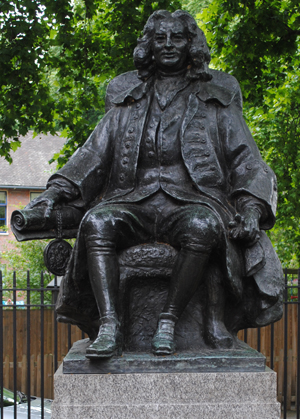
One of the best places to visit to find out more about Captain Coram and his life is the Foundling Museum, housed in part of the former hospital. For our previous story on the hospital, follow this link. A statue of Coram (pictured above) stands outside in Brunswick Square.

Daytripper – Oxford

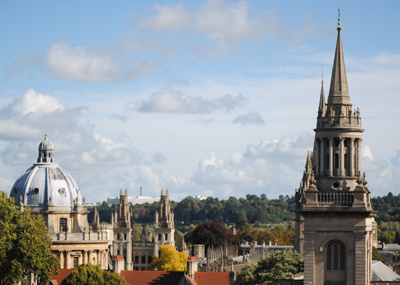
The “city of dreaming spires”, Oxford is a delight for the student of historic architecture, boasting an impressive array of medieval and later, classically-inspired, buildings.

Only about an hour from London by train (leave from Paddington Station), Oxford was established as a town in the 9th century and rose to prominence during the medieval period as the location of a prestigious university, an institution which remains synonymous with the city today.

Major development followed the Norman Conquest the castle was constructed, the remains of which were included in a £40 million redevelopment several years ago of the area in which it stands and which now houses the Oxford Castle Unlocked exhibition which looks at some of the key figures in the castle’s past (you can also climb St George’s Tower for some great views over the city).

The university first appears in the 1100s and gradually expanded over the ensuing centuries gradually evolved to encompass the many medieval colleges which can still be seen there today.

Something of a hotbed of activity during the Reformation, Oxford saw the burning of three bishops – Hugh Latimer, Nicholas Ridley and Archbishop of Canterbury Thomas Cranmer at a site marked by a memorial in Magdalen Street. Constructed in the 1840s, it was designed by Sir George Gilbert Scott who drew inspiration from the Eleanor Crosses King Edward I had erected in honor of his deceased wife, Eleanor of Castile, following her death in 1290.

Oxford was also the site of the headquarters of King Charles I during the English Civil War after the king was forced to leave London (the town eventually yielded to parliamentarian forces after a siege in 1646) and was later home to the court of King Charles II after he fled London during the Great Plague of 1665-66.

Canals arrived in the late 18th century and the railways followed. Industrialisation came – in particular, in the 20th century, in the form of a large car manufacturing plant at the suburb of Cowley – and with it an increasingly cosmopolitan population. But at its heart Oxford remains a student city and it’s the students that continue to provide the lively atmosphere in the city centre.

Look for Carfax Tower to get your bearings – formerly the tower of a 14th century church, this lies at the heart of the town and can be climbed for some great views over the surrounding streets. Some of the colleges are also open to the public (see noticeboards outside the colleges for times) – particularly worth visiting is Christ Church which dates from 1524 and, founded by Cardinal Wolsey, was initially known as Cardinal’s College. It features the Tom Tower, home of the bell Great Tom, which was designed by former student Sir Christopher Wren. The college, which is unique in that the college chapel is also a cathedral, is also home to the Christ Church Picture Gallery.

Other colleges of note include the beautiful Magdalen (pronounced Maudlin, it was founded in 1458 – alumni have included writers John Betjeman, CS Lewis and Oscar Wilde), All Souls (founded in 1438 with King Henry VI its co-founder), and Merton College (the oldest of Oxford’s colleges, it was founded in 1264 and is home to Mob Quadrangle, the oldest quadrangle in the university).

Other university buildings which are a must include the Radcliffe Camera – now the reading room of the Bodleian Library, this Baroque rotunda dates from 1748 and was built as a memorial to 18th century physician Dr John Radcliffe, the Sheldonian Theatre – another of Wren’s designs, it was built in the 1660s as the university’s principal assembly room, and St Mary the Virgin Church – the official church of the university, the present building partly dates from the 13th century and boasts terrific views from the tower.

Make sure you also take the time to wander through the water meadows along the River Cherwell (there are also punt rides) and walk along the River Thames, known as the Isis as it passes through Oxford. Keep an eye out also for the ‘Bridge of Sighs’, similar in design to the Venetian landmark, it spans New College Lane and joins two sections of Hertford College.

Other sites in Oxford include the Ashmolean Museum of Art and Archaeology. Considered of the UK’s best, the original Ashmolean was the first purpose built museum in England, opening in 1683. It now houses treasures include art and antiquities with the late ninth century Alfred Jewel, said to have been made for King Alfred the Great, among its prized objects. Other museums include the Pitt Rivers Museum which cares for the university’s collection of anthropology and world archaeology and includes exhibits brought back to Britain by explorer Captain James Cook.

Take the time also to wander through the covered market off high street which has some interesting shops selling everything from clothes to fresh food and flowers and gifts. Fans of Inspector Morse, meanwhile, may also enjoy seeing some of the sites of particular significance in the TV series – there’s an interactive online map here.

A vibrant city redolent with history, Oxford remains of England’s jewels. Perfect as a day-trip destination from London.

Where is It? #3

This is the third in our series in which we ask you to identify where in London this picture was taken and what it’s of. If you reckon you know the answer, leave a comment below. We’ll reveal the answer early next week. Good luck!

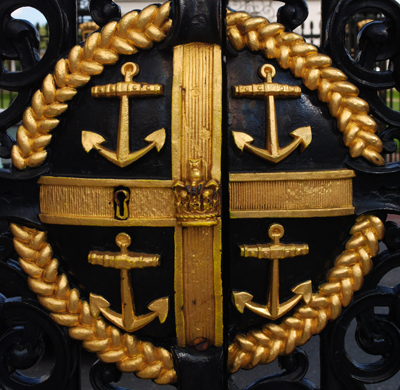
Apologies for the delay in getting this answer to you (Exploring London has been on a summer break!). But if you’ve been wondering, the answer is that the picture shows a lock detail from one of the gates leading into the old Royal Naval College at Greenwich – the anchors were a clue! Congrats to Ian who guessed the location was near the Queen’s House (contained within the former Royal Naval College). Click here if you’re interested in reading our previous entry about the former Royal Naval College and Sir Christopher Wren’s role in its design.

10 small (and fascinating) museums in London…7. The Cartoon Museum

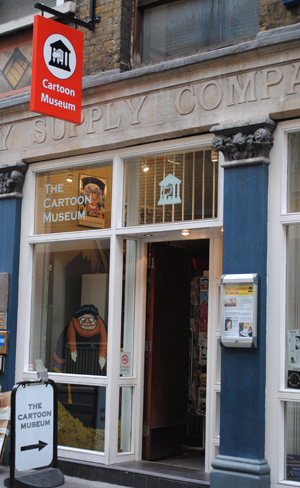
Hidden away in Bloomsbury almost in the shadow of the gigantic bulk of the British Museum, this small museum offers an interesting insight into the development of cartoons and comic strips from a uniquely British perspective.

Opened in 2006, the museum exhibits are spread over two floors and trace the history of cartoons and comic strips from their origins in the 1700s through to today’s graphic novels.

While it can seem at first glance only a small display, there’s a wealth of information accompanying the more than 200 exhibits which range from Hogarth prints and early satirical political cartoons by the likes of James Gillray and George Cruikshank through to the works of more modern artists like David Low and Donald McGill, originals of comic strips like Dennis the Menace and Andy Capp and even manga Shakespeare.

And no need to worry about the kids – if they become bored (as is likely), there’s an interesting exhibition on the creation of Peppa Pig complete with original storyboards and a cartoon running on the television as well as plenty of reading materials and, upstairs, the chance for them to indulge their passion for cartoons by designing their own.

The museum is also currently running a splendid exhibition on Dr Who comics spanning the period from 1964 (the year after the first Dr Who was televised) through to today. For Dr Who fans, this exhibition – which runs until 30th October – is a must.

Don’t forget to pause at the shop on the way out – it’s stocked with all sorts of comic-related paraphernalia.

WHERE: The Cartoon Museum, 35 Little Russell Street (nearest Tube stations are Tottenham Court Road, Holborn and Russell Square); WHEN: 10.30am to 5.30pm, Tuesday to Saturday, 12.30pm to 5pm Sundays; COST: £5.50 an adult/£4 concessions (£3 students)/children under 18 free (children 12 or under must be accompanied by an adult); WEBSITE: www.cartoonmuseum.org

Famous Londoners – Sir William Walworth

Twice Lord Mayor of London, Sir William Walworth is best remembered as the man who killed the leader of the Peasant’s Revolt, Wat Tyler.

Believed to have been born in the first half of the 14th century to a couple in Durham, Walworth at some point moved to London where he was apprenticed to the leading fishmonger John Lovekyn (he was also one of London’s biggest exporters of wool).

In 1368, following Lovekyn’s death, Walworth replaced Lovekyn as the alderman of Bridge Ward. Two years later, in 1370, he was elected sheriff and the following year he became an MP (by this stage, he was also already a major lender of money to the crown). Walworth was first elected as mayor in 1374, elected again as an MP in 1377, and again as mayor in 1380.

It was on 13th June, 1381, Walworth, still London’s mayor, led the defence of London Bridge against Wat Tyler and the rebels. He was later with the king, Richard II, when he subsequently met with Tyler and others at Smithfield. During that encounter Walworth stabbed Tyler and later had him beheaded. The reason for Walworth’s stabbing of Tyler remains unclear.

Walworth was knighted on the field for his efforts in defending the king during the rebellion and was later involved in restoring the peace in London and in the counties of Kent and Middlesex.

Sir William did marry but he and his wife Margaret, who died in 1394, had no children. Following his death in 1386 at his house in Thames Street (later the Fishmonger’s Hall), he was buried at the church of St Michael, Crooked Lane, to which he had already made some substantial donations.

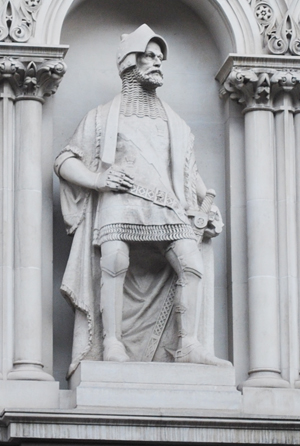
He subsequently became a hero in popular story-telling and in 1592 was included in Richard Johnson’s book Nine Worthies of London. A wooden statue of him was placed at the Fishmonger’s Hall in 1685. There is a much later statue of Sir William on the Holborn Viaduct (pictured).

This article has been updated.

Where is it? #2…

This is the second of our series in which we ask you to identify where in London this picture was taken and what it’s of. If you reckon you know the answer, leave a comment below. We’ll reveal the answer on Monday.

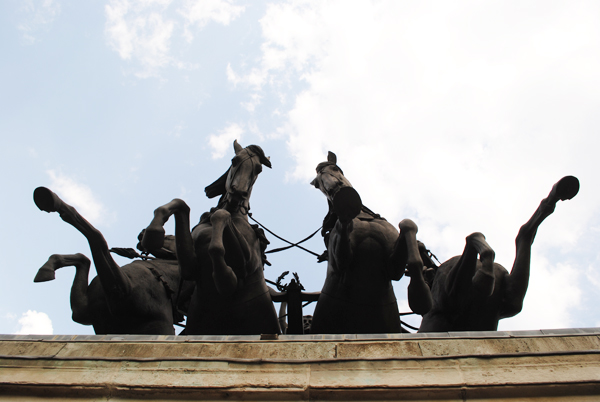
Obviously, this one was too easy – yes, it is the top of Wellington Arch at Hyde Park Corner. The Decimus Burton-designed arch, which dates from 1826-30 and was initially known as the Green Park Arch, was built to commemorate Britain’s victory over Napoleon.

In 1846, it was adorned with a controversial giant statue of the Duke of Wellington on horseback but in 1883, when the arch had to be moved from its initial position parallel to the Hyde Park Screen to where it now stands to accommodate increased road traffic, the statue was removed to Aldershot (where it still stands) and not replaced.

In 1912, thanks to the support of King Edward VII (initially as Prince of Wales), the space was occupied with Adrian Jones’ sculpture of four horses pulling a chariot (known as a quadriga) driven by a boy with a winged figure representing peace standing behind him. It remains to this day.

Congrats to Hazel Edmunds who was the first to guess it on Exploring London and Sarah Goldsworthy, who was the first on Facebook. Honorable mention to Mike Paterson who also guessed it.

We’ve decided to make this a weekly feature – have a look for the next challenge on Friday afternoon!

10 small (and fascinating) museums in London…5. The Old Operating Theatre Museum and Herb Garret

It’s the most unlikely location for anything to do with a hospital. High above the street in what was a herb garrett above a former church sits what was the operating theatre for females of St Thomas’ Hospital.

Built in 1703, the attic space resembles something of a large barn and was likely first used for storing and drying herbs by the resident apothecary at the then newly reconstructed St Thomas’ Hospital (this was largely rebuilt at the end of the 17th century on the same site previously occupied by the hospital as far back as the 1200s).

In 1822, the hospital’s governors decided that part of the herb garrett be converted into a new purpose-built operating theatre for female patients. The addition of windows in what was left of the adjoining garret, meanwhile, suggest it may have been used as a recovery ward.

The first thing that assails you as you enter the herb garrett these days, having clambered up a narrow twisting staircase is the sweet, spicy smell of herbs.

There are plenty of these within the garret, each with a hand written card explaining the curative properties they were renowned for – who knew, for example, that the ash of bladderwrack, dried kelp or seaweed, could be used to treat scrofula and goitre, or that the origins of aspirin go back to 1758 when a Chipping Norton clergyman chewed on a willow twig?

Elsewhere in the space are displays featuring early surgeon’s implements (and all the horror that entails), specimen jars containing human organs, anatomical models, pill and medicine making equipment and a display on nursing (there’s also a display on the poet John Keats who briefly served as an apprentice apothecary at St Thomas’ and St Guy’s in 1815-17).

Through the garret is located the operating theatre itself, complete with the wooden operating table and series of seats for spectators. Information panels nearby speak of such things as the blood box located below the floor into which the blood drained away and the speed with which surgeon’s had to work (until 1846 there was no reliable anaesthetic and it wasn’t until 1865 that Sir Joseph Lister introduced antiseptic procedures). There’s also a panel on the resurrection men – people who traded in cadavers to meet the growing needs of anatomists in the 18th and 19th centuries (and whom were known in London and elsewhere to have murdered people to meet the demand for bodies).

For all the faux-horror of nearby attractions like the London Dungeon, it’s here that you can truly experience the horrors some people have had to face as they prepared to go under the surgeon’s knife.

WHERE: The Old Operating Theatre Museum and Herb Garret, 9a St Thomas’s Street, London Bridge (nearest Tube station is London Bridge); WHEN: 10.30am to 5pm daily; COST: £5.90 an adult/£4.90 concessions/£3.80 children under 16/£13.80 a family (up to four children); WEBSITE: www.thegarret.org.uk.

10 Questions – Martin Stancliffe, Surveyor to the Fabric, St Paul’s Cathedral…

In the first of a new series in which we ask 10 questions of someone involved with one of London’s historic sites, we speak to Martin Stancliffe, Surveyor of the Fabric at St Paul’s Cathedral, about the £40 million, 15 year cleaning and restoration project at the iconic London structure which came to an end last month…

1. What does your job at the cathedral involve? “Advising on all aspects of the care and repair of the fabric of the cathedral, and its setting. This involves devising and leading all fabric projects, major or minor.”

 2. What prompted the 15 year repair and cleaning project? “The perception that the cathedral could reach out more to all its visitors both as a great centre for worship and as a great tourist attraction if it were in better condition and had improved facilities.”

3. How much of a difference has the cleaning and repair project made to the look of the cathedral, both inside and out? “I think it is not too much to say that the cleaning has transformed the appearance of both the exterior and the interior. In particular, the interior now speaks much more clearly of its primary purpose as a great church and a setting for great national services of memorial or celebration. In addition, the programme of repair works in almost all parts of the cathedral has put it into good condition in ways that can be sensed, but cannot  – I hope – be seen.”

4. How many people have been involved? “It is hard to make a count, but the number must run into several hundred.”

5. What trades did the task require and was it easy to source the sort of expertise required? “The various different tasks required a great range of skills, from masons to electricians and scaffolders,  and from expert painters and gilders to conservators. There is a wonderful supply of skilled craftsmen and professionals in this country; but younger people need to be encouraged to understand how creative and rewarding such work is, and to learn the expert skills required to continue to care for buildings like this.”

6. What was the most challenging aspect of the project? “The most challenging aspect was the organisation of the internal cleaning project, which required special techniques and special scaffolding to enable the cathedral to continue its day to day work uninterruptedly throughout the 15 year programme – including having to remove all scaffolding from the interior for the Queen’s Golden Jubilee right in the middle of the project!”

7. Is the cathedral we now see as (original architect) Sir Christopher Wren envisaged it? “No, the interior had already been substantially altered in the 19th century by the removal of the original choir screen, the stripping of paint from all the internal stonework, and the installation of mosaic decorations. However, the atmosphere in the cathedral is certainly closer to how Wren envisaged it than in its gloomy state 15 years ago; and he would certainly have recognised – and welcomed – the radiant quality of light which has been restored to the interior.”

8. Did you make any interesting discoveries about the building during the restoration project? “A building like this is always revealing new things. We discovered much more about how the lower parts of the dome were constructed, and we have understood much better why and how the building moved and settled as a structure over the last 300 years. We also discovered many fragments of the great cathedral which stood on this site for some 600 years before the destruction of the Great Fire, built into the structure of  Wren’s cathedral.”

 9. What’s your favorite part of the cathedral?  “I love all parts of the dome, from the top of the lantern down to its complex foundations on the top of the arches of the nave.”

10. Can you tell us something about St Paul’s that many visitors may be unaware of? “Many people are unaware of the reason why the dome seems so all embracing when you are in the interior. This is because the dome spans right across the whole width of the church,  allowing the aisles to pass through it, unlike St Peter’s in Rome, for instance.”

WHERE: St Paul’s Cathedral, St Paul’s Churchyard (nearest tube station is St Paul’s); WHEN: St Paul’s is open from 8.30am to 4pm (galleries from 9.30am to 4.15pm), Monday to Saturday. Open for worship only on Sundays;  COST: £14.50 an adult/£13.50 concessions/£5.50 a child (6-18 years)/£34.50 a family of four; WEBSITE: www.stpauls.co.uk

Daytripper – Brighton

It’s summer and that means, fingers crossed that the weather holds, Londoners start looking for the beach. One of the easiest to access coastal resorts – just an hour on the train – is the East Sussex town of Brighton.

Its history dates back to before the Doomsday Book and by medieval times, the town – previously known as Brighthelmstone – was prosperous enough to become a target to French raiders who burnt it down during a raid in 1514.

Yet much of what we now know as Brighton dates from the late 18th century when the town was transformed into a fashionable seaside resort. But before we get to that, there’s a couple of notable survivors from earlier days worth mentioning.

First up is the  14th century St Nicholas’ Church which, although considerably altered in later years, still contains a Norman font and has several graves of interest in the churchyard including that of Captain Nicholas Tattersall who carried King Charles II to France in his boat in 1651, as well as those of Phoebe Hessel, famed for having served 17 years in the army during the 1700s disguised as a man, Sake Dene Mohomed who first brought Turkish baths to Brighton and Amon Wilds, a famed Regency architect and builder.

And for a feel of what the medieval streetscape may have been like, head to the central shopping area known as The Lanes which still follows the medieval street pattern (although the shops date from later period) and which, boasting a range of interesting shops, is well worth spending some time poking about in.

While Brighton had gradually been establishing a reputation as a sea bathing resort in the years prior to 1783, in that year the town’s profile received a valuable boost when the Prince Regent (later King George IV) visited the town. So taken with it was he that not only did he make repeat visits, he also constructed the magnificently opulent Royal Pavilion (pictured) – completed in 1822 and designed by John Nash – which still stands as one of the town’s foremost attractions.

The property, which Queen Victoria sold to the town in 1850 for the grand price of £53,000, boasts a series of exquisitely decorated chambers inspired by exotic ‘oriental’ themes. A 10 year, £10 million restoration project was completed in 1991.

Other properties in the town dating from a similar era include the Brighton Dome, which, completed in 1808, was originally the stables for the Prince Regent (back in the day when the Royal Pavilion was simply a farmhouse – in fact, it’s said that it was that fact people commented that the Prince’s horses were better accommodated than the man himself which helped spur him to build the Royal Pavilion). These days it’s the town’s main landmark entertainment venue and contains a concert hall and theatre.

Another property of the era is the Western Pavilion which feature a large Indian dome in reference to those of the Royal Pavilion and was built by Amon Henry Wilds, son of the architect Amon Wilds and a partner in his architectural practice, in 1831 as a residence. It stands next to the Gothic house built by his father, and another architect, Charles Busby, in the 1820s.

The arrival of the railway in 1841 further opened up the town to Londoners which in itself led to the construction of numerous waterfront hotels (the most famous of which is the Grand Hotel, built in 1864 and the scene of a 1984 IRA bombing aimed at killing then PM Margaret Thatcher).

The boom also saw three piers built running out off the foreshore – the Chain Pier (built in 1823 and destroyed by a storm in 1896), the West Pier (constructed in 1866, the derelict remains of which stand starkly in the waters off the town today after it was closed in 1975), and the Palace Pier (constructed in 1899, it is now hosts a lively funfair and, since 2000, has been formally known as Brighton Pier).

The late 1800s also saw the founding the Booth Museum (1874) by naturalist and collector Edward Thomas Booth (located in Dyke Road, it is now known as the Booth Museum of Natural History) and Volk’s Electric Railway which opened in 1883 and is now the ‘world’s oldest operating electric railway’, still running daily trains between Brighton Pier and Black Rock near the Marina.

Brighton, now part of the City of Brighton & Hove, remains a popular beach resort for Londoners, both for its beach and its nightlife, so on a warm day be prepared to fight the crowds.

Among the town’s other, more recent, attractions are the Sea Life Centre on the waterfront, home to more than 150 creatures including sharks and rays, the Brighton Museum & Art Gallery in the city’s ‘cultural quarter’ near the Royal Pavilion, and the Brighton Fishing Museum, also located on the waterfront, it traces the story of the town’s fishing community.

Visit Brighton has a range of maps and walks to help you explore the city. Visit www.visitbrighton.com for more information.

10 small (and fascinating) museums in London…3. The Foundling Museum

Opened in 2004, the Foundling Museum was created to look after the former Foundling Hospital’s collection of art and artifacts and provides a unique and deeply moving insight into the work of the hospital and those who came under its care.

The Foundling Hospital’s origins go back to the 1720s when former mariner and ship-builder Captain Thomas Coram, shocked by the number of abandoned babies he saw in London (it’s estimated that in the early 1700s, there were as many as 1,000 babies being abandoned every year), began a campaign to found a hospital for “exposed and deserted young children”, that is, ‘foundlings’.

The hospital was founded in 1739 after King George II granted it a royal charter and, from that date until its closure in 1953, had some 27,000 children pass through its doors.

The museum’s story is not an easy one to tell for while the hospital was founded with the best of intentions, the life of the children who came into its care – even in the 20th century – remained far from easy; it was not, as one of those who formerly lived at the hospital notes, a life they would wish on anyone else. But the museum handles their story – as well as that of those behind the hospital’s founding – with care and dignity.

Located at 40 Brunswick Square – close to the site of the original hospital, the museum is spread over four floors. On the ground floor is an exhibition which details the hospital’s history and features objects including a series of sketches by the controversial 18th century artist William Hogarth, an ardent supporter of the hospital’s work and later one of the many artists who became a governor, as well as the founding charter document itself.

Among the most poignant of the artifacts to be found in the museum are the tokens mothers left with their children so they could later identify them (these were removed from the children on being taken into the hospital, however, to ensure the child’s anonmity).

The lower ground floor has a space for temporary exhibitions – at present this contains the ‘Foundling Voices’ exhibition in which those who once lived under the care of the hospital tell their stories firsthand in what is an emotional journey into the hospital’s relatively recent past (the exhibition runs until 30th October). It is also home to the reconstructed Committee Room, built as part of the original hospital in the mid-1700s, dismantled and then reconstructed in the new headquarters.

Upstairs (the stairs themselves were taken from the boy’s wing of the original hospital), is a reconstruction of the hospital’s original Picture Gallery which was London’s first public art gallery and was instrumental in raising the profile of the work of the hospital. Among the works it contains is Hogarth’s 1740 portrait of Captain Thomas Coram. Nearby is the Court Room, another reconstruction from the original hospital, this time of the building’s most splendid room, used for meetings of the Board and Governors and other special occasions. It too contains numerous artworks.

The top floor of the building houses the Gerald Coke Handel Collection, said to be the greatest collection of artifacts relating to composer George Frideric Handel in the world. Handel’s assocation with the museum goes back to 1749 when he offered a performance of his music to help fund the hospital’s completion. He held another the following year, this time performing the Messiah, and after that Handel agreed to an annual benefit performance – a practice which continued until his death in 1759.

Key artifacts in the Handel collection include the composer’s will and codicils, written in his own hand, as well as programme from the first performance of the Messiah along with other documents and artworks.

WHERE: The Foundling Museum, 40 Brunswick Square, Bloomsbury (nearest Tube station is Russell Square); WHEN: 10am to 5pm, Tuesday to Saturday/11am to 5pm Sunday (closed Mondays); COST: £7.50 an adult/£5 concessions/children under 16 free; WEBSITE: www.foundlingmuseum.org.uk.

LondonLife – Waterbus on Regent’s Canal

Regent’s Canal was fully opened in 1820 and linked the Grand Junction Canal, which ended at Little Venice in Paddington in London’s west, with the East London Docks and Limehouse in the east. Architect John Nash was one of the directors of the canal company and it was thanks to his friendship with the Prince Regent, the future King George IV, that the canal obtained its name. Nash saw the canal as an integral part of his plans for The Regent’s Park and it now runs along the park’s northern edge. Nash’s assistant James Morgan was the canal’s chief engineer. The waterbus service, which operates between Little Venice and Camden Loch, runs at various times daily until October. See here for timetable details.

What’s in a name?…Whitechapel

An area of the East End of London which has become synonymous with the Jack the Ripper murders of the late 1880s, the origins of the name Whitechapel actually lie much further back in history.

The name dates back to the 14th century when the church of St Mary Matfelon (or Matfelun) was built on what is now the corner of Whitechapel High Street and Adler Street. The church, which was known as the “white chapel” apparently thanks to the white stone used in the walls, was apparently first constructed the mid 13th century and is said to have been named after a prominent local family. It became the parish church of Whitechapel in the 14th century.

Rebuilt and extended several times over the ensuing centuries – including in 1673 and the 1870s, it was bombed during the Blitz in 1940 and ultimately finally removed in 1952. The site where it once stood is now the Altab Ali Park, named after a young Bangladeshi man who was murdered in a racially motivated attack in Adler Street in 1978.

Whitechapel originally stood along the road, which from Roman times ran from London to Colchester. The fact it stood outside the city walls meant it to became home to some of the city’s more undesirable businesses including slaughterhouses, tanneries and breweries.

Greater numbers of poor came into the area from Middle Ages onwards and by the mid-1800s it was one of London’s most crowded, poorest and disease ridden areas, known for its immigrant population and for its rising levels of crime.

This reputation was only solidified in 1888 when the killings of the so-called murderer Jack the Ripper garnered worldwide attention for the brutal slayings of at least five women (some believe the figure should be much higher). Speculation still surrounds the Ripper’s identity.

These days, Whitechapel – along with many inner city areas – is undergoing a gentrification process and is now known as something of a hub for art and music as well as home to a street market in Brick Lane.

Ripperology aside, other notable landmarks include The Blind Beggar pub in Whitechapel Road (it was here gangster Ronnie Kray shot George Cornell in 1966; its sign is pictured above) and the Whitechapel Bell Foundry (described in the Guinness Book of Records as Britain’s oldest manufacturing company, it was founded in 1570 and among the most famous bells cast there are the US Liberty Bell (1752) Big Ben (1858) – stay tuned for our upcoming ‘London’s Oldest’ entry).

The area is also home to the internationally renowned Whitechapel Gallery on the corner of Brick Lane and Whitechapel High Street and the East London Mosque, one of the largest in the UK.

Around London – National Maritime Museum expands; new galleries proposed for British Museum; Festival of British Archaeology in London; and, the London Street Photography Festival…

The National Maritime Museum in Greenwich opened the doors of its new £36.5 million Sammy Ofer Wing today. The new, architecturally slick extension – which is being touted as bringing with it a change of direction in the way the museum operates – features a new permanent gallery known as Voyages as well as a temporary exhibition space, library and archive. There’s also a lounge, cafe and brasserie – the latter boasting views out over Greenwich Park. The Voyages gallery has been designed as an introduction to the museum and features a 30 metre long thematic ‘object wall’ hosting more than 200 objects – everything from a letter written by Horatio Nelson to his mistress Emma Hamilton while he was on board the Victory in 1803 through to a watch belonging to Robert Douglas Norman – among those who perished on the Titanic, and a somewhat battered Punch puppet. The special exhibition space initially hosts High Arctic which uses technology to create an “immersive environment” exploring the Arctic world from the perspective of the future. The museum is also introducing the Compass Card scheme, a new initiative which will eventually be rolled out across the museum. Visitors are presented with a unique card with which, by inserting it into special units placed in galleries, they can flag their interest in receiving further information on a specified subject. The card can then be used to call up related archival information in the museum’s Compass Lounge or using the visitor’s home computer. For more information, see www.nmm.ac.uk.

The British Museum has announced funding has been secured for two new gallery spaces. These will include a new gallery looking at the history of world money from 2000 BC to present day. Known as the Citi Money Gallery, it will be opened in 2012. A donation from Paul and Jill Ruddock, meanwhile, means the museum will also be working on a major redisplay of Room 41 which covers the Mediterranean and Europe from 300 to 1,100 AD. The artefacts in the room include treasures taken from Sutton Hoo and the Vale of York Viking Hoard. The gallery will open in 2013/14. For more, see www.britishmuseum.org.

Now On: Festival of British Archaeology. Coordinated by the Council for British Archaeology, the 21st festival (formerly known as National Archaeology Week) kicks off this weekend and runs until the end of July. It boasts more than 800 events across Britain including in London where they include guided tours of the Rose Theatre, a range of Roman themed events and activities – including a gladiator show – at the Museum of London, gallery talks at the Bank of England Museum and British Museum, the chance to visit the Billingsgate Roman House and Baths, and a guided walk of Londinium (Roman London) organised by All Hallows by the Tower. For a complete events listing, see http://festival.britarch.ac.uk/.

Now OnThe London Street Photography Festival is running until the end of the month with a series of exhibitions, talks, walks and workshops, the majority of which are taking place in and around King’s Cross. Key events include Street Markets of London in the 1940s – Walter Joseph featuring never before seen images at the British Library, Vivien Maier: A Life Uncovered at the German Gymnasium, and Seen/Unseen – George Georgiou and Mimi Mollica at the Collective Gallery. For more information, see www.londonstreetphotographyfestival.org.