10 (lesser known) monuments featuring animals in London – 7. Jim and Tycho…

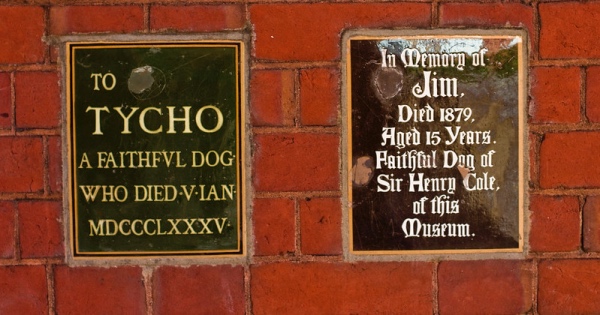
Set into a wall of the V&A’s John Madejski Garden in South Kensington are two small plaques – one dedicated to “Jim” and another to “Tycho”. Both, as one of the plaques records, were dogs, at least one of which belonged to the museum’s first director, Sir Henry Cole.

Jim was a Yorkshire terrier who died at Sir Henry’s home on 30th January, 1879, at the age of (as the plaque records) 15 years.

Sir Henry wrote in his diary on that day that “Jimmy”, who died very quietly apparently of “asthma and cold”, had been portrayed in Punch with him (although it was actually in Vanity Fair in 1871) and “was a character in the Museum”.

While Jim’s story is fairly well known, there’s a little more mystery surrounding the identity of Tycho, which the plaques records as a “faithful dog” who who died in 1885.

But according to Nicholas Smith, an archivist based at the V&A Archive and his meticulously researched blog post on the matter, Tycho is also mentioned in Cole’s diary – not as his own dog but as that of his son Alan. Indeed, one diary entry records Tycho fighting with another dog (presumably Cole senior’s) named Pickle. Which as Smith points out, begs the question of why no plaque for Pickle?

Both Jim and Tycho are believed to be buried in the garden where the plaques can be seen (which may explain the lack of a plaque for Pickle).

PICTURE: Steve and Sara Emry (licensed under CC BY-NC-SA 2.0)


Exploring London’s 100 most popular posts of all time! – Numbers 92 and 91…

And this week’s “best of” posts are:

92. Famous Londoners – Sir Robert Peel

91. LondonLife – Florence Nightingale remembered…


10 (lesser known) monuments featuring animals in London – 6. Sam the cat…

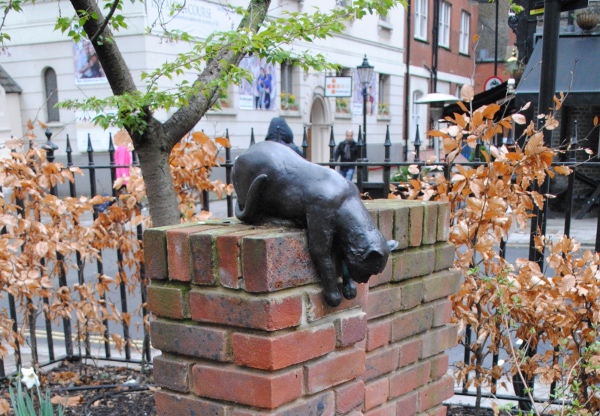
Captured preparing to jump off a red brick wall, this small playful statue of a domestic cat named Sam can be found in the south-west corner of Queen Square Gardens in Holborn. 

The bronze statue actually commemorates Patricia Penn (1914-1992), a former resident in the square who was a nurse, “champion of local causes” and member of the Queen Square Resident’s Association. The statue was donated by the local community in Penn’s memory.

As is clear from the monument, Penn was also a cat lover. Sam was, of course, one of her pet cats.

Sadly, the original version of Sam – which was installed in 2002 to mark the 10th anniversary of Penn’s death, was stolen in 2007. But a replacement was installed in 2009 – this time with steel rods running into the bricks to prevent it being taken again.


Exploring London’s 100 most popular posts of all time! – Numbers 94 and 93…

Our countdown continues…

94. Lost London – York Watergate

93. A Moment in London’s History – The execution of William Wallace…


10 (lesser known) monuments featuring animals in London – 5. Jamrach’s Tiger…

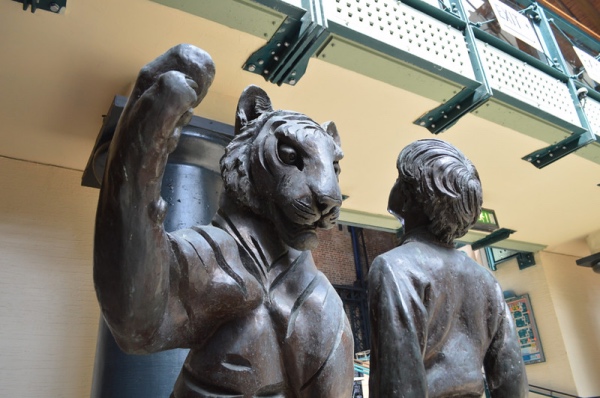
This bronze statue located at Tobacco Dock in Wapping commemorates an incident in 1857 in which a newly arrived Bengal tiger escaped from its wooden crate, terrorised the local population and absconded with a boy in its mouth.

The tiger, along with various other animals, had just arrived at a premises on Betts Street, just off the Ratcliffe Highway, which was owned by exotic animal trader Charles Jamrach, the man behind Jamrach’s Animal Emporium, when it made its break for freedom.

The boy, variously said to be seven, eight or nine-years-old, had apparently approached the tiger to pet it when the tiger took the boy by his jacket and carried him off in its mouth, presumably looking for a quiet place to consume its prey.

Jamrach followed, subsequently bailing up the tiger and, thrusting his cane into the big cat’s throat, forcing it to let go of the no-doubt terrified boy.

The tiger, which was guided back to its cage after the event, was subsequently sold for £300 to George Wombwell and went on to become a popular tourist attraction in his travelling menagerie.

Despite being relatively unharmed, the boy (variously described as seven, eight or nine, however, sued Jamrach and was awarded some £300 in damages – the same amount Jamrach had sold the animal for.

The statue is located near where the event happened by Tobacco Dock’s Pennington Street entrance.

PICTURE: Matt Brown (licensed under CC BY 2.0)

Exploring London’s 100 most popular posts of all time! – Numbers 96 and 95…

The next couple in our year-long countdown

96. Treasures of London – Swiss Court…

95. Lost London – The Roman basilica and forum…

10 (lesser known) monuments featuring animals in London – 4. Trump…

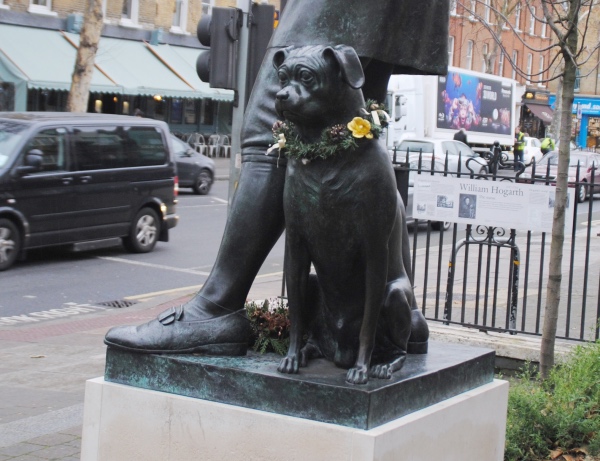
Sitting at the foot of a statue of artist William Hogarth – described on the monument as the “father of English painting” but perhaps best known today for his satirical prints such as Gin Lane – in Chiswick High Road in London’s west is his beloved pug dog, Trump.

Trump, who famously features in Hogarth’s 1745 self-portrait, The Painter and his Pug (now at the Tate Britain), was one of several pugs owned by the artist over his career.

Trump, like the other dogs, appears in several of Hogarth’s works including the self-portrait and the 1746 work Captain Lord George Graham in his Cabin, now at the National Maritime Museum.

The dog was also the subject of a terracotta sculpture by Frenchman Louis-François Roubiliac, created to accompany a bust of Hogarth in 1741. It was later reproduced in porcelain versions and plaster casts of it were sold after Hogarth’s death in 1764. While the original of sculpture of the dog is lost, the bust of Hogarth can still be seen at the National Portrait Gallery.

Hogarth is often said to have compared himself to his dogs and his close connection was noted by others who used it to make fun of the artist including Paul Sandby who, in a 1753 etching, depicted Hogarth as half-pug.

The statue, which stands opposite the intersection with Turnham Green Terrace, is located not far from the country retreat where Hogarth lived – splitting his time between it and his Leicester Square townhouse – between 1749 and his death (now a museum known as Hogarth’s House; the artist is also buried nearby)

The work of Jim Matheison, it was unveiled by Ian Hislop and David Hockney in 2001.

Exploring London’s 100 most popular posts of all time! – Numbers 98 and 97…

We’ll return to our regular programming next week but in the meantime, enjoy the next couple of entries in our year-long countdown…

98. Lost London – Bridewell Palace…

97. Lost London – Exeter/Essex House…


Exploring London marks 10 years!

Did you know that 2020 marks 10 years since Exploring London first began…well…exploring London?

We’ll be celebrating our anniversary across the year in a number of ways including counting down our 100 most read stories ever…

So let’s kick off the countdown with numbers 100 and 99…

100. LondonLife – A new crown for King Henry VIII…

99. 10 sites of significance in Jane Austen’s London…1. 10 Henrietta Street, Covent Garden…

PICTURE: Adi Goldstein/Unsplash

Exploring London’s 10 most popular posts for 2019…Numbers 4 and 3…

4. 10 of London’s most curious (and historic) graves – A recap…

3. Lost London – The Mappin & Webb building…

Exploring London’s 10 most popular posts for 2019…Numbers 6 and 5…

6. 10 historic London hotels…5. The Great Western Hotel (Hilton London Paddington)…

5. This Week in London – City of London’s biggest rooftop viewing platform opens; Rembrandt at the British Museum; and, Franz West at the Tate…

Exploring London’s 10 most popular posts for 2019…Numbers 10 and 9…

And so we come to our annual countdown of the most popular stories published in 2019. Without further ado here’s the first two…

10. 10 of London’s most curious (and historic) graves – 7. Ben Jonson (Westminster Abbey)…

9. 10 of London’s most curious (and historic) graves – 2. Hannah Courtoy…  

We’ll publish the next two tomorrow…

10 (lesser known) monuments featuring animals in London – 3. Hodge…

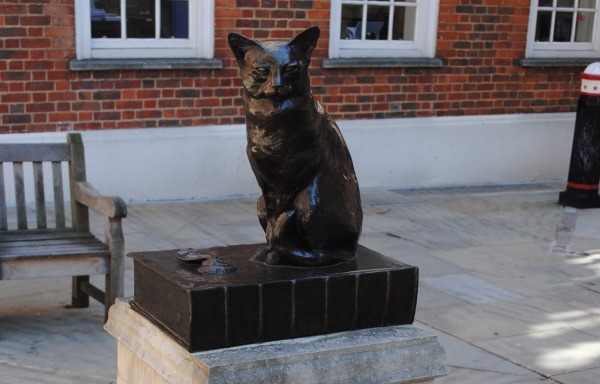
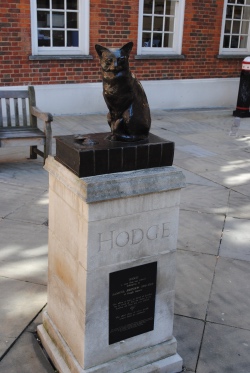
This famous cat, belonging to lexicographer Dr Samuel Johnson (1709-84), is memorialised outside his former home in Gough Square.

Johnson was known for his fondness of this particular cat – his biographer James Boswell, reports, for example: “I recollect him one day scrambling up Dr Johnson’s breast, apparently with much satisfaction, while my friend smiling and half-whistling, rubbed down his back, and pulled him by the tail.”

According to Boswell, Johnson told him that while he had had finer cats, Hodge – who is believed to have been a black cat – was a “very fine cat indeed”. Such was the cat’s renown that poet Percival Stockdale wrote an Elegy on The Death of Dr Johnson’s Favourite Cat.

This statue to Hodge was erected in 1966 by then Lord Mayor of London, Sir Roger Cook. The work of Jon Bickley (who apparently modelled Hodge on his own cat Thomas Henry), it depicts Hodge sitting on top of Johnson’s famous (and massive) dictionary and next to some empty oyster shells (the latter a reference to Johnson’s habit of feeding oysters to Hodge – while this wasn’t unusual, Johnson’s going out himself to fetch them himself – lest his servants resent Hodge – was).

The monument, which has Hodge looking towards his former home, features a plaque which has Johnson’s quote about Hodge – “a very fine cat indeed” – as well as his famous quote about the city in which they lived – “Sir, when a man is tired of London, he is tired of life, for there is in London all that life can afford.”

Dr Johnson’s former house and workplace at number 17 Gough Square, where he lived for 11 years, is now a museum.


10 (lesser known) monuments featuring animals in London – 2. Tom Sayer’s dog, Lion…

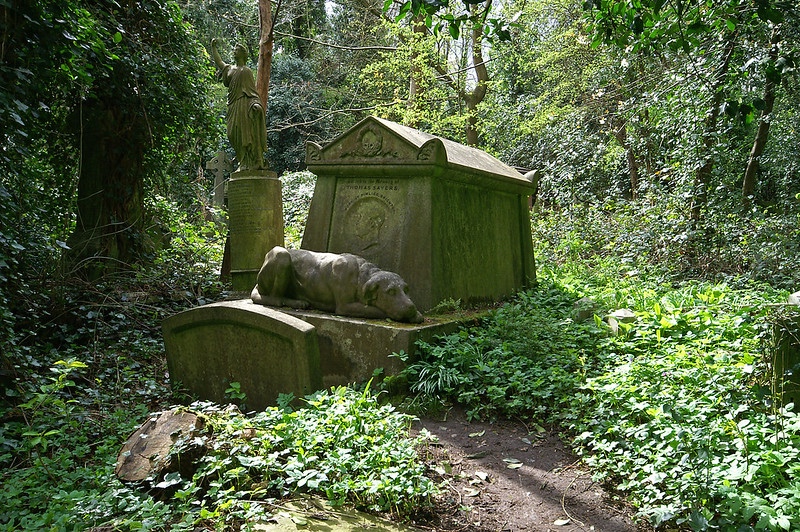
From a cat to a dog – this week we’re looking at the grave of Victorian-era bare knuckle prize fighter Tom Sayers which features a statue of his faithful hound, Lion.

Sayers – widely considered the first boxer to hold the World Heavyweight Champion after he defeated American John Camel Heenan in 1860 – had a career spanning more than a decade in the the mid-19th century and was able to retire in 1860 thanks to a generous public. But he died only five years later at the age of 39 in 1865.

His burial at Highgate Cemetery – where this tomb is located – is said to have been attended by 10,000 people, such was his fame. Lion, a mastiff, was described as the “chief mourner” at his funeral.

Lion had been Sayers’ dog since at least early 1861 when mentions of the brown dog accompanying the pugilist started to appear in the press. The newspapers noted the apparent bond between the two but when Sayers failed bid to create a circus saw him auction off various associated animals and paraphernalia, that didn’t stop Lion being on the auction list.

Sayers apparently had a change of heart, however, as Lion’s turn to go under the hammer came up and stepped in to buy back the dog – but not before the price had apparently run up to 20 guineas.

Following Sayers’ death, Lion again went to auction and this time was sold to a close friend of Sayers, a former soldier who was the landlord of the Welsh Harp pub where the boxer had held his circus auction.

Following a public subscription, the stone monument – including the statue of Lion – was installed over Sayers’ grave in 1866.

Lion, however, was again sold and apparently ended his life on a country estate.

With thanks to an article by Gary Lucken, ‘A tale of ‘Lion’ hunting: Boxing Monthly turns pet detective’ published in Boxing Monthly.

WHERE: Western Cemetery, Swain’s Lane (nearest Tube is Archway); WHEN: Guided tour only – bookings essential for weekdays/no bookings on weekends (tours run every half hour from 10.30am to 3pm); COST: £12 adults/£6 children eight 17/no children under 8; WEBSITE: www.highgate-cemetery.org

PICTURE: Nick Garrod (licensed under CC BY-NC-ND 2.0)

10 (lesser known) monuments featuring animals in London – 1. Dick Whittington’s cat…

OK, there’s a plethora of monuments in London which depict animals including well-known Animals in War Memorial in Park Lane. But in this series we thought we’d take a look at some of the less well-known monuments or those that are a little off the beaten track. 

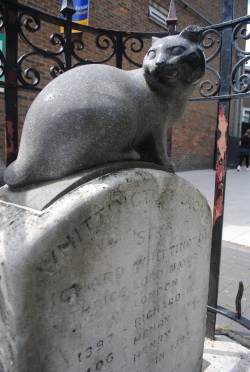
First up, it’s Dick Whittington’s cat – sometimes portrayed as male cat called Tommy – who can be seen sitting atop what’s called The Whittington Stone at the foot of Highgate Hill in London’s north.

The Grade II-listed monument, the base of which dates from 1821 and was restored in 1935, is said to mark the spot where Whittington, who was said to be about to give up on life in the city after failing to make his fortune and, with his cat in tow, was making his way home to Gloucestershire, heard the famous Bow Bells of London ring out and apparently say to him “Turn Again Whittington! Thrice Lord Mayor of London!”.

Which he did and which become true, apparently thanks to his cat whom he sold for a fortune in gold to someone from a rat-infested land, usually referred to as the Kingdom of Barbary.

Of course, Sir Richard Whittington, while known by many through Christmas pantomimes, was a real person who lived in the 14th and 15th centuries (and was indeed Mayor of London three times) but whether he actually had a cat remains a matter of conjecture.

The sculpture of the cat, made of polished black Kellymount limestone, is the work of Jonathan Kenworthy, and was only added to the top of the stone in 1964.

There is apparently a belief that if the Whittington Stone is ever removed or any harm befall it, it is an omen of disaster.

WHERE: Highgate Hill, near the intersection with Magdala Avenue (nearest Tube station is Archway); WHEN: Anytime; COST: Free; WEBSITE: No.


10 (more) historic London garden squares – A recap…

We’ve finished our series on historic London garden squares, so before we launch our next series, here’s a recap…

1. Portman Square…

2. Golden Square…

3. Gordon Square…

4. Red Lion Square…

5. Brunswick Square…

6. St George’s Square…

7. Belgrave Square…

8. Salisbury Square…

9. Manchester Square…

10. Fitzroy Square…

10 (more) historic London garden squares…10. Fitzroy Square…

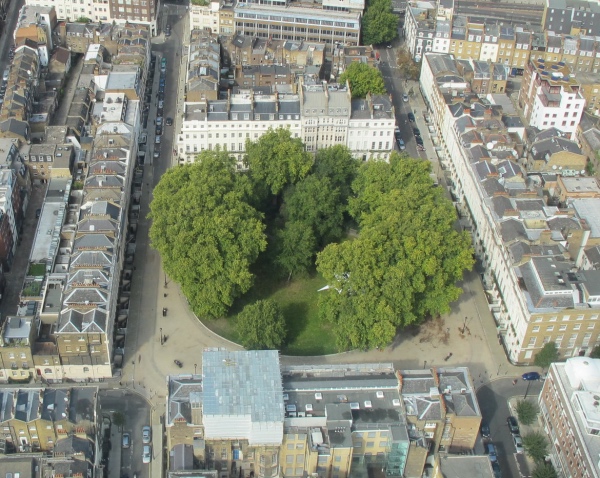
This Georgian square, like the nearby (and famous) Fitzroy Tavern, Fitzroy Street and Fitzrovia itself, owes its names to the FitzRoy family who owned the land on which it was built.

It was Charles FitzRoy, 1st Baron Southampton, who had the area developed in the late 18th and early 19th centuries with the aim of creating a desirable location for aristocratic families to live.

It was completed in stages with residences along the eastern and southern sides built first – from the 1790s – by Robert and James Adam (the southern side was destroyed in the Blitz but has been rebuilt).

The Napoleonic Wars then interrupted construction and it wasn’t until the late 1820s and early 1830s that the northern and western sides were completed.

Notable residents included painter James McNeill Whistler (number eight), Sir Charles Eastlake, first director of the National Gallery (number seven), Prime Minister Lord Salisbury (number 21 – now home to the High Commission of Mozambique), George Bernard Shaw (number 29 – later also briefly home to Virginia Woolf), and artists Ford Madox Brown (number 37) and Roger Fry (number 33)

In more recent times, the square has been home to the likes of the late media tycoon Robert Maxwell (number six), and novelist Ian McEwan (number 11 – he made the square the main location for his 2005 novel, Saturday).

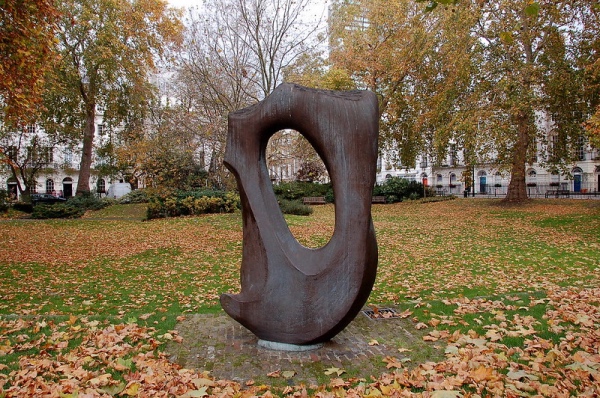
The garden was first laid out in about 1790, initially just for the use of residents. Monuments now include Naomi Blake’s View, erected for the Queen Elizabeth II’s Silver Jubilee in 1977.

The square was largely pedestrianised in the 1970s and upgraded in 2008.

PICTURES: Top – View of Fitzroy Square from the former BT Tower (Rain Rabbit/CC BY-NC 2.0/image cropped); Below – View (James Stringer/CC BY-NC 2.0/)

10 (more) historic London garden squares…9. Manchester Square…

This Marylebone square is one of the better preserved Georgian-era squares in London. 

Located on the Portman Estate, it was laid out in the 1770s as a residential square with the north side of the square dominated by Manchester House, built in the 1770s as the home of the 4th Duke of Manchester (from whom the house and square, now derive their name).

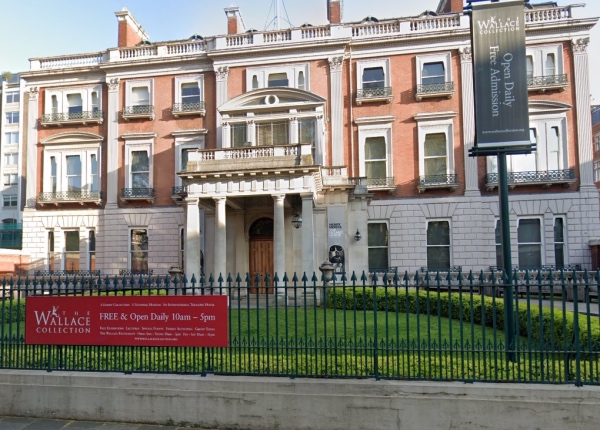
The house, meanwhile, changed its name when the 2nd Marquess of Hertford took over the lease in 1797. It became known as Hertford House and now houses The Wallace Collection (pictured below), a collection of artworks left to the nation – along with the house – by Lady Wallace, widow of Sir Richard Wallace, illegitimate son of 4th Marquess, in 1897, and opened to the public as a museum in 1900.

The almost circular private gardens in the centre were laid out in the mid-1770s with garden beds and railings (there was apparently a church planned for the centre of the square on which the gardens were located, but it was never built).

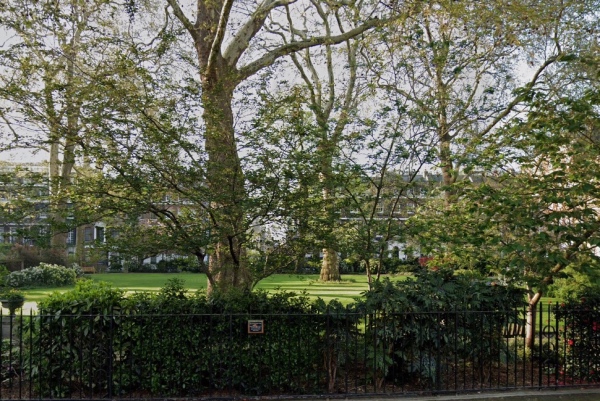
During World War II, trenches were dug in the garden and railings removed and the gardens did receive some bomb damage but they were restored in the 1960s and then extensively replanted in the mid-Noughties. The garden (pictured above, looking south) features mature London plane and lime trees.

Famous residents in the square, which has now largely been converted to offices, have included German-born composer Sir Julius Benedict (he lived at number two), surgeon and neurologist John Hughlings Jackson (number three) and colonial administrator Alfred, Lord Milner (number 14) – all of which have English Heritage Blue Plaques on their former properties – as well as Admiral Sir Thomas Foley (number one).

The square, which, along with Portman Square is Grade II-listed, also become briefly famous in around 1815 when it was reported a “pig-faced woman” lived there.

It is also known for being the former site of record label EMI – the cover shot for the Beatles’ first LP, Please Please Me, was shot in the modernist building’s stairwell in 1963 (the building has since been demolished but EMI took part of the staircase with them when they left in 1995).

Interestingly, Manchester Square Fire Station, which was decommissioned in 2005, was actually located a few blocks away in Chiltern Street (it was also known as the Chiltern Firehouse).

PICTURES: Google Maps

10 (more) historic London garden squares…8. Salisbury Square…

This City of London square sits on the part of the site of what had been Salisbury House, the town house of the bishops of Salisbury.

The house, which later became known as Dorset House, burned down in the Great Fire of London of 1666 and the square, now at the southern end of Salisbury Court, developed in its aftermath.

Lying just to the south of Fleet Street, the square was once home to the Salisbury Court Theatre in the mid-17th century and John Dryden lived here from 1673 to 1682, a period during which he wrote works including Amboyna (1673), All for Love (1678) and The Spanish Fryar (1681). It was also a popular place for actors to reside given its proximity to the Dorset Garden Theatre which was also built on part of the site of Salisbury House.

There was an alehouse here when King George I acceded to the throne – known as a locale frequented by his supporters, it was famous for an incident in 1716 in which it was stormed by a Jacobite mob during which the landlord shot a weaver (he was acquitted but five rioters were hanged at the end of the court.

Samuel Richardson ran a printing shop lived here from 1723 – Pamela was among the works he wrote here. He later pulled down some old residences to expand his printing operations (and it was in his house that Dr Samuel Johnson and William Hogarth first met).

In 1863, all the houses on the south side were replaced by the Salisbury Hotel and this was replaced in  the 1960s by Salisbury Square House when the square was remodelled and the central area laid out. Only number one remains of the early 18th century houses which once stood here.

The now largely paved square features garden boxes in the middle along with an obelisk commemorating Robert Waithman, Lord Mayor of London between 1823-24. It had apparently originally been erected in Farringdon Street but was moved here in the 1970s.

PICTURE: Google Maps.


10 (more) historic London garden squares…7. Belgrave Square…

This expansive square in the centre of Belgravia is one of the largest 19th century squares in London.

The square, which along with nearby Chester Square, Eaton Square and Wilton Crescent stands on land once known as Five Fields, was laid out in the 1820s on the orders of Robert Grosvenor, 2nd Earl Grosvenor, whose subsidiary title was Viscount Belgrave and who later become the first Marquess of Westminster (and whose family seat is Eaton Hall in Cheshire, close to the village of Belgrave from whence the name comes).

Property contractor Thomas Cubitt was responsible for the masterplan and architect George Basevi, a pupil of Sir John Soane and cousin of Benjamin Disraeli, had the task of designing the original four terraces which surrounded the square.

Most of the houses were occupied by 1840. Today, the buildings – many of which are listed – are home to numerous embassies and official residences of ambassadors.

These include the Portuguese Embassy (11 to 12), the Austrian Ambassador’s official residence (18 – the Austrians have been there since 1866 when it was used by members of the Austro-Hungarian Empire’s Foreign Service), the High Commission of Brunei (20), the German Embassy (21-23), the Spanish Embassy (number 24), the Norwegian Embassy (25), the Serbian Embassy (28) and the Turkish Embassy (43).

Famous residents have included the currently Duke of Kent – he was born at number three in 1935, Victorian politician Sir George Murray, Secretary of State for War and the Colonies, who lived at number five up until his death in 1846, and shipbuilder, Lord Pirrie, chairman of Belfast-based Harland and Wolff – builder of the RMS Titanic (in fact it’s said that it was at a dinner here which Lord Pirrie hosted and J Bruce Ismay, owner of the White Star Line, attended where plans to build the ship were first discussed).

The two hectare garden in the centre, which remains closed to the public and is Grade II listed, had gravel walks laid out in the 1850s (the current design is a restoration of what was there in the 1860s). Behind the railings, the gardens features wooden pergolas and shelters and a tennis court.

Among the monuments around the external perimeter of the square are statues of of South American revolutionary leader Simon Bolivar (1783-1830), Argentinean national hero General Jose de San Martin (1778-1850), Christopher Columbus (1451-1506) and Prince Henry the Navigator. There’s also a 1998 statue of Robert Grosvenor by Jonathan Wylder on the corner of Wilton Crescent.

Within the gardens are Homage to Leonardo da Vinci, erected in 1982, and a bust of George Basevi, the architect of Belgrave Square.

Top – Statue of Prince Henry the Navigator; Below – The Spanish Embassy. PICTURES: David Adams