Lost London – Alsatia…

A Thames-side slum area located between Temple and Whitefriars Street (and south of Fleet Street), an area previously occupied by the Whitefriars Monastery, Alsatia was known as something of a lawless district where residents resisted any intervention by City officials.

The district came into existence following the dissolution of the monastery by King Henry VIII (he apparently gave the buildings and land to his physician Dr William Butts) and the area, despite some initial efforts to build substantial houses there, eventually degenerated into an overcrowded slum (apparently even when the priory was still existent, some of the surrounding areas had been somewhat disreputable).

The right of sanctuary apparently existed in the area which meant that debtors and criminals who entered gained immunity from arrest while they remained here.

Authorities were certainly loathe to enter the district given the strength which residents showed in resisting any attempts to grab hold of wanted persons and the maze-like narrow thoroughfares of the area and it became mockingly referred to as Alsatia in a reference to Alsace, a much disputed region on the French-German border which was historically outside normal legal jurisdiction.

Among those who took refuge here was Daniel Defoe – he is said to escaped here in 1692 after he was wanted by authorities for writing seditious material.

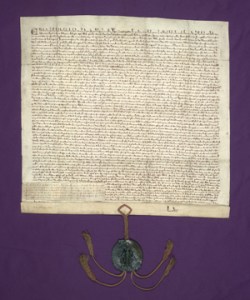
There were several attempts to clean up the slum but these had little effect (although the Great Fire of London did burn through here in 1666) and in 1608, King James I confirmed the area’s liberties in a formal charter. The rights remained in place until 1697 when they were abolished by an Act of Parliament (along with those of other liberties), although the area maintained its disreputable character for some time after.

Alsatia was mentioned in several books including in Thomas Shadwell’s 1688 play The Square of Alsatia and Sir Walter Scott’s 1822 novel, The Fortunes of Nigel, and the term continued to be used to refer to run-down neighbourhoods until late in the 19th century.

LondonLife – Rotherhithe from the Thames…


Wapping


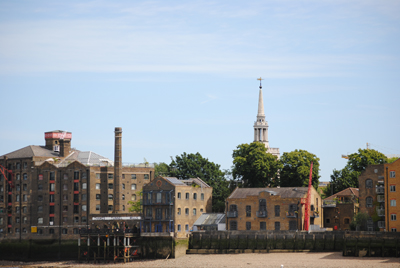
Pictured is the south bank of the Thames showing the buildings of the former Thames Tunnel Mills (now converted to residences). The tower of the Church of St Mary the Virgin is in the background – the church dates from 1716 and was designed by John James, an associate of Sir Christopher Wren.

What’s in a name?…Fulham…

Fulham-PalaceThis Thameside area in London’s west has a long and storied history and its name is a reflection of it.

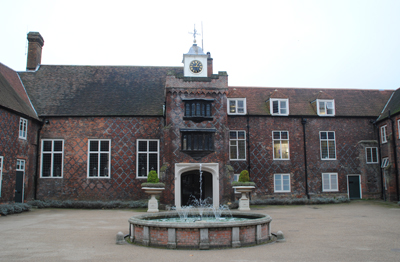
Long home to the ‘country’ manor of the bishops of London (Fulham Palace, pictured above), the name Fulanham is recorded as early as the late 7th century.

While there’s been speculation in the past that the name Fulham (also recorded among other variations as Fullam) was a corruption of ‘fowl-ham’ – relating to the wild fowl that were to be found here – or of ‘foul-ham’, relating to the muddied waters, that’s now apparently generally deemed not to be the case.

Instead, its name most likely owes its origins to an Anglo-Saxon named Fulla and the Old English word ‘hamm’ – a term for a water meadow or piece of land enclosed in a bend in a river (in contrast to the more common ‘ham’ which refers to an estate or homestead) – and referred to the manor he owned here, its boundaries set by a bend in the Thames. (It should be noted there is evidence of earlier occupation of the site by the Romans and as far back as the Neolithic era).

In about 700, the manor of Fulham – which includes the area we now think of as Fulham as well as land stretching as far afield as Acton, Ealing and Finchley – was acquired by Bishop Waldhere of London from Bishop Tyrhtilus of Hereford. Since Tudor times, Fulham Palace was used as the country home of the bishops of London and in the 20th century became their principal residence. It was used as such until 1975 and now houses a museum and reception rooms.

As well as now being used for the area which once contained what became the village of Fulham itself, since 1979 the name has also been used in that of the Borough of Hammersmith and Fulham. Interestingly, Fulham Broadway tube station was known as Walham Green when it first opened in 1880 and was only given its current name in 1952.

The bishop’s palace (and the nearby riverside Bishop’s Park) aside, other landmarks in the area include the Grade I-listed All Saints Church, which is largely late Victorian and which hosts the grave of abolitionist Granville Sharp, and the nearby Powell Almhouses which date from 1869.

It’s also linked by Putney Bridge with Putney on the other side of the Thames; the current bridge is the work of Sir Joseph Bazalgette and was built in 1882 – it replaced an earlier wooden bridge built in 1729 and overlooks where the annual Oxford-Cambridge Boat Race begins (other bridges spanning the river from Fulham include the rather ugly Wandsworth Bridge).

Known during the 18th century as something of a mecca for gambling, prostitution and other debauched leisure activities, these days Fulham is known for its football club, Fulham FC headquartered at Craven Cottage stadium (named for a cottage owned by Baron Craven which once stood here), shopping and is a sought-after residential location.

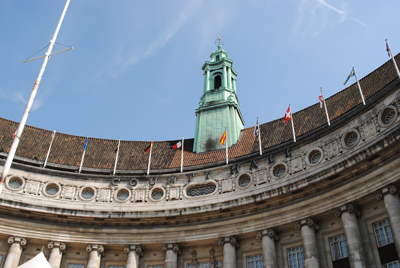
LondonLife – Flying the flags on the London County Hall…


County-Hall


Located on the South Bank of the Thames opposite Whitehall is the former vast  headquarters of the London County Council and later, the Greater London Council. The Grade II* listed building, first opened in 1922, these days houses everything from the London Sea Life Aquarium, the London Dungeon and the visitor centre for the London Eye as well as hotels, restaurants and even flats.

London Pub Signs – The Gipsy Moth…

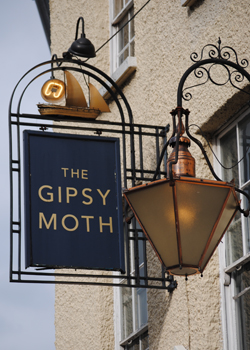
The boat on this iconic Greenwich pub’s sign probably gives the game away here – the Gipsy Moth is named after a yacht of the same name.

The-Gipsy-MothThe Gipsy Moth IV was sailed single-handedly around the globe by Sir Francis Chichester, then aged in his 60s, in 1966-67, who broke numerous records as he did so including the fastest voyage around the world by any small vessel, the longest non-stop passage by a small vessel and what was then the longest single-handed passage.

Following the death of Sir Francis on 26th August, 1972 (he had been knighted by Queen Elizabeth II on the steps of the Old Royal Naval College using the same sword that had knighted Sir Francis Drake in the presence of Queen Elizabeth I in 1581), the boat was put on display in a Greenwich dry dock next to the Cutty Sark. Initially open to the public, it was later closed due to deterioration.

Following a restoration in the early Noughties, in 2006 the Gipsy Moth IV was again sailed around the world (on a trip that wasn’t always smooth sailing) to mark the 40th anniversary of Sir Francis’ journey. It is now owned by a charitable trust based in Cowes on the Isle of Wight.

The renovated pub, located at 60 Greenwich Church Street next to the Cutty Sark, is situated in a building which dates from the late 18th century. It apparently changed its name from the Wheatsheaf in the mid-1970s apparently to mark the arrival of the Gipsy Moth IV.

The pub features a beer garden with views of the Cutty Sark. For more information, see www.thegipsymothgreenwich.co.uk.

This Week in London – Gothic literature at the British Library; founder of War Graves Commission honoured; and, New Year’s Eve tickets on sale…

Gothic The UK’s largest exhibition of Gothic literature opens at the British Library in Kings Cross on Saturday (4th October), marking the 250th anniversary of the publication of the breakthrough book, Horace Walpole’s The Castle of Otranto. Terror and Wonder: The Gothic Imagination will feature manuscripts and rare and personal editions of Gothic classics like Bram Stoker’s Dracula, Mary Shelley’s Frankenstein, Robert Louis Stevenson’s Strange Case of Dr Jekyll and Mr Hyde and Charles Dickens’ Oliver Twist as well as the work of contemporary writers like Angela Carter and Mervyn Peake. There will also be Gothic-inspired artworks by the likes of Henry Fuseli and William Blake and modern art, photography, costumes and movies by the likes of Chapman Brothers and Stanley Kubrick. A range of literary, film and music events will accompany the exhibition which runs until 20th January. Admission charge applies. For more, see www.bl.uk/whatson/exhibitions/gothic/. PICTURE: Percival Delivering Belisane from the Enchantment of Urma, Henry Fuselli. © Tate.

The founder of the Imperial (now Commonwealth) War Graves Commission, Sir Fabian Ware (1869-1949), has been honoured with an English Heritage blue plaque at his former home in Marylebone. Sir Fabian lived at the early 19th century Grade II-listed terraced house at 14 Wyndham Place between 1911 and 1919. It was during this period that he served with the British Red Cross in France and first began recording the graves of soldiers killed in battle. In 1917, the Imperial War Graves Commission was formed with the task of reburying the war dead in permanent cemeteries in France. Knighted in 1920, Sir Fabian was to be director of graves registration and enquiries at the War Office during World War II and it was at this time that he extended the war graves scheme to civilians killed in the conflict. The commission changed its name to the Commonwealth War Graves Commission in 1960. Today it cares for cemeteries and memorials at 23,000 locations in 153 countries. For more, see www.english-heritage.org.uk/discover/blue-plaques/.

New Year’s Eve in London will be a ticketed event for the first time this year with 100,000 tickets being made available to the public with each costing a £10 administration fee – the entire sum of which will apparently be used to pay for the ticketing system. Making the announcement last month, the Mayor of London, Boris Johnson’s, office, said the growth in numbers of those who have gathered to watch the fireworks on the Thames – from around 100,000 in 2003 to an estimated 500,000 last year – has put an enormous strain on transport and safety infrastructure and meant people have had to turn up earlier and earlier to get a good view, facing hours waiting in cold and cramped conditions, or risk being among the “hundreds of thousands” unable to get a good view or even see the display at all. Booking tickets – people may secure up to four – will guarantee “good views of the celebrations and a better visitor experience”. To book tickets, head to www.london.gov.uk/nye.

Send all items for inclusion to exploringlondon@gmail.com.

10 of London’s World War I memorials – 8. The RAF Memorial…

RAF-Memorial
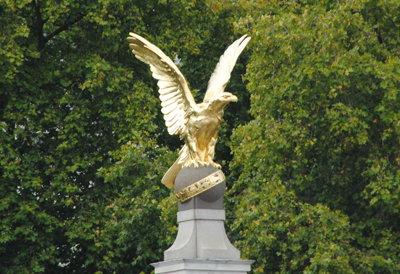
Aerial combat probably isn’t the first thing that springs to mind when thinking about the fighting in World War I but, as the Royal Air Force Memorial on Victoria Embankment records, air crew played a vital role.

The memorial features a bronze eagle perched on an orb girded with a belt depicting the signs of the zodiac which sits atop a Portland stone pylon. It was designed by Sir Reginald Blomfield with the eagle, inspired by the RAF’s badge, sculpted by William Reid Dick. Along with the dedication, it carries an inscription from the Bible (Exodus 19:4) –  “I bare you on eagles wings and brought you unto myself” (sic).

Various other sites were apparently considered for the memorial before the location – amid a string of other memorials between Westminster and Hungerford Bridge – was settled upon (as were other designers including the renowned Edwin Lutyens).

Unveiled on 13th July, 1923, by the Prince of Wales, the memorial was dedicated to the memory of all those who gave their lives in the ranks of the Royal Flying Corps, the Royal Naval Air Service  and the Royal Air Force  (formed through the amalgamation of the RFC and RNAS at a hotel in Strand in 1918) during World War I, along with those who had died while serving in air forces from across the British Empire.

A further dedication was later unveiled in 1946 on Battle of Britain Sunday remembering the men and women of air forces from across the Commonwealth and Empire who died during World War II.

A simple, yet still evocative, memorial.

London Pub Signs – The Captain Kidd…

Captain-Kidd2

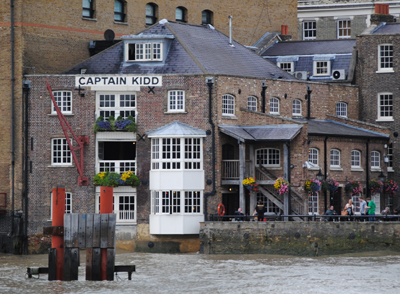
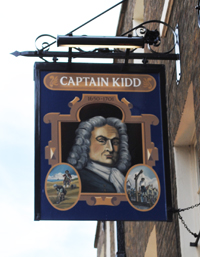
Located on the north bank of the River Thames in Wapping, East London, this pub owes its name to the infamous mariner who met his end at nearby Execution Dock.

Located in what was originally a warehouse, the pub – one of several riverside pubs in Wapping – only apparently dates from the 1980s but the historic location – and the ample views it provides over the river from its garden area – ensures it still has plenty of atmosphere.

Captain-KiddCaptain William Kidd himself was a Scot, born in 1645, who took to the seas in the Caribbean where he operated as a privateer. It was during a voyage in the Indian Ocean – he had set off from London in 1696 – that he undertook actions which led him to being accused of murder and piracy, something he discovered upon his return to the Caribbean soon after.

He traveled to the North American city of Boston to plead his case with the governor but was instead arrested and eventually sent to England where he stood trial for piracy and murder. He was found guilty on all charges and was hanged on 23rd May, 1701, at Execution Dock –  believed to have been located just to the west of the pub – in Wapping.

It was apparently a messy affair – the hangman’s rope broke on the first attempt and he was only successfully hanged on the second. Kidd’s tar-covered body was later displayed in a gibbet hung over the Thames at Tilbury Point as a warning to other pirates for three years.

Kidd’s fame grew after his death, thanks in large part to rumours he’d left buried treasure someone in the US, and his name has become somewhat synonymous with piracy ever since.

The pub, at 108 Wapping High Street, is operated by Samuel Smith’s.

This Week in London – Dr Livingstone’s beetles; the Great River Race; Snowdon at the NPG; and Foundlings at War…

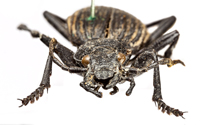
BeetleFrom Dr Livingstone, I presume? A recently unearthed collection of beetles gathered together by Dr David Livingstone during his Zambezi expedition of 1858-64 will go on display in its original box at the Natural History Museum in South Kensington on Friday night. The specimens were found among the museum’s 10 million beetles by beetle curator Max Barclay who stumbled on an unusual box received from a private collector. The collector was later found out to be amateur entomologist Edward Young Western (1837-1924) who apparently bought the specimens from a member of Livingstone’s expedition. The 20 beetles found inside the box are believed to the only surviving specimens known to have been collected by Livingstone. The specimens will be on show as part of Science Uncovered, a free annual after hours event – part of European Researcher’s Night – which will take place at the museum between 3pm and 10.30pm Friday night. Other highlights of the night include the chance to extract DNA from strawberries and bananas, create your own earthquake and chat live with NASA about chasing asteroids. For more, see www.nhm.ac.uk/scienceuncovered. PICTURE: Giant Predatory Ground Beetle, Termophilum alternatum © The Trustees of the Natural History Museum, London.

Totally Thames – the month long celebration of the great river – is going out with a bang this weekend with more than 300 crews expected to take part in the Great River Race. Running from Millwall to Ham in Surrey, the 21.6 mile long event attracts entries from across the globe. The first boats leave Millwall at 12.40pm. Head to the riverbank between Richmond and Ham at approximately 3.40pm to see the winners cross the line to a cannon broadside. For more on the Great River Race, see www.greatriverrace.co.uk. Other events on as part of Totally Thames this weekend include historic riverside walks – one focused on Brunel and another on London’s ports before the Great Fire of 1666 as well as exhibitions including Richmond’s River at Orleans Gallery House in Twickenham and your last chance to see Florentijn Hofman’s HippopoThames. For more on Totally Thames, see www.totallythames.org.

Some of Snowdon’s most iconic images will be on show as part of a new exhibition opening at the National Portrait Gallery near Trafalgar Square on Friday. Snowdon: A Life in View will feature studio portraits spanning a period from the 1950s to the 1990s alongside images from Private View, Snowdon’s 1965 examination of the British art world, created in collaboration with art critic John Russell and then director of Whitechapel Gallery, Bryan Robertson. More than 40 black-and-white portraits are included in the display including some works acquired by the gallery last year. To be held in Room 37 and 37a of the ground floor Lerner Contemporary Galleries until 21st June. Admission is free. For more, see www.npg.org.uk.

On Now: Foundlings at War: World War I. This display at the Foundling Museum in Bloomsbury reveals for the first time the stories of foundlings who fought as well as those of the mothers forced to leave their children at the hospital as a result of bereavement or abandonment of those serving abroad. A free digital ibook, The Foundlings at War: World War I, containing expanded background information was published to coincide with the opening of the display earlier this month and can be downloaded from iTunes. The exhibition is part of a major research project, Foundlings at War, supported by the Heritage Lottery Fund and is the first of several displays examining the institution’s historic links with the military. For more, see www.foundlingmuseum.co.uk.

Send all items for inclusion to exploringlondon@gmail.com.

A Moment in London’s History – The landing of King George I at Greenwich…

GreenwichFollowing on from the last moment in London’s history which looked at the death of Queen Anne, we pause a moment to look at the day 300 years ago – 18th September, 1714 – when her successor, King George I, landed at Greenwich as he arrived to take up his new throne.

There was apparently thick fog when the Elector of Hanover made his way up the Thames accompanied by a flotilla of boats carrying his family and entourage including 18 cooks as well as his mistress, Ehrengard Melusine von der Schulenburg, and his half-sister Sophia Charlotte von Kielmansegg (known rather nastily among English courtiers as the “Maypole” and the “Elephant”).

He landed at the water gates of the Sir Christopher Wren-designed Royal Hospital for Seamen, now known as the Old Royal Naval College, in Greenwich (pictured above) but when the waiting crowds cheered the disembarking king, it was a case of mistaken identity. In fact, they were cheering his son, George Augustus (and future King George II) and by the time the king actually disembarked, much of the crowd had already dissolved, leaving a much smaller – and probably disappointing – gathering to welcome him.

The arrival of the king – a re-enactment of which took place at the ORNC last week – is depicted in a painting in the upper part of the the college’s Painted Hall. The work of artist James Thornhill, it depicts the king wearing Roman costume riding a chariot and appears alongside a figure of St George defeating the dragon (who, of course, stood for the papacy and family of the deposed King James II).

The Painted Hall also features a family portrait of the new Royal Family, excluding George’s wife Sophia Dorothea who was imprisoned in Germany at the time following allegations of infidelity. The future King George II is featured with his back to the king in reference to the hostility between the two of them.

The ORNC is currently looking to raise £5.5 million to conserve Thornhill’s paintings following a restoration of the Painted Hall in 2013. For more details, head to www.ornc.org/support/current/conserve-the-painted-hall.

This Week in London – Open House London this weekend; the Ming dynasty at the British Museum; John Constable at the V&A; and Totally Thames…

The-Leadenhall-Building• Open House London is finally here with some 800 buildings across the city – some of them rarely accessible to the public – open for free this weekend, from grand historical institutions and modern skyscrapers through to ‘green’ schools, engineering projects, parks and gardens, and private homes. The weekend – which is being run this year under the theme of ‘revealing’ – also includes a programme of walks, engineering and landscape tours, cycle rides, a bus tour, childrens’ activities and expert talks as well as a moonlit ‘culture crawl’ through London on Friday night and into Saturday morning (a fundraiser for Maggie’s Centres). Among the buildings opening their doors in the festival – created by London-based architecture organisation Open-City – are the ever popular 30 St Mary Axe (aka ‘The Gherkin’), the Foreign and India Office in Whitehall, the Bank of England, Portcullis House and City Hall along with everything from The Leadenhall Building (aka ‘The Cheesegrater’ – pictured), and Temple Church in the City to the Admiral’s House in Greenwich, the Dutch Embassy in Kensington and the steam coaster, the SS Robin, in Tower Hamlets. As mentioned in a previous week, some visits required pre-booking so make sure you check the programme before heading out. For a full copy of the programme of events, see www.londonopenhouse.org. PICTURE: © R Bryant.

A major new exhibition focusing on China during the “pivotal” 50 years of Ming Dynasty rule between 1400-1450 opens at the British Museum in Bloomsbury today. Ming: 50 years that changed China features some of the finest objects ever made in China – loaned from institutions in China and elsewhere – as it explores some of the “great social and cultural changes” that saw Beijing established as the capital and the building of the Forbidden City. It includes objects from the imperial courts along with finds from three regional “princely tombs”. Four emperors ruled during the period and the display will feature the sword of Yongle Emperor, “the warrior”, the handwriting of the Hongxi emperor, “the bureaucrat”, the paintings of the Xuande emperor, “the aesthete”, and portraits of the regents who ruled while the Zhengtong emperor was a boy. The exhibition runs until 4th January. Admission charge applies. For more, see www.britishmuseum.org.

The work of 19th century artist John Constable and its debt to 17th century masters is the focus of a new exhibition opening at the V&A on Saturday. Constable: The Making of a Master – which features more than 150 works including celebrated pieces by Constable like The Hay Wain (1821), The Cornfield (1826) and Salisbury Cathedral from the Meadows (1831) as well as oil sketches, drawings, watercolours and engravings – will juxtapose his works with those of 17th century landscape masters like Ruisdael, Rubens and Claude. Among those of their works on display will be Rubens’ Moonlight Landscape (1635-1640) and Ruisdael’s Windmills near Haarlem (c.1650-62). The exhibition runs until 11th January. Admission charge applies. For more, see www.vam.ac.uk/constable.

And don’t forget, Totally Thames continues to run throughout this month which an extensive programme of river-related events. Those on during the coming week include Londonist Afloat: Terrific Tales of the Thames, a series of discussion sessions on aspects of the River Thames being held aboard the HMS President and London’s River – The City’s Ebb and Flow, a guided walk along the river (held on every Saturday and Monday during September), and Hospital and Troop Ships – Transporting the walking and wounded in the First World War, an exhibition held aboard the HQS Wellington (open Sundays and Mondays in September). For the full programme of events, see www.totallythames.org.

Send all items for inclusion to exploringlondon@gmail.com.

This Week in London – The Magna Carta at the new City of London Heritage Gallery; Tudor monarchs at the NPG; Mapping London; and objects with story at Pitzhanger…

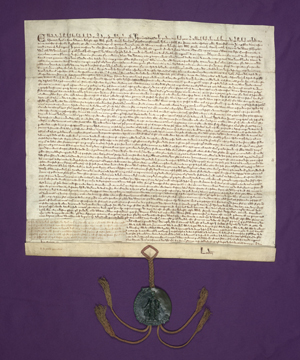
Magna-Carta-1297_Copright-London-Metropolitan-Archives---CopyThe 13th century’s finest surviving copy of the Magna Carta is taking centre stage at the new City of London Heritage Gallery which opens to the public this Friday. The 1297 document, which bears a superimposed memo reading ‘make it happen’, is being featured as part of the Corporation’s efforts to mark next year’s 800th anniversary of the signing of the landmark document. Other items on display in the new permanent, purpose-built exhibition space at the Guildhall Art Gallery include the medieval Cartae Antiquae, a volume containing transcripts of charters and statues covering laws enacted between 1327 and 1425 – a period which includes the reign of King Richard III, a poster for a World War I recruitment meeting held at the Guildhall in 1914, and a series of paintings depicting the 25 City Aldermen who were in office in the mid-1400s. The gallery, admission to which is free, will in future feature a rotating selection of rare documents from the City of London Corporation’s archives including the purchase deed William Shakespeare signed on buying a home in Blackfriars in 1613. For more, including opening times, see www.cityoflondon.gov.uk/heritagegallery. For more on events to mark the 800th anniversary of the signing of the Magna Carta next year, see www.magnacarta800th.com. PICTURE: Copyright London Metropolitan Archives.

Rare depictions of Tudor monarchs will be seen at the National Portrait Gallery in the most complete presentation of their portraiture to date. The Real Tudors: Kings and Queens Rediscovered features the gallery’s oldest portrait – that of King Henry VII – displayed alongside a Book of Hours inscribed by the king to his daughter, six portraits of King Henry VIII along with his rosary (on loan from Chatsworth), portraits of King Edward VI and a page from his diary in which he relates his father’s death, five portraits of Queen Mary I along with her prayer book (on loan from Westminster Cathedral) and several portraits of Queen Elizabeth I displayed alongside her locket ring (on loan from Chequers, the country residence of the PM). There will also be a discussion surrounding the search for a “real” portrait of the ‘nine days queen’, Lady Jane Grey, alongside a portrait of her that dates from the Elizabethan period. With many of the portraits newly examined as part of the gallery’s ‘Making Art in Tudor Britain’ project, visitors to the gallery will also be able to access a specially created app which allowing them to access the new research while looking at the portraits. The display, which will form the core of a larger exhibition in Paris next year, can be seen until 1st March. Admission to the gallery, off Trafalgar Square, is free. For more, see www.npg.org.uk.

An exhibition of rare maps from London, dating from between 1572 and last year, at gallery@oxo on South Bank, is closing on Sunday. Part of the Totally Thames festival, the Mapping London exhibition shows how the landscape along the River Thames as it passes through the capital has changed over the years. It features the first available map of London, which dates from 1572, as well as a 2013 map of underground London, monumental wall maps, and even a map of London that doubles as fan. The free exhibition at Oxo Tower Wharf is being curated by Daniel Crouch, one of the world’s leading map dealers. For more, see www.totallythames.org/events/info/mapping-london.

• A Crafts Council touring exhibition showcasing the work of 12 contemporary artisans and design studios – each of which uses objects as a means of storytelling – has opened at Pitzhanger Manor House and Gallery in Ealing – its first stop – this week. Crafting Narrative: Storytelling through objects and making explores the potential of objects to reflect on history, culture, society and technology through a combination of new and commissioned works, film text and photography. Works include Hilda Hellström’s The Materiality of a Natural Disaster which consists of food vessels made of soil from a field belonging to the last resident inside the Japanese Daiichi nuclear plant exclusion zone, Onkar Kular and Noam Toran’s archive of objects belonging to the fictional Lövy-Singh clan – an East London family of mixed Jewish and Sikh descent, and Hefin Jones’ The Welsh Space Campaign which features objects such as astronaut boots in the form of traditional Welsh clogs in an attempt to show how Wales has the capacity to explore space. The free exhibition is at the manor until 19th October. For more, see www.pitzhanger.org.uk.

Send all items for inclusion to exploringlondon@gmail.com.
LondonLife – HippopoThames…

Hippo1

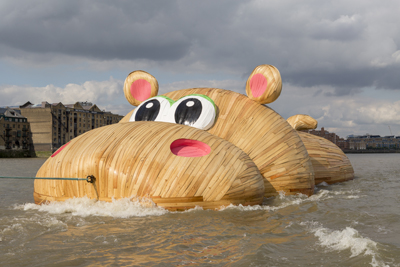
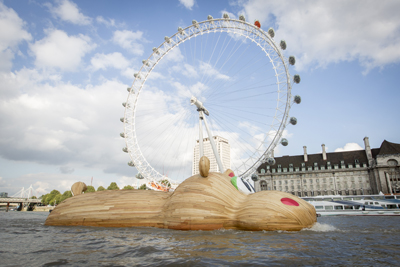
A 21 metre long wooden hippopotamus, HippopoThames, has been spotted in the River Thames off the new quarter of Nine Elms near Battersea in the city’s west. The semi-immersed sculpture, by Dutch artist Florentijn Hofman (famed for his huge yellow Rubber Duck), is part of the month long celebration of London’s river known as Totally Thames and can be seen at the site until 28th September. The sculpture was inspired by the history of the Thames – in particular, the hippos which once inhabited it (in fact, there’s a talk on the subject of the hippos at the Doodle Bar in Battersea tonight – admission charge applies, see www.totallythames.org/events/info/thames-natural-history). Hippopo is moored off Riverside Gardens, Nine Elms Lane, SW8 2DU. For foreshore access times, see www.totallythames.org/events/info/florentijn-hofman. PICTURES: Steve Stills.

Hippo2

This Week in London – Prepare to celebrate the Thames; Auerback on show at the Tate; and, Jan van Huysum at Dulwich…

London’s month long celebration of the River Thames kicks off on Monday with a 30 day programme of events ranging from regattas and river races to foreshore archaeology, arts, music and community festivals and environmental and educational activities. Highlights of Totally Thames include the Mayor’s Thames Festival, which runs all month and includes new art, films and performances on the riverside as well as beach combing, bonfires, walks, talks and cruises, the Royal Greenwich Tall Ships Festival, which runs from 5th to 9th September and features the largest fleet of tall ships to visit London in 25 years, the Great River Race on 27th September which has attracted more than 300 crews from across the globe, Handel’s Fireworks Music and Illuminations taking place at Hampton Court Palace on 14th September and, taking place this weekend, The Big Thames Tidy, which sees water charity Thames21 hosting one of the biggest clean-ups the river has ever seen. We’ll be mentioning events in more details as the month unfolds. To see the full programme of events, head to www.totallythames.org.

The most significant private collection of the paintings and drawings of Frank Auerbach – described as one of Britain’s “greatest living artists” – has gone on show at Tate Britain on Millbank. The works, which span the period from Auerbach’s student days in the late 1940s until 2007, were collected by the late artist Lucian Freud and hung in his London house until his death in 2011. They include portraits of Auerbach’s friends and relatives and landscapes of London. BP Spotlight – Frank Auerbach: Painting and Drawings from the Lucian Freud Estate is on display until 9th November. For more, see www.tate.org.uk.

• Now On: An Impossible Bouquet, Four Masterpieces by Jan van Huysum. This exhibition at the Dulwich Picture Gallery features works by the 18th century Dutch artist taken from private collections as well as the Dulwich’s own painting and is aimed at showcasing the “artist’s ingenuity and astonishing ability to paint flowers, fruit and insects with minute attention to detail”. The exhibition only has a month to go – it closes on 28th September. Admission charge applies. For more, see www.dulwichpicturegallery.org.uk.

Send all items for inclusion to exploringlondon@gmail.com.
This Week in London – Notting Hill Carnival; St Paul’s treasures on show; Sherlock Holmes on film; and more…

Photo-by-Wayne-G-callender-(2)The August Bank Holiday is upon us which means it’s carnival time! The Notting Hill Carnival kicks off this Sunday with an extravaganza of costumes, dancing, music and food. The carnival’s origins go back to the late Fifties and early Sixties (the exact date is somewhat controversial!) when it started as a way of Afro-Caribbean communities celebrating their cultures and traditions, drawing on the tradition of carnivals in the Caribbean. The carnival is now Europe’s largest street festival and this year’s parade signifies the start of a three year celebration in the lead-up to the Golden Jubilee year of 2016. The carnival kicks off at 9am on Sunday – children’s day – and the same time on Monday – adult’s day – and organisers say the procession should be completed by 7pm. For more, see www.thelondonnottinghillcarnival.com. PICTURE: Wayne G Callender/Notting Hill Carnival.

A pop-up display of some of St Paul’s Cathedral’s treasures will appear today and tomorrow (Thursday, 21st August, and Friday 22nd August) in the cathedral’s crypt. Put together by Museum Studies students from Leicester University, the display will feature items relating to a royal event from each of the first three centuries of Wren’s church. They include images and objects from the Thanksgiving Service for the recovery of King George III in 1789 as well as items from Queen Victoria’s Diamond Jubilee in 1897 and the wedding of Prince Charles and Lady Diana in 1981. The display will be shown from 1pm to 2pm each day – entry is free via the cathedral’s north west crypt door. Meanwhile, the cathedral is offering a private, behind the scenes evening photography tour of the building for the winner of a photography competition looking for “the most surprising image” of the cathedral. The winner – and five friends – will also be treated to a meal at the Grange Hotel’s Benihama restaurant. The Surprise St Paul’s competition runs until 26th September and entrants just need to tweet or post their images to the church’s Twitter or Facebook pages with the hashtag #SurpriseStPauls. For more, see www.stpauls.co.uk.

The National Gallery has made free wi-fi available throughout the building. The Trafalgar Square-based gallery says it’s now also welcoming visitor photography and is encouraging visitors to check in on Facebook and comment on Twitter using the hashtag #MyNGPainting. For more, see www.nationalgallery.org.uk.

Fancy yourself a detective? The Museum of London and the BFI are asking for the public’s help in tracking down a copy of the first ever feature film starring the fictional character Sherlock Holmes.  A Study in Scarlet was released 100 years ago this autumn and was directed by George Pearson with then unknown James Bragington playing the part of Holmes. An adaption of Sir Arthur Conan Doyle’s story of the same name, it is based around Brigham Young’s trek across America with his Mormon followers and sees Holmes solve a series of murders. The film was made at Worton Hall studios and on location in Cheddar Gorge and Southport Sands in 1914. The organisations are seeking the film in the lead-up to the Museum of London’s landmark exhibition on Holmes which opens in October. If you do happen to find the film, you can write to Sherlockholmes@bfi.org.uk or make contact via social media using the hashtag #FindSherlock.

A public ballot has opened for tickets to attend the art installation Fire Garden by renowned French troupe Carabosse at Battersea Power Station this September. The event – which will be held on the nights of Friday 5th and Saturday 6th September – is one of the highlights of Totally Thames, a month-long celebration of London’s great river, and is presented as a tribute to the power station before it’s closed to the public for redevelopment. A free event, it’s expected to be so popular that organisers are holding a ballot for tickets. The ballot closes midday on 27th August. To enter via the Totally Thames website, head here.

Send all items for inclusion to exploringlondon@gmail.com.
10 sites from Shakespearean London – 8: Memorialising Shakespeare (part 1)…

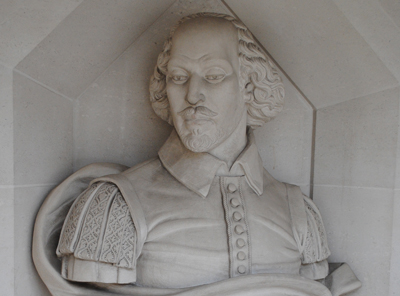
Shakespeare

This week (and next week) as part of our look at Shakespeare’s London, we’re taking a look at a few of the many memorials to William Shakespeare located around London…

• Westminster Abbey: Perhaps the most famous of London’s memorials to Shakespeare can be found in Poet’s Corner, an area of the abbey which has become noted as a burial place and memorial site for writers, playwrights and poets. Designed by William Kent, the memorial statue of Shakespeare was placed here in January, 1741 (there had apparently been some earlier talk of bringing his bones from Stratford-upon-Avon but that idea was squashed). The life-size statue in white marble, sculpted by Peter Scheemakers, was erected by Richard Boyle, the 3rd Earl of Burlington, Dr Richard Mead, Alexander Pope and Tom Martin. The memorial also features the heads of Queen Elizabeth I, King Henry V and King Richard III on the base of a pedestal and shows Shakespeare pointing to a scroll on which are painted a variation of lines taken from The Tempest. A Latin inscription records the date the memorial was created and an English translation of this was added in 1977. For more on the abbey, see www.westminster-abbey.org.

• Guildhall Art Gallery (pictured above): Facing into Guildhall Yard from niches under the loggia of the Guildhall Art Gallery are four larger-than-life busts of historical figures connected with the City of London. As well as one of Lord Protector Oliver Cromwell, architect Christopher Wren, and diarist Samuel Pepys (along with a full-length statue of Dick Whittington and his famous cat) is a bust depicting Shakespeare. Carved out of Portland stone by sculptor Tim Crawley, the busts were installed in 1999. Much attention was apparently paid to creating a bust which resembled pictures of Shakespeare. Follow this link for more on the gallery.

Former City of London School: This Thames-side building, dating from the 1880s, features a full length statue of Shakespeare who gazes out over the river. He’s not alone – poet John Milton, Sir Isaac Newton, Sir Thomas More and Sir Francis Bacon stand nearby, selected, apparently, to represent various disciplines taught at the school. The statues were the work of John Daymond who depicted Shakespeare flanked by representations of classics and poetry and drawing and music. The school vacated the building on Victoria Embankment  in the 1980s and it’s now occupied by JP Morgan.

We’ll be looking at some more works depicting Shakespeare next week…

Lost London – Baynard’s Castle (part 1)…

Baynard’s Castle actually refers to two buildings – a Norman fortification demolished in the early 13th century and a later medieval palace located to the east of the original structure. This week we’re looking at the first of those buildings – the Norman fortification.

Castle-BaynardThe first Baynard’s Castle was built in the late 11th century by Ralph Baynard (Baignard) and is believed to have replaced an earlier fortification at the site at the junction of the Thames and the Fleet rivers (the river now emerges into the Thames under Blackfriars Bridge).

Baynard (his name may be the origin of the name for Bayswater – Baynard’s Watering place – see our earlier post here), was the sheriff of Essex and a supporter of William the Conqueror.

The castle – which is said to have featured walls and parapets and which is generally said to have been on the waterfront (although some have said it was located inland) – remained in Baynard’s family until the reign of King Henry I when in 1111, his grandson William Baynard apparently forfeited his lands for supporting Henry’s eldest brother and would-be king, Robert Curthose.

It was later passed to the King’s steward Robert Fitz Richard, son of the Earl of Clare, and is known to have been inherited by his grandson, Robert Fitzwalter.

Fitzwalter, however, was a key opponent of King John and as early as 1212 he was in hot water for his part in a conspiracy against the king, although he stated it was because the king tried to seduce his daughter, Matilda the Fair. Either way, he escaped trial by heading to France and John seized the opportunity to raze the castle which he did on 14th January, 1213.

Fitzwalter was later forgiven under an amnesty and went on to play a leading role among the baronial opposition to Kong John – he was among 25 barons charged with enforcing the promises of the Magna Carta of 1215.

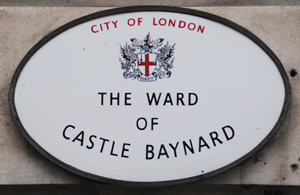
The name Baynard’s Castle is remembered in the London ward of Castle Baynard (pictured) which covers the area in which it once stood.

This Week in London – First World War galleries open at IWM; London’s WWI memorials the focus of new exhibition; and, London celebrates the Festival of Archaeology…

New galleries dedicated to exploring the history of World War I will open – along with the rest of the refurbished building – at the Imperial War Museum in Lambeth on Saturday. The First World War Galleries span 14 areas displaying everything from shell fragments and lucky charms carried by soldiers to weapons and uniforms, diaries and letters, photographs, art and film. Interactive displays include ‘Life at the Front’ featuring a recreated trench with a Sopwith Camel plane and Mark V tank, and ‘Feeding the Front’ featuring an interactive table of more than four metres long which looks how troops were kept fed. There are also reflective areas in which visitors are encouraged to reflect on some of the most difficult aspects of war. The museum – which features a dramatic new atrium – is also launching the largest exhibition and first major retrospective of British World War I art for almost 100 years. Truth and Memory includes works by some of the UK’s most important artists. Entry to both is free with Truth and Memory running until 8th March. For more, see www.iwm.org.uk.

London’s memorials to those who died in World War I are the focus of a new exhibition which opened at Wellington Arch near Hyde Park Corner yesterday. The English Heritage exhibition, which has a particular focus on the six memorials cared for by English Heritage but also looks at other memorials, will include designs, statuettes and photographs of the memorials including the Cenotaph in Whitehall. Also featured in We Will Remember Them: London’s Great War Memorials are official documents – including a note of condolence and medals certificates – received by the family of author and broadcaster Jeremy Paxman on the death of his great uncle Private Charles Dickson, who died at Gallipoli in 1915. Runs until 30th November. Admission charge applies. For more see www.english-heritage.org.uk/daysout/properties/wellington-arch/. Meanwhile, coinciding with the opening of the exhibition has been news that five of London’s key war memorials – including the Edith Cavell Memorial in St Martin’s Place and the Royal Artillery Memorial at Hyde Park Corner – have had their heritage listing upgraded.

In case you missed it, the 24th annual Festival of Archaeology kicked off last weekend and features a range of events across London. Highlights include the chance again to go ‘mudlarking’ on the Thames river bank below the Tower of London and have your finds assessed by archaeologists (this Saturday and Sunday from 11am to 4pm), guided 90 minute walks around Islington and Highbury this weekend with a particular focus on the 1940s, and a look behind the scenes at the London Metropolitan Archives (2pm to 5pm today). The festival continues until 27th July. Check the website for a full program of events – www.archaeologyfestival.org.uk.

LondonLife – Remembering London’s bridges now and then…

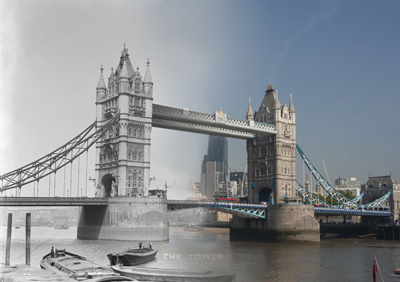
Tower-Bridge

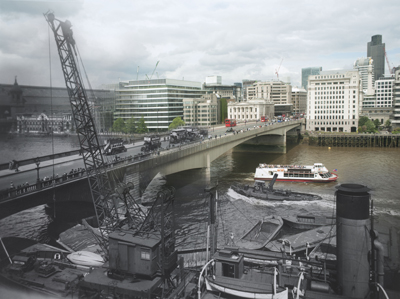
Some of 16 hybrid images showing London’s bridges old and new which have been released by the Museum of London Docklands to mark the recent opening of the museum’s new free art exhibition Bridges. The images have been created using historic photographs showcased in the exhibition which opened last Friday and runs until 2nd November. The photographs were taken by renowned late 19th and 20th century photographers, including Henry Grant, Henry Turner, Sandra Flett, Christina Broom, Roger Mayne and George Davison Reid. Above is Tower Bridge, taken by Christina Broom (c. 1903–10) from Shad Thames Jetty. For more, see www.museumoflondon.org.uk/docklands/PICTURE © Christina Broom/Museum of London.

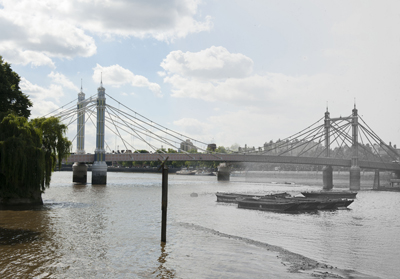
Albert-bridge

Albert Bridge (unknown photographer), Chelsea. Glass lantern slide, c. late 19th century. © Museum of London.

Vauxhall-bridge

Vauxhall Bridge from Cambridge Wharf (taken by Albert Gravely Linney), 1928. Taken from the north bank of the Thames. © Albert Gravely Linney/Museum of London

London-Bridge

Looking north across London Bridge (taken by George Davison Reid), c. 1920s. Taken from inside on the 5th floor of No1 London Bridge. © George Davison Reid/Museum of London

Richmond-Bridge

Richmond Bridge, glass lantern slide, c. late 19th century. Taken from the south side of the river. © Museum of London.

What’s in a name?…Bayswater

The origins of the name of this inner west London location on the northern side of Hyde Park and Kensington Gardens go back to at least the 14th century when it was recorded as Bayard’s or perhaps Baynard’s watering place.

Bayard was the word for a bay-coloured horse but it is thought that instead the name here comes from a local landowner – it’s been suggested he may be the same Baynard whose name is was remembered in the long gone Norman fortification Baynard’s Castle in the City.

The name probably referred to a site where people on their way out of or headed to London stopped for a rest and some water; the water aspect may relate to springs or to the Westbourne Stream which ran through the area.

It’s now known for its culturally diverse population and high concentration of hotels. It’s also known for Georgian terraces – many of which have been converted into flats, mansion blocks and garden squares.

Notable residents have included Peter Pan author JM Barrie and former PM’s Tony Blair and Winston Churchill while landmarks include Whiteleys, a department store which first opened in the mid 19th century (and was later rebuilt after burning down).