London Pub Signs – The Dickens Inn…

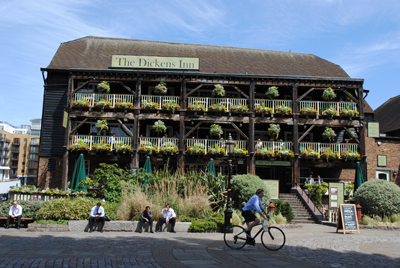
The-Dickens-InnOK, the first thing to note here is that despite the name of this pub, located in St Katharine Docks, it has nothing to do with the famous 19th century novelist Charles Dickens. Well, not directly, at least.

That said, it still has an interesting history – dating back to at least the turn of the 19th century (although there is the suggestion it may be older), it is thought to have formerly been used as a brewery building or a tea warehouse and stood on a site about 70 metres east of its current location.

A brick ‘skin’ was built over the top of the timber building in the 1820s to bring it up to modern standards. It survived the Blitz but was slated to be demolished in the 1970s when the site was to be redeveloped.

But help was at hand and in 1976 the building was saved when it was painstakingly moved to its current site. The building was reconstructed to resemble what the inn’s owners called a “three storey balconied inn of the 18th century” (although there is something doubt whether such buildings ever existed like this in the 18th century).

Ah, and to Dickens. While the writer himself is not known to have visited the building, he did know the area well and its likely he would have frequently passed by it during his lifetime (in fact, when his grandson, Cedric Charles Dickens, formally opened the inn in May, 1976, he is quoted on the inn’s website as saying that: “My Great Grandfather would have loved this inn”.)

Spread over three levels with balconies on the upper two, the inn originally featured a sawdust covered floor and candlelit dining on the balconies. Both practices have since come to an end but the building does offer some great views of the dock and nowadays contains several different facilities including a tavern, pizzeria and restaurant called The Grill. There’s also a suite of function rooms.

Among the famous the establishment claims as visitors in more recent times are the late Joan Rivers and singer Katie Melua.

For more information, see www.dickensinn.co.uk.
Treasures of London – The Isabella Plantation…

Isabella-Plantation2


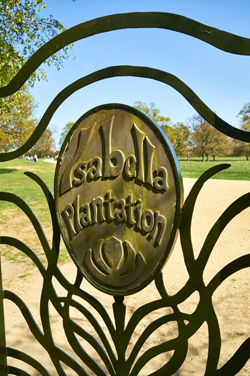
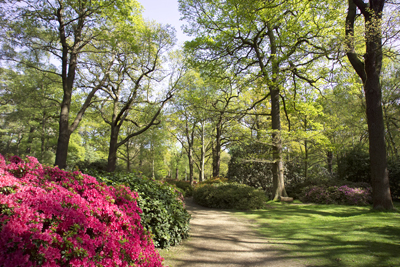
Isabella-PlantationAn area first fenced off within Richmond Park in the early 19th century, this ornamental garden remains an enchanting place to escape city life.

It was former Prime Minister Lord Sidmouth who established the plantation in the south-west corner of Richmond Park in 1831 when he was deputy ranger, enclosing the 42 acre site with fences to keep the deer out and planting oak, beech, and chestnut trees with a view to growing them for timber.

It was also he who, drawing on an older name for the area – Isabella Slade (Isabell is thought to have meant ‘dingy yellow’ in Old English and may refer to the colour of the topsoil in the plantation area while Slade meant a shallow valley) – gave it the name the Isabella Plantation.

The garden as we largely know it now was established on the site in the years immediately after World War II with clearings, ponds and waterways (these are today fed from Pen Ponds), thanks in large part to George Thomson, superintendent of the park from 1951-71, and his head gardener, Wally Miller.

Isabella Plantation was opened to the public in 1953 although improvements – including the Bog Garden which was reconstructed in 2000 – continue to be carried out.

Highlights among the flora include the National Collection of ‘Wilson 50’ Kurume azaleas (introduced by plant collector Ernest Wilson from Japan to the West in the 1920s) and large collections of rhododendrons and camellias. The garden also attracts a wide range of birds as well as other wildlife and offers the visitor something to see all year round.

There’s a number of trails you can download free-of-charge from the Royal Parks website which will help you to fully engage with the plantation.

WHERE: Isabella Plantation, Richmond Park (pedestrian access to the plantation from Peg’s Pond Gate, Broomfield Hill Gate, Bramble Gate, Deer Sanctuary Gate and High Wood Gate); WHEN: Daily (check Richmond Park opening times); COST: Free; WEBSITE: www.royalparks.org.uk/parks/richmond-park/richmond-park-attractions/isabella-plantation.

PICTURES: © Greywolf/The Royal Parks

This Week in London – Virtual reality at the British Museum; British Library’s Grade I listing; and, Deptford’s cardboard tower…

Get an up close and in-depth look at the Bronze Age as virtual reality comes to the British Museum this weekend. For the first time, families including children aged 13 or over will be able to wear Samsung Gear VR devices to virtually explore a Bronze Age site designed by Soluis Heritage which features objects from the museum’s collections. They will also be able to enter an “immersive fulldome” where they can explore a virtual reality world featuring a Bronze Age roundhouse and objects. The event will take place in the Samsung Digital Discovery Centre on Saturday and Sunday. For more, see www.britishmuseum.org.

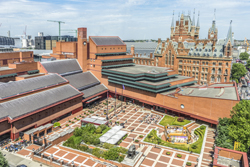
british-library-aerial-shotThe British Library at St Pancras has been given Grade I heritage status, joining the top 2.5 per cent of listed buildings in England. Designed by architect Sir Colin St John Wilson and his partner MJ Long and completed in the late Nineties, the library is the largest public building to have been built in the UK in the 20th century. At the heart of the library is the King’s Library tower which houses the library of George III as well as the Treasures Gallery where national treasures such as the Magna Carta, Lindisfarne Gospels and original Beatles lyrics are displayed. The library was listed along with seven other libraries in England, all of which have been given Grade II status. Meanwhile the record-breaking exhibition Magna Carta: Law, Liberty, Legacy has entered its final month before closing on 1st September. The display features two of the four surviving Magna Cartas as well as the US Declaration of Independence and Bill of Rights – in the UK for the first time – and more than 200 objects including medieval manuscripts, artworks, 800-year-old garments and esoterica such as King John’s teeth and thumb bone. Admission charge applies. For more, see www.bl.uk/magna-carta. PICTURE: Tony Antoniou/British Library.

Help build The People’s Tower in Douglas Square in Deptford, south east London, this weekend. French artist Olivier Grossetete has been invited by the Albany to build the tower – with your help – out of cardboard boxes. Tower assembly takes place between 10am and 3pm on Saturday and then between 11am and 5pm on Sunday, there will be free live music and family entertainment in the Albany Garden as the tower is finished and then knocked down. No booking is required. For more, check out www.thealbany.org.uk.

Send all items for inclusion to exploringlondon@gmail.com.

10 small, ‘secret’ and historic gardens in central London…3. St Dunstan in the East Garden…

St-Dunstan1

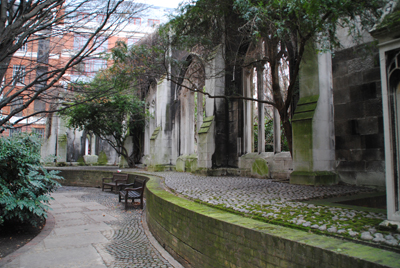
Located amid the remains of the medieval church of St Dunstan in the East, the garden was created in the late 1960s after the church was finally – and irrevocably, apparently – destroyed in the Blitz of World War II.

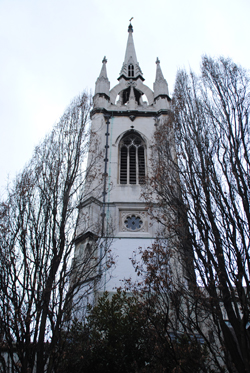
St-Dunstan2The church’s origins went back to around 1100 and it was subsequently extended with a new south aisle in the late 14th century and repaired in the early 17th century before being severely damaged in the Great Fire of 1666.

Patched up, with a new steeple and tower added to the building between 1695-1701 by Sir Christopher Wren, the building stood until the early 19th century when much of the church – with the exception of Wren’s additions – had to be rebuilt (for more on the history of the church, see our earlier Lost London post here).

The ‘new’ building was, however, badly damaged during bombing in 1941 and it was decided not to rebuild the church in the aftermath of the war.

The City of London opened a garden, sympathetic with the remains of the Grade I-listed building, on the site in 1971 (although Wren’s tower remains). They won a landscape award only a few years later.

Features in these atmospheric gardens – which seem to capture the essence of the Romantic idea of what ruins should look like – include a fountain which sits in the middle of the nave. In 2010 it was one of five public gardens in the City where award-winning  ‘insect hotels’ were installed.

Maintenance works were carried out in 2015 and new plantings put in (the picture, above, was taken before this).

WHERE: St Dunstan in the East, between Idol Lane and St Dunstan’s Hill, City of London (nearest Tube stations are Monument and Tower Hill); WHEN: 8am to 7pm or dusk (whichever is earlier); COST: Free; WEBSITE: www.cityoflondon.gov.uk/things-to-do/green-spaces/city-gardens/visitor-information/Pages/St-Dunstan-in-the-East.aspx

LondonLife – London’s celebration of sculpture…

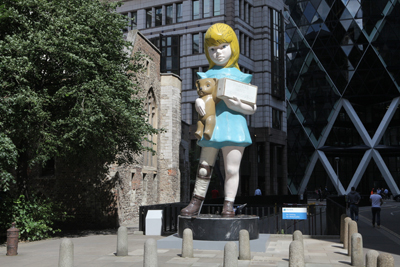
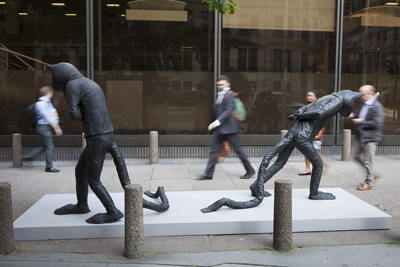
(i)-Damien-Hirst,-Charity.-Sculpture-in-the-City-2015Damien Hirst’s seven foot tall statue Charity (2002-2003) stands in the shadow of the Gherkin as a highlight of this year’s Sculpture in the City event. Kicking off last month, the exhibition – the fifth of its kind – features 14 works by a series of internationally renowned artists. Other sculptures (pictured below) include Adam Chodzko’s 2010 work Ghost (on show at Leadenhall Market), Laura Ford’s 2012 work Day of Judgement – Cats 1 & 2 (150 Leadenhall Street), Sigalit Laudau’s 2011 work ‘O my friends, there are no friends’ (St Helen’s Square), and Kris Martin’s 2012 work Bells II (on the corner of Bishopsgate and Wormwood Street). The works can be seen until May next year. For more (including a map of locations), see www.cityoflondon.gov.uk/sculptureinthecity. PICTURES: Nick Turpin.

Adam-Chodzko's-'Ghost',-Leadenhall-Market.-Sculpture-in-the-City-2015,-Photograph-by-Nick-Turpin

(i)-Laura-Ford's-'Days-of-Judgement---Cats-1-&-2'.-Sculpture-in-the-City-2015,-Photograph-by-Nick-Turpin

(iii)-Sigalit-Landau.-O-my-friends,-there-are-no-friends.-Sculpture-in-the-City-2015.

Kris-Martin--Bells-II_landscape

A Moment in London’s History – Outbreak of the Great Plague…

St-Olave-Hart-StreetIt’s 350 years ago this year that the Great Plague broke out in London in 1665, bringing death on an unprecedented scale to the city.

The plague, which was apparently also known as the Poor’s Plague, is said to have broken out in early 1665 – perhaps February – with the first areas to be affected dockside districts and the crowded slum of St Giles in the Fields before it moved into the City proper. There are claims that the outbreak’s origins occurred a couple of months earlier at a property in Drury Lane where contaminated bales of goods imported from Holland were opened by Flemish weavers.

However it came to be in London, it soon spread and by July was running rampant with many of the nobility, merchants, and tradesmen choosing to flee the city in the hope of escaping its reach. They included King Charles II and his family and court who moved to Hampton Court in early July and then to Salisbury at the start of August before, following some cases there, to Oxford in September.

Those who did come down with the disease – generally thought to have been bubonic plague, a disease of rats which is transmitted to humans via fleas – were confined to their homes with red crosses and the words ‘Lord, have mercy on us’ painted on the door while gatherings in public – such as for the theatre – were banned to prevent the disease’s spread.

Other measures to contain the disease included the imposition of a curfew and the killing of an estimated 40,000 dogs and 200,000 cats, thought to be spreaders of the disease, on the orders of the mayor, Sir John Lawrence.

Bills of mortality recorded the number of deaths weekly – in the week of 19th to 26th September, the number peaked at 7,165 people before declining. By late in the year life in the capital had started returning to normal.

While the bodies were buried in mass graves, by September the growing numbers of dead meant many were simply left to rot where they fell.

The estimated numbers of those who died varies somewhat depending on the source but according to the Museum of London’s website, the Great Plague of 1665 is estimated to have killed 100,000 people – about a fifth of the population – within just seven months of its outbreak.

While the sheer number of dead is unprecedented, other plagues were proportionally deadlier, in particular the coming of the Black Death in 1348 which killed about half of all Londoners over an 18 month period (equating to an estimated 40,000 people).

The Great Plague was, thankfully, the last major plague to affect London. Among those who had survived was the diarist Samuel Pepys whose entries provide a valuable source of information on how the plague affected Londoners (pictured above is detail from the gateway into the church of St Olave Hart Street – Pepys’ parish church at the time of the plague – where a number of victims of the Great Plague were buried).

Lost London – Inigo Jones’ Grand Portico on Old St Paul’s Cathedral…

Inigo-Jones-portico

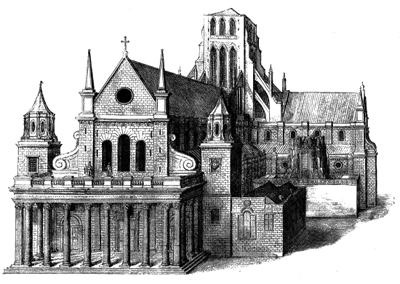
A short-lived addition to Old St Paul’s Cathedral before it burned down in the Great Fire of 1666, the classical-style portico was designed by Inigo Jones as part of makeover King James I ordered him to give the cathedral in the first half of the 17th century.

St Paul’s, which was completed in the early 14th century in the Early English Gothic style (see our post here for more on its earlier history), had fallen into a state of disrepair by the 1620s, thanks in part to a fire caused by lightning which had brought the spire – 489 feet (149 metres) high when built – crashing down through the nave roof in 1561.

The spire wasn’t rebuilt and repair works undertaken to the cathedral roof were apparently shoddy, meaning that by the early 1600s, things were in a parlous state.

Jones started work in the 1620s, cleaning and repairing the massive structure and adding a layer of limestone masonry over the exterior to give the building a more classical look inspired by the temples of ancient Rome he had seen in that city and in Naples and the work of Italian Renaissance architect Andrea Palladio.

This was complemented by the grand portico he added to the west front in the 1630s (and which was paid for by King James’ son, King Charles I). Featuring 10 columns across its breadth and four deep (these, it has been suggested, stood about 45 feet tall), it was topped by a frieze of lions’ heads and foliage with plans for a series of statues which some say were to be saints and others kings to be placed along the top (in the end only statues of King Charles I and King James I were ever placed there). The facade also featured turrets at either side.

Work on the repairs came to a halt in 1642 thanks to the Civil War, during which Parliamentarian forces famously used the cathedral’s great nave for stables.

Following the Restoration in 1660, with Jones now dead (he died in 1652), Sir Christopher Wren was invited by King Charles II to restore the grand old building but Sir Christopher proposed it be demolished instead, a decision which lead to an outcry among London’s citizens.

Wren then changed his plans to instead restore the existing build but replace the spire with a dome. His scaffolding was in place around the cathedral when the Great Fire broke out in 1666 and badly damaged the building (although the portico apparently remained standing until 1687-88 when Sir Christopher had it demolished to make way for his new western front).

Interestingly, it is said Wren used blocks from the portico to create the foundations for the building which now stands on the site.

PICTURE: Wenceslaus Hollar’s rendering of Inigo Jones’ West Portico/Wikipedia

For more on the history of St Paul’s Cathedral see Ann Saunders’ St Paul’s Cathedral: 1,400 Years at the Heart of London.

This Week in London – Buckingham Palace offers a “Royal Welcome”; exploring London’s outdoor spaces; and contemporary portraiture at the V&A…

Buckingham-PalaceBuckingham Palace opened its 19 State Rooms to the public last weekend under the theme of ‘A Royal Welcome’. As well as the chance to see the State Rooms themselves, a series of displays and films are located throughout the palace which show how Royal Household staff are involved in welcoming the tens of thousands of guests who come to the palace each year for receptions, State Banquets, garden parties and investitures. And, for the first time, the public can enter the palace through the Grand Entrance where the Australian State Coach will be displayed. Other highlights include the Palace Ballroom – set up for a State Banquet with silver gilt candelabra and centrepieces from King George IV’s grand service, displays recreating part of the dresser’s workroom and the palace kitchens, pantries and wine cellars in the throes of preparing for a State Banquet, and some of the gifts received during State Visits to the palace. Items of Queen Elizabeth II’s personal jewellery are also on display including the Kokoshnik Tiara, worn at a State Banquet in honour of the President of Mexico this year, Queen Mary’s Dorset bow brooch and the diamond Coronation necklace and earrings. The palace is open until 27th September. Admission charge applies. For more, see www.royalcollection.org.uk.

A new interactive map of public outdoor areas in London has been created to help encourage the city’s residents and tourists to make the most of the great outdoors this summer. The map details more than 200 public spaces including squares, green spaces and public street amenities, many of which have been improved as part of the Mayor of London, Boris Johnson’s Great Outdoors initiative which has seen more than £400 million invested in 242 projects since 2009. To check out the map, follow this link.

A new exhibition examining contemporary portraiture – and its inspiration from traditional modes of portraiture such as miniatures, medals and death masks – opened at the V&A in South Kensington this week. Facing History: Contemporary Portraiture features more than 80 prints and photographs drawn from the V&A’s collection and created by artists including Julian Opie, Grayson Perry, Thomas Ruff, Maud Sulter and Gavin Turk. Works featured include self-referential pieces like Grayson Perry’s pair of prints, Mr and Mrs Perry and Gavin Turk’s Portrait of Something that I’ll Never Really See, portraits of real and fictional characters like Brian D Cohen’s Man with Eyes Closed (Walter White) whose subject is both a character from US TV series Breaking Bad and Bryan Cranston, the actor who played him, Cecilia Mandrile’s identity-card inspired ID-Intensively Displaced series, and 11 pieces from Ellen Heck’s Forty Fridas. Exhibition runs until 24th April. Admission is free. For more, see www.vam.ac.uk.

Send all items for inclusion to exploringlondon@gmail.com

10 small, ‘secret’ and historic gardens in central London…2. Whittington Garden…

Whittington-Garden

The history of this City of London garden can be immediately spotted in the garden’s name.

It’s named for Richard (Dick) Whittington, a four time medieval mayor of London whose name (and cat) has been immortalised in stories and rhymes which continue to be retold in Christmas pantomimes every year (you can read more about the real Dick Whittington in our earlier post here).

Whittington-Garden2The reason for the garden’s name is in its proximity to the church of St Michael Paternoster Royal – it stands on the other side of College Street – which he poured money into rebuilding during his lifetime and where he was buried (you can read more about the building here). You can also see a Blue Plaque on the former site of Whittington’s house further up College Hill.

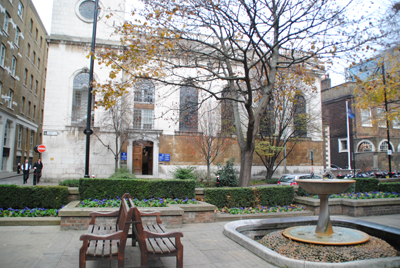
The garden (pictured above looking across to the church) stands on what was the river bank during the Roman era at the bottom of College Hill. It was previously the site of buildings connected with the fur trade but these suffered bomb damage during World War II and were subsequently demolished.

The City of London Corporation acquired the site in 1955 and laid out the gardens in 1960 and the small fountain now found there dates from later that decade.

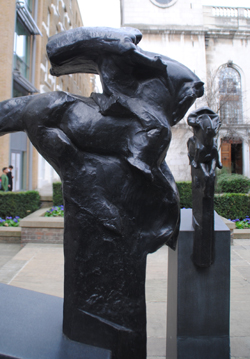
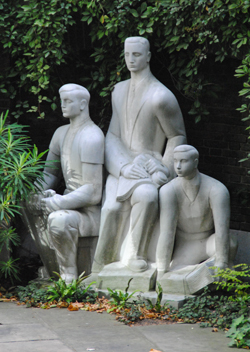
The gardens, which contain some substantial trees and lawn areas as well as hedges and flower beds, were refurbished in 2005. Features include two granite plinths upon which sit two horsemen (pictured). Sculpted by Italian sculptor Duilio Cambellotti, they were presented to the City of London by the Italian President during a state visit in 2005.

WHERE: Whittington Garden, between College Street and Upper Thames Street, City of London (nearest Tube station is Cannon Street); WHEN: Anytime; COST: Free; WEBSITE: www.cityoflondon.gov.uk/things-to-do/green-spaces/city-gardens/visitor-information/Pages/Whittington-Garden.aspx.

LondonLife – Artistic eyes gaze upon us…

V&A

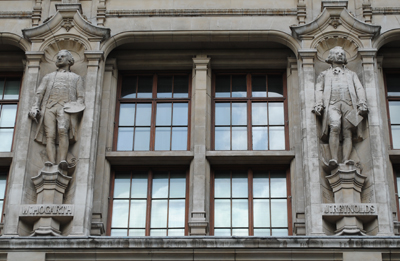
Eighteenth century artists William Hogarth and Joshua Reynolds gaze down from the facade of the V&A in South Kensington. The Victoria and Albert Museum was established in 1852 – capitalising on the success of the Great Exhibition the previous year – and moved to its current site in 1857. The foundation stone for the current building was laid by Queen Victoria herself in 1899 and it was to mark this occasion that the museum was renamed the Victoria and Albert Museum after the queen and late Prince Albert (although the queen really just wanted it to be the Albert Museum). For more on the V&A, see www.vam.ac.uk.

Famous Londoners – Sir Hugh Myddelton…

The Welsh-born “merchant adventurer” Sir Hugh Myddelton (also spelt Myddleton or Middleton) is best remembered in London for the construction of the New River, a water engineering project which still provides some of city’s water.

Sir-Hugh-MyddeltonBorn about 1560, the sixth son (and one of 16 children) of Richard Myddelton, governor of Denbigh Castle in Wales, Hugh Myddelton travelled to London to seek his fortune and there became apprenticed to a goldsmith before himself becoming a member of the Goldsmith’s Company in 1592 (he later became warden of the company).

Operating out of premises in Bassishaw (now Basinghall Street), he gained a reputation among the wealthy and nobility for his work and was appointed Royal Jeweller to King James I (he had apparently also supplied jewellery to Queen Elizabeth I).

Myddelton became a wealthy merchant and banker, and, in 1603, he also succeeded his father as MP for Denbigh Borough, a post he held repeatedly until 1628.

Sir Hugh became one of the driving forces behind the New River project which aimed to address the strain on London’s water sources by bringing clean water from the River Lea in Hertfordshire via a 39 mile-long canal to New River Head in London.

After an aborted earlier attempt to build a canal from Hertfordshire to London (which had run into financial difficulties), Sir Hugh was granted authority to carry out the works for the New River in 1609 and employed mathematicians like Edward Pond and Edward Wright to direct the course with the man behind the earlier attempt, Edmund Colthurst, overseeing the works.

By 1611 it became clear to Myddelton that he wouldn’t have the necessary funds to complete the works so he obtained the financial aid of the king (in return the king was to get half of all profits).

The project was eventually completed in 1613 and a ceremony was held at the New River Head in Islington where the canal then terminated (just south of where Sadler’s Wells Theatre now stands).

Myddelton, who continued to diversify in business and made considerable sums from his ownership of lead and silver mines in Wales as well as from a land reclamation project on the Isle of Wight, became the first governor of the New River Company when it was created by royal charter in 1619 and remained a key figure in it until his death. He was created a baronet in 1622.

Myddelton, who married twice, had 15 or more children to his second wife – only about half of whom survived him. He died on 7th December, 1631, and was buried in the now demolished St Matthew Friday Street where he had been a church warden (some of his children were buried there as well). One of his brothers, Sir Thomas Myddelton, was a Lord Mayor of London.

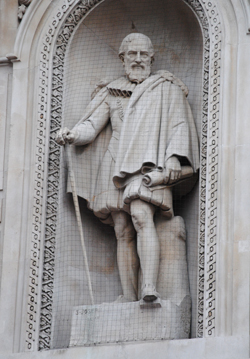
Among memorials to Sir Hugh in London is a statue of him on Islington Green which was unveiled in 1872 by William Gladstone, later PM. There is also a statue of him on the Royal Exchange (pictured) and a number of Islington streets have been named for him.

For more on London’s historic water sources, see London’s Lost Rivers: A Walker’s Guide.

Treasures of London – Daniel Defoe grave memorial, Bunhill Fields…

Daniel-Defoe-memorial2
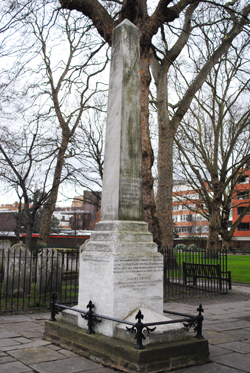
Located in Bunhill Fields Burial Ground in City Road, this memorial to Daniel Defoe, the author of numerous books including Robinson Crusoe and Moll Flanders as well as a journalist, pamphleteer and ‘provocateur’ or spy, wasn’t erected until 1870, almost 140 years after his death.

After he died in 1731 at the age of 70, Defoe was among the more than 120,000 people buried in Bunhill Fields, a Nonconformist cemetery which opened in 1665 and had closed by 1853. He was apparently buried under the name Dabow, thanks to a spelling mistake made by the gravedigger.

Daniel-Defoe-memorialWhen he died in relative obscurity (he was believed to have been hiding from his creditors at the time), his fame rose after his death – due in large part to the rising popularity of Robinson Crusoe, and by the mid-19th century, it was believed that the simple headstone over his grave didn’t do justice to him.

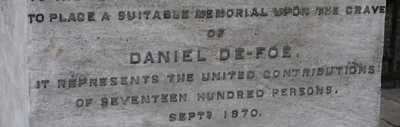
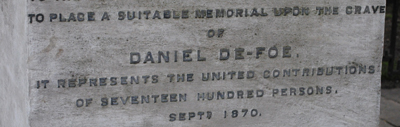
Hence an appeal was run by children’s magazine Christian World for a more suitable memorial for the writer – named as Daniel De-Foe on the memorial – and more than £150 was raised from 1,700 people, an amount which apparently exceeded expectations.

Sculptor Samuel Horner was subsequently commissioned to carve the memorial obelisk, which features projections at the base resembling a coffin lid, to the designs of CC Creeke of Bournemouth. It was unveiled on 16th September, 1870, in a ceremony attended by three of Defoe’s great grand-daughters.

There was apparently a newspaper story that the sculptor uncovered a coffin bearing Defoe’s name in preparing the site for the monument and had to get the aid of police to prevent watchers from making off with the bones from within.

The monument, which may not mark the exact location of Defoe’s grave site due to the movement of graves in the burial ground, is now Grade II*-listed (and the burial ground itself Grade I-listed). Others buried at Bunhill Fields include author John Bunyan, artist William Blake and Susanna Wesley, mother of John Wesley, founder of Methodism.

WHERE: Bunhill Fields Burial Ground, 38 City Road (nearest Tube station is Old Street); WHEN: 7.30am to 7pm or dusk; COST: Free; WEBSITE: www.cityoflondon.gov.uk/things-to-do/green-spaces/city-gardens/visitor-information/Pages/Bunhill-Fields.aspx

This Week in London – Celebrate summer at the Tate; Titian revealed at Apsley House; and, exploring the unconscious at The Freud Museum…

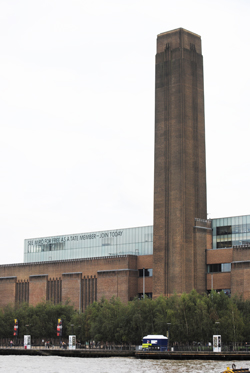
Turbine-HallOn Saturday, the Tate Modern’s Turbine Hall on South Bank will host an “audio-visual feast” of music, performances, art installations and activities. The free Turbine Festival will feature everything from an alternative hair salon and a London bus built on the day by artist John Costi to a pop-up juice bar where you can make your own drinks and a record shop where you can design your own vinyl record sleeve. The day will also feature performances by Grime/HipHop/AfroPop artist Afrikan Boy, Felix’s Machines – who will transform live music and sound into a 3D visual show, and poet Jacob Sam-La Rose, as well as a programme of “bite-sized” films running in collaboration with the London Short Film Festival, and a series of interactive workshops covering everything from beatboxing to crafting. Visitors to the festival, sponsored by Hyundai, are also encouraged to contribute to a special project by My Culture Museum by submitting photographs or bringing objects to be archived and curated. Runs from 12.30pm to 9.30pm. For more, see www.tate.org.uk.

•  Three paintings previously attributed to later followers of 16th century Venetian artist Titian but subsequently found to be by the artist himself and his studio have gone on display together for the first time at Apsley House. The three paintings – which include Titian’s Mistress (c1560), A Young Woman Holding Rose Garlands (c1550) and Danae (c1553) – were all in poor condition before conservation and cleaning by experts from English Heritage, the Museo del Prado in Madrid and the Hamilton Kerr Institute revealed their true quality (and Titian’s signature on two of the paintings). All three works were held in the Spanish Royal Collection and among 160 that Joseph Bonaparte, brother of Napoleon and King of Spain, tried to take out of the country following his defeat by the Duke of Wellington at the Battle of Vittoria in 1813. Wellington was subsequently given the paintings by a grateful King Ferdinand VII. The Titian at Apsley House exhibition, which opened earlier this month, runs at the Duke of Wellington’s home at Hyde Park Corner until 31st October. Admission charges apply. For more, see www.english-heritage.org.uk/visit/places/wellington-arch/.

On Now: Festival of the Unconscious. This festival at Sigmund Freud’s former London home and now home to The Freud Museum sees artists, designers, writers and performers taking another look at Freud’s seminar 1915 paper, The Unconscious. Features of the festival, which runs until 4th October, include specially commissioned films by animators from Kingston University running throughout the house, sound and video installations by London-based art project Disinformation in the dining room and an installation from stage designers at the Royal Central School of Speech and Drama in Freud’s study. There’s also a display by Julian Rothenstein, co-author of Psychobox, and a chance to recline and “free-associate” on a psycho-analytic couch in Freud’s bedroom. An extensive programme of events accompanies the displays. Admission charges apply. For more, see www.freud.org.uk.

Send all items for inclusion to exploringlondon@gmail.com.

10 small, ‘secret’ and historic gardens in central London…1. Goldsmiths’ Garden…

Goldsmiths1

Welcome to the first in our new Wednesday series, looking at some of central London’s small historic gardens which, while not secret in the strictest sense of the word, may tend to get overlooked. Each of the gardens we’re looking at is accessible to the public and has a link to the city’s history as well as providing a peaceful oasis out of the hustle and bustle…

First up, it’s the Goldsmiths’ Garden, located on the site of the former medieval church of St John Zachary at the corner of Gresham and Noble Streets in the City.

Goldsmiths2The church, which dates back to at least the late 12th century, was destroyed in the Great Fire of London in 1666 and not rebuilt (its parish was united with that of St Anne and St Agnes) although its ruins apparently remained until the 19th century. The church’s layout can be seen in the sunken area of the current garden.

The Worshipful Company of Goldsmiths had acquired land in the area in medieval times and built their first hall here in 1339 on the site of the current hall (which lies across the road from the garden and dates from the early 19th century).

The first garden was constructed on the site of the former church in 1941 by fire watchers after the area suffered in the Blitz and it apparently won a Gardener’s Company award for “Best Garden on a Blitzed Site” in 1950.

The garden has since been altered and refurbished several times since, including in around 1960 by landscape architect Sir Peter Shepheard and in the 1990s by landscape architect Anne Jennings.

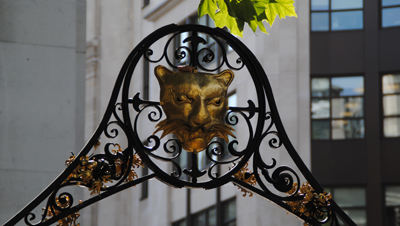
Goldsmiths3Features today include the iron entrance archway (top) which was commissioned by the Blacksmiths Company during the 1990s renovation. It features the leopard’s head hallmark of the Goldsmiths’ Company Assay Office, used to verify the purity of silver since the early 14th century.

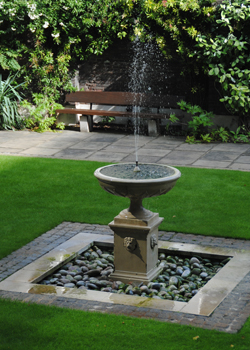
As well as the central fountain installed in the 1990s (and donated by the Constructors’ Company), the garden also features a two metre high, 2.5 tonne Portland stone monument called the Three Printers (pictured right).

The work of Wilfred Dudeney, it was commissioned by the Westminster Press Group in the late 1950s for their new headquarters in New Street Square, off Fleet Street, and depicts a newsboy, editor and printer. It was placed in a demolition yard in Watford when the group moved headquarters before taking its current position in 2009.

WHERE: Goldsmiths’ Garden, corner of Gresham and Noble Streets, City of London (nearest Tube stations are St Paul’s, Bank and Barbican); WHEN: Anytime; COST: Free; WEBSITE: www.thegoldsmiths.co.uk/goldsmiths’-hall/.

For more on London’s parks and gardens, check out Jill Billington’s London’s Parks and Gardens.

LondonLife – From Burning Man to the British Library…

Crossroads

Visual artist David Normal brings the British Library’s collections to life in an “epic suite of murals” called Crossroads of Curiosity. Unveiled at the library at a special event on the eve of the summer solstice (20th June), the art installation – which has its origins in a work first created for Nevada’s Burning Man Festival in 2014 – juxtaposes images from millions of digitised book illustrations the library released onto Flickr in 2013. The installation can be seen in the library’s piazza in King’s Cross until 8th November. Entry is free. For more, see www.crossroadsofcuriosity.com. PICTURES: Courtesy of the British Library.

Crossroads2

What’s in a name?…Drury Lane…

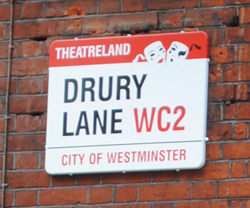
Famous for its associations with London’s theatreland, Drury Lane takes its name from the Drury family who once owned a mansion here.

Drury-LanePreviously known as the Via de Aldwych (apparently for a stone monument the Aldwych Cross which stood at the street’s northern end), Drury Lane – which runs between High Holborn and Aldwych – was renamed after Drury House which was built at the southern end of the street.

Some accounts suggest it was Sir Robert Drury (1456-1535), an MP and lawyer, who built the property around 1500; others say it was his son, Sir William Drury, also an MP and a Privy Councillor, who did so  in around 1600 – which may mean there were two versions of the one property.

The street, meanwhile, is said to have been briefly renamed Prince’s Street during the reign of King James I (1603-1625) but, following the Restoration in 1660, the name Drury once more gained supremacy.

The origins of the street’s famous theatre (London’s oldest), the Theatre Royal Drury Lane, dates from the same year (see our earlier post here). Other theatres in the street included the Cockpit Theatre which had been designed at one stage by Inigo Jones.

The street is also famous for being the site of the worst outbreak of the plague in London – the Great Plague of 1665, burned away the following year by the Great Fire – and by the 18th century was a slum noted for its seediness, in particular for prostitution (it features in William Hogarth’s work The Harlot’s Progress).

This didn’t change until the second half of the 19th century – author Charles Dickens had been among others who had commented on the poverty he had seen there – when gentrification took hold. Among the shops opened there during this time was the first Sainsbury’s, founded at number 173 in 1869.

Alongside the Theatre Royal Drury Lane (although the main entrance is in Catherine Street), other theatres in the street today include the New London Theatre and the London Theatre.

This Week in London – Exploring London’s archaeology; Alice in Bloomsbury; and, ‘Soundscapes’ at the National Gallery…

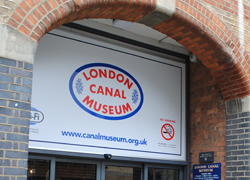
Canal-MuseumDescend into ice wells at the London Canal Museum; delve into the archaeological archives of the Egypt Exploration Society; discover the history of the Spitalfields Charnel House; and, tour the remains of London’s Roman military fort with experts from the Museum of London. The British Festival of Archaeology kicked off last weekend and there’s a plethora of events happening across London as part of the more than 1,000 taking place across the country. For a full programme of events – many of which are free – head to www.archaeologyfestival.org.uk. The festival runs until 26th July.

Follow Alice down the rabbit hole in a new exhibition which opened at the Cartoon Museum in Bloomsbury yesterday. Marking the 150th anniversary of the book’s publication, Alice in Cartoonland looks at how cartoonists, caricaturists, satirists, animators and graphic artists adapted and used author Lewis Carroll (aka Charles Lutwidge Dodson) and original illustrator John Tenniel’s work in social and political commentaries as well as just to have fun. The display features posters, cartoon strips, comic and graphic novels and artwork from TV and film versions of Alice with Low, Vicky, Shepard, Steadman and Gilroy among the artists represented. Runs until 1st November (with some events held in conjunction with it). Admission charge applies. For more, see www.cartoonmuseum.org.

Exploring the National Gallery’s art collection is usually done with the eyes but thanks to an innovative project which kicked off last week, it’s now also about listening. A series of contemporary sound artists and musicians including Nico Muhly, Gabriel Yared, Susan Philipsz, Jamie xx, Chris WatsonJanet Cardiff and George Bures Miller have created sounds and musical pieces in response to works they have chosen from the gallery’s collection. Selected works include the late 14th century The Wilton Diptych (Muhly), Hans Holbein’s 1533 painting The Ambassadors (Philipsz) and Paul Cézanne’s painting Bathers (Les Grandes Baigneuses) (Yared). Soundscapes runs until 6th September in the Sainsbury Wing. Admission charge applies. For more, see www.nationalgallery.org.uk.

Send all items for inclusion to exploringlondon@gmail.com.

10 sites from London at the time of the Magna Carta – 10. Priory of the Order of St John of Jerusalem…

Crypt

Founded in Clerkenwell in 1144, the Priory of the Order of St John of Jerusalem served as the order’s English headquarters.

The order, also known as the Knights Hospitaller, was founded in Jerusalem in 1080 to care for the sick and poor, and soon spread across Europe with the English ‘branch’ established on 10 acres just outside the City walls apparently by a knight, Jorden de Briset.

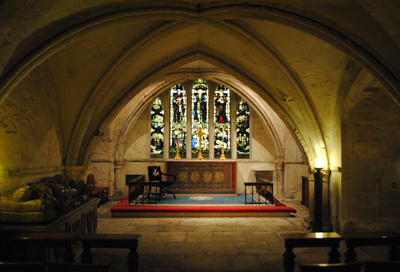
The original buildings – of which only the 12th century crypt (pictured above) survives complete with some splendid 16th century tomb effigies including that of the last prior, Sir William Weston – included a circular church, consecrated in 1185, and monastic structures including cloisters, a hospital, living quarters and a refectory or dining hall.

There are records of dignitaries staying at the priory as it grew in size and renown – among them was King John who in 1212, apparently stayed here for an entire month. There are also surviving accounts of Knights Hospitaller riding out in procession from the priory and through the City at the start of a journey to the Holy Land.

The priory and church were attacked during the Peasant’s Revolt of 1381, thanks to its connection with the hated Poll Tax (Prior Robert Hales was also the Lord High Treasurer and was beheaded during the revolt on Tower Hill).

The church was subsequently rebuilt as a rectangular-shaped building and then, in the early 16th century, enlarged when the site was significantly renovated. These renovations were still relatively new when the priory was dissolved in 1540 during the Dissolution of King Henry VIII.

The priory church, which survived the Great Fire of 1666, was later used as a parish church but was destroyed in an air raid in World War II. Subsequently rebuilt, it can be visited today along with the crypt below and the cloister garden, created in the 1950s as a memorial to St John’s Ambulance members from the London area (the original shape of the circular church is picked out in the paving here).

Perhaps the most famous building to survive is St John’s Gate which dates from the 16th century and was once the gatehouse entrance to the priory (added in the final renovations).

After the Dissolution it served various roles including as the office of the Master of Revels (where Shakespeare’s plays were licensed), the home of The Gentleman’s Magazine (Samuel Johnson was among contributors and worked on site), a coffee house (run by William Hogarth’s father) and a public house called the Old Jerusalem Tavern (yes, Charles Dickens was said to be a regular). It is now home to the recently renovated Museum of the Order of St John (you can see our earlier post on the museum here).

WHERE: Museum of the Order of St John, St John’s Gate (and nearby priory church), St John’s Lane, Clerkenwell (nearest Tube stations is Farringdon); WHEN: 10am to 5pm, Monday to Saturday (tours are held at 11am and 2.30pm on Tuesday, Friday and Saturday); COST: Free (a suggested £5 donation for guided tours); WEBSITE: www.museumstjohn.org.uk.

We’ll kick off a new Wednesday series next week…

LondonLife – A riot of summer colour…

Regent's-Park

Flowers in Regent’s Park, north London. The park, which was designed by John Nash, was opened to the public in 1835. For more on the history of the park, see our earlier post here.

London Pub Signs – Jamaica Wine House…

Located on the site of London’s first coffee house in St Michael’s Alley in the City, the Jamaica Wine House comes with plenty of yesteryear atmosphere.

Jamaica_Wine_HouseThe coffee house, which was established in 1652 at the sign of ‘Pasqua Rosee’s Head’ (named for one of the co-owners, a Turk and former manservant called Pasqua Rosee), was once frequented by the likes of diarist Samuel Pepys who apparently had a pleasurable night there on 10th December, 1660.

Standing in the midst of what became a hotspot for coffee houses in London, it was apparently damaged in the Great Fire of London of 1666. Rebuilt as the Jamaica Coffee House in the 1670s, it become known as something of a gathering place for seafarers who were involved in the West Indies trade. The current name bears testament to that past (we’ll take a more in-depth look at the history of the coffee house in an upcoming Lost London post).

While the building which housed the coffee shop is long gone, the current Grade II-listed building, located just of Cornhill, dates from 1869 and was built as a public house. Built of red brick and red stone, retains much of its Victorian character outside and in – with the latter featuring dark wood panelling on the walls and decorative ceilings and glasswork. The basement features a wine bar.

These days the establishment – which is known fondly to regulars as the ‘Jampot’ – boasts a clientele which includes City workers as well as “bell-ringers” and walking tourists (or so the website says). And then there’s the three ghosts – one of which is said to be a dog.

Now part of the Shepherd Neame chain (which purchased it in 2009). For more, see www.shepherdneame.co.uk/pubs/london/jamaica-wine-house.

PICTURE: Matthew Black/Flickr. Used under licence CC BY-SA 2.0