 Wishing you a very Merry Christmas for 2012! We’ll be posting our most popular posts of 2012 countdown later this week…
LondonLife – Forget the halls, they’re decking the city…part two…
There’s still a weekend to go before Christmas and if, having finished all Christmas shopping, you’re still in the mood for seeing some light displays, here’s some more places to look for some amazing (and in some cases historic), Christmas decorations (for the first part of this overview, head here)…
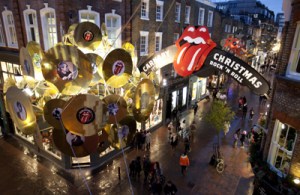 • Last week we mentioned some of the key sites to look for light displays in the West End this Christmas. Some of the other places to look include: the iconic shopping strip of Carnaby Street (decorations there this year are inspired by the 50th anniversary of the Rolling Stones – pictured) as well as South Molton Street, off Oxford Street (which again features some beautiful illuminated archways), and streets throughout St James (the St James Christmas lights were this year switched on by opera star Katherine Jenkins who earlier led a carol service at St James’s Church) and Mayfair.
• Around Bow Lane and Watling Street in the City of London. Daubed with more than 10,000 lights, these narrow streets provide a wonderful sense of London past.
• Marylebone. The lights here are well worth venturing out for. Turned on this year by Strictly Come Dancing‘s Claudia Winkleman.
• Historic West End arcades. Still a place for fashionable shopping and tasteful Christmas decor, these include the Burlington Arcade, Royal Arcade, Princes Arcade and the Piccadilly Arcade.
• And, of course, throughout London many shops have Christmas window displays. They include that of Fortnum & Mason in Piccadilly which this year have a Dick Whittington theme (see our earlier post here); Harvey Nichols in Knightsbridge which have gone with an oriental theme; Harrods in Brompton Road which have a Disney Princess theme; and Liberty in Great Marlborough Street which have gone with a theme inspired by the age of steam trains.
Of course, our list is by no means been comprehensive and is only confined to London’s heart – please share any other sensational Christmas decorations you’ve come across elsewhere in the city…
Around London – Christmas at the Tower and Kew Gardens; Old Flo on display; African Diaspora on show at MoL Docklands; and, Mariko Mori at the Royal Academy…
 • The Tower of London is going Victorian this Christmas with visitors able to experience some of what the Yuletide celebrations in the foreboding, much storied buildings were like in the mid-to-late 1800s. Visitors will be shown how many of the Christmas customs we now participate in each year – like writing cards, pulling crackers and the setting up of family Christmas trees – owe their origins to the Victorian era. The Yeoman Warders will be receiving a Victorian makeover and writer of the age – Charles Dickens – will be reciting some of his works before joining in a “raucous” lunch party with some of his fellow writers, artists and benefactors. It’s even rumoured that Queen Victoria and Prince Albert themselves may make an appearance (take that as a given). Bah! Humbug! A Very Merry Victorian Christmas runs from 27th until 31st December. The festivities will all be included in the usual admission price. For more, see www.hrp.org.uk. PICTURE: Nick Wilkinson/NewsTeam.
• Kew Gardens are celebrating Christmas with a host of events including a “Twelve trees of Christmas” family trail. The trail, a map of which can be picked up as you enter, includes facts about trees along the route. Volunteer guides are also leading free tours of seasonal highlights and the Kew Christmas tree can be seen at Victoria Gate. Other festive treats at Kew include the chance to see Father Christmas in his grotto (until Sunday only) and a vintage carousel on the Kew Palace Lawn. Many of the Christmas-related events end on 6th January. See www.kew.org for more.
• A display focusing on the history of Henry Moore’s sculpture, Draped Seated Woman (better known as Old Flo), has opened at the Museum of London Docklands. Henry Moore and the East End provides a glimpse into 1950s East London and looks at why public art was considered important at the time. It features some of the maquettes (scale models) Moore used in creating the piece. The exhibition was opened following a decision by the Mayor of Tower Hamlets, Lutfur Rahman, to sell Old Flo (now at the Yorkshire Sculpture Park) rather than display the artwork in a public space. The move is being contested by the Museum of London Docklands who have offered to put the work on public display. An online exhibition can be seen at www.museumoflondon.org.uk/oldflo and a ‘pop-up exhibition’ on Old Flo will be launched in January. The museum is also encouraging people to tweet their views about the selling of the sculpture under the hashtag #saveoldflo.
• On Now: Take Another Look. Still at the Museum of London Docklands, this exhibition focuses on the visual representation of people from the African Diaspora who were living and working in Britain in the late 18th and early 19th century. The display of 17 exhibits in the London, Sugar and Slavery gallery features prints by artists including Thomas Rowlandson and George Cruikshank as well as newspaper cuttings, mostly dating from 1780-1833, which show black Britons in perhaps what were unexpected roles – soldiers, musicians and sportsmen – during what was the period in which the abolition of slavery occurred. There are a series of events planned around the exhibition which runs until 4th August. Entry is free. For more see www.museumoflondon.org.uk/Docklands/.
• On Now: Mariko Mori: Rebirth. The first major museum exhibition of the New York-based Japanese artist Mariko Mori in London since 1998 has opened at the Royal Academy of Arts in Piccadilly. The exhibition features some of the artist’s most acclaimed works from the last 11 years, many of which have never before been seen in the UK, as well as works created just for the exhibition. Highlights include Tom Na H-iu, a five metre high glass monolith lit by hundreds of LED lights and connected back to the Institute for Cosmic Ray Research at the University of Tokyo; Transcircle, described as a “modern day Stonehenge”; and, Flatstone, an installation of “22 ceramic stones assembled to recreate an ancient shrine”. Runs until 17th February. Admission charge applies. For more, see www.royalacademy.org.uk.
LondonLife – Dick Whittington at Fortnum & Mason…
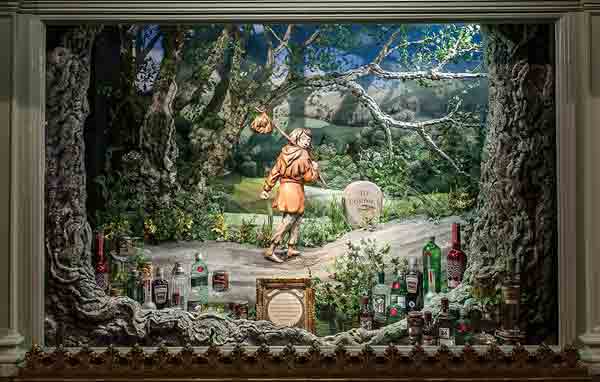
“Turn again, Dick Whittington!” This year’s Christmas window display at Piccadilly’s Fortnum & Mason tell the story of thrice Lord Mayor of London (and popular panto figure), Dick Whittington. The windows were unveiled by the current Lord Mayor of London, Roger Gifford (his wife Clare has just written a new version of the story) and the cast from Hackney Empire’s Dick Whittington. For more on the story of Dick Whittington, see our earlier post here. For more on Fortnum & Mason see our earlier post here. PICTURE: Courtesy of Fortnum & Mason.
Where is it?…#53

The latest in the series in which we ask you to identify where in London this picture was taken. If you think you can identify this picture, leave a comment below. We’ll reveal the answer early next week. Good luck!
Well done to Angelo and Carol – this is indeed part of a series of sculptures which project out of the facade of Allington House (formerly known as Saga House) at the junction of Victoria and Allington Streets. The sculptures – known as The Endangered Species Triptych, they include an elephant, tiger, orang-utan, shark and birds – have reportedly adorned the building since the 1980s and are the work of Barry Baldwin. Weighing more than 12 tonnes, they project almost a metre out of the building’s facade. There are indeed plans to demolish the building and a campaign, spearheaded by London historian and guide Peter Berthoud, has been launched to save the sculptures. You can find out more and sign a petition here: www.change.org/en-GB/petitions/land-securities-stop-the-demolition-of-the-sculptures-at-allington-house#.
Treasures of London – The Burghers of Calais…
One of 12 casts made of an original which stands in Calais, France, this sculptural group commemorates one of the most poignant moments of the bloody Hundred Years War.
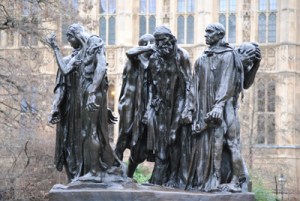 The original work, by the renowned Auguste Rodin who beat five others with his design, was completed in 1889 and stands outside Calais’ town hall. This cast was produced in 1908 and presented to the nation in 1914 by the National Art Collections Fund. It stands in Victoria Tower Gardens, just to the south of the Houses of Parliament in Westminster.
The sculpture commemorates an event which took place in 1347. Calais, then, as now, an important French port, had been besieged by the English for more than a year and, in a desperate situation as the townspeople starved (and despite orders from the French King Philip IV to hold out), the city authorities were seek terms from the English king, Edward III, still flushed with the success of the Battle of Crecy the year before.
Edward’s conditions for their surrender were harsh – six of the city’s leaders had to be handed over and the rest of the city would be spared. But more than that, the six had to leave the city stripped of almost all their clothes, wearing nooses around their necks and carrying the keys to the city and castle.
Six burghers, led by Eustache de Saint Pierre and also including John Daire and brothers James and Peter Wisant, did so and it is the scene of them making their way to King Edward that Rodin has captured. Their bravery was rewarded – while King Edward apparently order them to be beheaded, his pregnant English Queen, Philippa of Hainault, intervened on their behalf and they were spared execution, dressed and fed before they were safely escorted away.
Only 12 casts of the group were ever permitted under French law – the London cast was the third to be made.
Around London – A West End institution reopens; Barnet’s Foundling Hospital under the spotlight; English landscape masters at the RA…
• A West End institution which has hosted a who’s who of Londoners – including the likes of Oscar Wilde, Arthur Conan Doyle, Rudyard Kipling and Winston Churchill as well as, more recently, David Bowie, Mick Jagger and Princess Diana – has reopened its doors to the public after a four year redevelopment. Originally opened in 1865 by French wine merchant Daniel Nicholas Thévenon and his wife Celestine, Café Royal at 68 Regent Street – overlooking Piccadilly Circus – has been relaunched as five star hotel featuring more than 150 rooms, six historic suites and a variety of dining venues – including the spectacular Grill Room – as well as a private members club, meeting rooms and wellbeing centre. The redevelopment of this storied building, which centres on the original premises – retaining John Nash’s Grade I-listed facade, has seen the restoration of grand public rooms, originally dating from the 1860s and 1920s, as well as an expansion into neighbouring buildings – all under the watchful eye of David Chipperfield Architects and Donald Insall Associates. For more, see www.hotelcaferoyal.com.
• One of six small hospitals set up by the Bloomsbury-based Foundling Hospital, the Barnet branch operated in Monken Hadley in west London from 1762-1768. It’s now the subject of one of two new exhibitions which opened at the Barnet Museum at the beginning of the month. The Barnet Foundling Hospital, Monken Hadley, 1762-1768, features a range of objects relating to some of the children placed in the hospital including identifying coin tokens left by mothers, and letters written by manager Prudence West. The exhibition initially runs until 14th January – after which objects will be replaced with prints – and then until 28th February. The second exhibition, Foundling Voices, is on tour from the Foundling Museum and features oral histories of some of the last people to be cared for by the Foundling Hospital in Berkhamsted which closed in 1954. This runs until 13th January. Admission to both is free. For more, see www.barnetmuseum.co.uk.
• On Now: Constable, Gainsborough, Turner and the Making of Landscape. This exhibition, recently opened in the John Madejski Fine Rooms and Weston Rooms at the Royal Academy of Arts, features works of art by three “towering figures” of English landscape painting – John Constable, Thomas Gainsborough and JMW Turner. The 120 works on display includes paintings, prints, books and archival material. Highlights include Gainsborough’s Romantic Landscape (c 1783), Constable’s The Leaping Horse (1825) and Boat Passing a Lock (1826), and Turner’s Dolbadern Castle (1800). There are also works by their 18th century contemporaries and artifacts including letters written by Gainsborough, Turner’s watercolour box, and Constable’s palette. Admission charge applies. Runs until 17th February. For more, see www.royalacademy.org.au.
LondonLife – Forget the halls, they’re decking the city…
We’ve decided not to kick off our next Wednesday series until the new year so in the meantime, we’ll take a look at where you can find some of the best – and some of the most historic – Christmas decorations in London (and we’d love to hear your thoughts as well!). Here is some of what you’ll find in the West End this year…
 1. Trafalgar Square Christmas Tree: A symbol of Christmas in London since 1947, this massive tree (usually a Norwegian spruce) is an annual gift from the people of Norway as thanks for British support during Norway’s years of occupation in World War II. The tree – which is usually around 50 to 60 years old, more than 20 metres high and resident in the forests around Oslo – is felled in November in a ceremony attended by the Lord Mayor of Westminster, the Mayor of Oslo and the British ambassador to Norway before being brought to the UK by sea. This year’s tree lighting ceremony took place on 6th December and a program of choirs will be singing at the tree during evenings in the lead-up to Christmas.
2. Regent Street Christmas Lights: The street’s stunning Christmas light displays apparently date back to the early 1950s when the lifting of wartime lighting restrictions allowed the display. The lighting ceremony has since become an annual event – this year’s lights – which stretch over a mile and tell the story of the 12 Days of Christmas – were turned on by some 40 Olympians and Paralympians in November and will remain up until early January next year.
3. Oxford Street Christmas Lights: Switched on in early November by singer Robbie Williams (with supporting act Leona Lewis), the Oxford Street Christmas display – this year more properly known as the Marmite Oxford Street Christmas Lights – has been a West End tradition since 1959. This year’s mile long display involves 300,000 LED bulbs. Among the stars who have switched on the lights over the display’s 53 year history are the Spicegirls, Westlife and The Saturdays, who held the honor last year.
4. Bond Street Christmas Lights: A more boutique display than its more celebrated neighbours, this year’s lights were switched on by Gareth Malone and the Military Wives Choir.
5. Covent Garden decorations: This year’s decorations include an innovative display from United Visual Artists in the Market Building as well as a giant Lego advent calendar with a new window opened each day at 4pm in the lead-up to Christmas. Other Christmas-related features include a 32 foot high topiary reindeer as well as the chance for kids to pet a real reindeer on Saturdays. There’s also a food market and choir singing.
Famous Londoners – Gog and Magog…
Regular watchers of London’s Lord Mayor’s Show parade will be familiar with the two giants Gog and Magog who for centuries have been an integral part of the procession. But just who are the two stern figures who strike fear into the hearts of all they pass (well, perhaps not so much the fear)?
 While the names Gog and Magog appear several times in different contexts in the Bible came t0 epitomise the enemies of God, legend has it that the Gog and Magog seen in this context were leaders of a race of giants who inhabited Britain in times of prehistory.
Defeated by Brutus, a descendent of the Trojan Aeneas and the founder of London and first king of Britain, they were then chained to the gate of his palace which stood on the site of where Guildhall – home of the City of London Corporation – now stands.
Seen as guardians of the City of London, figures of the giants have been carried in the Lord Mayor’s Show – the annual procession surrounding the election of the new Lord Mayor – since as far back as the reign of King Henry V (originally made of ‘wickerwork and pasteboard’, they were later replaced with wooden ones).
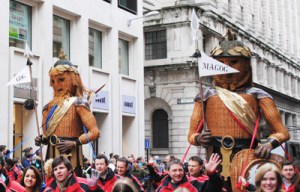
The seven foot high wicker versions of the giants which are now carried in the parade were donated by the Worshipful Company of Basketweavers in 2006 (pictured here in the 2010 parade) and are the just latest in a series of effigies and statues of the two giants which have been associated with Guildhall.
These include pair of nine foot high limewood statues of the giants which currently stand in Guildhall – carved in 1953 by David Evans, they replaced two earlier, 14 foot high oak versions made by Richard Saunders in the early 1700s which were destroyed in the Blitz during World War II. They, in turn, were created to replace earlier papier mache versions.
As well as being found in numerous cities around the world, figures of the two giants also famously feature as the clock’s bell ringers on the facade of the Church of St Dunstan-in-the-West in Fleet Street. The clock, incidentally, was the first public clock in London to have a minute hand.
Around London: Charles Dickens Museum reopens; ‘The History Man’s’ blue plaque; and, a Dandy exhibition at the Cartoon Museum…
• The only surviving London house lived in by author Charles Dickens – now occupied by the Charles Dickens Museum – reopens on Monday after a £3.1 million restoration and refurbishment. The redevelopment of the Georgian, Grade I listed townhouse at 48 Doughty Street in Bloomsbury – a project named Great Expectations – has seen the museum expand into a neighbouring property at 49 Doughty Street which now houses a visitor and learning centre and cafe. Inside the house itself, the rooms have been returned to their appearance during Victorian times and on display will be some of Dickens’ personal items which haven’t been seen before. They include a set of photographic prints from 1865 which depict a train crash in Staplehurst, Kent, in which Dickens was involved. The museum, which is where Dickens wrote Oliver Twist, Nicholas Nickleby and finished The Pickwick Papers while living here between 1837-1839, was first opened in 1925. This year marks the bicentenary of Dickens’ birth (he was born on 7th February, 1812, in Portsmouth). For more on the museum and upcoming events there (including Christmas performances of A Christmas Carol and a series of special Dickensian Christmas walks), see www.dickensmuseum.com. For more on Dickens, see our earlier special – 10 London sites to celebrate Charles Dickens.
• Historian and broadcaster AJP Taylor, known as ‘The History Man’, has been honoured by English Heritage with a blue plaque placed on his former home at 13 St Mark’s Crescent in Primrose Hill. Taylor lived at the mid-nineteenth century semi-detached villa between 1955 and 1978 during the height of his fame. First appearing on television as early as 1942, Taylor was a regular on television discussion programmes between the 1950s and 1980s, and is described as one of the first ‘media dons’. He also wrote weekly columns in the press and books including the controversial The Origins of the Second World War. Married three times, he had six children and died of Parkinson’s disease in 1990. For more, see www.english-heritage.org.uk/about/news/?topic=Blue%20Plaques.
• On Now: A Dandy 75th Birthday Exhibition. This exhibition at the Cartoon Museum in Bloomsbury focuses on The Dandy, Britain’s longest running comic (officially recognised by the Guinness Book of Records), and follows its development from its birth with the release of the first issue on 4th December, 1937 (which, incidentally, was so popular it sold 481,895) through to this year’s issues including the final print issue released on 4th December this year (after which The Dandy goes digital). Runs until 24th December. Admission charge applies. For more see www.cartoonmuseum.org.
10 Historic London Markets – 10. Greenwich Market…
While there is said to have been a market in Greenwich since as far back as the 1300s, it was on 19th December, 1700, that Lord Romney granted the Commissioners of Greenwich Hospital a charter to hold a market on Wednesdays and Saturdays.
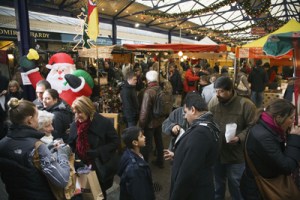 The market was originally located on the site of the Old Royal Naval College’s west gate and the surrounding area but under an initiative to clean up the area in the early 1800s – when the market sold all manner of foodstuffs, including livestock, as well as general goods – saw the commissioners move it to its current location on an “island site” in the midst of a block bounded by Nelson Road, King William Walk, College Approach and Greenwich Church Street.
Under the direction of Greenwich surveyor Joseph Kay (he also built Greenwich’s Trafalgar Tavern), between 1827-1833 the market was rebuilt with three roofs constructed over three linked buildings to protect traders and customers from the weather.
In 1849 an Act of Parliament was passed giving Greenwich Hospital the right to regulate the marketplace including creating byelaws and collecting fees from traders.
In the early 1900s, the byelaws were changed so the market could trade six days a week (except Sundays) and in 1908, the original timber roofing of the market was replaced with the steel and glass roof that still stands today.
The market, which lost its roof when it was struck by flying bombs in 1944, was established as a wholesale market in the years after the war and renovations carried out in the late 1950s/early 1960s. The market remained a wholesale fruit and vegetable market until 1980s when, inspired by the success of Camden Lock Market in London’s north (we’ll look at this market in a later post), it was transformed into an arts and crafts market (officially opened on 14th May, 1985) with shops around the edge let to craft-related businesses.
These days the market has about 150 stalls, selling everything from antiques and fashion to art and photographic work, jewellery, books and gifts as well a host of places to eat and drink in the market and surrounding streets.
A regeneration plan – under which a 100 bed hotel, 17,000sq ft of retail space and 155 trading stalls would be located on the 1.64 acre site currently occupied by the market – is now under consideration by Greenwich Hospital. The market is expected to be relocated to the grounds of the Old Royal Naval College while the regeneration takes place in January with the market reopened in late 2014.
WHERE: The market has four entrances – off Greenwich Church Street, Nelson Road, King William Walk and College Approach, Greenwich (nearest DLR is Cutty Sark); WHEN: 10am to 5.30pm, Tuesday to Sunday and Bank Holidays (different stalls operate on different days – check website for details); COST: Free; WEBSITE: www.shopgreenwich.co.uk/greenwich-market.
This is the last in our series on 10 Historic London Markets (we’ll be looking at more markets in upcoming posts). PICTURE: visitlondonimages/britainonview/Stephen McLaren.
For more on London’s markets, check out The London Market Guide
LondonLife – Winter Wonderland returns to Hyde Park…
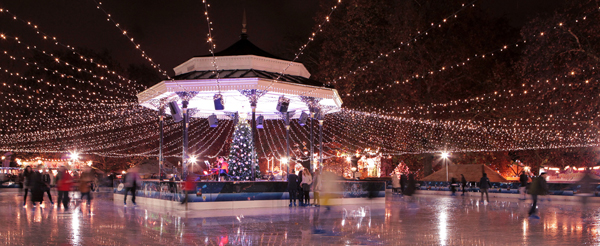 Hyde Park Winter Wonderland is back for Christmas. As well as attractions including the UK’s largest outdoor ice rink centred on a Victorian bandstand (pictured), a giant observation wheel, Bavarian village, markets and Zippo’s Circus, this year’s event features an ice and snow sculpture experience – The Magical Ice Kingdom – created from more than 200 tonnes of ice and snow and featuring more than 500 snow and sculptures. Winter Wonderland, located at the eastern end of Hyde Park, first opened in winter 2007 and has since attracted more than 10 million visitors. This year’s event is open from 10am to 10pm, every day (except Christmas Day) until 6th January. For more, head to www.hydeparkwinterwonderland.com.
What’s in a name?…Barbican
Though it’s these days associated with a Brutalist housing estate and performing arts centre based in the north of the City of London, the name Barbican has been associated with the area on which the estate stands for centuries.
 The word barbican (from the Latin barbecana) refers to an outer fortification designed to protect the entrance to a city or castle. In this case it apparently referred to watchtower which may have had its origins in Roman or Saxon times (or maybe both). The City of London website suggests it was located “somewhere between the northern side of the Church of St Giles Cripplegate and the YMCA hostel on Fann Street”.
When-ever it was built, the watchtower was apparently demolished on the orders of King Henry III in 1267, possibly as a response to Londoners who had supported England’s barons when they had rebelled against him. One source suggests the tower was rebuilt during the reign of King Edward III but, if so, the date of its subsequent demolition remains unknown.
Later residents of the area – which become known as a place to trade new and used clothes – included John Milton and William Shakespeare.
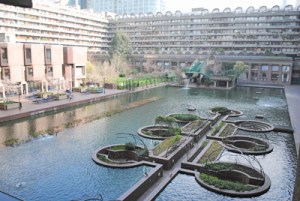
The area known as Barbican was devastated by bombing raids in World War II. Discussions on the future of the site started in 1952 and for more than 10 years plans for redeveloping the area were debated until finally, in the early 1960s, work began on what is now the Barbican Estate including three tall residential towers (part of the residential estate is pictured above). Completed in the mid 1970s, the Brutalist design of the complex, which features buildings named after historical figures associated with the area, means it meets with strong reactions from those who encounter it whether love – or hate.
Construction of the arts centre – known as the Barbican Centre – the largest performing arts centre in Europe and home to the London Symphony Orchestra – was started in the early 1970s. The £156 million centre was eventually opened by Queen Elizabeth II in 1982.
Other buildings within the Grade II listed complex include the Guildhall School of Music and Drama, the City of London School for Girls and a YMCA.
Where is it? #52…
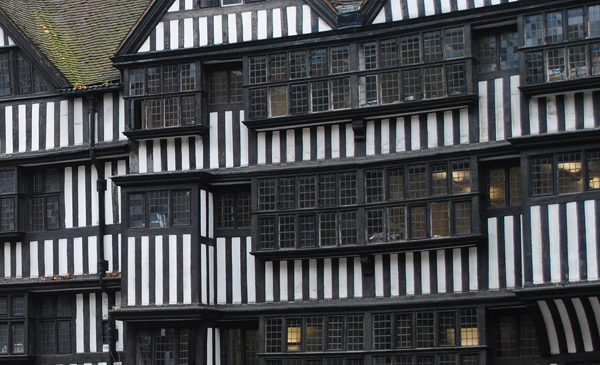
The latest in the series in which we ask you to identify where in London this picture was taken and what it’s of. If you think you can identify this picture, leave a comment below. We’ll reveal the answer early next week. Good luck!
Well done to all those who identified this as Staple Inn in High Holborn. The last surviving of the buildings once known as the Inns of Chancery – medieval period schools which provided legal training, the current structure dates from about 1580 and is a rare survivor from before the Great Fire of London in 1666. As mentioned by Mike below, it had to be largely rebuilt after the hall was devastated by a flying bomb in August, 1944. Staple Inn is now home to the Institute of Actuaries (we’ll be taking a more in-depth look at the building and its history in an upcoming post).
Lost London – Old St Paul’s Chapterhouse…
We’re yet to take an in-depth look at Old St Paul’s Cathedral – that is, the building that stood on the existing site before being destroyed in the Great Fire of London in 1666 – but today we thought we’d focus on just one aspect of the former church – the old chapterhouse.
 Located in the South Churchyard on the Thames side of St Paul’s Cathedral, the location of the chapterhouse is today marked out by raised stonework (the actual building remains lay a few feet below) which can be freely accessed from the street.
The octagonal chapterhouse, which replaced an earlier chapterhouse, stood in the middle of a 100 foot square arcaded cloister, both of which were designed by the royal mason, William Ramsay, in 1332 during the reign of King Edward III, in one of the first known examples of what is referred to as the ‘Perpendicular Gothic’ style.
Designed as a two-storey building for better air circulation, the actual chapter room was located on the second floor of the chapterhouse over an undercroft below and it was here the monks would meet daily to discuss affairs relating to the cathedral (the word chapterhouse comes from the fact that it was while in this room the monks would be a read a daily chapter from the body of rules governing them).
The marked out chapterhouse (pictured above – the chairs are standing inside the chapterhouse) was unveiled in 2008 following a £3.8 million redevelopment of the South Churchyard, itself part of the bigger, recently completed, overhaul of the entire cathedral).
WHERE: South Churchyard, St Paul’s Cathedral (nearest tube station is St Paul’s); WHEN: Anytime; COST: Free (to go inside the cathedral costs £15 an adult/£14 concessions and students/£6 a child (6-18 years)/£36 a family of four); WEBSITE: www.stpauls.co.uk
Around London – Christmas at the Geffrye; a Kensington Palace advent calendar; new furniture gallery at the V&A; and, last chance to see Bronze…
• Christmas is looming and at the Geffrye Museum in Hoxton that means the museum’s many period rooms have been transformed for the Christmas festivities. The rooms span 400 years of history, from 1600 until today, and show how the middle class have lived over that time. The Christmas display will also provide insights into such Christmas traditions as kissing under the mistletoe, hanging up stockings, sending Christmas cards and decorating trees. The Christmas theme carries through to the restaurant and gift shop. Entry to the exhibition is free. Runs until 6th January. For an online gallery showing some of the rooms, click here. For more on the museum, see www.geffrye-museum.org.uk.
• Meanwhile Kensington Palace is to be transformed into giant advent calendar in the lead-up to Christmas with a daily ‘reveal’ inspired by Princess Victoria’s Christmas diary entries and letters. The halls of the palace will be decorated with 24 specially designed mirrored baubles, Christmas music will be played throughout and a sparkling 25 foot high Christmas tree will be placed in the gardens. As part of the Christmas festivities, an evening of carol singing will be held on 5th December in the King’s Gallery with carols sung by the Hampton Court Palace Royal Chapel Choir. Other events include a Midwinter Masquerade Ball on 13th December and an Eerie Evening Tour on 20th December. For more, see www.hrp.org.uk/KensingtonPalace/.
• A new permanent furniture gallery opens at the V&A this Saturday. The Dr Susan Weber Gallery – the first at the museum dedicated to furniture – will display more than 200 pieces of British and European furniture, spanning a period stretching from the Middle Ages through to present day, as well as examples of American and Asian furniture. Each piece is examined in detail with information provided about the materials and techniques used in creating it. Among the designers represented will be Thomas Chippendale, Grinling Gibbons, Robert Adam, Ron Arad and Tom Dixon. Highlights include a 20th century Frank Lloyd Wright-designed dining chair, a gilded cassone made for the Duke of Urbino in about 1509, and a scagliola decorated table which was formerly at Warwick Castle and dates from 1675. Twenty-five ‘key’ pieces have been selected for a central chronological display including a storage unit by Charles and Ray Eames dating from 1949-50, a Gothic revival cradle dating from 1861 and designed by Richard Norman Shaw and one of the museum’s newest acquisitions, the 2011 ‘Branca’ chair, designed by Industrial Facility. The display includes the use of touch screen interfaces, films and audio recordings. Entry is free. For more, see www.vam.ac.uk.
• On Now: Bronze. Last chance to see this exhibition at the Royal Academy of Arts which closes on 9th December. The exhibition brings together more than 150 of the finest bronzes in the world, spanning 5000 years of history, with many of the pieces on display never seen before in the UK. Among the earliest works are the 14th century BC bronze and gold Chariot of the Sun from Denmark, ancient Chinese ritual vessels including an elephant-shaped vessel dating from the Shang Dynasty (1100-1050 BC) and an Etruscan masterpiece – Chimera of Arezzo, dating from about 400 BC. Other highlights include a Roman cavalry helmet found in Cumbria in 2010 and the Portrait of King Seuthes III, dating from the early Hellenistic period, and found in Bulgaria in 2004 as well as a series of Renaissance bronzes and more recent works like Rodin’s The Age of Bronze (c 1876). Admission charge applies. For more, see www.royalacademy.org.uk.
10 Historic London Markets – 9. Petticoat Lane Market…
One of the more well-known street markets of London, there has been a market operating in Petticoat Lane (later known as Middlesex Street) in East London since the 17th century.
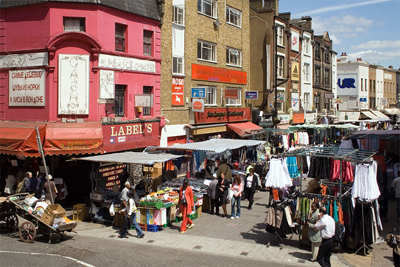 The market – which lies in relatively close proximity to the Columbia Road Flower Market and Old Spitalfields Market as well as Brick Lane – started to emerge in the early 1600s as a place where clothes were traded and received a boost with the arrival of Huguenot silk weavers who settled in the area later that century having fled religious persecution in the continent (it’s believed the lane was named after the silk petticoats which were sold here).
During the 1800s the area become renowned as the centre of the clothes manufacturing trade and the market was the place to buy the clothes. Around 1830, the name of the street was changed from Petticoat Lane to Middlesex Street after some sensibilities were offended that the street was named after unmentionables.
In the late 19th and early 20th centuries, the market became dominated by Jewish traders who had arrived in London, like the Huguenots before them, fleeing persecution in Europe. They added new life to the market and maintained the coster traditions.
Like many other street markets in London, the market didn’t get formal approval until quite late in life – only in 1936 was it was protected by an Act of Parliament.
These days the market – one of 1o managed by the London Borough of Tower Hamlets in whose jurisdiction the majority of the market lies – occupies the lanes and streets centring on Middlesex Street including Cobb Street, Goulston Street and Wentworth Street (which has long had a street market in its own right). It is open weekdays as well as Sunday when there are more than 1,000 stalls selling everything from clothes to CDs, books and artwork.
WHERE: Middlesex Street (nearest Tube stations are Aldgate, Aldgate East and Liverpool Street); WHEN: 10am to 4pm, Monday to Friday and 9am to 3pm Sunday; COST: Free.
PICTURE: Andrew Dunn, www.andrewdunnphoto.com (via Wikipedia).
London Pub Signs – The Enterprise…
Not surprisingly, this Holborn pub is named after a ship – in the case a vessel that was sent to search for the doomed fourth expedition of Sir John Franklin in the Arctic.
 Franklin’s expedition – which consisted of two ships, the HMS Erebus and HMS Terror – had departed England in 1845 with the aim of traveling through the last un-navigated section of the Northwest Passage. But the ships became icebound near King William Island off the coast of Canada and all 129 people, including Sir John, on the expedition were lost.
Pressure from Franklin’s wife, Lady Jane Franklin, and a reward offered by the Admiralty led to many attempts to find the lost expedition involving numerous ships. These included the HMS Enterprise which twice set off to find Franklin’s ships, failing in the attempt both times.
The lost expedition and the numerous attempts to find it captured public attention and The Enterprise in Holborn is one of a couple of pubs in London that bears the ship’s name.
While some human remains and parts of the ships from the Franklin Expedition were found in the years following, the exact fate of the crew on the lost expedition remains something of a mystery.
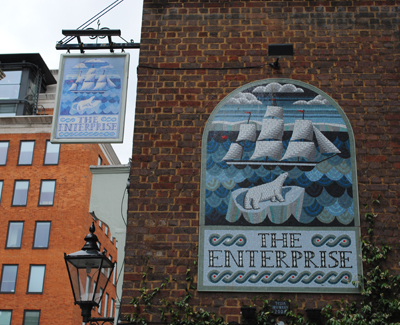
The pub in Red Lion Street features a wonderful mosaic on an external wall depicting the ship sailing past an iceberg on which stands a polar bear (pictured). The work Tessa Hunkin, it was installed in 2006.
For more on the Victorian era pub – much of which has been restored, see www.the-enterprise.co.uk.
Where is it?…#51…
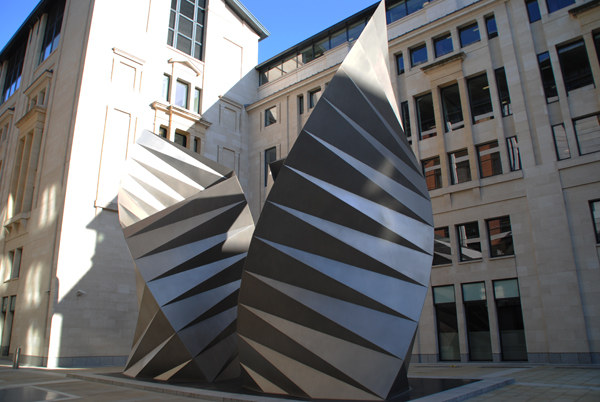 The latest in the series in which we ask you to identify where in London this picture was taken and, although this is a little odd this week, what it’s of. If you think you can identify this picture, leave a comment below. We’ll reveal the answer early next week. Good luck!
Well done to all those who correctly said this sculpture, Paternoster Vents (although many refer to it as Angel’s Wings), is located in Bishop’s Court, just to the west of Paternoster Square near St Paul’s Cathedral. The work of Thomas Heatherwick (yes, the same man who designed the stunning Olympic cauldron used in this year’s Games), it is actually some beautifully designed cooling vents for an electrical substation underneath. The 11 metre high sculpture takes its design from folded paper and is made from stainless steel.
Around London – Regicides’ rogues gallery; seeing London in extreme detail; Marilyn at the NPG; and, the Middle East at the V&A…
• A “rogues gallery of regicides” – six key parliamentarians who signed the death warrant of King Charles I – has been placed online this week by the National Army Museum to mark Parliament Week. The online gallery presents portraits and “potted histories” of the six men who include Oliver Cromwell (later Lord Protector of the Commonwealth, he died before the Restoration), Henry Ireton, John Hutchinson, John Hewson, John Okey and Thomas Harrison (the latter two were captured after the Restoration and rather brutally executed). In September, the museum placed 643 oil paintings from its collection online at the Your Paintings website – a collaboration between the BBC and the Public Catalogue Foundation. The paintings, which span 400 years of military history, can be viewed here: www.nam.ac.uk/your-paintings.
• While we’re looking at things online, photographer Henry Stuart earlier this month placed a GigaPixel image of London as seen from the top of St Paul’s Cathedral’s Dome – more than 100 metres above street level – as the sun sets over the city. Gigapixel means extreme detail so you can zoom in to pick out the details of individual buildings in greater clarity that the human eye can see from such a distance. Landmarks visible include the Olympic Stadium, Buckingham Palace, Westminster Abbey and Wembley Stadium. The picture can be seen here. The image can be compared to a similar image taken at sunset earlier this year (you can see this one here). He’s also taken a GigaPixel image of the St Paul’s interior (see it here). To find out more about Stuart’s work, head to www.sphericalimages.com.
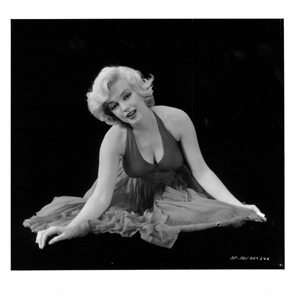 • On Now: Marilyn Monroe: A British Love Affair. This display at the National Portrait Gallery – coinciding with the 50th anniversary of Marilyn’s death – puts a spotlight on her links with the UK and features a range of photographic portraits as well as rare magazine covers, vintage prints, lobby cards and film stills. Monroe, then newly married to playwright Arthur Miller, spent four months in the UK in 1956 during which time she was making the film The Prince and the Showgirl opposite Laurence Olivier. Other events recorded include her meeting with the Queen and a private sitting with the film’s cinematographer Jack Cardiff. Among other images on display are Antony Beauchamp’s 1951 images of Marilyn in a yellow bikini and photographs taken by Cecil Beaton in New York’s Ambassador Hotel in 1956. There is also a selection of magazine covers ranging from a 1947 cover of Picture Post featuring then Norma Jeane Baker to the cover of Town magazine published three months after her death and featuring an image from her last official photo shoot. Runs until 24th March. Admission is free. For more, see www.npg.org.uk. PICTURE: Marilyn Monroe, artwork for The Prince and The Showgirl poster/Courtesy The John Kobal Foundation.
• On Now. Light from the Middle East: New Photography. Described as the “first major museum exhibition of contemporary photography from and about the Middle East”, this exhibition at the V&A features more than 90 works which show creative responses to events which have shaped the region over the past 20 years – including the recent revolution in Egypt. The display is structured around three themes – Recording, Reframing and Resisting – and as many as 30 artists from 13 countries are represented in the display including Abbas (Iran), Youssef Nabil (Egypt) and Walid Raad (Lebanon). Runs until 7th April. Admission is free. For more, see www.vam.ac.uk.
 Exploring London