Lost London – Old St Paul’s Chapterhouse…

We’re yet to take an in-depth look at Old St Paul’s Cathedral – that is, the building that stood on the existing site before being destroyed in the Great Fire of London in 1666 – but today we thought we’d focus on just one aspect of the former church – the old chapterhouse. 

Located in the South Churchyard on the Thames side of St Paul’s Cathedral, the location of the chapterhouse is today marked out by raised stonework (the actual building remains lay a few feet below) which can be freely accessed from the street.

The octagonal chapterhouse, which replaced an earlier chapterhouse, stood in the middle of a 100 foot square arcaded cloister, both of which were designed by the royal mason, William Ramsay, in 1332 during the reign of King Edward III, in one of the first known examples of what is referred to as the ‘Perpendicular Gothic’ style.

Designed as a two-storey building for better air circulation, the actual chapter room was located on the second floor of the chapterhouse over an undercroft below and it was here the monks would meet daily to discuss affairs relating to the cathedral (the word chapterhouse comes from the fact that it was while in this room the monks would be a read a daily chapter from the body of rules governing them).

The marked out chapterhouse (pictured above – the chairs are standing inside the chapterhouse) was unveiled in 2008 following a £3.8 million redevelopment of the South Churchyard, itself part of the bigger, recently completed, overhaul of the entire cathedral).

WHERE: South Churchyard, St Paul’s Cathedral (nearest tube station is St Paul’s); WHEN: Anytime;  COST: Free  (to go inside the cathedral costs £15 an adult/£14 concessions and students/£6 a child (6-18 years)/£36 a family of four); WEBSITE: www.stpauls.co.uk

Around London – Christmas at the Geffrye; a Kensington Palace advent calendar; new furniture gallery at the V&A; and, last chance to see Bronze…

Christmas is looming and at the Geffrye Museum in Hoxton that means the museum’s many period rooms have been transformed for the Christmas festivities. The rooms span 400 years of history, from 1600 until today, and show how the middle class have lived over that time. The Christmas display will also provide insights into such Christmas traditions as kissing under the mistletoe, hanging up stockings, sending Christmas cards and decorating trees. The Christmas theme carries through to the restaurant and gift shop. Entry to the exhibition is free. Runs until 6th January. For an online gallery showing some of the rooms, click here. For more on the museum, see www.geffrye-museum.org.uk.

• Meanwhile Kensington Palace is to be transformed into giant advent calendar in the lead-up to Christmas with a daily ‘reveal’ inspired by Princess Victoria’s Christmas diary entries and letters. The halls of the palace will be decorated with 24 specially designed mirrored baubles, Christmas music will be played throughout and a sparkling 25 foot high Christmas tree will be placed in the gardens. As part of the Christmas festivities, an evening of carol singing will be held on 5th December in the King’s Gallery with carols sung by the Hampton Court Palace Royal Chapel Choir. Other events include a Midwinter Masquerade Ball on 13th December and an Eerie Evening Tour on 20th December. For more, see www.hrp.org.uk/KensingtonPalace/.

• A new permanent furniture gallery opens at the V&A this Saturday. The Dr Susan Weber Gallery – the first at the museum dedicated to furniture – will display more than 200 pieces of British and European furniture, spanning a period stretching from the Middle Ages through to present day, as well as examples of American and Asian furniture. Each piece is examined in detail with information provided about the materials and techniques used in creating it. Among the designers represented will be Thomas Chippendale, Grinling Gibbons, Robert Adam, Ron Arad and Tom Dixon. Highlights include a 20th century Frank Lloyd Wright-designed dining chair, a gilded cassone made for the Duke of Urbino in about 1509, and a scagliola decorated table which was formerly at Warwick Castle and dates from 1675. Twenty-five ‘key’ pieces have been selected for a central chronological display including a storage unit by Charles and Ray Eames dating from 1949-50, a Gothic revival cradle dating from 1861 and designed by Richard Norman Shaw and one of the museum’s newest acquisitions, the 2011 ‘Branca’ chair, designed by Industrial Facility. The display includes the use of touch screen interfaces, films and audio recordings. Entry is free. For more, see www.vam.ac.uk.

• On Now: Bronze. Last chance to see this exhibition at the Royal Academy of Arts which closes on 9th December. The exhibition brings together more than 150 of the finest bronzes in the world, spanning 5000 years of history, with many of the pieces on display never seen before in the UK. Among the earliest works are the 14th century BC bronze and gold Chariot of the Sun from Denmark, ancient Chinese ritual vessels including an elephant-shaped vessel dating from the Shang Dynasty (1100-1050 BC) and an Etruscan masterpiece – Chimera of Arezzo, dating from about 400 BC. Other highlights include a Roman cavalry helmet found in Cumbria in 2010 and the Portrait of King Seuthes III, dating from the early Hellenistic period, and found in Bulgaria in 2004 as well as a series of Renaissance bronzes and more recent works like Rodin’s The Age of Bronze (c 1876). Admission charge applies. For more, see www.royalacademy.org.uk.

10 Historic London Markets – 9. Petticoat Lane Market…

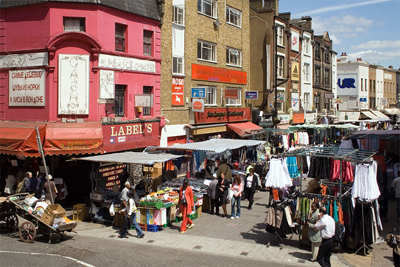
One of the more well-known street markets of London, there has been a market operating in Petticoat Lane (later known as Middlesex Street) in East London since the 17th century.

The market – which lies in relatively close proximity to the Columbia Road Flower Market and Old Spitalfields Market as well as Brick Lane – started to emerge in the early 1600s as a place where clothes were traded and received a boost with the arrival of Huguenot silk weavers who settled in the area later that century having fled religious persecution in the continent (it’s believed the lane was named after the silk petticoats which were sold here).

During the 1800s the area become renowned as the centre of the clothes manufacturing trade and the market was the place to buy the clothes. Around 1830, the name of the street was changed from Petticoat Lane to Middlesex Street after some sensibilities were offended that the street was named after unmentionables.

In the late 19th and early 20th centuries, the market became dominated by Jewish traders who had arrived in London, like the Huguenots before them, fleeing persecution in Europe. They added new life to the market and maintained the coster traditions.

Like many other street markets in London, the market didn’t get formal approval until quite late in life – only in 1936 was it was protected by an Act of Parliament.

These days the market – one of 1o managed by the London Borough of Tower Hamlets in whose jurisdiction the majority of the market lies – occupies the lanes and streets centring on Middlesex Street including Cobb Street, Goulston Street and Wentworth Street (which has long had a street market in its own right). It is open weekdays as well as Sunday when there are more than 1,000 stalls selling everything from clothes to CDs, books and artwork.

WHERE: Middlesex Street (nearest Tube stations are Aldgate, Aldgate East and Liverpool Street); WHEN: 10am to 4pm, Monday to Friday and 9am to 3pm Sunday; COST: Free.

PICTURE: Andrew Dunn, www.andrewdunnphoto.com (via Wikipedia).

London Pub Signs – The Enterprise…

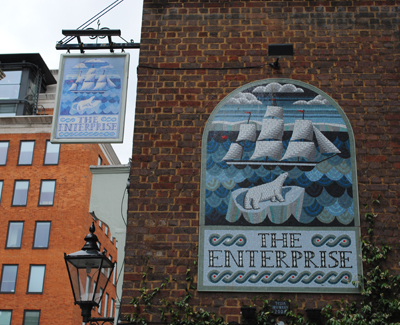
Not surprisingly, this Holborn pub is named after a ship – in the case a vessel that was sent to search for the doomed fourth expedition of Sir John Franklin in the Arctic.

Franklin’s expedition – which consisted of two ships, the HMS Erebus and HMS Terror – had departed England in 1845 with the aim of traveling through the last un-navigated section of the Northwest Passage. But the ships became icebound near King William Island off the coast of Canada and all 129 people, including Sir John, on the expedition were lost.

Pressure from Franklin’s wife, Lady Jane Franklin, and a reward offered by the Admiralty led to many attempts to find the lost expedition involving numerous ships. These included the HMS Enterprise which twice set off to find Franklin’s ships, failing in the attempt both times.

The lost expedition and the numerous attempts to find it captured public attention and The Enterprise in Holborn is one of a couple of pubs in London that bears the ship’s name.

While some human remains and parts of the ships from the Franklin Expedition were found in the years following, the exact fate of the crew on the lost expedition remains something of a mystery.

The pub in Red Lion Street features a wonderful mosaic on an external wall depicting the ship sailing past an iceberg on which stands a polar bear (pictured). The work Tessa Hunkin, it was installed in 2006.

For more on the Victorian era pub – much of which has been restored, see www.the-enterprise.co.uk.

Where is it?…#51…

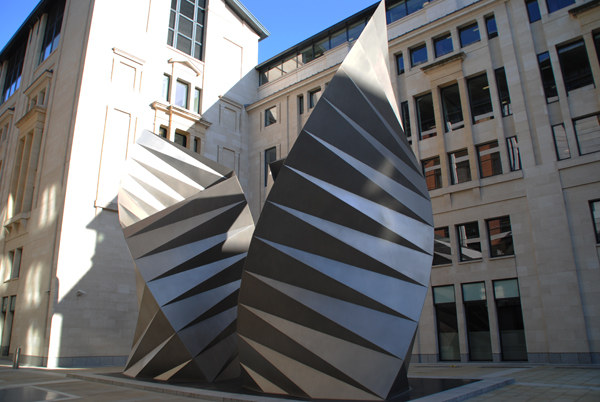
The latest in the series in which we ask you to identify where in London this picture was taken and, although this is a little odd this week, what it’s of. If you think you can identify this picture, leave a comment below. We’ll reveal the answer early next week. Good luck!

Well done to all those who correctly said this sculpture, Paternoster Vents (although many refer to it as Angel’s Wings), is located in Bishop’s Court, just to the west of Paternoster Square near St Paul’s Cathedral. The work of Thomas Heatherwick (yes, the same man who designed the stunning Olympic cauldron used in this year’s Games), it is actually some beautifully designed cooling vents for an electrical substation underneath. The 11 metre high sculpture takes its design from folded paper and is made from stainless steel.

Around London – Regicides’ rogues gallery; seeing London in extreme detail; Marilyn at the NPG; and, the Middle East at the V&A…

A “rogues gallery of regicides”  – six key parliamentarians who signed the death warrant of King Charles I – has been placed online this week by the National Army Museum to mark Parliament Week. The online gallery presents portraits and “potted histories” of the six men who include Oliver Cromwell (later Lord Protector of the Commonwealth, he died before the Restoration), Henry Ireton, John Hutchinson, John Hewson, John Okey and Thomas Harrison (the latter two were captured after the Restoration and rather brutally executed). In September, the museum placed 643 oil paintings from its collection online at the Your Paintings website – a collaboration between the BBC and the Public Catalogue Foundation. The paintings, which span 400 years of military history, can be viewed here: www.nam.ac.uk/your-paintings.

• While we’re looking at things online, photographer Henry Stuart earlier this month placed a GigaPixel image of London as seen from the top of St Paul’s Cathedral’s Dome – more than 100 metres above street level – as the sun sets over the city. Gigapixel means extreme detail so you can zoom in to pick out the details of individual buildings in greater clarity that the human eye can see from such a distance. Landmarks visible include the Olympic Stadium, Buckingham Palace, Westminster Abbey and Wembley Stadium. The picture can be seen here. The image can be compared to a similar image taken at sunset earlier this year (you can see this one here). He’s also taken a GigaPixel image of the St Paul’s interior (see it here). To find out more about Stuart’s work, head to www.sphericalimages.com.

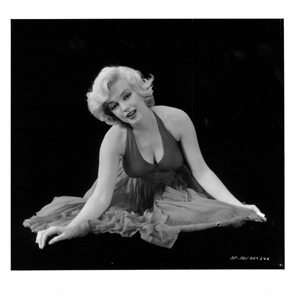
• On Now: Marilyn Monroe: A British Love Affair. This display at the National Portrait Gallery – coinciding with the 50th anniversary of Marilyn’s death – puts a spotlight on her links with the UK and features a range of photographic portraits as well as rare magazine covers, vintage prints, lobby cards and film stills. Monroe, then newly married to playwright Arthur Miller, spent four months in the UK in 1956 during which time she was making the film The Prince and the Showgirl opposite Laurence Olivier. Other events recorded include her meeting with the Queen and a private sitting with the film’s cinematographer Jack Cardiff. Among other images on display are Antony Beauchamp’s 1951 images of Marilyn in a yellow bikini and photographs taken by Cecil Beaton in New York’s Ambassador Hotel in 1956. There is also a selection of magazine covers ranging from a 1947 cover of Picture Post featuring then Norma Jeane Baker to the cover of Town magazine published three months after her death and featuring an image from her last official photo shoot. Runs until 24th March. Admission is free. For more, see www.npg.org.uk. PICTURE: Marilyn Monroe, artwork for The Prince and The Showgirl poster/Courtesy The John Kobal Foundation.

• On Now. Light from the Middle East: New Photography. Described as the “first major museum exhibition of contemporary photography from and about the Middle East”, this exhibition at the V&A features more than 90 works which show creative responses to events which have shaped the region over the past 20 years – including the recent revolution in Egypt. The display is structured around three themes – Recording, Reframing and Resisting – and as many as 30 artists from 13 countries are represented in the display including Abbas (Iran), Youssef Nabil (Egypt) and Walid Raad (Lebanon). Runs until 7th April. Admission is free. For more, see www.vam.ac.uk.

10 Historic London Markets – 8. Columbia Road Flower Market…

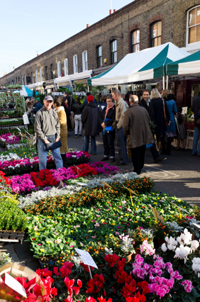
Originally founded in the early 1800s, the Columbia Road market in East London has since evolved into a specialist flower market on Sundays.

First emerging as a general street market in the early 1800s, the market was formalised in the mid 1800s when banking heiress Angela Burdett-Coutts financed the construction of the now demolished – and somewhat architecturally fanciful – Columbia Market. This opened in 1869 at the northern end of the road but didn’t prove a great success. Despite efforts to save it – including apparently relaunching it as a fish market – it closed in 1885.

The market building – which is said to have resembled the sort of market hall that might be found in rural areas – was later used as a warehouse but after suffering bomb damage in World War II were demolished.

The market, meanwhile, reappeared on the street and as the area’s Jewish population grew, moved to a Sunday, a decision which allowed traders from Covent Garden and Spitalfields to trade their leftover goods from the previous day.

The introduction of new regulations – including those introduced in the 1960s requiring traders to attend regularly – saw the market gradually transform itself into the colorful market selling cut flowers, plants and bulbs you can find there today. Popular with film makers and photographers thanks to the colourful backdrop it provides, the surrounding streets also feature a range of interesting independent shops and cafes.

WHERE: Columbia Road, Bethnal Green (nearest Tube stations are Shoreditch, Liverpool Street, Aldgate East and Bethnal Green); WHEN: 8am to 2pm Sunday; COST: Free; WEBSITE(S): www.columbiaroad.info/www.columbia-flower-market.freewebspace.com/index.html.

PICTURE: Dynasoar/www.istockphoto.com

LondonLife – A new crown for King Henry VIII…

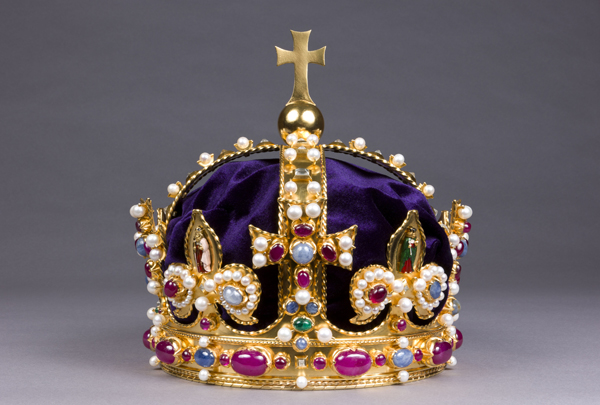
A recreation of King Henry VIII’s imperial crown, destroyed after the English Civil War, has gone on show in the Chapel Royal at Hampton Court Palace. Originally created for either King Henry VIII or his father, King Henry VII, the crown was worn at the coronations of Henry VIII’s children and possibly the king’s own as well as at Hampton Court Palace during major liturgical and court ceremonies. It was subsequently used by his successors down to King Charles I before being melted down by the Commonwealth Government in 1649 at the Tower of London. The replica crown, which is being displayed in the Royal Pew – allowing visitors access to the balcony in the chapel for the first time in seven years, is the result of detailed historical research by Dr Kent Rawlinson, curator at Hampton Court Palace, and was made by Crown Jeweller Harry Collins and his master craftsmen. Hand-crafted in silver gilt, it features 344 jewels including pearls and precious and semi-precious stones. Five enameled figures are set within five fleur-de-lis – the figures represent the Virgin and Child, St George and English kings believed to be St Edmund, St Edward the Confessor and King Henry VI (King Henry VIII had the latter three figures added to the crown to underline the political and religious authority of the Crown). For more on Hampton Court Palace, see www.hrp.org.uk/HamptonCourtPalace/PICTURE: HRP/Newsteam

Where’s London’s oldest…public bust?

You don’t have to go far in London to find a bust of a famous figure from English history but the oldest public bust (that is, located outdoors where passersby can see it) is in fact from Egypt.

Sitting above the entrance to Sotherby’s auction house in New Bond Street, Mayfair, is a bust of Sekhmet, a lion-headed Egyptian goddess of war and healing. The half-statue, made from black basalt, was made around 1,320 BC during the 18th dynasty.

It has been sitting above Sotherby’s entrance since the 1880s when it was sold at auction for £40, but never collected.

Sotherby’s, founded by Samuel Baker in 1744, has operated on the site at 34-35 New Bond Street since 1917 when it moved from its previous home at The Strand.

You might be interested in seeing our earlier entry for London’s oldest full length outdoor statue here

Where is it?…#50

The latest in the series in which we ask you to identify where in London this picture was taken and what it’s of. If you think you can identify this picture, leave a comment below. We’ll reveal the answer early next week. Good luck!

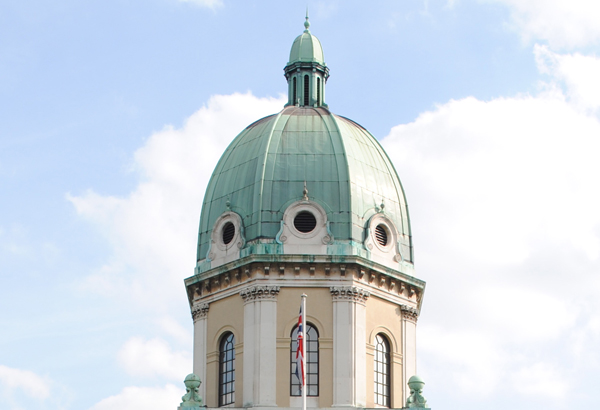
Well done to Martine Poupaux, this is indeed the dome on top of the Imperial War Museum in Lambeth Road, London. The museum, which was formally established by an Act of Parliament in 1920, was initially based in the Crystal Palace and then from 1924 to 1935 in two galleries adjoining the former Imperial Institute, South Kensington. It reopened at its current home in 1936 at a ceremony attended by King George VI. The building was formerly the central portion of Bethlem Royal Hospital, or ‘Bedlam’, which have moved to the site in 1815 (the dome wasn’t part of the original building – it was added later). We’ll be exploring more this history in upcoming posts. For more on the Imperial War Museum, see www.iwm.org.uk/visits/iwm-london.

Lost London – Bridewell Palace…

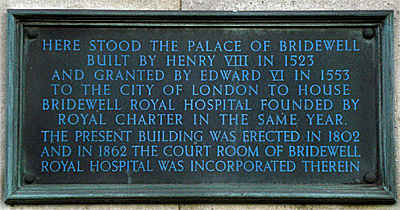
Built in the 16th century for King Henry VIII, Bridewell Palace only had a short-lived life as a royal residence before it was handed over to the City of London and used as a poorhouse and prison.

Located on the western bank of the Fleet River (the site is now occupied by Unilever House and remembered in the place names of Bridewell Place and Bridewell Court), the palace – named for a holy well located nearby which was dedicated to St Bride  (St Brigid) – was built on the direction of the king’s key advisor Cardinal Thomas Wolsey between 1510-15 on land which had previously been the site of St Bride’s Inn.

In 1515 Cardinal Wolsey gave it to King Henry VIII after taking up residence at Hampton Court and York Place  – Henry was looking for a royal residence in London after the Palace of Westminister was largely destroyed in a fire in 1512. Work continued on the palace until its completion in 1523.

The palace, the site of which is now marked with a plaque on the approach to Blackfriars Bridge, consisted of two courtyards surrounded by brick buildings with the three storey royal lodgings (separate quarters for the king and queen) located around the inner courtyard and entered by a grand staircase from the outer courtyard. It also featured a watergate was located on the Thames and, interestingly, Bridewell was the first royal palace not to have its own great hall.

Among historic events hosted here was the visit of the Holy Roman Emperor Charles V in 1522 (the emperor did not stay here but his entourage did). In 1528 meetings of the papal delegation took place at Blackfriars (located next door and joined by a specially built gallery) to discuss the king’s divorce from Queen Katherine of Aragon – it’s here that the Queen made her most famous speech declaring her fidelity to the king – and for its duration the king and queen lodged at Bridewell. It’s also said that it was at Bridewell Palace that artist Hans Holbein the Younger painted his famous work – The Ambassadors (see our earlier post on this here).

Following Cardinal Wolsey’s fall from favor in 1529, King Henry VIII no longer used the property (he took over the Palace of Whitehall, then known as York Place, as his main residence in 1530 – for more on this see our earlier post here). It was leased for much of the following decade to the French ambassador in London before, following petitioning for a new hospital for the poor from Nicholas Ridley, the Bishop of London, King Edward VI gave it to the City of London in 1553. They took over fully in 1556 and converted the palace into a prison, hospital and workrooms (we’ll deal in detail with the prison in an upcoming post).

Around London – Egypt comes to Wellington Arch; Dorothy Bohm at the MoL; Testino at the NPG; and performance art at the Tate Modern…

The influence of ancient Egypt on English architecture and interiors is under the spotlight in a new English Heritage exhibition inside Wellington Arch’s Quadriga Gallery at Hyde Park Corner. Egypt in England reveals that the Egyptian style, while it has been used in 18th century gardens in England, first rose to popularity after Napoleon’s invasion of Egypt in 1798, continued when the discovery of Tutankhamun’s tomb in 1922 triggered a new wave of ‘Egyptomania’ and went onto into the later 20th century where its influence can be seen on buildings like cinemas and shops. The exhibition features photographs of Egyptian-style buildings and landmarks from across England – including London sites such as the The Egyptian Avenue and Circle of Lebanon Vaults at Highgate Cemetery and The Egyptian Hall at Harrods – alongside images of the Egyptian sources which inspired them. There are also 19th century travel brochures, a number of shabtis (the small mummy-like figurines placed in tombs which were often taken home by visitors as souvenirs) and Wedgewood ceramics designed in the Egyptian style. The display also tells the story of London landmark Cleopatra’s Needle, a 3,500-year-old obelisk which sits on the north bank of the Thames (see our earlier post on it here). Admission charge applies. Runs until 13 January. For more, see www.english-heritage.org.uk/daysout/properties/wellington-arch/.

A new exhibition of photographs taken by celebrated snapper Dorothy Bohm opens at the Museum of London tomorrow. Women in Focus will feature 33 color photographs dating from the 1990s to the present which juxtapose women who work and live in London with the ever-present images of women in advertising, artwork and shop windows. The images show women in their varied roles in society – from parents to professionals – and reflects on how they are seen in London’s public spaces. Runs until 17th February. For more, see www.museumoflondon.org.uk.

• Now On: Mario Testino: British Royal Portraits. This display at the National Portrait Gallery features eight portraits of Royal Family members taken by Mario Testino between 2003 and 2010. As well an official portrait of Prince Charles taken in 2003, others include a portrait of Prince William taken the same year for his 21st birthday, another of Prince Harry on his 21st birthday, a portrait of Prince Charles and Duchess Camilla commissioned by British Vogue in 2006 and official engagement portraits of Prince William and Duchess Catherine taken in 2010. It is the first time the portraits have all been shown together. The exhibition runs in Room 40 until 3rd February. Admission is free. For more, see www.npg.org.uk.

• Now On: A Bigger Splash: Painting after Performance. This newly opened exhibition at the Tate Modern explores the changing relationship between performance and painting, spanning the period from 1950 to today and featuring works from more than 40 artists including David Hockney, Yves Klein, Jackson Pollock and Cindy Sherman. Themes examined in the exhibition include how the painted canvas has been used as an ‘arena’ in which performance is carried out, the use of the human body as a surface and how contemporary artists are using painting to create social and theatrical spaces. Runs until 1st April. Admission charge applies. For more, see www.tate.org.uk.

10 Historic London Markets – 7. Portobello Market…

Established far more recently than many of the other markets we’ve looked at, the origins of a market in Portobello Road in London’s inner west only go back to the mid-to-late 19th century.

The oddly named road (it takes its name from the Battle of Porto Bello in the wonderfully named ‘War of Jenkins’ Ear’ between Britain and Spain in the mid 18th century – more on that in an upcoming What’s in a Name? post), was transformed from a mere laneway, known as Greens Lane, to a larger thoroughfare in the mid 180os as the area developed and the market started to take shape in the 1880s.

These days the street market can stretch for a mile along Portobello Road from Golborne Road in the north to Chepstow Villas in the south.

It offers everything from fruit and vegetables and various foodstuffs (sold particularly at the northern end and along Golborne Road itself, known as Golborne Market as well around Elgin Crescent) through to vintage and alternative clothing, music and other bric-a-brac (a section in the middle, around the Westway flyover, specialises in this – this area includes the Acklam Village Market and the Portobello Green Fashion Market) and the world famous antiques market (down at the south end, closer to Notting Hill Gate Tube station – Saturday is the key day here).

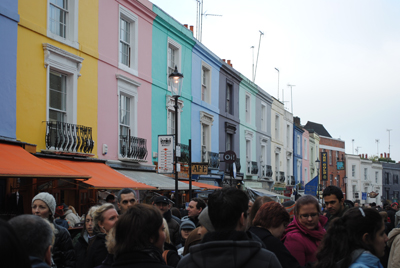
Different sections of the market open on different days – there’s a great map showing what opens when on the Portobello and Golborne Markets website here) – but Saturdays and Sundays are sure to find the area packed with people. The street is also lined with independently owned shops (including the colourful buildings above) and arcades and, as well as street food stalls, there’s plenty of pubs, cafes and restaurants where you can get a bite to eat.

There is currently a campaign to have Portobello Road declared Britain’s first “business conservation area” with the aim of preserving the character of the market. Head here for more details.

WHERE: Portobello Road, Notting Hill (nearest Tube stations are Notting Hill Gate or Ladbroke Grove); WHEN: Trading hours vary, see websites for details; COST: Free; WEBSITE(S): www.rbkc.gov.uk/subsites/visitkensingtonandchelsea/shopping/portobello/ourmarkets/portobelloroadmarket.aspxhttp://shopportobello.co.uk/.

LondonLife – Dick Whittington visits St Paul’s for the Lord Mayor’s Show…

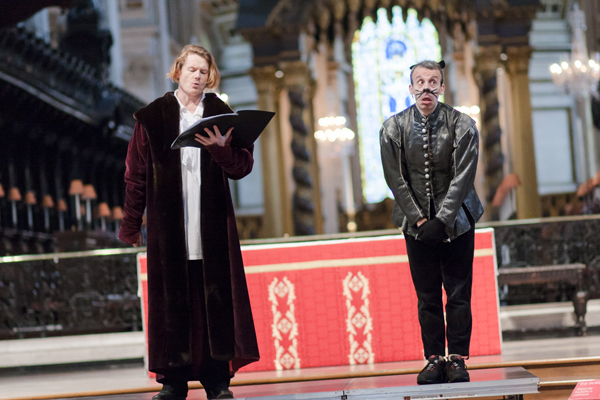
Actors Julian Rhind-Tutt (The Madness of King George, Notting Hill) and David Schneider (Horrid Henry the Movie, I’m Alan Partridge) star as thrice Lord Mayor of London, Dick Whittington, and his cat in one of a series of free performances held in St Paul’s Cathedral last Saturday as part of the festivities surrounding the annual Lord Mayor’s Show. The Lord Mayor, Roger Gifford, visited St Paul’s to receive a blessing before heading on to the Royal Courts of Justice to swear an oath of allegiance (and then, eventually returning to Mansion House where his journey had also begun). Interestingly, the Lord Mayor was unable to complete his entire journey to and from Mansion House in the State Coach this year (see our earlier post here) when what was reported as a fault with the coach’s wheels meant he had to complete the journey in an open top Land Rover. For more on events at St Paul’s Cathedral, see www.stpauls.co.uk.

PICTURE: © Graham Lacdao/The Chapter of St Paul’s Cathedral

Famous Londoners – Sir Peter Lely…

One of the most famous painters of his age, Dutchman Sir Peter Lely – currently the subject of an exhibition at London’s Courtauld Gallery – rose to become the foremost portrait painter at the English Court during the latter half of the 17th century.

Born to Dutch parents on 14th September, 1618, in Westphalia (now part of Germany) where his father was serving as an infantry captain, Peter – originally named Pieter van der Faes – studied art as an apprentice in Haarlem in what is now The Netherlands. While there he is believed to have changed his name to Lely based on a heraldic lily which appeared on the gable of the house where his father was born in The Hague.

Lely appeared in London in the early 1640s and, while he initially devoted himself to the sort of narrative-style paintings inspired by classical mythology, the Bible and literature he had been working on in Haarlem but having found no great success there, soon turned his hand to portraiture.

The death of court portraitist Anthony van Dyck in 1641 had left a vacuum he stepped into the gap, soon becoming the most in-demand portrait painter at the Royal Court, his sitters including none other than King Charles I himself.

However, Lely, who was made a freeman of the Painter-Stainers Company in London in 1647, managed to straddle the political divide and after the beheading of King Charles I and the end of the English Civil War in 1651, was able to continue painting portraits of the most powerful people in the land including Oliver Cromwell – whom he painted “warts and all” as per the Lord Protector’s request – and his Cromwell’s brother Richard.

Already renowned as the best artist in the country, following the Restoration in 1660, Lely became Principal Painter of King Charles II, placed on an annual stipend as van Dyck had been before him during the reign of King Charles I.

Lely’s workshop was large and its output prolific, with his students and employees – who at one stage apparently included scientist and architect Robert Hooke – often completing his paintings after he sketched out some details, only painting the sitter’s face in any great detail.

Among his most famous works are a series of 10 portraits known as the Windsor Beauties (currently at Hampton Court Palace), a series of portraits of senior naval officers who served in the Second Anglo-Dutch War, known as the Flagmen of Lowestoft (most of the works at are the National Maritime Museum in Greenwich) and Susannah and the Elders (currently at Burghley House in Cambridgeshire) as well as some of the paintings in the current Courtauld exhibition including Nymphs by a Fountain (usually found at the Dulwich Picture Gallery) and Boy as a Shepherd (also the Dulwich Picture Gallery).

Lely was also known as an avid collector of art and is credited as being the first artist in England to do so in any serious manner – among his purchases were works which formerly formed part of King Charles I’s collection. At the time of his death, he is said to have owned more than 500 paintings, although more than half of these were works of his or his studio.

Sir Peter, who never married but had two children who survived him with a common-law wife Ursula, lived at a house in the north-east corner of Covent Garden from about 1650 until his death in 1680 (some sources have him knighted in this year, others in 1679) but also had a house at Kew and owned property outside of London including in Lincolnshire and The Hague.

He was apparently working at his easel in the studio of his Covent Garden house when he died on 30th November, 1680. He was buried at St Paul’s Church, Covent Garden. The monument to him, the work of Grinling Gibbons, was destroyed by fire in 1795.

Peter Lely: A Lyrical Vision – which focuses on some of his early non-portrait works – runs at The Courtauld Gallery until 13th January. For more on the exhibition, visit www.courtauld.ac.uk/gallery/exhibitions/2012/peter-lely/index.shtml. Running alongside the exhibition is a display of some of the drawings from Sir Peter’s own collection, Peter Lely: The Draughtsman and His Collection.

Where is it?…#49

The latest in the series in which we ask you to identify where in London this picture was taken and what it’s of. If you think you can identify this picture, leave a comment below. We’ll reveal the answer early next week. Good luck!

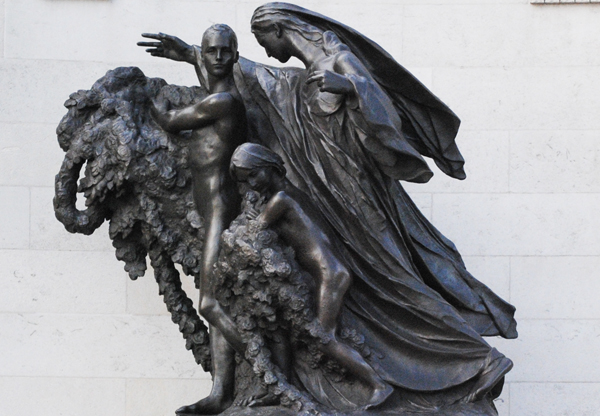
Sunday was Remembrance Day, so we thought it appropriate to have a war memorial as last week’s Where is it? This memorial, located at Victoria Embankment on the north bank of the Thames, is the Anglo-Belgian War Memorial, given in 1920 as a gift to Britain by the people of Belgium as a thank you for their help in providing a refuge in England during World War I. The work of celebrated Belgian sculptor Victor Rosseau, it features three bronze figures – a Belgian mother, a boy and a girl, the latter two carrying garlands – and although you can’t see it in this picture, there’s two figures behind them on the Portland stone surround representing ‘honour’ and ‘liberty’.

Daytripper – Bodiam Castle…

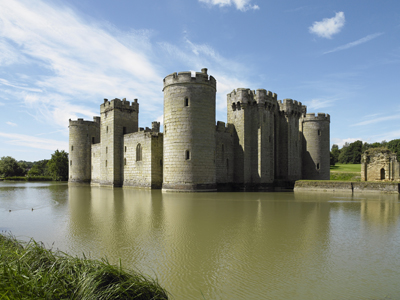
This spectacular 14th century moated castle in East Sussex looks every bit the medieval fortress it was built to be. Yet at the same time, Bodiam was built as a residence with the comfort of its residents in mind.

The building of the castle took place in the latter part of the 14th century when in 1385 Sir Edward Dalyngrigge – an influential knight of Sussex – decided to put to use some of the booty he had amassed fighting in France and build the castle on an elevated position overlooking the River Rother – ostensibly to help repel any French who dared to invade (a very real threat – it was only eight years before that Rye had been burned to the ground, see our earlier entry here) – but no doubt also to enhance his own status.

Having obtained royal permission to “crenellate”, Sir Edward, who had obtained the Manor of Bodiam through his wife, set about the construction of the castle which featured rather simple defences including a moat and single perimeter wall studded with four corner round towers and a massive gatehouse (which still contains an original wooden portcullis).

The castle remained in the family until the Wars of the Roses when Sir Thomas Lewknor surrendered the castle to Yorkist forces having himself being attainted for treason by King Richard III for his support of the Lancastrian cause.

But the castle returned to the family after the accession of King Henry VII, eventually passing into the hands of the Earls of Thanet before, in 1644, it was sold to one Nathaniel Powell, a supporter of the Parliamentarian forces in the Civil War, so the then owner – Sir John Tufton, the second earl and a Royalist – could pay fines levied upon him by Parliament.

It is believed that it was after this that the castle was substantially dismantled and by the mid-eighteenth century it was depicted as an ivy-clad ruin.

It then passed through numerous private hands before undergoing some restoration in the 19th and early 20th centuries and was eventually purchased by Lord Curzon, former Viceroy of India, in 1916. He oversaw extensive restoration work before, on his death in 1925, the property passed into the care of the National Trust. They have since continued the work.

The castle these days is a shell of its former self, but with the outer walls and towers largely intact, is one of the most picturesque in the south of England. And there’s enough of the interior layout remaining to give a good sense of how it once operated as a house and fortress.


There’s also a tea-room and gift shop on site and the Trust regularly hold events there including this and next weekend’s hawking events and the upcoming ‘medieval Christmas’.

Bodiam Castle can be a little hard to reach without a car although you can a train to a nearby station and catch a taxi from there. You can also take a steam train from Tenterden to Bodiam but this only runs on limited days (see the Kent and East Sussex Railway website – www.kesr.org.uk – for more).

WHERE: Bodiam Castle, Bodiam, near Robertsbridge, East Sussex; WHEN: 11am to 4pm, Wednesday to Sunday (times can change, so check before heading out); COST: £7 an adult/£3.50 a child/£18.60 a family (includes gift aid donation); WEBSITE: www.nationaltrust.org.uk/bodiam-castle/.
PICTURE: Matthew Antrobus/National Trust

Around London – Lord Mayor’s Show; Remembrance Sunday; Ansel Adams at the NMM; and, Mughal India at the British Library…

• The 2012 Lord Mayor’s Show is just about upon us and while you may not have a grandstand seat, there’s still plenty of places you can stand and watch the parade of more than 6,500 people pass by. Saturday’s parade – which celebrates the election of the 685th Lord Mayor of London, Alderman Roger Gifford – leaves Mansion House at 11am and travels via Poultry and Cheapside to St Paul’s Cathedral where it pauses for the Lord Mayor and his officials to receive a blessing – before continuing on via Ludgate Hill and Fleet Street to the Royal Courts of Justice, arriving there at about 12.30pm. There the Lord Mayor gives his oath of loyalty to the Crown (while in the surrounding streets the participants and 125 horses are fed and watered) before the parade reassembles and sets off from Embankment at 1pm, heading back to Mansion House via Queen Victoria Street – the Lord Mayor arrives sometime between 2pm and 2.30pm. (The website has a terrific one page map of the route you can download and print). There’s no fireworks display after the parade – although there’s a host of other activities taking place in the City of London – but if you’re up and about early enough, you may want to watch the Lord Mayor as he boards the barge QRB Gloriana at the Westminster Boating Base in Vauxhall at 8.30am and, escorted by a flotilla, makes his way up the Thames to HMS President, just below St Katharine Docks, arriving at about 9.35am after Tower Bridge opens in salute. For more, head to www.lordmayorsshow.org.

• The annual Remembrance Sunday service – commemorating the contribution of British and Commonwealth servicemen and women in the two World Wars and later conflicts – will take place at the Cenotaph on Whitehall at 11am this Sunday. While no tickets are required to watch the event, the Department of Culture, Media and Sport, who organise the service, advise arriving early if you wish to secure a good viewing space (and leave time for security checks at the entrance to either end of Whitehall). Whitehall opens at 8am. For more details, see www.culture.gov.uk/what_we_do/honours/3333.aspx.

A new exhibition of the work of US photographic pioneer Ansel Adams opens at the National Maritime Museum in Greenwich tomorrow (Friday). Ansel Adams: Photography from the Mountains to the Sea, which comes from the Peabody Essex Museum in Salem, Massachusetts, will feature more than 100 original prints, many of which have never been exhibited before in the UK. It is said to be the first exhibition to focus on his “lifelong fascination” with water and the display features some of Adams’ finest images based on this subject including what are some of the most famous photographs of the 20th century. Highlights include the first photograph Adams’ ever image – taken at age 14 – which features a pool located at the Panama Pacific Exhibition at the 1915 World’s Fair, the three American Trust murals produced in the 1950s on an “unprecedented scale”, Adam’s favorite work – Golden Gate before the Bridge – which hung above his desk, and iconic images such as Clearing Winter Storm, Yosemite and Stream, Sea, Clouds, Rodeo Lagoon, Marin Country, California. There is an admission charge. Runs until 28th April. For more details on the exhibition, see www.rmg.co.uk.

Also opening tomorrow (Friday) is the British Library’s major autumn exhibition – Mughal India: Art, Culture and Empire. The exhibition focuses on the Mughal dynasty – which once ruled over much of the Indian sub-continent – and is the first to document the period spanning the 16th to 19th centuries. Featuring more than 200 manuscripts and paintings, most of which come from the library’s own collection, highlights include Akbar ordering the slaughter to cease in 1578 – a work attributed to the artist Miskina in 1595, Abu’l Hasan’s early 17th century painting Squirrels in a plane tree, the historically important illustration Prince Aurangzeb reports to the Emperor Shah Jahan in durbar, and a portrait of Prince Dara Shikoh, favorite son and heir-apparent of 17th century Emperor Shah Jahan. Runs until 2nd April. Admission charge applies. For more on the exhibition and accompanying events, see www.bl.uk.

10 Historic London Markets – 6. Old (and New) Spitalfields Market…

There has been a market on the site now known as Old Spitalfields Market, located on the eastern outskirts of the City of London next to what was the Priory and Hospital of St Mary Spital, since the thirteenth century.

But it was centuries later when, following the tumult of the Civil War, in 1682, John Balch was formally granted a Royal Charter by King Charles II to hold a “flesh, fowl and roots” market on Thursdays and Saturdays in or on the rectangle of land known as Spital Square. A ‘market-house’ was built on the site around this time for administrators with traders selling their wares from stalls.

The success of the market drew people to the area – in particular, Huguenots fleeing France who brought with them new skills in silk-weaving, and later Irish fleeing the Potato Famine and Jews escaping the harsh political climate in Eastern Europe – and the market gained a name for itself as a place to buy fresh produce.

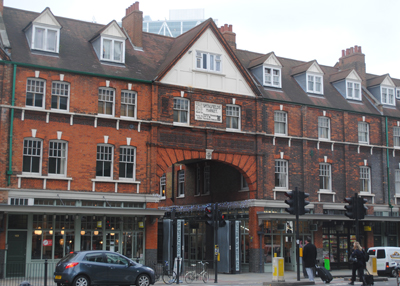
By late in the 19th century, the market had fallen into decline. So, in 1876, a former market porter by the name of Robert Horner decided it needed an upgrade and, buying the lease, had the central market square roofed with glass and new market buildings, known as the Horner Buildings (pictured above), constructed around the northern, eastern and southern sides of the site. Having cost £80,000, it was completed in 1893.

In 1920, the City of London took over control of the market and later than decade expanded the original buildings. Having continued to grow over the ensuing years and with traffic congestion continuing to increase in the surrounding streets, it was decided to move the fresh produce aspect of the market to a new location at Leyton to the north-east.

The new market, known as New Spitalfields Market, covers more than 31 acres and boasts more than 100 traders.

Meanwhile, Old Spitalfields Market, the western end of which was redeveloped in the late 20th century, continues to operate on the original market site – now known as Horner Square, with stalls selling everything from contemporary and vintage fashion to music, gems and jewellery, bric-a-brac and antiques as well as various themed market days – check the website for more details.

Old Spitalfields Market
WHERE: Horner Square, Spitalfields (nearest Tube stations are Shoreditch High Street and Liverpool Street); WHEN: Markets are held every day – times vary so check website for details; COST: Free; WEBSITE: www.oldspitalfieldsmarket.com.
.
New Spitalfields Market
WHERE: 23 Sherrin Road, Leyton (nearest Tube station is Leyton); WHEN: Trading hours midnight to around 9am, Monday to Saturday; COST: Free; WEBSITE: www.cityoflondon.gov.uk/business/wholesale-food-markets/new-spitalfields/Pages/default.aspx.

LondonLife Special – It’s Bonfire Night!…

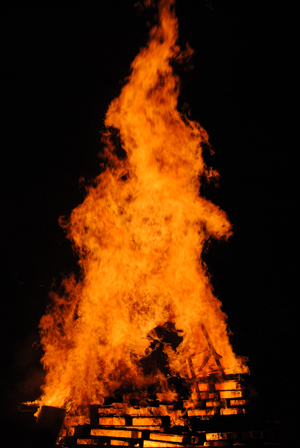
Today marks what was traditionally known as Guy Fawkes Day or, as it’s known more popularly today, Bonfire Night, when, along with people throughout the UK, Londoners celebrate the capture of would be regicide Guy Fawkes and his conspirators, who in 1605 plotted to blow up the House of Lords and with it, King James I, during the State Opening of Parliament.

We’ve previously run a couple of pieces on the conspiracy and some of the key people and places involved – check out our earlier entries here and here.

Meantime, if you’re wanting to attend a celebration in London, Time Out has a terrific guide to all the events taking place – simply head to their page here. Enjoy the night!