Lost London – Greyfriars…

A now long gone Franciscan friary located in the north-west of the City of London near Newgate (just to the north of St Paul’s Cathedral), Greyfriars, so known for the color of the friars’ clothing, was the second Franciscan religious house to have been founded in England.

The foundations of the friary date from the early part of the 13th century – the Franciscans, as members of the Order of Friars Minor were known, had arrived in 1224 and are recorded as settling on land granted to them by a rich mercer, John Iwyn, just inside the City wall, in 1225, in the butcher’s quarter of the city.
King Henry III apparently gave them some oak to build their own friary in 1229 and by the mid 1200s, there were more than 80 friars living on the site which was gradually extended over the ensuing years to the north and the west.

Using funds given them by Sir William Joyner, Lord Mayor of London in 1239, they built a chapel which was later extensively enlarged and improved in the late 13th and early 14th centuries – the new church was said to be 300 feet long – with much of the work funded by Queen Margaret, second wife of King Edward I, and later in the 14th century, Queen Isabella, wife of Edward III. It apparently suffered some damage in a storm in 1343 but was restored by King Edward III.

When it was finally completed in 1348, the church is said to have been the second largest in London. A library was later added to the buildings, founded by the famous Lord Mayor of London, Richard “Dick” Whittington.

Such was the fame of the church that, the heart of Queen Eleanor, wife of King Henry III, was buried here after her death in 1291 while, despite dying at her castle in Marlborough, Queen Margaret was also buried here in 1318 (apparently wearing a Franciscan habit).

But perhaps the most notorious person to be buried here was Queen Isabella, wife of King Edward II and known by many as the “She-Wolf of France”, after her death in 1358. In fact, it’s said that the ghost of Isabella still haunts the former location of Greyfriars, driven forth from the grave for her role in deposing her husband.

Other non royal luminaries said to have been buried here include the 15th century writer Sir Thomas Mallory, author of Le Morte d’Arthur and 16th century Catholic nun Elizabeth Barton, the so-called ‘mad maid of Kent’ who was executed for her rather unwise prophecies predicting King Henry VIII’s death if he married Anne Boleyn.

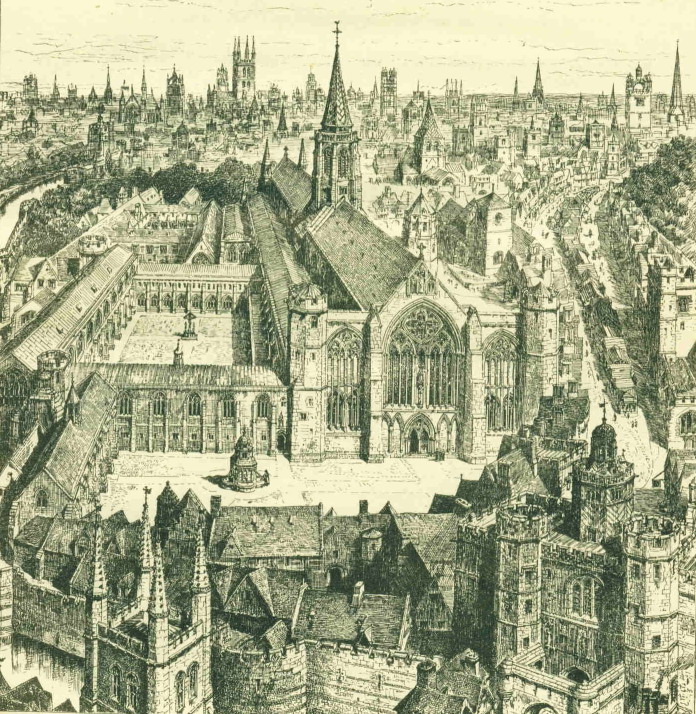
The end of the friary, pictured above in the sixteenth century, came in 1538 when it fell victim to King Henry VIII’s policy of dissolving monasteries and was surrendered to his representatives.

Some of the houses were subsequently converted for private use and the church, which was somewhat damaged during this period with many of the elaborate tombs destroyed, was briefly closed before it and other buildings were given to the City of London Corporation who reopened it again in 1547 as Christ Church Greyfriars, a parish church serving the now joined parishes of St Nicholas Shambles and St Ewen.

Only a few year’s later King Edward IV founded a school for poor orphans in some of the old friary buildings known as Christ’s Hospital or informally as The Bluecoat School thanks to the uniforms students wore. Some of the school buildings, along with part of the church which was also used by the school, was destroyed by the Great Fire of London in 1666, but the school was rebuilt and remained in use until the late 1800s when the last of the students were relocated to a new facility in Sussex (where the school still exists today).

The church (also known as Christ Church Newgate Street), meanwhile, was also rebuilt after the Great Fire – it was one of Sir Christopher Wren’s designs and was completed in 1704. The church remained in use until World War II when a firebomb struck it during a German raid on 29th December, 1940, all but destroying it.

The church was not rebuilt and the parish merged with the nearby St Sepulchre-without-Newgate – the largest parish church in London – and eventually what’s left of the church – the tower with rebuilt steeple and the west and north walls – were converted into a public garden (rose beds were planted where the pews once stood and there are wooden towers representing the church’s pillars). Pictured right, it’s now a terrific place to sit and have lunch pondering the past which the bustle of the city goes on about you.

PICTURE: (top) Wikipedia

For a great biography of Isabella, the She-Wolf of France, see Alison Weir’s Isabella: She-Wolf of France, Queen of England. For more on Sir Christopher Wren’s churches in London, see John Christopher’s Wren’s City of London Churches.

Around London – Naval caricatures; James Bond; a Taliban motorbike; and Sir Peter Lely at the Courtauld…

Naval caricatures of the late 18th and early 19th century go on display in a new exhibition which opens at the National Maritime Museum today. Broadsides! Caricature and the Navy 1756-1815 features a small selection of the museum’s extensive collection of caricatures – one of the largest in the world, it features works by James Gillray, George M Woodward and Thomas Rowlandson. It explores the role the caricatures played in shaping public opinion during the period which included the American War of Independence and wars against revolutionary and Napoleonic France. The exhibition features 20 prints with visitors able to see others in the museum’s collection via the website www.rmg.co.uk/collections. Admission is free. Runs until 3rd February. For more, see www.rmg.co.uk.

Celebrate the 50th anniversary of James Bond and the premiere of the latest film in the franchise, Skyfall, with a look at a rare collection of James Bond posters and other memorabilia as well as the latest Bond vehicle this weekend. The Hospital Club in Covent Garden is hosting the event, in conjunction with Blue Robin, which features about 50 vintage posters from movies such as 1973’s Live And Let Die and 1963’s From Russia With Love. There’s also the chance to have your photo taken beside the double-cab Land Rover Defender which features in the opening chase sequence of Skyfall. Also exhibited will be M’s chauffeur-driven Jaguar XJ long wheel base and the black Range Rover driven by Bill Tanner, M’s chief of staff. The free exhibition is open to the public from 11am to 7pm from tomorrow until Monday (please call reception on 020 7170 9100 before visiting). For more, see www.thehospitalclub.com.

A motorbike captured from Taliban insurgents in Afghanistan by members of the 1st Battalion The Rifles has gone on display at the Imperial War Museum in London. The Honda motorbike forms part of the interactive display, War Story: Serving in Afghanistan, in which visitors can delve into the lives of service personnel taking part in Operation Herrick through personal artefacts, photographs and video. The bike was recovered by soldiers after it was left behind by two insurgents during an encounter on 4th May last year. It is the largest item to be donated through the War Story project and is the only item of enemy equipment acquired by the project to date. The motorbike will be displayed until 18th December. For more, see www.iwm.org.uk.

Now On: Peter Lely: A Lyrical Vision. This newly opened exhibition at the Courtauld Gallery is the first to look at the group of large scale narrative paintings produced by Sir Peter during the turmoil of the Civil War in the 1640s and 1650s. Renowned as the principal painter of King Charles II and the “outstanding artistic figure of Restoration England”, Sir Peter apparently never wished to be seen principally as a portraitist and following his arrival in England in the early 1640s, initially devoted himself to paintings inspired by classical mythology, the Bible and contemporary literature. The exhibition centres on The Courtauld’s own work, The Concert, and features an important group of little known paintings from private collections. Runs until 13th January. Admission charge applies. For more, see www.courtauld.ac.uk/gallery/index.shtml.

10 Historic London Markets – 4. Leadenhall Market…

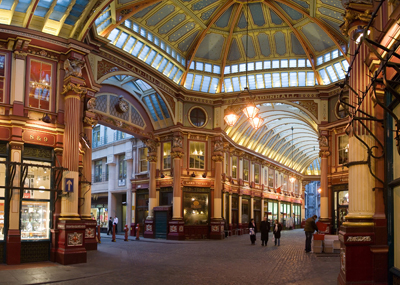
A covered – and splendidly decorated – Victorian-era market located just off Gracechurch Street in the heart of the City of London, Leadenhall Market might go un-noticed by many but visit at lunchtime on a weekday and you’ll to fight for space among the besuited City workers looking for sustenance there.

The history of a market on this site goes back to Roman times for it was under the current market that the remains of Londinium’s basilica and forum – the Roman marketplace – can be found (there’s apparently a part of the basilica wall in the basement of one of the Leadenhall shops).

This fell into disuse following the Roman period, however, and the origins of the current market are generally agreed upon as emerging in the 14th century when it occupied the site of a lead-roofed manor (hence “leaden hall) which was at one stage leased by the famous Lord Mayor Richard “Dick” Whittington before it burnt down in the late 1400s. The subsequent market was initially associated with poultry and then with cheese and other foodstuffs (it remained known for game and poultry) and separate areas were later developed for trade in wool, leather and cutlery.

In 1666, a small section of the market was destroyed in the Great Fire of London but it was rebuilt shortly after – for the first time under cover – and was divided into three sections: the Beef Market, the Green Yard and the Herb Market.

In 1881, after the existing building was demolished, a new structure boasting wrought iron and glass was designed by Sir Horace Jones (architect for the Corporation of the City of London, he also designed Billingsgate and Smithfield Markets – see our earlier entries here and here). The market is now one of the City’s five principal shopping centres and, as well as fresh food and flowers, hosts a variety of specialty shops, restaurants, cafes and pubs.

The Grade II* listed building was extensively restored in 1991. It has since starred in Harry Potter and the Philosopher’s Stone as well as other films including The Imaginarium of Doctor Parnassus and the recent Tinker, Tailor, Soldier, Spy.

Before we finish, we would be remiss not to mention Old Tom. A celebrated gander, he managed to avoid the axe for years and became a favorite of traders and customers (even being fed by local innkeepers) – so much so, that when he died at the age of 38 in 1835, his body lay in state before he was buried on site. There’s a bar in the market named for him.

WHERE: Gracechurch Street, City of London (nearest Tube stations are Monument, Bank and Cannon Street); WHEN: Public areas are generally open 24 hours a day with core trading hours between 10am and 5pm weekdays (check with individual shops for opening hours); COST: Free; WEBSITE: www.leadenhallmarket.co.uk

PICTURE: DAVID ILIFF. Licence CC-BY-SA 3.0. Via Wikipedia.

LondonLife – Flying over the Thames by night…

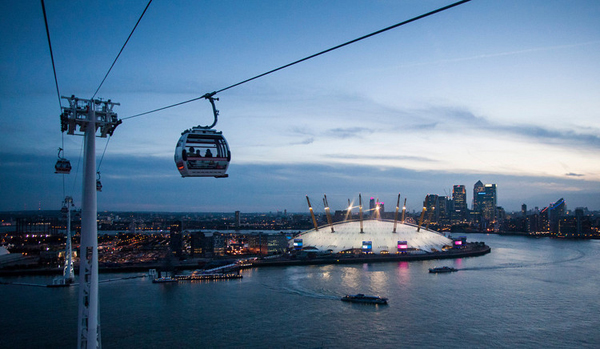
Sailing high over the River Thames between North Greenwich in the river’s southern bank and the Royal Docks on the river’s northern bank is the cable car formally known as the Emirates Air Line. Opened in late June and running every day, the cable car – the UK’s first in an urban area – is operated by Transport for London and links into the Underground and Docklands Light Rail network. Travelling at about 90 metres above the ground along a course of more than half a mile, passengers can take in the City, Docklands, Greenwich and as far eastward down the river as the Thames Barrier. This image, which shows the 02 Arena in the background, was taken just after the Closing Ceremony of the Olympic Games in August. For more, see www.emiratesairline.co.ukPICTURE: © Transport for London

Where’s London’s oldest…bridge over the Thames?

While there’s been a bridge over the River Thames near where London Bridge now stands since Roman times, the bridge which is currently there was built in the early 1970s. To find Greater London’s oldest surviving bridge across the Thames we have to head to Richmond in the city’s west.

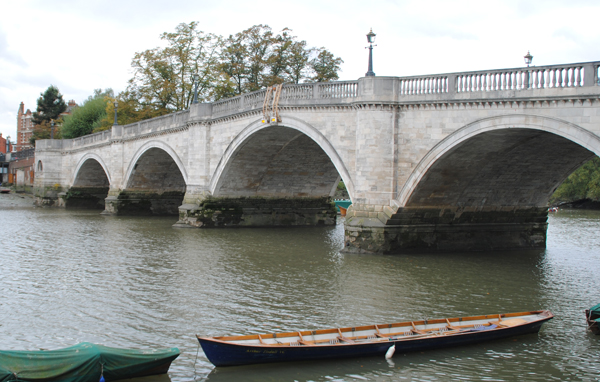
The 300 foot long stone arch bridge, made from Portland stone, was built between 1774-77 and replaced a ferry crossing between Richmond to the east and East Twickenham to the west (this had apparently been in operation since shortly after the Norman Conquest and at the time it was discontinued consisted of two vessels – a passenger craft and a ‘horse boat’).

Designed by James Paine and Kenton Couse and built by Thomas Kerr, the bridge features five arches including a 60 foot wide central span which was big enough for larger watercraft and gave the bridge its rather humpbacked appearance. Its construction was privately funded with the £26,000 required to build the bridge partly raised via tontine schemes under which subscribers paid an agreed sum into a fund after which they each receive an annuity, the value of which increases as members of the fund die off.

Initially a toll bridge (the tolls – which were 1/2d for passengers and up to 2s 6d for coaches drawn by six horses – were ended in 1859 when the last tontine shareholder died), the bridge was widened in the late 1930s but – now a Grade I listed structure – remains essentially true to its original design.

It was the eighth bridge to be built across the the Thames in Greater London but is now the oldest still standing (among those which predated it but have been demolished are London Bridge, Westminster Bridge and Blackfriars Bridge) and has been featured in paintings by the likes of  Thomas Rowlandson, John Constable and JMW Turner.

Where is it?…#47

The latest in the series in which we ask you to identify where in London this picture was taken and what it’s of. If you think you can identify this picture, leave a comment below. We’ll reveal the answer early next week. Good luck!

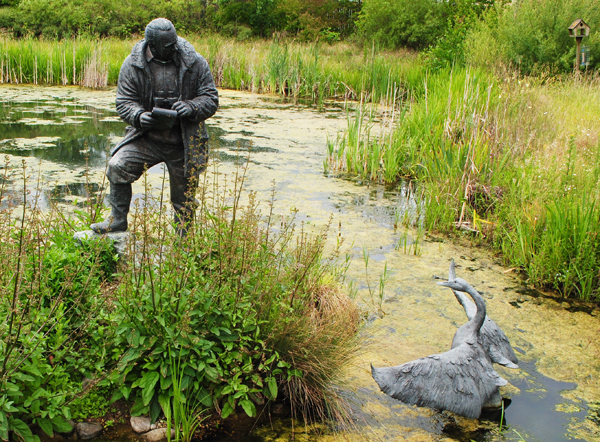
Well done Janet, this is indeed a statue of conservationist Sir Peter Scott (1909-1989) just outside the main entrance of the London Wetland Centre in Barnes in London’s west. A founder of the World Wildlife Fund, Sir Peter – the only child of Antarctic explorer Robert Falcon Scott – also founded the Wildlife & Wetlands Trust which operates a network of wetland centres across the UK including the London Wetland Centre. This 44 acres of recreated wetlands opened in 2000 and is located in a loop of the Thames previously occupied by four Victorian-era reservoirs. The statue of Sir Peter with two Bewick swans is the work of sculptor Nicola Godden and was unveiled by Sir David Attenborough in 2000. For more on the centre, see www.wwt.org.uk/visit/london/.

Treasures of London – Temple Church knight effigies…

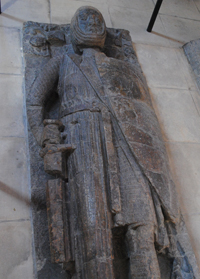
A relic of the early medieval age, the late 12th century Temple Church in the City of London is a marvel in its own right, its circular nave modelled on the Church of the Holy Sepulchre in Jerusalem (for more on its history, see our earlier entry here). But it’s inside the round church – once based inside property that formed the London headquarters of the Templar Knights – that we are concerned with in this piece – for there can be found are series of remarkable effigies of knights which date from the 13th century.

There are nine effigies in all (and one grave cover) and, having survived the Great Fire of 1666, most of them were damaged during World War II when, in a bombing raid on 10th May, 1941, the roof was set alight and came crashing down on top of them. They have since been repaired, using as much of the original material as possible, and still make an imposing sight redolent with the history they depict.

Pre-eminent (at least in his lifetime) among those depicted is William Marshal, the 1st Earl of Pembroke (1146 -1219) and an advisor of kings including King Henry II, King Richard ‘the Lionheart’ and King John who was named Regent during the infancy of King Henry III.

One of the most influential men of his age (described by early thirteenth century Archbishop of Canterbury, Stephen Langton, as the “greatest knight who ever lived”), he lies in the southern group of effigies near his sons William, 2nd Earl of Pembroke (1190-1231) and Gilbert, the 4th Earl of Pembroke (1194-1241). (The 3rd Earl of Pembroke, Richard, was the second son of William – he died after being captured during fighting in Ireland and was buried in Kilkenny). Another of this group is believed t0 depict Robert, Lord de Ros, one of the 25 barons to guarantee the observance of the Magna Carta, signed by King John in 1215.

The only identified effigy in the northern group is that of Geoffrey de Mandeville, the 1st Earl of Essex and a man known for the cruelties he inflicted during the troubled reign of King Stephen (he shifted his allegiances between King Stephen and his rival, the Empress Matilda several times), particularly in the eastern counties where he seized Ramsey Abbey near Peterborough to use as his base.

Interestingly, none of the men named was a Templar but are believed to have been benefactors of the Templar Knights. Some of those shown are cross-legged but whether this denotes a crusader or not remains a matter of debate.

WHERE: Off Fleet Street and down Inner Temple Lane (nearest tube station is Temple); WHEN: Check website for times; COST: £4 (free to under 18s, seniors); WEBSITE: www.templechurch.com.

Around London – Resurrection men at the MoL; Hollywood costumes at the V&A; Hanwell locks “at risk”; and, David Nash sculptures at Kew…

• A new exhibition at the Museum of London opens tomorrow (Friday) looking at the “murky world” of the early 19th century ‘resurrection men’ and the surgeon/anatomist whom they supplied with bodies. Doctors, Dissection and Resurrection Men will centre around the 2006 excavation of a until then forgotten burial ground at the Royal London Hospital in Whitechapel. The excavation of the area – which was used between 1825-41 – uncovered some 262 burials and while many contained just one person, others contained a mix of bones providing ample evidence of dissections, autopsies, amputations and the wiring together of bones for teaching as well as evidence animals had been dissected for comparative studies. The excavation revealed that rather than rely on body snatchers, the hospital had used its own ‘unclaimed’ patients for dissection practice. As well as human remains from the find (displayed for the first time), exhibition highlights include various instruments used in early 19th century surgery, a plaster cast of James Legg who was hanged for murder before his body was flayed and cast in plaster for study purposes and a wooden skeleton and other detailed anatomical models made by Joseph Browne. The exhibition runs until 14th April. An admission charge applies. For more details – including the programme of talks taking place alongside the exhibition – see www.museumoflondon.org.uk.

• The three piece white suit worn by John Travolta in Saturday Night Fever, the blue and white gingham pinafore dress worn by Judy Garland in The Wizard of Oz and costumes worn by Meryl Streep in the recent film, The Iron Lady,  are all making their public appearance in London this weekend with the V&A’s major autumn exhibition. Opening on Saturday, Hollywood Costume features more than 100 iconic costumes designed for some of the big screen’s most unforgettable characters. A three gallery (or three ‘act’) journey covering the silent film era of Charlie Chaplin through to a look at motion capture costume design in Avatar, the exhibition explores the role costume design plays in cinematic storytelling and examine the changing social and technological context in which designers worked over the past century. Sourced from major motion picture studios, costume houses, museums, archives and private collections, the costumes will be  displayed alongside interviews with costume designers, actors and directors. Runs until 27th January. Admission charge applies. For more, see www.vam.ac.uk/hollywoodcostume.

A flight of locks which raise the Grand Union Canal 53 feet over the course of a third of a mile at Hanwell in west London is among the top Grade II heritage sites at risk in England, according to English Heritage. The organisation released its Heritage At Risk Register 2012 this week and announced a new program to examine how Grade II listed buildings not already covered by the register can be assessed. Other “at risk” sites in London include Kensal Green (All Souls) Cemetery – one of London’s “magnificent seven” Victoria cemeteries, Abney Park Cemetery in Hackney, Gunnersbury Park in Houslow and 94 Piccadilly (Cambridge House) in Westminster. For more, see www.english-heritage.org.uk/caring/heritage-at-risk/.

• On Now: David Nash at Kew: A Natural Gallery. New works by renowned sculptor David Nash were officially unveiled at Kew Gardens last weekend. Mostly created using Kew trees which have come to the end of their life whether through storms, lightning or disease, the series of sculptures – created on site since April in a ‘wood quarry’ in the arboretum – has been installed in gallery spaces across the gardens including The Nash Conservatory, the Temperate House and The Shirley Sherwood Gallery of Botanical Art. They are displayed along with a series of drawings and short films. Runs until 14th April. An admission charge applies. See www.kew.org.

10 Historic London Markets – 3. Billingsgate Market…

Now the UK’s largest inland fish market (and located in Poplar, east London), the history of Billingsgate Market goes back centuries.

Known originally by various spellings including Blynesgate and Byllynsgate, Billingsgate may have been named for watergate on the north bank of the Thames near where the market was originally established (an alternate theory is that it was named for a man named Biling or an mythological British king, Belin).

The right to collect tolls and customs at Billingsgate, along with Cheap and Smithfield, was granted by King Henry IV in 1400.

Billingsgate only became particularly associated with fish in the 1500s and in 1699, an Act of Parliament was passed making it “a free and open market for all sorts of fish whatsoever” (this was with the exception of eels, restricted to being sold by Dutchmen from boats in the river – a reward for the help they provided after the Great Fire of 1666).

While for much of the market’s history, fish was sold for stalls and sheds around the ‘hythe’ or dock at the site known as Billingsgate, in 1850 the first purpose-built market building was constructed in Lower Thames Street.

Deemed inadequate for the task at hand, however, it was demolished after slightly more than 20 years of service. A new building, designed by then City Architect Sir Horace Jones and constructed by John Mowlem, was opened in on the same site in 1876. In the late 19th century, it is said to have been the largest fish market in the world. The heritage listed former fish market building in Lower Thames Street (pictured above) is now used as a venue for corporate events, catwalk shows, post premiere parties and concerts (see the website for more www.oldbillingsgate.co.uk).

In 1982, the market was relocated to a 13 acre site on the Isle of Dogs, just to the north-east of Canary Wharf. The building contains a trading floor with some 98 stands and 30 shops as well as an 800 tonne freezer store. An average of 25,000 tonnes of fish and fish products are sold through its merchants every year and the market has an annual turnover of around £200 million.

The role of the fish porter – who traditionally have been the only people licensed to move fish around the market – was opened up to anyone following a fiercely fought battle between the porters, traders and the City of London Corporation earlier this year.

The market is open to the general public and tours can be arranged – head to the website for details.

WHERE: Billingsgate Market, Trafalgar Way, Poplar (nearest Tube Station is Canary Wharf); WHEN: 4am to 9.30am Tuesday to Saturday (children under 12 are not permitted on the market floor and non-slip shoes are advisable); COST: Free; WEBSITE: www.cityoflondon.gov.uk/business/wholesale-food-markets/billingsgate/Pages/default.aspx.

LondonLife – Canary Wharf skyline…


Skyline of Canary Wharf, Docklands, east London. Taken from a ferry on the Thames. Canary Wharf is one of the city’s main financial districts and is centred around One Canada Square (pictured with the pyramidal top), formerly the tallest building in the UK (it has been surpassed by The Shard).

Famous Londoners – John Wesley…

Credited as the founder, along with his brother, of Methodism, it was in London that John Wesley experienced the spiritual awakening that would change his life and lead to the establishment of a new religious movement.

Born on 17th June, 1720, in Epworth, not far from Lincoln, Wesley was the 15th of 19 children born to Samuel Wesley – the rector there – and his wife Susanna. Rescued from a fire in the family rectory at a young age, the event was to have a lasting impression on him leading to his later view that he was set apart for a special purpose – “a brand plucked from the burning”.

Wesley was educated at London’s Charterhouse School and then at Christchurch College in Oxford. Ordained a priest in the Church of England in 1728, he spent two years serving as his father’s curate before returning to Oxford in 1729.

It was there he formed the ‘Holy Club’ with his brother Charles and fellow students including George Whitfield. It’s here that the name ‘Methodist’ was first used as a pejorative term to describe members of the group thanks to their ‘methodical’ way of living – which included religious practises like fasting as well as caring for the ill and prisoners – and which was later adopted by Wesley himself.

Following a largely unsuccessful sojourn in the newly founded American Province of Georgia with his brother Charles (they had been invited by the colony’s first governor, James Oglethorpe, to minister to the new settlers) during which Wesley was involved in a courtship that ended badly, the clergyman fled back to England.

It was in London, on 24th May, 1738, that the clergyman then had his “Aldersgate experience” in which he felt his heart “strangely warmed” while at a religious meeting in Aldersgate Street (there’s a monument – the Aldersgate Flame – to this next to the Museum of London).

Initially influenced by the Moravians (Wesley even visited one of their communities in Germany), he later developed some concerns about some aspects of their teachings and so began forming his own followers into what would become the Methodist Society. Despite considerable opposite from the Church of England (Wesley was still an ordained Anglican minister), the new Methodists continued to work among the poor of London and elsewhere in England.

Barred from many Church of England pulpits thanks to his views on everything from salvation to the role ordinary people could play in the church, Wesley began preaching to large masses in the open air – ‘field preaching’ – as he travelled extensively about the country. He is said to have preached as many as 40,000 sermons and travelled some 250,000 miles during his ministry and campaigned on many social issues – including prison reform and the abolition of slavery – while his brother Charles is credited with writing thousands of hymns.

The first Methodist chapels in the UK were opened in the late 1770s – while the first was in Bristol, the second was opened in City Road, London, in 1778. It is still in use today – you can visit it, the Museum of Methodism (housed in the chapel crypt), and the house where Wesley lived the last 12 years of his life – follow this link for more details. The statue pictured above stands outside.

While he did not ordain ministers in England and throughout his lifetime continued to consider himself an Anglican, in an act which helped lead to the creation of an independent Methodist Church (formally created after his death), in 1784 Wesley ordained ministers to head to the newly independent United States of America after the Anglican Church failed to do so.

John Wesley died on 2nd March, 1791, at the age of 87, in his house. He was entombed at the London chapel.

While at the time of his death, it’s estimated that there were 135,000 members and more than 500 itinerant preachers working under the name  of “Methodist”, Wesley’s legacy was to become far greater as his ideas spread across the globe. It’s now estimated that there are around 70 million Methodists around the world.

Other monuments commemorating Wesley in London include Methodist Central Hall in Westminster – located opposite Westminster Abbey – which was built in the early Twentieth century to mark the centenary of Wesley’s death and a statue of Wesley on St Paul’s Churchyard, erected in 1988.

There’s a terrific walking guide published by the Methodist Church which links sites of relevance to Wesley’s life in London. You can download it here.

Where is it?…#46

The latest in the series in which we ask you to identify where in London this picture was taken and what it’s of. If you think you can identify this picture, leave a comment below. We’ll reveal the answer early next week. Good luck!

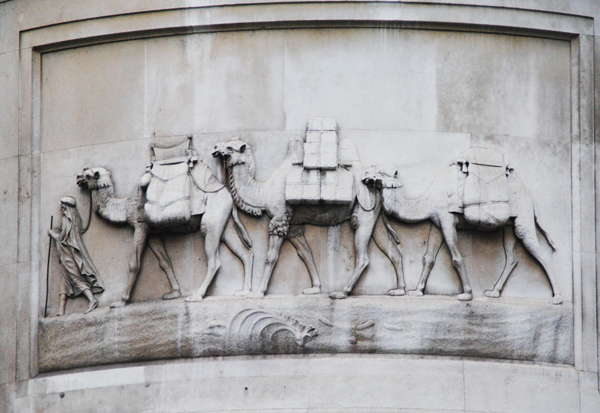
Well done to Carol Stanley – this is indeed located at 20 Eastcheap in the City of London. The building on the facade of which this relief of a camel train sits was formerly the offices of Peek Bros & Co, dealers in tea, coffee and spices. Peek House was built in 1883 after the previous structure, along with others on this side of Eastcheap, was demolished to make way for the Underground’s Metropolitan Line. The picture was carved by William Theed the Younger, who also sculpted the Africa group – including camel – on the Albert Memorial.

Daytripper – Avebury…

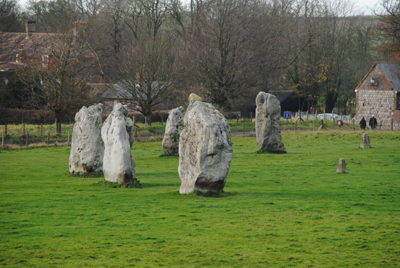
One of Britain’s most significant pre-historic sites, the small village of Avebury in Wiltshire – to the west of London –  sits in the midst of a stunning series of standing stones, the remains of three vast stone circles built around 2,600 BC.

A World Heritage Site, the vast outer circle of stones – which contains two smaller circles of stones and other associated stones – is around 3/4 of a mile in circumference and about 1,115 feet across the middle. It stands inside a three to four metre deep ditch which despite, the millenniums of weathering, still looks impressive to the eye.

It remains a matter of speculation what the purpose of the ditch and the standing stones was, although some have suggested there was a religious purpose in their creation.

The stone circle (pictured) is now managed by the National Trust – see their website for opening times.

Stretching away to the south-east and south-west from the stone circle are two great “avenues” of pairs of stones, known as the West Kennet and Beckhampton Avenues – perhaps the last of what were originally four avenues. West Kennet is by far the best preserved of the two.

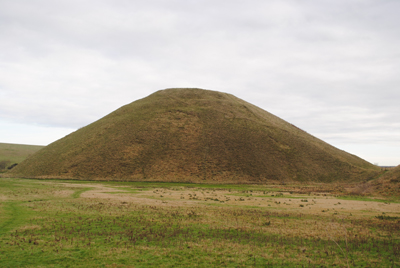
It’s worth having a car for there are several other Neolithic sites nearby including the stunning Silbury Hill (pictured below), located almost directly south of Avebury. At around 37 metres high it is the largest prehistoric mound in Europe (while you can’t access the site of the hill itself, you can get some stunning views from a carpark). Work on the hill is said to have started at about 2,400 BC but its not known conclusively when it was finished.

Further to the south (1.2 miles from Avebury village) is the West Kennet Long Barrow, one of the longest burial mounds in Britain. Dating from about 3,700 BC, remains of 36 people were placed in here soon after it was first built. The barrow is open for inspection. To the east stands The Sanctuary, once site of a double stone circle.

Back to Avebury village – which was originally founded in Anglo-Saxon times (a Romano-British settlement had stood further to the south) – and here, as well as exploring the stone circles, it’s worth taking the time to visit Avebury Manor.

The manor is the former home of Alexander Keiller, who was responsible for much of the excavation work that took place here in the early 20th century as well as the re-erection of many of the stones, and is also said to have once hosted Queen Anne for a meal. Now a National Trust property, it recently starred in the BBC series, The Manor Reborn. Check the National Trust website for opening times – an admission charge applies.

There’s also a museum, the Alexander-Keiller Museum, which was established by the man himself  in 1938 in the manor’s old stable to display some of his finds (it now also includes the threshing barn), and a cafe and National Trust shop.

While it is possible to reach Avebury by public transport, a car can be a good idea to get around to the various sites – particularly if under time constraints.

Around London – Harry Hammond at the V&A; a cabaret star’s blue plaque; and Kerouac at the British Library…

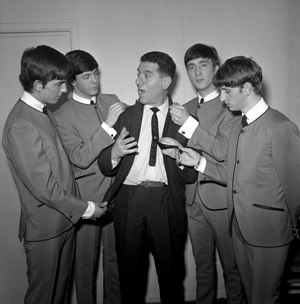
• A new exhibition of the works of renowned music photographer Harry Hammond opens at the V&A this Saturday. Halfway to Paradise: The Birth of British Rock features more than 60 portraits, behind the scenes and performance shots showing stars including Roy Orbison, Ella Fitzgerald, Cliff Richard and Shirley Bassey. Hammond’s pictures, which are all drawn from the V&A collection, chronicle the jazz and big band musicians of the 1950s like Frank Sinatra and Billie Holiday, visits from American rock ‘n roll stars such as Little Richard and Gene Vincent and early British rock groups – such as the Animals and the Beatles (pictured with Dougie Millings) – of the 1960s. There will also be behind the scenes shots of some of the early days of music television in the 1950s and the exhibition will be accompanied by a soundtrack by the artists depicted. Born in the East End, Hammond was a society portrait photographer before serving as a reconnaissance photographer with the RAF in World War II. It was on his return to London after the war that he started photographing people working in the music business, later becoming one of the primary photographers for the New Musical Express (NME) magazine. Runs until 3rd March next year. Admission is free. For more, see www.vam.ac.uk. PICTURE: V&A Images.

• Still on a musical theme and 1930s cabaret star Leslie Hutchinson (1900 – 1969) has been honored with an English Heritage Blue Plaque at his former home in Chalk Farm. The singer and pianist, better known to many as simply ‘Hutch’, lived at 31 Steele’s Road between 1929 and 1967. The Grenada-born performer lived in New York and Paris before coming to London where he became one of the most popular cabaret performers of the 1930s – one of his signatures was apparently to arrive at nightclubs dressed like an aristocrat with a white piano strapped to his chauffeur-driven car (this was despite the racial prejudice he faced which saw him being asked to enter by the servant’s quarters when performing at some of Mayfair’s grandest homes). Hutch lived at the Steele’s Road property for almost all the years he lived in London, only leaving two years before his death in 1969. The plaque was unveiled by his daughter, Gabrielle Markes, who only discovered her parentage in middle age and who subsequently proposed that the plaque be placed on the house. For more, see www.english-heritage.org.uk.

On Now: On the Road: Jack Kerouac’s Manuscript Scroll. This new exhibition at the British Library centres on Kerouac’s 120-foot-long manuscript scroll of On the Road and explores the development of the novel which, written over a period of three weeks in April 1951 using rolls of taped together architect’s paper, came to define the Beat Generation. The exhibition, which relaunches the Library’s Folio Society Gallery, will show the first 50 feet of the scroll in a specially-designed case. Other exhibits include first editions of other Beat classics such as The Naked Lunch and sound recordings featuring the likes of Kerouac, Allen Ginsberg and William S. Burroughs. Runs until 27th December. Admission is free. For more, see www.bl.uk.

10 Historic London Markets – 2. Smithfield Market…

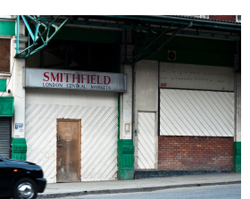
Now the largest wholesale meat market in the UK and one of the biggest in Europe, the connections between the site of Smithfield Market, officially known as the London Central Markets, and livestock go back to at least 800 years.

Since the 12th century animals were routinely traded here thanks to the site’s position on what was then the northern edge of the city. Smithfield was also known for being an area for jousting and tournaments and was the location of the (in)famous St Barthlomew Fair (this closed in 1855) as well as an execution ground – among those executed here were Wat Tyler, leader of the Peasant’s Revolt, and ‘Braveheart’, Sir William Wallace (1305).

Skip ahead several hundred years and, by the the mid-1800s, traffic congestion led to the livestock trade being relocated to a new site north of Islington. Plans were soon launched to locate a cut meat market on the Smithfield site.

Following the passing of an Act of Parliament, work on the new market began in 1866 with Sir Horace Jones (he of Tower Bridge fame), the City Architect, overseeing the design. Constructed of ornamental cast iron, stone, Welsh slate and glass, the initial market buildings were completed in 1868 with the result being two vast buildings, separated by a grand central avenue, but linked under a single roof. The new market was opened amid much pomp by the Lord Mayor of London on 24th November, 1868.

Four further buildings were soon added – only one, the Poultry Market, which opened in 1875, is still in use – and in the 1870s the market began to see the arrival of frozen meat imported from as far afield as Australia and South America.

Closed briefly during World War II – when the site was used for storage and an army butcher’s school – it reopened afterwards. The main poultry building was destroyed in a fire in 1958 and a replacement featuring a domed roof – the largest clear spanning dome roof in Europe at the time – was completed by 1963.

More recently, the market underwent a major upgrade in the 1990s. Queen Elizabeth II opened the refurbished East Market Building in June, 1997.

WHERE: London Central Markets, Charterhouse Street and West Smithfield (nearest Tube Stations are Barbican, St Paul’s and Moorgate); WHEN: From 3am Monday to Friday (visitors are told to arrive by 7am to see the market in full swing) (There are walking tours available – see www.cityoflondontouristguides.com for details); COST: Free entry; WEBSITE: www.smithfieldmarket.com.

PICTURE: Rossella De Berti/www.istockphoto.com

LondonLife – Bronze Age finds at Crossrail site…

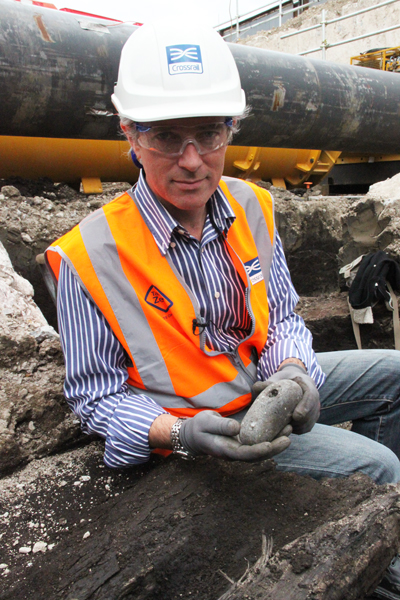
Crossrail’s lead archaeologist Jay Carver holding a hammer stone which is among the first Bronze Age finds uncovered during the £14.8 billion rail project.

The discoveries, uncovered at the Plumstead tunnel entrance site in East London (not far from Belmarsh Prison), also included two wooden stakes that may have been cut by early hunters with an axe and which  may have been used in the building of a timber path, part of a network which allowed hunters to access wetland areas about 3,500 years ago.

“Although we haven’t identified an actual track way yet, the timbers are similar to those used to make the track ways and certainly show that people were in the area exploiting the woodland,” says Mr Carver. “This is a promising find as we continue our search for evidence of a Bronze Age transport route along where London’s newest railway will run.”

Previous objects found at Crossrail project sites include human bones from the medieval period, a find of rare amber and a piece from a mammoth’s jaw bone.

The latest finds, which are now being examined by Museum of London Archaeology, were made as a month long exhibition opens at Crossrail’s Tottenham Court Road Visitor Information Centre (16-18 St Giles High Street), displaying previous objects found during the project.

Meanwhile, as part of the exhibition, Mr Carver will also host a Q&A session on Twitter (#BisontoBedlam) today between 2pm and 9pm during which he will answer questions on Crossrail’s archaeology programme and the exhibition.

Crossrail, Europe’s largest construction project, will see the construction of a new rail link running along a 73 mile route across the city.

For more on Crossrail, see www.crossrail.co.ukPICTURE: Courtesy of Crossrail.

What’s in a name?…Cannon Street

One of the major thoroughfares of the City of London, Cannon Street’s name has nothing at all to do with artillery or religion. In fact, the street, which runs from St Paul’s Churchyard in the west to Eastcheap in the east, owes its name to the industry that once took place there.

Like many other streets in the City connected with the occupations of past residents, Cannon Street is a corruption of a street formerly known as Candelwichstrete (one of many various spellings of which the modern English version is Candlewick Street) which relates to the candlemakers and wax chandlers who lived and conducted their trade along the street in the Middle Ages (the Tallow Chandlers Company, involved in regulating candle-making, has been located in adjoining Dowgate Hill since 1476, although the current building dates from 1672).

The name was gradually corrupted into Cannon Street (apparently the corruption was at least partly due to its pronunciation in the Cockney dialect), which is what it was known as by the late 17th century when the seemingly ever-present Samuel Pepys was writing his diary.

Cannon Street – which was only extended to its current length in the mid-1800s under the supervision of architect JP Bunning, having formerly been a narrow lane which stopped at Dowgate Hill in the east – apparently later become known for the number of drapers based there and was also home to the Steelyard or Stalhof, the trading base of the German Hanseatic League in London in the 13th and 14th centuries (a plaque commemorating this was erected at Cannon Street Station in 2005).

Now lined with office buildings including some former warehouses from the Victorian era, the street is also home to a recently redeveloped above ground train station and Underground station- both of which were opened in the late 1800s (the station, which built was on the site of the Roman governor’s palace, was originally located behind the Cannon Street Hotel, birthplace of the British Communist Party). Cannon Street is also the location of the mysterious London Stone – formerly located at the now long-gone St Swithin’s Church, it can be found behind a grill at number 111 – for more on it, see our earlier post here).

London Pub Signs – The Lord Raglan…

Originally known as The Bush,  The Lord Raglan pub just to the north of St Paul’s was renamed in the mid 1800s to commemorate one of the heroes of the Battle of Waterloo – the 1st Baron Raglan (1788-1855).

Named the 1st Baron Raglan in 1852, the man previously known as Lord FitzRoy Somerset had lost his right arm at the Battle of Waterloo, fought between the Duke of Wellington and Napoleon on 18th June, 1815, in modern-day Belgium.

His name was subsequently adopted to to describe the ‘Raglan Sleeve’, a type of sleeve which extends as a single piece to the collar and a style which Lord Raglan was said to have favored after his arm was amputated.

Lord Raglan died in 1855 while Commander-in-Chief at the Crimean War. There is a blue plaque commemorating his role in this war on his former house in Stanhope Gate in Mayfair.

The site of the Lord Raglan tavern, 61 St Martin’s Le Grand, is said to be one of the oldest tavern sites in the city, originally dating from about 1779, and while the current building dates from 1855, the cellars are said to be much older and are said to incorporate parts of what was the Roman wall.

For more on the Lord Raglan, see the Taylor Walker website at www.taylor-walker.co.uk/pub/lord-raglan-st-pauls/c1779/.

Where is it?…#45


The latest in the series in which we ask you to identify where in London this picture was taken and what it’s of. If you think you can identify this picture, leave a comment below. We’ll reveal the answer early next week. Good luck!

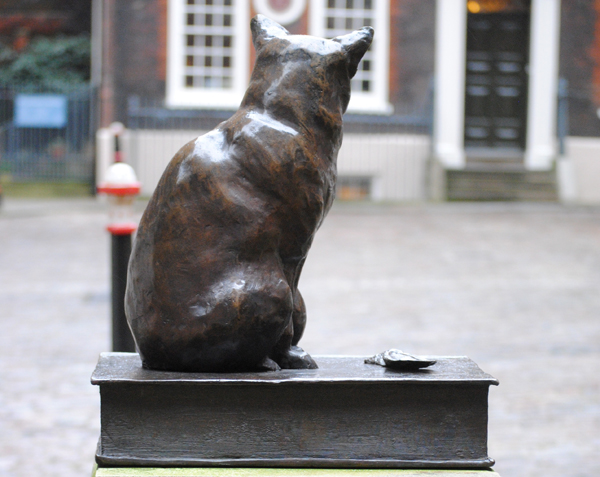
Congrats to Mike, Debbie, Janet, and Zoe (on Facebook), this is indeed the back of the statue of Hodge the cat in Gough Square in the City of London, just outside Dr Johnson’s House at No 17. One of the cats of the famed lexicographer, Dr Samuel Johnson, Hodge had his own moment of stardom in James Boswell’s Life of Johnson in which Dr Johnson is heard remarking that he’s had better cats than Hodge before, apparently in response to Hodge’s reaction, stating that he was “a very fine; a very fine cat indeed” (Johnson was apparently unusual for his love of cats; Boswell did not suffer the same love). This bronze statue of Hodge, by sculptor Jon Bickley and placed here in 1997, has Hodge sitting on a copy of Dr Johnson’s famous dictionary and beside him is some empty oyster shells, referring to Dr Johnson’s habit of buying oysters for his cats to eat. For more on Dr Johnson’s House (where Dr Johnson lived from 1747-59), see www.drjohnsonshouse.org.

Treasures of London – The Becket Casket…

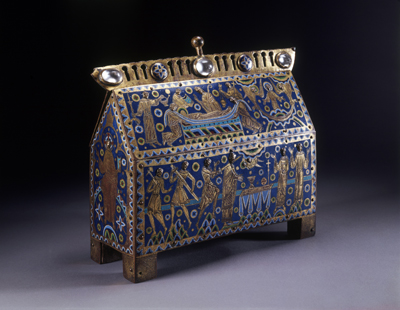
This stunning early medieval casket, dating from around 1180-1190, commemorates one of the most infamous events of the Angevin era – the death of Thomas Becket, Archbishop of Canterbury, who was murdered in Canterbury Cathedral on 29th December, 1170, by four knights of King Henry II.

The murder – for which the king undertook public penance (although whether he ordered the death of Becket, his former chancellor and friend, remains a matter of some dispute) – provoked outrage across Europe and pilgrims soon started flocking to Becket’s tomb.

So much so that the Archbishop was canonised in 1173 and in 1220 a richly decorated shrine was created to house Becket’s remains and serve as a focal point for pilgrims (a pilgrimage to Becket’s shrine is at the heart of Geoffrey Chaucer’s A Canterbury Tale). The shrine was eventually destroyed in 1538 on the orders of King Henry VIII during the Dissolution of the Monasteries.

The beautiful Becket Casket, made of Limoges enamel, depicts, among other things, Becket’s murder, subsequent burial and the ascension of his soul to heaven. On the rear are four long-haired figures who may represent saints or the Cardinal Virtues of Prudence, Justice, Fortitude and Temperance.

One of more than 40 examples still in existence (the British Museum also has one), it was probably made for an important religious house and may have been used to contain relics of the dead saint.

It can now be found in the collection of the V&A’s Medieval and Renaissance Gallery at the museum’s premises in South Kensington.

WHERE: Room 8 (case 20), Victoria & Albert Museum, Cromwell Road, South Kensington (nearest Tube Stations are South Kensington and Knightsbridge). WHEN: 10am to 5.45pm daily (Fridays until 10pm – select galleries after 6pm)COST: Free; WEBSITE: www.vam.ac.uk.

For more on Thomas Becket, see John Guy’s book Thomas Becket: Warrior, Priest, Rebel, Victim: A 900-Year-Old Story Retold.

PICTURE: V&A images