Daytripper – Rye

This beautifully preserved medieval town on the East Sussex coast is really worth more than a daytrip – it’s a terrific place to spend a weekend! 
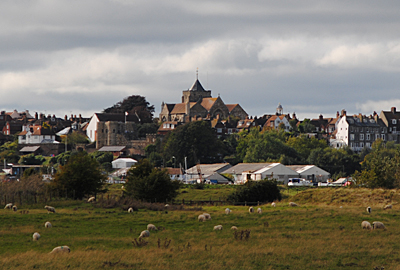
The history of this fortified township – which was once on the coast but now sits some two miles back from open water thanks to the silting up of the harbour – stretches back to at least Saxon times.

But it was in the Middle Ages that, thanks to its position relative to France, it flourished as a port and was eventually given the distinction of being a member of the Cinque Ports Federation (the federation originally included the ports of Hastings, New Romney, Hythe, Dover and Sandwich and was later expanded to include Rye and Winchelsea).

However, the proximity to France also meant the town had an interesting relationship with the French who conducted repeated raids including in 1339 when 52 houses and a mill were burned, and in 1377 when the town was almost completely burnt to the ground and the invaders made off with the bells of St Mary’s Church (dating from 1150, the church is certainly well worth a visit, particularly for the stunning views from the bell tower roof).
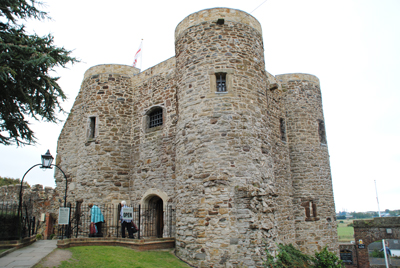
Key surviving fortifications including the 14th century The Ypres Tower (originally called Baddings Tower, this 40 foot high structure – pictured right – with three round towers is now home to half the Rye Castle Museum – the other half being in East Street) and Landgate (this was built as part of a series of walls and gates constructed after the devastating 1377 raid) were built to counter this threat and when the French raided again in 1449, they were successfully resisted.

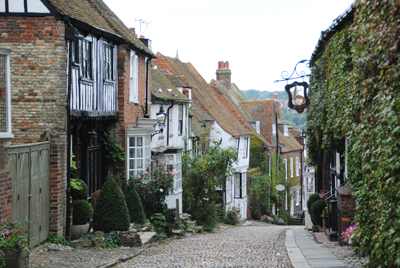
Rye’s location – it now sits at the confluence of the Rother, Tillingham and Brede Rivers – also meant that since its earliest days, it was popular with smugglers despite government efforts to stop them (they did eventually succeed in the early 19th century thanks to customs law reforms and the establishment of a national coastguard service). Among the most famous to frequent the town was the Hawkhurst Gang, who used the Mermaid Inn in the beautiful cobbled Mermaid Street (pictured, below) as one of their bases in the area in the early 18th century (the gang was eventually captured and executed in 1749). The inn apparently may date back as far as the 12th century and has a fascinating history.
Aside from the many Tudor and Georgian homes, notable buildings include the Old Grammar School in High Street (founded in 1636), the Town Hall in Lion Street (1742) and the red brick fronted Lamb House in West Street – once home to authors Henry James and EF Benson and now owned by the National Trust. There’s also a model of the town (complete with sound and light show which gives a great overview of the town’s history) at the Rye Heritage Centre located in an old sail loft on Rye Strand Quay – a good place to visit for information and details of walks and tour options.

Not far from Rye can be seen Camber Castle, a round artillery fort (essentially a glorified gun platform) built by King Henry VIII. It’s now managed by English Heritage and can be visited on tours.

Rye is located about an hour’s journey by car from the M25 and can be reached by train from Charing Cross, London Bridge or Waterloo East or from St Pancras (via Ashford International).
Around London – Liberty Festival’s 10th; teddy bears at Royal Parks; Cosmati pavement on the web; and animal crackers at Cartoon Museum…

• This weekend London host’s the 10th Liberty Festival, a showcase of deaf and disabled artists. Free events – including live music, dance, street theatre, film and cabaret – are being held at several locations across the city over Saturday, Sunday and Monday, including in Trafalgar Square, the National Theatre, South Bank Centre, BFI Southbank and Picture, the Mayor of London’s Live Site at Potters Fields Park next to City Hall on the south bank of The Thames. Highlights of the event – a centrepiece of the Paralympic celebrations – include a “cabaret showcase of comedy, film and music” at Royal Festival Hall on Saturday, and a “jazz, blues and R&B spectacular” at BT London Live Trafalgar Square on Sunday. This year’s event, produced by the Mayor of London with Greenwich+Docklands Festivals, coincides with Unlimited, the London 2012 Festival’s showcase of disabled artists. For more details, see www.molpresents.com/liberty. For more on BT London Live Trafalgar Square, see www.btlondonlive.com.

• If you go down the woods (read Royal Parks) today…you will find a Teddy Bear’s picnic! Royal Parks is inviting children up to the age of 12 to attend three Teddy Bear’s picnics it’s holding in Richmond Park and Bushy Park this week. While one event has already gone (it was held yesterday), there’s still two to go – one at the Kingston Gate Playground in Richmond Park from 11.30am to 3.30pm today, and another at the Bushy Park Playground between 11.30am and 3.30pm tomorrow (Friday). Both afternoons feature free craft activities, games and a “best dressed ted” competition. For more, see www.royalparks.org.uk.

Tragedy on the Thames: Princess Alice Disaster. This talk at the London Metropolitan Archives looks at an event which took place on 3rd September, 1878 when a day trip to Rosherville Pleasure Gardens in Gravesend turned to tragedy with more than 650 people dead after a collision on the Thames. The talk will discuss the coroner’s inquests and witness accounts before looking at some original documents held at the LMA. The free event is held on Monday from 2pm to 3pm. Booking essential (020 7332 3851). For more on the LMA, follow this link.

Westminster Abbey has unveiled a new website showing how the spectacular Cosmati pavement was brought back to life in a two year restoration project. The 13th century floor mosaic, which covers the floor in front of the High Altar, was hidden under carpets for more than 100 years before the restoration work was carried out. The new website features more than 40 films showing all elements of the restoration and interviews with experts about the pavement as well as an interactive map of the pavement. For more, see www.westminster-abbey.org/conservation. You can also see our Treasures of London article on the pavement here.

• On Now: Animal Crackers – A Cartoon and Comic Bestiary. This exhibition at the Cartoon Museum in Bloomsbury features characters including Mickey Mouse, Wallace and Gromit, Fred Basset and Rupert Bear as well as icons like the American Eagle, Russian Bear and financial Fat Cat and joke cartoons from publications including Punch, Private Eye, The Spectator and many national newspapers. More than 140 cartoons, caricatures, comics and graphic novels, created by more than 60 artists, are included in the display. Runs until 21st October. Admission charge applies. For more, see www.cartoonmuseum.org.

10 Historic Sporting Events in London – 8. The first London Marathon…

Now one of the world’s largest long distance running events, the first London Marathon was held on 29th March, 1981, and saw some 6,255 people lead across the finish line by American Dick Beardsley and Norwegian Inge Simonsen, who finished in a dead heat. The first woman to finish was the UK’s Joyce Smith.

The idea of holding such an event in London arose after John Disley and the late Chris Brasher (a former Olympian), both members of Richmond’s Raneleigh Harriers running club, decided to enter the New York Marathon in 1979. Returning to London exhilarated by their experience, they began investigating the possibly of holding such an event here and, meeting with a positive response from authorities, pushed ahead with it.

About 20,000 people applied to enter the first London Marathon but only 7,747 people were accepted to run. The course, which is still roughly the same, starts at various locations in Blackheath and passes through Charlton, Woolwich and Greenwich before crossing the Thames at Tower Bridge, looping around through the East End and Docklands before following the river into Westminster.

While the first race finished at Constitution Hill, between Green Park and Buckingham Palace, the race now finishes in The Mall (although for many years in between it finished on Westminster Bridge).

Such was the success of the first event – which was covered by the BBC – that the following year more than 90,000 people applied to run in the race from all around the world. Slightly more than 18,000 were accepted to run.

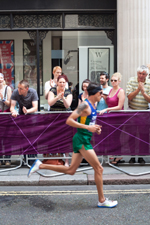
At the end of this year’s event – held on 22nd April (a runner from which is pictured) – more than 882,000 people have now completed the race. Now formally known as the Virgin London Marathon, a record high of 37,227 completed the run this year.

This year’s men’s race was won by Kenyan Wilson Kipsang who completed the race in  2:04:44 – the second fastest time over the London course – while the women’s was also won by a Kenyan – Mary Keitany – who, in taking back-to-back titles, completed the course in 2:18:37.

Since its inception, one of the key aspects of the race has been its fund-raising for a variety of charitable causes. Key among these is The London Marathon Charitable Trust which, established at the race’s outset, helps fund community sports facilities and develop recreational projects around the city.

For more on the Virgin London Marathon, see www.virginlondonmarathon.com.

PICTURE: © photocritical/istockphoto.com

LondonLife – Celebrating the Paralympics in Trafalgar Square…

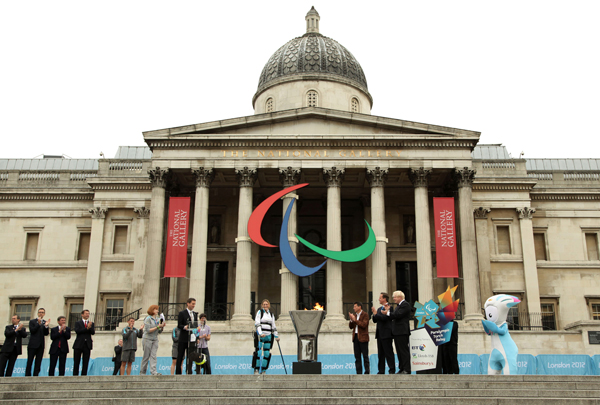
Claire Lomas, an event rider paralysed from the chest down who became the first person to complete a marathon in a bionic suit when she finished the London Marathon in April, is applauded by Lord Sebastian Coe, chairman of the London Organising Committee of the Olympic and Paralympic Games, Prime Minister David Cameron and the Mayor of London, Boris Johnson, after lighting a ‘celebration cauldron’ in Trafalgar Square (with the National Gallery in the background). The event, using the English National Flame which was originally created at Scafell Pike, was part of the Paralympic Flame’s visit to London last Friday during which it was taken to various landmarks across London including the Houses of Parliament, Notting Hill ahead of last weekend’s Notting Hill Carnival, and the Royal Opera House in Covent Garden. During the event in Trafalgar Square, 26 ‘Flame ambassadors’ each collected a ‘splinter’ of the Flame in a lantern to take to various Flame celebrations being held around the country over the past few days. The Flame visits London again this Wednesday in the 24 hour Torch Relay leading up to the Opening Ceremony of the Paralympic Games on Wednesday night. For more on the Paralympic Torch Relay, see www.london2012.com/paralympics/torch-relay/PICTURE: LOCOG. 

Where is it? #41….

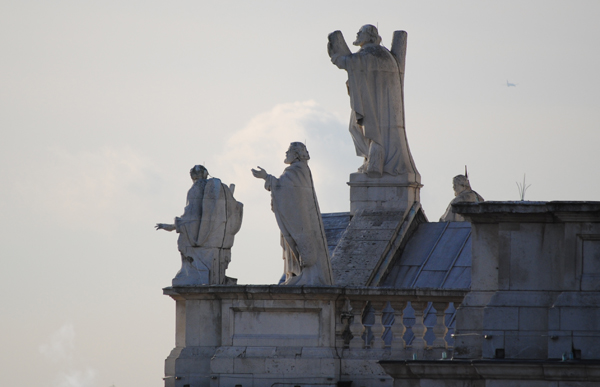
The latest in the series in which we ask you to identify where in London this picture was taken and what it’s of. If you think you can identify this picture (and try and be as precise as possible), leave a comment below. We’ll reveal the answer early next week. Good luck!

Yes, you guessed it, these are indeed the 3.7 metre high statues which sit above the south transept of St Paul’s Cathedral. The statues include those of St Andrew and St Thomas, both of which are attributed to Caius Gabriel Cibber (1630-1700) and Grinling Gibbons (1648-1721). We had originally said they were the work of Francis Bird (1667-1731), who also completed the famous panel depicting the Conversion of St Paul on the cathedral’s west front and the original version of the statue of Queen Anne outside the main entrance (more on that another time), but while he was responsible for other statues on the cathedral, turns out he wasn’t for these two. The image was taken from the viewing deck of One New Change on Cheapside.

Treasures of London – King Lud and his sons…

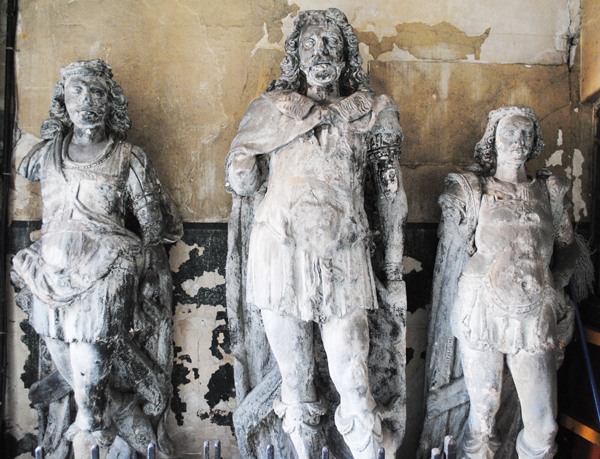
A mythical figure from early Britain, King Lud is said to have been a pre-Roman king of Britain who rebuilt London (which according to legend had been originally founded by the exiled Trojan Brutus) and from whom London derives its name.

Lud is said by some to have given his name to the gateway known as Ludgate (although others say it comes from an Old English term meaning swing or postern gate – see our earlier post here for more on Ludgate).

This series of badly weathered statues – depicting King Lud and his two sons, apparently named Androgeus and Theomantius – was originally located on the gate. In fact, the legend goes, the king was buried under it.

Following the gate’s demolition, the statues – said to date from 1586 with the name of the sculptor now lost to time – were moved here at some point to the vestry porch of St Dunstan-in-the West in Fleet Street.

Around London – Notting Hill Carnival; Paralympics comes to town; Albert Adams at the IWM; and, exploring the anatomy of athletes at the Hunterian…

• The Notting Hill Carnival – the largest festival of its kind in Europe – takes place in London’s west this Sunday and bank holiday Monday. More than a million people are expected top attend to see the floats, listen to the traditional steel drum bands and sample some of the food found at the hundreds of stalls along the streets of Notting Hill.  Sunday, when the costume prizes are awarded, has been designated as Children’s Day and Monday, when the main parade takes place, as Adult’s Day. The festival has been held every summer since 1966. For more, see www.thenottinghillcarnival.com.

• With the memories of the Olympics still fresh in our minds, it’s time to turn our attention to the impending Paralympics and associated events including the 24 hour Torch Relay which hits London next Wednesday, just before the Opening Ceremony. The torch enters London at Watford and and then moves south through the city, taking in many of London’s most famous landmarks as it visits all six boroughs before arriving at the Olympic Stadium. For more on the route, see www.london2012.com/paralympics/torch-relay/route/. Meanwhile, as with the Olympics, those who don’t have tickets to the Paralympics will be able to watch on a giant screen at Trafalgar Square daily between 11am and 10pm where there will also be live music and activities including the chance to try out a range of Paralympic sports. For more, see www.btlondonlive.com/trafalgar-square. Tower Bridge, meanwhile, is undergoing a makeover with the installation of the Paralympics symbol, Agistos, tomorrow following the earlier removal of the Olympic Rings. Historic projections, meanwhile, will once again appear on the Houses of Parliament. Other events taking place around the Paralympic Games include Surprises: What You Will: Pop-Up Shakespeare – which will see Shakespearean characters like Juliet, Hamlet and Puck suddenly appearing and performing at “cultural hotspots” around the city (the exact time and location of the performances will remain a surprise until the day but you can register for updates at www.molpresents.com/surprises or follow @molpresents and @London2012Fest.

• A series of artworks by South African-born Expressionist Albert Adams are on show at the Imperial War Museum this summer. The works on show include the last painting he completed before his death in 2006 – title Abu Ghraib, it was inspired by reports of abuse perpetrated at the Abu Ghraib prison in Iraq – as well as a series of etchings Adams created between 2001 and 20064 which address conflicts like that Iraq War and Darfur. Admission is free. For more, see www.iwm.org.uk.

On Now: Anatomy of an Athlete – Elite sport, surgery and medical art. This exhibition in the Qvist Gallery at the Royal College of Surgeons’ Hunterian Museum in Lincoln’s Inn Fields features new artworks by world-leading medical artists which explore the anatomy and physiology of elite athletes. The art works come in a variety of forms – watercolour, video and sculpture – and represent the human body in a selection of sports and para-sports. Admission if free. Runs until 29th September. For more, see www.rcseng.ac.uk/museums/.

10 Historic Sporting Events in London – 7. The first Five Nations game played at Twickenham…

Twickenham was only a new ground when, in 1910, a England played Wales in what was the first international to be played at the ground – part of the first of what later became officially recognised as the Five Nations competition.

The game played on 15th January, 1910, was only the second to be played in the competition and followed Wales defeat of France in Swansea earlier in the month. A crowd of about 18,000 watched as England defeated Wales 11-6 (England went on to win the competition, winning three matches and drawing the match they played against Ireland).

Twickenham, meanwhile, had only hosted its inaugural match the year before when local sides the Harlequins and Richmond played (the Harlequins won, 14-10). The Rugby Football Union had purchased 10.25 acres of land in Twickenham – previously a market garden – after witnessing the crowds at international rugby contests held at Crystal Palace in south-east London in 1905 and 1906 and decided they needed a ground of their own.

The pitch was raised to prevent flooding and covered stands were build on the east and west side of the pitch, a terrace at the south end and an open mound at the north along with space f0r 200 automobiles or carriages.

The ground – the pitch of which was used for grazing animals in World War I – was developed further in the following years until World War II when it was used as a civil defence depot.

The next major development occurred in the late 1970s/early 1980s when the south terrace was controversially replaced with the South Stand. A new North Stand followed in 1991, a new East Stand in 1993 and a new West Stand in 1995. What was then known as the Museum of Rugby, based at Twickenham Stadium, was opened to the public the following year.

The most recent work has again been on the South Stand which was reopened in 2006 and brought the capacity of the ground to 82,000.

Other landmark games among the many played at Twickenham include the 1959 Twickenham Jubilee celebration match between England and Wales versus Ireland and Scotland (England and Wales won, 26-17) and the final of the 1991 Rugby World Cup (Australia defeated England 12-6). Twickenham will also host the final of the 2015 Rugby World Cup.

There are regular tours of the ground (it’s advised to book these in advance) with highlights including the England dressing room, royal box, hospitality suites, medical room, player’s tunnel onto the pitch, a panoramic view of the arena from the top of the stand and a walk pitchside.

The tour also includes a visit to the World Rugby Museum (it’s possible to just buy tickets to the museum). Located in the East Stand (and known between 1996 and 2007 as the Museum of Rugby), the museum is home to some 25,000 artefacts – everything from a 1910 England v Ireland programme to pieces of kit worn by players from the earliest days of the game, a ceremonial wahaiki (or war cleaver) presented to the RFU by New Zealand Maoris in 1989, and the Calcutta Cup – dating from 1878 and made from the melted down silver coins (the savings of the now defunct Calcutta Rugby Club), it is presented to the winners of annual England versus Scotland match played as part of the RBS 6 Nations Championship.

The museum also houses the Twickenham Wall of Fame, described as “a celebration of the best players from all over the world that have ever played at Twickenham Stadium”. There are also a series of blue plaques around the stadium celebrating some of the best players.

WHERE: Twickenham Stadium, Whitton Road, Twickenham (nearest station is Twickenham); WHEN: Museum is open 10am to 5pm Tuesday to Saturday/11am to 5pm Sunday; Tours are run at select times Tuesday to Sunday – check website for details including scheduled closures; COST: £7 an adult/£5 concessions for museum only; £15 and adult/£9 concessions/£45 family ticket; WEBSITE: www.rfu.com/twickenhamstadium.

LondonLife – A giant shot put hits Greenwich…

Another reminder of the Olympic and Paralympic Games in London can be found at the Old Royal Naval College in Greenwich. The sculpture, a three metre wide shot put embedded in the ground, is one of a series of three different Gifts from the Gods sculptures which have appeared around the city. As well as shot puts, the other sculptures – all of which look as though they’ve been dropped from a great height – depict a 10 metre high javelin and a seven metre long bow with arrows. The sculptures, which will remain in place until 10th September, are part of Wonder, a series of interactive installations put in place as part of the Mayor of London Presents program. For more, see www.molpresents.com/wonder. For more on the Old Royal Naval College, see www.ornc.orgPICTURE: Steve Bradbury/Courtesy of ORNC.

What’s in a Name?…Trafalgar Square

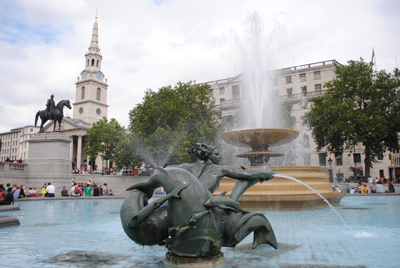
It wasn’t until some time after Admiral Lord Nelson’s victory over the French fleet in the Battle of Trafalgar off the coast of Spain on 21st October, 1805, that the large public space in Westminster we now know as Trafalgar Square took its name.

Prior to the development of the square, much of the area it covers was occupied the King’s Mews – stables linked to the Palace of Whitehall – and was simply seen as part of the district known as Charing Cross (named for the memorial cross which stood close to where the equestrian statue of King Charles I now stands – for more on this, see our earlier post and follow the links).

Following the relocation of the Mews in the early 19th century, plans were drawn up by architect-of-the-age John Nash to redevelop the area while the square itself, completed in 1845, was designed by Sir Charles Barry (best known for his work on the Houses of Parliament).

The final design incorporated a statue of Admiral Lord Nelson atop a column, known as ‘Nelson’s Column’, in the centre – apparently against Barry’s wishes (see our earlier post for more on Nelson’s Column).

Originally designed with an upper terrace and a lower piazza linked by stairs at the eastern and western end of the terrace, the square contains two fountains on either side of the column – the current fountains were designed by Sir Edwin Lutyens in 1937-9 and replaced earlier ones.

It was originally suggested that the square be named King William IV Square but it was apparently architect George Ledwell Taylor who provided the alternative of Trafalgar Square in honor of Nelson’s great battle.

Bordered by significant landmarks including the National Gallery to the north, the church of St Martin’s-in-the-Fields to the north-east, South Africa House to the east and Canada House to the west, the square stands at the confluence of a number of major roadways including Whitehall, Strand, Charing Cross Road and The Mall.

Aside from the aforementioned statue of King Charles I, monuments within the square include Nelson’s Column along with plinths set in the four corners of the square. These bear statues of King George IV, Victorian military figures General Sir Charles James Napier and Major-General Sir Henry Havelock while the fourth plinth, located in the north-west corner, was originally intended to bear an equestrian statue of King William IV.

Instead, it was left empty for many years before the advent of the Fourth Plinth project under which a variety of contemporary artworks – most recently a massive sculpture of a boy astride a rocking horse – have occupied the space (you can see a picture of the current work in our earlier post here).

The square, once known as the home of thousands of pigeons before these were banished midway through last decade to allow greater public use of the space, also features the busts of three admirals – John Jellicoe, David Beatty and Andrew Cunningham, located against the north wall under the terrace.

There are also two statues on a lawn in front of the National Gallery – these are of US President George Washington and King James II. Curiously, the square also features a small pillar box in the south-east corner, referred to by some as the smallest police station in London.

A renovation project in 2003 pedestrianised the roadway along the north side of the square and installed a central stairway between the the upper and lower levels along with lifts, public toilets and a cafe.

For some more on the history of Trafalgar Square, see Jean Hood’s Trafalgar Square: A Visual History of London’s Landmark Through Time.

LondonLife – Gold, gold, gold…

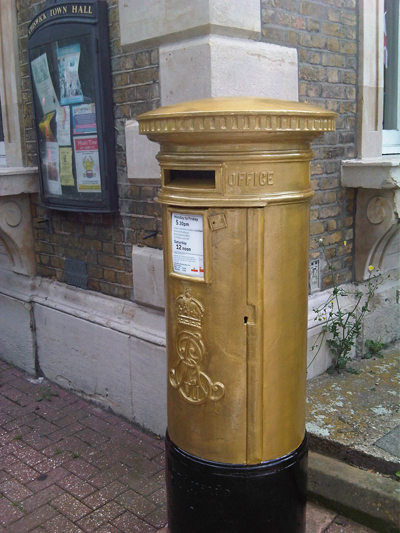
The Olympics might be over but there are still plenty of reminders of the Games around town. Not the least of which are the gold postboxes, painted that color in celebration of London’s gold medallists (the postboxes are located in the home towns of the gold medallists where possible). Pictured is the gold postbox in Heathfield Terrace, Chiswick, west London, painted gold in honor of the victory of Pete Reed in the men’s four rowing. It’s one of a number of gold postboxes in London – others include one in with others in Carshalton Road, Sutton, for Joanna Rowsell’s gold medal win in the women’s team pursuit; one in Church Road in Wimbledon for Andy Murray’s gold medal in the men’s tennis singles, and one in Broad Street, Teddington for Mo Farah’s gold medal in the men’s 5000 metres. Royal Mail has a website where you can see the location of all the gold postboxes in London and elsewhere around the nation – www.goldpostboxes.com. Not sure how long the gold is going to last – Royal Mail has said they will repaint them red – the color they have been, with a few exceptions, since 1874 –  in “due course” but there is a push for them to remain gold as a reminder of the Games.

PICTURE: Courtesy of Royal Mail.

Where is it?…#40

The latest in the series in which we ask you to identify where in London this picture was taken and what it’s of. If you think you can identify this picture, leave a comment below. We’ll reveal the answer early next week. Good luck!

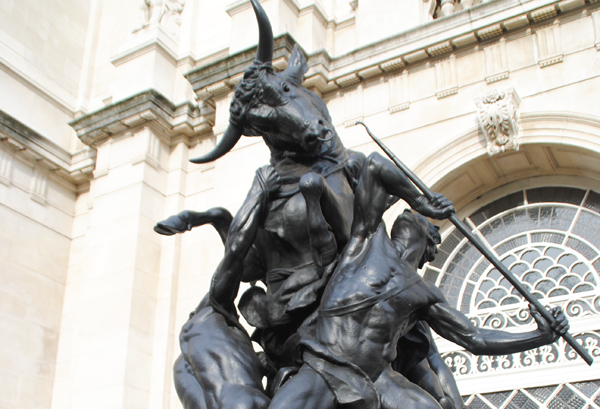
Well done to Angelo – this is indeed located outside the Tate Gallery, just to the left of the main entrance. The statue is The Death of Dirce, a work by Sir Charles Lawes-Wittewronges, and was one of a several copies of the same work he made in the early 1900s (this bronze version was made in 1906), including a couple of bronze versions and a colossal marble version. The sculptural group, based on the Hellenistic sculpture known as the Farnese Bull (which is indeed in Naples), depicts Dirce, the wife of the King of Thebes who was tied to the horns of a bull by Amphion and Zethus as a punishment. Sir Charles was something of a noted athlete in a range of sports as well as a sculptor who exhibited 12 works at the Royal Academy. He was also involved in a famous libel case in the 1880s. The statue was presented to what was then the National Gallery of British Art by his widow after his death in 1911.

10 Historic Sporting Events in London – 6. The first Wimbledon championships…

While the history of the All England Tennis and Croquet Club goes back as far as 1868 (it was initially just known as the All England Croquet Club), the first Wimbledon Championships, officially known as The Championships, Wimbledon, were held some nine years later in 1877.

The only event held at the first championship was the “gentlemen’s singles” and the winner was cricketer (and, of course tennis player) Spencer Gore who emerged victorious over William Marshall in straight sets – 6-1, 6-2, 6-4 – before a crowd of about 200 (the “ladies’ singles” wasn’t introduced until 1884 with Maud Watson the first female champion after she defeated her sister Lilian).

Each of the 22 male amateur entrants had paid an entrance fee of £1, 1 shilling, and had to bring their own racquets and shoes “without heels” but were supplied with tennis balls.

Gore apparently won 12 guineas in prize money as well as a trophy, the Field Cup (the Gentleman’s Singles Trophy was introduced in 1887).

The club was then located at a site on Worple Road in Wimbledon (see our earlier entry about a plaque unveiled there earlier this year); it wasn’t until 1922 that it moved to it current location in Church Road. The layout of the courts at Worple Road – which saw the principal court named Centre Court thanks its position in the middle of the others – was carried over to the new location.

For more on the history of Wimbledon – which was the site of the tennis competition during this Olympics – including important milestones, see our earlier entry.

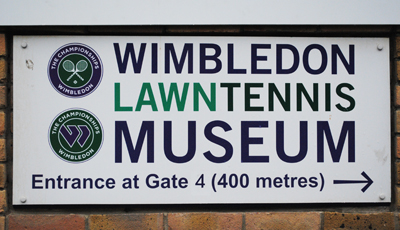
There is a museum based at Wimbledon (pictured above) which details more of the history of the place with exhibits including the Championship trophies, tennis memorabilia dating back to 1555 and a ‘ghostlike’ John McEnroe talking about the games and his opponents in his old dressing room. The museum is currently hosting a special exhibition, Tennis at the Olympics.

WHERE: All England Lawn Tennis Club, Church Road, Wimbledon – between gates 3 and 4 (nearest tube Southfields); WHEN: 10am to 5pm (last admission 4.30pm) daily (not during the Olympics – reopens on 15th August); COST: Museum only £11 an adult/£9.50 concessions/£6.75 child, or Museum plus tour £20 an adult/£17 concessions/£12.50 child; WEBSITE: www.wimbledon.com.

LondonLife – The 2012 Serpentine Gallery Pavilion…

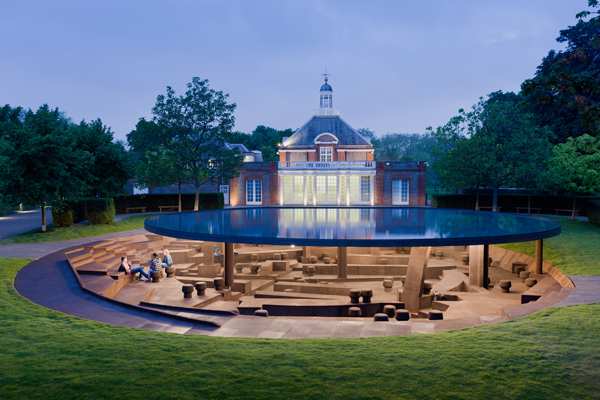
The 12th in the Serpentine Gallery’s annual architecture series, this year’s Serpentine Gallery Pavilion in Kensington Gardens has been designed  by Herzog & de Meuron and Ai Weiwei, the design team behind for the Beijing National Stadium, star of the 2008 Olympic Games and commonly known as the “bird’s nest”. Twelve columns – each of which represents one of the 12 annual pavilions created so far (including this one) – support a floating platform roof standing 1.5 metres off the ground. The interior is clad in cork and the pavilion designed to “inspire visitors to look beneath the surface of the park as well as back in time across the ghosts of the earlier structures”. Open until 14th October. For more information, see www.serpentinegallery.orgPICTURE: Serpentine Gallery Pavilion 2012. Designed by Herzog & de Meuron and Ai Weiwei © Herzog & de Meuron and Ai Weiwei. IMAGE –  © 2012 Iwan Baan.

London Pub Signs – Tom Cribb…

In keeping with the sporting theme, we decided to take a look at a pub that bears that name of a sportsman – in this case Tom Cribb, a celebrated early nineteenth century boxer.

Born in 1781, Cribb moved to London from his home in Gloucestershire at just the tender age of 13 and worked in various jobs including as a bellhanger and a porter on the wharves before in taking up the sport of bare knuckle boxing with his first public bout in 1805 (he was known as the ‘Black Diamond’ thanks to his previous work as a coal porter).

Further fights followed and Cribb’s skill was such that in 1809 he won the British title and the following year he fought American and former slave Tom Molineaux to become world champion, a feat he repeated the in 1811 by beating Molineaux again.

Cribb retired from boxing in 1812 and later became a publican, running a couple of different pubs before taking up the job the Union Arms, located at 26 Panton Street, in the West End. He did apparently marry and in 1821 was among the prize fighters who guarded the entrance to Westminster Hall on the day of King George IV’s coronation.

Forced to give up his pub to creditors to pay off gambling debts, he retired to Woolwich in 1839 and died there in 1848 – he was buried in St Mary’s Churchyard where there is a memorial to him.

The pub which now bears his name is located on the same site as the Union Arms, although it is numbered 36 due to a numbering change. Inside it features a boxing theme with photos of some of Britain’s greatest boxers adorning the wall.

For more, see www.shepherdneame.co.uk/pubs/london/tom-cribb.

For a book on Tom Cribb, try Tom Cribb: The Life of the Black Diamond.

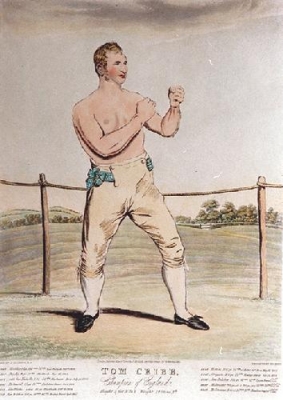
PICTURE: Tom Cribb in an engraving published in 1842. Source – Wikipedia.

Where is it?…#39

The latest in the series in which we ask you to identify where in London this picture was taken and what it’s of. If you think you can identify this picture, leave a comment below. We’ll reveal the answer early next week. Good luck!

As was guessed, this is indeed a detail from the controversial Queen Elizabeth Gate in Hyde Park, close to Hyde Park Corner. Commonly referred to as the “Queen Mother Gates”, in a project instigated by Prince Michael of Kent they were commissioned in 1991 to mark the Queen Mother’s 90th birthday. The 120ft by 21ft stainless steel gates, designed by Giuseppe Lund, feature a much commented upon lion and white unicorn created by sculptor David Wynne. The gates cost £1.5 million to construct.

Olympics Special – London bridges aglow…

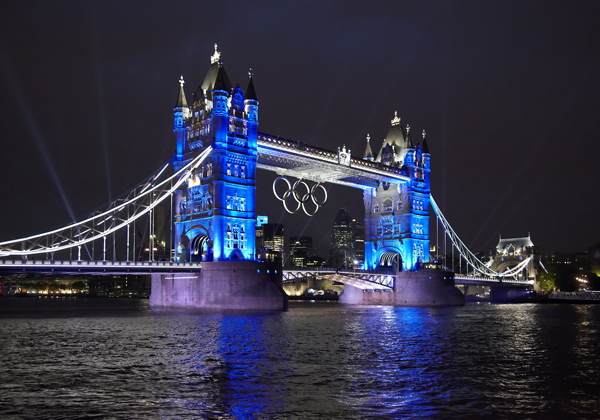
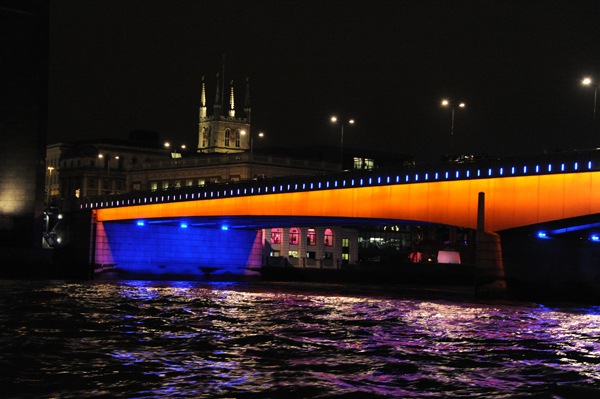
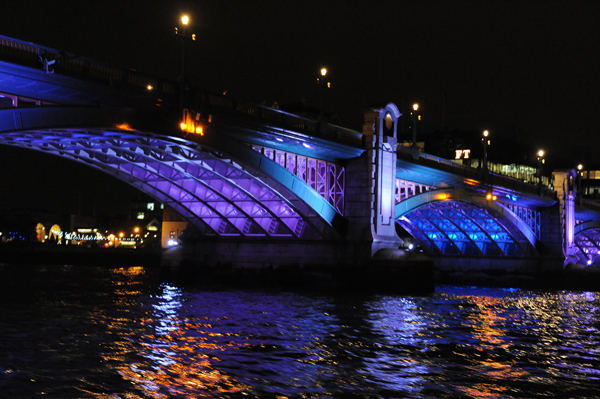
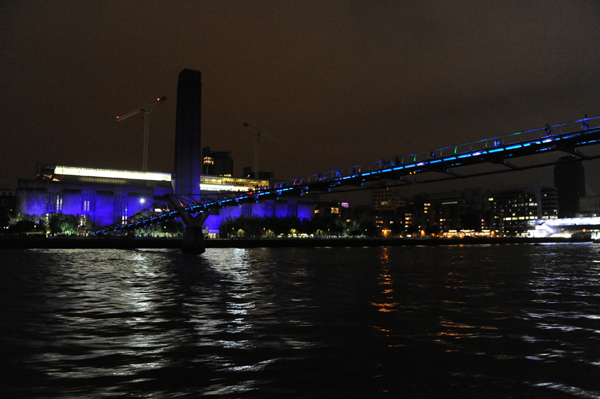
Seven of London’s bridges are being lit up at night until 10th September in an initiative called “Dazzle”. Being run under the Mayor of London Presents program, it celebrates the 50 evenings of the Olympic and Paralympic Games. Here’s just a sample of what you can see…

The most iconic of London’s bridges, Tower Bridge has been a focal point for Olympic celebrations. One of the great structures of Victorian London, it was opened in 1894 and at the time was largest bascule bridge ever built (for more on Tower Bridge, see our earlier post here).

The most recent version of London Bridge, this links Borough High Street in Southwark (you can see Southwark Cathedral in the background) and King William Street in the City and was built in the late 1960s/early 1970s and opened by Queen Elizabeth II in 1973. There have been bridges in this vicinity since as far back as Roman times (for more on the history of London Bridge, see our earlier post here).

The current Southwark Bridge – which links the City of London with the heart of Southwark – dates from 1921 and replaced an earlier bridge designed by John Rennie.

Initially plaqued by the wobbles, the steel suspension walk bridge known as Millennium Bridge is the newest of the bridges that cross the Thames in central London, linking St Paul’s Cathedral on the north bank with the Tate Modern on the south (the looming bulk of which is pictured here). First opened in July 2000, it was closed after concerns over its movement and then reopened to the public in 2002.

Other bridges taking part in Dazzle but not shown here include the Golden Jubilee footbridges, Waterloo Bridge and Blackfriars Bridge.

For more on the program, see www.molpresents.com/dazzle.

PICTURES: All images courtesy of the City of London Corporation.

Around London – Celebrating the Olympics; Camden Lock’s night market; and, images of London at the Tate…

We’ll kick off this week with just a few more of the plethora of Olympic-related events which are happening around town:

Tower Bridge, site of some spectacular fireworks last Friday night, is currently hosting an exhibition celebrating the 26 cities which have hosted the modern Olympics. Cities of the Modern Games, located on the bridge’s walkways, runs alongside an interactive exhibition looking at the bridge’s construction. Follow the link for details.

The Guildhall Art Gallery is showcasing sculpture and art inspired by sport and the “Olympic values”. The art works are all winning entries from a contest organised by the International Olympic Committee. The chosen works were selected from among 68 submissions made by an international jury. Follow the link for details.

The Design Museum is hosting a new exhibition celebrating the nexus between sport and design. Designed to Win looks at everything from the design of F1 cars to running shoes, bats and bicycles and explores the way in which design has shaped the sporting world. Runs until 9th September. Admission charge applies. See www.designmuseum.org.

• The London Metropolitan Archives is holding an exhibition of playing cards featuring an Olympic theme. Sporting Aces – Playing Cards and the Olympic Games features cards drawn from the collection of the Worshipful Company of Makers of Playing Cards which have an Olympic theme. Admission is free. Runs until 13th September. See www.cityoflondon.gov.uk/lma.

And in other news…

A night market has been launched at Camden Lock over the summer period. Street food stalls and vintage fashion, arts and crafts and book shops will be open until 10pm every Thursday with extras including live music and film screenings. For more, see www.camdenlockmarket.com.

• On Now: Another London: International Photographers and City Life 1930-1980. This exhibition at Tate Britain in Millbank features more than 150 classic photographs of the city and its communities by foreign photographers including such luminaries as Henri Cartier-Bresson. The exhibition features iconic works such as Robert Frank’s London (Stock Exchange) 1951, Cartier-Bresson’s images of King George VI’s coronation, Elliot Erwitt’s depiction of a rain-washed London bus stop, and Bruce Davidson’s image of a child with pigeons in Trafalgar Square alongside works such as Wolfgang Suschitzky’s images of working class families in the East End, from the 1940s, and Karen Knorr’s images of punks in the 1970s. The photographs all come from the Eric and Louise Franck London Collection, which includes more than 1,200 images of London and has been promised as a gift to the Tate. Runs until 16th September. Admission charge applies. See www.tate.org.uk. 

Have we missed something we should be telling others about? Send details in an email to exploringlondon@gmail.com.

10 Historic Sporting Events in London – 5. The ‘Ashes’ are born…

While England and Australia played their first test match as far back as 1877 (at the Melbourne Cricket Ground), the origins of The Ashes go back to a game played at The Oval (now officially known as The KIA Oval) in Kennington in 1882.

Playing their only test of that tour, the Australians only made 63 runs in their first innings, giving England a 38 run lead with a total of 101. Australia followed this up with 122 leaving England just 85 runs to win. They were stopped just eight runs short of victory.

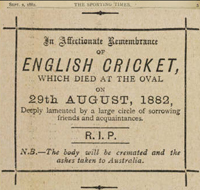
The English team were berated in the press for the loss and on 2nd September that year, a mock obituary for English cricket appeared in The Sporting Times stating that, having died at The Oval on 29th August, 1882, it will be “deeply lamented”. There was a note at the bottom of the obituary (picture right) which said that the body would be cremated and the ashes taken to Australia. And so the name, the Ashes, was born.

English captain Ivo Bligh subsequently promised that he would regain the ashes during the 1882-83 English cricket team’s tour of Australia while the Australian captain WL Murdoch vowed to defend them. It was during a social match played at Rupertswood Estate outside the city of Melbourne that Bligh was presented with the tiny terracotta ashes urn (today on display at the MCC Museum at Lord’s – see our earlier post for more).

The history of The Oval goes back to the mid-1840s when, following the establishment of the Surrey Cricket Club, it was granted a lease for the land from the Duchy of Cornwall (who still own it). The Ashes aside, memorable moments there have included the playing of the first match in the Australian Aboriginal team’s tour of England in 1868 (the first tour of England by a foreign side) and the first England v Australia test match to be played in England (1880). The Oval was also the location for the first international football match, played between England and Scotland in 1870, and the first FA Cup Final, played here in 1872.

Interestingly, The Oval also held a particular attraction for the US billionaire philanthropist,  J Paul Getty II, who built a replica of the ground at his estate at Wormsley Lodge in England’s south.

The history of Lord’s, London’s most famous cricket ground, meanwhile, goes back somewhat further. The current ground is the third to bear the name of Lord’s – the first was created on what is now Dorset Square in Marylebone at the behest of entrepreneur Thomas Lord (from whom it derives its name) and the first match staged there in 1787, the date on which the Marylebone Cricket Club was formed. Between 1811 and 1813, the ground was relocated to Marylebone Bank in Regent’s Park before moving to its current home in St John’s Wood (then the site of a duck pond).

Both grounds continue to host a range of cricketing and other events, such as the current Olympic archery competition being held at Lord’s.

WHERE: The Oval, Kennington Oval, Kennington (nearest Tube stations are Oval, Vauxhall and Kennington); WHEN: 90 minute tours of the ground are available (check website for booking details); COST: Tours cost £10 an adult/£5 under 16s/£25 a family ticket; WEBSITE: www.kiaoval.com.

WHERE: Lord’s Cricket Ground, St John’s Wood Road, St John’s Wood (nearest Tube Stations are Warwick Avenue, St John’s Wood, Marylebone and Maida Vale); WHEN: 100 minute tours of the ground (which include a visit to the MCC Museum) are available daily (check website for times – note that there are no tours during the Olympics, these resume on 21st August); COST: Tours cost £15 an adult/£9 concessions/£40 a family ticket; WEBSITE: www.lords.org.

PICTURE: Wikipedia