10 small (and fascinating) museums in London…8. The Geffrye Museum

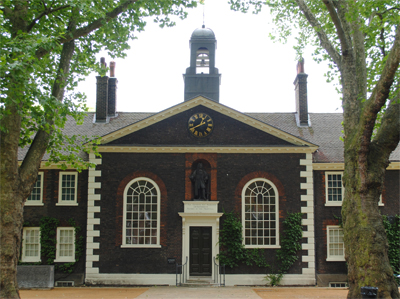
We have mentioned this museum before, but it’s well worth doing so again (particularly for those who may have missed the first entry). Located in former almhouses in Shoreditch, the Geffrye Museum is a survey of house interiors from the 17th century through to modern times.

Featuring 11 reconstructed period interiors created using authentic furnishings, it tells the story of the city through its residents’ homes (albeit largely wealthy ones) and includes a look at a hall in 1630, a parlour in 1790, a drawing room in 1870 and a loft conversion dating from 1998. There’s an audio guide which provides details on each room and information panels as you go along (and if you can’t get there but want to have a look, the website gives a detailed look at each room with notes on select furnishings).

The almshouses in which the museum resides (it runs along the rear wing of a U-shaped courtyard and takes in the chapel) were built in the early 1700s by the Company of Ironmongers after it received a bequest from Sir Robert Geffrye, a former twice-master of the company and a former Lord Mayor of London (his statue adorns the front of the chapel and faces out into the courtyard, itself a quiet oasis in busy Shoreditch).

These were used until early in the 20th century when the company decided to relocate the remaining pensioners. But the buildings have been preserved and it is possible to visit a former almshouse which has been restored and opened as a museum with displays on what life was like for the pensioners. Meanwhile, at the rear of the museum is a walled herb garden filled with herbs and a series of ‘period garden rooms’ ranging from the 17th to 20th centuries.

There’s also a restaurant and shop onsite (housed in a new extension opened in 1998).

WHERE: 136 Kingsland Road, Shoreditch. Nearest tube is Liverpool Street or Old Street (a fair walk) or Hoxton Overground Station (next door); WHEN: Tuesdays to Saturdays, 10am-5pm or Sundays and Bank Holidays, 12-5pm (gardens open until 31st October); COST: Free (admission to almhouses £2.50 at set times on select days); WEBSITE: www.geffrye-museum.org.uk


Where is It? #3

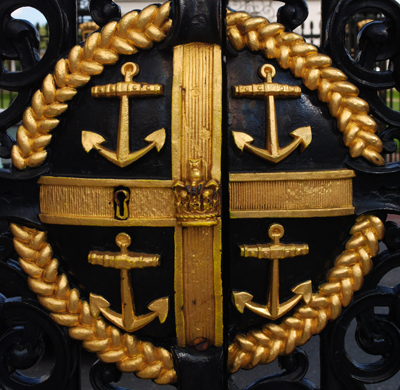
This is the third in our series in which we ask you to identify where in London this picture was taken and what it’s of. If you reckon you know the answer, leave a comment below. We’ll reveal the answer early next week. Good luck!

Apologies for the delay in getting this answer to you (Exploring London has been on a summer break!). But if you’ve been wondering, the answer is that the picture shows a lock detail from one of the gates leading into the old Royal Naval College at Greenwich – the anchors were a clue! Congrats to Ian who guessed the location was near the Queen’s House (contained within the former Royal Naval College). Click here if you’re interested in reading our previous entry about the former Royal Naval College and Sir Christopher Wren’s role in its design.

Around London – Story of London Festival; a new filmlovers’ walk; ‘pocket histories’ of London; and, Your 2012…

The third Story of London Festival kicked off at the start of the month with a programme of events aimed at celebrating the 60th anniversary of the 1951 Festival of Britain. This year’s festival is being coordinated by the Museum of London in partnership with the Southbank Centre. It also involves five London borough museums – that of Brent, Dagenham, Haringey, Redbridge and Wandsworth – which are hosting free displays and events around the theme of how they celebrated in 1951. The festival runs until the end of the month, so there’s still plenty of time to get involved. Among the highlights still to come is the Floral Bicycle Parade around the Southbank Centre on 28th August (‘decorating stations’ will be set up at the centre prior to the parade). For a full listing of what’s happening, see www.london.gov.uk/priorities/art-culture/storyoflondon.

The City of London has released a new filmlovers’ walking tour of London which takes in locations featured in films and TV shows. Lights, camera, action starts on Millennium Bridge (destroyed in the opening sequence of Harry Potter and the Half-Blood Prince) and takes in 23 other locations including St Paul’s Cathedral (The Madness of King George and Great Expectations), Bank Junction (28 Days Later, National Treasure II), St Bart’s Hospital (Bridget Jones: The Edge of Reason), Moorgate (Ocean’s 13 and The Bourne Ultimatum) and Tower Bridge (BranniganThe Mummy ReturnsThunderbirdsTomb RaiderSherlock Holmes) before finishing at Postman’s Park (Closer). The walk has been mapped out by the City’s film team which works with location managers and film directors when they’re working in the Square Mile. The leaflet can be picked up free-of-charge from the City of London Information Centre (opposite St Paul’s) or downloaded here.

• Interested in a snapshot of what London was like during a particular historical era? The Museum of London has launched a series of 16 “pocket histories”, each of which, in up to 1,000 words, tackles a particular aspect of the city’s history based around five objects or images. The subjects covered range from a look at the River Thames in prehistory to life in medieval London, from an examination of the history of Jack the Ripper and the East End, to a detailed look at the London’s plagues. While designed for a general audience, the histories are expected to be particularly useful to school students. They can be looked at online or downloaded as a PDF. Further subjects are expected to be added in the future. See www.museumoflondon.org.uk/pockethistories. The museum has also launched Picturebank, a collection of images which can be accessed online and viewed, printed or copied for educational use.

• On Now: Your 2012. The Museum of London Docklands is hosting a free exhibition featuring images capturing the construction work at the Olympic site in East London and the impact on the surrounding boroughs and the environment as well as archival images which show the history of the site. The free exhibition runs until 5th February. For more, see www.museumoflondon.org.uk/docklands/.

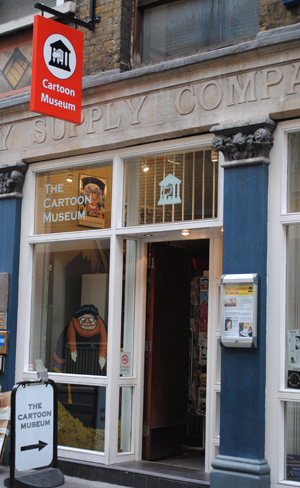
10 small (and fascinating) museums in London…7. The Cartoon Museum

Hidden away in Bloomsbury almost in the shadow of the gigantic bulk of the British Museum, this small museum offers an interesting insight into the development of cartoons and comic strips from a uniquely British perspective.

Opened in 2006, the museum exhibits are spread over two floors and trace the history of cartoons and comic strips from their origins in the 1700s through to today’s graphic novels.

While it can seem at first glance only a small display, there’s a wealth of information accompanying the more than 200 exhibits which range from Hogarth prints and early satirical political cartoons by the likes of James Gillray and George Cruikshank through to the works of more modern artists like David Low and Donald McGill, originals of comic strips like Dennis the Menace and Andy Capp and even manga Shakespeare.

And no need to worry about the kids – if they become bored (as is likely), there’s an interesting exhibition on the creation of Peppa Pig complete with original storyboards and a cartoon running on the television as well as plenty of reading materials and, upstairs, the chance for them to indulge their passion for cartoons by designing their own.

The museum is also currently running a splendid exhibition on Dr Who comics spanning the period from 1964 (the year after the first Dr Who was televised) through to today. For Dr Who fans, this exhibition – which runs until 30th October – is a must.

Don’t forget to pause at the shop on the way out – it’s stocked with all sorts of comic-related paraphernalia.

WHERE: The Cartoon Museum, 35 Little Russell Street (nearest Tube stations are Tottenham Court Road, Holborn and Russell Square); WHEN: 10.30am to 5.30pm, Tuesday to Saturday, 12.30pm to 5pm Sundays; COST: £5.50 an adult/£4 concessions (£3 students)/children under 18 free (children 12 or under must be accompanied by an adult); WEBSITE: www.cartoonmuseum.org

LondonLife – London’s celebrates one year to the Olympic Games…

Late last month, London celebrated one year to go until the Opening Ceremony of the 2012 Olympic Games. The milestone was marked with a series of events in Trafalgar Square and at Olympic venues, including here at the Olympic Stadium in London’s east where the number one was mown into the grass. In Trafalgar Square, meanwhile, International Olympic Committee president Jacques Rogge formally invited the world’s athletes to attend the games and unveiled the medals while at the newly completed Aquatic Centre, British diver Tom Daley became the first athlete to break the waters. For more see www.london2012.com.

PICTURE: LOCOG

Famous Londoners – Sir William Walworth

Twice Lord Mayor of London, Sir William Walworth is best remembered as the man who killed the leader of the Peasant’s Revolt, Wat Tyler.

Believed to have been born in the first half of the 14th century to a couple in Durham, Walworth at some point moved to London where he was apprenticed to the leading fishmonger John Lovekyn (he was also one of London’s biggest exporters of wool).

In 1368, following Lovekyn’s death, Walworth replaced Lovekyn as the alderman of Bridge Ward. Two years later, in 1370, he was elected sheriff and the following year he became an MP (by this stage, he was also already a major lender of money to the crown). Walworth was first elected as mayor in 1374, elected again as an MP in 1377, and again as mayor in 1380.

It was on 13th June, 1381, Walworth, still London’s mayor, led the defence of London Bridge against Wat Tyler and the rebels. He was later with the king, Richard II, when he subsequently met with Tyler and others at Smithfield. During that encounter Walworth stabbed Tyler and later had him beheaded. The reason for Walworth’s stabbing of Tyler remains unclear.

Walworth was knighted on the field for his efforts in defending the king during the rebellion and was later involved in restoring the peace in London and in the counties of Kent and Middlesex.

Sir William did marry but he and his wife Margaret, who died in 1394, had no children. Following his death in 1386 at his house in Thames Street (later the Fishmonger’s Hall), he was buried at the church of St Michael, Crooked Lane, to which he had already made some substantial donations.

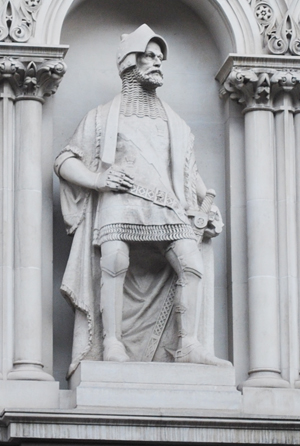
He subsequently became a hero in popular story-telling and in 1592 was included in Richard Johnson’s book Nine Worthies of London. A wooden statue of him was placed at the Fishmonger’s Hall in 1685. There is a much later statue of Sir William on the Holborn Viaduct (pictured).

This article has been updated.

Where is it? #2…

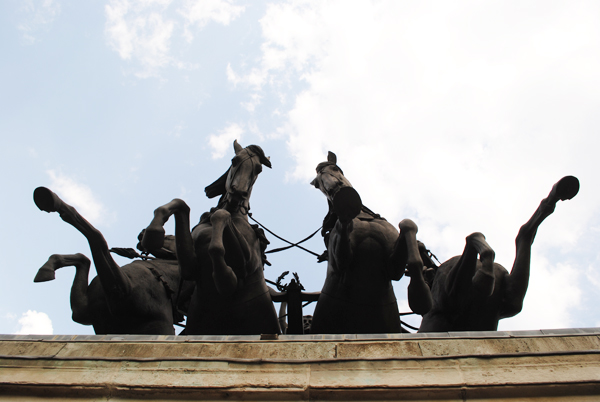
This is the second of our series in which we ask you to identify where in London this picture was taken and what it’s of. If you reckon you know the answer, leave a comment below. We’ll reveal the answer on Monday.

Obviously, this one was too easy – yes, it is the top of Wellington Arch at Hyde Park Corner. The Decimus Burton-designed arch, which dates from 1826-30 and was initially known as the Green Park Arch, was built to commemorate Britain’s victory over Napoleon.

In 1846, it was adorned with a controversial giant statue of the Duke of Wellington on horseback but in 1883, when the arch had to be moved from its initial position parallel to the Hyde Park Screen to where it now stands to accommodate increased road traffic, the statue was removed to Aldershot (where it still stands) and not replaced.

In 1912, thanks to the support of King Edward VII (initially as Prince of Wales), the space was occupied with Adrian Jones’ sculpture of four horses pulling a chariot (known as a quadriga) driven by a boy with a winged figure representing peace standing behind him. It remains to this day.

Congrats to Hazel Edmunds who was the first to guess it on Exploring London and Sarah Goldsworthy, who was the first on Facebook. Honorable mention to Mike Paterson who also guessed it.

We’ve decided to make this a weekly feature – have a look for the next challenge on Friday afternoon!

Around London – In the aftermath of the riots…

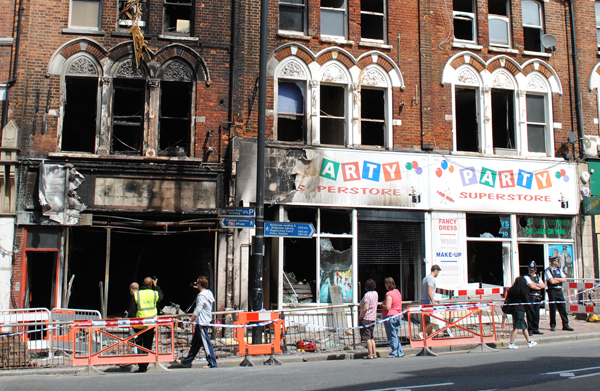
Damage in Clapham Junction, south London, following Monday night’s riots. PICTURE: David Adams

It’s been a tough few days to be a resident of London – the city we at Exploring London love for its vibrant culture and deep, rich history. Calm seems to have descended for the moment, but we couldn’t let the week pass without paying tribute to all those of the “broom army” who have turned up to help out with the clean-up of the damaged high streets, those who are donating clothes and goods for people who lost their homes, and the emergency workers – police, paradmedics and firefighters – who have worked so tirelessly to restore order to the streets since Saturday night. Here’s a couple of places to turn to if you want to get involved: www.riotcleanup.co.uk, a website showing where clean-up operations are underway (the Guardian newspaper is also running a riot clean-up page at http://ukriotcleanup.crowdmap.com/main), while the Londonist blog has a terrific page showing where you can donate and what items are most in need (http://londonist.com/2011/08/london-riots-how-you-can-donate-to-the-victims.php). And, of course, you can check out @riotcleanup on Twitter.

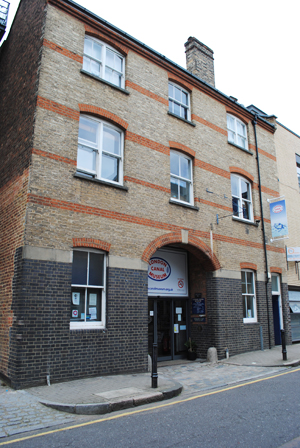
10 small (and fascinating) museums in London…6. London Canal Museum

London’s Regent’s Canal no longer plays the important transport role it once did – it’s now largely for pleasure that people ply the waters from the East London Docks up to Little Venice. But its key contribution to the city’s development and those of other canals across the country are celebrated at this small museum.

The museum, which sits just behind King’s Cross railway station, was opened in 1992 and features two floors of exhibits. They include half a narrow boat, the Coronis, which you can walk through to experience the cramped conditions in which the boatmen and their families once lived. There are also some fascinating recordings of people who actually did live on narrowboats about what life was like as well as displays and photographs of a lifestyle now long gone.

Outside, in Battlebridge Basin, is a moored a small collection of narrowboats while upstairs is a more detailed history of how the canals were developed, some fascinating film archival footage on a continuous loop, and a chance to operate a model of a lock.

As an added bonus, the museum is housed in what was once an ice warehouse and it’s still possible to view one of two massive ice wells which occupied the basement space where blocks of ice imported from Norway were once stored.

There are also displays on the history of the former ice business owner, Carlo Gatti, and some interesting information about the early days of ice and icecream in London – of particular note is the collection of ‘licking dishes’ in which icecream was sold for a penny.

WHERE: London Canal Museum, 12-14 New Wharf Road (nearest Tube station is King’s Cross); WHEN: 10am to 4.30pm, Tuesday to Sunday (open late until 7.30pm on the first Thursday of each month); COST: £4 an adult/£3 concessions/£2 children/£10 a family; WEBSITE: www.canalmuseum.org.uk

Treasures of London – Peter Pan statue, Kensington Gardens

It’s now one of the most popular statues in London – the diminuative “boy who wouldn’t grow up”. But few people today are aware of its somewhat unusual origins.

Located about half-way along the western shore of the Long Water in Kensington Gardens, the bronze statue first “appeared” in the park in 1912. The story goes that author JM Barrie, who published his first story about Peter Pan – The Little White Bird – in 1902, chose the location of the statue based on it being the place where, in the story, Peter Pan landed after flying out of the nursery window of his home.

Peter Pan first appeared on stage two years later in 1904 in the play Peter Pan, or The Boy Who Wouldn’t Grow Up, and this was later expanded into a novel by Barrie, Peter and Wendy. He’s since appeared in numerous film and stage adaptations – including sequels and prequels to the original tales.

Barrie had apparently been thinking about the statue for some time prior to its appearance – in 1906 he went so far as to take a series of photographs of six-year-old  Michael Llewelyn Davies wearing a Peter Pan costume (it was Barrie’s relationship with the Llewelyn Davies family which is said to have inspired Peter Pan’s creation).

Six years later Barrie commissioned Sir George Frampton to create the statue – interestingly, in what was a cause of some friction between the artist and patron, Sir George modelled his figure not on Llewelyn Davies but on another boy. Peter is seen playing on some pipes and is surrounded by small animals and fairies. There’s no sign of Captain Hook.

On the 1st of May, the statue simply appeared in its current position after being taken into the park under the cover of darkness. Barrie announced what he called his “May Day gift” to the children of London in The Times newspaper, describing it as “delightfully conceived”.

There was apparently some initially concerns raised among MPs about the appropriateness of an author erecting a statue to promote his own work but it has since become an iconic symbol of the gardens (and undergone some repairs – including after an incident in 1952 when Peter’s pipes were stolen).

So popular has the statue proved, that copies of the Peter Pan statue – created using Sir George’s mould – can now be found in Liverpool as well as in countries including Canada, Brussels, Australia and the US. There are others (not copies) in Kirriemuir, Scotland (Barrie’s birthplace) and another of him with Tinkerbell outside Great Ormond Street Hospital for Children (which holds the copyright to the character).

WHERE: Peter Pan statue (nearest Tube station is Lancaster Gate); WHEN: 6am to dusk daily; COST: Free; WEBSITE: www.royalparks.gov.uk/Kensington-Gardens.aspx

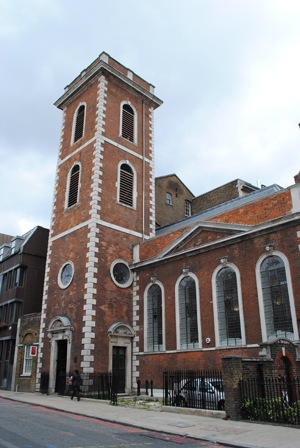
10 small (and fascinating) museums in London…5. The Old Operating Theatre Museum and Herb Garret

It’s the most unlikely location for anything to do with a hospital. High above the street in what was a herb garrett above a former church sits what was the operating theatre for females of St Thomas’ Hospital.

Built in 1703, the attic space resembles something of a large barn and was likely first used for storing and drying herbs by the resident apothecary at the then newly reconstructed St Thomas’ Hospital (this was largely rebuilt at the end of the 17th century on the same site previously occupied by the hospital as far back as the 1200s).

In 1822, the hospital’s governors decided that part of the herb garrett be converted into a new purpose-built operating theatre for female patients. The addition of windows in what was left of the adjoining garret, meanwhile, suggest it may have been used as a recovery ward.

The first thing that assails you as you enter the herb garrett these days, having clambered up a narrow twisting staircase is the sweet, spicy smell of herbs.

There are plenty of these within the garret, each with a hand written card explaining the curative properties they were renowned for – who knew, for example, that the ash of bladderwrack, dried kelp or seaweed, could be used to treat scrofula and goitre, or that the origins of aspirin go back to 1758 when a Chipping Norton clergyman chewed on a willow twig?

Elsewhere in the space are displays featuring early surgeon’s implements (and all the horror that entails), specimen jars containing human organs, anatomical models, pill and medicine making equipment and a display on nursing (there’s also a display on the poet John Keats who briefly served as an apprentice apothecary at St Thomas’ and St Guy’s in 1815-17).

Through the garret is located the operating theatre itself, complete with the wooden operating table and series of seats for spectators. Information panels nearby speak of such things as the blood box located below the floor into which the blood drained away and the speed with which surgeon’s had to work (until 1846 there was no reliable anaesthetic and it wasn’t until 1865 that Sir Joseph Lister introduced antiseptic procedures). There’s also a panel on the resurrection men – people who traded in cadavers to meet the growing needs of anatomists in the 18th and 19th centuries (and whom were known in London and elsewhere to have murdered people to meet the demand for bodies).

For all the faux-horror of nearby attractions like the London Dungeon, it’s here that you can truly experience the horrors some people have had to face as they prepared to go under the surgeon’s knife.

WHERE: The Old Operating Theatre Museum and Herb Garret, 9a St Thomas’s Street, London Bridge (nearest Tube station is London Bridge); WHEN: 10.30am to 5pm daily; COST: £5.90 an adult/£4.90 concessions/£3.80 children under 16/£13.80 a family (up to four children); WEBSITE: www.thegarret.org.uk.

Lost London – Billingsgate Roman House and Baths

Hidden beneath an office building in Lower Thames Street opposite the former Billingsgate Fish Market are the remains of some of London’s best preserved Roman ruins in the form of an expansive house and baths complex.

Last weekend, the Festival of British Archaeology presented a rare opportunity to visit the property which has been the subject of an extensive conservation project.

The remains of the buildings were first discovered by workmen building the New Coal Exchange in 1848 (this was demolished in the 1960s and the current office building constructed in its place in the 1970s – the ruins now sit in its basement).

While the house – which may have formed an L-shape or three-sided building stretching around a courtyard – dates back to the 2nd century AD, the baths complex – which is believed to be located in the house’s courtyard – were added the following century. The buildings, both of which feature an underfloor heating system known as a hypocaust, are notable for the fact that they remained in use until the early 5th century AD when much of what had been Roman Londinium was then already in decline.

Visitors to the baths would first have visited the cold room (frigidarium) before moving on to the warm room (tepidarium) and then the hot room (caldarium) which was heated by the hypocaust. There they would pause to remove dirt and oils from their skin using curved metal scrapers known as strigils before retracing their steps to the cold room where they are believed to have either jumped bravely into a plunge pool or splashed cold water over themselves.

The site includes two furnaces – one at the house and another at the baths – used for heating the space under the floors. The fact both buildings were constructed of stone indicates they were either owned by a wealthy family or were for communal use, perhaps as an inn for travellers.

The objects found in the premises include hoard of bronze coins (all minted after 395 AD) and a bronze brooch, believed to have belonged to a Saxon woman who must have dropped it after 450 AD when the bath house may already have been in ruins.

You can follow the conservation work being currently being carried out on the property – a joint project involving the City of London Corporation, the Museum of London, English Heritage, Nimbus Conservation and the Institute of Archeology of University College London – here: www.billingsgatebathhouse.wordpress.com. It’s expected the ruins will next be opened to the public for the Open House weekend on September 17th/18th.

Around London – 16 Underground stations listed; life in a gun turret at HMS Belfast; and that dress on display at Buckingham Palace

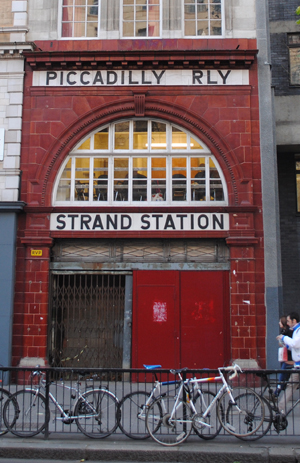
Sixteen London Underground stations were this week listed as Grade II heritage buildings. The Tube stations – several of which were designed by Leslie Green, known for his pioneering use of ‘ox-blood’ red tiles on the exterior of stations to create a consistent brand for the stations – include the now-closed Aldwych (pictured) along with Oxford Circus (originally two stations), Covent Garden and Russell Square as well as Belsize Park, Brent Cross, Caledonian Road, Chalk Farm, Chesham, Perivale, Redbridge, St John’s Wood, West Acton and Wood Green. Three other stations – Arnos Grove, Oakwood and Sudbury Town – have had their status upgraded from Grade II to Grade II*. These three were all designed by modernist architect Charles Holden for the extension of the Piccadilly Line in the 1930s. The new listings were made by Tourism and Heritage Minister John Penrose on the advice of English Heritage.

A new permanent exhibition showing would-be sailors what it is like to fight at sea opens at the HMS Belfast this weekend. Gun Turret Experience: A Sailor’s Story, 1943, is an immersive experience using lights, imagery, sound, smoke effects, movement and smell to recreate the atmosphere and conditions of a gun turret tower when a crew was at battle stations. Visitors are encouraged to follow the story of a young sailor on Boxing Day, 1943 when the German battle cruiser Scharnhorst is sighted leading to the Battle of the North Cape. The Gun Turret Experience, housed within the original triple gun turrets overlooking the quarterdeck, was developed with the help of Royal Navy veterans and eye-witness accounts from the Imperial War Museum (of which the HMS Belfast is part). Entry is included in normal admission price. For more information, see www.hmsbelfast.iwm.org.uk.

• Now On: See the dress the Duchess of Cambridge wore when she was married to Prince William in April at this year’s summer opening at Buckingham Palace. The gown, which features a nine foot long train, will be displayed along with the Halo Tiara until 3rd October in the palace ballroom (the same room used for the newly married couple’s reception). The exhibition features video footage of designer Sarah Burton, explaining how the dress was made. This year’s summer opening also features a display of the work of Carl Faberge – including his magnificent jewel-encrusted Imperial Easter Eggs as well as bejewelled boxes and miniature carvings of favorite pets of the royal family. More than half a million people are expected to visit the exhibition. For more information, see www.royalcollection.org.uk/default.asp?action=article&ID=30

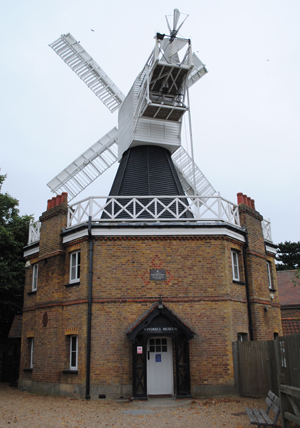
10 small (and fascinating) museums in London…4. The Wimbledon Windmill Museum

A tiny museum located in an 1817 windmill standing in the middle of Wimbledon Common, the Wimbledon Windmill Museum provides an interesting insight into the work and lives of the millers who once occupied it and the thousands of other windmills around the UK.

Displays are located over three levels – the last reached by a steep climb up a ladder – and range from the tools and machinery used by the millers to a room packed with models of different types of windmills (all of which turn when you press a button) through to a room set up as the mill was in the 1870s when it was divided into homes for six families.

As well as the more static displays, there’s also a chance for the kids to make their own flour and a video playing on a loop which goes into considerable detail on the history and function of windmills in the UK.

There are tearooms located next door (and, if you happen to visit when it’s snowing, there’s a great toboggan run located nearby!).

The windmill itself has some interesting historic connections – it was in the miller’s cottage behind the windmill (now much enlarged) that Scouts founder Robert Baden-Powell was staying when he wrote Scouting for Boys in 1907.

While this mill dates from 1817, there is a record of millers being on the common as far back as the 17th century. As well as making flour, the miller also served as the common’s constable.

This job entailed keeping an eye out for robbers operating on the common as well as illegal duelists (Wimbledon Common and Putney Heath were apparently popular spots for this).

Indeed, history records that Thomas Dann – the first miller about whom there is a record – and his wife witnessed an infamous duel between Lord Cardigan and Captain Tuckett from the windmill’s roof. Tuckett was wounded during the second round of shots and subsequently taken into the windmill for treatment of his injuries while Dann took Lord Cardigan into custody (he was eventually acquitted after a trial in the House of Lords).

This is certainly a small museum but, with an entry price of only a couple of pounds, well worth spending a little time to look through.

WHERE: The Wimbledon Windmill Museum, Wimbeldon Common (nearest Tube stations are Wimbledon, Wimbledon Park and Southfields); WHEN: 2pm to 5pm Saturdays, 11am to 5pm Sundays (and Bank Holiday Mondays) until October 30th; COST: £2 adults/£1 concessions and children/£5 families (two adults and up to four children); WEBSITE: www.wimbledonwindmill.org.uk.

LondonLife – SS Robin returns to East London…

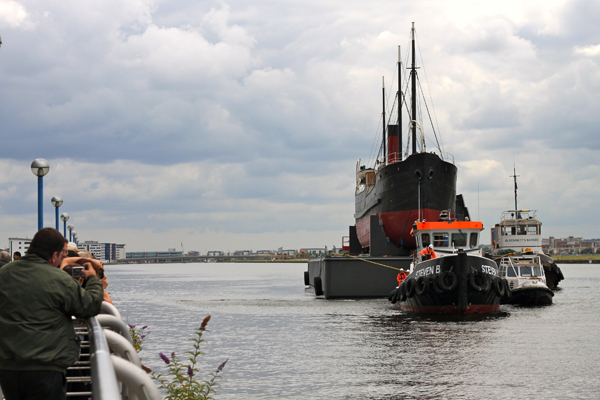
The SS Robin being towed to its new mooring in East London on a floating pontoon. PICTURE: James Spellane/SS Robin Trust.

The world’s oldest complete steamship, the SS Robin, made a dramatic return to the Royal Docks in East London earlier this month. Built in 1890 at the Thames Ironworks shipyard on the River Lea, the coastal cargo steamer was operational for more than 80 years, initially around the coast of Britain and the English Channel and later in Spain where it bore the name Maria. The 300 tonne vessel has just been through a three year restoration project spearheaded by the SS Robin Trust. It has now taken up a temporary mooring on a new floating pontoon while final conservation work is completed. It is anticipated that the steamship – which is listed on the ‘Core Collection’ of the UK National Historic Ships Register meaning it’s seen as historically significant as London’s two other maritime landmarks, the Cutty Sark and HMS Belfast – will be opened to the public. For more information, see www.ssrobin.com.

10 Questions – Martin Stancliffe, Surveyor to the Fabric, St Paul’s Cathedral…

In the first of a new series in which we ask 10 questions of someone involved with one of London’s historic sites, we speak to Martin Stancliffe, Surveyor of the Fabric at St Paul’s Cathedral, about the £40 million, 15 year cleaning and restoration project at the iconic London structure which came to an end last month…

1. What does your job at the cathedral involve? “Advising on all aspects of the care and repair of the fabric of the cathedral, and its setting. This involves devising and leading all fabric projects, major or minor.”

 2. What prompted the 15 year repair and cleaning project? “The perception that the cathedral could reach out more to all its visitors both as a great centre for worship and as a great tourist attraction if it were in better condition and had improved facilities.”

3. How much of a difference has the cleaning and repair project made to the look of the cathedral, both inside and out? “I think it is not too much to say that the cleaning has transformed the appearance of both the exterior and the interior. In particular, the interior now speaks much more clearly of its primary purpose as a great church and a setting for great national services of memorial or celebration. In addition, the programme of repair works in almost all parts of the cathedral has put it into good condition in ways that can be sensed, but cannot  – I hope – be seen.”

4. How many people have been involved? “It is hard to make a count, but the number must run into several hundred.”

5. What trades did the task require and was it easy to source the sort of expertise required? “The various different tasks required a great range of skills, from masons to electricians and scaffolders,  and from expert painters and gilders to conservators. There is a wonderful supply of skilled craftsmen and professionals in this country; but younger people need to be encouraged to understand how creative and rewarding such work is, and to learn the expert skills required to continue to care for buildings like this.”

6. What was the most challenging aspect of the project? “The most challenging aspect was the organisation of the internal cleaning project, which required special techniques and special scaffolding to enable the cathedral to continue its day to day work uninterruptedly throughout the 15 year programme – including having to remove all scaffolding from the interior for the Queen’s Golden Jubilee right in the middle of the project!”

7. Is the cathedral we now see as (original architect) Sir Christopher Wren envisaged it? “No, the interior had already been substantially altered in the 19th century by the removal of the original choir screen, the stripping of paint from all the internal stonework, and the installation of mosaic decorations. However, the atmosphere in the cathedral is certainly closer to how Wren envisaged it than in its gloomy state 15 years ago; and he would certainly have recognised – and welcomed – the radiant quality of light which has been restored to the interior.”

8. Did you make any interesting discoveries about the building during the restoration project? “A building like this is always revealing new things. We discovered much more about how the lower parts of the dome were constructed, and we have understood much better why and how the building moved and settled as a structure over the last 300 years. We also discovered many fragments of the great cathedral which stood on this site for some 600 years before the destruction of the Great Fire, built into the structure of  Wren’s cathedral.”

 9. What’s your favorite part of the cathedral?  “I love all parts of the dome, from the top of the lantern down to its complex foundations on the top of the arches of the nave.”

10. Can you tell us something about St Paul’s that many visitors may be unaware of? “Many people are unaware of the reason why the dome seems so all embracing when you are in the interior. This is because the dome spans right across the whole width of the church,  allowing the aisles to pass through it, unlike St Peter’s in Rome, for instance.”

WHERE: St Paul’s Cathedral, St Paul’s Churchyard (nearest tube station is St Paul’s); WHEN: St Paul’s is open from 8.30am to 4pm (galleries from 9.30am to 4.15pm), Monday to Saturday. Open for worship only on Sundays;  COST: £14.50 an adult/£13.50 concessions/£5.50 a child (6-18 years)/£34.50 a family of four; WEBSITE: www.stpauls.co.uk

Daytripper – Brighton

It’s summer and that means, fingers crossed that the weather holds, Londoners start looking for the beach. One of the easiest to access coastal resorts – just an hour on the train – is the East Sussex town of Brighton.
Its history dates back to before the Doomsday Book and by medieval times, the town – previously known as Brighthelmstone – was prosperous enough to become a target to French raiders who burnt it down during a raid in 1514.

Yet much of what we now know as Brighton dates from the late 18th century when the town was transformed into a fashionable seaside resort. But before we get to that, there’s a couple of notable survivors from earlier days worth mentioning.

First up is the  14th century St Nicholas’ Church which, although considerably altered in later years, still contains a Norman font and has several graves of interest in the churchyard including that of Captain Nicholas Tattersall who carried King Charles II to France in his boat in 1651, as well as those of Phoebe Hessel, famed for having served 17 years in the army during the 1700s disguised as a man, Sake Dene Mohomed who first brought Turkish baths to Brighton and Amon Wilds, a famed Regency architect and builder.

And for a feel of what the medieval streetscape may have been like, head to the central shopping area known as The Lanes which still follows the medieval street pattern (although the shops date from later period) and which, boasting a range of interesting shops, is well worth spending some time poking about in.

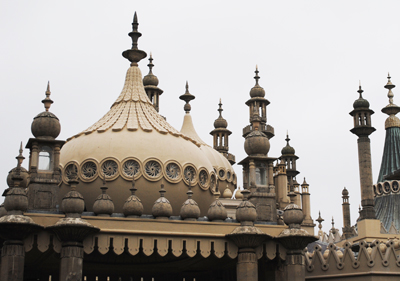
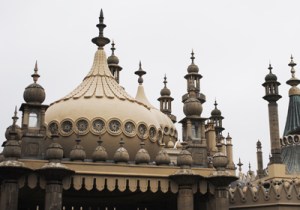
While Brighton had gradually been establishing a reputation as a sea bathing resort in the years prior to 1783, in that year the town’s profile received a valuable boost when the Prince Regent (later King George IV) visited the town. So taken with it was he that not only did he make repeat visits, he also constructed the magnificently opulent Royal Pavilion (pictured) – completed in 1822 and designed by John Nash – which still stands as one of the town’s foremost attractions.

The property, which Queen Victoria sold to the town in 1850 for the grand price of £53,000, boasts a series of exquisitely decorated chambers inspired by exotic ‘oriental’ themes. A 10 year, £10 million restoration project was completed in 1991.

Other properties in the town dating from a similar era include the Brighton Dome, which, completed in 1808, was originally the stables for the Prince Regent (back in the day when the Royal Pavilion was simply a farmhouse – in fact, it’s said that it was that fact people commented that the Prince’s horses were better accommodated than the man himself which helped spur him to build the Royal Pavilion). These days it’s the town’s main landmark entertainment venue and contains a concert hall and theatre.

Another property of the era is the Western Pavilion which feature a large Indian dome in reference to those of the Royal Pavilion and was built by Amon Henry Wilds, son of the architect Amon Wilds and a partner in his architectural practice, in 1831 as a residence. It stands next to the Gothic house built by his father, and another architect, Charles Busby, in the 1820s.

The arrival of the railway in 1841 further opened up the town to Londoners which in itself led to the construction of numerous waterfront hotels (the most famous of which is the Grand Hotel, built in 1864 and the scene of a 1984 IRA bombing aimed at killing then PM Margaret Thatcher).

The boom also saw three piers built running out off the foreshore – the Chain Pier (built in 1823 and destroyed by a storm in 1896), the West Pier (constructed in 1866, the derelict remains of which stand starkly in the waters off the town today after it was closed in 1975), and the Palace Pier (constructed in 1899, it is now hosts a lively funfair and, since 2000, has been formally known as Brighton Pier).

The late 1800s also saw the founding the Booth Museum (1874) by naturalist and collector Edward Thomas Booth (located in Dyke Road, it is now known as the Booth Museum of Natural History) and Volk’s Electric Railway which opened in 1883 and is now the ‘world’s oldest operating electric railway’, still running daily trains between Brighton Pier and Black Rock near the Marina.

Brighton, now part of the City of Brighton & Hove, remains a popular beach resort for Londoners, both for its beach and its nightlife, so on a warm day be prepared to fight the crowds.

Among the town’s other, more recent, attractions are the Sea Life Centre on the waterfront, home to more than 150 creatures including sharks and rays, the Brighton Museum & Art Gallery in the city’s ‘cultural quarter’ near the Royal Pavilion, and the Brighton Fishing Museum, also located on the waterfront, it traces the story of the town’s fishing community.

Visit Brighton has a range of maps and walks to help you explore the city. Visit www.visitbrighton.com for more information.
Around London – Yuri Gagarin honored; Londinium by iPhone; celebrating a year to the Olympics; and, British Museum hopes to buy Europe’s oldest book…

Earlier this month it was former US President Ronald Reagan’s turn to be honored with statue in Grosvenor Square. Last week it was the turn of former Soviet Cosmonaut Yuri Gagarin – the first man in space – to be so honored with a new statue located outside the British Council’s offices in the Mall (opposite another explorer, Captain James Cook). The statue, a gift of the Russian Space Agency Roscosmos, was unveiled to mark the 50th anniversary of Gagarin’s celebratory visit to London on 14th July, 1961, just three months after he completed his orbit of the earth on 12th April that year. The 3.5 metre high zinc alloy figure stands close to Admiralty Arch which was where Gagarin met then Prime Minister Harold MacMillan after he was invited to the UK by the National Union of Foundrymen. Among those present for the unveiling of the statue – which is a replica of one in the town of Lubertsy where Gagarin worked as a foundryman as a teenager – was Gagarin’s daughter Elena Gagarina, now director of the Kremlin Museums, and Vladimir Popovkin, head of the Russian Federal Space Agency. The British Council is running an exhibition, Gagarin in Britain, which looks at the life of Gagarin and the early Soviet space programme, until 14th September – among the objects on display is the first space suit and an ejector seat similar to that Gargarin used when he ejected out of Vostok 1. Entry is by registration only and space is limited – email gargarin@britishcouncil.org is you’d like to register for a place. For more information, see www.britishcouncil.orgPICTURE: Frank Noon/British Council

A new iPhone app which directs people to key sites in what was Roman London (Londinium) will go live on Monday. Developed by the Museum of London and the History Channel, Streetmuseum Londonium will bring to life some of the city’s most significant Roman sites, such as the amphitheatre at Guildhall, using “augmented reality video” which will overlay scenes of Roman London over the modern city while soundscapes will allow users to listen to a ritual at the Temple of Mithras or traders at the forum. In addition, users will be able to ‘digitally excavate’ Roman artifacts including leather bikini briefs and an ancient manicure set. Navigation to these “immersive experiences” will be via a specially created new map of Roman London which will be superimposed on a modern map of the capital, allowing users to see how the city has changed. The launch follows the earlier creation of the Streetmuseum app which guides people to more than 200 sites across the city. More than 200,000 people from across the world have so far downloaded this. Streetmuseum Londinium will be available free to download from 25th July. See www.museumoflondon.org.uk/apps for more.

London will mark one year to go until the Olympic Games next Wednesday with a ceremony in Trafalgar Square which will be broadcast live on BBC1. Among those present with be the International Olympic Committee (IOC) President Jacques Rogge, London Organising Committee of the Olympic and Paralympic Games (LOCOG) chairman Sebastian Coe and Mayor of London Boris Johnson. The event will also feature a live cross to the Aquatics Centre in Olympic Park where Olympic hopeful Tom Daley will make the first dive into the pool.

• The British Library hopes to raise £2.75 million to acquire the world’s earliest surviving intact European book, the 7th century St Cuthbert Gospel. A copy of the Gospel of St John, the book was buried with St Cuthbert on the isle of Lindisfarne in 698 and later found in the saint’s coffin in Durham Cathedral in 1104. The National Heritage Fund Memorial has already awarded £4.5 million to obtain the St Cuthbert Gospel and the Art Fund and The Garfield Weston Foundation have donated £250,000 each. The book has been on long-term loan to the library since 1979 and is regularly on view in the Sir John Ritblat Treasures Gallery. The library was approached last year and given first option to acquire the text after the Society of Jesus (British Province) decided to sell it. A price of £9 million has been agreed, of which £2.75 million remains outstanding. For more, see www.bl.uk.

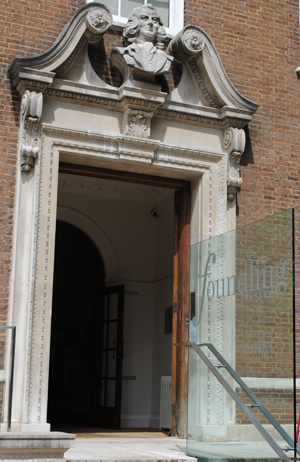
10 small (and fascinating) museums in London…3. The Foundling Museum

Opened in 2004, the Foundling Museum was created to look after the former Foundling Hospital’s collection of art and artifacts and provides a unique and deeply moving insight into the work of the hospital and those who came under its care.

The Foundling Hospital’s origins go back to the 1720s when former mariner and ship-builder Captain Thomas Coram, shocked by the number of abandoned babies he saw in London (it’s estimated that in the early 1700s, there were as many as 1,000 babies being abandoned every year), began a campaign to found a hospital for “exposed and deserted young children”, that is, ‘foundlings’.

The hospital was founded in 1739 after King George II granted it a royal charter and, from that date until its closure in 1953, had some 27,000 children pass through its doors.

The museum’s story is not an easy one to tell for while the hospital was founded with the best of intentions, the life of the children who came into its care – even in the 20th century – remained far from easy; it was not, as one of those who formerly lived at the hospital notes, a life they would wish on anyone else. But the museum handles their story – as well as that of those behind the hospital’s founding – with care and dignity.

Located at 40 Brunswick Square – close to the site of the original hospital, the museum is spread over four floors. On the ground floor is an exhibition which details the hospital’s history and features objects including a series of sketches by the controversial 18th century artist William Hogarth, an ardent supporter of the hospital’s work and later one of the many artists who became a governor, as well as the founding charter document itself.

Among the most poignant of the artifacts to be found in the museum are the tokens mothers left with their children so they could later identify them (these were removed from the children on being taken into the hospital, however, to ensure the child’s anonmity).

The lower ground floor has a space for temporary exhibitions – at present this contains the ‘Foundling Voices’ exhibition in which those who once lived under the care of the hospital tell their stories firsthand in what is an emotional journey into the hospital’s relatively recent past (the exhibition runs until 30th October). It is also home to the reconstructed Committee Room, built as part of the original hospital in the mid-1700s, dismantled and then reconstructed in the new headquarters.

Upstairs (the stairs themselves were taken from the boy’s wing of the original hospital), is a reconstruction of the hospital’s original Picture Gallery which was London’s first public art gallery and was instrumental in raising the profile of the work of the hospital. Among the works it contains is Hogarth’s 1740 portrait of Captain Thomas Coram. Nearby is the Court Room, another reconstruction from the original hospital, this time of the building’s most splendid room, used for meetings of the Board and Governors and other special occasions. It too contains numerous artworks.

The top floor of the building houses the Gerald Coke Handel Collection, said to be the greatest collection of artifacts relating to composer George Frideric Handel in the world. Handel’s assocation with the museum goes back to 1749 when he offered a performance of his music to help fund the hospital’s completion. He held another the following year, this time performing the Messiah, and after that Handel agreed to an annual benefit performance – a practice which continued until his death in 1759.

Key artifacts in the Handel collection include the composer’s will and codicils, written in his own hand, as well as programme from the first performance of the Messiah along with other documents and artworks.

WHERE: The Foundling Museum, 40 Brunswick Square, Bloomsbury (nearest Tube station is Russell Square); WHEN: 10am to 5pm, Tuesday to Saturday/11am to 5pm Sunday (closed Mondays); COST: £7.50 an adult/£5 concessions/children under 16 free; WEBSITE: www.foundlingmuseum.org.uk.

LondonLife – Waterbus on Regent’s Canal

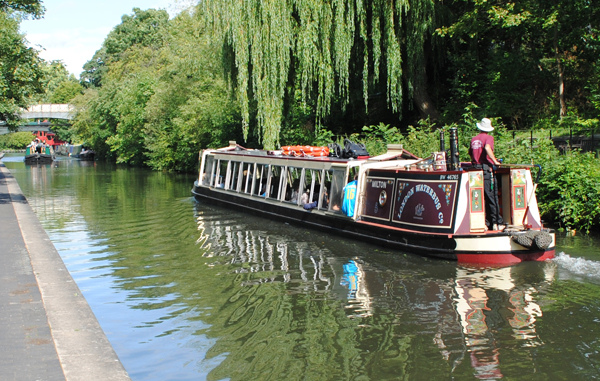
Regent’s Canal was fully opened in 1820 and linked the Grand Junction Canal, which ended at Little Venice in Paddington in London’s west, with the East London Docks and Limehouse in the east. Architect John Nash was one of the directors of the canal company and it was thanks to his friendship with the Prince Regent, the future King George IV, that the canal obtained its name. Nash saw the canal as an integral part of his plans for The Regent’s Park and it now runs along the park’s northern edge. Nash’s assistant James Morgan was the canal’s chief engineer. The waterbus service, which operates between Little Venice and Camden Loch, runs at various times daily until October. See here for timetable details.