This Week in London – Botticelli at the V&A; Shakespeare recalled in free sound and light show; and, ‘punk’ captured on film…

VenusA major new exhibition opening at the V&A this Saturday will feature more than 150 works from around the world in a display exploring how artists and designers have responded to the artistic legacy of Botticelli. Italian artist Sandro Botticelli (1445-1510) was largely forgotten for more than 300 years after his death but is now widely recognised as one of the greatest artists of all time. Botticelli Reimagined features painting, fashion, film, drawing, photography, tapestry, sculpture and print with works by Dante Gabriel Rossetti, Edward Burne-Jones, William Morris, René Magritte, Elsa Schiaparelli, Andy Warhol and Cindy Sherman. The exhibition is divided into three sections: ‘Global, Modern, Contemporary’, ‘Rediscovery’, and ‘Botticelli in his own Time’. Runs until 3rd July. Admission charge applies. For more, see www.vam.ac.uk/Botticelli. PICTURE: Venus, after Botticelli by Yin Xin (2008). Private collection, courtesy Duhamel Fine Art, Paris. (Name of artist corrected)

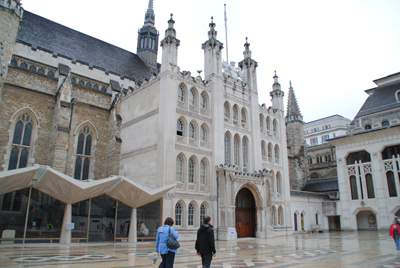
The historic facade of Guildhall in the City of London will become a canvas for a free son et lumiére show on Friday and Saturday nights to mark the 400th anniversary of the death of William Shakespeare. The display, which runs on a 20 minute loop between 6.45pm and 8.45pm, will feature period images and music from the City’s extensive archives and use 3D projection mapping techniques to transform the Dance Porch of the 15th century building. The Guildhall Art Gallery will be open from 6pm to 9pm and, as well as allowing people to view a property deed for a house in Blackfriars which was signed by the Bard, will feature a pop-up bar with a Shakespeare-themed cocktail. For more on this and other events, see www.cityoflondon.gov.uk/shakespeare400.

The 40th anniversary of punk is the subject of a new photographic exhibition drawn from the archives of world renowned music photographer and rockarchive.com founder Jill Furmanovsky which opened at the City of London Corporation’s Barbican Music Library this week. Chunk of Punk, which runs until 28th April, features many of Furmanovsky’s well-known punk-related images as well as hitherto unseen pictures with The Ramones, Buzzcocks, The Clash, The Sex Pistols, Blondie, The Undertones, Siouxsie and the Banshees, Blondie and Iggy Pop among the bands featured. The exhibition forms part of Punk.London: 40 Years of Subversive Culture. For more, see www.cityoflondon.gov.uk.

Send all items for inclusion to exploringlondon@gmail.com.

10 London ‘battlefields’ – 10. The Battle of London…

The final in our series looking at London ‘battlefields’, this week we take a look at the so-called Battle of London, the air war fought over London during World War II which, along with the bombing of other British cities, is best known by the phrase The Blitz (it forms part of the greater Battle of Britain).

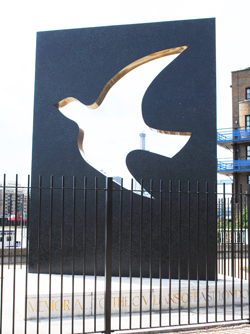
Blitz-memorialTaking place from the afternoon of 7th September, 1940, until May, 1941, the Blitz saw London sustain repeated attacks from the German Luftwaffe, most notably between 7th September and mid November when the city was bombed on every night bar one.

The night of 7th September, the first night of the Blitz (a short form of ‘Blitzkrieg’ – German for ‘lightning war’), was among the worst – with more than 450 killed and 1,300 injured as wave after wave of bombers attacked the city. Another 412 were killed the following night.

One of the most notorious raids took place on 29th December when  incendiary bombs dropped on the City of London starting what has been called the Second Great Fire of London. Around a third of the city was destroyed, including more than 30 guild halls and 19 churches, 16 which had been rebuilt by Sir Christopher Wren in the aftermath of the Great Fire of London in 1666.

The city was only attacked sporadically in the early months of 1941 but the night of the last major raid of the Blitz – that of 10th May, a night subsequently known as The Longest Night – saw the highest casualties of any night with almost 1,500 people reportedly killed.

The Blitz killed almost 30,000 civilian in London, and destroyed more than a million homes with the worst hit districts poorer areas like the East End.

The battle wasn’t one-sided – the RAF fought the Luftwaffe in the skies and did have some wins – on 15th September (a day known as Battle of Britain Day), for example, they shot down some 60 aircraft attacking London for the loss of less than 30 British fighters.

It was this victory which led the Germans to reduce the number of daylight attacks in favour of night-time raids which, until the launch of the RAF’s night-time fighters in 1941, meant they met little effective resistance. This included that of ground defences – throughout December, 1940, it’s said that anti-aircraft fire only brought down 10 enemy planes.

Yet, the Blitz did not lead to a German victory. For the Nazi regime, the purpose of the constant bombing of London (and other cities) was aimed at sapping the morale of its residents to the extent that they would eventually be forced to beg for peace. But the plan failed and Londoners, digging deep, proved their mettle in the face of fear.

Hundreds of thousands of people were involved in  Civil Defence working in a range of jobs – everything from air raid shelter wardens to rescue and demolition teams – and worked alongside firefighters whose numbers were supplemented by an auxiliary service. Naturally all suffered a high level of casualties.

As the weeks passed, the carnage mounted in terms of the loss of and damage to life, destruction of property and psychological toll. And yet the Londoners – sheltering Underground, most famously in the tunnels of the Tube – survived and, as had been the case after the first Great Fire of London, the ruined city was eventually rebuilt.

There are numerous Blitz-related memorials in London, many related to specific bombings. But among the most prominent are the National Firefighters Memorial, located opposite St Paul’s Cathedral, which pays tribute to the firefighters who lost their lives in the war (as well as in peacetime), and a riverside memorial in Wapping honouring civilians of East London killed in the Blitz.

A Moment in London’s History – Publication of Charles Dickens’ ‘A Christmas Carol’…

St-Michael's-CornhillCredited as “the man who invented Christmas”, Victorian author Charles Dickens’ featured Christmas celebrations in many of his works – but none more so than in his famous story, A Christmas Carol.

Published 172 years ago this December, the five part morality tale centres on the miserly Londoner Ebenezer Scrooge who, following several ghostly visitations by the likes of the Ghosts of Christmas Past, Present and Yet to Come, becomes a changed man and recaptures the essence of what Christmas is all about.

The book – whose characters (said to have been partly based on people he knew in real life) also include the abused clerk Bob Cratchit and his ever positive youngest son, Tiny Tim – is based in London.

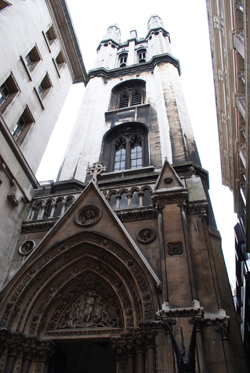
Among key locations mentioned in the book is Scrooge’s counting house, said to have been located in a courtyard off Cornhill (it’s been suggested this is Newman’s Court, thanks to a reference to a church tower, believed to be St Michael’s Cornhill – pictured), the home of Scrooge (it has been speculated this was located in Lime Street), and the home in Camden Town where the Cratchits celebrate their Christmas (perhaps based on one of Dickens’ childhood homes in Bayham Street). City of London institutions like the home of the Lord Mayor, Mansion House, and the Royal Exchange are also mentioned.

The book, which apparently only took Dickens six weeks to write while he was living at 1 Devonshire Terrace in Marylebone, was first published on 19th December, 1843, by London-based firm Chapman & Hall. Based at 186 Strand, they published many of Dickens’ works – everything from The Old Curiosity Shop to Martin Chuzzlewit – along with those of authors such as William Makepeace Thackeray and Elizabeth Barrett Browning.

A Christmas Carol‘s first print run of 6,000 sold out any Christmas Eve that same year and sales continued to be strong into the following year. Despite its warm reception by critics and popularity among the public, the book’s profits were somewhat disappointing for Dickens who had hoped to pay off his debts (he also lost out when he took on some pirates who printed their own version two months after its publication; having hauled them to court Dickens was apparently left to pay costs when they declared bankruptcy).

Dickens would later give some public readings of the book, most notably as a benefit for the Great Ormond Street Hospital for Sick Children (his last public reading of the book took place at St James’s Hall in London on 15th March, 1870, just three months before his death).

The book, which has apparently never been out of print, went on to become something of a Christmas classic and has been adapted into various films, theatre productions, radio plays and TV shows (one of our favourites is The Muppet Christmas Carol, dating from 1992).

10 London ‘battlefields’ – 8. The Gordon Riots…

Well, not so much a battle as a widespread civil insurrection, the Gordon Riots, often described as the worst riots London has ever seen, resulted in considerable property destruction and numerous deaths.

Houses-of-Parliament10The riots, which took place against a backdrop of high taxation, widespread poverty, and unjust laws, had its origin in the passing of the Catholic Relief Act of 1778 which intended to reduce entrenched discrimination against Roman Catholics in Britain and redress some of anti-Catholic laws which had been introduced 80 years earlier, partly in an attempt to get more Catholics to join the British Army to fight against the United States of America in what’s now known as the War of Independence.

While it initially passed without any real hostility, an attempt to extend the Act’s provisions to Scotland in 1779 provoked such a serious response there that the action was withdrawn. Following the Scottish success in having the provisions withdrawn, the Protestant Association of London was founded with the aim of spear-heading opposition to the act’s provisions. Lord George Gordon was elected president of the newly formed Protestant Association of London in November of that year.

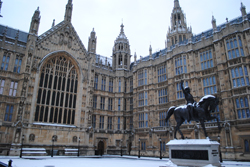
Following failed attempts to have King George III repeal the Act (Lord Gordon had several audiences with the King but failed to convince him of his case and was eventually banned from His Majesty’s presence), on 2nd June, 1780, Gordon and the members of the association marched on the Houses of Parliament (pictured above although the current buildings date from much later than these events) to deliver a petition demanding the Act be repealed.

They crowd, estimated to have been as big as 60,000 strong although a figure in the mid-40,000s is generally accepted, attempted unsuccessfully to force their way into the House of Commons before Lord Gordon, wearing a blue cockade (the symbol of the Protestant Association in his hat) was granted access to deliver the document.

Outside, meanwhile, things went from bad to worse and the crowd erupted into rioting, attacking members of the House of Lords, including bishops, as they attempted to enter and damaging carriages (including that of Lord Chief Justice William Murray, 1st Earl of Mansfield). Soldiers were eventually summoned to quell the riot which they did without violence. Inside, the members of the House of Commons voted down the petition by an overwhelming majority.

That night violence flared up again with the Roman Catholic Sardinian Embassy Chapel in Lincoln’s Inn Fields set alight while the chapel of the Bavarian Embassy in Golden Square, Soho, was destroyed and random violence carried out in streets known to be the residence of wealthy Catholics.

The next day, a crowd gathered in Moorfields – known to be home to many poor Irish Catholic immigrants – and that night attacked many homes.

The violence spread over the following days and among the buildings attacked was Newgate Prison (which was set on fire), the Fleet Prison, and the Clink in Southwark – hundreds of prisoners escaped – as well as Catholic churches, more embassy chapels, homes of known Catholics and politicians who had been associated with the passing of the act (including that of Lord Mansfield and Sir George Savile, who had proposed the Catholic Relief Act) and the Bank of England (the attack on the bank led to the long-standing tradition of soldiers guarding the bank).

Without a standing police force to tackle the mobs, on 7th June the army was called out with orders to fire on groups of four or larger who refused to disperse. In the next few days, well over 200 people (possibly more than 300) were shot dead and hundreds more wounded. Hundreds of the rioters were arrested and, of those, about 25 eventually executed. Gordon himself was arrested and charged with high treason but found not guilty.

LondonLife – Rediscovering Londinium’s residents…

Harper Road Woman (c) Museum of LondonA detailed picture of the inhabitants of Roman London, known as Londinium, has been created for the first time, the Museum of London announced this week. Detailed analysis of the DNA of four skeletons has revealed a culturally diverse population. The examined skeletons include that of a Roman woman (pictured left), likely to have been born in Britain with northern European ancestry, found buried with high status grave goods at Harper Road, Southwark, in 1979, and another of a man, whose DNA revealed connections to Eastern Europe and the Near East, who was found at London Wall in 1989 with injuries to his skull which suggest he may have been killed in the nearby amphitheatre before his head was dumped in a pit. The other two skeletons examined were found to be that of a blue-eyed teenaged girl found at Lant Street, Southwark, in 2003, believed to have been born in north Africa, whose ancestors lived in south-eastern Europe and west Eurasia, and that of an older man found at Mansell Street who was born in London and whose ancestry had links to Europe and north Africa. The examination – the first multi-disciplinary study of the inhabitants of a Roman city anywhere in the empire – also revealed that all four suffered from gum disease. Caroline McDonald, senior curator at the museum, said that while it has always been understood Roman London was a culturally diverse place, science was now “giving us certainty”. “People born in Londinium lived alongside people from across the Roman Empire exchanging ideas and cultures, much like the London we know today.” The four skeletons will form the basis of a new free display, Written in Bone, opening at the Museum of London on Friday. PICTURE: © Museum of London

WHERE: Museum of London, 150 London Wall (nearest Tube stations are Barbican and St Pauls); WHEN: 10am to 6pm daily; COST: Free; WEBSITE: www.museumoflondon.org.uk.

10 London ‘battlefields’ – 4. Jack Cade’s rebellion…

London-StoneLittle is known of Jack Cade until the former soldier from Kent led an uprising against the rule of King Henry VI during the Hundred Years War with France. And London was a key site of fighting during the uprising.

Cade, who adopted the name John Mortimer and who some claimed to have been a relative of Richard, Duke of York, was said to have been a veteran of the war who led rebels protesting against the king’s rule amid the general state of disorder affecting England at the time which saw such abuses as lands being illegally seized and a lack of confidence in courts to rule fairly. There was also some discontent over the loss of lands of Normandy.

While many of the rebels were peasants, the rebellion – which rose in late May or early June, 1450 – was also supported by nobles and churchmen who were protesting what they saw as poor governance.

Led by Cade, who also attracted the title ‘Captain of Kent’, were camped on Blackheath in what is now the city’s south-east by mid-June and there apparently presented an embassy from the king with a list of grievances.

Thomas, Lord Scales – authorised by the king to raise troops, subsequently marched out to Blackheath but Cade and his rebels retreated into the forests of Kent and managed to lure the royal troops into an ambush.

Cade and the rebels returned to Blackheath while back in London the Royal soldiers turned mutinous, angered over the defeat. They were disbanded to protect the City and the king retired to Kenilworth Castle, effectively abandoning London to the rebels (despite the offer of the Lord Mayor and aldermen to resist the rebels).

Cade then marched on London itself, reaching Southwark on 2nd July (apparently using the now vanished White Hart Inn as his HQ). He forced his way over London Bridge the next day, cutting the drawbridge ropes personally with his sword to ensure it couldn’t be raised again

Such was the support the rebels had in London, that resistance was initially minimal. Following his entry to London, Cade struck the famous London Stone (pictured above – for more on it, see our earlier post here) with his sword, declaring “Mortimer” was now lord of the city.

While initially under tight control, Cade gradually lost control of many of his followers who turned to looting. Meanwhile, to head off an attack on the Tower of London – where Lord Scales had retreated – he handed over the hated Lord Treasurer, James Fiennes, Lord Saye, and his son-in-law William Crowmer, Under Sheriff of Kent (they had apparently been imprisoned in the Tower by the King for their own protection such as their unpopularity). Both were beheaded – Fiennes at Cheapside, Crowmer at Mile End – and their heads placed on poles on London Bridge.

The king’s supporters in the Tower had regrouped by early July and, with the rebels, while initially welcomed by many, now clearly having outstayed their welcome, they and city militias drove the rebels from the streets and had taken back the northern half of London Bridge (another bloody battle over the bridge) when William of Waynflete, Bishop of Winchester, arrived with promises of pardon for the rebels on behalf of the Lord Chancellor and Archbishop of Canterbury, John Kemp.

His forced much reduced, Cade – a pardon in his pocket under Mortimer’s name only – moved back into Kent and continued to cause trouble. He was, however, captured by the new Sheriff of Kent, Alexander Iden, on 12th July, – one version says this took place near Heathfield in Sussex at a hamlet now known as Cade Street. In any event, Cade was mortally wounded during the struggle and died en route to London.

His corpse, however, completed the journey and Cade was hanged, drawn and quartered and his head placed atop a pole on London Bridge.

While the rebel ringleaders were later captured and killed, in the most part King Henry VI honoured the pardons he had granted.

The story of Cade’s rebellion features in William Shakespeare’s play, King Henry the Sixth.
LondonLife – City of spires…

City-of-Spires

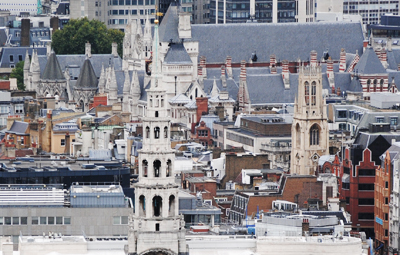
View looking west from St Paul’s Cathedral down Fleet Street.

What’s in a name?…Bleeding Heart Yard

Bleeding

There’s a couple of different suggestions as to how Bleeding Heart Yard – a small courtyard located in the Farringdon area of the City of London, just north of Ely Place – obtained its rather descriptive – and gory – name.

The more prosaic answer is that it was named after an inn which, from the 16th century, stood on the yard and had a sign showing the heart of the Virgin Mary pierced by five swords.

The more interesting answer, on the other hand, is that the name commemorates the horrible murder of Lady Elizabeth Hatton (of the famed Cecil family), second wife of Sir William Hatton (formerly known as Newport), and, after his death, wife of Sir Edward Coke.

The story goes that her corpse was found here on 27th January, 1626, with the beating heart torn from the body.

A version of the legend – albeit with a slightly different protagonist – appears in a story published in Bentley’s Miscellany in 1837 which told of how the wife of Sir Christopher Hatton (he was actually the uncle of Sir William Hatton), made a somewhat ill-conceived pact with the Devil to secure wealth, position and a mansion in Holborn. The Devil dances with her during the housewarming party at the new home and then tears out her heart, found beating in the yard the next morning.

The yard also features in Charles Dickens’ Little Dorrit where it is the location of the home of the Plornish family.

This Week in London – Lord Mayor’s Show marks 800 years; Dutch masters and Thomas Rowlandson at Queen’s Gallery; and, Alexander Calder on show at Tate…

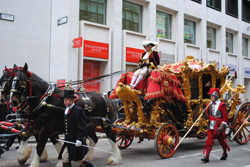
Lord-Mayor's-ShowThe Lord Mayor’s Show will mark its 800th anniversary on Saturday as the newly elected Jeffrey Mountevans – the 688th Lord Mayor of the City of London – makes his way through the City to Westminster to swear loyalty to the Crown. The procession of 7,000 people, some 180 horses and 140 vehicles will set off on its way along a three-and-a-half mile route at 11am, starting at Mansion House and traveling down Cheapside to pause at St Paul’s Cathedral (which is open for free all day) before heading on via Ludgate Hill and Fleet Street to the Royal Courts of Justice before returning the City via Queen Victoria Street from 1.10pm. In a special nod to the 800th anniversary, the famous bells of St Mary-le-Bow will ring out a special 800-change at noon. The day will conclude with fireworks over the River Thames kicking off at 5.15pm (for the best view head down to the riverside between Waterloo and Blackfriars Bridges, either on Victoria Embankment or on the South Bank). The show’s origins go back to 1215 when, in exchange for a Royal Charter granting the City of London the right to elect its own mayor, King John insisted the newly elected mayor travelled to Westminster each year to swear loyalty to the Crown. For more (including a map to print out), see https://lordmayorsshow.london. PICTURE: From a previous show.
Vermeer’s The Music Lesson is among 27 of the finest 17th and 18th century Dutch paintings in the Royal Collection which will go on display in a new exhibition at the Queen’s Gallery at Buckingham Palace from tomorrow. Masters of the Everyday: Dutch Artists in the Age of Vermeer also features works by the likes of Gerrit Dou, Pieter de Hooch and Jan Steen, all produced during what is known as the Dutch ‘Golden Age’. The exhibition is being shown alongside another display – High Spirits: The Comic Art of Thomas Rowlandson – which will focus on the work of 18th and early 19th century caricaturist Thomas Rowlandson. Around 100 of Rowlandson’s works feature in the display with highlights including The Two Kings of Terror featuring Napoleon and Death sitting face-to-face after Napoleon’s defeat at Leipzig in 1813, The Devonshire, or Most Approved Method of Securing Votes depicting Georgiana, Duchess of Devonshire, kissing a butcher (it was claimed she had claimed kisses for votes in the Westminster election of 1784), and A York Address to the Whale. Caught lately off Gravesend in which the Duke of York thanks a whale for distracting attention from accusations that his mistress was paid by army officers to secure promotions from the Duke. Admission charge applies. Both exhibitions run until 14th February, 2015. For more, see www.royalcollection.org.uk.

The first major UK exhibition of the works of kinetic sculpture pioneer Alexander Calder opened at the Tate Modern this week. Alexander Calder: Performing Sculpture features more than 100 of the ground-breaking 20th century artist’s works which trace how Calder turned sculpture from the idea of a static object to a continually changing work to be experienced in real time. Works on show include figurative wire portraits of artists – Joan Miró and Fernand Léger (both 1930), works exploring the idea of forms in space – Red Panel, White Panel and Snake and the Cross (1936), motorised mobiles such as Black Frame and A Universe (1934), and chiming mobiles such as Red Gongs (1950) and Streetcar (1951). It closes with the large scale Black Widow (c.1948), shown for the first time ever outside Brazil. Runs until 3rd April. Admission charge applies. For more, see www.tate.org.uk.

Send all items for inclusion to exploringlondon@gmail.com.


A Moment in London’s History – News of the victory at Agincourt reaches the city…

It wasn’t until four days after the battle which had taken place on 25th October, 1415, that news of King Henry V’s stunning victory over the French reached the English capital.

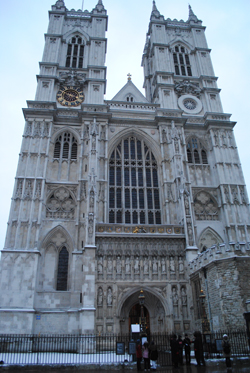
Westminster-Abbey-frontThe news apparently reached London very early in the morning and church bells were rung in celebration and a Te Deum sang in thanksgiving in many.

At 9am, a solemn procession of clergy made their way from St Paul’s Cathedral in the City to the shrine of St Edward the Confessor in Westminster Abbey (pictured) to give thanks.

Other attendees at the abbey included the Mayor-elect, Nicholas Wotton (this was the first of two occasions on which he was elected Lord Mayor), and the alderman of London, as well as the Queen Dowager, Joan of Navarre.

A few days later, on the 4th November, King Henry V’s brother – John of Lancaster, the Duke of Bedford, announced the news to Parliament.

King Henry V, meanwhile, arrived back in Dover on 16th November (apparently as a great snowstorm was making its presence felt) and headed for London. After pausing in Canterbury to give thanks in the cathedral and St Augustine’s Abbey, he reached the manor of Eltham (now in south-east London) on 22nd November.

He was met the next day on Blackheath by Wotton and City dignitaries who then, along with what were recorded as a crowd of 20,000 citizens, accompanied him and his small retinue, which included some of his most high profile prisoners such as Charles d’Orléans, Duke of Orléans (who spent 25 years as a prisoner in England), and Marshal Boucicaut (he would die six years later in Yorkshire), towards London.

There, welcomed as Henry V, “King of England and France”, he processed through the City which had been elaborately decorated – the decorations included the hanging of various coats of arms from various prominent sites as well as the positioning of statues of the likes of St George – ahead of his arrival.

Travelling down Cheapside, the king – who was modestly dressed in a purple gown and had eschewed wearing a crown for the event – stopped at St Paul’s where he performed his devotions, before proceeding to Westminster where he did the same before taking up residence for the night in the nearby Palace of Westminster.

On the king’s orders, a solemn mass was held in St Paul’s the next day for the fallen of both sides. The victorious king had returned!

10 London ‘battlefields’ – 2. ‘London Bridge is falling down’…

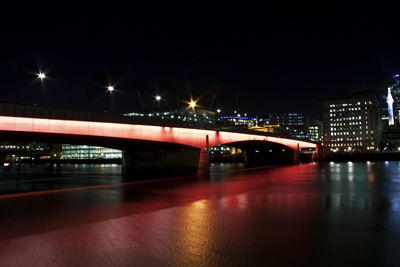
London-Bridge3We’ve touched on this story before but it’s worth a revisit as part of this series. London changed hands several times during the later half of the first millennium as the Anglo-Saxons fought Vikings for control of the city, meaning the city was the site of several battles during the period.

One of the most memorable (or so legend has it, there are some archaeologists who believe the incident never took place) was the battle in 1014 in which London Bridge – then a timber structure (today’s concrete bridge is pictured above) – was pulled down. A story attributed to the Viking skald or poet Ottarr the Black but not found in Anglo-Saxon sources, the event, if it did take place, did so against the backdrop of an ongoing conflict between the Danes and Anglo-Saxons.

Anglo-Saxon London had resisted several attempts at being taken by the Vikings – a fire was recorded in the city in 982, possibly caused by a Viking attack – and in 994, the Anglo-Saxon Chronicle reports that a fleet of 94 Danish and Norwegian ships were repelled with prejudice. Further attacks was driven back in 1009 and it wasn’t until 1013 that the city finally submitted to Danish rule after Sweyn Forkbeard had already claimed Oxford and Winchester.

But Sweyn, the father of the famous King Canute (Cnut), didn’t hold it long – he died on 3rd February the following year.

The deposed Anglo-Saxon King Æthelred II (also spent Ethelred, he was known as ‘the Unready’) – who had been forced to flee from London, which he used as his capital, to what is now Normandy thanks to Sweyn’s depredations – is said to have seized his chance and along with the forces of his ally, the Norwegian King Olaf II, he sailed up the Thames to London in a large flotilla.

The Danish had taken the city, occupying both the city proper and Southwark, and were determined to resist. According to the Viking account, they lined the timber bridge crossing the river and rained spears down on the would-be invaders. (The bridge, incidentally, had apparently been built following the attack in 993, ostensibly to block the river and prevent further incursions further upstream – there is certainly archaeological evidence that a bridge existed in about the year 1000).

Not to be beaten, Æthelred’s forces, using thatching stripped from the rooves of nearby houses to shield themselves, managed to get close enough to attach some cables to the bridge’s piers, pulling the bridge down and winning the battle, retaking the city.

There’s much speculation that the song London Bridge is Falling Down was inspired by the incident but it, like much of this story itself, remains just that – conjecture (although Ottarr’s skald does sound rather familiar).

The bridge was subsequently rebuilt and King Æthelred died only two years later, on 23rd April, 2016. The crown subsequently passed to his son Edmund Ironside but he too died after ruling for less than a year leaving Viking Canute to be crowned king.

PICTURE: http://www.freeimages.com

Wrapping up 10 small, ‘secret’ and historic gardens in central London…

Over the past couple of months our special Wednesday series has looked at “10 small, ‘secret’ and historic gardens in central London”. So we’re finishing the series by taking a quick look back at the 10 gardens we featured (and providing a single point where you can find any you may have missed)…

10 small, ‘secret’ and historic gardens in central London…1. Goldsmiths’ Garden…

10 small, ‘secret’ and historic gardens in central London…2. Whittington Garden…

10 small, ‘secret’ and historic gardens in central London…3. St Dunstan in the East Garden…

10 small, ‘secret’ and historic gardens in central London…4. St Mary Aldermanbury Gardens…

10 small, ‘secret’ and historic gardens in central London…5. Seething Lane Garden…

10 small, ‘secret’ and historic gardens in central London…6. Red Cross Garden, Southwark…

10 small, ‘secret’ and historic gardens in central London…7. St Swithin’s Church Garden…

10 small, ‘secret’ and historic gardens in central London…8. Postman’s Park…

10 small, ‘secret’ and historic gardens in central London…9. Garden of Rest, Marylebone…

10 small, ‘secret’ and historic gardens in central London…10. Geffrye Museum Gardens…

Do you have a favourite? Or maybe there’s a ‘small, secret and historic’ garden we didn’t mention that you love (and we may mention in a future special)?


Lost London – Church of St Alban, Wood Street…

This church, which survived until it was largely destroyed by bombing in World War II, isn’t completely lost – its tower still survives in the middle of Wood Street in the City.

St-Alban's-Wood-StreetThe church, one of a number dedicated to St Alban (Britain’s first Christian martyr) in London throughout its history, was medieval in origin although it has been argued its foundation dates back to the 8th century Saxon King Offa of Mercia who is believed to have had a palace here with the chapel on this site (Offa is also credited as the founder of St Alban’s Abbey).

The church had fallen into disrepair by the early 17th century and was demolished and rebuilt in 1630s. It proved unfortunate timing for only 32 years later it was completely destroyed again, this time in the Great Fire of London.

Following the Great Fire, the church, now combined with the parish of St Olave, Silver Street, was among those rebuilt to the designs of Sir Christopher Wren and completed in the mid-1680s.

It was restored in the late 1850s under the eye of Victorian architect Sir George Gilbert Scott and the four pinnacles on the tower, which stood on the north side of the church, were replaced later that century.

It survived until World War II when the building was burnt out and partly destroyed on a single night during the Blitz in December, 1940. The remains, with the exception of Wren’s Perpendicular-style tower, were later demolished in the 1950s (by which time the church had been united with the parish of  St Vedast, Foster Lane).

The Grade II*-listed tower was converted into a rather unusual private dwelling in the 1980s.

10 small, ‘secret’ and historic gardens in central London…8. Postman’s Park…

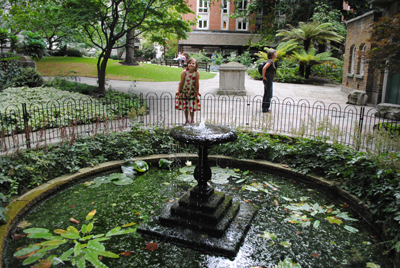
Postman's-ParkHousing one of London more unique memorials, Postman’s Park in the City’s north is located on what were once the churchyards and burial grounds of three different churches.

The park – which took its name from its popularity with postal workers who came here to escape their job at the nearby former General Post Office (read a Lost London article on the GPO here) – opened in 1880.

It was originally located on the site of the former churchyard of St Botolph’s-without-Aldersgate and was subsequently expanded to incorporate the adjacent churchyard of St Leonard, Foster Lane, and the burial ground of Christ Church, Greyfriars (also known as Christ Church, Newgate Street). Some of the headstones still stand along the park’s boundaries.

Postman's-Park3Its key feature is the G.F. Watts Memorial To Heroic Self Sacrifice (pictured, right). Victorian artist and philanthropist George Frederic Watts proposed the memorial commemorating “heroic men and women” who had given their lives to save others to mark Queen Victoria’s Jubilee in 1887 but the memorial which now stands there wasn’t built until 1900.

The memorial consists of a loggia, the inside of which is lined with glazed tablets. Each of these commemorates acts of bravery by “everyday heroes” as they attempted to rescue people from fires, runaway trains, sinking ships and drowning. There were 13 plaques at the time of his death in 1904 and his wife Mary added a further 34.

The latest of the memorials commemorating 62 individuals was added in 2009 (for more details, head to our earlier post here, part of our Curious London Memorials series; you can also find more about the memorial, including a free app, here).

The park also features a sundial and fountain amid bright flower beds and various species of trees including a large banana tree, a dove tree and Tasmanian tree ferns.

Claims to fame include its role in the 2004 film Closer, which starred Natalie Portman, Julia Roberts, Jude Law and Clive Owen (we won’t go into details, just in case you haven’t seen it!).

WHERE: Postman’s Park, between King Edward Street and St Martin’s le Grand (nearest tube stations are St Paul’s and Barbican); WHEN: The park, managed by the Corporation of London, is open 7am to 8pm or dusk (whichever is earlier); COST: Entry is free; WEBSITE: www.cityoflondon.gov.uk/things-to-do/green-spaces/city-gardens/visitor-information/Pages/Postman’s-Park.aspx.

Postman's-Park2

This Week in London – Palaces mark Queen Elizabeth II’s long reign; Richmond Park’s open day; celebrating a famous London redhead; and, London shops features in new work…

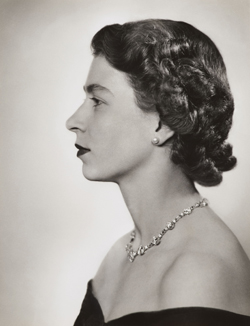
Dorothy-Wilding-1952A special photographic display has opened at Buckingham Palace this week to commemorate the fact that Queen Elizabeth II has this week become Britain’s longest-reigning monarch. The outdoor photographic display Long To Reign Over Us features a selection of photographs spanning the period from 1952 to today including informal family moments, official portraits and visits of the Queen to places across the UK and Commonwealth. Highlights include a black and white portrait by Dorothy Wilding from the start of the Queen’s reign in 1952, Cecil Beaton’s official Coronation Day portrait from 1953 and a 2006 image of the Queen with her Highland Ponies. The displays, which are also being shown as Windsor Castle and the Palace of Holyroodhouse in Edinburgh, can be seen by visitors to Buckingham Palace’s summer opening until 27th September. Admission charge applies. For more, see www.royalcollection.org.uk. PICTURE: Dorothy Wilding. Royal Collection Trust/© William Hustler and Georgina Hustler/National Portrait Gallery, London 

Still celebrating the Queen becoming Britain’s longest reigning monarch, and a new film installation celebrating the reigns of Queen Elizabeth II and Queen Victoria – whose reign she has now surpassed – has opened at Kensington Palace. The film installation explores key moments in the reigns of both – coronations, weddings, births as well as other key moments in their public lives –  and also examines the impact of new technologies in the reigns of both queens. For more, see www.hrp.org.uk/kensingtonpalace.

Richmond Park in London’s south-west is holding its annual open day this Sunday with a range of activities for kids including pony rides, the opportunity to see inside a bug hotel with a fibro-optic camera and the chance make pills in a restored Victorian pharmacy. The Holly Lodge Centre, normally reserved for schools and learning groups, will open its doors to the general public will be at the centre of the day, offering a range of activities for children while there will also be a guided walk led by the Friends of Richmond Park, vintage car displays, and a World War I re-enactment. The day runs from 11am to 4pm. Entrance to the Royal Park is free but parking is £5. For more, see www.royalparks.org.uk.

This Saturday is Redhead Day UK 2015 and to mark the occasion, the Guildhall Art Gallery in the City of London is inviting visitors to celebrate by taking a selfie with Dante Gabriel Rossetti’s iconic redhead La Ghirlandata. Painted by Rossetti in 1873, the artwork, said to be one of the finest pre-Raphaelite works in the world, is on permanent display at the gallery. The painting features on the cover of Jacky Colliss Harvey’s new book Red: A Natural History of the Redhead, three copies of which will be given away in a special draw at the gallery. Entry is free. For more, see www.cityoflondon.gov.uk/things-to-do/visit-the-city/attractions/guildhall-galleries/Pages/guildhall-art-gallery.aspx.

A six metre high ceramic installation created for the V&A by artist Barnaby Barford has gone on display in the museum’s Medieval & Renaissance Galleries in South Kensington. The Tower of Babel is composed of 3,000 small bone china buildings, each of which depicts a real London shop. Bamford photographed more than 6,000 shopfronts in the process of making the work, cycling more than 1,000 miles as he visited every postcode in London. The work can be seen until 1st November. Admission is free. See www.vam.ac.uk.

Send all items for inclusion to exploringlondon@gmail.com.

Treasures of London – The Cordwainer…

The-CordwainerThis bronze sculpture, located in Watling Street in the City of London, commemorates Ward of Cordwainer which in medieval times was home to London’s shoe-making industry.

The term ‘cordwainer’ relates to a shoemaker who makes shoes from new leather and is derived from the fact that shoe-makers used leather – “cordovan” – from the then Moorish town of Cordoba in Spain (in London this trade was controlled by the Worshipful Company of Cordwainers).

The statue, the work of Alma Boyes, was erected in 2002 in celebration of the centenary of the Ward of Cordwainer Club and was a joint initiative of the club and the City Corporation. Initially erected in Bow Churchyard, it was relocated to its present location alongside St Mary Aldermary Church, close to the Queen Victoria Street end of Watling Street, a couple of years later.

10 small, ‘secret’ and historic gardens in central London…7. St Swithin’s Church Garden…

St-Swithins2Back into the City of London this week and it’s another garden located on the site of a former church.

Situated just off Cannon Street, this much overlooked tiny raised garden was created on the site of the former Church of St Swithin. The church is believed to have existed here as early as the 11th century and was replaced, thanks largely to the generosity of Lord Mayor Sir John Hind, with a larger building in the early part of the 15th century – it featured one of the first towers built specifically for the task of hanging bells inside.

St-SwithinsThe church was among those destroyed in the Great Fire of London in 1666 but, now united with the parish of St Mary Bothaw, was rebuilt to the designs of Sir Christopher Wren shortly after in 1677-88.

Later known as St Swithin, London Stone thanks to the mysterious London Stone being built into the south wall of the church in the late 18th century (for more on the stone and its current location, see our earlier post here), the church survived until World War II when it was damaged beyond repair during bombing and was later destroyed.

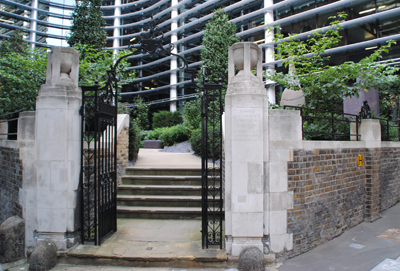
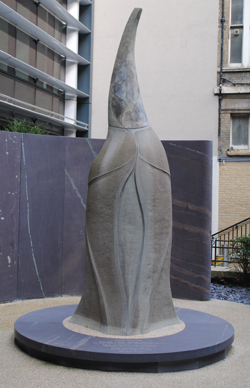
Relandscaped in 2010, the garden features a rather dramatic memorial (pictured) to the suffering of women and children in war in general and medieval figure, Catrin Glyndwr in particular. Unveiled in 2001, it was designed by Nic Stradlyn-John and sculpted by Richard Renshaw.

The daughter of the Welsh Prince Owain Glyndwr, she was captured in 1409 and brought with her children and mother to the Tower of London. Catrin and two of her children died in late 1413 and were buried in the former church.

WHERE: St Swithin’s Church Garden, Salters Hall Court off Cannon Street (nearest Tube station is Cannon Street); WHEN: daily; COST: Free; WEBSITE: www.bost.org.uk/open-places/red-cross-garden/.

Lost London – Chapel of St Thomas á Becket…

Known informally as the Chapel on the Bridge, the Chapel of St Thomas á Becket was located in the middle of London Bridge and, as the name suggests, was dedicated to the ill-fated archbishop of Canterbury.

London-Bridge-chapelFounded in 1205, the stone chapel was among the first buildings constructed on the bridge by priest-architect Peter de Colechurch in 1176, who was actually buried beneath the chapel (for more on him and the construction of the bridge, see our earlier posts here and here).

Facing downstream and located on a wider than normal pier – the 11th pier from the Southwark end of the bridge and the ninth from the City end – the original chapel was built in the early English Gothic style and consisted of an upper chapel with a groined roof and columns and vaulted lower chapel or undercroft. Standing some 40 foot high, it would have towered over the shops and residences on the bridge. There is some suggestion it was damaged by fire in 1212 and may have had to have been extensively repaired.

It’s name ensured its popularity – Becket was martyred in Canterbury Cathedral in 1170, apparently on the orders of King Henry II, and, canonised just three years later, had quickly become the focus of a popular religious cult in his home town of London. The chapel also became renowned as a wayside stop for pilgrims to receive the saint’s blessing before making their way to Canterbury where his shrine was located.

But it wasn’t just pilgrims who had an attachment – the chapel was apparently popular among watermen who, when the tide allowed them, were known to tie up their craft on the chapel pier and ascend to the undercroft through a lower entrance.

The chapel – which apparently had two priests at the beginning as well as a number of clerks although the number of priests is known to have climbed as high as five in the 14th century – was nominally under the control of the priest of the church of St Magnus-the-Martyr, located at the City end of the bridge. The reality seems to have been however, that the priests and other “Brothers of the Bridge” enjoyed considerable freedom in their roles, including, after 1483, obtaining the right keep alms taken during services provided he made a generous contribution to the parish finances. Like most who worked on the bridge, the priests and “clerks of the chapel” would likely have lived on it.

Relics housed in the chapel apparently included fragments of the True Cross and a number of chantries were built inside the chapel in the 14th century – it’s believed this may have led to some overcrowding and been one of the reasons for a major rebuilding of the chapel – this time in the Perpendicular Gothic style – between 1384 and 1397.

The chapel survived until the Dissolution when, in 1548, the priest was ordered to close it up and it was desecrated and later converted into a dwelling (later still, parts of it were used as a warehouse). It was demolished over succeeding years – by the late 18th century just the lower chapel remained –  with the final remnants removed in the early 1800s.

Some bones in a small casket were disinterred in from the chapel undercroft during this process in the early 19th century. Although these were rumoured to be those of de Colechurch, analysis found them to be part of a human arm bone, a cow bone and goose bones. (Other accounts suggest most of Peter’s bones were tossed into the Thames and that a small number were even sold at auction).

There’s a stained glass window commemorating the bridge in St Magnus-the-Martyr Church today (pictured above).

10 small, ‘secret’ and historic gardens in central London…5. Seething Lane Garden…

Seething-Lane-Garden

This small, simply laid out garden in the City of London is redolent with history.

It was once the site of the Navy Office, the workplace of diarist Samuel Pepys, and it was in the garden of this building that he and Sir William Penn buried their wine and parmesan cheese for safety during the Great Fire of London in 1666.

The office survived the Great Fire but was, oddly enough, destroyed by fire only a few years later in 1673 (there is a blue plaque commemorating it in the garden) and a new office, designed by Sir Christopher Wren, was built here in the early 1680s before it was demolished in 1788.

Seething-Lane-Garden2It’s due to its association with Pepys (who also lived in the street and was buried in the nearby church of St Olave Hart Street) that it boasts a bronze bust of him which was erected by the Samuel Pepys Club in 1983, designed by Karin Jonzen and funded by public subscription. It was presented to the garden by Fred Cleary who played an instrumental role in encouraging green spaces in the Square Mile in the 1970s.

The garden, which was laid out in about 1950, is also notable for its beds of red roses, planted to commemorate the deal struck in 1381 in which the Sir Robert Knollys was belatedly granted permission for a footbridge his wife had built over Seething Lane. She had done so contrary to planning rules while he was away fighting with John of Gaunt (ostensibly so she could avoid the dust of the street when crossing from her house to her rose garden), and so when he returned, the City of London Corporation allowed the bridge (now long gone) to remain, but only in exchange for the symbolic “penalty” of one red rose a year.

The occasion is still marked each June in a ceremony overseen by the Company of Watermen and Lightermen of the River Thames in which a red rose is plucked from the garden and delivered to the Lord Mayor of London at Mansion House.

WHERE: Seething Lane Garden, Seething Lane, City of London (nearest Tube stations is Tower Hill); WHEN: Daily; COST: Free; WEBSITE: www.cityoflondon.gov.uk/things-to-do/green-spaces/city-gardens/Pages/default.aspx.

This garden reopened in 2018 after being redeveloped as part of the Trinity Square redevelopment.


LondonLife – Crossrail unearthed mass burial believed to be of Great Plague victims…

Plague-Pit---Crossrail

Thirty skeletons found in a mass burial – the latest archaeological find at Crossrail’s Liverpool Street site – are believed to have been victims of the Great Plague of 1665. Made during the excavation of the former Bedlam burial ground in order to make way for a new eastern entrance to the station, the discovery comes during the 350th anniversary year of the Great Plague. Jay Carver, the lead archaeologist for Crossrail, said the mass burial – with the bodies placed in now long gone wooden coffins – was unlike other individual burials found in the cemetery and thus “is likely a reaction to a catastrophic event”. “Only closer analysis will tell if this is a plague pit from the Great Plague of 1665 but we hope this gruesome but exciting find will tell us more about one of London’s notorious killers.” Clues which suggest that may be the case include a headstone found nearby marked “1665” and the fact that the 30 people all seem to have been buried on the same day. Museum of London Archaeology osteologists will now analyse the skeletons to find out the cause of death. Archaeologists have excavated more than 3,500 skeletons from the site since excavation of the burial ground – used between 1569 to at least 1738 – began earlier this year. It suggested 30,000 Londoners were buried there during that period. For more on the the Great Plague, see our earlier post herePICTURE: © Crossrail Ltd.