What’s in a name?…Barbican

Though it’s these days associated with a Brutalist housing estate and performing arts centre based in the north of the City of London, the name Barbican has been associated with the area on which the estate stands for centuries.

BarbicanThe word barbican (from the Latin barbecana) refers to an outer fortification designed to protect the entrance to a city or castle. In this case it apparently referred to watchtower which may have had its origins in Roman or Saxon times (or maybe both). The City of London website suggests it was located “somewhere between the northern side of the Church of St Giles Cripplegate and the YMCA hostel on Fann Street”.

When-ever it was built, the watchtower was apparently demolished on the orders of King Henry III in 1267, possibly as a response to Londoners who had supported England’s barons when they had rebelled against him. One source suggests the tower was rebuilt during the reign of King Edward III but, if so, the date of its subsequent demolition remains unknown.

Later residents of the area – which become known as a place to trade new and used clothes – included John Milton and William Shakespeare.

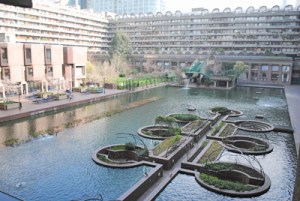
The area known as Barbican was devastated by bombing raids in World War II. Discussions on the future of the site started in 1952 and for more than 10 years plans for redeveloping the area were debated until finally, in the early 1960s, work began on what is now the Barbican Estate including three tall residential towers (part of the residential estate is pictured above). Completed in the mid 1970s, the Brutalist design of the complex, which features buildings named after historical figures associated with the area, means it meets with strong reactions from those who encounter it whether love – or hate.

Construction of the arts centre – known as the Barbican Centre – the largest performing arts centre in Europe and home to the London Symphony Orchestra – was started in the early 1970s. The £156 million centre was eventually opened by Queen Elizabeth II in 1982.

Other buildings within the Grade II listed complex include the Guildhall School of Music and Drama, the City of London School for Girls and a YMCA.

Around London – Lord Mayor’s Show; Remembrance Sunday; Ansel Adams at the NMM; and, Mughal India at the British Library…

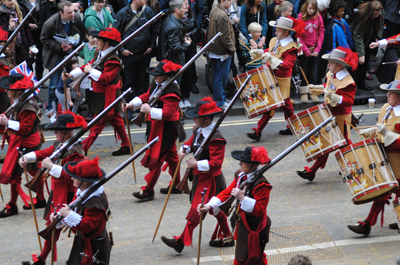
• The 2012 Lord Mayor’s Show is just about upon us and while you may not have a grandstand seat, there’s still plenty of places you can stand and watch the parade of more than 6,500 people pass by. Saturday’s parade – which celebrates the election of the 685th Lord Mayor of London, Alderman Roger Gifford – leaves Mansion House at 11am and travels via Poultry and Cheapside to St Paul’s Cathedral where it pauses for the Lord Mayor and his officials to receive a blessing – before continuing on via Ludgate Hill and Fleet Street to the Royal Courts of Justice, arriving there at about 12.30pm. There the Lord Mayor gives his oath of loyalty to the Crown (while in the surrounding streets the participants and 125 horses are fed and watered) before the parade reassembles and sets off from Embankment at 1pm, heading back to Mansion House via Queen Victoria Street – the Lord Mayor arrives sometime between 2pm and 2.30pm. (The website has a terrific one page map of the route you can download and print). There’s no fireworks display after the parade – although there’s a host of other activities taking place in the City of London – but if you’re up and about early enough, you may want to watch the Lord Mayor as he boards the barge QRB Gloriana at the Westminster Boating Base in Vauxhall at 8.30am and, escorted by a flotilla, makes his way up the Thames to HMS President, just below St Katharine Docks, arriving at about 9.35am after Tower Bridge opens in salute. For more, head to www.lordmayorsshow.org.

• The annual Remembrance Sunday service – commemorating the contribution of British and Commonwealth servicemen and women in the two World Wars and later conflicts – will take place at the Cenotaph on Whitehall at 11am this Sunday. While no tickets are required to watch the event, the Department of Culture, Media and Sport, who organise the service, advise arriving early if you wish to secure a good viewing space (and leave time for security checks at the entrance to either end of Whitehall). Whitehall opens at 8am. For more details, see www.culture.gov.uk/what_we_do/honours/3333.aspx.

A new exhibition of the work of US photographic pioneer Ansel Adams opens at the National Maritime Museum in Greenwich tomorrow (Friday). Ansel Adams: Photography from the Mountains to the Sea, which comes from the Peabody Essex Museum in Salem, Massachusetts, will feature more than 100 original prints, many of which have never been exhibited before in the UK. It is said to be the first exhibition to focus on his “lifelong fascination” with water and the display features some of Adams’ finest images based on this subject including what are some of the most famous photographs of the 20th century. Highlights include the first photograph Adams’ ever image – taken at age 14 – which features a pool located at the Panama Pacific Exhibition at the 1915 World’s Fair, the three American Trust murals produced in the 1950s on an “unprecedented scale”, Adam’s favorite work – Golden Gate before the Bridge – which hung above his desk, and iconic images such as Clearing Winter Storm, Yosemite and Stream, Sea, Clouds, Rodeo Lagoon, Marin Country, California. There is an admission charge. Runs until 28th April. For more details on the exhibition, see www.rmg.co.uk.

Also opening tomorrow (Friday) is the British Library’s major autumn exhibition – Mughal India: Art, Culture and Empire. The exhibition focuses on the Mughal dynasty – which once ruled over much of the Indian sub-continent – and is the first to document the period spanning the 16th to 19th centuries. Featuring more than 200 manuscripts and paintings, most of which come from the library’s own collection, highlights include Akbar ordering the slaughter to cease in 1578 – a work attributed to the artist Miskina in 1595, Abu’l Hasan’s early 17th century painting Squirrels in a plane tree, the historically important illustration Prince Aurangzeb reports to the Emperor Shah Jahan in durbar, and a portrait of Prince Dara Shikoh, favorite son and heir-apparent of 17th century Emperor Shah Jahan. Runs until 2nd April. Admission charge applies. For more on the exhibition and accompanying events, see www.bl.uk.

10 Historic London Markets – 4. Leadenhall Market…

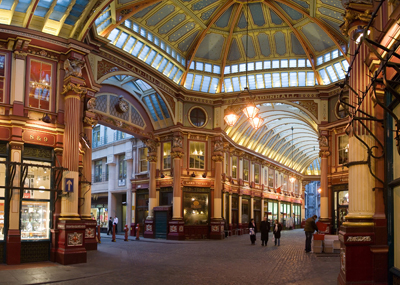
A covered – and splendidly decorated – Victorian-era market located just off Gracechurch Street in the heart of the City of London, Leadenhall Market might go un-noticed by many but visit at lunchtime on a weekday and you’ll to fight for space among the besuited City workers looking for sustenance there.

The history of a market on this site goes back to Roman times for it was under the current market that the remains of Londinium’s basilica and forum – the Roman marketplace – can be found (there’s apparently a part of the basilica wall in the basement of one of the Leadenhall shops).

This fell into disuse following the Roman period, however, and the origins of the current market are generally agreed upon as emerging in the 14th century when it occupied the site of a lead-roofed manor (hence “leaden hall) which was at one stage leased by the famous Lord Mayor Richard “Dick” Whittington before it burnt down in the late 1400s. The subsequent market was initially associated with poultry and then with cheese and other foodstuffs (it remained known for game and poultry) and separate areas were later developed for trade in wool, leather and cutlery.

In 1666, a small section of the market was destroyed in the Great Fire of London but it was rebuilt shortly after – for the first time under cover – and was divided into three sections: the Beef Market, the Green Yard and the Herb Market.

In 1881, after the existing building was demolished, a new structure boasting wrought iron and glass was designed by Sir Horace Jones (architect for the Corporation of the City of London, he also designed Billingsgate and Smithfield Markets – see our earlier entries here and here). The market is now one of the City’s five principal shopping centres and, as well as fresh food and flowers, hosts a variety of specialty shops, restaurants, cafes and pubs.

The Grade II* listed building was extensively restored in 1991. It has since starred in Harry Potter and the Philosopher’s Stone as well as other films including The Imaginarium of Doctor Parnassus and the recent Tinker, Tailor, Soldier, Spy.

Before we finish, we would be remiss not to mention Old Tom. A celebrated gander, he managed to avoid the axe for years and became a favorite of traders and customers (even being fed by local innkeepers) – so much so, that when he died at the age of 38 in 1835, his body lay in state before he was buried on site. There’s a bar in the market named for him.

WHERE: Gracechurch Street, City of London (nearest Tube stations are Monument, Bank and Cannon Street); WHEN: Public areas are generally open 24 hours a day with core trading hours between 10am and 5pm weekdays (check with individual shops for opening hours); COST: Free; WEBSITE: www.leadenhallmarket.co.uk

PICTURE: DAVID ILIFF. Licence CC-BY-SA 3.0. Via Wikipedia.

Where’s London’s oldest…livery company hall?

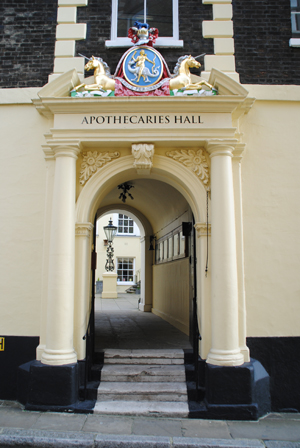
The oldest livery company building, that of the Worshipful Society of Apothecaries of London, dates from just after the Great Fire of London in 1666.

Originally built in 1672 to the designs of surveyor Edward Jerman, it replaced an earlier building which had been destroyed in the fire. It has since been refurbished several times and while the external facade appears as it did in the late 1700s, the interior layout, with Great Room – complete with original Irish Oak panelling, Court Hall and Parlour, is as it was when first built after the Great Fire.

Previously members of the Grocer’s Company (and earlier still, the Guild of Pepperers), the Apothecaries Society was incorporated as a City livery company on 1st December, 1617, when it was granted a royal charter by King James I.

They purchased a building in 1632, known then as Cobham House (previously owned by Lady Anne Howard), on land formerly part of Blackfriars Priory (see our former post on the priory here) – it was this building which was destroyed in 1666.

Among treasures inside the current hall is a portrait of Gideon de Laune, Royal Apothecary to Queen Anne of Denmark, wife of King James I, and credited as founder of the Society which was was presented to the Society  in 1641 and hangs in the Court Room. There’s also a 24-branch candelabrum in the Great Hall which was presented to the society by Sir Benjamin Rawling, Sheriff of London and Master of the Society in 1736.

Now one of the largest of the livery companies in the City and still active in regulating medical practitioners, it is 58th in order of precedence and is still active in its trade with the organisation’s constitution requiring 85 per cent of the Society’s membership belong to the medical profession. Past luminaries have included the Romantic poet, John Keats.

The society is also known for having established the Chelsea Physic Garden in 1673 – making it one of the oldest botanic gardens in the world – on land granted it by Sir Hans Sloane (see more on him in our earlier post here).

The hall is available for hire. For more information on the Society, see www.apothecaries.org. Visits to the hall are by prior arrangement only. Contact the Beadle via the above website to find out more.

LondonLife – John Donne at St Paul’s Cathedral…

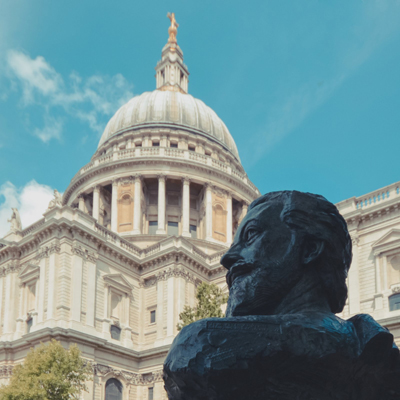
A new bust of priest and poet John Donne was unveiled outside St Paul’s Cathedral earlier this year. Donne was made  Dean of St Paul’s in 1621, a position he held until his death 10 years later. He was subsequently buried in Old St Paul’s Cathedral and a memorial to him – a likeness apparently based on a drawing of him in his shroud – was the only monument to survive the Great Fire of London in 1666. It’s still inside the cathedral. The new bronze bust, located in the garden to the south of the cathedral, was the work of artist Nigel Boonham and has Donne looking east towards his birth place in nearby Bread Street. The text “Hence is’t, that I am carried towards the West/This day, when my Soul’s form bends to the East” – taken from the poem Good-Friday, 1613, Riding Westward – is inscribed underneath the bust. Commissioned by the City of London, the sculpture was unveiled in June by the artist and Professor Peter McCullough, one of the cathedral’s Lay Canons. For more on St Paul’s, see www.stpauls.co.ukPICTURE: Graham Lacdao / The Chapter of St Paul’s Cathedral. 

Around London – Celebrating the Olympics; Camden Lock’s night market; and, images of London at the Tate…

We’ll kick off this week with just a few more of the plethora of Olympic-related events which are happening around town:

Tower Bridge, site of some spectacular fireworks last Friday night, is currently hosting an exhibition celebrating the 26 cities which have hosted the modern Olympics. Cities of the Modern Games, located on the bridge’s walkways, runs alongside an interactive exhibition looking at the bridge’s construction. Follow the link for details.

The Guildhall Art Gallery is showcasing sculpture and art inspired by sport and the “Olympic values”. The art works are all winning entries from a contest organised by the International Olympic Committee. The chosen works were selected from among 68 submissions made by an international jury. Follow the link for details.

The Design Museum is hosting a new exhibition celebrating the nexus between sport and design. Designed to Win looks at everything from the design of F1 cars to running shoes, bats and bicycles and explores the way in which design has shaped the sporting world. Runs until 9th September. Admission charge applies. See www.designmuseum.org.

• The London Metropolitan Archives is holding an exhibition of playing cards featuring an Olympic theme. Sporting Aces – Playing Cards and the Olympic Games features cards drawn from the collection of the Worshipful Company of Makers of Playing Cards which have an Olympic theme. Admission is free. Runs until 13th September. See www.cityoflondon.gov.uk/lma.

And in other news…

A night market has been launched at Camden Lock over the summer period. Street food stalls and vintage fashion, arts and crafts and book shops will be open until 10pm every Thursday with extras including live music and film screenings. For more, see www.camdenlockmarket.com.

• On Now: Another London: International Photographers and City Life 1930-1980. This exhibition at Tate Britain in Millbank features more than 150 classic photographs of the city and its communities by foreign photographers including such luminaries as Henri Cartier-Bresson. The exhibition features iconic works such as Robert Frank’s London (Stock Exchange) 1951, Cartier-Bresson’s images of King George VI’s coronation, Elliot Erwitt’s depiction of a rain-washed London bus stop, and Bruce Davidson’s image of a child with pigeons in Trafalgar Square alongside works such as Wolfgang Suschitzky’s images of working class families in the East End, from the 1940s, and Karen Knorr’s images of punks in the 1970s. The photographs all come from the Eric and Louise Franck London Collection, which includes more than 1,200 images of London and has been promised as a gift to the Tate. Runs until 16th September. Admission charge applies. See www.tate.org.uk. 

Have we missed something we should be telling others about? Send details in an email to exploringlondon@gmail.com.

Around London – The Shard celebrates; Crossrail archaeology; new sheriffs named; and, Blackpool at Wellington Arch…

• Europe’s tallest building marks the completion of its exterior structure today with a spectacular light show. The Shard, a £450 million development located over London Bridge Station in Southwark, stands 310 metres tall and was designed by Italian architect Renzo Piano. The controversial glass clad structure, work on which commenced in 2009, features a jagged top with the design reportedly referencing the city’s many church spires. While the exterior of the building is now complete, work is expected to continue on the building’s interior – which will contain offices, luxury shops and restaurants, a five star hotel and 10 top-end apartments (the highest in the UK) – until next year. It is expected that the building’s viewing decks – which offer panoramic 360 degree views over the city – will become a major new tourist attraction in the city. The Shard will be formally opened today by Qatari Prime Minister Hamad bin Jassem al-Thani and Prince Andrew, Duke of York. The hour long light show, which features lasers and searchlights, kicks off at 10pm and those who can’t see it in person can watch it streamed live at the-shard.com.

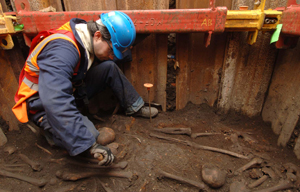
• A skeleton from the St Bethlehem Burial Ground and 55 million-year-old fragments of amber are among the artefacts which will go on display this Saturday at a special public exhibition of archaeological discoveries made during the construction of Crossrail. Almost 100 objects found at 10 different sites will be in the Bison to Bedlam – Crossrail’s archaeology story so far exhibition which marks the halfway point of the Crossrail archaeology program, first launched in 2009. Finds have dated from prehistoric times through to the Industrial Revolution and, as well as those aforementioned, also include some medieval ceramic wig curlers, 17th century gravestone markers and stakes made out of animal bone. All the items will be eventually donated to the Museum of London or Natural History Museum. The exhibition will be held from 10am to 5pm this Saturday at the Music Room, Grays Antiques, 26 South Molton Street (nearest Tube station is Bond Street). For more, see www.crossrail.co.uk.

• Alderman Jeffrey Evans (Ward of Cheap) and Nigel Pullman have been elected the new sheriffs of the City of London in a poll held late last month. The office of the sheriffs dates back to the Middle Ages – current duties include assisting the Lord Mayor of London in his official duties and attending sessions of the Central Criminal Court at the Old Bailey. The two new sheriffs take up their post in late September.

• On Now: Blackpool: Wonderland of the World. A new exhibition held in the Quadriga Gallery at the Wellington Arch, Hyde Park Corner, this looks at how Blackpool transformed in the 19th century from a small village to become became the first resort in the world to cater for the working classes. Focusing on two of the town’s key attractions – the Winter Gardens and the Blackpool Tower – the exhibition’s highlights include a silver model of Blackpool Tower dating from 1893, rare Victorian and vintage posters advertising performances by some of the stars who shone there, and early 20th century photographs of the interiors of the Winter Gardens. In addition, two crowns will illuminate the top of Wellington Arch in a taste of Blackpool’s famous light show. Organised by English Heritage in partnership with Blackpool Council, it runs until 27th August. Admission fee applies. See www.english-heritage.org.uk/daysout/properties/wellington-arch/exhibitions-at-the-arch/current-exhibition/ for more.

Where’s London’s oldest…manufacturing company?

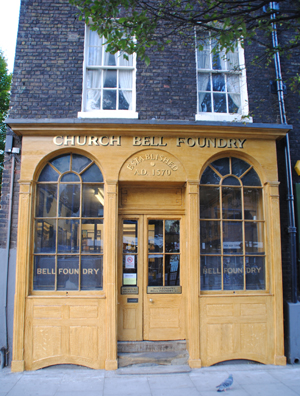
London’s oldest manufacturing company is the same as Britain’s oldest and is, according to the Guinness Book of Records, the Whitechapel Bell Foundry.

The company was established in 1570 (although founders have been discovered operating in the area as far back as 1420) and, according to its website, still concentrates solely on the manufacture of bells and their fittings with large church bells accounting for 80 per cent of the company’s business. The remainder of the business is involved in manufacturing handbells and other smaller bells.

The foundry’s current buildings, apparently originally used as a coaching inn named The Artichoke, date from 1670 and are presumed to have replaced structures consumed in the Great Fire of London. The foundry had earlier been located in smaller premises on the other side of Whitechapel Road.

The foundry has typically operated under the name of the master founder and owner but since 1968 has apparently operated under its current name.

The most famous bells cast at the foundry include the Liberty Bell (1752) – the symbol of American independence which cracked when first rung and was recast in Philadelphia, the Great Bell of Montreal Cathedral, ‘Great Tom’ of Lincoln Cathedral, and, of course, Big Ben (1858) – at 13,760 kilograms, the largest bell ever cast at the foundry.

Westminster Abbey and St Paul’s Cathedral also feature bells cast at the foundry and replacement bells for St Mary-le-Bow and St Clement Danes made here following their destruction in World War II and bells from the foundry have been sent as far afield as Australia and India.

Among the most recent bells to be cast at the foundry are the Royal Jubilee Bells, used in the Thames Diamond Jubilee Pageant and now housed at St James Garlickhythe in the City of London (each of the bells, which bear the Royal Arms, is named after a member of the Royal Family – Elizabeth being the largest with others named Philip, Charles, Anne, Andrew, Edward, William and Henry.)

There is a small exhibition on bell-making in the foundry shop looking at the history of the foundry and bell-making in general, and one-and-a-half-hour tours of the foundry run Saturdays (booking well in advance is usually required). Additional tours are being held every day during the Olympics.

WHERE: 32/34 Whitechapel Road; WHEN: Tours are usually held on Saturdays when no work is being undertaken – see website for dates – but special tours are being held daily from 10am to 5pm, 28th July to 12th August, 2012; COST: The exhibition/museum is free but tours are usually £12 a head for over 14s (Olympic period tours are £10 a head/£25 a family – children under 14 not admitted without adult supervision) – see website for more details on purchasing tickets; WEBSITE: www.whitechapelbellfoundry.co.uk.

Around London – Celebrating the City; Syon Park dig; Westminster’s rubbish; and, 1000 years of British literature…

• The City of London today kicks off Celebrate the City – four days of mostly free music, art and cultural events.The events include musical performances in many of the City’s churches, walks and talks at various locations around the Square Mile, new exhibitions including Butcher, Baker, Candlestock Maker – 850 years of Livery Company Treasures at the Guildhall Art Gallery, Livery Hall and historic building openings, family entertainment at the Cheapside Street Fayre at Saturday (including free ice-cream and tuk-tuk rides for children) and activities at the Barbican Centre and the Museum of London. The celebrations start in Guildhall Yard (pictured) at 6pm tonight when musicians from the Guildhall School of Music & Drama perform Tchaikovsky’s 1812 Overture, complete with firing cannons. Among the many other highlights will be the chance to play golden street pianos, to join in the Midsummer street part at the climax of the Spitalfields Music Summer Festival, to enjoy a sunset from the Tower Bridge walkways and to see the transformation of St Helen’s Square into a sculpture space. The weekend will also host the Open House Junior Festival, London’s first ever child-friendly City architecture festival. To see detailed listings of what’s on, head to www.visitthecity.co.uk/index.php/celebrate/.

• The Museum of London will next week launch its annual community and training dig at Syon Park in Hounslow. The dig, which will be open to school and community groups, will run from 25th June to 7th July and will focus on the area of Sir Richard Wynne’s house. A Parliamentarian, in 1659 he was implicated in a Royalist insurrection and was imprisoned. The house, which featured in the Battle of Brentford when Royalist troops advanced on Parliamentary forces in London in 1641, was later purchased by the Duke of Northumberland and demolished to extend Syon’s parkland. For more, see www.museumoflondon.org.uk.

• We couldn’t resist mentioning this one: Westminster City Council has released a top 10 list of the strangest objects people have dumped on London’s streets. They include an inflatable Margaret Thatcher and other inflatable dolls, wedding dresses, stuffed animals and a range of film props. The council say that, on average, enough litter is picked up off Westminster’s streets every two days to fill the entire 864 cubic metres of Marble Arch. They add that if just half of the annual waste collected off the street is recycled properly in the correct bins it would save them nearly £1million.

• On Now: Writing Britain: Wastelands to Wonderlands. The major summer exhibition at the British Library, it explores how the last 1,000 years of English literature have been shaped by the country’s places. The exhibition  features more than 150 works with highlights including John Lennon’s original lyrics for The Beatles’ song In My Life, JK Rowling’s handwritten draft of Harry Potter and the Philosopher’s Stone, JRR Tolkein’s original artwork for The Hobbit and original manuscripts from the likes of Jane Austen, William Blake, Charlotte Bronte, Arthur Conan Doyle, JG Ballard and Charles Dickens. As part of the exhibition, the Library is inviting people to “Pin-a-Tale” on an interactive map of Britain, that is, take a literary work and pin it on the map along with a description of how the work links with that particular location – head to www.bl.uk/pin-a-tale to take part. The exhibition runs until 25th September. Admission fee applies. For more, see www.bl.uk.

Where is it? #31…

The latest in the series in which we ask you to identify where in London this picture was taken and, importantly in this case, what it’s of. If you think you can identify this picture, leave a comment below. We’ll reveal the answer early next week. Good luck!

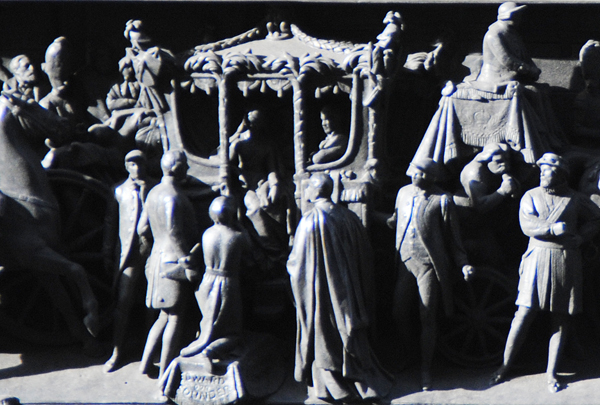
Well done to Jameson Tucker, this is indeed a relief on the Temple Bar Memorial, which stands where the Strand turns into Fleet Street. It depicts Queen Victoria on a royal progress to the Guildhall in 1837, a few months after her accession, when she was met at this spot by the Lord Mayor and Aldermen and presented with the sword of state and keys to the city.

According to a tradition said to date back to 1215, the Temple Bar is the only place where the monarch may enter London after first seeking permission from the Lord Mayor and being presented with the City’s Pearl Sword (one of five City swords, this is said to have been first given to the City by Queen Elizabeth I).

The monument itself was designed by Sir Horace Jones and erected in 1880 to mark the location where the Temple Bar – the ceremonial entrance to the City of London – originally stood (the last incarnation of the Temple Bar, designed by Sir Christopher Wren, is now located near in Paternoster Square near St Paul’s – see our earlier post for more on Wren’s Temple Bar).

On top of the granite and bronze monument stands a rearing griffin (actually it’s supposed to be a dragon), one of the city’s official boundary markers, sculpted by Charles Birch while on either side are bronze statues, by Sir Joseph Edgar Boehm, of Queen Victoria and Edward, Prince of Wales (later King Edward VII), who in 1872 were the last of the Royal family to pass through the Temple Bar gateway before its demolition in 1878 (they were on their way to St Paul’s to attend a thanksgiving service following the prince’s recovery from typhoid).

This is depicted in a relief on the north side of the monument by Charles Kelsey. Charles Mabey’s relief showing the Queen’s progress is located on the south side of the monument; he also designed one on the east side which shows a curtain being drawn over the old Temple Bar.

What’s in a name?…Southwark

One of those somewhat confusing placenames where the ‘w’ is effectively silent, Southwark (pronounced something like Suh-thuck) is a sizeable district south of the River Thames and one of the city’s oldest areas.

The area, which was settled as far back as Saxon times, takes its name from the Old English words suth or sud weorc which translates as “southern defensive work” and relates to the fact that the site is south of the City of London and at the southern end of London Bridge (the first bridge here was built by the Romans). While it was this name which was recorded in the Domesday Book of 1086, in the 900s the area was recorded as Suthriganaweorc which meant ‘fort of the men of Surrey’.

The name Southwark was also applied to borough which sat south of the river and still exists today – the Borough of Southwark. This in turn became shortened to just Borough, hence the name borough still exists as an alternative for part of Southwark even today (think of Borough Market and Borough High Street).

Part of Roman Londinium, Southwark was effectively abandoned after the end of Roman rule and then reoccupied by Saxons in the late 800s when the ‘burh’ (borough) of Southwark was created. It developed considerably in the medieval period and became known for its inns (think of the pilgrim inn, The Tabard, in The Canterbury Tales).

The area, particularly Bankside – part of the Borough of Southwark, also become known as an entertainment district with theatres and bear-baiting pits as well as a red-light district. It was also known for its prisons, in particular The Clink (controlled by the Bishop of Winchester), Marshalsea and the King’s Bench.

The area was also a centre of industry – everything from brewing to tanning – and came to boast numerous docks and warehouses (when it also became a centre of the food processing industry). With the closure of the docks, it’s retail, tourism, creative industries and the financial services which are dominant in the area today.

Landmarks are many thanks to the area’s long and colorful history (far too many to list in this short piece) but among major sites are Southwark Cathedral, Borough Market, and the George Inn as well as the Old Operating Theatre, Guy’s Hospital, and a replica of Sir Francis Drake’s ship, the Golden Hinde. Personalities associated with the area (again far too many to list here) include Geoffrey Chaucer, William Shakespeare and Charles Dickens.

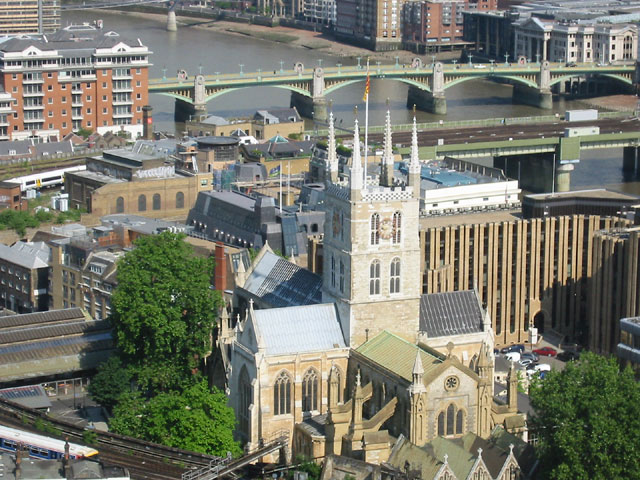
PICTURE: Southwark Cathedral © Copyright Kevin Danks and licensed for reuse under this Creative Commons Licence

For more, check out Southwark: A History of Bankside, Bermondsey and the Borough