A foody feast at Kew; the Queen goes to Westminster; Morecambe & Wise remembered; and, Francis Goodman on show…

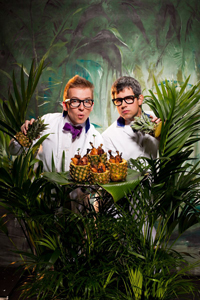
Bompas-&-Parr-with-pineapplesKew Gardens is all about food this summer and autumn with the launch of IncrEdibles: A Festival to Feed the Imagination this Sunday. Visitors are being encouraged to take part in a range of food-related activities including taking a fruit-shaped boat on the Palm House Pond around a floating pineapple island (the Tutti Frutti Boating Lake has been designed by “culinary creators” Bompas & Parr – pictured right), checking out a ‘global gastronomic garden’ featuring more than 90 edible plants on the Great Lawn, and listening to volunteer guides in the Palm House discussing how many of our foods have their origins in the rainforest. The festival also features a range of talks, tours and tastings and you can sample some special foods at the onsite eateries. The festival runs until 3rd November. For more, see www.kew.org. PICTURE: Bompas & Parr

A portrait of Queen Elizabeth II standing on the Cosmati pavement in Westminster Abbey will go on public display for the first time this afternoon at the abbey as part of the celebrations surrounding the 60th anniversary of the Queen’s coronation. The Coronation Theatre: Portrait of Her Majesty Queen Elizabeth II, is the work of Australian-born, London-based artist Ralph Heimans and has been acquired by the abbey for its collection. The painting, which was officially unveiled in London for the Diamond Jubilee last year, was exhibited at the National Portrait Gallery in Canberra until the end of March. The painting can be viewed in the chapter house at the abbey from 2pm today and will remain on display until 27th September. For more, see www.westminster-abbey.org.

A blue plaque commemorating late comic duo Eric Morecambe and Ernie Wise has been unveiled at the Teddington Studios in west London. The Heritage Foundation plaque was reportedly unveiled by Morecambe’s widow Joan and daughter Gail. Teddington’s Studio One was where the last four series of the duo’s show were produced.

On Now: Francis Goodman: Back in Focus. This display at the National Portrait Gallery features more than 40 black and white photographs spanning the career of fashion and society photographer Francis Goodman (1913-1989), from the 1930s to the 1970s and includes portraits of the likes of artists Francis Bacon and Lucian Freud as well as writers including Noel Coward and Nancy Mitford. The exhibition runs until 3rd November. Admission is free. For more, see www.npg.org.uk.

Around London – Chiswick House furnishings; Miniature German Bibles; free buses to Isabella Plantation; and, marking the 50th anniversary of the Profumo Affair…

A collection of furniture originally belonging to the 5th Duke of Devonshire and his wife, Georgiana, the Duchess of Devonshire, has been returned to the Palladian masterpiece, Chiswick House, in west London. The furniture – which includes four French fauteuils (open arm chairs) by the leading Parisian chair maker Jean-Baptiste Tilliard, four neo-classical chairs with caned backs and seats and a ladies’ roll-top writing desk – was purchased by English Heritage at an auction in 2010 with the assistance of Art Fund. It had been removed from the house to the family estate in the late 1800s. Extensive conservation work on the furnishings was carried out thanks to the support of The Art Fund, Chiswick House Friends and The Pilgrim Trust prior to their being restored to the house. They are now displayed in the bedchamber while a mahogany pole-screen – designed in about 1730 by William Kent, protégé and collaborator of the house’s first owner and architect, Richard Boyle, 3rd Earl of Burlington – has also been acquired and will be displayed in Lord Burlington’s Blue Velvet Room. Admission charge applies. For more information, see  www.english-heritage.org.uk/daysout/properties/chiswick-house/ or www.chgt.org.uk.

German miniature picture Bibles are the subject of a new exhibition at The Courtauld Gallery. The third display in the gallery’s Illuminating Objects programme, the display centres on Bibles created by two sisters who belonged to a family of printmakers, Johanna Christina (Or Christiana) and Maria Magdalena Kusel, in Augsburg in the late 17th century. While many of the 17th century ‘thumb’ Bibles were created for children, the Kusel sisters most likely made theirs for private devotion. It is believed this is the first time the two Bibles have gone on public display. Visitors to the Courtauld website are also able to turn the Bible’s pages. Runs until 22nd July. For more, see www.courtauld.ac.uk/gallery/exhibitions/2013/illuminating/bible.

Royal Parks are offering free travel to the newly improved Isabella Plantation – a 40 acre ornamental woodland garden in Richmond Park – this Sunday. The minibus service, which will travel from the traffic lights on Ham Common to the plantation, will be running between 10am and 4pm. The plantation, which features azaleas, rhododendrons, camellias, magnolias, daffodils and bluebells, has recently been the subject of a £1.5 million improvement project funded by the Heritage Lottery Fund and BIG Lottery Fund. Improvements have included enhancements to ponds and streams and upgrades to the existing path network. For more, see www.royalparks.org.uk/parks/richmond-park.

A display commemorating the 50th anniversary of the Profumo Affair has opened at the National Portrait Gallery. Scandal ’63: The Fiftieth Anniversary of the Profumo Affair looks in depth at the scandal in which Secretary of State for War John Profumo was found to have had a brief affair with nightclub hostess and model Christine Keeler who happened to also romantically involved with Yevgeny Ivanov, a senior Russian naval attache (rather controversial during the Cold War). The display features a vintage print of one of Lewis Morley’s seated nude portraits of Keeler as well as press images of other key protagonists in the matter including her friends Mandy Rice-Davies and Paula Hamilton-Marshall. Also featured is on-set photographs of Keeler taken to publicise The Keeler Affair, a film which was banned in Britain (and later remade in 1989), images of a now lost work of pop art by Pauline Boty featuring four of the key players (it was titled Scandal ’63), and a pastel of Keeler by Stephen Ward (pictured). Admission is free. Runs until 15th September. For more, see www.npg.org.uk.

Around London – Architects on show; Queen’s Orchard at Greenwich; first women dentist honoured; and Patrick Heron and TS Eliot at the NPG…

Regent Street is showcasing a number of architectural installations created by architects in an initiative being conducted in conjunction with the Royal Institute of British Architects (RIBA). Now in its fourth year, the Regent Street Windows project can be seen free in store windows including those of Topshop, Espirit, Jack Spade, Ferrari Store and Moss Bros until 6th May. Participating architects include Carl Turner Architects, naganJohnson architects, Gensler, Mamou-Mani, and AY Architects. Free 45 minute to one hour walking tours of the completed installations will be conducted by RIBA representatives at lunch time today, midday on Sunday and at 5.30pm next Wednesday. Prior booking is essential – email antonia.faust@riba.org for details.

The Queen’s Orchard has reopened in Greenwich Park having been restored with the addition of heritage fruit trees, new gates, pathways and ponds. The orchard dates back to the 17th century  – its name has been found on a records dating back to 1693 and now features on a new metal decorative gate which, as well as a well cover, was designed by local artist Heather Burrell along with local school students and the Friends of Greenwich Park. The heritage fruit trees, which have a provenance dating back to the 1500s, include apple, pear, cherry, plum, peach, apricot, nectarine, quince, and medlar trees. For more, see www.royalparks.org.uk.

The first woman to qualify as a dentist in Britain has been honoured by English Heritage with a blue plaque at her former home in Islington. Lilian Lindsay (1871-1960) lived at the house at 3 Hungerford Road, Lower Holloway, from 1872 until 1892 when she decided to become a dentist. Refused entry to the National Dental Hospital in London, she trained at the Edinburgh Dental Hospital and School (where she also met her husband Robert) before setting up a practice in Upper Holloway. Following her marriage, Lindsay relocated to Edinburgh where she and her husband ran a dental practice, only returning to London after their retirement in the 1920s. Both were actively involved in the British Dental Association. For more, see www.english-heritage.org.uk.

A 13-year-old photographer, Gideon Knight, is holding his first exhibition, ‘Wild About Photography’, at The Temple, Wanstead Park in Epping Forest. Self-taught, Knight has drawn on his passion for bird-watching in capturing a series of images of birds and other wildlife in a range of natural environments – from the forests of Essex to the countryside of southern Ireland. The exhibition is free. Open on weekends and bank holidays until the end of June, between noon and 5pm. You can follow Gideon at  http://earlywormbirder.blogspot.co.uk.

On Now: Patrick Heron: Studies for a Portrait of TS Eliot. On display for the first time at the National Portrait Gallery, the 10 paintings and drawings were completed in preparation for a 1949 modernist painting of the poet. They include two oil studies which have never before been seen in public. Heron secured permission to paint Eliot in January 1947 with the first sitting held two months later. Runs until 22nd September. For more, see www.npg.org.uk.

Around London – Royal Court treasures at V&A; Sir Michael Caine celebrated; a tunic with a past; and, George Catlin’s American Indian portraits…

Water_potA new exhibition opens at the V&A in South Kensington this Saturday which charts the development of cultural trade and diplomacy between Britain and Russia from the founding of the Muscovy Company in 1555 until the end of King Charles II’s reign in 1685. Treasures of the Royal Courts: Tudors, Stuarts and the Russian Tsars reveals the “majesty and pageantry” of the royal courts of both countries – from that of King Henry VIII to King Charles II in Britain and from that of Ivan the Terrible (Ivan IV) to the early Romanovs in Russia. The display features more than 150 objects including heraldry and processional armour,  furnishings, clothing, jewellery and portraiture including paintings and miniatures painted by court artists. Highlights include a rarely viewed portrait of Queen Elizabeth I, the Barbor Jewel – a pendant set with an onyx cameo of the queen; a hand-colored map of ‘Muscovy’ dating from 1570, and literature including Shakespeare’s First Folio as well as a showcase of British and French silver given to the Tsars by British merchants and kept in the Kremlin. The 20 pieces include the Dolphin Basin, made by Christiaen van Vianen – said to be a favoured silversmith of King Charles I and II – in 1635. The exhibition marks the 400th anniversary of the Romanov dynasty. Admission charge applies. Runs from Saturday, 9th March, until 14th July. For more, see www.vam.ac.uk. PICTURE: Water pot (1604-05), Historic collectino of the Armoury, © The Moscow Kremlin Museums.

The life and work of Sir Michael Caine – who turns 80 this month – is the focus of a new free exhibition at the Museum of London. Michael Caine, which opens tomorrow, features photographs including some never exhibited before as well as iconic portraits by the likes of David Bailey and Terry O’Neill as well as a selection of audio and film clips from movies such as Alfie, The Italian Job, Get Carter, Hannah and Her Sisters and Educating Rita. The exhibition follows Sir Michael’s life from “Cockney rebel, through to Hollywood legend and inspirational Londoner” and looks at how the city influenced his life and career. Runs until 14th July. To coincide with the exhibition, the Museum of London Docklands is running Caine on Screen, a selection of free films which can been voted for by the public (see our earlier post here). The schedule of films will be announced after 14th March. For voting details and more information, see www.museumoflondon.org.uk.

A bullet-pierced military tunic worn during the Indian Mutiny in the mid 19th century has been donated to the National Army Museum in Chelsea. The tunic, worn by Lieutenant Campbell Clark, of the 2nd Bengal European Fusiliers, at Cawnpore in 1857. The lieutenant was ambushed by rebels Indian infantry and shot at point-blank range. Despite being grievously wounded (the musket ball had passed through his stomach and remained in the wound), he survived the injury and the military hospital he was taken to and went on to have a long career, rising to the rank of colonel. He died in 1896 in Sussex. The tunic was donated to the museum by Clark’s great-great-nephew, John Gordon Clark. For more, see www.nam.ac.uk.

On Now: George Catlin: American Indian Portraits. Opening today, this exhibition at the National Portrait Gallery is the first major exhibition of the American artist’s works to be held in Europe since the 1840s and has been designed to demonstrate to the viewer how Catlin constructed a particular view of Native Americans in the minds of his audiences. Catlin made five trips into the western United States in the 1830s before the Native American peoples had been subsumed into the United States and, inspired by those trips, went on to create an Indian Gallery which featured 500 portraits, pictures and indigenous artefacts. He subsequently toured with the gallery in both the US and Europe. The exhibition is organised in collaboration with the Smithsonian American Art Museum in Washington. Runs until 23rd June. Admission charge applies. For more, see www.npg.org.uk.

Around London – Chinese New Year; Orchids at Kew; Lucian Freud’s donation to the National Gallery; and, Man Ray at the NPG…

Chinese New Year celebrations will go off with a bang in Chinatown in the West End this Saturday. The festivities, which are the largest outside Asia, will include a lion dance, fireworks, and a variety of performers – all gathered to herald the start of the Year of the Snake. The celebrations will kick off with a parade which will leave Trafalgar Square at 10am and end at Rupert Street in Chinatown at 11am. At 12pm, dignitaries will gather in Trafalgar Square for the Dotting of the Eye ceremony which will bring the dragons and lions to life and performances will the take place until 5.30pm. At 5.55pm a fireworks display will mark the end of the day’s celebrations. For more, see www.chinatownlondon.org/page/chinese-new-year-2013/378.

Like orchids? Want to escape the gloom of winter? Kew Gardens are celebrating the exotic plant with a dazzling display in the Princess of Wales Conservatory. Thousands of orchids will be on show as part of ‘Orchids at Kew’ and the plants will be used to recreate the giant waterlily flower, Victoria amazonica, which can normally be seen in the conservatory in the summer months. There are special behind the scenes tours, food and an adult education course for the truly interested. Charges apply. Opening on Saturday, 9th February, the display can be seen until 3rd March. For more, see www.kew.org.

The late artist Lucian Freud has donated a treasured portrait – Jean-Baptiste Camille Corot’s L’Italienne ou La Femme à la Manche Jaune (The Italian Woman, or Woman with Yellow Sleeve) – to the nation in gratitude for the welcome his family received when they arrived as refugees from Berlin. The Corot has been allocated to the National Gallery by the Arts Council England and was done under the Acceptance in Lieu scheme, which allows people to transfer works of art into public ownership instead of paying inheritance tax.  The painting – which was last seen in a show at the Louvre, Paris, in 1962, and was previously owned by Hollywood Golden Age star Edward G. Robinson – is on display on Room 41 of the gallery. For more, see www.nationalgallery.org.uk.

On Now: Man Ray Portraits. The first museum exhibition to focus on the photographic portraiture of the 20th century artist Man Ray, this display at the National Portrait Gallery features more than 150 vintage prints taken between 1916 and 1968. Subjects include everyone from Catherine Deneuve and Ava Gardner to Salvador Dali and Aldous Huxley. The majority of works have never been exhibited in the UK before. Runs until 27th May. Admission charge applies. For more, see www.npg.org.uk.

Like to tell others about your upcoming event in London? If you’ve got an event coming up, please send any press releases or details to exploringlondon@gmail.com.

Around London – Egypt comes to Wellington Arch; Dorothy Bohm at the MoL; Testino at the NPG; and performance art at the Tate Modern…

The influence of ancient Egypt on English architecture and interiors is under the spotlight in a new English Heritage exhibition inside Wellington Arch’s Quadriga Gallery at Hyde Park Corner. Egypt in England reveals that the Egyptian style, while it has been used in 18th century gardens in England, first rose to popularity after Napoleon’s invasion of Egypt in 1798, continued when the discovery of Tutankhamun’s tomb in 1922 triggered a new wave of ‘Egyptomania’ and went onto into the later 20th century where its influence can be seen on buildings like cinemas and shops. The exhibition features photographs of Egyptian-style buildings and landmarks from across England – including London sites such as the The Egyptian Avenue and Circle of Lebanon Vaults at Highgate Cemetery and The Egyptian Hall at Harrods – alongside images of the Egyptian sources which inspired them. There are also 19th century travel brochures, a number of shabtis (the small mummy-like figurines placed in tombs which were often taken home by visitors as souvenirs) and Wedgewood ceramics designed in the Egyptian style. The display also tells the story of London landmark Cleopatra’s Needle, a 3,500-year-old obelisk which sits on the north bank of the Thames (see our earlier post on it here). Admission charge applies. Runs until 13 January. For more, see www.english-heritage.org.uk/daysout/properties/wellington-arch/.

A new exhibition of photographs taken by celebrated snapper Dorothy Bohm opens at the Museum of London tomorrow. Women in Focus will feature 33 color photographs dating from the 1990s to the present which juxtapose women who work and live in London with the ever-present images of women in advertising, artwork and shop windows. The images show women in their varied roles in society – from parents to professionals – and reflects on how they are seen in London’s public spaces. Runs until 17th February. For more, see www.museumoflondon.org.uk.

• Now On: Mario Testino: British Royal Portraits. This display at the National Portrait Gallery features eight portraits of Royal Family members taken by Mario Testino between 2003 and 2010. As well an official portrait of Prince Charles taken in 2003, others include a portrait of Prince William taken the same year for his 21st birthday, another of Prince Harry on his 21st birthday, a portrait of Prince Charles and Duchess Camilla commissioned by British Vogue in 2006 and official engagement portraits of Prince William and Duchess Catherine taken in 2010. It is the first time the portraits have all been shown together. The exhibition runs in Room 40 until 3rd February. Admission is free. For more, see www.npg.org.uk.

• Now On: A Bigger Splash: Painting after Performance. This newly opened exhibition at the Tate Modern explores the changing relationship between performance and painting, spanning the period from 1950 to today and featuring works from more than 40 artists including David Hockney, Yves Klein, Jackson Pollock and Cindy Sherman. Themes examined in the exhibition include how the painted canvas has been used as an ‘arena’ in which performance is carried out, the use of the human body as a surface and how contemporary artists are using painting to create social and theatrical spaces. Runs until 1st April. Admission charge applies. For more, see www.tate.org.uk.

Around London – Henry Stuart at the NPG; the Lord Mayor’s Show; prehistoric Japanese pots; and, photography at the National Gallery…

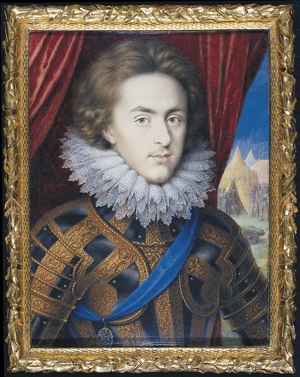
• The first ever exhibition focusing on Henry Stuart, older brother of King Charles I, has opened at the National Portrait Gallery. The Lost Prince: The Life and Death of Henry Stuart features more than 80 exhibits including paintings, miniatures, manuscripts, books and armour gathered from museums and personal collections around the UK and abroad – with some of the objects being displayed in public for the first time. Opened on 18th October – the 400th anniversary of the Prince’s death, among the paintings displayed in the exhibition are works by Holbein, Nicholas Hilliard and Isaac Oliver as well as Robert Peake as well as masque designs by Inigo Jones and poetry  by Ben Jonson. Henry, Prince of Wales, was the eldest son of King James I and Queen Anne of Denmark, and died at the age of 18 of typhoid fever. As well as looking at his short life, the exhibition covers the extraordinary reaction to his premature death (and the end of hope that King Henry IX would sit next upon the throne). The exhibition runs until 13th January. An admission fee applies. For more, see www.npg.org.uk. PICTURE:  Henry, Prince of Wales by Isaac Oliver, c. 1610-12; Copyright: The Royal Collection Photo: Supplied by Royal Collection Trust / © HM Queen Elizabeth II 2012

The Lord Mayor’s Show – the largest unrehearsed procession in the world – will be held on 10th November. This year’s procession – celebrating the election of the 685th Lord Mayor of London, Alderman Roger Gifford – will feature more than 6,500 people winding their way through the City of London in a three-and-a-half mile-long display including 22 marching bands, 125 horses, 18 vintage cars, 21 carriages, an original American stagecoach, a Sherman tank, a steamroller and a Japanese Taiko drum band. While there will be no fireworks after this year’s parade, following the success of last year’s trial there will be an early morning flotilla with the Lord Mayor conveyed in the barge QRB Gloriana from Vauxhall up the Thames to HMS President, just below St Katharine Docks, from where he will make his way to the Mansion House to join the procession as it heads first to St Paul’s and then on to the Royal Courts of Justice before returning (via a different route). There are no grand stand seats left but plenty of places you can watch it for free (for a chance to win free Grandstand tickets, head to the Lord Mayor’s Show Facebook page and ‘like’ it). We’ll be talking about this more next week, but in the meantime, for maps and details of a new smart phone app, head to www.lordmayorsshow.org.

Two prehistoric Japanese pots have gone on display at the British Museum. Loaned from the Nagaoka Municipal Science Museum, the pots date from the Middle Jomon period (3,500-2,500 BCE) and consist of a ‘flame’ and a ‘crown’ pot which were excavated in Nagaoka city. The pots form part of the Asahi Shimbun Displays in room 3 and will be there until 20th January. Meanwhile, continuing the Asian theme, an exhibition of more than 100 contemporary carved Chinese seals by artist Li Lanqing is on display in room 33 until 15th January. Admission to both is free. For more, see www.britishmuseum.org.

• On Now: Seduced by Art: Photography Past and Present. The National Gallery’s first major exhibition of photography, the display looks at the relationship between historical paintings and photography, both its early days in the mid-19th century and the work of contemporary photographers – in particular how photographers have used the traditions of fine art to “explore and justify” their own works. Almost 90 photographs are displayed alongside a select group of paintings for the show. Admission is free. Runs until 20th January in the Sainsbury Wing. For more, see www.nationalgallery.org.uk.

Around London – Richmond’s upsized Olympic rings; cart marking; ‘Sam’ Mussabini honored; and, Tudor twins at the NPG…

• The largest official Olympic Rings were unveiled at Richmond Park National Nature Reserve in London’s south-west this week, having been mown into the grass by the Royal Parks’ shire horses. The rings, which lie on Heathrow’s flight path and are 300 metres wide and more than 135 metres tall, will welcome athletes as they fly in to compete in the Games which kick off later this month. It took six shire horses to create the giant rings – which represent five continents – but they’ll be maintained by just two – Jim and Murdoch. Horses have worked in Richmond Park since as far back 1637 when King Charles I had the park enclosed as a royal hunting ground. Eleven Olympic events will be held on Royal Parks during the Games including road race cycling in Richmond Park. For more on Richmond Park, see www.royalparks.org.uk/parks/richmond-park. PICTURE: LOCOG.

• Almost 50 vehicles, ranging from handcarts to horse drawn carriages, steam powered vehicles to a new London bus, took part in the Worshipful Company of Carmen’s traditional ‘Cart Marking’ procession through the City of London yesterday. The ‘trade’ of carmen dates back to the 13th century when City authorities passed a bye-law controlling carters. At the ceremony, the carmen bring a variety of vehicles which are branded by placing a red hot iron on a wooden plate, with the year letter and the car number, in the continuation of an ancient tradition. The Worshipful Company of Carmen is said to be the oldest transportation organisation in the world. For more on the livery company, see www.thecarmen.co.uk.

• The late athletics coach Scipio Africanus “Sam” Mussabini (1867-1927) was honored this week with the unveiling of an English Heritage Blue Plaque at his former home in Herne Hill in London’s south. Mussabini, whose role in helping 100 metre sprinter Harold Abrahams win gold at the 1924 Olympics was depicted in the film Chariots of Fire (he was played by Ian Holm),  lived at the house at 84 Burbage Road from 1911 to about 1916. It backs onto the Herne Hill Stadium where he worked as a cycling and athletics coach from the 1890s, a period during which he trained several medal-winning Olympic athletes. All up, Mussabini’s runners won a total of 11 Olympic medals including five golds, between 1908 and 1928. For more, see www.english-heritage.org.uk.

On Now: Double Take: Versions and Copies of Tudor Portraits. This display at the National Portrait Gallery features five pairs of nearly identical Tudor portraits and explores how and why they were made. Among the portraits from the gallery’s collection on display are those of King Henry VIII, his wife Anne Boleyn, Archbishop William Warham, the merchant Thomas Gresham and Lord Treasurer Thomas Sackville – all of which are paired with paintings on loan from other collections. Admission is free. Runs until 9th September. For more information on the Making Art in Tudor Britain research project – of which this is a part – see www.npg.org.uk/research/programmes/making-art-in-tudor-britain.

Around London – Museums at Night; Ballgowns at the V&A; Edward Lear plaqued; and, the Queen’s portrait at the NPG…

• It’s Museums at Night weekend which means its your chance to see some of London’s best museums after hours. Culture24’s annual event, which runs from 18th to 20th May, features more than 5o late openings and special events in London – from after dark visits to Aspley House, the former home of the Duke of Wellington, to the chance to hear about the history of ‘Bedlam’, one of the world’s oldest psychiatric facilities, at the Bethlem Archives & Museum and Bethlem Gallery, and a “Cinderella shoe” workshop at the Design Museum. As well as organisations like the British Museum and National Gallery, among the lesser known museums taking part are the Cuming Museum in Southwark, the British Dental Association Museum, and the Ragged School Museum in Mile End. For all the details, follow this link

Saturday sees the opening of a new V&A exhibition featuring more than 60 ballgowns dating from 1950 to the present day – the first exhibition to be held in the newly renovated Fashion Galleries. Among those gowns on display as part of Ballgowns: British Glamour Since 1950 will be royal ballgowns including a Norman Hartnell gown designed for Elizabeth, the Queen Mother, Catherine Walker’s ‘Elvis Dress’ worn by Princess Diana (pictured), and gowns worn by today’s young royals. There will also be gowns worn by celebrities including Sandra Bullock, Liz Hurley and Bianca Jagger and works by the likes of Alexander McQueen, Jenny Packham and a metallic leather dress designed by Gareth Hugh specifically for the exhibition. Runs from 19th May to 6th January. Admission charge applies. See www.vam.ac.uk for more. PICTURE: Victoria and Albert Museum, London

The man credited with popularising the modern-day limerick, Edward Lear, has been honored with a green plaque at his former house in Westminster. The Westminster Council plaque was unveiled on Saturday – what would have been his 200th birthday – at 15 Stratford Place where he lived from 1853 until 1869. Lear, who was born in Holloway and raised in Grays Inn Road, was famous for his work The Owl and the Pussycat, and as well as for his writings, was also noted as an artist and illustrator. Councillor Robert Davis reportedly had a go himself at a limerick in honour of the artisy: “There once was man named Lear, who lived in a spot close to here. This plaque unveiled today, is a fitting way, to pay tribute on his two hundreth year”.

• On Now: The Queen: Art and Image. Having been on tour across Britian, this exhibition features some of the most remarkable images ever created of the Queen opened at the National Portrait Gallery this week. Containing works by Cecil Beaton and Annie Leibovitz, Pietro Annigoni and Andy Warhol, the exhibition is the most wide-ranging exhibition of images in different media ever devoted to a single royal sitter. Highlights include full-length 1954-55 painting by Annigoni (pictured, right, it’s displayed with his 1969 portrait), Lucian Freud’s 2000-01 portrait and Thomas Struth’s recent large-scale photograph of both the Queen and the Duke of Edinburgh as well as a never previously loaned 1967 portrait by Gerhard Richter and a specially commissioned holographic portrait. Runs until 21st October. Admission charge applies. For more, see www.npg.org.uk. PICTURE: Queen Elizabeth II, Queen Regent by Pietro Annigoni, 1954-5. The Fishmongers’ Company

Around London – Butler’s Retreat reopens in Epping Forest; Designs of the Year; and, Lucian Freud’s last work…

• Epping Forest’s historic Butler’s Retreat has reopened its doors as a cafe following a refurbishment project to restore the building to its former glory. The building was constructed in the 19th century and is one of the last remaining Victorian-era ‘retreats’ within the forest. Named for its 1891 occupier, John Butler, it was one of a number of retreats built to serve refreshments as part of the Temperance movement – said to have been “extremely popular” with visitors from the East End. The building, which now forms part of the Epping Forest visitor hub, is expected to host a range of events this summer and will have its opening hours extended with the slated opening of a restaurant upstairs in the evenings. Owned by the City of London, Epping Forest is the largest public open space in the London area, stretching across 12 miles from Manor Park in East London to a spot past Epping in Essex. The cafe, the refurbishment of which was carried out with funding provided via the Heritage Lottery’s Branching Out project, will be open from 9am to 5pm weekdays and 8am to 5pm weekends. For more on the cafe, see www.worldslarder.co.uk. For more on Epping Forest, see www.cityoflondon.gov.uk/eppingforest

• On Now – Designs of the Year Exhibition: The London Olympic Torch and the Duchess of Cambridge’s wedding dress are among 90 objects nominated as one of the “best designs in the world” in this year’s Design of the Year competition. The objects, which go on display at the Design Museum today, have been entered in seven categories – architecture, digital, fashion, furniture, graphics, product and transport – with winners to be announced on 24th April. Among the other objects nominated are a wind-propelled landmine detector, a pop-up cinema in Hackney, the London 2012 velodrome and the first Tesco virtual store. An admission charge applies for the exhibition which runs until 15th July.  For more information, see designsoftheyear.com.

On Now – Lucian Freud Portraits. The last work of the late artist Lucian Freud is on show for the first time in this exhibition at the National Portrait Gallery. The unfinished painting, Portrait of the Hound 2011, which depicts Freud’s assistant assistant David Dawson and his dog Eli, is a highlight of the exhibition which also includes works dating back as far as the 1940s. The 130 paintings and works on paper – which feature sitters including artists Francis Bacon and David Hockney along with the likes of Andrew Parker Bowles and Baron Rothschild – have been loaned from museums and private collections around the world. Runs until 27th May, 2012. Admission charge applies. See www.npg.org.uk.

Around London: A new pleasure garden for London; music hall star Dame Gracie Fields honored; mystery portraits at the NPG; and, celebrating the Olympics (from a Peruvian perspective)…

A new pleasure garden will be built in the city’s east as part of celebrations for next year’s Diamond Jubilee. London Pleasure Gardens, announced back in March, will be built upon a 60,000 square metre site at Pontoon Dock, opposite the ExCeL Exhibition Centre, and consist of an “ever-evolving creative playground for both resident Londoners and tourists alike”. The gardens, which will feature landscaped walkways, a floating cinema, an ‘adult’s playground’ and a range of facilities such as a ‘glass cafe’ – are expected to be open for the Queen’s Jubilee Weekend on 1st June. It’s expected that more than 40,000 people a day will pass through the site during the Olympics. London has had a long association with the concept of pleasure gardens – places where people gathered to listen to music, see art, eat and drink and talk, the most famous of which was the Vauxhall Pleasure Gardens. But the Royal Docks also had its own pleasure gardens in the past – these existed between 1851 and 1884 and were named the Royal Victoria Gardens.  For more, see www.londonpleasuregardens.com.

• Music hall star Dame Gracie Fields has been honored by English Heritage with a blue plaque on the Islington house where she lived for three years in the 1920s. It was while living at 72a Upper Street with her parents and first husband Archie Pitt, that she consolidated her reputation as one of Britain’s most popular performers and it was also during this time that she recorded for the first time (she was to become a regular on the BBC and by 1933 had cut a massive four million discs) and appeared before King George V and Queen Mary at a Royal Variety Performance. Following her success, Fields and Pitt built a mansion in The Bishop’s Avenue, Hampstead, called ‘The Tower’ in honor of the show which had made her a star – Mr Tower of London. She later separated from Pitt and married an Italian born director Monty Banks. They moved to the US in 1940 amid fears her husband would be interned and, after the war, she settled on the Italian island of Capri where, following Banks’ death in 1950, she married again. She made her final appearance on the London stage in 1978 – closing a Royal Variety Performance – and died back in Capri the following year.

• And, briefly…..A new species of dinosaur – Spinops sternbergorum – has reportedly been discovered at the Natural History Museum, identified from bones previously gathering dust on a shelf at the museum.

On Now: Imagined Lives: Portraits of Unknown People. This exhibition at the National Portrait Gallery centres on a group of 14 portraits from the 16th and 17th centuries which depict unknown people. Originally thought to represent famous figures like Queen Elizabeth I, the identity of the sitters is now considered unknown. In response to the pictures, eight internationally renowned authors – from Alexander McCall Smith and Joanna Trollope to Julian Fellowes and Terry Pratchett – have written imaginative short stories about the portraits, bringing them to life. The exhibition was originally shown in Somerset but is now running at the NPG until 22nd July. Admission is free. For more information, see www.npg.org.uk.

On Now: London and the Olympics. The Museum of London is hosting a new display which looks at the 1908 and 1948 Olympic Games held in London but, in twist, looks at not only the experiences of Londoners but those of the 41 man team Peru sent to the 1948 games. Pictures included in the display come from an album made by one of the athletes, Enrique Mendizabal Raig, recording the team’s visit (you can find the images on Flickr here). Entry is free. Runs until September. For more, see www.museumoflondon.org.uk.

Famous Londoners – Sarah Siddons

The most acclaimed tragic actress of the 18th and early 19th centuries, Sarah Siddons is best remembered for her iconic role as Shakespeare’s Lady Macbeth.

Born in 1755 into the theatrical Kemble family (her father was an actor and theatre manager and many of her 11 younger siblings, including John Philip Kemble, also went on to be actors) in Brecon, Wales, Siddons first began appearing with Kemble’s company while still at school. Still only a young teenager, she also began a romance with one of the company’s actors, William Siddons.

The liaison was discouraged by her parents (as was the idea of her acting) and in 1770 she was sent into service with a family in Warwick. She had kept up correspondence with Siddons, however, and, after her parents withdrew their opposition to the match, they were married on 26th November, 1773.

The couple rejoined Kemble’s company initially but were soon working for another, Chamberlain and Crump, and it was while doing so in the spa town of Cheltenham that Siddons’ abilities came to the notice of famed actor, playwright and theatre manager David Garrick.

Invited to London, her initial foray into acting there, however, fell flat and, following a short-lived season at Drury Lane Theatre which resulted in her services no longer being required (it is believed the fact she had two very young children at the time, having only just given birth to the second, didn’t help her performances), Siddons instead headed to the country and worked in places like York, Manchester and Bath, rebuilding her somewhat battered reputation.

It proved a successful move for when she was invited back to London in 1782, her now not just restored but blossoming reputation preceded her. To much acclaim she performed in the title role in David Garrick’s play, Isabella, or, the Fatal Marriage.

It was to be the first of many high profile roles – the most famous of which was to play Lady Macbeth – and Siddons soon rose to become the most sought-after actress in the city, a position which allowed her to mix among the elite of society (among her friends were counted lexicographer Dr Samuel Johnson and philosopher Edmund Burke and she even appeared before King George III and Queen Charlotte). Venerated as a “cultural icon”, her star continued to climb in the 1780s and it was in 1783-84 that she sat for a portrait, The Tragic Muse, by Sir Joshua Reynolds (pictured).

Her personal life, meantime, was another matter and in 1804, Siddons and her husband – who had increasingly spent time apart during the preceding years, formally separated (William died in Bath four years later). She had also experienced the deaths of many of her children – in fact, only two of her seven children were to outlive her.

Siddons retired from the stage in 1812 – her final moving performance was, you guessed it, as Lady Macbeth – but continued to appear on special occasions until 1819.

She died in June, 1831, and, following a huge funeral, was buried at St Mary’s Cemetery at Paddington Green. There is a statue of her at the grave. Siddons is among those actresses currently featured in the National Portrait Gallery exhibition The First Actresses – Nell Gwyn to Sarah Siddons. The exhibition runs until 8th January (an admission charge applies). For more information visit www.npg.org.uk.

For further reading – Robyn Asleson’s A Passion for Performance: Sarah Siddons and Her Portraitists

PICTURE: Sarah Siddons as the Tragic Muse by the Studio of Sir Joshua Reynolds, 1784  © National Portrait Gallery, London

Famous Londoners – Nell Gwyn…

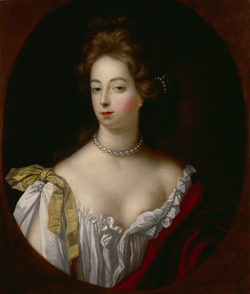
Perhaps now best known as the most prominent of the many mistresses of King Charles II, Eleanor ‘Nell’ Gwyn – currently subject of a new exhibition at the National Portrait Gallery – was a renowned actress in the years after the Restoration, known for her wit and beauty – “Pretty, witty Nell “as diarist Samuel Pepys called her.

Gwyn’s (variously spelt as Gwynn or Gwynne) origins remain something of a mystery – believed to have been born around 1651, her parents remain something of a mystery (some have suggested a Cavalier, Captain Thomas Gwyn, as her father) as does the place of her birth, variously claimed to be London, Hereford or Oxford – one source from 1715 claims she was born in Coal Yard Alley, off Drury Lane in Covent Garden.

Ascribed as having various jobs during her childhood – everything from helping at a bawdyhouse to a street vendor or cinder girl – around 1663, she was working as an “orange girl” at a theatre then known as the King’s Theatre in Bridge Street (now the site of the Theatre Royal Drury Lane).

She clearly made an impression for a year later she was working as an actress and is believed to have taken prominent actor Charles Hart as her lover. It has been suggested her first recorded stage appearance was in March, 1665. She wasn’t viewed as a brilliant dramatic actress but instead came into her own in comedies where her wit, as well as her beauty, could shine.

Having already been known to have had at least two lovers – Charles Hart and aristocrat Charles Sackville, Lord Buckhurst – by 1667 George Villiers, Duke of Buckingham, had decided to bring her to the attention of the king as a possible new mistress and so increase his influence. By 1668 or 1669, Nell is believed to have succeeded in this, joining the growing number of women who could claim the title (Charles II ended up having at least 12 children by his many mistresses).

Her acting work gradually decreased and in 1670, she gave birth to Charles, her first son and believed to be the king’s seventh illegitimate child. She briefly returned to the stage in 1670-71 before retiring from the theatre for good.

In February, 1671, Nell moved into a townhouse at 79 Pall Mall (she was granted freehold of the property five years later and the property, which still stands, remains the only one on the south side of Pall Mall not owned by the Crown) and in December, she gave birth to her second child by the king, another son James (he died in Paris while attending school there 10 years later).

Both sons were given titles – Charles was later named Duke of St Albans – and given the surname Beauclerk. In the 1670s, Charles granted Nell Burford House in Windsor where she resided when the king was resident there.

In the 1670s, Nell – who continued to maintain her friendships with the likes of Villiers – successfully fought off several rivals for the king’s affection and by the 1680s, her position as the king’s mistress was not in doubt. It was during this period that the story goes when her coach was mistaken by an angry to be that of the unpopular Duchess of Portsmouth, she put her head out the window to tell them “Pray good people be silent, I am the Protestant whore”.

When King Charles II died on 6th February, 1685, he left instructions she was to be looked after – his brother King James II both paid her debts and continued to pay her an annual pension.

Nell died less than three years later – still only aged in her thirties – on 14th November, 1687, have suffered strokes in previous years. She was buried in the church of St Martins-in-the-Fields.

Gwyn is seen as a key figure in London during the period after the Restoration and a symbol of the hedonism of the court of King Charles II, and her rise from apparently humble origins to the royal court has been the subject of numerous books, plays and films.

Gwyn is currently featured in an exhibition currently being held at the National Portrait Gallery: The First Actresses – Nell Gwyn to Sarah Siddons. The exhibition runs until 8th January (an admission charge applies). For more information visit www.npg.org.uk.

PICTURE: Eleanor ‘Nell’ Gwyn, by Simon Verelst, © National Portrait Gallery, London

Around London – Leading ladies of the 18th century at NPG; “at risk” in London; and, Antarctic images at the Queen’s Gallery…

• A new exhibition featuring some of London’s leading ladies of the eighteenth century opens at the National Portrait Gallery today. The First Actresses: Nell Gwyn to Sarah Siddons is the first exhibition devoted to eighteenth century actresses and features 53 portraits depicting the likes of Gwyn and Siddons as well as Lavinia Fenton, Mary Robinson and Dorothy Jordan. Highlights of the exhibition include a little known version of Joshua Reynolds’ portrait of Sarah Siddons as the “tragic muse”, William Hogarth’s The Beggar’s Opera and Thomas Gainsborough’s portraits of Giovanna Bacelli and Elizabeth Linley. The exhibition reveals the key role these women played in the celebrity culture found in London (and elsewhere) during the period. As a counterpoint, an accompanying exhibition displays photographs and paintings of some of today’s actresses. Runs until 8th January (an admission charge applies). For more information on the exhibition or the programme of accompanying events, see www.npg.org.uk.

Cemetery in Hackney and Kensal Green, a park in Hounslow and a Piccadilly property formerly used as the Naval and Military Club are among the “priority sites” listed on English Heritage’s annual Heritage At Risk Register. Released earlier this week, the register’s 10 London”risk priority sites” include London’s first metropolitan cemetery – Kensal Green (All Souls) – which dates from 1833, Gunnersbury Park in West London – featuring a large country home known as Gunnersbury Park House, it was built in 1801-28 and later remodelled, and a mansion at 94 Piccadilly – built in 1756-60 for Lord Egremont, it was later used at the Military and Naval Club and is now for sale. Others on the list include Abney Park Cemetery in Hackney – laid out in 1840, it is described as London’s most important Nonconformist cemetery, a medieval manor farm barn in Harmondsworth in London’s outer west, Tide Mill in Newham, East London, and the entire Whitechapel High Street and Stepney Green conservation areas. For more information, see www.english-heritage.org.uk/caring/heritage-at-risk/.

On Now: The Heart of the Great Alone: Scott, Shackleton and Antarctic Photography. Opening at the Queen’s Gallery, Buckingham Palace, tomorrow, the exhibition marks the centenary of Captain Robert Scott’s ill-fated expedition to the South Pole and features a collection of photographs presented to King George V by the official photographers on Scott’s expedition of 1910-13 and Ernest Shackleton’s expedition of 1914-16 as well as unique artifacts including the flag given to Scott by Queen Alexandra (the widow of King Edward VII) which was taken to the Pole. Highlights include Herbert Ponting’s images The ramparts of Mount Erebus and The freezing of the sea and Frank Hurley’s stunning images of Shackleton’s ship Endurance as it was crushed by ice. Runs until 15th April, 2012 (admission charge applied). For more, see www.royalcollection.org.uk.

Treasures of London – ‘The Ambassadors’

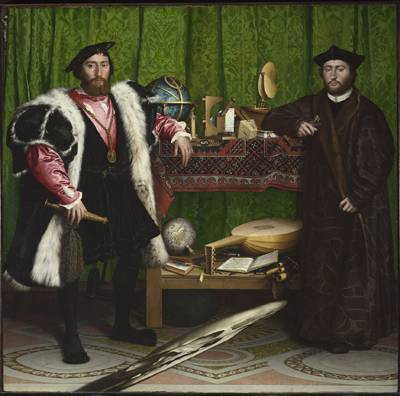
A stunning portrait on a grand scale, The Ambassadors depicts two influential figures from the 16th century – Jean de Dinteville, the then 29-year-old French ambassador to England and Georges de Selve, the then 25-year-old bishop of Lavaur and sometime French ambassador to the Emperor, the Venetian Republic and the Holy See.

The oil on oak work, which is housed in room four of the National Gallery and is also one of the images featured online as part of the Google Art Project, was painted by Hans Holbein the Younger in 1533 and is meant as a portrait to show the men’s power, learning and wealth – they are surrounded by objects which include celestial and terrestrial globes, a portable sundial, a lute (and its case), and books including one of hymns and another of arithmetic as well as richly decorated furnishings.

Yet there’s more to this painting than initially meets the eye – a closer look reveals a distorted skull in the foreground which, when viewed from the painting’s right-hand side comes into its proper perspective. A reflection on mortality perhaps?

And though no typically viewed as a religious work, there are also some striking religious overtones to this image including a broken string on the lyre – often seen as a Christian symbol of disharmony – and, partly hidden behind the curtain on the far left of the painting as you look at it, a crucifix hanging on the wall.

Holbein painted the work during his second stint in England while depicting life at the Tudor court. Among his most famous other images are one of King Henry VIII (held in the National Portrait Gallery) and another of Christina of Denmark (also in the National Gallery – painted to show Henry VIII the image of a potential future wife although the relationship never went any further than that).

PICTURE: Ng1314, Hans Holbein the Younger, Detail of Jean de Dinteville and George de Selve (‘The Ambassadors’), 1533 © The National Gallery, London.

WHERE: Room 4, National Gallery, Trafalgar Square (nearest tube stations Leicester Square and Charing Cross); WHEN: 10am to 6pm (Fridays 10am to 9pm); COST: Free; WEBSITE: www.nationalgallery.org.uk. The image is also available online as part of the Google Art Project here:www.googleartproject.com/museums/nationalgallery/the-ambassadors.