Around London – Margaret Thatcher’s funeral; telling the Jewel Tower’s story; depot open weekend; and, Designs of the Year…

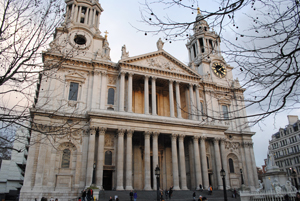
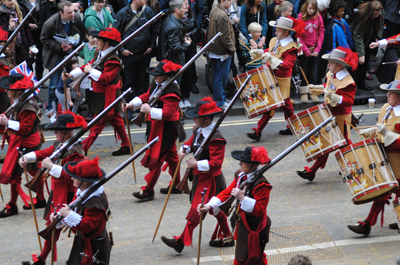
Margaret Thatcher’s funeral will be held next Wednesday at St Paul’s Cathedral from 11am with Queen Elizabeth II among those attending (the first time she has attended the funeral of a British politician since Sir Winston Churchill’s in 1965). The funeral procession of the former Prime Minister, who died on Monday aged 87, will start at the Houses of Parliament and make its way down Whitehall to Trafalgar Square before moving down the Strand, Fleet Street and Ludgate Hill to St Paul’s Cathedral. Baroness Thatcher’s coffin will carried in a hearse for the first part of the journey and will be transferred to a gun carriage drawn by six horses of the King’s Troop Royal Horse Artillery at St Clement Danes church on the Strand for the final part of the journey. There will be a gun salute at the Tower of London. Meanwhile, a Book of Condolence has opened at St Margaret’s Church, beside Westminster Abbey, this morning and will be available for people to pay their respects until 17th April, during the church’s opening hours. St Margaret’s – which stands between Westminster Abbey and the Houses of Parliament – is commonly known as the parish church of the House of Commons.

The story of the Jewel Tower – one of the last remaining parts of the medieval Palace of Westminster – is told in a new exhibition at the historic property. Now in the care of English Heritage, the tower – located to the south of Westminster Abbey, was built in 1365 to house King Edward III’s treasury, later used as King Henry VIII”s ‘junk room’, the record office for the House of Lords, and, from 1869, served was the “testing laboratory” for the Office of Weights and Measures. The exhibition, which opened this month, is part of the English Heritage celebrations commemorating the centenary of the 1913 Ancient Monuments Act. The Jewel Tower is open daily until November. Admission charge applies. For more, see www.english-heritage.co.uk.

See some of the earliest underground trains, a Lego version of Baker Street station and ride the Acton Miniature Railway. The London Transport Museum’s depot in Acton is holding it’s annual spring open weekend this Saturday and Sunday and in celebration of the Underground’s 150th anniversary, attractions will include the Metropolitan Steam Locomotive No. 1 and the recently restored Metropolitan Carriage 353 along with model displays, rides on the miniature railway, film screenings, talks, and workshops. Wales’ Ffestiniog Railway team – celebrating their own 150th anniversary – will also be present with the narrow gauge train, Prince. Open from 11am to 5pm both days. Admission charge applies. For more, see www.ltmuseum.co.uk.

Now On: Designs of the Year. The Design Museum has unveiled contenders for the sixth annual Designs of the Year competition and you can what they are in this exhibition. Consisting of more than 90 nominations spanning seven categories, the nominated designs include the Olympic Cauldron by Heatherwick Studio, The Shard – western Europe’s tallest building – by Renzo Piano, a non-stick ketchup bottle invented by the Varanasi Research Group at MIT, and Microsoft’s Windows phone 8. The exhibition runs until 7th July – the winners will be announced this month. Admission charge applies. For more, see www.designmuseum.org.

Where is it?…#51…

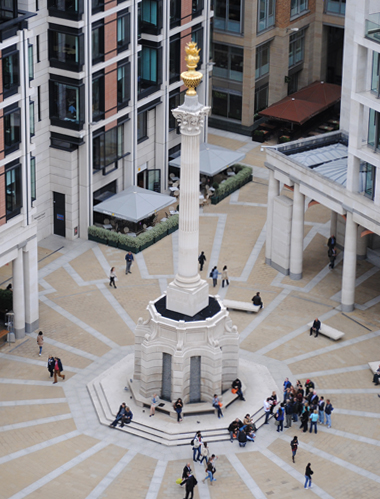
The latest in the series in which we ask you to identify where in London this picture was taken and, although this is a little odd this week, what it’s of. If you think you can identify this picture, leave a comment below. We’ll reveal the answer early next week. Good luck!

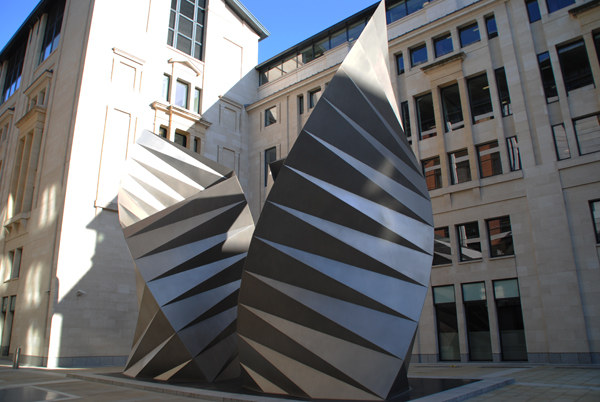
Well done to all those who correctly said this sculpture, Paternoster Vents (although many refer to it as Angel’s Wings), is located in Bishop’s Court, just to the west of Paternoster Square near St Paul’s Cathedral. The work of Thomas Heatherwick (yes, the same man who designed the stunning Olympic cauldron used in this year’s Games), it is actually some beautifully designed cooling vents for an electrical substation underneath. The 11 metre high sculpture takes its design from folded paper and is made from stainless steel.

LondonLife – Dick Whittington visits St Paul’s for the Lord Mayor’s Show…

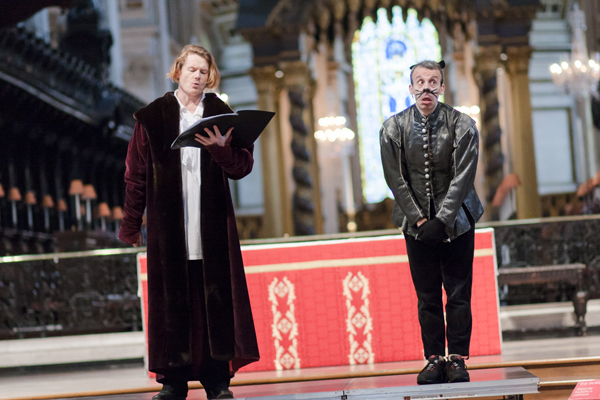
Actors Julian Rhind-Tutt (The Madness of King George, Notting Hill) and David Schneider (Horrid Henry the Movie, I’m Alan Partridge) star as thrice Lord Mayor of London, Dick Whittington, and his cat in one of a series of free performances held in St Paul’s Cathedral last Saturday as part of the festivities surrounding the annual Lord Mayor’s Show. The Lord Mayor, Roger Gifford, visited St Paul’s to receive a blessing before heading on to the Royal Courts of Justice to swear an oath of allegiance (and then, eventually returning to Mansion House where his journey had also begun). Interestingly, the Lord Mayor was unable to complete his entire journey to and from Mansion House in the State Coach this year (see our earlier post here) when what was reported as a fault with the coach’s wheels meant he had to complete the journey in an open top Land Rover. For more on events at St Paul’s Cathedral, see www.stpauls.co.uk.

PICTURE: © Graham Lacdao/The Chapter of St Paul’s Cathedral

Around London – Lord Mayor’s Show; Remembrance Sunday; Ansel Adams at the NMM; and, Mughal India at the British Library…

• The 2012 Lord Mayor’s Show is just about upon us and while you may not have a grandstand seat, there’s still plenty of places you can stand and watch the parade of more than 6,500 people pass by. Saturday’s parade – which celebrates the election of the 685th Lord Mayor of London, Alderman Roger Gifford – leaves Mansion House at 11am and travels via Poultry and Cheapside to St Paul’s Cathedral where it pauses for the Lord Mayor and his officials to receive a blessing – before continuing on via Ludgate Hill and Fleet Street to the Royal Courts of Justice, arriving there at about 12.30pm. There the Lord Mayor gives his oath of loyalty to the Crown (while in the surrounding streets the participants and 125 horses are fed and watered) before the parade reassembles and sets off from Embankment at 1pm, heading back to Mansion House via Queen Victoria Street – the Lord Mayor arrives sometime between 2pm and 2.30pm. (The website has a terrific one page map of the route you can download and print). There’s no fireworks display after the parade – although there’s a host of other activities taking place in the City of London – but if you’re up and about early enough, you may want to watch the Lord Mayor as he boards the barge QRB Gloriana at the Westminster Boating Base in Vauxhall at 8.30am and, escorted by a flotilla, makes his way up the Thames to HMS President, just below St Katharine Docks, arriving at about 9.35am after Tower Bridge opens in salute. For more, head to www.lordmayorsshow.org.

• The annual Remembrance Sunday service – commemorating the contribution of British and Commonwealth servicemen and women in the two World Wars and later conflicts – will take place at the Cenotaph on Whitehall at 11am this Sunday. While no tickets are required to watch the event, the Department of Culture, Media and Sport, who organise the service, advise arriving early if you wish to secure a good viewing space (and leave time for security checks at the entrance to either end of Whitehall). Whitehall opens at 8am. For more details, see www.culture.gov.uk/what_we_do/honours/3333.aspx.

A new exhibition of the work of US photographic pioneer Ansel Adams opens at the National Maritime Museum in Greenwich tomorrow (Friday). Ansel Adams: Photography from the Mountains to the Sea, which comes from the Peabody Essex Museum in Salem, Massachusetts, will feature more than 100 original prints, many of which have never been exhibited before in the UK. It is said to be the first exhibition to focus on his “lifelong fascination” with water and the display features some of Adams’ finest images based on this subject including what are some of the most famous photographs of the 20th century. Highlights include the first photograph Adams’ ever image – taken at age 14 – which features a pool located at the Panama Pacific Exhibition at the 1915 World’s Fair, the three American Trust murals produced in the 1950s on an “unprecedented scale”, Adam’s favorite work – Golden Gate before the Bridge – which hung above his desk, and iconic images such as Clearing Winter Storm, Yosemite and Stream, Sea, Clouds, Rodeo Lagoon, Marin Country, California. There is an admission charge. Runs until 28th April. For more details on the exhibition, see www.rmg.co.uk.

Also opening tomorrow (Friday) is the British Library’s major autumn exhibition – Mughal India: Art, Culture and Empire. The exhibition focuses on the Mughal dynasty – which once ruled over much of the Indian sub-continent – and is the first to document the period spanning the 16th to 19th centuries. Featuring more than 200 manuscripts and paintings, most of which come from the library’s own collection, highlights include Akbar ordering the slaughter to cease in 1578 – a work attributed to the artist Miskina in 1595, Abu’l Hasan’s early 17th century painting Squirrels in a plane tree, the historically important illustration Prince Aurangzeb reports to the Emperor Shah Jahan in durbar, and a portrait of Prince Dara Shikoh, favorite son and heir-apparent of 17th century Emperor Shah Jahan. Runs until 2nd April. Admission charge applies. For more on the exhibition and accompanying events, see www.bl.uk.

Treasures of London – The State Coach…

Eight days from now, the Lord’s Mayor’s Show will be winding its way through the streets of the City London with star of the show, the new Lord Mayor of London, Roger Gifford, riding in a spectacular gilt State Coach.

The coach’s origins go back to the mid 18th century although the reason why a coach is used go back some years earlier – to 1711, in fact, when then Lord Mayor Sir Gilbert Heathcote fell off the horse he was riding in the procession and broke his leg. It’s worth noting that up until the 1420s, the Lord Mayor rode all the way to the Palace of Westminster to swear fealty to the monarch – after that they went on a river barge down the Thames, a practice which continued until 1857 (although they still had to ride to and from the watercraft which is when Sir Gilbert had his accident).

While a stand-in coach was used for some years after Sir Gilbert’s fall, in 1757 Sir Charles Asgill, a banker who was set to be the next Lord Mayor, commissioned Joseph Berry of Leather Lane in Holborn to make the splendid vehicle still in use today (the coach was designed by architect Sir Robert Taylor). Built at a cost of £1,065.0s.3d, the substantial sum was met by the Aldermen. It’s now apparently worth more £2 million.

Richly ornate, many of the four ton coach’s features emphasise the role of the City of London as a centre of world trade – the cherubs at each of the coach’s four corners, for example, represent the four continents of Asia, Africa, America and Europe. The City’s coat-of-arms is on the back of the coach, the front panel has an image of Hope pointing at St Paul’s Cathedral and the side panels are decorated with representations of moral virtues.

The coach, which has undergone many restorations (in an indication of this, it’s said there’s as many as 100 coats of paint and varnish on the ceiling), has since been used in every Lord Mayor’s Show and when not in use, can be seen in the Museum of London.

PICTURE: The State Coach at last year’s Lord Mayor Show/© David Adams

Around London – Henry Stuart at the NPG; the Lord Mayor’s Show; prehistoric Japanese pots; and, photography at the National Gallery…

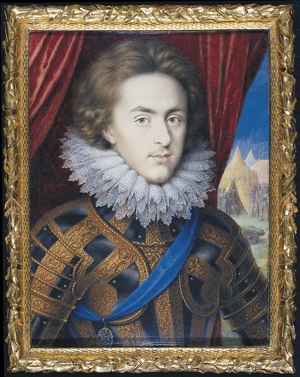
• The first ever exhibition focusing on Henry Stuart, older brother of King Charles I, has opened at the National Portrait Gallery. The Lost Prince: The Life and Death of Henry Stuart features more than 80 exhibits including paintings, miniatures, manuscripts, books and armour gathered from museums and personal collections around the UK and abroad – with some of the objects being displayed in public for the first time. Opened on 18th October – the 400th anniversary of the Prince’s death, among the paintings displayed in the exhibition are works by Holbein, Nicholas Hilliard and Isaac Oliver as well as Robert Peake as well as masque designs by Inigo Jones and poetry  by Ben Jonson. Henry, Prince of Wales, was the eldest son of King James I and Queen Anne of Denmark, and died at the age of 18 of typhoid fever. As well as looking at his short life, the exhibition covers the extraordinary reaction to his premature death (and the end of hope that King Henry IX would sit next upon the throne). The exhibition runs until 13th January. An admission fee applies. For more, see www.npg.org.uk. PICTURE:  Henry, Prince of Wales by Isaac Oliver, c. 1610-12; Copyright: The Royal Collection Photo: Supplied by Royal Collection Trust / © HM Queen Elizabeth II 2012

The Lord Mayor’s Show – the largest unrehearsed procession in the world – will be held on 10th November. This year’s procession – celebrating the election of the 685th Lord Mayor of London, Alderman Roger Gifford – will feature more than 6,500 people winding their way through the City of London in a three-and-a-half mile-long display including 22 marching bands, 125 horses, 18 vintage cars, 21 carriages, an original American stagecoach, a Sherman tank, a steamroller and a Japanese Taiko drum band. While there will be no fireworks after this year’s parade, following the success of last year’s trial there will be an early morning flotilla with the Lord Mayor conveyed in the barge QRB Gloriana from Vauxhall up the Thames to HMS President, just below St Katharine Docks, from where he will make his way to the Mansion House to join the procession as it heads first to St Paul’s and then on to the Royal Courts of Justice before returning (via a different route). There are no grand stand seats left but plenty of places you can watch it for free (for a chance to win free Grandstand tickets, head to the Lord Mayor’s Show Facebook page and ‘like’ it). We’ll be talking about this more next week, but in the meantime, for maps and details of a new smart phone app, head to www.lordmayorsshow.org.

Two prehistoric Japanese pots have gone on display at the British Museum. Loaned from the Nagaoka Municipal Science Museum, the pots date from the Middle Jomon period (3,500-2,500 BCE) and consist of a ‘flame’ and a ‘crown’ pot which were excavated in Nagaoka city. The pots form part of the Asahi Shimbun Displays in room 3 and will be there until 20th January. Meanwhile, continuing the Asian theme, an exhibition of more than 100 contemporary carved Chinese seals by artist Li Lanqing is on display in room 33 until 15th January. Admission to both is free. For more, see www.britishmuseum.org.

• On Now: Seduced by Art: Photography Past and Present. The National Gallery’s first major exhibition of photography, the display looks at the relationship between historical paintings and photography, both its early days in the mid-19th century and the work of contemporary photographers – in particular how photographers have used the traditions of fine art to “explore and justify” their own works. Almost 90 photographs are displayed alongside a select group of paintings for the show. Admission is free. Runs until 20th January in the Sainsbury Wing. For more, see www.nationalgallery.org.uk.

Lost London – Greyfriars…

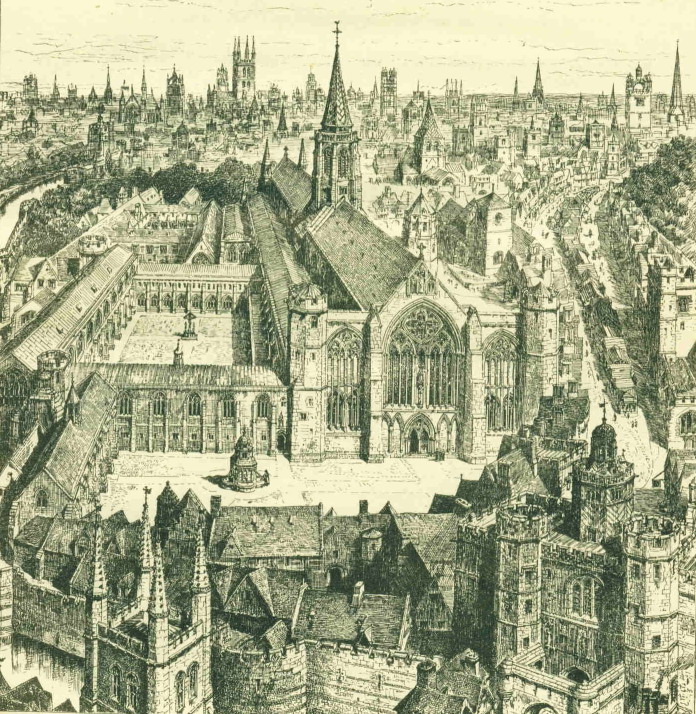
A now long gone Franciscan friary located in the north-west of the City of London near Newgate (just to the north of St Paul’s Cathedral), Greyfriars, so known for the color of the friars’ clothing, was the second Franciscan religious house to have been founded in England.

The foundations of the friary date from the early part of the 13th century – the Franciscans, as members of the Order of Friars Minor were known, had arrived in 1224 and are recorded as settling on land granted to them by a rich mercer, John Iwyn, just inside the City wall, in 1225, in the butcher’s quarter of the city.
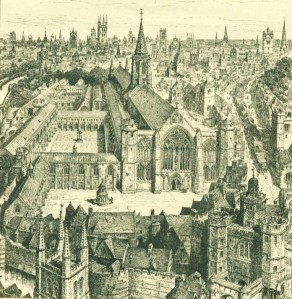
King Henry III apparently gave them some oak to build their own friary in 1229 and by the mid 1200s, there were more than 80 friars living on the site which was gradually extended over the ensuing years to the north and the west.

Using funds given them by Sir William Joyner, Lord Mayor of London in 1239, they built a chapel which was later extensively enlarged and improved in the late 13th and early 14th centuries – the new church was said to be 300 feet long – with much of the work funded by Queen Margaret, second wife of King Edward I, and later in the 14th century, Queen Isabella, wife of Edward III. It apparently suffered some damage in a storm in 1343 but was restored by King Edward III.

When it was finally completed in 1348, the church is said to have been the second largest in London. A library was later added to the buildings, founded by the famous Lord Mayor of London, Richard “Dick” Whittington.

Such was the fame of the church that, the heart of Queen Eleanor, wife of King Henry III, was buried here after her death in 1291 while, despite dying at her castle in Marlborough, Queen Margaret was also buried here in 1318 (apparently wearing a Franciscan habit).

But perhaps the most notorious person to be buried here was Queen Isabella, wife of King Edward II and known by many as the “She-Wolf of France”, after her death in 1358. In fact, it’s said that the ghost of Isabella still haunts the former location of Greyfriars, driven forth from the grave for her role in deposing her husband.

Other non royal luminaries said to have been buried here include the 15th century writer Sir Thomas Mallory, author of Le Morte d’Arthur and 16th century Catholic nun Elizabeth Barton, the so-called ‘mad maid of Kent’ who was executed for her rather unwise prophecies predicting King Henry VIII’s death if he married Anne Boleyn.

The end of the friary, pictured above in the sixteenth century, came in 1538 when it fell victim to King Henry VIII’s policy of dissolving monasteries and was surrendered to his representatives.

Some of the houses were subsequently converted for private use and the church, which was somewhat damaged during this period with many of the elaborate tombs destroyed, was briefly closed before it and other buildings were given to the City of London Corporation who reopened it again in 1547 as Christ Church Greyfriars, a parish church serving the now joined parishes of St Nicholas Shambles and St Ewen.

Only a few year’s later King Edward IV founded a school for poor orphans in some of the old friary buildings known as Christ’s Hospital or informally as The Bluecoat School thanks to the uniforms students wore. Some of the school buildings, along with part of the church which was also used by the school, was destroyed by the Great Fire of London in 1666, but the school was rebuilt and remained in use until the late 1800s when the last of the students were relocated to a new facility in Sussex (where the school still exists today).
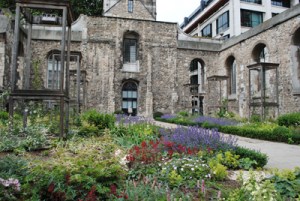
The church (also known as Christ Church Newgate Street), meanwhile, was also rebuilt after the Great Fire – it was one of Sir Christopher Wren’s designs and was completed in 1704. The church remained in use until World War II when a firebomb struck it during a German raid on 29th December, 1940, all but destroying it.

The church was not rebuilt and the parish merged with the nearby St Sepulchre-without-Newgate – the largest parish church in London – and eventually what’s left of the church – the tower with rebuilt steeple and the west and north walls – were converted into a public garden (rose beds were planted where the pews once stood and there are wooden towers representing the church’s pillars). Pictured right, it’s now a terrific place to sit and have lunch pondering the past which the bustle of the city goes on about you.

PICTURE: (top) Wikipedia

For a great biography of Isabella, the She-Wolf of France, see Alison Weir’s Isabella: She-Wolf of France, Queen of England. For more on Sir Christopher Wren’s churches in London, see John Christopher’s Wren’s City of London Churches.

Famous Londoners – John Wesley…

Credited as the founder, along with his brother, of Methodism, it was in London that John Wesley experienced the spiritual awakening that would change his life and lead to the establishment of a new religious movement.

Born on 17th June, 1720, in Epworth, not far from Lincoln, Wesley was the 15th of 19 children born to Samuel Wesley – the rector there – and his wife Susanna. Rescued from a fire in the family rectory at a young age, the event was to have a lasting impression on him leading to his later view that he was set apart for a special purpose – “a brand plucked from the burning”.

Wesley was educated at London’s Charterhouse School and then at Christchurch College in Oxford. Ordained a priest in the Church of England in 1728, he spent two years serving as his father’s curate before returning to Oxford in 1729.

It was there he formed the ‘Holy Club’ with his brother Charles and fellow students including George Whitfield. It’s here that the name ‘Methodist’ was first used as a pejorative term to describe members of the group thanks to their ‘methodical’ way of living – which included religious practises like fasting as well as caring for the ill and prisoners – and which was later adopted by Wesley himself.

Following a largely unsuccessful sojourn in the newly founded American Province of Georgia with his brother Charles (they had been invited by the colony’s first governor, James Oglethorpe, to minister to the new settlers) during which Wesley was involved in a courtship that ended badly, the clergyman fled back to England.

It was in London, on 24th May, 1738, that the clergyman then had his “Aldersgate experience” in which he felt his heart “strangely warmed” while at a religious meeting in Aldersgate Street (there’s a monument – the Aldersgate Flame – to this next to the Museum of London).

Initially influenced by the Moravians (Wesley even visited one of their communities in Germany), he later developed some concerns about some aspects of their teachings and so began forming his own followers into what would become the Methodist Society. Despite considerable opposite from the Church of England (Wesley was still an ordained Anglican minister), the new Methodists continued to work among the poor of London and elsewhere in England.

Barred from many Church of England pulpits thanks to his views on everything from salvation to the role ordinary people could play in the church, Wesley began preaching to large masses in the open air – ‘field preaching’ – as he travelled extensively about the country. He is said to have preached as many as 40,000 sermons and travelled some 250,000 miles during his ministry and campaigned on many social issues – including prison reform and the abolition of slavery – while his brother Charles is credited with writing thousands of hymns.

The first Methodist chapels in the UK were opened in the late 1770s – while the first was in Bristol, the second was opened in City Road, London, in 1778. It is still in use today – you can visit it, the Museum of Methodism (housed in the chapel crypt), and the house where Wesley lived the last 12 years of his life – follow this link for more details. The statue pictured above stands outside.

While he did not ordain ministers in England and throughout his lifetime continued to consider himself an Anglican, in an act which helped lead to the creation of an independent Methodist Church (formally created after his death), in 1784 Wesley ordained ministers to head to the newly independent United States of America after the Anglican Church failed to do so.

John Wesley died on 2nd March, 1791, at the age of 87, in his house. He was entombed at the London chapel.

While at the time of his death, it’s estimated that there were 135,000 members and more than 500 itinerant preachers working under the name  of “Methodist”, Wesley’s legacy was to become far greater as his ideas spread across the globe. It’s now estimated that there are around 70 million Methodists around the world.

Other monuments commemorating Wesley in London include Methodist Central Hall in Westminster – located opposite Westminster Abbey – which was built in the early Twentieth century to mark the centenary of Wesley’s death and a statue of Wesley on St Paul’s Churchyard, erected in 1988.

There’s a terrific walking guide published by the Methodist Church which links sites of relevance to Wesley’s life in London. You can download it here.

Famous Londoners – Grinling Gibbons…

A late 17th and early 18th century wood carver and sculptor, the curiously named Grinling Gibbons is remembered for his magnificent carvings in numerous English buildings including such London icons as St Paul’s Cathedral and Hampton Court Palace.

Not much is known about Gibbons’ early life. The son of English parents (his father was apparently a draper), he was born in Rotterdam in The Netherlands on 4th April, 1648, and, as a young man, is believed to have undertaken an apprenticeship as a sculptor in that country.

Around the age of 19, he moved to England – first to York and to Deptford in the south. It was the quality of his work which led diarist John Evelyn, having discovered Gibbons working on a limewood relief of Tintoretto’s Crucifixion in a small cottage near Deptford in early 1671, that led him to introduce him to Christopher Wren, the architect of the age, and fellow diarist Samuel Pepys and to eventually present him (and his relief) to King Charles II at Whitehall Palace on 1st March the same year.

But Gibbons’ work apparently failed to initially impress at court and it was only following his ‘discovery’ later that year by the court artist Sir Peter Lely that he began to receive major commissions.

It’s apparently not known when Gibbons married his wife Elizabeth and moved to London they were living there by 1672 and were having the first of their at least 12 children (while at least five of their daughters survived into adulthood, none of their sons did).

In 1672, they were living in an inn, called La Belle Sauvage or The Bell Savage, located on Ludgate Hill near St Paul’s, and, while Gibbons continued to maintain a workshop here into the 1680s, the family moved to Bow Street in Covent Garden around the end of the 1670s (the house here apparently collapsed in 1702 and was subsequently rebuilt in brick).

Gibbons, who was admitted to the Draper’s Company in 1672 and held various posts within it over ensuing years, reached the pinnacle of his success when he was made master sculptor and carver in wood to King William III in 1693, and was later made master carpenter to the king, then King George I, in 1719.

Having worked mostly in limewood, Gibbons, recently called the “British Bernini”, is known for his distinct and exuberant style which features cascading foliage, fruit, animals and cherubs. While he worked on numerous important buildings outside of London – including carvings in the Chapel Royal and king’s dining room at Windsor Castle, in a chapel at Trinity College in Oxford, at Blenheim Palace in Oxfordshire and a famous ‘carved room’ at Petworth House in Sussex – and beyond (he also created two presentation panels – known as the ‘Cosimo’ and ‘Modena’ panels which were sent to Italy as royal gifts), Gibbons is also noted for his work on a number of prominent buildings in London.

Among the buildings he worked on or in around London are the churches of St James’s in Piccadilly, St Mary Abchurch, St Michael Paternoster Royal and, famously, St Paul’s Cathedral (where he carved choir stalls, the bishop’s thrones and choir screen) as well as Hampton Court and Kensington Palaces.

While he is primarily remembered for his limewood carvings, Gibbons’ workshop was also responsible for sculpting statues, memorials and decorative stonework. A couple of the workshop’s statues can still be seen in London – one of King Charles II in Roman dress at the Royal Hospital in Chelsea and another of King James II outside the National Gallery in Trafalgar Square – while the magnificent Westminster Abbey memorial to Admiral Sir Clowdisley Shovell is also attributed to him.

Gibbons died at his Bow Street home on 3rd August, 1721, and was buried in St Paul’s Church in Covent Garden (his wife had been buried there several years before).

For more on Grinling Gibbons, check out David Esterly’s Grinling Gibbons and the Art of Carving.

LondonLife – John Donne at St Paul’s Cathedral…

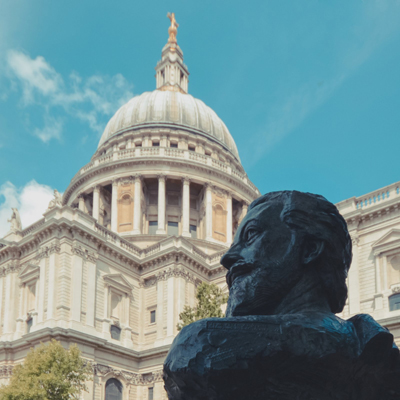
A new bust of priest and poet John Donne was unveiled outside St Paul’s Cathedral earlier this year. Donne was made  Dean of St Paul’s in 1621, a position he held until his death 10 years later. He was subsequently buried in Old St Paul’s Cathedral and a memorial to him – a likeness apparently based on a drawing of him in his shroud – was the only monument to survive the Great Fire of London in 1666. It’s still inside the cathedral. The new bronze bust, located in the garden to the south of the cathedral, was the work of artist Nigel Boonham and has Donne looking east towards his birth place in nearby Bread Street. The text “Hence is’t, that I am carried towards the West/This day, when my Soul’s form bends to the East” – taken from the poem Good-Friday, 1613, Riding Westward – is inscribed underneath the bust. Commissioned by the City of London, the sculpture was unveiled in June by the artist and Professor Peter McCullough, one of the cathedral’s Lay Canons. For more on St Paul’s, see www.stpauls.co.ukPICTURE: Graham Lacdao / The Chapter of St Paul’s Cathedral. 

Where is it? #41….

The latest in the series in which we ask you to identify where in London this picture was taken and what it’s of. If you think you can identify this picture (and try and be as precise as possible), leave a comment below. We’ll reveal the answer early next week. Good luck!

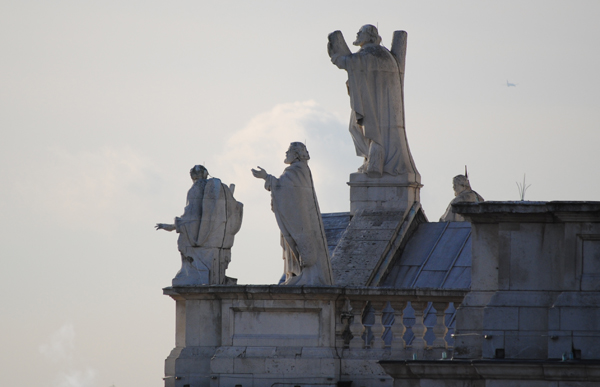
Yes, you guessed it, these are indeed the 3.7 metre high statues which sit above the south transept of St Paul’s Cathedral. The statues include those of St Andrew and St Thomas, both of which are attributed to Caius Gabriel Cibber (1630-1700) and Grinling Gibbons (1648-1721). We had originally said they were the work of Francis Bird (1667-1731), who also completed the famous panel depicting the Conversion of St Paul on the cathedral’s west front and the original version of the statue of Queen Anne outside the main entrance (more on that another time), but while he was responsible for other statues on the cathedral, turns out he wasn’t for these two. The image was taken from the viewing deck of One New Change on Cheapside.

Olympics Special – London bridges aglow…

Seven of London’s bridges are being lit up at night until 10th September in an initiative called “Dazzle”. Being run under the Mayor of London Presents program, it celebrates the 50 evenings of the Olympic and Paralympic Games. Here’s just a sample of what you can see…

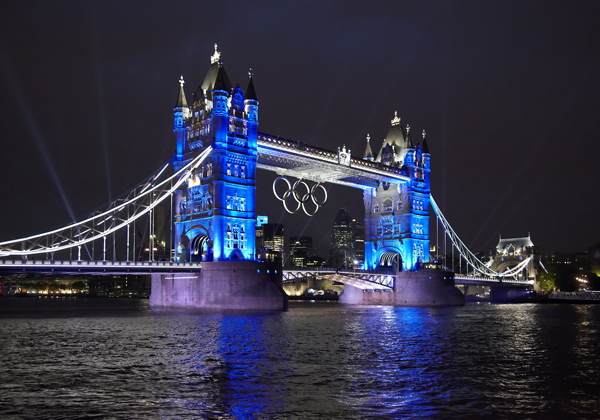
The most iconic of London’s bridges, Tower Bridge has been a focal point for Olympic celebrations. One of the great structures of Victorian London, it was opened in 1894 and at the time was largest bascule bridge ever built (for more on Tower Bridge, see our earlier post here).

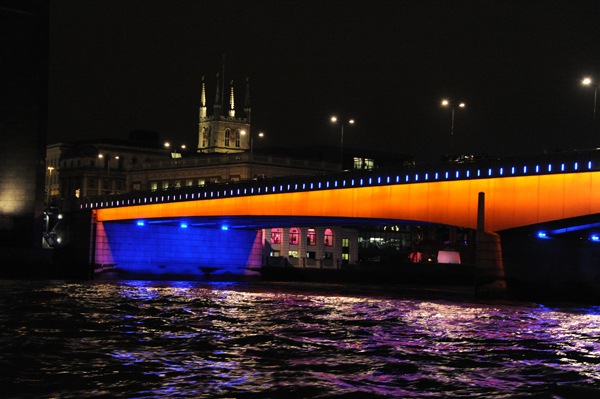
The most recent version of London Bridge, this links Borough High Street in Southwark (you can see Southwark Cathedral in the background) and King William Street in the City and was built in the late 1960s/early 1970s and opened by Queen Elizabeth II in 1973. There have been bridges in this vicinity since as far back as Roman times (for more on the history of London Bridge, see our earlier post here).

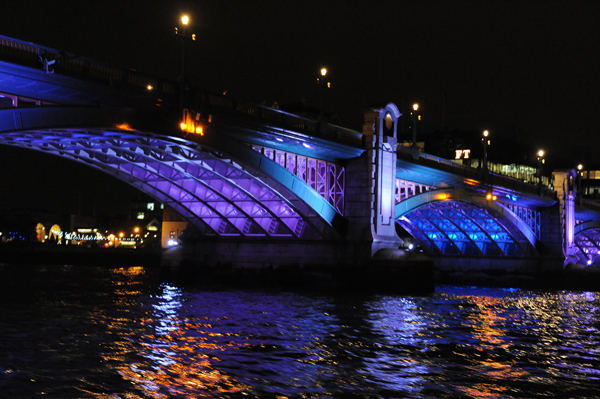
The current Southwark Bridge – which links the City of London with the heart of Southwark – dates from 1921 and replaced an earlier bridge designed by John Rennie.

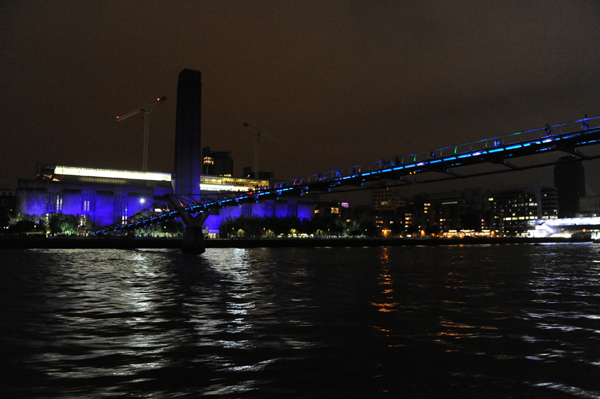
Initially plaqued by the wobbles, the steel suspension walk bridge known as Millennium Bridge is the newest of the bridges that cross the Thames in central London, linking St Paul’s Cathedral on the north bank with the Tate Modern on the south (the looming bulk of which is pictured here). First opened in July 2000, it was closed after concerns over its movement and then reopened to the public in 2002.

Other bridges taking part in Dazzle but not shown here include the Golden Jubilee footbridges, Waterloo Bridge and Blackfriars Bridge.

For more on the program, see www.molpresents.com/dazzle.

PICTURES: All images courtesy of the City of London Corporation.

Around London – Bells…and more bells; Olympic memorabilia; free wifi in the West End; The Arch returns to Kensington Gardens; and, Impressionists at the RA…

• It’s all about the Olympics in London this week and many of the events – like the Opening Ceremony and Torch Relay (see last week’s post) – are well covered elsewhere, but we thought we’d mention a couple of things in relation to the Games: 

The first is the ‘All the Bells’ project which will see bells across London being rung at 8:12am on Friday to “ring in” the first day of the Olympic and Paralympic Games. Work No. 1197: All the bells in a country rung as quickly and as loudly as possible for three minutes, commissioned as part of the London 2012 Festival, is the brainchild of Turner Prize-winning artist and musician Martin Creed and will involve thousands of bells across the nation. Speaking of bells, the City of London has announced that some of the City’s churches will be ringing continuously during the three Olympic marathon events – the men’s, women’s, and Paralympic events. As many as 57 of the country’s most experienced bell ringers, co-ordinated by the Ancient Society of College Youths (a ringing society created in London in 1637) will be working for three to four hours continuously at churches including St Paul’s Cathedral, St Mary le Bow, St Lawrence Jewry, St Magnus the Martyr, St Vedast and St Katharine Cree. During the women’s marathon, an all-female band will be attempting a peal at St Paul’s, the first all-woman attempt on the bells. (Apologies, this article had originally had the time for the bell ringing at 8.12pm – it is in the morning, not the evening!)

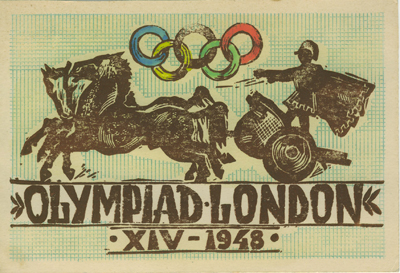
A new exhibition exploring London’s Olympic history has opened at the British Library. Olympex 2012: Collecting the Olympic Games features a range of memorabilia including a swimming costume and the finishing tape broken by – later disqualified – marathon runner Dorando Pietri  from the 1908 London Games (see our earlier post for more on him) as well as posters and artworks, stamps, letters and postcards. The exhibition also features audio interviews with Olympians including William (Bill) Roberts, a relay runner in the 1936 Berlin Olympics, and Dorothy Tyler, a medal-winning high jumper who competed in the 1936 and 1948 Olympics. Presented by the British Library and International Olympic Committee, the exhibition runs until 9th September at the library in St Pancras. Entry is free. For more, see www.bl.uk. PICTURE: Rare 1948 postcard by an unknown artist (c) Private collection/IOC

• A new free wifi network has been launched in London’s West End. Westminster City Council and telco O2 launched the network this week. It will initially cover Oxford and Regent Streets, Trafalgar Square, Leicester Square, Piccadilly Circus and Parliament Square with further areas in Westminster and Covent Garden the next to be included in the network. A once-only registration process is required to join.

• Henry Moore’s famous sculpture, The Arch, has been returned to its original home in Kensington Gardens. The six metre high work was presented to the nation by Moore in 1980 and was positioned on the north bank of the Long Water until 1996 when the structure became unstable and was placed in storage. In late 2010, the Royal Parks began a project with The Henry Moore Foundation to see if the work could be returned to the gardens. Work began to restore the piece – which consists of seven stones weighing 37 tonnes – to its original location earlier this year. For more on Kensington Gardens, see www.royalparks.org.uk/parks/kensington-gardens.

• On Now: From Paris: A Taste for Impressionism. This Royal Academy of Arts exhibition at Burlington House features 70 works from the Sterling and Francine Clark Art Institute in Williamstown, Massachusetts, and includes works by Manet, Monet, Pissarro, Degas, Sisley, Morisot and Renoir as well as those of post-Impressionist artists Corot, Théodore Rousseau and J-F. Millet, and ‘academic’ paintings by Gérôme, Alma-Tadema and Bouguereau. Runs until 23rd September. Admission charge applies. See www.royalacademy.org.uk for more.

Where’s London’s oldest…manufacturing company?

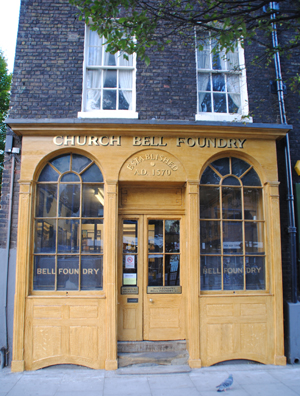
London’s oldest manufacturing company is the same as Britain’s oldest and is, according to the Guinness Book of Records, the Whitechapel Bell Foundry.

The company was established in 1570 (although founders have been discovered operating in the area as far back as 1420) and, according to its website, still concentrates solely on the manufacture of bells and their fittings with large church bells accounting for 80 per cent of the company’s business. The remainder of the business is involved in manufacturing handbells and other smaller bells.

The foundry’s current buildings, apparently originally used as a coaching inn named The Artichoke, date from 1670 and are presumed to have replaced structures consumed in the Great Fire of London. The foundry had earlier been located in smaller premises on the other side of Whitechapel Road.

The foundry has typically operated under the name of the master founder and owner but since 1968 has apparently operated under its current name.

The most famous bells cast at the foundry include the Liberty Bell (1752) – the symbol of American independence which cracked when first rung and was recast in Philadelphia, the Great Bell of Montreal Cathedral, ‘Great Tom’ of Lincoln Cathedral, and, of course, Big Ben (1858) – at 13,760 kilograms, the largest bell ever cast at the foundry.

Westminster Abbey and St Paul’s Cathedral also feature bells cast at the foundry and replacement bells for St Mary-le-Bow and St Clement Danes made here following their destruction in World War II and bells from the foundry have been sent as far afield as Australia and India.

Among the most recent bells to be cast at the foundry are the Royal Jubilee Bells, used in the Thames Diamond Jubilee Pageant and now housed at St James Garlickhythe in the City of London (each of the bells, which bear the Royal Arms, is named after a member of the Royal Family – Elizabeth being the largest with others named Philip, Charles, Anne, Andrew, Edward, William and Henry.)

There is a small exhibition on bell-making in the foundry shop looking at the history of the foundry and bell-making in general, and one-and-a-half-hour tours of the foundry run Saturdays (booking well in advance is usually required). Additional tours are being held every day during the Olympics.

WHERE: 32/34 Whitechapel Road; WHEN: Tours are usually held on Saturdays when no work is being undertaken – see website for dates – but special tours are being held daily from 10am to 5pm, 28th July to 12th August, 2012; COST: The exhibition/museum is free but tours are usually £12 a head for over 14s (Olympic period tours are £10 a head/£25 a family – children under 14 not admitted without adult supervision) – see website for more details on purchasing tickets; WEBSITE: www.whitechapelbellfoundry.co.uk.

Around London – Olympic Rings unveiled on Tower Bridge; London from above; Blake on Primrose; V&A illustrations; and, Munch at the Tate Modern…

• The Olympic Rings were unveiled on Tower Bridge yesterday to mark one month until the Opening Ceremony of the 2012 Games. Each of the rings weighs three tonnes and are 25 metres wide and 11.5 metres tall. A light show featuring thousands of LED lights brings them to life at night. The rings retract when the bridge is raised. Among those at the unveiling were Lord Sebastian Coe, chairman of LOCOG, London Mayor Boris Johnson and the Culture Secretary Jeremy Hunt.

• Several hundred images of London have been included in Britain from Above, a new website launched by English Heritage and the Royal Commissions on the Ancient and Historical Monuments of Scotland and Wales. The website, which boasts more than 15,000 images taken between 1919 and 1953 includes some of the oldest and most valuable images from the Aerofilms Collection, an archive of more than a million photographs taken between 1919 and 2006. A search for London brings up 283 results, among them stunning images of Tower Bridge, The Tower of London and St Paul’s Cathedral. Users are encouraged to download images, customise their own themed photo galleries and share information to add to the knowledge behind each of the images. For more, see www.britainfromabove.org.uk.

• A quote from William Blake has been inscribed on stone on the summit of Primrose Hill, famous for its views of the London skyline. The quote – “I have conversed with the spiritual sun. I saw him on Primrose Hill” – was selected, according to Nick Biddle, The Regent’s Park manager, “because it sums up so well the experience of standing on Primrose Hill in the early morning light”. “It is always a wonderful experience,” he says. The unveiling of the inscription signalled the end to a series of improvement works on the hill. For more, see http://www.royalparks.org.uk.

• On Now: V&A Illustration Awards display. Features works by the 14 artists short-listed for the V&A’s annual illustration awards. Drawn from more than 1,000 entries the panel – fashion designer Orla Kiely, broadcaster and cultural commentator Emma Freud and Moira Gemmill, V&A director of design – selected their favorite entries in three categories – book illustration, book cover and jacket illustration – while winners of last year’s award judged a fourth category for students’ work. Runs until 31st December. Admission is free. For more, see www.vam.ac.uk/illustrationawards.

• On Now: Edvard Munch: The Modern Eye. This major exhibition at the Tate Modern reassesses the work of this Norwegian painter and aims to show how he engaged with the 20th century world, in particular his interest in the rise of modern media including photography, film and stage production. Organised in conjunction with the Centre Pompidou in Paris and the Munch Museum in Oslo, the exhibition features more than 60 paintings and 50 photographs as well as Munch’s lesser-known work in film. They include different versions of celebrated works like The Sick Child and The Girls on a Bridge as well as his last work, a self protrait. Runs until 14th October. Admission charge applies. For more, see www.tate.org.uk.

Around London – Open gardens; new gates mark St Paul’s tercentenary; a new Olympics trail; and, truces at the IWM…

• If you’re not too exhausted after last weekend’s Diamond Jubilee festivities (or if you’re looking for something a little more sedate), this Saturday and Sunday London plays host to Open Garden Squares Weekend. Among the 208 gardens to be opened this weekend is the communal garden at Number 10 Downing Street, home of Prime Minister David Cameron. Laid out in 1736, the L-shaped garden at 10 Downing Street is shared by residents of both Number 10 and Number 11, including Larry, the Downing Street cat (tickets for this garden have already been allocated via a ballot process). Among the more than 200 gardens open to the public as part of the weekend are 24 new gardens and, for the first time, the event is being supported by the National Trust (along with the usual organisers, the London Parks and Gardens Trust). Downing Street aside, other gardens open to the public include the Regent’s Park Allotment Garden, the Royal College of Physicians’ Medicinal Garden, the Kensington Roof Gardens, and the gardens at HMP Wormwood Scrubs. Tickets for the gardens are cheaper if bought online in advance of the weekend and picked up on Saturday or Sunday – it’s not too late to do so, so for tickets and more information, head to www.opensquares.org.

A new pair gates designed to mark St Paul’s Cathedral’s tercentenary were opened in Richmond Park for the first time last week. The gates, which now form part of the historic vista seen from King Henry’s Mound in Richmond Park when looking toward’s St Paul’s Cathedral, were designed by 21-year-old blacksmith Joshua De Lisle and funded through a donation from the family of family of the late environmentalist and The Ecologist magazine founder Edward Goldsmith. Called ‘The Way’, the gates stand on the fence of Sidmouth Woods, and depict oak branches. Sir Christopher Wren, designer of St Paul’s, is acknowledged through the inclusion of a wren on one of the lower branches. For more on the Royal Parks, see www.royalparks.org.uk.

• Now On: Winning at the ancient Games. The British Museum is celebrating the London Olympics with a victory trail bringing together 12 “star objects” in its collection, united by the theme of winning. The ‘stops’ on the trail include a classical Greek statue of a winning charioteer on special loan from Sicily, a previously never exhibited mosaic showing Hercules, the legendary founder of the ancient Games, and the 2012 Olympic Medals. The trail is free. For more information, see www.britishmuseum.org.

Now On: Build the TruceDrawing on the idea of truce that was implemented during the ancient Olympic Games to allow athletes from Greece’s warring cities to compete, this new display at the Imperial War Museum features films, interviews and insights collected during a project investigating the concepts of truce, conflict and resolution and their relevance in the 21st  century. Highlights include excerpts of interviews with former IRA prisoner Seanna Walsh and former UDA prisoner Jackie McDonald -both now involved in peace initiatives in Northern Ireland, Courtny Edwards, who worked with a health service in displaced persons’ camps following civil war in Sierra Leone; and Professor Tony Redmond, who led aid teams in Kosovo following NATO attacks in 1999. Family activities are being run in conjunction with the exhibition on selected weekends. Entry is free. Runs until 23rd September. For more, see www.iwm.org.uk.

Celebrating the Diamond Jubilee with 10 royal London locations – 8. Golden Jubilee memorials…

UPDATED: Last week we looked at some of the monuments marking Queen Elizabeth II’s Silver Jubilee in London, so this week we’re taking a look at some of the monuments marking the Queen’s Golden Jubilee celebrating what were then 50 years on the throne in 2002.

The year  was marked with celebrations, including a Golden Jubilee Weekend, not unlike that experienced in London over last weekend, which featured public concerts in Buckingham Palace gardens including the ‘Party at the Palace’ pop concert, flyovers including one by a Concorde with the Red Arrows, a National Thanksgiving Service at St Paul’s Cathedral and a Jubilee Procession down The Mall.

In addition, the celebrations included the first ever parade of all the Queen’s bodyguards – this 300 strong group featured detachments from the Gentlemen at Arms (created by King Henry VIII in 1509), the Yeoman of the Guard (created by King Henry VII in 1485) and Yeoman Warders (based at the Tower of London).

As with the Silver Jubilee, the Queen more than 70 towns in the UK and visited countries overseas including Jamaica, New Zealand, Australia and Canada.

Among the monuments in London marking the Golden Jubilee are:

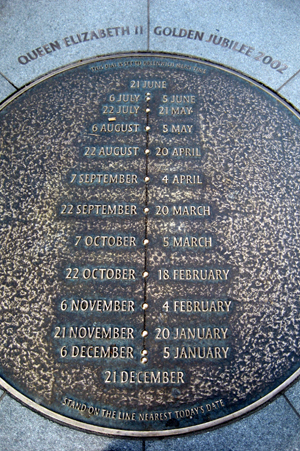
• Golden Jubilee Sundial, Old Palace Yard (pictured). Designed by Quentin Newark, this was Parliament’s gift to the Queen and was installed in 2002 as part of the yard’s revamp. The dial, which is ‘set’ to Greenwich Mean Time and can be found just outside the eastern end of Westminster Abbey, features a quote in its outer circle from William Shakespeare’s play, Henry VI, part III: “To carve out dials quaintly, point by point, thereby to see the minutes how they run: how many makes the hour full complete, how many hours brings about the day, how many days will finish up the year, how many years a mortal man may live.”

• King’s Stairs Memorial Stone, Bermondsey. This memorial stone located on the edge of King’s Stairs Gardens by the Thames in Bermondsey was first installed to mark the Queen’s Silver Jubilee. In 2002, the other side of the stone was inscribed to mark the Golden Jubilee and unveiled in the presence of the Earl and Countess of Wessex.

• Dovehouse Green, Royal Borough of Kensington and Chelsea. We omitted to mention this last week – located on an old burial ground granted by Sir Hans Sloane in 1733,  Dovehouse Green was laid out in 1977 to commemorate the Silver Jubilee and the Golden Jubilee of the Chelsea Society and was refurbished in 2002 to mark the Queen’s Golden Jubilee (it reopened in 2003).

• Great Ormond Street Hospital. Not strictly a Golden Jubilee memorial, there is a plaque close to the hospital’s main entrance which commemorates the Queen’s visit to the hospital to mark its 150th anniversary in 2002, “Her Majesty’s Golden Jubilee Year”.

• Golden Jubilee Footbridges. One memorial accidentally left off the list initially was the Golden Jubilee Bridges which run along either side of the Hungerford Bridge, between Westminster and Waterloo Bridges. The new four metre wide footbridges, which feature a particularly complex design, were named the Golden Jubilee Footbridges in honor of the Queen’s Golden Jubilee. They replaced an earlier – and somewhat notorious – footbridge which cantilevered off the side of the railway bridge.

PICTURE: Wallyg

Where is it? #31…

The latest in the series in which we ask you to identify where in London this picture was taken and, importantly in this case, what it’s of. If you think you can identify this picture, leave a comment below. We’ll reveal the answer early next week. Good luck!

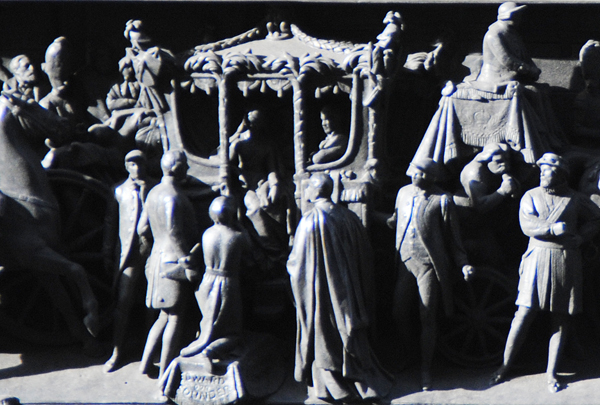
Well done to Jameson Tucker, this is indeed a relief on the Temple Bar Memorial, which stands where the Strand turns into Fleet Street. It depicts Queen Victoria on a royal progress to the Guildhall in 1837, a few months after her accession, when she was met at this spot by the Lord Mayor and Aldermen and presented with the sword of state and keys to the city.

According to a tradition said to date back to 1215, the Temple Bar is the only place where the monarch may enter London after first seeking permission from the Lord Mayor and being presented with the City’s Pearl Sword (one of five City swords, this is said to have been first given to the City by Queen Elizabeth I).

The monument itself was designed by Sir Horace Jones and erected in 1880 to mark the location where the Temple Bar – the ceremonial entrance to the City of London – originally stood (the last incarnation of the Temple Bar, designed by Sir Christopher Wren, is now located near in Paternoster Square near St Paul’s – see our earlier post for more on Wren’s Temple Bar).

On top of the granite and bronze monument stands a rearing griffin (actually it’s supposed to be a dragon), one of the city’s official boundary markers, sculpted by Charles Birch while on either side are bronze statues, by Sir Joseph Edgar Boehm, of Queen Victoria and Edward, Prince of Wales (later King Edward VII), who in 1872 were the last of the Royal family to pass through the Temple Bar gateway before its demolition in 1878 (they were on their way to St Paul’s to attend a thanksgiving service following the prince’s recovery from typhoid).

This is depicted in a relief on the north side of the monument by Charles Kelsey. Charles Mabey’s relief showing the Queen’s progress is located on the south side of the monument; he also designed one on the east side which shows a curtain being drawn over the old Temple Bar.

Around London – Diamond Jubilee celebrations special…

UPDATED: Excitement has been building for months ahead of this weekend’s Diamond Jubilee celebrations which include a 1,000 boat flotilla which will sail down the Thames on Sunday, the Diamond Jubilee concert on Monday and National Service of Thanksgiving at St Paul’s Cathedral on Tuesday which will be followed by a ceremonial procession back to Buckingham Palace.

• First to the flotilla. The formal river procession will be held between 2pm and 6pm, starting upriver of Battersea Bridge and finishing downriver of Tower Bridge. The Queen and her family will be boarding the Royal barge, the Spirit of Chartwell, near Albert Bridge at 2.30pm and will travel upriver at the centre of the flotilla with the aim of pulling up alongside HMS President, near Tower Bridge, at 4.15pm.

The flotilla will be one of the largest ever assembled on the river and feature rowing, working and pleasure boats of all shapes and sizes decked out for the occasion. In addition as many as 30,000 people will be aboard passenger boats and there will also be music barges and boats spouting geysers as well as specially constructed craft like a floating belfry. It is estimated that it will take the flotilla around 75 minutes to pass any static point along the route.

Downriver of London Bridge, near the end of the pageant’s seven mile (11 kilometre) course, a gun salute will be fired and the procession will pass through an ‘Avenue of Sail’ formed by traditional sailing vessels, oyster smacks, square riggers, naval vessels and others. For more on the pageant (including the location of large viewing screens – these positions will be regulated from 8am onwards – and road closures as well as an interactive map of the route), head to www.thamesdiamondjubileepageant.org.

• Diamond Jubilee Concert and Beacons. To be held outside Buckingham Palace, close to the Victoria Memorial, on the evening of Monday, 4th June, the concert – which starts at around 7.30pm and features everyone from Elton John to Paul McCartney and Shirley Bassey – will be televised live by the BBC (unless you’re lucky enough to have one of the 10,000 balloted tickets meaning you get to have a picnic in the palace gardens and see the concert). For those who can’t go but would like to experience some of the atmosphere, Royal Parks are setting up screens along The Mall, in St James’s Park and in Hyde Park.

At 10.30pm that night, the Queen will light the National Beacon outside Buckingham Palace, the last in a network of beacons to be lit across the country. More than 4,000 beacons will be lit by communities across the UK and in Commonwealth countries around the world between 10-10.30pm that night (for more on the beacons, see www.diamondjubileebeacons.co.uk).

• National Service of Thanksgiving and Carriage Procession. On Tuesday, the Queen and the Duke of Edinburgh will leave Buckingham Palace at 10.15am and travel by car to St Paul’s Cathedral via the Mall, through Trafalgar Square, down the Strand and Fleet Street and up Ludgate Hill to St Paul’s. There they and the 2,000 invited guests will attend the National Service of Thanksgiving, conducted by the Dean of St Paul’s, the Very Rev Dr David Ison (the Archbishop of Canterbury will preach).

At 11.30am, the Queen and Duke will then head to Mansion House for a reception (via St Paul’s Churchyard and Queen Victoria Street), hosted by the Lord Mayor of London David Wootton, Court of Aldermen and Court of Common Council. Other members of the Royal family will attend a reception at Guildhall. At 12.30pm, the  Queen and members of the Royal Family will then head to Westminster Hall (via Queen Victoria Street, St Paul’s Churchyard, Ludgate Hill, Fleet Street, the Strand, Whitehall and Parliament Square), entering through the Sovereign’s Entrance of the Palace of Westminster (Houses of Parliament) at 12.40pm. There, they will attend the Diamond Jubilee Lunch.

At 2.20pm, the Queen and Prince Philip will lead a carriage procession from the Palace of Westminster to Buckingham Palace (via New Palace Yard, Whitehall, Trafalgar Square and The Mall), riding in a 1902 State Landau. They will be followed by the Prince of Wales and Duchess of Cornwall in a State Landau, and the Duke and Duchess of Cambridge (Prince William and Kate) and Prince Harry in another State Landau. If it’s raining, these will be replaced by the Australian State Coach, Queen Alexandra’s State Coach and the Glass Coach. Military personnel will line the route, a 60 gun salute will be fired and a Guard of Honor will await them in the Buckingham Palace forecourt.

At 3.30pm, the Queen and members of the Royal Family in the carriage procession will appear on the balcony at Buckingham Palace to wave to the crowds and witness an RAF flypast and a Feu de Joie – a celebratory volley of rifle fire – which will be given as a salute in the palace forecourt.

There’s plenty more happening over the weekend including many local street parties – far too much for us to record here. So for more, head to the official Diamond Jubilee site, www.thediamondjubilee.org (or The Big Lunch for local lunches – www.thebiglunch.com). You can purchase a copy of the official souvenir programme online at www.royalcollectionshop.co.uk/diamond-jubilee-1/diamond-jubilee-official-souvenir-programme.html or download it at www.itunes.co.uk.

Reckon you can take a good photo? We’re looking for great images of this weekend’s Diamond Jubilee celebrations (just email us at exploringlondon@gmail.com).

Want to read more about the Queen? Why not check out Sixty Glorious Years: Queen Elizabeth II, Diamond Jubilee, 1952-2012, Queen Elizabeth II: A Diamond Jubilee Souvenir Album, or Debrett’s: The Queen – The Diamond JubileeFor related music, check out Diamond Jubilee: A Classical CelebrationThe Diamond Jubilee Album or Gary Barlow & the Commonwealth Band’s Sing EP (featuring Prince Harry).

Celebrating the Diamond Jubilee with 10 royal London locations – 7. Silver Jubilee memorials…

For those who may not be aware, the current Diamond Jubilee is, of course, not the first jubilee Queen Elizabeth II has celebrated. In 1977, the Queen and the nation marked her Silver Jubilee, celebrating her 25th year on the throne.

Just as this year is designed as a year of celebration, so too was 1977 with the anniversary of the Queen’s accession culminating in a series events run over a week in early June. They included street parties, the lighting of a chain of beacons across the country (the Queen lit the first fire at Windsor), a national service of thanksgiving at St Paul’s Cathedral (which the Queen went to in the Gold State Coach) and a river progress from Greenwich to Lambeth.

To mark the Jubilee, the Queen and Prince Philip also travelled across the country, visiting as many as 36 counties during a Royal Tour, and went overseas where they visited nine countries as far afield as Australia and New Zealand, the West Indies and Canada.

In London, a number of memorials were installed which can still be visited today. They include:

The Silver Jubilee Walkway. Opened by the Queen on 9th junee 1977, this is made up of five circular sections which are themselves located in a 15 mile (24 kilometre) circle around the city and takes in many of the city’s greatest sites, including St Paul’s Cathedral, Buckingham Palace, Tower Bridge and Shakespeare’s Globe. For more on the walk, see www.walklondon.org.uk/route.asp?R=3

• South Bank Jubilee Gardens. Originally created to celebrate the Silver Jubilee in 1977, these gardens, located between Waterloo and Westminster Bridges, have recently been remade – including planting 70 new trees – for the Queen’s Diamond Jubilee and the Olympic Games.

Memorial Urn in Queen Square, Bloomsbury. This monument has inscriptions by poets Philip Larkin (“In times when nothing stood, But worsened or grew strange, There was one constant good, She did not change”) and Ted Hughes (A nation’s a soul, A soul is a wheel, With a crown for a hub, To keep it whole”) in front of and behind it.

King’s Stairs Memorial Stone. This memorial stone (pictured) located on the edge of King’s Stairs Gardens by the Thames in Bermondsey was first installed to mark the Queen’s Silver Jubilee. The other side of the stone was inscribed during the Golden Jubilee in 2002.

• Plaque on Queen Elizabeth II’s birthplace. We’ve mentioned this plaque at 17 Bruton Street in Mayfair in an earlier entry but it’s interesting to note that it was erected in 1977.

Any others you can think of?