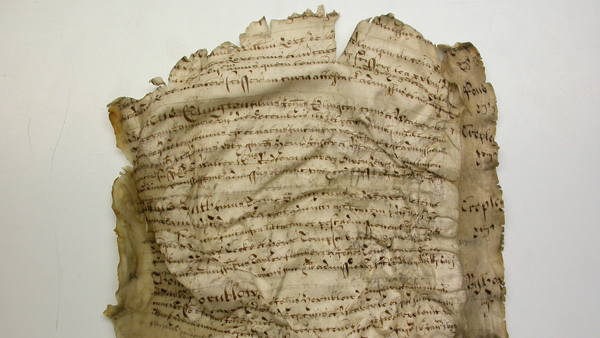
This Week in London – The Great Parchment Book; 20th century art at Guildhall Art Gallery; and, iconic music photography…

The Great Parchment Book, known as the ‘Domesday Book’ of the Ulster Plantation (now part of Northern Ireland), has gone on display at the City of London’s Heritage Gallery, located in the Guildhall Art Gallery. The book was compiled in 1639 and documents the period following King James I’s settlement of English and Scottish Protestants in Ulster. It came about after King Charles I seized estates around Derry which were managed by the Irish Society on behalf of the City of London and City livery companies and a survey was done to gather information about the lands. Stored at Guildhall, The Great Parchment Book was damaged in a fire in 1786 but following conservation is now on display. Runs until 10th August. Admission is free. For more, see www.greatparchmentbook.org. PICTURE: Courtesy City of London Corporation.

Works by Damien Hirst and David Hockney are among those on show in #LondonTrending which opens at the Guildhall Art Gallery today. A selection of limited edition prints on loan from British Land’s collection charts how collectives of London-based artists created some of the 20th century’s most innovative art. The display will also feature prints by pop artists Peter Blake, who created the sleeve design for The Beatles’ Sgt Pepper’s Lonely Hearts Club Band album, and Eduardo Paolozzi, who designed the mosaic patterned walls at Tottenham Court Road tube station as well as works by Richard Hamilton, Patrick Procktor, Jan Dibbets, Richard Long, Bruce McLean, Michael Lady, Simon Patterson, Gary Hume and Ian Davenport. Runs until 28th August in the Temple Room. Admission is free. A series of curator talks are scheduled. For more, see www.cityoflondon.gov.uk/londontrending.

Sheila Rock’s iconic portraits of musicians ranging from Sir Simon Rattle to Siouxsie Sioux are on show at the City of London’s Barbican Music Library. Picture This includes a wide range of her vintage prints including her work for album and vinyl 12” releases such as the shot of Debbie Harry used in 1978 for Blondie’s Denis’ 12. Other images included in the display feature Irish band U2 and conductor Daniel Barenboim. Rock, who has been based in London since 1970, was introduced to music photography by her ex-husband (and renowned rock photographer) Mick Rock and became known as a highly influential photographer during the punk and post-punk scene, later helping to shape the look of creative magazines such as The Face. Runs until 4th July. Entry is free. For more, follow this link.

Send all items for inclusion to exploringlondon@gmail.com.

This Week in London – Queen Margaret arrives at the Tower; 500 years of working Londoners; butlers explored at Apsley House; and, marking the Russian Revolution centenary…

The Tower of London’s dry moat will be transformed into a 15th century medieval court gathered to welcome a new Queen, Margaret of Anjou, for the May bank holiday this long weekend. The world of 1445 is being reimagined in a series of festivities – under the banner of Go Medieval at the Tower – which will include sword-fighting knights, hands-on experiences for kids such as the chance to fire a real crossbow, the “scents, sights and sounds” of a medieval encampment, and the chance to witness trades such as armoury and coin-striking. As well as, of course, opportunities to meet King Henry VI and his 15-year-old queen, Margaret who, upon her coronation, was honoured with a lavish pageant from Westminster Abbey to the Tower in which she received extravagant gifts including a lion. Runs from 10am to 5pm from Saturday to Monday. Admission charge applies. For more, see www.hrp.org.uk/tower-of-london/. PICTURE: © Historic Royal Palaces.

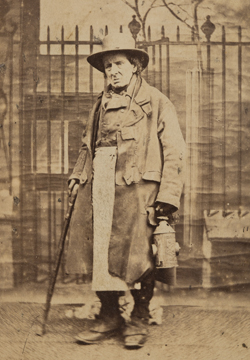
Working Londoners from the past 500 years are the subject of an open air exhibition opening in Guildhall Yard on Saturday. Londoners: Portraits of a Working City, 1447 to 1980 features a range of photographs, prints and drawings – many displayed for the first time – from the London Metropolitan Archives. The exhibition – which includes images of Jack Black of Battersea, Queen Victoria’s rat-catcher, and Charles Rouse, believed to be the last nightwatchman in 19th century London as well as pictures of Savoy Hotel page boys, a brick dust seller, a farrier in 1980s Deptford and a 15th century Lord Mayor – complements The Londoners exhibition currently running at the LMA in Clerkenwell which features 50 portraits not included in the Guildhall display. The free outdoor exhibition can be seen into 23rd May – for more, see www.cityoflondon.gov.uk/thelondoners. The Clerkenwell display can be seen until 5th July – for more, follow this link.

The life of the butler will be up for examination at Apsley House, home of the Duke of Wellington, this long weekend in an event which will also see the duke’s Prussian Dinner Service laid out in all its glory. Butlers and Banquets will feature talks about the history of the service – commissioned by King Frederick William III of Prussia and presented as a gift to the 1st Duke of Wellington after his victory over Napoleon at the Battle of Waterloo in 1815 – with younger visitors also having the chance to meet the butler of the house and find out what running a grand home like Apsley House was like as well as learning skills such as how to lay a table. Runs between 11am and 4pm from Saturday to Monday. Admission charge applies. For more, see www.english-heritage.org.uk/apsley.

A new exhibition marking the 100th anniversary of the Russian Revolution opens at the British Library in King’s Cross on Friday. Russian Revolution: Hope, Tragedy, Myths tells how the revolution unfolded during the reign of the last tsar, exploring the growth of the revolutionary movements with a special focus on key figures such as Tsar Nicholas II and revolutionary leaders such as Vladimir Lenin. Among the items on display is a letter Lenin wrote in April, 1902, applying to become a reader at the British Museum Library which he signed with his pseudonym, Jacob Richter, to evade the tsarist police. Other items on display include a souvenir album of the Tsar’s coronation and wallpaper hand-painted by women factory workers propaganda along with posters, letters, photographs, banners, weapons, uniform items, recordings and films. Runs until 29th August. Admission charge applies. For more, follow this link.

Send all items for inclusion to exploringlondon@gmail.com.
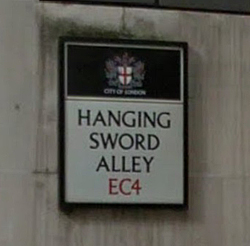
What’s in a name?…Hanging Sword Alley…

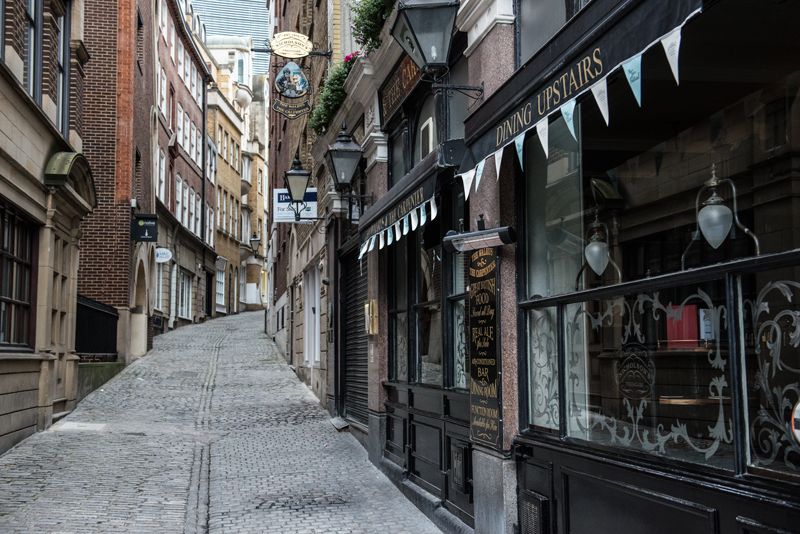
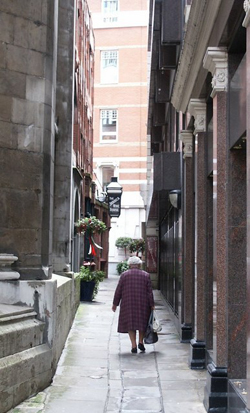
This narrow City of London passageway which runs between Whitefriars Street and Salisbury Square, just south of Fleet Street, is located in what was the precinct of the former Whitefriars monastery (what later became part of a somewhat lawless area known as Alsatia).

The name of the alley, which can be traced back to the mid-16th century, apparently relates to a hanging sign depicting a sword – hence “hanging sword” – and probably refers to a fencing school (the area was known for them) but it’s also been speculated the name could refer to a public house or brothel.

The alley was previously known as Blood Bowl Alley, a moniker derived from Blood Bowl House, a house of ill repute which once stood in the laneway (and featured in a William Hogarth’s Industry and Idleness series, in a plate depicting the Idle Apprentice, betrayed by a prostitute, being arrested).

The alleyway does get a mention in Dickens’ A Tale of Two Cities – it was here that he located the lodgings of Jerry Cruncher, the messenger for Tellsun’s Bank who makes money on the side as a ‘resurrection man’.

PICTURE: Google Maps

10 of the most memorable (and historic) views of London – 1. View from St Paul’s Cathedral’s dome…


We kick off a new series this week looking at 10 of most memorable (and historic) views of London and to kick it off, we’re looking at the views from one of London’s most prominent historic institutions, St Paul’s Cathedral.

There are two external galleries at St Paul’s – the first is the Stone Gallery which stands at 173 feet (53.4 metres) above ground level. Encircling the dome, it is reached, via a route which takes the visitor through the internal Whispering Gallery, upon climbing some 378 steps.

Located above it, encircling the cathedral’s famous lantern (which sits on top of the dome), is the Golden Gallery. It stands some 280 ft (85.4 metres) above the cathedral floor, and can be reached by a climb of 528 steps.

From it – and the Stone Gallery below it – can be seen panoramic views of the City of London and across the Thames to Southwark.

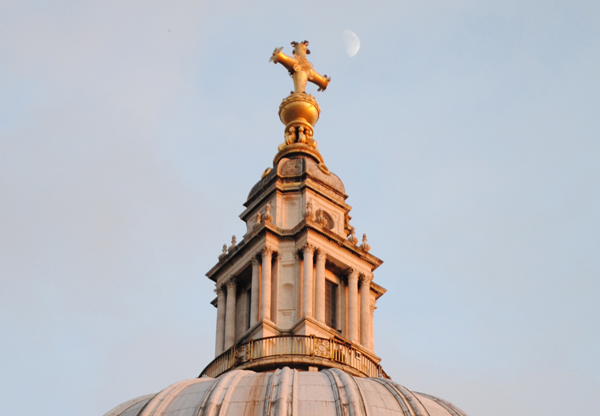
The lantern above, meanwhile, weighs some 850 tonnes and on its top sits a golden ball and cross – the current ball and cross, which weigh about seven tonnes, were put there in 1821, replacing the original ball and cross which had been erected in 1708.

St Paul’s Cathedral was the tallest building in London from 1710 into the 1960s (when it was surpassed by Millbank Tower and what is now known as the BT Tower). Sir Christopher Wren’s St Paul’s is not as tall as the original medieval cathedral which reportedly had a spire reaching 489 feet (149 metres) into the sky compared to St Paul’s as it is now, standing to a height of some 365 feet (111.3 metres) above ground level.

WHERE: St Paul’s Cathedral, St Paul’s Churchyard (nearest tube station is St Paul’s); WHEN: The galleries are open from 9.30am to 4.15pm, Monday to Saturday; COST: £18 an adult/£16 concessions and students/£8 a child (6-18 years)/£44 a family of four; WEBSITE: www.stpauls.co.uk

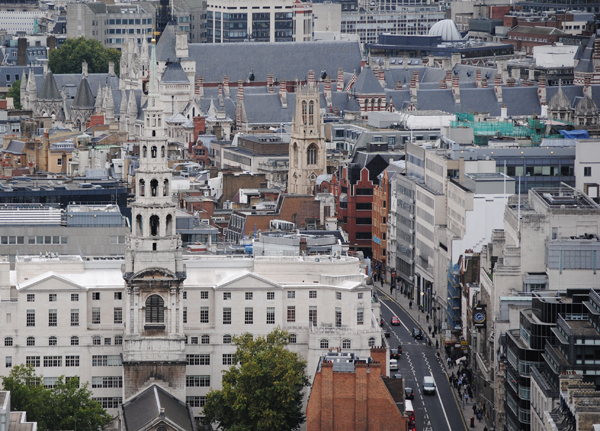
PICTURES: Top – Looking up at the lantern with the Golden Gallery around the base; Below – View looking west from St Paul’s down Fleet Street (the spires of St Brides and St Dunstan-in-the-West can be seen).

This Week in London – Maritime Greenwich lights up; garden memorial to Diana; and, Ecce Homo at St Paul’s…

Wishing all our readers a very happy Easter!

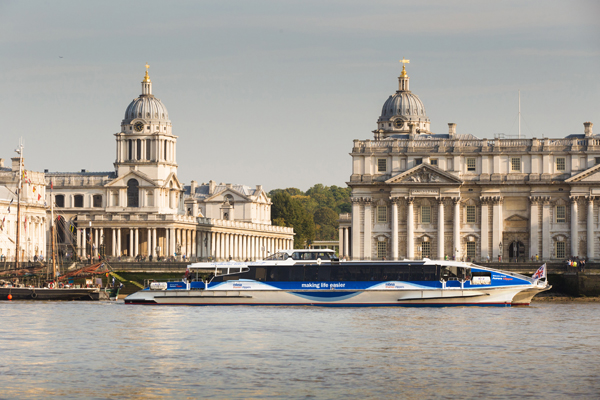
Maritime Greenwich will celebrate 20 years of UNESCO World Heritage Listing with a “spectacular” lighting event next Tuesday night. The lights will be switched on at 8.30pm on 18th April, illuminating landmarks including the Cutty Sark, the Queen’s House, National Maritime Museum and Royal Observatory as well as the Old Royal Naval College. The event, the first in a series to mark the 20 year anniversary this year, is the first time all the buildings have been lit up in unison and is a one night only event. Greenwich Park and the grounds of the National Maritime Museum and Old Royal Naval College will be kept open until 10pm to give visitors more time to witness the historic event. Maritime Greenwich was inscribed on the World Heritage List in 1997 due to its role in the progression of English artistic and scientific endeavour in the 17th and 18th centuries. The event takes place from 8.30pm to 11pm (Cutty Sark will be lit until 11pm) and is free to attend. For more, see www.rmg.co.uk. PICTURE: RMG

 A memorial garden to Princess Diana has opened at Kensington Palace, marking 20 years since her death. The temporary ‘White Garden’ – located in what was formerly the Sunken Garden which often featured floral displays admired by the Princess – features flowers and foliage inspired by memories of the Princess’s life, image and style. The garden, which can be seen from a public walkway, complements the exhibition, Diana: Her Fashion Story, currently on show in the palace. For more, see www.hrp.org.uk/kensington-palace/.

Mark Wallinger’s work, Ecce Homo – a life-sized sculpture of Jesus Christ with his hands bound behind his back and a crown of barbed wire on his head, has been placed at the top of St Paul’s Cathedral’s west steps for Easter. The sculpture, which will be at the cathedral for six weeks, represents Christ as he stands alone, waiting for judgement and a sentence of death. The sculpture is being presented by the cathedral in partnership with Amnesty International and the Turner Prize winning artist to highlight the plight of all those currently in prison, suffering torture or facing execution because of their political, religious or other conscientiously-held beliefs. The statue first appeared on the Trafalgar Square Fourth Plinth in 1999. For more, see www.stpauls.co.uk.

Send all items for inclusion to exploringlondon@gmail.com.
This Week in London – Revamped National Army Museum opens; butterflies return to the NHM; and World War I reimagined…

• The National Army Museum opens today following a massive three year, almost £24 million redevelopment. Designed by architects BDP and exhibition design agency Event (with £11.5 million in funding from The National Lottery), the main site of the museum at Chelsea features five new permanent galleries and a temporary exhibition space. Laid out over four floors, the new galleries feature more than 2,500 objects arranged under the themes of ‘Soldier’, ‘Army’, ‘Battle’, ‘Society’ and ‘Insight’. Among the objects on display are Crimean Tom, a cat found during the Crimean War and brought back as a pet (‘Soldier’), a portrait of Khudadad Khan VC, the first Indian soldier to win the Victoria Cross (‘Army’), the famous ‘Siborne Model’ of the Battle of Waterloo (‘Battle’), the flak jacket, helmet, identity discs and press pass of journalist Kate Adie (‘Society’), and a cup from the 1745 Jacobite Rebellion (‘Insight’). The new 500 square metre temporary exhibition space, meanwhile, is initially hosting the exhibition War Paint: Brushes with Conflict which features more than 130 paintings and objects explores the complex relationship between war and the men and women who map, record, celebrate and document it. Other features at the museum include a new cafe, shop and play area for children known as Play Base. Entry to the museum is free. For more, see www.nam.ac.uk.

• Butterflies return to the Natural History Museum this week with the immersive exhibition, Sensational Butterflies. The experience, now in its ninth year, takes visitors on a trail through a tropical habitat as they encounter each aspect of the life-cycle of the butterfly with highlights including watching them hatch from delicate chrysalises and seeing them feed and engage with each other. The Butterfly House team will be on hand to answer questions and give advice and tips. Admission charge applies. Runs from Friday until 17th September. For more, see www.nhm.ac.uk/sensational-butterflies.

A new exhibition exploring the personal stories of those who fought in World War I as well as those back home opens at the Guildhall Art Gallery tomorrow. Echoes Across The Century, conceived and delivered by the Livery Schools Link in partnership with the gallery, takes visitors on a “multi-sensory journey” exploring craftsmanship, memory and separation. It features Jan Churchill’s installation, Degrees of Separation, and the work of 240 students who were guided and inspired by Jane as they explored the impact of the war and imagined what life was like for those 100 years ago. Admission is free. Runs until 16th July. For more follow this link.

Send all items for inclusion to exploringlondon@gmail.com

Where’s London’s oldest…public toilets?


The oldest extant public toilets in London can be found Wesley’s Chapel in City Road.

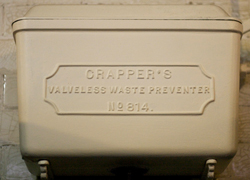
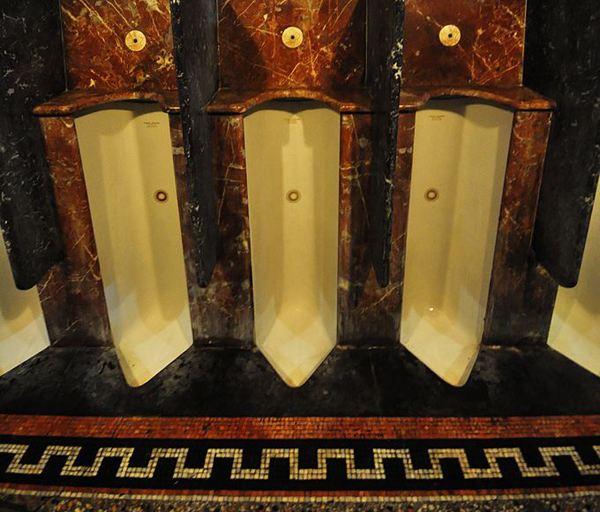
The gentlemen’s facilities, located off to the side of the chapel, were designed by the famous Thomas Crapper & Co and consist of enclosed wooden-walled cubicles, a series of urinals and wash basins.

The well-appointed toilets were installed in 1899 – more than 100 years after John Wesley’s death and long after many other parts of the Georgian and Victorian complex of buildings (including Wesley’s house) were built – but remain in working order even today.

Crapper, who had founded his company in the 1860s, championed the concept of the flushing toilet (although the idea had already been invented) and was responsible for the invention of the ballcock system. And contrary to common belief, Crapper – who received several royal warrants for his work – did not lend his name to a slang word for excrement – its origins go back much further.

WHERE: Wesley’s Chapel (with The Museum of Methodism and John Wesley’s House), 49 City Road (nearest Tube stations are Old Street and Moorgate; WHEN: 10am to 4pm Monday to Saturday/ 12:30pm to 1:45pm Sunday; COST: free (donations appreciated); WEBSITE: www.wesleyschapel.org.uk

PICTURES: Top – Ra Boe/Wikipedia/CC-BY-SA-3.0; Right – James O’Gorman/Flickr/CC BY-SA 2.0 (images cropped)


What’s in a name?….Threadneedle Street…

Famous for being the site of the Bank of England – “the Old Lady of Threadneedle Street” – since 1734, there’s a couple of explanations for the origins of Threadneedle Street’s name – and both relate to livery companies associated with textile industries.

The first is that of the Worshipful Company of Needlemakers, initially granted livery by the Lord Protector Oliver Cromwell in 1656 and then again by King Charles II in 1664. The company has a coat-of-arms featuring Adam and Eve holding up a shield on which can be seen three needles, hence Three Needles Street, the corruption of which is Threadneedle Street.

The second is that of the Merchant-Taylors’ Company, one of the 12 great livery companies, which was founded by Royal Charter in 1327. Its livery hall has been based in Threadneedle Street since the 14th century.

Either or both could be the reason for the unusual name of this City of London street, which runs from Mansion House north-east to Bishopsgate.

Other famous properties located in the street have included the headquarters of the infamous South Sea Company and the first site of the Baltic Exchange (formerly in the Virginia and Baltick Coffee House) which is now in St Mary Axe.

NOTE: The article initially said it was playwright Richard Brinsley Sheridan who first coined the phrase Old Lady of Threadneedle Street. To clarify – it was actually a speech by Sheridan, an MP, in the House of Commons in which he described the bank as “an old woman” which is thought to have prompted satirist James Gillray to produce a cartoon ‘Political Ravishment of the Old Lady of Threadneedle Street in Danger’ which in turn is believed to have coined the phrase.

LondonLife – Lovat Lane…

Originally known as Love Lane (the origins of which are somewhat obvious – a place where you could find ‘love’ although  whether this meant illicit love or has a more innocent explanation remains a matter of discussion),  the name of this charming alleyway – which runs south from Eastcheap to Lower Thames Street, was changed in the mid-20th century to avoid confusion with another Love Lane to the north. The new name apparently related to Lord Lovat, whose fisheries supplied the nearby former Billingsgate Market. PICTURE: Simon Mumenthaler/Unsplash.

Lost London – The Mermaid Tavern…

Located on Cheapside (with entrances on Friday and Bread Streets), the Mermaid Tavern is best known for being the home of Elizabethan-era drinking club known as the Mermaid Club (and also as the Friday Street Club or even the ‘Fraternity of Sireniacal Gentlemen’). 

cheapsideFounded in the early 17th century (and meeting on the first Friday of each month), its members included such literary luminaries as Ben Jonson, John Donne and Francis Beaumont.

There are also suggestions it was founded by Sir Walter Raleigh and that William Shakespeare was also a member but modern scholars have cast doubt upon both claims.

The earliest reference to the tavern, meanwhile, dates from the early 15th century.

The tavern, the location of which today corresponds to the corner of Bread and Cannon Streets, burned down in the Great Fire of London but lives on in John Keats’ poem Lines on the Mermaid Tavern.

LondonLife – Construction site…

building-site

PICTURE: Jamie Street/Unsplash


This Week in London – 500 years of Londoners; images of London under attack; reflections on Europe; and female ‘fighters’ fists…

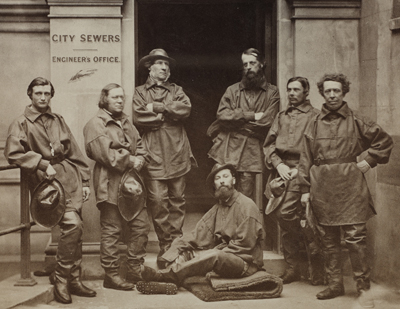
sewage-workersRat catchers, trapeze artists and politicians are among the subjects depicted in photographs, prints and drawings which form the heart of a new exhibition spanning 500 years of London’s history. Opening at the London Metropolitan Archives, The Londoners: Portraits of a Working City, 1447 to 1980 includes portraits of unknown Londoners as well as some of such luminaries as author Charles Dickens, night-watchmanengineer Isambard Kingdom Brunel and Lord Protector Oliver Cromwell. Highlights include a rare photograph of Charles Rouse, reputedly the last night watchman (pre-cursors to the Metropolitan Police) still on duty in London in the mid-19th century, an 1830 lithograph of a crossing sweeper, the ‘Old Commodore of Tottenham Court Road’, and a number of photographs shot by George WF Ellis in the mid-1920s including a portrait of feminist and social campaigner Dora Russell. The exhibition, which is part of a series of events marking 950 years of London archives, opens on Monday and runs until 5th July at the LMA in Clerkenwell. For more, see www.cityoflondon.gov.uk/lma. PICTURES: Top – A team of sewermen, photographed outside the City Sewers department in 1875. Right – Jack Black of Battersea, noted rat catcher to Queen Victoria, pictured here from a daguerreotype photograph taken for Henry Mayhew’s ‘1851 London Labour and the London Poor’. Both images © London Met Archives.

The response of artists and photographers to London’s Blitz during World War II forms the subject of a new exhibition which has opened at the Museum of London. Perspectives of Destruction: Images of London, 1940-44 explores how artists and photographers responded to the devastation caused by the massive aerial bombings. Much of the artwork was commissioned by the government’s War Artists Advisory Committee and focused on damage to buildings rather than deaths and injuries to people due to the impact it may have had on public moral. At the heart of the display is nine recently acquired drawings from official war artist Graham Sutherland depicting damage in the City of London and East End between 1940 and 1941. Also on show is a 1941 oil painting of Christchurch on Newgate Street by John Piper and David Bomberg’s Evening in the City of London, dating from 1944, which depicts St Paul’s Cathedral dominating the horizon above a devastated Cheapside. There’s also a photograph of a V-1 flying bomb narrowly missing the iconic cathedral which, along with eight others, was taken by City of London police constables Arthur Cross and Fred Tibbs. Other artists with works featured include Henry Moore, Bill Brandt and Bert Hardy. Runs until 8th May. Admission is free. For more, see www.museumoflondon.org.uk.

• A series of installations commissioned from 12 artists – asked to imagine what Europe might look like 2,000 years from now and how our present might then be viewed – have gone on display in the V&A as part of the week long ‘Collecting Europe’ festival. The festival, which only runs until 7th February, includes a range of talks, discussions, live performances and workshops aimed at encouraging debate around Europe and European identity in the light of the Brexit vote. The installations, commissioned by the V&A and Goethe-Institut London, have been created by artists from across Europe. For more, see www.vam.ac.uk/collectingeurope.

• Bronze casts of black women’s movement activists’ fists go on display at the City of London’s Guildhall Art Gallery from Tuesday. A Fighters’ Archive, features the work of sculptor Wijnand de Jong and pays tribute to 15 women who were members of various activist groups. The sculpture takes the form of a boxing archive – casts of boxers’ fists collected by boxing academies to commemorate prize fighters – with the fists cast from life. Subjects include Professor Dame Elizabeth Anionwu, Emeritus Professor of Nursing at the University of West London and patron of The Sickle Cell Society, Mia Morris, creator of Black History Month, and Gerlin Bean, founder of Brixton Black Women’s Centre. The fists can be seen until 19th March. Admission if free. For more, see www.cityoflondon.gov.uk/things-to-do/visit-the-city/attractions/guildhall-galleries/Pages/guildhall-art-gallery.aspx.

Send all items for inclusion to exploringlondon@gmail.com.
This Week in London – Roman finds from Walbrook revealed; Pablo Picasso prints; and, Highgate Cemetery’s virtual directory…

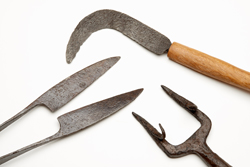
roman-gardening-toolsRoman tools and other artefacts from the era including a stamp for metal ingots and pottery are among objects found in London’s ‘lost’ Walbrook Valley which have gone on display at the Museum of London. Working the Walbrook features objects excavated during the past 170 years of digs around the watercourse which once cut the city in half, running from Finsbury Circus to Cannon Street. Created as part of a PhD project being supervised by the Museum of London and the University of Reading, the objects on show include an iron stamp dating from the Roman period inscribed with the letters MPBR (understood to be an abbreviation for ‘Metal Provinciae Britanniae’ – “the mines of the province of Britannia”) which is believed to have been used by officials to stamp metal ingots passing through London on their way to the Continent. Other items include Roman farming and gardening tools, and a pot decorated with a smith’s hammer, anvil and tongs which was found at the bottom of a well in Southwark and which may have been linked to worship of the god Vulcan. The free display is on show until March. For more, see www.museumoflondon.org.uk. PICTURE: Gardening tools from Roman London. A pruning hook, bailing fork and shears © Museum of London

• A series of prints by Pablo Picasso spanning the period from the late 1940s to the late 1950s form the heart of a new exhibition at the British Museum in Bloomsbury. The prints, which include 16 lithograph prints and three aquatint prints, were recently acquired by the museum in what represents the final part of the museum’s effort to more fully represent the artist’s work as a printmaker. Six of the lithographs were inspired by the beauty of Picasso’s lover Francoise Gilot while others feature Bacchanalian scenes and portraits of German-born dealer Daniel-Henry Kahnweiler. On display from Friday in Gallery 90A, they can be seen in the free exhibition until 3rd March. For more, see www.britishmuseum.org.

The details of some 160,000 people buried at Highgate Cemetery in north London have been made available online. Deceased Online has announced that all records for the period from May, 1839, to August, 2010 – a total of 159,863 people, are now available, including digital scans of original registers, details of who is buried in each grave and location maps for most graves. Notable people buried at Highgate include author Douglas Adams, philosopher Karl Marx and chemist and physicist Michael Faraday. For more, see www.deceasedonline.com

Send all items for inclusion to exploringlondon@gmail.com.
10 (more) fictional character addresses in London – 1. Fetter Lane, Old Jewry and Wapping…

Lemuel Gulliver, the ‘hero’ of Jonathan Swift’s 1726 book, Gulliver’s Travels, wasn’t a native Londoner but moved to the city for work and lived in several different locations before embarking on his famous voyage to the land of Lilliput.

lemuel-gulliverAccording to the book, the Nottinghamshire-born Gulliver studied at Emanuel College (sic) in Cambridge before he was apprenticed to London surgeon known as James Bates after which he spent a couple of years studying in the Dutch town of Leiden (spelt Leydon in the book).

Returning to England briefly, he spent the next few years voyaging to the “Levant” before returning to London where he “took part of a small house in Old Jewry” (Old Jewry lies in the City of London runs between Poultry and Gresham Street) and married Mary Burton, daughter of a Newgate Street hosier.

His master Bates dying, however, a couple of years later and with a failing business, he took up the position of surgeon on two different ships and it was when he eventually returned to London that he moved to Fetter Lane – which runs north from Fleet Street – and then from there to Wapping where hoping to retire from the sea and “get business (presumably he meant medical cases) among the sailors”.

But it was not to be and so, in 1699, Mr Gulliver set off on the voyage accounted in the famous book.

The name Fetter Lane, incidentally, has nothing to do with fetters (ie chains) – see our earlier post for more. And it’s also worth noting that the author, Jonathan Swift, also visited and lived in London at various times of his career – we’ll take a more in depth look at his experiences in a later post.

PICTURE: Lemuel Gulliver, depicted in a first edition of Gulliver’s Travels/Wikipedia.

LondonLife – Monumental spiral…

spiral

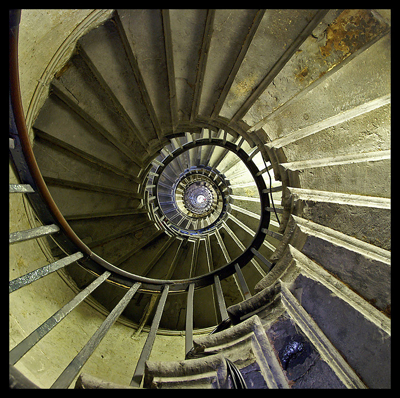
Inside The Monument, built to commemorate the Great Fire of London, in the City of London. For more on the history of The Monument. PICTURE: Flickr/CC BY 2.0.

This Week in London – The ‘William Charter’ on show; Donald Trump in London; and the Fourth Plinth shortlist…

A charter granted by King William the Conqueror to the City of London in 1067 is on display at the City of London Heritage Gallery. The 950-year-old charter, known as the William Charter, was given by the king soon after his coronation at Westminster Abbey but before he had entered the City and is seen as key in his winning the support of the City as well as in how the City came to have its special autonomy. Written in Old English, the charter measures only 2 x 16 centimetres and has one of the earliest seal impressions of King William I. The oldest item in the City of London Corporation’s 100 kilometres of archives, it’s on display at the gallery until 27th April. For more, follow this link.

Madame Tussauds in Marylebone has unveiled a wax figure of US President-elect Donald J Trump this week in the lead-up to his inauguration in Washington, DC, on Friday. The future president stands in the ‘Oval Office’ section of the display. The organisation’s team of sculptors, make-up artists and hair inserters have been working on the figure since his victory in the US election back in October. For more, see www.madametussauds.com/london/en/.

• A scoop of ice-cream with a visiting fly and micro-drone, a recreation of an ancient sculpture destroyed by the so-called Islamic State and a tower made of a VW, scaffolding, oil drums and a ladder among the possibilities to replace David Shrigley’s Really Good on Trafalgar Square’s Fourth Plinth next year. Maquettes of five short-listed sculptures are on show at the National Gallery from today until 26th March. Two of those displayed will be chosen to be featured on the plinth – one next year and the other in 2020. Admission is free. As well as Heather Phillipson’s The End, Michael Rakowitz’s The Invisible Enemy Should Not Exist, and Damián Ortega’s High Way, the short-listed works include Huma Bhabha’s Untitled (a massive figure like something from a sci-fi film) and Raqs Media Collective’s The Emperor’s Old Clothes (an empty robe).

Send all items for inclusion to exploringlondon@gmail.com.
Lost London – Pasqua Rosee’s Coffee House…

The first coffee house to be located in London, this premises was opened by a Greek, Pasqua Rosée, in 1652 and is believed to have been located in St Michael’s Alley off Cornhill.

st-michaels-alleyRosée had come to England as the manservant of Daniel Edwards, a member of the Levant Company who had first encountered him in Smyrna (in modern Turkey) and returned with him. One story says that Rosée decided to start the business after a falling out with Edwards on their return to England; another that Edwards helped Rosée start the business when they realised the interest people had in trying the new drink.
The establishment, which was originally located in a shed in the churchyard of St Michael’s Cornhill, was advertised by a sign which was apparently a portrait of Rosée – hence the name ‘The Sign of Pasqua Rosee’s Head’ – but it was also referred to as ‘The Turk’s Head’. Such was its success that Rosée was apparently selling up to 600 dishes of coffee a day.

Not everyone, however, was a fan of Rosée’s business – in particular tavern owners who saw it as a threat to their own – and aware of his status as an outsider, he is said to have decided to forge a partnership with a freeman of the City of London so there could be no dispute over his right to trade. He found just such a partner in a grocer, Christopher Bowman, in 1654.

The business was relocated following the creation of their partnership across the alley out of the shed and into a rather ruinous house but the new lease was signed only by Bowman. There is a suggestion that Rosée had to flee for some misdemeanour but for whatever reason, his name is no longer mentioned and Bowman was now apparently the sole owner of the business.

Despite the change of ownership, the business continued to trade under Rosée’s sign and it is said to have been Bowman who authored the handbill The Vertue of the Coffee Drink (sic) – an advertising document which credits its creation to Rosée and is filled with some rather dubious claims about the miraculous powers of the drink.

Notable visitors included Samuel Pepys who visited the famous coffee house in 1660, mentioning it in his famous diary.

Bowman apparently died in 1662 and the business went into decline before any trace of it was wiped away in the conflagration of the Great Fire of 1666. The Jamaica Wine House, which features a blue plaque to Rosée’s coffee house apparently erected by the Corporation of London in 1952, now stands near the site Rosée’s original shed.

PICTURE: View down St Michael’s Alley with the church on the left looking toward’s the Jamaica Wine House. © Copyright Paul Collins/CC BY-SA 2.0

Exploring London’s most popular posts for 2016 (part II)…

And so here are the five most popular new articles we published in 2016…

5. LondonLife – New Underground line named in honour of Queen Elizabeth II…

4. This Week in London – Norway on show at Dulwich; Bruegel the Elder at the Courtauld; and, Kew Gardens celebrates the orchid… 

3. A Moment in London’s History – Sir Walter Raleigh leaves the Tower… 

2. Lost London – The King’s Mews at Charing Cross…

1. (10) iconic London film locations…1. Mary Poppins and feeding the birds at St Paul’s Cathedral… 

A Moment in London’s History – Sir Henry Cole sends Christmas cards…

The practice of sending Christmas cards really began in the Victoria era and it was in London, in 1843, that the first commercial Christmas cards are widely said to have been designed and printed.

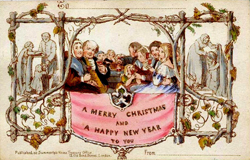
first-christmas-cardThe idea had come from Sir Henry Cole, the first director of the Victoria and Albert Museum, who, overwhelmed with the volume of correspondence he was receiving, conceived it as answer to his problem, allowing him to send Christmas greetings to a wide group of people – all at once.

He asked his friend, artist John Callcott Horsley, to design the card and an edition of 1,000 were printed by Jobbins of Warwick Court in Holborn.

The hand-coloured card, published by Summerley’s Home Treasury Office in Old Bond Street, showed a family gathered for a Christmas celebration with two side images showing people engaged in charitable acts and a message, ‘A Merry Christmas and a Happy New Year to You’. Designed as a single flat card (not foldable like they are today), it came complete with ‘To’ and ‘From’ spaces for the sender to fill in.

The cards which Sir Henry didn’t need for his personal use were placed on sale for a shilling each but it was a fairly steep price and that – and the fact that the image of people drinking at the festive season apparently roused the ire of temperance campaigners, helped to ensure the cards weren’t an immediate success.

Nonetheless, further cards were produced in the following years and within a couple of decades, they were being mass produced.

One of Sir Henry’s original cards was reportedly sold at an auction in 2013 for £22,000.

This Week in London – Marie Duval explored; Christmas in Trafalgar Square and at Dulwich; and, Australian Impressionists at The National Gallery…

The life and work of 19th century London actress, cartoonist and illustrator Marie Duval is the subject of a new exhibition which opens at the Guildhall Library in the City tomorrow. Marie Duval: Laughter in the First Age of Leisure is the first one solely dedicated to Duval’s work (her real name was Isabelle Émilie de Tessier) as a 19th century pioneer of the art of comics. Her work first appeared in a range of cheap British ‘penny papers’ and comics of the 1860s to 1880s aimed at working class people. The exhibition has been produced by the University of Chester in partnership with the library and with the support of the British Library.

Carol singing has kicked off in Trafalgar Square to mark the Christmas season. More than 40 groups are taking part in the sessions – free to watch – which take place between 4pm and 8pm on weekdays and from 2pm on weekends until 23rd December. The square is also home to a traditional Norwegian spruce Christmas Tree which has, as has been the case every year since 1947, been brought from forest near Oslo in thanks for Britain’s support of Norway during World War II. For more, see www.london.gov.uk/events.

The Dulwich Picture Gallery’s Christmas festival – featuring the ‘Winterlights’ lights trail, artisan Christmas market, pop-up carollers and other entertainments – has opened at the south London gallery. This year’s festivities also include two contemporary baroque-inspired Christmas trees by 3D art specialists, Nagual Creations, and visitors also have the chance to create their own festive family photo using a specially commissioned giant gold frame in the grounds as well as listen to Christmas story-telling in the gallery’s Keeper’s Cottage. The Winterlights display runs from 6pm to 10pm until 18th December (excluding Mondays; admission charges apply) with the market, featuring 50 stalls, held over the next two weekends – 10th-11th December and 17th-18th December (entry is free). For more, see www.dulwichpicturegallery.org.uk.

The first UK exhibition to focus on Australian impressionist paintings has opened at The National Gallery. Australia’s Impressionists features 41 paintings including some never shown before in the UK and explores the impact of European Impressionism on Australian painting of the 1880s and 1890s with a particular focus on four artists: Tom Roberts, Arthur Streeton, Charles Conder and John Russell. The exhibition is organised into three sections: the first looking at the landmark 1889 9 by 5 Impression Exhibition held in Melbourne, the second looking at the role of Australian Impressionism in the forging of a national identity, and the third looking at the work and influence of John Russell. The exhibition can be seen in the Sunley Room until 26th March. Entry is free. For more, see www.nationalgallery.org.uk.