This Week in London – The Notting Hill Carnival turns 50; St Paul’s marks the Great Fire’s 350th; and, London’s subcultures captured on film…

The Notting Hill Carnival, the largest street festival in Europe, is celebrating its 50th birthday this Bank Holiday weekend. Events at the west London-based celebration of Caribbean culture, music, food and drink include a Children’s Day on Sunday with a parade for children, performances on the World Music Stage at Powis Square as well as food and drink (runs from 10am to 8.30pm); and, the main event, the 3.5 mile long Monday Parade and Grand Finale featuring 60 bands, performances at the World Music Stage as well as food and other activities (runs from 10am to 8.30pm). For more, see www.thenottinghillcarnival.com.

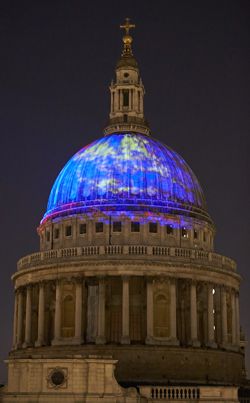
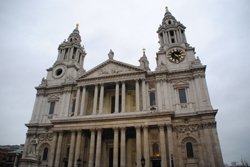
St-Paul's St Paul’s Cathedral, created after Old St Paul’s was destroyed in the Great Fire of London, has been marking the 350th anniversary of that event with a special programme of walks, talks, tours, special sermons and debates. Running until next April, they include special ‘fire tours’ of the cathedral, a special ‘family trail’ through the cathedral (which you can download for free), and Triforium tours in which you can see carved stones from Old St Paul’s and Sir Christopher Wren’s ‘great model’ of the new cathedral. In addition, an exhibition featuring a collection of pre-Great Fire artefacts, Out of the Fire, opens on 1st September (admission included in cathedral admission charge) and the cathedral will be kept open for two nights next week until 9pm, on 2nd and 3rd September. For the full programme of events, bookings and more information, head to www.stpauls.co.uk/fire.

On Now – Stomping Grounds: Photographs by Dick Scott-Stewart. This free exhibition at the Museum of London features images taken by the relatively unknown London-based photographer in the late 1970s and early 1980s, depicting everyone from the New Romantics of Covent Garden and Rockabillies of Elephant and Castle to wrestling matches at the Battersea Arts Centre and punks congregating on the Kings Road. The exhibition features 38 photographs and other “ephemera”. Entry is free. Closes on 18th September. For more, see www.museumoflondon.org.uk.

Send all events for inclusion to exploringlondon@gmail.com

10 sites commemorating the Great Fire of London – 3. The Templar’s column…

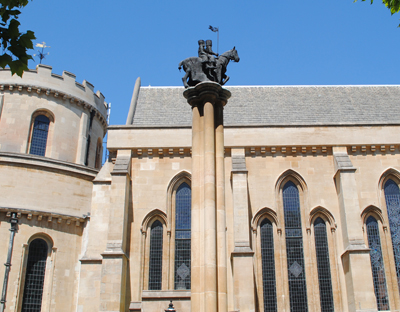
Knights-atop-the-columnStanding outside the Temple Church, in the west of the City of London (between Fleet Street and the River Thames), stands a pillar topped with a pair of Templar knights riding a horse in an obvious commemoration of the military order that once had its preceptory here.

But what many people don’t realise is that the column was also erected, apparently like the Golden Boy of Pye Corner, to commemorate another point where the all-consuming Great Fire of London was finally stopped.

The 10 metre high column was erected in 2000 (another of its purposes was to mark the millennium) in what was once the cloister courtyard of the headquarters of the Templars, which had originally founded to protect pilgrims to the Holy Land in 1119.

The bronze figures of the two men atop a single horse which caps the column was a representation of the image found on the order’s official. It represents the poverty of those who initially joined it – so poor they could only afford one horse for every two men, a situation which was to change dramatically in coming centuries as the order accumulated wealth, a situation which, eventually, in France, led to its downfall.

London Remembers reports that the column was designed in the gothic style, similar to the Purbeck marble columns in the church (which, incidentally, are said to be the oldest surviving free-standing examples of their kind) and deliberately made to contrast with the more florid column of Sir Christopher Wren’s Monument, which marks where the fire started and, also, according to a signboard, “the arrival of the new classical order”.

The column, designed by Ptolemy Dean, and the sculpture, designed by Nicola Hicks, were the gift of Lord Lloyd of Berwick, Treasurer of the Inner Temple in 1999. A Latin inscription around the base of the column reads: “Lest the Temple should be without a memorial of the start of the third millennium the Inner Temple caused this monument to be erected for the greater glory of God.”

For more on Temple and the Temple Church, see our earlier posts here and here and here.

LondonLife – Tranquil waters of the Barbican…

Barbican

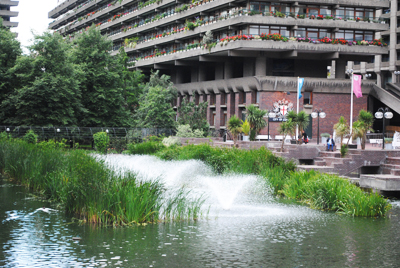
Inside the Barbican Estate residential development in the City of London. The Brutalist, Grade II listed, complex was developed in the 1960s and 1970s in an area which had been devastated in the bombing of World War II. For more on the development and the origins of its name, see our earlier post herePICTURE: David Adams

What’s in a name?…Little Britain…

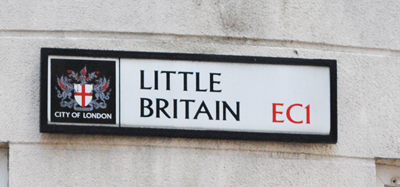
Little-BritainThis central – and rather unassuming – London street owes its name to the French – not British – who apparently once lived in the area which lies just south of Smithfield.

Originally named Little Brittany, it was settlers from Brittany in the east of modern France that inhabited the area where the street can be found after the Norman Conquest. Foremost among them apparently was the Duke of Brittany who apparently had a house here prior to the 1500s.

Between the late 15th century and early 18th century, the street was known as a location for booksellers (it was here that Britain’s first daily newspaper, the early 18th century Daily Courant, was printed in the area after moving from Fleet Street).

Famous residents over the years have included the 17th century poet John Milton (there’s also a much-repeated anecdote that has a Little Britain-based bookseller trying to convince the Earl of Dorset to buy as many copies of the apparently immoveable Paradise Lost as he could carry) , a very young Samuel Johnson (the then three-year-old and his mother lodged with a bookseller when she brought him to be touched by Queen Anne as a cure for his scrofula), and Benjamin Franklin who stayed here in 1724.

Literary references included a mention in Charles Dickens’ Great Expectations – the office of the lawyer Mr Jaggers were placed here.

St Bartholomew’s Hospital now occupies many of the buildings in the street.

This Week in London – A Queen’s garden party; the Great Fire 350 Festival; and, getting behind the scenes at the Museum of London…

Kensington-Palace-garden-partyJoin Queen Caroline, wife of King George II, for a garden party in the grounds of Kensington Palace this weekend. The celebrations include music, military drills and live performances in a bid to bring the era of the Georgians to life. Visitors can listen to court gossip, learn how to play popular music and devise ways to amuse the queen as they pop in and out of a range of tents set up in the gardens, each of which contains a different activity, from uncovering dress secrets to designing a mini-garden fit for a king or queen. There’s even the chance to sample some Georgian ice-cream in the ice-house. The days will be held from today until 21st August. Admission charges apply. For more, see www.hrp.org.uk/kensington-palace/. PICTURE: Via HRP

The Great Fire 350 Festival – marking the 350th anniversary of the Great Fire of London – is underway and there’s a range of events being held in London over this month and next. While we’ll be mentioning some of these a little closer to actual anniversary date, meantime there are bi-weekly walks, a ‘Fire Trail’ treasure hunt and a new Monument app to keep you busy. The latter allows visitors to conduct a self-guided ‘Great Fire journey’ focusing on the fire itself, the commemoration of the blaze and London as we know it now as well as taking users into the minds of Sir Christopher Wren and Robert Hooke – designers of The Monument. Available for download from Android Market and Apple App Store. For more on the events running as part of the anniversary, see www.visitlondon.com/greatfire350/events.

 Take a behind the scenes look at the Museum of London – and see some rarely exhibited objects – in an exhibition which opened late last month. The free display allows visitors to catch a glimpse of some of the work that goes on behind the scenes and see objects usually housed in the museum’s extensive stores including a detailed model of the process engraving department at the Evening Standard newspaper in 1977, an ice-cream maker and moulds from around 1910, and a confectioner’s icing stand from about 1900. The exhibition can be seen until 15th September. For more, see www.museumoflondon.org.uk.

Send all items for inclusion to exploringlondon@gmail.com.

10 sites commemorating the Great Fire of London – 2. The Golden Boy of Pye Corner…

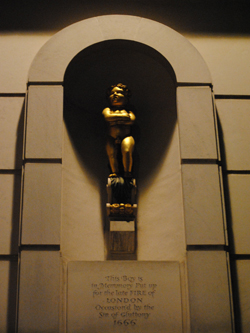
Golden-Boy-of-Pye-CornerWe’ve mentioned this memorial before but it’s worth a revisit. While last week’s entry looked at a plaque marking the site of the start of the Great Fire of London in September, 1666, this week we’re taking a (second) look at one of the sites where it was stopped.

Positioned high on a building on the corner of Giltspur Street and Cock Lane in Smithfield, this small wooden gilt 17th century statue, by an unknown maker, was once located on front of the pub, The Fortune of War, which stood on the site until it was demolished in 1910 (it was apparently used by body-snatchers as a place to display stolen corpses for surgeons from the nearby St Bartholomew’s Hospital to take their pick from).

The statue marks one of the locations on the city fringes where the fire was ‘stayed’ through the demolition of buildings. It bears an inscription which reads “This Boy is in Memmory put up for the late Fire of London Occasion’d by the Sin of Gluttony 1666”.

Well below it is an explanatory note below explains that the boy was made deliberately fat (the statue was apparently originally known as ‘The Fat Boy’ although to the modern eye it doesn’t look particularly so) in reference to the rather odd claim the fire was started in Pudding Lane as a result of the sin of gluttony and not by Papists as had been originally claimed on The Monument.

It has been said that the statue – which is believed to have once had wings and which is the reason why the building it is upon carries a Grade II heritage listing – was merely a shop sign and originally had nothing to do with the Great Fire, which may well be the case, but that said it is known that the fire stopped here (sparing St Bart’s further up Giltspur Street).

PICTURE: David Adams

A Moment in London’s History – The rebuilding of London in the aftermath of the Great Fire…

It’s the 350th anniversary of the Great Fire of London ands we thought we’d take a quick look at what happened in the aftermath.

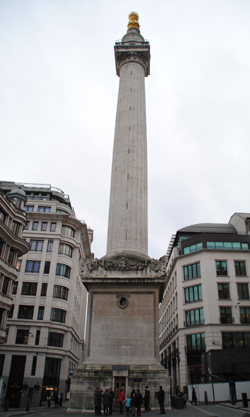
The-MonumentWith much of the city razed in the four day fire of early September, 1666, attention quickly turned to the rebuilding of the City and within just a few days, proposals began coming in for the recreation – and transformation – of London.

Christopher Wren, John Evelyn and Robert Hooke were among those who put forward new designs for the city along with the likes of one Richard Newcourt, whose proposed rigid grid featuring churches set in squares wasn’t adopted for London but was eventually for the streets of Philadelphia in what is now the United States of America.

None of these plans – Wren’s vision had apparently been inspired by the Gardens of Versailles while Evelyn’s was an Italianate city with wide piazzas – were eventually adopted, however, thanks largely to the difficulty in working out who owned which properties in the city (people had more on their mind, such as survival perhaps).

In October, 1666, King Charles II – who had encouraged many of those left homeless to move out of the City out of fears that a rebellion was in the offing – joined with the City authorities in appointing six commissioners to regulate the rebuilding (a key factor in which was the mandatory use of brick in place of wood).

Their actions were supported by a couple of parliamentary acts – drawn up to regulate the rebuilding and allow for the opening and widening of roads, among other things – and the establishment of specially convened Fire Courts to deal with property disputes (owners had to clear roadways of debris and establish their rights of ownership before they could start reconstruction).

Rebuilding was, not surprisingly, to take years – after all, almost 400 acres had been burned within the City walls and 63 acres outside them with more than 80 churches, 44 livery halls and more than 13,000 houses among the casualties. And it was patchy with new buildings standing alongside empty blocks awaiting reconstruction.

Construction of the many grand public buildings destroyed in the fire, such as St Paul’s Cathedral, would also take years (the cathedral, Wren’s Baroque masterpiece, wasn’t completed until 1711).

PICTURE: The Monument, which commemorates the Great Fire of London, is among the works of Sir Christopher Wren (for more on the Monument, see our earlier post here).

This Week in London – Turner back at the Tate; another Great Fire exhibition; and, Heroes and Villains…

Some of painter JMW Turner’s greatest works have returned to the Tate Britain – home of the largest collection of the artist’s works – where they have been put into a new free display. The works, which include Norham castle – Sunrise (c1845), Peace – Burial at Sea (exhibit 1842) and The Dogani, San Giorgio (exhibit 1842), have travelled more than 12,000 miles and been seen by more than 750,000 people in the UK, US and Canada as part of The EY Exhibition: Late Turner – Painting Set Free. They now form part of a new display of more than 100 works spread over eight rooms of the Tate Britain’s Clore Gallery. The three central spaces of the gallery present an overview of the major paintings Turner exhibited during his lifetime – his Self-Portrait (c1799), which will feature on the Bank of England’s new £20 note, is among works shown here – while four smaller galleries located to the sides will show themed groups of work. One brings together scenes from the artist’s British travels and another those from his European jaunts while the final two show the artist’s works on paper and a group of “radical late works” found in his studio after his death. For more, see www.tate.org.uk/visit/tate-britain

A new exhibition exploring the Great Fire of London to mark its 350th anniversary opens at the Guildhall Library in the City of London on Monday. That Dreadful Fire: The Hand of God, a Great Wind and a Very Dry Season explores the story through the collections of the Guildhall Library, including English and foreign accounts, sermons and public records. Runs until 30th November. For more and walks and talks, see www.cityoflondon.gov.uk/things-to-do/guildhall-library/events-exhibitions/Pages/the-dreadful-fire.aspx.

On Now: Heroes and Villains. This exhibition at the Cartoon Museum in Bloomsbury features art “depicting real life, the cartoon and comic world that highlights those we love and those we love to hate”. Featuring political cartoons, cartoon and comic strips, and caricatures, including some selected by celebrities and members of the public, it runs until 30th October. Admission charge applies. For more, see www.cartoonmuseum.org.

Send all items for inclusion to exploringlondon@gmail.com.

10 sites commemorating the Great Fire of London – 1. Thomas Farriner’s plaque

This year marks 350 years since the Great Fire of London destroyed much of the City of London and to mark the anniversary, we’re today launching a new special series looking at some of the lesser known – and, in some cases, more unusual – memorials and plaques commemorating the event.

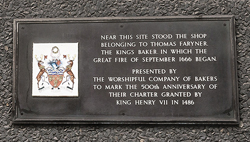
Thomas-Farriner-plaqueSure, everyone knows about The Monument near London Bridge erected to commemorate the event (see our earlier post on it here). But often overlooked is the plaque located in nearby Pudding Lane commemorating the site where the fire began in the early hours of 2nd September, 1666 – the bakery of Thomas Farriner (also variously spelt Faryner or Farynor).

The plaque, located close to the corner of Pudding Lane and Monument Street, was erected in 1986 by the Worshipful Company of Bakers to mark the anniversary of their Royal Charter being granted by King Henry VII some 500 years earlier. It reads (in part): “Near this site stood the shop belonging to Thomas Faryner, the King’s baker, in which the Great Fire of September 1666 began.”

While that fits with the long-held idea that the location of the bakery was 202 feet (61 metres) from the where the Monument stands, the same height of the memorial column itself, new research claims that the site of the bakery was not actually where Pudding Lane now stands but in nearby Monument Street instead.

Drawing on a planning document dating from 1679 and found within the London Metropolitan Archives, academic Dorian Gerhold reportedly cross-referenced the document with later maps and concluded that the baker’s oven was actually located on what is now Monument Street, 60 feet to the east of the intersection with Pudding Lane.

Farriner, meanwhile, was, as a king’s baker, a supplier to the Royal Navy. During the fire, the widower managed to escape the flames along with his three children (although their housemaid, unable or unwilling to escape out a window, perished). He was later able to rebuild the bakery and his home and when he died only a few years after the fire, left considerable sums to his children.

Incidentally, Farriner, his daughter Hanna and his son Thomas were all in the jury which convicted Frenchman Robert Hubert of starting the fire in their bakery by tossing a grenade in through the window (Hubert had confessed and, despite the fact that it’s believed few thought him actually guilty, he was convicted and hanged at Tyburn on 27th October, 1666, for the crime of arson.)

PICTURE: Steve James/Flickr/CC BY_NC-ND 2.0 (cropped and straightened)

Treasures of London – Restored 17th century fire engine…

Fire-Engine-Restoration

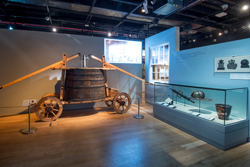
Originally built in the late 1670s by John Keeling in the aftermath of the Great Fire of London, the engine was acquired by the Museum of London in 1928.

Late-19th-century-photographThen only consisting of the central barrel and pump, it has been restored for the current exhibition, Fire! Fire!, being held to mark the 350th anniversary of the fire which wiped out much of the City of London.

Based on a 19th century photograph (pictured) which showed it still intact with undercarriage, wheels, tow bar and pumping arm, the restoration was carried out by the museum in partnership with Kent-based Croford Coachbuilders using traditional techniques and materials over a three month period.

Meriel Jeater, curator of the Fire! Fire! exhibition, said the reconstruction had revealed new insights into how the fire engine worked and shows that, weighing more than 500 kilograms without water, it would have been extremely difficult to manoeuvre along London’s narrow streets.

“Also, the relatively crude pump mechanism was only able to squirt out about six pints of water over a rather short distance, so it would have been perilously close to the flames to have had any chance of putting them out.”

Fire! Fire! can be seen at the Museum of London until 17th April. Admission charge applies. For more, see www.museumoflondon.org.uk/fire-fire.

PICTURES: © Museum of London.

Lost London – Christ’s Hospital…

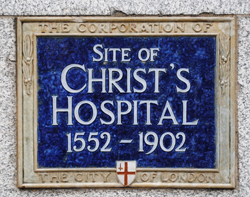
One of the achievements of the short-lived reign of King Edward VI, son of King Henry VIII, was the establishment of this hospital for orphans in 1552 in what were once buildings used by the Greyfriars Monastery (for more on the history of Greyfriars, see our earlier post here).

Christs-HospitalLocated in Newgate Street, the hospital soon had a school attached which became known as the Blue Coat School thanks to the distinctive long blue coats the students wore (and still do, the school is now located near Horsham in West Sussex).

Many of the hospital buildings were destroyed in the Great Fire of London of 1666 but most were later rebuilt under the supervision of Sir Christopher Wren, although the actual work was apparently carried out by others.

Students at the school have included antiquarian William Camden, Romantic poet Samuel Taylor Coleridge and writer Charles Lamb.

New buildings for girls were opened in Hertford in 1704 and the school moved out to Sussex in 1902 with the General Post Office built over the top of the demolished buildings.

This Week in London – Kew Gardens celebrates its herbaceous borders; the global ‘War on Terror’ at the IWM; Bobby Moore honoured; exposing the camera; and, 60 years of fanzines…

The first of three weekends celebrating the creation of the world’s longest double herbaceous borders – known as the Great Broad Walk Borders – will be held at Kew Gardens this weekend. Made up of 30,000 plants, the borders run along 320 metres of the Broad Walk which was originally landscaped in the 1840s by William Nesfield to provide a more dramatic approach to the newly constructed Palm House (completed in 1848). The spirit of the formal colourful beds he created along either side of the walk have been recreated using a range of plants. To celebrate, Kew are holding three themed weekends, the first of which, carrying a history and gardens theme, is this Saturday and Sunday. As well as talks and drop-in events, there will be a range of family-related activities as well as craft workshops, tours, and shopping. Further weekends will be held on 13th and 14th August (around the theme of the excellence of horticulture at Kew) and the bank holiday weekend of 27th to 29th August (around the theme of a celebration of beauty). For more, head to www.kew.org.

A new exhibition centring on the experiences of UK citizens and residents suspected but never convicted of terrorism-related activities and the role of the British Government in the ‘Global War on Terror’ opens at the Imperial War Museum in Lambeth today. Edmund Clark: War on Terror, Clark’s first major solo show in the UK, looks at the measures taken by states to protect their citizens from the threat of international terrorism and their far-reaching effects, exploring issues like security, secrecy, legality and ethics. Among the photographs, films and documents on display are highlights from five series of Clark’s work including Negative Publicity: Artefacts of Extraordinary Rendition, created in collaboration with counter-terrorism investigator Crofton Black, and other works including the film Section 4 Part 20: One Day on a Saturday, photographs and images from the series Guantanamo: If the Light Goes Out and Letter to Omar as well as the first major display of the work Control Order House. Runs until 28th August, 2017. Admission is free. For more, see www.iwm.org.uk/exhibitions/iwm-london/edmund-clark-war-of-terror.

The only English football captain to win a World Cup, Bobby Moore, has become the first footballer to be honoured with an English Heritage blue plaque. The plaque was unveiled at the footballer’s childhood home at 43 Waverley Gardens in Barking, East London, this week. Moore is best remembered for leading England to a 4-2 win over West Germany in the 1966 World Cup. For more, see www.english-heritage.org.uk/visit/blue-plaques/.

The camera is the subject of a new photography display which opened at the V&A in South Kensington last weekend. The Camera Exposed features more than 120 photographs, including works by more than 57 known artists as well as unknown amateurs. Each work features at least one camera and include formal portraits, casual snapshots, still-lifes, and cityscapes. Among the images are pictures of photographers such as Bill Brandt, Paul Strand and Weegee with their cameras along with self-portraits by Eve Arnold, Lee Friedlander and André Kertész in which the camera appears as a reflection or shadow. The display includes several new acquisitions including a Christmas card by portrait photographer Philippe Halsman, an image of photojournalist W Eugene Smith testing cameras and a self-portrait, taken by French photojournalist Pierre Jahan using a mirror. Runs in gallery 38A until 5th March. Free admission. For more, see www.vam.ac.uk/exhibitions/the-camera-exposed.

Sixty years of fanzines – from the development of zine-making back in the 1940s through to today’s – go on show at the Barbican Music Library in the City on Monday. FANZINES: a Cut-and-Paste Revolution features zines including VAGUE, Sniffing’ Glue, Bam Balam, Fatal Visions, Hysteria and Third Foundation among others. The exhibition, which runs until 31st August, is being held in conjunction with this year’s PUNK LONDON festival. For more, see www.cityoflondon.gov.uk/services/libraries-and-archives/our-libraries/Pages/Barbican-Music-Library.aspx.

Send all items for inclusion to exploringlondon@gmail.com.

LondonLife – Sculpture returns to the City…

Sculpture1
Sculpture in the City has returned to the Square Mile for summer with 17 contemporary artworks by internationally renowned artists located in public spaces across the City of London.
 With the event now in its sixth year, this year’s sculptures include Jaume Plensa’s seven metre high cast iron work Laura (located at 30 St Mary Axe (aka The Gherkin), it’s pictured above), Matt Collishaw’s work, Magic Lantern Small – a grand scale “zoetrope”, one of the earliest moving image machines (located in Bury Court, it’s pictured below), and Huma Bhabha’s work, The Orientalist (located in Fenchurch Avenue, it’s pictured far below). Other works can be found in locations including St Botolph-without-Bishopsgate Gardens, The Leadenhall Building and St Helen’s Bishopsgate Churchyard. A map of the SITC trail and extra commentary on the individual artworks can be accessed by downloading the SMARTIFY app for Apple and Android devices and then scanning any of the sculptures. There’s also a map and information available at www.cityoflondon.gov.uk/sculptureinthecity. PICTURES: Nick Turpin

Sculpture2

Sculpture3

This Week in London – Remembering the Great Fire of 1666; rediscovering the Palace of Whitehall; and, the Queen’s dresses go on show…

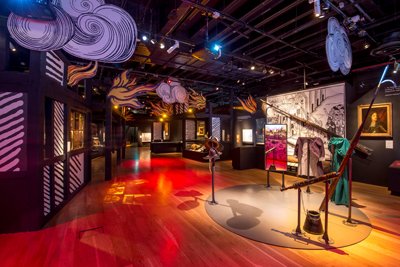
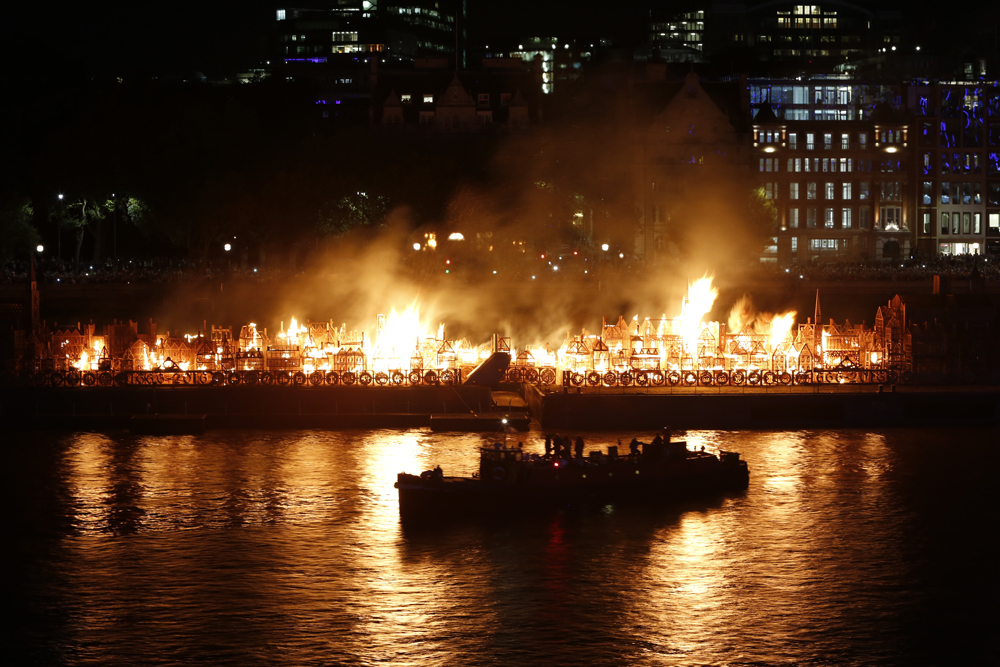
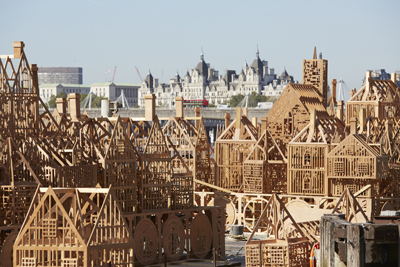
Fire2• A new “theatrical” exhibition marking the 350th anniversary of the Great Fire of London is opening at the Museum of London on Saturday. Fire! Fire! takes visitors on an interactive journey from before, during and after the great fire, looking at how the fire started and spread and the personal stories of Fire1Londoners present at the time. Visitors will be able to step in Pudding Lane and see what life was like for 17th century Londoners, walk into the bakery where the fire started, and identify objects melted by the flames. Exhibits on show include a restored 17th century fire engine, originally built in London in the last 1670s, other firefighting equipment including a squirt, a leather bucket and fire hook, a pair of bed hangings, a burnt Geneva Bible, and letters written in the fire’s aftermath. Admission charges apply. Can be seen until 17th April next year. A series of events, including walks, tours, lectures, workshop and family activities, accompanies the exhibition. For more, see www.museumoflondon.org.uk/fire-fire.  The museum has also commissioned a Minecraft building group recreate London as it was in 1666 with the first of three interactive maps to be released next week (available for free download from www.museumoflondon.org.uk) and further maps to follow in September and February. For more information on other events surrounding the anniversary, see www.visitlondon.com/greatfire350.
The long lost Palace of Whitehall is the subject of a new visitor experience which kicks off at the last surviving part of the palace – the Banqueting House – today. Handheld devices, binaural 3D sound and haptic technology is being made available to guests as they stroll around the streets of modern Whitehall, allowing them to immerse themselves in the former palace during the time of the Tudors and the Stuarts. The Lost Palace experience, created in a collaboration between Historic Royal Palaces and Chomko & Rosier and Uninvited Guests, includes a chance to see the jousts which so delighted Queen Elizabeth I at Horse Guards Parade, accompany King Charles I as he walks through St James’s Park to his execution at the Banqueting House, meet Guy Fawkes following his arrest in the Gunpowder Plot, take part in a performance of King Lear and eavesdrop on an encounter between King Henry VIII and Anne Boleyn before their doomed love affair began. The Palace of Whitehall was once the largest palace in Europe with 1,500 rooms spread across 23 acres. Tickets can be purchased at the Banqueting House. Runs until 4th September. For more details, see www.hrp.org.uk/thelostpalace.
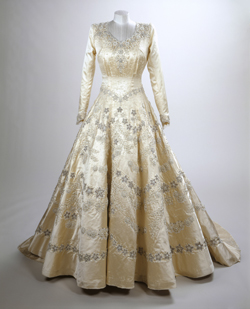
DressDresses worn by Queen Elizabeth II during two of the most significant events in Her Majesty’s life – her wedding and her coronation – can be seen as part of the Summer Opening of the State Rooms at Buckingham Palace from Saturday. The two dresses will form part of a special exhibition – Fashioning a Reign: 90 Years of Style from The Queen’s Wardrobe, the largest display of the Queen’s dress ever held. Alongside the two feature dresses, both designed by British couturier Sir Norman Hartnell, are around 150 outfits created by designers including Hartnell, Hardy Amies and Ian Thomas. The then Princess Elizabeth’s wedding dress (pictured), made for her marriage to the Duke of Edinburgh on 20th November, 1947, was made in ivory silk, decorated with crystals and 10,000 seed pearls and attached to a 15 foot long train, while the Queen’s Coronation dress – created for the event on 2nd June, 1953, is made of white duchesse satin and encrusted with seed pearls, sequins and crystals (along with an extra four-leaf shamrock on the left side of the skirt, added secretly by Sir Norman, to bring her good luck). The exhibition, open to 2nd October, is being accompanied by special displays at both Windsor Castle and Holyroodhouse in Edinburgh. Admission charges apply. For more, see www.royalcollection.org.uk. PICTURE: Royal Collection Trust/© Her Majesty Queen Elizabeth II 2016. 

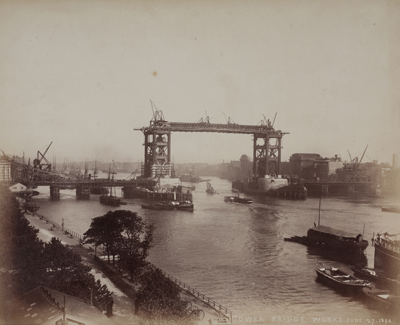
The world’s largest collection of London images – more than 250,000, dating from 1450 to now – are being made available on a free-to-access website hosted by the London Metropolitan Archives from today. Collage – The London Picture Archive features more than 8,000 historical photographs of capital’s streets as well as images of the Great Fire of London in 1666 and photographs of the construction of Tower Bridge along with maps, prints, paintings and films, all drawn from the collections at the City of London Corporation’s Guildhall Art Gallery and the Clerkenwell-based London Metropolitan Archives. The collection can be accessed at www.collage.cityoflondon.gov.uk.

It’s hands-on gaming at the Science Museum for two weeks from Friday with more than 160 systems and hundreds of games available to play on. Power UP spans 40 years of gaming with games ranging from classics like Pong and Pac-Man to modern games like Halo and systems from Atari and SEGA to PS4 and Xbox One. Ninety minute sessions are being held four times daily from 11am tomorrow until 7th August. Ticket charges apply. For more , see www.sciencemuseum.org.uk/powerup.

Send all items for inclusion to exploringlondon@gmail.com.

This Week in London – Festival of Archaeology; exploring colour and vision at the NHM; and the City’s Summer Community Fair…

The 25th annual Festival of Archaeology has kicked off across the UK this week and, of course, there’s events taking place across London. They include a walk exploring the moat at Fulham Palace this Sunday, the opportunity to join Inspector of Ancient Monuments Jane Siddell on a walk along the route of the former London wall in the City of London next Thursday, a tour of the remains of London’s Roman amphitheatre beneath Guildhall Yard on 28th July, and the chance to investigate ancient poo at the Museum of London Docklands over the week from 25th to 29th July. Some of the events are free to attend and require no booking; others charge an admission price and require advance booking. For all details, head to www.archaeologyfestival.org.uk.

Giant-Jewel-Beetle Explore how colour and vision have shaped the natural world in a new exhibition which opens at the Natural History Museum in South Kensington tomorrow. Colour and Vision features more than 350 rarely seen specimens and uses immersive arts and digital imaging to highlight how colour and vision influence life on the planet, providing insights into how humans and animals perceive the world and how colour-shifters, stealth experts and mimics use colour to survive. They include specimens from the rarely-displayed national eye collection, some of nature’s finest examples of structural colour – including Jewel beetles and hummingbirds, cochineal insects which show how nature can be used to create pigments for dyes and paints, and some rose-ringed parrots, whose different colours reveal the visible impact of a mutation in their pigment genes. The exhibition also features a newly commissioned light installation – Our Spectral Vision – by artist Liz West which has been inspired by Sir Isaac Newton’s investigation of the colour spectrum and blue morphs butterflies. Runs to 6th November. Admission charges apply. For more, see www.nhm.ac.uk. PICTURE: Giant jewel beetles/© Trustees of NHM.
The City of London Corporation’s Community Fair will be held on Sunday in Guildhall Yard, featuring entertainment, food stalls and activities for all ages. The free event will see the yard lined with market stalls run by local clubs, faith groups, learning providers and cultural partners who will be offering games and activities as well as information and handmade items for sale. Special guest broadcaster and author Charlie Dimmick will be giving planting workshops throughout the afternoon and will take part in a special Q&A session. Runs from noon to 4pm. For more details, see www.cityoflondon.gov.uk/communityfair.
Send all items for inclusion to exploringlondon@gmail.com.
10 notable blue plaques of London – 5. Five Londoners with more than one blue plaque…

There’s quite a few whose London residence (or otherwise) is commemorated by more than one blue plaque. So, breaking away from our usual ‘one plaque’ format, here were listing five of those who have made the grade…

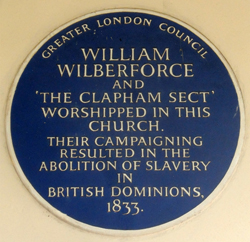
William-Wilberforce-blue-plaque1. William Wilberforce (1759-1833). The late 18th century and early 19th century politician and anti-slavery campaigner tops our list with three English Heritage blue plaques. The first is at 111 Brookwood Road in Battersea – the site of Brookwood House where Wilberforce resided during his anti-slavery campaign. The second is on Holy Trinity Church on Clapham Common, the church where Wilberforce and the Clapham Sect with whom he is associated worshipped. And the third is on a property at 44 Cadogan Place in Chelsea where Wilberforce died.

2. Dr Samuel Johnson (1709-1784). Like Wilberforce, the 18th century lexicographer Dr Johnson has three English Heritage blue plaques to his name. The first, on his famous Gough Square property in the City of London we’ve already mentioned (see our earlier post here), while the second is on a property at 8 Russell Street, Covent Garden, then occupied by bookseller Thomas Davies, which was where Dr Johnson famously first met James Boswell in 1763. The third time Dr Johnson’s name appears, more unusually, is on a plaque commemorating Essex Street – Dr Johnson is among a number of names listed on it for his role in establishing an “evening club” at the pub, the Essex Head, in the street in 1783.

3. Samuel Pepys (1633-1703): The 17th century diarist seems to pop-up everywhere in central London so it’s not surprising there are two plaques in the English Heritage blue plaques scheme dedicated to him (although both are located in the same street – one he apparently liked very much). The plaques are located at number 12 and number 14 Buckingham Street in Covent Garden and both mark the site of a Pepys residence.

4. Virginia Woolf (1882-1941): The writer, publisher and literary critic’s name appears on two properties – at 29 Fitzroy Square in Fitzrovia where Woolf lived between 1907-1911 and on Hogarth House at 34 Paradise Road in Richmond where she and Leonard Woolf lived between 1915-1924 (and also where they founded the Hogarth Press in 1917).

5. William Morris (1834-1896): The poet and artist has two English Heritage blue plaques to his credit – the first on 17 Red Lion Square in Holborn where Morris lived in a flat from 1856-1859 with Sir Edward C Burne-Jones, and the second on Red House in Bexleyheath where he and his wife Jane Burden lived from 1860-1865.

PICTURE: Spudgun67/Wikimedia/CC BY-SA 4.0 (image cropped)

This Week in London – Architecture on show; designing London’s transport system; and, the Battle of the Somme commemorated…

Archio-Plantotype-Workshop-1The London Festival of Architecture kicked off this week with more than 200 events planned for the capital across the month of June. Highlights include “open studios” in which 50 architectural practices across London open their doors to the public, a series of film showing at the BFI concerning the portrayal of the built environment in documentaries and hosted tours through some of London council estate’s green spaces and private gardens. The festival, which centres around three key themes – housing renewal and regeneration, creative workspaces and community engagement, also features a range of exhibitions, installations, talks and workshops including the Archio Plantotype Workshop on 25th June in which participants are asked to help design and build model prototype planters to grow compact and hybrid plants (pictured). For the full programme, check out www.londonfestivalofarchitecture.org.

1997-14154-Booklet;-The-Passenger's-Guide-to-London-Transport,-issued-by-London-Transport,-March-1962The design of London’s transport system – from posters, maps and signage to the styling of trains and stations – is the subject of a new exhibition at the London Transport Museum in Covent Garden. Designology – Shaping London explores the role design has played in London’s public transportation systems, spanning the period from the system’s Victorian origins to today. Among the objects on display are an 1834 Shillibeer Woolwich Omnibus timetable, original architectural drawings by Charles Holden of Arnos Grove and Sudbury art deco stations, and a 1994 magnetic ticket hall station model. There are also case studies on key design features found across the transport network such as the New Johnston typeface and the design of Moquette fabric used on the Underground and buses. Visitors are also encouraged to design their own bus stop sign (and share it on social media with the hashtag #pimpmybusstop) and visit a pop-up design studio to find out more about contemporary design innovation. There’s an accompanying programme of events. Admission charges apply. For more, see www.ltmuseum.co.uk. PICTURE: The Passenger’s Guide to London Transport, issued by London Transport, March, 1962./The London Transport Museum.

The “worst day” in the history of the British Army – 1st July, 1916, when almost 60,000 died during the Battle of the Somme – is being commemorated in an exhibition marking the battle’s centenary in Guildhall Yard. Fields of Battle, Lands of Peace: Somme 1916, features a series of evocative photographs by Michael St Maur Sheil of the battlefields as they look today contrasted with images taken at the time. The outdoor exhibition is being accompanied by a display of Somme-related artefacts in the City of London Heritage Gallery at the Guildhall Art Gallery. Admission to the display is free. Runs until 5th July.

Send all items for inclusion to exploringlondon@gmail.com.
10 notable blue plaques of London – 3. The City of London’s only ‘blue plaque’ (and it’s not even blue)…

Samuel-Johnson-plaqueThere is only one official blue plaque in the square miles of the City of London – that which marks the property of lexicographer Dr Samuel Johnson in Gough Square (he always did like to stand out from the crowd) – and, like many of the plaques in the scheme, it’s not even blue.

Samuel-Johnson-plaque2The plaque was among the 35 erected in the first 35 years of the scheme – this one in 1876 – and was done so by the Society of Arts which then ran the scheme (later the Royal Society of Arts). In common with most of the first 35 plaques, it is brown in colour.

In 1879, just three years after this plaque was erected, the Society of Arts came to an agreement with the Corporation of the City of London that the corporation – the governing body of the square mile – would commemorate sites of historic significance within its boundaries and the agreement has stood ever since.

The hundreds of “blue plaques” since erected by the City of London Corporation are rectangular in nature and commemorate everything from structures like the long-gone historic gate of Aldgate (88 Aldgate High Street) to homes of the notable such as martyred Archbishop of Canterbury Thomas á Becket (86 Cheapside).

There’s a searchable database of all the City of London plaques which can be found here.

And, of course, Dr Johnson’s house, which he lived in from 1748-59 which compiling his famous A Dictionary of the English Language (the first comprehensive English language dictionary), is now a museum – for details of that, see our earlier post here.

This Week in London – Photography and art at the Tate; punk’s 40th birthday; and, Sunday dome openings at St Paul’s…

proserpineThe “dynamic dialogue” between British painters and photographers is the subject of a new exhibition which opened at Tate Britain in Millbank this week. Painting with Light: Art and Photography from the Pre-Raphaelites to the Modern Age features almost 200 works, revealing their common influences and showing how photography adapted many of the “Old Master traditions” to create new works. Among those whose works are featured in the exhibition are everyone from David Octavius Hill and Robert Adamson to JMW Turner, John Everett Millais, Dante Gabriel Rosetti and photographer Julia Margaret Cameron. Highlights include examples of three-dimensional photography which used models and props to recreate popular works of the time, including a previously unseen private album in which the Royal Family re-enact famous paintings. Runs until 25th September in the Linbury Galleries. For more, see www.tate.org.uk. PICTURE: Dante Gabriel Rossetti (1828-1882),  Proserpine 1874. Tate.

The 40th anniversary of punk is being commemorated in a new exhibition which opens at the British Library tomorrow. Punk 1976-78 traces the impact of punk from its roots in the French Situationist movement and New York City art-rock scene through to the rise and fall of the Sex Pistols and looks at the impact punk had on music, fashion and design in the mid-Seventies. Located in the library’s Entrance Hall Gallery, the free display – which includes materials from the UK’s biggest punk-related archive held at Liverpool John Moores University – features a rare copy of the Sex Pistol’s God Save the Queen single, fanzines such as the first punk fanzine Sniffin’ Glue, flyers, posters and gig tickets from venues including the Roxy Club, Covent Garden and Eric’s Club, audio recordings, and original record sleeves such as John Peel’s personal copy of the Undertones’ single Teenage Kicks. There’s a full calendar of events to accompany the exhibition including John Lydon’s only live interview of the year. Runs until 2nd October. For more, see www.bl.uk/events/punk-1976-78.

Climb St Paul Cathedral’s dome on special Sunday openings during May. And in order not to disturb Sunday services, visitors who wish to climb to the dome’s Stone Gallery and Golden Gallery will see parts of the cathedral not normally open to the public as they enter through a not-normally used side door and climb 22 extra steps. Admission charge applies. For more, see www.stpauls.co.uk.

Send all items for inclusion exploringlondon@gmail.com.

A Moment in London’s history…The ‘longest night’…

FirefightersIt was 75 years ago this year – on the night of 10th/11th May, 1941 – that the German Luftwaffe launched an unprecedented attacked on London, an event that has since become known as the ‘Longest Night’ (it’s also been referred to as ‘The Hardest Night’).

Air raid sirens echoed across the city as the first bombs fells at about 11pm and by the following morning, some 1,436 Londoners had been killed and more than that number injured while more than 11,000 houses had been destroyed along and landmark buildings including the Palace of Westminster (the Commons Chamber was entirely destroyed and the roof of Westminster Hall was set alight), Waterloo Station, the British Museum and the Old Bailey were, in some cases substantially, damaged.

The Royal Air Force Museum records that some 571 sorties were flown by German air crews over the course of the night and morning, dropping 711 tons of high explosive bombs and more than 86,000 incendiaries. The planes were helped in their mission – ordered in retaliation for RAF bombings of German cities – by the full moon reflecting off the river below.

The London Fire Brigade recorded more than 2,100 fires in the city and together these caused more than 700 acres of the urban environment, more than double that of the Great Fire of London in 1666 (the costs of the destruction were also estimated at more than double that of the Great Fire – some £20 million).

Fighter Command sent some 326 aircraft into the fight that night, not all of them over London, and, according to the RAF Museum, the Luftwaffe officially lost 12 aircraft (although others put the figure at more than 30).

By the time the all-clear siren sounded just before 6am on 11th May, it was clear the raid – which turned out to be the last major raid of The Blitz – had been the most damaging ever undertaken upon the city.

Along with the landmarks mentioned above, other prominent buildings which suffered in the attack include Westminster Abbey, St Clement Danes (the official chapel of the Royal Air Force, it was rebuilt but still bears the scars of the attack), and the Queen’s Hall.

Pictured above is a statue of firefighters in action in London during the Blitz, taken from the National Firefighters Memorial near St Paul’s Cathedral – for more on that, see our earlier post here.

For more on The Longest Night, see Gavin Mortimer’s The Longest Night: Voices from the London Blitz: The Worst Night of the London Blitz.