Lost London – Blackwell Hall…

A trade hall for the wool and cloth trade, Blackwell Hall, also known as Bakewell Hall, once stood on the east side of Guildhall Yard in Basinghall Street.

The buttressed stone building – whose previous owners included Thomas Bakewell (from where apparently it gets its name) – is understood to have been purchased by the City of London Corporation during the reign of King Richard II and subsequently established as a cloth market.

‘Factors’ were introduced to act as agents and handle the sale of goods on behalf of the clothiers but shifts in trade – in particular the expansion of northern mills which led to them handling their sales directly –  saw the importance of the London-based factors wane.

The structure was rebuilt a couple of times over its lifespan – there are records of a rebuilding in 1588 and again after the Great Fire of 1666 – before it was finally demolished in 1820 to make way for the Bankrupcy Court.

Remains of the foundations were discovered during excavations in Guildhall Yard in 1988.

LondonLife – #MuseumWeek…

Dr-Johnsons-HouseIt’s #MuseumWeek on Twitter and museums all over London are among the more than 2,000 institutions worldwide already tweeting away. Among those, large and small, taking part in London are the @hornimanmuseum, @ExploreWellcome, @JewishMuseumLDN, @BFHouse@HRP_Palaces, @NMMGreenwichand @drjohnsonshouse (pictured). Each day of the week they’ll be tweeting on a different theme until Sunday (today’s is #souvenirsMW). For the full stream, head to @MuseumWeek.

LondonLife – An ancient guardian sits watch…

Guardian

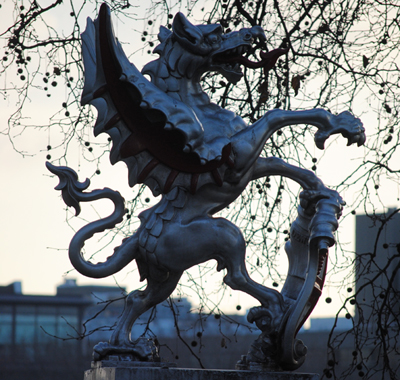
Marking the boundary of the City of London on Victoria Embankment is this large statue of a dragon holding a shield bearing the City’s coat-of-arms. One of a pair, these two statues were originally mounted above the entrance to the Coal Exchange in Lower Thames Street and were moved here in 1963 following the building’s demolition. They’re just two of numerous dragons which guard the City’s outer edges.

Famous Londoners – Mellitus…

We’re delving back a long way into London’s history here to the Anglo-Saxon period when London was known as Lundenwic. Credited as the first bishop of London in the Anglo-Saxon period, Mellitus is perhaps most famous for having founded the precursor to today’s St Paul’s Cathedral.

Mellitus-stoneTradition holds that Mellitus was a priest – perhaps an abbot – of noble birth who was among a group of missionaries, known as the Gregorian mission, sent from the monastery of St Andrew on the Coelian Hill in Rome to England by Pope Gregory the Great in response to a call from St Augustine – the first archbishop of Canterbury – for people to help convert the Saxons to Christianity.

The mission was dispatched to England in 601 AD (apparently Mellitus brought with him a number of books, including possibly the St Augustine Gospels now at Cambridge University) coming via Gaul where the mission paused to deliver letters to various Frankish kings.

The group reached England sometime prior to 604 AD for that year St Augustine, with the permission of Saxon King Æthelberht of Kent (aka Ethelbert), consecrated Mellitus Bishop of the East Saxons with London as his seat, making him the first post-Roman-era bishop of the city.

Records are scant about Mellitus’ time as bishop but he is believed to have constructed a simple wooden church dedicated to St Paul (the first ‘version’ of St Paul’s Cathedral) in 604 with King Æthelberht as his patron (the ruler of Lundenwic was King Sæberht but, while he was then a pagan and unlikely to welcome the building of a church, he apparently owed his allegiance to Æthelberht as his overlord (Sæberht was later baptised by Mellitus). It was apparently constructed in the ruins of a temple dedicated to the Roman goddess Diana as per the instructions Mellitus had carried from Rome to convert rather than destroy pagan temples.

Mellitus is known to have left the city in 610 to attend a council of bishops called in Italy by Pope Boniface IV. He returned with letters from the Pope for the Archbishop of Canterbury, Laurentius (or Laurence), and one for King Æthelberht.

There was a crisis following the death of both kings Æthelberht and Sæberht some time around 616-618. Sæberht’s three sons inherited and subsequently drove Mellitus out of the city into exile (Bede suggests it’s because he refused them a ‘taste’ of the sacramental bread but its also suggested he was exiled from his bishopric because the overlordship of the East Saxons passed from the now dead King Æthelberht of Kent to the pagan East Anglian King Raedwald and thus the brothers felt there was no need to allow a Christian bishopric in the city any longer).

Mellitus fled first to Canterbury but King Æthelberht’s successor Eadbald was also a pagan and so he continued to Gaul. He was eventually recalled – some suggest his exile was only a year – after Archbishop Laurentius converted Eadbald. Mellitus was not to return to Lundenwic, however, and the bishopric remained vacant for some years thereafter (it wasn’t until 654 that Cedd reclaimed the bishopric).

Mellitis, meanwhile, went on to greater things – he succeeded Laurentius as the third Archbishop of Canterbury following Laurentius’ death in 619. During his time as archbishop, legend has it that Canterbury was saved from fire due to his prayers which summoned a strong wind that kept the flames from the town.

He eventually died on 24th April, 624. He was buried at St Augustine’s Abbey in Canterbury (the ruins of the abbey remain in the city today).

Mellitus, who has a stone memorial at Canterbury Cathedral (pictured), was later elevated to sainthood within the Roman Catholic Church  and there was a shrine to Mellitus in Old St Paul’s Cathedral in London.

PICTURE: Ealdgyth/Wikipedia


LondonLife – Astrologer, former Lord Mayor and Leveller among those buried in Bedlam, new research finds…

Bedlam2

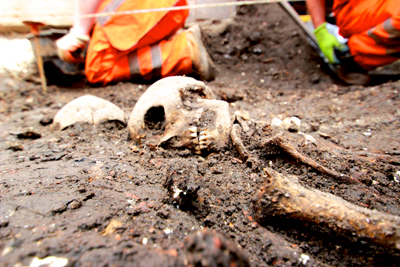
The remains of an astrologer believed to have been stoned to death by an angry mob, a former Lord Mayor of London and a member of Civil War era dissenting group, the Levellers, who was executed by firing squad may be among those exhumed from the former Bedlam burial ground in Liverpool Street in the City of London in a new archaeological excavation.

A research project carried out ahead of the planned excavation of the new eastern entrance of the Liverpool Street Crossrail Station has unearthed the names and backgrounds of more than 5,000 of the 20,000 Londoners who were buried on the site in the 16th and 17th centuries.

They include Dr John Lamb, an astrologer and advisor to the Duke of Buckingham, who a mob apparently stoned to death outside a theatre in 1628 after allegations against him of rape and black magic, Sir Ambrose Nicholas, Lord Mayor of London in 1575, as well as victims of riots by ‘Fanatiques’ (as noted in the diaries of Samuel Pepys in January, 1661) and, according to a report in The Independent, Robert Lockyer, a member of the Leveller movement who was executed by firing squad in 1649 during the English Civil War.

Some 3,000 skeletons will be disinterred in the excavation along with, it is expected, Roman and medieval artefacts. The dig will start next month and will be carried out by MOLA (Museum of London Archaeology). The skeletons will be analysed before they are reburied in consecrated ground.

The research into the backgrounds of more than 5,000 of those buried on the site – which was established in 1569 to help alleviate overcrowding caused by outbreaks of plague and other epidemics – has been carried out by 16 volunteers with the results compiled into a new online database – the Bedlam Burial Ground Register. Plague was the most common form of death followed by infant mortality and consumption.

“This research is a window into one of the most turbulent periods of London’s past,” said lead archaeologist Jay Carver. “These people lived through civil wars, the Restoration, Shakespeare’s plays, the birth of modern industry, plague and the Great Fire.”

Crossrail workers recently discovered the gravestone of Mary Godfree who died in September, 1665, as a result of the ‘Great Plague’ which reached its peak that year.

PICTURES: Courtesy of Crossrail.

We’re running a bit behind this week, so the next instalment in our Churchill series won’t appear until later this week.

This Week in London – Churchill’s Scientists; Waterloo online; a Chelsea murder case reopened; exploring Crossrail; and, astronomical photography…

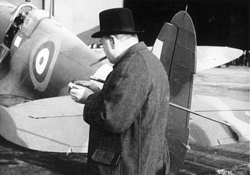
Churchill-with-a-Spitfire-from-Castle-Bromwich,-credit-Philip-Insley,-CBAF-Archive-Vickers-ArchiveSyndics Marking the 50th anniversary of the death of Winston Churchill, a new exhibition at the Science Museum in South Kensington looks at his passion for science and the influence that had on bringing World War II to an end. Churchill’s Scientists celebrates the individuals who flourished under Churchill’s patronage (and , as well as helping to bring about the end of World War II, also launched a post-war “science renaissance”) – from Robert Watson-Watt (inventor of radar) through to Bernard Lovell (creator of the world’s largest telescope) – and also delves into more personal stories of Churchill’s own fascination with science and tech. The display include objects from the museum’s collection as well as original archive film footage, letters and photographs. Highlights include the high speed camera built at Aldermaston to film the first microseconds of the detonation of the UK’s first home grown atomic bomb, the cigar Churchill was smoking when he heard news of his re-election as PM in 1951, and a one-piece green velvet “siren suit” designed by Churchill to wear during air raids (only one of three originals known to exist, it’s never been on public display outside of the tailors who created it). The free exhibition runs until 1st March and is part of the Churchill 2015 programme of events. Visit www.sciencemuseum.org.uk/churchill for more. PICTURE: Churchill with a Spitfire from Castle Bromwich (Philip Insley, CBAF Archive Vickers ArchiveSyndics).

The National Army Museum and Waterloo2oo have launched an online gallery which will eventually comprise images and information on more than 200 artefacts associated with the Battle of Waterloo ahead of the 200th anniversary in June. Among the objects featured on Waterloo200.org are the Duke of Wellington’s boots, a French eagle standard captured in battle and the saw used to amputate the Earl of Uxbridge’s leg. One hundred items – drawn from the Army Museum’s collection as well as from European museums and private collections – can already be seen on the site with a further 100 to be added before the bicentenary on 18th June.

The Talk: Death in Disguise: The Amazing True Story of the Chelsea Murders. On 12th February, the Guildhall Library in the City of London will host Gary Powell as he examines the facts of this double murder which took place in Chelsea in May, 1870, and left Victorian society reeling. For more events at the library, follow this link.

On Now: Breakthrough: Crossrail’s tunnelling story. This exhibition at the London Transport Museum in Covent Garden brings a new perspective on the massive Crossrail project currently underway in the city. Visitors will experience the tunnel environment through a five metre high walk-through installation featuring a computer simulation of a giant boring machine as well as learn about how the project is shaping up, play interactive tunnelling games and hear firsthand from those who work underground. Admission charge for adults applies. Runs until August. For more, see www.ltmuseum.co.uk.

Extended: Astronomy Photographer of the Year Exhibition. This exhibition at the Royal Observatory Greenwich features the winning images from last year’s competition. They include the Briton James Woodend’s image of a vivid green aurora in the Icelandic night sky; American Patrick Cullis’ view of earth taken from 87,000 feet above ground; and, New Zealander Chris Murphy’s image of dusty clouds dancing across the Milky Way. The exhibition can be seen for free in the Observatory’s Astronomy Centre until 19th July. For more, see www.rmg.co.uk/astrophoto.

• Send all items for inclusion to exploringlondon@gmail.com. 

10 London sites associated with Sir Winston Churchill – 1. St Paul’s Cathedral…

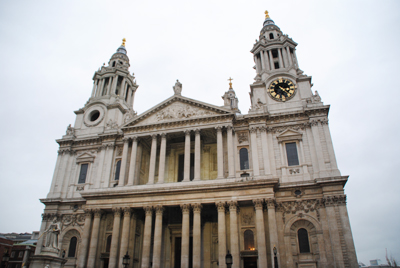
St-Paul'sThe world recently paused to mark the 50th anniversary of the death of former British PM, Sir Winston Churchill (see our earlier post here), so we’re launching a new series looking at 10 sites associated with Churchill in London.

Given the recent anniversary, we’re starting at a site close to the end of his story, at St Paul’s Cathedral, where his state funeral was held on 30th January, 1965.

Code-named ‘Operation Hope Not’, the funeral had been thoroughly planned in the years leading up to the former PM’s death and took place just six days after he passed. Having lain in state in Westminster Hall for three days (during which time it’s estimated 320,000 filed past his flag draped body), his coffin, carried on a gun carriage pulled by 120 members of the Royal Navy, was escorted by more than 2,300 personnel from the military as it made its way through city streets lined with thousands of people to St Paul’s for the service.

During the service, the catafalque containing Churchill’s body stood on a raised platform beneath the central dome surrounded by six candlesticks. Among the official pallbearers – who marched before it down the aisle – were another former PM, Clement Attlee, along with military figures like Field Marshal Lord Slim and Admiral of the Fleet Lord Mountbatten of Burma.

A plethora of world leaders representing 112 nations attended the funeral service including six sovereigns, six presidents and 16 prime ministers. Among them – in an unprecedented move for a state funeral – was Queen Elizabeth II (sovereigns do not normally attend non-family funerals) along with Prince Philip and Prince Charles.

It’s estimated that as some 350 million people around the globe tuned in to watch the funeral on TV.

After the service, Churchill’s body was taken to Tower Pier (near the Tower of London) where, to the sound of a 19-gun salute fired by the Royal Artillery, he was loaded on the MV Havengore. Sixteen RAF Lightning aircraft then did a flypast as he was transported upriver to Festival Pier with dockers dipping their cranes in salute as the boat passed (this journey was recreated last week using the original barge in commemoration of the 50th anniversary of his death).

On its arrival at Festival Pier, the body was then taken to Waterloo Station from where it went via train in a specially prepared carriage (the refurbished funeral train has been brought back together at the National Railway Museum at York) to be buried in St Martin’s churchyard in Bladon, Oxfordshire – a site not far from his birthplace at Blenheim Palace.

A bronze memorial plaque commemorating where Churchill’s catafalque stood in St Paul’s is set before the Quire steps while in 2004, the Winston Churchill Memorial Screen was unveiled in the crypt where it stands in line with the final resting places of both Admiral Lord Nelson and the Duke of Wellington.

For more on the state funeral, St Paul’s has a great page of detail which you can find here, including downloadable copies of the Order of Service and other documents. 

Famous Londoners – The Unknown Roman Girl…

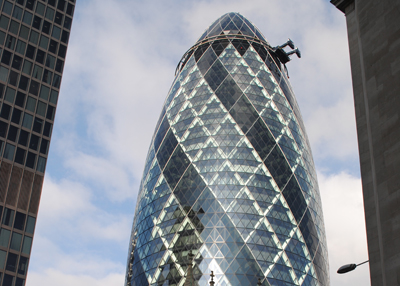
GherkinIn an unusual ‘Famous Londoners’, this week we’re looking at a former inhabitant of London who we still know relatively little about.

The remains of the teenaged girl – believed to have been aged between 13 and 17 years – were found in 1995 when the conically-shaped skyscraper at 30 St Mary Axe, fondly known as the Gherkin (and then formally known as the Swiss Re Tower), was being constructed.

The girl, whose skeleton was unearthed where the foundations now stand, was buried sometime between 350 and 400 AD in what appeared to be an isolated grave which would have lain just outside the edge of early Roman Londinium.

The body lay with the girl’s head to the south and the arms folded across. Pottery was found associated with the body which provided dating information.

After being exhumed, the skeleton was housed at the Museum of London for some 12 years before in 2007 it was reburied near the new building. The burial featured a ceremony at nearby St Botolph-without-Aldgate followed by a procession to the gravesite where a dedication took place which included “music and libations”. Among those who attended was the Lady Mayoress of the City of London.

There’s an inscription in honour of the girl on a stone feature outside the building in both Latin and English while a stone set in the pavement decorated with laurel leaves marks the (re)burial spot.

Other recent Roman remains found in London include the skeleton of a young Roman woman, believed to date from the 4th century, which was found still inside its sarcophagus at a site in Spitalfields and a series of two dozen Roman-era skulls which, likely to date from the first century A, were found during excavations for the Crossrail project in 2013. It has been suggested they may have been Britons executed for their role in the famed Queen Boudicca’s rebellion against the Romans in 61 AD.

LondonLife – Mary and infant Jesus back on display in St Paul’s…

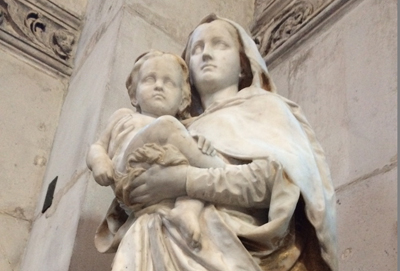
The-Madonna-and-ChildThis Victorian-era marble statue of the Virgin and Child has gone back on show in St Paul’s Cathedral more than 70 years after it taken down following bombing during World War II. Part of an ornate high altar and reredos installed at the cathedral’s east end in 1888, the statue – the work of Thomas Garner – was put into storage after that part of the cathedral took a direct hit during the Blitz of 1940 and what remained of the altar was dismantled (the statue and a crucifix were the only parts retained by the cathedral). It can now be seen in the Chapel of St Erkenwald and St Ethelburga (also known as the Middlesex Chapel) in the north transept. For more, see www.stpauls.co.uk. PICTURE: The Chapter of St Paul’s Cathedral.


This Week in London – New Year’s Eve sold out; New Year’s Day Parade; and, National Gallery buys Corot work…

All 100,000 tickets for London’s New Year’s Eve fireworks are now booked, the Greater London Authority announced this week. They’ve advised those without a ticket to avoid the area around Embankment and South Bank on the night, saying that the best alternative view of the fireworks will be live on BBC One. Meanwhile, don’t forget the New Year’s Day Parade which will kick off in Piccadilly (near junction with Berkeley Street) from noon on New Year’s Day. The parade – which takes in Lower Regent Street, Pall Mall, Trafalgar Square and Whitehall before finishing at 3.30pm at Parliament Square in Westminster – will feature thousands of performers. Grandstand tickets are available. For more, see www.londonparade.co.uk.

The National Gallery has acquired French artist Jean-Baptiste-Camille Corot’s work, The Four Times of Day, it was announced this month. The 1858 work, acquired with the aid of the Art Fund, has something of a star-studded pedigree – it was bought by Frederic, Lord Leighton, in 1865, and the four large panels were displayed at his London home until his death. In the same family collection for more than a century after that, they have been on loan to the National Gallery since 1997. They complement 21 other paintings by Corot in the gallery’s collection. The Four Times of Day can be seen in Room 41. Entry is free. For more, see www.nationalgallery.org.uk.

Exploring London is taking a break over Christmas, so this will be the last This Week in London update until mid-January. But we’ll still be posting some of our other usual updates including our most popular posts for 2014 round-up!

Famous Londoners – Dr Richard Mead…

Eighteenth century physician Dr Richard Mead is noted not only for his attendance on the rich and famous of his time – including royalty – but also for his philanthropy, his expansive collections and, importantly, his contributions in the field of medicine.

Born in Stepney, London, on the 11th August, 1673, as the 11th of 13 children of nonconforming minister Matthew Mead, Mead studied both Utrecht and Leiden before receiving his MD in Italy. Returning to England in 1696, he founded his own medical practice in Stepney.

He married Ruth Marsh in 1699 and together the couple had at least eight children, several of whom died young, before her death in 1720 (he subsequently married again, this time to Anne, daughter of a Bedfordshire knight, Sir Rowland Alston).

Having published the then seminal text – A Mechanical Account of Poisons – in 1702, the following year Mead was admitted to the Royal Society. He also took up a post as a physician at St Thomas’ Hospital, a job which saw him move to a property in Crutched Friars in the City – his home until 1711, when he relocated to Austin Friars.

It was after this that he become friends with eminent physician John Radcliffe who chose Mead as his successor and, on his death in 1714, bequeathed him his practice and his Bloomsbury home (not to mention his gold-topped cane, now on display at the Foundling Museum – see note below).

Following Radcliffe’s death, in August of that year Dr Mead attended Queen Anne on her deathbed. Other distinguished patients over his career included King George I, his son Prince George and daughter-in-law Princess Caroline – in fact he was appointed as official physician to the former prince when elevated to the throne as King George II – as well as Sir Isaac Newton, lexicographer Dr Samuel Johnson, Alexander Pope, Sir Robert Walpole and painter Antoine Watteau.

Mead, who had been named a governor of St Thomas’ in 1715 and elected a fellow of the Royal College of Physicians in 1716, was over the years recognised as an expert in a range of medical fields – including, as well as poisons, smallpox, scurvy and even the transmission of the plague.

Among the many more curious stories about Dr Mead is one concerning a ‘duel’ (or fistfight) he apparently fought with rival Dr John Woodward outside Gresham College in 1719 over their differences in tackling smallpox and others which concern experiments he conducted with venomous snakes to further his knowledge of venom before writing his text on poisons.

Dr Mead was also known for his philanthropy and became one of the founding governors of the Foundling Hospital (as well as being its medical advisor) – a portrait of him by artist Allan Ramsay (for whom he was a patron), currently hangs at the museum.

Dr Mead, who by this stage lived in Great Ormond Street in Bloomsbury (the property, which backed onto the grounds of the Foundling Museum and which Mead had moved into after his first wife’s death, later formed the basis of the Great Ormond Street Hospital for Children), is also noted for the large collection he gathered of paintings – including works by Dürer, Holbein, Rembrandt, and Canaletto, a library of more than 10,000 books, antiquities and classical sculpture as well as coins and jewels, all of which scholars and artists could access at his home (it took some 56 days to sell it all after his death).

While Dr Mead – who died on 16th February, 1754 – was buried in the Temple Church, there is a monument to him – including a bust by Peter Scheemakers – in the north aisle of Westminster Abbey.

Dr Mead is currently being honoured in an exhibition at the Foundling Museum – The Generous Georgian: Dr Richard Meadwhich runs until 4th January. There’s an accompanying blog here which provides more information on his life and legacy.

8 structures from the London that never was – 5. Sir Joseph Paxton’s Great Victorian Way…

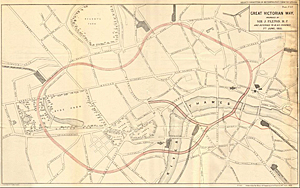
Fresh from the success of designing The Crystal Palace for the Great Exhibition of 1851 (see our earlier post here), in 1855 Sir Joseph Paxton came up with the idea of building a covered elevated railway “girdle” which would circle parts of central and west London and alleviate traffic congestion.

Great-Victorian-WayThe proposed 10 mile long, eight track railway – which would feature trains propelled by air pressure (an “atmospheric” system) rather than conventional steam engines and included  “express” trains which would only stop at select stations – was to be constructed inside a vast, 108 foot high glass covered arcade which would also contain a road, shopping and even housing.

The trains would travel at such a speed that to get from any one point on the “girdle” to its opposite point would only take 15 minutes.

Paxton presented his proposal to a Parliamentary Select Committee in June 1855 – he had already shown it to Prince Albert whom, he said, “gives it his approval”.

He estimated the cost of his proposal – which he thought would carry some 105,000 passengers every day – at some £34 million – a figure which parliament, which had initially been supportive of the idea, found a little hard to stomach.

This was especially thanks to the fact they were already dealing with the costs of Sir Joseph Bazalgette’s vast sewer system (see our earlier post here), created as a result of the ‘Great Stink’ in 1858 when the smell of untreated human excrement and other waste in the Thames became so strong, parliament had to act.

As a result, the project – which would have crossed the Thames three times, once with a spur line that ended near Piccadilly Circus – never eventuated but the Underground’s Circle Line today follows roughly the same route Paxton’s railway would have.

What’s in a name?…Holborn…

Prudential-Assurance-Building

The origins of the name of this part of central London, to the west of the City, lie in the fact that the Fleet River runs through the area (albeit, since the 18th century, underground).

Mentioned as far back as the 950s, the name Holborn comes from the Old English “hol” or “holh” (“hollow”) and “burne” or “bourne” (“stream”) and means the “stream in the hollow” with the hollow in this case being the valley over which the Holborn Viaduct was built in the 1860s.

The term ‘Holburne’ was either used to refer to a tributary of the Fleet or part of the river itself. There was a bridge which apparently bore the same name and spanned either the Fleet or its tributary up until the river was covered.

The street now known as High Holborn – the main street in the area – was originally a Roman road and by the 19th century had become a centre for the entertainment industry featuring theatres, restaurants and pubs (including one of our favorites, the Cittee of Yorke).

The street is also home to the Holborn Bar, which marked the boundary of the City of London and was once site of a toll gate – it’s now the site of the Royal Fusilier’s War Memorial.

Other famous monuments in the area include an equestrian statue of Prince Albert – the City of London’s official statue of him – which was removed from its position in the centre of Holborn Circus in the east of the area to a new position on the western side of the intersection during a renovation last year.

Now dominated by offices and some shopping precincts (these include a street market in Leather Lane), among other notable buildings are pre-Great Fire of London survivor Staple Inn (see our earlier post here), churches including St Andrew Holborn, and St Alban the Martyr, Holborn, and, to the east, St Etheldreda’s Church (see our earlier post here) and Ye Olde Mitre pub (see our earlier post here).

The area is also home to the Inns of Court Lincoln’s Inn and Gray’s Inn and the Grade II*-listed Prudential Assurance Building (pictured above), constructed on the former site of Furnival’s Inn in the late 19th century/early 20th century, as well as Hatton Garden, famous for being the centre of London’s jewellery trade.

Lost London – Alsatia…

A Thames-side slum area located between Temple and Whitefriars Street (and south of Fleet Street), an area previously occupied by the Whitefriars Monastery, Alsatia was known as something of a lawless district where residents resisted any intervention by City officials.

The district came into existence following the dissolution of the monastery by King Henry VIII (he apparently gave the buildings and land to his physician Dr William Butts) and the area, despite some initial efforts to build substantial houses there, eventually degenerated into an overcrowded slum (apparently even when the priory was still existent, some of the surrounding areas had been somewhat disreputable).

The right of sanctuary apparently existed in the area which meant that debtors and criminals who entered gained immunity from arrest while they remained here.

Authorities were certainly loathe to enter the district given the strength which residents showed in resisting any attempts to grab hold of wanted persons and the maze-like narrow thoroughfares of the area and it became mockingly referred to as Alsatia in a reference to Alsace, a much disputed region on the French-German border which was historically outside normal legal jurisdiction.

Among those who took refuge here was Daniel Defoe – he is said to escaped here in 1692 after he was wanted by authorities for writing seditious material.

There were several attempts to clean up the slum but these had little effect (although the Great Fire of London did burn through here in 1666) and in 1608, King James I confirmed the area’s liberties in a formal charter. The rights remained in place until 1697 when they were abolished by an Act of Parliament (along with those of other liberties), although the area maintained its disreputable character for some time after.

Alsatia was mentioned in several books including in Thomas Shadwell’s 1688 play The Square of Alsatia and Sir Walter Scott’s 1822 novel, The Fortunes of Nigel, and the term continued to be used to refer to run-down neighbourhoods until late in the 19th century.

This Week in London – Paddington comes to town; it’s Christmas decorations time; Guards Memorial upgraded; and Grayson Perry…

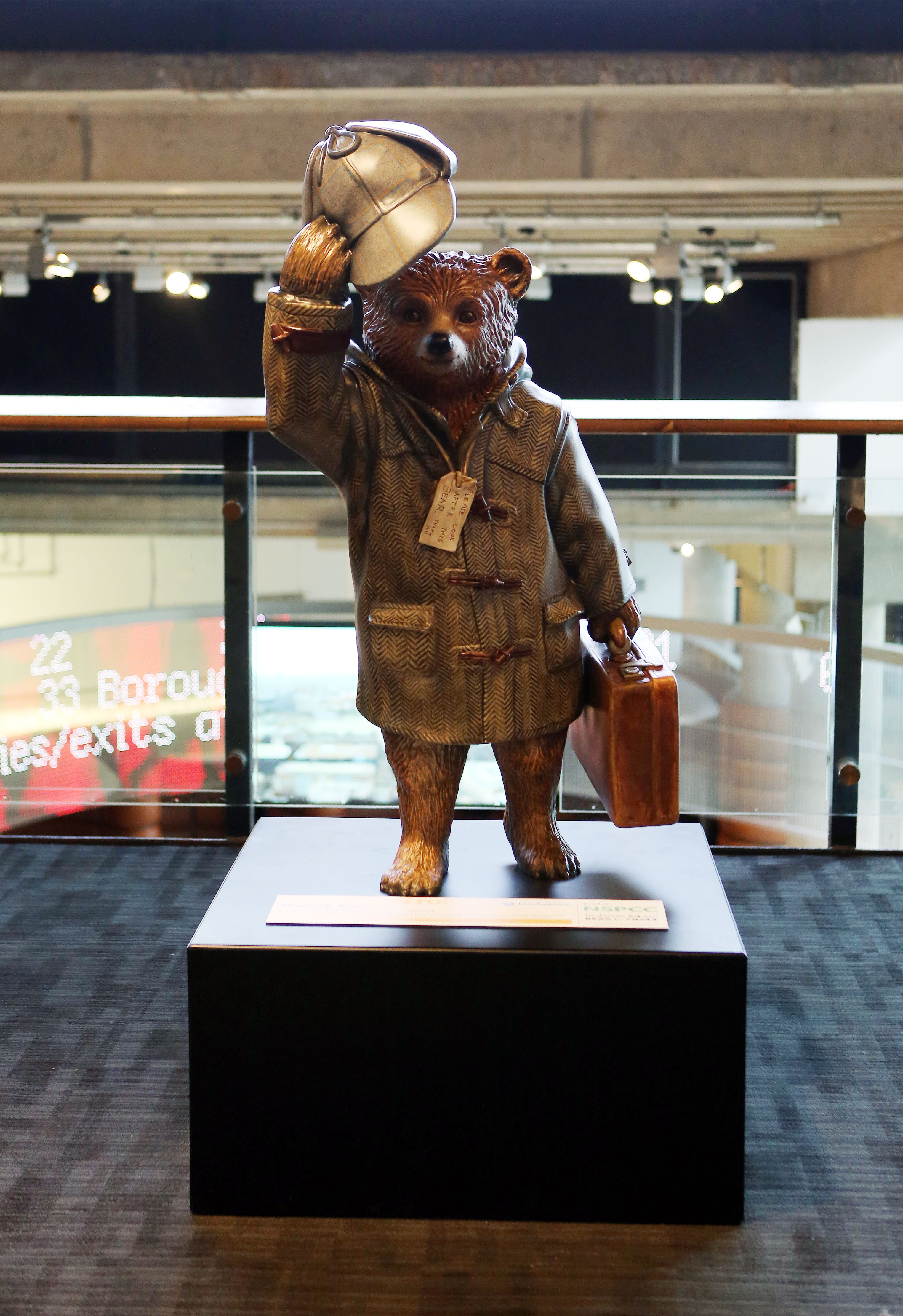
The Paddington Trail, London, 2014Paddington comes to the Museum of London in a new exhibition opening tomorrow to coincide with the bear’s big-screen debut. A Bear called Paddington charts the story of the character from his genesis on Christmas Eve, 1956, when creator Michael Bond bought his wife a small toy bear and named him after the railway station near where they loved across the next almost 60 years to today. Objects on display include: a first edition A Bear Called Paddington – dating from 1958, it belonged to Bond’s daughter Karen Jankel; an original illustration of Paddington by Paddy Fortnum; the typewriter Bond used to write Paddington at Work and Paddington Goes To Town; the original Paddington puppet from the 1970s TV animations; and, props from the upcoming film Paddington (released on 28th November). The free exhibition runs until 4th January. See www.museumoflondon.org.uk for more. The museum, meanwhile, is also playing host to a new life-sized statue of the famous bear designed by Benedict Cumberbatch (and known as Sherlock Bear for obvious reasons given Cumberbatch’s penchant for playing a certain detective – pictured). It forms just one stop on the Paddington Trail which, as the work of VisitLondon.com, NSPCC and film-makers StudioCanal, links 50 sites – each with their own statue of the bear – across the capital. Designed by everyone from Mayor Boris Johnson to football star David Beckham and actors Sandra Bullock and Hugh Bonneville, the bears can be found around town until 30th December. For more on the trail, including a map of locations, check out www.visitlondon.com/paddington/.

While the Oxford Street lights are already switched on (as are those in Covent Garden), Carnaby Street’s Christmas decorations are to be officially launched at 6.30pm tonight. The launch coincides with a shopping party (including 20 per cent discount), live music, free drinks, good bags and “trend masterclasses” with Grazia Magazine’s editor-at-large Angela Buttolph. Oh, and the decorations consist of eight red and white oversized sets of headphones and sunglasses. Meanwhile the Regent Street lights get turned on this Sunday with an event featuring a star-studded cast including Take That’s Mark Owen, Gary Barlow and Howard Donald (who are switching on the lights but not playing). While there’s entertainment along the street from noon, the music kicks off at 4pm and the lights, designed around the theme of the film Night at the Museum: Secret of the Tomb, get switched-on at 5pm and will be followed by a fireworks display. For more, see www.regentstreetonline.com.

The Guards Memorial in Horseguards Parade, Westminister, has been upgrade to a Grade 1-listed structure on the advice of English Heritage. Unveiled in 1926 by the Duke of Connaught, Senior Colonel of the Guards, and General George Higginson, a Crimean veteran, the memorial commemorates the 14,000 Guardsmen who died in the First World War. Designed by architect Harold Chalton Bradshaw and sculpted by Gilbert Ledward, it features five bronze soldiers, each representing a typical soldier from each of the divisions – Grenadiers, Coldstreams, Scots, Welsh and Irish Guards.

On Now: Grayson Perry: Who Are You? This exhibition at the National Portrait Gallery near Trafalgar Square features a series of new works created by Perry during the making of his Channel 4 TV series of the same name. Interspersed with 19th and 20th century collections of the gallery, the portraits – which include a tapestry, sculptures and pots – are of families, groups and individuals and include everyone from a young Muslim convert and Celebrity Big Brother contestant Rylan Clark. Runs until 15th March. Entry is free. For more, see www.npg.org.uk.

Send all items for inclusion to exploringlondon@gmail.com.

Famous Londoners – The Pageantmaster…

Last Saturday saw the running of the Lord Mayor’s Show in London – the 799th year the event has been held. So we thought it was a good time to take a look at the office perhaps most famously associated with the annual running of the show (with the exception of the new Lord Mayor, of course) – the Pageantmaster.

The office dates back to at least the mid 16th century – some sources record Richard Baker of the Painter-Stainers Company as being the first to be given the role in 1566. It involves organising the annual grand three-and-a-half mile long procession of the new Lord Mayor (in this case Alan Yarrow) from Mansion House via St Paul’s Cathedral to the Royal Courts of Justice at Temple Bar (and then back again along Victoria Embankment).

The current Pageantmaster, Dominic Reid, took on the role in 1992 following the death of his father John who had carried out the role for the 20 years previously. Pageantmaster Court in the city was named for the role in the early 1990s (it had formerly been known as Ludgate Court). Mr Reid, an architect and soldier, is now the longest serving Pageantmaster in history – his father had held that title before him and before that the record had apparently been held by one Thomas Jourdan who managed 14 shows between 1671-85.

Mr Reid, who like his father before him has been awarded an OBE for his work on the Show, said at a Gresham College lecture in 2011 that as Pageantmaster, he is “responsible for all aspects of the design, organisation and production of the Lord Mayor’s Show. In this role I am the agent of the Senior Alderman below the Chair, and I am employed as a consultant to Lord Mayor’s Show Ltd the not for profit company limited by guarantee that puts on the show.”

The role is now so big – involving more than 7,000 participants, 20 bands, 150 horses and hundreds of vehicles – that it now reportedly takes the Pageantmaster a good nine months to organise all the details.

The Pageantmaster himself takes part each year in the procession and while he has apparently previously ridden a horse, he can now be seen standing on the back of a ceremonial City of London vehicle.

For more of the history of the Lord Mayor’s Show, see our previous entries on Gog and Magog and the State Coach or the official website www.lordmayorsshow.london.

Lost London – The Devil Tavern…

Famous as the home of the Apollo Club, the Devil – more completely the Devil and St Dunstan or The Devil and the Saint, thanks to its sign which showed the saint tweaking the Devil’s nose with pincers – was a Fleet Street institution.

The-Devil-TavernLocated at number 2, Fleet Street close to the Temple Bar, the tavern’s origins date back to at least 16th century but it was Elizabethan playwright Ben Jonson who made it home to the literary dining club known as the Apollo Club (the moniker comes from the name of the room in the tavern in which the club was located).

As well as Jonson, members of the club are said to have included William Shakespeare, Jonathan Swift, Alexander Pope and Dr Samuel Johnson. Samuel Pepys is also said to have frequented the tavern.

A bust of Apollo was mounted over the door to the room and a verse of welcome on the wall – they apparently still exist inside the bank of Child & Co (now part of the Royal Bank of Scotland) which now occupies the site on which the tavern once stood. The ‘rules’ of the club – which have been penned by Jonson – also apparently hung over the fireplace (and the name of the club lives on in Apollo Court over the road).

The tavern is also noted for its associations with ‘Mull Sack’ (aka chimney sweep turned 17th century highwayman John Cottington) and hosted concerts and other important gatherings including that of the Royal Society which held its annual dinner here in 1746.

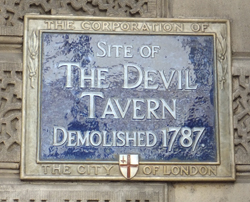
It was demolished in the 1787 when the site was annexed by the neighbouring bank. A plaque can now be seen on the bank’s wall in Fleet Street.

PICTURE: Open Plaques

This Week in London – Sherlock Holmes at the MoL; Rembrandt’s latter years; and, William Morris’ legacy..

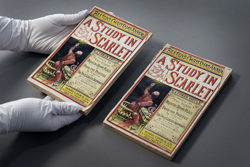
Sherlock-15Sherlock Holmes and his relationship to London, the city in which he lived, is the focus of a new exhibition which opens at the Museum of London from Friday. Sherlock Holmes: The Man Who Never Lived and Will Never Die, the first major temporary exhibition on Sir Arthur Conan Doyle’s famous character to be held in London in more than 60 years, will look at his literary origins and his relationship with late 19th century London, through to his portrayal in popular culture including through stage and screen performances starring everyone from Peter Cushing to Jeremy Brett and Robert Downey, Jr. Highlights of the exhibition include Conan Doyle’s notebook containing the first ever lines of a Sherlock Holmes story and notes in which he experimented with names for his to leading characters (later Holmes and Dr John Watson), a rare oil on canvas painting of Conan Doyle painted by Sidney Paget in 1897 which has never before been on public display in London, the original manuscript of 1903’s The Adventure of the Empty House, the Belstaff coat and the Derek Rose camel dressing gown worn by Benedict Cumberbatch from the BBC series and original pages from Edgar Allan Poe’s 1841 hand-written manuscript of The Murders in the Rue Morgue (Poe was an important influence on Conan Doyle’s writings). The exhibition will also include paintings, drawings, illustrations and photographs of Victorian London along with a vast collection of objects from the period. Runs until 27th April. Admission charge applies. For more, see www.museumoflondon.org.uk/sherlock. PICTURE: Two editions of A Study in Scarlet in which Conan Doyle introduced Holmes and Watson, Beeton’s Christmas Annual 1887.

The first ever in-depth exploration of Rembrandt’s final years of painting opened at the National Gallery off Trafalgar Square yesterday. Rembrandt: The Late Works features about 40 paintings, 20 drawings and 30 prints with key works including moving The ‘Jewish Bride’ (from Rijksmuseum in Amsterdam), An Old Woman Reading (The Buccleuch Collection in Scotland), Bathsheba with King David’s Letter (Musee du Louvre in Paris) and Lucretia (National Gallery of Art in Washington, DC) as well as the last minute loan of The Conspiracy of the Batavians under Claudius Civilis (from the Royal Academy of Fine Arts in Sweden). The exhibition provides new insights into some of the artist’s most famous works including The Sampling Officials of the Amsterdam Drapers (aka The Syndics), and brings together a number of self-portraits usually seen in different galleries. The exhibition runs in the Sainsbury Wing until 18th January. Admission charge applies. For more, see www.nationalgallery.org.uk.

The first exhibition devoted to Pre-Raphelite William Morris and his influence on 20th century life opens at the National Portrait Gallery off Trafalgar Square today. Anarchy & Beauty: William Morris and His Legacy, 1860-1960 explores the ‘art for the people’ movement which Morris and the artists of the Pre-Raphelite Brotherhood initiated, reveals the work of Arts and Crafts practitioners inspired by Morris, and shows how Morris’ “radical ideals” influenced the Garden City movement and post-war designers like Terence Conran. Highlights include Morris’ handwritten Socialist Diary, his gold-tooled hardbound copy of Karl Marx’s Le Capital and Burne-Jones’ handpainted Prioresses Tale wardrobe. Admission charge applies. The exhibition runs until 11th January. For more, see www.npg.org.uk.

Send all items to inclusion to exploringlondon@gmail.com.

Famous Londoners – Sir Robert Geffrye…

He lends his name to one of London’s best small museums but who was the person behind the name the Geffrye Museum?

Sir-Robert-GeffryeDetails about his life are somewhat scant but it is generally believed Sir Robert Geffrye (among a number of variants of the spelling of his name) was born around 1613 in the village of Landrake near Saltash in Cornwall.

Moving to London while still just in his teens, he is believed to have undertaken a seven year apprenticeship, eventually admitted as a member of the Worshipful Company of Ironmongers and freeman of the City of London.

It’s been suggested he was an ironmonger in name only but it seems to be the case that his new status gave him the opportunity to launch his career as a merchant and he apparently made a fortune from investing in African and East Indian trade.

Geffrye – who married Priscilla Cropley, a lawyer’s daughter, at the chapel in the Mercer’s Hall in Cheapside in 1651 and lived in Lime Street – was twice Master of the Worshipful Company of Ironmongers (first in 1667 and then again in 1685).

He was knighted by King Charles II in 1673 (his coat-of-arms can still be seen in the Ironmonger’s Hall) and in 1674, he was appointed a sheriff of London before being elected Lord Mayor in 1685 (his wife Priscilla had died in 1676).

In 1688, Geffrye became president of Bridewell and Bethlehem Hospitals – a role which he held for two years and which apparently saw him attending Bridewell every Friday to judge and sentence prisoners.

He died in February 1704 and was buried in the now long-gone St Dionis Backchurch, where his wife had been buried earlier. Their remains were transferred to the almshouses grounds after the church was demolished in 1878.

Geffrye left behind a substantial fortune and, along with bequests to family, friends and charities, he made a sizeable bequest which funded the building of 14 almshouses in Shoreditch (now home to the Geffrye Museum which this year celebrates its tercentenary) (for more on the museum and alms houses, see our earlier posts here and here).

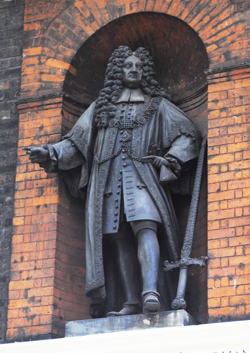
A replica of an original 1723 statue of Sir Robert still adorns the almshouses which bear his name (pictured above).

For more on the people that made London, see Boris Johnson’s Johnson’s Life of London: The People Who Made the City That Made the World.

LondonLife – Sheep in the City…

Sheep

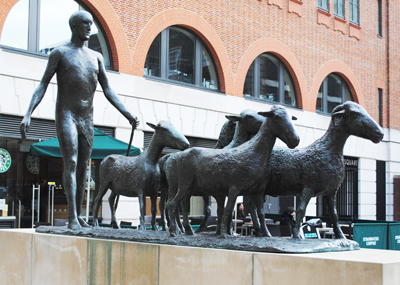
A small flock of sheep made their way across London Bridge this week as the Freemen of the City of London exercised their ancient prerogative to drive sheep over the span. A reported 600 Freemen from the City’s 110 livery companies took part in the annual drive along with a score of sheep – all in an effort to raise for the Lord Mayor’s Appeal. There’s a permanent reminder of the tradition of driving sheep in the heart of the City in Paternoster Square near St Paul’s Cathedral where Dame Elisabeth Frink’s bronze sculpture of Shepherd and Sheep can be found (pictured above).