10 significant sites from Georgian London – 3. St Mary le Strand…

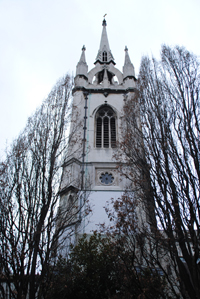
This oddly located church on the Strand is the work of acclaimed architect James Gibbs – the first public project he embarked upon after returning from Italy where he had trained.
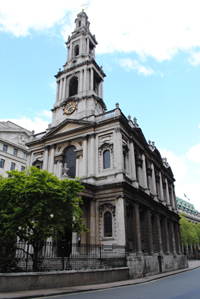
St-Mary-le-StrandWhile the history of St Mary le Strand goes at least back to the Middle Ages (and it initially stood just south of the current churches’ position on land currently occupied by Somerset House), the construction of the current church – the first of 50 built in London under a special commission aimed at, well, seeing more churches built in the capital to meet the needs of the growing population – began around 1715 (the foundation stone was laid on 25th February, the year after the accession of King George I.)

While building was briefly delayed by the Jacobite rising which broke out in 1715, the church was finally consecrated for use on 1st January, 1723.

Gibbs, who trained under a baroque master – a style which contrasted with the Palladian-style favoured by Lord Burlington and others, had apparently originally intended the church to be in the Italianate style with a campanile over the west end instead of the steeple  but this scheme also included a 250 foot high column surmounted by a statue of Queen Anne located to the west of the church which would celebrate the work of the commission (it’s also worth noting that the churches built by the committee – and they didn’t get close to building 50 – were known as “Queen Anne Churches” despite their construction taking place largely after her death).

However, plans for the column were abandoned on the queen’s death on 1st August, 1714, and instead Gibbs – a Roman Catholic who thanks to his supposed Jacobite sympathies apparently finished the project without pay, was ordered to use the stone which had been gathered to build the steeple and, thanks to that, amend his plans for the church into an oblong form rather than the square form he had initially intended. The work shows the influence of Sir Christopher Wren as well as churches in Italy.

The interior has been remodelled several times since its creation. The white and gold plastered ceiling was apparently inspired by the work of Italian sculptor and architect Luigi Fontana on two Roman churches and other features include paintings by American artist Mather Brown (these were put in place in 1785 and are located on panels on the side walls of the chancel – they were restored in 1994), while the crucifix behind the altar was presented by parishioners in 1893.

It the late 1800s, the London County Council proposed demolishing the church so it could widen the Strand for traffic but this plan was abandoned after an outcry led by artist Walter Crane (although the graveyard was removed).

Famous faces associated with the church include Charles Dickens’ parents, John and Elizabeth, who were married here in 1809, and there’s a story that during a secret visit to London in 1750, Bonnie Prince Charlie (Charles Edward Stuart) renounced the Roman Catholic Church by receiving Anglican communion here. The parish currently includes that of nearby St Clement Danes after the church was bombed in 1941 (it’s now central church of the Royal Air Force).

WHERE: St Mary le Strand, Strand (nearest tube stations are Temple, Covent Garden, Holborn, Charing Cross and Embankment); WHEN: Usually open 11am to 4pm from Tuesdays to Thursdays and 10am to 1pm Sundays; COST: free; WEBSITE: www.stmarylestrand.org.

Famous Londoners – Wynkyn de Worde…

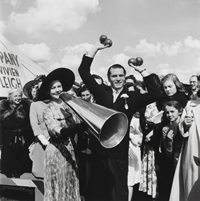
Known as the “Father of Fleet Street”, Wynkyn de Worde was key figure in the early use of the printing press in England.

Wynkyn_de_WordeBorn on the continent (candidates include Wœrth in Alsace in north-east France and Wœrden in The Netherlands), Wynkyn – whose name comes in various spellings, although it is said to have originally been Jan van Wynkyn – is believed to have become apprenticed to a printer in Cologne before meeting with famed pioneering English printer William Caxton in the early 1470s.

He apparently accompanied Caxton from Cologne to Bruges and then back to London in the late 1470s or early 1480s where he started working with Caxton at his premises in Westminster. During this period he is said to have lived with his English wife Elizabeth in a premises located with the sanctuary of Westminster Abbey (they are known to have attended St Margaret’s Church and even rented a pew there until Elizabeth’s death in 1498, after which Wynkyn is believed to have remarried.)

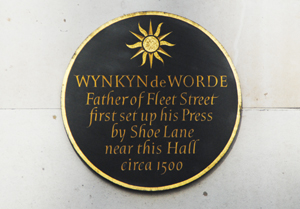
After Caxton’s death in 1492, Wynkyn took over his printing business and, around 1500, he relocated his office from Caxton’s Westminster premises to the “sign of the Sun” in Fleet Street near Shoe Lane – in fact, he is credited as being the first printer to locate in the street which becomes famously associated with publishing. There’s a plaque (pictured below), on the wall of the hall of the Worshipful Company of Stationers, located off Ave Maria Lane near St Paul’s Cathedral, commemorating the move (although Shoe Lane is located some distance away). Wynkyn later also ran a shop in St Paul’s Churchyard.

Wynkyn-de-Worde2While Wynkyn, like Caxton before him, relied on the patronage of the rich and famous (Margaret Beaufort, mother of King Henry VII among them), he also printed relatively inexpensive books in a bid to capture a wider market. In all he published more than 400 different books in at least 750 editions ranging from religious texts and poetry to fictional romantic works, educational textbooks and books aimed at children. He is noted for his use of woodcuts illustrations while his other claims to fame include being the first English printer to use italic type and the first to print music from moveable type.

De Worde died around 1534 but his legacy lives on through the mass media publishing of today (albeit not longer from Fleet Street). There is a Wynkyn de Worde Society based in Suffolk which is aimed at furthering the printing industry.

PICTURE: Wikipedia

Lost London – The aviaries of Birdcage Walk…

The street now known as Birdcage Walk – which runs along the southern side of St James’s Park – refers to the former aviary and menagerie which was located in the south-eastern corner of the park during the reign of King James I in the early 1600s.

Birdcage-WalkAs well as the exotic birds which give the street its name, the menagerie of King James I – who drained marshy ground on which the park now stands and first had the park landscaped – was said to have included camels, crocodiles and an elephant.

The aviaries were apparently expanded during the reign of King Charles II later that same century. It was around this time – in 1664 – that pelicans were first introduced into the park when presented to the king as a gift from the Russian ambassador.

Only the Royal Family and the Duke of St Albans – Hereditary Grand Falconer – were reportedly allowed to drive along Birdcage Walk until 1828 when it was opened to the general public.

Interestingly, Storey’s Gate, a narrow street runs south from Birdcage Walk to Westminster Abbey, is actually named after Edward Storey, who was “keeper of the king’s birds” during the reign of Charles II.

This Week In London – Kenwood House reopens; robot safari at the Science Museum; Kew Gardens illuminates for Christmas; Vivien Leigh at the NPG; and more…

Kenwood House in north London is being reopened to the public today following a £5.95 million restoration project which has seen the library returned to what Scottish architect Robert Adam had intended it to be. The project, which saw the Hampstead property closed since March last year, has also seen the restoration of three other Robert Adam-designed rooms – the entrance hall, Great Stairs and antechamber or entrance to the library – as well as the redecoration of four rooms in 18th century style, repainting of the exterior and the repair of the home’s roof – a job aimed at protecting the rooms and its stellar

Kenwood-House-Librarycollection of artworks by the likes of Rembrandt and Vermeer. English Heritage has also endeavoured to make the property more homely, replacing ticket desks and rope barriers with an open fire, warm rugs and leather couches on which visitors can relax. The library (pictured) was built and decorated to Adam’s designs between 1767 and 1770 as part of a wider remodelling of the villa for its owner Lord Chief Justice William Murray, 1st Earl of Mansfield. Redecorated many times since, it was restored in the 1960s but this redecoration was later found to be inaccurate. The Caring for Kenwood restoration project, which has also seen restoration of the Kenwood Dairy, was funded by a £3.89 million grant from the Heritage Lottery Fund as well as support from the Wolfson Foundation and other donors. To coincide with the reopening, a new app exploring Kenwood House has been released which can be downloaded for free from the iTunes store. For more, see www.english-heritage.org.uk/daysout/properties/kenwood/. PICTURE: English Heritage/Patricia Payne.

Head out on a “robot safari” this weekend with a special free event at Science Museum in South Kensington. Robot SafariEU, part of Eurobotics week, features 13 biometric robots from across Europe including an underwater turtle robot, a shoal of luminous fish robots, a robotic cheetah cub and Pleurobot, a robotic salamander. Roboticists from across Europe will be on hand to help visitors interact with the bots. Suitable for all ages, the event kicked off on Wednesday night and runs again on the weekend. Admission is free but timed tickets are required. For more, see www.sciencemuseum.org.uk/RobotSafari.

A memorial to author, scholar and apologist CS Lewis was dedicated at Westminster Abbey last Friday – the 50th anniversary of his death. Conducting the service, the Dean of Westminster, the Very Reverend Dr John Hall, said Lewis was “one of the most significant Christian apologists of the 20th century” and the author of stories that had “inspired the imagination and faith of countless readers and film-goers”. Douglas Gresham, younger stepson of Lewis, read from the author’s book, The Last Battle, at the service. The memorial is located in Poet’s Corner in the abbey’s south transept. For more see www.westminster-abbey.org.

A Blue Plaque commemorating Al Bowlly – described as “Europe’s most popular crooner and famous radio and record star” – will be unveiled at his home in Charing Cross Road this week. Bowlly, who lived between 1899 and 1941, was the voice beyond songs like Goodnight Sweetheart and The Very Thought Of You. The English Heritage Blue Plaque will be unveiled at Charing Cross Mansions, 26 Charing Cross Road – his home during the pinnacle of his career. For more, see www.english-heritage.co.uk/discover/blue-plaques/.

Kew Gardens has opened its gates after dark for the first time with a “captivating show of lights, sound and landscape” this festive season. A mile long illuminated trail, created in partnership with entertainment promoter Raymond Gubbay, will take visitors’ through the garden’s unique tree collections, kicking off at Victoria Gate where a Christmas village (and Santa’s Woodland Grotto) is located. The gardens will be open every Thursday to Sunday until 23rd December and then be open every night from 26th December to 4th January from 4.45pm to 10pm. Admission charge applies. For more, see www.kew.org/Christmas.

VivienLeighActress Vivien Leigh is the star of a new exhibition opening on Saturday at the National Portrait Gallery. Starring Vivien Leigh: A Centenary Celebration tells her story with a focus on her Academy Award-winning role in 1939’s Gone With The Wind. The display features more than 50 portraits of Leigh by the likes of Cecil Beaton, Angus McBean and Madame Yevonde – many of which have never been exhibited in the gallery before – and a selection of memorabilia including magazine covers, vintage film stills and press books. Among the photos will be a newly acquired image of Leigh and her husband, Laurence Olivier, taken by British photojournalist Larry Burrows at a garden party in 1949 (pictured), along with two rarely seen portraits of Leigh – one taken on the set of The School for Scandal by Vivienne in 1949 and the other by Paul Tanqueray in 1942. The exhibition will be held in Room 33 and runs until 20th July. Admission is free. For more, see www.npg.org.uk. PICTURE:  Copyright – Larry Burrows Collection 2013.

What’s in a name?…Millbank

Millbank

The origins of this Thames-side district of London are as obvious as they sound – it was the site of a mill which stood on the west bank of the river.

The mill, which had served Westminster Abbey since at least the 16th century, stood here until about 1735 when it was demolished and replaced by a mansion built by Sir Robert Grosvenor, a member of the Grosvenor family responsible for developing parts of Mayfair.

The house was pulled down in 1809 to make way for Millbank Prison, which was the country’s first national prison and which was where prisoners were held before their transportation to Australia.

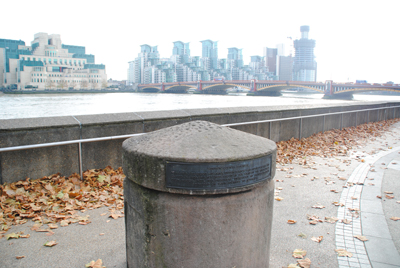
The prison closed about 1890 (a buttress which once stood at the top of the prison’s river steps commemorates the prison – pictured above).

The site is now occupied by some of the more interesting buildings in the area – including the Chelsea College of Arts (buildings formerly used by the  Royal Army Medical School, Tate Britain (which opened in 1897 as the National Gallery of British Art), and a housing development known as the Millbank Estate, constructed to providing housing for 4,500 members of the working class.

While the area was previously known for having been dominated by marshland, land was eventually reclaimed along the waterfront and an embankment established, defining the course of the river.

As well as the district, the name Millbank is also the name of the street which runs along the riverbank between the Houses of Parliament and Vauxhall Bridges.

For more on London’s prisons, check out Geoffrey Howse’s A History of London’s Prisons.

10 fictional character addresses in London – 4. 186 Fleet Street…

OK, so the debate may continue over whether Sweeney Todd was an actual person (according to author Peter Haining, the real Todd, born in Brick Lane, is supposed to have been hanged in 1802) or a fictional character, but, suspending that debate for the moment, we’re including the infamous Fleet Street barber in this list.

186-Fleet-StreetKnown as the “demon barber of Fleet Street”, Todd first appeared in literature as a murderer in the Victorian serial, The String of Pearls: A Romance, published in a weekly periodical, and soon became a staple of the Victorian theatre, later appearing in numerous plays and films including the 2007 Johnny Depp vehicle, Sweeney Todd.

His MO usually involved cutting his unsuspecting victim’s throat and then, using a specially constructed barber’s chair, dropping the body into the cellar. There, he and his associate, Mrs Lovett, would rob them (alternatively, other versions have him dropping the customers into the cellar first and then, if needed, finishing them off).

Mrs Lovett would then dispose of the remains by baking them into pies and selling them via her pie shop located nearby in Bell Yard. The story goes that the cellar was linked to nearby Bell Yard via tunnels.

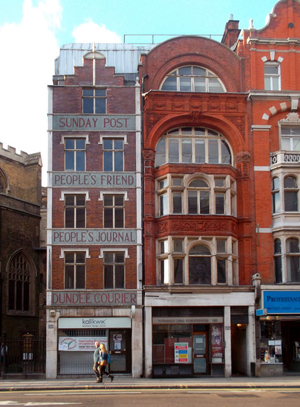
Sweeney Todd was supposed to have terrorised London in the late 18th century and his barber shop was apparently located at 186 Fleet Street in London – right next to St Dunstan-in-the-West. The site is now occupied by a former newspaper office – that of the Dundee Courier (pictured above, left).

For Peter Haining’s book on Sweeney Todd, see Sweeney Todd: The Real Story of the Demon Barber of Fleet Street.

PICTURE: 186 Fleet Street, Sweeney Todd’s (Des Blenkinsopp) / CC BY-SA 2.0

What’s in a name?…Gracechurch Street…

This central London thoroughfare runs through the heart of the City of London and has been a main thoroughfare since Roman times.

Gracechurch-StreetStretching from Eastcheap (near the Monument) to Leadenhall Street, the street runs over the site of what was Roman London’s forum and basilica (see our earlier post on the Roman buildings here).

The name, meanwhile, comes from the former medieval church of St Benet Gracechurch which was once located on the corner of Gracechurch and Fenchurch Streets.

The church, which was destroyed in the Great Fire of 1666 but rebuilt by Sir Christopher Wren before finally being demolished in 1876, was named for St Benedict (St Benet is a short form) while Gracechurch – which was used after the Great Fire – was a corruption of Grasschurch, a reference to it being located near a hay market (in fact, the church was also known as St Benet Grass). The street was also known as Gracious Street.

Landmarks along Gracechurch Street including the Leadenhall Market (see our earlier post here) and a 30s-inspired modern building of note which stands at number 20.

PICTURE: Looking down Gracechurch Street toward the Monument.

For more on London’s Wren churches, see John Christopher’s Wren’s City of London Churches.

LondonLife – The Monument from St Paul’s…

Monument1

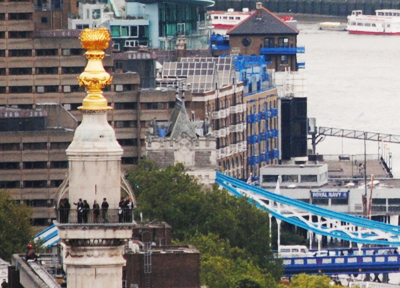
View of the top of the Monument from the top of St Paul’s Cathedral. For more on the history of The Monument, see our earlier post here.

Lost London – St Paul’s Cross…

Paul's-Cross-Memorial

Located in the north-east corner of the churchyard of St Paul’s Cathedral, St Paul’s Cross – also known simply as Paul’s Cross – was a large free-standing cross which served as an open-air pulpit for at least 500 years.

The history of the Cross goes back to at least the 12th century and it long served as a public gathering place for Londoners to hear sermons or matters of public importance. King Henry III met Londoners here in 1259 so they could swear their allegiance, people like 15th century chaplain Richard Walker appeared here to plead guilty for crimes against the church (in his case to charges of sorcery) and it was here that William Tyndale’s testaments were burnt in the 16th century.

Pauls-Cross2Conversely, it was also from here that the English Reformation was preached (there’s a painting in the Houses of Parliament of King Edward VI listening to a sermon preached from the Cross by reformist Bishop Latimer). It has been said that if all the sermons preached here had been collected, they would effectively make a history of the Church of England.

While it was a simpler structure in its earlier years, in the late 15th century, the then Bishop of London, Thomas Kempe, ordered the construction of a ‘preaching station’ on the site. It was an elevated small wooden structure with a lead roof topped by a cross under which a preacher and a couple of others could stand.

The cross and pulpit were destroyed during the English Civil War in 1643.

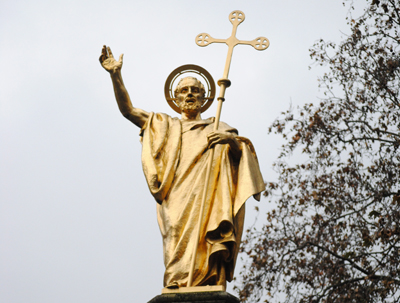
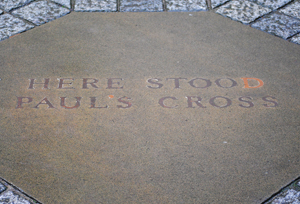
These days there’s a plaque marking the original site of the cross (above). In 1910, the St Paul’s Cross Memorial – a column topped with a gilt statue of St Paul designed by Sir Reginald Blomfield (pictured top), was installed nearby (as ordered by the will of HC Richards, according to a plaque on the site) and remains there today.

The Virtual Pauls Cross website, led by Professor John N Wall of North Carolina State University in the US, reconstructs what the site would have looked like when John Donne gave his Gunpowder Day sermon on 5th November, 1622.

Around London – The Bard is back; Foundling Museum displays; and, exhibitions on iconoclasm and explicit Japanese art…

The Bard is back in Leicester Square with the announcement last week that restoration work on the square’s 19th century Grade II listed statue of William Shakespeare – the only full-length statue the playwright in central London – has been completed. The 11 month restoration was carried out as part of £17 million revamp of the square which has seen the installation of a new fountain. The statue, which was the work of James Knowles, has been in the square since it was completed in its current configuration in 1874. Meanwhile, in other sculpture-related news, Sorry, Sorry Sarajevo – a life-size statue of a man holding  a dead or badly injured man in his arms has been placed in St Paul’s Cathedral where it will remain for the rest of the year. The work by Nicola Hicks dates from 1993 – when the Bosnian war was at its height – and has been placed opposite Henry Moore’s 1983 sculpture, Mother and Child: Hood as part of the cathedral’s approach to next year’s World War I centenary.

Two new displays opened at the Foundling Museum in Bloomsbury last month. Hogarth and Copyright, which runs until 5th January, looks at the role the artist William Hogarth played in the passing of the 1735 Engravers’ Copyright Act (also known as Hogarth’s Act – it was the first law to protect artist’s rights over their work) while Handel and Lucretia, presented in conjunction with The Sir Denis Mahon Charitable Trust and running until 26th January, shows Guercino’s painting Lucretia alongside two early manuscripts of Handel’s cantata La Lucretia. Entry is part of admission price. For more, see www.foundlingmuseum.org.uk.

A new exhibition tracing the history of attacks on artworks in Britain from the 16th century to today opened at Tate Britain in Millbank this week. Art under Attack: Histories of British Iconoclasm looks at why and how monuments have been damaged over the past 500 years. The display includes the remarkable pre-Reformation sculpture, the Statue of the Dead Christ (about 1500-1520), which was discovered in 1954 beneath the chapel floor at the Mercer’s Hall. Already damaged – most likely at the hands of Protestant iconoclasts – it may have been buried there to protect it. Also displayed are fragments of monuments destroyed in Ireland last century, paintings including Edward Burne-Jones’ 1898 painting Sibylla Delphica which was attacked by suffragettes in 1913-14, and Allen Jones’ 1969 work Chair – damaged in a feminist attack in 1986. Runs until 5th January. Admission charge applies. For more, see www.tate.org.uk.

A controversial exhibition of sexually explicit Japanese works of art created between 1600-1900 opened at the British Museum this week. Shunga: sex and pleasure in Japanese Art – which carries a warning of “parental guidance for visitors under 16 years – features 170 works including paintings, prints and illustrated books. Drawn from collections in the UK, Japan, Europe and the US, the exhibition of explores the phenomena of what are known as shunga (‘spring pictures’), looking at why it was produced and to whom it was circulated. Admission charge applies. Runs until 5th January. For more, see www.britishmuseum.org.

Lost London – St Dunstan in the East…

St-Dunstan-in-the-East

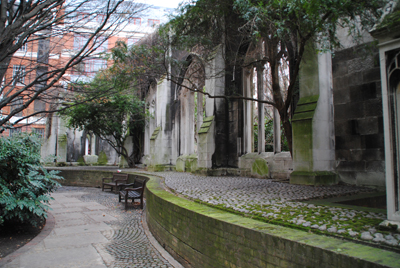
The ruins of this medieval church can still be found in the eastern end of the City of London and now play host to a rather delightful little park.

Originally built around 1,100 in the Gothic style, the church – which stands between St Dunstan’s Hill and Idol Lane (off Great Tower Street) was enlarged and repaired in ensuing centuries before suffering severe damage in the Great Fire of London in 1666. Not enough to destroy the church, however, and it was repaired in the late 1660s with a new steeple and tower designed by Sir Christopher Wren to fit with the existing structure, was added in the late 1690s. Inside were carvings by Grinling Gibbons.

St-Dunstan-in-the-East-smallBut by the early 19th century, however, the weight of the roof had pushed the walls dramatically out of line and, after an unsuccessful attempt to repair the church, it was decided to demolish it (with the exception of Wren’s tower) and rebuild.

Built in the Perpendicular style to the designs of David Laing, the new church reopened in 1821.

The church lasted for more than 100 years before it was again severely damaged, this time during the Blitz of 1941. Wren’s spire and tower thankfully remained but other than that it was a shell with only the north and south walls remaining.

The Anglican Church decided not to rebuild – the parish was incorporated into that of All Hallows by the Tower – and the City of London Corporation opted to turn the (now) Grade I-Iisted remains into a public park. It was opened in 1971 by the then Lord Mayor of London, Sir Peter Studd.

It remains there today, with beautiful climbing foliage – including many exotic plants – and a fountain in the nave. The tower, meanwhile, is used by a complementary medical centre.

A great place to pass a lunch hour!

What’s in a name?…St Mary Axe

There’s several stories behind the rather odd name given to this narrow street which runs between Houndsditch and Leadenhall Street in the City of London – now famous for the gherkin-shaped skyscraper located within it.

St-Mary-AxeIt’s generally agreed that street’s name comes – at least partly – from a former church which it has been suggested once stood where the building known as Fitzwilliam House now stands.

Known as the Church of St Mary Axe (although its full name was apparently the somewhat longer Church of St Mary, St Ursula and her 11,000 Virgins), the medieval building was apparently demolished in the 1560s and the parish united with that of St Andrew Undershaft (this church still sits on the corner of St Mary Axe and Leadenhall Street).

The reasons for the church to be so named remain a matter of speculation. The most interesting version (and the one that would explain the church’s longer name) has it that the name was given due to an axe that was once on display in the church.

The axe had apparently come from Europe where legend says it was one of three axes used by the Huns (some say the three included Atilla himself) to slaughter 11,000 handmaidens who had been travelling in Europe with St Ursula. St Ursula herself was fatally shot with arrows by the Huns’ leader.

How and why the axe came to be on display in this particular church remains something of a mystery but so well did the church become identified with the gruesome relic that it became known as the church of St Mary Axe.

Another version we’ve come across states that the church took on the name because its patrons were the the Skinners’ Company who used such axes. Yet another suggests that the street was named after the church of St Mary and that of a nearby tavern which operated under a sign bearing the image of an axe (but it’s possible the tavern had such a sign because of its proximity to the church in the first place).

These days, as well as being the location of St Andrew Undershaft (now part of the parish of St Helen’s Bishopsgate) and the building known as the Gherkin (it’s official name is 30 St Mary Axe), St Mary Axe is also the place where, on 10th April, 1992, an IRA bomb exploded outside the Baltic Exchange, killing three people.

PICTURE: The Gherkin with St Andrew Undershaft in the foreground.

London Pub Signs – Ye Olde Watling…

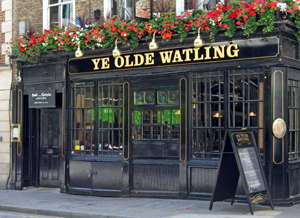
Ye-Olde-WatlingThis pub, located in the City, takes its name from the street upon which it stands – Watling Street.

The street, which is just 180 metres long, bears the same name as a great Roman road which ran all the way from Dover through London to the long gone Roman town of Viroconium (now known as Wroxeter in Shropshire).

The Roman road followed, to some extent, the route of an ancient Celtic pathway. But while the Celtic pathway crossed the Thames at Westminster, the Roman road, once the bridge was constructed, crossed at London Bridge and headed through London, apparently taking in this surviving piece.

The building itself – located on the intersection with Bow Lane – is said to have been constructed from old ship’s timbers by none other than Sir Christopher Wren in 1668. The upstairs rooms were said to have been used as a drawing office during the construction of Wren’s masterpiece, St Paul’s Cathedral. It may have also been used as  pub by the workmen building the cathedral – in fact it’s said to have been the first pub built after the Great Fire of 1666.

The pub is part of the Nicholson group. For more on it, check out www.nicholsonspubs.co.uk/yeoldewatlingwatlingstreetlondon.

PICTURE: Duncan Harris/Wikipedia

Lost London – Enon Chapel…

Built in what was then Clement’s Lane, just off the Strand, in the early 1820s, Enon Chapel became something of a byword for scandal thanks to its rather stuffed crypt.

The Baptist chapel had two functions: the upper floor served as a chapel for worship while beneath it – separated only by a timber floor –  lay a crypt where, for a small sum – said to be the very affordable amount of 15 shillings – people could bury their loved ones. (The smell can’t have been very pleasant from the get-go – apparently an open sewer ran under the chapel).

Despite the apparent smell and the fact people in the chapel fainted and even became sick from the mouldering bodies beneath their feet, it wasn’t until 1844 that, during the works to cover the sewer beneath the chapel, it was discovered the minister – who had since died – had interred an estimated 12,000 people plus people in the crypt, some of whom were buried under a shallow layer of earth while others were simply stacked in their coffins (or remains thereof).

The works were put on hold following the discovery but the remains weren’t removed until 1847 when they were taken out to West Norwood Cemetery, in the city’s south. In the meantime, the building was used as a dancing saloon, albeit with a new brick floor separating it from the crypt (the fact of the bodies beneath the floor certainly wasn’t hidden – the saloon even advertised the dancing events as “dancing on the dead”). In fact, it also became something of a tourist attraction with thousands of people visiting the site to view the remains before they were carted off.

While the scandal may not have resulted in instant action at Enon Chapel, it did help bring attention to the deplorable state of many of the City’s burial grounds which eventually resulted in the passing of the Burial Act of 1852 under which London’s burial grounds were closed and cemeteries built out in the countryside.

The building has long since gone.

Where’s London’s oldest…drinking fountain?

A rather humble looking fountain set into the railing outside the Church of St Sepulchre-without-Newgate at the corner of Giltspur Street and Holborn Viaduct, it’s easy to overlook this important part of London’s historic fabric.

FountainBut this free water fountain is London’s oldest and was installed here on 21st April, 1859, by the then Metropolitan Drinking Fountain Association. Established by Samuel Gurney – an MP and the nephew of social reformer Elizabeth Fry, the organisation aimed to provide people with free drinking water in a bid to encourage them to choose water over alcohol.

Within two years of the fountain’s creation, the organisation – which later changed its name to Metropolitan Drinking Fountain and Cattle Trough Association in reflection of its expanded role in also helping animals – had placed as many as 85 fountains across London.

Such was the need for a clean water supply that, according to the Drinking Fountain Association, as many as 7,000 people a day used the fountain when it was first installed.

The fountain on Holborn Hill was removed in 1867 when the nearby street Snow Hill was widened during the creation of the Holborn Viaduct and the rails replaced but it was returned there in 1913. Rather a poignant reminder of the days when water wasn’t the publicly available resource it is today, the marble fountain still features two small metal cups attached to chains for the ease of drinking and carries the warning, “Replace the Cup!”.

PICTURE: Wikipedia/JustinC

Around London – The ‘Line of Kings’ has a makeover; London captured from St Paul’s; and, cycles at the Museum of London…

Line-of-Kings

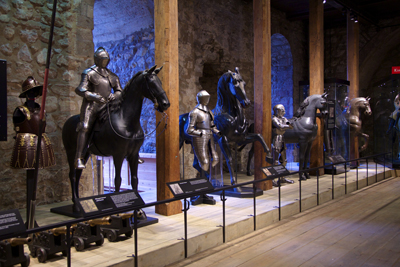
The Tower of London’s iconic exhibition, the Line of Kings, has had a makeover. Described as the “world’s longest running visitor attraction”, the Line of Kings features more than 500 objects including historic suits of armour – such as those worn by King Henry VIII, King Charles I and King James II – as well as life-sized wooden horses and individually carved king’s heads, many of which were made between 1685 and 1690. The exhibition was originally created following the Restoration in 1660 and was used as propaganda to promote the king’s rule (interestingly omitting queens and featuring only those deemed “good kings”). Rearranged and dispersed over the centuries, it’s been brought back together in the White Tower and reopened last month. Entry to the exhibition – a collaboration between Historic Royal Palaces and the Royal Armouries – is free as part of general admission to the Tower. For more, check out www.royalarmouries.org/line-of-kings. PICTURE: HRP/Newsteam

Four cameras mounted on top of St Paul’s Cathedral’s Golden Gallery have captured a 360 degree time lapse video of the capital. The video, which was shot in early July, captured 36 hours in the life of London and is the work of specialist photographer Henry Stuart who previously completed two projects from the Golden Gallery – a GigaPixel image of London and a Day Meets Night image. The latest project captured some 8,000 panoramic images. The time lapse video, which is set to Kyrie from Wolfgang Amadeus Mozart’s Missa in C major ‘Missa solemnis’ K337 being sung by the St Paul’s Cathedral Choir, can be found at http://visualise.com/videos/london-360-time-lapse-from-st-pauls-cathedral.

• On Now: London Cycles. This free exhibition at the Museum of London looks at cycling in the capital with highlights including 10 large scale portraits by Ugo Gattoni, bikes including an 1880s “boneshaker”, a penny farthing, an 1930s Enfield cycle and a ‘Boris’ bike as well as head cam footage from riders including from the annual Tweed Run bike. The free display runs until 22nd September. For more, see www.museumoflondon.org.uk.

10 (more) curious London memorials…4. ‘People of London’ Memorial…

People-of-London

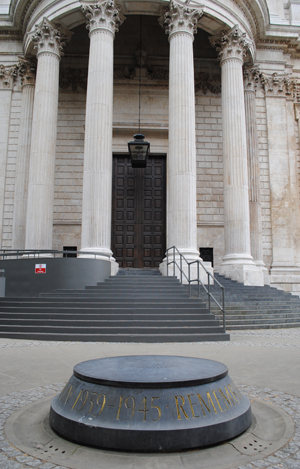
Amid all the grand war-related memorials of London, this rather humble memorial sitting outside the north transept of St Paul’s Cathedral in St Paul’s Churchyard can easily be overlooked. 

Known as the Memorial to the Londoners killed in World War II Bombardments or simply as the ‘People of London’ memorial as it’s called on the sculptor’s website, it commemorates the 30,000 Londoners who were killed during the Blitz  (not to be confused with the National Firefighters’ Memorial, known informally to many as the Blitz Memorial, which sits opposite the cathedral’s south transept and commemorates firefighters who died during the Blitz).

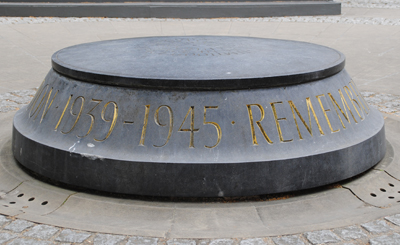
People-of-London---smallThe round memorial was carved from a three tonne block of Irish limestone and is set into paving (it was initially very shiny).

The gilded inscription which runs around the outside reads “Remember before God the people of London 1939-1945” while on top, written in a spiral, is an inscription written by Sir Edward Marsh – “In war resolution, in defeat defiance, in victory magnanimity, in peace goodwill”, the text of which was used by Sir Winston Churchill in the frontispiece to his history, The Second World War.

Unveiled by the Queen Mother on 11th May, 1999, the memorial is the work of Richard Kindersley, whose other memorials include the Commonwealth Memorial on Constitution Hill.

Kindersley writes on his website, that the “position of the memorial adjacent to St Paul’s is most appropriate, as most people will remember the dramatic photograph of the Cathedral dome of the taken during a devastating attack in 1941.”

It was paid for by public funds raised following an appeal in the Evening Standard newspaper, launched in connection with the 50th anniversary of VE Day.

10 Historic London Garden Squares…10. Charterhouse Square…

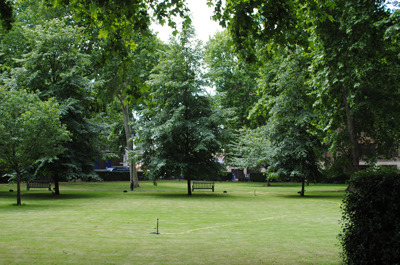
Charterhouse-Square-GardensThe final in our series on historic garden squares in London (for this year, anyway), we’re taking a look at Charterhouse Square.

The five sided square, located just to the east of Smithfield, takes its name from a Carthusian monastery which was established in 1371 on what is now its north side. Prior to this, what is now the square had from 1348 served as a location for a plaque burial pit (a number of skeletons from the plaque pit have been unearthed as part of the Crossrail project – for our earlier story on this, follow this link).

The monastery was dissolved in 1537 after the monk’s refused to recognise King Henry VIII’s Act of Supremacy (some were later executed at Tyburn) and it was subsequently transformed into a manor house with Thomas Howard, the 4th Duke of Norfolk, among its residents over the years (in fact he was imprisoned there around 1570 for allegedly plotting to marry Mary, Queen of Scots – he was later executed by Queen Elizabeth I for treason).

Under the will of Thomas Sutton, an almshouse and school was subsequently established on the site – the almshouse remains there while the school, whose students had included Methodism founder John Wesley and writer William Makepeace Thackeray, moved out to Godalming in Surrey in 1872. As well as the almshouse (which is open for guided tours, check this site for details), some of the buildings are now occupied by medical related institutions.

In the 1600s, the square was also home to numerous other large residences among them Rutland House, which had been the residence of the Venetian ambassador. It lost its aristocratic inhabitants in the ensuing centuries but remained mainly residential up until the late 19th century when it gradually became taken over by businesses and other organisations. Interesting to note is that the east side of the square is still home to the residential unit complex known as Florin Court, better known as Whitehaven Mansions, the home of Hercule Poirot in the TV series which bears his name.

The area of the garden square itself was variously referred to as the Charterhouse Churchyard, the Charterhouse Yard and Charterhouse Close over the years and has gone through numerous incarnations with efforts to improve and formalise its look dating back to at least the 16th century. It was at least partly enclosed by the late 1600s and the fences replaced several times, notably in 1742 when an Act of Parliament was passed allowing residents to fine those who entered without authorisation. The enclosing fences have since been modified several more times.

One of the major changes to the shape of the square occurred in 1860 when the Metropolitan Railway was extended between Farringdon and Moorgate. It was at this time that the road surface which surrounds the central garden, which has a Grade II heritage listing, was laid down.

Today the gardens in the centre of the square remain under the management of the Charterhouse (and hence aren’t open to the general public except on tours) but even without a tour it’s still a quiet place to walk around the outside of, evoking a strong sense of years gone past.

Around London – The City of London Festival; last chance to see the Temperate House; and, Vermeer and music at the National Gallery…

City-of-London-FestivalThe City of London Festival kicked off last Sunday and runs for the next month in what is being billed as an “extravaganza of music, dance, art, film, poetry, family and participation events” in the Square Mile. Among the highlights of this year’s festival – the 51st – is a series of musical performances at St Paul’s Cathedral and a range of other locations including livery halls, churches and Mansion House – home of the Lord Mayor of London – as well as walks and talks including a two-day conference this Friday and Saturday, Worlds in Collision, which will explore questions surrounding the healing power of music in the treatment of post-traumatic stress disorders resulting from conflict. There’s also a range of free events such as a family day on Hampstead Heath celebrating Northern Irish culture and heritage and artistic installations such as that by artist Konstantin Dimopoulos which this week saw the trees of Festival Gardens near St Paul’s turn bright blue. Trees around Devonshire Square are also expected to be ‘coloured’ and both sites will form part of a ‘Tree Trail’ in the square mile which is aimed at revealing the ‘secret stories’ of some of the city’s trees and the locations they inhabit. The festival, which runs until 26th July, will be reflecting on a number of significant historical landmark anniversaries taking place this year, including the 400-year relationship between the City of London and the Northern Irish community of Derry-Londonderry, the 300th anniversary of the Treaty of Utrecht and the 100th anniversary of the birth of composer Benjamin Britten. For more information and a full programme of events, see www.colf.org. PICTURE: London Symphony Orchestra at St Paul’s Cathedral, © City of London Festival/Robert Piwko

The next month represents the last chance to visit Kew Gardens’ historic Temperate House – the world’s largest surviving Victorian glasshouse – for five years. The Grade I-listed building is about to undergo a five year restoration project, funded by a £14.7 million grant from the Heritage Lottery Fund. It is home to Kew’s rarest plant, the South African cycad Encephalartos woodii while other rarities include the St Helena ebony (Trochetiopsis ebenus). The Temperate House will close on 4th August and won’t reopen until May 2018. For more, see www.kew.org.

On Now: Vermeer and Music: The Art of Love and Leisure. Opened yesterday, this landmark exhibition at the National Gallery explores the motif of music in Dutch painting, in particular in the works of Johannes Vermeer and his contemporaries. Displayed alongside actual examples of 17th century virginals, guitars, lutes and other instruments, visitors will be able to see for themselves how accurate the painters were and discover why they may have taken artistic liberties. At the centre of the exhibition are three works by Vermeer – A Young Woman Standing at a Virginal and A Young Woman seated at a Virginal (both of which form part of the gallery’s collection) and The Guitar Player (on loan from Kenwood House). A fourth Vermeer, The Music Lesson, has been loaned from the Queen. Other artists featured in the exhibition include Gerard ter Borch, Gabriel Metsu, Jan Steen, Pieter de Hooch and Godfried Schalcken. Live musicians from the Academy of Ancient Music will be playing at the gallery three days each week. Runs until 8th September. Admission charge applies. For more, see www.nationalgallery.org.uk.

10 Historic London Garden Squares…9. Queen Square…

Queen-Charlotte

This rectangular-shaped square in Bloomsbury, known for its association with the medical profession, was first laid out in the early 1700s and was named for Queen Anne.

Originally known as Devonshire Square, the space was largely laid out between 1716 and 1725 on land owned by Sir Nathaniel Curzon of Kedlestone and, as with so many of London’s squares, attracted it’s fair share of the well-to-do. Among early residents were several bishops and members of the aristocracy.

Queen-SquareOne of the most interesting early associations with Queen Square is that of King George III and his consort Queen Charlotte. The king – better known to many as ‘Mad King George’ – was treated for mental illness in a house on the square and there’s a tradition that Queen Charlotte, stored some of the food to be consumed by the king during his treatment in the base of what is now the pub known as the Queen’s Larder (see our previous entry on the pub here).

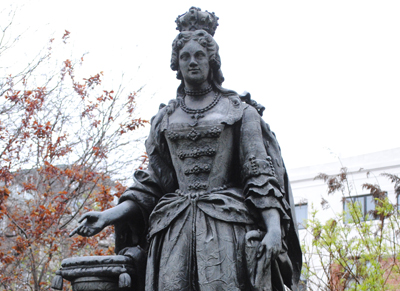
There’s a statue of a queen in the central gardens which was thought to be of Queen Charlotte. Since it was erected in 1775, there has been some confusion over the statue’s identity – it has been thought at different stages to be of Queen Anne, Queen Mary (co-ruler with King William III), and Queen Caroline (consort of King George II) – a fact which has led to some confusion as to which queen the square was named after (although general consensus now seems to be that it was indeed Queen Anne whom the square was named after).

The houses in Queen Square – which was later associated with artists and literary types – were gradually replaced by institutional buildings relating to, among other things, education and the practice of medicine and today it remains a hub for the medical establishment – the National Hospital for Neurology and Neurosurgery and the Royal London Hospital for Integrated Medicine (formerly known as the Royal London Homoeopathic Hospital) are both located on the east side of the square and there are several other medical-related buildings located around it including the former Italian Hospital (Ospedale Italiano) which was founded by Italian businessman Giovanni Battista Ortelli in 1884 for poor Italian immigrants and since about 1990 has been part of the Great Ormond Street Hospital.

SamOther prominent buildings located on the square include the Church of St George the Martyr Holborn (number 44) which, built in 1706, predates the square’s formation. The church is known as the ‘sweep’s church’ due to the practice of a parishioner who provided Christmas dinners for 100 chimney sweep apprentices each year.

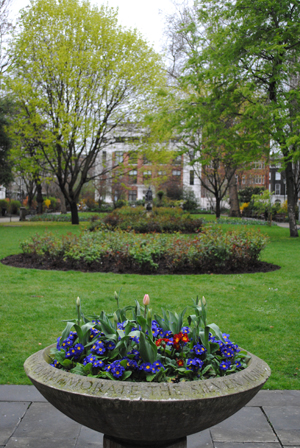
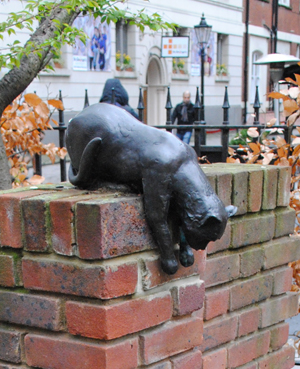
The gardens themselves are protected by an Act of Parliament passed in the 1830s and the gardens are to this day maintained by trustees appointed under that act. Aside from the statue of the queen, monuments in the gardens include a small plaque commemorating the bomb which landed in the square during a Zeppelin raid in World War I (no one was killed), benches commemorating 16 doctors from the homeopathic hospital who died in the Trident air disaster of 1972, and some lines of poetry on a flower bowl and surrounds by Philip Larkin and Ted Hughes in honor of the Queen’s Silver Jubilee of 1977. Statues include a 2001 bronze of Mother and Child and, (this one we love), a sculpture of Sam the cat, apparently a local resident (pictured)!