This Week in London – Dunkirk Little Ships at Royal Docks a highlight of ‘Museums at Night’; the Magna Carta in stitches; and Peter Kennard’s works on show…

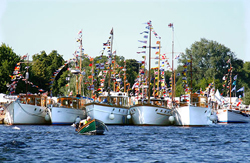
Dunkirk-Little-Ships-More than 20 Dunkirk Little Ships will gather at London’s Royal Docks this weekend ahead of their Return to Dunkirk journey marking the 75th anniversary of the Dunkirk evacuations. The event, which is part of the UK’s annual festival of late openings Museums at Night, will see the ships parade around Royal Victoria Dock on Saturday night with the Silver Queen offering twilight trips and the chance to step on board some of the other ships (the Little Ships will continue with their own festival on Sunday commencing with a church service by the quayside at 11am). Other events being offered in London as part of Museums at Night include ‘Dickens After Dark’ in which the Charles Dickens Museum will open its doors to visitors for night of Victorian entertainment on Friday night and a night of music featuring the Royal College of Music at Fulham Palace (also on Friday night). Among the other London properties taking part are the Handel House Museum, Benjamin Franklin House, the Wellcome Collection, Museum of the Order of St John, and the National Archives in Kew. For a full list of events, check out http://museumsatnight.org.uk

Meanwhile, Dulwich Picture Gallery in south London is holding its first weekend culture festival, MayFest: Men of Mystery, as part of Museums at Night. On Friday and Saturday nights, there will be tours of the gallery’s new exhibition featuring the work of artist Eric Ravilious followed by outdoor cinema screenings of Alfred Hitchcock’s Rear Window and The 39 Steps as well as free swing dance lessons, street foods and a pop-up vintage shop which will help people get the vintage look. Visitors are being encouraged to dress up in styles of the 1930s and 1940s with a prizes awarded to those with the “best vintage style”. The gallery will also be inviting visitors to take part in a mass installation drop-in workshop held in the gallery’s grounds over the weekend and Saturday morning will see special events for children. For more, see www.dulwichpicturegallery.org.uk/whats-on/.

A major new work by acclaimed artist Cornelia Parker goes on display in the entrance hall of the British Library in King’s Cross tomorrow to mark the 800th anniversary of the Magna Carta. The almost 13 metre long Magna Carta (An Embroidery) replicates the entire Wikipedia entry on the Magna Carta as it was on the 799th anniversary of the document and was created by many people ranging from prisoners and lawyers to artists and barons. It accompanies the library’s exhibition Magna Carta: Law, Liberty, Legacy. Entry to see the artwork is free. For more, see www.bl.uk/cornelia-parker.

The works of Peter Kennard, described as “Britain’s most important political artist”, are on display in a new exhibition which opens at the Imperial War Museum in London today. Peter Kennard: Unofficial War Artist is the first major retrospective exhibition of his work and features more than 200 artworks and other items drawn from his 50 year career including an art installation, Boardroom, created especially for the display. Works on show include his iconic transposition of Constable’s painting Haywain which he showed carrying cruise missiles about to be deployed in Greenham Common, the Decoration paintings created in 2004 in response to the Iraq War of 2003, his seminal STOP paintings which reference events of the late 1960s such as the ‘Prague Spring’ and anti-Vietnam war protests and his 1997 installation Reading Room. The free exhibition runs at the Lambeth institution until 30th May next year. For more, see www.iwm.org.uk/london.

Send all items for inclusion to exploringlondon@gmail.com.
A Moment in London’s History – Londoners granted the right to elect their mayor…

It was on 9th May, 2015, 800 years ago this year that, in the lead-up to the creation of the Magna Carta in June, King John issued a charter granting the City of London the right to freely elect its own mayor.

The charter, which was issued at the Temple – King John’s power base to the west of the City (for more on it, see our earlier post here), was a fairly blatant bid to keep the support of the city.

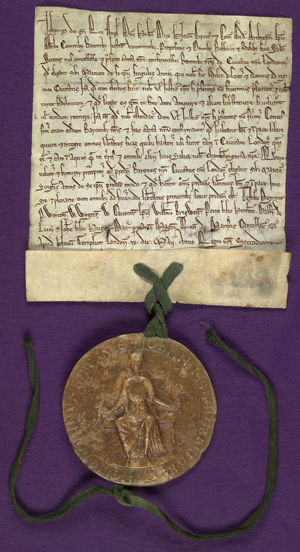
King-John-CharterKnown simply as the King John Charter, it stated that the barons of the city, “may choose to themselves every year a mayor, who to us may be faithful, discreet, and fit for government of the city, so as, when he shall be chosen, to be presented unto us, or our justice if we shall not be present”.

In return, the mayor was required to be presented to the monarch to take an oath of loyalty each year – a practice commemorated in the Lord Mayor’s Show each November.

The charter, which has a particularly good impression of the king’s seal, is currently on display in the City of London’s newly opened Heritage Gallery, located at the Guildhall Art Gallery.

The event was one of a series leading up to the signing of the Magna Carta in June. Only 10 days after King John issued the charter to the City of London, rebel barons, who have previously taken Bedford, marched on the city to demand their rights and arrived their before the Earl of Salisbury (whom John had ordered to occupy the city).

Aldgate was apparently opened to them by some supporters within the city and the forces of the rebel barons went on to attack the home of royalists as well as those of Jews along with a Jewish burial ground in Barbican – the latter because Jewish moneylenders had lent money to the king.

They later besieged the Tower of London and while they couldn’t take the fortress, their seizure of the city was enough to help force the king to open negotiations late in the month, asking the Archbishop of Canterbury, Stephen Langdon, on 27th May  to arrange truce (which, while it was apparently not observed terribly well, did help pave the path to the Magna Carta).

The exhibition at the Heritage Gallery runs until 4th June. For more information, see www.cityoflondon.gov.uk/things-to-do/visiting-the-city/attractions-museums-and-galleries/guildhall-art-gallery-and-roman-amphitheatre/Pages/Heritage-Gallery.aspx.

PICTURE: City of London: London Metropolitan Archives

This Week in London – Marking VE Day’s 70th; Rut Blees Luxemburg at the Museum of London; and India’s Sidi community on show at the NPG…

Three days of events kick off in London tomorrow to mark the 70th anniversary of Victory in Europe (VE) Day. Events will include a Service of Remembrance at the Cenotaph in Whitehall at 3pm tomorrow (Friday) coinciding with two minutes national silence while Trafalgar Square – scene of VE Day celebrations in 1945 – will host a photographic exhibition of images taken on the day 70 years ago (the same images will be on show at City Hall from tomorrow until 5th June) and, at 9.32pm, a beacon will be lit at the Tower of London as part of a nation wide beacon-lighting event. On Saturday at 11am, bells will ring out across the city to mark the celebration and at night, a star-studded 1940s-themed concert will be held on Horse Guards Parade (broadcast on BBC One). Meanwhile, on Sunday, following a service in Westminster Abbey, a parade of current and veteran military personnel will head around Parliament Square and down Whitehall, past the balcony of HM Treasury where former PM Sir Winston Churchill made his historic appearance before crowds on the day, to Horse Guards. A flypast of current and historic RAF aircraft will coincide with the parade and from 1pm the Band of the Grenadier Guards will be playing music from the 1940s in Trafalgar Square. Meanwhile, starting tomorrow, special V-shaped lights will be used to illuminate Trafalgar Square, St Paul’s Cathedral and the Houses of Parliament as a tribute. For more information, see www.gov.uk/government/topical-events/ve-day-70th-anniversary.

The works of leading London-based photographer Rut Blees Luxemburg are on show in at new exhibition at the Museum of London in the City. London Dust will feature three major newly acquired works by Luxemburg including Aplomb – St Paul’s, 2013, Walkie-Talkie Melted My Golden Calf, 2013, and the film London/Winterreise, 2013. Blees Luxemburg’s images – others of which are also featured in the exhibition – contrast idealised architectural computer-generated visions of London that clad hoardings at City-building sites with the gritty, unpolished reality surrounding these. In particular they focus on a proposed 64 floor skyscraper, The Pinnacle, which rose only seven stories before lack of funding brought the work to a halt. The free exhibition runs until 10th January next year. For more, see www.museumoflondon.org.uk.

The Talk: The Cutting Edge – Weapons at the Battle of Waterloo. Paul Wilcox, director of the Arms and Armour Research Institute at the University of Huddersfield, will talk about about the weapons used at Waterloo with a chance to get ‘hands-on’ with some period weapons as part of a series of events at Aspley House, the former home of the Iron Duke at Hyde Park Corner, to mark the bicentenary of the Battle of Waterloo. To be held on Monday, 11th May, from 2.30pm to 4pm. Admission charge applies and booking is essential – see www.english-heritage.org.uk/apsley for more.

On Now: On Belonging: Photographs of Indians of African Descent. A selection of ground-breaking photographs depicting the Sidi community – an African minority living in India – is on show at the National Portrait Gallery off Trafalgar Square. The works, taken between 2005 and 2011, are those of acclaimed contemporary Indian photographer Ketaki Sheth and the exhibition is his first solo display in the UK. They provide an insight into the lives of the Sidi, and include images of a young woman named Munira awaiting her arranged wedding, young boys playing street games, and the exorcism of spirits from a woman as a young girl watches. Admission is free. Runs in Room 33 until 31st August. For more, see www.npg.org.uk.

Send all items for inclusion to exploringlondon@gmail.com.
LondonLife – Royal gun salute in Hyde Park marks birth of Princess Charlotte Elizabeth Diana…

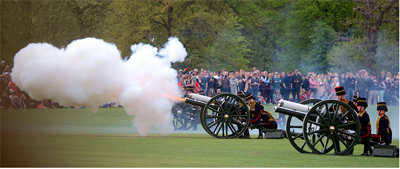
Gun-salute

Guns fired a royal salute in Hyde Park on Monday to mark the birth of the Duke and Duchess of Cambridge’s new daughter (and Prince George’s new sister), named Princess Charlotte Elizabeth Diana (or more formally, Her Royal Highness Princess Charlotte of Cambridge). Seventy-one horses pulling six World War I-era 13-pounder field guns from the King’s Troop Royal Horse Artillery rode out in procession with the Royal Artillery Band from Wellington Barracks, past Buckingham Palace, up Constitution Hill to Wellington Arch, and into Hyde Park to fire the salute. The 41 gun salute was fired at the same time as a 62 gun salute at the Tower of London. By custom, gun salutes are fired for the birth of every prince or princess, regardless of where they sit in the order of succession. A basic salute is 21 rounds with an additional 20 rounds fired because Hyde Park is a Royal Park while at the Tower of London an extra 20 rounds are fired because it is a royal palace along with a further 21 because of its City of London location. The princess, fourth in line to the throne, was born at 8:34am on Saturday at St Mary’s Hospital in Paddington, and weighed 8lbs, 3oz (3.7kg). PICTURE: © Courtesy of Ian Wylie Photo.

This Week in London – Duke of Wellington on show; wartime City bank recreated in Warwickshire; and early photographs at the Tate…

ArthurWellesleyThe Duke of Wellington’s political and military career as well as his personal life is being explored in an exhibition running at the National Portrait Gallery off Trafalgar Square until August. Wellington: Triumphs, Politics and Passions features 59 portraits and other works including a rarely seen portrait of the Iron Duke painted by Sir Thomas Lawrence and commissioned by Sarah, Countess of Jersey, a year after Wellington had become Prime Minister. The portrait (pictured) remains unfinished – the state it was in when Lawrence died in 1830 – and, held in a private collection, hasn’t been shown in public for any significant period until now. The exhibition also includes a John Hoppner portrait of the duke as a young soldier, a daguerreotype taken by Antoine Claudet on Wellington’s 75th birthday in 1844 and drawings by Lawrence of Wellington’s wife, Kitty. The exhibition – which is part of the commemorations marking 200 years since the Battle of Waterloo, runs until 7th June. Admission is free. For more see www.npg.org.uk. PICTURE: Arthur Wellesley, 1st Duke of Wellington by Sir Thomas Lawrence (1829), © On loan to National Portrait Gallery by kind permission of Mr. & Mrs. Timothy Clode.

Upton House is Warwickshire has turned the clock back to 1939 with a display dedicated to the time when the Bearstead family moved their City-based bank, M Samuel & Co, to their historic family mansion to escape the Blitz in London. Twenty-two bank staff took over the house, sleeping in shared dormitories and taking meals of rook pie in the home’s Long Gallery while secretaries typed surrounded by works of art. The National Trust has returned 12 rooms to their wartime look based on research conducted by 80 of the volunteers at the house. They’re filled with thousands of objects, from ration-book toothpaste to wartime toilet rolls, to recreate a wartime experience at the home. Outside an Anderson Shelter stands in the garden where heritage vegetables are being grown in an allotment. Visitors will also find out how 40 of the most precious works in the home were sent to a special storage facility in a Welsh slate mine to protect them. Admission charge applies. For more, see www.nationaltrust.org.uk/upton-house/

On Now – Salt and Silver: Early Photography 1840-1860. This exhibition at Tate Britain in Millbank is the first major exhibition in Britain dedicated to salt prints, the earliest form of paper photography, and features 90 images including some of the best and rarest early photographs. The salt print technique was invented in Britain in the 1840s and 1850s and spread across the world, hence as well as portraits, still lifes and scenes from ‘modern life’, the images on show include from William Fox Talbot’s images of a Paris street to Nelson’s Column under construction, Linnaeus Tripe’s views of Puthu Mundapam in India and Auguste Salzmann’s studies of statues in Greece. Runs in the Linbury Galleries until 7th June. Admission charge applies. For more, see www.tate.org.uk.

Send all items for inclusion to exploringlondon@gmail.com.

10 sites from London at the time of the Magna Carta – 2. St Bartholomew the Great…

St Bartholomew the Great in Smithfield – the oldest parish church in London (see our earlier piece here) – is worth a revisit thanks to the fact that it would have been standing (at least partially) when the seal of King John was first affixed to the Magna Carta .

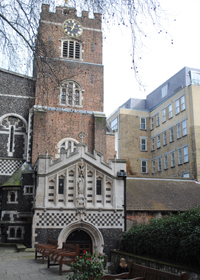
St-BartholomewsOnly half the size it once was, this church was founded in 1123 AD as the priory church for a community of Augustinian Canons and owes its origins to Rahere, a favored courtier of King Henry I who renounced his way of life and made a pilgrimage to Rome, returning to found both the church and nearby hospital for the poor.

Only the eastern part of the church was built by the time of the death of Rahere – the first prior – in 1145 and the building continued for some years afterward. While the interior walls now look somewhat plain, they would have been highly decorated when the building was originally constructed. At the time of the Magna Carta, the church would have only been partly completed.

The tomb of Rahere still lies within the church, on the left hand side of the altar – although the canopy over it dates from the 15th century. There were some healing miracles recorded at the tomb.

The church’s current configuration came about when the priory was dissolved in 1539 and the nave of the church was pulled down, leaving what’s there now – the quire, altar and lady chapel.

The brick tower at the church’s west end dates from the 1620s while the gateway through which you enter the church grounds features a restored 13th century arch topped by a late Tudor building.

The church was briefly used by some Dominican friars but since the reign of Queen Elizabeth I has fulfilled the role of parish church. A concerted restoration effort began in the mid-19th century by Sir Aston Webb (architect of the Victoria & Albert Museum), leaving the Lady Chapel with a very different feel to the Norman choir. The building is now Grade I-listed.

WHERE: Off Little Britain, West Smithfield (nearest tube station is Barbican); WHEN: 8.30am to 5pm Monday to Friday, 10.30am to 4pm Saturday, 8.30am to 8pm Sunday (except for services) ; COST: £4 an adult/£3.50 concession/£10 a family; WEBSITE: www.greatstbarts.com

What’s in a name?…Downing Street…

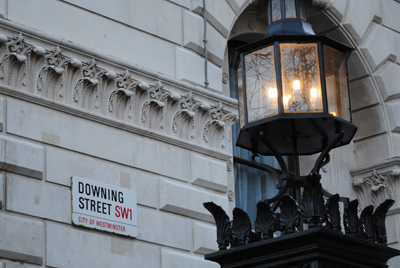
Downing-Street

One of the most famous streets (and photographed) in London (though sadly not open to the public), Downing Street in Whitehall is these days most well-known for being the location, at Number 10, of the official residence of the British Prime Minister.

But Downing Street’s history dates back to a time before the first British PM moved in (this was Sir Robert Walpole in the 1735 and even after that, it didn’t become a regular thing for Prime Ministers to live here until the Twentieth century). And its name bears testimony to its creator, Sir George Downing, a soldier and diplomat described as “a miserly and at times brutal” man who served first under both Oliver Cromwell and, following the Restoration, King Charles II (and was, coincidentally, one of the first graduates of Harvard University).

In the 1650s, Sir George took over the Crown’s interest in land here, just east of St James’s Park, and intended to build a row of townhouses upon it. His ambitions were delayed, however, due to an existing lease with the descendants of Elizabethan courtier Sir Thomas Knyvet who had once lived in a large home on the site of what is now Number 10 Downing Street.

By the 1680s, however, the lease had expired and between 1682-84, Downing was able to construct a cul-de-sac, closed at the St James’s Park end, featuring either 15 or 20 two storey terraced townhouses with stables and coach-houses, designed by no less than Sir Christopher Wren.

While the homes were apparently of shoddy craftsmanship and stood upon poor foundations (Churchill famously wrote that Number 10 was “shaky and lightly built by the profiteering contractor whose name they bear”), the street apparently attracted some notable residents from the start.

These included the Countess of Yarmouth, who briefly lived at Number 10 in the late 1680s, Lord Lansdowne and the Earl of Grantham, and even, briefly, apparently the diarist James Boswell in the mid 1700s. Downing himself isn’t thought to have ever lived here – he retired to Cambridge a few months after the houses were completed.

The houses between Number 10 and Whitehall – on the north side of the street – were taken over by the government and eventually demolished in the 1820s to allow for the construction of offices for the Privy Council, Board of Trade and Treasury while the houses on the south side remained until they were demolished in the early 1860s to make way for the Foreign, India, Colonial and Home Offices.

The numbers in the street have changed since Downing’s houses were first built. Of the original homes in the street only Number 10 (home of the PM) and Number 11 (home of the Chancellor of the Exchequer) survive.

Access to the street has been restricted since the 1980s with the current black steel gates put in place in 1989.

An underground tunnel apparently runs under the street connecting number 10 with Buckingham Palace and the underground bunker, Q-Whitehall, built in the 1950s in the event of nuclear war.

Treasures of London – Australian War Memorial…

Australian-War-Memorial

Tomorrow is the 25th April – commemorated every year as Anzac Day in Australia in memory of that country’s soldiers who lost their lives. This year marks 100 years since Australian troops first landed at Gallipoli during World War I. 

While attention will be focused on Anzac Cove in modern Turkey and the Australian war memorials on what was the Western Front in western Europe, in London there will be several events including a wreath laying ceremony at The Cenotaph in Whitehall, a commemoration and thanksgiving service in Westminster Abbey and a dawn service held at the Australian War Memorial in Hyde Park Corner.

This last memorial, dedicated to the more than 100,000 Australians who died in both world wars, was unveiled on Armistice Day, 2003, in the presence of Queen Elizabeth II, then-Australian PM John Howard and then British PM Tony Blair.

It records the 23,844 names of town where Australians who served in World War I and II were born.

Superimposed over the top are 47 of the major battles they fought. Principal architect Peter Tonkin said the somewhat curvaceous design of the memorial, made of grey-green granite slabs, “reflects the sweep of Australian landscape, the breadth and generosity of our people, the openness that we believe should characterise our culture”.

For more on the wall – including the ability to search for town names – see www.awmlondon.gov.au.

10 sites from London at the time of the Magna Carta – 1. The Tower…

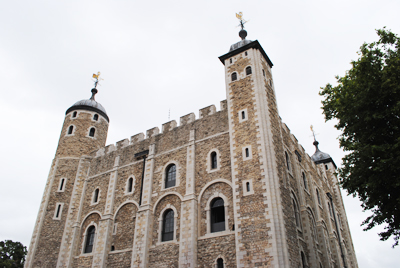
This week we’re starting a new series in honour of the 800th anniversary of the signing of the Magna Carta in which we look back at the London of 1215. First up we take a look at the Tower of London which was a smaller version of the complex of buildings which today exists on the site.

By 1215, the Tower of London – the fortress first constructed on the orders of William the Conqueror – had already existed for more than 100 years, nestled into a corner of the city’s walls which had existed since Roman times.

Then, as now, the White Tower – initially itself known as the Tower of London, it was later dubbed the White Tower thanks to the whitewash used to cover the Kentish limestone to protect it from the weather (and for its visual impact) – stood at the heart of the complex. Unlike today’s building, it lacked the large windows which date from the early 18th century, and while the towers were believed to be capped with cones, the present cupolas date from the reign of King Henry VIII.

White-Tower

While it had long been surrounded by a palisade and ditch, in 1189, King Richard I’s chancellor William Longchamp, the Bishop of Ely, had begun to extend the castle’s defences while the king was on crusade (in fact, the first siege of the Tower took place in 1191 when the then Prince John did so in opposition to Longchamp’s  regime – it only lasted three days before Longchamp surrendered).

This extension, which was completed by King John following his accession to the throne in 1199, saw the size of the bailey around the White Tower doubled and a new curtain wall and towers – including the Bell Tower – built around its outer perimeter with a ditch below (the ruins of the Wardrobe Tower, just to the east of the White Tower show where the original Roman-era wall ran).

But it wasn’t until the reign of King John’s son, King Henry III, that the royal palace which now stands on the river side of the White Tower was constructed. Until that point – and at the time of the signing of the Magna Carta – the royal apartments remained within the White Tower itself, located on the upper floor.

Like those of the garrison commander known as the constable (located on the entrance level), the king’s apartments would have consisted of a hall and a large chamber, which may have been divided into smaller chambers with wooden partitions as well as a chapel (on the upper level this was the still existing Chapel of St John the Evangelist, although it would have then been more more richly decorated). Unlike the lower levels, the king’s level was of double height with a gallery (this level now has its own full floor).

The royal apartments had a variety of uses – as well as a residence and refuge for the king, they were also at times a place to keep high profile prisoners such as the Bishop of Durham, Ranulf Flambard, who was imprisoned on the orders of King Henry I (and who escaped from an upper window on a rope which had been smuggled in to him and fled to Normandy).

It is also worth noting that while King John apparently kept exotic animals at the Tower, it is his son, King Henry III who is usually credited with founding the Royal Menagerie there.

And it was his son, King Edward I, who expanded the Tower to its current size of  about 18 acres by rebuilding the western section of the inner ward and adding the outer ward.

WHERE: Tower of London (nearest Tube station Tower Hill); WHEN: 9am to 5.30pm, Tuesday to Saturday, 10am to 5.30pm Sunday to Monday; COST: £24.50 adults; £11 children under 15; £18.70 concessions; £60.70 for a family (discounts for online purchases/memberships); WEBSITE: www.hrp.org.uk/toweroflondon/.  

This Week in London – Wellington Arch marks the Battle of Waterloo; Shakespeare’s Globe celebrates the Bard’s birth; and the ‘cathedral on the marsh’ open day…

The Battle of Waterloo comes under the microscope in a new exhibition opening at Wellington Arch on Hyde Park Corner tomorrow. Wellington Arch: Waterloo 1815 – The Battle for Peace provides an overview of the battle and the reasons which led to it, the people involved and the battle’s legacy. Displayed items include the sword the Duke of Wellington carried at the battle, his handwritten battle orders and an original pair of ‘Wellington boots’ as well as, of course, the arch itself, which was built in 1825-27 as a monument to Wellington’s victories over Napoleon. Admission charge applies. For more, see www.english-heritage.org.uk/visit/places/wellington-arch/.

Shakespeare’s Globe in Southwark celebrates the Bard’s birthday with a Hamlet-themed day of free family events this Sunday. Along with an Elsinore bouncy castle, there will be sword-fighting demonstrations, ‘skull’ coconut shies and a grave-digging ball pool while actors who have taken on the role of Hamlet over the years while appear on stage attempting to deliver the quickest ever reading of the play and famous film adaptions of Hamlet will be playing on screen around the site. The day will also mark almost a year since Shakespeare’s Globe embarked on an unprecedented two year global tour of Hamlet taking in every country in the world in honour of last year’s 450th anniversary of Shakespeare’s birth. The birthday event at the Globe runs between 11am and 4.30pm. For more, see www.shakespearesglobe.com.

The famous “cathedral on the marsh” – the Crossness Pumping Station –  is open to the public this Sunday, the first of five days it will be open this year. The pumping station at Abbey Wood in south-east London was built by Sir Joseph Bazalgette as part of a general sewerage system upgrade and was opened by the Prince of Wales in 1865. The Grade I-listed Beam Engine House was constructed in the Romanesque-style and features some of the “most spectacular ornamental Victorian cast ironwork” to be found today. The day runs from 10.30am to 4pm. Admission charges apply but no booking is required. For more, see www.crossness.org.uk.

Send all items for inclusion to exploringlondon@gmail.com. 
10 London sites associated with Sir Winston Churchill – 10. Odd Churchill memorials…

We finish our series on Winston Churchill, we take a look at a couple of the more odd memorials to him in London.

St-Mary-Aldermanbury

First up, it’s the remains of the church of St Mary Aldermanbury in the City. Among the scores of churches destroyed in the Great Fire of London, it was rebuilt to the designs of Sir Christopher Wren but was again gutted by fire during the Blitz of 1940, leaving only the walls standing. In 1966, the town of Fulton, Missouri, in the US had the remains of the building transported to their town where they were reconstructed in the grounds of Westminster College. It was there that he had made his famous “Iron Curtain” speech in 1946 and the citizens had the church restored as a  memorial to him (beneath the reconstructed church now lies National Churchill Museum). The scant remains of the church in London (pictured above), meanwhile, is now a green oasis in the midst of the city. There’s a memorial plaque at the site which were added by the US college. (The grounds, incidentally are also home to a monument to John Heminge and Henry Condell, two actors and friends of Shakespeare – you can read more on that in an earlier post here).

Bracken-House-clockThe second odd Churchill memorial we’re looking at is a clock face located on the facade of Bracken House – a building which sits opposite St Paul’s in the City. The astronomical clock, the work of Philip Bentham, features shows the time, date and astronomical symbol as well as a sunburst at its centre – look closely and you’ll see a familiar face at the centre. The building, which dates from the 1950s, is apparently named after Brendan Bracken, onetime chairman of the Financial Times which was published in the building until the 1980s. The Churchill connection comes in thanks to the fact that Bracken was a close personal friend of Churchill and served as his Minister of Information from 1941 to 1945.

And that brings to an end our series on Churchill. Next week we kick off a new Wednesday series.

A Moment in London’s History – Colonel Blood’s attempt to steal the Crown Jewels…

Martin-Tower

London has been making headlines around the world recently thanks, in part, to the estimated £200 million  heist which took place in Hatton Garden last week. So we thought it was a good time to take a look back to one of London’s most famous robberies (or attempts at least)…

The attempt dates back to 1671 when a self-styled colonel, Irish adventurer Thomas Blood, made an attempt to steal the Crown Jewels from the Tower of London.

The Irishman – whose history included fighting on both sides in the English Civil War, first with the Royalists and then with the Parliamentarians when he saw the tide was turning – visited the Tower of London several times in the lead-up to the attempt as he, disguised as a parson, cultivated a relationship with Talbot Edwards, an elderly keeper of the jewels, and his family.

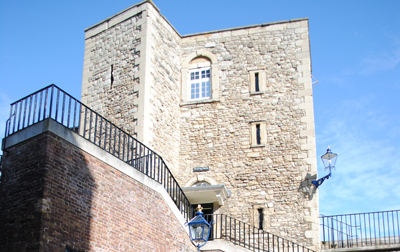
On the night of 9th May, he and a group of accomplices, including his son, attended a dinner put on by the Edwards at the Tower. While waiting for the meal, Blood asked to see the jewels which were housed behind a grille in the basement of the Martin Tower (pictured above) above which the Edwards had an apartment.

Edwards complied and once in the Jewel House, Blood and his accomplices attacked him, knocking him to the floor with a mallet and then stabbing him before binding and gagging him.

They then turned their attention to the jewels – Blood used a mallet to flatten St Edwards Crown so he could hide it beneath his coat while his brother-in-law Hunt filed the Sovereign’s Sceptre with Cross in two to fit it in his bag and a third man, Robert Perot, stuffed the Sovereign’s Orb down his trousers.

Things didn’t go smoothly after that and the alarm was raised before the gang could make their getaway. It has been suggested it was Edwards who raised the alarm – that despite efforts to shut him up he managed to remove his gag and raise the alarm  – but other versions say it was his son, returning from service in Flanders, who raised the alarm on seeing the gang.

In any event, the gang fled, evading efforts of the warders to stop them, before Blood, Hunt and Perot were captured on the Tower of London wharf. The crown, globe and orb were all recovered, albeit damaged.

Blood refused to speak after his capture and was eventually taken before King Charles II for interrogation. But he was evidently so impressed with his captive that he not only pardoned Blood but also rewarded him with land in Ireland.

Blood did later end up briefly in prison after a dispute with the Duke of Buckingham and died soon after his release in August, 1680, but in the intervening years he had become something of a celebrity around London including the Royal Court.

Security around the Crown Jewels, meanwhile, was upgraded somewhat in the wake of the attempt. While others have tried to steal them, none have ever been successful.

WHERE: Tower of London (nearest Tube station is Tower Hill); WHEN: 9am to 5.30pm Tuesday to Saturday, 10am to 5.30pm Saturday and Monday (last admission 5pm); COST: £24.50 an adult/£11 a child (5-15 years)/£18.70 concession/£60.70 a family of four (discount applies to online bookings); WEBSITE: www.hrp.org.uk/TowerOfLondon/.

Treasures of London – The Australian State Coach…

Australian-State-Coach
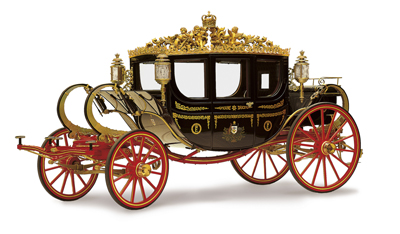
Among the treasures on show at this year’s summer opening of Buckingham Palace, the Australian State Coach was a gift to Queen Elizabeth II by Australia on 8th May, 1988, to mark the Australian Bicentennial.

The coach – the first to be built for the Royal Family since the Coronation of King Edward VII in 1902 – was built by Australian WJ “Jim” Frecklington who also designed the Diamond Jubilee State Coach.

The coach, which is usually kept in the Royal Mews where it can be viewed by the public, has been used at the State Opening of Parliament and other occasions involving foreign royal families and visiting heads of state. It was also used to carry Prince Charles, the Duchess of Cornwall and Michael and Carole Middleton back to Buckingham Palace after the wedding of Prince William and Catherine Middleton.

It was last used to carry the Duke of Edinburgh and Señora Rivera, wife of the president of Mexico, on a State Visit in March this year.

The summer opening of the palace runs from 25th July to 27th September. The coach will be on display in the Grand Entrance portico.

WHERE: Summer Opening of Buckingham Palace (nearest Tube stations are Victoria, Green Park and Hyde Park Corner); WHEN: 25th July to 31st August – 9.30am to 7.30pm daily (last admission 5.15pm)/1st to 27th September – 9.30am to 6.30pm (last admission 4.15pm); COST: £35.60 adults/£20 under 17 and disabled/£32.50 concessions/£91.20 family (2 adults and three under 17s); WEBSITE: www.royalcollection.org.uk/visit/the-state-rooms-buckingham-palace/plan-your-visit.

PICTURE: Royal Collection Trust © Her Majesty Queen Elizabeth II, 2015 

This Week in London – The Boat Race; Designs of the Year; Heckling Hitler; and Victorian-era homelessness…

The 161st Boat Race is on this weekend and will once more see Oxford and Cambridge rowing crews battling it out in their annual contest on the Thames. The day’s schedule of festivities kicks off at noon at Bishop’s Park near the race’s starting point just west of Putney Bridge and at Furnivall Gardens near Hammersmith Bridge but the main highlights don’t take place until late in the afternoon – the Newton Women’s Boat Race at 4.50pm and the main event, the BNY Mellon Boat Race, at 5.50pm. The race runs along the Thames from Putney Bridge through to Chiswick Bridge with plenty of vantage points along the way. The tally currently sits at 78 to Oxford and 81 to Cambridge. For more information, including where to watch, head to http://theboatraces.org/.

• Prospective “Designs of the Year” are on display at the Design Museum in Shad Thames ahead of the announcement of awards in May and June. With the awards – handed out in six categories – now in their eighth year, the 76 designs on display include Google’s self-driving car, the Frank Gehry-designed Foundation Louis Vuitton in Paris and Asif Kahn’s experimental architectural installation Megafaces which debuted at the Sochi Olympics as well as Norwegian banknotes, a billboard that cleans pollutants from the air and a book printed without ink. Runs until 23rd August. Admission charge applies. For more, see www.designmuseum.org/exhibitions/designs-of-the-year-2015.

On Now: Heckling Hitler: World War II in Cartoon and Comic Art. Showing at the Cartoon Museum in Bloomsbury, this exhibition explores how World War II unfolded through the eyes of British cartoonists. It features more than 120 original drawings and printed ephemera and while the focus is largely on those contained newspapers and magazines, the exhibition does include some sample materials from books, aerial leaflets, artwork from The Dandy and The Beano, postcards and overseas propaganda publications as well as some unpublished cartoons drawn in prisoner-of-war camps and by civilians at home (the latter on scrap paper from the Ministry of Food), and even a rare pin cushion featuring Hitler and Mussolini. Among the artists whose works are featured are ‘Fougasse’ (creator of Ministry of Information posters reminding the public that ‘Careless Talk Costs Lives’), William Heath Robinson and Joe Lee. The exhibition runs until 12th July. Admission charge applies. For more, see www.cartoonmuseum.org/exhibitions/current-exhibitions/heckling-hitler.

On Now: Homes of the Homeless: Seeking Shelter in Victorian London. This exhibition at the Geffrye Museum in Shoreditch explores the places inhabited by London’s poor during the 19th and 20th centuries and brings them to life through paintings, photographs and objects as well as the retelling of personal stories and reports. Starting in the 1840s, the exhibition charts the problems faced by London’s poor and examines the dirty and cramped conditions of lodging houses, workhouses and refuges where they took shelter along with, for those even less fortunate, the streets where they slept rough before moving on to some of the housing solutions designed specifically to help the poor. Runs until 12th July. Admission charge applies. Running alongside the exhibition is a free display, Home and Hope – a collaborative exhibition with the New Horizon Youth Centre which explores the experience of young homeless people in London today. For more, see www.geffrye-museum.org.uk/whatson/exhibitions-and-displays/homes-of-the-homeless/.

Send all items for inclusion to exploringlondon@gmail.com

10 London sites associated with Sir Winston Churchill – 9. Memorialising Churchill…

There are numerous memorials to Sir Winston Churchill around London and today we’ll look at a handful of them (while next week we’ll take a look at a couple of the most unusual memorials). We’ve already looked at the most famous statue of him in Parliament Square (in an earlier post here), but here’s some more…

Allies1 AlliesMayfair. These almost life-size bronze statues, located at the juncture of Old and New Bond Streets, depict Churchill and US President Franklin D Roosevelt in an informal pose, sitting and talking together on a bench. The sculpture was a gift from the Bond Street Association to the City of Westminster and was unveiled by Princess Margaret on 2nd May, 1995 commemorating 50 years since the end of World War II. It is the work of US sculptor Lawrence Holofcener. There’s a space between the two World War II leaders where the passerby can sit and have their picture taken between them.

• Member’s Lobby, House of Commons. We’ve already mentioned this bronze statue (see our previous post here), erected in 1969, which stands just outside Churchill Arch opposite one of another former PM, David Lloyd George.  It is the work of Croatian-born sculptor Oscar Nemon who also created numerous other busts of the former PM now located both in the UK (one of which is mentioned below) and around the world.

Great Hall, Guildhall. Commissioned by the Corporation of the City of London and unveiled in 1955, this bronze statue shows Churchill, wearing a suit and bow tie, seated in an armchair and looking ahead. Another work of Nemon’s, it was commissioned as a tribute to “the greatest statesman of his age and the nation’s leader in the Great War of 1939-1945”.

Outside former Conservative Club, Wanstead. A very thick-necked bust of Churchill, erected in 1968, sits outside the 18th century mansion in Wanstead High Street, north-east London, which was once the Conservative Club and is now occupied by a restaurant. The bigger than life-sized bust is the work of Italian artist Luigi Fironi and stands on a plinth once part of old Waterloo Bridge. Churchill was the Conservative member for this area between 1924-1964 and based at the club from 1930 to 1940.

 • Woodford Green. Another tribute from his former constituents, this full length bronze statue in north-east London is the work of Scottish artist David McFall and was unveiled in 1959 in the presence of Churchill himself and Field Marshal Viscount Montgomery. Churchill was the MP for Woodford between 1945 and 1964.

This Week in London – Party time at Hampton Court; new rooms unveiled at Eltham; Richard III at the Science Museum, and Kew’s Easter egg hunt…

Wishing all of our readers a very happy Easter! 

Hampton-Court

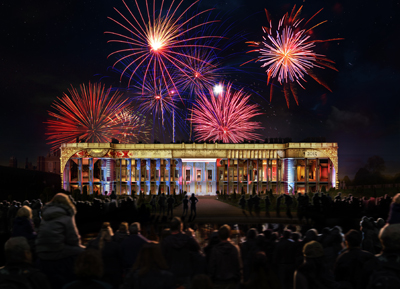
It’s party time at Hampton Court Palace this weekend as the palace celebrates its 500th anniversary with festivities including a spectacular (and historic) light show. Friday, Saturday and Sunday nights the palace will be open for an evening of festivities including the chance to taste-test pork cooked in the Tudor kitchens, enjoy a drink at a pop-up bar in the Cartoon Gallery, listen to live performances of period music in the state apartments and watch a 25 minute sound and light show in the Privy Garden taking viewers on a journey through the palace’s much storied past culminating in a fireworks finale. The nights run from 6.30pm to 9.15pm. Admission charge applies. For more, see www.hrp.org.uk/HamptonCourtPalace/. PICTURE: HRP/Newsteam

A luxury wartime bunker, a map room dating from the 1930s and a walk-in wardrobe complete with vintage fashion are among five new rooms at Eltham Palace in south London which are opening to the public for the first time this Easter. The rooms also include a basement billiards room and adjoining bedrooms, one of which features one of the first showers ever installed in a residential house in the UK. They have been restored as part of English Heritage’s major £1.7 million makeover of the property – the childhood home of King Henry VIII which was converted into a stunning Art Deco gem in the 1930s. Visitors will be invited to join one of Stephen and Virginia Courtauld’s legendary cocktail party’s of the 1930s while children can take part in an interactive tour exploring the story of the animals that lived at the palace including Mah-Jongg, the Courtauld’s pet lemur (who had his own heated bedroom!). Admission charge applies. For more, see www.english-heritage.org.uk/eltham. Meanwhile, anyone wishing to donate to support the renovation of the map-room can do so at www.english-heritage.org.uk/donate-eltham.

• A new exhibition showcasing the latest scientific displays concerning the life and death of King Richard III has opened at the Science Museum. King Richard III: Life, Death and DNA, which opened last Wednesday – the day before the king’s remains were reinterred at Leicester Cathedral, features an analysis of Richard III’s genome, a 3D printed skeleton (only one of three in existence) and a prototype coffin. It explores how CT scans were used to prove the king’s fatal injuries at the Battle of Bosworth in 1485 were caused by a sword, dagger and halberd (a reproduction of the latter is on display). The exhibition will run until 25th June. Entry is free. For more, see www.sciencemuseum.org.uk/RichardIII.

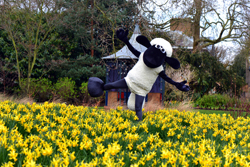
Shaun-the-Sheep• Join Shaun the Sheep and friends for Kew Garden’s annual Easter Egg hunt this Sunday. The hunt will take place from 9.30am to noon (or when the eggs run out!) with participants needing to find three sheep and collect a token/chocolate dropping from each before finding the Easter bunny and claiming eggs supplied by Divine chocolate. Shaun, meanwhile, who hit the big screen for the first time this year, will be found in the Madcap Meadow until 12th April. Admission charge applies. For the full range of events taking place at the gardens this Easter season, check out www.kew.orgPICTURE: RBG Kew.

London’s Boroughs are turning 50 and to celebrate London councils – working with the London Film Archive – have released a short film telling the story of the past half century. Follow this link to see it. Councils across the city, meanwhile, are holding events throughout the year to mark the occasion – check with your local council for details; some, like Barking and Dagenham, and Camden have dedicated pages.

The first chief of the Secret Intelligence Service, Sir Mansfield Cumming, has been commemorated with an English Heritage blue plaque at his former home in Westminster. Known as ‘C’ thanks to his habit of initialling papers (a tradition which has been carried on by every chief since), Cumming was chief of the Foreign Section of the Secret Service Bureau from 1909 until his death in 1923. Flats 53 and 54 at 2 Whitehall Court – now part of Grade II*-listed The Royal Horseguards Hotel – served as Cumming’s home and office at various times between 1911 and 1922. The plaque was unveiled by current Secret Intelligence Service chief, Alex Younger. Meanwhile, Amelia Edwards, pioneering Egyptologist, writer, and co-founder of the Egypt Exploration Fund, has also been honoured with a blue plaque on her former home in Islington. Edwards lived at 19, Wharton Street in Clerkenwell between 1831 and 1892. For more, see www.english-heritage.org.uk/visit/blue-plaques/.

Send all items for inclusion to exploringlondon@gmail.com.
What’s in a name?…Farringdon

Farringdon is a name that crops up quite a bit in London. As well as Farringdon Road, Farringdon Street and Farringdon Lane, there’s a Tube/overground train station which also bear the name along with two of the 25 wards of the City of London.

These latter are named Farringdon Within and Farringdon Without – a distinction which relates to their placement within and without the City’s walls and dates to the late 14th century.

While the name Farringdon, which can be found elsewhere in England, apparently meant ‘ferny hill’ in Old English, its origins in London apparently relate to two medieval London goldsmiths, William de Faringdon (also spelt de Farindon and various other ways) and his son Nicholas.

Both William and Sir Nicholas were aldermen and Lord Mayors of London in the late 13th and early 14th centuries.

Sir Nicholas was apparently well favoured by King Edward II – he was several times appointed mayor, a job the king apparently said he could hold for “as long as it pleased him”. He was buried at St Peter-le-Chepe, destroyed in the Great Fire of London.

Interestingly, another well-known alderman of this ward was the radical MP John Wilkes, who was elected while in Newgate Prison.

Farringdon Street, which becomes Farringdon Road, runs along the course of the former Fleet River and dates from the 1730s when the river was arched over.

Lost London – Blackwell Hall…

A trade hall for the wool and cloth trade, Blackwell Hall, also known as Bakewell Hall, once stood on the east side of Guildhall Yard in Basinghall Street.

The buttressed stone building – whose previous owners included Thomas Bakewell (from where apparently it gets its name) – is understood to have been purchased by the City of London Corporation during the reign of King Richard II and subsequently established as a cloth market.

‘Factors’ were introduced to act as agents and handle the sale of goods on behalf of the clothiers but shifts in trade – in particular the expansion of northern mills which led to them handling their sales directly –  saw the importance of the London-based factors wane.

The structure was rebuilt a couple of times over its lifespan – there are records of a rebuilding in 1588 and again after the Great Fire of 1666 – before it was finally demolished in 1820 to make way for the Bankrupcy Court.

Remains of the foundations were discovered during excavations in Guildhall Yard in 1988.

10 London sites associated with Sir Winston Churchill – 7. St Margaret’s Church…

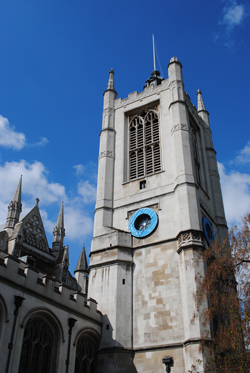
Nestled next to Westminster Abbey opposite the Houses of Parliament, St Margaret’s has long been known as the “parish church of the House of Commons” (although we should point out it’s not officially a parish church). As a result, it probably doesn’t come as a surprise that it has a couple of significant links to former PM Winston Churchill.

St-Margarets-ChurchAmong the most momentous personal occasions was when Churchill married Clementine Hozier in the church on 12th September, 1908, after a short courtship. A headline in the Daily Mirror called it ‘The Wedding of the Year’.

After the fighting of World War II ended in 1945, on VE Day Churchill, in a move reflecting that taken by then PM David Lloyd George after World War I, led the members of the House of Commons in procession from the Houses of Parliament into the church for a thanksgiving service.

In 1947, the church was the scene of another Churchill wedding, this time that of Sir Winston’s daughter, Mary who was wedded to Captain Christopher Soames of the Coldstream Guards on 11th February. 

WHERE: St Margaret’s Church, Westminster (nearest Tube stations are St James’s Park and Westminster); WHEN: 9.30am to 3.30pm weekdays/9.30am to 1.30pm Saturday/2pm to 4.30pm Sunday; COST: Free; WEBSITE: www.westminster-abbey.org/st-margarets-church.


LondonLife – #MuseumWeek…

Dr-Johnsons-HouseIt’s #MuseumWeek on Twitter and museums all over London are among the more than 2,000 institutions worldwide already tweeting away. Among those, large and small, taking part in London are the @hornimanmuseum, @ExploreWellcome, @JewishMuseumLDN, @BFHouse@HRP_Palaces, @NMMGreenwichand @drjohnsonshouse (pictured). Each day of the week they’ll be tweeting on a different theme until Sunday (today’s is #souvenirsMW). For the full stream, head to @MuseumWeek.