What’s in a name?…Sloane Square

Sloane-SquareThis upmarket square in west London is named in honor of Sir Hans Sloane, the physician come botanist who bought the manor of Chelsea in 1712 and, in doing so, provided grounds for the Chelsea Physic Garden.

Sloane Square was developed by architect Henry Holland Sr and his son Henry Holland Jr in 1771 as part of a residential development they called Hans Town (also named after Sir Hans, it’s still a ward in the Royal Borough of Kensington and Chelsea). For more on Sir Hans Sloane, see our earlier post here.

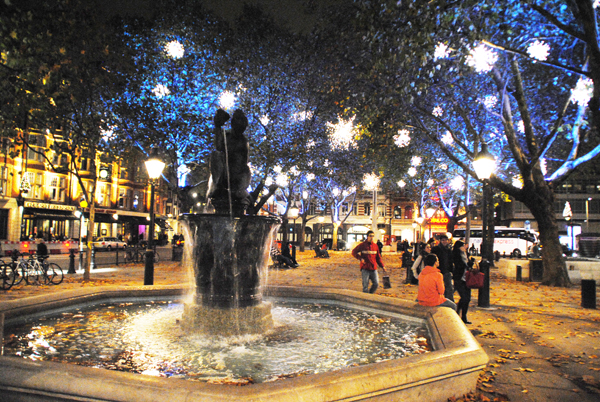
The square, pictured above as it looks decorated for Christmas, initially consisted of a village green bordered with posts and chains and the surrounding buildings were all residential. Apparently the square initially failed to attract the right sort of residents (it was a little too far from Mayfair) but despite this initial setback, it gradually became the centre of a desirable residential precinct.

Private houses began making way for other buildings in the square in the nineteenth century – in 1810, the New Chelsea Theatre opened, subsequently renamed the Royal Court Theatre (this was later moved to another site still on the square and remains there today), and in 1812, the Chelsea, Brompton and Belgrave Dispensary was established for the relief of the sick and the poor.

The Sloane Square Underground station opened in 1868 and rebuilt after it was damaged by bombs in World War II (it’s interesting to note that the River Westbourne actually runs through some iron conduit over the top of the platforms on its way to the River Thames).

Other notable buildings in the square today include the Peter Jones department store which first arrived in the square in the late nineteenth century.

The square itself was redesigned in the 1930s when the war memorial was put in its current position. The Venus Fountain (pictured above) which now stands there – the work of Gilbert Ledward – was erected in 1953.

10 Historic London Garden Squares…5. Berkeley Square…

Berkeley-Square

Located in the south-west of Mayfair in London’s West End, Berkeley Square was originally laid out by architect William Kent in the mid 1700s.

It takes its name from the Berkeley family of Gloucestershire (the first Lord Berkeley of Stratton was a Royalist commander in the Civil War) whose London residence, Berkeley House, stood on what is now the south side of the square until it was destroyed in a fire in 1733 (Devonshire House, whose residents included the 5th Earl of Devonshire and his somewhat notorious wife Georgiana, was subsequently built on the site and remained there until it was demolished in the 1920s).

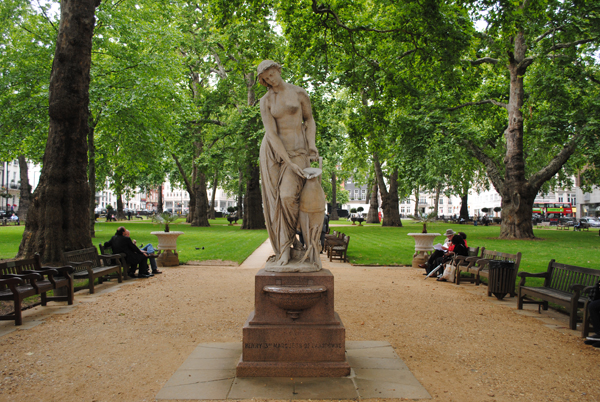
The gardens, which feature some of the city’s oldest London Plane trees (dating from 1789), have a pump house at the centre which was built in 1800 and is now Grade II listed (it stands on the site of an earlier equestrian statue of King George III). Other features including the statue Lady of Sumaria (Water Carrier) – pictured above – which was made by Pre-Raphaelite sculptor Alexander Munro in 1858 and stands at the garden’s southern end.

Among notable buildings which face onto the square are Lansdowne House – located on the south-west corner of the square, it was designed by Robert Adam and now home of the Lansdowne Club – and number 50 Berkeley Square, home of short-lived early 19th century PM George Canning (and said to be the most haunted house in London). The square was also the home of society favorite, Gunter’s Tea Shop, which dated from the mid-1700s.

Famous residents have included wartime PM Sir Winston Church (he lived at number 48 as a child); Horace Walpole, some of the first Prime Minister Robert Walpole (he lived at number 11 during the 1700s), Robert Clive (more famously known as Clive of India, he committed suicide in number 45 in 1774), and the fictional Bertie Wooster and his valet Jeeves (creations of author PG Wodehouse). The square also featured in the famous wartime song, A Nightingale Sang in Berkeley Square.

The square is open from 8am daily with closing times varying based on the season.

10 Historic London Garden Squares…4. St James’s Square…

A quiet square at the heart of the area known as St James, the square’s origins go back to the 1660s when King Charles II granted what was initially a lease (and later the freehold) over a section of St James’s Field to Henry Jermyn, a favourite of King Charles I’s queen Henrietta Maria who was created the 1st Earl of St Alban.

William-IIIThe earl began developing the residential square (the original design had houses on the south-side fronting onto Pall Mall) and, thanks to its proximity to Whitehall and St James’s Palace, quickly attracted some of the who’s who of London to live there.

Indeed it’s said that by the 1720s, seven dukes and seven earls were in residence in the square – other residents included PMs William Pitt the Elder and William Gladstone (both lived in Chatham House, at numbers 9 and 10, albeit at different times) as well as two of James II’s mistresses, Arabella Churchill and Catherine Sedley, who apparently lived at number 21 in the late 1600s.

Among the architects who designed houses around the square were Robert Adam, Sir John Soane, and, in more recent times, Edwin Lutyens.

The square – which reached its final layout, designed by John Nash, around 1854 – remained a desirable place to live even as in the 19th century, some of the houses gave way to financial institutions, private clubs, offices and even lodging houses. These days it’s dominated by business and other institutional organisations.

Organisations located in the square today include the Naval and Military Club (number four – former home of Nancy Astor), the East India Club (number 16) and the London Library (located at number 14, it was founded by Thomas Carlyle in 1841) as well as the international headquarters of BP.

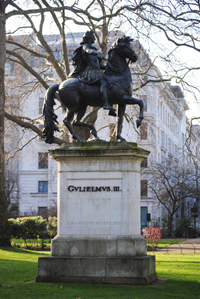
The gardens feature an equestrian statue of King William III at their centre (the work of John Bacon Sr and Jr, it was installed in 1808 and is pictured above). Other monuments include The Stag (located in the south-west corner, it is the work of Marcus Cornish and was installed in 2001) and, just outside the garden railings in the north-east corner, a memorial to WPC Yvonne Fletcher who was killed when a gun was fired from the Libyan Embassy (known as the Libyan People’s Bureau, it was located at number 5) during a demonstration on 17th April, 1984. The pavilion on the south side was designed by John Nash.

The gardens are private – managed by the St James’s Square Trust – but open to the public on weekdays from 10am to 4.30pm.

LondonLife – Celebrating 100 years of the RHS Chelsea Flower Show…

Chelsea2

Queen Mary (wife of King George V) with group at the RHS Chelsea Flower Show in 1913. The show, which was first held in the grounds of the Royal Hospital, Chelsea, in 1913, is celebrating its centenary this year. The 244 exhibitors at the inaugural event have grown to more than 500 today with 161,000 visitors now attending the show each year. Other pictures released to mark the centenary include (see below) gardeners carrying pots at the show in 1931; visitors looking at a display of cacti at the 1964 show; and, an aerial view of the show in the 1990s. The show runs from today until 25th May. For more on the RHS Chelsea Flower Show, see www.rhs.org.uk/Shows—events/RHS-Chelsea-Flower-Show/2013PICTURES: RHS Lindley Library. 

Gardeners-carrying-pots-at-the-Show.-Date-1931.-Credit,-RHS-Lindley-Library

Chelsea3

Chelsea4

10 Historic London Garden Squares…3. Soho Square…

Soho-Square

Originally named King’s Square in honour of King Charles II, Soho Square was laid out on what had been known as Soho Fields as a residential square with a garden at its centre in the late 1670s – part of the general demand for homes that came about after the Great Fire of London in 1666.

A fashionable place to live when built, among the early mansions was Monmouth House, a grand mansion originally built for James Scott, the Duke of Monmouth (and illegitimate son of King Charles II who lost his head after leading a rebellion against King James II) and later used by the French ambassador before it was demolished in the 1770s. Two of the square’s original homes are located at numbers 10 and 15.

A number of trees and shrubs were recorded as being planted here including cherry, peach and almond trees as well as lilacs, jessamine and honeysuckle – it’s suggested these may have been chosen by botanist Sir Joseph Banks who lived at number 32 from 1777 until his death in 1820.

King-Charles-IIThe square, which was opened to the public in 1954, is today at the heart of the West-End district of Soho, once synonymous with late night entertainment including the sex industry but also home to a growing number of film and media-related organisations (for a look at the derivation of the name Soho, see our earlier post).

Indeed, a number of media companies are based in the square itself – British Movietone, which was produced the Movietone news, was located here at number 22 for years while current inhabitants include Twentieth Century Fox (located in a building at number 31-32 where the botanically minded Linnean Society once met).

Other buildings of note in the square include the French Protestant Church, built in 1891-93 and located at numbers eight and nine and St Patrick’s Church, located at on the corner of Soho Square and Sutton Row. While a chapel was first consecrated here in 1792, the current building dates from the 1890s (reopened in 2011 after a £3.5 million restoration) and has catacombs which spread a considerable distance under the square. In a nod to less savoury aspects of the square’s past, the White House Brothel was also located here – at number 21 – in the late 18th century (the building is now known as Manor House).

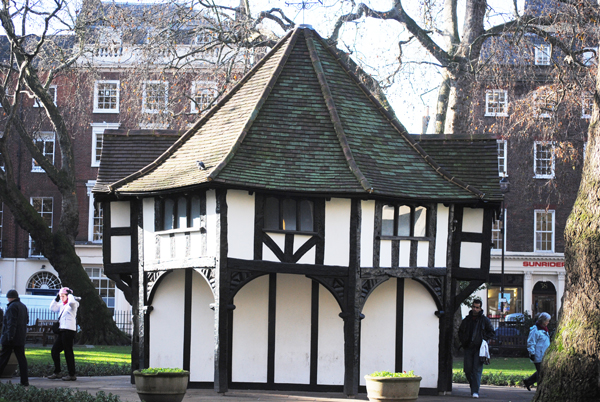
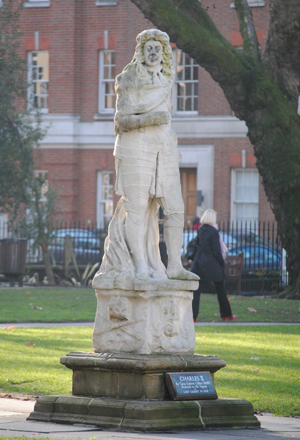
The oldest statue in the square is that of Caius Gabriel Cibber’s King Charles II which dates from 1681 (pictured right) – a reminder of the square’s past name.  Originally part of a larger monument containing a fountain, it was removed in 1875 to make way for the distinctive half-timbered Tudor-style hut (pictured above) used by gardeners which, having been rebuilt in the 1930s, currently sits at the square’s centre and only returned to the gardens in 1938. There’s also a bench in the square which commemorates the late singer Kirsty MacColl, writer of the song Soho Square.

For more on London’s squares, see Gary Powell’s Square London.

10 Historic London Garden Squares…2. Parliament Square

Located in one of the most prominent sites in London, Parliament Square is these days perhaps best known as a protest site for those wanting to attract Parliament’s eye. And while, unlike say, Trafalgar Square, many visitors to London may not know its name, its proximity to the Houses of Parliament, Whitehall, Westminster Bridge and Westminster Abbey means it’s rarely off anyone’s tourist agenda.

David-Lloyd-GeorgeThe history of the square goes back to 1868 when architect Sir Charles Barry (responsible for the design of the Houses of Parliament) designed a square to improve traffic flow in the area (and demolished many buildings – apparently the area was a slum – in the process).

The roads around the square featured London’s first traffic signals (it used semaphore arms rather than lights and was installed at the meeting of Great George and Bridge Streets) and in addition the square was originally the location for the Buxton Memorial Fountain which moved to its present position in Victoria Tower Gardens in 1940 (see our earlier post on the fountain here). In 1950, the entire square was redesigned by architect George Grey Wornum.

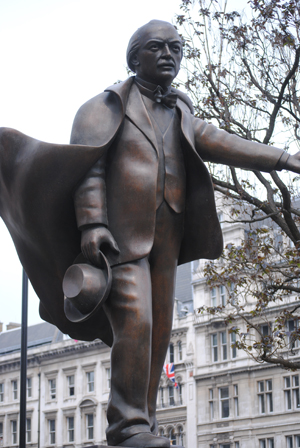
The square is home to a plethora of statues including former PMs Sir Winston Churchill, a relatively recent statue of David Lloyd George (pictured), Sir Robert Peel (also the founder of the Metropolitan Police Force – see our earlier post here), Benjamin Disraeli, the Earl of Derby and Lord Palmerston as well as South African PM Jan Christian Smuts and, (if you count the space in front of Middlesex Guildhall), US President Abraham Lincoln (a replica of a statue in Lincoln Park, Chicago) and former Foreign Secretary and PM George Canning. Among the last statues added was a nine foot high bronze figure of Nelson Mandela which was placed in the square in 2007 after an unsuccessful push to have it located in Trafalgar Square.

Among the most high profile of protests to have been held there is that of the late peace campaigner Brian Haw who camped on the square for 10 years until 2010. Among the most recent protests this year has been a colourful demonstration by beekeepers, calling for a ban on pesticides.

For more on London’s statues, see Peter Matthews’ London’s Statues and Monuments.

10 Historic London Garden Squares…1. Leicester Square…

In the first of a new Wednesday series looking at historic London garden squares, we take a look at what next to Trafalgar Square, is the most famous square in the entire city – Leicester Square.

Located in the heart of the West End, Leicester Square’s history finds its origins back in the 17th history when Robert Sidney, the 2nd Earl of Leicester acquired property on the site where the square now stands. Then known as St Martin’s Field and located within the parish of St Martin’s, Sidney purchased four acres in 1630 and constructed Leicester House on land now located at the square’s northern end.

Leicester-SquareThe earl raised the ire of locals, however, when – having subsequently fenced off the land to prevent people from wandering on to his property – he enclosed what had previously been common land.

The people appealed to King Charles I who appointed three members of the Privy Council to look at the issue. Their decision? That the earl keep a section of his land open for the use of the parishioners of St Martin’s.

First known as Leicester Field, it was this land which later became known as Leicester Square. Fine homes were built around the square (its proximity to the Royal Court and centre of government made it a desirable place to live for the well-to-do and those seeking influence) with the centre enclosed with rails (it’s pictured here in 1750).

The square’s reputation also had a royal boost when, in 1717/1718, Leicester House became home to Prince George (later King George II) and his wife Princess Caroline along with their court after the prince fell out with his father King George I and was banished from St James’ Palace (this story is recounted in marvellous detail in Lucy Worsley’s terrific book, Courtiers: The Secret History of the Georgian Court).

The prince remained at the house for 10 years and was proclaimed King George II after his father’s death at its gate. Interestingly, King George II’s eldest son, Prince Frederick, also lived here for a time after he too fell out with his father (King George II). Apparently their relationship was even worse than the previous generation’s had been.

Despite its royal attractions, even at this stage the square apparently had it’s darker side with some less than savoury characters attending the hotels and livery stables that were built there. But things were to get worse as the wealthy moved out – a situation not helped when Leicester House was demolished in the 1790s.

Leicester Square became known as an entertainment venue in the 19th century (among attractions was the short-lived Royal Panopticon of Science and Art which showcased the best in science and art and Wyld’s Great Globe which contained a gigantic model of the earth) and received a new injection of life when theatres and music halls moved in, bringing the crowds back with them.

Shakespeare-StatueMeanwhile, the status of the square – and whether it could be built upon – remained a matter of debate well into the 19th century. That ended in 1874 when businessman Albert Grant bought the freehold of the land, had the garden created upon it and then donated it to the Metropolitan Board of Works as a gift to the city.

Responsibility for the management of the square now rests with the City of Westminster. The square area – which is now known for hosting film premieres as well as the tourists who inevitably gather there – was pedestrianised in the 1980s and has just undergone a redevelopment and modernisation which was unveiled last year.

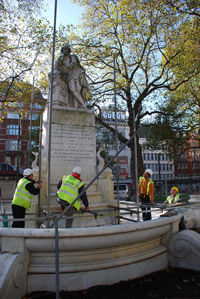
Meanwhile, work to restore the 19th century Shakespeare statue and fountain in the square’s centre is about to be completed (pictured). The square also contains a statue of actor Charlie Chaplin in the square as well as busts of scientist Sir Isaac Newton, painter and first president of the royal Academy Sir Joshua Reynolds, 18th century pioneer surgeon John Hunter, and painter William Hogarth.

The tradition of the entertainment continues in the modern era through the cinemas which now stand in the square and regularly host film premieres (an interesting, if oft-repeated, film-related anecdote connected to the square is that it was in a phone booth located at the square that during the 1960s a young actor Maurice Micklewhite saw a poster for The Caine Mutiny and decided to change his name to Michael Caine).

PICTURES (top) Wikipedia and (below) City of Westminster.

Where is it?…#61…

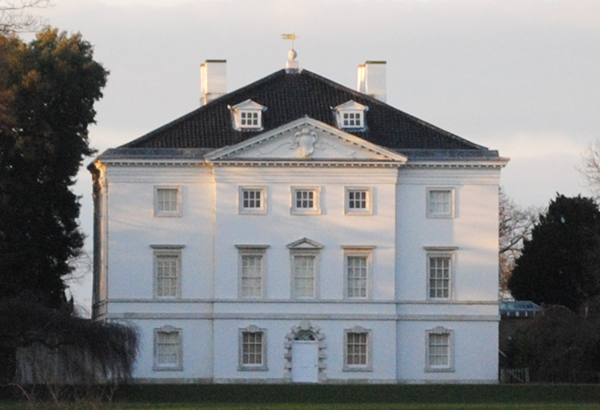
Where-is-it--#61Can you identify where in London this picture was taken and what it’s of? If you think you can, leave a comment below. We’ll reveal the answer early next week. Good luck!

Well done to Sue and Helen – this is, of course, Marble Hill House, located in south-west London on the banks of the River Thames between Richmond and Twickenham (this picture is taken from the opposite side of the Thames). Built for Henrietta Howard, mistress of King George II when he was Prince of Wales, for the lady in her “retirement” from court, the Palladian villa is set among 66 acres of parkland. We’ll look at the house in more detail in a later post.

WHERE: Marble Hill House, Richmond Road, Twickenham (nearest Tube station is Richmond (1 mile) or train station, St Margarets (0.5 mile)); WHEN: 10am-2pm Saturday, 10am to 5pm Sunday (cafe and park are open daily); COST: £5.70 adults/£5.10 concessions/£3.40 child (5-15 years); WEBSITE: www.english-heritage.org.uk/daysout/properties/marble-hill-house/.

Around London – Olympics at the Museum of London; Oxford wins the Boat Race; restoration project at Kew; and, Phantom Ride at the Tate…

 Diver Tom Daley’s swimming trunks, cyclist Bradley Wiggins’ yellow jersey and a Mary Poppins outfit worn in last year’s Olympic Games’ opening ceremony are among the items on display as part of the Museum of London’s 2012 display. The free display, which opened last week, exactly 200 days after the Paralympics closing ceremony, features a selection of 70 items connected with the Games. Runs in the Galleries of Modern London until 31st October. For more, see www.museumoflondon.org.uk.

Oxford took line honours at the 159th Boat Race, held on the River Thames last weekend. The Dark Blues – whose crew included Olympic medalists Constantine Louloudis and Malcolm Howard – still trail Cambridge (the Light Blues) – whose crew included another Olympic medallist, George Nash, however, with 77 wins to 81 wins. For more, see www.theboatrace.org or our previous articles – here and here.

Kew Garden’s historic Temperate House has received a £14.7 million Lottery Fund grant for conservation of the Grade One listed building, the largest Victorian glasshouse in the world. The grant – which adds to £10.4 million from the government and £7.7 million from private donors – will also be used to create a “more inspiring” public display for visitors with the overall £34.3 million project completed by May, 2018. The building opened in 1863 and was last refurbished 35 years ago. It houses some of the world’s rarest plants, including a South African cycad (Encephalartos woodii). For more, see www.kew.org.

On Now: Phantom Ride. This “haunting” film installation by artist Simon Starling was commissioned by the Tate Britain in Millbank and is located in the neo-classical Duveen galleries. Referencing the late nineteenth century tradition of ‘phantom rides’ – films, often made by cameramen strapped to the front of a train, that gave a dramatic sense of motion as if one is aboard an invisible vehicle – the installation includes a “compelling flow of images” of artworks that once filled the Duveen galleries, creating a sense of movement as the works move up and down the walls. Admission is free. Runs until 20th October. For more, see www.tate.org.uk.

Around London – Bedchamber secrets at Hampton Court; Roman remains at the British Museum; Easter chocolate at Kew Gardens; Harry Beck’s blue plaque; and, Underground art…

Happy Easter! We’re taking a break over the Easter weekend…Our next update will be on Tuesday, 2nd April.

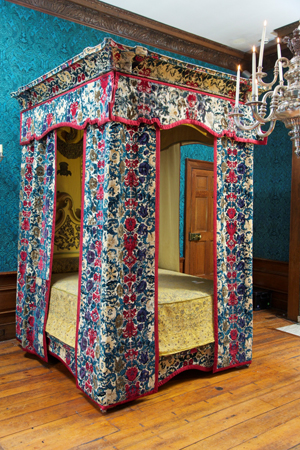
Mary-of-Modena's-bedA new exhibition exploring the secrets of the bedchambers of the Stuart and Hanoverian courts of the 17th and 18th centuries opened at Hampton Court Palace this week. At the heart of Secrets of the Royal Bedchamber are six royal beds which tell the story of why the bedchamber became the most important part of the palace and detail some of the events that took place there before an audience of courtiers, politicians and family members – from births and deaths to the consummation of marriages and the discussion of important affairs of state. It tells of why courtiers would fight for positions such as the ‘groom of the stool’ or ‘necessary woman’ and how beds which could cost the same as a London townhouse were sometimes never slept in. Among the beds on display is the ‘Warming Pan Bed’ (pictured), the State Bed of King James II’s queen, Mary of Modena, and scene of the royal birth that ultimately led to the end of the Stuart line, and the ‘Travelling Bed’ of King George II which travelled as far afield as Hanover and the battlefields of Europe. The exhibition also gives rare access into the Prince of Wales’ Apartments, designed by 17th and 18th architect Sir John Vanbrugh, and now open for the first time in 20 years.  Admission charge applies. Runs until 3rd November. For more, see www.hrp.org.uk. PICTURE: HRP

The Roman cities of Pompeii and Herculaneum are the subject of a major exhibition opening at the British Museum today. Life and death in Pompeii and Herculaneum brings together more than 250 objects from the two cities which were buried in just 24 hours during the eruption of Mount Vesuvius in 79 AD. The objects include celebrated finds and recent discoveries, many of which have never before been seen outside Italy, and help explore what daily life was like for the inhabitants. Artefacts include a beautiful wall painting from Pompeii showing baker Terentius Neo and his wife, wooden furnishings including a linen chest, inlaid stool, and even a baby’s crib from Herculaneum, and casts of victims including a family of four and a dog who died at Pompeii. Runs until 29th September. Admission charge applies. For more, see www.britishmuseum.org.

Find out more about the history of chocolate at Kew Gardens this Easter, from the ritualistic use of cacao in ancient Mayan and Aztec cultures to the arrival of chocolate in 17th century London, where it was a luxury item for high society to indulge in at newly fashionable chocolate houses. Running from tomorrow until 14th April, there will be a range of workshops taking place at the gardens around the chocolate theme along with a traditional Easter Egg Hunt on Easter Sunday (31st March). The garden’s cocoa tree can be found in the Princess of Wales Conservatory. Admission charge applies. See www.kew.org.

Harry Beck, designer of the innovative first diagrammatic Tube map, has been honoured by an English Heritage blue plaque – inscribed in the Underground’s new Johnston typeface – at his birthplace in Leyton in London’s east. Beck, who was born in a small terraced house at 14 Wesley Road in 1902, was working with London Transport as a draughtsman in the London Underground Serial Engineer’s Office, when, in 1931, he produced his first design for a diagrammatic map. He continued to update the map with new stations and lines even after leaving London Transport with the last version of his map published in 1960. Beck died in 1974. Meanwhile, a blue plaque commemorating railway engineer Sir Nigel Gresley (1876-1941) has been returned to King’s Cross station following the completion of building work. It can be found on platform 8. For more, see www.english-heritage.org.uk/discover/blue-plaques/.

On Now: The Underground. A commission from Art on the Underground, this exhibition of artist Mark Wallinger’s work at the Anthony Reynolds Gallery (60 Great Marlborough Street) features some examples of 270 labyrinth designs – one representing each of the Underground stations – which are being installed at the Tube stations themselves. Among those stations represented at this showing are Westminster, St James’s Park, Oxford Circus, Victoria, Embankment, Green Park, King’s Cross St Pancras, Baker Street and Tottenham Court Road. While labyrinths are already in place at these locations, the remainder of Wallinger’s labyrinth designs will be appearing at Tube stations over the coming months. Runs until 27th April. For more, see www.anthonyreynolds.com.

LondonLife – 14th century burial ground unearthed underneath Charterhouse Square…

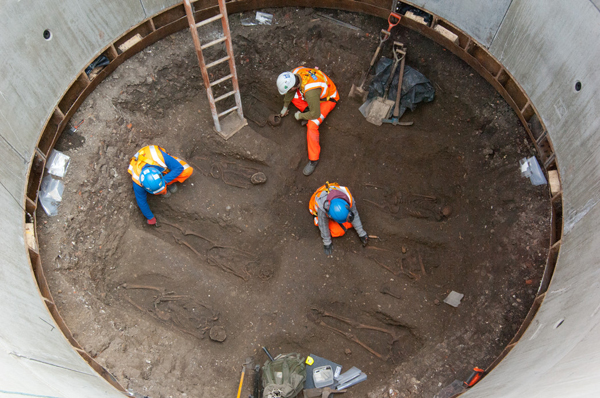
Crossrail---FarringdonA lost London burial ground has been unearthed in Farringdon by archaeologists working on the £14.8 million Crossrail project.

Thirteen adult skeletons, believed to be up to 660 years old, have been discovered lying in two rows 2.5 metres below the ground on the edge of Charterhouse Square.

It is likely based on the depth at which the bodies were buried and other evidence (including pottery found at the site and a similarity between the layout of the bones and those of 14th century plaque victims unearthed at the East Smithfield Burial Ground in the 1980s), that the skeletons were buried here in 1349 during the Black Death.

Historical records suggest that as many as 50,000 people may have been buried here in the three years from the burial ground’s opening in 1348. The burial ground remained in use until the 1500s but has never been located in modern times.

The skeletons are being excavated and taken to the Museum of London Archaeology for laboratory testing.

Crossrail Lead Archaeologist Jay Carver described the discovery as “highly significant”.

“We will be undertaking scientific tests on the skeletons over the coming months to establish their cause of death, whether they were Plague victims from the 14th Century or later London residents, how old they were and perhaps evidence of who they were,” he said.

“However, at this early stage, the depth of burials, the pottery found with the skeletons and the way the skeletons have been set out, all point towards this being part of the  14th century emergency burial ground.”

It is likely more remains will be found according to experts.

Archaeologists working on the Crossrail project have previously uncovered more than 300 burials at the New Cemetery near the site of the Bedlam Hospital at Liverpool Street from the 1500s to 1700s.

For more on Crossrail, see www.crossrail.co.uk.

10 of London’s greatest Victorian projects – 6. Victoria and Albert Embankments…

We’ve already mentioned these two riverside embankments as part of our previous piece on Sir Joseph Bazalgette’s revolutionary sewer system. But so important are they to the shape of central London today – not to mention a great place to take a stroll – that we thought they’re also worth a mention in their own right.

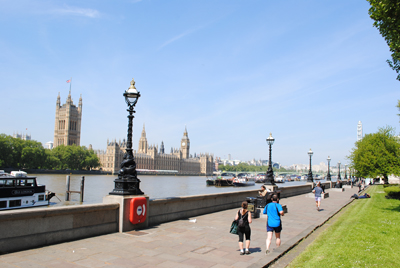
Albert-EmbankmentAs mentioned, the Victoria and Albert Embankments (the latter is pictured right) – named, of course, for Queen Victoria and her by then late consort, Prince Albert, who had died in 1861 (see our previous post What’s in a name?…Victoria Embankment) – were located on opposite sides of the River Thames and involved reclaiming a considerable amount of the river so new sewers could be laid.

Construction of Victoria Embankment – which was also seen as a way to relieve traffic congestion in the central London area – started in the mid 1860s and was complete by 1870. Running along the north and western banks of the Thames between Westminster and Blackfriars bridges, its creation involved the demolition of many riverside buildings as a new walk and roadway were constructed behind a wall.

Numerous monuments have since been located along this promenade – they include the Battle of Britain Monument, RAF Memorial and the mis-named Cleopatra’s Needle (see our earlier post to find out why) – as well as a number of permanently berthed ships including the HQS Wellington – the base of the Honorable Company of Master Mariners – and the HMS President.

The walkway also features original decorative lamps – interestingly, Victoria Embankment was the first roadway in London to be permanently lit  by electric-powered lighting (from 1878).

The parks, collectively known as Victoria Embankment Gardens, contain numerous statues and monuments (including one to Bazalgette himself – it’s located close to the intersection with Northumberland Avenue) as well as a bandstand. They also contain the remains of York Watergate – once fronting on to the river, it shows how much land was reclaimed for the project (you can also visit the riverside entrance to Somerset House to gain a feel for where the river once was – look through the glass floor and you’ll see the old riverbank below).

Albert Embankment, meanwhile, runs between Vauxhall and Westminster Bridges on the eastern side of the river. Constructed around the same time as Victoria Embankment, it was designed to prevent flooding of the low-lying areas of Vauxhall and Kennington and to help in Bazalgette’s sewage system plan (although it apparently doesn’t have the same large sewers as can be found on the other side of the river).

Sadly, the demolition did see the centre of what was once the village of Lambeth removed to make way for the new promenade and roadway. But like Victoria Embankment, Albert Embankment features delightfully decorative lamps along the riverfront promenade and is a great place for a walk in any weather.

Around London – Chinese New Year; Orchids at Kew; Lucian Freud’s donation to the National Gallery; and, Man Ray at the NPG…

Chinese New Year celebrations will go off with a bang in Chinatown in the West End this Saturday. The festivities, which are the largest outside Asia, will include a lion dance, fireworks, and a variety of performers – all gathered to herald the start of the Year of the Snake. The celebrations will kick off with a parade which will leave Trafalgar Square at 10am and end at Rupert Street in Chinatown at 11am. At 12pm, dignitaries will gather in Trafalgar Square for the Dotting of the Eye ceremony which will bring the dragons and lions to life and performances will the take place until 5.30pm. At 5.55pm a fireworks display will mark the end of the day’s celebrations. For more, see www.chinatownlondon.org/page/chinese-new-year-2013/378.

Like orchids? Want to escape the gloom of winter? Kew Gardens are celebrating the exotic plant with a dazzling display in the Princess of Wales Conservatory. Thousands of orchids will be on show as part of ‘Orchids at Kew’ and the plants will be used to recreate the giant waterlily flower, Victoria amazonica, which can normally be seen in the conservatory in the summer months. There are special behind the scenes tours, food and an adult education course for the truly interested. Charges apply. Opening on Saturday, 9th February, the display can be seen until 3rd March. For more, see www.kew.org.

The late artist Lucian Freud has donated a treasured portrait – Jean-Baptiste Camille Corot’s L’Italienne ou La Femme à la Manche Jaune (The Italian Woman, or Woman with Yellow Sleeve) – to the nation in gratitude for the welcome his family received when they arrived as refugees from Berlin. The Corot has been allocated to the National Gallery by the Arts Council England and was done under the Acceptance in Lieu scheme, which allows people to transfer works of art into public ownership instead of paying inheritance tax.  The painting – which was last seen in a show at the Louvre, Paris, in 1962, and was previously owned by Hollywood Golden Age star Edward G. Robinson – is on display on Room 41 of the gallery. For more, see www.nationalgallery.org.uk.

On Now: Man Ray Portraits. The first museum exhibition to focus on the photographic portraiture of the 20th century artist Man Ray, this display at the National Portrait Gallery features more than 150 vintage prints taken between 1916 and 1968. Subjects include everyone from Catherine Deneuve and Ava Gardner to Salvador Dali and Aldous Huxley. The majority of works have never been exhibited in the UK before. Runs until 27th May. Admission charge applies. For more, see www.npg.org.uk.

Like to tell others about your upcoming event in London? If you’ve got an event coming up, please send any press releases or details to exploringlondon@gmail.com.

Famous Londoners – John Nash…

Arguably the greatest architect of Regency London, John Nash’s imprint can still be seen in numerous sites around the city, from the master-planning of Regent’s Park and Regent Street to the beautiful buildings of All Soul’s Church in Langham Place and Marble Arch on the edge of Hyde Park.

Born the son of a Welsh millwright in Lambeth, London, on 18th January, 1752, Nash – who went on to work in a range of different architectural styles – trained as a draughtsman under the tutelage of architect Sir Robert Taylor and in 1777 established his own business as a builder and surveyor.
John-NashBut he certainly didn’t meet with immediate success and, following failure as a building speculator (he built properties in Bloomsbury Square and Great Russell Street but failed to make enough money from the venture – there’s a blue plaque on one of the houses, which he lived in, at 66 Great Russell Street), was declared bankrupt in 1783.

Meanwhile, his personal life was also in turmoil during these years – in 1775 he had married, Jane Kerr, the daughter of a Surrey surgeon, but separated from her in the early 1780s after various troubles including her eventually apparently having a child with a Welshman named Charles Charles, who is said to have died in prison after he was jailed for adultery.

Brought down by his misfortune, in the mid 1780s Nash moved to Carmarthen in Wales where he had family. Taking up work here, by the late 1780s he was designing prisons – the first was at Carmarthen – and worked on a number of other prominent buildings including St David’s Cathedral and various country houses.

Rising to prominence in Carmarthen society, by 1797, however, Nash was again working in London, initially in partnership with the renowned landscape architect Humphrey Repton with whom he had formed a business relationship some years earlier (although the partnership had soured over finances by 1800).

He built a substantial home at 29 Dover Street in Mayfair and in 1798, his first wife presumably dead, he married his second wife, Mary Anne Bradley, and soon started work on building a Gothic-inspired residence for them, known as East Cowes Castle, on the Isle of Wight. It was completed in 1802 but enlarged some years later.

Nash designed numerous country properties in the early 19th century, inspired by everything from castles to Italianate architecture, both in England and Ireland and soon came to the attention of the Prince Regent, the future King George IV (there was a rumour his wife was one of the prince’s discarded mistresses).

In 1806 he was officially made Deputy Surveyor General in the Office of Woods and Forests – the office which managed the Crown estate, and from 1815 on, he largely worked for the prince alone. Among the major London commissions from his royal patron were the design of Regent Street (he and his wife moved into number 14 in 1823) and the development of Regent’s Park on land formerly known as Marylebone Park and surrounding housing estates (for more on The Regent’s Park, see our earlier entry here). He also redeveloped St James’s Park.

In 1815, he was commissioned to develop the Prince Regent’s Marine Pavilion in Brighton and by 1822 had transformed the building into the spectacular Royal Pavilion which can be visited there today.

Nash was also involved in the development of The Regent’s Canal – which linked the Grand Union Canal in London’s west to the River Thames in London’s east and was completed in 1820 – and built many of the grand villas which still line it (for more on Regent’s Canal, see our earlier entry here).

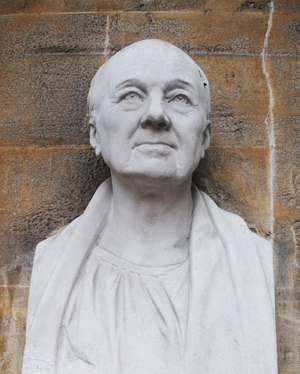
Becoming an official architect to the Office of Works in 1813 (an appointment which only ended in 1832, three years before his death), Nash went on to design churches – including All Soul’s in Langham Place (he’s depicted above in a bust at the church) – as well as West End theatres including the Haymarket Theatre and the Royal Opera House (which burnt down in 1867) as well as the adjacent Royal Opera Arcade and residences including Carlton House Terrace and Clarence House (for more on this, see our earlier entry here).

Other major commissions included the redevelopment of Buckingham Palace (parts of the current building are his work but the main facade isn’t – for more on the palace history, see our earlier entry here) and the Royal Mews, and the creation of Marble Arch, originally envisaged as the main gateway to the palace (see our earlier entry here). Nash also designed a conservatory for Kew Gardens.

Nash’s close relationship with the Prince Regent (who become King George IV on 29th January, 1820), meant that when the king died in 1830, he found himself on the outer (and his reputation took many years to recover thanks to his association with the unpopular king). With no knighthood forthcoming for his efforts (unlike many of his contemporaries) and the chance of further work unlikely (his work on Buckingham Palace had been left unfinished due to concerns over rising costs), Nash retired to his house on the Isle of Wight.

He died there on 13th May, 1835, and was buried in the churchyard at St James’s Church in East Cowes. He was survived by his wife who, having settled his debts, retired to Hampstead.

For an in-depth study of Nash, try Geoffrey Tyack’s book, John Nash: Architect of the Picturesque.

10 of London’s greatest Victorian projects – 3. The Palm House, Kew Gardens…

We head back before the creation of the grand buildings of Albertopolis for this week’s entry to the construction of the Palm House at Kew Gardens – widely considered the world’s most important surviving Victorian-era glass and iron structure.

Palm-House,-KewDesigned by the great architect Decimus Burton (his other works include Wellington Arch), the now Grade I-listed Palm House was built under the supervision of leading Irish glasshouse designer Richard Turner between 1844 and 1848 as a home for Kew’s collection of exotic palms. Turner borrowed from the ship-building industry to build the structure, which contains 16,000 panes of glass, with the design essentially that of an upturned ship’s hull.

Due to the fact that the palms needed a warm environment in which to live, coal-fed boilers were located in a basement below the Palm House which heated water pipes running throughout the building (the smoke from the boilers was diverted to the Italianate Campanile located a short distance away which acted as a smoke stack).

The Palm House (the earliest known picture is shown above) has been restored several times – first in the 1950s when the boilers were converted to run on oil and moved to a site behind the Campanile, and again in the 1980s, a complete overhaul which involved almost completely emptying the structure of its resident palms, dismantling and rebuilding the structure itself. It was officially reopened by Queen Elizabeth, the Queen Mother, in 1990.

Among the many exotic plants inside the glasshouse – which rises to a height of 19 metres – highlights include the rare triangle palm (Dypsis decaryi) from Madagascar, a Mexican yam (Dioscorea macrostachya), used apparently in the development of the contraceptive pill, a double coconut palm (Lodoicea maldivica) which bears the largest seed in the world, and a cycad (Encephalartos altensteinii) which has been described as the “world’s oldest pot plant” and was brought to Kew from South Africa in 1775.

WHERE: The Palm House, Kew Gardens (nearest Tube station is Kew Gardens); WHEN: 9.30am to 3.45pm except Tuesday when it closes at 2pm (closing times change with the seasons); COST: £14.50 adults/£12.50 concessions/children 16 and under free; WEBSITE: www.kew.org.

PICTURE: Royal Botanic Gardens Kew

Exploring London’s 10 most popular posts for 2012 – 6 and 5…

Both of the next two are from our Thursday updates – Around London…

6. Around London: Olympic Torch Relay hits London; mascots pop-up all over the city; and Shakespeare at the British Museum – not a surprising mention, given the Olympic theme;

5. Around London – Butler’s Retreat reopens in Epping Forest; Designs of the Year; and, Lucian Freud’s last work. The reason for this update’s inclusion remains a bit of a mystery – but it was a big year for the late Lucian Freud.

Around London – Christmas at the Tower and Kew Gardens; Old Flo on display; African Diaspora on show at MoL Docklands; and, Mariko Mori at the Royal Academy…

Victorian-Christmas The Tower of London is going Victorian this Christmas with visitors able to experience some of what the Yuletide celebrations in the foreboding, much storied buildings were like in the mid-to-late 1800s. Visitors will be shown how many of the Christmas customs we now participate in each year – like writing cards, pulling crackers and the setting up of family Christmas trees – owe their origins to the Victorian era. The Yeoman Warders will be receiving a Victorian makeover and writer of the age – Charles Dickens – will be reciting some of his works before joining in a “raucous” lunch party with some of his fellow writers, artists and benefactors. It’s even rumoured that Queen Victoria and Prince Albert themselves may make an appearance (take that as a given). Bah! Humbug! A Very Merry Victorian Christmas runs from 27th until 31st December. The festivities will all be included in the usual admission price. For more, see www.hrp.org.uk. PICTURE: Nick Wilkinson/NewsTeam.

Kew Gardens are celebrating Christmas with a host of events including a “Twelve trees of Christmas” family trail. The trail, a map of which can be picked up as you enter, includes facts about trees along the route. Volunteer guides are also leading free tours of seasonal highlights and the Kew Christmas tree can be seen at Victoria Gate. Other festive treats at Kew include the chance to see Father Christmas in his grotto (until Sunday only) and a vintage carousel on the Kew Palace Lawn. Many of the Christmas-related events end on 6th January. See www.kew.org for more.

A display focusing on the history of Henry Moore’s sculpture, Draped Seated Woman (better known as Old Flo), has opened at the Museum of London Docklands. Henry Moore and the East End provides a glimpse into 1950s East London and looks at why public art was considered important at the time. It features some of the maquettes (scale models) Moore used in creating the piece. The exhibition was opened following a decision by the Mayor of Tower Hamlets, Lutfur Rahman, to sell Old Flo (now at the Yorkshire Sculpture Park) rather than display the artwork in a public space. The move is being contested by the Museum of London Docklands who have offered to put the work on public display. An online exhibition can be seen at www.museumoflondon.org.uk/oldflo and a ‘pop-up exhibition’ on Old Flo will be launched in January. The museum is also encouraging people to tweet their views about the selling of the sculpture under the hashtag #saveoldflo.

On Now: Take Another Look. Still at the Museum of London Docklands, this exhibition focuses on the visual representation of people from the African Diaspora who were living and working in Britain in the late 18th and early 19th century. The display of 17 exhibits in the London, Sugar and Slavery gallery features prints by artists including Thomas Rowlandson and George Cruikshank as well as newspaper cuttings, mostly dating from 1780-1833, which show black Britons in perhaps what were unexpected roles – soldiers, musicians and sportsmen – during what was the period in which the abolition of slavery occurred. There are a series of events planned around the exhibition which runs until 4th August. Entry is free. For more see www.museumoflondon.org.uk/Docklands/.

On Now: Mariko Mori: Rebirth. The first major museum exhibition of the New York-based Japanese artist Mariko Mori in London since 1998 has opened at the Royal Academy of Arts in Piccadilly. The exhibition features some of the artist’s most acclaimed works from the last 11 years, many of which have never before been seen in the UK, as well as works created just for the exhibition. Highlights include Tom Na H-iu, a five metre high glass monolith lit by hundreds of LED lights and connected back to the Institute for Cosmic Ray Research at the University of Tokyo; Transcircle, described as a “modern day Stonehenge”; and, Flatstone, an installation of “22 ceramic stones assembled to recreate an ancient shrine”. Runs until 17th February. Admission charge applies. For more, see www.royalacademy.org.uk.

Treasures of London – The Burghers of Calais…

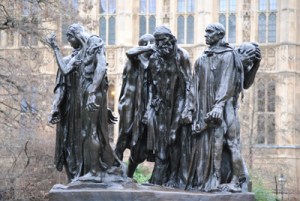
One of 12 casts made of an original which stands in Calais, France, this sculptural group commemorates one of the most poignant moments of the bloody Hundred Years War.

Burghers-of-CalaisThe original work, by the renowned Auguste Rodin who beat five others with his design, was completed in 1889 and stands outside Calais’ town hall. This cast was produced in 1908 and presented to the nation in 1914 by the National Art Collections Fund. It stands in Victoria Tower Gardens, just to the south of the Houses of Parliament in Westminster.

The sculpture commemorates an event which took place in 1347. Calais, then, as now, an important French port, had been besieged by the English for more than a year and, in a desperate situation as the townspeople starved (and despite orders from the French King Philip IV to hold out), the city authorities were seek terms from the English king, Edward III, still flushed with the success of the Battle of Crecy the year before.

Edward’s conditions for their surrender were harsh – six of the city’s leaders had to be handed over and the rest of the city would be spared. But more than that, the six had to leave the city stripped of almost all their clothes, wearing nooses around their necks and carrying the keys to the city and castle.

Six burghers, led by Eustache de Saint Pierre and also including John Daire and brothers James and Peter Wisant, did so and it is the scene of them making their way to King Edward that Rodin has captured. Their bravery was rewarded – while King Edward apparently order them to be beheaded, his pregnant English Queen, Philippa of Hainault, intervened on their behalf and they were spared execution, dressed and fed before they were safely escorted away.

Only 12 casts of the group were ever permitted under French law – the London cast was the third to be made.

Lost London – Old St Paul’s Chapterhouse…

We’re yet to take an in-depth look at Old St Paul’s Cathedral – that is, the building that stood on the existing site before being destroyed in the Great Fire of London in 1666 – but today we thought we’d focus on just one aspect of the former church – the old chapterhouse. 

Located in the South Churchyard on the Thames side of St Paul’s Cathedral, the location of the chapterhouse is today marked out by raised stonework (the actual building remains lay a few feet below) which can be freely accessed from the street.

The octagonal chapterhouse, which replaced an earlier chapterhouse, stood in the middle of a 100 foot square arcaded cloister, both of which were designed by the royal mason, William Ramsay, in 1332 during the reign of King Edward III, in one of the first known examples of what is referred to as the ‘Perpendicular Gothic’ style.

Designed as a two-storey building for better air circulation, the actual chapter room was located on the second floor of the chapterhouse over an undercroft below and it was here the monks would meet daily to discuss affairs relating to the cathedral (the word chapterhouse comes from the fact that it was while in this room the monks would be a read a daily chapter from the body of rules governing them).

The marked out chapterhouse (pictured above – the chairs are standing inside the chapterhouse) was unveiled in 2008 following a £3.8 million redevelopment of the South Churchyard, itself part of the bigger, recently completed, overhaul of the entire cathedral).

WHERE: South Churchyard, St Paul’s Cathedral (nearest tube station is St Paul’s); WHEN: Anytime;  COST: Free  (to go inside the cathedral costs £15 an adult/£14 concessions and students/£6 a child (6-18 years)/£36 a family of four); WEBSITE: www.stpauls.co.uk

Lost London – Greyfriars…

A now long gone Franciscan friary located in the north-west of the City of London near Newgate (just to the north of St Paul’s Cathedral), Greyfriars, so known for the color of the friars’ clothing, was the second Franciscan religious house to have been founded in England.

The foundations of the friary date from the early part of the 13th century – the Franciscans, as members of the Order of Friars Minor were known, had arrived in 1224 and are recorded as settling on land granted to them by a rich mercer, John Iwyn, just inside the City wall, in 1225, in the butcher’s quarter of the city.

King Henry III apparently gave them some oak to build their own friary in 1229 and by the mid 1200s, there were more than 80 friars living on the site which was gradually extended over the ensuing years to the north and the west.

Using funds given them by Sir William Joyner, Lord Mayor of London in 1239, they built a chapel which was later extensively enlarged and improved in the late 13th and early 14th centuries – the new church was said to be 300 feet long – with much of the work funded by Queen Margaret, second wife of King Edward I, and later in the 14th century, Queen Isabella, wife of Edward III. It apparently suffered some damage in a storm in 1343 but was restored by King Edward III.

When it was finally completed in 1348, the church is said to have been the second largest in London. A library was later added to the buildings, founded by the famous Lord Mayor of London, Richard “Dick” Whittington.

Such was the fame of the church that, the heart of Queen Eleanor, wife of King Henry III, was buried here after her death in 1291 while, despite dying at her castle in Marlborough, Queen Margaret was also buried here in 1318 (apparently wearing a Franciscan habit).

But perhaps the most notorious person to be buried here was Queen Isabella, wife of King Edward II and known by many as the “She-Wolf of France”, after her death in 1358. In fact, it’s said that the ghost of Isabella still haunts the former location of Greyfriars, driven forth from the grave for her role in deposing her husband.

Other non royal luminaries said to have been buried here include the 15th century writer Sir Thomas Mallory, author of Le Morte d’Arthur and 16th century Catholic nun Elizabeth Barton, the so-called ‘mad maid of Kent’ who was executed for her rather unwise prophecies predicting King Henry VIII’s death if he married Anne Boleyn.

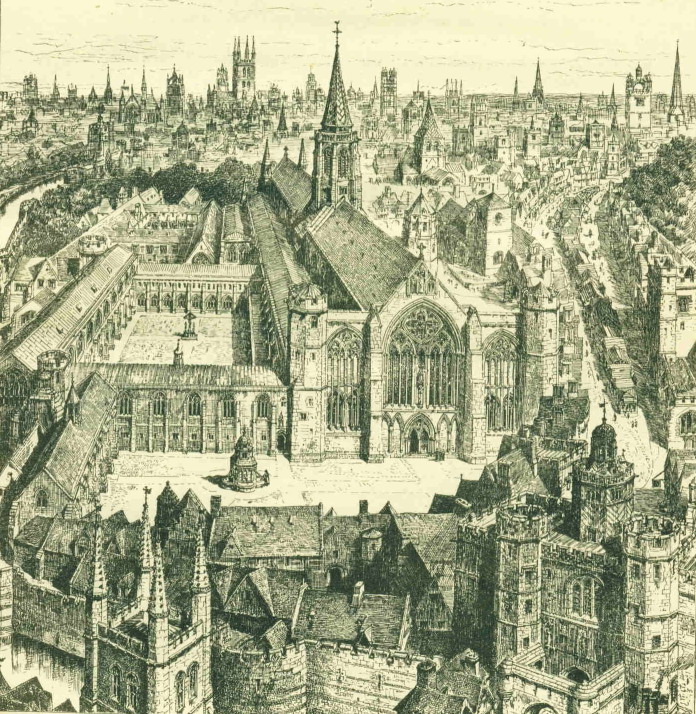
The end of the friary, pictured above in the sixteenth century, came in 1538 when it fell victim to King Henry VIII’s policy of dissolving monasteries and was surrendered to his representatives.

Some of the houses were subsequently converted for private use and the church, which was somewhat damaged during this period with many of the elaborate tombs destroyed, was briefly closed before it and other buildings were given to the City of London Corporation who reopened it again in 1547 as Christ Church Greyfriars, a parish church serving the now joined parishes of St Nicholas Shambles and St Ewen.

Only a few year’s later King Edward IV founded a school for poor orphans in some of the old friary buildings known as Christ’s Hospital or informally as The Bluecoat School thanks to the uniforms students wore. Some of the school buildings, along with part of the church which was also used by the school, was destroyed by the Great Fire of London in 1666, but the school was rebuilt and remained in use until the late 1800s when the last of the students were relocated to a new facility in Sussex (where the school still exists today).

The church (also known as Christ Church Newgate Street), meanwhile, was also rebuilt after the Great Fire – it was one of Sir Christopher Wren’s designs and was completed in 1704. The church remained in use until World War II when a firebomb struck it during a German raid on 29th December, 1940, all but destroying it.

The church was not rebuilt and the parish merged with the nearby St Sepulchre-without-Newgate – the largest parish church in London – and eventually what’s left of the church – the tower with rebuilt steeple and the west and north walls – were converted into a public garden (rose beds were planted where the pews once stood and there are wooden towers representing the church’s pillars). Pictured right, it’s now a terrific place to sit and have lunch pondering the past which the bustle of the city goes on about you.

PICTURE: (top) Wikipedia

For a great biography of Isabella, the She-Wolf of France, see Alison Weir’s Isabella: She-Wolf of France, Queen of England. For more on Sir Christopher Wren’s churches in London, see John Christopher’s Wren’s City of London Churches.