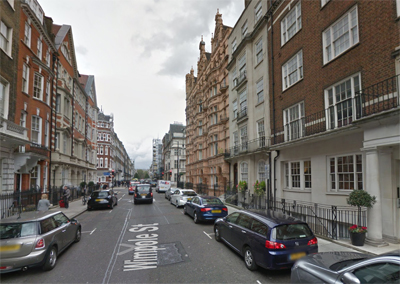
 This notable Marylebone Street contains the home of Henry Higgins, the professor of phonetics who attempts to help Cockney flower girl Eliza Doolittle pass for a duchess as part of a bet in George Bernard Shaw’s play Pygmalion.
Written in 1912, the play which gives Professor Higgins’ address as 27A Wimpole Street was in 1964 adapted into the film, My Fair Lady, starring Audrey Hepburn and Rex Harrison.
The choice of Wimpole Street as the address of Professor Higgins – both for his home and “laboratory” – was apparently not co-incidental. Articles in The Telegraph and Daily Mail last year talk about the fact that 27a lies not far from a grand Georgian (Grade II-listed) townhouse (then on the market for £15 million) in Upper Wimpole Street which was formerly the home of a Professor Horace Hayman Wilson, a professor of Sanskrit at Oxford University in the early 19th century.
The articles say that while the “real-life academic ‘model'” for Higgins was Henry Sweet – an early 20th century Oxford professor of phonetics who is named in the preface to the play, the basis for Professor Higgins’ rather grand lifestyle was that of Professor Wilson.
They also suggest that the connection between Professor Higgins and Professor Wilson makes sense considering one of the mysteries of Pygmalion – how a humble phonetics professor could afford consulting rooms on a street known for wealthy private medical practices.
The answer lies in the Professor Wilson’s history – his father, a doctor, bought a house in the street in 1806 and subsequently bought a neighbouring property for his son who initially pursued a medical career before moving into academia where he specialised in languages. Splitting his time between Wimpole Street, Oxford and Calcutta in India, Professor Wilson’s lifestyle, straddling high society and academia, formed a prototype for that of Professor Higgins. Or so the story goes.
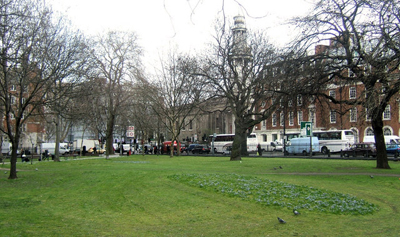
PICTURE: Looking down Wimpole Street; number 27 is second on the left. PICTURE: Google Maps.

 conservationist and influential figure in the Arts and Crafts movement” as well as being the father of world famous writer Rudyard Kipling – opens at the V&A in South Kensington on Saturday. The exhibition is the first exploring the life and work of Kipling (1837-1911) who campaigned for the preservation of Indian crafts as well as being a craftsman himself (his terracotta panels can still be seen on the exterior of the V&A) and an illustrator of his son’s books. Lockwood Kipling: Arts and Crafts in the Punjab and London features paintings of the Indian section of the 1851 Great Exhibition as well as objects which were on display (the exhibition was visited by Kipling while a teenager), Kipling’s sketches of Indian craftspeople observed during his many years living in India as well as objects he selected for the V&A while there, designs and illustrations for books, and furniture he helped his former student architect Bhai Ram Singh design for royal residences Bagshot Park and Osborne. The free exhibition, a collaboration between the V&A and the Bard Graduate Centre in New York, runs until 2nd April (it will be on display at the Bard Graduate Center, New York, from 15th September this year). For more, see
 This pub’s name isn’t too mysterious – it is, of course, named after Albert, Prince Consort to Queen Victoria, and given the date on which the building that now occupies the site was built – between 1862 and 1867, nor is the motivation to name it so – Prince Albert died on 14th December, 1861, leaving a bereft queen and a nation in mourning.

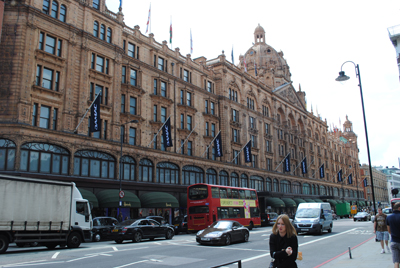
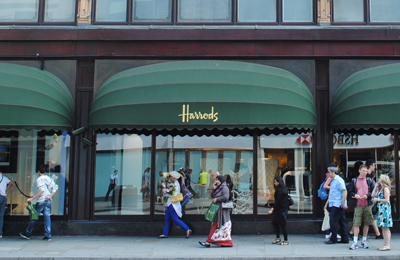
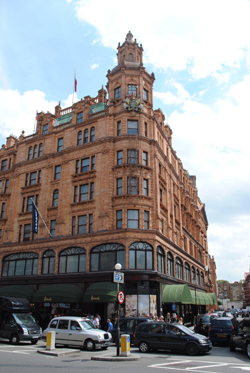 In 1849, to capitalise on trade to the upcoming Great Exhibition in Hyde Park in 1851, he took over a small shop on the site of the current store – initially with just two assistants and a messenger boy. In 1861 his son, the similarly-named Charles Digby Harrods, took over the business and by 1880, the store was employing more than 100 people offering customers everything from medicines and perfumes to clothing and food and already attracting the wealthy customers it would become known for.