10 of London’s greatest Victorian projects – 1. Royal Albert Hall…

The London Underground’s first railway journey took place on 9th January, 1863, and to celebrate we’re taking a look at 10 great Victorian-era projects in London. First up is Royal Albert Hall in South Kensington.

Royal-Albert-HallOpened on 29th March, 1871 (and in continuous use ever since), Royal Albert Hall was built in fulfilment of Prince Albert’s dream of creating a hall that would stand in the heart of the South Kensington estate and provide a focal point for the promotion of the arts and sciences.

It was on the back of the success of the Great Exhibition held in Hyde Park in 1851, that Prince Albert, Prince Consort to Queen Victoria, proposed the creation of a permanent arts and sciences precinct in South Kensington and advised the purchase of land for that purpose (the hall is located on land once occupied by Gore House). But it wasn’t until after his death in 1861 that his vision was actually realised.

Construction of the hall – which was to serve as the centrepoint of the cultural precinct which became known, somewhat derisively, as Albertopolis – started in April 1867 (initially to be known as The Central Hall of Arts and Sciences, the hall apparently had its named changed to the Royal Albert Hall of Arts and Sciences by Queen Victoria while she was laying the foundation stone on 20th May that year – around 7,000 people attended the event). It was designed by engineers Captain Francis Fowke and, after his death, Lieutenant Colonel Harry Darracott Scott, based on concepts put forward by the man described as the “driving force” behind the project, Henry Cole (later the first director of what is now the Victoria and Albert Museum). He had been inspired by the Roman amphitheatres he had seen while touring in southern France.

While initial proposals had suggested the hall would accommodate as many as 30,000 people, this was later scaled back to about 7,000 (and today the figure is apparently about 5,500 thanks to fire regulations).

The central auditorium, measuring 185 feet by 219 feet, is covered by a glazed dome constructed of wrought iron girders and was the largest structure of its kind in the world at the time of its building. The hall’s exterior was built from about six million red bricks and features an 800 foot long terracotta frieze showing figures engaged in a range of cultural pursuits. Much of the interior decorative detail was added later.

So overcome was Queen Victoria at the building’s opening in 1871 that Edward, the Prince of Wales, had to speak in her place, declaring it open on her behalf before a crowd which included then Prime Minister Benjamin Disraeli. Her only reported comment on the hall was that it reminded her of the British constitution.

The Grade One listed hall – which thankfully only suffered minor damage during World War II bombing raids (the German pilots apparently used its bulk as a navigation aid) – has since undergone substantial modifications including works undertaken to improve the hall’s acoustics, the replacement of gas lighting (electricity was first demonstrated in the hall in 1873) and demolition in 1889 of an adjoining glass conservatory to its south. A massive programme of improvements was carried out between 1996 and 2004 at the cost of more than £69 million.

The list of those who have performed or spoken at the hall reads something like a who’s who – among them are classical composers Wagner, Verdi, Elgar and Rachmaninov, singers and musicians including Frank Sinatra, Jimi Hendrix, The Beatles, The Who, Eric Clapton, Elton John, Adele, and Jay Z as well as sports personalities including boxer Mohammed Ali and tennis player John McEnroe, explorers like Sir Ernest Shackleton, world figures such as Queen Elizabeth II, Sir Winston Churchill, former South African president Nelson Mandela, the Dalai Lama and former US president Bill Clinton and other high profile personalities such as Albert Einstein, Alan Ginsberg and Paul Robeson.

Among the other events held in the hall have been a marathon race, Greco-Roman wrestling and two Welsh National Eisteddfod’s (in 1887 and 1909). One of the most popular series of events now held there each year are the BBC Promenade Concerts, known as The Proms they include more than 70 events, which have been held in the hall since World War II.

A Victorian masterpiece. For more on the hall, see www.royalalberthall.com.
LondonLife – Celebrating London Underground’s 150th…

London-Underground1

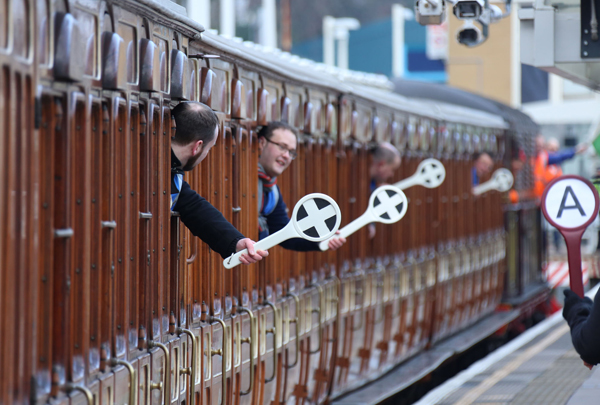
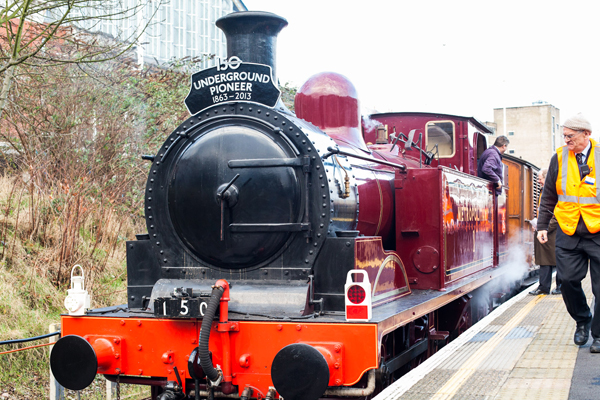
Metropolitan Locomotive No 1 recreated the first London Underground journey, which took place on 9th January, 1863, on the Metropolitan Line between Paddington and Farringdon, as part of the network’s 150th anniversary celebrations last Sunday. The newly restored locomotive was the last to be built at Neasden in 1898 by the Metropolitan Railway. It was pulling the Metropolitan Railway Jubilee Carriage No 353, the oldest operational underground carriage in existence. Ex Metropolitan Railway electric Locomotive No.12 Sarah Siddons also formed part of the train. The train will also be running this coming Sunday (20th January) and on special occasions throughout this year and is just one of a series of events planned by the London Transport Museum to mark the anniversary of what is the world’s oldest underground railway. They include an upcoming exhibition of London Underground’s poster art (more on that to come). For more, see www.ltmuseum.co.uk. PICTURES: © Transport for London from the London Transport Museum collection.

London-Underground3

Where’s London’s oldest…Thames tunnel?

While the Greenwich foot tunnel may these days be more well-known due to the fact it is still open to pedestrians, London’s oldest under-Thames tunnel (also credited as the oldest underwater tunnel in the world) actually runs between Rotherhithe on the river’s southern bank and Wapping on the northern.

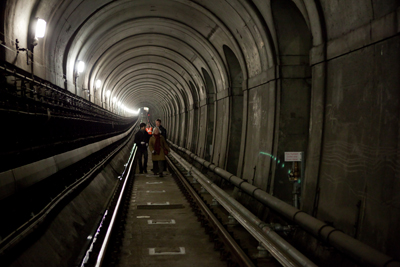
Thames_Tunnel-in-2010First opened in 1843, the Thames Tunnel (pictured left during a brief reopening to pedestrians in 2010) was the first major project of star Victorian engineer (and delightfully named) Isambard Kingdom Brunel (who, at the age of just 19 started work on the job with his father, a French engineer named Marc Isambard Brunel) and was known for a time as the eighth Wonder of the World.

It was constructed after demand grew for a way to transport goods across the crowded Port of London to the east of London Bridge. Given the height of the masts of larger ships, a bridge was deemed impracticable with the ramps required to take wheeled transport to the necessary height far too long (although this problem was overcome at the end of the 1800s by the use of new bascule technology in the construction of Tower Bridge).

Following several failed attempts to dig a tunnel under the Thames, Marc Brunel was given permission to build the new tunnel in the mid 1820s. The project relied on the use of a ‘tunnelling shield’, a then state-of-the-art technological solution to under river tunnelling which had only a few years earlier been patented by Marc Brunel and Thomas Cochrane, and Brunel initially thought the project would only take three years (it ended up taking as many as 18).

Construction by the newly formed Thames Tunnel Company, which had the support of none other than the Duke of Wellington, commenced in early 1825 at the Rotherhithe end. The shield enabled miners to dig out the tunnel while bricklayers came along behind them. While it significantly reduced the risk of a collapse (although several floods still did occur, taking the lives of six men – a fact which didn’t apparently much deter the sightseers who paid for the privilege of seeing the shield in operation), working conditions remained terrible with the men constantly showered with water from the river which was at that time the city’s main sewer. How many died indirectly as a result of working on the project is unknown.

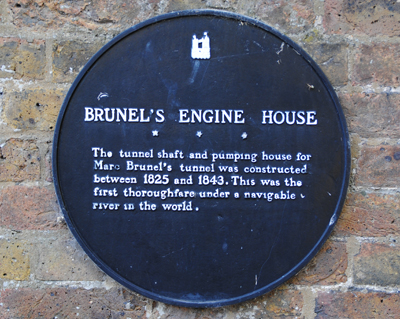
Brunel-plaqueIndeed, such was the stress of the project that Marc Brunel, later knighted for his efforts in building the tunnel, himself suffered a stroke during its construction. Isambard Brunel, who took over as the project’s engineer when the resident engineer fell ill in 1826, himself came close to being killed when he had to flee the flooding tunnel.

After much delay (including seven years in which the unfinished tunnel was left untouched) and several more disasters, the tunnel was finally completed in November, 1841.

After being fitted out with lighting, spiral staircases and roads in the following years, it was finally opened to pedestrians only on 25th March, 1843. While it was originally envisaged that the primary purpose of the tunnel would be to transport goods under the river, this never occurred.

Still, it did capture the public’s attention and as many as 50,000 people walked through the tunnel on the opening day (among the initial visitors to the tunnel was Queen Victoria herself). Within 10 weeks of its opening, a million people (a figure equal to what was then half the population of London) had reportedly passed through it.

Despite the number of people initially using it, however, the tunnel was still not a financial success and over the ensuing years became noted as a gathering place for unsavoury types. In 1865 it was purchased by the East London Railway Company which subsequently incorporated the tunnel into its railway network with both the Wapping and Rotherhithe entrance shafts converted into stations. It later become part of the London Underground network – the  – and since 2010 has been part of the London Overground.

Both stations are still in use and you can get a good sense of what the tunnel was like by riding the overground between Rotherhithe and Wapping. The Brunel Museum in Rotherhithe – actually housed within a building originally used to house machinery for draining the tunnel – see plaque above – is also a great place to find out more about the project and Brunel. Visit www.brunel-museum.org.uk for details.

PICTURES: Top – Lars Plougmann (Wikipedia)/Other – David Adams

For more on the life of Brunel, see Steven Brindle’s Brunel: The Man Who Built the World.

Around London – Christmas at the Tower and Kew Gardens; Old Flo on display; African Diaspora on show at MoL Docklands; and, Mariko Mori at the Royal Academy…

Victorian-Christmas The Tower of London is going Victorian this Christmas with visitors able to experience some of what the Yuletide celebrations in the foreboding, much storied buildings were like in the mid-to-late 1800s. Visitors will be shown how many of the Christmas customs we now participate in each year – like writing cards, pulling crackers and the setting up of family Christmas trees – owe their origins to the Victorian era. The Yeoman Warders will be receiving a Victorian makeover and writer of the age – Charles Dickens – will be reciting some of his works before joining in a “raucous” lunch party with some of his fellow writers, artists and benefactors. It’s even rumoured that Queen Victoria and Prince Albert themselves may make an appearance (take that as a given). Bah! Humbug! A Very Merry Victorian Christmas runs from 27th until 31st December. The festivities will all be included in the usual admission price. For more, see www.hrp.org.uk. PICTURE: Nick Wilkinson/NewsTeam.

Kew Gardens are celebrating Christmas with a host of events including a “Twelve trees of Christmas” family trail. The trail, a map of which can be picked up as you enter, includes facts about trees along the route. Volunteer guides are also leading free tours of seasonal highlights and the Kew Christmas tree can be seen at Victoria Gate. Other festive treats at Kew include the chance to see Father Christmas in his grotto (until Sunday only) and a vintage carousel on the Kew Palace Lawn. Many of the Christmas-related events end on 6th January. See www.kew.org for more.

A display focusing on the history of Henry Moore’s sculpture, Draped Seated Woman (better known as Old Flo), has opened at the Museum of London Docklands. Henry Moore and the East End provides a glimpse into 1950s East London and looks at why public art was considered important at the time. It features some of the maquettes (scale models) Moore used in creating the piece. The exhibition was opened following a decision by the Mayor of Tower Hamlets, Lutfur Rahman, to sell Old Flo (now at the Yorkshire Sculpture Park) rather than display the artwork in a public space. The move is being contested by the Museum of London Docklands who have offered to put the work on public display. An online exhibition can be seen at www.museumoflondon.org.uk/oldflo and a ‘pop-up exhibition’ on Old Flo will be launched in January. The museum is also encouraging people to tweet their views about the selling of the sculpture under the hashtag #saveoldflo.

On Now: Take Another Look. Still at the Museum of London Docklands, this exhibition focuses on the visual representation of people from the African Diaspora who were living and working in Britain in the late 18th and early 19th century. The display of 17 exhibits in the London, Sugar and Slavery gallery features prints by artists including Thomas Rowlandson and George Cruikshank as well as newspaper cuttings, mostly dating from 1780-1833, which show black Britons in perhaps what were unexpected roles – soldiers, musicians and sportsmen – during what was the period in which the abolition of slavery occurred. There are a series of events planned around the exhibition which runs until 4th August. Entry is free. For more see www.museumoflondon.org.uk/Docklands/.

On Now: Mariko Mori: Rebirth. The first major museum exhibition of the New York-based Japanese artist Mariko Mori in London since 1998 has opened at the Royal Academy of Arts in Piccadilly. The exhibition features some of the artist’s most acclaimed works from the last 11 years, many of which have never before been seen in the UK, as well as works created just for the exhibition. Highlights include Tom Na H-iu, a five metre high glass monolith lit by hundreds of LED lights and connected back to the Institute for Cosmic Ray Research at the University of Tokyo; Transcircle, described as a “modern day Stonehenge”; and, Flatstone, an installation of “22 ceramic stones assembled to recreate an ancient shrine”. Runs until 17th February. Admission charge applies. For more, see www.royalacademy.org.uk.

Around London: Charles Dickens Museum reopens; ‘The History Man’s’ blue plaque; and, a Dandy exhibition at the Cartoon Museum…

The only surviving London house lived in by author Charles Dickens – now occupied by the Charles Dickens Museum – reopens on Monday after a £3.1 million restoration and refurbishment. The redevelopment of the Georgian, Grade I listed townhouse at 48 Doughty Street in Bloomsbury – a project named Great Expectations – has seen the museum expand into a neighbouring property at 49 Doughty Street which now houses a visitor and learning centre and cafe. Inside the house itself, the rooms have been returned to their appearance during Victorian times and on display will be some of Dickens’ personal items which haven’t been seen before. They include a set of photographic prints from 1865 which depict a train crash in Staplehurst, Kent, in which Dickens was involved. The museum, which is where Dickens wrote Oliver Twist, Nicholas Nickleby and finished The Pickwick Papers while living here between 1837-1839, was first opened in 1925. This year marks the bicentenary of Dickens’ birth (he was born on 7th February, 1812, in Portsmouth). For more on the museum and upcoming events there (including Christmas performances of A Christmas Carol and a series of special Dickensian Christmas walks), see www.dickensmuseum.com. For more on Dickens, see our earlier special – 10 London sites to celebrate Charles Dickens.

Historian and broadcaster AJP Taylor, known as ‘The History Man’, has been honoured by English Heritage with a blue plaque placed on his former home at 13 St Mark’s Crescent in Primrose Hill.  Taylor lived at the mid-nineteenth century semi-detached villa between 1955 and 1978 during the height of his fame. First appearing on television as early as 1942, Taylor was a regular on television discussion programmes between the 1950s and 1980s, and is described as one of the first ‘media dons’. He also wrote weekly columns in the press and books including the controversial The Origins of the Second World War. Married three times, he had six children and died of Parkinson’s disease in 1990. For more, see www.english-heritage.org.uk/about/news/?topic=Blue%20Plaques.

On Now: A Dandy 75th Birthday Exhibition. This exhibition at the Cartoon Museum in Bloomsbury focuses on The Dandy, Britain’s longest running comic (officially recognised by the Guinness Book of Records), and follows its development from its birth with the release of the first issue on 4th December, 1937 (which, incidentally, was so popular it sold 481,895) through to this year’s issues including the final print issue released on 4th December this year (after which The Dandy goes digital). Runs until 24th December. Admission charge applies. For more see www.cartoonmuseum.org.

10 Historic London Markets – 8. Columbia Road Flower Market…

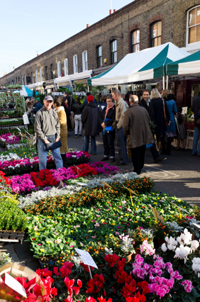
Originally founded in the early 1800s, the Columbia Road market in East London has since evolved into a specialist flower market on Sundays.

First emerging as a general street market in the early 1800s, the market was formalised in the mid 1800s when banking heiress Angela Burdett-Coutts financed the construction of the now demolished – and somewhat architecturally fanciful – Columbia Market. This opened in 1869 at the northern end of the road but didn’t prove a great success. Despite efforts to save it – including apparently relaunching it as a fish market – it closed in 1885.

The market building – which is said to have resembled the sort of market hall that might be found in rural areas – was later used as a warehouse but after suffering bomb damage in World War II were demolished.

The market, meanwhile, reappeared on the street and as the area’s Jewish population grew, moved to a Sunday, a decision which allowed traders from Covent Garden and Spitalfields to trade their leftover goods from the previous day.

The introduction of new regulations – including those introduced in the 1960s requiring traders to attend regularly – saw the market gradually transform itself into the colorful market selling cut flowers, plants and bulbs you can find there today. Popular with film makers and photographers thanks to the colourful backdrop it provides, the surrounding streets also feature a range of interesting independent shops and cafes.

WHERE: Columbia Road, Bethnal Green (nearest Tube stations are Shoreditch, Liverpool Street, Aldgate East and Bethnal Green); WHEN: 8am to 2pm Sunday; COST: Free; WEBSITE(S): www.columbiaroad.info/www.columbia-flower-market.freewebspace.com/index.html.

PICTURE: Dynasoar/www.istockphoto.com

Where is it?…#50

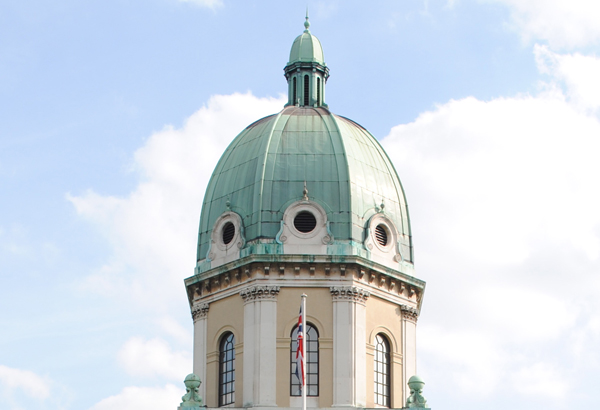
The latest in the series in which we ask you to identify where in London this picture was taken and what it’s of. If you think you can identify this picture, leave a comment below. We’ll reveal the answer early next week. Good luck!

Well done to Martine Poupaux, this is indeed the dome on top of the Imperial War Museum in Lambeth Road, London. The museum, which was formally established by an Act of Parliament in 1920, was initially based in the Crystal Palace and then from 1924 to 1935 in two galleries adjoining the former Imperial Institute, South Kensington. It reopened at its current home in 1936 at a ceremony attended by King George VI. The building was formerly the central portion of Bethlem Royal Hospital, or ‘Bedlam’, which have moved to the site in 1815 (the dome wasn’t part of the original building – it was added later). We’ll be exploring more this history in upcoming posts. For more on the Imperial War Museum, see www.iwm.org.uk/visits/iwm-london.

10 Historic London Markets – 7. Portobello Market…

Established far more recently than many of the other markets we’ve looked at, the origins of a market in Portobello Road in London’s inner west only go back to the mid-to-late 19th century.

The oddly named road (it takes its name from the Battle of Porto Bello in the wonderfully named ‘War of Jenkins’ Ear’ between Britain and Spain in the mid 18th century – more on that in an upcoming What’s in a Name? post), was transformed from a mere laneway, known as Greens Lane, to a larger thoroughfare in the mid 180os as the area developed and the market started to take shape in the 1880s.

These days the street market can stretch for a mile along Portobello Road from Golborne Road in the north to Chepstow Villas in the south.

It offers everything from fruit and vegetables and various foodstuffs (sold particularly at the northern end and along Golborne Road itself, known as Golborne Market as well around Elgin Crescent) through to vintage and alternative clothing, music and other bric-a-brac (a section in the middle, around the Westway flyover, specialises in this – this area includes the Acklam Village Market and the Portobello Green Fashion Market) and the world famous antiques market (down at the south end, closer to Notting Hill Gate Tube station – Saturday is the key day here).

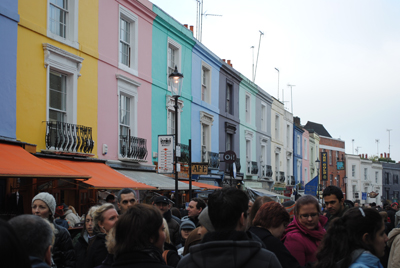
Different sections of the market open on different days – there’s a great map showing what opens when on the Portobello and Golborne Markets website here) – but Saturdays and Sundays are sure to find the area packed with people. The street is also lined with independently owned shops (including the colourful buildings above) and arcades and, as well as street food stalls, there’s plenty of pubs, cafes and restaurants where you can get a bite to eat.

There is currently a campaign to have Portobello Road declared Britain’s first “business conservation area” with the aim of preserving the character of the market. Head here for more details.

WHERE: Portobello Road, Notting Hill (nearest Tube stations are Notting Hill Gate or Ladbroke Grove); WHEN: Trading hours vary, see websites for details; COST: Free; WEBSITE(S): www.rbkc.gov.uk/subsites/visitkensingtonandchelsea/shopping/portobello/ourmarkets/portobelloroadmarket.aspxhttp://shopportobello.co.uk/.

Where is it?…#46

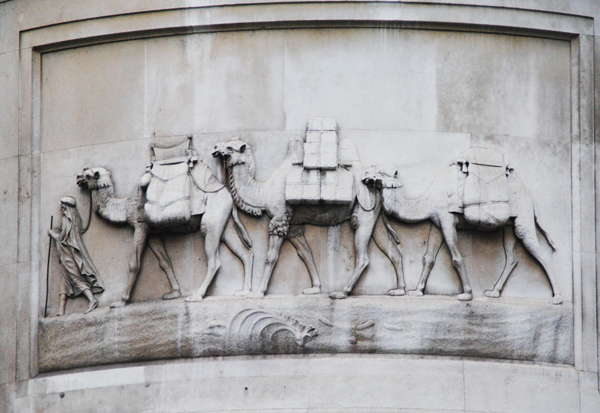
The latest in the series in which we ask you to identify where in London this picture was taken and what it’s of. If you think you can identify this picture, leave a comment below. We’ll reveal the answer early next week. Good luck!

Well done to Carol Stanley – this is indeed located at 20 Eastcheap in the City of London. The building on the facade of which this relief of a camel train sits was formerly the offices of Peek Bros & Co, dealers in tea, coffee and spices. Peek House was built in 1883 after the previous structure, along with others on this side of Eastcheap, was demolished to make way for the Underground’s Metropolitan Line. The picture was carved by William Theed the Younger, who also sculpted the Africa group – including camel – on the Albert Memorial.

What’s in a name?…Cannon Street

One of the major thoroughfares of the City of London, Cannon Street’s name has nothing at all to do with artillery or religion. In fact, the street, which runs from St Paul’s Churchyard in the west to Eastcheap in the east, owes its name to the industry that once took place there.

Like many other streets in the City connected with the occupations of past residents, Cannon Street is a corruption of a street formerly known as Candelwichstrete (one of many various spellings of which the modern English version is Candlewick Street) which relates to the candlemakers and wax chandlers who lived and conducted their trade along the street in the Middle Ages (the Tallow Chandlers Company, involved in regulating candle-making, has been located in adjoining Dowgate Hill since 1476, although the current building dates from 1672).

The name was gradually corrupted into Cannon Street (apparently the corruption was at least partly due to its pronunciation in the Cockney dialect), which is what it was known as by the late 17th century when the seemingly ever-present Samuel Pepys was writing his diary.

Cannon Street – which was only extended to its current length in the mid-1800s under the supervision of architect JP Bunning, having formerly been a narrow lane which stopped at Dowgate Hill in the east – apparently later become known for the number of drapers based there and was also home to the Steelyard or Stalhof, the trading base of the German Hanseatic League in London in the 13th and 14th centuries (a plaque commemorating this was erected at Cannon Street Station in 2005).

Now lined with office buildings including some former warehouses from the Victorian era, the street is also home to a recently redeveloped above ground train station and Underground station- both of which were opened in the late 1800s (the station, which built was on the site of the Roman governor’s palace, was originally located behind the Cannon Street Hotel, birthplace of the British Communist Party). Cannon Street is also the location of the mysterious London Stone – formerly located at the now long-gone St Swithin’s Church, it can be found behind a grill at number 111 – for more on it, see our earlier post here).

London Pub Signs – The Lord Raglan…

Originally known as The Bush,  The Lord Raglan pub just to the north of St Paul’s was renamed in the mid 1800s to commemorate one of the heroes of the Battle of Waterloo – the 1st Baron Raglan (1788-1855).

Named the 1st Baron Raglan in 1852, the man previously known as Lord FitzRoy Somerset had lost his right arm at the Battle of Waterloo, fought between the Duke of Wellington and Napoleon on 18th June, 1815, in modern-day Belgium.

His name was subsequently adopted to to describe the ‘Raglan Sleeve’, a type of sleeve which extends as a single piece to the collar and a style which Lord Raglan was said to have favored after his arm was amputated.

Lord Raglan died in 1855 while Commander-in-Chief at the Crimean War. There is a blue plaque commemorating his role in this war on his former house in Stanhope Gate in Mayfair.

The site of the Lord Raglan tavern, 61 St Martin’s Le Grand, is said to be one of the oldest tavern sites in the city, originally dating from about 1779, and while the current building dates from 1855, the cellars are said to be much older and are said to incorporate parts of what was the Roman wall.

For more on the Lord Raglan, see the Taylor Walker website at www.taylor-walker.co.uk/pub/lord-raglan-st-pauls/c1779/.

Around London – Dickens and the foundlings; astronomy photographs at the Royal Observatory; Royal Parks allotments; and, Asian drinking vessels at the British Museum…

• A new exhibition exploring the relationship between author Charles Dickens, the Foundling Hospital and its secretary and former foundling, John Brownlow, opened at the Foundling Museum today. Received, a Blank Child: Dickens, Brownlow and the Foundling Hospital looks at how Dickens supported the institution in various ways including helping a young mother petition for a place for her child and publicising the work of the hospital through his writing – in particular the 1853 article Received, A Blank Child (the phrase comes from the wording used on the hospital’s entry forms). Among the items on display are never before displayed letters from Dickens relating to the hospital. The exhibition, which runs until 16th December, is free with the museum admission. And if you haven’t yet had a chance to see it, there’s still time to catch Dickens and the Foundling, in which six contributors including actor Gillian Anderson and journalist Jon Snow, have chosen objects to be displayed. This ends on 28th October. For more, see www.foundlingmuseum.org.uk.

Images from the Astronomy Photographer of the Year competition have gone on display at the Royal Observatory in Greenwich (which runs the competition in conjunction with Sky at Night Magazine). Among the winning images were The Whirlpool Galaxy taken by Martin Pugh of the UK/Australia, Star Icefall by Masahiro Miyasaka of Japan, and Venus-Jupiter Close Conjunction, by Laurent Laveder of France. The exhibition is free of charge and runs until February next year. For more (including an online gallery), see www.rmg.co.uk/visit/exhibitions/astronomy-photographer-of-the-year/2012-winners/.

It’s Harvest Festival time at London’s Royal Parks and this Sunday, between 11am and 4pm, people are invited to attend the Kensington Gardens’ allotment to see the fruits of the gardeners’ labour including the “big dig” of the potato crop as well as seasonal vegetables. There’s also the chance for families to see the allotment chickens being fed and children’s activities run by Ginger Cat. This week’s event follows one last weekend at Regent’s Park. For more, see www.royalparks.org.uk.

• On Now: Ritual and revelry: the art of drinking in Asia. This new free exhibition in room 91 of the British Museum features a display of objects which have been used in the consumption of liquids in various Asian contexts and the manner in which their use is intertwined with ritual, religious and otherwise. Among the vessels on display is a Tibetan skull-cap known as a kapala which is made from a human skull and used in religious rituals as well as a silver tea set from western India which features handles shaped like bamboo stems and a lacquered wooden sake bottle which was used as an altar piece. Runs until 6th January. For more, see www.britishmuseum.org.

What’s in a name?…Pimlico

Tradition holds that this small triangular area, wedged between Westminster and Chelsea on the north bank of the Thames, takes its name from Ben Pimlico, said to be the 17th century owner of an famous alehouse or tea garden in Hoxton, on the north side of the City, and brewer of a particularly sought-after “nut brown” ale.

The story goes that so popular was his brew that Hoxton Street was then known as the “Pimlico Path”  due to the numbers making their way to his alehouse and that the area of Pimlico somehow adopted this name (although to be fair we should note that it’s also been suggested that the name comes from the Pamlico tribe of American Indians who exported timber to London around the same period).

While references to Pimlico go back to the 17th century, the area was largely uninhabited until the 19th century when it was developed by Victorian planner Thomas Cubitt under contract to the land owner, the Grosvenor family.

Initially in demand among the well-to-do, the fortunes of the area had declined by the end of the nineteenth century before a resurgence of interest took place in the early 20th century.

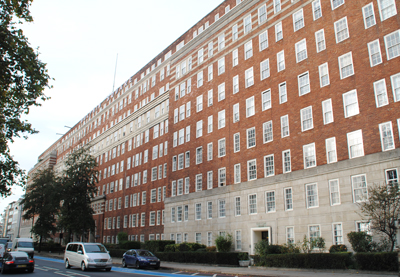
Among the projects constructed at that time was Dolphin Square (pictured) – with more than 1,200 apartments, it was the largest apartment complex in Europe at the time and has since proved particularly popular among politicians keen to be close to the action in Westminster and Whitehall.

Famous residents of Pimlico have included Winston Churchill, who lived briefly at 33 Eccleston Square between 1908-11.

Worth noting is that there is a racecourse in Maryland in the US known as the Pimlico Race Course which is also named for Ben Pimlico’s tavern.

For a photographic essay of Pimlico, check out Brian Girling’s Pimlico Through Time.

London Pub Signs – Tom Cribb…

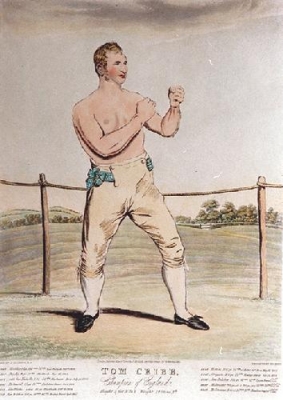
In keeping with the sporting theme, we decided to take a look at a pub that bears that name of a sportsman – in this case Tom Cribb, a celebrated early nineteenth century boxer.

Born in 1781, Cribb moved to London from his home in Gloucestershire at just the tender age of 13 and worked in various jobs including as a bellhanger and a porter on the wharves before in taking up the sport of bare knuckle boxing with his first public bout in 1805 (he was known as the ‘Black Diamond’ thanks to his previous work as a coal porter).

Further fights followed and Cribb’s skill was such that in 1809 he won the British title and the following year he fought American and former slave Tom Molineaux to become world champion, a feat he repeated the in 1811 by beating Molineaux again.

Cribb retired from boxing in 1812 and later became a publican, running a couple of different pubs before taking up the job the Union Arms, located at 26 Panton Street, in the West End. He did apparently marry and in 1821 was among the prize fighters who guarded the entrance to Westminster Hall on the day of King George IV’s coronation.

Forced to give up his pub to creditors to pay off gambling debts, he retired to Woolwich in 1839 and died there in 1848 – he was buried in St Mary’s Churchyard where there is a memorial to him.

The pub which now bears his name is located on the same site as the Union Arms, although it is numbered 36 due to a numbering change. Inside it features a boxing theme with photos of some of Britain’s greatest boxers adorning the wall.

For more, see www.shepherdneame.co.uk/pubs/london/tom-cribb.

For a book on Tom Cribb, try Tom Cribb: The Life of the Black Diamond.

PICTURE: Tom Cribb in an engraving published in 1842. Source – Wikipedia.

Olympics Special – London bridges aglow…

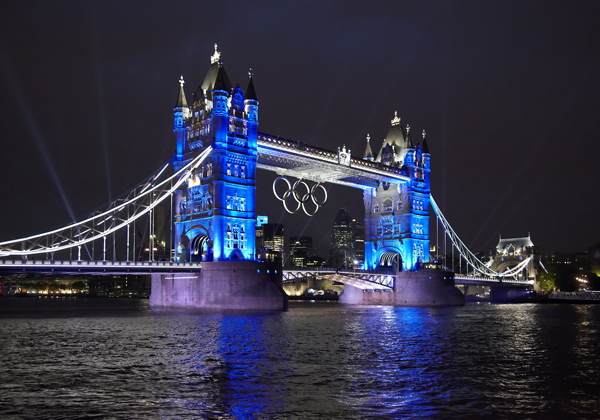
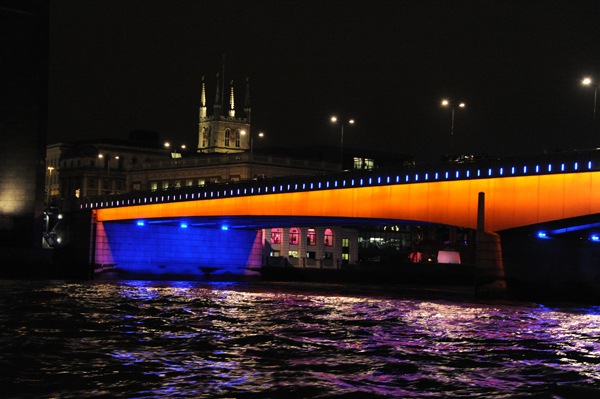
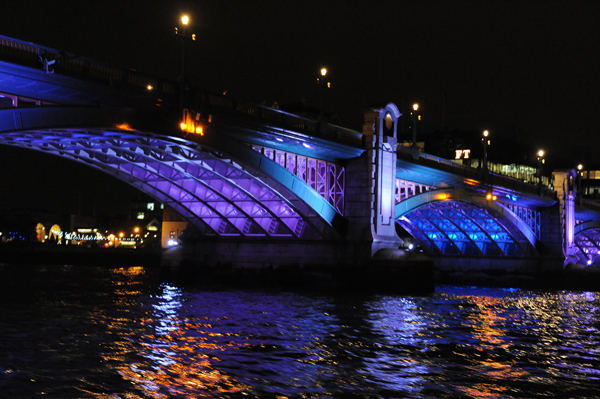
Seven of London’s bridges are being lit up at night until 10th September in an initiative called “Dazzle”. Being run under the Mayor of London Presents program, it celebrates the 50 evenings of the Olympic and Paralympic Games. Here’s just a sample of what you can see…

The most iconic of London’s bridges, Tower Bridge has been a focal point for Olympic celebrations. One of the great structures of Victorian London, it was opened in 1894 and at the time was largest bascule bridge ever built (for more on Tower Bridge, see our earlier post here).

The most recent version of London Bridge, this links Borough High Street in Southwark (you can see Southwark Cathedral in the background) and King William Street in the City and was built in the late 1960s/early 1970s and opened by Queen Elizabeth II in 1973. There have been bridges in this vicinity since as far back as Roman times (for more on the history of London Bridge, see our earlier post here).

The current Southwark Bridge – which links the City of London with the heart of Southwark – dates from 1921 and replaced an earlier bridge designed by John Rennie.

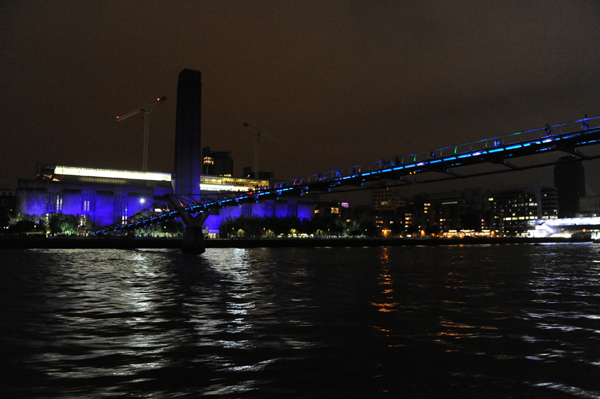
Initially plaqued by the wobbles, the steel suspension walk bridge known as Millennium Bridge is the newest of the bridges that cross the Thames in central London, linking St Paul’s Cathedral on the north bank with the Tate Modern on the south (the looming bulk of which is pictured here). First opened in July 2000, it was closed after concerns over its movement and then reopened to the public in 2002.

Other bridges taking part in Dazzle but not shown here include the Golden Jubilee footbridges, Waterloo Bridge and Blackfriars Bridge.

For more on the program, see www.molpresents.com/dazzle.

PICTURES: All images courtesy of the City of London Corporation.

10 Historic Sporting Events in London – 5. The ‘Ashes’ are born…

While England and Australia played their first test match as far back as 1877 (at the Melbourne Cricket Ground), the origins of The Ashes go back to a game played at The Oval (now officially known as The KIA Oval) in Kennington in 1882.

Playing their only test of that tour, the Australians only made 63 runs in their first innings, giving England a 38 run lead with a total of 101. Australia followed this up with 122 leaving England just 85 runs to win. They were stopped just eight runs short of victory.

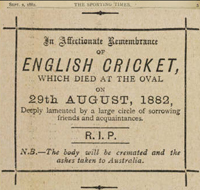
The English team were berated in the press for the loss and on 2nd September that year, a mock obituary for English cricket appeared in The Sporting Times stating that, having died at The Oval on 29th August, 1882, it will be “deeply lamented”. There was a note at the bottom of the obituary (picture right) which said that the body would be cremated and the ashes taken to Australia. And so the name, the Ashes, was born.

English captain Ivo Bligh subsequently promised that he would regain the ashes during the 1882-83 English cricket team’s tour of Australia while the Australian captain WL Murdoch vowed to defend them. It was during a social match played at Rupertswood Estate outside the city of Melbourne that Bligh was presented with the tiny terracotta ashes urn (today on display at the MCC Museum at Lord’s – see our earlier post for more).

The history of The Oval goes back to the mid-1840s when, following the establishment of the Surrey Cricket Club, it was granted a lease for the land from the Duchy of Cornwall (who still own it). The Ashes aside, memorable moments there have included the playing of the first match in the Australian Aboriginal team’s tour of England in 1868 (the first tour of England by a foreign side) and the first England v Australia test match to be played in England (1880). The Oval was also the location for the first international football match, played between England and Scotland in 1870, and the first FA Cup Final, played here in 1872.

Interestingly, The Oval also held a particular attraction for the US billionaire philanthropist,  J Paul Getty II, who built a replica of the ground at his estate at Wormsley Lodge in England’s south.

The history of Lord’s, London’s most famous cricket ground, meanwhile, goes back somewhat further. The current ground is the third to bear the name of Lord’s – the first was created on what is now Dorset Square in Marylebone at the behest of entrepreneur Thomas Lord (from whom it derives its name) and the first match staged there in 1787, the date on which the Marylebone Cricket Club was formed. Between 1811 and 1813, the ground was relocated to Marylebone Bank in Regent’s Park before moving to its current home in St John’s Wood (then the site of a duck pond).

Both grounds continue to host a range of cricketing and other events, such as the current Olympic archery competition being held at Lord’s.

WHERE: The Oval, Kennington Oval, Kennington (nearest Tube stations are Oval, Vauxhall and Kennington); WHEN: 90 minute tours of the ground are available (check website for booking details); COST: Tours cost £10 an adult/£5 under 16s/£25 a family ticket; WEBSITE: www.kiaoval.com.

WHERE: Lord’s Cricket Ground, St John’s Wood Road, St John’s Wood (nearest Tube Stations are Warwick Avenue, St John’s Wood, Marylebone and Maida Vale); WHEN: 100 minute tours of the ground (which include a visit to the MCC Museum) are available daily (check website for times – note that there are no tours during the Olympics, these resume on 21st August); COST: Tours cost £15 an adult/£9 concessions/£40 a family ticket; WEBSITE: www.lords.org.

PICTURE: Wikipedia

Famous Londoners – Mr Punch…

Infamous, perhaps, rather than famous, Mr Punch (one half of Punch & Judy) this year celebrated the 350th anniversary of his first public appearance in London (which, in our view, makes him an honorary Londoner!).

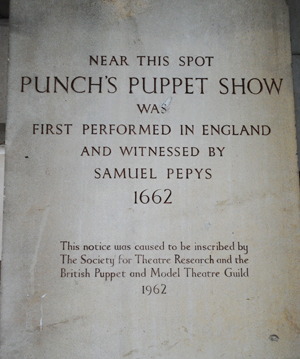
The first documented appearance of the hook-nosed Mr Punch – known for his acrimonious relationship with his wife Judy –  dates back to 9th May, 1662, when diarist Samuel Pepys recorded seeing a Mr Punch puppet performing as part of an Italian marionette show at Covent Garden (officially awarded a Guinness World Record title earlier this year for being the first recorded Mr Punch puppet show).

Mr Punch’s origins go back to Italy (Punchinello is thought to be an anglicised version of the character name of Pulcinella), typically wears a jester’s motley and tall, ‘sugarloaf’, hat with a tassel. Now generally a hand-puppet rather than a marionette, these days he usually performs in a mobile puppet booth with a cast of characters who as well as Judy can include a baby, a police constable and a crocodile.

Storylines – which were initially aimed at adults but are now generally aimed at children – vary but usually include references to current events (and perhaps also some mocking of public figures) and inevitably involve the unruly and often bawdy trickster, Mr Punch, doing away with his foes before uttering the line: “That’s the way to do it!”

Interestingly, Punch & Judy performers refer to themselves as “professors”  – there’s a story, apparently apocryphal, that this title was granted to the performers by King Charles II thanks to his enjoyment of the show. Collecting money from an audience watching the show is known as ‘bottling’ and those who assist the professor by doing so as ‘bottlers’, thanks to the tradition of using a bottle for the task.

Mr Punch reached the height of his popularity in the Victorian and Edwardian ages and could typically be seen carrying on in seaside resorts across the country. The dramatic decline in his popularity since means it can be harder to find a Punch & Judy show today (and even when you do, much of his more brutal antics have been excised from plays so as not to offend modern sensibilities), but it’s still possible to see Punch and Judy performances in many places across the UK including, on occasion, at Covent Garden where there is a plaque (shown above) commemorating the performance seen by Mr Pepys.

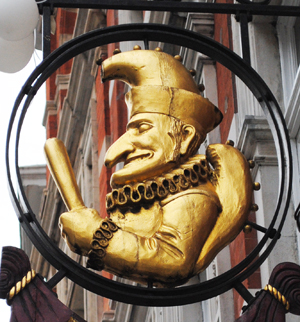
Mr Punch is still celebrated every year at Covent Garden’s May Fayre and Puppet Festival (held close to 9th May – not only the day Mr Pepys saw the puppet but now regarded as Mr Punch’s ‘birthday’) and there is a fellowship of Punch and Judy performers – The Punch & Judy Fellowship – who aim to “preserve, promote and protect” the traditions of the puppet show. Punch can also be seen on the facade of the Punch Tavern in Fleet Street – the sign is pictured above (keep on eye out for our upcoming Pub Signs look at the pub’s history).

What’s in a name?…Victoria Embankment

This Thames-side stretch of land, part of the massive Thames Embankment, was completed in 1870 after several years work and named for the then-reigning monarch, Queen Victoria.

The Victoria Embankment, which runs from Westminster Bridge to Blackfriars Bridge, pushed back the waters of the Thames and reclaimed land which was used for a roadway (built over over the District Tube line) and several public gardens, collectively known as Victoria Embankment Gardens. To see the level of the original river bank, go to the lower entrance of Somerset House on Victoria Embankment and look through the glass floor just outside the doors.

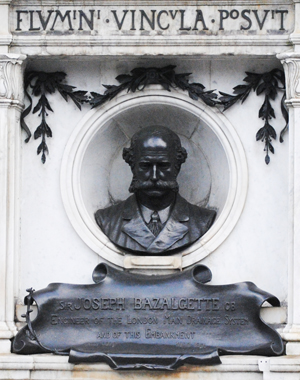
The project was carried out under the direction of engineer of the age, Sir Joseph Bazelgette, as part of his monumental effort to build a modern sewage system for London and to help relieve traffic congestion.

The stretch of roadway and the series of gardens which now occupy part of Victoria Embankment feature numerous statues (including one of Bazelgette himself – pictured) and other landmarks such as the York Watergate (see our previous post), Cleopatra’s Needle (see our previous post) and the RAF Memorial.

There are also several piers positioned along the Victoria Embankment including Embankment, Westminster and Blackfriars Millennium Piers which vessels moored along this section of the riverbank include the HQS Wellington (home of the Honourable Company of Master Mariners) and the HMS President (now a function centre, it is formerly a naval ship named HMS Saxifrage.)

Treasures of London – The Clock Tower…

The tower at the northern end of the Houses of Parliament is known to many simply as Big Ben – what isn’t often realised is that (as was pointed out in this earlier article) Big Ben actually refers to a bell inside the tower and not the tower itself. The tower, rather, has the rather plain moniker of The Clock Tower. But in honor of the Queen’s Diamond Jubilee, that’s all about to change.

News broke this week that politicians have decided to rename the tower the Elizabeth Tower in honor of Queen Elizabeth II. The move does have precedent – the great southern tower which stands over the Sovereign’s Entrance to the House of Lords was once known as the King’s Tower but was renamed the Victoria Tower in honor of Queen Victoria’s Diamond Jubilee in 1897 (Queen Victoria is the only other British monarch to have celebrated a Diamond Jubilee).

The 96 metre high tower, part of the Houses of Parliament (officially known as the Palace of Westminster), is not the first clock tower to stand on the site of the palace. The first, located on the north side of New Palace Yard, was built in 1288-90 in the reign of King Edward I and contained a bell and clock.

It was replaced in 1367 with a tower that featured the first public chiming clock in England. This second tower was demolished in 1707 after falling into disrepair and replaced with a sundial.

Following a fire which destroyed much of the Palace of Westminster in 1834, architect Sir Charles Barry was selected to design new buildings to house Parliament but interestingly his initial designs didn’t include a clock tower – this was added to the plans in 1836.

Construction of the new Clock Tower, which was built from the inside out and clad in Yorkshire Anston stone and Cornish granite, began in September 1843 but wasn’t completed until 1859 following considerable delays. The ‘lantern’ at the top is known as the ‘Ayrton Light’, named for Acton Smee Ayrton, an MP and the First Commissioner of Works in the 1870s. Not installed until 1885, it is lit up when either House is sitting at night.

The clock was constructed by Edward John Dent and his stepson Frederick to the designs of Edmund Beckett Denison. It included a “revolutionary mechanism” known as the ‘Grimthorpe Escapement’ (Denison was later created Baron Grimthorpe), which helped ensure the clock’s accuracy despite external factors like wind pressure on the clock’s hands and which was adopted in many subsequent clocks. The design of the dials were a collaboration between Barry and Augustus Welby Pugin.

The clock was installed in April 1859 but the cast-iron hands were too heavy and had to be replaced with copper ones. It began keeping time on 31st May, 1859.

It’s worth noting that the tower tilts at 0.26 degrees to the north-west but experts say this is apparently not going to be a major structural problem for 10,000 years.

For more on the Clock Tower including a terrific virtual tour, see www.parliament.uk/bigben. It is possible to tour the Houses of Parliament – including climbing the 334 steps to the top of the Clock Tower – but this is only open to UK residents (and they book up months in advance). For more on the tours, see www.parliament.uk/visiting/visiting-and-tours/ukvisitors/bigben/.