LondonLife – Recalling the Queen’s Coronation…

Coronation

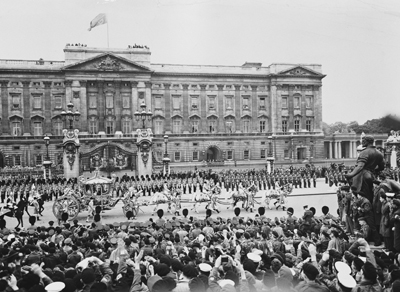
The Gold State Coach passes in front of Buckingham Palace on 2nd June, 1953. The image is among the displays at the special exhibition marking the 60th anniversary of the coronation of Queen Elizabeth II which forms part of the summer opening of Buckingham Palace’s State Rooms. The exhibition, which runs until 29th September, features dresses, uniforms and robes worn by the principal royal party on the day along with works of art, paintings and other objects related to it. Admission charge applies. For more, check out www.royalcollection.org.ukPICTURE: Royal Collection Trust/All Rights Reserved.

LondonLife – New life for the Blue Plaques scheme…

Alexander-Pope

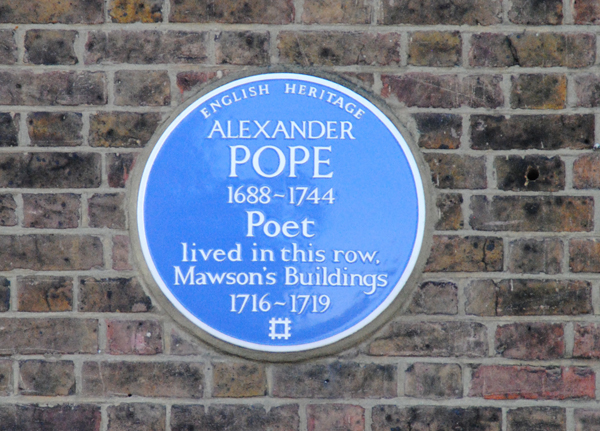
The humble Blue Plaque is set for a new lease on life following an announcement this week. The London Evening Standard has announced it will help breathe new life into English Heritage’s Blue Plaque’s scheme this week with the scheme – which was suspended in January due to funding cuts – set to relaunch next year in association with the newspaper. As many as 20 new plaques have already been funded through a £80,000 donation from property developer David Pearl, says the paper, and the public are being urged to help financially support the programme at www.english-heritage.org.uk/donate. The Standard also noted that from next year its readers will be able to vote for candidates for future plaques. Each Blue Plaque costs about £4,000 to create and install. Pictured is a Blue Plaque commemorating poet Alexander Pope’s residence in a Chiswick property between 1716-1719.  The property is now the Mawson Arms public house.

LondonLife – A look into London’s wartime past…

StreetMuseum

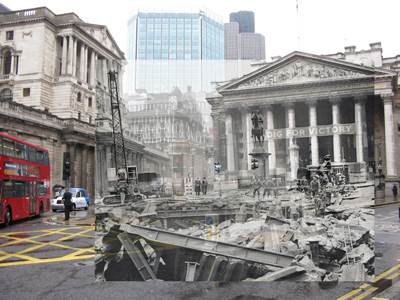
Images from the Museum of London’s Streetmuseum app give a glimpse into London’s past – in this case, its wartime history. The image above, taken by Police Constable Arthur Cross, official photographer of the City of London Police, and his assistant PC Fred Tibbs, shows bomb damage at Bank Underground Station, following a direct hit on 10th January, 1941. An estimated 111 people who had been sheltering in the Tube died, some of them thrown into the path of an incoming train. The crater that was left outside the Royal Exchange was so large the Royal Engineers had to build a bridge across it. For details on how to download the app, head to www.museumoflondon.org.uk/Resources/app/you-are-here-app/home.htmlPICTURE: © Museum of London/By Kind Permission of The Commissioner of the City of London Police.

LondonLife – LEGO celebrates the Tube’s 150th…

Lego-Tube-map

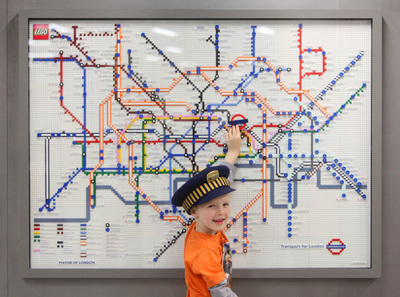
Six-year-old James Apps gets a close-up look at a map of the Tube as it will look in 2020, one of five LEGO Tube maps currently on display in London. The maps depict the evolution of the Tube network from 1927 through what it will look like in 2020, including Crossrail, and the proposed Northern Line extension and proposed Croxley Rail Link. The maps – each of which contains more than 1,000 bricks and took professional LEGO builder Duncan Titmarsh four days to build – can be found in the ticket halls of the following stations – South Kensington (1927), Piccadilly Circus (1933), Green Park (1968), Stratford (2013) and King’s Cross (2020). Visit the Transport for London website for more on the Underground’s 150th anniversary here (the website includes downloadable instructions for building your own Underground roundel out of LEGO bricks). PICTURE: Transport for London.

LondonLife – A glimpse into some of London’s hidden gardens…

Eccleston-Square

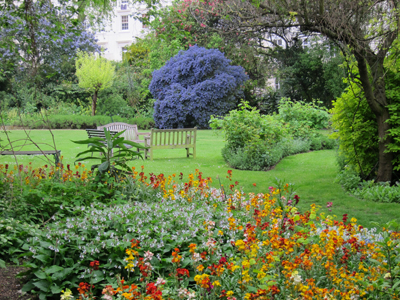
Thousands turned out for the Open Garden Squares Weekend in London earlier this month when more than 200 of London’s private, hidden, unusual or little known gardens – including those at Eccleston Square in Pimlico, pictured above – threw open their gates to the curious public. Among the highlights of this year’s weekend was the chance to see the gardens at 10 Downing Street (more than 40,000 people applied for the 40 places) which also included a tour of the house. Next year’s event will be held on 14th and 15th June. For more, see www.opensquares.org.

PICTURE: Courtesy of Open Garden Squares Weekend.

LondonLife – Celebrating the 60th anniversary of Queen Elizabeth II’s coronation…

Regent-Street-turns-purple-to-celebrate-The-Queen’s-Coronation-

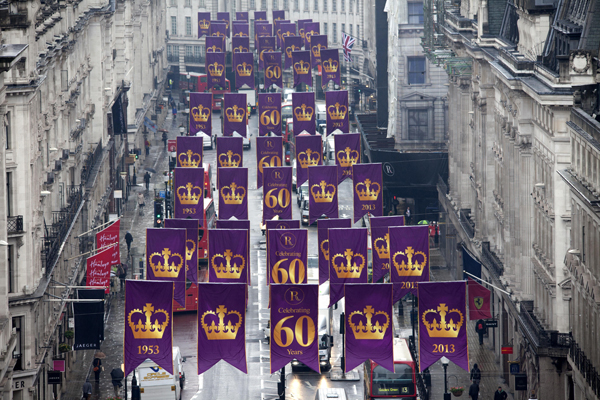
Regent Street is adorned with flags in celebration of the 60th anniversary of Queen Elizabeth II’s coronation, among the many ways in which London has been celebrating the occasion. The official anniversary was on Sunday – it was 2nd June, 1953, some 16 months after the 25-year-old Queen took the throne following the death of her father King George VI, that Queen Elizabeth II was crowned in Westminster Abbey. In celebrations yesterday, the King’s Troop Royal Horse Artillery fired a 41-gun salute in Green Park at midday followed an hour later by a 62-gun salute fired by the Honourable Artillery Company across the River Thames from the Tower of London. The Queen and other members of the royal family (along with some 2,000 guests) is attending a special service at Westminster Abbey today (for more on how the abbey is celebrating the event, see our earlier post here). More than 8,000 people attended the coronation which was watched by an estimated 27 million people across the country. PICTURE: RegentStreetOnline


LondonLife – Celebrating 100 years of the RHS Chelsea Flower Show…

Chelsea2

Queen Mary (wife of King George V) with group at the RHS Chelsea Flower Show in 1913. The show, which was first held in the grounds of the Royal Hospital, Chelsea, in 1913, is celebrating its centenary this year. The 244 exhibitors at the inaugural event have grown to more than 500 today with 161,000 visitors now attending the show each year. Other pictures released to mark the centenary include (see below) gardeners carrying pots at the show in 1931; visitors looking at a display of cacti at the 1964 show; and, an aerial view of the show in the 1990s. The show runs from today until 25th May. For more on the RHS Chelsea Flower Show, see www.rhs.org.uk/Shows—events/RHS-Chelsea-Flower-Show/2013PICTURES: RHS Lindley Library. 

Gardeners-carrying-pots-at-the-Show.-Date-1931.-Credit,-RHS-Lindley-Library

Chelsea3

Chelsea4

LondonLife – Paternoster Square from St Paul’s…

Paternoster-Square

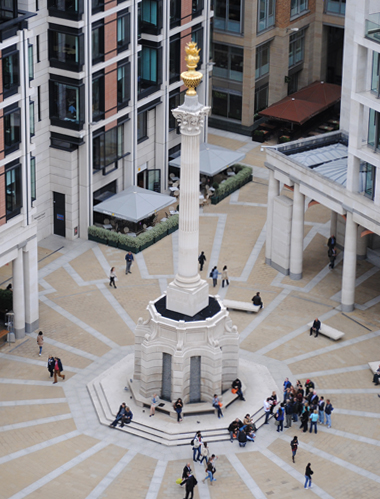
Looking down on Paternoster Square from St Paul’s Cathedral. The 23.3 metre tall pillar at the centre of the square is the  Paternoster Square Column. Designed by architects Whitfield Partners (responsible for the square’s redevelopment in the early 2000s) and topped by a gilded copper urn with flames coming out of the top, it serves as a ventilation shaft for a carpark underneath. The redevelopment of the square – home to the London Stock Exchange since 2004 – followed an earlier redevelopment in the 1960s (needed after aerial bombing destroyed the area in World War II, the second time the area had been destroyed – the first was when the Great Fire of London swept through in 1666). The square takes it name from Paternoster Row which once ran through it. For more, see www.paternostersquare.info.

PICTURE: David Adams

LondonLife – Celebrating St George’s Day…

Feast-of-St-George

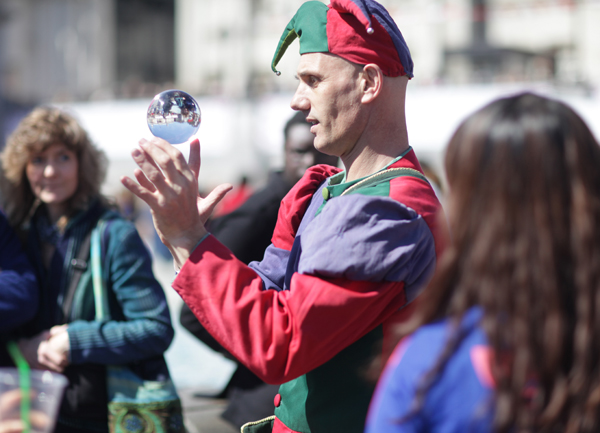
Magic tricks at the ‘Feast of St George’ in Trafalgar Square on Saturday. Wandering performers were just part of the celebrations in the square held there on Saturday in honour of St George’s Day (the actual St George’s Day is today, 23rd April). Other activities also included a farmer’s market, food tastings and live cooking demonstrations with a specially decorated banqueting table, music, traditional games and children’s activities including a quest with prizes awarded by a five metre high interactive dragon. Put on by the Mayor of London, the Feast of St George is inspired by St George’s Day’s 13th century origins as a national day of feasting. PICTURE: James O Jenkins/Greater London Authority.

LondonLife – The Tweed Run London…

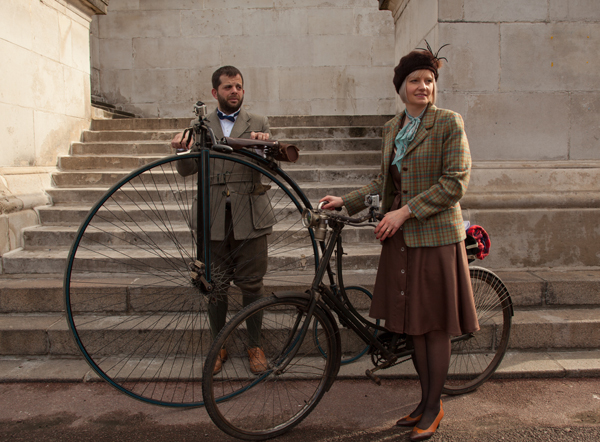
Tweed-RunThe Tweed Run London celebrated its fifth anniversary last Saturday with more than 500 taking part in the rather unusual annual event in which participants combine their passion for British fashion with their love for cycling. Among those taking part (entry was via a lottery system) on bikes of all shapes and sizes were people from as far afield as The Netherlands, Korea, Russia, Australia, Japan and even Afghanistan. The two hour ride took in Marylebone High Street, Savile Row, Regent Street, Piccadilly Circus and the Houses of Parliament before finishing at Trafalgar Square. The ride has been copied by other cities around the world including, Tokyo, Toronto and St Petersburg. For more on the Tweed Run, see www.tweedrun.comPICTURE: Selim Korycki, Tweed Run LLP.

LondonLife – New pelicans fly into St James’s Park from Prague…

Pelicans

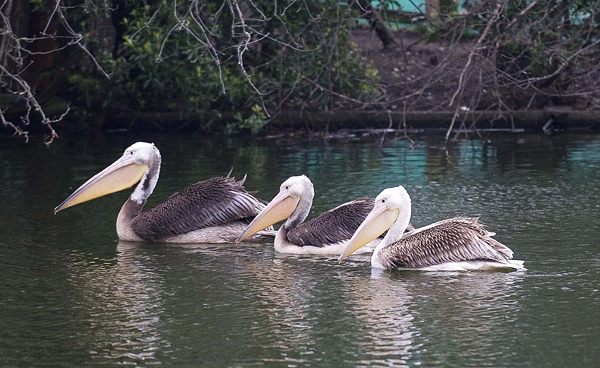
Following a tradition that dates back to 1664, three new pelicans have taken up residence in St James’s Park in front of Buckingham Palace. A gift from the City of Prague in the Czech Republic (the birds were donated by Prague Zoo), one of the pelicans is named Tiffany (in honour of New York-based The Tiffany & Co Foundation – which funded transport of the birds) while the other two have yet to be named with the public invited to join in the process by voting for their favourite name for one of the birds from a shortlist published on the Royal Parks Foundation website, www.supporttheroyalparks.org (the poll closes on 16th April). Choices include Bela, Karola, Queenie and Isla. The first pelican to live in the Royal Parks was a gift to King Charles II from the Russian ambassador in 1664 and they have been there ever since. The new arrivals, join the existing ‘scoop’ of pelican residents in the park – Gargi, Vaclav and Louis. PICTURE: Courtesy of Royal Parks Foundation.

LondonLife – Farewell to the BBC Television Centre…

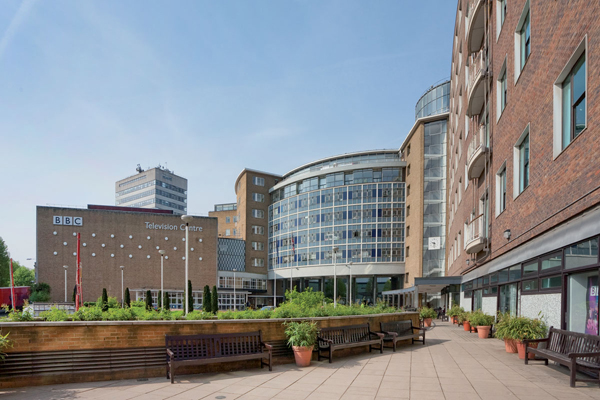
BBC-Television-CentreThe BBC Television Centre in London’s west closed its doors on Sunday, almost 53 years after it was officially opened on 29th June, 1960.  The 14 acre site in Wood Lane, White City, was sold for £200 million to developers Stanhope Plc. It will be redeveloped into new premises including a hotel, offices, flats, townhouses and a cinema. The Television Centre – the main building of which was affectionately known as the ‘doughnut’ thanks to its circular shape – has hosted some of the UK’s most iconic television shows – from The Two Ronnies to NewsnightMonty Python’s Flying Circus to Dr Who, Fawlty Towers and Blue Peter. It’s far from the end of the relationship between the site and the BBC. Various arms of the BBC will return to the site in coming years and other plans reportedly include the creation of a ‘virtual attraction’ where visitors can experience the creation of shows like Top Gear and EastEnders. BBC stars including Sir Michael Parkinson, Penelope Keith, Ronnie Corbett, Sir Terry Wogan and Sir David Jason have paid tribute to the building in a TV special, Goodbye Television Centre, broadcast on 22nd March. For more, see www.bbc.co.uk.

LondonLife – The city illuminated…

London-at-night-(NASA)

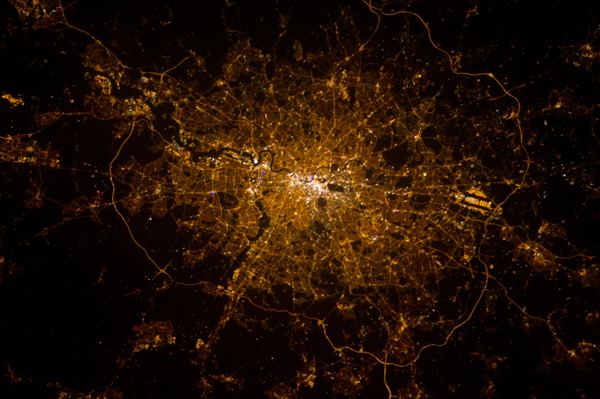
An image of London taken from the International Space Station, about 240 miles above the Earth, on 2nd February, 2013. Writes Expedition 34 flight engineer Chris Hadfield – an astronaut with the Canadian Space Agency: “London, on the Thames, from the city to the encircling motorway. Heathrow very visible on the (west).” North is at the bottom of the image, making west on the right in this image. As well as the M25, the winding River Thames can be clearly seen cutting through the city centre. PICTURE: NASA

LondonLife – 14th century burial ground unearthed underneath Charterhouse Square…

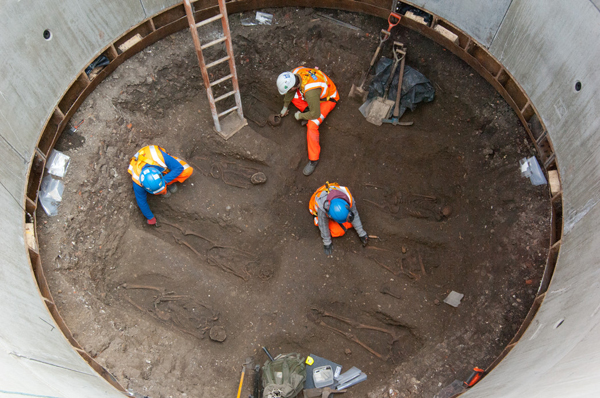
Crossrail---FarringdonA lost London burial ground has been unearthed in Farringdon by archaeologists working on the £14.8 million Crossrail project.

Thirteen adult skeletons, believed to be up to 660 years old, have been discovered lying in two rows 2.5 metres below the ground on the edge of Charterhouse Square.

It is likely based on the depth at which the bodies were buried and other evidence (including pottery found at the site and a similarity between the layout of the bones and those of 14th century plaque victims unearthed at the East Smithfield Burial Ground in the 1980s), that the skeletons were buried here in 1349 during the Black Death.

Historical records suggest that as many as 50,000 people may have been buried here in the three years from the burial ground’s opening in 1348. The burial ground remained in use until the 1500s but has never been located in modern times.

The skeletons are being excavated and taken to the Museum of London Archaeology for laboratory testing.

Crossrail Lead Archaeologist Jay Carver described the discovery as “highly significant”.

“We will be undertaking scientific tests on the skeletons over the coming months to establish their cause of death, whether they were Plague victims from the 14th Century or later London residents, how old they were and perhaps evidence of who they were,” he said.

“However, at this early stage, the depth of burials, the pottery found with the skeletons and the way the skeletons have been set out, all point towards this being part of the  14th century emergency burial ground.”

It is likely more remains will be found according to experts.

Archaeologists working on the Crossrail project have previously uncovered more than 300 burials at the New Cemetery near the site of the Bedlam Hospital at Liverpool Street from the 1500s to 1700s.

For more on Crossrail, see www.crossrail.co.uk.

LondonLife – Yuri Gagarin relocates to Greenwich…

Elena-Gagarina-and-Dr-Kevin-Fewster

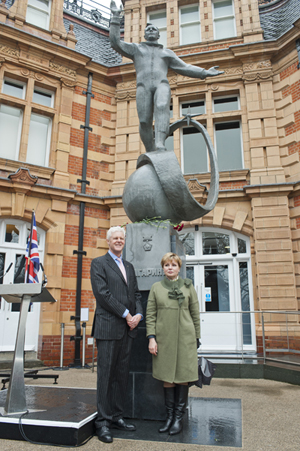
A statue of Russian cosmonaut and first man in space Yuri Gagarin has been relocated to the newly named Yuri Gagarin Terrace outside the Royal Observatory in Greenwich. First unveiled in The Mall, not far from Admiralty Arch, on 14th July 2011, the statue was a gift from the Russian federal space agency, Roscosmos, to mark the 50th anniversary of manned space flight (you can read more at our earlier post here). But it was only granted permission to remain on the site for 15 months and so has now been relocated to Greenwich where it as officially unveiled last Thursday in the week of Gagarin’s birthday by his daughter Elena Gagarina (pictured here with Royal Museums Greenwich director Dr Kevin Fewster). The statue – a 3.5 metre high zinc alloy figure – shows Gagarin dressed in a spacesuit and standing on a globe. It stands just outside the observatory’s Astronomy Centre. For more on the Royal Observatory Greenwich – the “home” of Greenwich Mean Time, see www.rmg.co.uk.

LondonLife – Paper protestors fill Parliament Square…

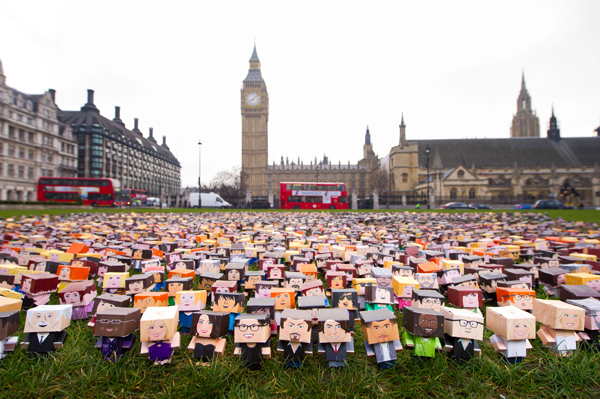
mc_fairtrade_004Jonathan Ross, Eddie Izzard, Amanda Holden, Tulisa and Gok Wan were among the thousands of people represented by paper protestors in Parliament Square, outside the Houses of Parliament, on Monday. The Fairtrade-backed protest marked the second week of ‘Fairtrade Fortnight’ and was aimed at sending a message to Prime Minister David Cameron to “do more to protect smallholder farmers from trade injustice”. More than 8,000 people have signed the online petition so far, creating a personalised “mini marcher” via Fairtrade’s partnership with Foldable.me. The final petition will be delivered to the PM on World Fair Trade Day in May ahead of the June meeting of the G8. For more on the Fairtrade Foundation, see www.fairtrade.org.uk.

LondonLife – ‘Hans of Antwerp’ at The Queen’s Gallery…

Hans-of-AntwerpRecently conserved, Hans Holbein the Younger’s portrait Hans of Antwerp is one of 27 works by the painter on display in the exhibition, The Northern Renaissance: Durer to Holbein, at The Queen’s Gallery, Buckingham Palace. The portrait was first recorded in the Royal Collection in 1639 when it was said to have been hung in King Charles I’s Chair Room at Whitehall (it was painted in the 1530s by Holbein, best known as King’s Painter to King Henry VIII). While it has been previously thought the sitter was a goldsmith (a close friend of Holbein and witness to his will in 1543), Royal Collection Trust conservators have now definitively ruled it to be that of a merchant, possibly a German of the Hanseatic League based at the London Steelyard. You’ll have to be quick to see the exhibition – it winds up on 14th April. Admission charge applies. For more, see www.royalcollection.co.uk.

PICTURE: Royal Collection Trust/ © 2012, Her Majesty Queen Elizabeth II.

LondonLife – Kingston Bridge, south-west London…

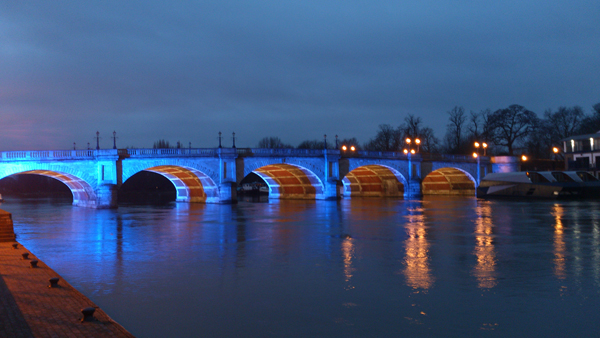
Kingston-BridgeThe photographer, TC Nepomuceno, says “I took this photo…when I was cycling by the riverside from Fulham to Kingston upon Thames. Was amazing to spot so terrific bridge! Kingston upon Thames (is) really worth a visit!”

 Taken an interesting photograph of somewhere in London? We’re always looking for interesting images of the city so if you’ve got one you reckon captures a snippet of life in London, please contact us at exploringlondon@gmail.com or via Flickr at www.flickr.com/groups/exploringlondon/.

LondonLife – ‘White Shirt Week’ in St James’s…

Freddie-Fox-launches-White-Shirt-Week-in-St-James's-London


Freddie Fox (who plays Lord Alfred Douglas opposite Rupert Everett as Oscar Wilde in David Hare’s The Judas Kiss now playing at the Duke of York Theatre) marks the start of ‘White Shirt Week’ which kicked off in St James’s on Monday. The West End area is home to Jermyn Street which apparently boasts “the highest number of world renowned shirt makers on one luxury shopping street” with each shirt maker having their own signature design. While the origins of the white shirt date back as far as ancient Egypt, it was only in more recent centuries that in the UK the white shirt developed from being simply an undergarment to a fashion item in its own right – in fact, by the 19th century, the white shirt was worn by gentlemen as a statement that they weren’t engaged in manual labour and could employ servants to launder it. For more on St James’s, see www.stjameslondon.co.uk.

LondonLife – The one-time home of King Richard III…

Crosby-HallIn honour of the stunning news this week that a skeleton found under a Leicester carpark last year is indeed that of the King Richard III, here’s a picture of the front of Crosby Hall, London home to the king when he was still merely the Duke of Gloucester.

Now located in Cheyne Walk, Chelsea, the Grade II* hall was previously located in Bishopsgate and was the great hall of the 15th century property Crosby Place. As well as being occupied by Richard who rented it from the owner in 1483, a wool merchant named Sir John Crosby (in fact, it also appears in a scene of William Shakespeare’s play, Richard III), the property – built between 1466-75 – was also, from 1523-24, the home of Sir Thomas More, the ill-fated sixteenth century chancellor of King Henry VIII.

The hall was moved piece-by-piece to Chelsea in 1910 when it was threatened with demolition and now stands on land where there was once an orchard owned by Sir Thomas. It served as a dining hall for the British Federation of University Women but is now in private ownership.

The body was confirmed as being, “beyond reasonable doubt”, that of King Richard III, England’s last Plantagenet king, at an extraordinary press conference at the University of Leicester yesterday. Bent by severe scoliosis of the spine, the skeleton’s back had been further twisted to fit into the hole dug for it near the high altar at the church of Grey Friars which had previously stood on the site. Work has now begun a new tomb for the king at nearby Leicester Cathedral.

King Richard III was killed at the Battle of Bosworth on 22nd August, 1485, and was the last English king to die in battle. The researchers found the body was likely to have been killed by one of two fatal wounds – one in which the base of his skull had been sliced off with a weapon believed to be a bladed weapon like a halberd and another from a sword which penetrated his brain. The evidence showed the body had been significantly mutilated after death with a total of 10 wounds on the skeleton.

While radiocarbon dating placed the body in the right time frame and the wounds on the body and burial site were consistent with historical evidence, the key to the identification was the matching of the bones’ DNA with that of a Canadian man, Michael Ibsen, a direct descendant of the king’s sister, Anne of York.

For more on the amazing find, see www.le.ac.uk/richardiii/.