10 small, ‘secret’ and historic gardens in central London…5. Seething Lane Garden…

Seething-Lane-Garden

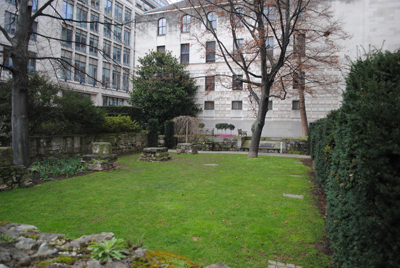
This small, simply laid out garden in the City of London is redolent with history.

It was once the site of the Navy Office, the workplace of diarist Samuel Pepys, and it was in the garden of this building that he and Sir William Penn buried their wine and parmesan cheese for safety during the Great Fire of London in 1666.

The office survived the Great Fire but was, oddly enough, destroyed by fire only a few years later in 1673 (there is a blue plaque commemorating it in the garden) and a new office, designed by Sir Christopher Wren, was built here in the early 1680s before it was demolished in 1788.
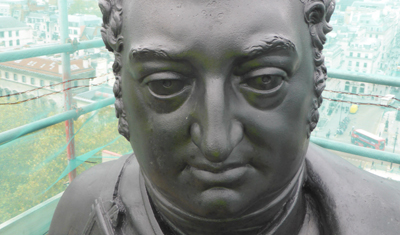
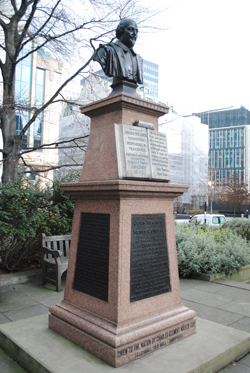
Seething-Lane-Garden2It’s due to its association with Pepys (who also lived in the street and was buried in the nearby church of St Olave Hart Street) that it boasts a bronze bust of him which was erected by the Samuel Pepys Club in 1983, designed by Karin Jonzen and funded by public subscription. It was presented to the garden by Fred Cleary who played an instrumental role in encouraging green spaces in the Square Mile in the 1970s.

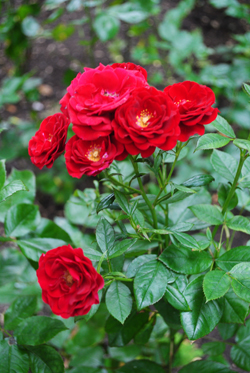
The garden, which was laid out in about 1950, is also notable for its beds of red roses, planted to commemorate the deal struck in 1381 in which the Sir Robert Knollys was belatedly granted permission for a footbridge his wife had built over Seething Lane. She had done so contrary to planning rules while he was away fighting with John of Gaunt (ostensibly so she could avoid the dust of the street when crossing from her house to her rose garden), and so when he returned, the City of London Corporation allowed the bridge (now long gone) to remain, but only in exchange for the symbolic “penalty” of one red rose a year.

The occasion is still marked each June in a ceremony overseen by the Company of Watermen and Lightermen of the River Thames in which a red rose is plucked from the garden and delivered to the Lord Mayor of London at Mansion House.

WHERE: Seething Lane Garden, Seething Lane, City of London (nearest Tube stations is Tower Hill); WHEN: Daily; COST: Free; WEBSITE: www.cityoflondon.gov.uk/things-to-do/green-spaces/city-gardens/Pages/default.aspx.

This garden reopened in 2018 after being redeveloped as part of the Trinity Square redevelopment.
 

10 small, ‘secret’ and historic gardens in central London…4. St Mary Aldermanbury Gardens…

St-Mary-Aldermanbury2Like St Dunstan in the East, these gardens at the corner of Love Lane and Aldermanbury are also based inside the remains of a medieval church.

The church of St Mary Aldermanbury (the name may relate to its proximity close to Guildhall, or the ‘Alderman’s Bury’ or ‘Alderman’s Hall’), mentioned as far back as the late 12th century, was destroyed in the Great Fire of London but was among those rebuilt to the designs of Sir Christopher Wren only to be destroyed again during the Blitz in 1940.

Shakespeare-MonumentThis time there was to be no rebuilding and instead, in 1966 the walls – all that remained – were moved more than 4,000 miles away to the town of Fulton, Missouri, in the US.

There they were reconstructed in the grounds of Westminster College – site of Winston Churchill’s famous “Iron Curtain” speech in 1946 – and the church restored as a memorial to the former British PM. The National Churchill Museum is located beneath.

There’s plaque mentioning this in the gardens (and featuring an image of what the church looked like after its reconstruction in Fulton) which still contains the church’s footings (these date from the 15th century when the church was apparently partially rebuilt) and give an indication of what the church’s footprint would have been along with headstones (among those whose remains were buried here was the notorious Judge Jeffreys).

Other features include a memorial to Henry Condell and John Heminge, both involved in the publication of William Shakespeare’s first folio (you can read more about it in our earlier post here).

The garden was laid out after the church was removed. It is a designated Site of Local Importance for Nature Conservation and attracts wildlife including birds such as blackbirds, woodpigeons, house sparrows and blue tits. Plantings were added in 2011 to maximise the attraction to bird as well as bees and butterflies. On the corner outside the garden is a fountain.

WHERE: St Mary Aldermanbury Garden, Aldermanbury, City of London (nearest Tube stations are St Pauls and Monument); WHEN: 8am to 7pm daily; COST: Free; WEBSITE: www.cityoflondon.gov.uk/things-to-do/green-spaces/city-gardens/visitor-information/Pages/St-Mary-Aldermanbury.aspx.

10 small, ‘secret’ and historic gardens in central London…2. Whittington Garden…

Whittington-Garden

The history of this City of London garden can be immediately spotted in the garden’s name.

It’s named for Richard (Dick) Whittington, a four time medieval mayor of London whose name (and cat) has been immortalised in stories and rhymes which continue to be retold in Christmas pantomimes every year (you can read more about the real Dick Whittington in our earlier post here).

Whittington-Garden2The reason for the garden’s name is in its proximity to the church of St Michael Paternoster Royal – it stands on the other side of College Street – which he poured money into rebuilding during his lifetime and where he was buried (you can read more about the building here). You can also see a Blue Plaque on the former site of Whittington’s house further up College Hill.

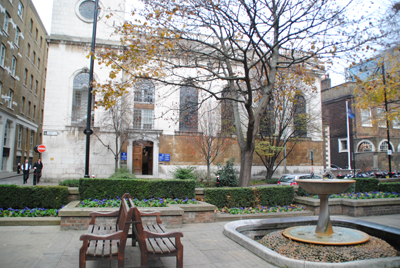
The garden (pictured above looking across to the church) stands on what was the river bank during the Roman era at the bottom of College Hill. It was previously the site of buildings connected with the fur trade but these suffered bomb damage during World War II and were subsequently demolished.

The City of London Corporation acquired the site in 1955 and laid out the gardens in 1960 and the small fountain now found there dates from later that decade.

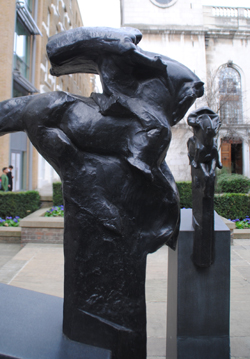
The gardens, which contain some substantial trees and lawn areas as well as hedges and flower beds, were refurbished in 2005. Features include two granite plinths upon which sit two horsemen (pictured). Sculpted by Italian sculptor Duilio Cambellotti, they were presented to the City of London by the Italian President during a state visit in 2005.

WHERE: Whittington Garden, between College Street and Upper Thames Street, City of London (nearest Tube station is Cannon Street); WHEN: Anytime; COST: Free; WEBSITE: www.cityoflondon.gov.uk/things-to-do/green-spaces/city-gardens/visitor-information/Pages/Whittington-Garden.aspx.

Famous Londoners – Sir Hugh Myddelton…

The Welsh-born “merchant adventurer” Sir Hugh Myddelton (also spelt Myddleton or Middleton) is best remembered in London for the construction of the New River, a water engineering project which still provides some of city’s water.

Sir-Hugh-MyddeltonBorn about 1560, the sixth son (and one of 16 children) of Richard Myddelton, governor of Denbigh Castle in Wales, Hugh Myddelton travelled to London to seek his fortune and there became apprenticed to a goldsmith before himself becoming a member of the Goldsmith’s Company in 1592 (he later became warden of the company).

Operating out of premises in Bassishaw (now Basinghall Street), he gained a reputation among the wealthy and nobility for his work and was appointed Royal Jeweller to King James I (he had apparently also supplied jewellery to Queen Elizabeth I).

Myddelton became a wealthy merchant and banker, and, in 1603, he also succeeded his father as MP for Denbigh Borough, a post he held repeatedly until 1628.

Sir Hugh became one of the driving forces behind the New River project which aimed to address the strain on London’s water sources by bringing clean water from the River Lea in Hertfordshire via a 39 mile-long canal to New River Head in London.

After an aborted earlier attempt to build a canal from Hertfordshire to London (which had run into financial difficulties), Sir Hugh was granted authority to carry out the works for the New River in 1609 and employed mathematicians like Edward Pond and Edward Wright to direct the course with the man behind the earlier attempt, Edmund Colthurst, overseeing the works.

By 1611 it became clear to Myddelton that he wouldn’t have the necessary funds to complete the works so he obtained the financial aid of the king (in return the king was to get half of all profits).

The project was eventually completed in 1613 and a ceremony was held at the New River Head in Islington where the canal then terminated (just south of where Sadler’s Wells Theatre now stands).

Myddelton, who continued to diversify in business and made considerable sums from his ownership of lead and silver mines in Wales as well as from a land reclamation project on the Isle of Wight, became the first governor of the New River Company when it was created by royal charter in 1619 and remained a key figure in it until his death. He was created a baronet in 1622.

Myddelton, who married twice, had 15 or more children to his second wife – only about half of whom survived him. He died on 7th December, 1631, and was buried in the now demolished St Matthew Friday Street where he had been a church warden (some of his children were buried there as well). One of his brothers, Sir Thomas Myddelton, was a Lord Mayor of London.

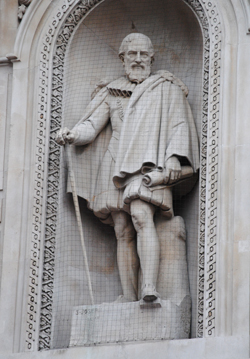
Among memorials to Sir Hugh in London is a statue of him on Islington Green which was unveiled in 1872 by William Gladstone, later PM. There is also a statue of him on the Royal Exchange (pictured) and a number of Islington streets have been named for him.

For more on London’s historic water sources, see London’s Lost Rivers: A Walker’s Guide.

Treasures of London – Daniel Defoe grave memorial, Bunhill Fields…

Daniel-Defoe-memorial2
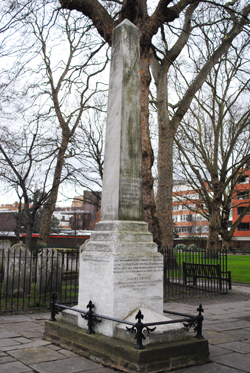
Located in Bunhill Fields Burial Ground in City Road, this memorial to Daniel Defoe, the author of numerous books including Robinson Crusoe and Moll Flanders as well as a journalist, pamphleteer and ‘provocateur’ or spy, wasn’t erected until 1870, almost 140 years after his death.

After he died in 1731 at the age of 70, Defoe was among the more than 120,000 people buried in Bunhill Fields, a Nonconformist cemetery which opened in 1665 and had closed by 1853. He was apparently buried under the name Dabow, thanks to a spelling mistake made by the gravedigger.

Daniel-Defoe-memorialWhen he died in relative obscurity (he was believed to have been hiding from his creditors at the time), his fame rose after his death – due in large part to the rising popularity of Robinson Crusoe, and by the mid-19th century, it was believed that the simple headstone over his grave didn’t do justice to him.

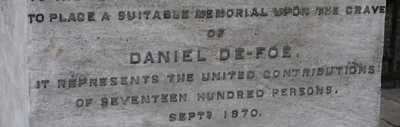
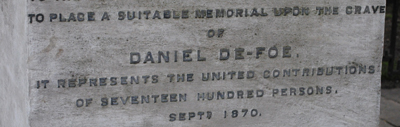
Hence an appeal was run by children’s magazine Christian World for a more suitable memorial for the writer – named as Daniel De-Foe on the memorial – and more than £150 was raised from 1,700 people, an amount which apparently exceeded expectations.

Sculptor Samuel Horner was subsequently commissioned to carve the memorial obelisk, which features projections at the base resembling a coffin lid, to the designs of CC Creeke of Bournemouth. It was unveiled on 16th September, 1870, in a ceremony attended by three of Defoe’s great grand-daughters.

There was apparently a newspaper story that the sculptor uncovered a coffin bearing Defoe’s name in preparing the site for the monument and had to get the aid of police to prevent watchers from making off with the bones from within.

The monument, which may not mark the exact location of Defoe’s grave site due to the movement of graves in the burial ground, is now Grade II*-listed (and the burial ground itself Grade I-listed). Others buried at Bunhill Fields include author John Bunyan, artist William Blake and Susanna Wesley, mother of John Wesley, founder of Methodism.

WHERE: Bunhill Fields Burial Ground, 38 City Road (nearest Tube station is Old Street); WHEN: 7.30am to 7pm or dusk; COST: Free; WEBSITE: www.cityoflondon.gov.uk/things-to-do/green-spaces/city-gardens/visitor-information/Pages/Bunhill-Fields.aspx

10 sites from London at the time of the Magna Carta – 10. Priory of the Order of St John of Jerusalem…

Crypt

Founded in Clerkenwell in 1144, the Priory of the Order of St John of Jerusalem served as the order’s English headquarters.

The order, also known as the Knights Hospitaller, was founded in Jerusalem in 1080 to care for the sick and poor, and soon spread across Europe with the English ‘branch’ established on 10 acres just outside the City walls apparently by a knight, Jorden de Briset.

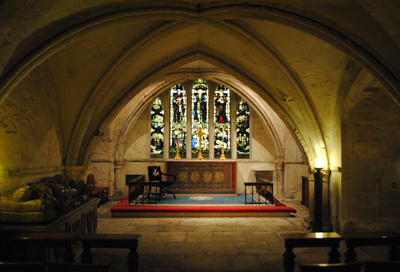
The original buildings – of which only the 12th century crypt (pictured above) survives complete with some splendid 16th century tomb effigies including that of the last prior, Sir William Weston – included a circular church, consecrated in 1185, and monastic structures including cloisters, a hospital, living quarters and a refectory or dining hall.

There are records of dignitaries staying at the priory as it grew in size and renown – among them was King John who in 1212, apparently stayed here for an entire month. There are also surviving accounts of Knights Hospitaller riding out in procession from the priory and through the City at the start of a journey to the Holy Land.

The priory and church were attacked during the Peasant’s Revolt of 1381, thanks to its connection with the hated Poll Tax (Prior Robert Hales was also the Lord High Treasurer and was beheaded during the revolt on Tower Hill).

The church was subsequently rebuilt as a rectangular-shaped building and then, in the early 16th century, enlarged when the site was significantly renovated. These renovations were still relatively new when the priory was dissolved in 1540 during the Dissolution of King Henry VIII.

The priory church, which survived the Great Fire of 1666, was later used as a parish church but was destroyed in an air raid in World War II. Subsequently rebuilt, it can be visited today along with the crypt below and the cloister garden, created in the 1950s as a memorial to St John’s Ambulance members from the London area (the original shape of the circular church is picked out in the paving here).

Perhaps the most famous building to survive is St John’s Gate which dates from the 16th century and was once the gatehouse entrance to the priory (added in the final renovations).

After the Dissolution it served various roles including as the office of the Master of Revels (where Shakespeare’s plays were licensed), the home of The Gentleman’s Magazine (Samuel Johnson was among contributors and worked on site), a coffee house (run by William Hogarth’s father) and a public house called the Old Jerusalem Tavern (yes, Charles Dickens was said to be a regular). It is now home to the recently renovated Museum of the Order of St John (you can see our earlier post on the museum here).

WHERE: Museum of the Order of St John, St John’s Gate (and nearby priory church), St John’s Lane, Clerkenwell (nearest Tube stations is Farringdon); WHEN: 10am to 5pm, Monday to Saturday (tours are held at 11am and 2.30pm on Tuesday, Friday and Saturday); COST: Free (a suggested £5 donation for guided tours); WEBSITE: www.museumstjohn.org.uk.

We’ll kick off a new Wednesday series next week…

Treasures of London – ‘Timepiece’, Thames embankment…

Sundial

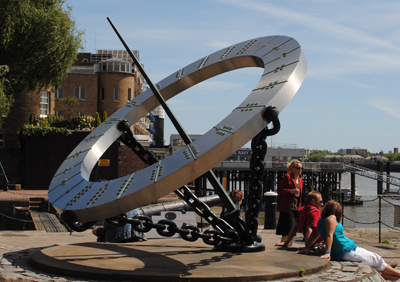
In honour of the sun and the heatwave it’s brought this summer, here’s the giant “equinoctial” sundial on the north bank of the Thames, just east of Tower Bridge. Known as Timepiece, it is the work of London-based sculptor Wendy Taylor and was installed here, beside the lock that leads into St Katharine Docks, in 1973. Measuring more than 3.5 metres across, the dial is made from stainless steel and is supported by three chunky chain link cables. According to the plaque, it was commissioned by Strand Hotels Ltd. It’s now a Grade II-listed structure.

LondonLife – Remembering 7/7…

77

Remembering the 52 who were killed and the 784 injured in the bombing attacks in London on 7th July, 2005. Pictured is the Hyde Park memorial which bears testament to the names of those who died in its 52 pillars.

10 sites from London at the time of the Magna Carta – 8. Bermondsey Abbey…

Bermondsey Abbey, which was more than 130-years-old by the time King John put his seal to the Magna Carta in 1215, has an unusual connection to the unpopular king – it is one of a number of buildings in London which has, at various times in history, been erroneously referred to as King John’s Palace.

This suggestion – that it was a palace which was later converted into an abbey – may have arisen from a site on the former abbey grounds being known at some point in its history as King John’s Court (that name was said to commemorate the fact that King John visited the abbey).

Putting how King John’s name came to be linked with the abbey aside, we’ll take a quick look at the history of the abbey which rose to become an important ecclesiastical institution in medieval times.

While there was a monastic institution in Bermondsey as far back as the early 8th century, the priory which was here during the reign of King John was founded in 1082, possibly on the site of the earlier institution, by a Londoner named as Aylwin Child(e), apparently a wealthy Saxon merchant who was granted the land by King William the Conqueror.

In 1089, the monastery –  located about a mile back from the river between Southwark and Rotherhithe – became the Cluniac Priory of St Saviour, an order centred on the French abbey of Cluny, and was endowed by King William II (William Rufus) with the manor of Bermondsey.

It was “naturalised” – that is, became English – by the first English prior, Richard Dunton, in 1380, who paid a substantial fine for the process. It was elevated to the status of an abbey by Pope Boniface IX in 1399.

It had some important royal connections – King John’s father, King Henry II and his wife Queen Eleanor celebrated Christmas here in 1154 (their second child, the ill-fated Henry, the young King, was born here a couple of months later), and Queen Catherine (of Valois), wife of King Henry V, died here in 1437. It was also at Bermondsey Abbey that Elizabeth Woodville, the widow of King Edward IV and mother of the two “Princes in the Tower”, died in 1492 following her retirement from court.

The abbey, which grew to have an enormous income thanks to its acquisition of property in a range of counties, survived until the Dissolution when, in 1537, King Henry VIII closed its doors. It was later acquired by Sir Thomas Pope who demolished the abbey and built a mansion for himself on the site (and founded Trinity College in Oxford apparently using revenues from the property). We’ll deal more with its later history in an upcoming post.

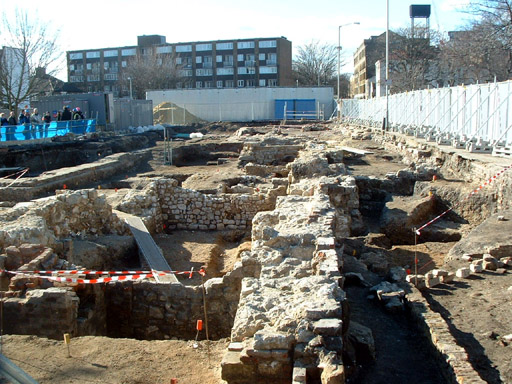
The ruins of the abbey were extensively excavated in the past few decades and some of the remaining ruins of the abbey can still be seen buildings around Bermondsey Square and a blue plaque commemorating the abbey was unveiled in 2010. Bermondsey Street runs roughly along the line of the path which once led from the abbey gates to the Thames and the abbey had a dock there still commemorated as St Saviour’s Dock. The abbey’s name is commemorated in various streets around the area.

For more on the history of the Magna Carta, see David Starkey’s Magna Carta: The True Story Behind the Charter.

PICTURE: An archaeological dig at the ruins of Bermondsey Abbey in 2006. Zefrog/Wikipedia.

Lost London – St Martin Outwich…

This former City church – now part of the parish of St Helen’s Bishopsgate – once stood on the corner of Threadneedle Street and Bishopsgate (the site is marked by a blue plaque).

St-Martin-OutwichA medieval church which was apparently rebuilt in the 14th century in the Gothic style, it was dedicated to St Martin while there is some discrepancy over the use of the name Outwich – some sources say it comes from a corruption of the name of the family who paid for its reconstruction – the Oteswich family – while others say the family in fact took their name from the church and that ‘outwich’ simply means the outer side of the wich (one of a number of Saxon words for a town).

It survived the Great Fire of 1666 but gradually fell into disrepair and in 1765 was badly damaged in another fire which destroyed some 50 houses.

In 1796, Parliament passed an act allowing the parish to raise money for its building – the donations included some from the powerful City livery companies – and after a couple of years of construction, it was consecrated in November, 1798.

Designed by Samuel P Cockerell, the church was unusual in that it featured an oval interior. Medieval stained glass from the original church was placed in a window over the altar while some of the monuments that had been present in the old church – including one commemorating John Oteswich and his wife – were transferred to the new. The dead buried at St Martin Outwich, meanwhile, were reburied in the City of London churchyard (where a memorial to them can now be seen).

A painting from 1838 shows a curved interior with high semi-circular windows, some intricate medieval monuments and closed in box pews.

Thanks to a falling population and pressure to widen the streets, the church was eventually demolished in 1874 and the parish amalgamated with St Helen’s. As had previously happened, a number of monuments – including the Oteswich memorial – which were in the old church were moved to St Helen’s before its demolition.

Proceeds from the sale of the church grounds were used to fund the construction of Holy Trinity Church in Dalston. Built in the late 1870s to the designs of Ewan Christian, it is perhaps best known as the Clown’s Church and is where the clown service is usually held each year.

PICTURE: sleepymyf

Treasures of London – Waterloo Memorial…

Waterloo-MemorialUnveiled earlier this month at Waterloo Station to mark the bicentenary of the Battle of Waterloo, the memorial features a supersized solid bronze replica of the obverse side of the Waterloo Campaign medal depicting Nike, the Greek goddess of victory.

The memorial, which was installed on a balcony above the main concourse by The London Mint Office on behalf of Waterloo200 – the organisation overseeing bicentenary commemorations, is dedicated to the 4,700 members of the allied armies who were killed in the battle on 18th June, 1815 (which also left 14,600 wounded and 4,700 missing).

The upsized medal, which has a diameter of 65 centimetres, is a replica of one which was the first to be commissioned for every soldier who fought in the battle, regardless of their rank.

Designed by London-based artist Jason Brooks, the memorial also features a famous quote from the Duke of Wellington on granite: “My heart is broken by the terrible loss I have sustained in my old friends and companions and my poor soldiers. Believe me, nothing except a battle lost can be half so melancholy as a battle won.”

It was unveiled on 10th June by the 9th Duke of Wellington (pictured with the memorial) in a ceremony attended by some of the descendants of those who fought and died in the battle.

Waterloo Station was itself, of course, named in commemoration of the battle (well, indirectly – it, like the surrounding district itself, took its name from nearby Waterloo Bridge which was in fact named after the battle).

Treasures of London – Australian War Memorial…

Australian-War-Memorial

Tomorrow is the 25th April – commemorated every year as Anzac Day in Australia in memory of that country’s soldiers who lost their lives. This year marks 100 years since Australian troops first landed at Gallipoli during World War I. 

While attention will be focused on Anzac Cove in modern Turkey and the Australian war memorials on what was the Western Front in western Europe, in London there will be several events including a wreath laying ceremony at The Cenotaph in Whitehall, a commemoration and thanksgiving service in Westminster Abbey and a dawn service held at the Australian War Memorial in Hyde Park Corner.

This last memorial, dedicated to the more than 100,000 Australians who died in both world wars, was unveiled on Armistice Day, 2003, in the presence of Queen Elizabeth II, then-Australian PM John Howard and then British PM Tony Blair.

It records the 23,844 names of town where Australians who served in World War I and II were born.

Superimposed over the top are 47 of the major battles they fought. Principal architect Peter Tonkin said the somewhat curvaceous design of the memorial, made of grey-green granite slabs, “reflects the sweep of Australian landscape, the breadth and generosity of our people, the openness that we believe should characterise our culture”.

For more on the wall – including the ability to search for town names – see www.awmlondon.gov.au.

This Week in London – Wellington Arch marks the Battle of Waterloo; Shakespeare’s Globe celebrates the Bard’s birth; and the ‘cathedral on the marsh’ open day…

The Battle of Waterloo comes under the microscope in a new exhibition opening at Wellington Arch on Hyde Park Corner tomorrow. Wellington Arch: Waterloo 1815 – The Battle for Peace provides an overview of the battle and the reasons which led to it, the people involved and the battle’s legacy. Displayed items include the sword the Duke of Wellington carried at the battle, his handwritten battle orders and an original pair of ‘Wellington boots’ as well as, of course, the arch itself, which was built in 1825-27 as a monument to Wellington’s victories over Napoleon. Admission charge applies. For more, see www.english-heritage.org.uk/visit/places/wellington-arch/.

Shakespeare’s Globe in Southwark celebrates the Bard’s birthday with a Hamlet-themed day of free family events this Sunday. Along with an Elsinore bouncy castle, there will be sword-fighting demonstrations, ‘skull’ coconut shies and a grave-digging ball pool while actors who have taken on the role of Hamlet over the years while appear on stage attempting to deliver the quickest ever reading of the play and famous film adaptions of Hamlet will be playing on screen around the site. The day will also mark almost a year since Shakespeare’s Globe embarked on an unprecedented two year global tour of Hamlet taking in every country in the world in honour of last year’s 450th anniversary of Shakespeare’s birth. The birthday event at the Globe runs between 11am and 4.30pm. For more, see www.shakespearesglobe.com.

The famous “cathedral on the marsh” – the Crossness Pumping Station –  is open to the public this Sunday, the first of five days it will be open this year. The pumping station at Abbey Wood in south-east London was built by Sir Joseph Bazalgette as part of a general sewerage system upgrade and was opened by the Prince of Wales in 1865. The Grade I-listed Beam Engine House was constructed in the Romanesque-style and features some of the “most spectacular ornamental Victorian cast ironwork” to be found today. The day runs from 10.30am to 4pm. Admission charges apply but no booking is required. For more, see www.crossness.org.uk.

Send all items for inclusion to exploringlondon@gmail.com. 

10 London sites associated with Sir Winston Churchill – 9. Memorialising Churchill…

There are numerous memorials to Sir Winston Churchill around London and today we’ll look at a handful of them (while next week we’ll take a look at a couple of the most unusual memorials). We’ve already looked at the most famous statue of him in Parliament Square (in an earlier post here), but here’s some more…

Allies1 AlliesMayfair. These almost life-size bronze statues, located at the juncture of Old and New Bond Streets, depict Churchill and US President Franklin D Roosevelt in an informal pose, sitting and talking together on a bench. The sculpture was a gift from the Bond Street Association to the City of Westminster and was unveiled by Princess Margaret on 2nd May, 1995 commemorating 50 years since the end of World War II. It is the work of US sculptor Lawrence Holofcener. There’s a space between the two World War II leaders where the passerby can sit and have their picture taken between them.

• Member’s Lobby, House of Commons. We’ve already mentioned this bronze statue (see our previous post here), erected in 1969, which stands just outside Churchill Arch opposite one of another former PM, David Lloyd George.  It is the work of Croatian-born sculptor Oscar Nemon who also created numerous other busts of the former PM now located both in the UK (one of which is mentioned below) and around the world.

Great Hall, Guildhall. Commissioned by the Corporation of the City of London and unveiled in 1955, this bronze statue shows Churchill, wearing a suit and bow tie, seated in an armchair and looking ahead. Another work of Nemon’s, it was commissioned as a tribute to “the greatest statesman of his age and the nation’s leader in the Great War of 1939-1945”.

Outside former Conservative Club, Wanstead. A very thick-necked bust of Churchill, erected in 1968, sits outside the 18th century mansion in Wanstead High Street, north-east London, which was once the Conservative Club and is now occupied by a restaurant. The bigger than life-sized bust is the work of Italian artist Luigi Fironi and stands on a plinth once part of old Waterloo Bridge. Churchill was the Conservative member for this area between 1924-1964 and based at the club from 1930 to 1940.

 • Woodford Green. Another tribute from his former constituents, this full length bronze statue in north-east London is the work of Scottish artist David McFall and was unveiled in 1959 in the presence of Churchill himself and Field Marshal Viscount Montgomery. Churchill was the MP for Woodford between 1945 and 1964.

10 London sites associated with Sir Winston Churchill – 2. Houses of Parliament…

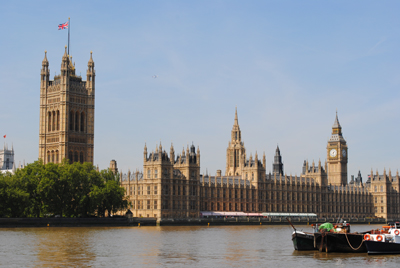
Houses-of-Parliament

Of course, no look at London sites associated with Sir Winston Churchill would be complete without a mention of the Palace of Westminster, better known as the Houses of Parliament.

Churchill made his maiden speech in the House of Commons on 18th February, 1901, having won the seat of Oldham for the Conservative Party the year before (he switched to the Liberal Party in 1904 and eventually rejoined the Conservatives in 1924).

Over his long career in politics (he was an MP for 62 years), he served in a variety of roles including the President of the Board of Trade, Home Secretary, First Lord of the Admiralty, Minister of Munitions, Chancellor of the Exchequer, and twice, Prime Minster.

Some of the most famous speeches Churchill gave in the House of Commons were during World War II – they include the ‘blood, toil, tears and sweat’ speech given on 13th May, 1940 – the first after he had been made Neville Chamberlain’s replacement as PM, the ‘we shall fight them on the beaches’ speech given on 4th June, 1940, and the ‘this was their finest hour’ speech of 18th June, 1940, in which he gave the ‘Battle of Britain’ its name and, as the name suggests, first recorded the phrase “their finest hour” (the speech ended with it).

Churchill’s last speech to Parliament was given on 1st March, 1955, in which he spoke about the British development of a hydrogen bomb.

There’s several places within the Houses of Parliament which now bear Churchill’s name. Among them are the Churchill Room (named as such in 1991 when ownership of the room passed from the Lords to the Commons, it features two of his paintings and a bronze bust of the PM).

They also include the Churchill Arch – this leads from the Members’ Lobby into the Commons Chamber and is flanked by a 1969 statue of Churchill ( and one of fellow former PM, David Lloyd George (one foot on each of the statues has been burnished thanks to the practice of MPs to touch them as they enter the Commons Chamber).

It took on its current name after it was rebuilt following damage from bombs during World War II – at Churchill’s suggestion damaged stone was reused in its construction as a memorial to the “ordeal” Westminster had endured during the war. The statue of Churchill, incidentally, was the focus of recent commemorations on the 50th anniversary of his death.

Churchill’s stamp can also be seen on the Commons Chamber itself – it was he who recommended that when the chamber was rebuilt after World War II that it retain its rectangular shape rather than be redesigned in a semi-circle.

Churchill’s body lay in state in Westminster Hall prior to his funeral service in January, 1965 (for more on that, see our previous post here.

For more on Churchill’s Parliamentary career, check out the UK Parliament’s Living History page here: www.parliament.uk/about/living-heritage/transformingsociety/private-lives/yourcountry/collections/churchillexhibition/.

10 London sites associated with Sir Winston Churchill – 1. St Paul’s Cathedral…

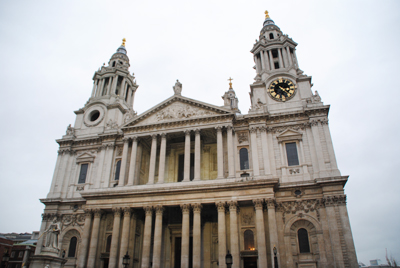
St-Paul'sThe world recently paused to mark the 50th anniversary of the death of former British PM, Sir Winston Churchill (see our earlier post here), so we’re launching a new series looking at 10 sites associated with Churchill in London.

Given the recent anniversary, we’re starting at a site close to the end of his story, at St Paul’s Cathedral, where his state funeral was held on 30th January, 1965.

Code-named ‘Operation Hope Not’, the funeral had been thoroughly planned in the years leading up to the former PM’s death and took place just six days after he passed. Having lain in state in Westminster Hall for three days (during which time it’s estimated 320,000 filed past his flag draped body), his coffin, carried on a gun carriage pulled by 120 members of the Royal Navy, was escorted by more than 2,300 personnel from the military as it made its way through city streets lined with thousands of people to St Paul’s for the service.

During the service, the catafalque containing Churchill’s body stood on a raised platform beneath the central dome surrounded by six candlesticks. Among the official pallbearers – who marched before it down the aisle – were another former PM, Clement Attlee, along with military figures like Field Marshal Lord Slim and Admiral of the Fleet Lord Mountbatten of Burma.

A plethora of world leaders representing 112 nations attended the funeral service including six sovereigns, six presidents and 16 prime ministers. Among them – in an unprecedented move for a state funeral – was Queen Elizabeth II (sovereigns do not normally attend non-family funerals) along with Prince Philip and Prince Charles.

It’s estimated that as some 350 million people around the globe tuned in to watch the funeral on TV.

After the service, Churchill’s body was taken to Tower Pier (near the Tower of London) where, to the sound of a 19-gun salute fired by the Royal Artillery, he was loaded on the MV Havengore. Sixteen RAF Lightning aircraft then did a flypast as he was transported upriver to Festival Pier with dockers dipping their cranes in salute as the boat passed (this journey was recreated last week using the original barge in commemoration of the 50th anniversary of his death).

On its arrival at Festival Pier, the body was then taken to Waterloo Station from where it went via train in a specially prepared carriage (the refurbished funeral train has been brought back together at the National Railway Museum at York) to be buried in St Martin’s churchyard in Bladon, Oxfordshire – a site not far from his birthplace at Blenheim Palace.

A bronze memorial plaque commemorating where Churchill’s catafalque stood in St Paul’s is set before the Quire steps while in 2004, the Winston Churchill Memorial Screen was unveiled in the crypt where it stands in line with the final resting places of both Admiral Lord Nelson and the Duke of Wellington.

For more on the state funeral, St Paul’s has a great page of detail which you can find here, including downloadable copies of the Order of Service and other documents. 

Famous Londoners – The Unknown Roman Girl…

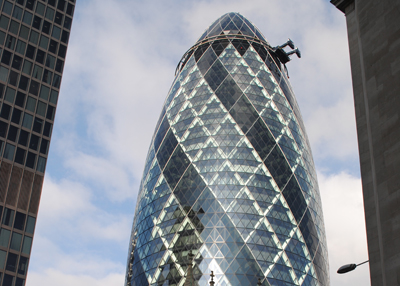
GherkinIn an unusual ‘Famous Londoners’, this week we’re looking at a former inhabitant of London who we still know relatively little about.

The remains of the teenaged girl – believed to have been aged between 13 and 17 years – were found in 1995 when the conically-shaped skyscraper at 30 St Mary Axe, fondly known as the Gherkin (and then formally known as the Swiss Re Tower), was being constructed.

The girl, whose skeleton was unearthed where the foundations now stand, was buried sometime between 350 and 400 AD in what appeared to be an isolated grave which would have lain just outside the edge of early Roman Londinium.

The body lay with the girl’s head to the south and the arms folded across. Pottery was found associated with the body which provided dating information.

After being exhumed, the skeleton was housed at the Museum of London for some 12 years before in 2007 it was reburied near the new building. The burial featured a ceremony at nearby St Botolph-without-Aldgate followed by a procession to the gravesite where a dedication took place which included “music and libations”. Among those who attended was the Lady Mayoress of the City of London.

There’s an inscription in honour of the girl on a stone feature outside the building in both Latin and English while a stone set in the pavement decorated with laurel leaves marks the (re)burial spot.

Other recent Roman remains found in London include the skeleton of a young Roman woman, believed to date from the 4th century, which was found still inside its sarcophagus at a site in Spitalfields and a series of two dozen Roman-era skulls which, likely to date from the first century A, were found during excavations for the Crossrail project in 2013. It has been suggested they may have been Britons executed for their role in the famed Queen Boudicca’s rebellion against the Romans in 61 AD.

LondonLife – Mary and infant Jesus back on display in St Paul’s…

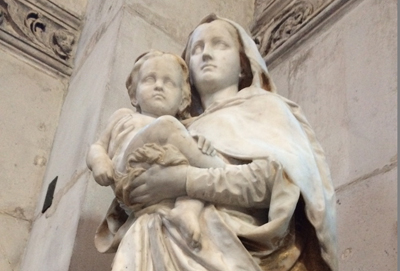
The-Madonna-and-ChildThis Victorian-era marble statue of the Virgin and Child has gone back on show in St Paul’s Cathedral more than 70 years after it taken down following bombing during World War II. Part of an ornate high altar and reredos installed at the cathedral’s east end in 1888, the statue – the work of Thomas Garner – was put into storage after that part of the cathedral took a direct hit during the Blitz of 1940 and what remained of the altar was dismantled (the statue and a crucifix were the only parts retained by the cathedral). It can now be seen in the Chapel of St Erkenwald and St Ethelburga (also known as the Middlesex Chapel) in the north transept. For more, see www.stpauls.co.uk. PICTURE: The Chapter of St Paul’s Cathedral.


LondonLife – The Duke of York has a facelift…

Duke-of-YorkA monument commemorating Prince Frederick, the Duke of York and Albany and commander-in-chief of the British Army during the French Revolutionary wars – the Duke of York Column in St James’s Park – has had a makeover. The monument, which was erected in 1834, is the tallest in the Royal Parks. It features a 124 foot tall column of pink and grey Aberdeen granite designed by Benjamin Wyatt and is topped by a 14 foot tall bronze statue of the duke (thought to be the ‘Grand Old Duke of York’ referred to in the nursery rhyme), designed by Sir Richard Westmacott. The column has been cleaned while the statue, which had developed a green pigment thanks to the oxidation process which also gives the Statue of Liberty its green patina, has been repatinated, rewaxed and buffed. The monument, which cost £100,000 to refurbish, originally cost £15,760 and was funded with a day’s pay from every serving soldier. For more on St James’s Park, check out www.royalparks.org.uk/parks/st-jamess-park. PICTURE: Courtesy of Royal Parks.

LondonLife – Prince Albert keeps his lonely vigil…

Albert-Memorial2


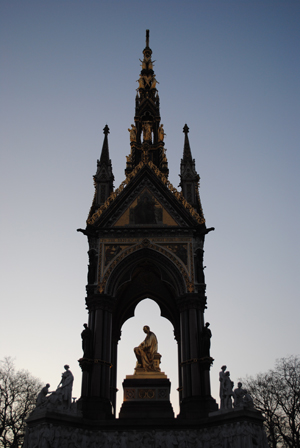
The Albert Memorial, South Kensington. For its history, see our earlier post here.