Famous Londoners – Grinling Gibbons…

A late 17th and early 18th century wood carver and sculptor, the curiously named Grinling Gibbons is remembered for his magnificent carvings in numerous English buildings including such London icons as St Paul’s Cathedral and Hampton Court Palace.

Not much is known about Gibbons’ early life. The son of English parents (his father was apparently a draper), he was born in Rotterdam in The Netherlands on 4th April, 1648, and, as a young man, is believed to have undertaken an apprenticeship as a sculptor in that country.

Around the age of 19, he moved to England – first to York and to Deptford in the south. It was the quality of his work which led diarist John Evelyn, having discovered Gibbons working on a limewood relief of Tintoretto’s Crucifixion in a small cottage near Deptford in early 1671, that led him to introduce him to Christopher Wren, the architect of the age, and fellow diarist Samuel Pepys and to eventually present him (and his relief) to King Charles II at Whitehall Palace on 1st March the same year.

But Gibbons’ work apparently failed to initially impress at court and it was only following his ‘discovery’ later that year by the court artist Sir Peter Lely that he began to receive major commissions.

It’s apparently not known when Gibbons married his wife Elizabeth and moved to London they were living there by 1672 and were having the first of their at least 12 children (while at least five of their daughters survived into adulthood, none of their sons did).

In 1672, they were living in an inn, called La Belle Sauvage or The Bell Savage, located on Ludgate Hill near St Paul’s, and, while Gibbons continued to maintain a workshop here into the 1680s, the family moved to Bow Street in Covent Garden around the end of the 1670s (the house here apparently collapsed in 1702 and was subsequently rebuilt in brick).

Gibbons, who was admitted to the Draper’s Company in 1672 and held various posts within it over ensuing years, reached the pinnacle of his success when he was made master sculptor and carver in wood to King William III in 1693, and was later made master carpenter to the king, then King George I, in 1719.

Having worked mostly in limewood, Gibbons, recently called the “British Bernini”, is known for his distinct and exuberant style which features cascading foliage, fruit, animals and cherubs. While he worked on numerous important buildings outside of London – including carvings in the Chapel Royal and king’s dining room at Windsor Castle, in a chapel at Trinity College in Oxford, at Blenheim Palace in Oxfordshire and a famous ‘carved room’ at Petworth House in Sussex – and beyond (he also created two presentation panels – known as the ‘Cosimo’ and ‘Modena’ panels which were sent to Italy as royal gifts), Gibbons is also noted for his work on a number of prominent buildings in London.

Among the buildings he worked on or in around London are the churches of St James’s in Piccadilly, St Mary Abchurch, St Michael Paternoster Royal and, famously, St Paul’s Cathedral (where he carved choir stalls, the bishop’s thrones and choir screen) as well as Hampton Court and Kensington Palaces.

While he is primarily remembered for his limewood carvings, Gibbons’ workshop was also responsible for sculpting statues, memorials and decorative stonework. A couple of the workshop’s statues can still be seen in London – one of King Charles II in Roman dress at the Royal Hospital in Chelsea and another of King James II outside the National Gallery in Trafalgar Square – while the magnificent Westminster Abbey memorial to Admiral Sir Clowdisley Shovell is also attributed to him.

Gibbons died at his Bow Street home on 3rd August, 1721, and was buried in St Paul’s Church in Covent Garden (his wife had been buried there several years before).

For more on Grinling Gibbons, check out David Esterly’s Grinling Gibbons and the Art of Carving.

Where is it?…#43

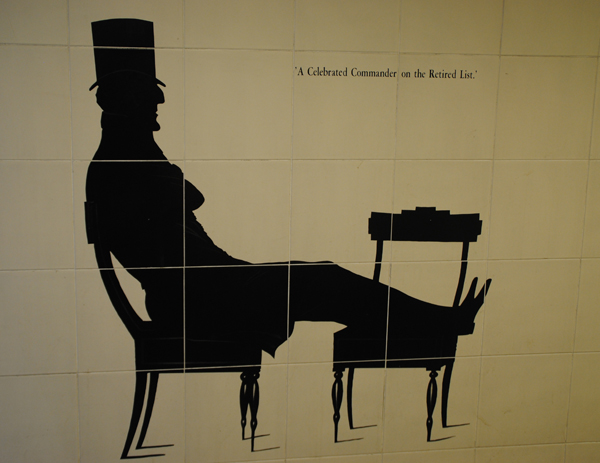
The latest in the series in which we ask you to identify where in London this picture was taken and what it’s of. If you think you can identify this picture, leave a comment below. We’ll reveal the answer early next week. Good luck!

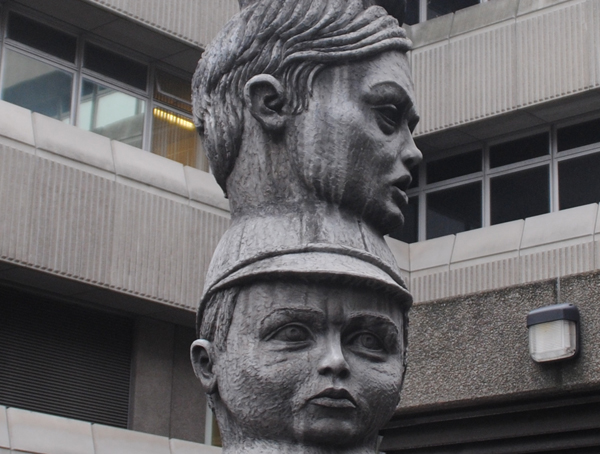
This image is one of many found in a subterranean tunnel surrounding Hyde Park Corner Underground Station and depicts, of course, the 1st Duke of Wellington, Arthur Wellesley, enjoying his latter years. The ‘Iron Duke’ has strong connections to Hyde Park Corner – his former home, Apsley House, No 1. London, is located there as is the Wellington Arch, the Decimus Burton memorial to him. For more on the Duke, see our earlier post here and for more on Wellington Arch, see our earlier ‘Where is it?’ post here.

Around London – London’s listed; Open House beckons; Blue Plaque for opthalmologist; and, Motya Charioteer at the British Museum…

• It includes everything from the iconic Lloyd’s Building in the City to the former Strand Union Workhouse in Fitzrovia which may have inspired scenes in Charles Dickens’ Oliver Twist and the red phone boxes which sit outside the British Museum in Bloomsbury. English Heritage this week released it’s London List 2011 which documents the more than 100 sites in London which have been awarded listed status by the organisation last year. They include 19 Underground stations (among them that of Oxford Circus, St James’s Park and Aldwych), four war memorials (including the grand Central Park War Memorial in East Ham) and two schools as well as various cemetery monuments (including at Highgate and Brompton Cemeteries, and Bunhill Fields Burial Ground) and parks (the status of Green Park was upgraded to Grade II*), religious and commercial premises, public libraries and homes. To download a copy, visit www.english-heritage.org.uk/publications/london-list-2011/.

It’s just one week to go until the Open House London weekend when more than 750 buildings of all sorts open their doors to you. We’ll be talking more about some of the special places open this year in next week’s update – this is, after all, one of our favorite London events of the year, and while, if you haven’t already entered, you’ve missed on the balloted openings, there’s still plenty of places where you can simply turn up on the day (and entry to all is free). If you haven’t already bought one, you can buy the Guide online – just follow the links from www.openhouselondon.org.uk. It can also be picked up free at some participating London libraries.

• Dame Ida Mann, Oxford’s first female professor and a pioneering ophthalmologist, has been honored with an English Heritage Blue Plaque at her childhood home in West Hampstead. The plaque, which was unveiled by an Australian opthalmologist who worked with Mann, Donald F. Ezekial, last week, has been placed on a house at 13 Minster Road where Mann lived from 1902-1934. Mann was born in West Hampstead and lived there for 41 years before eventually emigrating to Australia. For more on blue plaques, see www.english-heritage.org.uk.

• On Now: Motya Charioteer at the British Museum. Best be quick for this one, the charioteer, on loan from the Museo Giuseppe Whitaker on Motya, is only around until 19th September (that’s next Wednesday). The stunning statue, displayed near the sculptures from the Parthenon, dates from about 460-450 BC and is generally credited as one of the finest examples of Greek marble sculpture to have survived down the ages. It is believed to depict the winner of a chariot race and is likely to have been commissioned to commemorate a victory by a participant from one of Sicily’s Greek cities. It was found in Sicily in 1979. Admission is free. For more, see www.britishmuseum.org.

Where is it?…#42

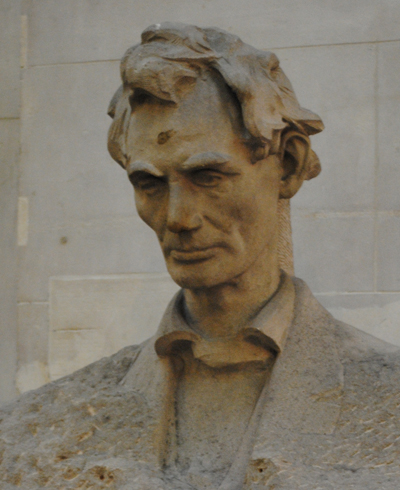
The latest in the series in which we ask you to identify where in London this picture was taken and what it’s of. If you think you can identify this picture, leave a comment below. We’ll reveal the answer early next week. Good luck!

Well done to Carol, this bust – yes, of Abraham Lincoln, 16th President of the United States – is located just inside the ‘rear’ entrance of the Royal Exchange in the heart of the City. The work of Irish-American sculptor Andrew O’Connor, it was carved from a block of limestone apparently quarried near the President’s birthplace in central Kentucky. The bust, which shows Lincoln is his prime, was presented to The Gresham Committee by the Lincoln Committee in 1930.

(And sorry about the previous #42 post – a technical glitch meant we had to shelve it!)


LondonLife – John Donne at St Paul’s Cathedral…

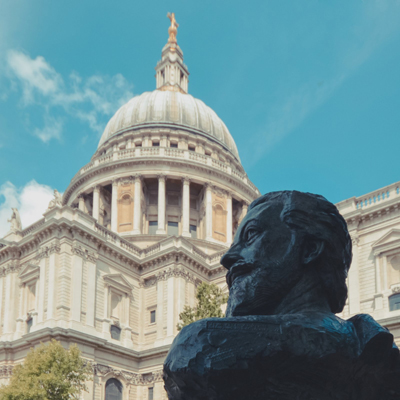
A new bust of priest and poet John Donne was unveiled outside St Paul’s Cathedral earlier this year. Donne was made  Dean of St Paul’s in 1621, a position he held until his death 10 years later. He was subsequently buried in Old St Paul’s Cathedral and a memorial to him – a likeness apparently based on a drawing of him in his shroud – was the only monument to survive the Great Fire of London in 1666. It’s still inside the cathedral. The new bronze bust, located in the garden to the south of the cathedral, was the work of artist Nigel Boonham and has Donne looking east towards his birth place in nearby Bread Street. The text “Hence is’t, that I am carried towards the West/This day, when my Soul’s form bends to the East” – taken from the poem Good-Friday, 1613, Riding Westward – is inscribed underneath the bust. Commissioned by the City of London, the sculpture was unveiled in June by the artist and Professor Peter McCullough, one of the cathedral’s Lay Canons. For more on St Paul’s, see www.stpauls.co.ukPICTURE: Graham Lacdao / The Chapter of St Paul’s Cathedral. 

Where is it? #41….

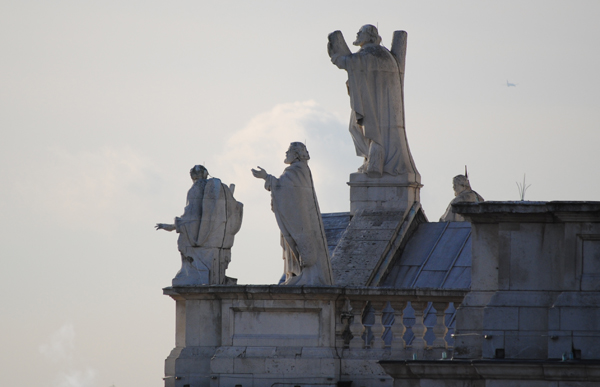
The latest in the series in which we ask you to identify where in London this picture was taken and what it’s of. If you think you can identify this picture (and try and be as precise as possible), leave a comment below. We’ll reveal the answer early next week. Good luck!

Yes, you guessed it, these are indeed the 3.7 metre high statues which sit above the south transept of St Paul’s Cathedral. The statues include those of St Andrew and St Thomas, both of which are attributed to Caius Gabriel Cibber (1630-1700) and Grinling Gibbons (1648-1721). We had originally said they were the work of Francis Bird (1667-1731), who also completed the famous panel depicting the Conversion of St Paul on the cathedral’s west front and the original version of the statue of Queen Anne outside the main entrance (more on that another time), but while he was responsible for other statues on the cathedral, turns out he wasn’t for these two. The image was taken from the viewing deck of One New Change on Cheapside.

Treasures of London – King Lud and his sons…

A mythical figure from early Britain, King Lud is said to have been a pre-Roman king of Britain who rebuilt London (which according to legend had been originally founded by the exiled Trojan Brutus) and from whom London derives its name.

Lud is said by some to have given his name to the gateway known as Ludgate (although others say it comes from an Old English term meaning swing or postern gate – see our earlier post here for more on Ludgate).

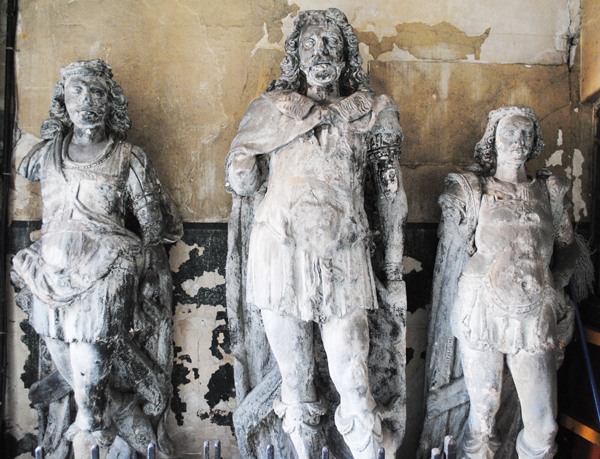
This series of badly weathered statues – depicting King Lud and his two sons, apparently named Androgeus and Theomantius – was originally located on the gate. In fact, the legend goes, the king was buried under it.

Following the gate’s demolition, the statues – said to date from 1586 with the name of the sculptor now lost to time – were moved here at some point to the vestry porch of St Dunstan-in-the West in Fleet Street.

LondonLife – A giant shot put hits Greenwich…

Another reminder of the Olympic and Paralympic Games in London can be found at the Old Royal Naval College in Greenwich. The sculpture, a three metre wide shot put embedded in the ground, is one of a series of three different Gifts from the Gods sculptures which have appeared around the city. As well as shot puts, the other sculptures – all of which look as though they’ve been dropped from a great height – depict a 10 metre high javelin and a seven metre long bow with arrows. The sculptures, which will remain in place until 10th September, are part of Wonder, a series of interactive installations put in place as part of the Mayor of London Presents program. For more, see www.molpresents.com/wonder. For more on the Old Royal Naval College, see www.ornc.orgPICTURE: Steve Bradbury/Courtesy of ORNC.

What’s in a Name?…Trafalgar Square

It wasn’t until some time after Admiral Lord Nelson’s victory over the French fleet in the Battle of Trafalgar off the coast of Spain on 21st October, 1805, that the large public space in Westminster we now know as Trafalgar Square took its name.

Prior to the development of the square, much of the area it covers was occupied the King’s Mews – stables linked to the Palace of Whitehall – and was simply seen as part of the district known as Charing Cross (named for the memorial cross which stood close to where the equestrian statue of King Charles I now stands – for more on this, see our earlier post and follow the links).

Following the relocation of the Mews in the early 19th century, plans were drawn up by architect-of-the-age John Nash to redevelop the area while the square itself, completed in 1845, was designed by Sir Charles Barry (best known for his work on the Houses of Parliament).

The final design incorporated a statue of Admiral Lord Nelson atop a column, known as ‘Nelson’s Column’, in the centre – apparently against Barry’s wishes (see our earlier post for more on Nelson’s Column).

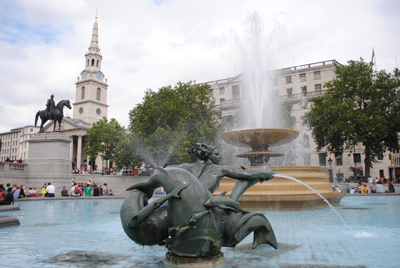
Originally designed with an upper terrace and a lower piazza linked by stairs at the eastern and western end of the terrace, the square contains two fountains on either side of the column – the current fountains were designed by Sir Edwin Lutyens in 1937-9 and replaced earlier ones.

It was originally suggested that the square be named King William IV Square but it was apparently architect George Ledwell Taylor who provided the alternative of Trafalgar Square in honor of Nelson’s great battle.

Bordered by significant landmarks including the National Gallery to the north, the church of St Martin’s-in-the-Fields to the north-east, South Africa House to the east and Canada House to the west, the square stands at the confluence of a number of major roadways including Whitehall, Strand, Charing Cross Road and The Mall.

Aside from the aforementioned statue of King Charles I, monuments within the square include Nelson’s Column along with plinths set in the four corners of the square. These bear statues of King George IV, Victorian military figures General Sir Charles James Napier and Major-General Sir Henry Havelock while the fourth plinth, located in the north-west corner, was originally intended to bear an equestrian statue of King William IV.

Instead, it was left empty for many years before the advent of the Fourth Plinth project under which a variety of contemporary artworks – most recently a massive sculpture of a boy astride a rocking horse – have occupied the space (you can see a picture of the current work in our earlier post here).

The square, once known as the home of thousands of pigeons before these were banished midway through last decade to allow greater public use of the space, also features the busts of three admirals – John Jellicoe, David Beatty and Andrew Cunningham, located against the north wall under the terrace.

There are also two statues on a lawn in front of the National Gallery – these are of US President George Washington and King James II. Curiously, the square also features a small pillar box in the south-east corner, referred to by some as the smallest police station in London.

A renovation project in 2003 pedestrianised the roadway along the north side of the square and installed a central stairway between the the upper and lower levels along with lifts, public toilets and a cafe.

For some more on the history of Trafalgar Square, see Jean Hood’s Trafalgar Square: A Visual History of London’s Landmark Through Time.

LondonLife – Gold, gold, gold…

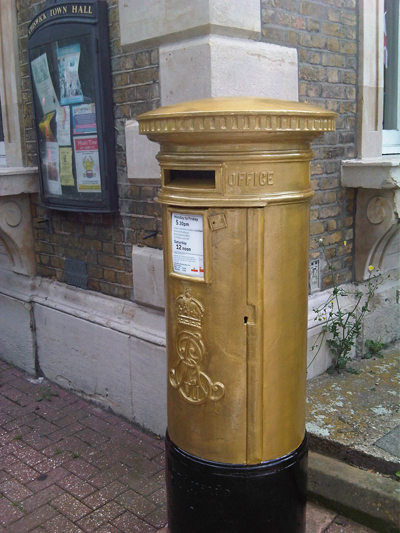
The Olympics might be over but there are still plenty of reminders of the Games around town. Not the least of which are the gold postboxes, painted that color in celebration of London’s gold medallists (the postboxes are located in the home towns of the gold medallists where possible). Pictured is the gold postbox in Heathfield Terrace, Chiswick, west London, painted gold in honor of the victory of Pete Reed in the men’s four rowing. It’s one of a number of gold postboxes in London – others include one in with others in Carshalton Road, Sutton, for Joanna Rowsell’s gold medal win in the women’s team pursuit; one in Church Road in Wimbledon for Andy Murray’s gold medal in the men’s tennis singles, and one in Broad Street, Teddington for Mo Farah’s gold medal in the men’s 5000 metres. Royal Mail has a website where you can see the location of all the gold postboxes in London and elsewhere around the nation – www.goldpostboxes.com. Not sure how long the gold is going to last – Royal Mail has said they will repaint them red – the color they have been, with a few exceptions, since 1874 –  in “due course” but there is a push for them to remain gold as a reminder of the Games.

PICTURE: Courtesy of Royal Mail.

Around London – Bells…and more bells; Olympic memorabilia; free wifi in the West End; The Arch returns to Kensington Gardens; and, Impressionists at the RA…

• It’s all about the Olympics in London this week and many of the events – like the Opening Ceremony and Torch Relay (see last week’s post) – are well covered elsewhere, but we thought we’d mention a couple of things in relation to the Games: 

The first is the ‘All the Bells’ project which will see bells across London being rung at 8:12am on Friday to “ring in” the first day of the Olympic and Paralympic Games. Work No. 1197: All the bells in a country rung as quickly and as loudly as possible for three minutes, commissioned as part of the London 2012 Festival, is the brainchild of Turner Prize-winning artist and musician Martin Creed and will involve thousands of bells across the nation. Speaking of bells, the City of London has announced that some of the City’s churches will be ringing continuously during the three Olympic marathon events – the men’s, women’s, and Paralympic events. As many as 57 of the country’s most experienced bell ringers, co-ordinated by the Ancient Society of College Youths (a ringing society created in London in 1637) will be working for three to four hours continuously at churches including St Paul’s Cathedral, St Mary le Bow, St Lawrence Jewry, St Magnus the Martyr, St Vedast and St Katharine Cree. During the women’s marathon, an all-female band will be attempting a peal at St Paul’s, the first all-woman attempt on the bells. (Apologies, this article had originally had the time for the bell ringing at 8.12pm – it is in the morning, not the evening!)

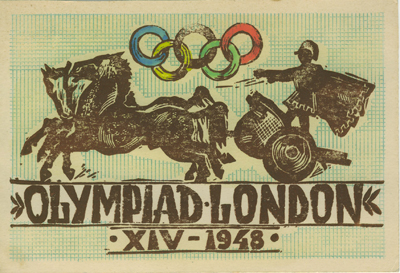
A new exhibition exploring London’s Olympic history has opened at the British Library. Olympex 2012: Collecting the Olympic Games features a range of memorabilia including a swimming costume and the finishing tape broken by – later disqualified – marathon runner Dorando Pietri  from the 1908 London Games (see our earlier post for more on him) as well as posters and artworks, stamps, letters and postcards. The exhibition also features audio interviews with Olympians including William (Bill) Roberts, a relay runner in the 1936 Berlin Olympics, and Dorothy Tyler, a medal-winning high jumper who competed in the 1936 and 1948 Olympics. Presented by the British Library and International Olympic Committee, the exhibition runs until 9th September at the library in St Pancras. Entry is free. For more, see www.bl.uk. PICTURE: Rare 1948 postcard by an unknown artist (c) Private collection/IOC

• A new free wifi network has been launched in London’s West End. Westminster City Council and telco O2 launched the network this week. It will initially cover Oxford and Regent Streets, Trafalgar Square, Leicester Square, Piccadilly Circus and Parliament Square with further areas in Westminster and Covent Garden the next to be included in the network. A once-only registration process is required to join.

• Henry Moore’s famous sculpture, The Arch, has been returned to its original home in Kensington Gardens. The six metre high work was presented to the nation by Moore in 1980 and was positioned on the north bank of the Long Water until 1996 when the structure became unstable and was placed in storage. In late 2010, the Royal Parks began a project with The Henry Moore Foundation to see if the work could be returned to the gardens. Work began to restore the piece – which consists of seven stones weighing 37 tonnes – to its original location earlier this year. For more on Kensington Gardens, see www.royalparks.org.uk/parks/kensington-gardens.

• On Now: From Paris: A Taste for Impressionism. This Royal Academy of Arts exhibition at Burlington House features 70 works from the Sterling and Francine Clark Art Institute in Williamstown, Massachusetts, and includes works by Manet, Monet, Pissarro, Degas, Sisley, Morisot and Renoir as well as those of post-Impressionist artists Corot, Théodore Rousseau and J-F. Millet, and ‘academic’ paintings by Gérôme, Alma-Tadema and Bouguereau. Runs until 23rd September. Admission charge applies. See www.royalacademy.org.uk for more.

Famous Londoners – Mr Punch…

Infamous, perhaps, rather than famous, Mr Punch (one half of Punch & Judy) this year celebrated the 350th anniversary of his first public appearance in London (which, in our view, makes him an honorary Londoner!).

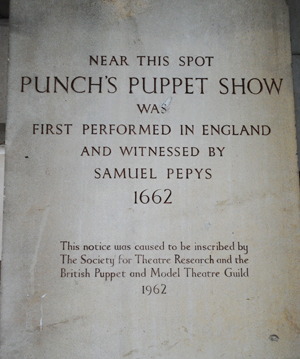
The first documented appearance of the hook-nosed Mr Punch – known for his acrimonious relationship with his wife Judy –  dates back to 9th May, 1662, when diarist Samuel Pepys recorded seeing a Mr Punch puppet performing as part of an Italian marionette show at Covent Garden (officially awarded a Guinness World Record title earlier this year for being the first recorded Mr Punch puppet show).

Mr Punch’s origins go back to Italy (Punchinello is thought to be an anglicised version of the character name of Pulcinella), typically wears a jester’s motley and tall, ‘sugarloaf’, hat with a tassel. Now generally a hand-puppet rather than a marionette, these days he usually performs in a mobile puppet booth with a cast of characters who as well as Judy can include a baby, a police constable and a crocodile.

Storylines – which were initially aimed at adults but are now generally aimed at children – vary but usually include references to current events (and perhaps also some mocking of public figures) and inevitably involve the unruly and often bawdy trickster, Mr Punch, doing away with his foes before uttering the line: “That’s the way to do it!”

Interestingly, Punch & Judy performers refer to themselves as “professors”  – there’s a story, apparently apocryphal, that this title was granted to the performers by King Charles II thanks to his enjoyment of the show. Collecting money from an audience watching the show is known as ‘bottling’ and those who assist the professor by doing so as ‘bottlers’, thanks to the tradition of using a bottle for the task.

Mr Punch reached the height of his popularity in the Victorian and Edwardian ages and could typically be seen carrying on in seaside resorts across the country. The dramatic decline in his popularity since means it can be harder to find a Punch & Judy show today (and even when you do, much of his more brutal antics have been excised from plays so as not to offend modern sensibilities), but it’s still possible to see Punch and Judy performances in many places across the UK including, on occasion, at Covent Garden where there is a plaque (shown above) commemorating the performance seen by Mr Pepys.

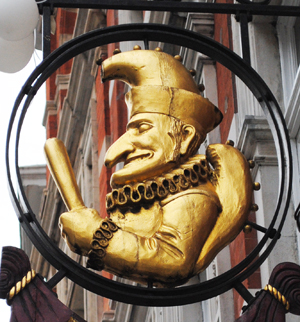
Mr Punch is still celebrated every year at Covent Garden’s May Fayre and Puppet Festival (held close to 9th May – not only the day Mr Pepys saw the puppet but now regarded as Mr Punch’s ‘birthday’) and there is a fellowship of Punch and Judy performers – The Punch & Judy Fellowship – who aim to “preserve, promote and protect” the traditions of the puppet show. Punch can also be seen on the facade of the Punch Tavern in Fleet Street – the sign is pictured above (keep on eye out for our upcoming Pub Signs look at the pub’s history).

Where is it?…#38


The latest in the series in which we ask you to identify where in London this picture was taken and what it’s of. If you think you can identify this picture, leave a comment below. We’ll reveal the answer early next week. Good luck!

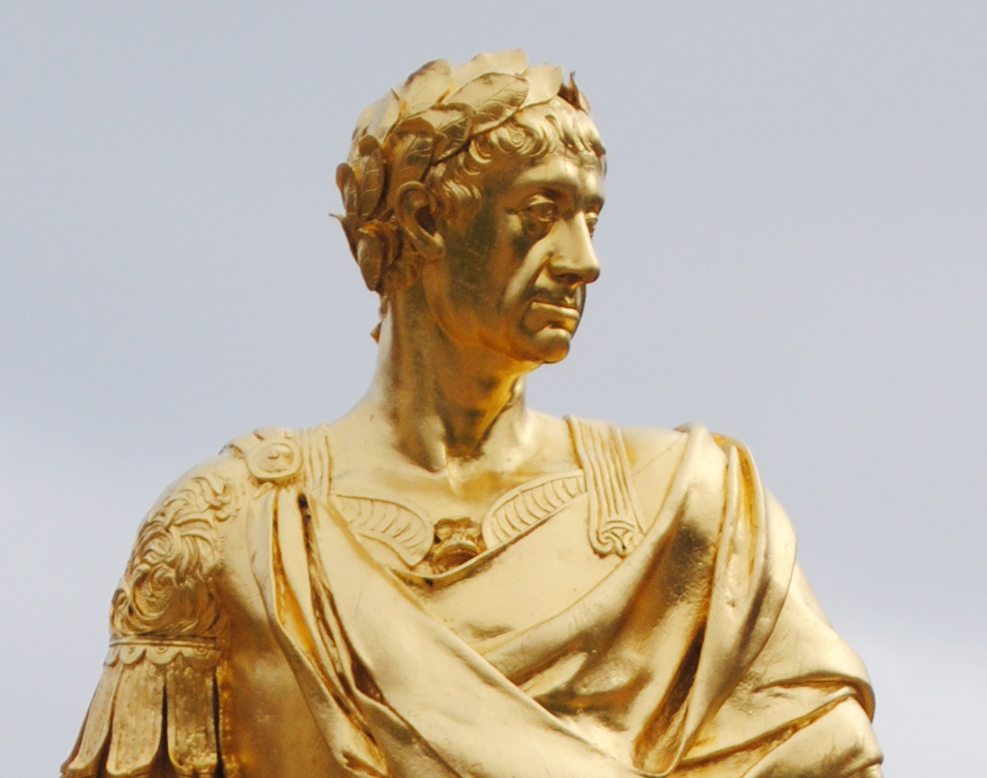
No-one managed it this time. This gilded bronze statue depicts King Charles II dressed as a Roman general and is located in the Figure Court of the Royal Hospital in Chelsea. The king founded the hospital in 1682 to provide a home for retired soldiers (the grand buildings you see are the work of Sir Christopher Wren – see our earlier entry here for more). The 7’6” tall statue, which was re-gilded to celebrate Queen Elizabeth II’s Golden Jubilee in 2002, was presented to the king in 1682 and moved to the hospital after his death in 1685. Although generally attributed to Grinling Gibbons, according to Walking London’s Statues and Monuments, it’s probably actually the work of Arnold Quellin, who worked in Gibbons’ studio. The statue is covered in oak branches on a date around 29th May each year – on a day known as Founders Day or Oak Apple Day – in commemoration of the legendary escape of the future king (by concealing himself in an oak tree) after the Battle of Worcester in 1651, the last battle of the English Civil War. For more on the hospital see www.chelsea-pensioners.co.uk.
Where is it? #37…

The latest in the series in which we ask you to identify where in London this picture was taken and what it’s of. If you think you can identify this picture, leave a comment below. We’ll reveal the answer early next week. Good luck!

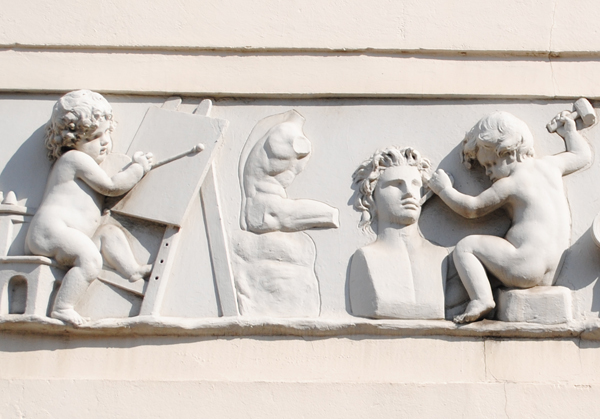
Bit of a harder one this week but well done to Parktown for punting for an embassy in Belgravia. This is indeed in Belgravia – in fact it’s just off Belgrave Square. The panel is part of one of two which adorn the walls of the Norwegian Embassy in Belgrave Place. Dating from 1796, the two panels depicting cherubs in various activities – one of which represents ‘agriculture’ and the other, the one pictured above, ‘arts’ – are made of Coade Stone (a reconstituted material made in the late 1700s/early 1800s, also used to create the South Bank Lion) which originally adorned the Danish-Norwegian Consulate in Stepney and were moved to this listed Georgian terrace, in 1968.

LondonLife – Unveiling the Bomber Command Memorial…

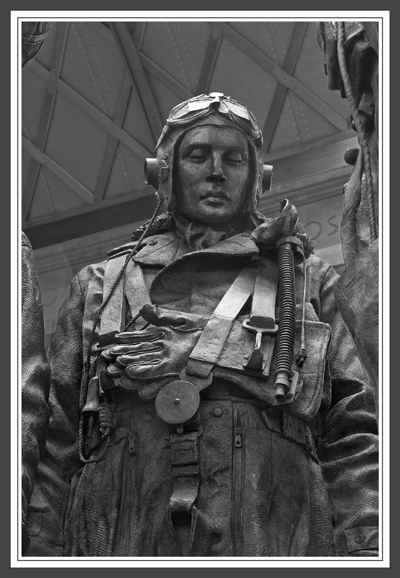
A new memorial honoring the 55,573 airmen who died while serving in Bomber Command during World War II was formally dedicated by Queen Elizabeth II in Green Park last week. At the centre of a new Portland stone pavilion, designed by architect Liam O’Connor (the architect behind the Commonwealth Memorial Gates near Buckingham Palace), is a nine foot high sculpture – the work of Philip Jackson – depicting seven aircrew from a Lancaster bomber having just returned from an operation (detail of which is pictured). The roof of the pavilion, the design of which was inspired by construction techniques used in the Vickers Wellington bomber, incorporates aluminium which was recovered from a Handley Page Halifax III bomber shot down over Belgium on the night of 12th May, 1944. The eight crew were killed during the incident and three of them were found still at their stations when the aircraft was excavated from a swamp in 1997 (they were subsequently buried with full military honors alongside the other five members of the crew). Hundreds of RAF veterans and Commonwealth airmen turned out to see the £6 million publicly funded memorial officially unveiled. The event was also marked with a flyover by five RAF Tornado bombers followed by the RAF’s last Lancaster Bomber which dropped thousands of poppies over Green Park in a message of remembrance. About 125,000 men served in Bomber Command from 1939-1945. The memorial, created following a five year campaign, commemorates people of all nations who lost their lives in the bombing campaigns of that period. For more on the memorial, see www.bombercommand.com.

PICTURE: Courtesy of Mike Legend at Flickr.

Around London – Olympic Rings unveiled on Tower Bridge; London from above; Blake on Primrose; V&A illustrations; and, Munch at the Tate Modern…

• The Olympic Rings were unveiled on Tower Bridge yesterday to mark one month until the Opening Ceremony of the 2012 Games. Each of the rings weighs three tonnes and are 25 metres wide and 11.5 metres tall. A light show featuring thousands of LED lights brings them to life at night. The rings retract when the bridge is raised. Among those at the unveiling were Lord Sebastian Coe, chairman of LOCOG, London Mayor Boris Johnson and the Culture Secretary Jeremy Hunt.

• Several hundred images of London have been included in Britain from Above, a new website launched by English Heritage and the Royal Commissions on the Ancient and Historical Monuments of Scotland and Wales. The website, which boasts more than 15,000 images taken between 1919 and 1953 includes some of the oldest and most valuable images from the Aerofilms Collection, an archive of more than a million photographs taken between 1919 and 2006. A search for London brings up 283 results, among them stunning images of Tower Bridge, The Tower of London and St Paul’s Cathedral. Users are encouraged to download images, customise their own themed photo galleries and share information to add to the knowledge behind each of the images. For more, see www.britainfromabove.org.uk.

• A quote from William Blake has been inscribed on stone on the summit of Primrose Hill, famous for its views of the London skyline. The quote – “I have conversed with the spiritual sun. I saw him on Primrose Hill” – was selected, according to Nick Biddle, The Regent’s Park manager, “because it sums up so well the experience of standing on Primrose Hill in the early morning light”. “It is always a wonderful experience,” he says. The unveiling of the inscription signalled the end to a series of improvement works on the hill. For more, see http://www.royalparks.org.uk.

• On Now: V&A Illustration Awards display. Features works by the 14 artists short-listed for the V&A’s annual illustration awards. Drawn from more than 1,000 entries the panel – fashion designer Orla Kiely, broadcaster and cultural commentator Emma Freud and Moira Gemmill, V&A director of design – selected their favorite entries in three categories – book illustration, book cover and jacket illustration – while winners of last year’s award judged a fourth category for students’ work. Runs until 31st December. Admission is free. For more, see www.vam.ac.uk/illustrationawards.

• On Now: Edvard Munch: The Modern Eye. This major exhibition at the Tate Modern reassesses the work of this Norwegian painter and aims to show how he engaged with the 20th century world, in particular his interest in the rise of modern media including photography, film and stage production. Organised in conjunction with the Centre Pompidou in Paris and the Munch Museum in Oslo, the exhibition features more than 60 paintings and 50 photographs as well as Munch’s lesser-known work in film. They include different versions of celebrated works like The Sick Child and The Girls on a Bridge as well as his last work, a self protrait. Runs until 14th October. Admission charge applies. For more, see www.tate.org.uk.

10 Historic Sporting Events in London – 1. The 1908 Olympic Games…

The London Olympics are almost upon us and having completed our series on the Queen to mark her Diamond Jubilee, we’re launching a new special looking at historic sporting events which took place in London and where they were carried out.

To kick it off, however, we thought we’d take a look at Olympics past. London has previously hosted the Games twice – 1908 and 1948. So this week we’re taking a look at the 1908 Games.

The 1908 Summer Olympics – officially recognised as the fourth “modern” Games – were initially to be held in Rome. But the eruption of Mt Vesuvius in 1906 devastated the city of Naples and so the funds which were to be used for the Games had to be diverted to help the stricken community.

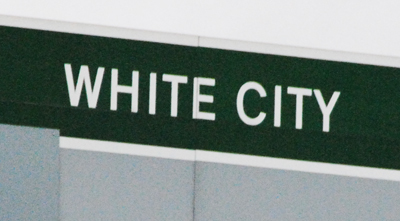
A number of candidates, including Milan and Berlin, were apparently considered before it was decided to hold the Games in White City in London’s west alongside the Franco-British Exhibition already being held in the area (the white marble clad buildings constructed for the exhibition buildings are what gave the area its name).

A new stadium – the White City Stadium – was constructed in just 10 months for the Games and was designed to accommodate 66,000 people. As well as the running track around the perimeter with which we are familiar today, there was also a cycle track located outside the running track while the infield hosted swimming and diving pools and a pitch where football, hockey, rugby and lacrosse could be played. Wrestling and gymnastics was also conducted in the middle of the stadium.

While many of the 110 events in 22 different sports – including athletics, archery, lacrosse, rugby union, swimming, water polo and  tug of war (the only time run at an Olympics, it was won by a City of London police team) – and were held at the stadium, a number were held elsewhere.

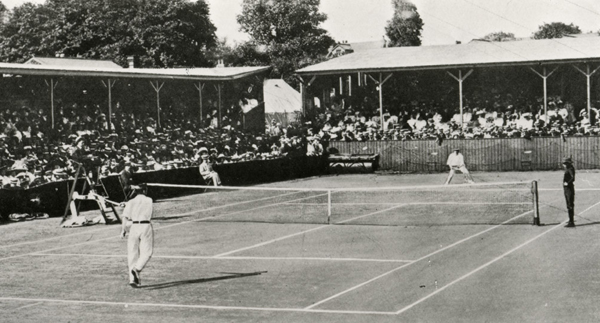
These included tennis (at the All England Lawn Tennis and Croquet Club in Wimbledon – see yesterday’s post), rowing (at Henley), fencing (at the neighbouring British-Franco Exhibition) and jeu de paume or ‘real tennis’ (at the Queen’s Club in West Kensington).

The Games, which ran for six months from April to October, were noted for being the first in which Winter events were included (four figure skating events were held at the Prince’s Skating Club in Knightsbridge), for being the first at which the Olympic creed – “The important thing in life is not the triumph, but the fight; the essential thing is not to have won, but to have fought well” – was publicly proclaimed.

They were also the Olympics at which length of the marathon was set at 26 miles, 385 yards (the distance from a window outside the nursery at Windsor Castle, where the event was started to give the Royal Family a good view, to the stadium) and were the first Games in which spectators marching into the arena behind their country’s flag during the opening ceremony.

The marathon, incidentally, was particularly controversial with Italian Dorando Pietri finishing first after being assisted across the finish line by officials when he collapsed (he was disqualified but awarded a special cup for his efforts by Queen Alexandra). There was also controversy when the US team refused to dip their flag before King Edward VII in the opening ceremony. Judging disputes also led to the creation of standard rules and the introduction of neutral judges in subsequent Games.

White City Stadium initially fell into disuse but was subsequently used for greyhound racing and athletics. The site is now occupied by the BBC. There is a ‘Roll of Honour’, unveiled on the site in 2005, which commemorates the 1908 Games.

Oh, and the most medals were won by Great Britain who won 56 gold, 51 silver and 38 bronze while the US came next with 23 gold, 12 silver and 12 bronze.

You can check out the Olympic website for more including images – www.olympic.org/london-1908-summer-olympics.

LondonLife – Marking Wimbledon that was…

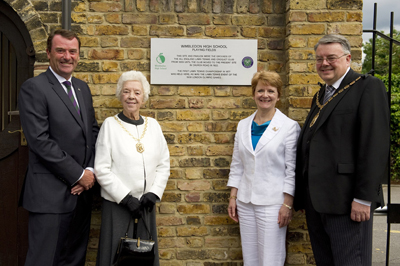
Wimbledon kicked off this week, so it’s only fitting that we mention the recent unveiling of a plaque commemorating the first ever Wimbledon Championships, held in 1877.

The plaque was unveiled last Monday on the former site of the All England Lawn Tennis and Croquet Club just off Worple Road in Wimbledon. As well as the first championships, it also commemorates use of the site for the 1908 Olympics tennis event.

The location of the former club, which it occupied until 1922, is now used as playing field by Wimbledon High School. The club is now based in Church Road opposite Wimbledon Park.

For more on the history of Wimbledon, see our entry from last year’s event here. For more on this year’s event, see www.wimbledon.com.

PICTURES: Top – The Championships being played at the former location in Worple Road (© Wimbledon Lawn Tennis Museum); and, at the plaque’s unveiling featuring the chairman of the All England Lawn Tennis and Croquet Club, Philip Brook, Wimbledon High School headmistress, Heather Hanbury, and the Mayor of Merton, Cr David Williams  (© AELTC/Thomas Lovelock).

Famous Londoners – Florence Nightingale…

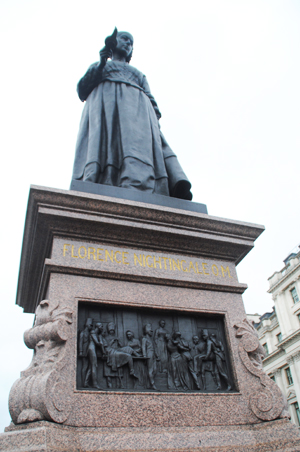
Known as “The Lady with the Lamp”, Florence Nightingale is remembered for her contribution to the development of the profession of nursing and the reform of medical practices during the Crimean War and the latter half of the 19th century.

Born on 12th May, 1820 in Florence (it’s from her birthplace that she gets her name), Florence Nightingale was the second daughter of William Edward Nightingale, son of a wealthy Sheffield banker, and Frances Smith.

She had a relatively privileged childhood at her family’s homes of Lea Hurst in Derbyshire and Embley Park in Hampshire (her father was named High Sheriff of the county in 1828) as well as occasional visits to London and received a broad education.

Believing herself to be called by God into His service when in her mid-teens, she chafed at the life set before her. It was a during visit to  convent which holidaying in Rome with family friends that she became convinced she had a mission from God to tend to the sick.

This was only furthered during a subsequent visit to a religious community at Kaiserswerth am Rhein – a training school for nurses – that finally convinced her of the possibility of making nursing a vocation for ladies. Returning to England, Nightingale took up her first official post – as superintendent of the Hospital for Invalid Gentlemen – in 1853.

The Crimean War broke out in March, 1854, and later that year, aware of reports of the suffering sick and wounded English soldiers were enduring, Nightingale offered her services to the War Office following an invitation by the Secretary for War Sidney Herbert.

Charged with authority over all the nurses (her official title was later Superintendent of the Female Nurses in the Hospitals in the East), Nightingale embarked for Crimea on 21st October with 38 nurses (there’s a plaque at 90 Harley Street – site of the hospital from which Nightingale left for the Crimea). She reached Scutari in Turkey on 4th November, the night before the Battle of Inkerman.

Headquartered in Scutari, Nightingale set about organising the military hospitals, improving general hygiene and conditions and supplies of essentials like clothes and other equipment. The wounded men soon recognised her efforts and began calling her ‘The Lady of the Lamp’ – referring to sight of her checking the wards at night.

Visiting hospitals near and in Balaclava in 1855, Nightingale fell ill from “Crimean fever” but recovered and was able to return to Scutari and continue her work. The following March Nighingale returned to Balaclava and continued to work there until the hospitals closed in July. She returned to England and the family home at Lea Hurst the following month.

In September, 1856, Nightingale had an audience with Queen Victoria at Balmoral – she used the occasion to inform the Queen and Prince Albert of the reforms needed in the military hospital system (and subsequently met with the Queen many times). Backed by data she had collected in the Crimea, Nightingale also pushed for a commission into military hospitals – it was commenced in April 1857 and Nightingale’s written evidence was critical to its recommendations.

In 1860, the Nightingale School and Home for Nurses was established at St Thomas’ Hospital in London (it was funded with £50,000 raised through the Nightingale Fund which had been established in 1855). She as unable to take up the post of superintendent due to ill health and other reasons but continued to take an active interest.

Nightingale – who wrote more than 200 books, reports and pamphlets on hospital planning and organisation, including the famous Notes on Nursing (1859), and interestingly is also said to have invented the pie chart – was also involved in establishing the East London Nursing Society (1868), the Workhouse Nursing Association and National Society for Providing Trained Nurses for the Poor (1874) and the Queen’s Jubilee Nursing Institute (1890).

Her accolades included the German Order of the Cross of Merit and the French Gold Medal of Secours aux Blessés Militaires and the badge of honour of the Norwegian Red Cross Society. She was the first woman to be awarded the Order of Merit and the Freedom of the City of London.

Nightingale died at the age of 90 in South Street London (just off Park Lane – there’s a Blue Plaque marking the spot), on 13th August, 1910. She was buried in the family plot at East Wellow, Hampshire.

There is a memorial to Nightingale as part of the Crimean War Memorial at Waterloo Place and a chapel dedicated to her at Westminster Abbey which is involved in the annual service commemorating her held there on her birthday, International Nurses Day, every year. For more on the service, see our earlier post here.

Well worth a visit is the Florence Nightingale Museum, located within St Thomas’ Hospital.    Highlights include her pet Owl Athena and the Turkish lantern she used in the Crimean War and the museum archives include around 800 letters from Florence Nightingale. For more on the museum, see www.florence-nightingale.co.uk.

Treasures of London – Duke of York’s Column…

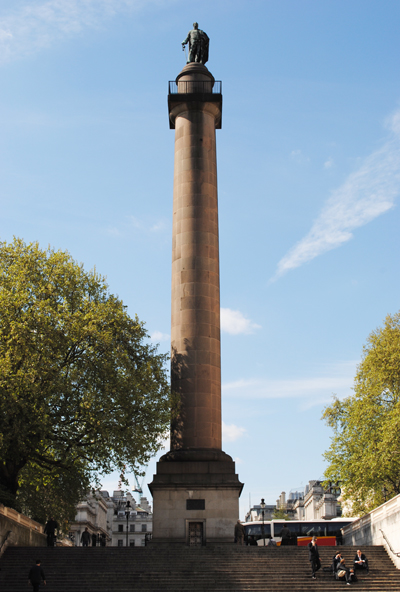
With Nelson’s Column in Trafalgar Square stealing much of the limelight, the Duke of York’s Column in Waterloo Place tends to get overlooked. So we thought it was time we took a more in-depth look at its history.

The monument is dedicated to Prince Frederick (1763-1827), the second son of King George III and commander-in-chief of the British Army during wars which were fought between France and European powers including Britain between 1792 and 1802.

The Duke was not a successful military commander on the field – his one outing in Flanders was a disaster and is said to have resulted in him being immortalised in the song, The Grand Old Duke of York – but he is celebrated for reforming the army after his return to England.

The almost 42-metre high monument  features a larger-than-life bronze statue of the Duke dressed in the robes of the Knights of the Garter – the work of Sir Richard Westmacott – standing on the top of a granite column and gazing down a series of steps and over The Mall towards St James’s Park.

The overall monument was designed by Benjamin Dean Wyatt. His design was selected by a committee from among other submissions and erected between 1830-33. While the Duke was an inveterate gambler and died deeply in debt, the British Army is said to have voted to forgo a day’s pay to fork out the £25,000 required to build the commemorative monument. It was said in jest that the height of the monument allowed the Duke to escape his creditors.

Interestingly, the hollow column contains a spiral staircase which originally gave access to a viewing platform at the top. Access was apparently prohibited after a spate of suicides.

Looking for more on statues and monuments around London – why not check out Peter Matthews’ London’s Statues and Monuments?