10 Historic Sporting Events in London – 1. The 1908 Olympic Games…

The London Olympics are almost upon us and having completed our series on the Queen to mark her Diamond Jubilee, we’re launching a new special looking at historic sporting events which took place in London and where they were carried out.

To kick it off, however, we thought we’d take a look at Olympics past. London has previously hosted the Games twice – 1908 and 1948. So this week we’re taking a look at the 1908 Games.

The 1908 Summer Olympics – officially recognised as the fourth “modern” Games – were initially to be held in Rome. But the eruption of Mt Vesuvius in 1906 devastated the city of Naples and so the funds which were to be used for the Games had to be diverted to help the stricken community.

A number of candidates, including Milan and Berlin, were apparently considered before it was decided to hold the Games in White City in London’s west alongside the Franco-British Exhibition already being held in the area (the white marble clad buildings constructed for the exhibition buildings are what gave the area its name).

A new stadium – the White City Stadium – was constructed in just 10 months for the Games and was designed to accommodate 66,000 people. As well as the running track around the perimeter with which we are familiar today, there was also a cycle track located outside the running track while the infield hosted swimming and diving pools and a pitch where football, hockey, rugby and lacrosse could be played. Wrestling and gymnastics was also conducted in the middle of the stadium.

While many of the 110 events in 22 different sports – including athletics, archery, lacrosse, rugby union, swimming, water polo and  tug of war (the only time run at an Olympics, it was won by a City of London police team) – and were held at the stadium, a number were held elsewhere.

These included tennis (at the All England Lawn Tennis and Croquet Club in Wimbledon – see yesterday’s post), rowing (at Henley), fencing (at the neighbouring British-Franco Exhibition) and jeu de paume or ‘real tennis’ (at the Queen’s Club in West Kensington).

The Games, which ran for six months from April to October, were noted for being the first in which Winter events were included (four figure skating events were held at the Prince’s Skating Club in Knightsbridge), for being the first at which the Olympic creed – “The important thing in life is not the triumph, but the fight; the essential thing is not to have won, but to have fought well” – was publicly proclaimed.

They were also the Olympics at which length of the marathon was set at 26 miles, 385 yards (the distance from a window outside the nursery at Windsor Castle, where the event was started to give the Royal Family a good view, to the stadium) and were the first Games in which spectators marching into the arena behind their country’s flag during the opening ceremony.

The marathon, incidentally, was particularly controversial with Italian Dorando Pietri finishing first after being assisted across the finish line by officials when he collapsed (he was disqualified but awarded a special cup for his efforts by Queen Alexandra). There was also controversy when the US team refused to dip their flag before King Edward VII in the opening ceremony. Judging disputes also led to the creation of standard rules and the introduction of neutral judges in subsequent Games.

White City Stadium initially fell into disuse but was subsequently used for greyhound racing and athletics. The site is now occupied by the BBC. There is a ‘Roll of Honour’, unveiled on the site in 2005, which commemorates the 1908 Games.

Oh, and the most medals were won by Great Britain who won 56 gold, 51 silver and 38 bronze while the US came next with 23 gold, 12 silver and 12 bronze.

You can check out the Olympic website for more including images – www.olympic.org/london-1908-summer-olympics.

LondonLife – Marking Wimbledon that was…

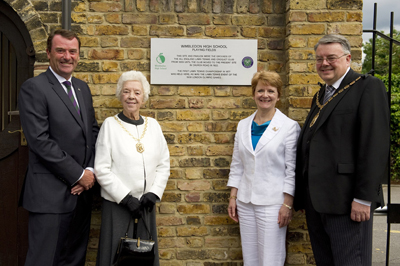
Wimbledon kicked off this week, so it’s only fitting that we mention the recent unveiling of a plaque commemorating the first ever Wimbledon Championships, held in 1877.

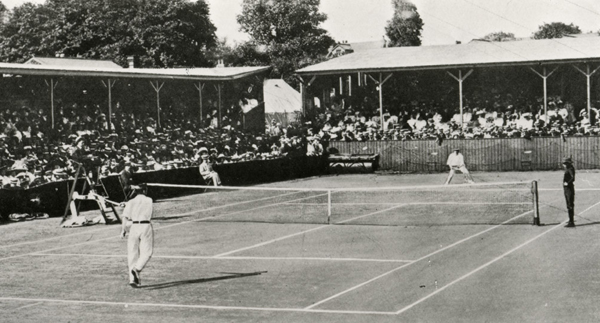
The plaque was unveiled last Monday on the former site of the All England Lawn Tennis and Croquet Club just off Worple Road in Wimbledon. As well as the first championships, it also commemorates use of the site for the 1908 Olympics tennis event.

The location of the former club, which it occupied until 1922, is now used as playing field by Wimbledon High School. The club is now based in Church Road opposite Wimbledon Park.

For more on the history of Wimbledon, see our entry from last year’s event here. For more on this year’s event, see www.wimbledon.com.

PICTURES: Top – The Championships being played at the former location in Worple Road (© Wimbledon Lawn Tennis Museum); and, at the plaque’s unveiling featuring the chairman of the All England Lawn Tennis and Croquet Club, Philip Brook, Wimbledon High School headmistress, Heather Hanbury, and the Mayor of Merton, Cr David Williams  (© AELTC/Thomas Lovelock).

Famous Londoners – Florence Nightingale…

Known as “The Lady with the Lamp”, Florence Nightingale is remembered for her contribution to the development of the profession of nursing and the reform of medical practices during the Crimean War and the latter half of the 19th century.

Born on 12th May, 1820 in Florence (it’s from her birthplace that she gets her name), Florence Nightingale was the second daughter of William Edward Nightingale, son of a wealthy Sheffield banker, and Frances Smith.

She had a relatively privileged childhood at her family’s homes of Lea Hurst in Derbyshire and Embley Park in Hampshire (her father was named High Sheriff of the county in 1828) as well as occasional visits to London and received a broad education.

Believing herself to be called by God into His service when in her mid-teens, she chafed at the life set before her. It was a during visit to  convent which holidaying in Rome with family friends that she became convinced she had a mission from God to tend to the sick.

This was only furthered during a subsequent visit to a religious community at Kaiserswerth am Rhein – a training school for nurses – that finally convinced her of the possibility of making nursing a vocation for ladies. Returning to England, Nightingale took up her first official post – as superintendent of the Hospital for Invalid Gentlemen – in 1853.

The Crimean War broke out in March, 1854, and later that year, aware of reports of the suffering sick and wounded English soldiers were enduring, Nightingale offered her services to the War Office following an invitation by the Secretary for War Sidney Herbert.

Charged with authority over all the nurses (her official title was later Superintendent of the Female Nurses in the Hospitals in the East), Nightingale embarked for Crimea on 21st October with 38 nurses (there’s a plaque at 90 Harley Street – site of the hospital from which Nightingale left for the Crimea). She reached Scutari in Turkey on 4th November, the night before the Battle of Inkerman.

Headquartered in Scutari, Nightingale set about organising the military hospitals, improving general hygiene and conditions and supplies of essentials like clothes and other equipment. The wounded men soon recognised her efforts and began calling her ‘The Lady of the Lamp’ – referring to sight of her checking the wards at night.

Visiting hospitals near and in Balaclava in 1855, Nightingale fell ill from “Crimean fever” but recovered and was able to return to Scutari and continue her work. The following March Nighingale returned to Balaclava and continued to work there until the hospitals closed in July. She returned to England and the family home at Lea Hurst the following month.

In September, 1856, Nightingale had an audience with Queen Victoria at Balmoral – she used the occasion to inform the Queen and Prince Albert of the reforms needed in the military hospital system (and subsequently met with the Queen many times). Backed by data she had collected in the Crimea, Nightingale also pushed for a commission into military hospitals – it was commenced in April 1857 and Nightingale’s written evidence was critical to its recommendations.

In 1860, the Nightingale School and Home for Nurses was established at St Thomas’ Hospital in London (it was funded with £50,000 raised through the Nightingale Fund which had been established in 1855). She as unable to take up the post of superintendent due to ill health and other reasons but continued to take an active interest.

Nightingale – who wrote more than 200 books, reports and pamphlets on hospital planning and organisation, including the famous Notes on Nursing (1859), and interestingly is also said to have invented the pie chart – was also involved in establishing the East London Nursing Society (1868), the Workhouse Nursing Association and National Society for Providing Trained Nurses for the Poor (1874) and the Queen’s Jubilee Nursing Institute (1890).

Her accolades included the German Order of the Cross of Merit and the French Gold Medal of Secours aux Blessés Militaires and the badge of honour of the Norwegian Red Cross Society. She was the first woman to be awarded the Order of Merit and the Freedom of the City of London.

Nightingale died at the age of 90 in South Street London (just off Park Lane – there’s a Blue Plaque marking the spot), on 13th August, 1910. She was buried in the family plot at East Wellow, Hampshire.

There is a memorial to Nightingale as part of the Crimean War Memorial at Waterloo Place and a chapel dedicated to her at Westminster Abbey which is involved in the annual service commemorating her held there on her birthday, International Nurses Day, every year. For more on the service, see our earlier post here.

Well worth a visit is the Florence Nightingale Museum, located within St Thomas’ Hospital.    Highlights include her pet Owl Athena and the Turkish lantern she used in the Crimean War and the museum archives include around 800 letters from Florence Nightingale. For more on the museum, see www.florence-nightingale.co.uk.
Treasures of London – Duke of York’s Column…

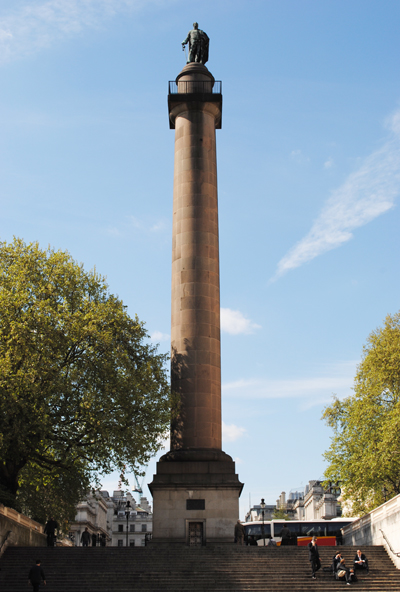
With Nelson’s Column in Trafalgar Square stealing much of the limelight, the Duke of York’s Column in Waterloo Place tends to get overlooked. So we thought it was time we took a more in-depth look at its history.

The monument is dedicated to Prince Frederick (1763-1827), the second son of King George III and commander-in-chief of the British Army during wars which were fought between France and European powers including Britain between 1792 and 1802.

The Duke was not a successful military commander on the field – his one outing in Flanders was a disaster and is said to have resulted in him being immortalised in the song, The Grand Old Duke of York – but he is celebrated for reforming the army after his return to England.

The almost 42-metre high monument  features a larger-than-life bronze statue of the Duke dressed in the robes of the Knights of the Garter – the work of Sir Richard Westmacott – standing on the top of a granite column and gazing down a series of steps and over The Mall towards St James’s Park.

The overall monument was designed by Benjamin Dean Wyatt. His design was selected by a committee from among other submissions and erected between 1830-33. While the Duke was an inveterate gambler and died deeply in debt, the British Army is said to have voted to forgo a day’s pay to fork out the £25,000 required to build the commemorative monument. It was said in jest that the height of the monument allowed the Duke to escape his creditors.

Interestingly, the hollow column contains a spiral staircase which originally gave access to a viewing platform at the top. Access was apparently prohibited after a spate of suicides.

Looking for more on statues and monuments around London – why not check out Peter Matthews’ London’s Statues and Monuments?

Around London – Trooping the Colour and Hampton Court celebrations; Park Lane sculptures; pathologist honored; Londoners at play; and, an exploration of gold…

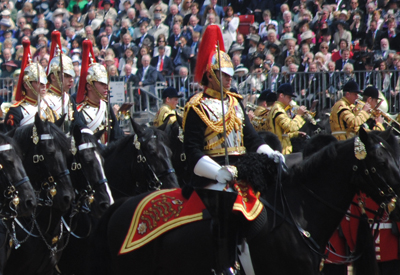
• It’s another weekend of celebration in London with events including Trooping the Colour and the Hampton Court Palace Festival taking place. With Diamond Jubilee fever in the air, expect crowds for this year’s Trooping the Color – the annual celebration of the Queen’s birthday – held at Horse Guards Parade on Saturday. The procession down The Mall kicks off at 10am  with the flypast back at Buckingham Palace at 1pm (organisers advice getting your place by 9am – for more, follow this link). The Hampton Court Palace Festival, meanwhile, kicks off today with a performance by Liza Minnelli and runs through next week until John Barrowman performs at the festival’s closing next Saturday (24th June). The festival, set against the backdrop of Hampton Court Palace, this year celebrates its 20th year – among other performers are Van Morrison, James Morrison, Frankie Valli & The Four Seasons and this Saturday (16th June) sees the holding of the 20th Anniversary Classical Gala and fireworks. For more, see http://hamptoncourtpalacefestival.com/. PICTURE: Trooping the Colour 2011.

• Park Lane’s central reservation is now hosting three new large scale sculptures by artist William Turnbull, considered a pioneer of modernism. The three works – 3×1 (1966), Large Horse (1990) and Large Blade Venus (1990) – have been installed as part of Westminster City Council’s ‘City of Sculpture’ festival. The works are on loan from the artist as well as the Yorkshire Sculpture Park and Chatsworth House, where they have been recently displayed.

• Professor Keith Simpson, a pathologist who has conducted post-mortems as part of the investigation into some of the country’s most infamous murders, has been honored with a green plaque at his former residence at 1 Weymouth Street by Wesminster City Council. The cases he worked on include the 1949 Acid Bath Murders (John George Haigh was hanged for the murder of six people in August that year) and the murder of gangster George Cornell, shot dead by Ronnie Kray in Whitechapel’s Blind Beggar Pub in 1966. Professor Simpson, who died in 1985, worked in the field of pathology for more than 30 years, taught at Guy’s Hospital in London and was renowned as having performed more autopsies than anyone else in the world.

• Now On: Londoners at Play. This exhibition at the Getty Images Gallery in Eastcastle Street explores through images how Londoners spent their leisure time – from the 19th century through to today. The display features 57 images including an image of ‘Last Night of the Proms’ from 1956 featuring conductor Sir Malcolm Sergeant, a print taken from a glass plate negative showing Londoners cycling in Royal Parks in 1895 and a crowd watching a Punch and Judy show in Covent Garden in 1900. Admission is free. Runs until 25th August. For more, see www.gettyimagesgallery.com/Exhibitions/Default.aspx.

• Now On: Gold: Power and Allure – 4,500 Years of Gold Treasures from across Britain. This exhibition at the Goldsmith’s Hall showcases more than 400 gold items, dating from 2,500 BC through to today. Admission is free. Runs until 28th July. For more information, see www.thegoldsmiths.co.uk.

Where is it? #32…

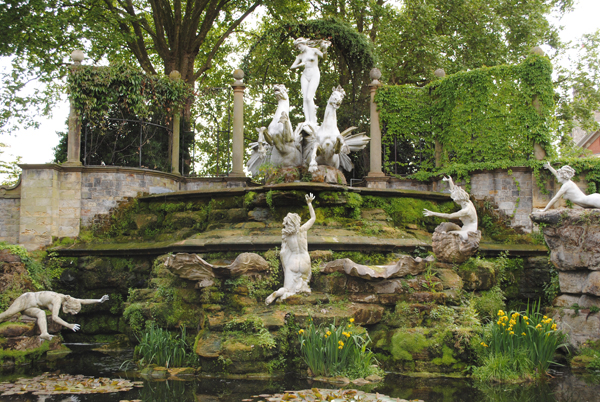
The latest in the series in which we ask you to identify where in London this picture was taken and what it’s of. If you think you can identify this picture, leave a comment below. We’ll reveal the answer early next week. Good luck!
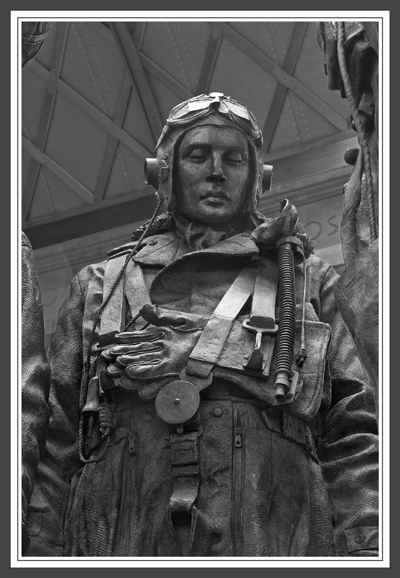
Thought this one might stump a few but no! Well done to Janet Holmes and Park Town – both correctly located this at Twickenham and Janet in the gardens at York House, a 17th century mansion now used by the London Borough of Richmond upon Thames. The house was named for the York family who once owned it and was also used by the French royal family (as well as nearby Orleans House). The gardens, which are open to the public, are quite spectacular and include two sections joined by a high bridge over a road. The gardens features numerous statues which were imported from Italy by a fraudulent financier, Whitaker Wright, who in the early 20th century took his own life. They were subsequently acquired by the last private owner of York House, Sir Ratan Tata (the son of an Indian industrialist, he purchased the house from the Duc d’Orleans). The larger than life-sized marble statues suffered neglect and vandalism before being restored in 1989. The particular group shown here is known as ‘The Naked Ladies’ and include eight ‘Oceanids’ and two aquatic horses. For more on the gardens and York House, see www.yorkhousesociety.org.uk.

Where is it? #31…

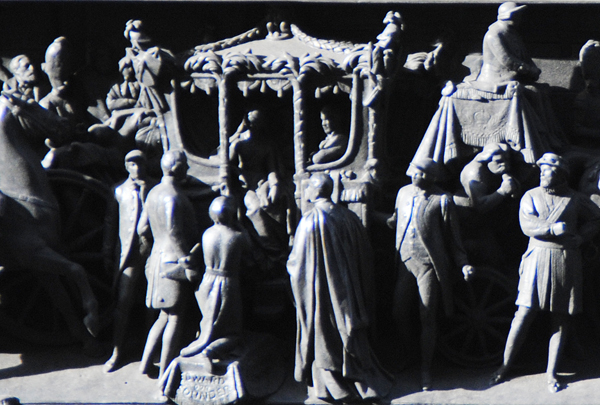
The latest in the series in which we ask you to identify where in London this picture was taken and, importantly in this case, what it’s of. If you think you can identify this picture, leave a comment below. We’ll reveal the answer early next week. Good luck!
Well done to Jameson Tucker, this is indeed a relief on the Temple Bar Memorial, which stands where the Strand turns into Fleet Street. It depicts Queen Victoria on a royal progress to the Guildhall in 1837, a few months after her accession, when she was met at this spot by the Lord Mayor and Aldermen and presented with the sword of state and keys to the city.

According to a tradition said to date back to 1215, the Temple Bar is the only place where the monarch may enter London after first seeking permission from the Lord Mayor and being presented with the City’s Pearl Sword (one of five City swords, this is said to have been first given to the City by Queen Elizabeth I).

The monument itself was designed by Sir Horace Jones and erected in 1880 to mark the location where the Temple Bar – the ceremonial entrance to the City of London – originally stood (the last incarnation of the Temple Bar, designed by Sir Christopher Wren, is now located near in Paternoster Square near St Paul’s – see our earlier post for more on Wren’s Temple Bar).

On top of the granite and bronze monument stands a rearing griffin (actually it’s supposed to be a dragon), one of the city’s official boundary markers, sculpted by Charles Birch while on either side are bronze statues, by Sir Joseph Edgar Boehm, of Queen Victoria and Edward, Prince of Wales (later King Edward VII), who in 1872 were the last of the Royal family to pass through the Temple Bar gateway before its demolition in 1878 (they were on their way to St Paul’s to attend a thanksgiving service following the prince’s recovery from typhoid).

This is depicted in a relief on the north side of the monument by Charles Kelsey. Charles Mabey’s relief showing the Queen’s progress is located on the south side of the monument; he also designed one on the east side which shows a curtain being drawn over the old Temple Bar.

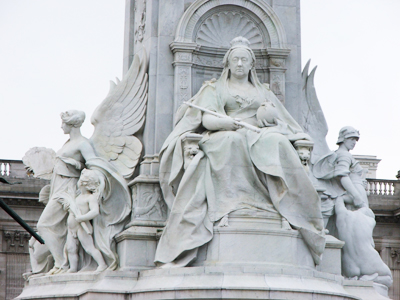
Treasures of London – The Queen Victoria Memorial…

It’s partly obscured now, thanks to preparations for the current Diamond Jubilee, and we have touched on it before (see our earlier post here) but we thought it appropriate to take a look at the main London memorial to the only other British monarch ever to have celebrated a Diamond Jubilee – Queen Victoria.

Prominently located outside of Buckingham Palace at the head of The Mall, work on the Grade I listed Queen Victoria Memorial commenced in 1903.  Dedicated to the Queen, who ruled from 1819-1901, it was unveiled by King George V, grandson of King Victoria, and that of his cousin German Emperor Wilhelm II in May, 1911 (although it wasn’t completed until 1924).

The statue, nicknamed the Wedding Cake, was designed by Sir Aston Webb (he who also designed the currently facade to Buckingham Palace and The Mall – down which the statue of Victoria serenely gazes), and sculpted by Sir Thomas Brock, who, so the story goes, received his knighthood after King George V was so moved at the dedication that he spontaneously decided to knight him then and there.

At 25 metres high, this vast statue is made of 2,300 tons of white marble, 800 tones of granite and 70 tons of bronze. It is the largest statue in London with the exception of that dedicated to Prince Albert in Kensington (it could be described as a companion piece) and is the largest statue of a monarch in England.

The statue is redolent with symbolism – four bronze lions at the base represent the idea of Power (a pair of these was apparently donated by New Zealand) while other bronze figures represent Peace, Progress, Manufacture and Agriculture. There is a nautical theme around the base with depictions of mermaids and ship’s prows among the scenes depicted, all of which evoke Seapower.

On the same level as the seated Queen are Truth, Justice and what’s variously described as Charity or Motherhood while above her are gilded figures representing Courage, Constancy and Winged Victory.

PICTURE: Louise Schuller (www.sxc.hu)

Celebrating the Diamond Jubilee with 10 royal London locations – 7. Silver Jubilee memorials…

For those who may not be aware, the current Diamond Jubilee is, of course, not the first jubilee Queen Elizabeth II has celebrated. In 1977, the Queen and the nation marked her Silver Jubilee, celebrating her 25th year on the throne.

Just as this year is designed as a year of celebration, so too was 1977 with the anniversary of the Queen’s accession culminating in a series events run over a week in early June. They included street parties, the lighting of a chain of beacons across the country (the Queen lit the first fire at Windsor), a national service of thanksgiving at St Paul’s Cathedral (which the Queen went to in the Gold State Coach) and a river progress from Greenwich to Lambeth.

To mark the Jubilee, the Queen and Prince Philip also travelled across the country, visiting as many as 36 counties during a Royal Tour, and went overseas where they visited nine countries as far afield as Australia and New Zealand, the West Indies and Canada.

In London, a number of memorials were installed which can still be visited today. They include:

The Silver Jubilee Walkway. Opened by the Queen on 9th junee 1977, this is made up of five circular sections which are themselves located in a 15 mile (24 kilometre) circle around the city and takes in many of the city’s greatest sites, including St Paul’s Cathedral, Buckingham Palace, Tower Bridge and Shakespeare’s Globe. For more on the walk, see www.walklondon.org.uk/route.asp?R=3

• South Bank Jubilee Gardens. Originally created to celebrate the Silver Jubilee in 1977, these gardens, located between Waterloo and Westminster Bridges, have recently been remade – including planting 70 new trees – for the Queen’s Diamond Jubilee and the Olympic Games.

Memorial Urn in Queen Square, Bloomsbury. This monument has inscriptions by poets Philip Larkin (“In times when nothing stood, But worsened or grew strange, There was one constant good, She did not change”) and Ted Hughes (A nation’s a soul, A soul is a wheel, With a crown for a hub, To keep it whole”) in front of and behind it.

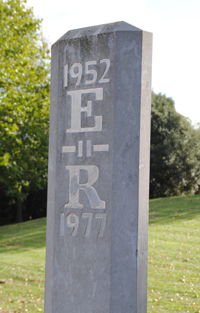
King’s Stairs Memorial Stone. This memorial stone (pictured) located on the edge of King’s Stairs Gardens by the Thames in Bermondsey was first installed to mark the Queen’s Silver Jubilee. The other side of the stone was inscribed during the Golden Jubilee in 2002.

• Plaque on Queen Elizabeth II’s birthplace. We’ve mentioned this plaque at 17 Bruton Street in Mayfair in an earlier entry but it’s interesting to note that it was erected in 1977.

Any others you can think of?

Around London – Leicester Square reopens; RA and MOL exhibitions mark Diamond Jubilee; ‘Jed’ retires; and, the history of horses at the British Museums…

• Leicester Square officially reopened last night following a £15.3 million transformation which has seen every paving stone replaced, new plants, and 40 new water jets placed around the Grade II listed fountain and statue of William Shakespeare. The 17 month makeover also included new lighting, new seating and a refurb of the underground toilets. The square – which owes its name to Robert Sidney, the 2nd Earl of Leicester, who purchased this land in 1630 and, after building himself a mansion, kept aside part of the land for public use – now welcomes as many as 250,000 tourists a day and is known as one of the world’s premiere sites for the release of new films.

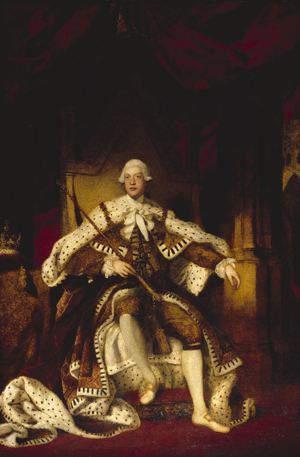
• The Royal Academy of Arts is marking the Queen’s Diamond Jubilee with a new exhibition opening tomorrow which features a selection of paintings by Royal Academicians elected during the early part of the Queen’s reign. The Queen’s Artists will include works by Jean Cooke, Frederick Gore and Ruskin Spear and will be displayed in the Reynolds and Council Rooms. Meanwhile The Saloon will house a collection of sculptures, paintings and drawings prepared by Royal Academicians for British coins and royal seals on loan from the Royal Mint Museum. The collection includes portraits of the Queen by Edward Bawden and Sir Charles Wheeler which have never before been shown in public, and Sir Anthony Caro’s new coin design of the London 2012 Olympic Games. Over in the Tennant Gallery, The King’s Artist’s George III’s Academy, will look at the king’s role in the foundation of the academy in 1768 and his influence in selecting the first artists. Highlights include portraits of King George III (pictured) and Queen Charlotte painted by the academy’s first president, Sir Joshua Reynolds. Admission charge applies. For more, see www.royalacademy.org.uk. PICTURE: Copyright Royal Academy of Arts, London/John Hammond.

• A new exhibition focusing on Londoners and their treasured souvenirs commemorating Queen Elizabeth II opens tomorrow at the Museum of London. At Home with the Queen features 12 photographic portraits of Londoners at home with their mementos as well as a selection of royal commemorative objects from the museum’s collection. The latter include trinkets produced for Queen Victoria’s Diamond Jubilee in 1897, official Coronation Day street decorations, Silver Jubilee paper tableware and souvenirs relating to the current Diamond Jubilee. Runs until 28th October. Admission is free. For more (including a series of events running on conjunction with the exhibition), see www.museumoflondon.org.uk.

The Royal Parks’ Shire horse, Jed, retired last week after a decade of service working in Richmond Park. The Queen presented a commemorative retirement rosette to Jed who was born in 1993 and joined the Royal Parks from Bass Brewery in Burton upon Trent almost 10 years ago. Horses have been used in Richmond Park since it was enclosed by King Charles I in 1637. The horses took a break in 1954 but the Shires were reintroduced in 1993 as a way to sustainably manage the parkland. For more on Richmond Park, see www.royalparks.org.uk/parks/richmond-park.

On Now: The horse: from Arabia to Royal Ascot. This major free exhibition at the British Museum is part of the august institution’s Diamond Jubilee celebrations and traces the history of the horse from domestication around 3,500 BC through to present day, with a particular focus on Britain’s equestrian tradition, from the introduction of the Arabian breed in the 18th century to events like Royal Ascot. Highlights include one of the earliest known depictions of horse and rider – a terracotta mould found in Mesopotamia dating from around 2000 to 1800 BC, a cylinder seal of Darius dating from 522 to 486 BC depicting the king hunting lions in a chariot, a 14th century Furusiyya manuscript, an Arabian manual of horsemanship, and the 19th century Abbas Pasha manuscript, the primary source of information about the lineage of purebred Arabian horses acquired by Abbas Pasha (mid-nineteenth century viceroy of Egypt). The exhibition is being held in Room 35. Runs until 30th September. For more, see www.britishmuseum.org.

Celebrating the Diamond Jubilee with 10 royal London locations – 6. The Mall…

For many Londoners, an opportunity to see the Queen means heading to Buckingham Palace to watch her wave from the balcony – or standing in the Mall to watch as her carriage goes by.

Given that, we thought we’d take the time to have a quick look at the history of The Mall, an important player in events like the annual Trooping the Colour.

This one kilometre long grand processional route which links Trafalgar Square to Buckingham Palace, was originally cut through St James’s Park in 1660 when King Charles II was looking for a new paille-maille pitch (see our earlier entry on Pall Mall for more on this). Two long avenues of trees were planted on either side, giving it a leafy feel that’s still in evidence today.

The Mall had become notorious by the 18th century and was spruced up in 1911 under the eye of Sir Aston Webb (who also designed other elements in the area including a new facade for Buckingham Palace, the Queen Victoria Memorial in front of the palace, and Admiralty Arch at the western end of the route) to become the grand avenue, complete with red-carpet like surface (this was done later), that it is today.

It is bordered by St James’s Park on the south side and on the north side is overlooked by various grand buildings – including Clarence House and the Institute of Contemporary Arts – as well as, toward the western end, Green Park.

These days the Queen publicly processes down The Mall for a number of events throughout the year – among them are the State Opening of Parliament (held earlier this month) as well as military ceremonies like Trooping the Colour and events like last year’s Royal Wedding when is it said that more than a million people were said to have filled the broad street.

The Mall is also the route along which Heads of State process in a horse drawn carriage during official visits (the road is then decorated with Union Jacks and flags of the visitor’s country). During the Olympics, it will be the start and end location of the marathons and cycling road races.

Apart from the Queen Victoria Memorial at the eastern end of The Mall, statues and monuments lining the road include the Queen Mother Memorial, a statue of explorer Captain James Cook, and a recently installed statue of cosmonaut, Yuri Gagarin.

There are apparently a series of tunnels underneath with link Buckingham Palace with Whitehall.

We should also briefly mention Horseguards, which is at The Mall’s eastern end and where Trooping the Colour and Beating Retreat takes place. This was formerly the site of a tiltyard of the Palace of Whitehall and jousting tournaments were held here during the time of King Henry VIII. It has been used for parades and ceremonies since the 17th century. While cars were parked here for much of the 20th century, this practice was stopped in the mid-1990s.

LondonLife – Wellington Arch reopens…

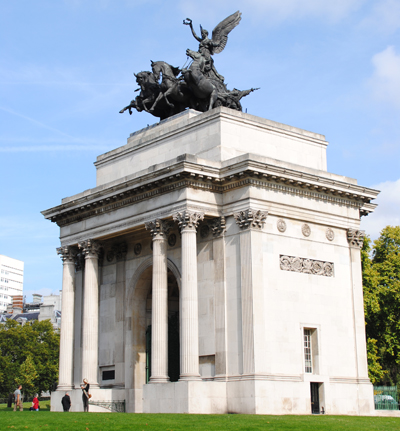
A newly refurbished Wellington Arch reopened last week with a new exhibition dedicated to Stonehenge. Stonehenge: Monumental Journey, which runs until 24th June in the arch’s Quadriga Gallery, show how visitors to the monument have interacted with it over time and look at how it new works will see it reconnected with the landscape around it. Other exhibitions in the Quadriga Gallery later this year include Blackpool: The Wonderland of the World, The Ladies of Kenwood, and Egypt in England. The refurbished arch also now contains a bookshop dedicated to English Heritage publications. For more on the history of Wellington Arch, see our previous entry here.

WHERE: Aspley Way, Hyde Park Corner (nearest Tube station is Hyde Park Corner); WHEN: 10am to 5pm, Wednesday to Sunday (until 28th March, 2013); COST: £4 an adult/£2.40 a child/£3.60 concession/£21.30 family (English Heritage members free); WEBSITE: www.english-heritage.org.uk/daysout/properties/wellington-arch/

Where is it? #28…

The latest in the series in which we ask you to identify where in London this picture was taken and what it’s of. If you think you can identify this picture, leave a comment below. We’ll reveal the answer early next week. Good luck!
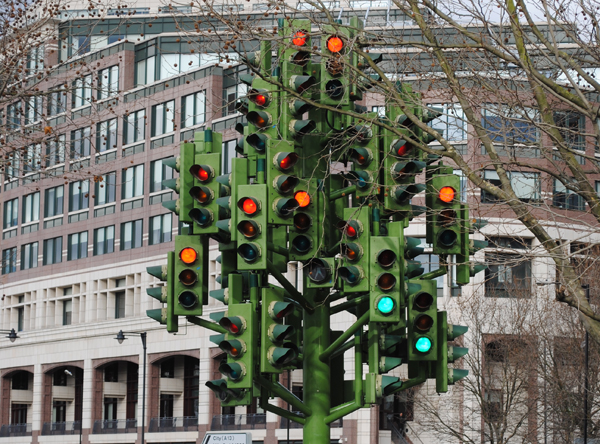
Well done to all those who guessed this was at or near Canary Wharf (although, as with our previous Where is it? on Little Ben, there is a slight trick to this one, because it’s no longer there). This is indeed Pierre Vivant’s sculpture, Traffic Light Tree, which was formerly located on the Heron Quay roundabout at the junction of Heron Quays, Marsh Wall and Westferry Road just outside the Canary Wharf development on the Isle of Dogs. The eight metre tall structure contains 75 lights and was installed in 1998 in place of a London plane tree which was apparently ill from pollution. In 2005, the roundabout was voted the best-looking in the UK in a poll by Saga Motor Insurance. That, however, didn’t save the structure from being removed late last year due to the remodelling of the roundabout. Tower Hamlets Council, who own the sculpture, called for suggestions for new locations following its removal and reportedly received about 200 replies. As far as Exploring London is aware, it currently remains in storage and no new site has yet been revealed (although the council has reportedly said it will remain somewhere on the Isle of Dogs). We’re checking with Tower Hamlets for further information…

Treasures of London – Diana Memorial Fountain

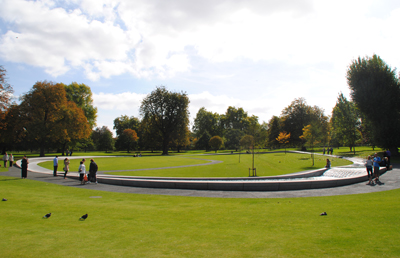
Located in Hyde Park (not far from the Lido), this memorial to Diana, Princess of Wales, is designed as a ring of water – rather like a stream bed – with two cascades tumbling down to meet in a pool at the bottom.

The fountain, which was opened by Queen Elizabeth II in July, 2004, also features three bridges which lead into the heart of the fountain – a symbol, apparently, of Diana’s openness to people.

Designed by US architect Kathryn Gustafson, the fountain – which cost £3.6 million – is made of 545 pieces of Cornish granite, each of which was shaped using laser cutting technology before being pieced together using traditional skills.

Gustafson’s design was selected after more than 10,000 plans were submitted to the Princess Diana Memorial Fountain Committee in 2002. The architect has been reported as saying she wanted the design to reflect Diana’s inclusive “personality”.

The fountain was briefly closed to the public shortly after opening in 2004 because of safety concerns but reopened with new guidelines soon after.

The fountain is located on the route for the the Diana, Princess of Wales, Memorial Walk, which takes on four of the royal parks – Kensington Gardens, Hyde Park, Green Park and St James’s Park.

Diana, whose divorce from Prince Charles had only been finalised the previous year, died in a car crash in Paris in August, 1997, along with Dodi Al Fayed.

WHERE: Hyde Park (nearest Tube stations are Knightsbridge and Hyde Park Corner); WHEN: 10am to 8pm until end of August (check website for times after that); COST: Free; WEBSITE: http://www.royalparks.org.uk/parks/hyde-park/diana-memorial-fountain

LondonLife – Florence Nightingale remembered…

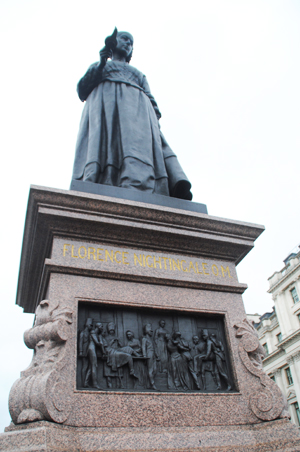
The life of Florence Nightingale, ‘The Lady with the Lamp’, depicted here on the Crimean War Memorial at Waterloo Place, is to be commemorated at the annual service in Westminster Abbey tomorrow. The Florence Nightingale commemoration service is held “to celebrate nursing and midwifery and all staff, both qualified and unqualified working in these services”. During the service a lamp, carried this year by Claire Gibbs, will be taken from the Abbey’s Florence Nightingale Chapel (formerly known as the Nurses’ chapel but rededicated in May 2010 – the centenary of Nightingale’s death) and escorted by a procession of nurses – this year it’s students from Liverpool John Moores University – to Reverend Professor Vernon White who will place it upon the High Altar. The address will be given by the former Archbishop of Canterbury, Lord Carey. Nightingale (1820-1910) rose to fame for her pioneering nursing work during the Crimean War and established the first secular nursing school in the world at St Thomas’ Hospital in London. The upcoming International Nurses Day is celebrated each year on her birthday – 12th May. Tickets for this year’s commemoration service are already allocated – to apply for tickets to next year’s, keep an eye on www.florence-nightingale-foundation.org.uk for details.

Treasures of London – Marble Arch…

Originally installed as a grand entrance to Buckingham Palace, John Nash’s arch was moved to its current location, what is now effectively a traffic island not far from Speaker’s Corner in nearby Hyde Park, in 1851.

The story goes that this took place after it was discovered that the arch was too narrow for the widest of the new-fangled coaches but there are some doubts over this, particularly as the gold state coach passed under it during Queen Elizabeth II’s coronation in 1952. Another story says that it was moved after extensions to Buckingham Palace left insufficient space for it.

Work on the arch had started at Buckingham Palace in the mid 1820s and it was completed by 1833. It was originally moved to replace Cumberland Gate as the new entrance to Hyde Park and to complement Decimus Burton’s arch at Hyde Park Corner. Successive roadworks in the 20th century, however, left it in its current position.

Clad in Carrara marble, the design of the arch was inspired by Rome’s Arch of Constantine and the Arc do Carrousel in Paris. The sculptural ornamentation, which includes works by Sir Richard Westmacott and Edward Hodges Baily, however, was apparently never completed and an equestrian statue of King George IV, originally destined for the top of the arch, instead now stands in Trafalgar Square. The bronze gates – which bear the lion of England, cypher of King George IV and image of St George and the Dragon – were designed by Samuel Parker.

Only senior members of the Royal family and the King’s Troop Royal Horse Artillery are permitted to pass under the central arch of the monumental structure.

The arch stands close to where the Tyburn Tree once stood (for more on this, see our earlier post). It contains three small rooms which, up until the 1950s housed what has been described as “one of the smallest police stations in the world”.

There was some talk in 2005 that the arch would be moved to Speaker’s Corner but this obviously hasn’t eventuated.

Around London – Cutty Sark reopens; Genghis Khan at Marble Arch; New theatre for the West End; and, Shakespeare’s cash…

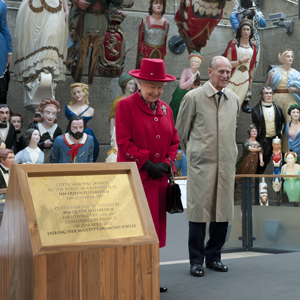
• The Cutty Sark, the world’s last surviving 19th century tea clipper, reopens to the public today following a £50 million, six year conservation project. The project to restore the Greenwich-docked ship has involved raising it more than three metres so visitors can walk underneath and see for themselves the sleek lines which helped the vessel set a then record-breaking speed of 17.5 knots or 20mph in sailing from Sydney to London. As well as raising the ship three metres, the project has involved encasing the ship’s hull in a glass casing to protect it from the weather – this area also contains the museum’s extensive collection of more than 80 ships’ figureheads, never been seen in its entirety on the site. The ship’s weather deck and rigging, meanwhile, have been restored to their original specification and new, interactive exhibitions on the vessel’s history have been installed below deck. Originally launched in 1869 in Dumbarton, Scotland, Cutty Sark visited most major ports around the world, carrying cargoes including tea, gunpowder, whiskey and buffalo horns and made its name as the fastest ship of the era when carrying wool between Australia and England. The ship became a training vessel in the 1920s and in 1954 took up her current position in the dry dock at Greenwich before opening to the public. In November 2006, the ship’s rig was dismantled in preparation for a restoration project – this received a setback on 21st May, 2007, when a fire broke out aboard the ship and almost destroyed it. The ship – which was officially reopened by Queen Elizabeth II and the Duke of Edinburgh (pictured) yesterday – is now under the operational management of the umbrella body, Royal Museums Greenwich. For more (including the online purchasing of tickets), see www.rmg.co.uk/cuttysark or www.cuttysark.org.uk. PICTURE: National Maritime Museum, London.

• A large statue of Genghis Khan has invaded Marble Arch. The 16 foot (five metre) tall sculpture of the Mongolian warlord, created by artist Dashi Namdakov, was erected by Westminster City Council as part of its ongoing City of Sculpture festival which is running in the lead-up to the Olympics. The statue has sparked some controversy – Labour councillors at Westminster have reportedly suggested Dambusters hero Guy Gibson would be a more suitable subject for a statue than the warlord Khan. The Russian artist, who has an exhibition opening at the Halcyon Gallery in Mayfair next month, told the Evening Standard he simply wanted to honor Khan on the 850th anniversary of his birth.

• Development of a new West End theatre, the first to be built in the area in 30 years, has been given the green light. The new 350 seat theatre will be part of a development project located between Charing Cross Road and Oxford Street which will also feature office and retail spaces. The site was occupied by a pickle factory in the 19th and 20th centuries and from 1927 was the home of the Astoria cinema, remodelled as a live venue in the 1980s. Live music was last presented there in 2009 when the site was compulsorily acquired for the Crossrail project.

• On Now: Crowns and Ducats: Shakespeare’s money and medals. This exhibition at the British Museum explores the role of money in Shakespeare’s world and looks at how coins – a frequently recurring motif in Shakespeare’s work – and medals were issued to mark major events. Objects in the display include Nich0las Hilliard’s ‘Dangers Averted’ medal of Elizabeth I and William Roper’s print of the Queen, the first to be signed and dated by a British artist, as well as a money box such as might have been used at the Globe and a hoard of coins, including a Venetian ducat, deposited in Essex around the time of Shakespeare’s birth. Almost every coin mentioned in Shakespeare’s plays will be on show – from ‘crack’d drachmas’ to ‘gilt twopences’. Runs until 28th October in room 69a. Entry is free. For more, see www.britishmuseum.org.

Where is it? #24

The latest in the series in which we ask you to identify where in London this picture was taken and what it’s of. If you think you can identify this picture, leave a comment below. We’ll reveal the answer early next week. Good luck!
Must have been a tough one because we only had one taker – Sue Kendrick – who was correct in saying that this was the memorial to 17th century English composer Henry Purcell located in Christchurch Gardens on Victoria Street (yes, near Scotland Yard!). The rather florid memorial, sculpted by Glynn Williams, was unveiled by Princess Margaret on 22nd November, 1995, the tercentenary of Purcell’s death. Purcell, credited as one of the greatest ever English composers thanks to his unique take on Baroque music, is believed to have been born nearby in a premises on a lane located off Old Pye Street. The gardens in which they are located also houses the Suffragette Memorial and is a former burial ground.

Lost London: Gates Special – The Stone Gate, London Bridge

And so we come to the last entry in our special series on Lost London looking at some of London’s gates – this time the only gate located on the south side of the Thames.

Located at the south end of London Bridge, this gate guarded the bridge entry in medieval times. When the first gate was built here remains something of a mystery but it is known that the first stone bridge, built in the late 1100s under the direction of priest Peter de Colechurch (it opened in 1209), certainly included a gatehouse known as the Stone Gateway (referred to by some as Bridge Gate) at the southern end.

The practice of parboiling the heads of traitors and the dipping them in tar before putting them on pikes above the gate apparently dates from 1305 when Scottish rebel William Wallace’s head was displayed there. The practice apparently continued until 1678 when goldsmith William Stayley’s head was the last to be displayed there.

As we mentioned in our earlier post on London Bridge, famous heads to adorn the gateway over the years included Peasant’s Revolt leader Wat Tyler in 1381, rebel Jack Cade in 1450, the former chancellor Sir Thomas More and Bishop John Fisher in 1535, Thomas Cromwell in 1540 and Guy Fawkes in 1606.

Pictured above is an enlarged detail of a 1616 print showing London Bridge by Claes Van Visscher – the heads are clearly visible on top. One German visitor famously counted 30 heads on top when he visited in 1598.

The gate (and it should be mentioned there was also another gate on the bridge with a drawbridge which was replaced by Nonsuch House in 1577) was presumably removed sometime after 1756 when an Act of Parliament authorised the removal of shops and houses on the bridge.

Of course, there are many other gates in London – some of them smaller gates in the city walls – which have been lost to time. We’ll be looking at some more of these in future posts…

PICTURE: Wikipedia

Lost London: Gates Special – Newgate

Better known now as the name for the infamous former prison which whom its history is intertwined, Newgate was originally one of the seven principal gates of London and, like five others, originally dates back to Roman times.

The gate, which apparently took the name ‘new’ thanks to a rebuild in the early medieval era, possibly in the reign of King Henry I or King Stephen, was located close to where the street known as Newgate meets the Old Bailey (see picture – there’s a blue plaque marking the spot on Newgate).

It was used as a prison from the 12th century for housing debtors and felons  – in the 13th century King Henry III is recorded as having issued orders for the prison’s repair (You can see our earlier entry on the prison here.)

The gate’s prison function – this was really no more than a few ‘cells’ – was substantially added to in the 1420s when, apparently as required under the terms of former Mayor Richard Whittington’s will, the gate was rebuilt and a new prison building was constructed to the south on what is now the site of the Old Bailey (home of the Central Criminal Court).

The gate was eventually demolished in the mid 18th century apparently due to urban planning issues. The prison, meanwhile, continued to be used until 1902 and was finally pulled down two years later.