Famous Londoners – John Wesley…

Credited as the founder, along with his brother, of Methodism, it was in London that John Wesley experienced the spiritual awakening that would change his life and lead to the establishment of a new religious movement.

Born on 17th June, 1720, in Epworth, not far from Lincoln, Wesley was the 15th of 19 children born to Samuel Wesley – the rector there – and his wife Susanna. Rescued from a fire in the family rectory at a young age, the event was to have a lasting impression on him leading to his later view that he was set apart for a special purpose – “a brand plucked from the burning”.

Wesley was educated at London’s Charterhouse School and then at Christchurch College in Oxford. Ordained a priest in the Church of England in 1728, he spent two years serving as his father’s curate before returning to Oxford in 1729.

It was there he formed the ‘Holy Club’ with his brother Charles and fellow students including George Whitfield. It’s here that the name ‘Methodist’ was first used as a pejorative term to describe members of the group thanks to their ‘methodical’ way of living – which included religious practises like fasting as well as caring for the ill and prisoners – and which was later adopted by Wesley himself.

Following a largely unsuccessful sojourn in the newly founded American Province of Georgia with his brother Charles (they had been invited by the colony’s first governor, James Oglethorpe, to minister to the new settlers) during which Wesley was involved in a courtship that ended badly, the clergyman fled back to England.

It was in London, on 24th May, 1738, that the clergyman then had his “Aldersgate experience” in which he felt his heart “strangely warmed” while at a religious meeting in Aldersgate Street (there’s a monument – the Aldersgate Flame – to this next to the Museum of London).

Initially influenced by the Moravians (Wesley even visited one of their communities in Germany), he later developed some concerns about some aspects of their teachings and so began forming his own followers into what would become the Methodist Society. Despite considerable opposite from the Church of England (Wesley was still an ordained Anglican minister), the new Methodists continued to work among the poor of London and elsewhere in England.

Barred from many Church of England pulpits thanks to his views on everything from salvation to the role ordinary people could play in the church, Wesley began preaching to large masses in the open air – ‘field preaching’ – as he travelled extensively about the country. He is said to have preached as many as 40,000 sermons and travelled some 250,000 miles during his ministry and campaigned on many social issues – including prison reform and the abolition of slavery – while his brother Charles is credited with writing thousands of hymns.

The first Methodist chapels in the UK were opened in the late 1770s – while the first was in Bristol, the second was opened in City Road, London, in 1778. It is still in use today – you can visit it, the Museum of Methodism (housed in the chapel crypt), and the house where Wesley lived the last 12 years of his life – follow this link for more details. The statue pictured above stands outside.

While he did not ordain ministers in England and throughout his lifetime continued to consider himself an Anglican, in an act which helped lead to the creation of an independent Methodist Church (formally created after his death), in 1784 Wesley ordained ministers to head to the newly independent United States of America after the Anglican Church failed to do so.

John Wesley died on 2nd March, 1791, at the age of 87, in his house. He was entombed at the London chapel.

While at the time of his death, it’s estimated that there were 135,000 members and more than 500 itinerant preachers working under the name  of “Methodist”, Wesley’s legacy was to become far greater as his ideas spread across the globe. It’s now estimated that there are around 70 million Methodists around the world.

Other monuments commemorating Wesley in London include Methodist Central Hall in Westminster – located opposite Westminster Abbey – which was built in the early Twentieth century to mark the centenary of Wesley’s death and a statue of Wesley on St Paul’s Churchyard, erected in 1988.

There’s a terrific walking guide published by the Methodist Church which links sites of relevance to Wesley’s life in London. You can download it here.
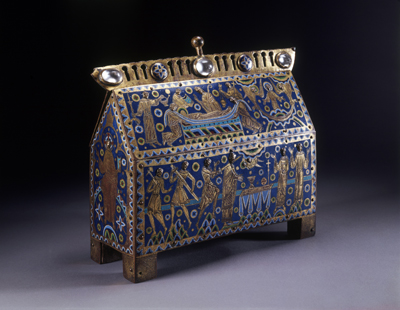
Treasures of London – The Becket Casket…

This stunning early medieval casket, dating from around 1180-1190, commemorates one of the most infamous events of the Angevin era – the death of Thomas Becket, Archbishop of Canterbury, who was murdered in Canterbury Cathedral on 29th December, 1170, by four knights of King Henry II.

The murder – for which the king undertook public penance (although whether he ordered the death of Becket, his former chancellor and friend, remains a matter of some dispute) – provoked outrage across Europe and pilgrims soon started flocking to Becket’s tomb.

So much so that the Archbishop was canonised in 1173 and in 1220 a richly decorated shrine was created to house Becket’s remains and serve as a focal point for pilgrims (a pilgrimage to Becket’s shrine is at the heart of Geoffrey Chaucer’s A Canterbury Tale). The shrine was eventually destroyed in 1538 on the orders of King Henry VIII during the Dissolution of the Monasteries.

The beautiful Becket Casket, made of Limoges enamel, depicts, among other things, Becket’s murder, subsequent burial and the ascension of his soul to heaven. On the rear are four long-haired figures who may represent saints or the Cardinal Virtues of Prudence, Justice, Fortitude and Temperance.

One of more than 40 examples still in existence (the British Museum also has one), it was probably made for an important religious house and may have been used to contain relics of the dead saint.

It can now be found in the collection of the V&A’s Medieval and Renaissance Gallery at the museum’s premises in South Kensington.

WHERE: Room 8 (case 20), Victoria & Albert Museum, Cromwell Road, South Kensington (nearest Tube Stations are South Kensington and Knightsbridge). WHEN: 10am to 5.45pm daily (Fridays until 10pm – select galleries after 6pm)COST: Free; WEBSITE: www.vam.ac.uk.

For more on Thomas Becket, see John Guy’s book Thomas Becket: Warrior, Priest, Rebel, Victim: A 900-Year-Old Story Retold.

PICTURE: V&A images

Around London – Dickens and the foundlings; astronomy photographs at the Royal Observatory; Royal Parks allotments; and, Asian drinking vessels at the British Museum…

• A new exhibition exploring the relationship between author Charles Dickens, the Foundling Hospital and its secretary and former foundling, John Brownlow, opened at the Foundling Museum today. Received, a Blank Child: Dickens, Brownlow and the Foundling Hospital looks at how Dickens supported the institution in various ways including helping a young mother petition for a place for her child and publicising the work of the hospital through his writing – in particular the 1853 article Received, A Blank Child (the phrase comes from the wording used on the hospital’s entry forms). Among the items on display are never before displayed letters from Dickens relating to the hospital. The exhibition, which runs until 16th December, is free with the museum admission. And if you haven’t yet had a chance to see it, there’s still time to catch Dickens and the Foundling, in which six contributors including actor Gillian Anderson and journalist Jon Snow, have chosen objects to be displayed. This ends on 28th October. For more, see www.foundlingmuseum.org.uk.

Images from the Astronomy Photographer of the Year competition have gone on display at the Royal Observatory in Greenwich (which runs the competition in conjunction with Sky at Night Magazine). Among the winning images were The Whirlpool Galaxy taken by Martin Pugh of the UK/Australia, Star Icefall by Masahiro Miyasaka of Japan, and Venus-Jupiter Close Conjunction, by Laurent Laveder of France. The exhibition is free of charge and runs until February next year. For more (including an online gallery), see www.rmg.co.uk/visit/exhibitions/astronomy-photographer-of-the-year/2012-winners/.

It’s Harvest Festival time at London’s Royal Parks and this Sunday, between 11am and 4pm, people are invited to attend the Kensington Gardens’ allotment to see the fruits of the gardeners’ labour including the “big dig” of the potato crop as well as seasonal vegetables. There’s also the chance for families to see the allotment chickens being fed and children’s activities run by Ginger Cat. This week’s event follows one last weekend at Regent’s Park. For more, see www.royalparks.org.uk.

• On Now: Ritual and revelry: the art of drinking in Asia. This new free exhibition in room 91 of the British Museum features a display of objects which have been used in the consumption of liquids in various Asian contexts and the manner in which their use is intertwined with ritual, religious and otherwise. Among the vessels on display is a Tibetan skull-cap known as a kapala which is made from a human skull and used in religious rituals as well as a silver tea set from western India which features handles shaped like bamboo stems and a lacquered wooden sake bottle which was used as an altar piece. Runs until 6th January. For more, see www.britishmuseum.org.

LondonLife – A snapshot in time at the soon-to-be Design Museum…

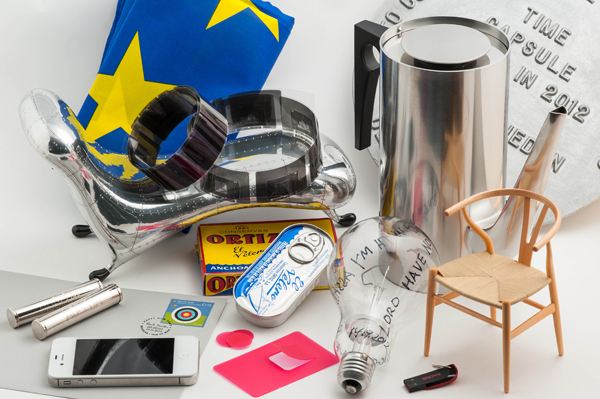
A selection of objects chosen by leading designers and architects including Sir Terence Conran, Sir Paul Smith, Zaha Hadid, and Norman Foster were buried within the foundations of the soon-to-be Design Museum in Kensington High Street earlier this month. The objects, which included everything from a miniature model of an 1949 Wish Bone Chair to an iPhone, a Cylinder Line Coffee Pot, a tin of anchovies and Tube maps, were placed within a time capsule which was buried as part of a ground-breaking ceremony for the new museum. Designed by John Pawson, the new Design Museum will be based within the converted interior of the former Commonwealth Institute Building. Expected to open in 2015, it will have three times as much space as the existing premises in Shad Thames, south east London. For more, see http://designmuseum.org.

PICTURE: Dominic French.

Around London – Open House London; 16th century tankard at MoL Docklands; and, Spanish artists shine at the British Museum…

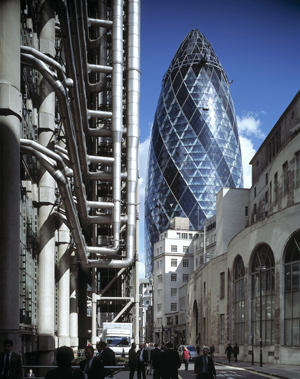
It’s Open House London weekend and that means your chance to enter scores of buildings not normally open to the public. More than 750 buildings are taking part in this, the 20th year the weekend has been held and there’s also an extensive program of free talks, walks and specialist tours. Among the buildings open this year are the iconic Gherkin building in the City (formally known as 30 St Mary Axe, pictured), Heron Tower in Bishopsgate, numerous livery company halls including that of the Apothecaries, Fishmongers and Carpenters, government buildings including Marlborough House, Westminster Hall, and the Foreign Office and numerous historic residences from the Mansion House, home of the Lord Mayor of London to Osterley Park House in west London. Among the events on offer is a moonlit hike through London tomorrow night to raise money for Maggie’s Cancer Caring Centres and rides on the new Emirates Airline cable car as well as boat tours to the Thames Barriers. If you didn’t order a guide, you can see the program online at the Open House London website – www.londonopenhouse.org. PICTURE: (c) Grant Smith/VIEW Pictures

A 16th century wooden tankard, found by a mudlark on the Thames foreshore near Ratcliff in London’s east, has briefly gone on display at the Museum of London Docklands. The large vessel, capable of holding three pints, has the initials RH inscribed on the base. It’s unknown for what purpose it was used, perhaps serving as a decanter rather than for individual use and may have been used on a ship. The vessel will be on display at the museum only until 27th September. For more, see www.museumoflondon.org.uk.

On Now: Renaissance to Goya: Prints and drawings from Spain. Opening at the British Museum today is this new exhibition featuring important prints and drawings by Spanish and other European artists working in Spain and spanning a period from the mid 16th century through to the 19th century. While all the works are drawn from the museum’s collection, many have never been on display before. The artists represented include Diego Velazquez, Alonso Cano, Bartolome Murillo, Francisco Zubaran and Jusepe de Ribera as well as Francisco de Goya. Held in room 90. Admission is free. Runs until 6th January. For more, see www.britishmuseum.org.

Around London – London’s listed; Open House beckons; Blue Plaque for opthalmologist; and, Motya Charioteer at the British Museum…

• It includes everything from the iconic Lloyd’s Building in the City to the former Strand Union Workhouse in Fitzrovia which may have inspired scenes in Charles Dickens’ Oliver Twist and the red phone boxes which sit outside the British Museum in Bloomsbury. English Heritage this week released it’s London List 2011 which documents the more than 100 sites in London which have been awarded listed status by the organisation last year. They include 19 Underground stations (among them that of Oxford Circus, St James’s Park and Aldwych), four war memorials (including the grand Central Park War Memorial in East Ham) and two schools as well as various cemetery monuments (including at Highgate and Brompton Cemeteries, and Bunhill Fields Burial Ground) and parks (the status of Green Park was upgraded to Grade II*), religious and commercial premises, public libraries and homes. To download a copy, visit www.english-heritage.org.uk/publications/london-list-2011/.

It’s just one week to go until the Open House London weekend when more than 750 buildings of all sorts open their doors to you. We’ll be talking more about some of the special places open this year in next week’s update – this is, after all, one of our favorite London events of the year, and while, if you haven’t already entered, you’ve missed on the balloted openings, there’s still plenty of places where you can simply turn up on the day (and entry to all is free). If you haven’t already bought one, you can buy the Guide online – just follow the links from www.openhouselondon.org.uk. It can also be picked up free at some participating London libraries.

• Dame Ida Mann, Oxford’s first female professor and a pioneering ophthalmologist, has been honored with an English Heritage Blue Plaque at her childhood home in West Hampstead. The plaque, which was unveiled by an Australian opthalmologist who worked with Mann, Donald F. Ezekial, last week, has been placed on a house at 13 Minster Road where Mann lived from 1902-1934. Mann was born in West Hampstead and lived there for 41 years before eventually emigrating to Australia. For more on blue plaques, see www.english-heritage.org.uk.

• On Now: Motya Charioteer at the British Museum. Best be quick for this one, the charioteer, on loan from the Museo Giuseppe Whitaker on Motya, is only around until 19th September (that’s next Wednesday). The stunning statue, displayed near the sculptures from the Parthenon, dates from about 460-450 BC and is generally credited as one of the finest examples of Greek marble sculpture to have survived down the ages. It is believed to depict the winner of a chariot race and is likely to have been commissioned to commemorate a victory by a participant from one of Sicily’s Greek cities. It was found in Sicily in 1979. Admission is free. For more, see www.britishmuseum.org.

Around London – Cecil Beaton at the IWM; a night of bicycles at the Design Museum; and, Dickens and the Foundling…

A major new exhibition featuring stunning images captured by the late renowned society and fashion photographer Cecil Beaton during World War II opens at the Imperial War Museum in Lambeth today. Cecil Beaton: Theatre of War features some of the 7,000 photographs the photographer took between 1940 and 1945 with many of them exhibited for the first time. The photographs were taken in an array of locations – from Britain and Europe to the Middle East and Africa, India, Burma, China and the US – and depict everything from “ordinary” people in civilian life through to some of the era’s most famous military leaders. The exhibition will also look at how the war affected Beaton personally including his own brushes with death including in a major air crash and suffering from the likes of dengue fever and dysentery. Admission charge applies. Runs until 1st January. For more, see www.iwm.org.uk.

• A celebration of all things bicycle will be held at the Design Museum tomorrow (Friday, 7th September) night. Bike V Design, which kicks off at 6.30pm, will feature talks exploring the design of bikes, a mini cinema and live performances including BMX stunts and circus trick cycling as well as a demonstration of saddle manufacturing. Visitors are encouraged to bring their own bikes or enjoy the selection of bespoke bicycles on display. The night is being held to coincide with Designed to Win, the museum’s current exhibition exploring the tension between sport and design. An admission charge applies. For more, see www.designmuseum.org.

• On Now: Dickens and the Foundling. In case you’ve missed it, this exhibition at the Foundling Museum in Bloombury explores the relationship between the writer and the Foundling Hospital through a series of objects selected for display by six people with an interest in Dickens including actress Gillian Anderson, Dickens’ descendent Mark Dickens, comedian Armando Iannucci, Camden councillor Tulip Siddiq, poet Lemn Sissay and journalist Jon Snow. Among the objects on show are a letter from Dickens to the editor of The Times in which he objects to public hangings, the writing desk at which Dickens wrote what we have of the unfinished The Mystery of Edwin Drood, and a manuscript page from Oliver Twist, written when Dickens lived in a house at nearby Doughty Street. The exhibition runs until the end of October. Free with museum admission. For more, see www.foundlingmuseum.org.uk.

Around London – Liberty Festival’s 10th; teddy bears at Royal Parks; Cosmati pavement on the web; and animal crackers at Cartoon Museum…

• This weekend London host’s the 10th Liberty Festival, a showcase of deaf and disabled artists. Free events – including live music, dance, street theatre, film and cabaret – are being held at several locations across the city over Saturday, Sunday and Monday, including in Trafalgar Square, the National Theatre, South Bank Centre, BFI Southbank and Picture, the Mayor of London’s Live Site at Potters Fields Park next to City Hall on the south bank of The Thames. Highlights of the event – a centrepiece of the Paralympic celebrations – include a “cabaret showcase of comedy, film and music” at Royal Festival Hall on Saturday, and a “jazz, blues and R&B spectacular” at BT London Live Trafalgar Square on Sunday. This year’s event, produced by the Mayor of London with Greenwich+Docklands Festivals, coincides with Unlimited, the London 2012 Festival’s showcase of disabled artists. For more details, see www.molpresents.com/liberty. For more on BT London Live Trafalgar Square, see www.btlondonlive.com.

• If you go down the woods (read Royal Parks) today…you will find a Teddy Bear’s picnic! Royal Parks is inviting children up to the age of 12 to attend three Teddy Bear’s picnics it’s holding in Richmond Park and Bushy Park this week. While one event has already gone (it was held yesterday), there’s still two to go – one at the Kingston Gate Playground in Richmond Park from 11.30am to 3.30pm today, and another at the Bushy Park Playground between 11.30am and 3.30pm tomorrow (Friday). Both afternoons feature free craft activities, games and a “best dressed ted” competition. For more, see www.royalparks.org.uk.

Tragedy on the Thames: Princess Alice Disaster. This talk at the London Metropolitan Archives looks at an event which took place on 3rd September, 1878 when a day trip to Rosherville Pleasure Gardens in Gravesend turned to tragedy with more than 650 people dead after a collision on the Thames. The talk will discuss the coroner’s inquests and witness accounts before looking at some original documents held at the LMA. The free event is held on Monday from 2pm to 3pm. Booking essential (020 7332 3851). For more on the LMA, follow this link.

Westminster Abbey has unveiled a new website showing how the spectacular Cosmati pavement was brought back to life in a two year restoration project. The 13th century floor mosaic, which covers the floor in front of the High Altar, was hidden under carpets for more than 100 years before the restoration work was carried out. The new website features more than 40 films showing all elements of the restoration and interviews with experts about the pavement as well as an interactive map of the pavement. For more, see www.westminster-abbey.org/conservation. You can also see our Treasures of London article on the pavement here.

• On Now: Animal Crackers – A Cartoon and Comic Bestiary. This exhibition at the Cartoon Museum in Bloomsbury features characters including Mickey Mouse, Wallace and Gromit, Fred Basset and Rupert Bear as well as icons like the American Eagle, Russian Bear and financial Fat Cat and joke cartoons from publications including Punch, Private Eye, The Spectator and many national newspapers. More than 140 cartoons, caricatures, comics and graphic novels, created by more than 60 artists, are included in the display. Runs until 21st October. Admission charge applies. For more, see www.cartoonmuseum.org.

Around London – Notting Hill Carnival; Paralympics comes to town; Albert Adams at the IWM; and, exploring the anatomy of athletes at the Hunterian…

• The Notting Hill Carnival – the largest festival of its kind in Europe – takes place in London’s west this Sunday and bank holiday Monday. More than a million people are expected top attend to see the floats, listen to the traditional steel drum bands and sample some of the food found at the hundreds of stalls along the streets of Notting Hill.  Sunday, when the costume prizes are awarded, has been designated as Children’s Day and Monday, when the main parade takes place, as Adult’s Day. The festival has been held every summer since 1966. For more, see www.thenottinghillcarnival.com.

• With the memories of the Olympics still fresh in our minds, it’s time to turn our attention to the impending Paralympics and associated events including the 24 hour Torch Relay which hits London next Wednesday, just before the Opening Ceremony. The torch enters London at Watford and and then moves south through the city, taking in many of London’s most famous landmarks as it visits all six boroughs before arriving at the Olympic Stadium. For more on the route, see www.london2012.com/paralympics/torch-relay/route/. Meanwhile, as with the Olympics, those who don’t have tickets to the Paralympics will be able to watch on a giant screen at Trafalgar Square daily between 11am and 10pm where there will also be live music and activities including the chance to try out a range of Paralympic sports. For more, see www.btlondonlive.com/trafalgar-square. Tower Bridge, meanwhile, is undergoing a makeover with the installation of the Paralympics symbol, Agistos, tomorrow following the earlier removal of the Olympic Rings. Historic projections, meanwhile, will once again appear on the Houses of Parliament. Other events taking place around the Paralympic Games include Surprises: What You Will: Pop-Up Shakespeare – which will see Shakespearean characters like Juliet, Hamlet and Puck suddenly appearing and performing at “cultural hotspots” around the city (the exact time and location of the performances will remain a surprise until the day but you can register for updates at www.molpresents.com/surprises or follow @molpresents and @London2012Fest.

• A series of artworks by South African-born Expressionist Albert Adams are on show at the Imperial War Museum this summer. The works on show include the last painting he completed before his death in 2006 – title Abu Ghraib, it was inspired by reports of abuse perpetrated at the Abu Ghraib prison in Iraq – as well as a series of etchings Adams created between 2001 and 20064 which address conflicts like that Iraq War and Darfur. Admission is free. For more, see www.iwm.org.uk.

On Now: Anatomy of an Athlete – Elite sport, surgery and medical art. This exhibition in the Qvist Gallery at the Royal College of Surgeons’ Hunterian Museum in Lincoln’s Inn Fields features new artworks by world-leading medical artists which explore the anatomy and physiology of elite athletes. The art works come in a variety of forms – watercolour, video and sculpture – and represent the human body in a selection of sports and para-sports. Admission if free. Runs until 29th September. For more, see www.rcseng.ac.uk/museums/.

10 Historic Sporting Events in London – 7. The first Five Nations game played at Twickenham…

Twickenham was only a new ground when, in 1910, a England played Wales in what was the first international to be played at the ground – part of the first of what later became officially recognised as the Five Nations competition.

The game played on 15th January, 1910, was only the second to be played in the competition and followed Wales defeat of France in Swansea earlier in the month. A crowd of about 18,000 watched as England defeated Wales 11-6 (England went on to win the competition, winning three matches and drawing the match they played against Ireland).

Twickenham, meanwhile, had only hosted its inaugural match the year before when local sides the Harlequins and Richmond played (the Harlequins won, 14-10). The Rugby Football Union had purchased 10.25 acres of land in Twickenham – previously a market garden – after witnessing the crowds at international rugby contests held at Crystal Palace in south-east London in 1905 and 1906 and decided they needed a ground of their own.

The pitch was raised to prevent flooding and covered stands were build on the east and west side of the pitch, a terrace at the south end and an open mound at the north along with space f0r 200 automobiles or carriages.

The ground – the pitch of which was used for grazing animals in World War I – was developed further in the following years until World War II when it was used as a civil defence depot.

The next major development occurred in the late 1970s/early 1980s when the south terrace was controversially replaced with the South Stand. A new North Stand followed in 1991, a new East Stand in 1993 and a new West Stand in 1995. What was then known as the Museum of Rugby, based at Twickenham Stadium, was opened to the public the following year.

The most recent work has again been on the South Stand which was reopened in 2006 and brought the capacity of the ground to 82,000.

Other landmark games among the many played at Twickenham include the 1959 Twickenham Jubilee celebration match between England and Wales versus Ireland and Scotland (England and Wales won, 26-17) and the final of the 1991 Rugby World Cup (Australia defeated England 12-6). Twickenham will also host the final of the 2015 Rugby World Cup.

There are regular tours of the ground (it’s advised to book these in advance) with highlights including the England dressing room, royal box, hospitality suites, medical room, player’s tunnel onto the pitch, a panoramic view of the arena from the top of the stand and a walk pitchside.

The tour also includes a visit to the World Rugby Museum (it’s possible to just buy tickets to the museum). Located in the East Stand (and known between 1996 and 2007 as the Museum of Rugby), the museum is home to some 25,000 artefacts – everything from a 1910 England v Ireland programme to pieces of kit worn by players from the earliest days of the game, a ceremonial wahaiki (or war cleaver) presented to the RFU by New Zealand Maoris in 1989, and the Calcutta Cup – dating from 1878 and made from the melted down silver coins (the savings of the now defunct Calcutta Rugby Club), it is presented to the winners of annual England versus Scotland match played as part of the RBS 6 Nations Championship.

The museum also houses the Twickenham Wall of Fame, described as “a celebration of the best players from all over the world that have ever played at Twickenham Stadium”. There are also a series of blue plaques around the stadium celebrating some of the best players.

WHERE: Twickenham Stadium, Whitton Road, Twickenham (nearest station is Twickenham); WHEN: Museum is open 10am to 5pm Tuesday to Saturday/11am to 5pm Sunday; Tours are run at select times Tuesday to Sunday – check website for details including scheduled closures; COST: £7 an adult/£5 concessions for museum only; £15 and adult/£9 concessions/£45 family ticket; WEBSITE: www.rfu.com/twickenhamstadium.

10 Historic Sporting Events in London – 6. The first Wimbledon championships…

While the history of the All England Tennis and Croquet Club goes back as far as 1868 (it was initially just known as the All England Croquet Club), the first Wimbledon Championships, officially known as The Championships, Wimbledon, were held some nine years later in 1877.

The only event held at the first championship was the “gentlemen’s singles” and the winner was cricketer (and, of course tennis player) Spencer Gore who emerged victorious over William Marshall in straight sets – 6-1, 6-2, 6-4 – before a crowd of about 200 (the “ladies’ singles” wasn’t introduced until 1884 with Maud Watson the first female champion after she defeated her sister Lilian).

Each of the 22 male amateur entrants had paid an entrance fee of £1, 1 shilling, and had to bring their own racquets and shoes “without heels” but were supplied with tennis balls.

Gore apparently won 12 guineas in prize money as well as a trophy, the Field Cup (the Gentleman’s Singles Trophy was introduced in 1887).

The club was then located at a site on Worple Road in Wimbledon (see our earlier entry about a plaque unveiled there earlier this year); it wasn’t until 1922 that it moved to it current location in Church Road. The layout of the courts at Worple Road – which saw the principal court named Centre Court thanks its position in the middle of the others – was carried over to the new location.

For more on the history of Wimbledon – which was the site of the tennis competition during this Olympics – including important milestones, see our earlier entry.

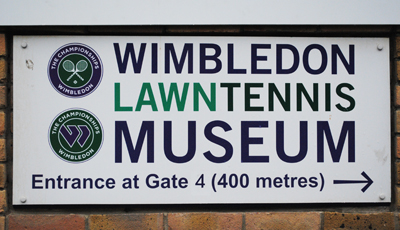
There is a museum based at Wimbledon (pictured above) which details more of the history of the place with exhibits including the Championship trophies, tennis memorabilia dating back to 1555 and a ‘ghostlike’ John McEnroe talking about the games and his opponents in his old dressing room. The museum is currently hosting a special exhibition, Tennis at the Olympics.

WHERE: All England Lawn Tennis Club, Church Road, Wimbledon – between gates 3 and 4 (nearest tube Southfields); WHEN: 10am to 5pm (last admission 4.30pm) daily (not during the Olympics – reopens on 15th August); COST: Museum only £11 an adult/£9.50 concessions/£6.75 child, or Museum plus tour £20 an adult/£17 concessions/£12.50 child; WEBSITE: www.wimbledon.com.

Around London – Celebrating the Olympics; Camden Lock’s night market; and, images of London at the Tate…

We’ll kick off this week with just a few more of the plethora of Olympic-related events which are happening around town:

Tower Bridge, site of some spectacular fireworks last Friday night, is currently hosting an exhibition celebrating the 26 cities which have hosted the modern Olympics. Cities of the Modern Games, located on the bridge’s walkways, runs alongside an interactive exhibition looking at the bridge’s construction. Follow the link for details.

The Guildhall Art Gallery is showcasing sculpture and art inspired by sport and the “Olympic values”. The art works are all winning entries from a contest organised by the International Olympic Committee. The chosen works were selected from among 68 submissions made by an international jury. Follow the link for details.

The Design Museum is hosting a new exhibition celebrating the nexus between sport and design. Designed to Win looks at everything from the design of F1 cars to running shoes, bats and bicycles and explores the way in which design has shaped the sporting world. Runs until 9th September. Admission charge applies. See www.designmuseum.org.

• The London Metropolitan Archives is holding an exhibition of playing cards featuring an Olympic theme. Sporting Aces – Playing Cards and the Olympic Games features cards drawn from the collection of the Worshipful Company of Makers of Playing Cards which have an Olympic theme. Admission is free. Runs until 13th September. See www.cityoflondon.gov.uk/lma.

And in other news…

A night market has been launched at Camden Lock over the summer period. Street food stalls and vintage fashion, arts and crafts and book shops will be open until 10pm every Thursday with extras including live music and film screenings. For more, see www.camdenlockmarket.com.

• On Now: Another London: International Photographers and City Life 1930-1980. This exhibition at Tate Britain in Millbank features more than 150 classic photographs of the city and its communities by foreign photographers including such luminaries as Henri Cartier-Bresson. The exhibition features iconic works such as Robert Frank’s London (Stock Exchange) 1951, Cartier-Bresson’s images of King George VI’s coronation, Elliot Erwitt’s depiction of a rain-washed London bus stop, and Bruce Davidson’s image of a child with pigeons in Trafalgar Square alongside works such as Wolfgang Suschitzky’s images of working class families in the East End, from the 1940s, and Karen Knorr’s images of punks in the 1970s. The photographs all come from the Eric and Louise Franck London Collection, which includes more than 1,200 images of London and has been promised as a gift to the Tate. Runs until 16th September. Admission charge applies. See www.tate.org.uk. 

Have we missed something we should be telling others about? Send details in an email to exploringlondon@gmail.com.

Where’s London’s oldest…sports museum?

In honor of the Olympics, we’re staying with a sporting theme over the next couple of weeks and so this week thought we’d take a look at the oldest sports museum in London – and, it is claimed, the world.

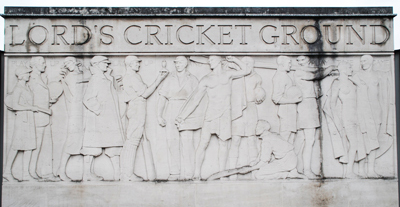
The Marylebone Cricket Club (MCC) Museum is located at Lord’s Cricket Ground in St John’s Wood, just north-west of the City (keep an eye out for our post on Lord’s later this week), and is said to have been collecting cricket-related artefacts since as far back as 1864.

The star sight on display is that tiny urn, known simply as The Ashes, which was given to English captain Ivo Bligh during the English cricket team’s visit to Australia following a game on an estate outside Melbourne on Christmas Eve 1882 (the term was actually first used in August that year when, following an English loss to Australia, at The Oval, The Sporting Times ran an obituary for English cricket and said its ashes would be taken to Australia).

The museum also contains cricket equipment used by some of the game’s greats along with memorabilia celebrating the likes of WG Grace, Victor Trumper, Jack Hobbs, and Donald Bradman as well as more recent players Shane Warne, Rahul Dravid and Paul Collingwood. Other exhibits include the Wisden Trophy, a stuffed sparrow bowled out by Jehangir Khan in 1936 and the battered copy of Wisden’s which EW Swanton used to help him survive a World War II Japanese internment camp.

There is also an extensive collection of cricket-related paintings and photography and a theatre – the Brian Johnson Memorial Theatre – which screens archival cricket footage.

It should be noted that the museum is closed during the Olympics (until 15th August) when Lord’s is playing host to the archery competition (people attending the archery, however, will have free entry). In celebration of the archery, the museum is hosting an exhibition of trophies and pictures related to archery, the centrepiece of which is an arrangement featuring the Musselburgh Arrow and Medals, prizes which have been competed for since 1603.

WHERE: MCC Museum, Lord’s Cricket Ground, St John’s Wood Road, St John’s Wood (nearest Tube Stations are Warwick Avenue, St John’s Wood, Marylebone and Maida Vale); WHEN: Weekdays (with exceptions – check website for details and times); COST: £7.50 an adult/£5 for concessions (or included with tours); WEBSITE: www.lords.org.

Around London: Olympic Torch Relay hits London; mascots pop-up all over the city; and Shakespeare at the British Museum…

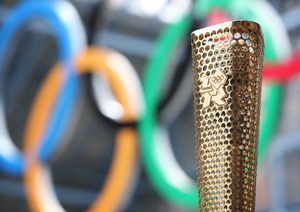
• The Olympic Torch Relay arrives in London tomorrow night before working its way around all of the city’s 33 boroughs and reaching the Olympic Stadium for the Opening Ceremony next Friday.  The torch will arrive in the city by helicopter from Guildford tomorrow night and then be abseiled into the Tower of London where it will spend the night ensconced with the Olympic medals. The relay will travel 200 miles over the next week, carried by more than 980 torchbearers. The route is as follows:

  • Saturday, 21st July – Greenwich via Newham, Tower Hamlets and Hackney to Waltham Forest (highlights include a visit to the Cutty Sark);
  • Sunday, 22nd July – Redbridge via Barking & Dagenham and Havering to Bexley (highlights include a ride on the London Eye and a crossing of the Thames);
  • Monday, 23rd July – Lewisham via Bromley, Croydon, Sutton and Merton to Wandsworth (highlights include a visit to a live filming of Eastenders);
  • Tuesday, 24th July – Kingston via Richmond, Hounslow, Hillingdon and Denham to Ealing (highlights include a visit to Kew Gardens);
  • Wednesday, 25th July – Harrow via Brent, Barnet and Enfield to Haringey (highlights include a visit to Wembley Arena);
  • Thursday, 26th July – Camden via Islington, the City of London, Southwark, Lambeth, Wandsworth, Kensington & Chelsea and Hammersmith & Fulham  to Westminster (the many landmarks to be visited include St Paul’s Cathedral, Shakespeare’s Globe, Trafalgar Square, Buckingham Palace and Hyde Park);
  • Friday, 27th July – From Hampton Court Palace (where it will be taken into the maze) on board Gloriana via the Thames to Olympic Park for the Opening Ceremony.

The 70 day torch relay, which kicked off on 19th May, will have travelled a total distance of about 8,000 miles and have involved 8,000 torchbearers by the time it reaches its end. LOCOG and Transport for London have advised people to see the relay at a location closest to their home given the expected crowds. For more detailed route information, see www.london2012.com/torch-relay/route/. PICTURE: LOCOG

Still talking all things Olympics and London’s largest ever ‘pop up’ shop – where you can buy Olympic merchandise – was officially opened by multiple gold medalist Sir Steve Redgrave in Hyde Park last week. The shop, located on Rotten Row, will be the site of special athlete visits during the Games and visitors can have their photo taken with the Olympic Torch.

• Meanwhile, life-sized versions of the Olympic mascot Wenlock and Paralympic mascot Mandeville are popping up at some of London’s key tourist locations. The 83 two metre tall sculptures capture various elements of life in London with incarnations including a Beefeater, a giant red phone box and a replica of Big Ben. The figures can be found on the routes of Stroll, six new discovery trails designed to help both tourists and Londoners get more out of the city. A QR code on the bottom of each of the sculptures directs smartphone users to further information about the discovery trails. The discovery trails are part of the Mayor of London Presents, a city-wide programme featuring free events, shows and activities. For more on what’s happening in your area, see www.molpresents.com. Some of these events are also being run as part of the Festival of London 2012. For more on this, see http://festival.london2012.com.

• On Now: Shakespeare: staging the world. Part of the World Shakespeare Festival taking place in London, this exhibition at the British Museum looks at the then emerging role of London as a “world city” as interpreted through Shakespeare’s plays and examines the role the playhouse performed in this. The museum has collaborated with the Royal Shakespeare Company to produce the exhibition which features more than 190 objects including paintings, jewels and rare manuscripts. These include the Ides of March coin, a Roman gold aureus commemorating the assassination of Julius Caesar (Julius Caesar), the Lyte Jewel, presented to Thomas Lyte in 1610 in thanks for his work in tracing King James I’s lineage back through Banquo (Macbeth), and a 1610 bird’s-eye view of Venice (Othello and The Merchant of Venice). Runs until 25th November. Admission charge applies. For more, see www.britishmuseum.org.

Treasures of London – The Rosetta Stone…

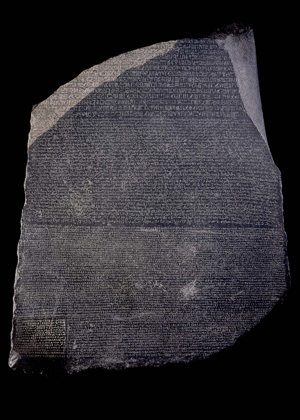
Now housed in the British Museum, the Rosetta Stone, discovered in Egypt in 1799, provided the key to understanding hieroglyphics.

Created in 196 BC, the stone, which measures 112.3 by 75.7 centimetres, has inscribed upon it a priestly decree passed in support of the 13-year-old pharoah, Ptolemy V, and was issued on the first anniversary of his coronation.

Its discovery was a breakthrough in understanding hieroglyphics, which had fallen out of use around the 4th century, due to the fact that the decree was written upon it in three languages – hieroglyphic as well as the everyday Egyptian language of demotic and, importantly, Greek.

Scholars studying the stone were able to use the Greek to decipher the other two languages. Among them were  Jean-François Champollion who announced the translation had been completed in Paris in 1822.

The stone was unearthed near the town of el-Rashid or ‘Rosetta’ by French soldiers in 1799 as they were digging out the foundations of an extension to a fort and following Napoleon’s defeat became the property of the British along with other antiquities under the 1801 Treaty of Alexandria. It has been on display since at the British Museum since 1802 (only briefly removed toward the end of the First World War when it was stored in a subterranean postal railway underneath Holborn).

The stone, said to be the most visited item in the British Museum, underwent a significant restoration and conservation process in 1999 which involved removing grease left by people touching the stone and materials used to create copies of it following its rediscovery – including printers ink from 1799.

WHERE: Room 4, Egyptian Sculpture, British Museum, Great Russell Street (nearest Tube stations are Russell Square, Tottenham Court Road, Goodge Street and Holborn); WHEN: 10am to 5.30pm daily; COST: Free; WEBSITE: www.britishmuseum.org.

PICTURE: The Rosetta Stone © The Trustees of the British Museum

Famous Londoners – Florence Nightingale…

Known as “The Lady with the Lamp”, Florence Nightingale is remembered for her contribution to the development of the profession of nursing and the reform of medical practices during the Crimean War and the latter half of the 19th century.

Born on 12th May, 1820 in Florence (it’s from her birthplace that she gets her name), Florence Nightingale was the second daughter of William Edward Nightingale, son of a wealthy Sheffield banker, and Frances Smith.

She had a relatively privileged childhood at her family’s homes of Lea Hurst in Derbyshire and Embley Park in Hampshire (her father was named High Sheriff of the county in 1828) as well as occasional visits to London and received a broad education.

Believing herself to be called by God into His service when in her mid-teens, she chafed at the life set before her. It was a during visit to  convent which holidaying in Rome with family friends that she became convinced she had a mission from God to tend to the sick.

This was only furthered during a subsequent visit to a religious community at Kaiserswerth am Rhein – a training school for nurses – that finally convinced her of the possibility of making nursing a vocation for ladies. Returning to England, Nightingale took up her first official post – as superintendent of the Hospital for Invalid Gentlemen – in 1853.

The Crimean War broke out in March, 1854, and later that year, aware of reports of the suffering sick and wounded English soldiers were enduring, Nightingale offered her services to the War Office following an invitation by the Secretary for War Sidney Herbert.

Charged with authority over all the nurses (her official title was later Superintendent of the Female Nurses in the Hospitals in the East), Nightingale embarked for Crimea on 21st October with 38 nurses (there’s a plaque at 90 Harley Street – site of the hospital from which Nightingale left for the Crimea). She reached Scutari in Turkey on 4th November, the night before the Battle of Inkerman.

Headquartered in Scutari, Nightingale set about organising the military hospitals, improving general hygiene and conditions and supplies of essentials like clothes and other equipment. The wounded men soon recognised her efforts and began calling her ‘The Lady of the Lamp’ – referring to sight of her checking the wards at night.

Visiting hospitals near and in Balaclava in 1855, Nightingale fell ill from “Crimean fever” but recovered and was able to return to Scutari and continue her work. The following March Nighingale returned to Balaclava and continued to work there until the hospitals closed in July. She returned to England and the family home at Lea Hurst the following month.

In September, 1856, Nightingale had an audience with Queen Victoria at Balmoral – she used the occasion to inform the Queen and Prince Albert of the reforms needed in the military hospital system (and subsequently met with the Queen many times). Backed by data she had collected in the Crimea, Nightingale also pushed for a commission into military hospitals – it was commenced in April 1857 and Nightingale’s written evidence was critical to its recommendations.

In 1860, the Nightingale School and Home for Nurses was established at St Thomas’ Hospital in London (it was funded with £50,000 raised through the Nightingale Fund which had been established in 1855). She as unable to take up the post of superintendent due to ill health and other reasons but continued to take an active interest.

Nightingale – who wrote more than 200 books, reports and pamphlets on hospital planning and organisation, including the famous Notes on Nursing (1859), and interestingly is also said to have invented the pie chart – was also involved in establishing the East London Nursing Society (1868), the Workhouse Nursing Association and National Society for Providing Trained Nurses for the Poor (1874) and the Queen’s Jubilee Nursing Institute (1890).

Her accolades included the German Order of the Cross of Merit and the French Gold Medal of Secours aux Blessés Militaires and the badge of honour of the Norwegian Red Cross Society. She was the first woman to be awarded the Order of Merit and the Freedom of the City of London.

Nightingale died at the age of 90 in South Street London (just off Park Lane – there’s a Blue Plaque marking the spot), on 13th August, 1910. She was buried in the family plot at East Wellow, Hampshire.

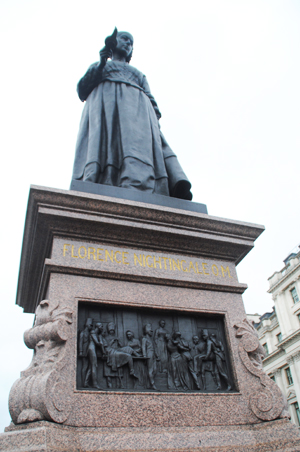
There is a memorial to Nightingale as part of the Crimean War Memorial at Waterloo Place and a chapel dedicated to her at Westminster Abbey which is involved in the annual service commemorating her held there on her birthday, International Nurses Day, every year. For more on the service, see our earlier post here.

Well worth a visit is the Florence Nightingale Museum, located within St Thomas’ Hospital.    Highlights include her pet Owl Athena and the Turkish lantern she used in the Crimean War and the museum archives include around 800 letters from Florence Nightingale. For more on the museum, see www.florence-nightingale.co.uk.

Around London – Celebrating the City; Syon Park dig; Westminster’s rubbish; and, 1000 years of British literature…

• The City of London today kicks off Celebrate the City – four days of mostly free music, art and cultural events.The events include musical performances in many of the City’s churches, walks and talks at various locations around the Square Mile, new exhibitions including Butcher, Baker, Candlestock Maker – 850 years of Livery Company Treasures at the Guildhall Art Gallery, Livery Hall and historic building openings, family entertainment at the Cheapside Street Fayre at Saturday (including free ice-cream and tuk-tuk rides for children) and activities at the Barbican Centre and the Museum of London. The celebrations start in Guildhall Yard (pictured) at 6pm tonight when musicians from the Guildhall School of Music & Drama perform Tchaikovsky’s 1812 Overture, complete with firing cannons. Among the many other highlights will be the chance to play golden street pianos, to join in the Midsummer street part at the climax of the Spitalfields Music Summer Festival, to enjoy a sunset from the Tower Bridge walkways and to see the transformation of St Helen’s Square into a sculpture space. The weekend will also host the Open House Junior Festival, London’s first ever child-friendly City architecture festival. To see detailed listings of what’s on, head to www.visitthecity.co.uk/index.php/celebrate/.

• The Museum of London will next week launch its annual community and training dig at Syon Park in Hounslow. The dig, which will be open to school and community groups, will run from 25th June to 7th July and will focus on the area of Sir Richard Wynne’s house. A Parliamentarian, in 1659 he was implicated in a Royalist insurrection and was imprisoned. The house, which featured in the Battle of Brentford when Royalist troops advanced on Parliamentary forces in London in 1641, was later purchased by the Duke of Northumberland and demolished to extend Syon’s parkland. For more, see www.museumoflondon.org.uk.

• We couldn’t resist mentioning this one: Westminster City Council has released a top 10 list of the strangest objects people have dumped on London’s streets. They include an inflatable Margaret Thatcher and other inflatable dolls, wedding dresses, stuffed animals and a range of film props. The council say that, on average, enough litter is picked up off Westminster’s streets every two days to fill the entire 864 cubic metres of Marble Arch. They add that if just half of the annual waste collected off the street is recycled properly in the correct bins it would save them nearly £1million.

• On Now: Writing Britain: Wastelands to Wonderlands. The major summer exhibition at the British Library, it explores how the last 1,000 years of English literature have been shaped by the country’s places. The exhibition  features more than 150 works with highlights including John Lennon’s original lyrics for The Beatles’ song In My Life, JK Rowling’s handwritten draft of Harry Potter and the Philosopher’s Stone, JRR Tolkein’s original artwork for The Hobbit and original manuscripts from the likes of Jane Austen, William Blake, Charlotte Bronte, Arthur Conan Doyle, JG Ballard and Charles Dickens. As part of the exhibition, the Library is inviting people to “Pin-a-Tale” on an interactive map of Britain, that is, take a literary work and pin it on the map along with a description of how the work links with that particular location – head to www.bl.uk/pin-a-tale to take part. The exhibition runs until 25th September. Admission fee applies. For more, see www.bl.uk.

Around London – Open gardens; new gates mark St Paul’s tercentenary; a new Olympics trail; and, truces at the IWM…

• If you’re not too exhausted after last weekend’s Diamond Jubilee festivities (or if you’re looking for something a little more sedate), this Saturday and Sunday London plays host to Open Garden Squares Weekend. Among the 208 gardens to be opened this weekend is the communal garden at Number 10 Downing Street, home of Prime Minister David Cameron. Laid out in 1736, the L-shaped garden at 10 Downing Street is shared by residents of both Number 10 and Number 11, including Larry, the Downing Street cat (tickets for this garden have already been allocated via a ballot process). Among the more than 200 gardens open to the public as part of the weekend are 24 new gardens and, for the first time, the event is being supported by the National Trust (along with the usual organisers, the London Parks and Gardens Trust). Downing Street aside, other gardens open to the public include the Regent’s Park Allotment Garden, the Royal College of Physicians’ Medicinal Garden, the Kensington Roof Gardens, and the gardens at HMP Wormwood Scrubs. Tickets for the gardens are cheaper if bought online in advance of the weekend and picked up on Saturday or Sunday – it’s not too late to do so, so for tickets and more information, head to www.opensquares.org.

A new pair gates designed to mark St Paul’s Cathedral’s tercentenary were opened in Richmond Park for the first time last week. The gates, which now form part of the historic vista seen from King Henry’s Mound in Richmond Park when looking toward’s St Paul’s Cathedral, were designed by 21-year-old blacksmith Joshua De Lisle and funded through a donation from the family of family of the late environmentalist and The Ecologist magazine founder Edward Goldsmith. Called ‘The Way’, the gates stand on the fence of Sidmouth Woods, and depict oak branches. Sir Christopher Wren, designer of St Paul’s, is acknowledged through the inclusion of a wren on one of the lower branches. For more on the Royal Parks, see www.royalparks.org.uk.

• Now On: Winning at the ancient Games. The British Museum is celebrating the London Olympics with a victory trail bringing together 12 “star objects” in its collection, united by the theme of winning. The ‘stops’ on the trail include a classical Greek statue of a winning charioteer on special loan from Sicily, a previously never exhibited mosaic showing Hercules, the legendary founder of the ancient Games, and the 2012 Olympic Medals. The trail is free. For more information, see www.britishmuseum.org.

Now On: Build the TruceDrawing on the idea of truce that was implemented during the ancient Olympic Games to allow athletes from Greece’s warring cities to compete, this new display at the Imperial War Museum features films, interviews and insights collected during a project investigating the concepts of truce, conflict and resolution and their relevance in the 21st  century. Highlights include excerpts of interviews with former IRA prisoner Seanna Walsh and former UDA prisoner Jackie McDonald -both now involved in peace initiatives in Northern Ireland, Courtny Edwards, who worked with a health service in displaced persons’ camps following civil war in Sierra Leone; and Professor Tony Redmond, who led aid teams in Kosovo following NATO attacks in 1999. Family activities are being run in conjunction with the exhibition on selected weekends. Entry is free. Runs until 23rd September. For more, see www.iwm.org.uk.

Around London – Leicester Square reopens; RA and MOL exhibitions mark Diamond Jubilee; ‘Jed’ retires; and, the history of horses at the British Museums…

• Leicester Square officially reopened last night following a £15.3 million transformation which has seen every paving stone replaced, new plants, and 40 new water jets placed around the Grade II listed fountain and statue of William Shakespeare. The 17 month makeover also included new lighting, new seating and a refurb of the underground toilets. The square – which owes its name to Robert Sidney, the 2nd Earl of Leicester, who purchased this land in 1630 and, after building himself a mansion, kept aside part of the land for public use – now welcomes as many as 250,000 tourists a day and is known as one of the world’s premiere sites for the release of new films.

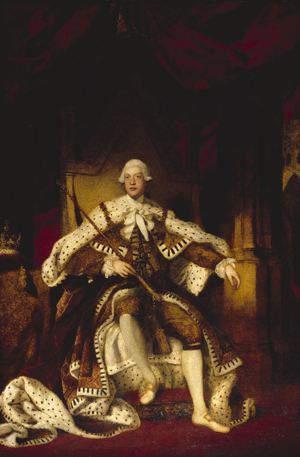
• The Royal Academy of Arts is marking the Queen’s Diamond Jubilee with a new exhibition opening tomorrow which features a selection of paintings by Royal Academicians elected during the early part of the Queen’s reign. The Queen’s Artists will include works by Jean Cooke, Frederick Gore and Ruskin Spear and will be displayed in the Reynolds and Council Rooms. Meanwhile The Saloon will house a collection of sculptures, paintings and drawings prepared by Royal Academicians for British coins and royal seals on loan from the Royal Mint Museum. The collection includes portraits of the Queen by Edward Bawden and Sir Charles Wheeler which have never before been shown in public, and Sir Anthony Caro’s new coin design of the London 2012 Olympic Games. Over in the Tennant Gallery, The King’s Artist’s George III’s Academy, will look at the king’s role in the foundation of the academy in 1768 and his influence in selecting the first artists. Highlights include portraits of King George III (pictured) and Queen Charlotte painted by the academy’s first president, Sir Joshua Reynolds. Admission charge applies. For more, see www.royalacademy.org.uk. PICTURE: Copyright Royal Academy of Arts, London/John Hammond.

• A new exhibition focusing on Londoners and their treasured souvenirs commemorating Queen Elizabeth II opens tomorrow at the Museum of London. At Home with the Queen features 12 photographic portraits of Londoners at home with their mementos as well as a selection of royal commemorative objects from the museum’s collection. The latter include trinkets produced for Queen Victoria’s Diamond Jubilee in 1897, official Coronation Day street decorations, Silver Jubilee paper tableware and souvenirs relating to the current Diamond Jubilee. Runs until 28th October. Admission is free. For more (including a series of events running on conjunction with the exhibition), see www.museumoflondon.org.uk.

The Royal Parks’ Shire horse, Jed, retired last week after a decade of service working in Richmond Park. The Queen presented a commemorative retirement rosette to Jed who was born in 1993 and joined the Royal Parks from Bass Brewery in Burton upon Trent almost 10 years ago. Horses have been used in Richmond Park since it was enclosed by King Charles I in 1637. The horses took a break in 1954 but the Shires were reintroduced in 1993 as a way to sustainably manage the parkland. For more on Richmond Park, see www.royalparks.org.uk/parks/richmond-park.

On Now: The horse: from Arabia to Royal Ascot. This major free exhibition at the British Museum is part of the august institution’s Diamond Jubilee celebrations and traces the history of the horse from domestication around 3,500 BC through to present day, with a particular focus on Britain’s equestrian tradition, from the introduction of the Arabian breed in the 18th century to events like Royal Ascot. Highlights include one of the earliest known depictions of horse and rider – a terracotta mould found in Mesopotamia dating from around 2000 to 1800 BC, a cylinder seal of Darius dating from 522 to 486 BC depicting the king hunting lions in a chariot, a 14th century Furusiyya manuscript, an Arabian manual of horsemanship, and the 19th century Abbas Pasha manuscript, the primary source of information about the lineage of purebred Arabian horses acquired by Abbas Pasha (mid-nineteenth century viceroy of Egypt). The exhibition is being held in Room 35. Runs until 30th September. For more, see www.britishmuseum.org.

Around London – Museums at Night; Ballgowns at the V&A; Edward Lear plaqued; and, the Queen’s portrait at the NPG…

• It’s Museums at Night weekend which means its your chance to see some of London’s best museums after hours. Culture24’s annual event, which runs from 18th to 20th May, features more than 5o late openings and special events in London – from after dark visits to Aspley House, the former home of the Duke of Wellington, to the chance to hear about the history of ‘Bedlam’, one of the world’s oldest psychiatric facilities, at the Bethlem Archives & Museum and Bethlem Gallery, and a “Cinderella shoe” workshop at the Design Museum. As well as organisations like the British Museum and National Gallery, among the lesser known museums taking part are the Cuming Museum in Southwark, the British Dental Association Museum, and the Ragged School Museum in Mile End. For all the details, follow this link

Saturday sees the opening of a new V&A exhibition featuring more than 60 ballgowns dating from 1950 to the present day – the first exhibition to be held in the newly renovated Fashion Galleries. Among those gowns on display as part of Ballgowns: British Glamour Since 1950 will be royal ballgowns including a Norman Hartnell gown designed for Elizabeth, the Queen Mother, Catherine Walker’s ‘Elvis Dress’ worn by Princess Diana (pictured), and gowns worn by today’s young royals. There will also be gowns worn by celebrities including Sandra Bullock, Liz Hurley and Bianca Jagger and works by the likes of Alexander McQueen, Jenny Packham and a metallic leather dress designed by Gareth Hugh specifically for the exhibition. Runs from 19th May to 6th January. Admission charge applies. See www.vam.ac.uk for more. PICTURE: Victoria and Albert Museum, London

The man credited with popularising the modern-day limerick, Edward Lear, has been honored with a green plaque at his former house in Westminster. The Westminster Council plaque was unveiled on Saturday – what would have been his 200th birthday – at 15 Stratford Place where he lived from 1853 until 1869. Lear, who was born in Holloway and raised in Grays Inn Road, was famous for his work The Owl and the Pussycat, and as well as for his writings, was also noted as an artist and illustrator. Councillor Robert Davis reportedly had a go himself at a limerick in honour of the artisy: “There once was man named Lear, who lived in a spot close to here. This plaque unveiled today, is a fitting way, to pay tribute on his two hundreth year”.

• On Now: The Queen: Art and Image. Having been on tour across Britian, this exhibition features some of the most remarkable images ever created of the Queen opened at the National Portrait Gallery this week. Containing works by Cecil Beaton and Annie Leibovitz, Pietro Annigoni and Andy Warhol, the exhibition is the most wide-ranging exhibition of images in different media ever devoted to a single royal sitter. Highlights include full-length 1954-55 painting by Annigoni (pictured, right, it’s displayed with his 1969 portrait), Lucian Freud’s 2000-01 portrait and Thomas Struth’s recent large-scale photograph of both the Queen and the Duke of Edinburgh as well as a never previously loaned 1967 portrait by Gerhard Richter and a specially commissioned holographic portrait. Runs until 21st October. Admission charge applies. For more, see www.npg.org.uk. PICTURE: Queen Elizabeth II, Queen Regent by Pietro Annigoni, 1954-5. The Fishmongers’ Company