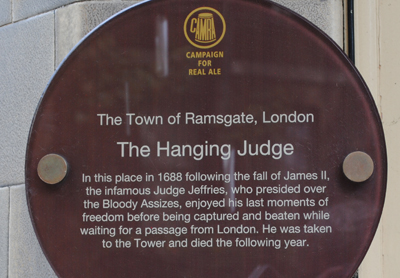
Famous Londoners – Judge Jeffreys…

The-Town-of-Ramsgate2

Best known as the “Hanging Judge” thanks to his role in the so-called Bloody Assizes of 1685, George Jeffreys climbed the heights of England’s legal profession before his ignominious downfall.

Born on 15th May, 1645, at the family home of Acton Hall in Wrexham, North Wales, Jeffreys was the sixth son in a prominent local family. In his early 20s, having been educated in Shrewsbury, Cambridge and London, he embarked on a legal career in the latter location and was admitted to the bar in 1668.
Town-of-RamsgateIn 1671, he was made a Common Serjeant of London, and despite having his eye on the  more senior role of Recorder of London, was passed over. But his star had certainly risen and, despite his Protestant faith, he was a few years later appointed to the position of solicitor general to James, brother of King Charles II and the Catholic Duke of York (later King James II), in 1677.

The same year he was knighted and became Recorder of London, a position he had long sought, the following year. Following revelations of the so-called the Popish Plot in 1678 – said to have been a Catholic plot aimed the overthrow of the government, Jeffreys – who was fast gaining a reputation for rudeness and the bullying of defendants – served as a prosecutor or judge in many of the trials and those implicated by what turned out to be the fabricated evidence of Titus Oates (Jeffreys later secured the conviction of Oates for perjury resulting in his flogging and imprisonment).

Having successfully fought against the Exclusion Bill aimed at preventing James from inheriting the throne, in 1681 King Charles II created him a baronet. In 1683 he was made Lord Chief Justice and a member of the Privy Council. Among cases he presided over was that of Algernon Sidney, implicated in the Rye House Plot to assassinate the king and his brother (he had earlier led the prosecution against Lord William Russell over the same plot). Both were executed.

It was following the accession of King James II in February, 1685, that Jeffreys earned the evil reputation that was to ensure his infamy. Following the failed attempt by James Scott, 1st Duke of Monmouth and illegitimate son of the late King Charles II, to overthrow King James II, Jeffreys was sent to conduct the trials of the captured rebels in West Country towns including Taunton, Wells and Dorchester – the ‘Bloody Assizes’.

Of the almost 1,400 people found guilty of treason in the trials, it’s estimated that between 150 and 200 people were executed and hundreds more sent into slavery in the colonies. Jeffreys’, meanwhile, was busy profiting financially by extorting money from the accused.

By now known for his corruption and brutality, that same year he was elevated to the peerage as Baron Jeffreys of Wem and named Lord Chancellor as well as president of the ecclesiastical commission charged with implementing James’ unpopular pro-Catholic religious policies.

His fall was to come only a couple of years later during Glorious Revolution which saw King James II overthrown by his niece, Mary, and her husband William of Orange (who become the joint monarchs Queen Mary II and King William III).

Offered the throne by a coalition of influential figures who feared the creation of a Catholic dynasty following the birth of King James II’s son, James Francis Edward Stuart, William and Mary arrived in England with a large invasion force. King James II’s rule collapsed and he eventually fled the country.

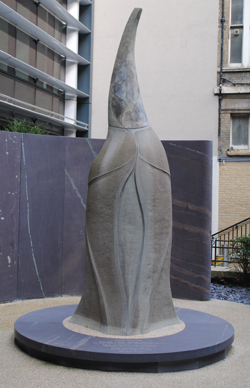
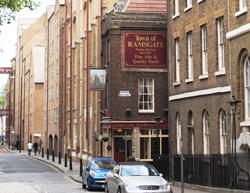
Remaining in London after the king had fled, Lord Jeffreys only attempted to flee as William’s forced approached the city. He made it as far as Wapping where, despite being disguised as a sailor, he was recognised in a pub, now The Town of Ramsgate (pictured above).

Placed in custody in the Tower of London, he died there of kidney problems on 18th April, 1689, and was buried in the Chapel Royal of Saint Peter ad Vincula (before, in 1692, his body was moved to the Church of St Mary Aldermanbury). All traces of his tomb were destroyed when the church was bombed during the Blitz (for more on the church, see our earlier post here).
A Moment in London’s History – Princess Victoria’s christening…

Cupola-Room

On Sunday, Princess Charlotte, daughter of Prince William and Princess Kate, was christened at Sandringham. So we thought we’d take a quick look at another christening that took place in London almost 200 years ago, that of Princess Victoria.

The future Queen Victoria was born on 24th May, 1819 – the daughter of Edward, Duke of Kent (fourth son of King George III), and his wife, Princess Victoria Mary Louisa of Saxe-Coburg-Saalfeld.

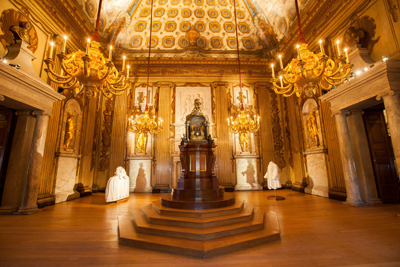
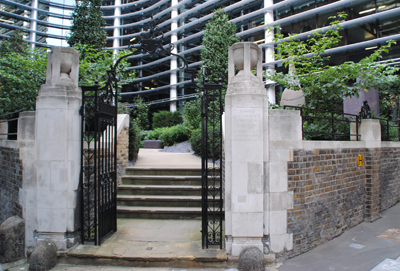
At the insistence of the Prince Regent (later King George IV), the christening was a small affair and was held a month after the birth on the afternoon of 24th June in the magnificent Cupola or Cube Room of Kensington Palace (pictured as it is now, above).

The guest list was small and included the Prince Regent, Prince Frederick, the Duke of York, and his wife Princess Frederica, Princess Augusta Sophia, Princess Mary, the Duchess of Gloucester, and her husband, Prince William, and Prince Leopold, who had recently become a widower after the death of Princess Charlotte.

The ceremony was conducted by Charles Manners-Sutton, the archbishop of Canterbury, and, thanks to the intransigence of the Prince Regent, her name was apparently only decided at the last minute.

The Prince Regent has earlier forbidden the use of such ‘royal’ names including Charlotte, Elizabeth, Georgina or Augusta and when asked by the archbishop what she would be named, he replied brusquely that she would be named Alexandrina in honour of the Russian Tsar Alexander, one of the new princess’s godparents.

Her second name was Victoria in honour of her mother, and while Victoria was often called “Drina” while a girl, she herself apparently preferred her second name to her first.

The gold font used in the ceremony formed part of the Crown Jewels and its origins go back to the time of King Charles II.

Interestingly, there were a couple of significant Victorian connections during Princess Charlotte’s christening – the font used at this christening was known as the Lily Font (like its predecessor, it is usually found with the Crown Jewels in the Tower of London).

It was commissioned by Queen Victoria and Prince Albert for the christening of their first daughter, Princess Victoria, in 1841, apparently due to Queen Victoria’s dislike for the gold font used at her own christening – it had been used by King Charles II to christen his illegitimate children.

The Lily Font has apparently been used at every royal christening since except that of Princess Eugenie who had a public baptism in Sandringham in 1990.

Princess Charlotte also wore a replica of the christening gown worn by Princess Victoria.

WHERE: The Broad Walk, Kensington Gardens, Kensington (nearest Tube stations are High Street Kensington or Queensway); WHEN: Daily 10am to 6pm (until 31st October); COST: £17.50 adult/£14.10 concession/children under 16 free (online booking discounts available, Historic Royal Palaces members free); WEBSITE: www.hrp.org.uk/KensingtonPalace.

PICTURE: HRP/newsteam

A Moment in London’s History – Londoners granted the right to elect their mayor…

It was on 9th May, 2015, 800 years ago this year that, in the lead-up to the creation of the Magna Carta in June, King John issued a charter granting the City of London the right to freely elect its own mayor.

The charter, which was issued at the Temple – King John’s power base to the west of the City (for more on it, see our earlier post here), was a fairly blatant bid to keep the support of the city.

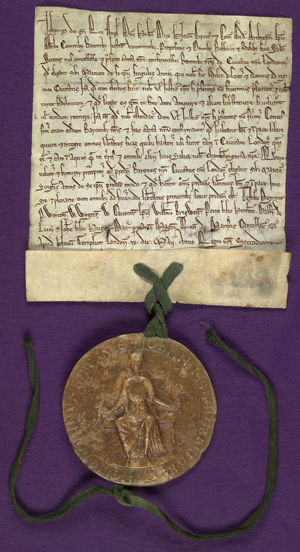
King-John-CharterKnown simply as the King John Charter, it stated that the barons of the city, “may choose to themselves every year a mayor, who to us may be faithful, discreet, and fit for government of the city, so as, when he shall be chosen, to be presented unto us, or our justice if we shall not be present”.

In return, the mayor was required to be presented to the monarch to take an oath of loyalty each year – a practice commemorated in the Lord Mayor’s Show each November.

The charter, which has a particularly good impression of the king’s seal, is currently on display in the City of London’s newly opened Heritage Gallery, located at the Guildhall Art Gallery.

The event was one of a series leading up to the signing of the Magna Carta in June. Only 10 days after King John issued the charter to the City of London, rebel barons, who have previously taken Bedford, marched on the city to demand their rights and arrived their before the Earl of Salisbury (whom John had ordered to occupy the city).

Aldgate was apparently opened to them by some supporters within the city and the forces of the rebel barons went on to attack the home of royalists as well as those of Jews along with a Jewish burial ground in Barbican – the latter because Jewish moneylenders had lent money to the king.

They later besieged the Tower of London and while they couldn’t take the fortress, their seizure of the city was enough to help force the king to open negotiations late in the month, asking the Archbishop of Canterbury, Stephen Langdon, on 27th May  to arrange truce (which, while it was apparently not observed terribly well, did help pave the path to the Magna Carta).

The exhibition at the Heritage Gallery runs until 4th June. For more information, see www.cityoflondon.gov.uk/things-to-do/visiting-the-city/attractions-museums-and-galleries/guildhall-art-gallery-and-roman-amphitheatre/Pages/Heritage-Gallery.aspx.

PICTURE: City of London: London Metropolitan Archives

This Week in London – Marking VE Day’s 70th; Rut Blees Luxemburg at the Museum of London; and India’s Sidi community on show at the NPG…

Three days of events kick off in London tomorrow to mark the 70th anniversary of Victory in Europe (VE) Day. Events will include a Service of Remembrance at the Cenotaph in Whitehall at 3pm tomorrow (Friday) coinciding with two minutes national silence while Trafalgar Square – scene of VE Day celebrations in 1945 – will host a photographic exhibition of images taken on the day 70 years ago (the same images will be on show at City Hall from tomorrow until 5th June) and, at 9.32pm, a beacon will be lit at the Tower of London as part of a nation wide beacon-lighting event. On Saturday at 11am, bells will ring out across the city to mark the celebration and at night, a star-studded 1940s-themed concert will be held on Horse Guards Parade (broadcast on BBC One). Meanwhile, on Sunday, following a service in Westminster Abbey, a parade of current and veteran military personnel will head around Parliament Square and down Whitehall, past the balcony of HM Treasury where former PM Sir Winston Churchill made his historic appearance before crowds on the day, to Horse Guards. A flypast of current and historic RAF aircraft will coincide with the parade and from 1pm the Band of the Grenadier Guards will be playing music from the 1940s in Trafalgar Square. Meanwhile, starting tomorrow, special V-shaped lights will be used to illuminate Trafalgar Square, St Paul’s Cathedral and the Houses of Parliament as a tribute. For more information, see www.gov.uk/government/topical-events/ve-day-70th-anniversary.

The works of leading London-based photographer Rut Blees Luxemburg are on show in at new exhibition at the Museum of London in the City. London Dust will feature three major newly acquired works by Luxemburg including Aplomb – St Paul’s, 2013, Walkie-Talkie Melted My Golden Calf, 2013, and the film London/Winterreise, 2013. Blees Luxemburg’s images – others of which are also featured in the exhibition – contrast idealised architectural computer-generated visions of London that clad hoardings at City-building sites with the gritty, unpolished reality surrounding these. In particular they focus on a proposed 64 floor skyscraper, The Pinnacle, which rose only seven stories before lack of funding brought the work to a halt. The free exhibition runs until 10th January next year. For more, see www.museumoflondon.org.uk.

The Talk: The Cutting Edge – Weapons at the Battle of Waterloo. Paul Wilcox, director of the Arms and Armour Research Institute at the University of Huddersfield, will talk about about the weapons used at Waterloo with a chance to get ‘hands-on’ with some period weapons as part of a series of events at Aspley House, the former home of the Iron Duke at Hyde Park Corner, to mark the bicentenary of the Battle of Waterloo. To be held on Monday, 11th May, from 2.30pm to 4pm. Admission charge applies and booking is essential – see www.english-heritage.org.uk/apsley for more.

On Now: On Belonging: Photographs of Indians of African Descent. A selection of ground-breaking photographs depicting the Sidi community – an African minority living in India – is on show at the National Portrait Gallery off Trafalgar Square. The works, taken between 2005 and 2011, are those of acclaimed contemporary Indian photographer Ketaki Sheth and the exhibition is his first solo display in the UK. They provide an insight into the lives of the Sidi, and include images of a young woman named Munira awaiting her arranged wedding, young boys playing street games, and the exorcism of spirits from a woman as a young girl watches. Admission is free. Runs in Room 33 until 31st August. For more, see www.npg.org.uk.

Send all items for inclusion to exploringlondon@gmail.com.

LondonLife – Royal gun salute in Hyde Park marks birth of Princess Charlotte Elizabeth Diana…

Gun-salute

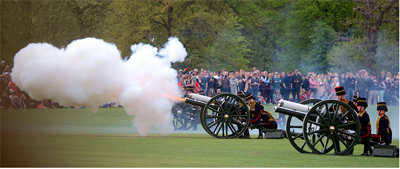
Guns fired a royal salute in Hyde Park on Monday to mark the birth of the Duke and Duchess of Cambridge’s new daughter (and Prince George’s new sister), named Princess Charlotte Elizabeth Diana (or more formally, Her Royal Highness Princess Charlotte of Cambridge). Seventy-one horses pulling six World War I-era 13-pounder field guns from the King’s Troop Royal Horse Artillery rode out in procession with the Royal Artillery Band from Wellington Barracks, past Buckingham Palace, up Constitution Hill to Wellington Arch, and into Hyde Park to fire the salute. The 41 gun salute was fired at the same time as a 62 gun salute at the Tower of London. By custom, gun salutes are fired for the birth of every prince or princess, regardless of where they sit in the order of succession. A basic salute is 21 rounds with an additional 20 rounds fired because Hyde Park is a Royal Park while at the Tower of London an extra 20 rounds are fired because it is a royal palace along with a further 21 because of its City of London location. The princess, fourth in line to the throne, was born at 8:34am on Saturday at St Mary’s Hospital in Paddington, and weighed 8lbs, 3oz (3.7kg). PICTURE: © Courtesy of Ian Wylie Photo.

10 sites from London at the time of the Magna Carta – 1. The Tower…

This week we’re starting a new series in honour of the 800th anniversary of the signing of the Magna Carta in which we look back at the London of 1215. First up we take a look at the Tower of London which was a smaller version of the complex of buildings which today exists on the site.

By 1215, the Tower of London – the fortress first constructed on the orders of William the Conqueror – had already existed for more than 100 years, nestled into a corner of the city’s walls which had existed since Roman times.

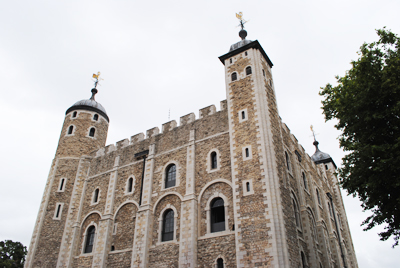
Then, as now, the White Tower – initially itself known as the Tower of London, it was later dubbed the White Tower thanks to the whitewash used to cover the Kentish limestone to protect it from the weather (and for its visual impact) – stood at the heart of the complex. Unlike today’s building, it lacked the large windows which date from the early 18th century, and while the towers were believed to be capped with cones, the present cupolas date from the reign of King Henry VIII.

White-Tower

While it had long been surrounded by a palisade and ditch, in 1189, King Richard I’s chancellor William Longchamp, the Bishop of Ely, had begun to extend the castle’s defences while the king was on crusade (in fact, the first siege of the Tower took place in 1191 when the then Prince John did so in opposition to Longchamp’s  regime – it only lasted three days before Longchamp surrendered).

This extension, which was completed by King John following his accession to the throne in 1199, saw the size of the bailey around the White Tower doubled and a new curtain wall and towers – including the Bell Tower – built around its outer perimeter with a ditch below (the ruins of the Wardrobe Tower, just to the east of the White Tower show where the original Roman-era wall ran).

But it wasn’t until the reign of King John’s son, King Henry III, that the royal palace which now stands on the river side of the White Tower was constructed. Until that point – and at the time of the signing of the Magna Carta – the royal apartments remained within the White Tower itself, located on the upper floor.

Like those of the garrison commander known as the constable (located on the entrance level), the king’s apartments would have consisted of a hall and a large chamber, which may have been divided into smaller chambers with wooden partitions as well as a chapel (on the upper level this was the still existing Chapel of St John the Evangelist, although it would have then been more more richly decorated). Unlike the lower levels, the king’s level was of double height with a gallery (this level now has its own full floor).

The royal apartments had a variety of uses – as well as a residence and refuge for the king, they were also at times a place to keep high profile prisoners such as the Bishop of Durham, Ranulf Flambard, who was imprisoned on the orders of King Henry I (and who escaped from an upper window on a rope which had been smuggled in to him and fled to Normandy).

It is also worth noting that while King John apparently kept exotic animals at the Tower, it is his son, King Henry III who is usually credited with founding the Royal Menagerie there.

And it was his son, King Edward I, who expanded the Tower to its current size of  about 18 acres by rebuilding the western section of the inner ward and adding the outer ward.

WHERE: Tower of London (nearest Tube station Tower Hill); WHEN: 9am to 5.30pm, Tuesday to Saturday, 10am to 5.30pm Sunday to Monday; COST: £24.50 adults; £11 children under 15; £18.70 concessions; £60.70 for a family (discounts for online purchases/memberships); WEBSITE: www.hrp.org.uk/toweroflondon/.  

A Moment in London’s History – Colonel Blood’s attempt to steal the Crown Jewels…

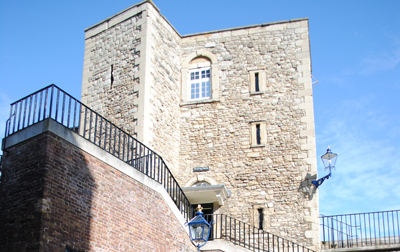
Martin-Tower

London has been making headlines around the world recently thanks, in part, to the estimated £200 million  heist which took place in Hatton Garden last week. So we thought it was a good time to take a look back to one of London’s most famous robberies (or attempts at least)…

The attempt dates back to 1671 when a self-styled colonel, Irish adventurer Thomas Blood, made an attempt to steal the Crown Jewels from the Tower of London.

The Irishman – whose history included fighting on both sides in the English Civil War, first with the Royalists and then with the Parliamentarians when he saw the tide was turning – visited the Tower of London several times in the lead-up to the attempt as he, disguised as a parson, cultivated a relationship with Talbot Edwards, an elderly keeper of the jewels, and his family.

On the night of 9th May, he and a group of accomplices, including his son, attended a dinner put on by the Edwards at the Tower. While waiting for the meal, Blood asked to see the jewels which were housed behind a grille in the basement of the Martin Tower (pictured above) above which the Edwards had an apartment.

Edwards complied and once in the Jewel House, Blood and his accomplices attacked him, knocking him to the floor with a mallet and then stabbing him before binding and gagging him.

They then turned their attention to the jewels – Blood used a mallet to flatten St Edwards Crown so he could hide it beneath his coat while his brother-in-law Hunt filed the Sovereign’s Sceptre with Cross in two to fit it in his bag and a third man, Robert Perot, stuffed the Sovereign’s Orb down his trousers.

Things didn’t go smoothly after that and the alarm was raised before the gang could make their getaway. It has been suggested it was Edwards who raised the alarm – that despite efforts to shut him up he managed to remove his gag and raise the alarm  – but other versions say it was his son, returning from service in Flanders, who raised the alarm on seeing the gang.

In any event, the gang fled, evading efforts of the warders to stop them, before Blood, Hunt and Perot were captured on the Tower of London wharf. The crown, globe and orb were all recovered, albeit damaged.

Blood refused to speak after his capture and was eventually taken before King Charles II for interrogation. But he was evidently so impressed with his captive that he not only pardoned Blood but also rewarded him with land in Ireland.

Blood did later end up briefly in prison after a dispute with the Duke of Buckingham and died soon after his release in August, 1680, but in the intervening years he had become something of a celebrity around London including the Royal Court.

Security around the Crown Jewels, meanwhile, was upgraded somewhat in the wake of the attempt. While others have tried to steal them, none have ever been successful.

WHERE: Tower of London (nearest Tube station is Tower Hill); WHEN: 9am to 5.30pm Tuesday to Saturday, 10am to 5.30pm Saturday and Monday (last admission 5pm); COST: £24.50 an adult/£11 a child (5-15 years)/£18.70 concession/£60.70 a family of four (discount applies to online bookings); WEBSITE: www.hrp.org.uk/TowerOfLondon/.

10 London sites associated with Sir Winston Churchill – 8. Sidney Street, Stepney…

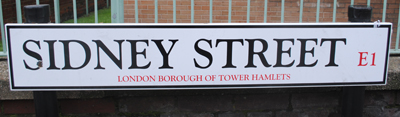
Sidney-Street

Sir Winston Churchill will be forever associated with this now rather nondescript East London street, thanks to a series of events that occurred when he was Home Secretary.

Known as the Siege of Sidney Street or the Battle of Stepney, the event was sparked when, on 16th December, 1910, a gang of Russian and Latvian exiles attempted to break into a jewellers in Houndsditch by tunnelling from an adjacent property in Exchange Buildings.

Tipped off by a neighbour, the police arrived and in the series of events that followed, a number of officers were shot and three – Sergeant Charles Tucker, PC Walter Choate and Sergeant Robert Bentley – were killed (Sergeant Tucker died at the scene and the latter two later that day in hospital). The event became known as the Houndsditch Murders.

The gang members largely escaped – although one gang member, George Gardstein, was later found dead of wounds he had received during the gunfight – and an intensive manhunt commenced for the gang.

Some two weeks later, on 2nd January, 1911, police were informed that several members of the gang, including the alleged mastermind known as Peter the Painter (who may not have even existed or who may have been a Polish decorator Peter Piaktow), were hiding at a property at 100 Sidney Street.

Expecting fierce resistance, several hundred police officers moved in to surround the property the next day and, at dawn – after encountering heavy fire from the building, the siege began.

When the then 36-year-old Churchill received word of the siege (apparently while taking a bath), he made his way to the site, already attracting crowds of onlookers, to observe and apparently offer advice.

At the scene he authorised the use of the military – including a detachment of Scots Guards from the Tower of London and 13 pounder artillery pieces. These, drawn by the Royal Horse Artillery, had just arrived when a fire began to consume the building (it may have been sparked by a bullet hitting a gas pipe). The fire brigade attended but Churchill apparently refused them entry until the shooting stopped.

The gang members inside the building never attempted to escape the building and the remains of two of them – Latvians Fritz Svaars and William Sokolow – were subsequently found in its ruins.

Along with the thee policemen killed at the attempted burglary, a firefighter – Charles Pearson – was also killed, struck by falling debris. There is a memorial plaque to him at the former site of 100 Sidney Street.

Seven supposed members of the gang were eventually captured by police but all either had the charges dropped, were acquitted or had their convictions quashed.

Churchill’s role at the six hour siege was the matter of some controversy and former PM (and then Opposition Leader) Arthur Balfour was among those who accused him of acting improperly and risking lives.

There’s a famous photo of Churchill – who was recorded by one of his biographers saying the event had been “such fun” – peering around a corner at the scene (there’s a story that a bullet tore through his top hat, almost killing him, during the siege) while the event was also one of the first news stories to be captured on film (by Pathe News).

LondonLife – Farewell to the poppies…

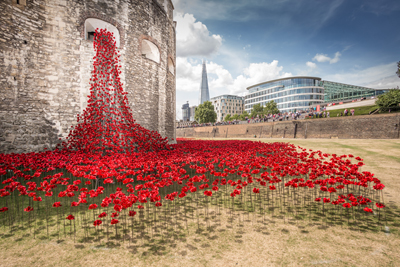
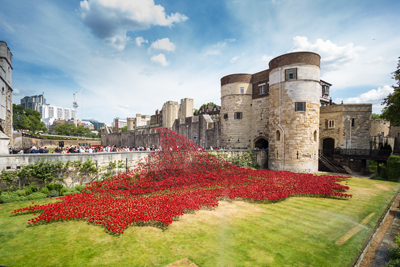
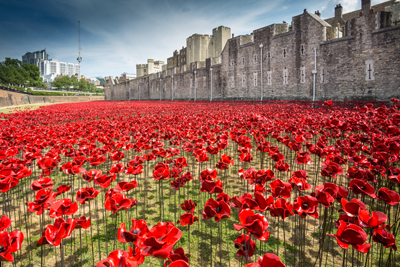
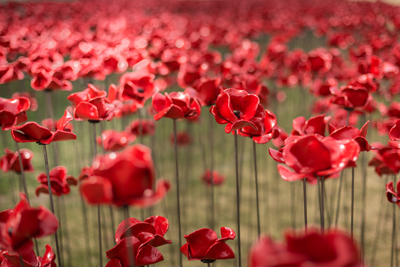
Poppies4The Tower of London is bidding farewell to the sea of poppies that has filled its dry moat while two major features of the instalment – created to mark the centenary of World War I – prepare to head off on tour. Known as Weeping Window (shown above) and Wave (shown immediately below) – the two features of the Blood Swept Lands and Seas of Red installation will both tour various locations across the UK for the next few years before going on permanent display at the Imperial War Museum in London and Manchester. So, we thought we’d take a look back at what has proved to be one of the most popular and moving memorials to appear in the capital in recent years. Created by ceramic artist Paul Cummins (with setting by stage designer Tom Piper), the project saw as many as 888,246 ceramic poppies –  representing all British and Colonial fatalities during the war – planted by volunteers in the moat. The last one was planted on Armistice Day  – 11th November – last week before the process of removal began. PICTURES: ©Richard Lea-Hair and Historic Royal Palaces. 

Poppies5

Poppies2

Poppies1

Poppies6

10 of London’s World War I memorials – 10. Grave of the Unknown Warrior, Westminster Abbey…

In this, the final in our series looking at London’s World War I memorials, we’re taking a look at one of the city’s most visited monuments – the grave of the Unknown Warrior in Westminster Abbey.

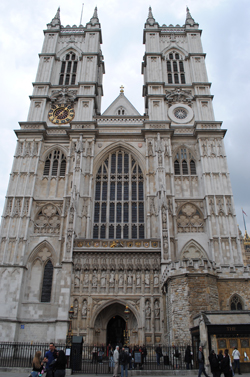
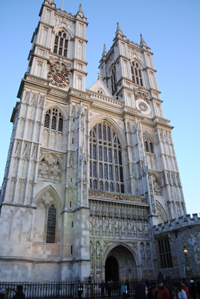
Located at the west end of the minster nave (pictured is the west front of the abbey inside of which lies the grave), the grave is that of a British soldier whose body was brought back from France and buried on the site on 11th November, 1920. The grave, which also contains soil brought from France, is covered by a slab of black marble from Belgium.

Westminster-Abbey2The slab bears an inscription written by Herbert Ryle, then dean of the abbey, which commemorates the “many multitudes” who died during World War I. “They buried him among the kings because he had done good toward God and toward his house”.

It is believed the idea for the memorial was that of a chaplain at the front during the war – Rev David Railton – who in 1916 saw a grave in northern France which featured a cross upon which was written, “An Unknown British Soldier”. He wrote to Ryle about what he’d seen and the idea for the new memorial slowly took shape – albeit with the initial misgivings of some including King George V.

Representing servicemen from the army, navy or air force from anywhere within Britain and its dominions who died in the war and have no other memorial or known grave, the unidentified body which lies in the grave is believed to have been selected at random from among a number bodies of soldiers who died early in the war – accounts suggest they numbered either four or six – and which were exhumed from battle areas at the Aisne, the Somme, Arras and Ypres.

Covered with Union flags, the bodies were taken to a chapel at St Pol on 7th November, 1920, and one selected by Brigadier General LJ Wyatt, commander of troops in France and Flanders. 

The three remaining bodies were reburied while the selected remains were placed in two coffins, the outer one made of oak harvested from a tree which had grown at Hampton Court Palace. A 16th century crusader’s sword taken from the Tower of London’s collection was placed in the wrought iron bands of the coffin and it was then covered with a flag which Rev Railton had used as an altar cloth during the war (known as the Ypres or Padre’s Flag, it now hangs nearby in St George’s Chapel at the abbey).

The coffin was then transported on the destroyer HMS Verdun to Dover and then taken by train to Victoria Station before, on the morning of 11th November, it was placed on a gun carriage drawn by six black horses and transported through massive but silent crowds which lined the streets.

Pausing at the Cenotaph in Whitehall, King George V unveiled the monument which represent an empty tomb (see our earlier post here) and placed a wreath on the coffin and then, followed by the king, other royal family members and dignitaries, it was taken to the abbey minster and lowered into the grave at a special service attended by the king, Queen Alexandra, the queens of Spain and Norway, and Prime Minister David Lloyd George and former Prime Minister HH (later Lord) Asquith (a recording made of some of the service – apparently conducted simultaneously with one at the Arc de Triomphe in Paris – became the first ever electrical recording to be sold to the public).

Thousands of mourners paid their respects at the open grave before the grave was filled in and covered with temporary stone on 18th November. The marble stone which now stands there was unveiled at a special service on 11th November the following year. A framed US Congressional Medal of Honor, conferred by General John J Pershing on the unknown warrior on 17th October, 1921, hangs from a pillar nearby.

WHERE: Westminster Abbey, Westminster (nearest Tube station is Westminster or St James’s Park); WHEN: Generally open to tourists everyday except Sunday  (times vary so check the website); COST: £18 an adult/£15 concessions/£8 schoolchildren (11-18 years), free for children aged under 11/£44 for a family (two adults, two children); WEBSITE: www.westminster-abbey.org.

10 of London’s World War I memorials – 6. The Royal Fusilier’s Memorial…

Fusiliers-MonumentLocated at Holborn Bar – one of the traditional entry points to the City of London, this memorial was erected in 1922 to the memory of the almost 22,000 solider of the Royal Fusiliers (City of London Regiment) who died during the Great War.

The monument, which stands on a traffic island in the middle of busy High Holborn, was designed by sculptor Albert Toft (and hence is known affectionately as “Albert”) along with architects Cheadle and Harding at the behest of several senior officers from the regiment.

It was originally intended to be erected in one of the capital’s many parks. Hounslow Barracks was the next intended location but, after consultation with the City, the site in Holborn was eventually settled upon.

The larger-than-life bronze figure, which stands on a Portland stone pedestal holding a rifle with fixed bayonet, was apparently modelled on an actual person – a Sgt Cox, who served with the Royal Fusiliers throughout the war. The east face features a plate listing all the battalions who served in World War I; the west face features the regimental crest and dedication.

The Grade II-listed memorial, which was officially unveiled by the Lord Mayor of London (we think it was Sir Edward Cecil Moore) on 4th November, 1922, was later updated with inscriptions commemorating those who fell during World War II and in subsequent conflicts.

The original model for the monument can now be seen in the Fusilier Museum at the Tower of London. Interestingly, there is a twin monument, dedicated to the 41st Division, at Flers on the Somme, in France. It was unveiled in 1932.

PICTURE: Mike Peel (www.mikepeel.net)

This Week in London – WWI at the Tower of London; remembering the Olympics; and, Roald Dahl’s portrait….

A new display commemorating the 100th anniversary of the outbreak of World War I has opened at the Tower of London, coinciding with the sea of ceramic poppies which has been ‘planted’ in its moat (see our earlier post on the poppies here). The exhibition, housed in the Flint Tower, features photographs and film from 1914 showing how the Tower was used for in the recruitment, deployment and training of the military and as a place for execution. Photographs from today have been combined with those from 1914 to create moving composite images. The display can be seen with general admission entry. For more, see www.hrp.org.uk/TowerOfLondon/.

A copper element which represented Team GB and was one of 204 – one for each country – used in the Olympic cauldron during the 2012 Games is on display at the Museum of London. It and Paralympic GB’s element will be on alternate display in a new gallery, Designing a Moment: The London 2012 Cauldron, which follows the cauldron’s journey its design and manufacture to its unveiling, ceremonial role, and legacy. The gallery features two seven metre long sections of the cauldron, which was designed by Heatherwick Studio and which featured one element for each country represented at the Games and then for the Paralympics. Until 27th August, it will also feature the Team GB’s element which will then be returned to the British Olympic Association/British Olympic Foundation and replaced with the Paralympics GB copper element, on loan from the British Paralympic Association, which will remain on show until 23rd October, after which it will be replaced by an unassigned Paralympic copper element. Admission is free. For more, see www.museumoflondon.org.uk.

A portrait of author Roald Dahl as a young RAF pilot during World War II has gone on show at the National Portrait Gallery near Trafalgar Square. Painted by Matthew Smith, the work is featured in Colour, Light, Texture: Portraits by Matthew Smith & Frank Dobson, a new display which brings together Smith’s paintings with Dobson’s sculptures. The portrait was painted in 1944 when Dahl was in his late twenties. Found in Room 33, the display can be seen until April 6th. Admission is free. For more, see www.npg.org.uk.

Send all items for inclusion to exploringlondon@gmail.com.

10 sites from Shakespearean London – 10: London in Shakespeare’s plays…

In this, the final in our series looking at Shakespeare’s London, we take a quick look at some of the plethora of London locations mentioned by the Bard in his historical plays. Some we have already covered, but here are a few more…

Westminster-AbbeyWestminster Abbey (pictured): We’ve already talked about Poet’s Corner but Shakespeare himself makes mention of Westminster Abbey in his plays, notably in Henry VI, Part I, when it’s the scene of Henry V’s funeral. The Jerusalem Chamber, principal room of Cheyneygates, the medieval house of abbots of Westminster is mentioned in Henry IV, Part II.

The Houses of Parliament: True, the buildings have changed somewhat since Shakespeare’s day but the former Palace of Westminster is the site of scenes in numerous plays including Richard IIHenry IV, Part II and Henry VI, Part III are set. Among rooms mentioned is Westminster Hall which survives today from the original building.

The Tower of London: As one would expect, this prominent London landmark pops up in several of Shakespeare’s plays including Henry VI, Part I and Richard III where its plays a rather central role – among the events recorded in the latter play are the infamous drowning of Richard III’s elder brother George in a butt of Malmsey wine.

Ely House: The London residence of the bishops of Ely, this long gone building is mentioned in Richard II (for more on Ely House see our earlier posts on Ye Olde Mitre Tavern here and St Etheldreda’s Church here ).

The London Stone: Now at 111 Cannon Street, the London Stone originally was located at another location in Cannon Street and its here in Henry VI, Part II, that rebel Jack Cade stops to strike his sword upon the stone (for more on the London Stone, see our earlier post here).

Other London sites mentioned in Shakespeare’s plays include generic “London Streets” (mentioned in a number of plays), “Eastcheap, near the Boar’s Head Tavern” (Henry IV, Part II), the Temple Garden (Henry VI, Part I) and Blackheath (Henry VI, Part II).

LondonLife – Poppies at the Tower of London…

A04208

More than 800,000 ceramic poppies are being “planted” in the moat of the Tower of London to commemorate the centenary of World War I.

The work of ceramic artist Paul Cummins, Blood Swept Lands and Seas of Red will grow throughout the summer until, by Armistice Day, 888,246 ceramic poppies are ‘planted’ in the dry moat, each one representing a British or colonial military fatality during the war.

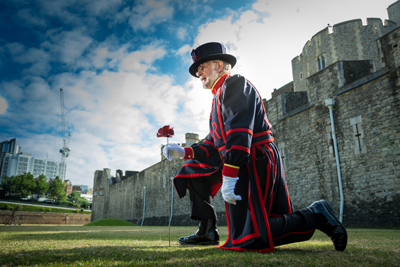
The first poppy was planted by Yeoman Warder Crawford Butler back in July (pictured) and the work was officially “unveiled” today – 100 years since the first full day of Britain’s involvement in the war. 

More than 8,000 volunteers will be involved in planting the poppies which can be purchased for £25 with 10 per cent from each poppy plus all net proceeds shared equally among six service charities: the Confederation of Service Charities (COBSEO), Combat Stress, Coming Home, Help for Heroes, Royal British Legion and SSAFA (formerly the Soldiers, Sailors, Airmen and Families Association).

Starting today, the public will also be able to witness the daily twilight reading of a roll of honour featuring the names of 180 serving military killed during the World War I from Tower Hill terrace. The reading will be followed by the bugler playing the Last Post. Members of the public can nominate a name for the roll of honour. 

For more, see poppies.hrp.org.uk. PICTURE: Photo: © Richard Lea-Hair/Historical Royal Palaces

London Pub Signs – The Hung, Drawn and Quartered…

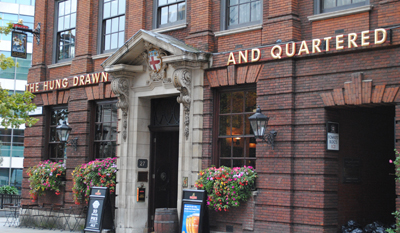
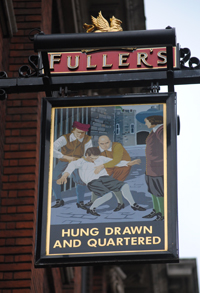
Hung-longThe rather grisly name of this pub (and there’s some debate over whether hanged or hung is grammatically correct) relates to its location close by the former public execution ground of Tower Hill.

While for many Tower Green inside the Tower of London is synonymous with beheadings, only seven people, including Anne Boleyn, were ever actually executed there. Far more people were executed outside the Tower’s walls at nearby Tower Hill, just to the north.

HungSome of the names of those executed here are recorded on a memorial at the site – everyone from Simon Sudbury, the Archbishop of Canterbury who was beheaded here by an angry mob in 1381, through to Sir Thomas More in 1535 (gracious King Henry VIII commuted his sentence from being hung, drawn and quartered to mere beheading), and Simon Fraser, the 11th Lord Lovat, a Jacobite arrested after the Battle of Culloden and the last man to be executed here when his head was lopped off in 1747.

While, as you can see above, many of those executed at Tower Hill were beheaded (and most were of the nobility), there were some executions there which did involve the guilty party being hung, drawn and quartered – a punishment reserved for those being convicted of high treason and also enforced at other sites in London including at Tyburn and Smithfield. Among them was William Collingbourne in 1484 for supporting the cause of Henry Tudor against that of King Richard III.

A plaque on the external wall of the nearby pub quotes a passage from the famous diarist Samuel Pepys after he witnessed an execution in Charing Cross on 13th October, 1660: “I went to see Major General Harrison. Hung drawn and quartered. He was looking as cheerful as any man could in that condition”.

Thomas Harrison fought with Parliament during the Civil War and was among those who signed the death warrant of King Charles I. Found guilty of regicide after the Restoration, he was hung, drawn and quartered (though as Pepys tells us, not here).

The pub, located at 26-27 Great Tower Street, is part of the Fuller’s chain. For more, see www.hung-drawn-and-quartered.co.uk.

This Week in London – First World War galleries open at IWM; London’s WWI memorials the focus of new exhibition; and, London celebrates the Festival of Archaeology…

New galleries dedicated to exploring the history of World War I will open – along with the rest of the refurbished building – at the Imperial War Museum in Lambeth on Saturday. The First World War Galleries span 14 areas displaying everything from shell fragments and lucky charms carried by soldiers to weapons and uniforms, diaries and letters, photographs, art and film. Interactive displays include ‘Life at the Front’ featuring a recreated trench with a Sopwith Camel plane and Mark V tank, and ‘Feeding the Front’ featuring an interactive table of more than four metres long which looks how troops were kept fed. There are also reflective areas in which visitors are encouraged to reflect on some of the most difficult aspects of war. The museum – which features a dramatic new atrium – is also launching the largest exhibition and first major retrospective of British World War I art for almost 100 years. Truth and Memory includes works by some of the UK’s most important artists. Entry to both is free with Truth and Memory running until 8th March. For more, see www.iwm.org.uk.

London’s memorials to those who died in World War I are the focus of a new exhibition which opened at Wellington Arch near Hyde Park Corner yesterday. The English Heritage exhibition, which has a particular focus on the six memorials cared for by English Heritage but also looks at other memorials, will include designs, statuettes and photographs of the memorials including the Cenotaph in Whitehall. Also featured in We Will Remember Them: London’s Great War Memorials are official documents – including a note of condolence and medals certificates – received by the family of author and broadcaster Jeremy Paxman on the death of his great uncle Private Charles Dickson, who died at Gallipoli in 1915. Runs until 30th November. Admission charge applies. For more see www.english-heritage.org.uk/daysout/properties/wellington-arch/. Meanwhile, coinciding with the opening of the exhibition has been news that five of London’s key war memorials – including the Edith Cavell Memorial in St Martin’s Place and the Royal Artillery Memorial at Hyde Park Corner – have had their heritage listing upgraded.

In case you missed it, the 24th annual Festival of Archaeology kicked off last weekend and features a range of events across London. Highlights include the chance again to go ‘mudlarking’ on the Thames river bank below the Tower of London and have your finds assessed by archaeologists (this Saturday and Sunday from 11am to 4pm), guided 90 minute walks around Islington and Highbury this weekend with a particular focus on the 1940s, and a look behind the scenes at the London Metropolitan Archives (2pm to 5pm today). The festival continues until 27th July. Check the website for a full program of events – www.archaeologyfestival.org.uk.

This Week in London – Woolly mammoths star at the NHM; the Ceremony of the Constable’s Dues; mummies at the British Museum; and, Rupert Potter’s photographs…

The most complete woolly mammoth ever found is the star attraction at a new exhibition opening at the Natural History Museum tomorrow. Lyuba – a one month old mammoth – was found by a reindeer herder in Siberia in 2007 and was named after the reindeer herder’s wife. Thought to be 42,000-years-old, the young mammoth was thought to be healthy when it died and still has remnants of its mother’s milk in its stomach. It is the first time the mammoth – normally housed at the Shemanovsky Museum-Exhibition Complex in Salekhard, Russia, is being shown in Western Europe. Mammoths: Ice Age Giants will also feature life-sized models and skeletons of mammoths. Runs until 7th September. Admission charge applies. For more, see www.nhm.ac.uk.

The German naval ship FGS Niedersachsen will take part in the Ceremony of the Constable’s Dues at the Tower of London tomorrow, having saluted the Tower with a gun salute yesterday – the first time a gun salute has taken place in honour of the ceremony in 40 years. The ceremony dates back to the 24th century and while past offerings have included barrels of rum, oysters, cockles and mussels, this year the Tower’s constable, General the Lord Dannatt, will be presented with a barrel of wine. The ceremony will see the ship’s Commander Kurt Leonards led his crew to the Tower’s West Gate where they will be challenged by the axe wielding Yeoman Gaoler before marching on to Tower Green to “present the dues” or deliver the wine, to the Constable. The ceremony takes place at noon. For more on the Tower, see www.hrp.org.uk/TowerOfLondon/.

A new exhibition about ancient lives in Egypt and Sudan has kicks off at the British Museum today. Ancient lives, new discoveries will reveal new research about one of the museum’s most popular collections – that of ancient Egyptian and Sudanese mummies – and uses state-of-the-art technology to take you inside the mummy cases and bring you face-to-face with eight people who lived in the Nile Valley thousands of years ago. The selected mummies come from a period spanning 4,000 years, from the Predynastic period to the Christian era, and come from sites in both Egypt and Sudan. They include an adult male from Thebes mummified about 600 BC and a female singer called Tamut who lived in Thebes around 900 BC. The museum received its first mummy in 1756 and hasn’t unwrapped any of them relying on increasingly advanced technologies to see inside. The exhibition runs until 30th November. Admission charge applies. For more, see www.britishmuseum.org.

On Now – The World of Rupert Potter: Photographs of Beatrix, Millais and Friends. The amateur photography of Rupert Potter, father of children’s author Beatrix Potter, is on show in his exhibition at the National Portrait Gallery. The display features selected works from the gallery’s extensive collection of his works including two new acquisitions which show Beatrix Potter on holidays both before and after her publishing success. Other photos depict the sitters and paintings of artist Sir John Everett Millais, who was a friend of Rupert Potter’s. The free exhibition runs until 16th November in Room 28. For more, see www.npg.org.uk.

Send all items of interest for inclusion to exploringlondon@gmail.com.

LondonLife – The Tudor Pull…

Tudor-Pull

Crowds lined the banks of The Thames last weekend as Her Majesty’s Watermen rowed from Hampton Court Palace to the Tower of London in the annual “Tudor Pull”.  The palace-to-palace rowing event on Sunday kicked off around 10am with a ceremony at Hampton Court during which the ‘Stela’ – an ancient piece of medieval water pipe made from a hollowed-out tree trunk which symbolises the power of The Thames – is passed to the watermen who then took it up river to the Tower in the royal barge Gloriana. The barge, which was accompanied by a fleet of other traditional rowing craft, stopped at several locations along the journey, before it arrived at the Tower in Sunday afternoon where the ‘Stela’ was presented to the Governor. The event is also said to commemorate the sinking in 1256 of Queen Eleanor’s royal barge under old London Bridge. For more on the Historic Royal Palaces in London, head to www.hrp.org.uk.

PICTURE: Courtesy of Historic Royal Palaces.

Our new special series will kick off next week!

This Week in London – New drawbridge for the Tower; Churchill War Rooms celebrate 30 years; and, the mid-Twentieth century home at the Geffrye…

There’s a working drawbridge at the Tower of London, something not seen at the fortress since the 1970s. The bridge, which would have originally spanned a water-filled moat, was created in 1834 to allow munitions to be brought into the basement level of the White Tower from the wharf (the moat was drained in 1843 on the orders of the then-Constable, the Duke of Wellington). The bridge has been altered many times but the last time it was completely replaced was in 1915 while the tradition of raising it was carried on until the 1970s before it was permanently fixed in 1978. The new bridge draws on historic designs from 1914 and has been constructed of steel and English oak. It will be raised and lowered on “high days” and holidays and for educational purposes. For more, see www.hrp.org.uk/TowerOfLondon/.

The Churchill War Rooms – a complex of underground rooms from where then PM Winston Churchill and others directed the course of Allied troops during World War II – is celebrating the 30th anniversary of its public opening with a new displaying showcasing never before seen objects related to its creation as a tourist attraction. The objects include a private admissions ticket from the days when the only way inside was via specially granted permission, correspondence about the fate of the War Rooms and a poster from 1984 advertising the opening of the Cabinet War Rooms to the public. Admission charge applies. For more, see www.iwm.org.uk/visits/churchill-war-rooms.

On Now: John Pantlin: photographing the mid-century home. This free exhibition at the Geffrye Museum in Shoreditch celebrates the work of Pantlin who is noted for his extensive work for the architectural press in the 1950s and 1960s. The small exhibition focuses on his shots of domestic interiors with shots of sun-filled living rooms and bedrooms filled with toys with all images drawn from the Robert Elwall Photographs Collection. Runs until 29th June. For more, see www.geffrye-museum.org.uk.

Where’s London’s oldest…museum?

Power-House

London’s oldest museum is not the British Museum or any of the Kensington museums but is actually contained within one of the city’s iconic structures.

Located within the Tower of London, the Royal Armouries Museum takes the prize of being not only the city’s oldest museum but oldest museum in the whole of Britain.

It’s origins go back to medieval times when the tower housed the main royal arsenal and was a working armoury and, by the time of the Restoration, there was a permanent public display in the White Tower with the star attractions being the Spanish Armoury, a collection of weapons and torture instruments claimed to have been taken from the Spanish Armada of 1588, and the Line of Kings (see our earlier post on this here).

Other displays – including one focused on artillery and another on horses – were subsequently added in various buildings within the tower precincts including in the Grand Storehouse which, located to the north of the White Tower, destroyed by fire in 1841. Over the ensuing years, the displays were moved back into the White Tower.

As well as the revamped Line of Kings and the Power House exhibition looking at the people, institutions and history of the Tower, the current display includes a dragon made of more than 2,600 items of weaponry, following a long-standing tradition in the museum of creating displays out of masses of weapons.

As well as continuing its presence at the Tower of London, the museum is now also housed at Fort Nelson at Portsmouth – this opened in 1995 when it became home to the museum’s artillery collection – and in Leeds, which opened in 1996. There’s also some weapons on display in Louisville, Kentucky, in the US, under a  cooperative agreement with the Frazier International History Museum.

PICTURE: ‘Keeper’, the Dragon trophy – part of the Power House display in the Royal  Armouries Museum at the Tower of London. HRP newsteam.

WHERE: Tower of London (nearest Tube station Tower Hill); WHEN: 9am to 5.30pm, Tuesday to Saturday, 10am to 5.30pm Sunday to Monday; COST: £21.45 adults; £10.75 children under 15; £18.15 concessions; £57.20 for a family; WEBSITE: www.hrp.org.uk/toweroflondon/.