Famous Londoners – Dr Richard Mead…

Eighteenth century physician Dr Richard Mead is noted not only for his attendance on the rich and famous of his time – including royalty – but also for his philanthropy, his expansive collections and, importantly, his contributions in the field of medicine.

Born in Stepney, London, on the 11th August, 1673, as the 11th of 13 children of nonconforming minister Matthew Mead, Mead studied both Utrecht and Leiden before receiving his MD in Italy. Returning to England in 1696, he founded his own medical practice in Stepney.

He married Ruth Marsh in 1699 and together the couple had at least eight children, several of whom died young, before her death in 1720 (he subsequently married again, this time to Anne, daughter of a Bedfordshire knight, Sir Rowland Alston).

Having published the then seminal text – A Mechanical Account of Poisons – in 1702, the following year Mead was admitted to the Royal Society. He also took up a post as a physician at St Thomas’ Hospital, a job which saw him move to a property in Crutched Friars in the City – his home until 1711, when he relocated to Austin Friars.

It was after this that he become friends with eminent physician John Radcliffe who chose Mead as his successor and, on his death in 1714, bequeathed him his practice and his Bloomsbury home (not to mention his gold-topped cane, now on display at the Foundling Museum – see note below).

Following Radcliffe’s death, in August of that year Dr Mead attended Queen Anne on her deathbed. Other distinguished patients over his career included King George I, his son Prince George and daughter-in-law Princess Caroline – in fact he was appointed as official physician to the former prince when elevated to the throne as King George II – as well as Sir Isaac Newton, lexicographer Dr Samuel Johnson, Alexander Pope, Sir Robert Walpole and painter Antoine Watteau.

Mead, who had been named a governor of St Thomas’ in 1715 and elected a fellow of the Royal College of Physicians in 1716, was over the years recognised as an expert in a range of medical fields – including, as well as poisons, smallpox, scurvy and even the transmission of the plague.

Among the many more curious stories about Dr Mead is one concerning a ‘duel’ (or fistfight) he apparently fought with rival Dr John Woodward outside Gresham College in 1719 over their differences in tackling smallpox and others which concern experiments he conducted with venomous snakes to further his knowledge of venom before writing his text on poisons.

Dr Mead was also known for his philanthropy and became one of the founding governors of the Foundling Hospital (as well as being its medical advisor) – a portrait of him by artist Allan Ramsay (for whom he was a patron), currently hangs at the museum.

Dr Mead, who by this stage lived in Great Ormond Street in Bloomsbury (the property, which backed onto the grounds of the Foundling Museum and which Mead had moved into after his first wife’s death, later formed the basis of the Great Ormond Street Hospital for Children), is also noted for the large collection he gathered of paintings – including works by Dürer, Holbein, Rembrandt, and Canaletto, a library of more than 10,000 books, antiquities and classical sculpture as well as coins and jewels, all of which scholars and artists could access at his home (it took some 56 days to sell it all after his death).

While Dr Mead – who died on 16th February, 1754 – was buried in the Temple Church, there is a monument to him – including a bust by Peter Scheemakers – in the north aisle of Westminster Abbey.

Dr Mead is currently being honoured in an exhibition at the Foundling Museum – The Generous Georgian: Dr Richard Meadwhich runs until 4th January. There’s an accompanying blog here which provides more information on his life and legacy.

This Week in London – Science Museum’s new IT gallery; Hornchurch skatepark protected; NHM’s ice rink opens; and Emily Carr at Dulwich…

Queen Elizabeth II opened the new Information Age gallery at the Science Museum this week by sending her first tweet. Following a tour of the new gallery exploring the way technologies – including everything from the telegraph through to the world wide web – have transformed the way we communicate, the Queen tweeted: “It is a pleasure to open the Information Age exhibition today at the @ScienceMuseum and I hope people will enjoy visiting.  Elizabeth R.” The gallery in the South Kensington museum explores the growth of communications technologies through important events such as the sinking of the Titanic in the Atlantic in 1912, the first BBC broadcast in 1922, the TV broadcast of the 1953 coronation of Queen Elizabeth II and the creation of the first international link on the ARPANET network – the forerunner of the internet – by University College London in 1973. Entry to the new gallery is free. For more, see www.sciencemuseum.org.uk.

• In a European first (and only the second time it’s occurred around the world), an East London skatepark has been given heritage protection. Known as ‘the Rom’, the Hornchurch structure was purpose-built in 1978 by leading skatepark designers Adrian Rolt and G-Force. It has been listed as Grade II and is only the second skatepark to in the world to win such protection with the first being the ‘Bro Bowl’ in Tampa, Florida, added to the US National Register of Historic Places in October last year. Heritage Minister Ed Vaizey said the listing is testament to the park’s design. The listing was carried out on the advice of English Heritage.

The Natural History Museum’s ice rink opens today, the 10th year it’s been positioned outside the stunning South Kensington building. The 1,000 square metre rink has been decorated with 80,000 fairy lights and a 40 foot high Christmas tree, and this year has been joined by an interactive Lindt Christmas chalet where you’ll be able to sample complimentary truffles and join in activities. The rink is open to 4th January. For more, see www.nhmskating.com.

The works of pioneering Canadian artist Emily Carr are the focus of a new exhibition opening at the Dulwich Picture Gallery in London’s south on Saturday. From the Forest to the Sea: Emily Carr in British Columbia is the first major solo exhibition in Europe dedicated to the modernist artist who lived between 1871 and 1945. It features more than 140 works and indigenous artefacts as well as a recently discovered illustrated journal, Sister and I in Alaska, in which Carr documented her pivotal trip up and down the north-west coast of Canada in 1907. Highlights include Totem and Forest, (Untitled) Seascape and View in Victoria Harbour, one of a number of momentary records left behind in her trunk after her death. Runs until 8th March. Admission charge applies. See www.dulwichpicturegallery.org.uk for more.

Send items for inclusion to exploringlondon@gmail.com.

London Pub Signs – The Gipsy Moth…

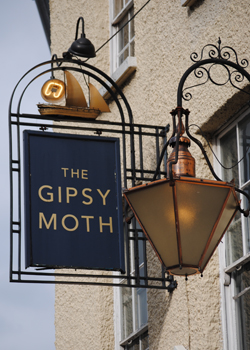
The boat on this iconic Greenwich pub’s sign probably gives the game away here – the Gipsy Moth is named after a yacht of the same name.

The-Gipsy-MothThe Gipsy Moth IV was sailed single-handedly around the globe by Sir Francis Chichester, then aged in his 60s, in 1966-67, who broke numerous records as he did so including the fastest voyage around the world by any small vessel, the longest non-stop passage by a small vessel and what was then the longest single-handed passage.

Following the death of Sir Francis on 26th August, 1972 (he had been knighted by Queen Elizabeth II on the steps of the Old Royal Naval College using the same sword that had knighted Sir Francis Drake in the presence of Queen Elizabeth I in 1581), the boat was put on display in a Greenwich dry dock next to the Cutty Sark. Initially open to the public, it was later closed due to deterioration.

Following a restoration in the early Noughties, in 2006 the Gipsy Moth IV was again sailed around the world (on a trip that wasn’t always smooth sailing) to mark the 40th anniversary of Sir Francis’ journey. It is now owned by a charitable trust based in Cowes on the Isle of Wight.

The renovated pub, located at 60 Greenwich Church Street next to the Cutty Sark, is situated in a building which dates from the late 18th century. It apparently changed its name from the Wheatsheaf in the mid-1970s apparently to mark the arrival of the Gipsy Moth IV.

The pub features a beer garden with views of the Cutty Sark. For more information, see www.thegipsymothgreenwich.co.uk.

This Week in London – The Magna Carta at the new City of London Heritage Gallery; Tudor monarchs at the NPG; Mapping London; and objects with story at Pitzhanger…

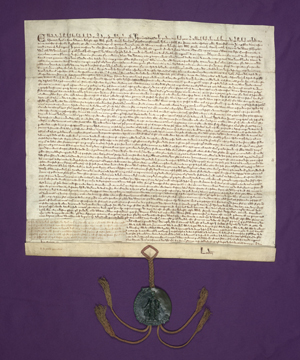
Magna-Carta-1297_Copright-London-Metropolitan-Archives---CopyThe 13th century’s finest surviving copy of the Magna Carta is taking centre stage at the new City of London Heritage Gallery which opens to the public this Friday. The 1297 document, which bears a superimposed memo reading ‘make it happen’, is being featured as part of the Corporation’s efforts to mark next year’s 800th anniversary of the signing of the landmark document. Other items on display in the new permanent, purpose-built exhibition space at the Guildhall Art Gallery include the medieval Cartae Antiquae, a volume containing transcripts of charters and statues covering laws enacted between 1327 and 1425 – a period which includes the reign of King Richard III, a poster for a World War I recruitment meeting held at the Guildhall in 1914, and a series of paintings depicting the 25 City Aldermen who were in office in the mid-1400s. The gallery, admission to which is free, will in future feature a rotating selection of rare documents from the City of London Corporation’s archives including the purchase deed William Shakespeare signed on buying a home in Blackfriars in 1613. For more, including opening times, see www.cityoflondon.gov.uk/heritagegallery. For more on events to mark the 800th anniversary of the signing of the Magna Carta next year, see www.magnacarta800th.com. PICTURE: Copyright London Metropolitan Archives.

Rare depictions of Tudor monarchs will be seen at the National Portrait Gallery in the most complete presentation of their portraiture to date. The Real Tudors: Kings and Queens Rediscovered features the gallery’s oldest portrait – that of King Henry VII – displayed alongside a Book of Hours inscribed by the king to his daughter, six portraits of King Henry VIII along with his rosary (on loan from Chatsworth), portraits of King Edward VI and a page from his diary in which he relates his father’s death, five portraits of Queen Mary I along with her prayer book (on loan from Westminster Cathedral) and several portraits of Queen Elizabeth I displayed alongside her locket ring (on loan from Chequers, the country residence of the PM). There will also be a discussion surrounding the search for a “real” portrait of the ‘nine days queen’, Lady Jane Grey, alongside a portrait of her that dates from the Elizabethan period. With many of the portraits newly examined as part of the gallery’s ‘Making Art in Tudor Britain’ project, visitors to the gallery will also be able to access a specially created app which allowing them to access the new research while looking at the portraits. The display, which will form the core of a larger exhibition in Paris next year, can be seen until 1st March. Admission to the gallery, off Trafalgar Square, is free. For more, see www.npg.org.uk.

An exhibition of rare maps from London, dating from between 1572 and last year, at gallery@oxo on South Bank, is closing on Sunday. Part of the Totally Thames festival, the Mapping London exhibition shows how the landscape along the River Thames as it passes through the capital has changed over the years. It features the first available map of London, which dates from 1572, as well as a 2013 map of underground London, monumental wall maps, and even a map of London that doubles as fan. The free exhibition at Oxo Tower Wharf is being curated by Daniel Crouch, one of the world’s leading map dealers. For more, see www.totallythames.org/events/info/mapping-london.

• A Crafts Council touring exhibition showcasing the work of 12 contemporary artisans and design studios – each of which uses objects as a means of storytelling – has opened at Pitzhanger Manor House and Gallery in Ealing – its first stop – this week. Crafting Narrative: Storytelling through objects and making explores the potential of objects to reflect on history, culture, society and technology through a combination of new and commissioned works, film text and photography. Works include Hilda Hellström’s The Materiality of a Natural Disaster which consists of food vessels made of soil from a field belonging to the last resident inside the Japanese Daiichi nuclear plant exclusion zone, Onkar Kular and Noam Toran’s archive of objects belonging to the fictional Lövy-Singh clan – an East London family of mixed Jewish and Sikh descent, and Hefin Jones’ The Welsh Space Campaign which features objects such as astronaut boots in the form of traditional Welsh clogs in an attempt to show how Wales has the capacity to explore space. The free exhibition is at the manor until 19th October. For more, see www.pitzhanger.org.uk.

Send all items for inclusion to exploringlondon@gmail.com.

10 of London’s World War I memorials – 3. Tower Hill Memorial…

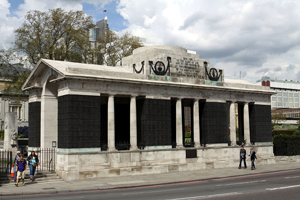
The Tower Hill Memorial was originally built to commemorate those of the Merchant Navy and fishing fleets who died at sea in World War I and was later expanded to include those who died in World War II.

Tower-Hill-MemorialLocated in the south-west corner of the garden in Trinity Square, the part of the memorial relating to World War I has the form of a 20-plus metre long vaulted corridor inside of which are a series of bronze plaques engraved with the names of 11,919 people whose grave was the sea.

Designed by Sir Edwin Lutyens and featuring sculptures by Sir William Reid-Dick, the Portland Stone memorial was unveiled on 12th December, 1928, by Queen Mary. The names are placed alphabetically under the names of their ships with the skipper or master the first name.

Located to the north of the original monument, the World War II extension, which was unveiled by Queen Elizabeth II on 5th November, 1955, takes the form of a semi-circular sunken garden and features the names of almost 24,000 seamen who died in World War II. It was designed by Sir Edward Maufe with sculpture by Charles Wheeler.

The memorial’s register is located inside nearby Corporation of Trinity House office (Cooper’s Row entrance).

PICTURE: Chmee2/Wikimedia Commons


Treasures of London – The Wolsey Angels…

Wolsey-Angels


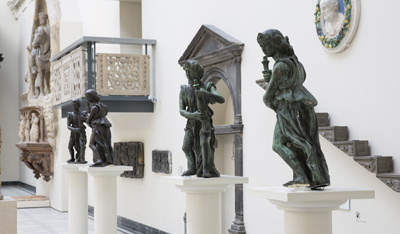
Four bronze angels, designed for the tomb of Cardinal Thomas Wolsey, have been temporarily reunited in the V&A’s Medieval & Renaissance galleries as the museum looks for funding to acquire them.

Once thought lost, the Wolsey Angels were commissioned in 1524 from Florentine sculptor Benedetto de Rovezzano for the tomb of Wolsey, chief advisor to King Henry VIII and one of the most powerful men in the kingdom. Each of the angels, which measure around a metre in height, was created between 1524 and 1529 – the period in which Wolsey was trying to have the pope annul Henry VIII’s marriage to Catherine of Aragon.

As is well-known, Wolsey failed to do so and died in 1530 in disgrace. Henry appropriated Wolsey’s assets including the tomb which the king apparently intended to use for himself. The work was slow, however, and when Henry died in 1547, it remained unfinished. His children – King Edward VI, Queen Mary I and Queen Elizabeth I – each said they would complete the tomb as a memorial to their father but didn’t and in 1565, Elizabeth moved parts of the tomb to Windsor.

During the English Civil War elements of the tomb were sold off to raise funds and only the black stone chest – now used to house the remains of Admiral Lord Nelson in the St Paul’s Cathedral crypt – were believed to have survived along with four large gilt-bronze candlesticks which were installed at St Bavo Cathedral in Ghent.

The angels passed out of sight until, in 1994, two of them appeared in a Sotheby’s sale. Acquired by a Parisian art dealer, they were later attributed to Benedetto. The remaining two angels were discovered at Harrowden Hall in Northamptonshire in 2008 – the hall is now owned by the Wellingborough Golf Club – and it was subsequently revealed that the other two had been stolen from the same site 20 years previously.

The V&A has embarked on a campaign – backed by Hilary Mantel, the Booker Prize winning author of Wolf Hall – to acquire the four angels, priced at £5 million. It has already been granted £2 from the National Heritage Memorial Fund and the Art Fund has pledged a further £500,000.

Mantel described the recovery of the angels as “one of those miracles that historians pray for; something that seems irrevocably lost has been there all the time”. “To claim the angels for the nation would connect us to one of the liveliest eras of our history and one of its most remarkable men.”

Donations can be made via the V&A’s website at www.vam.ac.uk/wolseyangels.

PICTURE: Wolsey Angels on display at the V&A/© Victoria and Albert Museum, London

This Week in London – Notting Hill Carnival; St Paul’s treasures on show; Sherlock Holmes on film; and more…

Photo-by-Wayne-G-callender-(2)The August Bank Holiday is upon us which means it’s carnival time! The Notting Hill Carnival kicks off this Sunday with an extravaganza of costumes, dancing, music and food. The carnival’s origins go back to the late Fifties and early Sixties (the exact date is somewhat controversial!) when it started as a way of Afro-Caribbean communities celebrating their cultures and traditions, drawing on the tradition of carnivals in the Caribbean. The carnival is now Europe’s largest street festival and this year’s parade signifies the start of a three year celebration in the lead-up to the Golden Jubilee year of 2016. The carnival kicks off at 9am on Sunday – children’s day – and the same time on Monday – adult’s day – and organisers say the procession should be completed by 7pm. For more, see www.thelondonnottinghillcarnival.com. PICTURE: Wayne G Callender/Notting Hill Carnival.

A pop-up display of some of St Paul’s Cathedral’s treasures will appear today and tomorrow (Thursday, 21st August, and Friday 22nd August) in the cathedral’s crypt. Put together by Museum Studies students from Leicester University, the display will feature items relating to a royal event from each of the first three centuries of Wren’s church. They include images and objects from the Thanksgiving Service for the recovery of King George III in 1789 as well as items from Queen Victoria’s Diamond Jubilee in 1897 and the wedding of Prince Charles and Lady Diana in 1981. The display will be shown from 1pm to 2pm each day – entry is free via the cathedral’s north west crypt door. Meanwhile, the cathedral is offering a private, behind the scenes evening photography tour of the building for the winner of a photography competition looking for “the most surprising image” of the cathedral. The winner – and five friends – will also be treated to a meal at the Grange Hotel’s Benihama restaurant. The Surprise St Paul’s competition runs until 26th September and entrants just need to tweet or post their images to the church’s Twitter or Facebook pages with the hashtag #SurpriseStPauls. For more, see www.stpauls.co.uk.

The National Gallery has made free wi-fi available throughout the building. The Trafalgar Square-based gallery says it’s now also welcoming visitor photography and is encouraging visitors to check in on Facebook and comment on Twitter using the hashtag #MyNGPainting. For more, see www.nationalgallery.org.uk.

Fancy yourself a detective? The Museum of London and the BFI are asking for the public’s help in tracking down a copy of the first ever feature film starring the fictional character Sherlock Holmes.  A Study in Scarlet was released 100 years ago this autumn and was directed by George Pearson with then unknown James Bragington playing the part of Holmes. An adaption of Sir Arthur Conan Doyle’s story of the same name, it is based around Brigham Young’s trek across America with his Mormon followers and sees Holmes solve a series of murders. The film was made at Worton Hall studios and on location in Cheddar Gorge and Southport Sands in 1914. The organisations are seeking the film in the lead-up to the Museum of London’s landmark exhibition on Holmes which opens in October. If you do happen to find the film, you can write to Sherlockholmes@bfi.org.uk or make contact via social media using the hashtag #FindSherlock.

A public ballot has opened for tickets to attend the art installation Fire Garden by renowned French troupe Carabosse at Battersea Power Station this September. The event – which will be held on the nights of Friday 5th and Saturday 6th September – is one of the highlights of Totally Thames, a month-long celebration of London’s great river, and is presented as a tribute to the power station before it’s closed to the public for redevelopment. A free event, it’s expected to be so popular that organisers are holding a ballot for tickets. The ballot closes midday on 27th August. To enter via the Totally Thames website, head here.

Send all items for inclusion to exploringlondon@gmail.com.

A Moment in London’s History – The death of Queen Anne…

Queen-Anne

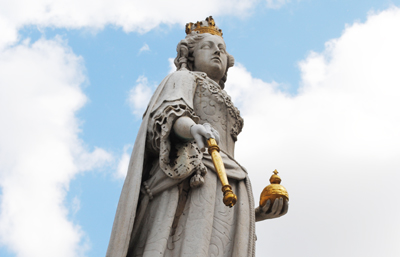
While much attention is being paid this year to the fact it’s the 300th anniversary of the accession of King George I (and the House of Hanover), we thought we’d take a quick look at the event which precipitated that moment – the death of the last Stuart monarch, Queen Anne, on 1st August, 1714.

The queen (depicted here in Richard Belt’s copy of a Francis Bird original outside St Paul’s Cathedral), who had ruled since 1702 and was the first monarch of Great Britain thanks to the 1707 Act of Union, died at Kensington Palace at about 7.30am. She had apparently suffered a series of strokes, having experienced declining health for the previous couple of years (this included gout which had severely limited her mobility and saw her carried in a chair even at her coronation). She was 49.

Her body was so swollen at the time of her death that she had to be placed in a large square-shaped coffin which was carried by 14 men.

Following her funeral, on 24th August she was laid to rest next to her husband, George of Denmark (he’d died at Kensington six years before), in the Stuart vault on the south side of King Henry VII’s chapel in Westminster Abbey.

Many of the bones of her infant and stillborn children lie nearby (Anne was pregnant 18 times) and apparently due to a lack of space, only a “small stone” marks her grave site. Anne’s seated wax funeral effigy, modelled from her death mask, can be seen in the abbey’s museum.

The idiom “Queen Anne is dead” – used as a response to someone who brings old news or who states the obvious – is thought to have its origins in the idea that while news of her death was officially kept quiet so the Hanoverian succession could be shored up, news of it nonetheless leaked quite quickly meaning that by the time it was officially announced, it was already well known.

LondonLife – Hampton Court Palace’s royal ‘edible’ gardens…

Gardens1

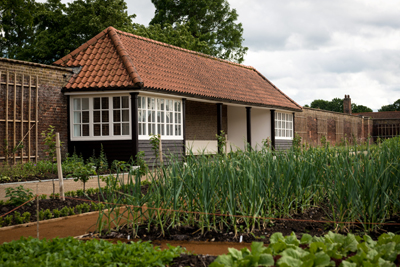
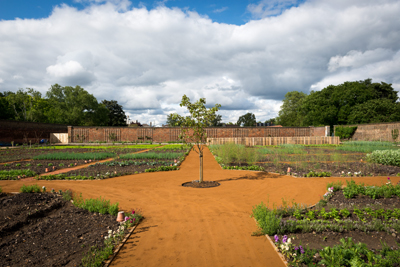
Historic Royal Palaces has reopened Hampton Court Palace’s royal kitchen garden, having recreated it according to a plan dating from 1736. The  six acre garden – constructed on the site of King Henry VIII’s tiltyard on the orders of Queen Anne in 1702 – was used to supply the table of monarchs from the early 1700s through to the 1840s. The recreated version showcases rare and heritage varieties of fruit and vegetables including Italian celery, borrage, skirret and swelling parsnips as well as apricots, nectarine and peaches while on site displays showcase some of the techniques used by the royal gardeners. The gardens are open to the public free-of-charge and it’s hoped that as they mature, vegetable growing classes will be held there. The gardens have been opened as part of celebrations marking the 300th anniversary of the Hanoverian accession. For more on Hampton Court Palace, see www.hrp.org.uk/HamptonCourtPalace/. PICTURES: Courtesy Historic Royal Palaces.

Gardens2

Gardens3

Treasures of London – Swiss Court…

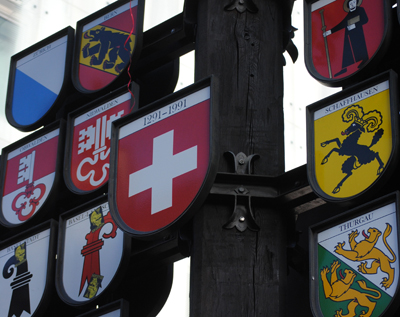
Cantonal-treeIn the hubbub of the West End, it’s easy to walk past the colourful monuments of Swiss Court without realising their significance is. 

Located between Piccadilly Circus and Leicester Square, the area was formerly home of the Swiss Centre, completed in the late 1960s as a showcase and trade centre for Switzerland. The centre was demolished in the late Noughties and replaced by the building now housing the W London Hotel and M&M’s World.

It was named Swiss Court on 15th April, 1991 – the 700th anniversary of the Swiss Confederation – by the then Lord Mayor of Westminster, Cr David Avery – and has two monuments commemorating the friendship between Switzerland and the UK.

The first is a “cantonal tree” (pictured) which displays the coats of arms of 26 cantons of Switzerland and was presented as a gift from Switzerland to mark the Silver Jubilee of Queen Elizabeth II in May 1977, “as a token of the friendship that exists between our two countries.”

The second is a glockenspiel featuring 27 bells and 11 moving figures which was originally attached to the front of the Swiss Centre after it was gifted to the City of Westminster by Switzerland and Liechtenstein in 1985.

It was removed when the building was demolished but, following a restoration and update (it’s now wirelessly controlled from Derby), returned to Swiss Court as a freestanding, 10 metre monument in late 2011. It now stands just a couple of metres from the cantonal tree.

10 sites from Shakespearean London – 8: Memorialising Shakespeare (part 1)…

Shakespeare

This week (and next week) as part of our look at Shakespeare’s London, we’re taking a look at a few of the many memorials to William Shakespeare located around London…

• Westminster Abbey: Perhaps the most famous of London’s memorials to Shakespeare can be found in Poet’s Corner, an area of the abbey which has become noted as a burial place and memorial site for writers, playwrights and poets. Designed by William Kent, the memorial statue of Shakespeare was placed here in January, 1741 (there had apparently been some earlier talk of bringing his bones from Stratford-upon-Avon but that idea was squashed). The life-size statue in white marble, sculpted by Peter Scheemakers, was erected by Richard Boyle, the 3rd Earl of Burlington, Dr Richard Mead, Alexander Pope and Tom Martin. The memorial also features the heads of Queen Elizabeth I, King Henry V and King Richard III on the base of a pedestal and shows Shakespeare pointing to a scroll on which are painted a variation of lines taken from The Tempest. A Latin inscription records the date the memorial was created and an English translation of this was added in 1977. For more on the abbey, see www.westminster-abbey.org.

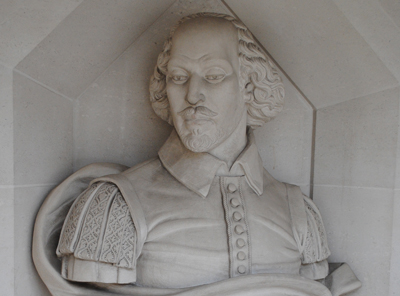
• Guildhall Art Gallery (pictured above): Facing into Guildhall Yard from niches under the loggia of the Guildhall Art Gallery are four larger-than-life busts of historical figures connected with the City of London. As well as one of Lord Protector Oliver Cromwell, architect Christopher Wren, and diarist Samuel Pepys (along with a full-length statue of Dick Whittington and his famous cat) is a bust depicting Shakespeare. Carved out of Portland stone by sculptor Tim Crawley, the busts were installed in 1999. Much attention was apparently paid to creating a bust which resembled pictures of Shakespeare. Follow this link for more on the gallery.

Former City of London School: This Thames-side building, dating from the 1880s, features a full length statue of Shakespeare who gazes out over the river. He’s not alone – poet John Milton, Sir Isaac Newton, Sir Thomas More and Sir Francis Bacon stand nearby, selected, apparently, to represent various disciplines taught at the school. The statues were the work of John Daymond who depicted Shakespeare flanked by representations of classics and poetry and drawing and music. The school vacated the building on Victoria Embankment  in the 1980s and it’s now occupied by JP Morgan.

We’ll be looking at some more works depicting Shakespeare next week…

10 sites from Shakespearean London – 7. Shakespearean connections in the Elizabethan world – St John’s Gate and Staple Inn…

Following on from our post last week, we take a look at a couple more of London’s buildings that had some sort of association with William Shakespeare…

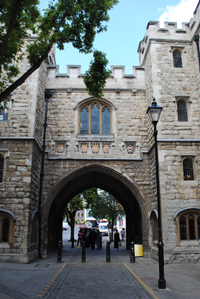
St-John's-Gate St John’s Gate, Clerkenwell (pictured): This former gatehouse into Clerkenwell Priory was at the time of Shakespeare home to the Master of the Revels and where the playwright would have had to have brought his plays for official government approval. Thirty of the Bard’s plays were licensed here and the Master of Revels during all but the final few years of Shakespeare’s career was Edmund Tilney (or Tylney), who served in the post under both Queen Elizabeth I and King James I. The gatehouse was later used as a coffee house and pub among other things and is associated with everyone from artist William Hogarth (his father Richard ran the coffee house), Dr Samuel Johnson and Charles Dickens. These days, the gatehouse is part of the Museum of the Order of St John (for more on that, see our earlier post here).

Staple Inn, Holborn: OK, there’s no direct link at all between Shakespeare and this building on High Holborn but it was built during his lifetime – in 1585 – and as such is one of very few surviving examples of buildings of his era. Its name comes from the fact the site where it stands was originally a covered market where wool was weighed and taxed (the word ‘staple’ apparently relates to the duty on wool introduced in 1275). It later became an Inn of Chancery – a medieval school for lawyers which fed students through to the Inns of Court (in this case mostly Gray’s Inn), and it was members of the Society of Staple Inn who built the new building here in the 1580s. The building – which still boasts a grand hall – survived the Great Fire of London in 1666 and, albeit with considerable damage, the Blitz. Since the late 1800s, it has been home to what’s now known as the Institute and Faculty of Actuaries. The building, which was restored in the 1990s, is a great example of an Elizabethan-era structure and gives some sense of what Shakespeare’s London was like.

Famous Londoners – Philip Henslowe…

A contemporary of William Shakespeare (and hence, given our current focus on Shakespeare, the reason why we’re featuring him), Philip Henslowe was a theatre owner and impresario who, along with John Chomley, built the Rose Theatre in Bankside.

Henslowe is believed to have been born in about 1550 and was the son of Edmund Henslowe, master of the game at Ashdown Forest in Sussex. He is known to have moved to London in the 1570s and there became an apprentice to dyer Henry Woodward. Marrying Woodward’s widow Agnes, from 1577 Henslowe lived in Southwark – in the Liberty of the Clink – where, along with other business interests including bringing in timber from Sussex, he is known to have been a prominent landlord.

He and Chomley built The Rose Theatre – the first theatre in Bankside – in 1587 on land Henslowe had purchased several years earlier and from 1591 onwards, he partnered with the acting company known as the Admiral’s Men (they had parted ways with theatre owner James Burbage after a dispute about money). In fact it was the company’s leading actor, the renowned Edward Alleyn, who married Henslowe’s step-daughter Joan.

Following the arrival of the rival Globe Theatre in Bankside in the late 1590s, Henslowe decided to make a move and built the Fortune Theatre in the north-west corner of the City which subsequently became home to the Admiral’s Men. He is also believed to have had interests in several other theatres – Newington Butts, the Swan and more latterly, the Hope in Paris Garden, a versatile facility which could be used as both animal-baiting ring and theatre.

His prominence in business matters led to many rewards including serving as a Groom of the Chamber during the reign of Queen Elizabeth I and the delightfully named Gentleman Sewer of the Chamber during the reign of King James I.

He died in 1616, leaving behind a diary which spans the period 1592 to 1609 – it includes mention of performances of many of Shakespeare’s plays and although the Bard himself doesn’t get a mention, many of his contemporaries – Christopher Marlowe and Ben Jonson included – do. The diary – which had been written in an old account book and provides great detail of Henslowe’s theatre-related business – passed into the care of Dulwich College which his son-in-law had founded.

Click here to buy Henslowe’s Diary.

Famous Londoners – Christopher Marlowe…

Born the same year as Shakespeare, Christopher Marlowe was, like him, one of the foremost dramatists of the Elizabethan era.

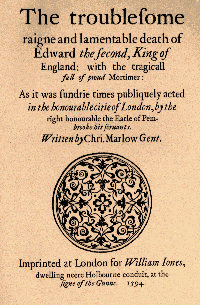
EdwardiiquartoBorn in Canterbury the son of shoemaker John Marlowe and his wife Catherine in 1564 (he was baptised on 26th February and likely to have been born a few days before), Marlowe attended the King’s School in the city and went on to study at Corpus College in Cambridge, receiving a Bachelor of Arts in 1584 and a Master of Arts in 1587. It is believed that at around this time, he was also working secretly for the government of Queen Elizabeth I, although what the nature of that work was remains unknown.

While Marlowe’s first play was Dido, Queen of Carthage, he first found theatrical success in 1587 with Tamburlaine the Great, later followed with a second part. His other four plays included The Jew of Malta, Edward the Second, The Massacre at Paris about the St Bartholomew’s Day Massacre in 1572, and Doctor Faustus.

The plays served as key works for the Admiral’s Men, the company of Edward Alleyn who performed many of the key roles in the plays, and who is strongly associated with the Rose Theatre  – indeed it was here that Tamburlaine the Great, The Jew of Malta, and Doctor Faustus premiered (you can see our earlier post on the theatre here).

Marlowe, who is known to have lived in Shoreditch, also completed other works included poetry and translations and while there is little evidence about his personal life, there is much speculation including that he was, as aforementioned, a spy as well as a carouser (he is known to have frequented taverns in London including Ye Olde Cock in Fleet Street), a homosexual and/or a heretic. It has also been suggested he was a tutor to noblewoman Arabella Stuart.

It is known that he was arrested in 1592 in Flushing in The Netherlands for counterfeiting coins and was sent back to England but no further action was taken.

His death is one of the big mysteries of his life. A warrant was issued for Marlowe’s arrest over some heretical tracts which were found in the lodgings of his colleague Thomas Kyd (who when questioned apparently implicated him) and he appeared to answer to the Privy Council on 20th May, 1593. They weren’t sitting and he was apparently instructed to appear daily until further notice. He was dead 10 days later.

The exact circumstances of his death remain a matter of speculation. It is often said he died in a drunken brawl with one early source suggesting this was over a homosexual love affair and another, more recent, theory suggesting he even faked his own death to avoid being executed for heresy (an extrapolation of this theory goes that after his fake death he continued writing plays under the name of William Shakespeare but this is generally deemed fairly far-fetched). The official account recorded at the time was that he was stabbed to death in a brawl over payment of a bill with men at a house in Deptford.

He was buried in an unmarked grave at St Nicholas’ Church in Deptford. There is a memorial window to him in Poet’s Corner in Westminster Abbey. A gift of the Marlowe Society, it was unveiled in 2002 and controversially included a question mark after the generally accepted date of his death. There is a portrait, dated 1585,  generally believed to be of Marlowe at Cambridge.

PICTURE: Title page of the earliest known edition of Edward II (1594)/Wikipedia

Lost London – The Steelyard…

The Thames-side property known as the Steelyard – the phrase comes from the Dutch-German word Stahlhof and relates either to a steel beam used for weighing goods or a courtyard where the goods were sold – was the main trading base of the Hanseatic League in London from the 13th century onward.

Located near where Walbrook flows out of the Thames on the north bank (the site is now at least partly covered by Cannon Street Station), the walled compound – which at some point housed as many as 400 people – was in some senses a mini city within a city complete with a hall, warehouses, a weighing house and counting houses as well as residences and a chapel.

While the community – which represented an alliance of towns and cities in northern Europe – was mentioned as far back as the late 1200s, it wasn’t until 1303 that King Edward I formerly confirmed the tax and customs concessions of the merchants (at some point, in return for privileges they were given, the group was charged with keeping up the maintenance of Bishopsgate).

The power of the trading post had grown substantially by the 15th century and the concessions the group had been granted meant there was inevitably considerable friction with English merchants. There was also some official friction and one example of it was when the Steelyard was closed temporarily in the 15th century when the Hanse cities were at war with England.

In 1598 Queen Elizabeth I took away the Steelyard’s trading privileges (after which the compound was apparently looted). It was subsequently allowed to reopen by King James I but never regained the prominence it had previously had.

Much of the compound was destroyed in the Great Fire of London but nonetheless, the Steelyard was rebuilt and continued to provide links between German cities and the English until the mid 1800s when the land was sold off and, in 1866, Cannon Street Station built on the site.

A couple of surviving objects from the Steelyard include a series of at least eight portraits of Hanse merchants painted by Hans Holbein the Younger and a stone model of the Hanseatic Arms which were placed over the gate into the compound can be seen at the Museum of London.

10 sites from Shakespearean London – 1. The Globe…

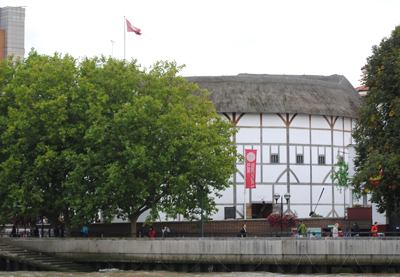
The-GlobeMention William Shakespeare and London in the same breath and everyone immediately thinks of one building – the reconstructed Globe on Bankside. So we thought that to kick off our new series – being run in honour of the 450th anniversary of the playwright’s birth – we’d take a look at history of the iconic structure.

The-Globe2The original Globe Theatre, located a few hundred metres to the south, opened in 1599 as a home for the actors’ company known as the Lord Chamberlain’s Men (later renamed the King’s Men on the accession of King James I in 1603), of which Shakespeare was a member. Founded by James Burbage, this merry band was originally was housed at London’s first purpose-built playhouse Shoreditch before lease disputes led them to establish a new theatre in Southwark, close to the then existing theatre, The Rose.

Up and running by 1599 (Shakespeare was among four actors who bought a share in the property to help fund the new building which used timbers from the former Shoreditch theatre), the new theatre was used for 14 years until, during a performance of Henry VIII in 1613, wadding from a stage cannon ignited and the theatre burned to the ground. Rebuilt with a tiled roof, it remained the home of the company until it was closed down by the Puritan government in 1642 and demolished two years later.

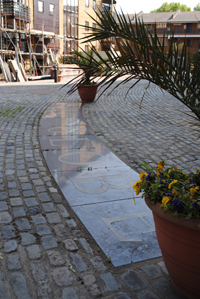
You can see the original site of The Globe just in nearby Park Street. The shape of the structure is marked by a dark line embedded in the pavement (pictured).

The reconstructed building which stands proudly by the water today was the vision of the late American actor, director and producer, Sam Wanamaker. He founded the Shakespeare Globe Trust which, with the on-site assistance of Queen Elizabeth II, opened the theatre at its current site in 1997 (sadly, Wanamaker had died three-and-a-half-years previously).

The building’s design was drawn from sifting through what little historical evidence could be found including the findings of an archaeological dig at the original site, descriptions contained in Shakespeare’s plays (including the line from Henry V – “Or may we cram within this wooden ‘O’), and printed panoramas from the time, although it should be noted that much – particularly the design of the stage – is speculative.

Meanwhile the techniques used in the construction of the theatre were the subject of years of research and were in accord with those of the early 17th century  and included using oak laths and staves to support lime plaster and then covering the walls in white lime wash while the roof was made of water reed thatch.

One of the best ways to see the theatre and make the most of the atmosphere is to see a play from a standing position in the pit!

WHERE: Globe Theatre Exhibition & Tour, Shakespeare’s Globe, 21 New Globe Walk (nearest Tube stations are Southwark and London Bridge); WHEN: Exhibition is open 9am to 5.30pm daily – tours run at various times, see website for details; COST: Exhibition and tour cost is £13.50 adults/£12 seniors/£11 students/£8 children (5-15 with children under five free)/£36 family of four; WEBSITE: www.shakespearesglobe.com.

10 significant sites from Georgian London – 10. Wesley’s Chapel…

Wesley's-ChapelIt’s a church with a difference for the final entry in our Georgian series. Known as the “Cathedral of Methodism”, the Grade I-listed chapel on City Road in the Borough of Islington was first opened in 1778 just over the road from Bunhill Fields graveyard and remains in use today.

Methodism’s founder, John Wesley, had already established a London base in a former cannon foundry close by known as the Foundery when the fact the lease was expiring and plans for residential development of the area led him to look elsewhere for a headquarters for the Methodism movement (which he still then considered part of the Anglican Church).

Wesley's-graveWesley approached the City of London for a new site and, following a massive fundraising effort, in April, 1777, the building’s foundation stone was laid. The architect for the new building was George Dance the Younger, then surveyor to the City of London, and the builder, a local preacher named Samuel Tooth.

The new chapel – which Wesley described as “perfectly neat, but not fine” – was opened on All Saints Day, 1778 – apparently Wesley spent the first 15 minutes of his sermon railing against the elaborate hats worn by female congregants.

The chapel last underwent a major restoration in the 1970s after it was found to be unsound and was reopened in 1978 in the presence of Queen Elizabeth II and the Duke of Edinburgh exactly 200 years after Wesley first opened it.

Inside the chapel – which features seats upon a gallery as well as the ground floor – features a ceiling said to have been the widest unsupported ceiling in England at the time it was built (the present one is a replica; the original had been damaged by fire in 1879).

The original pillars used in the chapel to support the gallery were ship’s masts from the naval dockyard at Deptford given as a gift from King George III – these were replaced during the centenary commemoration of Wesley’s death with pillars of French jasper in 1891 but a couple of originals can still be seen in the vestibule.

Memorials inside the chapel include those to John and Charles Wesley and early Methodists John Fletcher and Thomas Coke.

Next to the chapel is the house Wesley lived in during the last 11 years of his life (this can be visited – and we’ll cover it in more detail in a later post) and underneath it in the crypt is the Museum of Methodism – well worth a visit in its own right.

Wesley’s tomb (pictured) is located behind the east end of the church (accessed through the chapel) and outside the entrance to the chapel is a statue of Wesley. The grave of Susanna Wesley, mother of the Wesleys, can be found across the road in Bunhill Fields.

WHERE: Wesley’s Chapel, 49 City Road (nearest Tube station Old Street and Moorgate);  WHEN: 10am to 4pm Monday to Saturday (services Sunday – check website for details); COST: free but donations welcome; WEBSITE: www.wesleyschapel.org.uk.

What’s in a name?…Seven Dials…

Seven-Dials---bigStanding at the junction of seven streets in London’s West End is a pillar topped with six – that’s right, six – sundials, giving the intersection and the surrounding area its name.

The layout of the area was originally designed by Thomas Neale, an MP and entrepreneur, in the early 1690s – it was part of the rebuilding of London after the Great Fire of 1666 – and initially had the pillar standing at the centre of six streets before it was later increased to seven. The streets which radiate out from the hub include Earlham, Mercer and Monmouth Streets and Shorts Gardens.

Seven-dialsWhile Neale, who designed the street layout to maximise street frontages and thus his return, had hoped the area would attract the well-to-do, it was not be and by the 19th century the area had become one of the cities most notorious slums, considered part of the infamous rookery of St Giles.

That has since changed and today the area is at the heart of a bustling commercial district, the streets which run off it housing stylish shops and offices.

The pillar itself apparently never had seven faces – there is the suggestion that the column itself was the seventh – and while the original column was removed in 1773, apparently by city authorities keen to rid the area of undesirables, it was replaced with a replica column in the late 1980s and unveiled by Queen Beatrix of The Netherlands to commemorate the tercentenary of the reign of King William III and Queen Mary II in June, 1989.

The original column, meanwhile, was apparently first acquired by an architect, James Paine, who kept it at his house in Surrey, before, in 1820, being taken to Weybridge where, in 1820, the column was re-erected as a memorial to Princess Frederica, Duchess of York (who had lived there). The dial-stone, meanwhile, was used as a mounting block before eventually being placed outside the Weybridge Library.

10 significant sites from Georgian London – 8. Marble Hill House…

Marble-Hill-HouseA Palladian villa located on the bank of the Thames between Richmond and Twickenham, Marble Hill House was built in the mid to late 172os for Henrietta Howard, mistress of King George II and later Countess of Suffolk.

The symmetrical property – seen as a model for later Georgian-era villas in both England and overseas – was constructed by Roger Morris. He, along with Henry Herbert – a friend of the countess and later the 9th Earl of Pembroke – was also involved in its design as was Colen Campbell, architect to the Prince of Wales and future King George II, who is believed to have drawn up the first sketch designs for the house.

As well as being familiar with the work of neo-Palladian Inigo Jones, Lord Herbert had travelled in Italy and there is it believed had directly encountered the works of sixteenth century Italian architect Andrea Palladio whose architecture the property emulated (see our earlier post on Chiswick House here).

Key rooms include the ‘great room’ – a perfect cube, this is the central room of the house and boasts a wealth of gilded carvings; the dining parlour which had hand-painted Chinese wallpaper; and, Lady Suffolk’s rather sparsely furnished but nonetheless impressive, bedchamber.

Marble-Hill-GrottoHoward, who as well as being a mistress of King George II both before and after his accession to the throne in 1727, was a Woman of the Bedchamber to his wife, Queen Caroline of Ansbach, and, as a result, initially spent little time at the property (which coincidentally was built using money the King had given her while he was still Prince of Wales).

But after she become the Countess of Suffolk in 1731 when her estranged husband Charles Howard became 9th Earl of Suffolk after his brothers’ deaths, Lady Suffolk was appointed Mistress of the Robes, and following the death of her husband in 1733, retired from court.

In 1735 following the end of her intimate relationship with the King, she married a second time, this time happily, to George Berkeley, younger brother of the 3rd Earl of Berkeley and an MP. Together the new couple split their time between a house in Savile Row and Marble Hill. Her husband died in 1746 and Lady Suffolk, who had come to be considered a very “model of decorum”, died at Marble Hill in 1767.

Among the visitors who had spent time at the property were poet and neighbour Alexander Pope (responsible for the design of the grounds along with royal landscape gardener Charles Bridgeman), writer and satirist Jonathan Swift, and, in Lady Suffolk’s later years, Horace Walpole – son of PM Sir Robert Walpole and builder of the Gothic masterpiece Strawberry Hill.

Following Lady Suffolk’s death, later residents of the property included another Royal Mistress – Mrs Fitzherbert, mistress to the future King George IV, Swedenborgian Charles Augustus Tulk and Jonathan Peel, brother of Sir Robert Peel (you can read more about Sir Robert Peel here).

Following the latter’s death, the house stood empty for many years before publication of plans for a redevelopment by then owner William Cunard caused a public outcry which saw the property pass into the hands of the London County Council around the year 1900.

The house opened to the public as a tea room in 1903 and remained as such until the mid-1960s when, now in the hands of the Greater London Council, it underwent a major restoration project and was reopened as a museum. In 1996, the house – which now stands on 66 acres and can be seen in a much lauded view from Richmond Hill – came into the care of English Heritage.

The grounds – Marble Hill Park – are open to the public for free and include a cafe located in the former coach house. Other features in the grounds include Lady Suffolk’s Grotto – pictured above – based on one at Pope’s residence nearby. It was restored after being rediscovered in the 1980s.

WHERE: Marble Hill House, Richmond Road, Twickenham (nearest Tub-e station is Richmond (1 miles) or train stations at St Margaret’s or Twickenham);  WHEN: Various times Saturday and Sunday – entry to the house by guided tour only; COST: £5.90 adults/£3.50 children (5-15 years)/£5.30 concession/£15.30 family; WEBSITE: www.english-heritage.org.uk/daysout/properties/marble-hill-house/.

Daytripper – Walmer Castle…

Walmer-CastleA coastal artillery fort built on the orders of King Henry VIII in light of a threatened Catholic invasion, Walmer Castle on the Kentish coast is officially the residence of the Lord Warden of the Cinque Ports.

What was a rather functional artillery platform has been embellished significantly in the years since it became the official residence of the Lord Warden in 1708, creating a comfortable home for holders of the title who have included Queen Elizabeth, the Queen Mother, the Duke of Wellington and bookseller WH Smith.

The ‘castle’, located about a two hour, 10 minute train journey from London (and then a mile walk from Walmer Station), was constructed in 1539 as one of a string of forts – others include nearby Deal Castle and the long gone Sandown Castle – designed to protect the watery stretch between Goodwin Sands and the coast known as the Downs.

Its low circular design, featuring a central ‘keep’ reached by a drawbridge and surrounded by a curtain wall with four projecting, semi-circular bastions, was influenced by the need to defend against heavy artillery and provide a platform for guns.

Initially garrisoned with ten gunners, four soldiers and two porters under the command of a captain and a lieutenant, Walmer saw little action during Tudor times but was the site of a siege during the Civil War.

Obsolete by the end of the 17th century, it was the Duke of Dorset who was the first Lord Warden (an office created in the thirteenth century to oversee the affairs of the Cinque Ports Confederation, a grouping of five ports including Hastings, Romney, Hythe, Dover and Sandwich) to use Walmer Castle as a residence, embarking on a renovation and extension of the existing structure.

Further alterations was carried out by successive Lords Warden, the most extensive being those made by  the 2nd Earl Granville, Lord Warden between 1865 and 1891, who commissioned architect George Devey to oversee the additions.

The gardens, meanwhile, which are well worth visiting in their own right, were also Granville’s work as well as that of an earlier Lord Warden, Prime Minister William Pitt the Younger, who was Lord Warden between 1792 and 1806.

The Duke of Wellington (Lord Warden between 1829 and 1852) reputedly enjoyed his time staying at the castle – he was even visited by the young Princess Victoria here in 1835 (she later stayed for a month with her family when Queen) and died here on 14th September 1852. His room can still be seen inside – the contents include the armchair he was sitting in when he died (the rooms also include a small museum dedicated to Wellington and another dedicated to William Pitt).

Not all Lords Warden enjoyed the property. Sir Winston Churchill, Lord Warden  between 1941 and 1965, never stayed here but Sir Robert Menzies, Prime Minister of Australia and Lord Warden between 1966 and 1978, did and the Queen Mother, Lord Warden between 1978 and 2002, was a regular visitor.

The castle was opened to the public soon after responsibility for it was transferred from the War Office to the Ministry of Works in 1905. It is now under the care of English Heritage and the rooms inside are decorated as they were in the 1930s (it was WH Smith who ensured historic furnishings at Walmer could not be removed). There are even a couple of holiday cottages on site which can now be rented.

WHERE: Walmer Castle, Kingsdown Road, Deal, Kent; WHEN: 10am to 6pm daily (until 6th July); COST: Adults £7.90/Children (5-15 years) £4.70/Concession £7.10; WEBSITE: www.english-heritage.org.uk/daysout/properties/walmer-castle-and-gardens/.