Around London – The Lord Mayor’s Show goes on; London 2012 Festival launched; dowry tradition lives on; and, Leonardo da Vinci at the National Gallery…

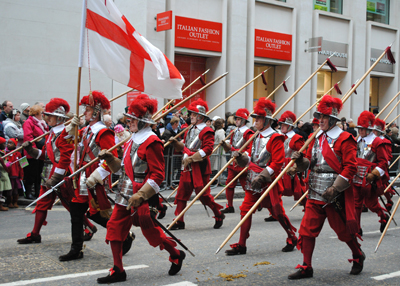
On Saturday the annual Lord Mayor’s Show will crawl its way across London’s Square Mile in a three mile long procession that will involve 123 floats and 6,200 people. The show (a scene from last year’s procession is pictured) is held each year as the first public outing of the newly elected Lord Mayor – this year it’s David Wootton, the City of London’s 684th Lord Mayor, who officially takes up his new office tomorrow (11th November). Organisers have said the procession will follow its usual route despite the protestors currently encamped outside St Paul’s. Leaving Mansion House, the official residence of the Lord Mayor, at 11am, it will make its way down Cheapside to St Paul’s Cathedral, where the new Lord Mayor will be blessed, before heading onto the Royal Courts of Justice, where the Lord Mayor swears an oath of allegiance to Queen Elizabeth II, and then returning to Mansion House. The the procession, the origins of which date back to 1215, will feature representatives of livery companies, educational and youth organisations, military units and other London-associated organisations and charities like St Bart’s Hospital. There will be a fireworks display at 5pm on the Thames between Blackfriars and Waterloo. For more information, see www.lordmayorshow.org.

• Organisers have unveiled plans for the London 2012 Festival, a 12 week nationwide cultural celebration of music, theatre, dance, art, literature, film and fashion held around next year’s Games. We’ll be providing more details in upcoming weeks and months but among the highlights in London will be a British Museum exhibition on the importance of Shakespeare as well as “pop-up” performances by actor Mark Rylance – both held as part of the World Shakespeare Festival, a musical tribute to the history of jazz at the Barbican by the London Symphony Orchestra and Jazz at the Lincoln Center Orchestra, an exhibition of the work of artist Damien Hirst at the Tate Modern and another on Yoko Ono at the Serpentine Gallery, and ‘Poetry Parnassus’ at the Southbank Centre – the largest poetry festival ever staged in the UK. The festival is the finale of the “Cultural Olympiad” – launched in 2008, it has featured a program of events inspired by the 2012 Olympics – and will see more than 10 million free events being held across the country. For more details, see www.london2012.com.

In a tradition which dates back to the late 1800s, three “poor, honest (and) young” women have been awarded a dowry by the City of London Corporation. Susan Renner-Eggleston, Elizabeth Skilton, and Jenny Furber have each received around £100 under the terms of a bequest Italian-born Pasquale Favale made to the City in 1882. Inspired by the happiness he found is his marriage to his London-born wife Eliza, Favale bequeathed 18,000 Lira to the City in 1882 and stipulated that each year a portion of the money was to be given to “three poor, honest, young women, natives of the City of London, aged 16 to 25 who had recently been or were about to be married”. To be eligible the women must have been born in the City of London or currently reside there.

• On Now: Leonardo da Vinci: Painter at the Court of Milan. Billed as the year’s blockbuster art event in London, this exhibition at the National Gallery focuses on Da Vinci’s time as a court painter in Milan in the 1480s-90s and features 60 paintings and drawings. Thanks to a collaboration between the National Gallery and the Louvre, they include two versions of the Virgin of the Rocks (it is the first time the two versions are being shown together). Other paintings include Portrait of a Musician, Saint Jerome, The Lady with an Ermine (an image of Cecilia Gallerani, mistress of Milan’s ruler at the time – Ludovico Maria Sforza, ‘Il Moro’) and Belle Ferronniere as well as a copy of Da Vinci’s painting, The Last Supper, by his pupil Giamopietrino. Runs until 5th February and an admission charge applies. For more, see www.nationalgallery.org.uk.

The Royal Parks – 6. Greenwich Park

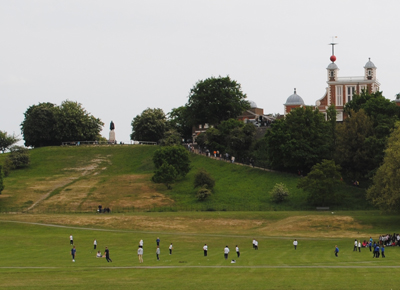
The oldest of the royal parks, the 74 hectare (183 acre) Greenwich Park has been associated with royalty since at least the 15th century.

The area covered by the park had been occupied by the Romans (there are some remains of a building, possibly a temple, near Maze Hill Gate) and later the Danes, who raised protective earthworks here in the 11th century. After the Norman Conquest, it became a manor.

Its enclosure only happened in 1433 after the land came into the possession of Humphrey of Lancaster, Duke of Gloucester and brother of King Henry V. At the time regent to the young King Henry VI, Duke Humphrey also built a tower on the heights above the park – where the Royal Observatory now stands.

Following the duke’s death in 1447, the land was seized by Margaret of Anjou – wife of King Henry VI – and subsequently became known as the Manor of Placentia. King Henry VII later rebuilt the manor house, creating what was known as Greenwich Palace or the Palace of Placentia.

Not surprisingly, it was King Henry VIII, who, having been born at Greenwich Palace, introduced deer to the park. Indeed the park was to have strong associations with others in his family – the king married Catherine of Aragorn and Anne of Cleeves at Greenwich Palace, and his daughters, later Queen Mary I and Queen Elizabeth I, were born there while his son, King Edward VI, died there in 1553 at the age of only 15. (There’s a tree in the park known as Queen Elizabeth’s Oak, which is said to be where she played as a child).

In 1613, King James I gave the palace and accompanying park – which he had enclosed with a high wall – to his wife, Queen Anne of Denmark, apparently as an apology after swearing at her in public when she accidentally shot one of his favorite dogs. Queen Anne subsequently commissioned Inigo Jones to design what is now known as the Queen’s House – for more on that, see our earlier post.

Following the Restoration, King Charles II ordered the palace rebuilt and while this work remained unfinished, the king did succeed in having the park remodelled – it is believed that Andre Le Notre, gardener to King Louis XIV of France, had a role in this.

The works included cutting a series of terraces into the slope – these were known as the Great Steps and lined with hawthorn hedges – as well as creating a formal avenue of chestnut trees (now known as Blackheath Avenue), and some woodlands. Work is currently taking place on restoring an orchard which dates from 1666 at the park.

King Charles II also commissioned Sir Christopher Wren to build the Royal Observatory that still stands on the hill overlooking the park – it stands on the site once occupied by the Duke Humphrey Tower (the Royal Observatory is home of the Prime Meridian – see our earlier post on the Royal Observatory for more).

King James II was the last monarch to use the palace and park – his daughter Queen Mary II donated the palace for use as a hospital for veteran sailors and the park was opened to the pensioners in the early 1700s. The hospital later become the Royal Naval College and the National Maritime Museum later moved onto the site (for more on this, see our earlier post).

As an aside, Royal Parks say the truncated shape of some of the trees in the park is apparently due to the fact that when anti-aircraft guns were positioned in the flower garden during World War II, the trees had to be trimmed to ensure a clear field of fire.

Facilities in the park today include a tea house, a children’s playground, sporting facilities such as tennis courts and, of course, the Wilderness Deer Park where you can see wildlife at large. Statues include that of Greenwich resident General James Wolfe, an instrumental figure in establishing British rule in Canada – it sits on the crest of the hill opposite the Royal Observatory looking down towards the Thames.

The park, which is part of the Greenwich World Heritage Site, is slated as a venue for next year’s Olympics – it will host equestrian events and the shooting and running events of the pentathlon.

WHERE: Greenwich Park (nearest DLR station is Cutty Sark – other nearby stations include Greenwich, Maze Hill and Blackheath); WHEN: 6am to at least 6pm (closing times vary depending on the month); COST: Free entry; WEBSITE: www.royalparks.gov.uk/Greenwich-Park.aspx

The Royal Parks – 3. Green Park

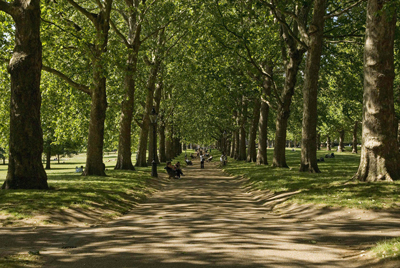
Perhaps the most overlooked and least celebrated of central London’s Royal Parks, Green Park (officially The Green Park) is a peaceful oasis of leafy trees between the bustle of Piccadilly and traffic of Constitution Hill and part of an unending swathe of green which connects Kensington Gardens with, eventually, St James’ Park.

Originally meadowland used for hunting, the earliest known mention of the area where the park now stands was apparently in 1554 when it was believed to be a staging point for Thomas Wyatt (the younger) who led a group of rebels protesting against the marriage of Queen Mary I to King Philip II of Spain. The unfortunate – and unsuccessful (in terms of his rebellion at least) – Wyatt was later beheaded for treason.

In 1668, King Charles II had the park enclosed with a brick wall and stocked with deer, as well as having a ranger’s lodge and icehouse built (to keep his drinks cool when entertaining in summer). While it was initially known as Upper St James’s Park, by 1746 Green Park had its own name. It’s not really known what prompted the name change but the unofficial story is that Queen Catherine of Braganza, wife of King Charles II, found out that her philandering husband had picked some flowers there for another woman – a milkmaid. In revenge, she had every flower in the park pulled up with orders they were not to be replanted. To this day, while some 250,000 daffodils bloom here in spring, there remain no formal flowerbeds in the park.

The 47 acre (19 hectare) park, which was also used on occasion as a duelling ground, underwent further development at the beginning of the following century with the creation of the ornamental Tyburn Pool near the centre of the park.

Queen Caroline, the wife of King George II, meanwhile, had a reservoir built to supply water to St James’s Palace and Buckingham Palace (it was known as the Queen’s Basin) as well as a library and the Queen’s Walk. Planted in 1730, this runs along the eastern side of the park and helped to turn it into a fashionable place in which to be seen (and led to the building of many a mansion in nearby Piccadilly).

Other buildings in the park have included two temporary ‘temples’ – the Temple of Peace (erected in 1749 to mark the end of the War of Austrian Succession) and the Temple of Concord (erected in 1814 to mark 100 years of the rule of the Hanoverian dynasty). Both of these, believe it or not, burnt down during the celebrations they were built for.

The park, which underwent a redesign in which the first trees were planted in the 1820s as part of architect John Nash’s grand plans for St James’s Park, was opened to the general public in 1826 but by then many of its earlier features – including the ranger’s house, Tyburn Pool and the Queen’s Basin – were already gone.

In more recent times, war memorials have been added to the park – the maple-leaf daubed, Pierre Granche-designed memorial to Canadian soldiers in 1994 (Canada is also remembered in Canada Gate on the park’s south side, installed in 1908 to mark the nation’s contribution to the Empire), and a set of memorial gates on Constitutional Hill at the park’s western end which is dedicated to the five million people from the Indian Sub-Continent, Africa and the Caribbean who served in World War II in 2004. The park also features the ‘Diana fountain’, installed in 1952 by the Constance Fund (and currently undergoing restoration).

On 14th June, a 41 royal gun salute is fired here to mark the Queen’s birthday. Salutes are also fired here for the State Opening of Parliament in November or December, Remembrance Sunday, and for State Visits.

WHERE: Green Park (nearest tube station is Green Park and Hyde Park Corner); WHEN: daily; COST: free; WEBSITE: http://www.royalparks.gov.uk/Green-Park.aspx

PICTURE: Courtesy of Royal Parks. © Anne Marie Briscombe 

London Pub Signs – The Queen’s Larder

In the first of an occasional series looking at the story behind some of London’s pub signs, we take a look at The Queen’s Larder in Queen Square, Bloomsbury.

The origins of the pub go back to the early 18th century – around 1710 – when there was known to be an alehouse on the site now occupied by the tavern. The story goes that as King George III (aka the ‘Mad King George’ depicted in the film of the same name) began to be affected by mental illness he was brought to a house in Queen Square where he stayed and was treated by a Dr Willis.

While he was undergoing this treatment – which was apparently initially successful, his wife Queen Charlotte rented an underground cellar below the alehouse and there stored some of the king’s favorite delicacies.

When a tavern was later built on the site, it was named The Queen’s Larder in honor of the role it had played in providing a storehouse for his treats.

The square itself contains a statue which was believed to be of Queen Anne – after whom the square was renamed (it had previously been known as Devonshire Square) – but it is now thought that the statue may in fact be of Queen Charlotte.

The Royal Parks – 2. Kensington Gardens

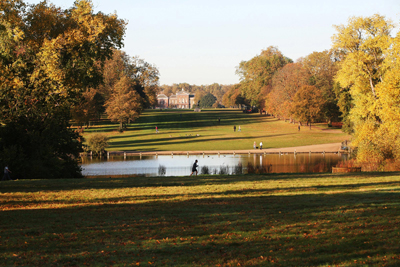
Once the western part of King Henry VIII’s hunting ground, the 111 hectare Kensington Gardens is now primarily associated with the palace which sits at its heart.

The origins of the gardens go back to 1689 when King William III and Queen Mary II decided to make Kensington Palace (which, as we mentioned last week, was formerly known as Nottingham House) their home. Queen Mary oversaw the creation of a formal, Dutch-style garden featuring hedges and flower beds.

Queen Anne expanded the gardens after King William III’s death and commissioned landscape designers Henry Wise and George Loudon to create an English-style garden. She also ordered the construction of the Orangery which still stands to the north of the palace complex today (and houses a fine restaurant).

But it’s to Queen Caroline, wife of King George II, to whom Kensington Gardens owe its current form for it was she who in 1728, scythed off 300 acres of Hyde Park and employed Charles Bridgeman to create a new garden. His designs included damming the Westbourne stream to create the Long Water and the adjoining Serpentine in Hyde Park. He was also responsible for the creation of the Round Pond in front of the palace and, a landscape-history making move, used a ditch known as a ha-ha to separate the gardens from Hyde Park.

By the reign of King Charles II, the gardens had become fashionable for the elite to stroll in with the Broad Walk a popular promenade. But the gardens gradually fell from favour – a move exacerbated when Queen Victoria, who was born in Kensington Palace, moved to live at Buckingham Palace.

There were some changes made during the era, however. They included the creation of the ornamental Italian water gardens at the northern end of the Long Water and the Albert Memorial (see our previous story here) on the southern edge of the gardens.

Other highlights there today include the Peter Pan statue (see our earlier story on this), the Serpentine Gallery (with, in summer, a temporary pavilion), the Peter Pan-themed Diana, Princess of Wales Memorial Playground (opened in 2000), and the Elfin Oak, a stump which originally came from Richmond Park and is carved with tiny figures of woodland animals and fairies.

There’s also a statue of Queen Victoria directly outside of Kensington Palace which, interestingly, was sculpted by her daughter Princess Louise in celebration 50 years of her reign, as well as statues of Edward Jenner, creator of the small pox vaccine, and John Hanning Speke, discoverer of the Nile.

Other facilities include a cafe and, next to the magazine, an allotment.

WHERE: Kensington Gardens (nearest tube stations are that of Queensway, Bayswater, Lancaster Gate, South Kensington, Gloucester Road and Kensington High Street); WHEN: 6am to dusk; COST: Free; WEBSITE: http://www.royalparks.gov.uk/Kensington-Gardens.aspx

PICTURE: Courtesy of Royal Parks. © Giles Barnard

The Royal Parks – 1. Hyde Park

This year marks the 160th anniversary of the transfer of the care of the Royal Parks to the government (meaning the public was freely able to enjoy access for the first time). To celebrate, over the next weeks we’ll be taking a look at the history of each of them. First up is the 142 hectare Hyde Park, perhaps the most famous of all eight Royal Parks.

Formerly owned by Westminster Abbey, King Henry VIII seized the land in 1536 for use as a private hunting ground. He had it enclosed with fences and the Westbourne Stream, which ran through the park – it now runs underground – dammed.

It remained the king and queen’s private domain (Queen Elizabeth I is known to have reviewed troops there) until King James I appointed a ranger to look after the park and permitted limited access to certain members of the nobility in the early 17th century.

The park’s landscaping remained largely unaltered until the accession of King Charles I – he created what is known as the ‘ring’ – a circular track where members of the royal court could drive their carriages. In 1637, he also opened the park to the public (less than 30 years later, in 1665, it proved a popular place for campers fleeing the Great Plague in London).

During the ensuring Civil War, the Parliamentarians created forts in the park to help defend the city against the Royalists – some evidence of their work still remains in the raised bank next to Park Lane.

After King William III and Queen Mary II moved their court to Kensington Palace (formerly Nottingham House) in the late 1600s, they had 300 oil lamps installed along what we know as “Rotten Row’ – the first artificially lit road in the country – to enable them and their court to travel safely between the palace and Westminster.

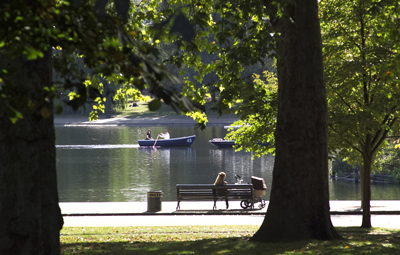
The natural looking Serpentine – the great, 11.34 hectare, lake in the middle of Hyde Park (pictured) – was created in the 1730s on the orders of Queen Caroline, wife of King George II, as part of extensive work she had carried out there. It was Queen Caroline who also divided off what we now know as Kensington Gardens from Hyde Park, separating the two with a ha-ha (a ditch).

The next major changes occurred in the 1820s when King George IV employed architect and garden designer Decimus Burton to create the monumental park entrance at Hyde Park Corner – the screen still remains in its original position while Wellington Arch was moved from a parallel position to where it now stands (see our previous posts for more on that). Burton also designed a new railing fence and several lodges and gates for the park. A bridge across the Serpentine, meanwhile, was built at about the same time along with a new road, West Carriage Drive, formally separating Hyde Park and Kensington Gardens.

While the basic layout of the park has been largely unchanged since, there have been some additions – among them, the establishment in 1872 of Speaker’s Corner as a place to speak your mind in the north-east corner of the park (near Marble Arch), the creation in 1930 of the Lido for bathing in warm weather, and, more recently, the building of the Diana, Princess of Wales’ Memorial Fountain (unveiled in 2004), and the 7 July Memorial (unveiled in July 2009).

Other sculptures in the park include Isis (designed by Simon Gudgeon, located on the south side of the Serpentine), the Boy and Dolphin Fountain (designed by Alexander Munro, it stands in the Rose Garden), and a monumental statue of Achilles, a memorial to the Duke of Wellington designed by Richard Westmacott, near Park Lane. There are also memorials to the Holocaust, Queen Caroline, and the Cavalry as well as a Norwegian War Memorial and a mosaic marking the site of the Reformer’s Tree (the tree was burnt down during the Reform League Riots of 1866).

The park has been integral part of any national celebrations for centuries – in 1814 a fireworks display there marked the end of the Napoleonic Wars, the Great Exhibition – with the vast Crystal Palace – was held there in 1851 and in 1977 a Silver Jubilee Exhibition was held marking Queen Elizabeth II’s 25 year reign. Cannons are fire there on June 2nd to mark the Queen Elizabeth II’s coronation and on 10th June for the Duke of Edinburgh’s birthday.

Facilities these days include rowing and pedal boats, tennis courts, deck chairs, a restaurant and cafe (the latter based in the Lido) and, of course, some Boris bikes. There is a heritage walk through the park which can be downloaded from the Royal Parks website.

WHERE: Hyde Park (nearest tube stations are that of Marble Arch, Hyde Park Corner, Lancaster Gate, Knightsbridge and South Kensington); WHEN: 5am to midnight; COST: Free; WEBSITE: www.royalparks.gov.uk/Hyde-Park.aspx?page=main

PICTURE: Courtesy of Royal Parks. © Indusfoto Ltd 

LondonLife – Open House London, The Middle Temple Hall

Last weekend saw thousands of people make their way to rarely opened properties across London as part of Open House London. Among the properties we visited was the Middle Temple Hall, one the finest example of a 15th century hall in London (if not the UK). The hall was built in the 1560s and early 1570s – by which time the Middle Temple, one of the medieval Inns of Court (more of which we’ll be talking about in an upcoming series), had already existed for about 200 years – and the hall which the Temple currently used, that of the former Templar Knights, was starting to fall apart. The new hall was constructed under the direction of law reporter Edmund Plowden, then Treasurer of the Inn, and funded by members of the Middle Temple. In use by about 1570, Queen Elizabeth I is, according to some stories, said to have dined there many times and it was in the hall that the first performance of Shakespeare’s Twelfth Night took place. While it suffered some damage in World War II bombings, the hall still looks much as it did in the late 1500s. It remains at the centre of the Middle Temple’s collegiate and social life and it is here that members are called to the Bar. Among the notable objects inside are numerous paintings and stained glass memorials of people associated with the Inn (including Sir Walter Raleigh and numerous monarchs – from King Charles I to King Edward VII) as well as the High Table – a table made of three 29 foot long planks from a single oak, it is said to be a gift from Queen Elizabeth I – and the ‘cupboard’, a smaller table which was apparently made from the hatch cover of Sir Francis Drake’s ship, the Golden Hind. Late note: I should add that the Middle Temple Hall is not normally open to the public.

Treasures of London – Tower Bridge

Often confused with London Bridge, Tower Bridge stands as a testament to Victorian engineering ingenuity.

The bridge – a major restoration of which was completed in March this year – was officially opened on 30th June, 1894, by the Prince and Princess of Wales (later King Edward VII and Queen Alexandra) eight years after work on a new Thames crossing commenced, driven by the need for a bridge which was more accessible to people living in East London (at the time pedestrians and vehicles were facing considerable congestions, with some being forced to wait hours before crossing the Thames).

At the time of its completion, Tower Bridge (although not universally acclaimed at the time) was the most sophisticated and largest bascule bridge ever built – the word bascule comes from the French for ‘see-saw’ and refers to the action of the bridge when it swings open. The bascules, which took only a minute to open, were initially operated by a steam-powered hydraulic system although since 1976, they have been driven by oil and electricity.

The 293 feet tall structure was built from steel and clad in Portland stone and Cornish granite to ensure it blended with the nearby tower of London. It was built with two walkways joining to two great towers at a height of 110 feet. Initially open to the elements, these were conceived as a way for people to cross the bridge while the bascules were raised open but due to a lack of use, they were closed in 1910 (they were reopened in 1982 when the first permanent exhibition took up residence at the bridge).

These days as well as providing a thoroughfare across the river for pedestrians and vehicles (and still opening for larger boats and ships from time to time although 24 hours notice is required), the bridge – which, along with four other London bridges, is maintained by the Bridge House Estates trust, a charity whose roots go back to the 11th century – houses an exhibition which tells the story of its construction. The walkways provide wonderful views down the river.

Interestingly, the iconic colors of Tower Bridge only date from 1976 when the structure was painted red, white and blue for the Queen Elizabeth II’s Silver Jubilee. Before that, the bridge was painted a chocolate brown though it was originally a greenish blue color.

One of the most interesting stories associated with Tower Bridge is that of a bus driven by Albert Gunton. On the bridge when it started opening in December 1952, he had to make the bus jump the gap – at three foot wide – to avoid the bus toppling into the river below. Passengers only suffered minor injuries and Gunton was later awarded a bravery award for his actions.

A list of times when the bridge will be lifted (this happens around 1,000 times a year) is kept on the Tower Bridge website.

WHERE: The exhibition entrance is located at the north west tower of the bridge (nearest Tube stations are Tower Hill or London Bridge); WHEN: 10am to 6.30pm (last admission 5.30pm) daily until end of September, then 9.30am to 6pm (last admission 5pm) until March; COST: £6 an adult/£4.20 concessions/£2.50 children aged 5 to 15 (under fives are free)/£12.50 for a family; WEBSITE: www.towerbridge.org.uk

LondonLife – Remembering September 11

London, along with the rest of the world, will this week pause to remember 11th September, 2001, when nearly 3,000 people died after planes were flown into New York’s World Trade Center towers and the Pentagon (a fourth plane crashed in Pennsylvania). In preparation for the 10th anniversary, London’s Mayor Boris Johnson unveiled a 10 metre high sculptural memorial, After 9/11, in Battersea Park which controversially uses steel girders from the towers in its design. But London already has a memorial to the events of 11th September. This is located in Grosvenor Square Garden, opposite the US Embassy. Opened on 11th September, 2003, the memorial features a pavilion which has three bronze plaques listing the name of UK citizens, UK Overseas Territories and people of dual nationality who lost their lives. The site was chosen partly on the basis that it was at the foot of the nearby Roosevelt Memorial that people laid flowers and lit candles in the immediate aftermath of the attacks. Plants at the memorial include white Bianca Roses which were among the flowers in the Queen’s bouquet laid at Westminster Abbey in a service held on 29th November, 2001, and were the roses that family members laid on the innocent victims memorial outside the abbey . In addition, more than 3,000 of the rose petals cascaded from the Whispering Gallery to the altar of St Paul’s Cathedral on the  first anniversary service.

Where is London’s oldest…tailor?

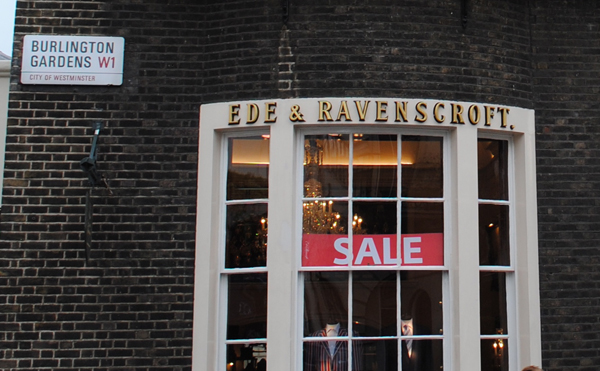
Founded in 1689, Ede & Ravenscroft is thought to be not only the oldest tailor in London but the world.

The origins of the business can be traced back to William and Martha Shudall, tailors who set up shop in Aldwych in London that year. Their work had soon caught the eye of royalty with the company winning the contract to create robes for the coronation of King William III and Queen Mary II after what is known as the Glorious Revolution.

As well as making robes for the clergy, government officials and those working in the legal and academic professions, the company’s relationship with the Royal Family continued and they have provided robes and tailoring for as many as 12 coronations including that of King George III.

Wig-making was added to the business in the 1800s when Joseph Ede (robe maker to Queen Victoria) married into the Ravenscroft family – already known for their wig-making (the business was renamed from Ede & Son to include the Ravenscroft name in 1902).

The company, headquartered at 93 Chancery Lane (they also have several other shopfronts including one at Burlington Gardens near Savile Row – see picture), currently holds three Royal Warrants, being official robe-makers to the Queen, Prince Philip and Prince Charles.

Daytripper – Brighton

It’s summer and that means, fingers crossed that the weather holds, Londoners start looking for the beach. One of the easiest to access coastal resorts – just an hour on the train – is the East Sussex town of Brighton.

Its history dates back to before the Doomsday Book and by medieval times, the town – previously known as Brighthelmstone – was prosperous enough to become a target to French raiders who burnt it down during a raid in 1514.

Yet much of what we now know as Brighton dates from the late 18th century when the town was transformed into a fashionable seaside resort. But before we get to that, there’s a couple of notable survivors from earlier days worth mentioning.

First up is the  14th century St Nicholas’ Church which, although considerably altered in later years, still contains a Norman font and has several graves of interest in the churchyard including that of Captain Nicholas Tattersall who carried King Charles II to France in his boat in 1651, as well as those of Phoebe Hessel, famed for having served 17 years in the army during the 1700s disguised as a man, Sake Dene Mohomed who first brought Turkish baths to Brighton and Amon Wilds, a famed Regency architect and builder.

And for a feel of what the medieval streetscape may have been like, head to the central shopping area known as The Lanes which still follows the medieval street pattern (although the shops date from later period) and which, boasting a range of interesting shops, is well worth spending some time poking about in.

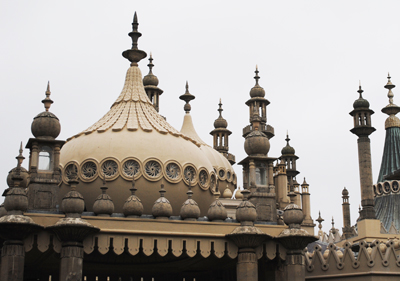
While Brighton had gradually been establishing a reputation as a sea bathing resort in the years prior to 1783, in that year the town’s profile received a valuable boost when the Prince Regent (later King George IV) visited the town. So taken with it was he that not only did he make repeat visits, he also constructed the magnificently opulent Royal Pavilion (pictured) – completed in 1822 and designed by John Nash – which still stands as one of the town’s foremost attractions.

The property, which Queen Victoria sold to the town in 1850 for the grand price of £53,000, boasts a series of exquisitely decorated chambers inspired by exotic ‘oriental’ themes. A 10 year, £10 million restoration project was completed in 1991.

Other properties in the town dating from a similar era include the Brighton Dome, which, completed in 1808, was originally the stables for the Prince Regent (back in the day when the Royal Pavilion was simply a farmhouse – in fact, it’s said that it was that fact people commented that the Prince’s horses were better accommodated than the man himself which helped spur him to build the Royal Pavilion). These days it’s the town’s main landmark entertainment venue and contains a concert hall and theatre.

Another property of the era is the Western Pavilion which feature a large Indian dome in reference to those of the Royal Pavilion and was built by Amon Henry Wilds, son of the architect Amon Wilds and a partner in his architectural practice, in 1831 as a residence. It stands next to the Gothic house built by his father, and another architect, Charles Busby, in the 1820s.

The arrival of the railway in 1841 further opened up the town to Londoners which in itself led to the construction of numerous waterfront hotels (the most famous of which is the Grand Hotel, built in 1864 and the scene of a 1984 IRA bombing aimed at killing then PM Margaret Thatcher).

The boom also saw three piers built running out off the foreshore – the Chain Pier (built in 1823 and destroyed by a storm in 1896), the West Pier (constructed in 1866, the derelict remains of which stand starkly in the waters off the town today after it was closed in 1975), and the Palace Pier (constructed in 1899, it is now hosts a lively funfair and, since 2000, has been formally known as Brighton Pier).

The late 1800s also saw the founding the Booth Museum (1874) by naturalist and collector Edward Thomas Booth (located in Dyke Road, it is now known as the Booth Museum of Natural History) and Volk’s Electric Railway which opened in 1883 and is now the ‘world’s oldest operating electric railway’, still running daily trains between Brighton Pier and Black Rock near the Marina.

Brighton, now part of the City of Brighton & Hove, remains a popular beach resort for Londoners, both for its beach and its nightlife, so on a warm day be prepared to fight the crowds.

Among the town’s other, more recent, attractions are the Sea Life Centre on the waterfront, home to more than 150 creatures including sharks and rays, the Brighton Museum & Art Gallery in the city’s ‘cultural quarter’ near the Royal Pavilion, and the Brighton Fishing Museum, also located on the waterfront, it traces the story of the town’s fishing community.

Visit Brighton has a range of maps and walks to help you explore the city. Visit www.visitbrighton.com for more information.

Treasures of London – The White Tower

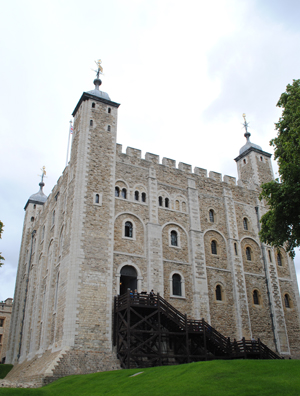
It’s one of London’s most famous landmarks and, having just undergone a three year, £2 million restoration, we thought it was time to take a look at the origins of the White Tower.

Now the keep of the Tower of London, the White Tower was first built by the Norman King William the Conqueror following his defeat of Saxon King Harold Godwinson and the cream of the Saxon army at the Battle of Hastings in 1066.

Following his coronation at Westminster Abbey on Christmas Day, King William then withdrew to Barking Abbey while his men built several temporary strongholds in the city to ensure it wouldn’t cause any trouble – this included an earth and timber keep standing on an artificial mound in the south-east corner of the city’s Roman-era walls.

The White Tower, a permanent structure, replaced this and although the exact date its construction started is unknown, building – under the watchful eye of Gundulf, the Bishop of Rochester, was well underway by the mid-1070s. While the labourers were English, the masons in charge of the building were Norman and then even used some Caen stone imported from William’s homeland (along with Kentish ragstone). By 1097 the tower was complete.

Primarily built as a fortress rather than for comfort, the size of the Tower was intimidating and, at 27.5 metres tall, it would have dominated the skyline for miles. Initial defences surrounding the White Tower included the Roman walls and two ditches although in later years outer walls were added to create the massive fortifications and series of towers one encounters at the site today.

The tower earned its moniker, the White Tower, from the whitewash used on its walls during the reign of King Henry II. The caps on the four turrets which stand at each corner of the tower were originally conical but were replaced with the current onion-shaped domes in the 1500s (the round tower was once home to the Royal Observatory before it moved out to Greenwich). The White Tower’s large external windows are also more modern innovations, these were added in the 1600s by Sir Christopher Wren.

The original entrance to the White Tower was on the first floor, reached by a wooden staircase (that could be removed if necessary), much as it is today while, for security reasons, the internal stone spiral staircase was placed as far from this entry as possible in the north-east turret. A stone forebuilding was later added during the reign of King Henry II but was later demolished.

Inside, accommodation for the king was provided on the second floor – it originally had a gallery above but an extra floor – still there today – was later added. Accommodation for the Tower’s constable was probably on the first floor. Both floors were divided in two – with a large hall on one side and smaller apartments on the other. These rooms now house displays on the Tower’s history – at the present these include the Royal Armouries’ exhibition ‘Power House’.

The White Tower is also home to the Chapel of St John the Evangelist which, made from Caen stone, still looks much the same as it did in Norman times. It was used by the royal family when in residence at the tower but by the reign of King Charles II had become a store for state records. These were removed in 1857. Among some of the events which took place here was the lying in state of Queen Elizabeth of York, wife to King Henry VII, after her death in 1503, and the betrothal of Queen Mary I to Philip of Spain in 1554 (by proxy, Philip was not present). Prince Charles received communion here on his 21st birthday.

Other historic events associated with the White Tower include the apparent murder in 1483 of the ‘Princes in the Tower’ – King Edward V and his younger brother, Richard, Duke of York – while legend says they were killed in the Bloody Tower, the discovery of two skeletons under stairs leading to the chapel during building works in 1674 has led some to believe that they may have been buried here.

It was also in the White Tower that King Richard II was forced to sign away his throne to King Henry IV in 1399 and it was from the White Tower that Gruffydd ap Llywelyn Fawr, the illegitimate son of  Welsh Prince Llywelyn the Great, apparently fell to his death while attempting to escape captivity in 1244.

There are tours of the White Tower daily at 10.45am, 12.45pm, and 2.15pm.

WHERE: Tower of London (nearest tube station Tower Hill); WHEN: 9am to 5.30pm, Tuesday to Saturday, 10am to 5.30pm Sunday to Monday (until 31st October); COST: Included in Tower of London admission – £19.80 adults; £10.45 children under 15; £17.05 concessions; £55 for a family (prices include a voluntary donation); WEBSITE: www.hrp.org.uk/toweroflondon/.

Famous Londoners – Sir Hans Sloane

An Ulster-Scots born physician, scientist and avid collector, Sir Hans Sloane served as doctor to no less than three British monarchs during the 17th and 18th centuries and during his life amassed a vast collection of natural specimens and curiosities which after his death were used to form the core of the British Museum’s collection.
Born on 16th April, 1660, at Killyleagh in County Down, Ireland, Sir Hans was the son of Alexander Sloane, a “receiver-general of taxes” who originally hailed from Scotland.

Even as a young man, he developed a keen interest in the natural sciences. Having suffered from some ill-health which, at the age of 16 is said to have kept him confined to a room for a year, in 1679, at the age of 19, he moved to London where he studied chemistry at the Apothecaries Hall and botany at the Chelsea Physic Garden – a period during which he befriended the botanist John Ray and chemist Robert Boyle.

Four years later, he travelled through France where he received his Doctorate of Physics. On his subsequent return to London in 1685, he was made a Fellow of the Royal Society and in 1687 a Fellow of the Royal College of Physicians.

Given the chance to travel to Jamaica as physician to the new Governor, Christopher, the 2nd Duke of Albemarle, he only spent 15 months there (the Governor died soon after arrival). But it was an important period during which not only did he document and collect a vast amount of flora and fauna (bringing some 800 specimens back to London), he also came up with the idea of drinking chocolate with milk after witnessing locals drinking the dark chocolate with water but finding the mix made him “nauseous” (back in England, his concoction was first sold as a medicine and was later manufactured as a drink by Cadburys).

Having returned to London in 1689, he published the information he had gathered in Jamaica, and in 1693 he become secretary to the Royal Society.

In 1695 he married a Jamaican sugar planter’s widow, Elizabeth Langley Rose (with whom he had several children but of whom only two daughters, Sarah and Elizabeth, survived) and, thanks in part to an ongoing association with the duke’s widow, was able to set up a fashionable medical practice at 3 Bloomsbury Place on the northern end of Bloomsbury Square.

The house, not far from where the British Museum now stands, become something of an attraction in its own right, filled with objects and specimens he had collected on his travels as well as those – in some cases complete collections – given to him by others including friends and patients (in fact, he had to purchase the property next door, number four, to find room for them all – this property is now marked with a Blue Plaque).

The composer Handel is said to have been among those who visited the property and there is a delightful tale that says Sir Hans was outraged when Handel placed a buttered scone on one of his rare books.

With his services as a physician highly prized, in 1696, he was appointed physician to Queen Anne, the first of the three monarchs he would serve. In 1712-13, with his collection still growing, he purchased the Manor of Chelsea to help house it (four acres of which were leased to the Chelsea Physic Garden, which had been founded in 1673 with the idea of providing a training ground for apprentice apothecaries, in perpetuity).

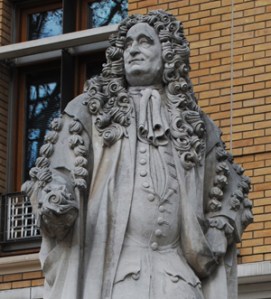
He subsequently moved his collection out to this property and his connection with Chelsea is still celebrated in place names such as name Sloane Square (not to mention Sloane Street, Sloane Gardens, Hans Street, Hans Crescent, Hans Road and Hans Place). There is also a statue of the bewigged man in Duke of York Square (pictured), not far from Sloane Square – this is a 2007 copy of 1737 original by John Rysbrack, another (older) copy of which can be found in the Chelsea Physic Garden.

Following Queen Anne’s death in 1714, in 1716 Sir Hans was appointed physician to her successor, King George I (he was also created a baronet the same year, becoming the first medical practitioner to receive a hereditary title).

Three years later, in 1719, he become president of the Royal College of Physicians, an office he held for 16 years, and in 1727, he was appointed physician to King George II. The same year he succeeded Isaac Newton as president of the Royal Society, an office which he held until 1741.

In 1742, Sir Hans retired to his property in Chelsea.

By the time of his death on 11th January, 1753 at the ripe old age of 93, Sir Hans had collected more than 71,000 objects including books, manuscripts, drawings, coins and medals and plant specimens which he bequeathed to King George II in exchange for a payment of £20,000 to his executors.

Parliament agreed, following a lottery to raise the money, his collection went on to form the basis of the British Museum, first opened to the public in 1759 in Bloomsbury. It was also to form the basis of the museum’s later offshoot, the Natural History Museum at South Kensington.

Sir Hans was buried at Chelsea Old Church with his wife Elizabeth who died in 1724.
King James I’s London – 10. Westminster Abbey’s Lady Chapel

And so we come to the final instalment in our series on King James I’s London. This week we’re looking at Westminster Abbey’s Lady Chapel where King James I – who was crowned in Westminster Abbey in 1603 – was laid to rest after his death in 1625.

But before we turn to James himself, it’s worth noting that several members of his immediate family are also buried in the abbey’s Lady Chapel (pictured). These include his eldest son, Henry Fredrick, Prince of Wales, who died in 1612 at the age of 18 (and thus opened the way for his younger brother Charles to become King Charles I). He is buried in the south aisle of the magnificent Lady Chapel which had been added at the behest of King Henry VII between 1503 and 1519 and replaced a 13th century chapel.

Three of James’ daughters are also buried in the Lady Chapel – Mary, who died in 1607, aged two, and Sophia, who died in 1606, aged just three days old. Both of them have monuments in the north aisle while their sister Elizabeth, wife of King Fredrick V of Bohemia, who died much later in 1662, is buried near her brother Henry Fitzpatrick.

As we’ve previously mentioned, King James I also outlived his wife, Queen Anne of Denmark, who died of dropsy at Hampton Court Palace on 2nd March, 1619, at the age of 43. She lay in state at Somerset House until her funeral on 13th May and was then buried in the south-eastern area of the Lady Chapel where her gravesite is marked by a modern stone bearing her name. Her wooden funeral effigy is one of a collection which can still be seen in the Abbey’s Museum.

After James himself died on 27th March, 1625, he was laid in the vault beneath King Henry VII’s monument beside Elizabeth of York, Henry’s wife. No monument was erected to mark his passing save for a modern inscription placed nearby (in fact Queen Elizabeth I was the last monarch to be buried with a monument above the site – see below).

It’s also worth noting that in 1612 – nine years into his reign – James arranged for the body of his mother – Mary, Queen of Scots, who was executed in 1587 on the orders of Queen Elizabeth I – to be transferred from its resting place in Peterborough Cathedral to the south aisle of the Lady Chapel where he had an elaborate tomb erected featuring an elegant white marble effigy showing her wearing a coif, ruff and long mantle.

In the north aisle, James had previously erected a marble monument to his predecessor, Queen Elizabeth I and had her body moved from where it had lain in the vault of her grandfather, King Henry VIII, to a place beneath the new monument. Her half-sister, Queen Mary I, is also buried beneath the monument.

That’s the final in our series on King James I’s London – it’s by no means a comprehensive look at significant sites in the early Stuart period and we shall be looking at more from the period down the track, but it’s a good start. Our new special series starts next week. 

WHERE: Westminster Abbey, Westminster (nearest Tube station is Westminster or St James’s Park); WHEN: Open to tourists everyday except Sunday  (times vary so check the website); COST: £16 an adult/£13 concessions/£6 schoolchildren (11-18 years), free for children aged under 11/£38 for a family (two adults, two children); WEBSITE: www.westminster-abbey.org

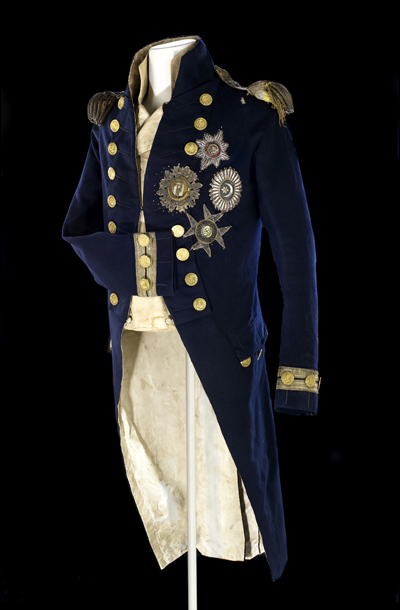
Treasures of London – Admiral Lord Nelson’s coat

It was roughly two hours into the Battle of Trafalgar on 21st October, 1805, about 1.15pm, that Great Britain’s most famous seaman, Admiral Horatio Lord Nelson, was fatally struck by a musket ball.

Fired by a marksmen in the rigging of the French ship Redoubtable, the musket ball struck him in the left shoulder as he stood on the deck of his flagship, HMS Victory.

Having fallen to his knees, he was spotted by the Victory‘s captain, Thomas Hardy, before he collapsed. Carried below the decks to the ship’s cockpit, it was there that he died (the Victory can still be visited at Portsmouth).

His damaged coat, meanwhile, was placed under the head of Midshipman George Augustus Westphal, who was being treated for his injuries nearby. Blood from the midshipman (late himself an admiral) stuck his hair to one of the epaulettes, part of which was was cut away and retained by his family as a memento.

The “undress jacket” was later returned to Nelson’s mistress, Emma Lady Hamilton, in accordance with his wishes. She later gave it to Joshua Jonathan Smith, Lord Mayor of London in 1810-1811, to as payment of a debt just prior to retiring to France in 1814. It was Prince Albert, the consort of Queen Victoria, who later purchased the coat for £150 from Smith’s widow and presented it to Greenwich Hospital in 1845.

The jacket can now be found in the National Maritime Museum in Greenwich (housed in a section of the former Naval College). Along with the fatal musket ball hole on the left shoulder, the tails and left sleeve of the jacket are stained with the blood of John Scott, Nelson’s secretary, who had died in the early moments of the battle on the spot where Nelson was later shot. It’s also possible to see where the epaulette was damaged during the treatment of Midshipman Westphal.

The front of the coat also features embroidered versions of the four orders of chivalry awarded to Nelson – these are the star of the Order of the Bath, the Order of the Crescent awarded by the Sultan of Turkey, the Order of St Ferdinand and of Merit awarded by Ferdinand IV of Naples, and the German Order of St Joachim. According to the National Maritime Museum, “Nelson habitually wore them on all his uniform coats”.

The coat’s right sleeve is positioned as Nelson would have worn it – in 1797 he had lost his right arm at the Battle of Santa Cruz de Tenerife.

PICTURE: Vice-admiral’s undress coat worn by Nelson (1758-1805) at the Battle of Trafalgar. There is a bullet hole on the left shoulder, close to the epaulette. (c) National Maritime Museum, Greenwich, London, Greenwich Hospital Collection.

WHERE: National Maritime Museum, Romney Road, Greenwich, (nearest DLR station is Cutty Sark or Greenwich mainline station); WHEN: Open 10am to 5pm daily; COST: Free; WEBSITE: www.nmm.ac.uk.

LondonLife – St Paul’s celebrates 300 years since its completion…

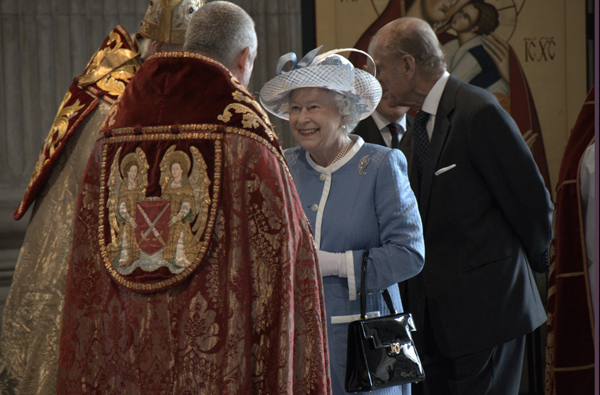
Queen Elizabeth II attends the tercentenary service at St Paul’s. PICTURE: Graham
Lacdao/St Paul’s Cathedral

A service was held at St Paul’s today in celebration of the 300 year anniversary of the cathedral’s completion.

The tercentenary service also marks the end of a massive 15 year, £40 million repair and cleaning project, meaning the cathedral is now clear of scaffolding for the first time in 15 years.

Designed by the indomitable Sir Christopher Wren, work on St Paul’s Cathedral began in 1677 and was formally completed in 1710 (although it had been holding services since 1697). (For more on the history of St Paul’s, see our earlier post, part of our series on Wren’s London, here).

Said to have the largest dome after St Peter’s in Vatican City, St Paul’s has been at the centre of London’s (and the United Kingdom’s) religious and political life for centuries, hosting state funerals (Lord Nelson, the Duke of Wellington and Winston Churchill’s were all held here) as well as the royal wedding of Prince Charles and Lady Diana and many celebration services.

Sights include the crypt – containing the tombs of both Nelson and Wellington – and the Whispering Gallery (see our earlier post on the Whispering Gallery here) as well as the exterior viewing galleries.

To celebrate the cathedral’s liberation from scaffolding, St Paul’s is holding a 300th Anniversary Photography Competition in which photographers are invited to submit their best exterior shots of the building. The 10 winning images will then be displayed in the cathedral crypt. The competition runs until 16th July.

To enter, upload pictures to St Paul’s 300th anniversary competition group at Flickr – www.flickr.com/groups/stpaulslondon/. For more information, see www.stpauls.co.uk/photocomp.

Around London – The Tower hosts Royal Beasts; take a ride on a 1938 tube train; Lambeth Palace Library celebrates the King James Bible; and, see model cathedrals at Sir John Soane’s house…

• The history of the Royal Menagerie is the focus of a new exhibition on now at the Tower of London. Royal Beasts explores the history of the Tower menagerie which, founded during the reign of King John in the early 1200s, remained there for more than 600 years. Among the animals were lions (the first record of which dates from 1210), a grizzly bear (a gift from the Hudson Bay Company to King George III), elephants, tigers, ostriches and kangaroos. Highlights of the exhibition include modern animal sculptures by artist Kendra Haste and interactive sensory displays. The recently restored north wall walk and the never before opened Brick Tower will host some of the displays, including sights, sounds and smells of some of the animals. See www.hrp.org.uk/TowerofLondon.

A 1938 tube train will run along the western end of the Piccadilly Line this Sunday (that’s Father’s Day in case you’ve forgotten) as part of the London Transport Museum’s Heritage Vehicles on the Move 2011 programme. Leaving Northfields, the train will travel to High Street Kensington via Earl’s Court (crossing from the Piccadilly to the District Line in a move not normally experienced by the general public) before heading back down the District Line to Acton Town where it will change back onto the Piccadilly Line. The train will then undertake the “fishhook move”, visiting Heathrow Terminal 4 before going to Terminals 1,2,3 and 5. The entire journey is expected to last about two hours. Tickets, which can be purchased at the museum ticket desk or by calling 020 7565 7298, will need to be collected at Northfields Station. For more, see www.ltmuseum.co.uk/whats-on/events/vehicles-on-the-move.

• Lambeth Palace Library is celebrating the 400th anniversary of the King James Bible with a new exhibition. The exhibits include a 1611 edition of the Bible as well as Medieval Bible translations, landmark editions of the Bible which drew on the textual scholarship of the Renaissance and Reformation and early printed vernacular versions. Runs until 29th July. Admission is by pre-booking only. For information on buying tickets and more, see www.lambethpalacelibrary.org/content/2011exhibition.

On Now: Time is running out to see Sir Herbert Oakley’s collection of 27 models of European and English cathedrals at the Sir John Soane Museum. The models were made in the 1850s by William Gorringe, who was a modelmaker by appointment to Queen Victoria. Runs until 25th June. For more, see www.soane.org/exhibitions/

LondonLife – Trooping the Colour…

A ceremony first believed to have been performed during the reign of King Charles II, since 1748 the parade has been used to mark the Official Birthday of the Sovereign.

 Queen Elizabeth II inspects the Guards in her phaeton.

Prince William, Prince Charles, the Duke of Kent and Princess Anne riding Queen’s Escort behind the Queen.

The parade includes six Guards groups. This year it was the turn of the Scots Guards, raised in 1642 at the behest of King Charles I, to parade their colours.

Part of the Household Mounted Cavalry, the Blues and Royals.

At 1pm, back at Buckingham Palace following the firing of a 41 gun salute, the Queen and the Royal Family watch Royal Air Force aircraft performing a fly past overhead.

The RAF’s Red Arrows aerobatic display team perform a colorful flypast over Buckingham Palace.
All images and text are © David S. Adams

Where’s London’s oldest…outdoor statue?

It’s generally believed that London’s oldest outdoor statue is that of King Alfred the Great which stands in Trinity Church Square in Southwark but there are a few others worth mentioning for their age.

But first, to the statue of Alfred the Great. Located now in Trinity Church Square, it is thought to have been made in the late 14th century (although it’s also suggested it could be much younger) in honor of the man who ruled Wessex in the 9th century and is often credited as being the first “king of the English”.

The statue (right) was apparently located at the Palace of Westminster before it was brought to its present location in 1823 at about the time the square was being laid out.

Others among London’s oldest statues is that of King Charles I sitting astride his horse and looking from Whitehall from its position on the southern side of Trafalgar Square.

Credited as being London’s “oldest equestrian bronze”, this statue is the work of French sculptor Hubert Le Sueur and was cast in 1633 (during King Charles I’s rule) at the behest of Richard Weston, one of the king’s favorites, who that year became the 1st Earl of Portland.

It was removed during the Civil War but later reacquired by the Portland family and, following the Restoration, was reinstalled on its current site – once that of the Charing Cross (see our previous entry for more details) – in 1675 by King Charles II.

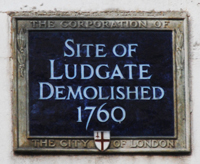
Another of London’s oldest statues is that of Queen Elizabeth I which stands on the facade of the church St Dunstan-in-the-West in Fleet Street. This statue, which has been attributed to William Kerwin although other names have also been suggested, dates from 1586 (created during her reign) and decorated the west side of Ludgate until its demolition in 1760, after which it was apparently put into storage until being brought to the church in the 19th century.

Standing nearby in the vestry porch as statues of the legendary pre-Roman British king, Lud, and his sons, Androgeus and Tenvantius, which were also removed from Ludgate and probably date from the same period (about 1586).

The Royal Wedding – A view from The Mall…

Along with tens of thousands of others, Exploring London took up a post in The Mall to watch festivities surrounding the London wedding of Prince William and Kate Middleton. Here’s some of what we saw…

Kate Middleton, newly titled Her Royal Highness the Duchess of Cambridge, rides in a 1977 Rolls Royce Phantom IV from the Goring Hotel in Belgravia to Westminster Abbey via The Mall, greeting crowds along the way. Others, including Prince William, had already passed by.

The crowds cheered along The Mall throughout the morning, including after Rowan Williams, the Archbishop of Canterbury, was heard over loudspeakers announcing that the couple were now man and wife. The Bishop of London, Dr Richard Chartres, delivered the address while James Middleton read the lesson.

After the ceremony, the newly married couple processed in the 1902 State Landau down Whitehall and The Mall through a sea of flag-waving well-wishers towards Buckingham Palace after the wedding ceremony. The Landau was the same used by Prince Charles and Princess Diana after their 1981 wedding.

The couple, along with other members of the royal family and Kate Middleton’s parents, appear on the balcony of Buckingham Palace at around 1.30pm, waving to the crowd and exchanging kisses. Here they are flanked by Queen Elizabeth II (right) and the Duke and Duchess of Cornwall (left) along with bridesmaids and pageboys.

A Lancaster bomber and two Spitfires flew over the top of Buckingham Palace as part of an RAF flypast. They were followed by two tornados and two typhoons. The flypast brought official celebrations to an end after which the royal rejoined the champagne and canape reception already underway.

Crowds fill The Mall in the wedding’s aftermath. The newly weds later left Buckingham Palace driving a vintage convertible Aston Martin owned by Prince Charles. Overhead hovered a Sea King helicopter manned by some of Prince William’s colleagues.