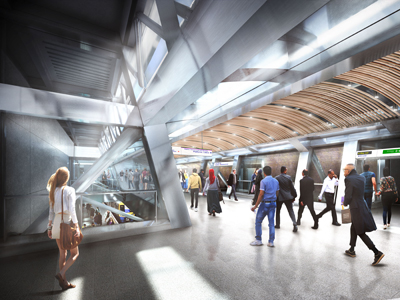
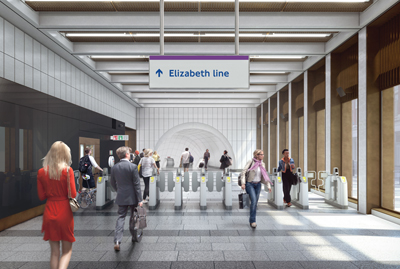
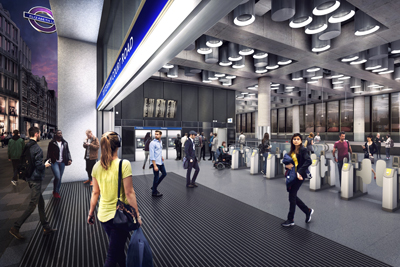
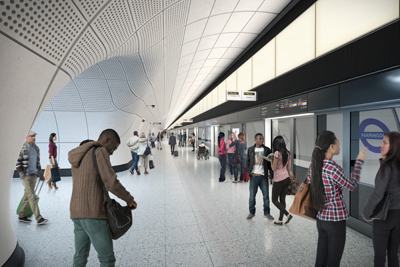
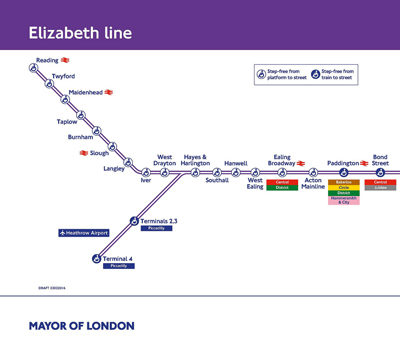
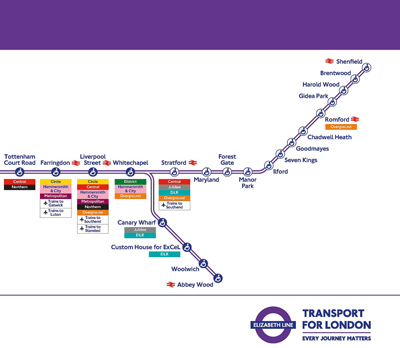
A new exhibition featuring designs for the 10 new Elizabeth line Underground stations has opened at the Royal Institute of British Architects (RIBA). Platform for Design: Stations, Art and Public Space provides insights into the design of the new railway – part of the massive Crossrail project, its stations and public spaces which are slated to open in 2018. Each of the new stations will have their own distinct character designed to reflect the environment and heritage of the area in which they are located. The new Elizabeth line station at Paddington, for example, is said to “echo the design legacy of Brunel’s existing terminal building” while the design of the new Farringdon station is inspired by the historic local blacksmith and goldsmith trades and the distinctive architecture of the Barbican. Many of the new stations will also featured permanent, integrated works of art design to create a “line-wide exhibition”. The Elizabeth line runs from Heathrow and Reading in the west across London to Abbey Wood and Shenfield. The exhibition at RIBA at 66 Portland Place in Marylebone runs until 14th June. Admission is free. For more on the exhibition, including the accompanying programme of events, see www.crossrail.co.uk/news/news-and-information-about-crossrail-events.
Transport
10 iconic London film locations…8. The Tube and Sliding Doors’ defining moment…
The London Underground appears in many films (more of that in a moment) but there’s only a few where the story really hinges on it, one of which is the Gwyneth Paltrow rom-com, Sliding Doors.
In the movie, PR flack Helen (played by Paltrow) is fired from her job and heads to Embankment Station where her one life suddenly becomes two possibilities.
Without giving too much away (and yes, we know it dates to 1998, but still), in one version she makes her way through the “sliding doors” an catches the train and her life seems to fall into place; in the other she fails to and her life goes somewhat belly-up. It’s a tale of two futures; the life that might have been – and it all hinges on that Tube ride.
Fun fact: scenes for the film were actually shot at Waterloo Station on the Waterloo and City Line and at Fulham Broadway Station on the District Line.
As mentioned above, Sliding Doors – which also features numerous other London locations and co-stars John Hannah – is far from the only film in which the Tube features – in fact, last year it was reported that the London Underground Film Office handles more than 200 requests a month.
While the first film featuring the Tube apparently dates as far back as 1928 (Anthony Asquith’s silent film Underground), other more recent films which have featured the London Underground include everything from Skyfall to The Bourne Ultimatum, and Thor: The Dark World (not forgetting the previously mentioned film V for Vendetta).
They haven’t always been the real thing – the chase scene featuring the Tube in 2012’s Skyfall, for example, was apparently filmed on a set at Pinewood Studios (another Bond film, Die Another Day, even features an imaginary station – Vauxhall Cross – which is used by MI6 as a secret base.)
And when movies are shot featuring the real Underground, the now closed – or ‘ghost’ – station of Aldwych (formerly on a spur branch of the Piccadilly Line) is a popular choice: as well as Atonement and V for Vendetta, it was used in the TV series’ such as Mr Selfridge and Sherlock.
For more on London film locations, see the London Film Location Guide.
LondonLife – New Underground line named in honour of Queen Elizabeth II…
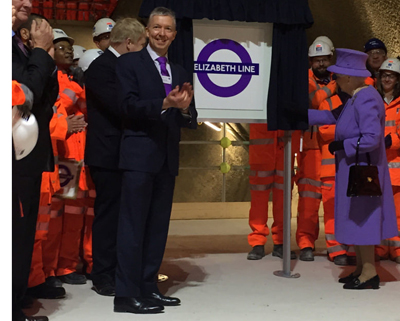
Boris Johnson, the Mayor of London, announced last week that the new Underground line under construction in the Crossrail project will be named the Elizabeth line, in honour of Queen Elizabeth II. The Queen (pictured above with Transport Commissioner Mike Brown), who became the first ruling monarch to travel on the Underground when she did so in 1969 at the opening of the Victoria line, was on hand for a tour of the line’s Bond Street Station site and was presented with a commemorative Elizabeth line roundel. The new line, which will change the way people travel across London, stretches from Reading and Heathrow in the west to Shenfield and Abbey Wood in the east. PICTURES: © Transport for London/James O Jenkins (above).
LondonLife – See the Thames…in Blackfriars station…
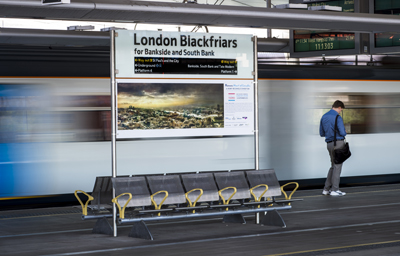
This is one of a series of works by renowned photographer Henry Reichhold which features in the exhibition Thames – Heart of London, currently on show at Blackfriars Thameslink railway station. Thameslink and JCDecaux have provided 49 platform advertising sites for the display, part of the Totally Thames celebrations taking place throughout September. The photographs, which measure 2.5 metres long, are an attempt to capture the character of the Thames as it winds its way through the city and were taken from a series of notable vantage points including the Shard, City Hall, OXO Tower, One Canada Square, Southbank Tower and the Houses of Parliament. As well as the river itself, they also capture some of the many events which have taken place upon it – from the Diamond Jubilee Pageant to New Year’s Day celebrations. Each image has taken between one and three weeks to create from up to 100 separate photographs – selected out of more than 800 taken on a single day – which have then been put together in a stunning panorama. New York-born Reichhold says the process of “extracting” the final image is “never the same”. “The camera is very stubborn about creating a ‘mechanical’ view and it is the reinterpretation of these files to in some way reflect what the human eye sees that I find so troublesome and fascinating.” The exhibition is at Blackfriars Station, 179 Queen Victoria Street, London, and runs until 30th September. Entry is free to passengers with a valid GTR train ticket and to holders of a 10p platform ticket.
LondonLife – The Serpentine’s 2015 Pavilion…
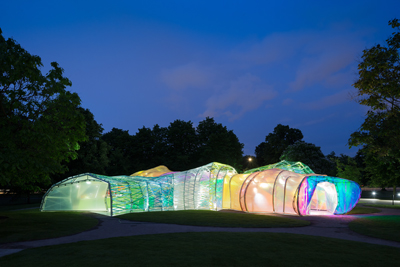
This year’s Serpentine Pavilion, marking the 15th anniversary of the annual summer commission by the Serpentine Galleries in Kensington Gardens, is a polygonal multi-coloured structure designed by Spanish architects selgascano. Made from a fluorine-based polymer, the pavilion has multiple entry and exit points and takes as its inspiration the site itself as well as the way in which people move through London, notably via the web-like network of the London Underground. Say selgascano: “We sought a way to allow the public to experience architecture through simple elements: structure, light, transparency, shadows, lightness, form, sensitivity, change, surprise, colour and materials. We have therefore designed a pavilion which incorporates all of these elements.” The architects say the pavilion was also designed as a tribute to the previous pavilion commissions, designed by the likes of Frank Gehry, Oscar Niemeyer and Zaha Hadid. For more, see www.serpentinegalleries.org. PICTURE: © Iwan Baan
Treasures of London – Waterloo Memorial…
Unveiled earlier this month at Waterloo Station to mark the bicentenary of the Battle of Waterloo, the memorial features a supersized solid bronze replica of the obverse side of the Waterloo Campaign medal depicting Nike, the Greek goddess of victory.
The memorial, which was installed on a balcony above the main concourse by The London Mint Office on behalf of Waterloo200 – the organisation overseeing bicentenary commemorations, is dedicated to the 4,700 members of the allied armies who were killed in the battle on 18th June, 1815 (which also left 14,600 wounded and 4,700 missing).
The upsized medal, which has a diameter of 65 centimetres, is a replica of one which was the first to be commissioned for every soldier who fought in the battle, regardless of their rank.
Designed by London-based artist Jason Brooks, the memorial also features a famous quote from the Duke of Wellington on granite: “My heart is broken by the terrible loss I have sustained in my old friends and companions and my poor soldiers. Believe me, nothing except a battle lost can be half so melancholy as a battle won.”
It was unveiled on 10th June by the 9th Duke of Wellington (pictured with the memorial) in a ceremony attended by some of the descendants of those who fought and died in the battle.
Waterloo Station was itself, of course, named in commemoration of the battle (well, indirectly – it, like the surrounding district itself, took its name from nearby Waterloo Bridge which was in fact named after the battle).
Treasures of London – The Australian State Coach…

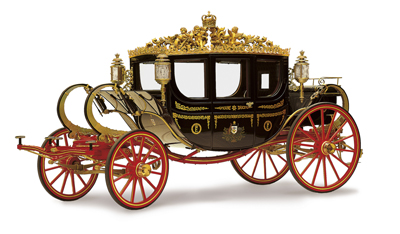
Among the treasures on show at this year’s summer opening of Buckingham Palace, the Australian State Coach was a gift to Queen Elizabeth II by Australia on 8th May, 1988, to mark the Australian Bicentennial.
The coach – the first to be built for the Royal Family since the Coronation of King Edward VII in 1902 – was built by Australian WJ “Jim” Frecklington who also designed the Diamond Jubilee State Coach.
The coach, which is usually kept in the Royal Mews where it can be viewed by the public, has been used at the State Opening of Parliament and other occasions involving foreign royal families and visiting heads of state. It was also used to carry Prince Charles, the Duchess of Cornwall and Michael and Carole Middleton back to Buckingham Palace after the wedding of Prince William and Catherine Middleton.
It was last used to carry the Duke of Edinburgh and Señora Rivera, wife of the president of Mexico, on a State Visit in March this year.
The summer opening of the palace runs from 25th July to 27th September. The coach will be on display in the Grand Entrance portico.
WHERE: Summer Opening of Buckingham Palace (nearest Tube stations are Victoria, Green Park and Hyde Park Corner); WHEN: 25th July to 31st August – 9.30am to 7.30pm daily (last admission 5.15pm)/1st to 27th September – 9.30am to 6.30pm (last admission 4.15pm); COST: £35.60 adults/£20 under 17 and disabled/£32.50 concessions/£91.20 family (2 adults and three under 17s); WEBSITE: www.royalcollection.org.uk/visit/the-state-rooms-buckingham-palace/plan-your-visit.
PICTURE: Royal Collection Trust © Her Majesty Queen Elizabeth II, 2015
This Week in London – Churchill’s Scientists; Waterloo online; a Chelsea murder case reopened; exploring Crossrail; and, astronomical photography…
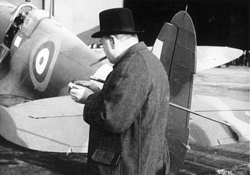
• Marking the 50th anniversary of the death of Winston Churchill, a new exhibition at the Science Museum in South Kensington looks at his passion for science and the influence that had on bringing World War II to an end. Churchill’s Scientists celebrates the individuals who flourished under Churchill’s patronage (and , as well as helping to bring about the end of World War II, also launched a post-war “science renaissance”) – from Robert Watson-Watt (inventor of radar) through to Bernard Lovell (creator of the world’s largest telescope) – and also delves into more personal stories of Churchill’s own fascination with science and tech. The display include objects from the museum’s collection as well as original archive film footage, letters and photographs. Highlights include the high speed camera built at Aldermaston to film the first microseconds of the detonation of the UK’s first home grown atomic bomb, the cigar Churchill was smoking when he heard news of his re-election as PM in 1951, and a one-piece green velvet “siren suit” designed by Churchill to wear during air raids (only one of three originals known to exist, it’s never been on public display outside of the tailors who created it). The free exhibition runs until 1st March and is part of the Churchill 2015 programme of events. Visit www.sciencemuseum.org.uk/churchill for more. PICTURE: Churchill with a Spitfire from Castle Bromwich (Philip Insley, CBAF Archive Vickers ArchiveSyndics).
• The National Army Museum and Waterloo2oo have launched an online gallery which will eventually comprise images and information on more than 200 artefacts associated with the Battle of Waterloo ahead of the 200th anniversary in June. Among the objects featured on Waterloo200.org are the Duke of Wellington’s boots, a French eagle standard captured in battle and the saw used to amputate the Earl of Uxbridge’s leg. One hundred items – drawn from the Army Museum’s collection as well as from European museums and private collections – can already be seen on the site with a further 100 to be added before the bicentenary on 18th June.
• The Talk: Death in Disguise: The Amazing True Story of the Chelsea Murders. On 12th February, the Guildhall Library in the City of London will host Gary Powell as he examines the facts of this double murder which took place in Chelsea in May, 1870, and left Victorian society reeling. For more events at the library, follow this link.
• On Now: Breakthrough: Crossrail’s tunnelling story. This exhibition at the London Transport Museum in Covent Garden brings a new perspective on the massive Crossrail project currently underway in the city. Visitors will experience the tunnel environment through a five metre high walk-through installation featuring a computer simulation of a giant boring machine as well as learn about how the project is shaping up, play interactive tunnelling games and hear firsthand from those who work underground. Admission charge for adults applies. Runs until August. For more, see www.ltmuseum.co.uk.
• Extended: Astronomy Photographer of the Year Exhibition. This exhibition at the Royal Observatory Greenwich features the winning images from last year’s competition. They include the Briton James Woodend’s image of a vivid green aurora in the Icelandic night sky; American Patrick Cullis’ view of earth taken from 87,000 feet above ground; and, New Zealander Chris Murphy’s image of dusty clouds dancing across the Milky Way. The exhibition can be seen for free in the Observatory’s Astronomy Centre until 19th July. For more, see www.rmg.co.uk/astrophoto.
• Send all items for inclusion to exploringlondon@gmail.com.
8 structures from the London that never was – 5. Sir Joseph Paxton’s Great Victorian Way…
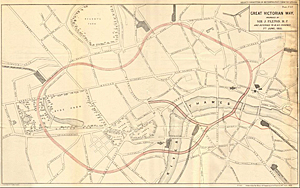
Fresh from the success of designing The Crystal Palace for the Great Exhibition of 1851 (see our earlier post here), in 1855 Sir Joseph Paxton came up with the idea of building a covered elevated railway “girdle” which would circle parts of central and west London and alleviate traffic congestion.
The proposed 10 mile long, eight track railway – which would feature trains propelled by air pressure (an “atmospheric” system) rather than conventional steam engines and included “express” trains which would only stop at select stations – was to be constructed inside a vast, 108 foot high glass covered arcade which would also contain a road, shopping and even housing.
The trains would travel at such a speed that to get from any one point on the “girdle” to its opposite point would only take 15 minutes.
Paxton presented his proposal to a Parliamentary Select Committee in June 1855 – he had already shown it to Prince Albert whom, he said, “gives it his approval”.
He estimated the cost of his proposal – which he thought would carry some 105,000 passengers every day – at some £34 million – a figure which parliament, which had initially been supportive of the idea, found a little hard to stomach.
This was especially thanks to the fact they were already dealing with the costs of Sir Joseph Bazalgette’s vast sewer system (see our earlier post here), created as a result of the ‘Great Stink’ in 1858 when the smell of untreated human excrement and other waste in the Thames became so strong, parliament had to act.
As a result, the project – which would have crossed the Thames three times, once with a spur line that ended near Piccadilly Circus – never eventuated but the Underground’s Circle Line today follows roughly the same route Paxton’s railway would have.
8 structures from the London that never was – 2. Watkin’s Tower…
Designed as London’s response to the Eiffel Tower, Watkin’s Tower was the brainchild of railway entrepreneur and MP Sir Edward Watkin.
Following the opening of the Eiffel Tower in 1889, Watkin wanted to go one better in London and build a tower than surpassed its 1,063 feet (324 metres) height.
He apparently first approached Gustave Eiffel himself to design the tower which was to be located as the centrepiece for a pleasure park development at Wembley Park in London’s north (which, incidentally, would be reached by one of Sir Edward’s railway lines – he opened Wembley Park station to service it). But Eiffel declined the offer and Watkin subsequently launched an architectural design competition.
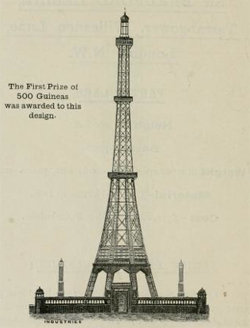
Among the 68 designs received from as far afield as the US and Australia were a cone-shaped tower with a railway spiralling up its exterior, a Gothic-style tower (also with a railway), a tower topped with a 1/12 scale replica of the Great Pyramid, one modelled on the spire of Bow Church in Cheapside and one topped by a giant globe (you can see the catalogue of all entries here).
The winning entry was submitted by Stewart, MacLaren and Dunn who proposed a steel eight legged tower soaring 1,200 feet (366 metres) into the sky. To be lit with electric lighting at night, it came with two observation decks with restaurants, theatres and exhibition space as well as winter gardens, Turkish baths, shops, promenades and a 90 room hotel as well as an astronomical observatory. The top of the tower would be reached by a series of elevators.
The first stage of the project – formally known as London Tower or the Wembley Park Tower – had still not been completed when Wembley Park opened in May, 1894 – standing 154 feet (47 metres tall), it was finally finished in September the following year.
It was to never rise higher. The project become mired in problems – Watkin retired through ill health (and died in 1901), the structure started to subside and the construction company went into liquidation. Dubbed Watkin’s Folly and the London Stump, what there was of the tower was eventually demolished between 1904-1907.
While the dream of the tower never came to be, the site nonetheless became a popular vehicle for recreation and the site was later used for the 1924 British Empire Exhibition with Wembley Stadium built over the spot where the tower had once stood.
10 of London’s World War I memorials – 9. Great Western Railway War Memorial…
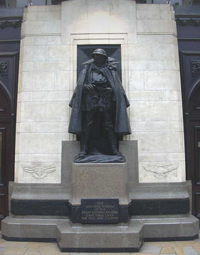
One of many memorials located in London’s railway stations, the Great Western Railway War Memorial is located on platform one of Paddington Station.
The memorial features a bronze figure of a soldier sculpted by Charles Sargeant Jagger standing against a granite and marble backdrop designed by Thomas S Tait. The soldier, who is dressed in battle gear with a helmet on his head and a great coat thrown about his shoulders, is depicted apparently reading a letter from home.
To either side of the soldier are reliefs depicting the emblems of the Royal Air Force and the Royal Navy while inscribed on the plinth beneath him is an inscription dedicated the memorial to employees of the railway who died in World War I. Inside the plinth was placed a sealed casket containing a vellum roll on which is written the names of all 2,524 men who died.
The memorial, known as the ‘GWR Memorial’, was unveiled on Armistice Day by Viscount Churchill, chairman of the Great Western Railway, in 1922 before a crowd estimated at around 6,000 people. It was later updated after World War II.
Restored in 2001, the memorial recently featured in the World War I commemorative project – “Letter to an Unknown Soldier” – in which members of the public were invited to write a letter to the soldier. The statue is also among more than 20 in London which have been brought to life as part of Sing London’s Talking Statues initiative (it has the voice of Patrick Stewart!).
Among our favourite railway memorials, others include the magnificent “Victory Arch” at Waterloo Station.
PICTURE: Cnbrb at the English language Wikipedia
What’s in a name?…Chancery Lane
This central London street, which runs between Fleet Street and High Holborn, has long been associated with the law and government, and still is so today with the Royal Courts of Justice standing close to its southern end and Lincoln’s Inn – one of the four Inns of Court – located on the lane’s western side.
Its name is a corruption of the original Chancellor Lane – a moniker which apparently dates back to at least the 14th century – and which referred to the buildings where the official documents of the Lord Chancellor’s Office, known as the Rolls of the Court of Chancellory (Chancery), were stored.
The street was apparently first known as New Street and later as Converts Lane; the latter in reference to the House of Converts (Domus Conversorum) King Henry III founded here in the 1272 for the conversion of Jews to Christianity.
When King Edward I expelled all the Jews from the kingdom in 1290, the ‘house’ continued in use as such for foreign-born Jews, albeit with very small numbers of residents until the early 17th century.
In the meantime, in 1377 King Edward III gave orders that the complex of buildings used by the Domus Conversorum also be given over to the Master of the Rolls for the storage of chancellory documents and it was this move which led to the lane gaining its new name.
The buildings – which included a chapel which had become known as the Chapel of the Master of the Rolls or the simply the Rolls Chapel which had been rebuilt several times including to the designs of 17th century architect Inigo Jones – were finally demolished around the turn of the 20th century and subsumed into the Public Records Office complex on Chancery Lane (this was formerly housed in what is now the Maughan Library of King’s College London).
The lane these days is also home to such august institutions as The Law Society and the London Silver Vaults. It also lends its name to an Underground Station located to the east of the lane entrance in High Holborn.
What’s in a name?…Fenchurch Street…
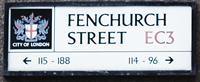
There’s a couple of alternate theories for the origins of this City of London street’s name.
Running between Gracechurch Street to the west and Aldgate to the east, Fenchurch Street isn’t actually home to Fenchurch Street Station (one of the four Monopoly board stations!) – that’s located in adjoining Fenchurch Place. And for good measure, there’s also a nearby Fenchurch Avenue.
The name apparently relates to a church that once stood here, known as St Gabriel Fenchurch. The fen part of the name is believed to either stand for what may have been nearby ‘fens’ – that is, swampy or marshy ground – related to the now lost Langbourn River once located here or for faenum, a Latin word for hay which may have referred to a nearby haymarket.
The church, which is known to have existed from at least the 14th century and stood between Rood and Mincing Lanes, burnt down in the Great Fire of London in 1666 and was not rebuilt but merged into the parish of St Margaret Pattens (there’s a plaque marking its site in Fenchurch Street opposite Cullum Street – we’ll have a look at the church in more detail in a later Lost London entry).
Landmarks in the street include Lloyd’s Register of Shipping at number 71 (a Grade II-listed building dating from 1901) and the somewhat controversial tower at 20 Fenchurch Street, nicknamed the ‘Walkie Talkie’ building.
LondonLife – Remembering London’s bridges now and then…
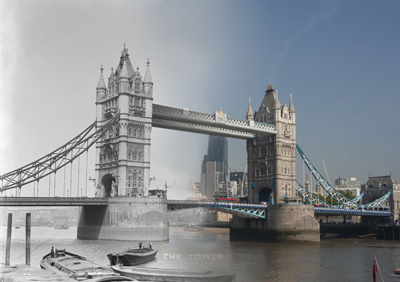
Some of 16 hybrid images showing London’s bridges old and new which have been released by the Museum of London Docklands to mark the recent opening of the museum’s new free art exhibition Bridges. The images have been created using historic photographs showcased in the exhibition which opened last Friday and runs until 2nd November. The photographs were taken by renowned late 19th and 20th century photographers, including Henry Grant, Henry Turner, Sandra Flett, Christina Broom, Roger Mayne and George Davison Reid. Above is Tower Bridge, taken by Christina Broom (c. 1903–10) from Shad Thames Jetty. For more, see www.museumoflondon.org.uk/docklands/. PICTURE © Christina Broom/Museum of London.
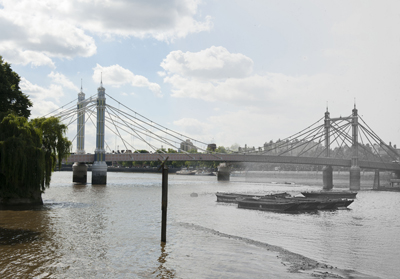
Albert Bridge (unknown photographer), Chelsea. Glass lantern slide, c. late 19th century. © Museum of London.
Vauxhall Bridge from Cambridge Wharf (taken by Albert Gravely Linney), 1928. Taken from the north bank of the Thames. © Albert Gravely Linney/Museum of London
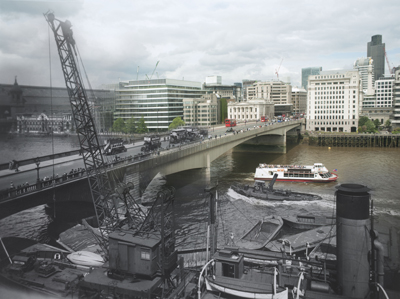
Looking north across London Bridge (taken by George Davison Reid), c. 1920s. Taken from inside on the 5th floor of No1 London Bridge. © George Davison Reid/Museum of London
Richmond Bridge, glass lantern slide, c. late 19th century. Taken from the south side of the river. © Museum of London.
This Week in London – Celebrating the Year of the Bus; the British Library looks at WWI; medieval jousting and The Duke of Wellington; and, Blue Plaque nominations resumed…
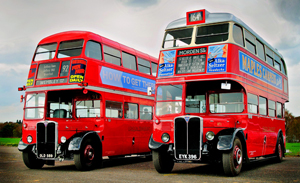
• Almost 50 buses, from a horse-drawn model of the 1820s to the New Routemasters of today, will come to Regent Street on Sunday in celebration of the Year of the Bus. The ‘Regent Street Bus Cavalcade’ – which will stretch from Piccadilly Circus to Oxford Circus and will see the iconic West End street closed to traffic – will also feature a variety of free family events including Lego workshops (there will be a bus shelter and bus stop made entirely out of Lego outside Hamley’s toy shop), children’s theatre performances, a pop-up London Transport canteen and the chance to have a personal message recorded by the voice of London’s buses, Emma Hignett. There will also be an exhibition – Battle Bus – which provides information about the B-type bus (a newly restored version of which will be on display) which was used during World War I to carry soldiers to the frontline as well as ambulances and mobile pigeon lofts while jewellery company Tatty Devine will feature a special range of bus-inspired jewellery and hold jewellery-making workshops on board a London bus. The cavalcade, supported by the Regent Street Association and The Crown Estate, is part of Transport for London’s celebrations marking the Year of the Bus, organised in partnership with the London Transport Museum and the capital’s bus operators. The free event runs from 11.30am to 6pm. For more information, see www.tfl.gov.uk/yearofthebus and www.ltmuseum.co.uk.
• A new exhibition of materials showing how people coped at home and on the front during World War I opens at the British Library in King’s Cross today as part of efforts to mark the war’s centenary. Enduring War: Grief, Grit and Humour features personal objects such as letters, a handkerchief bearing the lyrics of It’s A Long, Long Way to Tipperary, Christmas cards, school essays about airship raids over London sit and recruitment posters, humorous magazines and even a knitting pattern for balaclavas. Highlights include a letter in which Sir Arthur Conan Doyle expresses his concern over his son serving at the front, manuscripts by war poets such as Rupert Brooke as well as Wilfred Owen’s manuscript for Anthem for Doomed Youth, Vaughan Williams’ A Pastoral Symphony and Laurence Binyon’s For the Fallen. A specially commissioned video and ‘soundscape’, Writing Home, features personal messages contained on postcards written to and from the front. A range of events accompanies the free exhibition. Runs until 12th October. For more on the exhibition, see www.bl.uk.
• Armoured knights on horseback can be seen jousting at Eltham Palace in south London this weekend. The former childhood home of King Henry VIII will host a Grand Medieval Joust which will also include displays of foot combat, the antics of a court jester, medieval music performances and a series of children’s events including a knight’s school. Runs from 10am to 5pm on both Saturday and Sunday. Admission charge applies. For more, see www.english-heritage.org.uk/events. Meanwhile, the Battle of Waterloo is being remembered at the Duke of Wellington’s home of Apsley House near Hyde Park Corner. Visitors will come face-to-face with Wellington’s troops and their wives, having the chance to take a look inside a soldier’s knapsack, see the equipment he used and the drills he performed as well as see the Battle of Waterloo recreated in vegetables. The Waterloo Festival – this year marks 200 years since Napoleon’s abdication and exile to Elba – runs from 11am to 5pm on Saturday and Sunday. Admission charge applies. For more, see www.english-heritage.org.uk/apsley/.
• Nominations have reopened for English Heritage’s Blue Plaques scheme in London. In 2012 nominations were temporarily suspended while new funding for the scheme was found and thanks to one individual’s donation and the creation of a new Blue Plaques Club to support the scheme on an ongoing basis, they have now reopened. There are 880 official Blue Plaques on London’s streets – remembering everyone from Florence Nightingale to Fred Perry and Charles Darwin. For more and details on nominations, see www.english-heritage.org.uk/discover/blue-plaques/.
Send all items of interest for inclusion to exploringlondon@gmail.com.
What’s in a name?…Maida Vale
This district in west London – located to the south-west of St Johns Wood – takes its name from the Italian town of Maida in Calabria where, in 1806, the British won a victory over Napoleon.
Led by Sir John Stuart (later Count of Maida), about 5,000 British troops defeated a larger number of French in a battle in what was a much-needed boost to the British after the defeat at Austerlitz in December the previous year.
There was apparently a pub located in the area named, in the wake of the victory, ‘The Hero of Maida’ in reference to Stuart and his role in the battle. The pub has since gone but its name lives on in the street and the district which still carries it.
Landmarks in Maida Vale include the basin – complete with houseboats and the puppet theatre barge – known as Little Venice (some say this name was coined by poet Robert Browning; others attribute it to Lord Byron) where Regent’s Canal meets with the Paddington arm of the Grand Junction Canal (pictured is Regent’s Canal looking toward Little Venice).
Maida Vale is also home to the BBC Maida Vale Studios (on Delaware Road) while notable residents have included computer science pioneer Alan Turing who was born at 2 Warrington Crescent in 1912 and David Ben-Gurion, first Prime Minister of Israel, who lived at 75 Warrington Crescent.
The area to the south-west is unofficially known as Maida Hill and this was apparently initially the name used for the entire area until the more romantic Maida Vale came into usage in the mid 19th century. Maida Vale also gives its name to a Tube station – it opened in 1915.
This Week in London – London’s World War I transport in focus; Museums at Night; and, Tony Hancock remembered…
• Opening tomorrow, a major exhibition at the London Transport Museum will take an in-depth look at the role transport played in London during World War I – from how London bus drivers took their vehicles to the front lines to the advance of women into the transport workforce for the first time and, of course, how Londoners fared under the deadly aerial attack of the Luftwaffe. Key among the objects on display as part of Goodbye Piccadilly at the Covent Garden site will be ‘Ole’ Bill’ – a 1911 bus on loan from the Imperial War Museum which was requisitioned for the front and, taking its name from Bruce Bairsfather’s popular cartoon character, featured regularly in Armistice Day parades until the 1960s. Other highlights include World War I recruitment posters, a 1914 female bus conductor’s uniform and a newly acquired piece of ‘trench art’ – a decorated Daimler bus steering wheel. Runs until 8th March. Admission charge applies. For more, see www.ltmuseum.co.uk.
• The annual Museums at Night event kicks off tonight and runs until Saturday night. Among the premises participating this year is the Hunterian Museum at the Royal College of Surgeons in Lincoln’s Inn Fields which is showing a selection of rarely seen materials from its archives, the Banqueting House in Whitehall, Keat’s House in Hampstead and the Petrie Museum of Egyptian Archaeology at University College London which is running a murder mystery event Friday night. Some events are ticketed and some have an admission charge so check out the website before you go. For more, see www.culture24.org.uk/places-to-go/museums-at-night.
• The late comedian Tony Hancock was honoured with an English Heritage Blue Plaque at his former home in South Kensington on Monday on what would have been his 90th birthday. Hancock, famous for Hancock’s Half Hour on radio and TV, lived on the fourth floor of a Grade II-listed building at 20 Queen’s Gate Place with his wife Cicely Romanis between 1952 and 1958. It was the longest time he lived at any property in London and coincided with the most creative and successful period of his career with the show first board cast on BBC radio in 1954 and also appearing on TV from 1956 onwards. Hancock died in 1968. For more, see www.english-heritage.org.uk/discover/blue-plaques/.
Send all items of interest for inclusion to exploringlondon@gmail.com.
This Week in London – A rare chance to walk through a Thames tunnel; Matisse at the Tate; and, Spitting Image on show…
• It’s a rare chance to walk the historic Thames Tunnel between Wapping and Rotherhithe – the first tunnel ever dug under a navigable waterway. Transport for London and London Overground are offering the chance to purchase tickets to walk the tunnel – built by Marc Brunel, it’s now used by the London Overground – over the May Bank Holiday weekend on 24th to 26th May. Tickets, which cost £18 plus booking fee, go on sale today at 10am via the London Transport Museum in Covent Garden and are strictly limited (with no on the day admissions allowed). Proceeds from the day will go to the Railway Children’s Charity and the Brunel Museum. Also, worth noting is that the London Transport Museum is offering tours of its depot this Friday and Saturday. Admission charge applies. For more, see www.ltmuseum.co.uk.
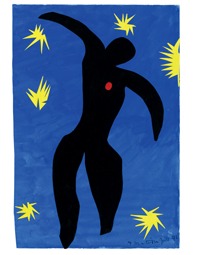
• The paper cut-outs of Henri Matisse are the focus of a landmark exhibition which opened at Tate Modern last week. Henri Matisse: The Cut-Outs features about 130 works created between 1937 and 1954 with many seen together for the first time. Highlights include maquettes featured in the 1947 book Jazz, The Snail and its sister work Memory of Oceania (both 1953) and the largest number of the Blue Nudes ever shown together. The display takes an in-depth look at the methods and materials Matisse used in the production of the cut-outs. Runs until 7th September (and keep an eye out for the accompanying film, Matisse: Live in cinemas). Admission charge applies. For more, see www.tate.org.uk. PICTURE: Henri Matisse, Icarus 1946, Maquette for plate VIII of the illustrated book Jazz 1947, Digital image: © Centre Pompidou, MNAM–CCI, Dist. RMN-Grand Palais / Jean-Claude Planchet, Artwork: © Succession Henri Matisse/DACS 2014.
• On Now: Spitting Image. This exhibition at the Cartoon Museum in Bloomsbury centres on the partnership of three dimensional artists Peter Fluck and Roger Law and their key role in the creation of what became known as Spitting Image. It features caricature drawings and photographs created for magazines in the 1970s and 1980s of the likes of Paul McCartney, Michael Jackson, Kate Moss, Saddam Hussein, Billy Connolly, Rupert Murdoch, Jo Brand and John Paul II as well as members of the Royal Family and politicians including Margaret Thatcher. Also present are some of the puppets used in the TV show which ran for 18 series between 1984 and 1996 – these include those of Thatcher, The Queen, Princess Diana and Mr Spock. Runs until 8th June (with selected late opening nights). Admission charge applies. For more, see www.cartoonmuseum.org.
Send all items of interest for inclusion to exploringlondon@gmail.com.
LondonLife – Pigeon collective at Embankment…
LondonLife – A splash of colour comes to St Pancras…
In contrast to the colourless smog which has lain over London, Scottish artist David Batchelor’s sculpture, Chromolocomotion, brings a splash of colour to the Grand Terrace at St Pancras International. Unveiled this week, the 20 by 10 metre work consists of 44 L-shaped pieces of coloured perspex suspended from the Grade I-listed roof of the Barlow Shed. It replaces Lucy and Jorge Orta’s Cloud: Meteoros and is the second installation commissioned by St Pancras International’s owners HS1 Ltd as part of the Terrace Wires initiative. The work will remain in place until late September. For more on the initiative, see www.terracewires.co.uk. PICTURE: HS1 Ltd.