8 structures from the London that never was – 2. Watkin’s Tower…

Designed as London’s response to the Eiffel Tower, Watkin’s Tower was the brainchild of railway entrepreneur and MP Sir Edward Watkin.
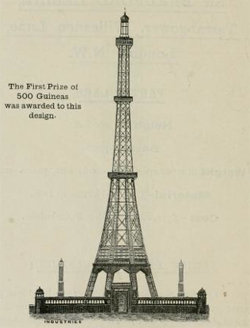
Watkin's-TowerFollowing the opening of the Eiffel Tower in 1889, Watkin wanted to go one better in London and build a tower than surpassed its 1,063 feet (324 metres) height.

He apparently first approached Gustave Eiffel himself to design the tower which was to be located as the centrepiece for a pleasure park development at Wembley Park in London’s north (which, incidentally, would be reached by one of Sir Edward’s railway lines – he opened Wembley Park station to service it). But Eiffel declined the offer and Watkin subsequently launched an architectural design competition.

Among the 68 designs received from as far afield as the US and Australia were a cone-shaped tower with a railway spiralling up its exterior, a Gothic-style tower (also with a railway), a tower topped with a 1/12 scale replica of the Great Pyramid, one modelled on the spire of Bow Church in Cheapside and one topped by a giant globe (you can see the catalogue of all entries here).

The winning entry was submitted by Stewart, MacLaren and Dunn who proposed a steel eight legged tower soaring 1,200 feet (366 metres) into the sky. To be lit with electric lighting at night, it came with two observation decks with restaurants, theatres and exhibition space as well as winter gardens, Turkish baths, shops, promenades and a 90 room hotel as well as an astronomical observatory. The top of the tower would be reached by a series of elevators.

The first stage of the project – formally known as London Tower or the Wembley Park Tower – had still not been completed when Wembley Park opened in May, 1894 – standing 154 feet (47 metres tall), it was finally finished in September the following year.

It was to never rise higher. The project become mired in problems – Watkin retired through ill health (and died in 1901), the structure started to subside and the construction company went into liquidation. Dubbed Watkin’s Folly and the London Stump, what there was of the tower was eventually demolished between 1904-1907.

While the dream of the tower never came to be, the site nonetheless became a popular vehicle for recreation and the site was later used for the 1924 British Empire Exhibition with Wembley Stadium built over the spot where the tower had once stood.
10 of London’s World War I memorials – 9. Great Western Railway War Memorial…

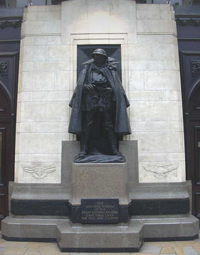
One of many memorials located in London’s railway stations, the  Great Western Railway War Memorial is located on platform one of Paddington Station.

The memorial features a bronze figure of a soldier sculpted by Charles Sargeant Jagger standing against a granite and marble backdrop designed by Thomas S Tait. The soldier, who is dressed in battle gear with a helmet on his head and a great coat thrown about his shoulders, is depicted apparently reading a letter from home.

GWR-Memorial-smallTo either side of the soldier are reliefs depicting the emblems of the Royal Air Force and the Royal Navy while inscribed on the plinth beneath him is an inscription dedicated the memorial to employees of the railway who died in World War I. Inside the plinth was placed a sealed casket containing a vellum roll on which is written the names of all 2,524 men who died.

The memorial, known as the ‘GWR Memorial’, was unveiled on Armistice Day by Viscount Churchill, chairman of the Great Western Railway, in 1922 before a crowd estimated at around 6,000 people. It was later updated after World War II.

Restored in 2001, the memorial recently featured in the World War I commemorative project – “Letter to an Unknown Soldier” – in which members of the public were invited to write a letter to the soldier. The statue is also among more than 20 in London which have been brought to life as part of Sing London’s Talking Statues initiative (it has the voice of Patrick Stewart!).

Among our favourite railway memorials, others include the magnificent “Victory Arch” at Waterloo Station.

PICTURE: Cnbrb at the English language Wikipedia

What’s in a name?…Fenchurch Street…

There’s a couple of alternate theories for the origins of this City of London street’s name.

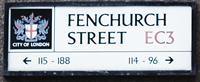
Fenchurch-StreetRunning between Gracechurch Street to the west and Aldgate to the east, Fenchurch Street isn’t actually home to Fenchurch Street Station (one of the four Monopoly board stations!) – that’s located in adjoining Fenchurch Place. And for good measure, there’s also a nearby Fenchurch Avenue.

The name apparently relates to a church that once stood here, known as St Gabriel Fenchurch. The fen part of the name is believed to either stand for what may have been nearby ‘fens’ – that is, swampy or marshy ground – related to the now lost Langbourn River once located here or for faenum, a Latin word for hay which may have referred to a nearby haymarket.

The church, which is known to have existed from at least the 14th century and stood between Rood and Mincing Lanes, burnt down in the Great Fire of London in 1666 and was not rebuilt but merged into the parish of St Margaret Pattens (there’s a plaque marking its site in Fenchurch Street opposite Cullum Street – we’ll have a look at the church in more detail in a later Lost London entry).

Landmarks in the street include Lloyd’s Register of Shipping at number 71 (a Grade II-listed building dating from 1901) and the somewhat controversial tower at 20 Fenchurch Street, nicknamed the ‘Walkie Talkie’ building.

This Week in London – A rare chance to walk through a Thames tunnel; Matisse at the Tate; and, Spitting Image on show…

It’s a rare chance to walk the historic Thames Tunnel between Wapping and Rotherhithe – the first tunnel ever dug under a navigable waterway. Transport for London and London Overground are offering the chance to purchase tickets to walk the tunnel – built by Marc Brunel, it’s now used by the London Overground – over the May Bank Holiday weekend on 24th to 26th May. Tickets, which cost £18 plus booking fee, go on sale today at 10am via the London Transport Museum in Covent Garden and are strictly limited (with no on the day admissions allowed). Proceeds from the day will go to the Railway Children’s Charity and the Brunel Museum. Also, worth noting is that the London Transport Museum is offering tours of its depot this Friday and Saturday. Admission charge applies. For more, see www.ltmuseum.co.uk.

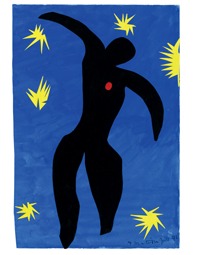
MatisseThe paper cut-outs of Henri Matisse are the focus of a landmark exhibition which opened at Tate Modern last week. Henri Matisse: The Cut-Outs features about 130 works created between 1937 and 1954 with many seen together for the first time. Highlights include maquettes featured in the 1947 book Jazz, The Snail and its sister work Memory of Oceania (both 1953) and the largest number of the Blue Nudes ever shown together. The display takes an in-depth look at the methods and materials Matisse used in the production of the cut-outs. Runs until 7th September (and keep an eye out for the accompanying film, Matisse: Live in cinemas). Admission charge applies. For more, see www.tate.org.uk. PICTURE: Henri Matisse, Icarus 1946, Maquette for plate VIII of the illustrated book Jazz 1947, Digital image: © Centre Pompidou, MNAMCCI, Dist. RMN-Grand Palais / Jean-Claude Planchet, Artwork: © Succession Henri Matisse/DACS 2014.

On Now: Spitting Image. This exhibition at the Cartoon Museum in Bloomsbury centres on the partnership of three dimensional artists Peter Fluck and Roger Law and their key role in the creation of what became known as Spitting Image. It features caricature drawings and photographs created for magazines in the 1970s and 1980s of the likes of Paul McCartney, Michael Jackson, Kate Moss, Saddam Hussein, Billy Connolly, Rupert Murdoch, Jo Brand and John Paul II as well as members of the Royal Family and politicians including Margaret Thatcher. Also present are some of the puppets used in the TV show which ran for 18 series between 1984 and 1996 – these include those of Thatcher, The Queen, Princess Diana and Mr Spock. Runs until 8th June (with selected late opening nights). Admission charge applies. For more, see www.cartoonmuseum.org.

Send all items of interest for inclusion to exploringlondon@gmail.com.

LondonLife – A splash of colour comes to St Pancras…

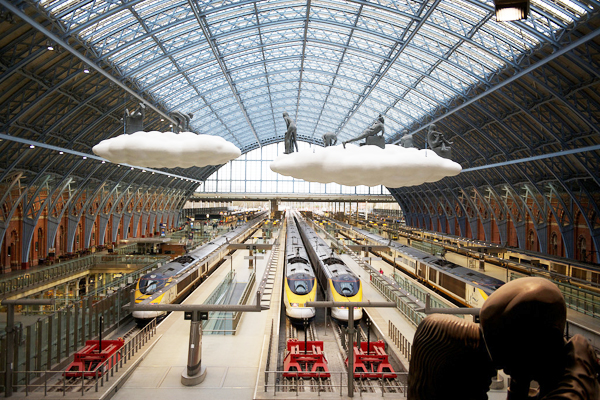
Chromolocomotion,-Terrace-Wires-art-programme-at-St-Pancras-International-1In contrast to the colourless smog which has lain over London, Scottish artist David Batchelor’s sculpture, Chromolocomotion, brings a splash of colour to the Grand Terrace at St Pancras International. Unveiled this week, the 20 by 10 metre work consists of 44 L-shaped pieces of coloured perspex suspended from the Grade I-listed roof of the Barlow Shed. It replaces Lucy and Jorge Orta’s Cloud: Meteoros and is the second installation commissioned by St Pancras International’s owners HS1 Ltd as part of the Terrace Wires initiative. The work will remain in place until late September. For more on the initiative, see www.terracewires.co.uk. PICTURE: HS1 Ltd.

London Pub Signs – The Minories…

The-MinoriesLocated close to Tower Hill in the eastern part of the City, this pub – and indeed the street in which it sits (at number 64-73) – takes its name from a former nunnery that was once located here.

Known as the Minoresses, the nuns – who belonged to the Order of St Clare (also known as the Poor Clares) – lived in a nunnery here. The institution was founded by in 1293 by Edmund, the brother to King Edward I (reigned 1272-1307), and the earl of Lancaster, Leicester, and Derby, to house nuns who had been brought to England from Spain by the earl’s wife, Blanche of Artois, the widow of King Henry I of Navarre.

As with the case of the Black Friars, the name came to be used to refer to the district in which the now long-gone nunnery once stood (it was dissolved in the Great Dissolution and later used as a residence by the likes of Henry, Duke of Suffolk and father of Lady Jane Grey) and lives on in the name of the street and the pub.

The pub, which has undergone a paint job since our picture was taken, is located under a railway bridge (and may have once been part of the former Minories Railway Station which closed in 1873. For more, see www.minories-london.co.uk.

10 (more) curious London memorials…1. Kindertransport memorial

KindertransportWay back in 2011 we ran a series looking at some of London’s most curious memorials. We’ve decided to revisit that theme in our new special series.

To kick it off, we’re taking a look at a group memorial found just outside Liverpool Street Station and dedicated to the thousands of Jewish children who arrived in the UK as refugees over nine months in 1938 and 1939, having fled the Nazis in Europe after the anti-Semitic attacks of the Kristallnacht.

Called Kindertransport – The Arrival, the group of bronze statues representing children with their luggage having just stepped off a train at the station were unveiled in 2006 in Hope Square. A short stretch of railway tracks lays behind them.

The memorial is the work of Frank Meisler – himself a child who travelled on a Kindertransport train from Danzig – and bears an inscription: “Children of the Kindertransport. In gratitude to the people of Britain for saving the lives of 10,000 unaccompanied mainly Jewish children who fled from Nazi persecution in 1938 and 1939. ‘Whosoever rescues a single soul is credited as though they had saved the whole world.’ Talmud.”  It is dedicated by the Association of Jewish Refugees and the Central British Fund for Jewish World Relief.

Around the statue group are a series of blocks upon which is inscribed the names of the cities from which the children fled. They include the cities of Cologne, Hanover, Stuttgart, Frankfurt, Munich, Danzig, Breslau, Prague, Hamburg, Leipzig, Berlin and Vienna along with others.

The statue is one of four, all created by Meisler, which have been erected along the route the children took to reach safety. Others can be found at the main railway station Gdansk in Poland, Friedrichstraße railway station in Berlin, and another in Rotterdam, The Netherlands.

Hope Square also contains another plaque which dedicates the square to the children of the Kinderstransport “who found hope and safety in Britain through the gateway of Liverpool Street Station”.

In late June, an event was held in the St James’s Palace to mark the 75th anniversary of the Kindertransport.

LondonLife: Clouds at St Pancras…

TerraceWires

Lucy and Jorge Orta’s sculpture Cloud: Meteoros is the first sculpture to be unveiled for the ‘Terrace Wires’ project at St Pancras International. The sculpture, which hangs on wires from the station’s roof, features two clouds hovering over the station floor on which figures can be seen looking down. Says artist Lucy Orta: “Our sculpture is symbol the space in between: that of the daily routines of the millions of passengers and visitors to the station and the freedom of our imagination, daydreams – looking up to the sky.” The sculpture will remain in place for the rest of the year. For more on art at St Pancras, see http://stpancras.com/art/ and www.terracewires.comPICTURE: Sam Lane/HS1 Ltd.


Around London – Bedchamber secrets at Hampton Court; Roman remains at the British Museum; Easter chocolate at Kew Gardens; Harry Beck’s blue plaque; and, Underground art…

Happy Easter! We’re taking a break over the Easter weekend…Our next update will be on Tuesday, 2nd April.

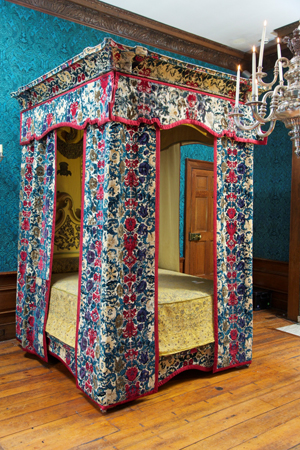
Mary-of-Modena's-bedA new exhibition exploring the secrets of the bedchambers of the Stuart and Hanoverian courts of the 17th and 18th centuries opened at Hampton Court Palace this week. At the heart of Secrets of the Royal Bedchamber are six royal beds which tell the story of why the bedchamber became the most important part of the palace and detail some of the events that took place there before an audience of courtiers, politicians and family members – from births and deaths to the consummation of marriages and the discussion of important affairs of state. It tells of why courtiers would fight for positions such as the ‘groom of the stool’ or ‘necessary woman’ and how beds which could cost the same as a London townhouse were sometimes never slept in. Among the beds on display is the ‘Warming Pan Bed’ (pictured), the State Bed of King James II’s queen, Mary of Modena, and scene of the royal birth that ultimately led to the end of the Stuart line, and the ‘Travelling Bed’ of King George II which travelled as far afield as Hanover and the battlefields of Europe. The exhibition also gives rare access into the Prince of Wales’ Apartments, designed by 17th and 18th architect Sir John Vanbrugh, and now open for the first time in 20 years.  Admission charge applies. Runs until 3rd November. For more, see www.hrp.org.uk. PICTURE: HRP

The Roman cities of Pompeii and Herculaneum are the subject of a major exhibition opening at the British Museum today. Life and death in Pompeii and Herculaneum brings together more than 250 objects from the two cities which were buried in just 24 hours during the eruption of Mount Vesuvius in 79 AD. The objects include celebrated finds and recent discoveries, many of which have never before been seen outside Italy, and help explore what daily life was like for the inhabitants. Artefacts include a beautiful wall painting from Pompeii showing baker Terentius Neo and his wife, wooden furnishings including a linen chest, inlaid stool, and even a baby’s crib from Herculaneum, and casts of victims including a family of four and a dog who died at Pompeii. Runs until 29th September. Admission charge applies. For more, see www.britishmuseum.org.

Find out more about the history of chocolate at Kew Gardens this Easter, from the ritualistic use of cacao in ancient Mayan and Aztec cultures to the arrival of chocolate in 17th century London, where it was a luxury item for high society to indulge in at newly fashionable chocolate houses. Running from tomorrow until 14th April, there will be a range of workshops taking place at the gardens around the chocolate theme along with a traditional Easter Egg Hunt on Easter Sunday (31st March). The garden’s cocoa tree can be found in the Princess of Wales Conservatory. Admission charge applies. See www.kew.org.

Harry Beck, designer of the innovative first diagrammatic Tube map, has been honoured by an English Heritage blue plaque – inscribed in the Underground’s new Johnston typeface – at his birthplace in Leyton in London’s east. Beck, who was born in a small terraced house at 14 Wesley Road in 1902, was working with London Transport as a draughtsman in the London Underground Serial Engineer’s Office, when, in 1931, he produced his first design for a diagrammatic map. He continued to update the map with new stations and lines even after leaving London Transport with the last version of his map published in 1960. Beck died in 1974. Meanwhile, a blue plaque commemorating railway engineer Sir Nigel Gresley (1876-1941) has been returned to King’s Cross station following the completion of building work. It can be found on platform 8. For more, see www.english-heritage.org.uk/discover/blue-plaques/.

On Now: The Underground. A commission from Art on the Underground, this exhibition of artist Mark Wallinger’s work at the Anthony Reynolds Gallery (60 Great Marlborough Street) features some examples of 270 labyrinth designs – one representing each of the Underground stations – which are being installed at the Tube stations themselves. Among those stations represented at this showing are Westminster, St James’s Park, Oxford Circus, Victoria, Embankment, Green Park, King’s Cross St Pancras, Baker Street and Tottenham Court Road. While labyrinths are already in place at these locations, the remainder of Wallinger’s labyrinth designs will be appearing at Tube stations over the coming months. Runs until 27th April. For more, see www.anthonyreynolds.com.

Lost London – Euston Arch…

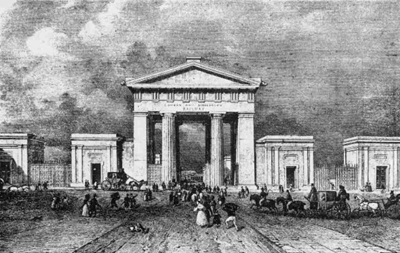
The original entrance to Euston Station, Euston Arch was not so much an arch as a colonnaded monumental gateway, formally known as a propylaeum, which resembled the entrance to a Greek temple.

Euston-ArchBuilt in 1837 (pictured here in 1851), it was designed by architect Philip Hardwick and inspired by the ancient architecture he had encountered on a trip to Europe – in particular the grand entrance to the Acropolis in Athens.

Commissioned by the London and Birmingham Railway as the grand entrance to the company’s new station then facing on to Euston Square (the site is now covered by the station structure), it was designed to complement the existing structure which had been built at the other end of the line in Curzon Street Station in Birmingham.

The building, which rose to a height of 21.5 metres and was built from Yorkshire-sourced sandstone, featured four columns behind which stood large iron gates. Rather controversial even when built, it led to an apparently unexciting courtyard lined with offices. There were lodges to either side.

While there had been a couple of proposals to relocate the arch – particularly after notice was given in 1960 that it would be demolished so the station could be rebuilt – none of the proposals came to fruition, and despite some intense last minute lobbying to preserve the arch by conservationists (among those lobbying were poet Sir John Betjeman and architectural scholar Sir Nikolaus Pevsner), demolition – viewed by some as an “architectural crime” – started in December 1961.

While sections of the arch was subsequently used as fill in the Prescott Channel in East London (numerous sections have since been recovered from the water), the main gates were saved and given to the National Railway Museum in York.

There has been talk of rebuilding the arch particularly since the formation of the Euston Arch Trust in 1994 (the patron of which is Michael Palin) with the aim of reusing some of the lost stonework. While rebuilding hasn’t yet eventuated, the proposed redevelopment of Euston Station in more recent years has given the project new impetus.

PICTURE: Wikipedia.

London Pub Signs – The Lord Aberconway…

Located just off Liverpool Street in Old Broad Street in the City, The Lord Aberconway is named after the last chairman of the Metropolitan Railway Company, operator of the world’s first underground railway (keep an eye out for our extended piece on the history of the Underground later this week).

Lord-AberconwayCharles McLaren – Lord Aberconway – (1850-1934) was a landowner, industrialist and MP who was raised to the peerage in 1911, a year after he had left the House of Commons. He served as chairman of ‘The Met’ from 1904 to 1933.

While the current building – the interior of which features booths and an L-shaped bar – dates from the 19th century, there has been a pub on the site, close to Liverpool Street Station, for much longer and its previous names included the King and Keys and the Metropolitan Railway’s ‘Refreshment Room’ and ‘Railway Buffet’.

The pub, which stands not far from the Monument commemorating the Great Fire of London, is reputed to be haunted by victims of the fire (only four people are said to have officially died in the blaze but it’s believed the death toll would have actually been much higher). You’re more likely to see city traders there however.

The pub is now run by the Nicholson’s. For more on the Lord Aberconway, see www.nicholsonspubs.co.uk/thelordaberconwayliverpoolstreetlondon/.

10 of London’s greatest Victorian projects – 8. London’s railways…

London’s railway network stands out as one of the greatest achievements of the Victorian age for it was during the 19th century that much of the railway infrastructure still in use today was first established.

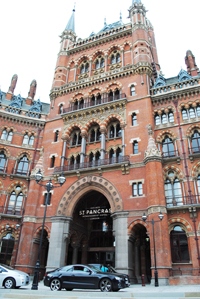
St-PancrasThe first railway line in London opened in February 1836 (six years after the UK’s first line opened) and ran between Spa Road in Bermondsey and Deptford on the south bank of the River Thames. The line was extended to London Bridge in December that same year and again to Greenwich, from cross-Channel steamers left – in April the following year.

That same year – 1837 – the station at Euston opened as the final stop for trains from Birmingham (an earlier terminus as Chalk Farm was deemed too far out). It was followed by Paddington in 1838, Fenchurch Street – the first permanent terminus in the City – in 1841, Waterloo in 1848 and King’s Cross in 1850.

Having seen a boom period during the 1840s, development of new lines took a back seat in the 1850s but resumed apace the following decade with the opening of Victoria Station, connecting the city to Brighton and Dover. Stations followed at Charing Cross, Ludgate Hill and Cannon Street and alongside the grand terminus’ around the outskirts of London where trains arriving from distant destinations arrived, numerous smaller railways began to be built, such as the West End of London and Crystal Palace Railway and the Victoria Station and Pimlico Railway, which took passengers on only short journeys across the city (these smaller railway companies all disappeared by 1923 when the 1921 Railways Act resulted in the creation of what are known as the “Big Four” British railway companies).

And, of course, the London Underground, has its first journey in 1863 but we’ll look at that in more detail next week.

Interesting to note that there were three classes of rail travel and while first and second class passengers had seats, this wasn’t always the case in third class where, writes Michael Paterson in Inside Dickens’ London, passengers, such as those on the Greenwich line, were initially forced to stand in open topped carriages known by some as ‘standipedes’.

Naturally, with the building of the railways came some spectacular stations – among the most spectacular is the late Victorian building which stood at the front of St Pancras Railway Station and housed the Midland Grand Hotel (pictured above). An exemplar of the Gothic Victorian style, it was designed by Sir George Gilbert Scott and, following a massive recent refurbishment, is now home to the five star Renaissance London Hotel and apartments.

We can, of course, only touch on the history of the railways in such a brief article – but we will be looking in more detail at some more specific elements of the system in later posts.

Where’s London’s oldest…Thames tunnel?

While the Greenwich foot tunnel may these days be more well-known due to the fact it is still open to pedestrians, London’s oldest under-Thames tunnel (also credited as the oldest underwater tunnel in the world) actually runs between Rotherhithe on the river’s southern bank and Wapping on the northern.

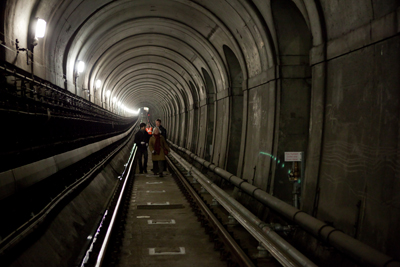
Thames_Tunnel-in-2010First opened in 1843, the Thames Tunnel (pictured left during a brief reopening to pedestrians in 2010) was the first major project of star Victorian engineer (and delightfully named) Isambard Kingdom Brunel (who, at the age of just 19 started work on the job with his father, a French engineer named Marc Isambard Brunel) and was known for a time as the eighth Wonder of the World.

It was constructed after demand grew for a way to transport goods across the crowded Port of London to the east of London Bridge. Given the height of the masts of larger ships, a bridge was deemed impracticable with the ramps required to take wheeled transport to the necessary height far too long (although this problem was overcome at the end of the 1800s by the use of new bascule technology in the construction of Tower Bridge).

Following several failed attempts to dig a tunnel under the Thames, Marc Brunel was given permission to build the new tunnel in the mid 1820s. The project relied on the use of a ‘tunnelling shield’, a then state-of-the-art technological solution to under river tunnelling which had only a few years earlier been patented by Marc Brunel and Thomas Cochrane, and Brunel initially thought the project would only take three years (it ended up taking as many as 18).

Construction by the newly formed Thames Tunnel Company, which had the support of none other than the Duke of Wellington, commenced in early 1825 at the Rotherhithe end. The shield enabled miners to dig out the tunnel while bricklayers came along behind them. While it significantly reduced the risk of a collapse (although several floods still did occur, taking the lives of six men – a fact which didn’t apparently much deter the sightseers who paid for the privilege of seeing the shield in operation), working conditions remained terrible with the men constantly showered with water from the river which was at that time the city’s main sewer. How many died indirectly as a result of working on the project is unknown.

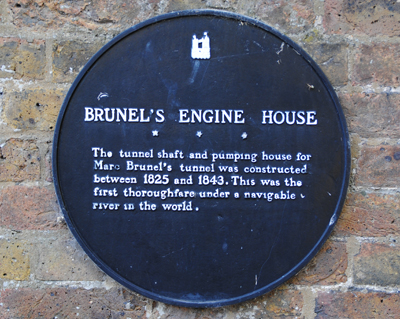
Brunel-plaqueIndeed, such was the stress of the project that Marc Brunel, later knighted for his efforts in building the tunnel, himself suffered a stroke during its construction. Isambard Brunel, who took over as the project’s engineer when the resident engineer fell ill in 1826, himself came close to being killed when he had to flee the flooding tunnel.

After much delay (including seven years in which the unfinished tunnel was left untouched) and several more disasters, the tunnel was finally completed in November, 1841.

After being fitted out with lighting, spiral staircases and roads in the following years, it was finally opened to pedestrians only on 25th March, 1843. While it was originally envisaged that the primary purpose of the tunnel would be to transport goods under the river, this never occurred.

Still, it did capture the public’s attention and as many as 50,000 people walked through the tunnel on the opening day (among the initial visitors to the tunnel was Queen Victoria herself). Within 10 weeks of its opening, a million people (a figure equal to what was then half the population of London) had reportedly passed through it.

Despite the number of people initially using it, however, the tunnel was still not a financial success and over the ensuing years became noted as a gathering place for unsavoury types. In 1865 it was purchased by the East London Railway Company which subsequently incorporated the tunnel into its railway network with both the Wapping and Rotherhithe entrance shafts converted into stations. It later become part of the London Underground network – the  – and since 2010 has been part of the London Overground.

Both stations are still in use and you can get a good sense of what the tunnel was like by riding the overground between Rotherhithe and Wapping. The Brunel Museum in Rotherhithe – actually housed within a building originally used to house machinery for draining the tunnel – see plaque above – is also a great place to find out more about the project and Brunel. Visit www.brunel-museum.org.uk for details.

PICTURES: Top – Lars Plougmann (Wikipedia)/Other – David Adams

For more on the life of Brunel, see Steven Brindle’s Brunel: The Man Who Built the World.

What’s in a name?…Cannon Street

One of the major thoroughfares of the City of London, Cannon Street’s name has nothing at all to do with artillery or religion. In fact, the street, which runs from St Paul’s Churchyard in the west to Eastcheap in the east, owes its name to the industry that once took place there.

Like many other streets in the City connected with the occupations of past residents, Cannon Street is a corruption of a street formerly known as Candelwichstrete (one of many various spellings of which the modern English version is Candlewick Street) which relates to the candlemakers and wax chandlers who lived and conducted their trade along the street in the Middle Ages (the Tallow Chandlers Company, involved in regulating candle-making, has been located in adjoining Dowgate Hill since 1476, although the current building dates from 1672).

The name was gradually corrupted into Cannon Street (apparently the corruption was at least partly due to its pronunciation in the Cockney dialect), which is what it was known as by the late 17th century when the seemingly ever-present Samuel Pepys was writing his diary.

Cannon Street – which was only extended to its current length in the mid-1800s under the supervision of architect JP Bunning, having formerly been a narrow lane which stopped at Dowgate Hill in the east – apparently later become known for the number of drapers based there and was also home to the Steelyard or Stalhof, the trading base of the German Hanseatic League in London in the 13th and 14th centuries (a plaque commemorating this was erected at Cannon Street Station in 2005).

Now lined with office buildings including some former warehouses from the Victorian era, the street is also home to a recently redeveloped above ground train station and Underground station- both of which were opened in the late 1800s (the station, which built was on the site of the Roman governor’s palace, was originally located behind the Cannon Street Hotel, birthplace of the British Communist Party). Cannon Street is also the location of the mysterious London Stone – formerly located at the now long-gone St Swithin’s Church, it can be found behind a grill at number 111 – for more on it, see our earlier post here).

What’s in a name?…Strand

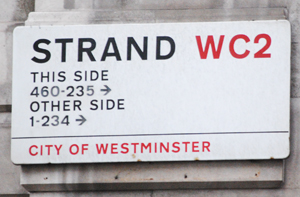
Now one of the major thoroughfares of the West End, the origins of the roadway known as the Strand go back to the Roman times leading west out of the city.

Later part of Saxon Lundenwic which occupied what is now the West End, it ran right along the northern shore of the Thames and so became known as the Strand (the word comes from the Saxon word for the foreshore of a river). During the following centuries the river was pushed back as buildings were constructed between the road and the river, leaving it now, excuse the pun, ‘stranded’ some distance from where the Thames flows.

Sitting on the route between the City of London and Westminster, seat of the government, the street proved a popular with the wealthy and influential and during the Middle Ages, a succession of grand homes or palaces was built along its length, in particular along the southern side.

All are now gone but for Somerset House – originally the home of the Dukes of Somerset, it was built in the 16th century but rebuilt in the 18th century after which it served a variety of roles including housing the Navy Office, before taking on its current role as an arts centre. Others now recalled in the names of streets coming off the Strand include the Savoy Palace, former residence of John of Gaunt which was destroyed in the Peasant’s Revolt, and York House, once home of the Bishops of Norwich and later that of George Villiers, favorite of King James I (see our earlier Lost London entry on York Watergate for more).

After the aristocracy decamped further west during the 17th and 18th centuries, the road and surrounding area fell into decline but was resurrected with a concerted building effort in the early 19th century (this included the creation of the Victoria Embankment which pushed the Thames even further away) which saw it become a favorite of the those who patronised the arts, including the opening of numerous theatres. Among those which still stand on the Strand today are the Adelphi and Savoy Theatres (this was apparently the first in London to be fitted with electric lights and sits on a site once occupied by the Savoy Palace).

Among the other landmarks along the Strand are the churches of St Mary-le-Strand (the present building which sits on what amounts to a traffic island) dates from 1717 and was designed by James Gibbs, and St Clement Danes, designed by Sir Christopher Wren and completed in 1682 (it is now the Central Church of the Royal Air Force). The Strand is also home to the Victorian-era Royal Courts of Justice (it boasts more than 1,000 rooms), Australia House (home of the oldest Australian diplomatic mission), the Strand Palace Hotel (opened in 1907) and Charing Cross Railway Station.

Around London – 16 Underground stations listed; life in a gun turret at HMS Belfast; and that dress on display at Buckingham Palace

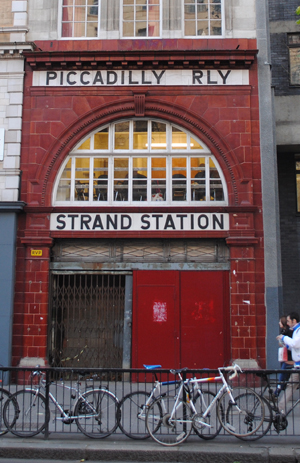
Sixteen London Underground stations were this week listed as Grade II heritage buildings. The Tube stations – several of which were designed by Leslie Green, known for his pioneering use of ‘ox-blood’ red tiles on the exterior of stations to create a consistent brand for the stations – include the now-closed Aldwych (pictured) along with Oxford Circus (originally two stations), Covent Garden and Russell Square as well as Belsize Park, Brent Cross, Caledonian Road, Chalk Farm, Chesham, Perivale, Redbridge, St John’s Wood, West Acton and Wood Green. Three other stations – Arnos Grove, Oakwood and Sudbury Town – have had their status upgraded from Grade II to Grade II*. These three were all designed by modernist architect Charles Holden for the extension of the Piccadilly Line in the 1930s. The new listings were made by Tourism and Heritage Minister John Penrose on the advice of English Heritage.

A new permanent exhibition showing would-be sailors what it is like to fight at sea opens at the HMS Belfast this weekend. Gun Turret Experience: A Sailor’s Story, 1943, is an immersive experience using lights, imagery, sound, smoke effects, movement and smell to recreate the atmosphere and conditions of a gun turret tower when a crew was at battle stations. Visitors are encouraged to follow the story of a young sailor on Boxing Day, 1943 when the German battle cruiser Scharnhorst is sighted leading to the Battle of the North Cape. The Gun Turret Experience, housed within the original triple gun turrets overlooking the quarterdeck, was developed with the help of Royal Navy veterans and eye-witness accounts from the Imperial War Museum (of which the HMS Belfast is part). Entry is included in normal admission price. For more information, see www.hmsbelfast.iwm.org.uk.

• Now On: See the dress the Duchess of Cambridge wore when she was married to Prince William in April at this year’s summer opening at Buckingham Palace. The gown, which features a nine foot long train, will be displayed along with the Halo Tiara until 3rd October in the palace ballroom (the same room used for the newly married couple’s reception). The exhibition features video footage of designer Sarah Burton, explaining how the dress was made. This year’s summer opening also features a display of the work of Carl Faberge – including his magnificent jewel-encrusted Imperial Easter Eggs as well as bejewelled boxes and miniature carvings of favorite pets of the royal family. More than half a million people are expected to visit the exhibition. For more information, see www.royalcollection.org.uk/default.asp?action=article&ID=30