10 of London’s greatest Victorian projects – 4. The Palace of Westminster…

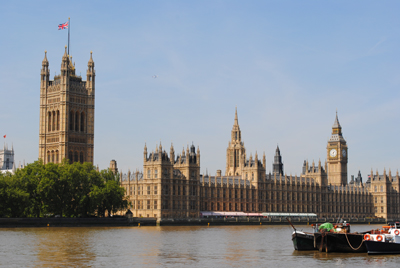
Commonly thought to be older than it actually is due to its Gothic stylings (although, to be fair, parts of it do date from medieval times), the Palace of Westminster – or, as it’s more commonly known, the Houses of Parliament – didn’t actually take on much of its current appearance until the latter half of the 19th century.

The need for a new building for parliament arose after 1834 when a fire, caused by the overheating of two underfloor stoves used to incinerate the Exchequer’s obsolete tally sticks, tore through the former complex, leaving only some structures from the old palace intact. They included the 11th century Westminster Hall (the largest in Europe when it was built), 14th century Jewel Tower and a chapterhouse, crypt and cloisters, all of which was once attached to the now gone St Stephen’s Chapel.
Houses-of-Parliament2While King William IV offered the use of Buckingham Palace for Parliament, the idea – along with a host of other options – was rejected as unsuitable. Instead, a competition was held for a new design and after almost 100 entries were considered, architect Charles Barry and his design for a new palace in the perpendicular Gothic style was chosen. Interestingly, while Barry was a classical architect, under the terms of the competition, designs were required to be in a Gothic style, thought to embody conservative values .

Incorporating some of the remains of the old palace – including Westminster Hall but not the Jewel Tower which to this day stands alone – the design was based around a series of internal courtyards with the House of Commons and House of Lords located on either side of a central lobby (first known as Octagonal Hall). The design involved reclaiming some land from the Thames so the building’s main river-facing facade could be completed.

Towers stand at either end of the complex – the Victoria Tower over the Sovereign’s Entrance at the southern end of the complex (for many years the tallest square stone tower in the world) and the narrower tower formerly known as the Clock Tower which houses the bell Big Ben, at the northern end – and there is a central Octagonal Tower which stands directly over the Central Lobby. The Clock Tower, incidentally, was renamed the Elizabeth Tower last year in honour of Queen Elizabeth II’s Diamond Jubilee (for more on it and Big Ben, see our earlier entries here and here).

Other towers include the Speaker’s Tower (located at the northern end of the building on the waterfront, this contains a residence for the Speaker), the Chancellor’s Tower (located at the southern end, it too contained a residence originally used by the Lord Chancellor) and St Stephen’s Tower – located in the middle of the building’s west front, it contains the public entrance to the building. Significant other rooms in the palace complex include the Robing Room – where the Queen puts on her ceremonial robes and crown before the State Opening of Parliament – and the Royal Gallery, used for state occasions.

The foundation stone (the building was constructed out of sand-coloured limestone from Yorkshire) was laid in 1840 and construction of the monumental building – which features more than 1,100 rooms and two miles of passageways – wasn’t completely finished until the 1870s although most of the work had been completed by 1860 (the year Barry died). The House of Lords first sat in their new chamber in 1847 and the House of Commons in 1852 (it was at this point that Barry was knighted for his work).

The cost, meanwhile, originally estimated at less than £750,000, ended up coming in at more than £2 million.

Much of the interior decoration owes its appearance to the Gothic revivalist Augustus Pugin who designed everything from wallpapers, to floor tiles and furnishings. Pugin also helped Barry with the external appearance but like Barry died before the project was completely finished (in 1852).

The palace was bombed numerous times in World War II – in one raid, the Commons Chamber was destroyed as firefighters opted to save the much older Westminster Hall instead. It was later rebuilt under the direction of Sir Giles Gilbert Scott and completed by 1950. Other aspects of the building have also been restored.

A Grade I-listed building classified as a World Heritage Site, Barry’s Houses of Parliament remain one of London’s most iconic structures. We’ll be looking in more detail at some of the building’s features in future posts.

WHERE: Houses of Parliament (nearest Tube stations are Westminster, St James’s Park and Embankment); WHEN: Tours (75 minutes) are run from 9.15am to 4.30pm on Saturdays (also six days a week during summer opening); COST: £15 adults/£10 concessions/£6 children five to 15 years (children under five are free). Prices go up after 1st April – check website for details and to purchase tickets (tours for UK residents, including climbing the Elizabeth Tower, can also be arranged through your MP); WEBSITE: www.parliament.uk.

For more, see Robert Wilson’s guide to the The Houses of Parliament or David Cannadine’s indepth,  The Houses of Parliament: History, Art, Architecture. For more on the story of the fire in 1834, see head parliamentary archivist Caroline Shenton’s recent book The Day Parliament Burned Down.

Famous Londoners – John Nash…

Arguably the greatest architect of Regency London, John Nash’s imprint can still be seen in numerous sites around the city, from the master-planning of Regent’s Park and Regent Street to the beautiful buildings of All Soul’s Church in Langham Place and Marble Arch on the edge of Hyde Park.

Born the son of a Welsh millwright in Lambeth, London, on 18th January, 1752, Nash – who went on to work in a range of different architectural styles – trained as a draughtsman under the tutelage of architect Sir Robert Taylor and in 1777 established his own business as a builder and surveyor.

John-NashBut he certainly didn’t meet with immediate success and, following failure as a building speculator (he built properties in Bloomsbury Square and Great Russell Street but failed to make enough money from the venture – there’s a blue plaque on one of the houses, which he lived in, at 66 Great Russell Street), was declared bankrupt in 1783.

Meanwhile, his personal life was also in turmoil during these years – in 1775 he had married, Jane Kerr, the daughter of a Surrey surgeon, but separated from her in the early 1780s after various troubles including her eventually apparently having a child with a Welshman named Charles Charles, who is said to have died in prison after he was jailed for adultery.

Brought down by his misfortune, in the mid 1780s Nash moved to Carmarthen in Wales where he had family. Taking up work here, by the late 1780s he was designing prisons – the first was at Carmarthen – and worked on a number of other prominent buildings including St David’s Cathedral and various country houses.

Rising to prominence in Carmarthen society, by 1797, however, Nash was again working in London, initially in partnership with the renowned landscape architect Humphrey Repton with whom he had formed a business relationship some years earlier (although the partnership had soured over finances by 1800).

He built a substantial home at 29 Dover Street in Mayfair and in 1798, his first wife presumably dead, he married his second wife, Mary Anne Bradley, and soon started work on building a Gothic-inspired residence for them, known as East Cowes Castle, on the Isle of Wight. It was completed in 1802 but enlarged some years later.

Nash designed numerous country properties in the early 19th century, inspired by everything from castles to Italianate architecture, both in England and Ireland and soon came to the attention of the Prince Regent, the future King George IV (there was a rumour his wife was one of the prince’s discarded mistresses).

In 1806 he was officially made Deputy Surveyor General in the Office of Woods and Forests – the office which managed the Crown estate, and from 1815 on, he largely worked for the prince alone. Among the major London commissions from his royal patron were the design of Regent Street (he and his wife moved into number 14 in 1823) and the development of Regent’s Park on land formerly known as Marylebone Park and surrounding housing estates (for more on The Regent’s Park, see our earlier entry here). He also redeveloped St James’s Park.

In 1815, he was commissioned to develop the Prince Regent’s Marine Pavilion in Brighton and by 1822 had transformed the building into the spectacular Royal Pavilion which can be visited there today.

Nash was also involved in the development of The Regent’s Canal – which linked the Grand Union Canal in London’s west to the River Thames in London’s east and was completed in 1820 – and built many of the grand villas which still line it (for more on Regent’s Canal, see our earlier entry here).

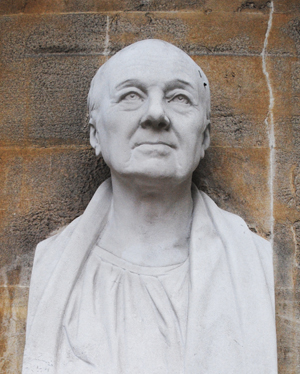
Becoming an official architect to the Office of Works in 1813 (an appointment which only ended in 1832, three years before his death), Nash went on to design churches – including All Soul’s in Langham Place (he’s depicted above in a bust at the church) – as well as West End theatres including the Haymarket Theatre and the Royal Opera House (which burnt down in 1867) as well as the adjacent Royal Opera Arcade and residences including Carlton House Terrace and Clarence House (for more on this, see our earlier entry here).

Other major commissions included the redevelopment of Buckingham Palace (parts of the current building are his work but the main facade isn’t – for more on the palace history, see our earlier entry here) and the Royal Mews, and the creation of Marble Arch, originally envisaged as the main gateway to the palace (see our earlier entry here). Nash also designed a conservatory for Kew Gardens.

Nash’s close relationship with the Prince Regent (who become King George IV on 29th January, 1820), meant that when the king died in 1830, he found himself on the outer (and his reputation took many years to recover thanks to his association with the unpopular king). With no knighthood forthcoming for his efforts (unlike many of his contemporaries) and the chance of further work unlikely (his work on Buckingham Palace had been left unfinished due to concerns over rising costs), Nash retired to his house on the Isle of Wight.

He died there on 13th May, 1835, and was buried in the churchyard at St James’s Church in East Cowes. He was survived by his wife who, having settled his debts, retired to Hampstead.

For an in-depth study of Nash, try Geoffrey Tyack’s book, John Nash: Architect of the Picturesque.

LondonLife – The Big Chill 2…

Big-Chill2

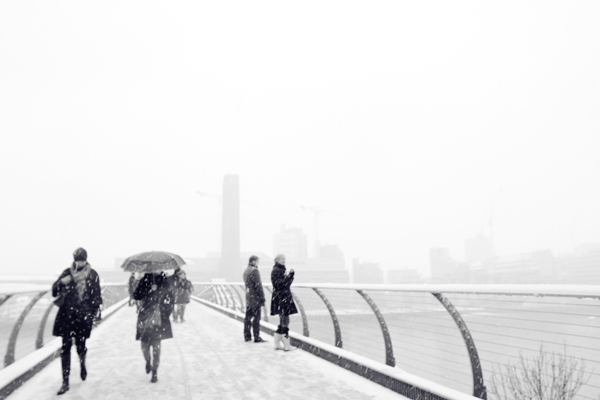
Says the photographer, Ben Bibriesca: “Instead of spending another lazy weekend in, my flatmate and I decided to plan a trip to the Tate Modern. Unfortunately due to the snow, all our friends dropped out. We decided to still go but spent more time outdoors taking photos in the snow then at the actual museum. This shot was taken right before we crossed the bridge to get to our destination. I just loved the way everything was snow covered and white.” For more of Ben’s work, see www.flickr.com/photos/benbibriesca/.

Taken an interesting photograph of somewhere in London? We’re always looking for interesting images of the city so if you’ve got one you reckon captures a snippet of life in London, please contact us at exploringlondon@gmail.com or via Flickr at www.flickr.com/groups/exploringlondon/.

What’s in a name?…Richmond

It was King Henry VII, father of King Henry VIII, who brought the name Richmond to London.

Richmond-PalaceInheritor of the title of the Earl of Richmond (the title relates to lands in Yorkshire and centres on the castle of Richmond), on being crowned king, Henry VII gained the use of Sheen (or Shene) Palace located on the banks of the Thames, about seven miles south west of Westminster (the history of which we’ll look at in greater detail in an upcoming post).

Sheen Palace was largely destroyed in a fire in 1497 and the king gave orders for it to be rebuilt (Richmond Palace is pictured here – found on a sign at Richmond). It was on its completion in around 1502 that Henry decided to rename the palace after his former earldom – Richmond.

The name Richmond, by the way, comes from a French word for ‘old hill’.

The once separated town of Richmond is now at the centre of the London Borough of Richmond upon Thames (it became a municipal borough in 1890) and a popular residential suburb for London’s wealthy (among those who have lived there are Mick Jagger and Jerry Hall) – sought after for its riverside amenity, quaint village green, and panoramic views from Richmond Hill as well as its fine shopping and dining.

Richmond’s other great drawcard is Richmond Park, one of the city’s eight Royal Parks, and home to more than 600 deer (see our earlier entry on it here).

London Pub Signs – The Gun…

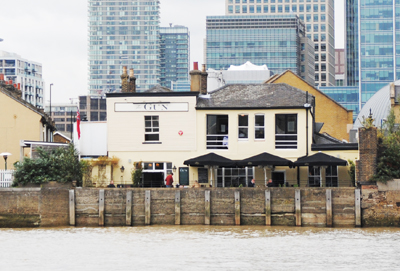
This Docklands pub – the site of which has hosted a public house for more than 250 years – is located in an area where iron foundries were once employed to produce cannons for the Royal Navy’s many ships of the line.

The-GunBut according to the pub’s website (and a plaque outside the building), the name comes from something much more specific – the cannon which was fired at celebrations surrounding the opening of the West India Import Docks in 1802.

And that’s not only historical link this Grade II-listed pub (seen here from the Thames) has with the navy. Heroic naval figure Vice Admiral Horatio Lord Nelson, who lived just up the road and was a frequent visitor to the docks, was apparently a regular at the pub where he was secretly meet with his mistress Lady Emma Hamilton (the room they met in is now called The River Room).

There’s also a history of smugglers operating out of the pub and a still present spyhole is said to have been used to watch for revenue officers.

In 2001 much of the interior of the pub was destroyed in a fire. It remained closed for three years before brothers Tom and Ed Martin bought the building and undertook a painstaking restoration in consultation with English Heritage, reopening the building’s doors in 2004.

As well as its historical associations, The Gun now boasts a couple of bars and dining rooms and  riverside terrace. During summer, the pub also opens a second terrace area under a Portuguese barbeque theme – A Grelha at the Gun.

For more on The Gun (located at 27 Coldharbour in the Docklands), see www.thegundocklands.com.

Where is it?…#54

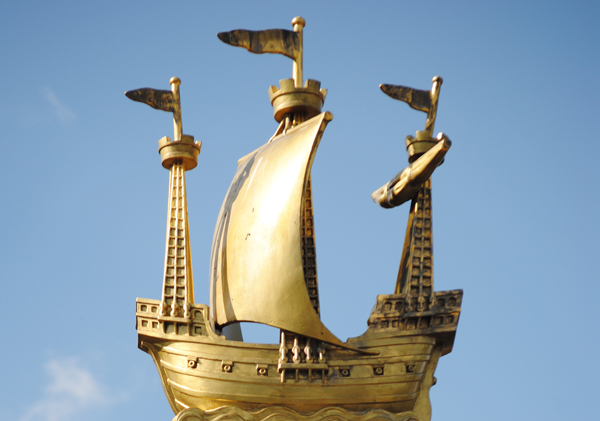
Where-is-it--#54The return for 2013 of our series in which we ask you to identify where in London this picture was taken. If you think you can identify this picture, leave a comment below. We’ll reveal the answer early next week. Good luck!

Thanks for the comments Parktown but this ship is not in Rotherhithe nor does it have anything to do with Lloyds! This is part of the decorative scheme of Chelsea Bridge which crosses the Thames between Chelsea and Battersea Park in London’s west. Initially known as Victoria Bridge, the first bridge here opened in 1857 (Albert Bridge, which opened later, is located further west). But increased traffic eventually led to its demolition in the 1930s (it had been renamed some years earlier to avoid the association of a royal name with a bridge which had become structurally unsound) and the current bridge, the first self-anchored suspension bridge (that is, the suspension cables attach to the deck and don’t extend to the ground) in Britain, was opened on the site in 1937. This gilt galleon sits atop a decorative lamp post at the bridge’s entrance (there are several) and below it is the coat-of-arms of the now defunct London County Council.

Lost London – Frost fairs…

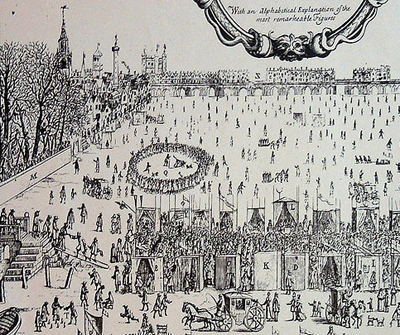
 As London undergoes the big chill with much of the rest of the country, we thought we’d take a quick look at the frost fairs which were once held on top of the frozen River Thames.

While records reveal the Thames froze over as far back as the city’s Roman era, the first recorded ‘frost fair’ dates from the mid-16th century (Queen Elizabeth I is said to have attended one in 1564) while the last was held in 1814.

Frost_Fair_of_1683While the lower temperatures played a role in allowing the ice to get thick enough to hold frost fairs on top (the period between the 14th and 19th centuries is known as the ‘Little Ice Age’ in northern Europe), so too did the fact that the Thames was broader and shallower than it is now, not to mention the narrow arches of Old London Bridge (it was demolished in 1831 – for more on this, see our earlier entry) which slowed the waters of the Thames.

The fairs were set up in a range of locations along the river. Descriptions of them talk of a range of activities being carried out on the river’s frozen surface – yes, the use of sleds and skates but also things like bear-baiting, coach, horse racing, dancing and puppet plays as well as the setting up of booths or stalls from which traders sold food, souvenirs, and, importantly, drink.

One of the longest of the fairs – recorded by diarist John Evelyn – was held over the winter of 1683-84 and located between Temple and Southwark. It featured streets of stalls with different traders grouped in different areas. King Charles II himself was a visitor.

During the last and biggest frost fair, held on the river near Blackfriars Bridge, a street known as ‘City Road’ ran down the middle of the Thames and donkeys gave people rides.

There is a frieze depicting a ‘frost fair’ underneath the southern end of Southwark Bridge.

PICTURE: Detail of an image of the Frost Fair of 1684 with London Bridge in the background. Source: Wikipedia.

Where’s London’s oldest…Thames tunnel?

While the Greenwich foot tunnel may these days be more well-known due to the fact it is still open to pedestrians, London’s oldest under-Thames tunnel (also credited as the oldest underwater tunnel in the world) actually runs between Rotherhithe on the river’s southern bank and Wapping on the northern.

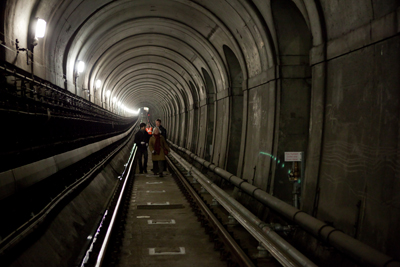
Thames_Tunnel-in-2010First opened in 1843, the Thames Tunnel (pictured left during a brief reopening to pedestrians in 2010) was the first major project of star Victorian engineer (and delightfully named) Isambard Kingdom Brunel (who, at the age of just 19 started work on the job with his father, a French engineer named Marc Isambard Brunel) and was known for a time as the eighth Wonder of the World.

It was constructed after demand grew for a way to transport goods across the crowded Port of London to the east of London Bridge. Given the height of the masts of larger ships, a bridge was deemed impracticable with the ramps required to take wheeled transport to the necessary height far too long (although this problem was overcome at the end of the 1800s by the use of new bascule technology in the construction of Tower Bridge).

Following several failed attempts to dig a tunnel under the Thames, Marc Brunel was given permission to build the new tunnel in the mid 1820s. The project relied on the use of a ‘tunnelling shield’, a then state-of-the-art technological solution to under river tunnelling which had only a few years earlier been patented by Marc Brunel and Thomas Cochrane, and Brunel initially thought the project would only take three years (it ended up taking as many as 18).

Construction by the newly formed Thames Tunnel Company, which had the support of none other than the Duke of Wellington, commenced in early 1825 at the Rotherhithe end. The shield enabled miners to dig out the tunnel while bricklayers came along behind them. While it significantly reduced the risk of a collapse (although several floods still did occur, taking the lives of six men – a fact which didn’t apparently much deter the sightseers who paid for the privilege of seeing the shield in operation), working conditions remained terrible with the men constantly showered with water from the river which was at that time the city’s main sewer. How many died indirectly as a result of working on the project is unknown.

Brunel-plaqueIndeed, such was the stress of the project that Marc Brunel, later knighted for his efforts in building the tunnel, himself suffered a stroke during its construction. Isambard Brunel, who took over as the project’s engineer when the resident engineer fell ill in 1826, himself came close to being killed when he had to flee the flooding tunnel.

After much delay (including seven years in which the unfinished tunnel was left untouched) and several more disasters, the tunnel was finally completed in November, 1841.

After being fitted out with lighting, spiral staircases and roads in the following years, it was finally opened to pedestrians only on 25th March, 1843. While it was originally envisaged that the primary purpose of the tunnel would be to transport goods under the river, this never occurred.

Still, it did capture the public’s attention and as many as 50,000 people walked through the tunnel on the opening day (among the initial visitors to the tunnel was Queen Victoria herself). Within 10 weeks of its opening, a million people (a figure equal to what was then half the population of London) had reportedly passed through it.

Despite the number of people initially using it, however, the tunnel was still not a financial success and over the ensuing years became noted as a gathering place for unsavoury types. In 1865 it was purchased by the East London Railway Company which subsequently incorporated the tunnel into its railway network with both the Wapping and Rotherhithe entrance shafts converted into stations. It later become part of the London Underground network – the  – and since 2010 has been part of the London Overground.

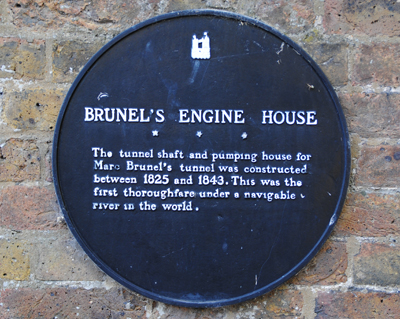
Both stations are still in use and you can get a good sense of what the tunnel was like by riding the overground between Rotherhithe and Wapping. The Brunel Museum in Rotherhithe – actually housed within a building originally used to house machinery for draining the tunnel – see plaque above – is also a great place to find out more about the project and Brunel. Visit www.brunel-museum.org.uk for details.

PICTURES: Top – Lars Plougmann (Wikipedia)/Other – David Adams

For more on the life of Brunel, see Steven Brindle’s Brunel: The Man Who Built the World.

Exploring London’s 10 most popular posts for 2012 – 4 and 3…

4. Around London – Olympic Rings unveiled on Tower Bridge; London from above; Blake on Primrose; V&A illustrations; and, Munch at the Tate Modern. More on an Olympic theme.

3. LondonLife – Florence Nightingale remembered. A piece mentioning the annual service at Westminster Abbey commemorating the life of the ‘Lady with the Lamp’. Part of our LondonLife series.

Lost London – Old St Paul’s Chapterhouse…

We’re yet to take an in-depth look at Old St Paul’s Cathedral – that is, the building that stood on the existing site before being destroyed in the Great Fire of London in 1666 – but today we thought we’d focus on just one aspect of the former church – the old chapterhouse. 

Located in the South Churchyard on the Thames side of St Paul’s Cathedral, the location of the chapterhouse is today marked out by raised stonework (the actual building remains lay a few feet below) which can be freely accessed from the street.

The octagonal chapterhouse, which replaced an earlier chapterhouse, stood in the middle of a 100 foot square arcaded cloister, both of which were designed by the royal mason, William Ramsay, in 1332 during the reign of King Edward III, in one of the first known examples of what is referred to as the ‘Perpendicular Gothic’ style.

Designed as a two-storey building for better air circulation, the actual chapter room was located on the second floor of the chapterhouse over an undercroft below and it was here the monks would meet daily to discuss affairs relating to the cathedral (the word chapterhouse comes from the fact that it was while in this room the monks would be a read a daily chapter from the body of rules governing them).

The marked out chapterhouse (pictured above – the chairs are standing inside the chapterhouse) was unveiled in 2008 following a £3.8 million redevelopment of the South Churchyard, itself part of the bigger, recently completed, overhaul of the entire cathedral).

WHERE: South Churchyard, St Paul’s Cathedral (nearest tube station is St Paul’s); WHEN: Anytime;  COST: Free  (to go inside the cathedral costs £15 an adult/£14 concessions and students/£6 a child (6-18 years)/£36 a family of four); WEBSITE: www.stpauls.co.uk

Lost London – Bridewell Palace…

Built in the 16th century for King Henry VIII, Bridewell Palace only had a short-lived life as a royal residence before it was handed over to the City of London and used as a poorhouse and prison.

Located on the western bank of the Fleet River (the site is now occupied by Unilever House and remembered in the place names of Bridewell Place and Bridewell Court), the palace – named for a holy well located nearby which was dedicated to St Bride  (St Brigid) – was built on the direction of the king’s key advisor Cardinal Thomas Wolsey between 1510-15 on land which had previously been the site of St Bride’s Inn.

In 1515 Cardinal Wolsey gave it to King Henry VIII after taking up residence at Hampton Court and York Place  – Henry was looking for a royal residence in London after the Palace of Westminister was largely destroyed in a fire in 1512. Work continued on the palace until its completion in 1523.

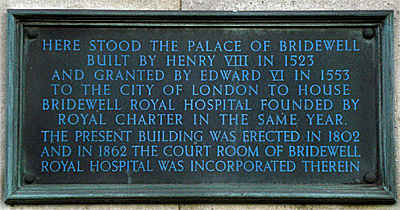
The palace, the site of which is now marked with a plaque on the approach to Blackfriars Bridge, consisted of two courtyards surrounded by brick buildings with the three storey royal lodgings (separate quarters for the king and queen) located around the inner courtyard and entered by a grand staircase from the outer courtyard. It also featured a watergate was located on the Thames and, interestingly, Bridewell was the first royal palace not to have its own great hall.

Among historic events hosted here was the visit of the Holy Roman Emperor Charles V in 1522 (the emperor did not stay here but his entourage did). In 1528 meetings of the papal delegation took place at Blackfriars (located next door and joined by a specially built gallery) to discuss the king’s divorce from Queen Katherine of Aragon – it’s here that the Queen made her most famous speech declaring her fidelity to the king – and for its duration the king and queen lodged at Bridewell. It’s also said that it was at Bridewell Palace that artist Hans Holbein the Younger painted his famous work – The Ambassadors (see our earlier post on this here).

Following Cardinal Wolsey’s fall from favor in 1529, King Henry VIII no longer used the property (he took over the Palace of Whitehall, then known as York Place, as his main residence in 1530 – for more on this see our earlier post here). It was leased for much of the following decade to the French ambassador in London before, following petitioning for a new hospital for the poor from Nicholas Ridley, the Bishop of London, King Edward VI gave it to the City of London in 1553. They took over fully in 1556 and converted the palace into a prison, hospital and workrooms (we’ll deal in detail with the prison in an upcoming post).

Where is it?…#49

The latest in the series in which we ask you to identify where in London this picture was taken and what it’s of. If you think you can identify this picture, leave a comment below. We’ll reveal the answer early next week. Good luck!

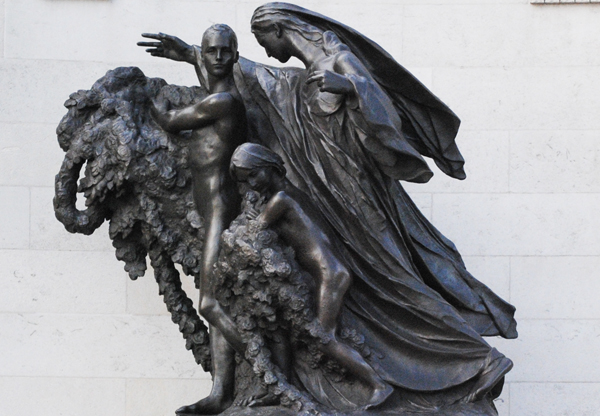
Sunday was Remembrance Day, so we thought it appropriate to have a war memorial as last week’s Where is it? This memorial, located at Victoria Embankment on the north bank of the Thames, is the Anglo-Belgian War Memorial, given in 1920 as a gift to Britain by the people of Belgium as a thank you for their help in providing a refuge in England during World War I. The work of celebrated Belgian sculptor Victor Rosseau, it features three bronze figures – a Belgian mother, a boy and a girl, the latter two carrying garlands – and although you can’t see it in this picture, there’s two figures behind them on the Portland stone surround representing ‘honour’ and ‘liberty’.

Around London – Lord Mayor’s Show; Remembrance Sunday; Ansel Adams at the NMM; and, Mughal India at the British Library…

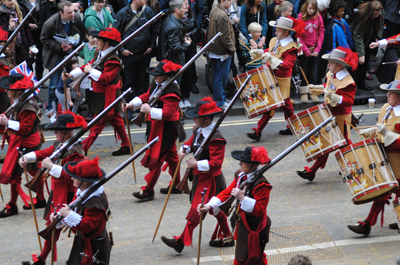
• The 2012 Lord Mayor’s Show is just about upon us and while you may not have a grandstand seat, there’s still plenty of places you can stand and watch the parade of more than 6,500 people pass by. Saturday’s parade – which celebrates the election of the 685th Lord Mayor of London, Alderman Roger Gifford – leaves Mansion House at 11am and travels via Poultry and Cheapside to St Paul’s Cathedral where it pauses for the Lord Mayor and his officials to receive a blessing – before continuing on via Ludgate Hill and Fleet Street to the Royal Courts of Justice, arriving there at about 12.30pm. There the Lord Mayor gives his oath of loyalty to the Crown (while in the surrounding streets the participants and 125 horses are fed and watered) before the parade reassembles and sets off from Embankment at 1pm, heading back to Mansion House via Queen Victoria Street – the Lord Mayor arrives sometime between 2pm and 2.30pm. (The website has a terrific one page map of the route you can download and print). There’s no fireworks display after the parade – although there’s a host of other activities taking place in the City of London – but if you’re up and about early enough, you may want to watch the Lord Mayor as he boards the barge QRB Gloriana at the Westminster Boating Base in Vauxhall at 8.30am and, escorted by a flotilla, makes his way up the Thames to HMS President, just below St Katharine Docks, arriving at about 9.35am after Tower Bridge opens in salute. For more, head to www.lordmayorsshow.org.

• The annual Remembrance Sunday service – commemorating the contribution of British and Commonwealth servicemen and women in the two World Wars and later conflicts – will take place at the Cenotaph on Whitehall at 11am this Sunday. While no tickets are required to watch the event, the Department of Culture, Media and Sport, who organise the service, advise arriving early if you wish to secure a good viewing space (and leave time for security checks at the entrance to either end of Whitehall). Whitehall opens at 8am. For more details, see www.culture.gov.uk/what_we_do/honours/3333.aspx.

A new exhibition of the work of US photographic pioneer Ansel Adams opens at the National Maritime Museum in Greenwich tomorrow (Friday). Ansel Adams: Photography from the Mountains to the Sea, which comes from the Peabody Essex Museum in Salem, Massachusetts, will feature more than 100 original prints, many of which have never been exhibited before in the UK. It is said to be the first exhibition to focus on his “lifelong fascination” with water and the display features some of Adams’ finest images based on this subject including what are some of the most famous photographs of the 20th century. Highlights include the first photograph Adams’ ever image – taken at age 14 – which features a pool located at the Panama Pacific Exhibition at the 1915 World’s Fair, the three American Trust murals produced in the 1950s on an “unprecedented scale”, Adam’s favorite work – Golden Gate before the Bridge – which hung above his desk, and iconic images such as Clearing Winter Storm, Yosemite and Stream, Sea, Clouds, Rodeo Lagoon, Marin Country, California. There is an admission charge. Runs until 28th April. For more details on the exhibition, see www.rmg.co.uk.

Also opening tomorrow (Friday) is the British Library’s major autumn exhibition – Mughal India: Art, Culture and Empire. The exhibition focuses on the Mughal dynasty – which once ruled over much of the Indian sub-continent – and is the first to document the period spanning the 16th to 19th centuries. Featuring more than 200 manuscripts and paintings, most of which come from the library’s own collection, highlights include Akbar ordering the slaughter to cease in 1578 – a work attributed to the artist Miskina in 1595, Abu’l Hasan’s early 17th century painting Squirrels in a plane tree, the historically important illustration Prince Aurangzeb reports to the Emperor Shah Jahan in durbar, and a portrait of Prince Dara Shikoh, favorite son and heir-apparent of 17th century Emperor Shah Jahan. Runs until 2nd April. Admission charge applies. For more on the exhibition and accompanying events, see www.bl.uk.

London Pub Signs – Doggett’s Coat and Badge…

Perhaps not so much a sign as a pub name, the strangely monikered Doggett’s Coat and Badge in South Bank is named after a rowing race – said to be the oldest continuous sporting event in the country – in which apprentice waterman traditionally competed for a prize consisting of waterman’s coat and badge and named after Irish-born actor and theatre manager, Thomas Doggett.

The race – which is held in July and runs over a course of four miles and seven furlongs from London Bridge to Chelsea (the starting and finishing points were originally both marked by pubs called The Swan) – was first held in 1715 when it was first organised by Doggett who financed it up until his death in 1721 after which he left instructions in its will for it to be carried on by The Fishmongers’ Company (which it still is today).

While there’s a nice story that Doggett, who managed the Drury Lane Theatre and later the Haymarket Theatre and carving out a name for himself as a ‘wit’, started the race as thanks to Thames watermen for rescuing him when he fell off a watercraft while crossing the Thames, Doggett – a committed Whig – actually started the race to commemorate the ascension of King George I – the first ruler of the House of Hanover – on 1st August, 1714, following the death of Queen Anne.

This year’s race winner was Merlin Dwan (London Rowing Club) who beat four others to finish in 24 minutes, 28 seconds.

The pub, one of the Nicholson franchise, is located in a multiple storey modern building complex and sits along the course of the race in South Bank. It features a range of bars including Thomas Doggett’s Bar and the Riverside Bar as well as a dining room and other function rooms.

For more on the pub, see www.nicholsonspubs.co.uk/doggettscoatandbadgesouthbanklondon/. For more on the race (which we’ll be mentioning, along with more on Thomas Doggett, in more detail in upcoming posts), see www.DoggettsRace.org.uk.

LondonLife – Flying over the Thames by night…

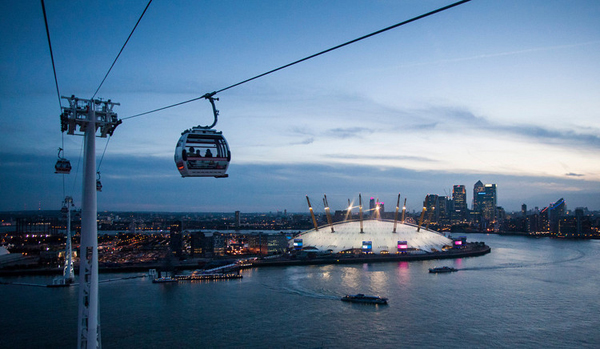
Sailing high over the River Thames between North Greenwich in the river’s southern bank and the Royal Docks on the river’s northern bank is the cable car formally known as the Emirates Air Line. Opened in late June and running every day, the cable car – the UK’s first in an urban area – is operated by Transport for London and links into the Underground and Docklands Light Rail network. Travelling at about 90 metres above the ground along a course of more than half a mile, passengers can take in the City, Docklands, Greenwich and as far eastward down the river as the Thames Barrier. This image, which shows the 02 Arena in the background, was taken just after the Closing Ceremony of the Olympic Games in August. For more, see www.emiratesairline.co.ukPICTURE: © Transport for London

Where’s London’s oldest…bridge over the Thames?

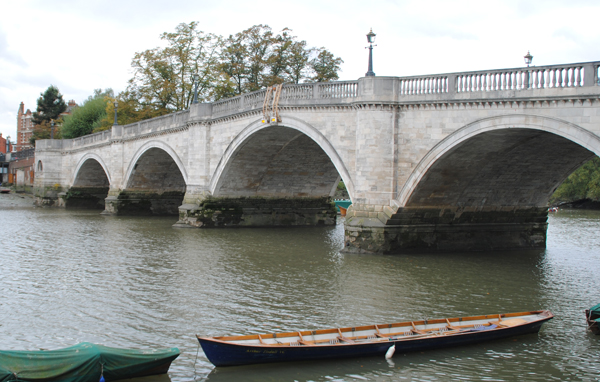
While there’s been a bridge over the River Thames near where London Bridge now stands since Roman times, the bridge which is currently there was built in the early 1970s. To find Greater London’s oldest surviving bridge across the Thames we have to head to Richmond in the city’s west.

The 300 foot long stone arch bridge, made from Portland stone, was built between 1774-77 and replaced a ferry crossing between Richmond to the east and East Twickenham to the west (this had apparently been in operation since shortly after the Norman Conquest and at the time it was discontinued consisted of two vessels – a passenger craft and a ‘horse boat’).

Designed by James Paine and Kenton Couse and built by Thomas Kerr, the bridge features five arches including a 60 foot wide central span which was big enough for larger watercraft and gave the bridge its rather humpbacked appearance. Its construction was privately funded with the £26,000 required to build the bridge partly raised via tontine schemes under which subscribers paid an agreed sum into a fund after which they each receive an annuity, the value of which increases as members of the fund die off.

Initially a toll bridge (the tolls – which were 1/2d for passengers and up to 2s 6d for coaches drawn by six horses – were ended in 1859 when the last tontine shareholder died), the bridge was widened in the late 1930s but – now a Grade I listed structure – remains essentially true to its original design.

It was the eighth bridge to be built across the the Thames in Greater London but is now the oldest still standing (among those which predated it but have been demolished are London Bridge, Westminster Bridge and Blackfriars Bridge) and has been featured in paintings by the likes of  Thomas Rowlandson, John Constable and JMW Turner.

10 Historic London Markets – 3. Billingsgate Market…

Now the UK’s largest inland fish market (and located in Poplar, east London), the history of Billingsgate Market goes back centuries.

Known originally by various spellings including Blynesgate and Byllynsgate, Billingsgate may have been named for watergate on the north bank of the Thames near where the market was originally established (an alternate theory is that it was named for a man named Biling or an mythological British king, Belin).

The right to collect tolls and customs at Billingsgate, along with Cheap and Smithfield, was granted by King Henry IV in 1400.

Billingsgate only became particularly associated with fish in the 1500s and in 1699, an Act of Parliament was passed making it “a free and open market for all sorts of fish whatsoever” (this was with the exception of eels, restricted to being sold by Dutchmen from boats in the river – a reward for the help they provided after the Great Fire of 1666).

While for much of the market’s history, fish was sold for stalls and sheds around the ‘hythe’ or dock at the site known as Billingsgate, in 1850 the first purpose-built market building was constructed in Lower Thames Street.

Deemed inadequate for the task at hand, however, it was demolished after slightly more than 20 years of service. A new building, designed by then City Architect Sir Horace Jones and constructed by John Mowlem, was opened in on the same site in 1876. In the late 19th century, it is said to have been the largest fish market in the world. The heritage listed former fish market building in Lower Thames Street (pictured above) is now used as a venue for corporate events, catwalk shows, post premiere parties and concerts (see the website for more www.oldbillingsgate.co.uk).

In 1982, the market was relocated to a 13 acre site on the Isle of Dogs, just to the north-east of Canary Wharf. The building contains a trading floor with some 98 stands and 30 shops as well as an 800 tonne freezer store. An average of 25,000 tonnes of fish and fish products are sold through its merchants every year and the market has an annual turnover of around £200 million.

The role of the fish porter – who traditionally have been the only people licensed to move fish around the market – was opened up to anyone following a fiercely fought battle between the porters, traders and the City of London Corporation earlier this year.

The market is open to the general public and tours can be arranged – head to the website for details.

WHERE: Billingsgate Market, Trafalgar Way, Poplar (nearest Tube Station is Canary Wharf); WHEN: 4am to 9.30am Tuesday to Saturday (children under 12 are not permitted on the market floor and non-slip shoes are advisable); COST: Free; WEBSITE: www.cityoflondon.gov.uk/business/wholesale-food-markets/billingsgate/Pages/default.aspx.

LondonLife – Canary Wharf skyline…


Skyline of Canary Wharf, Docklands, east London. Taken from a ferry on the Thames. Canary Wharf is one of the city’s main financial districts and is centred around One Canada Square (pictured with the pyramidal top), formerly the tallest building in the UK (it has been surpassed by The Shard).

Around London – Open House London; 16th century tankard at MoL Docklands; and, Spanish artists shine at the British Museum…

It’s Open House London weekend and that means your chance to enter scores of buildings not normally open to the public. More than 750 buildings are taking part in this, the 20th year the weekend has been held and there’s also an extensive program of free talks, walks and specialist tours. Among the buildings open this year are the iconic Gherkin building in the City (formally known as 30 St Mary Axe, pictured), Heron Tower in Bishopsgate, numerous livery company halls including that of the Apothecaries, Fishmongers and Carpenters, government buildings including Marlborough House, Westminster Hall, and the Foreign Office and numerous historic residences from the Mansion House, home of the Lord Mayor of London to Osterley Park House in west London. Among the events on offer is a moonlit hike through London tomorrow night to raise money for Maggie’s Cancer Caring Centres and rides on the new Emirates Airline cable car as well as boat tours to the Thames Barriers. If you didn’t order a guide, you can see the program online at the Open House London website – www.londonopenhouse.org. PICTURE: (c) Grant Smith/VIEW Pictures

A 16th century wooden tankard, found by a mudlark on the Thames foreshore near Ratcliff in London’s east, has briefly gone on display at the Museum of London Docklands. The large vessel, capable of holding three pints, has the initials RH inscribed on the base. It’s unknown for what purpose it was used, perhaps serving as a decanter rather than for individual use and may have been used on a ship. The vessel will be on display at the museum only until 27th September. For more, see www.museumoflondon.org.uk.

On Now: Renaissance to Goya: Prints and drawings from Spain. Opening at the British Museum today is this new exhibition featuring important prints and drawings by Spanish and other European artists working in Spain and spanning a period from the mid 16th century through to the 19th century. While all the works are drawn from the museum’s collection, many have never been on display before. The artists represented include Diego Velazquez, Alonso Cano, Bartolome Murillo, Francisco Zubaran and Jusepe de Ribera as well as Francisco de Goya. Held in room 90. Admission is free. Runs until 6th January. For more, see www.britishmuseum.org.

10 Historic Sporting Events in London – 10. The first Peter Pan Cup…

In this, the final in our series on historic sporting events in London we take a look at the first time the Peter Pan Cup was presented at the annual Serpentine Swimming Club’s Christmas Day race in Hyde Park.

While the origins of the annual 100 yard Christmas Day day race – and the club itself – go back to 1864, it wasn’t until 1904 that author JM Barrie (writer of Peter Pan, or The Boy Who Wouldn’t Grow Up and later knighted), first presented the Peter Pan Cup to the race’s winner (Peter Pan was first performed at the Duke of York’s Theatre the same year). Previous winners had received a gold medal.

Barrie’s involvement apparently came from the fact that he lived nearby in Bayswater and had often seen the swimmers.

The race, which starts at 9am on Christmas Day on the south side of the Serpentine near the cafe, is only open to club members (so don’t turn up expecting to be able to join in) and operates on a handicap system (pictured are swimmers in the 2009 race). Last year’s winner was Neil Price.

It’s worth noting that while this is the club’s most famous event, members swim every weekend throughout the year.

For more on the Serpentine Swimming Club, see http://serpentineswimmingclub.com/.

PICTURES: Serpentine Swimming Club