Lost London – King Edward III’s Thames-side manor house…

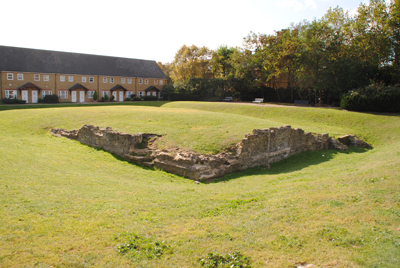
The remains of one of the lesser known former royal residences in London, King Edward III’s manor house, sit amid a grassy park on the south bank of the Thames at the corner of Bermondsey Wall East and Cathay Street in Rotherhithe.

Believed to have been built in about 1350 during the reign of the king (1312-1377), the 14th century property – which consisted of stone buildings arranged around two courtyards – was originally built on what was then an island surrounded by marshes.

The premises was surrounded on three sides by a moat – the fourth side opened directly to the river, allowing the king to travel to the property by boat.

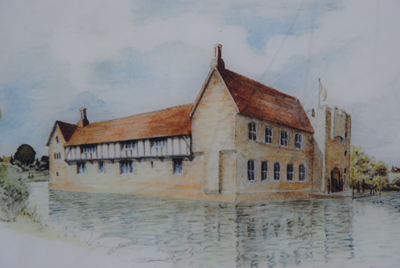
Among the buildings in the complex were a hall with a fireplace as well as private chambers for the king and utility spaces like kitchens (pictured below is a reconstruction of the property as depicted on an information plaque located at the site).

The function of the building remains somewhat a mystery – with no nearby royal parks it is unlikely it was a conventional hunting lodge although documentary evidence does point to falcons being house there so perhaps it was a place where the king hunted with falcons.

As the Thames riverbank was pushed northward over the following centuries, the residence became completely surrounded by a moat. It was eventually sold into private hands.

The site was apparently used as a pottery in the 17th century and warehouses occupied it in the 18th and 19th centuries (in fact a 14th century wall was incorporated into one of these and was still standing in 1907).

The warehouses were demolished in the 1970s and the remains of the palace confirmed on the site during an excavation by English Heritage 1985 (they also found a lot of Delftware on the site apparently related to its days as a pottery).

Around London – Europe’s oldest intact book at British Library; 100 days to the Games; world’s largest archaeological archive; the London Marathon; and, Turner at the National Gallery…

• The British Library has paid £9 million for a 7th century text, the St Cuthbert Gospel, which is also the oldest intact European book. The acquisition follows the library’s most successful fund-raising effort ever – it included a £4.5 million grant from the National Heritage Memorial Fund. The book – a Gospel of John bound in beautifully tooled red leather – was produced in north-east England in the late 7th century and was placed in the saint’s coffin after his death on the Isle of Lindisfarne in 698. It was retrieved when the coffin was opened at Durham Cathedral in 1104. The Gospel is on display in the Sir John Ritblat Treasures Gallery at the library in St Pancras and following a conservation review, it is anticipated it will soon be displayed with the pages open for the first time. There will be a public event celebrating the acquisition on 15th May. For more, see www.bl.uk/whatson/events/may12/index.html.

• London this week marked 100 days until the Opening Ceremony of the 2012 Olympic Games. This included unveiling the latest installation of the Olympic rings – made of 20,000 plants the 50 metre long rings are located in the Royal Botanic Gardens at Kew in the city’s west and can be seen from planes on the Heathrow flight path. The organising committee also announced the Red Arrows aerobatic display team will perform a nine-ship flypast in ‘big battle’ formation on the day of the Opening Ceremony (27th July) and stated that the games motto will be ‘Inspire a Generation’. For more, see www.london2012.com.

• The Museum of London’s archaeological archive – known as the London Archaeological Archive and Research Centre (LAARC) – is officially the largest in the world according to Guinness World Records. The archive contains more than five million artefacts and the records of almost 8,500 excavations dating back to 1830. Items in the archive include shoes dating back to Roman times, a 200-year-old set of false teeth, ‘witching bottles’ including one with human hair and toenails, and coffin plates from London’s cemeteries. The world record has been recorded as part of World Record London, a series of world record breaking events being held in the run-up to the Olympics. Others have included the Faberge Big Egg Hunt.

• Thousands of people are expected to take part in the Virgin London Marathon this Sunday. The 26.2 mile route starts in Blackheath, passes through Woolwich and Greenwich and crosses the Thames at Tower Bridge before looping around the east end of London, through Canary Wharf, and the west along The Highway (formerly known as The Ratcliffe Highway) and Embankment to Parliament Square, Birdcage Walk and finally to Buckingham Palace. The first London marathon was run in 1981. For more, see www.virginlondonmarathon.com.

• On Now: Turner Inspired – In the Light of Claude. The first major presentation of 17th century artist Claude Gellée’s influence on the English romantic artist J M W Turner, the exhibition focuses on Claude-inspired themes which run through Turner’s work including “the evocation of light and air in landscape, the effect of light upon water and his often radical reworking of contemporary scenes”. The display includes works from large scale oils on canvas through to leaves from Turner’s pocket sketchbooks. Interestingly, the exhibition also explores the story behind the so-called Turner Bequest – that on his death, Turner linked himself to Claude forever by leaving the National Gallery two pictures – Dido building Carthage (1815) and Sun rising through Vapour: Fishermen cleaning and selling Fish (before 1807) –  on condition that they were hung between two pictures by Claude, Seaport with the Embarkation of the Queen of Sheba (1648) and Landscape with the Marriage of Isaac and Rebecca (1648). Runs until 5th June. Admission charge applies. For more, see www.nationalgallery.org.uk.

Celebrating the Diamond Jubilee with 10 royal London locations – 1. The Queen’s birthplace

This week we start a new series in honour of this year being the Diamond Jubilee of Queen Elizabeth II. We’ll be looking at locations across the city which have played an important role in the story of the Queen. First up, it’s the Queen’s birthplace – a now non existent townhouse in Mayfair.

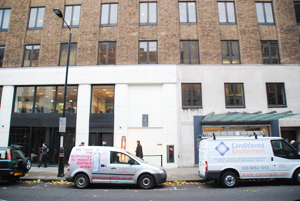
The property at 17 Bruton Street, which is marked by a small plaque installed in 1977 – the Queen’s Silver Jubilee (it’s in the middle of the image to the right), was actually the home of the Queen Mother’s parents, the Earl and Countess of Strathmore. It and the neighbouring townhouse at 18 Bruton Street have both been demolished and replaced with a rather bland office building.

Born here at 2.40am on 21st April, 1926, the Queen, named Elizabeth Alexandra Mary, was the first child of the then Duke and Duchess of York (later King George VI and Queen Elizabeth). At her birth, Queen Elizabeth II was only third in line to the throne after her uncle, the Prince of Wales (later, briefly, King Edward VIII), and her father.

The Queen’s grandparents, King George V and Queen Mary, both visited the newborn child at the property (along with an apparently large crowd outside). Elizabeth was christened five weeks later at the Chapel Royal in Buckingham Palace. She spent the first few months of her life living in a room at 17 Bruton Street which had been previously used by her mother before her marriage.

Recent books on the Queen include Andrew Marr’s  The Diamond Queen: Elizabeth II and Her People, the souvenir album Queen Elizabeth II: A Diamond Jubilee Souvenir Album, and Sarah Bradford’s Queen Elizabeth II: Her Life in Our Times.

• Correction: Bruton Street was mistakenly copied here as Brunton Street. It has been corrected. Apologies for the error!

LondonLife – All is revealed at Hampton Court Palace

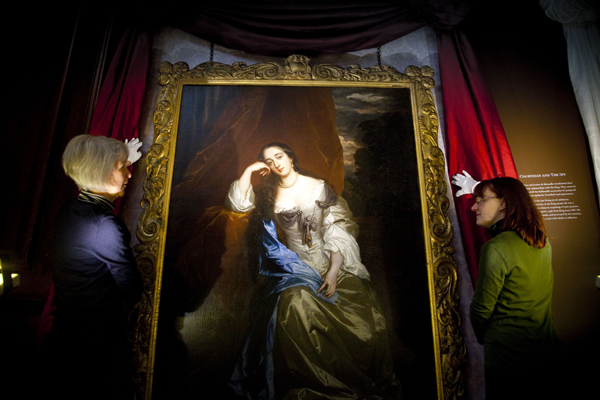
A portrait of King Charles II’s mistress, Barbara Villiers, is put into place ahead of The Wild, The Beautiful and the Damned exhibition which opened at Hampton Court Palace earlier this month. The portrait, which dates from about 1662, was painted by Sir Peter Lely – he also painted a picture King Charles II’s other principal mistress, Nell Gwyn, which is being shown together with the Villiers portrait for the first time. The exhibition, which focuses on the beauty, mistresses and debauchery of the Stuart Court, spans the reigns of the Stuarts from Charles II to Queen Anne and looks at how kings, queens and courtesans “swept away the Puritanical solemnity of the mid-17th century, and attempted to rewrite the moral code of social behaviour”. Runs until 30th September (admission is included in entry ticket; free to Historic Royal Palaces members). There are late openings on the first Monday of each month and note that the exhibition includes adult content. For more, see http://bit.ly/HvyiOE.

PICTURE: Richard Lea-Hair/newsteam.

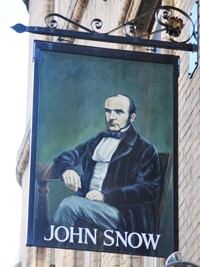
London Pub Signs – The John Snow

Located on the corner of Broadwick and Lexington Streets in Soho, this pub is named for the man who, through his meticulous research, was able to show that London’s cholera epidemic of 1854 was the result of a contaminated water supply.

A physician then working in London, John Snow didn’t believe in the current theory that diseases such as cholera were caused by bad air and instead, through a study looking at where those affected by the disease in 1854 lived and obtained their water, was able to pinpoint a water pump in what was then Broad Street (the ‘wick’ wasn’t added to the street’s name until the 1930s) as the original source.

The pump, which initially apparently stood just outside the pub, is now located down the street. A pink granite curbstone outside the side door of the John Snow pub and plaque on the pub wall mark where the pump formerly stood.

The building housing the pub dates from the 1870s and the pub was apparently initially called the Newcastle-upon-Tyne but this was formally changed to John Snow in May, 1955, to mark the centenary of Snow’s research into the 1854 epidemic.

For a terrific book about John Snow’s work, see Steven Johnson’s The Ghost Map: A Street, an Epidemic and the Hidden Power of Urban Networks.

Where is it? #24

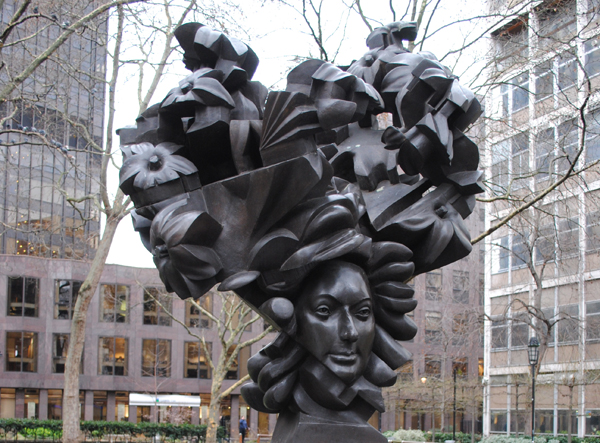
The latest in the series in which we ask you to identify where in London this picture was taken and what it’s of. If you think you can identify this picture, leave a comment below. We’ll reveal the answer early next week. Good luck!

Must have been a tough one because we only had one taker – Sue Kendrick – who was correct in saying that this was the memorial to 17th century English composer Henry Purcell located in Christchurch Gardens on Victoria Street (yes, near Scotland Yard!). The rather florid memorial, sculpted by Glynn Williams, was unveiled by Princess Margaret on 22nd November, 1995, the tercentenary of Purcell’s death. Purcell, credited as one of the greatest ever English composers thanks to his unique take on Baroque music, is believed to have been born nearby in a premises on a lane located off Old Pye Street. The gardens in which they are located also houses the Suffragette Memorial and is a former burial ground.

Daytripper – Rochester

We’ve talked about the Medway town of Rochester earlier in the week as part of our Dickens series but it’s also worth talking about this town in Kent in its own right. 

While Dickens’ connection with the town is a key part of the reason for its charm, this town, which dates from as far back as Roman times and remained an important centre thanks to its strategic position on the Medway, has plenty more to offer.

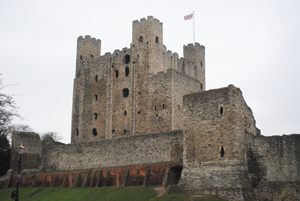
Foremost among its attractions are the Norman castle and cathedral. Rochester Castle has its origins in a wooden castle built soon after the Battle of Hastings in 1066 with the stone defences following soon after.

The tallest Norman keep in England, from which there are spectacular views, was built around 1127 on the order of its then owner, the Archbishop of Canterbury, William de Corbeil. It was about 90 years later, in 1215, when King John laid siege to it during the rebellion of his barons, only taking the castle after a seven week siege when his sappers undermined the south-east tower of the keep (famously it was the fat of 40 pigs which stoked the fire they laid in the tunnels under the tower). The castle was repaired and continued to be used until late medieval times when it fell into disuse and while much of the keep – the highest in England – is now ruined, it remains a stirring sight.

Rochester Cathedral, meanwhile, was first built in Saxon times (there has been a bishop here since 604) although no trace remains of this above ground. The current building, rather, dates from the Norman era – it was consecrated in 1130 in a ceremony attended by King Henry I – and was extensively added to over the following centuries with the completion of the Lady Chapel in 1492 the last major work. Among the most famous bishops here were Bishop Fisher and Bishop Ridley – both of whom died for their faith.

Strolling through the cobbled streets of this historic town, about 30 to 40 minutes from London by train, you’ll also come across the Guildhall Museum, which is housed in the 17th century guildhall and features a range of displays and exhibitions on the history of the Medway including a Dickens discovery room.

Also worth seeing is Eastgate House, the model for Dickens’ Westgate House and now the location of the Swiss chalet in which he wrote, and Restoration House – created from two medieval buildings in the 16th or 17th centuries and the inspiration for Miss Havisham’s home  (see our earlier post).

One unmissable gem is the Six Poor Travellers – an atmospheric and well preserved almshouse in the High Street which dates from Elizabethan times and has an amazing backstory which you can explore as you make your way through its narrow rooms.

Part of the charm of Rochester (and for more on Rochester generally visit www.cometorochester.co.uk/visit/index.htm) lies in its close proximity to Chatham and Gillingham and here you’ll find much more to amuse and entertain including Chatham’s Historic Dockyards (see our earlier daytripper on this), Fort Amherst, Britain’s largest Napoleonic fortress, and for those who can’t get enough of Charles Dickens, Dickens World.

Just to the north of Rochester is Upnor Castle, a rare surviving Elizabethan artillery fortress built to defend the fleet at Chatham Dockyard.

Around London – Of a dramatic Boat Race; celebrating bluebells; Cockney slang; WT Stead; and, Titian’s early masterpiece…

 • Cambridge took the line honours over Oxford in this year’s Boat Race on the Thames in what has been billed as one of the most dramatic races in its 158 race history. The race was interrupted when a swimmer, described as an anti-elitist protestor, was spotted in the water and, following a restart near the Chiswick Eyot, the boat crews clashed oars and one of the Oxford crew lost his oar’s spoon. Cambridge pulled steadily ahead with Oxford an oar down and was declared the winner by four and a quarter lengths. The presentation ceremony was subsequently not held after Oxford’s bow man collapsed and was rushed to hospital where was reported to be recovering well. The win takes Cambridge’s victories to 81 compared to Oxford’s 76. For more, see http://theboatrace.org. (For more on the history of the Boat Race, see our entry from last year).

Epping Forest’s bluebells are out in force and to celebrate the City of London Corporation is holding a series of events including an art exhibition at The Temple in Wanstead Park. The exhibition, Out of the Blue, celebrates the bluebells of Chalet Wood and features a “miscellany of bluebell images, artwork, folklore and fairies”. A free event, it runs until 27th May. This Sunday the Temple will also host an art afternoon with local artist Barbara Sampson and on 29th April photographer Robert Good will hold a course on photography around the forest. Both are free events. For more details, see www.cityoflondon.gov.uk/epping.

• “Porky pies” (lies) is the most used Cockney phrase, according to a survey of Britons on their knowledge and use of Cockney. The Museum of London survey of 2,000 people, including 1,000 from London, also found that “apples and pears” (stairs) was the most well-known Cockney phrase and that while a majority of people knew what common phrases like “brown bread” meant (in this case dead), only small percentages of people used them. And while 63 per cent of respondents believed Cockney slang was crucial to London’s identity, 40 per cent were convinced it is dying out and 33 per cent were sad at its passing. Strictly speaking, a ‘Cockney’ is someone who was born within the sound of bow bells at the church of St Mary-le-Bow in Cheapside, but according to Alex Werner, head of history collections at the museum, “people from all corners of London identify themselves as being Cockney”. He said that while for many people “Cockney rhyming slang is intrinsic to the identity of London”, the research the Cockney dialect “may not be enjoying the same level of popularity”. The research found that among the least known Cockney rhyming slang phrases included “white mice” (ice), “donkey’s ears” (years), and “loop de loop” (soup). For more from the museum, see www.museumoflondon.org.uk.

• The life of influential newspaper editor and Titanic victim, William Stead, will be celebrated at a two day conference next week. Hosted by the British Library, in association with Birkbeck College and the University of Birmingham, the conference will feature 40 speakers from around the world. Stead, who was editor of The Pall Mall Gazette, was a controversial figure who is credited with being one of the inventors of the modern tabloid. He died on the Titanic‘s maiden voyage – the 100th anniversary of which is being marked this month. W.T. Stead: A Centenary Conference for a Newspaper Revolutionary takes place from 16th to 17th April, 2012. Tickets (£45 for one day or £85 for two days) can be booked by visiting the box office in the St Pancras building or phoning 01937 546546. The programme for the conference can be found at https://sites.google.com/site/stead2012/.

• On Now: Titian’s First Masterpiece: The Flight into Egypt. The National Gallery is hosting a new exhibition focused on the then young artist’s creation of the magnificent painting The Flight into Egypt in the 16th century. The artwork, lent to the National Gallery by the Hermitage Museum, St Petersburg, has recently been restored and the exhibition represents the first time the painting has been seen outside Russia since 1768 when Empress Catherine the Great purchased it in Venice. Admission is free. Runs until 19th August. For more, see www.nationalgallery.org.uk.

Celebrating Charles Dickens – 10. Four Dickens daytrips…

And so we come to the final in our series celebrating the bicentenary of the birth of author Charles Dickens. This week we thought we’d take a look at a few of the key places you can go for a daytrip from London to find more Dickens-related sites…

• Portsmouth. Dickens was born here on 7th February, 1812, and the modest home in which this took place is now the Charles Dickens Birthplace Museum (www.charlesdickensbirthplace.co.uk). The house featured three furnished rooms and an exhibition room with a display on Dickens’ connections with Portsmouth and memorabilia including the couch on which he died at Gad’s Hill Place. Fans from all over the world will be converged in Portsmouth later this year when the International Dickens Fellowship Bicentenary Conference 2012 is held over 9th to 14th August (www.dickensfellowship.org/Events/annual-conference-2012).

• Chatham and Rochester, Kent.  Dickens spent five years of his childhood (from 1817 to 1822) living in Chatham and as a result it and the neighbouring Medway town of Rochester helped to inspire some of the characters and places in some of his most famous works. Restoration House in Rochester, for example, is believed to have been the inspiration for Satis House, where Miss Havisham lived in Great Expectations while Eastgate House (pictured) features as Westgate in both The Pickwick Papers and as the Nun’s House in The Mystery of Edwin Drood. Until 2004, the house served as the Charles Dickens Centre and interestingly, the Swiss chalet in which Dickens wrote was moved here in the 1960s from Gad’s Hill Place – it can be seen over the fence. The area has celebrated its connections with Dickens with an annual festival every year since 1978 – this year’s takes place on the 8th, 9th and 10th June. See www.medway.gov.uk/leisureandculture/events/dickensfestival.aspx for more. (Late addition: We neglected to mention Dickens World located at Chatham, an interactive experience which recreates nineteenth century England – you can find more about it here www.dickensworld.co.uk).

• Broadstairs, Kent. Dickens first came to stay at this seaside resort in 1837 when he was 25-years-old and already had a reputation on the rise. He repeatedly returned over the next couple of decades. The Dickens House Museum (www.dickensfellowship.org/branches/broadstairs) was once the home of Miss Mary Pearson Strong on whom much of the character of Miss Betsey Trotwood in David Copperfield is believed to be based. It features a range of Dickens-related artefacts, including letters he wrote from or about Broadstairs. The Broadstairs Dickens Festival runs from 16th to 22nd June.

• Gad’s Hill Place, Higham, Kent. Dickens died here in 1870 after spending the last 13 years of his life living at the property. It’s now a school (www.gadshill.org) but the ground floor will be open to the public this summer, from 25th July to 19th August, for pre-booked tours of reception rooms and the study where he wrote Great ExpectationsOur Mutual FriendA Tale of Two Cities and the unfinished novel Edwin Drood. For more information on the tours, see www.dickensmuseum.com/news/gads-hill-place-to-open-to-public/.

This was the last in our series on Charles Dickens – next week we start a new series in honor of Queen Elizabeth II’s Diamond Jubilee. For more events surrounding the Dickens celebrations both in London and elsewhere, see www.dickens2012.org.

Around London – At home in World War II; Hogwarts comes to London; Kew Steam Bridge Museum to be upgraded; and, V&A looks at British design…

• A new exhibition in which visitors can experience life during the Second World War through the eyes of a London family opens today at the Imperial War Museum in London. A Family in Wartime explores the lives of William and Alice Allpress and their 10 children at their South London home during the war as the face events such as the Blitz and the evacuation of the city. The display includes firsthand audio accounts from members of the family, photographs and a detailed model of the family home at 69 Priory Grove. Two of the family’s sons served in the military during the war while three of the daughters joined the Women’s Voluntary Service. Artefacts on display include many everyday household items such as cookery books which gave advice on cooking with limited rations and stirrup pumps which people were encouraged to wear in case of incendiary bombs as well as newspaper clippings, propaganda posters and film footage. There will also be artworks depicting wartime living by artists including Henry Moore, Wilfred Haines and Leila Faithful. Admission is free. For more, see www.iwm.org.uk/visits/iwm-london.

Hogwarts has come to London’s north with the opening of the new Warner Bros Studio Tour in Leavesden. The tour, which was launched this week, features sets, costumes and pros from the Harry Potter series of films and reveals how special effects and animatronics were used in the movies. Highlights include the chance to visit Hogwarts Great Hall, Dumbledore’s office and Diagon Alley as well as see Harry’s Nimbus 2000, the flying Ford Anglia owned by the Weasleys and Hagrid’s motorcycle. For more information, see www.wbstudiotour.co.uk.

The Kew Bridge Steam Museum in London’s west has been awarded a £1.84 million Heritage Lottery Fund grant for a restoration project that will see new visitor facilities and more modern displays as well as new outdoor water-based actvities. Project Aquarius will also see outstanding repairs to the Grade I and Grade II listed buildings – described as the most important historic site of the water supply industry in the UK – completed. The museum, which opened 37 years ago, features four giant working Cornish steam pumping engines as part of its displays telling the story of London’s water supply and attracts some 15,000 visitors a year. For more, see www.kbsm.org.

• On Now: British Design 1948-2012: Innovation in the Modern Age. The V&A’s major spring exhibition, this is a showcase of British design from the 1948 ‘Austerity Olympics’ to present day and features more than 300 objects – from the 1959 Morris Mini Minor to a model of the recently completed Zaha Hadid-designed London Aquatics Centre. Highlighting significant moments in British design, the exhibition looks not only at 60 years worth of fashion, furniture, fine art, graphic design, photography, ceramics, architecture and industrial design but also investigates how the UK continues to nuture artistic talent and the role British design and manufacturing plays around the world. Admission charge applies. Runs until 12th August. For more see www.vam.ac.uk.

We’re taking a break over Easter – posts will resume next Tuesday. In the meantime have a great Easter!

Celebrating Charles Dickens – 9. Dickens’ literary connections, part 2…

In which we continue our look at some of London’s connections with Dickens’ writings…

• ‘Oliver Twist’ workhouse, Cleveland Street. The building, recently heritage listed following a campaign to save it, is said to have served as the model for the workhouse in Oliver Twist and was apparently the only building of its kind still in operation when Dickens wrote the book in the 1830s. Dickens had lived as a teenager nearby in a house in Cleveland Street and was living less than a mile away in Doughty Street (now the Charles Dickens Museum) when he wrote Oliver Twist. Thanks to Ruth Richardson – author of Dickens and the Workhouse: Oliver Twist and the London Poor – for mentioning this after last week’s post.

• Clerkenwell Green. It is here that Mr Brownlow first comes into contact with Oliver Twist and, mistakenly suspecting him of stealing from him, chases him through the surrounding streets. Interestingly, the grass (which you would expect when talking about a green) has been gone for more than 300 years – so it wasn’t here in Dickens’ time either.

• Barnard’s Inn, Fetter Lane. It was here, at one of London’s Inns of Court, that Pip and Herbert Pocket had chambers in Great Expectations. Barnard’s Inn, now the home of Gresham College, is only one of a number of the Inns of Court with which Dickens and his books had associations – the author lived for a time at Furnival’s Inn while Lincoln’s Inn (off Chancery Lane) features in Bleak House and the medieval Staple Inn on High Holborn makes an appearance in his unfinished novel, The Mystery of Edwin Drood. And, as mentioned last week, Middle Temple also features in his books.

• ‘Dickens House’, Took’s Court. Renamed Cook’s Court in Bleak House, the house – located in a court between Chancery and Fetter Lane – was where the law stationer Mr Snagsby lived and worked in the book. It’s now occupied by music promoter and impresario Raymond Gubbay.

• London Bridge. The bridge, a new version of which had opened in 1831 (it has since been replaced), featured in many of Dickens’ writings including Martin Chuzzlewit, David Copperfield and Great Expectations. Other bridges also featured including Southwark Bridge (Little Dorrit) and Blackfriars Bridge (Barnaby Rudge) and as well as Eel Pie Island, south-west along the Thames River at Twickenham, which is mentioned in Nicholas Nickleby.

We’ve only included a brief sample of the many locations in London related in some way to Dickens’ literary works. Aside from those books we mentioned last week, you might also want to take a look at Richard Jones’ Walking Dickensian London,  Lee Jackson’s Walking Dickens’ London or, of course, Claire Tomalin’s recent biography, Charles Dickens: A Life.

Famous Londoners – Jack Ketch

A 17th century public executioner famed for his botched executions, Jack Ketch looms as an infamous figure in British history and a byword for brutality and executioners in general.

Ketch’s origins are unknown (he’s also known as John Catch) but he is believed to have received his appointment as a public hangman sometime in the early to mid 1660s – the first recorded mention of him in that role, in a pamphlet celebrating his handiwork, dates from 1678. Such was his self-importance that he apparently adopted the title Esquire and apparently asked for his letters to be addressed to Dr John Ketch.

Among those who died at his hand were those accused of involvement in the Popish Plot against the Crown – a Catholic conspiracy to assassinate King Charles II which was all apparently fabricated by Titus Oates. These included William Staley and Edward Coleman both of whom were hung, drawn and quartered in 1678 (Ketch was also charged with whipping Oates following his perjury conviction).

But Ketch’s most infamous executions, the only two beheadings he is known to have performed, became notorious because of the botched manner in which they were carried out.

It was reported that it took Ketch three blows to strike off the head of William, Lord Russell, when he was executed for treason on 21st July, 1683 (he had opposed the succession of James II and was accused of involvement in the Rye House Plot), although Ketch apparently denied suggestions he had turned up drunk and blamed Lord Russell for flinching.

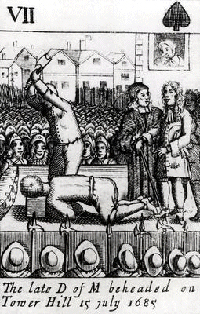
The beheading of James Scott, the Duke of Monmouth (and illegitimate son of King Charles II), on 15th July, 1685 (pictured above in a print from the time), was apparently even worse – it took Ketch five blows to take off his head and he apparently finished the job with a knife after having almost given up halfway through. Monmouth had been captured following the Battle of Sedgemoor in July 1685 in which he led an army having declared himself king (more on that another time).

Ketch fell out of favor with the authorities later that year and was briefly gaoled in Bridewell prison. He was reinstated but his return to the job of public executioner was only short-lived for he died in 1686 and is believed to have been buried in St James’ in Clerkenwell on 29th November, 1686.

He was survived by his wife Katherine, who apparently stood by her man despite the public feeling against him, and is it generally assumed a girl Susanna who was baptised at the church in Clerkenwell in 1668 – some 18 years before his death – was his daughter.

Following his death, Ketch’s name was adopted by subsequent public hangmen – he even appeared as an ongoing character in Punch and Judy shows.

For more on Ketch, see Tim Wales’ article Jack Ketch in the Oxford Dictionary of National Biography (a subscription is required for access).

PICTURE: Wikipedia.

Where is it? #23…

The latest in the series in which we ask you to identify where in London this picture was taken and what it’s of. If you think you can identify this picture, leave a comment below. We’ll reveal the answer early next week. Good luck!

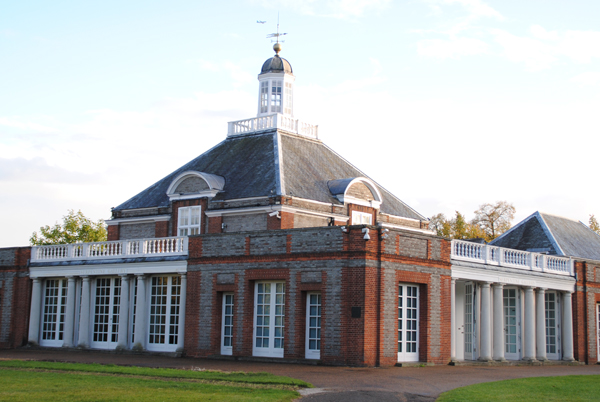
Well done to Jameson Tucker and Sean Dennis, both of whom identified this correctly as the Serpentine Gallery in Kensington Gardens. The gallery, which features modern and contemporary art, was created in 1970 and is housed in a tea pavilion which dates from the 1930s. Every summer since the year 2000, the Serpentine – named for the body of water which, strictly speaking, just runs through Hyde Park (although the section in Kensington Gardens is also often referred to in the same way) – has had a different temporary pavilion, designed by a leading architect, set up outside.

The Serpentine Gallery is to be expanded this year with the creation of the Serpentine Sackler Gallery in The Magazine building in the gardens. Located only a short distance from the existing gallery, the new premises is being designed by Pritzker Prize-winning architect Zaha Hadid and is named after Dr Mortimer and Theresa Sackler, whose foundation made the project possible through the largest single donation ever received by the Serpentine Gallery.

WHERE: Kensington Gardens; WHEN: Daily 10am to 6pm; COST: Free; WEBSITE: www.serpentinegallery.org.

Lost London: Gates Special – The Stone Gate, London Bridge

And so we come to the last entry in our special series on Lost London looking at some of London’s gates – this time the only gate located on the south side of the Thames.

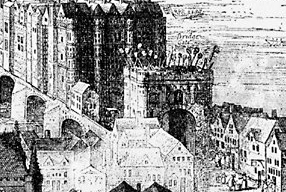
Located at the south end of London Bridge, this gate guarded the bridge entry in medieval times. When the first gate was built here remains something of a mystery but it is known that the first stone bridge, built in the late 1100s under the direction of priest Peter de Colechurch (it opened in 1209), certainly included a gatehouse known as the Stone Gateway (referred to by some as Bridge Gate) at the southern end.

The practice of parboiling the heads of traitors and the dipping them in tar before putting them on pikes above the gate apparently dates from 1305 when Scottish rebel William Wallace’s head was displayed there. The practice apparently continued until 1678 when goldsmith William Stayley’s head was the last to be displayed there.

As we mentioned in our earlier post on London Bridge, famous heads to adorn the gateway over the years included Peasant’s Revolt leader Wat Tyler in 1381, rebel Jack Cade in 1450, the former chancellor Sir Thomas More and Bishop John Fisher in 1535, Thomas Cromwell in 1540 and Guy Fawkes in 1606.

Pictured above is an enlarged detail of a 1616 print showing London Bridge by Claes Van Visscher – the heads are clearly visible on top. One German visitor famously counted 30 heads on top when he visited in 1598.

The gate (and it should be mentioned there was also another gate on the bridge with a drawbridge which was replaced by Nonsuch House in 1577) was presumably removed sometime after 1756 when an Act of Parliament authorised the removal of shops and houses on the bridge.

Of course, there are many other gates in London – some of them smaller gates in the city walls – which have been lost to time. We’ll be looking at some more of these in future posts…

PICTURE: Wikipedia

Around London – Crown Jewels polished for Diamond Jubilee; Diana’s dresses at Kensington Palace; a plaque for Ziggy Stardust; and At Home with the World…

• A revamped Crown Jewels display opens today at the Tower of London to mark the Diamond Jubilee of Queen Elizabeth II. The new display features graphics, music and newly restored film footage and will focus on the coronation ceremony as its central theme, exploring how the regalia are used in the ceremony. The regalia – which includes some of the most extraordinary diamonds in the world such as the Star of Africa and Koh-i-Nur – is being displayed in the order in which it is used at the coronation ceremony. The Crown Jewels have been on show to the public at the Tower of London since at least 1661 after they were remade for King Charles II’s coronation. The previous collection had been largely destroyed in the Civil War although some pieces survived including a gilt silver spoon probably made for King Henry II or King Richard I (the “Lionheart”). For more information, see www.hrp.org.uk/TowerOfLondon/.

Five dresses worn by Diana, Princess of Wales, have gone on display at Kensington Palace  which re-opened to the public this week following a £12 million overhaul. The five dresses include a black silk taffeta gown (designed by Emanuel) which Diana wore to a fundraising event at the Goldsmith’s Hall in 1981 – her first official engagement with Prince Charles as well as a formal dinner dress of ivory silk (Catherine Walker) created for a State Banquet for the King and Queen of Malaysia in 1993 and a black ribbed silk shift evening dress (Gianni Versace) worn to the London premiere of Apollo 13 in Hammersmith in 1995. For more on the revamp of the palace see our earlier post. Or visit www.hrp.org.uk/KensingtonPalace/.

• A plaque commemorating the site where the iconic image for the cover of David Bowie’s 1972 album The Rise and Fall of Ziggy Stardust and the Spiders of Mars was photographed has been unveiled in the West End. The plaque at the somewhat innocuous site at 23 Heddon Street, just off Regent Street, was installed by the Crown Estate and unveiled this week by Gary Kemp of Spandau Ballet. The image for the album cover was shot by the late photographer Brian Ward who managed to persuade Bowie to step outside the ‘studio’ space he had rented upstairs despite the fact it was a cold, wet January night.

• On Now: At Home with the World. This exhibition at the Geoffrye Museum explores the cosmopolitan nature of London’s homes over the past 400 years and looks at how diverse cultures have helped shaped the homes – covering everything from Chinese porcelain and the tea craze of the 1700s to the use of Islamic and Indian patterns in the 1800s, the popularity of Scandinavian and American design in the 1900s and the globalism of today. The period rooms on show at the museum have been reinterpreted to highlight the international influences. This is one of a series of Stories of the World: London exhibitions taking place across the city which are exploring four aspects of life – home, identity, journeys and place – as part of the London 2012 Cultural Olympiad program. Runs until 9th September. Entry is free. For more, see www.geffrye-museum.org.uk.

Celebrating Charles Dickens – 8. Dickens’ literary connections, part 1…

London is redolent with sites which appeared in the books of Charles Dickens and, having had a look at his life, it’s time we turn our attention to some of the sites relevant to his writing. For the next two weeks, we’re looking at just a few of the many, many sites which feature in his novels. So, here’s seven places to get us going…

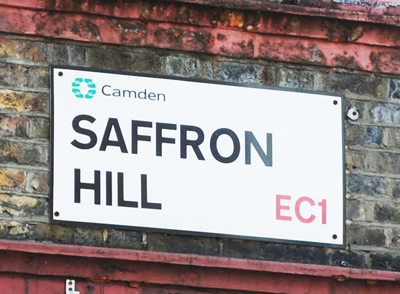
• Saffron Hill, Clerkenwell. Once a notorious slum akin to St Giles (see last week’s entry) and the city’s Italian Quarter, Saffron Hill is where Fagin and his gang of thieves operate in Oliver Twist and have their den.

• Chancery Lane, Holborn. Much of the novel Bleak House is set around this narrow street between High Holborn and Fleet Street – Tom Jarndyce kills himself in a coffee shop here in the novel and Lincoln’s Inn Hall – formerly home of the High Court of Chancery – also features.

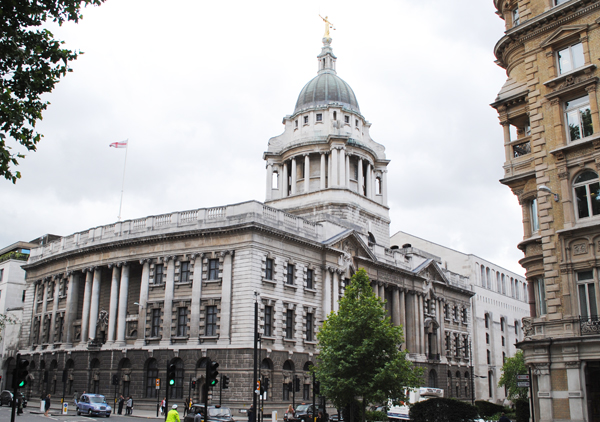
• The Old Bailey. Some have suggested Dickens worked here as a court reporter although there is no compelling evidence he did so. But the the Old Bailey (the current building dates from the early 20th century, well after Dickens’ death) and Newgate Prison certainly featured in his books – it is here that Fagin is eventually hung in Oliver Twist.

• Child & Co’s Bank, Fleet Street. While the present building dates from 1878, Dickens is believed to have used the bank as the model for Tellson’s Bank in A Tale of Two Cities.

• St Dunstan-in-the-West, Fleet Street. In David Copperfield, David and his aunt, Betsy Trotwood, make a special trip to see the giants Gog and Magog strike the church bells. It also features in Barnaby Rudge and Dickens dedicated his Christmas story, The Chimes, to the church.

• Garden Court and Fountain Court (pictured), Middle Temple. Garden Court is where Pip lived in Great Expectations and where Abel Magwitch turned up to reveal himself as Pip’s benefactor. Fountain Court features in Martin Chuzzlewit as the site for the romance of Ruth Pinch and John Westlock.

• Golden Square, Soho. Mentioned in Nicholas Nickleby – Nicholas’ uncle, Ralph Nickleby, was thought to live in a previous building at number seven.

There’s some great books about London sites which appear in Dickens’ books – among them are Ed Glinert’s Literary London: A Street by Street Exploration of the Capital’s Literary Heritage and Michael Paterson’s Inside Dickens’ London as well as Paul Kenneth Garner’s 
A Walk Through Charles Dickens’ London.

LondonLife – The Old Bailey and the notorious case of Dr Crippen…

Image

As well as being relevant to our recent focus on author Charles Dickens (as well as featuring in his works, some suggest he worked here as a court reporter), the Old Bailey (home of the Central Criminal Court) has been in the news recently for its role in the conviction of the  infamous murderer Dr Hawley Crippen. An American, Dr Crippen was tried and found guilty at the court of poisoning his first wife Cora and then of cutting her up (he was found to have hidden the body parts in the cellar of their home in Hilldrop Crescent, Holloway). He was hanged in 1910, having been arrested while fleeing on a ship to Canada with his mistress Ethel Le Neve. Now reportedly come plans to hold a posthumous retrial of the case in front of a judge at the Islington Museum. The event, which will be held later this year, is being organised by Archway-based human rights solicitor Greg Foxsmith and will see John Cooper, QC, defending Dr Crippen. The move comes follows an earlier investigation by US scientists who concluded from DNA evidence that the victim may have in fact been male. For a great read on the case of Dr Crippen – and the important role the new invention of the wireless telegraph played in his capture – have a look at Erik Larsen’s Thunderstruck.

What’s in a name?…St John’s Wood

This well-to-do area in London’s north-west, just outside Regent’s Park, takes its name from the historic ownership of land here by the Order of St John of Jerusalem (also known as the Knights Hospitaller).

The land had previously been part of the Great Forest of Middlesex. The Order of St John of Jerusalem, which since 1140s had its English headquarters in a Clerkenwell priory where St John’s Gate stands (this now houses the Museum of the Order of St John – see our previous entry here), took over ownership of land in the early 1300s after the previous owners, the Knights Templar, fell into disgrace.

Following the Dissolution, it became Crown land and remained so until 1688 after which it passed into the hands of private families, notably the Eyre family who owned much of the area.

It remained relatively undeveloped until the early 19th century when, following the introduction of semi-detached villas on planned estates, it was marketed as a residential alternative for London’s middle classes, away from the smog and congestion of central London.

It became favored by the bohemian set and residents included creative types like artists and authors as well as scientists and traditional craftsmen (apparently in the late 19th century it was also known for its upmarket brothels).

Rebuilt with swanky apartment complexes in the early twentieth century, these days it remains a leafy enclave for the wealthy. Many of the houses which have survived are heritage listed.

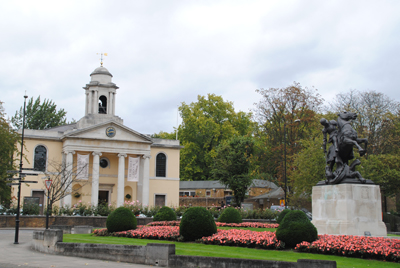
Landmarks include St John’s Church (pictured above, this was consecrated in 1814) and the St John’s Wood Barracks and a Riding School (this was completed in 1825 and is the oldest building still on the site) which is now home to the King’s Troop Royal Horse Artillery which carries out mounted ceremonial artillery duties such as firing royal salutes for the State Opening of Parliament, royal birthdays and state visits.

St John’s Wood is also home to Abbey Road Studios (home of the Beatles and that famous zebra crossing), Lord’s Cricket Ground (officially the home of the Marylebone Cricket Club which was moved here in 1814, the same year the church was consecrated) and the Central London Mosque located on the edge of Regent’s Park.

For more on St John’s Wood, take a look at the website of The St John’s Wood Society.

Where is it? #22

The latest in the series in which we ask you to identify where in London this picture was taken and what it’s of. If you think you can identify this picture, leave a comment below. We’ll reveal the answer early next week. Good luck!

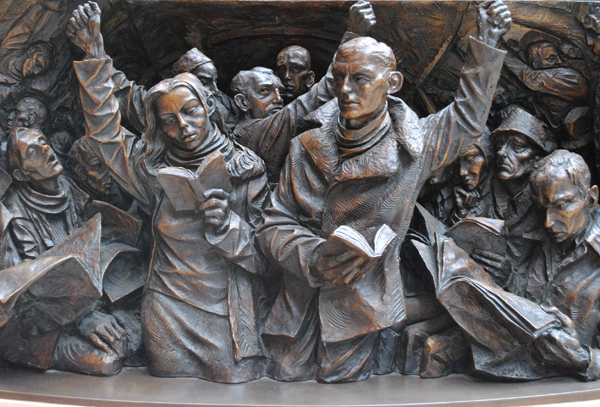
Congrats to Parktown – this image of people on the Tube is part of a 12 metre long frieze which runs around the base of Paul Day‘s monumental statue, The Meeting Place, which stands on the upper concourse in St Pancras International Station.

The five ton statue above – which itself stands under the station’s clock – features a 30 foot (nine metre) tall bronze couple embracing and was installed before the station’s reopening in 2007.

The frieze – the images of which depict scenes from the history of the Tube and railways –  was added in 2008. There was initially some controversy over some of the images in the frieze panels and one which depicted a grim reaper driving a train was replaced.

Treasures of London – The Banqueting House…

While we’ve looked at some of the history of the Banqueting House during last year’s special on King James I’s London, we thought we’d take a more in-depth look as part of our Treasures of London series…
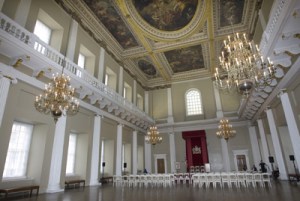
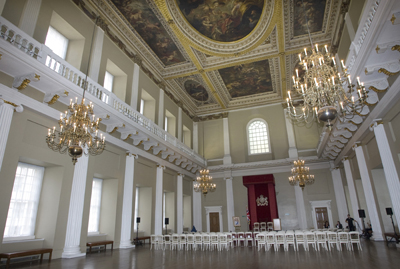
A perfect double cube with a sumptuous painted ceiling, this early 17th century building is the only remaining complete structure from the Palace of Whitehall which was destroyed by fire in 1698.

The building replaced an earlier banqueting hall built on the orders of Queen Elizabeth I and another, shorter-lived hall, built by King James I, which was destroyed by fire in 1619.

Following its destruction, King James had Inigo Jones design a new hall to provide, as the previous hall had, a location for state occasions, plays and masques – something of a cross between an organised dance, an amateur theatrical performance and just a chance to dress up.

Jones, who partnered with Ben Jonson to produce masques, designed the hall – which has a length double the width – with these performances specifically in mind. The first one – Jones and Jonson’s Masque of Augurs – was performed on Twelfth Night, 1622, even before the building was completed (the last masque was performed here, incidentally, in 1635, after which, thanks they were moved to a purpose built structure nearby, ostensibly to save the newly installed paintings from being damaged by the smoke of torches – see below).

The incredible paintings on the ceilings, which celebrate the reign of King James I and will be the subject of their own Treasures of London article at a later date, were installed by March 1636. Produced by Flemish artist Sir Peter Paul Rubens, they had been commissioned by King Charles I, King James’ son, in commemoration of his father. Ironically, it was outside the building where the monarchy was so celebrated that King Charles I was beheaded in 1649 (this is marked in a ceremony held at the Banqueting House on 30th January each year).

Following the king’s execution, Whitehall Palace wasn’t used for several years until Lord Protector Oliver Cromwell took up residence there in 1654, using the Banqueting House as a hall if audience. It stood empty after Cromwell’s death in 1658 until the Restoration in 1660 when King Charles II again used it as a grand ceremonial hall for receiving foreign embassies and conducting court ceremonies (these including the ancient custom of what is known as ‘Touching for the King’s Evil’ to cure those afflicted with the disease of scrofula as well as the washing of the feet of the poor by the sovereign on Maundy Thursday.)

King James II was the last king to live at Whitehall Palace and during his reign, from 1685-88, it was used as a royal storehouse. But it was revived for formal use following his reign – it was here that King William III and Queen Mary II were officially offered the crown on 13th February, 1689.

During their reign, the court’s focus shifted to Kensington but the Banqueting House was used for Queen Mary to lay in state after her death in 1694.

Following the destruction of the remainder of Whitehall Palace in 1698 – the origins of this fire are apparently owed to a maid who had put some linen by a charcoal fire to dry – the Banqueting Hall was used briefly as a Chapel Royal and, following a renovation in the late 1700s, it was used for concerts and, from 1808, as a place of worship for the Horse Guards.

Further renovation works followed and in 1837, it was re-opened as a Chapel Royal and used as such until 1890 when this practice was formally discontinued. In 1893, Queen Victoria gave the Royal United Services Institute the use of the building as a museum – among the things displayed there were the skeleton of Napoleon’s horse, Marengo. In 1962, the exhibits were dispersed and the Banqueting House today is used for a range of royal, corporate and social events.

There is an undercroft underneath, designed as a place where King James I could enjoy drinking with his friends. It was later used for storage.

WHERE: Corner of Whitehall and Horse Guards Avenue (nearest Tube stations are Westminster and Embankment); WHEN: Monday to Saturday 10am to 5pm; COST: £5 adults/£4 concessions/children under 16 free (Historic Royal Palaces members free); WEBSITE: www.hrp.org.uk/BanquetingHouse/.

PICTURE: Courtesy of Historic Royal Palaces/newsteam.co.uk